The effects of CSR involvement on
employees in the context of disaster relief:
The case of EDP´s response to wildfires in Portugal
[2017]
Maria Teresa Cardigos
Dissertation written under the supervision of Professor Sérgio Moreira
Dissertation submitted in partial fulfilment of requirements for the MSc in
Business, at the Universidade Católica Portuguesa, January 2019
2 Title: The effects of CSR involvement on employees in the context of disaster relief: the case
of EDP response initiative in the sequence of the wildfire Author: Maria Teresa Cardigos
Abstract
The purpose of the current research is to study the impact on employees of corporate volunteering initiatives, in the context of a natural catastrophe aftermath. Following on research showing that the involvement on Corporate Social Responsibility (CSR) activities influences positively employee Job Satisfaction. It will also be explored employee’s perceptions about the employer’s CSR engagement and effort. It was developed a conceptual model for the effects of involvement on CSR initiatives. More specifically, the research’s aim was to examine a conceptual model depicting employees’ motivations to engage in the CSR initiative as volunteers, the participation effects on employee job satisfaction and well-being, as well as the employees’ perceptions of firm’s CSR. To study this conceptual model, we considered the case study of EDP emergency volunteering response in the sequence of the wildfire registered in Portugal in June 2017. The results of the research revealed that when employees perceive meaningfulness within the volunteering experience, there is an increase on satisfaction at work. Additionally, employees who felt that they belonged to an intrinsically CSR committed company remained more satisfied with their job and reported higher levels of well-being. Taken together these results indicated evidences of positive contributes of CSR emergency volunteering initiatives proposed by the company at an individual level and at an organizational level.
Keywords: CSR, CSR engagement, volunteerism, disaster relief, job satisfaction, employee well-being
3
Resumo
O objetivo da presente dissertação é estudar o impacto de ações de voluntariado corporativo nos trabalhadores, no contexto de estado de emergência pós catástrofe natural. Neste sentido, o estudo procura demonstrar a relação entre o envolvimento em atividades de Responsabilidade Social Corporativa e a satisfação no trabalho. Seguidamente, recorreu-se à análise da perceção dos trabalhadores sobre os motivos que levam a empresa a investir em iniciativas de responsabilidade social. De um modo particular, o estudo procura analisar o modelo conceptual representando as motivações dos trabalhadores que levaram à participação das iniciativas como voluntários, os efeitos da participação no bem-estar e satisfação do trabalhador, bem como a perceção do envolvimento da empresa. O Grupo EDP, Energias de Portugal, e a sua ação interventiva na sequência dos incêndios em Portugal no ano 2017, serviu como base para este estudo. Os resultados revelaram que quando as experiências de voluntariado em contexto de crise são avaliadas como significativas e individualmente gratificantes, dá-se um aumento no nível de satisfação no trabalho. Adicionalmente, foi possível verificar que existe um efeito positivo ao nível da satisfação bem como no bem-estar individual, nos trabalhadores que acreditam pertencer a uma empresa intrinsecamente consciente socialmente, que procura genuinamente estar comprometida com o bem comum. Em suma, os resultados revelaram evidencias do contributo de iniciativas de voluntariado corporativo a nível individual bem como a nível organizacional.
Palavras-chave: Responsabilidade Social, Voluntariado corporativo, contexto de crise, necessidades da sociedade, satisfação do trabalhador, bem-estar do trabalhador.
4
Acknowledgments
I would like to thank my supervisor professor Sérgio Moreira for all his support and knowledge, it would have been unquestionably harder to structure and to complete the current dissertation without him.
Secondly, I would like to thank EDP, particularly the Corporate volunteering Department for the possibility given to develop this study with them. With special gratitude for the support and dedication of Rita Sacramento Monteiro. Without her enthusiasm, expertise and help this paper would have not been possible to execute
Thirdly, I am deeply thankful to my family, in particular to my parents who were absolutely supportive and for their unconditionally love. They were always there throughout the master’s program, in the hard times to make me believe it was possible to overcome any obstacle and in also there to celebrate any of my successes, which I will also deem theirs. To my dad who always believes in me and who is an inspiration. To my mother, my safety harbor and a constant motivation.
Lastly, I am really grateful to all my close friends, their friendship was decisive to overcome the ups and downs of life. In particularly, a special thanks to Manel for the enormous help throughout the dissertation, support, and dedication.
5
Table of Contents
Abstract ... 2 Resumo ... 3 Acknowledgments ... 4 1. Introduction ... 8 2. Literature Review ... 102.1 Corporate Social Responsibility______________________________________________ 10 2.1.1 CSR internal and external initiatives ... 11
2.1.2. Motivations and outcomes of CSR engagement ... 12
2.2 Employee and CSR ________________________________________________________ 14 2.2.1. The importance of CSR for employees ... 14
2.2.3 CSR and employee job satisfaction. ... 16
2.2.4 Employee volunteering ... 18
2.3 Importance of addressing community needs ___________________________________ 21 2.3.1 Disaster relief: Opportunities and challenges for CSR ... 22
2.4. Portugal wildfire catastrophe and EDP disater relief response initiative ___________ 24 2.4.1 EDP Group and response initiative ... 25
3. Hypotheses development and Conceptual Framework ... 26
3.1. Effects of CSR Participation on Job Satisfaction and Well-being _________________ 26 3.2. Moderation of Behavioural Motivation _______________________________________ 26 3.3. Effects of CSR induced attributions __________________________________________ 27 3.4. The relationship between Job Satisfaction and Employee Well-Being _____________ 28 4. Research Methods ... 29
4.1 Study I: Interviews ________________________________________________________ 30 4.1.1. Method ... 30
4.1.2 Analysis ... 30
4.1.3 Results and Discussions ... 32
4.2. Study II: Survey __________________________________________________________ 33 4.2.1. Method ... 33
6
4.2.2 Data Analysis ... 39
4.2.3 Discussion of Results ... 45
5. Conclusions ... 47
6. Limitations and Future Research ... 49
7. References ... 51
Appendix Index ... 61
Appendix I - Wildfires in Portugal, 2017 _________________________________________ 62 Appendix II – EDP Group _____________________________________________________ 63 Appendix III - Script of the interview ____________________________________________ 67 Appendix IV - Thematic Analysis _______________________________________________ 69 Appendix V – Variable Dictionary ______________________________________________ 75 Appendix VI - Survey template ________________________________________________ 81 Appendix VII - Quantitative analysis ____________________________________________ 87
7
List of Acronyms
CSR: Corporate Social Responsibility EDP: Energias de Portugal, SA. JS: Job Satisfaction
OJS: Overall Job Satisfaction IJS: Intrinsic Job Satisfaction
RVI: Response volunteering initiative MP: Meaningful Participation
BM: Behavioral Motivation SD: Standard deviation
8
1. Introduction
Over the past years, the field of Corporate Social Responsibility (CSR) became a crucial topic on the Corporate Agenda. More than ever, organizations are pressured to strategically direct their value creation in two directions: economic and social (Aguinis & Glavas, 2012; Lindgreen & Swaen, 2010). Organizations are a constituent part of society thus, as a major commitment, business leaders are expected to redirect them, not only focusing on direct stakeholders (Clarkson,1995), but also on society as a whole. More than contributing for a healthier and balanced society, companies are convened for the imperative mission of integrating social demands and the needs of the community where they operate (Sethi, 1975). A highly important instance of replying to social needs is the case of a response to major crisis as in natural disasters, when the community welfare is in risk.
Over the last two decades, Portugal has suffered an increase of wildfire acute events which had significant economic, social and environmental repercussions (Oliveira et al., 2017). According to the European Commission, Portugal is one of the three countries with the highest level of wild fire risk in Europe. This level has been increasing over the last two decades and particularly in recent years. (Scotto et al., 2014)
In this context, the aim of this dissertation project is to study corporate response initiatives in aftermath of disaster relief. In particular, the effects of corporate response programs that promote employee volunteerism, acknowledged today as a key component of firm’s CSR strategy. (Lindgreen & Swaen, 2010; Rodell, 2013)
The study is focused on the specific case of EDP, a global utility group, and its volunteering response strategy after a major wildfire in 2017. This wildfire deflagrated in Leiria, in the center of Portugal. Considered the most violent fire season ever registered, the number of casualties rose to 64, and more than 200 citizens were injured, with over 46 thousand hectares burned. EDP was the target considered to conduct the study due to its integrated response contribution, which involved employee activation strategies in order to mitigate the severe fire consequences. EDP is known for its cohesive business models based on superior quality regarding social environment impact and also characterized by its commitment to employee welfare and skills development. The key question of the research is if the participation in this volunteering project had an impact on employees, specifically, on employees’ well-being and satisfaction.
9 In addition, this research seeks to understand employee’s perceptions over firm CSR engagement and consequential effects on the before mentioned critical psychological states. According to scholars, the benefits and advantages of CSR engagement for firms and employees are innumerous, (Aguilera et al., 2007; Vlachos et al., 2013). For instance, external benefits as reputation, brand equity and firm profitability as a consequence of customer perceptions and loyalty, as well as internal benefits as employee motivation, employee satisfaction and increased productivity.
Despite the importance of CSR engagement, very few CSR studies were found on societal crisis response initiatives promoted by private sector organizations in Europe. This research’s aim is to fill-in this gap in the literature.
The structure of this dissertation consists in five main chapters. First, a literature review, with the academic background for CSR, employee Job Satisfaction, employee volunteerism and disaster relief context as an opportunity for CSR. Second, the qualitative study, consisting in 10 interviews with participants in the wildfire’s relief response. Third, the quantitative study which was based on questionnaires performed by EDP employees who participated in the Response Volunteering Initiative (RVI) and employees who did not participate. Forth, the conclusions of the studies. Fifth, the recommendations and limitations.
10
2. Literature Review
2.1 Corporate Social Responsibility
The concept of CSR has been emerging from ideology to a major business priority of the 21st
century (Porter & Kramer, 2002). It is agreed by scholars that the concept of CSR is a decisive factor for organizations to define their fit in society (Lindgreen & Swaen, 2010). Since Friedman’s (1962) approach, who strongly believed that firms had one and only social responsibility which was “to increase profits”, the concept of CSR has moved towards a wider concept. The conviction that corporations’ responsibilities towards society should not be constricted to shareholders expectations has been discussed for years. The established consensus is that “ethical situations in business are becoming increasingly more complex, involving issues such as societal expectations, fair competition, legal protection and rights, and social responsibilities.” (Koh & Boo, 2001).
Watts and Holme (1990) define CSR as “a continuing commitment by an organization to behave ethically and contribute to economic development, while improving the quality of life of its employees, the local community and society at large.” As Carroll (1991) pyramid of responsibilities recommends, firms must fulfil their legal, ethical and economic responsibilities before assuming their role regarding corporate philanthropy. Carroll’s model had already revealed the interdependence of economic and social goals and giving special attention to corporate social performance. Few years later, emphasizing the importance of stakeholders management, Aguinis and Glavas (2012) have proposed CSR as the “context-specific organizational actions and policies that take into account stakeholders’ expectations and the triple bottom line of economic, social, and environmental performance.”
Stakeholders or people who affect or are affected by a company’s actions, objectives or policies (Garriga & Melé, 2004), can vary depending on the way firms view its obligation towards these internal and external agents (Berger et al., 2007). Based on stakeholder theory (Clarkson, 1995) companies must set their key stakeholders, within clear distinguished classes: Primary stakeholders, the agents who are significantly affected by firm’s activities and Secondary stakeholders those who can also be affected but indirectly, since they are not as likely of being impacted by companies’ activities. Therefore, identifying key stakeholders and addressing their expectations, sets the agenda of any corporate responsible business’s leader.
11 Highly-valuable outcomes have been identified when organizational managers choose to engage in “supporting and rewarding ethical behavior”(Koh & Boo, 2001), Thus, CSR discussions moves from “whether” CSR is required or not, to “how” it should be appropriated, (Du et al., 2007), to define the fitting level of CSR investment (McWilliams, 2016) as well as “where to focus.” (Porter & Kramer, 2002). The ultimate compromise within firms conduct is to integrate “business strategy as part of broader ethics”(Lindgreen & Swaen, 2010), in order to create value for stakeholder and social change (Peloza & Shang, 2011).
2.1.1 CSR internal and external initiatives
In accordance to Lindgreen and Swaen (2010, p.4) “effective CSR requires developing appropriate CSR strategies, and effective CSR activities which are those directed at improving both stakeholder relations and social welfare.” CSR effective models congregates ethical terms and strategic terms. Authors as Brammer et al. (2007) distinguish CSR activities into external and internal. Activities as cause-related marketing, environmental and wildlife protection, volunteerism and corporate philanthropy, aim to attend community and environmental needs, and so, are considered external CSR activities. Activities that are designed to respond internally to employee and institutional ethical requirements are considered as CSR internal activities. Employee training, health insurance coverage, competitive wages are examples of this type of activities. (Bauman & Skitka, 2012). Companies are sometimes able to pursue integrated activities that respond to internal and external agents, “creating win-win situations through synergetic value creation” (Lindgreen & Swaen, 2010). Employee volunteering is an example of these unified initiatives, which firms are more predisposed to enroll despite the higher levels of investment it requires (Aguinis & Glavas, 2012). The increase of external stakeholder legitimacy and reputation, as well as promoting firm’s competitive positioning in the market, are critical reasons for companies to engage in CSR (Porter & Kramer, 2002, 2006). Another example of internal initiative or employee psychological well-being as mentioned before is employee training as a way to motivate employees and a prime opportunity to increase skills and expertise. Regardless of the type of initiative, “the overall motivation is to improve employees’ execution of work from an ethical standpoint.” (Valentine & Fleischman, 2008, p.160).
12
2.1.2. Motivations and outcomes of CSR engagement
The discussion about organizational outcomes and reasons that justify the importance of CSR engagement, going from external to internal benefits (Cycyota, Ferrante, & Schroeder, 2016) has been studied and findings are innumerous. Valentine & Fleischman (2008, p.168) findings consider three main outcomes “(1) enhanced legitimacy at the institutional level, (2) improved organizational attentiveness to public responsibility, and (3) more satisfied employees at the individual level”. However, what differentiates companies from achieving these three dimensions and succeeding, is the motivation behind and, necessarily, the stakeholders perception of that motivation (Aguilera et al., 2007).
CSR Firm’s motivation
Starting with companies’ motivation, Bendapudi, Neeli, and Singh (1996) propose the distinction between egoistic and altruistic motivation. Companies’ actions that are egoistically motivated mostly focus on additional rewards and avoid punishments. In opposition, altruistic motivation seek genuinely to contribute to an external needed situation, “even at the expense of a person's own welfare.” (Bendapudi et al,1996). Different authors prefer alternatively to distinguish between extrinsic and intrinsic motivations (Keaveney & Nelson, 1993). Deci (1971) defines intrinsically motivated behaviours as “those that are engaged in for their own sake”, in other words, behaviours that are focused on the pleasure and satisfaction derived from performance. Extrinsic motivation or self-interested behaviours are seen as a means to accomplish the inherent reward as a recompense (Guay et al., 2000). Depending on the motivational origin, different CSR approaches are accepted within the CSR culture established in the company.
The transversal point is that firms are all pressured to engage in CSR by stakeholders’ expectations which in turn are “driven by instrumental, relational, and moral motives.” (Aguilera et al., 2007). Respectively, these motives are in turn driven by needs for control, belongingness and meaningful existence, which will be addressed below.
13 Perceptions over firm’s CSR engagement
Stakeholder’s perception about firms’ motivational drivers is considered a crucial factor in this context, knowing that corporate “actions that demonstrate corporate social responsibility represent a fairly rare opportunity to positively influence how individuals—especially employees and prospective employees-perceive firms.” (Bauman & Skitka, 2012, p.64). Previous studies, have showed that employees’ perspective of firm CSR identity triggers emotional, “attitudinal, and behavioral responses.”(Rupp, Ganapathi, Aguilera, & Williams, 2006, p.75). Thus, Ellen, Webb and Mohr (2006) proposed that a “brand's CSR actions can be attributed to both intrinsic and extrinsic motives” (Du et al., 2007). According to Du, Bhattacharya and Sen (2010), while implementing CSR initiatives, firms’ leaders must take into consideration stakeholders skepticism. On the one hand, firms are pressured to invest in CSR engagement initiatives however, on the other hand, if these initiatives are not communicated properly the chances of falling into stakeholder skepticism and illegitimacy is high (Vlachos et al., 2013).
If consumers’ perceptions of firms’ motivational integrity can have serious economic impacts (Bhattacharya & Sen, 2004), again, employees’ perceptions of firms prosocial actions can also have repercussions. Yet, “the employee interpretation of the motives (intrinsic or extrinsic), which they attribute to their organization’s CSR initiatives, play an important role in implementing an organization’s social program.”(Vlachos et al., 2013, p.578). The key point is that unfavorable attributions to firm’s social strategies and preconceived ideas over firm’s commitment and attitude, limit the maximization of possible business outcomes. (Du et al., 2010) According to Lindgreen & Swaen (2010) an example of this negative consequence is when firms social initiatives are perceived as an attempt to make profit, creating a “backlash against CSR communication.”
Understanding the motivation behind firm’s CSR engagement and consequentially stakeholders CSR-induced attributions is therefore a priority (Vlachos et al., 2013).
Before going further, it is relevant to clearly define the concept of attribution, which according to Martinko et al. (2014) is “the individuals’ explanations for the causes of their successes and failures”. Based on the attribution theory, the author agrees “that attributions are an integral part of the motivation process and play an important role in explaining virtually all reward-oriented behavior in organizations.” (Martinko, et al., 2006, p.148). One of the main objectives
14 of the attribution theory is to focus and understand intrapersonal achievement-oriented behavior. (Martinko, 2006). Vlachos et al. distinguishes between intrinsic CSR-induced attributions and extrinsic CSR-induced attributions which are linked respectively with intrinsic and extrinsic motives.
Du et al.(2007) define extrinsic/self-interested motives as drivers focused on the brand’s own welfare, and intrinsic/selfless motives they explain it implies acting for the purpose of doing good and meeting society needs. Nevertheless, extrinsic motives are believed as legitimate and based on the attribution theory, Vlachos et al. (2013) proposes that intrinsic and extrinsic CSR-induced attributions can both be associated to employee job satisfaction. Considering as a key stakeholder, we will now focus on employees and their link with CSR.
2.2 Employee and CSR
2.2.1. The importance of CSR for employees
We will focus on the micro level of analysis and identify why employees give importance and engage in CSR behaviours, what are the implications, and which are the implicit benefits for themselves and for organizations. Employees’ concerns are not just focused on the company’s willingness to provide them what they need, but are also concerned with the firm’s willingness to respond to others’ needs (Rupp, 2011). This means that employees, as other groups in society, expect from their companies to act in a socially responsible way. Stephen Brammer and Millington (2003) offered evidence within their study in this sense explaining that employees attribute value and recognition to entities which are willing to provide socially responsible activities.
In the light of the Multiple Needs of Organizational Justice Model (Rupp et al., 2006), intrinsic CSR-induced motives are expected to please employee’s needs, in relational and moral perspectives (Vlachos et al., 2013). For Aguilera et al., (2007) employee judgements of CSR is the bottom line of a contagious process, going from a self-focused justice judgment to generate a climate based on fairness, influencing overall organizational climate of trust. This way, as organizational climate boosts their prosocial identity, employees are likely to feel proximity with one another and aligned in being satisfied with their life and in their job (Vlachos et al., 2013).
15 From a firm’s perspective, employees attitudes and reactions, in respect to CSR performance, are critical in quite a number of aspects such as employees’ identification (Rupp et al., 2006), and organizational commitment. Social identity theory sustains the fact that, when employees associate themselves with firms that pursue socially responsible behaviours they feel better-off and demonstrate higher levels of organizational commitment (Ferrell & Maignan, 2001). Moreover, prosocial organizations allow employees to enhance their self-concept and to feel happier, which has positive implications on firm’s performance (Brammer et al. 2007). Reinforcing this last idea, (Muller & Kraussl, 2011, p.204 ) mentioned that “employee involvement may indicate an organizational environment in which employees feel comfortable revealing their prosocial identities, which reinforces those identities and strengthens their sense of organizational commitment.”.
Employee´s desire of fairness in the work environment have implications at three different levels: instrumental, relational and morality-based motivations. This fact, according to (Rupp et al., 2006) and as above mentioned, drives employees in the direction of three main motives: to be in the control of something, the need for belongingness and to give meaning to their lives. Also, Aguinis and Glavas (2012) and Rodell (2013) defend that work meaningfulness is a positive correlate with CSR involvement and practices, which means that when employees feel truthfully engaged to their organization is for the reason that they feel their job is worthy. It works as a vicious cycle, as CSR engagement leads to high levels of firm reputation, employee CSR engagement is a result of firms’ CSR engagement. With the emphasis that in this case, external stakeholder perceptions about firm philanthropy involvement is genuine which leads to favorable trust within society (Godfrey, 2005). This hypothesis is validated also by (Muller & Kraussl, 2011, p.204) who argue that “positive evaluation underlies the formation of reputational capital which enhances firm value because it fosters trust and legitimacy, thereby mitigating risk.”.
One of Clarkson’s (1995, p.110) propositions in respect to the prominent role of primary stakeholder: “The survival and continuing profitability of the corporation depend upon its ability to fulfill its economic and social purpose, which is to create and distribute wealth or value sufficient to ensure that each primary stakeholder group continues as part of the corporation's stakeholder system.”
Summarizing, CSR has an imperative role in fulfilling employee’s needs which have relevant implications on employee job satisfaction.
16
2.2.3 CSR and employee job satisfaction.
As a primary stakeholder, employees’ well-being, satisfaction, and performance are real corporate concerns and business leaders have serious obligations when it comes to responding to their needs and expectations (Clarkson, 1995).
Locke (1976) defines job satisfaction as “a pleasurable or positive emotional state resulting from the appraisal of one’s job experiences’’ and Spector (1985) refers to satisfaction in the workplace as a reactional effect to the effectiveness of performing a job.
In terms of specific job characteristics that influence employee satisfaction, according to Hackman and Oldham (1976) there are five main characteristics: skill variety, task identity, task significance, autonomy, and feedback. The model proposed by the authors explains that these characteristics are the ones that can benefit employees on meaningfulness.
How does employees CSR participation, leads to Job Satisfaction? And, how employees’ needs fulfilled and satisfied while engaging in CSR initiatives?
There are multiple findings supporting the idea that business leaders can enhance and exploit employee satisfaction, investing and boosting firm ethical and moral culture. The authors Valentine & Fleischman (2008), explain that “organizational ethics is a company’s adoption of
desired ethical standards and business practices”. Another explanatory reason for companies
to act in a more responsible way and investing actual efforts in that sense, is the evident positive impact it can convey. More or less altruistically, companies know the beneficial effect it can have on employees.
Belonging to a “fair” and social responsible company (Rupp et al., 2006) leads employees to change behaviours (Lindgreen & Swaen, 2010). These behaviours in turn, remain associated with psychological attitudes, as employee well-being and satisfaction. (Rupp et al., 2006) When it comes to decisions, employees prefer organizations which show loyalty to the community, which promote internally an ethical climate of behaviours and are in a constant mode of acting in a social conscious way (Trevino & Nelson, 2004).
This relationship between ethics and job satisfaction has been studied with some variance on the effects and implications proposed. However, few authors claim that the link between the two is subjective and not so evident (Traynor, 1999). There are even recent study results showing that “some managers are skeptical as to whether organizations can successfully
17 institutionalize ethics since people’s values are learned at home and these values might be difficult to change.” (Jose & Thibodeaux, 2013, p.139).
In this research, the relationship between CSR organizational engagement and employee job satisfaction is explained in light of two theories: the multiple needs model of organizational justice theory (Cropanzano et al, 2001; Rupp et al., 2006). The model proposed by Rupp et al., (2006) concerns individuals fulfilment with fairness, which is, as it is for Vlachos et al.(2013) a fundamental pillar of its findings. Employees are strictly focused and concerned on how organizations remain fair, which comprehends how fairly they treat internal and external parties (Ambrose, 2002). On this basis, the model divides three primary motivations: “instrumental, relational, and morality” and defines three different crucial needs: “needs for control, belongingness and meaningful existence.” (Rupp et al., 2006, p.540). In most cases these employee needs can be fulfilled throughout volunteering experiences promoted and incentivized by the organizations as will be elaborated below (Bauman & Skitka, 2012; Burke & Greenglass, 1987; Rodell, 2013).
Adding to the discussion two more needs, safety or security and distinctiveness, Bauman and Skitka (2012) studied the link between employees’ psychological needs, the specific initiatives of CSR that can be exploited to address those needs and further outcomes.
If “employees’ perceptions of CSR will trigger positive emotional, attitudinal, and behavioral responses” (Rupp et al., 2006) as discussed, employee CSR perceptions lead to organizational identification which, in turn, has been demonstrated by Meyer et al. (2002) and validated by Brammer et al. (2007) have positive correlations with “organizational commitment, labour retention, labour health, and staff performance.”
Vlachos et al., (2013) went further on their study, highlighting the motives origin (intrinsic and extrinsic) and explained the influence of those motives in the overall employee job satisfaction. As Valentine & Fleischman, (2008, p.166) indicated “perceived CSR plays a mediating role in the relationship between ethics programs and job satisfaction.” Hence employees are motivated by pro-social organizational culture, and consequentially, it can improve satisfaction and intrinsic motivation towards their job.
18
2.2.4 Employee volunteering
Employee volunteerism is a particular topic within CSR. On the one hand, it is an external initiative which, from a macro perspective, can influence firm reputation and attend to community needs. On the other hand, it simultaneously works at the core internal needs of employee needs and desires (Aguinis & Glavas, 2012). Here we follow Rodell’s (2013, p.1274) definition of volunteerism: “Volunteering can be defined as giving time or skills during a planned activity for a volunteer group or organization (e.g., charitable groups, non-profit groups).” Rodell also suggested three key components that are crucial to determining whether a certain action or activity can be classified as volunteer:
a) “It is an active giving of time and/or skills rather than more passive support through monetary donations”;
b) “It is a planned (proactive) activity as opposed to a spontaneous (reactive) act of helping”; c) “It occurs in the context of a volunteer or charitable organization”.
The importance of employee volunteerism
The question why people choose to do volunteer work has been addressed by different studies revealing that “people volunteer because of an altruism–egoism mixture of motives such as a desire to help others or to satisfy important personal, social, and psychological goals” (Harrison, 1995, p.1196) or due to their individual dispositions, compassion to the cause or prosocial character (Clary, Snyder, & Stukas, 1996; Deci, Edward, Connell, 1989; Harrison, 1995). The Volunteer Function Inventory designed by Clary et al (1998) categorizes 5 specific motives for volunteering engagement: values; career; social motives; understanding and enhancement motives. The understanding motives are explained by the need that people have to improve non-related-job skills as well as the need to enroll in a new experience that can benefit them as individuals. Enhancing motives are explained by the need for personal growth, self-esteem, and well-being. These two motives are important as means to job related well-being (Cycyota et al., 2016). According to Burke and Greenglass (1987) employees seek for meaningfulness at work but it is not sufficient, so they tend to experience external activities to compensate this deficiency, such as volunteer work. Consistently, considering volunteering a meaningful
19 experience is a common option to accomplish this desire. (Rodell, 2013) Also explained by this compensation theory, employees who feel their job provides meaning to their lives have less tendency to engage in volunteering initiatives. (Rodell, 2013) In accordance with Rodell, Grant (2012) and Cycyota, Ferrante, & Schroeder (2016) agree that “employee volunteer activities can be approached as a substitute for enriched jobs.”
Furthermore, employees who participate in volunteering, have higher chances of acquiring new skills throughout the experience, which in turn are valued skills applicable in work environment situations (Booth et al., 2009). Peloza and Hassay, (2006) also identify the increase of competences, as team building abilities, beneficial not only to the employee but to the employer and to team development and progress. Corporate identification (Bartel, 2001) and job commitment, (Rodell, 2013) according to the studies are two outcomes of employee volunteering engagement, which in turn are also predictors of job satisfaction and job-related well-being (Warr et al., 1979) .This is clear for external stakeholders which makes them projecting firms’ image and in the light of this fact, it is proved that this specific initiatives attract external qualified employees, specially recent graduates employees (Cycyota et al., 2016).
Many studies prove that it is beneficial when employees are invited to work in different environment with colleagues of the same organization, since “the experience of working collectively as volunteers may be particularly memorable and helpful to reinforce employees’ sense that they are like others in the company.” (Bauman & Skitka, 2012, p.73). It helps generate healthier and more solid relationships within the company members and improve efficiency and team-building. (Peloza & Hassay, 2006) On their study, Cycyota et al. (2016) were able to consistently show that the “100 Best companies” include employee’ volunteerism strategies and initiatives as part of their CSR approach. They mention the six primary areas that
are part of the CSR efforts of these companies: “time allowances, community involvement, day of service events, skills-based volunteering or pro-bono service provisions, non-profit board services and focused philanthropic areas.” (Cycyota et al., 2016, p.324). Based on this evidence,
the author formulated a framework explaining all the contributions of volunteerism for firms, going from internal outcomes to external outcomes. (Figure 1.)
20
Figure 1. Framework of the contributions of volunteerism to a firm’s CSR strategy.
Employee’s motivation
As previously mentioned the importance of company’s motivation when implementing CSR strategies, employees’ motivations to participate in activities shape psychological outcomes. (Sheldon et al., 1996). Based on Self-determination theory (Deci & Ryan, 1985, 2000, 2009),
Internal Benefits • Employee Motivation - Altruism - Meaningfulness - Organizational citizenship behaviors
- Tangible and intangible rewards
• Skill Development
- Role variety
- Relational and social
• Employee Satisfaction
- Organizational commitment - Reduced turnover
- Increased
productivity/performance - Morale and team-building
External Benefits • Reputation/Image - Employee recruitment - Employee retention - Organizational culture - Brand equity • Firm Profitability - Customer perceptions - Customer loyalty • Stakeholder Engagement - Legitimacy - Community relations - Shareholder relations Impact of Employee Volunteerism
21 this inherent self-motivation is driven and reinforced by individual psychological needs and create conditions to boost positive outcomes as social development and personal well-being. The above-mentioned authors identify three needs in particular: relatedness, autonomy and competence which relate to either intrinsic or extrinsic motivation. Again, the distinction
between intrinsic and extrinsic motivations is proposed, referring intrinsic motivation “to performing an activity for itself, in order to experience pleasure and satisfaction inherent in the activity.” (Guay et al., 2000, p.176). Extrinsic motivation applies to behaviors which underlying purpose goes beyond the action itself. In alignment with previous studies, we will consider the measurement of individual motivation to volunteer (Deci et al., 2001). Self-determination theory complements this characterization of individuals’ motivations types by adding the concept of amotivation which is considered neither intrinsic nor extrinsic, but when people participate in activities with no expectations, determination or purpose (Deci et al., 1985). Lastly, extrinsic motivation is divided in two, external regulation “when behavior is regulated by rewards or in order to avoid consequences” and, in opposition, identified regulation when “behavior is valued and perceived as being chosen by oneself.” (Guay et al., 2000).
According to Rupp et al. (in press), when the staff participated in volunteering initiatives strongly imposed by corporations (external regulation) the outcomes are not catalyzed, comparing with situations when people self-decide to volunteer (identified regulation).
2.3 Importance of addressing community needs
Disaster relief CSR initiatives using employee’s volunteerism are based on the simple assumption that addressing community needs is an important investment.
Society as a whole, pressures companies on their “inherent” responsibility of acting ethically and on their duty of responding to critical needs of the community (Aguilera et al., 2007). Nevertheless, Carroll (1979) defends that philanthropic responsibilities “are purely voluntary, and the decision to assume them is guided only by a business’s desire to engage in social roles not mandated, not required by law, and not even generally expected from businesses in an ethical sense.”. Still, the idea that each firm owes to society prevails, since they are not isolated, but a piece that belongs to the social puzzle. In respect to legitimacy outcomes, “corporations that can demonstrate a significant impact on a social problem will gain more credibility than
22 those that are merely big givers.” (Porter & Kramer, 2002, p.15). The concept of convergence of interest by Porter and Kramer (2002, p.6) suggests that firms address strategically “important social and economic goals simultaneously, targeting areas of competitive context where the company and society both benefit because the firm brings unique assets and expertise.”. Aguilera, Rupp, Williams and Ganapathi (2007) defend that corporations have the power to trigger positive social change. They may decide to invest in procedures as improving employees work conditions, but it can also respond to external societal issues in a progressive way. In 2006, Porter and Kramer stated, “an affirmative corporate social agenda moves from mitigating harm to reinforcing corporate strategy through social progress.” Apparently, it is not enough to engage in CSR acting as ‘‘insurance’’ trying not be affected and related to a negative image (Peloza & Shang, 2011). It is different the impact of a “CSR brand” from a brand that engages in CSR initiatives occasionally. It is expected that a CSR brand accumulates mores consumer-specific benefits and higher levels of consumers’ CSR awareness, since these brands have a more robust CSR initiatives communications (Du et al., 2007; Punj & Moon, 2002). Sethi (1975) brings the concept of social responsiveness which is “the ultimate stage of adapting corporate behaviour to social needs”. Organizations are also required to act preventively and need to be equipped to address change. This change can be on legal and political matters, but also related with the emergence of social problems. Wartick and Cochran (1985) provided a model, built on Carroll's (1991) construction, involving two dimensions: corporate social responsibility and the processes of corporate social responsiveness (Clarkson, 1995). hence, Corporate Social responsiveness is also a crucial effective business strategy outcome.
2.3.1 Disaster relief: Opportunities and challenges for CSR
Apart from the government responsibility, which is irreplaceable , the private sector has started to embrace their responsibilities in circumstances of catastrophes once the public welfare is in danger (Jose et al., 2015). Notwithstanding, Lowe & Fothergill (2003) argue that since the early
1950s,the importance of organizations and community volunteers help in disaster relief context was recognized.
Private sector firms and organizations are those which aim to make profit, excluding the case of non-profit organizations, which have their particular mission in disaster scenarios. Thus, again “corporate altruism is not seen as a dependable substitute for an effective
government-23 led response to disaster.” (Kuo & Means, 2012, p.977). Porter & Kramer (2002) have mentioned that “when corporations support the right causes in the right ways – when they get the where and the how right – they set in motion a virtuous cycle.” In the case of major disaster, addressing “the right cause” is usually more evident, although to act in the right way is seldom not as clear from a company’s perspective. As Ballesteros and Useem (2017, p.3) highlighted, “responding effectively to natural disasters is a grand and growing challenge worldwide.” Due to financial capacity, logistical and operational force, most companies are capable to invest and make a substantial difference (Ballesteros & Useem, 2017). These are called dynamic capabilities according to the researches and are key success features in a competitive market. The Wall-Mart example and its strategic performance during Hurricane Katrina is a recognized example of how businesses can create value while contributing to a major social cause. The importance of cooperation in this context is mentioned by Kuo and Means (2012, p.978) as a decisive factor: “In social networks characterized by high degrees of trust and reciprocity, individuals and groups are able to accomplish greater things than they could by their isolated efforts.”
In the 21st century, the debate has been primarily focused on risk management and, secondly,
on disaster relief management. It is clearer, as companies take significant economic and social advantage of investing in their communities, that they are motivated to exploit effective risk management models. In small cities and communities, circumstances can create opportunities, foster people and some forms of altruism as volunteerism and community charity. This consists of an opportunity for companies as well (Ballesteros & Useem, 2017).
Summarizing, people’ willingness to volunteer their time and effort is significantly higher in respect to causes they consider imperative and significant to them, when they believe it is possible to make a difference (Bauman & Skitka, 2012). According to authors that studied volunteer behavior in catastrophes in the United States, as was the case after September 11th, even though humans have a clear egoistic orientation, an altruistic orientation is also present (Lowe &Fothergill, 2003; Tierney et.al, 2001). It is this “altruistic orientation” that boosts volunteers’ proactivity in situations such as natural catastrophes, when citizens almost spontaneously volunteer themselves to contribute to relieve others’ pains.
24
2.4. Portugal wildfire catastrophe and EDP disater relief response initiative
The current paper focuses on one specific case of national disaster in Portugal and the sequentially strategic volunteering response by EDP. (For more information of EDP and the wildfire, consult Appendix I and II).
Group EDP
EDP is a global utilities group, present in 14 different countries, in 4 different continents, with 40 years of existence. EDP is a company “which integrates, in its culture, commitments with its customers, with people, with the environment and with results.”. (Edp SA., 2018) Today, EDP is the largest Portuguese industrial group with 11,657 employees worldwide. EDP’s strategy is focused on creating value for its stakeholders remaining committed to sustainability, social and environmental goals.
“We believe that ethics is imperative for sustained business success and for truly exercising responsible corporate citizenship, two areas in which EDP seeks to excel.”
The 5 key values which characterize the company are: Innovation, Trust, Sustainability, Excellent and Initiative. Besides generating economic value, EDP strives to develop their people – which means increasing employee levels of health, safety, motivation and satisfaction is a transversal priority, as well as to invest on social programs – thus integrating business goals and society demanding needs.
Wildfire in Portugal, 2017
In 2017, Portugal suffered a wildfire with the highest rate of deaths ever registered (in Expresso, 2017, December 29). On June 17th, in Leiria district, on the counties of Pedrógão Grande, Castanheira de Pêra and Figeiró dos Vinhos, 64 casualties were registered, more than 200 injured and 46 thousand hectares of land burned. The majority of the victims died in Pedrogão Grande in less than one hour and the fire was only controlled after 4 days. This event is considered a national catastrophe. According to Journal Público (2018, December) an increase of catastrophes’ level during the next decades in Portugal is expected.
25
2.4.1 EDP Group and response initiative
In the sequence of the 2017 wildfire EDP activated strengths and expertise to build an integrated emergency response in the context of this disaster’s relieve. EDP support encompassed crisis management, collection of material donations, and activation of partnerships and creation of an operative office of recovery.
EDP Corporate Volunteering program activated employees to contribute and be part of the volunteering response initiative. This initiative was divided in two levels of social impact. One, named Volunteerism of Emergency, deploying EDP resources fostering employee collaboration from all sector of the Group, resulted in 7,175 hours of service hours. The second level of activation, the Volunteerism of Competences, with the objective of 30 rehabilitation project with 25 volunteers dedicating 4,776 hours.
26
3. Hypotheses development and Conceptual Framework
The key question of the research is if the participation in this volunteering project had an impact on employees, more specifically, on employees’ well-being and satisfaction. In addition, this research also addresses employee perceptions over firms’ CSR engagement and consequential effects on the same two critical psychological states. The Hypothesis formulated are represented in Figure 2.
3.1. Effects of CSR Participation on Job Satisfaction and Well-being
As mentioned, many have studied the importance for employees to engage in CSR volunteering activities in order to satisfy their needs of meaningfulness, satisfaction, welfare and belonginess. Thus, job satisfaction and employee CSR engagement are two distinguish variables although correlated. Therefore, the aim of the current study is to understand the relationship between employee participation in a specific CSR project, in a specific company - EDP, in the sequence of the wildfire in 2017. More precisely, the response volunteering initiative (RVI) proposed by EDP to its employees. We will be testing the effects of employee participation on Job Satisfaction and Well-being. With this purpose, the following hypotheses are proposed:
• Hypothesis 1a: Employee participation in the RVI positively influences employee job satisfaction;
• Hypothesis 1b: Meaningful participation is positively correlated with intrinsic job
satisfaction;
• Hypothesis 1c: Employee participation in the RVI positively influences employee
well-being;
• Hypothesis 1d: Meaningful participation is positively correlated with employee
well-being.
3.2. Moderation of Behavioural Motivation
Employee motivation to participate in the initiative is considered a moderated variable in the study. When employees decide to sign up and experience the RVI, and when this action is internally caused, it will lead to Intrinsic Motivation and Identified Regulation. (Guay et.al., 2000) In this case, the propensity to maximize the beneficial outcomes of the activity is high.
27 (Deci & Ryan, 1985) Contrary, employees who feel appealed to participate in the RVI by external reasons and not independently triggered, are most likely driven by behaviours associated with Amotivation and External Regulation. (Guay et.al., 2000) With the purpose of identifying the employee behavioral background, and for a better understanding of the relationship between the independent variable and the dependent variable, the following hypotheses are proposed:
• Hypothesis 2a: Behavioral motivation moderates the relationship between the
meaningful participation and employee Job satisfaction;
• Hypothesis 2b: Behavioral motivation moderates the relationship between the meaningful participation and employee well-being.
3.3. Effects of CSR induced attributions
Although, it is considered that ethical activities lead to increase levels of employee’s Job satisfaction “beliefs about company involvement in CSR activities should more directly influence individual responses to work.” (Valentine & Fleischman, 2008)
Regarding the CSR field studies have proved that “employees’ perceptions of CSR will trigger emotional, attitudinal, and behavioral responses.”(Rupp et al., 2006) In the light of this, we will consider the variable CSR-induce attributions - “how employee attitudes can be influenced by the extent to which employee consider employing organization’s actions (e.g., CSR actions) to be fair.” (Vlachos et al. 2013) Thus we will test if EDP employees CSR perceptions was an effective trigger and if it influences employees to act in a more socially responsible way by deciding to participate in CSR initiatives.
It is expected that employees’ subjective perception about the firm’s CSR culture can influence their satisfaction towards their job. In other words, CSR-induced (intrinsic or extrinsic) motives can have a positive relationship with outcomes as satisfaction and employee well-being. With this purpose the following hypotheses are proposed:
• Hypothesis 3a: Employee CSR-induced intrinsic attributions positively influence employee job satisfaction.
• Hypothesis 3b: Employee CSR-induced extrinsic attributions positively influences
employee job satisfaction.
• Hypothesis 3c: Employee CSR-induced intrinsic attributions positively influences
28 • Hypothesis 3d: Employee CSR-induced extrinsic attributions positively influences
employee well-being.
Furthermore, as mentioned, we verify if this perception of CSR, is positively related to the participation in the RVI. With this purpose the following hypotheses are proposed:
• Hypothesis 4a: Employee CSR-induced attributions positively influences the
participation on the RVI.
• Hypothesis 4b: Employee CSR-induced attributions positively influence participation meaningfulness.
3.4. The relationship between Job Satisfaction and Employee Well-Being
Lastly, there is one more variable which is considered to be a relevant psychological component of employee satisfaction in the work place. With this purpose the following hypotheses are proposed:
• Hypothesis 5: The relationship between subjective well-being and Job satisfaction is
positively correlated.
Figure 2: Conceptual framework and hypotheses CSR-induced attributions Well-being H2 H1 H4 H5 Job satisfaction Behavioral Motivation H3 Participation in CSR Response Initiative
29
4. Research Methods
The purpose of this research is to study the effect of employee participation in the CSR disaster relief volunteering initiatives on job satisfaction and well-being. Additionally, the motivation that drove employees to participate in the Response Volunteering Initiative (RVI) is considered as a moderator variable and the employee interpretation of firms’ motives to engage in CSR as a determinant of employee job satisfaction and well-being and employee’s wiliness to participate in CSR initiatives.
Two different data collection techniques were selected. More precisely, a Mixed method
research was applied, with qualitative and quantitative data collection procedures conducted sequentially. This method has important advantages to validate the research findings. Firstly, it
allowed to explain the relationship between the main quantitative variables by using qualitative data. Secondly, both techniques were complementary, strategically addressing different issues with different meaning objectives. Lastly, allowed us to study different research aspects – “quantitative to look at macro aspects and qualitative to look at micro aspects.” (Saunders, Lewis, & Thornhill, 2009).
This mixed-method research consisted of two main stages:
1. In-depth interviews were conducted with 10 EDP employees who have participated in the volunteering initiative and sequentially the qualitative content analysis;
2. A questionnaire was administered to 175 employees, providing quantitative data further
statistically analyzed.
In the qualitative method, an exploratory approach was carried out in order “to generate
knowledge groundedin human experience” (Nowell et al., 2017) and a thematic analysis was
done to analyze rigorously the data subtracted. The main goal was to identify interviewers’ motivations, comprehend their behaviors in detail and individual perceptions.
In the quantitative method an online survey with validated scales was assembled and shared among EDP employees.
30
4.1 Study I: Interviews
4.1.1. Method
Sample
The sample within this stage of research was obtained internally through EDP employees who participated at least once in the volunteering response initiative after the wildfires in 2017. The
interviews were conducted with 10 different employees, belonging to 4 different business units of the company: production, renewables, distribution and supply. The group was composed of six males and four females, with ages ranging from 23 to 58 years old.
Description of procedures and measures
The in-depth interviews were conducted following a prepared script. All questions were in line with the aim of the study and based on relevant information previously provided and debated with the head of Corporate Volunteering Department who was in charge of the response initiative following the wildfires. The participants of the initiative were invited by email, which was directed internally, to volunteer and participate in an interview for the study. The average duration of the interview was between 30 to 40 minutes. Face to face interviews were physically located at EDP’s headquarters. However, four out of the ten interviews were not face-to-face due to physical distance, thus the online platform called Skype was used. All the interviews were audio recorded with the respective interviewee’s agreement. The script of the interviews was comprehended 4 sections: (1) Detailed-oriented questions in order to understand the specifies of each participation and volunteer contribution; (2) Individual motivations that fostered the participation in the RVI; (2) perceptions over CSR impact at an organizational level; (4) Initiative assessment and feedback. The full script with the all questions of the different sections can be found on the appendix I.
4.1.2 Analysis
Content analysis it will be done in a deductive way, since the analysis’ structure is moving from
31 are referring to “the research method for making replicable and valid inferences from data to their context, with the purpose of providing knowledge, new insights, a representation of facts and a practical guide to action.” (Elo and Kyngas, 2007).
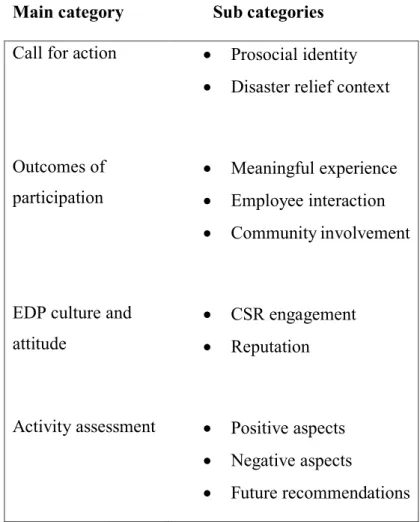
As qualitative data aims to “give meaning expressed to words” (Dey, 1993), a data categorization is required. In light of Sunders et al. (2009) argument that “the interactive nature of data collection and analysis allows you to recognize important themes, patterns, and relationships as you collect data.” In the light of this, the qualitative content analysis was based on the conceptualization of the main issues emerging from interviews. Despite being a complex task, “it is possible to distil words into fewer content categories.” (Elo & Kyngas, 2007). From the ten interviews was possible to distinguish four categories – Motivations (Call for action), Outcomes, EDP culture and attitudes, and Activity Assessment – and a total of 10 subcategories. These categories are described below in figure 3 and detailed analyzed in the appendix IV:
Main category Sub categories
Call for action • Prosocial identity
• Disaster relief context
Outcomes of participation
• Meaningful experience
• Employee interaction
• Community involvement
EDP culture and attitude
• CSR engagement
• Reputation
Activity assessment • Positive aspects
• Negative aspects
• Future recommendations
32
4.1.3 Results and Discussions
The main objectives within the qualitative data analysis were, in the first place, to comprehend the volunteer’s experience, probing individual attitudes and feelings towards it, i.e., to understand how meaningful the experience was felt by the employees, and what they gain from it. Secondly, to understand what drove them to the field and access main motivations behind the decision. Thirdly, to understand their perceptions over EDP’s active role in the CSR sector. Four themes were extracted from the interviews. The primary unexpected finding, which contradicts the literature, was that volunteers did not find a causal effect on their job by participating in the wildfire response. Even though they assess the experience as significant to them, there are no perceptions from the interviewees about any association between job engagement and job satisfaction with the experience they performed. One possibility for this unexpected result is that people are unaware of the effect of participating in the wildfire response on job related issues. In this sense, the quantitative study will further explore this topic. After having exploited the main reasons behind the decision of volunteering, the perspectives were multiple. On the one hand, it was possible to identify “prosocial identities”, with a natural propensity to volunteer. These are typically associated with behaviours based on intrinsic motivations, since it was not a one-time step but one action in concordance with an altruistic attitude towards life. According to Clary et al., (1998) when intrinsically motivated “the individual may find fulfilment in volunteer work itself.” On the other hand, few have clearly mentioned the context of catastrophe, as the main reason that drove them to volunteer. According to the literature, although legitime, this characterizes extrinsic motivational behaviours “because the activity is not performed for itself but as a means to an end (Guay and Vallerand, 2000)”. Moreover, since the “altruistic orientation is amplified in disasters” (Tierney et al., 2001) this motivational variance can lead to different expectations and further diverse outcomes. Prior research findings indicate “one’s current motivation is related to psychological outcomes such as positive affect (...)” (Guay et al., 2000). This way it will be measured the situational motivation of the volunteers, formulated by Guay, Vallerand, Robert in 2000, in order to understand the person self-regulatory process and to distinguish between intrinsically and extrinsically motivated behaviors. The behavioral motivation in respect to the volunteer activity, undertakes the role of a moderator in the study leading to the hypothesis 2. Intrinsic motivation refers to performing an activity for itself, in order to experience pleasure and
33 satisfaction inherent in the activity. On the other hand, extrinsic motivation pertains to a wide variety of behaviors where the goals of action extend beyond those inherent in the activity itself (Deci & Ryan, 1985).
Throughout the interviews, even before been questioned about this specify topic, EDP commitment to CSR was vastly mentioned. Not only as an influencing factor for employees to engage in volunteering work, but also as a reputational advantage making employees gratified and proud, considering as pillar responsibility for a leader company with the size and magnitude as EDP. Although with some contradictory perspectives, it was in line with the literature theories, as a key factor in the equation. (Vlachos et al., 2013) In order to fill the gaps of the data extracted from the interviews and verify the actual effect on job-related issues, employee CSR-induced attributions represent an important variable in the quantitative analysis. Already mentioned in the literature section, there are CSR-induced intrinsic attributions and extrinsic attributions (Vlachos et al., 2013). Consequentially, the third and fourth hypotheses were formulated, to analyze the effect this CSR perception on employee well-being and satisfaction as well as to determine if it influenced the predisposition of the employees to actual participated in the RVI.
To sum up, using quantitative analysis will allow to compare the different attitudes of the volunteers and to fill the gaps in the first analysis in respect to motivations disparity, and perception on EDP’s socially responsible identity. As well as unexplained and insufficient results about the participation outcomes, particularly in respect to non-perceived increased on job satisfaction.
4.2. Study II: Survey
4.2.1. Method
Sample
The method in this section of the study was based on data collected via an online questionnaire (survey template in appendix VI). The sample was selected from EDP and it is composed of 175 responses, of which 148 are valid responses to the complete survey. The sample population is dived in two categories: I) employees who participated in the RVI and ii) employees who did not participate.
34
General Sample Characteristics. The sample is composed of a total of 146 participants, of
which 56% are male and 43% are female. There were 69 participants on the RVI, representing 46.6% of the total, and there were 79 non-participants, representing 53% of the total. Additionally, 19 respondents, representing 13% of the total, have never participated in any volunteer activity. The average age of the sample is 47.71 with a SD of 12.29 with a maximum of 65 and minimum of 22 years. In respect to employee tenure in EDP, 24% of the total of respondents work for less than a year for the EDP, 42% work between one and three years, 21% work between three and six years and 14% work for more than six years. In respect to employee tenure with current supervisor 24% have the same supervisor for less than a year, 41% between one and three years, 21% between three and six years and 14% for more than six years (see table 1).
Participants in the initiative. The sample of participants is composed of a total of 69,
representing 47% of the general sample, of which 66% are male and 44% are female. The average age is 43.23 with a SD of 11.61 with a maximum of 60 and minimum of 23 years. The mean employee volunteering days in the initiative was 2.5 days, with a maximum of 31 days and minimum of 1 day. In respect to employee tenure in EDP, 0% work for less than a year for the EDP, 12% work between one and three years, 15% work between three and six years and 73% work for more than six years. In respect to employee tenure with current supervisor 23% have the same supervisor for less than a year, 45% between one and three years, 22% between three and six years and 10% for more than six years (see table 1).
Non-participants. The sample of non-participants is composed of a total of 79, representing
53% of the general sample, which 55% are male and 44% are female. The average age is 51.71 with a SD of 11.54 with a maximum of 65 and minimum of 22 years. 27% of non-participants, never had participated in any volunteer activity. In respect to employee tenure in EDP, 6% work for less than a year for the EDP, 1% work between one and three years, 5% work between three and six years and 87% work for more than six years. In respect to employee tenure with current supervisor 24% have the same supervisor for less than a year, 38% between one and three years, 20% between three and six years and 19% for more than six years.
Sample Comparation. In the table 1 we can see the comparation between the groups. The
groups are similar in terms of gender, Fisher test (p = 1.000) and in terms of time which have been working with the same superiors,
χ
2 (3) = 1.972, p = .578. There is a significant proportion of non-participants employees with less than 1 year and with more than 6 years of work35 experience in EDP,
χ
2 (3) = 15.524, p = .001. The average age of the participants is inferior than the non-participants, t(146) = - 4.446, p = .001.Description of Instruments and Procedures
Survey performance. The questionnaire was produced in the Qualtrics platform and
distributed between the November 26th and December 3rd 2018. The questionnaire was distributed via the head of the Corporate Volunteering Program, who disseminated internally via email to all the employees who participated in the initiative, to employees that are a member of the Corporate Volunteering program but that have not participated in this specific initiative, and to the general EDP employee population. The survey was also posted internally in the EDP Facebook forum.
The specific questions of the questionnaire were based on scales taken from previous validated research. It was used multiple-item measure, with Likert-type scale for the most important variables in the study. The survey was designed in Portuguese, since the target sample were only Portuguese EDP employees. There were four main sections in the survey:
• First, four demographic questions and two questions about volunteerism participation;
N % N % N % Gender Male 39 56.5% 44 55.7% 83 56.1% Female 30 43.5% 35 44.3% 65 43.9% Experience at EDP < 1 year 0 0,0% 5 6.3% 5 3.4%
Between 1 and 3 years 8 11.9% 1 1.3% 9 6.2%
Between 3 and 6 years 10 14.9% 4 5.1% 14 9.6%
> 6 years 49 73.1% 69 87.3% 118 80.8%
Time with current manager
< 1 year 16 23.2% 19 24.1% 35 23.6%
Between 1 and 3 years 31 44.9% 30 38,0% 61 41.2%
Between 3 and 6 years 15 21.7% 16 20.3% 31 20.9%
> 6 years 7 10.1% 14 17.7% 21 14.2%
Age M (SD) 43.2 (11.6) 51.7 (11.5) 47.7 (12.3)
Participants Non-participants Total