11
Identification of processed tuna products sold by the Brazilian
market
1, * Anderson Ferreira, 2 Humber A. Andrade, 3 Laura I. Weber
1 Brazilian Agricultural Research Corporation - Embrapa Agrosilvopastoral, Sinop, MT, Brazil.
2 Laboratório de Modelagem Estatística Aplicada, MOE/DEPAq, Universidade Federal Rural de Pernambuco, Recife,
PE, Brazil.
3 Laboratório Biologia Molecular, NUPEM/UFRJ, Universidade Federal do Rio de Janeiro, Macaé, RJ, Brazil
Abstract: The composition of processed food is a concern of consumers, of the fishery industry and governmental agencies. The specific composition of canned tuna in three Brazilian brands was evaluated using Single-Strand Conformational Polymorphism (SSCP) of the cytochrome b gene by comparison with patterns of fresh tuna samples and tuna-related species landed at Santa Catarina ports (South Brazil). Thirteen SSCP patterns were obtained from fresh samples, and the specific variety was confirmed by analyzing their sequences. Inconsistencies were found in the fishery statistics of Auxis thazard thazard and Scomber japonicus reported from Brazilian ports, where fresh samples instead were represented mostly by Auxis rochei rochei and Scomber colias. A case of introgression was detected between A. t. thazard and Katsuwonus pelamis. The skipjack tuna K.
pelamis composed seven out of eight of the processed tuna products analyzed, and two brands showed
products containing a mixture of tuna (K. pelamis or Thunnus albacares) and the less commercially valuable bonito meat (A. t. thazard), which reinforces the need for the control of canned tuna in the Brazilian market.
Keywords: Canned food; Bonito; Katsuwonus pelamis; Fishery, Food control.
Recebido: 22 de Março de 2015; aceito: 16 de Outubro de 2015, publicado: 17 de Dezembro de 2015. DOI: 10.14685/rebrapa.v6i3.3486
INTRODUCTION
In 2009, marine fishing production in Brazil reached 585,671 tons, and 26.8% of the total catch was landed in Santa Catarina State (South Brazil) ports (MPA, 2011). The fishery industries of Santa Catarina developed an extensive market for canned tuna. Brazilian canned tuna production in 2009 was 1,240,815 tons, with an annual consumption of 9.03 kg/individual/year and an increasing trend in the last several years (MPA, 2011). The identification of the specific composition of
processed food has been a concern of consumers and industries that buy processed meats. Brazilian governmental agencies are in charge of controlling which species are actually used in canned food products. In the case of processed tuna products, bonitos and other species of lower market value may be used instead of the product description declared on the labels (Botti e Giuffra, 2010). Bonito species are not as popular with consumers as other tuna; therefore, they have a much lower market price. The European community has drawn a strict distinction between tuna and bonito. The
12 skipjack tuna Katsuwonus pelamis Linnaeus,
1758 is considered a tuna together with all the members of the genus Thunnus South, 1845, while species of the genus Euthynnus Lütken, 1882, Sarda Plumier, 1802, and Auxys Cuvier, 1829, are considered bonitos (Ram et al., 1996). The fishery statistics show that the most abundant tuna and bonito landed at Santa Catarina ports between 2007 and 2009 were K.
pelamis (68,542 t), Thunnus albacares (12,764
t), T. obesus (3,746 t) and Auxis thazard thazard (1,673 t) (MPA, 2011). Scomber japonicus (18,486 t), which may be used as a substitute for tuna due to the similarity in taste and texture, is also often cited in the Brazilian fishery reports. Different molecular markers have been used for the identification of canned food. Tuna are submitted to cooking (Unseld et al., 1995) and sterilization processes, which degrade the proteins and DNA. Short mitochondrial regions have been efficiently amplified by the polymerase chain reaction (PCR) from processed tuna. Unseld et al. (1995) demonstrated that the use of a 59-bp region of the cytochrome b gene (described by the authors as a BDR region) by the Single-Strand Conformational Polymorphisms (SSCP) method allowed for the identification of most processed tuna species, and has proven to be useful at different laboratories around Europe (Rehbein; Mackie; Pryde, 1999).
Further mitochondrial DNA regions up to 200 bp (Quintero et al., 1998) have been studied using Restriction Fragment Length Polymorphisms (RFLPs) to identify the most closely related tunas (Ram et al., 1996; Quintero
et al., 1998; Pardo e Pérez-Villareal, 2004; Lin
e Hwang, 2007). SSCP is a sensitive and less expensive molecular technique for developing countries (Hayashi, 1991; Sunnucks et al., 2000). Therefore, the aims of the present work were to find out the specific and intra-specific variation in SSCP patterns of tuna, tuna-related species and other species landed in the ports of Santa Catarina State, South Brazil to determine which species have been commonly used as tuna meat in canned tuna.
MATERIAL AND METHODS Sampling and DNA extraction
Fresh fish samples were obtained from fishery landings at the ports of Navegantes, Itajaí and Porto Belo of Santa Catarina state, South Brazil (Table 1). Processed samples were obtained either directly from the fishery industry or from local markets. Oil-preserved samples were treated following the protocols of Bligh and Dyer (1959) and Rebhein et al. (1999) with modifications. First samples were dried with filter paper and then they were submerged for 24 h in a lipids extraction solution (1:2:0.8 Chloroform/Methanol/H2O). Extraction
solution was then removed from the tissue and absolute ethanol was added in a proportion of two times the volume of the tissue, and mixed for two hours in a rotating homogenizer (Phoenix). Then, ethanol was removed and the process repeated one more time adding fresh ethanol. At the end, the samples were stored in 0.3 g portions submerged in 1 mL absolute ethanol until DNA extraction.
DNA extraction was performed following Hoelzel (1998) using 0.1 g fresh or 0.3 g processed meat sample. Tissue samples were homogenized in 860 μl of lysis buffer (1% SDS w/v; 150 mM NaCl; 2 mM EDTA; 10 mM Tris-HCl, pH 8.0) with 84 µl of 5 M guanidine thioisocyanate (GuSCN) and 80 µl Proteinase K (10 mg/ml) and incubated for 1 h at 55ºC in a rotating homogenizer. Afterwards, samples were left overnight at 37ºC. The next morning, samples were centrifuged at 20ºC for 5 min. Supernatants were transferred to new tubes and 700 µl of DNA binding solution (50 mM Tris-HCl, pH 7.0; 25 mM EDTA, pH 8.0; 5 M GuSCN; 1% silica slurry) was added. Then, the samples were submitted to rotating homogenization for 2 h and centrifuged at 16,000 × g for 2 min. Silica pellets containing DNA were washed twice with 70% ethanol and dried; then, the DNA was resuspended in 80 µl of TE buffer (10 mM Tris-HCl, pH 7.4; 1 mM EDTA, pH 8.0).
13 Table 1. Species name obtained by morphological identification, local name, landing port and date of collection of fresh fish samples.
Species (common name) Local name Landing port
Date of landing (number of
fishes)
Thunnus alalunga Bonnaterre, 1788
(Albacore or long-finned tuna)
Albacora-branca Itajaí
02/05/2001(1), 03/10/02(1),
28/01/03(2)
Thunnus albacares Bonnaterre, 1788
(Yellowfin tuna) Albacora-lage Itajaí 02/05/2001(1), 20/08/02(1), 27/01/03(2)
Thunnus obesus Loive, 1839
(Bigeye tuna) Albacora-bandolim ou atum-cachorra Itajaí 03/10/2002(1)
Katsuwonus pelamis Linnaeus, 1758
(Skipjack or stripe-bellied tuna)
Bonito-listrado Navegantes 27/01/2003(1)
Auxis thazard thazard Lacepède, 1800
(Frigate mackerel)
Bonito-cachorro Itajaí
20/08/2002(1), 29/01/03(3)
Scomber japonicus Houttuyn, 1782
(Pacific chub mackerel) Cavalinha Itajaí 20/08/2002(2)
Sarda sarda (Bloch, 1793)
(Atlantic bonito) Sarda Itajaí 10/02/2003(1)
Scomberomorus brasiliensis (Collette et al.,
1978)
(Serra spanish mackerel or Brazilian spanish mackerel)
Sororoca Porto Belo Navegantes
2003(1) 29/01/2003(1)
PCR-SSCP patterns
The BDR region of the mitochondrial cytochrome b gene was amplified using the primers described by Unseld et al. (1995): Forward: 5'-aaactgcagcccctcagaatgatatttgtcctca-3'; Reverse: 5'-gctggtacctctacaaagaaacatgaaaca-3'. Amplification by PCR was performed in reactions containing 1x PCR buffer, 2.5 mM MgCl2, 0.2 mM dNTPs, 1 µM of each primer,
1U Taq DNA polymerase and 2 µl and 5 µl of DNA from fresh and processed tissue, respectively. The PCR reaction was conducted in a thermocycler using the following steps: 1 step of 5 min of initial denaturation at 94ºC followed by 35 cycles of 40 s denaturation at 94ºC, 80 s of primer annealing at 50ºC, 80 s of extension at 72ºC and, finally, 1 step of 7 min of final extension at 72ºC.
14 The SSCP patterns of samples were obtained by
running a natural vertical 6% polyacrylamide gel electrophoresis following the methodology of Brown (1994) and Hoelzel (1998). Gel was prepared with 1 x TBE buffer (obtained from a stock solution of 10 x TBE: 154 mM Tris-base; 90 mM Boric acid; 2 mM EDTA), 10% glycerol, 6% polyacrylamide (Crosslink 75:1), 0.1% ammonium persulphate and 0.075% TEMED, which was immediately poured between the plates after the addition of the last two components. Glass plates were previously treated with repel and bind silane in order to rescue the gel after electrophoresis. Samples were denatured by incubation for 5 min at 95ºC in equal volumes of denaturing solution [95% deionized formamide, 20 mM EDTA, pH of 8.0, 0.05% (w/v) bromophenol blue and 0.05% (w/v) xylene cyanol FF] and poured on ice immediately after denaturation. Ten microliters of the denatured samples were loaded into the gel. A non-denatured 123 bp ladder was poured in a single lane. Electrophoresis was performed at room temperature and at 15 Watts for a period of 6-8, before the blue stains run out of the gel. DNA fragments were visualized using silver nitrate staining protocol described by Hoelzel (1998), with modifications, by submerging the gel sticked on the glass plate in the following solutions: 3 min in fixing solution (10% ethanol, 0.5% acetic acid); 10 min in inpregnation solution (0.1% silver nitrate); one wash in deionized water; 20 min in the first revelation solution (1.5% NaOH; 0.01% NaBH4; 0.15%
formaldehyde); 10 min in the second revelation solution (0.75% NaCO3); one wash in deionized
water; one wash in the same fixing solution; and 30 min in hydratation solution (1.5% glicerol) which allows to keep the gel in good conditions until digitalization with a common scanner. DNA fragments obtained from the fresh samples that generated the SSCP patterns were purified from agarose gel using an Ultrafree-DA (Millipore) column following the recommendations of the supplier and were sent
to Macrogen, Inc., Korea (www.macrogen.com) for sequencing. Sequencing was conducted under BigDye™ terminator cycling conditions; the reacted products were purified using ethanol precipitation and were run using an Automatic Sequencer 3730XL.
The confirmation of the specific status of fresh samples was performed by comparing the obtained sequences with sequences from tuna and tuna-related species registered in the literature or deposited in GenBank by sequences comparisons and by tree clustering. The online tools BLASTN and ClustalW were used to find similarities between sequences and for their alignment, respectively. A phylogenetic tree was constructed using the MEGA version 5.10 software package (Tamura et al., 2011) by the minimum evolution method with the maximum composite likelihood model after 1,000 bootstrap resampling as confidence parameter of the branches. Afterwards, the SSCP patterns obtained from the fresh samples were used to identify the specific composition of the processed tuna. To confirm identity, fresh samples were run on electrophoresis side by side with the tuna sample in question.
RESULTS
Identification of fresh samples of scombroid species using SSCP patterns
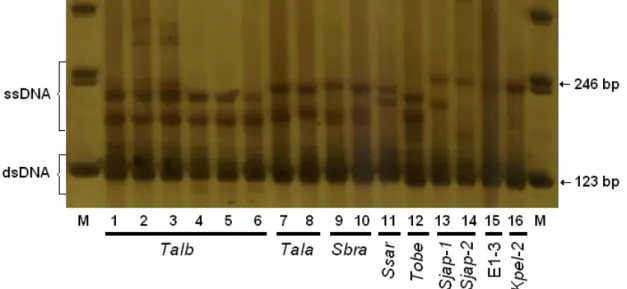
A total of thirteen SSCP patterns were found for the eight samples collected at the Santa Catarina ports (Figs. 1 and 2). Most species showed a single SSCP pattern, but three SSCP patterns were identified for the skipjack tuna K. pelamis (Kpel-1-BR, Kpel-2-BR and Kpel-3-BR); three SSCP patterns were identified for the presumed frigate mackerel A. t. thazard (1-BR, Atha-2-BR and Atha-3-BR); (Fig. 2) and two patterns were identified for the presumed S. japonicus (Sjap-1-BR and Sjap-2-BR) (Fig. 1).
15 Figure 1. The SSCP pattern obtained from Brazilian samples (-BR) after electrophoresis in a 6% natural polyacrylamide vertical gel stained with silver nitrate. (M) represents the 123 bp molecular ladder; SSCP patterns represented by (ssDNA) single stranded DNA; (dsDNA) double stranded DNA. The order of samples identified by morphological characters is: (1-6) Thunnus albacares, (7-8) T. alalunga, (9-10) Scomberomorus brasiliensis, (11) Sarda sarda, (12) T. obesus, (13) first and (14) second pattern of Scomber japonicus, (15) processed sample E1-3 and (16) second pattern of
Katsuwonus pelamis.
Figure 2. The SSCP pattern found for Brazilian samples (-BR) after electrophoresis in a 6% natural polyacrylamide vertical gel stained with silver nitrate. (M) represents the 123 bp molecular ladder; SSCP patterns represented by (ssDNA) single stranded DNA; (dsDNA) double stranded DNA. The order of samples identified by morphological characters is: (1 and 3) first, (2 and 4) second and (5) third pattern of Auxis thazad thazard, (6, 9-11) first, (7) second and (8) third pattern of Katsuwonus
16 Most sequences were consistent with the species
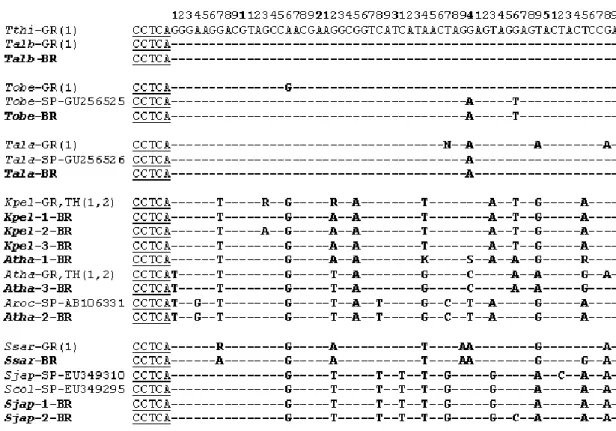
identified by morphological characteristics. The sequences of the individuals morphologically identified as K. pelamis, Thunnus albacares, T.
alalunga, T obesus and Sarda sarda showed
100% identity with sequences deposited in GenBank or in the literature (Fig. 3) and
clustered in the phylogenetic tree with their respective species (Fig. 4). The sequences that generated the SSCP patterns Kpel-1-BR and
Kpel-3-BR were identical, and all patterns
correspond to known forms of the species (Figs. 3 and 4).
Figure 3. The alignment of sequences of the 59-bp BDR region of the cytochrome b gene. Numbers in the top express the numbers of sites. The first five underlined bases correspond to the end of the forward primer. Dashes represent congruence with the first sequence (from T. thynnus) and base substitutions are indicated by the letters in black. Extensions in names are: (-BR) samples from Brazil obtained in this study (in black), (-SP) Spain, (-GR) Germany and (-TH) Thailand. Samples from Spain show the GenBank accession number. (Tthi) T. thinnus, (Talb) T. albacares, (Tobe) T. obesus, (Tala) T. alalunga, (Kpel) K. pelamis, (Atha) A. t. thazard, (Aroc) Auxis rochei rochei, (Ssar) Sarda
sarda, (Sjap) Scomber japonicus, (Scol) Scomber colias. (1) Unseld et al. 1995, (2) Ram et al. 1996.
Unexpected results were found when the sequences of the species identified morphologically as A. t. thazard and S.
japonicus were compared. The sequences that
generate the first pattern of the frigate mackerel (Atha-1-BR) showed 97% similarity to K.
pelamis by four sites characteristic of the
species, one site characteristic of A. t. thazard and three heteroplasmic sites for both species. The form was clustered with a confidence of 70% with the K. pelamis branch in the
phylogenetic tree (Fig. 4), suggesting a case of introgression. The sequence of the second pattern (Atha-2-BR) showed 100% similarity to the bullet tuna Auxis rochei rochei (Risso, 1810) determined by eight distinctive sites and was clustered with A. r. rochei in the phylogenetic tree with a confidence of 99% (Figs. 3 and 4). The sequence of the third pattern (Atha-3-BR) was 100% similar to the frigate mackerel A. t.
thazard and was similarly identified by
17 Figure 4. A phylogenetic tree showing the position of the samples from Brazil (in black) obtained in this study. Numbers in branches are bootstrap confidence values. Extensions in names are: (-BR) samples from Brazil, (-SP) Spain, (-GR) Germany and (-TH) Thailand. Samples from Spain show the GenBank accession number. (Tthi) T. thinnus, (Talb) T. albacares, (Tobe) T. obesus, (Tala) T.
alalunga, (Kpel) K. pelamis, (Atha) A. t. thazard, (Aroc) A. rochei rochei, (Ssar) Sarda sarda, (Schi) S. chilensis, (Sjap) Scomber japonicus, (Scol) S. colias, (Eaff) Euthynnus affinis, (Eall) E. alletteratus. (1) Unseld et al. 1995, (2) Ram et al. 1996.
Identification of the specific composition of canned tuna at the Brazilian market
The skipjack tuna K. pelamis was present in seven out of eight canned tuna analyzed, where
the most common form used to compound the products was the second SSCP pattern (Kpel-2-BR). Two brands contained a mixture of tuna (K. pelamis or T. albacares) and bonito meat (A.
18 Table 2. Analyzed processed samples and their specific composition.
Source Sample* Meat
type Preservation Specific composition (SSCP pattern code) Local
market E1-1 Solid Vegetable oil
Auxis thazard thazard (Atha-3-BR), Thunnus albacares (Talb-BR)
Local
market E1-2 Solid Salt and water Katsuwonus pelamis (Kpel-3-BR) Industry
supply E1-3 Grated
Processed
block Katsuwonus pelamis (Kpel-2-BR) Industry
supply E1-4 Grated
Processed
block Katsuwonus pelamis (Kpel-2-BR) Local
market E2-1 Solid Salt and water Katsuwonus pelamis (Kpel-2-BR) Local
market E2-2 Grated Vegetable oil Katsuwonus pelamis (Kpel-2-BR) Local
market E3-1 Solid Salt and water Katsuwonus pelamis (Kpel-2-BR) Local
market E3-2 Grated Vegetable oil
Katsuwonus pelamis (Kpel-2-BR), Auxis thazard thazard (Atha-3-BR)
*E1, E2 and E3 represent different brands
DISCUSSIONS
Single Stranded Conformational Polymorphisms are molecular markers very attractive for developing countries due to their low cost and high sensitivity, which has also proven to be of high confidence and consistence in their results as observed by analysis in very different countries of Europe (Rehbein; Mackie; Pryde, 1999). Dalmasso et al. (2007) and Terio
et al. (2010) designed probes for the
identification of tunid species by real time PCR, but this method still represents an expensive mean for routine evaluation of the specific composition of canned tuna in developing countries. The first steps (oil extraction, DNA extraction and amplification of the DNA) can be performed without commercial kits that are normally for 50 samples and very expensive. Instead, for example, DNA extraction can be done with the methodology here described. Although, it will take longer time (2-3 days) than with a commercial DNA extraction kit (1 day), after the preparation of solutions, they will last for many hundreds of samples. The same situation can be stated for the SSCP
electrophoresis and staining. It will be an initial spent of reagents and equipments, but the cost can be lowered by buying second handed equipments. An alternative method is analyzing samples by sequencing them, but not always sequencing is possible with samples in concentrations lower than 10 ng, which is the case of processed food. The coast of sequencing is high because for each sample two reactions are necessary. Instead, SSCP markers in polyacrylamide gels are able to detect samples in concentrations of few picograms and in each gel can be loaded free about 29 to 30 samples. It will take long before the need of replacing reagents after the initial investment. Not only governmental authorities will benefit of low coast techniques but also the industrial sector, which also requires low cost analysis to get the information about species composition of the processed blocks that they are buying for canned tuna. We have got mainly demands from the industrial sector, which is also worried about the products they sale for their consumers.
The analysis of fresh samples registered new intraspecific variation for A. t. thazard (or
19
Katsuwonus pelamis, the introgressed form) and S. colias. Introgressed sequences have already
been found in the genus Thunnus (Bremer et al., 2005) and Scomberomorus (Paine, McDowell e Geaves, 2007). However, we were not able to find any citation in the scientific literature regarding introgression of A. t. thazard and K.
pelamis. This issue needs further attention
because K. pelamis is considered a tuna, while
A. t. thazard belongs to the commercially lower
category of bonitos. The BDR region of the cytochrome b differentiates the skipjack tuna from other bonito genera and their varieties and allows the distinction of A. thazard from A.
rochei, but not of S. colias from S. australasicus,
which is not a problem because the latter is only found in the west Pacific and in the southeast Indian oceans (Infante et al., 2007).
The skipjack tuna K. pelamis proved to be the main component of canned tuna at the Brazilian market. The mixture of tuna and bonito meats in processed food found in the samples from the Brazilian market is not an uncommon practice in other countries (Ram et al., 1996; Botti e Giuffra, 2010). Sometimes, the Brazilian industries import tuna blocks from other countries, such as Venezuela and Thailand. In this case, may be adequate for the future to use other molecular tools.
It was believed for a long time that the frigate mackerel A. thazard was a single species in the Atlantic and that A. rochei was the earliest name of this species (Collette e Aadland, 1996). These authors reanalyzed Atlantic specimens morphologically and demonstrated that both are distinct Atlantic species with numerous diagnostic morphological characteristics. They described new subspecies for the Pacific Ocean, remaining A. t. thazard and A. r. rochei as subspecies counterparts of the Atlantic Ocean. High genetic differences were detected between
A. t. thazard and A. r. rochei for the cytochrome b gene (Botti e Giuffra, 2010), and we found that
for the 59-bp BDR region, eight substitutions allow the distinction of these species. Brazilian fishery statistics have maintained all the landings of frigate mackerel under the unique name of A. thazard.
Nonetheless, our data showed that landings of A.
r. rochei in Santa Catarina ports are also
included under this name. At first glance, it is not that difficult to identify the fish as the Auxis genus due to stripes on the dorsal region. Nevertheless, the distinction between A. t.
thazard and A. r. rochei, based on morphological characteristics, is not that intuitive. The posterior extension of the corselet of A. t. thazard is narrow and is only 1 to 5 scales wide under origin of the second dorsal fin, while the posterior extension of the corselet of A. r.
rochei is wider, usually 10 to 15 scales wide
under the origin of the second dorsal fin (Carpenter, 2002).
Hence, Brazilian fishermen describe the two
Auxis species as aggregated in one generic
category called “bonito cachorro”. Sampling research programs to assess the species composition of the fish landed in the harbors may help the distinction of these species in fishery reports. However, bonitos have not been the focus of research programs because catches and market prices are low. Onboard observer programs may also help to alleviate or eliminate misidentification of Auxis species. However, only tuna longline leased boats have onboard observers, while skipjack and bonitos are mainly caught by pole and line national boats (MPA, 2011). Hopefully, all Brazilian tuna fleets will be covered by onboard observers in the near future. Meanwhile, solving the Auxis misidentification issue is difficult.
The confirmation of the multispecific status of the previously considered widespread species S.
japonicus (Infante et al., 2007; Cheng et al.,
2011) into S. colias from the Atlantic and S.
japonicus from the Pacific was confirmed by
morphological characteristics, by mitochondrial genes (Scoles et al., 1998; Collette e Aadland, 1996; Catanese, Manchado e Infante, 2010; Cheng et al., 2011) and by nuclear DNA (Infante et al., 2007; Cheng et al., 2011). Our sequence data of the BDR cytochrome b region is further evidence of the landings of its congener S. colias at Santa Catarina ports. Confusions concerning the identification of
S.colias and of S. japonicus were already
recognized in some of the Brazilian harbors. For example, the statistical report of UNIVALI-CTTMar (2011) mentions that both species may be aggregated in the category “cavalinha”.
20 However, S. japonicus is still the unique species
appearing in the official report of the Ministry of Fisheries and Aquiculture (MPA, 2011). Although the sample size was low, our results combined with the results obtained elsewhere are strong enough to suggest that the Brazilian government and researchers should consider the hypothesis that all chub mackerel in the Atlantic are S. colias and not S. japonicus.
CONCLUSIONS
This study found that the skipjack tuna K.
pelamis was the main component of canned tuna
from the Brazilian market, which is consistent with the highest catch rate of this species at local ports. At least two brands used a mixture of tuna and the less commercially valuable bonito meat for the composition of processed tuna products, which reinforces the need for the control of canned tuna. The finding of S. colias and A. r.
rochei in the local landings, which are
unexpected species in accordance with national fishery statistics, also reinforces the need to amplify and improve the Brazilian onboard observer program. The mixed content found in canned food, which includes meat of high value (tunids or bonito K. pelamis) with low value meat (such as A. t. thazard), raises at least two important issues. a) The information printed on cans should tell the consumer about this possibility? b) What would be a fair price for the processed food that contains a mixture of K.
pelamis and A. t. thazard?
ACKNOWLEDGEMENTS
We would like to thank to PIBIC/UNIVALI for the IC grant to A. Ferreira. We would also like to thank the Biological Oceanography and Environmental Sciences Laboratories of UNIVALI for their help in collecting samples at local ports and for the morphological identification of species.
REFERENCES
Bligh, E. G.; Dyer, W. J. A rapid method of total lipid extraction and purification. Canadian Journal of Biochemistry and Physiology, v.
37, p. 911-912, 1959.
http://www.nrcresearchpress.com/loi/cjbp
Botti, S.; Giuffra, E. Oligonucleotide indexing of DNA barcodes: identification of tuna and other scombrid species in food products. BMC Biotechnology, v. 10: p. 1-7, 2010.
http://www.biomedcentral.com/bmcbiotechn ol
Bremer Jr. A.; Viñas, J.; Mejuto, J.; Eli, B.; Pla, C. Comparative phylogeography of Atlantic bluefin tuna and swordfish: the combined effects of vicariance, secondary contact, introgression, and population expansion on the regional phylogeny of two highly migratory pelagic fishes. Molecular Phylogeny and Evolution, v. 36: p. 169-187, 2005.
http://www.journals.elsevier.com/molecular-phylogenetics-and-evolution/
Brown, T. A. DNA sequencing. Oxford: Oxford University Press, 1994.
Carpenter, K. E. The living marine resources of the Western Central Atlantic. Bony fishes part 2 (Opistognathidae to Molidae), sea turtles and marine mammals. FAO Species Identification Guide for Fishery Purposes and American Society of Ichthyologists and Herpetologists. Special Publ., v. 5 (FAO Rome), p. 1375-2127,
2002, V3.
http://www.fao.org/docrep/009/y4160e/y4160e 00.htm
Catanese, G.; Manchado, M.; Infante, C. Evoltuionary relatedness of mackerels of the genus Scomber based on complete mitochondrial genomes: strong support to the reconition of Atlantic Scomber colias and Pacific Scomber japonicus as distinct species. Gene, v. 452: p. 35-43, 2010.
http://www.journals.elsevier.com/gene/
Cheng, J.; Gao, T.; Miao, Z.; Yanagimoto, T. Molecular phylogeny and evolution of Scomber (Teleostei: Scombridae) based on mitochondrial and nuclear DNA sequences. Chinese Journal of Oceanography and Limnology, v. 29, p.
297-310, 2011.
http://www.springer.com/earth+sciences.../o ceanography/journal/343
21 Collette, B. B.; Aadland, R. Revision of the
frigate tunas (Scombridae, Auxis), with descriptions of two new subspecies from the eastern Pacific. Fishery Bulletin, v. 94, p. 423-441, 1996. fisherybulletin.nmfs.noaa.gov/
Dalmasso, A.; Fontanella, E.; Piatti, P.; Civera, T.; Secchi, C.; Bottero, M. T. Identification of four tuna species by means of real-time PCR and melting curve analysis. Vetenary Research Communications, v. 31 (Supl. 1), p. 355-357, 2007. http://link.springer.com/journal/11259
Hayashi, K. PCR-SSCP. A single and sensitive method for detection of mutation in the genomic DNA. PCR Methods and Applications, v. 1, p.
34-38, 1991.
http://www.unboundmedicine.com/.../journa l/PCR_methods_and_applications
Hoelzel, A. R. Molecular Genetic Analysis of Population: a practical approach. 3rd. edition. New York: Oxford University Press, 1998.
Infante, C.; Blanco, E.; Zuasti, E.; Crespo, A.; Manchado, M. Phylogenetic differentiation between Atlantic Scomber colias and Pacific
Scomber japonicus based on nuclear DNA
sequences. Genetica, v. 130, p. 1-8, 2007.
http://www.springer.com/life+sciences/journ al/10709
Lin, W.-F.; Hwand, D.-F. Application of PCR-RFLP analysis on species identification of canned tuna. Food Control, v. 18, p.
1050-1057, 2007.
http://www.journals.elsevier.com/food-control/
MPA (Ministerio da Pesca e Aquicultura). Boletim Estatístico da Pesca e Aquicultura-Brasil - 2008-2009. Brasília: Ministério da
Pesca e Aquicultura, 2011.
http://www.pesca.sp.gov.br/noticia.php?id_not =12963
Paine, M. A.; McDowell, J. R.; Graves, J. E. Specific identification of western Atlantic Ocean scombrids using mitochondrial DNA cytochrome C oxidase subnit I (COI) gene region sequences, v. 80, p. 353-367, 2007.
Bulletin of Marine Science www.rsmas.miami.edu/bms/
Pardo, M. A.; Pérez-Villareal, B. Identification of commercial canned tuna species by restriction site analysis of mitochondrial DNA products obtained by nested primer PCR. Food Chemistry, v. 86, p. 143-150, 2004.
http://www.journals.elsevier.com/food-chemistry/
Quinteiro, J.; Sotelo, C. G.; Rehbein, H.; Pryde, S. E.; Medina, I.; Pérez-Martín, R. I.; Rey-Méndez, M.; Mackie, I. M. Use of mtDNA direct polymerase chain reaction (PCR) sequencing and PCR-restriction fragment length polymorphism methodologies in species identification of canned tuna. Journal of Agriculture and Food Chemistry, v. 46, p. 1662-1669, 1998. pubs.acs.org/journal/jafcau
Ram, J. L.; Ram, M. L.; Baidoun, F. F. Authentication of canned tuna and bonito by sequence and restriction site analysis of polymerase chain reaction products of mitochondrial DNA. Journal of Agriculture and Food Chemistry, v. 44, p. 2460-2467, 1996. pubs.acs.org/journal/jafcau
Rehbein, H.; Mackie, I. M.; Pryde, S.; Gonzales-Sotelo, C.; Medina, I.; Pérez-Martín, R.; Quinteiro, J.; Rey-Mendez; M. Fish species identification in canned tuna by PCR-SSCP: validation by collaborative study and investigation of intra-species variability of the DNA-patterns. Food Chemistry, v. 64, p.
263-268, 1999.
http://www.journals.elsevier.com/food-chemistry/
Scoles, D. R.; Collette, B. B.; Graves, J. E. Global phylogeography of mackerels of the genus Scomber. Fishery Bulletin, v. 96, p. 823-842, 1998. fisherybulletin.nmfs.noaa.gov/
Sunnucks, P.; Wilson, A. C. C.; Breheregaray, L. B.; Zenger, K.; French, J.; Taylor, A. C. SSCP is not so difficult: the application and utility of single-stranded conformation polymorphism in evolutionary biology and molecular ecology. Commentary. Molecular Ecology, v. 9, p. 1699-1710, 2000.
22
onlinelibrary.wiley.com/journal/10.1111/(IS SN)1365-294X
Tamura, K.; Peterson, D.; Stecher, G.; Nei, M.; Kumar, S. MEGA5: Molecular Evolutionary Genetics Analysis using Maximum Likelihood, Evolutionary Distance, and Maximum Parcimony Methods. Molecular Biology and Evolution , v. 28, p. 2731-2739, 2011.
mbe.oxfordjournals.org/
Terio, V.; Di Pinto, P.; Decaro, N.; Parisi, A.; Desario, C.; Martella, V.; Buonavoglia, C.; Tantillo, M. G. Identification of tuna species in commercial cans by minor groove binder probe real-time polymerase chain reaction analysis of mitochondrial DNA sequences. Molecular and Cellular Probes, v. 24, p. 352 -356, 2010.
www.journals.elsevier.com/molecular-and-cellular-probes-mcp/
UNIVALI-CTTMar (Universidade do Vale do Itajaí-Centro de Ciências Tecnológicas da Terra e do Mar). Boletim Estatístico da Pesca Industrial de Santa Catarina - Ano 2010, v.
10, p. 1-59, 2011.
http://www.univali.br/.../pesquisadores-divulgam-boletim-estatistico-da-pesca- industrial-em-sc.aspx
Unseld, M.; Beyermann, B.; Brandt, P.; Hiesel, R. Identification of the species origin of highly processed meat products by mitochondrial DNA sequences. PCR Methods and Applications, v.
4, p. 241-243, 1995.
http://www.unboundmedicine.com/.../journa l/PCR_methods_and_applications