Contributions to the Social Identity Approach to
Conformity and Intragroup Differentiation
António José Miguel Cameira
PhD dissertation supervised by
Prof. Dr. José M. Marques and Prof. Dr. Michael A. Hogg
Faculty of Psychology and Educational Sciences
University of Porto
Acknowledgements
This work would never be possible without the support of Profs. José Marques and Michael Hogg. Prof. José Marques introduced me to Social Psychology and was an endless source of knowledge in his classes, talks, writings and opinions; he also provided me experiences that gave meaning to this knowledge. The educational opportunities he provided me are countless. Prof. Michael Hogg’s writings and talks were fundamental for my education. He sponsored me beyond expectations, providing opportunities and experience, namely, during my staying in the University of Queensland under his supervision. For these reasons, I am deeply indebted to them both.
I also wish to acknowledge the contributions of Profs. Nyla Branscombe and Dominic Abrams to my socio-psychological education with their illuminating talks, writings and personal conversations. For similar reasons, I also wish to thank Profs. Fabio Lorenzi-Cioldi, Jorge Vala, and Maria Benedita Monteiro. Thanks also to Prof. Gabrielle Poeschl for helping to create the conditions for me to work.
The discussions with my colleagues Isabel Pinto and Rui Serôdio were important moments to clarify points of view, and improve down-to-earth but critical experimental procedures. I wish to thank them for their companionship along the production of this work.
Finally, I wish to thank my family, especially Claudia, my mother and my kids, for their support in this process. I am sure that without their moral support, the present work would not be possible.
This PhD was financially supported by the Faculty of Psychology and Educational Sciences, the Centre of Psychology of the University of Porto, and Project PRAXIS
Resumo
Contributos para uma abordagem de identidade social à conformidade e à diferenciação intragrupal
No presente trabalho, pretendemos obter evidência para o carácter implícito da influência informacional de referência (e.g., Hogg & Turner, 1987; Turner, 1987; 1991) e da diferenciação normativa intragrupal visando o estabelecimento de uma identidade social positiva, a Dinâmica de Grupos Subjectiva (e.g., Marques, Páez & Abrams, 1998; Marques, Abrams & Serôdio, 2001). No primeiro estudo empírico, examinamos a conformidade às normas implícitas dos grupos em função da sua credibilidade. Na primeira experiência, os participantes (n = 26), depois de observarem a selecção de imagens de um júri de peritos, caracterizada por uma norma implícita, avaliaram outras imagens semelhantes ou às aprovadas ou às rejeitadas pelo júri. Os resultados sugerem que a norma implícita do júri afectou as avaliações subsequentes dos participantes. A segunda experiência (n = 35) mostrou que apenas os estudantes das áreas de Letras mas não os de Ciências, estereotipicamente considerados, respectivamente, credível e não credível na apreciação estética, se conformaram mais à norma implícita do endogrupo que à do exogrupo. Na terceira experiência, os participantes (n = 37), foram categorizados num de dois grupos artificiais, respectivamente, credível e não credível na tarefa. Os resultados mostraram que a conformidade explícita, a identificação ao grupo e a percepção de credibilidade dos grupos estavam correlacionadas, particularmente quando o grupo era credível. Na quarta experiência (n = 57) replicámos os resultados anteriores, e verificámos ainda que a conformidade explícita e a implícita diferiam em magnitude mas não nas normas endossadas. Globalmente, os resultados são consistentes com o modelo da Influência Informacional da Referência. O segundo estudo examina a possibilidade de diferenciação normativa implícita. Na primeira experiência, os participantes (n = 31) categorizados em dois grupos artificiais, sobreavaliaram os membros do endogrupo relativamente aos do exogrupo não os membros que adoptavam as normas implícitas do endogrupo sobre os que adoptavam as do exogrupo. Na segunda experiência (n = 25), focada nas normas, obtivemos uma sobreavaliação dos membros que adoptaram a norma endogrupal implícita relativamente aos que adoptaram a norma exogrupal. Os resultados das duas experiências são discutidos à luz do modelo da Dinâmica de Grupos Subjectiva.
Résumé
Contributions à l’approche d’identité sociale à la conformité et à la différentiation intragroupe
Dans le présent travail, on vise obtenir évidence pour le caractère implicite de l’influence informationnelle de référence (e.g., Hogg & Turner, 1987; Turner, 1987; 1991) et de la différentiation normative intragroupe destinée à réussir une identité sociale positive, la Dynamique des Groupes Subjective (e.g., Marques, Páez & Abrams, 1998; Marques, Abrams & Serôdio, 2001). Dans la première étude, on examine la conformité endogroupale implicite en fonction de sa crédibilité. Dans la première expérience, les participants (n = 26), après avoir observé la sélection d’images d’un jury de experts, caractérisée par une norme implicite, ont jugé des images similaires ou aux approuvées ou aux rejetées par le jury. Les résultats suggèrent que la norme implicite du jury a affecté les jugements subséquents des participants. La seconde expérience (n = 35) a montré que les étudiants d’Humanités, mais non ceux de Sciences, stéréotypiquement considérés, respectivement, crédibles et non crédibles à l’appréciation esthétique, se sont conformé plus à la norme implicite de l’endogroupe qu’à celle de l’exogroupe. Dans la troisième expérience, les participants (n = 37), ont été catégorisés en un de deux groupes artificiels, respectivement, crédible et non crédible à la tâche. Les résultats ont montrés que la conformité explicite, l’identification au groupe et la perception de crédibilité des groupes étaient associées, particulièrement quand le groupe était crédible. Dans la quatrième expérience (n = 57) on a répliqués les résultats antérieurs et on a encore vérifié que la conformité explicite et celle implicite différait en intensité mais non aux normes soutenues. Globalement, les résultats sont consistent avec le modèle de l’Influence Informationnelle de Référence. La seconde étude examine la possibilité de différentiation normative implicite. Dans la première expérience, les participants (n = 31) catégorisés en deux groupes artificiels, ont surévalué des membres endogroupales relativement aux membres exogroupales mais pas les membres qui adoptaient la norme implicite de l’endogroupe sur ceux qui adoptaient celle de l’exogroupe. Dans la seconde expérience (n = 25), on a obtenue une surévaluation des membres qui adoptaient la norme implicite endogroupale relativement à ceux qui adoptaient la norme exogroupale. Les résultats des deux expériences sont discutés en base du modèle de la Dynamique des Groupes Subjective.
Abstract
Contributions to the Social Identity Approach to Conformity and Intragroup Differentiation
In the present work, we aim to obtain evidence for the implicit character of referent informational influence (e.g., Hogg & Turner, 1987; Turner, 1987; 1991) and of normative intragroup differentiation aimed to achieve a positive social identity, Subjective Group Dynamics (e.g., Marques, Páez & Abrams, 1998; Marques, Abrams & Serôdio, 2001). In the first study, we examined conformity to implicit group norms as a function of their credibility. In the first experiment, participants (n = 26), after observing the selection of abstract pictures made by a jury of experts, characterized by an implicit norm, judged other pictures similar to either the ones approved or rejected by the jury. The results suggest that the implicit norm of the jury affected participants’ subsequent evaluations. The second experience (n = 35) showed that Arts students, but not Sciences students, stereotypically considered, respectively, credible or non-credible in esthetical appreciation, conformed more to the implicit norm of the in-group than to that of the out-group. In the third experience, participants (n = 37), were categorized in one of two group artificial groups, respectively, credible and non-credible in the task. The results showed that explicit conformity, group identification and perception of groups’ credibility were correlated, particularly when the group was credible. In the fourth experience (n = 57), we replicated the previous findings, and confirmed that explicit and implicit conformity differed in degree but not in the endorsed norms. In the whole, the results are consistent with the Referent Informational Influence model. The second study focused on the possibility of implicit normative differentiation. In the first experiment, participants (n = 31) categorized in two artificial groups upgraded in-group over out-group members, but not members that endorsed the implicit norm of the in-group over those that endorsed that of the outin-group. In the second experience (n = 25), focused on the norms, we found an upgrading of members that adopted the implicit in-group norm relatively to members that adopted the equivalent out-in-group norm. The results of the two experiments are discussed at the light of Subjective Group Dynamics.
INDEX
INTRODUCTION ... 11
CHAPTER 1 THE SOCIAL IDENTITY APPROACH ... 15
Metatheoretical Conceptions ... 15
SOCIAL IDENTITY THEORY... 18
Social Categorization... 18
Social Identity and Social Comparison ... 21
Intergroup and Interpersonal Comparisons... 22
Intergroup and Interpersonal Behavior ... 23
Social Categorization and Intergroup Differentiation ... 24
Strategies for Positive Group Differentiation ... 25
SELF-CATEGORIZATION THEORY... 28
The Hierarchical Model of the Self ... 28
Relationships among Self-Categorizations... 28
The Salience of Group Memberships ... 30
Depersonalization ... 32
Social Attraction... 33
Motives for Self-Categorization ... 35
Conclusion... 37
CHAPTER 2 GROUP INFLUENCE AND CONFORMITY... 38
Sherif’s (1936) Studies on the Formation of Norms... 38
Asch’s (1951) Studies on Conformity ... 40
Theory of Informal Social Communication ... 41
Group Locomotion ... 42
The Achievement of Uniformity... 43
The Distinction between Normative and Informational Influences ... 44
Deutsch and Gerard’s (1955) Experiment ... 45
Minority Influence ... 47
Tests to the Conversion Model ... 49
Group Polarization ... 50
The Traditional Model of Social Influence... 52
Objections to the Traditional Model of Influence ... 54
THE SOCIAL IDENTITY APPROACH TO SOCIAL INFLUENCE... 56
Referent Informational Influence ... 56
Conformity as Assimilation to In-Group Representations... 57
Informational and Normative Nature of Group Influence... 59
Social Influence Phenomena from a Social Identity Perspective ... 60
Conclusion ... 64
CHAPTER 3 SOCIAL IDENTITY, IMPLICIT PROCESSING AND GROUP INFLUENCE ... 67
THE ASSOCIATION BETWEEN SELF AND IN-GROUP REPRESENTATIONS... 67
IMPLICIT IN-GROUP BIAS... 69
IMPLICIT OUT-GROUP DEROGATION... 70
IMPLICIT PREJUDICE... 71
STUDY 1 CONFORMITY TO IMPLICIT GROUP NORMS... 74
OVERVIEW OF THE STUDY... 76
EXPERIMENT 1 ACCEPTANCE OF A CREDIBLE SOURCE’S IMPLICIT NORM... 76
Method ... 77
Results ... 82
EXPERIMENT 2
CONFORMITY TO IMPLICIT NORMS AS A FUNCTION OF SOURCE’S CREDIBILITY AND GROUP MEMBERSHIP. 85
Pilot Study 1 ... 85 Pilot Study 2 ... 86 Main Experiment ... 89 Method ... 89 Results ... 89 Discussion ... 92 EXPERIMENT 3 CONFORMITY TO EXPLICIT NORMS AS A FUNCTION OF SOURCE’S CREDIBILITY AND SOURCE’S GROUP MEMBERSHIP... 94
Method ... 95
Results ... 97
Discussion ... 100
EXPERIMENT 4 EFFECTS OF SOURCES’CREDIBILITY AND GROUP MEMBERSHIP ON CONFORMITY TO EXPLICIT AND IMPLICIT NORMS...102 Method ... 102 Results ... 102 Discussion ... 110 CONCLUSION...111 CHAPTER 4 SOCIAL IDENTITY AND NORMATIVE DIFFERENTIATION ...113
TRADITIONAL RESEARCH ON NORMATIVE DIFFERENTIATION...113
Group Pressures towards Uniformity ... 113
Differential Reactions to Deviance ... 115
Status and Deviance... 116
Positive Differentiation of Minorities... 117
SOCIAL IDENTITY APPROACHES TO NORMATIVE DIFFERENTIATION...118
Intragroup Differentiation as a Function of Members’ Prototypicality... 120
Prototypicality and Attractiveness ... 120
Prototypicality and Leadership Endorsement ... 122
Differentiation as a Function of Members’ Contributes for Positive Social Identity... 124
Black-Sheep Effect ... 124
Subjective Group Dynamics ... 126
The Development of Sensitivity to In-Group Deviance ... 131
Emotional Consequences of Own Normative and Deviant Behavior ... 132
Conclusion ... 134
STUDY 2 IMPLICIT NORMATIVE DIFFERENTIATION OF GROUP MEMBERS...136
EXPERIMENT 5 Method ... 137 Results ... 139 Discussion ... 144 EXPERIMENT 6 Method ... 146 Results ... 148
Discussion and Conclusions... 151
GENERAL CONCLUSION...153
Group Influence ... 153
Normative Intragroup Differentiation... 158
REFERENCES ...161
APPENDIX 1 PRE-TEST OF THE MATERIAL USED IN EXPERIMENTS 1-5...182
APPENDIX 2 PRE-TEST TO EXPERIMENT 1 ...186
INDEX OF TABLES
TABLE 1.REPORTS ON THE DISTINCTION BETWEEN THE TWO SERIES OF PICTURES GROUPED BY BALANCE
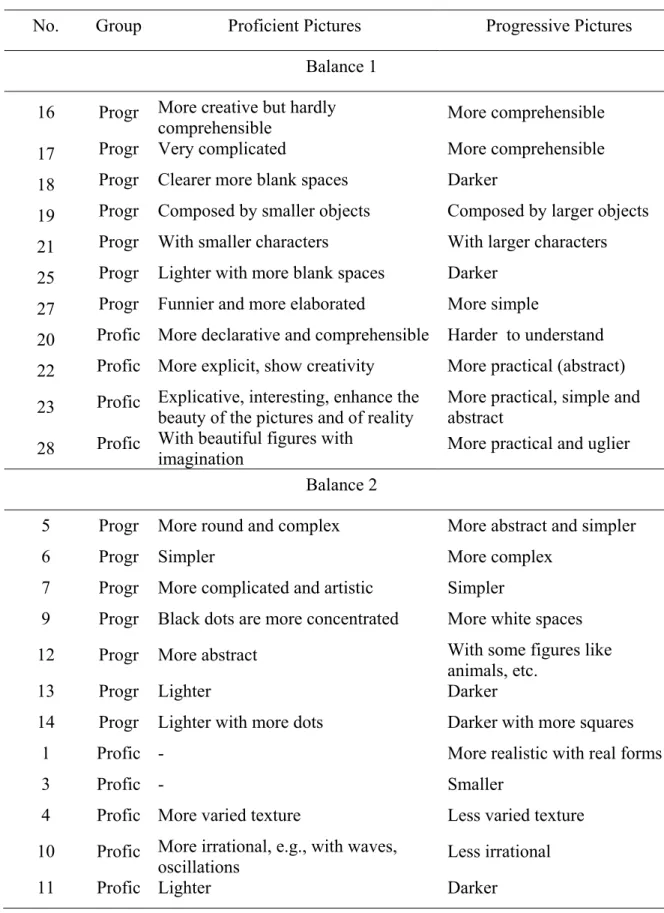
CONDITION (EXPERIMENT 1). ... 82
TABLE 2.REPORTS ON THE DISTINCTION BETWEEN THE TWO SERIES OF PICTURES ORDERED BY BALANCE CONDITION AND PARTICIPANTS’ GROUP (EXPERIMENT 2).. ... 90
TABLE 3.REPORTS ON THE DISTINCTION BETWEEN THE TWO SERIES OF PICTURES IN THE IMPLICIT NORM CONDITION ORDERED BY BALANCE CONDITION AND PARTICIPANTS’ GROUP (EXPERIMENT 4). ... 105
TABLE 4.MEANS OF CONFORMITY TO IN-GROUP AND OUT-GROUP NORMS (STANDARD DEVIATION IN ITALICS) AS A FUNCTION OF GROUPS’ COMPETENCE AND TYPE OF NORM (EXPERIMENT 4)... 106
TABLE 5.CORRELATIONS BETWEEN RELATIVE IN-GROUP IDENTIFICATION,RELATIVE PERCEIVED COMPETENCE AND RELATIVE IN-GROUP CONFORMITY WITHIN EACH BETWEEN-PARTICIPANTS CELL (EXPERIMENT 4)... 109
TABLE 6.REPORTS ON THE DISTINCTION BETWEEN THE TWO SERIES OF PICTURES (EXPERIMENT 5). ... 141
TABLE 7.REPORTS ON THE DISTINCTION BETWEEN THE TWO SERIES OF PICTURES (EXPERIMENT 6). ... 149
TABLE 8.REPORTS ON THE DISTINCTION BETWEEN THE TWO TYPES OF PICTURES (PRE-TEST). ... 184
TABLE 9.REPORTS ON THE DISTINCTION BETWEEN THE TWO SERIES OF PICTURES GROUPED BY BALANCE CONDITION (PRE-TEST TO EXPERIMENT 1). ... 188
INDEX OF FIGURES
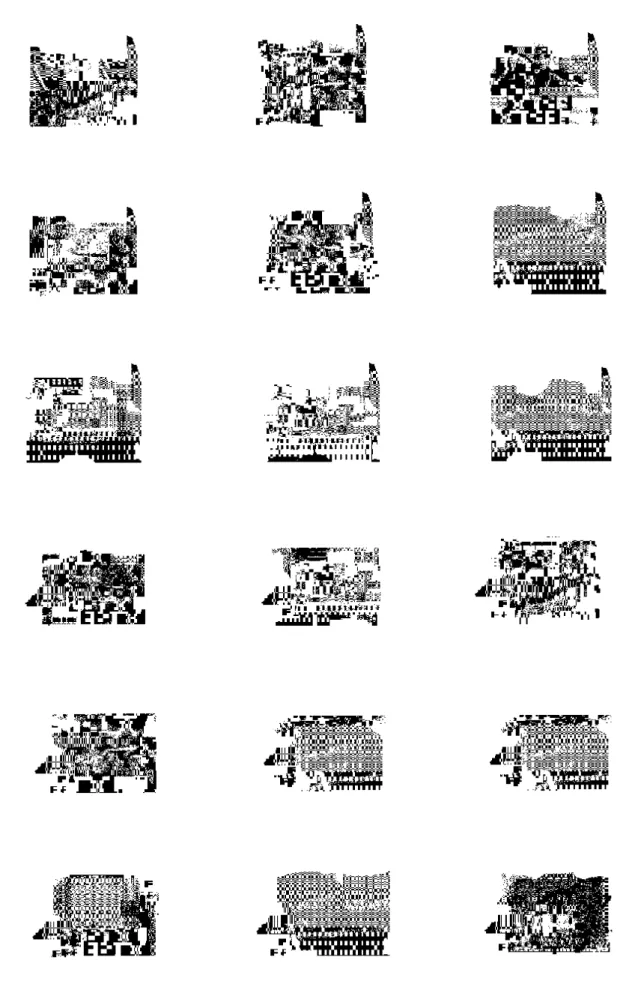
FIGURE 1.EXAMPLES OF THE TWO TYPES OF PICTURES USED IN THE EXPERIMENTS... 80
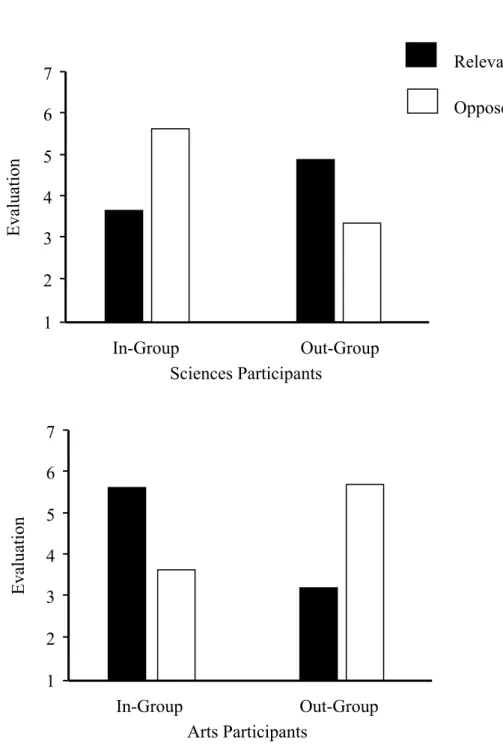
FIGURE 2.IN-GROUP AND OUT-GROUP EVALUATIONS IN RELEVANT AND OPPOSED TRAITS AS A FUNCTION OF RESPONDENTS’ HIGH-SCHOOL AREA (PILOT STUDY 2)... 88
FIGURE 3.MEANS OF CONFORMITY TO IN-GROUP AND OUT-GROUP NORMS AS A FUNCTION OF
PARTICIPANTS’ GROUP (EXPERIMENT 2)... 91 FIGURE 4.MEANS OF CONFORMITY TO IN-GROUP AND OUT-GROUP NORMS AS A FUNCTION OF GROUPS’
COMPETENCE IN THE TASK (EXPERIMENT 3). ... 99
FIGURE 5.MEANS OF ATTRIBUTION OF COMPETENCE IN THE TASK FOR IN-GROUP AND OUT-GROUP AS A FUNCTION OF THE CATEGORIZATION IN THE COMPETENT OR IN THE NON-COMPETENT GROUP
(EXPERIMENT 4)... 103
FIGURE 6.MEANS OF CONFORMITY TO THE IN-GROUP AND OUT-GROUP NORM AS A FUNCTION OF GROUPS’
COMPETENCE IN THE TASK IN THE EXPLICIT AND IMPLICIT NORM CONDITIONS (EXPERIMENT 4)... 108 FIGURE 7.SUBJECTIVE GROUP DYNAMICS MODEL. ... 127
FIGURE 8.EVALUATION OF NORMATIVE AND DEVIANT MEMBERS AS A FUNCTION OF GROUP MEMBERSHIP
(EXPERIMENT 5)... 142
FIGURE 9.EVALUATIONS OF HIGH AND LOW SIMILAR PARTICIPANTS AS A FUNCTION OF GROUP MEMBERSHIP AND NORMATIVE VS. DEVIANT STATUS OF THE TARGET (EXPERIMENT 5). ... 143
FIGURE 10.THE THREE PAIRS OF PICTURES PRESENTED TO PARTICIPANTS (EXPERIMENT 6)... 147
FIGURE 11.IMPRESSION OF NORMATIVE AND DEVIANT MEMBERS AS A FUNCTION OF THEIR GROUP
INTRODUCTION
Sometimes, groups make their norms explicit and formal so that members know exactly what it is expected from them. Other times, norms are simply there, and members cannot articulate immediately the codes by which they regulate. In the present work, we explore the relations of social identity processes to these implicit forms of group behavior.
The social identity approach developed from the principles of Social Identity Theory (e.g., Tajfel & Turner, 1986) and Self-Categorization Theory (Turner, Hogg, Oakes, Reicher & Wetherell, 1988), and constitutes, presently, an influential perspective in Social Psychology (e.g., Abrams & Hogg, 1999; Spears, Oakes, Ellemers & Haslam, 1997; Hogg, 2001b; 2001c; 2003; Hogg & Abrams, 2003; Robinson, 1996). Recently, some social identity processes were examined using research methods that circumvent participants’ conscious control. The associations between the self and the in-group representations (e.g., Onorato & Turner, 2004; Smith & Henry, 1996) or between positive attributes and the in-group and its members (e.g., Otten & Wentura, 1999; Perdue, Dovidio, Gurtman & Tyler, 1990) are examples of this research. The results obtained, suggesting that social identity processes operate also at an implicit level, reaffirm the role of social identity in the determination of individual behavior. In the present work, we extend the application of non-controlled methods to examine in-group conformity and normative intragroup differentiation.
Group influence and intragroup differentiation are important fields of research in Social Psychology. Group influence relates to phenomena such as conformity, polarization, leadership or minority influence. Normative intragroup differentiation relates to aspects such as social attractiveness, popularity and deviance. Traditional approaches to these phenomena have favored interindividual relations occurring within small interactive groups rather than group-based relations. The focus on the individual rather than on the group has led, in the case of group influence, to the distinction between personal motives to conform generating different forms of acceptance of norms. Group influence is associated to others’ coercion and pressures to comply with the group standards rather than to normative references of collective behavior. In the case of intragroup differentiation, the traditional approach has focused on the dynamics of small groups such as work and sport teams, committees, task forces, etc.
The social identity approach has provided a new look on the above phenomena emphasizing the distinct characteristics of group behavior as regards interpersonal behavior. This perspective stresses the importance of group identity for members namely its impact on their self-definition and esteem. Group processes are considered in the larger context of intergroup relations. In this perspective, group influence operates as a single process rather than several processes. The social identity perspective also provided insights on intragroup differentiation processes, particularly on those related with members’ contributions to a clear and positive social identity. Phenomena such as social attraction to prototypical group members or extreme derogation of in-group deviant members are viewed as intrinsically related to categorization and identification processes.
The Structure of the Present Work
We begin with an extended reference to the social identity approach, which constitutes the theoretical background of our empirical studies. Chapter 1 is thus dedicated to reviewing the principles and concepts of Social Identity Theory and Self-Categorization Theory. We begin with a brief reference to the metatheoretical underpinnings of the social identity approach. We then focus on major aspects of Social Identity Theory, namely, the relationship between social categorization, social identity and social comparison processes, and the need for positive group differentiation. Within Self-Categorization Theory, we shall address the hierarchical model of the self and the concept of prototypicality. We then address the dynamic relationship between the self and the social context, the salience mechanisms and the activation of self-categories. We conclude the chapter with a detailed reference to the phenomenological outcome of social self-categorization, depersonalization.
Given that we address two distinct fields of research, we decided to address each field separately in every respect. We shall present first the review of relevant literature concerning group influence followed by the respective empirical study, and then, we shall present the same contents concerning intragroup differentiation. In Chapter 2, we refer to classic investigations on conformity to provide the background in which the traditional approach to group influence developed (Asch, 1951; Festinger, Schachter & Back, 1950; Sherif, 1936). A critical review of this traditional perspective is provided:
the distinction between informational and normative influence (Deutsch & Gerard, 1955), the dependence versus independence of the individual as regards the group, and the particular conceptions of uncertainty and credibility. We then review the social identity approach to group influence processes forming the Referent Informational Influence model (e.g., Hogg & Turner, 1988; Turner, 1991). The Referent Informational Influence model postulates that uncertainty and consensual validation are intimately related to self-categorization and views conformity as the assimilation of the self to the in-group representation. A core difference from the traditional view is that group influence is conceived as a single process encompassing both normative and informational components. We shall review the major principles of the model and its explanation of group processes such as minority influence or group polarization.
In Chapter 3, we review previous research on social identity using non-controlled methods. After a comparison of these methodologies, we present our first study beginning with the methodology used in our experiments. The method consists of the implicit learning of group norms and its unnoticed influence in the receiver’s judgments of related stimuli. We shall then present our four-experiment study addressing the issue of implicit group conformity. The study confronts two hypotheses concerning the nature of group influence: The traditional hypothesis arguing for two forms of group influence and the social identity hypothesis arguing for a single process of group influence. First, we tested the idea that informational influences are implicitly accepted. To achieve this goal, in the first experiment, participants are exposed to the imperceptible criterion of a jury of experts before reporting their own preferences for identical abstract pictures. In the second experiment, we tested our hypotheses by assessing conformity to the implicit esthetical norms of credible or non-credible in-group and out-in-group sources, using natural in-groups. In the third experiment, we used artificial groups and manipulated the ascribed credibility of the in-group in the esthetical task. This experiment was aimed to check on the cognitive-motivational mechanisms that underlie controlled in-group conformity, namely, its relationships with in-group identification and perceived credibility. The fourth experiment aims to replicate the previous results and to address directly the differences between implicit and explicit group conformity. As a whole, the results supported our hypothesis that normative influences, similar to informational influences, are implicitly accepted
suggesting that group influence consists of a single process, as claimed by social identity approaches to social influence.
Chapter 4 is dedicated to intragroup differentiation. We briefly introduce the topic with a mention to classical experiments such as Festinger, Schachter and colleagues’ on group reactions to deviance (e.g., Festinger, 1950; Festinger et al, 1950; Schachter, 1951), Hollander’s on idiosyncratic credit (e.g., 1958; 1960), or Moscovici and colleagues’ on reactions to minorities (e.g., Moscovici, 1976; 1985, Moscovici et al, 1969; 1972). We then concentrate on the models issuing from a social identity perspective. We review the research of Hogg and colleagues on differentiation based on members’ prototypicality, in social attractiveness (e.g., Hogg & Hains, 1991) and leadership endorsement (e.g., Hains, Hogg & Duck, 1997). Finally, we address the research of Marques and colleagues on the black-sheep effect (e.g., Marques & Páez, 1994) and the Subjective Group Dynamics model (Marques, Páez & Abrams, 1998) whose analysis of intragroup differentiation processes takes into account the need for a positive social identity. Finally, we present our second empirical study aiming to check on the implicit character of implicit normative differentiation. The study addresses the idea that members may be differentiated as a function of their implicit normative or deviant behavior and that this differentiation is more extreme in the in-group than in the out-group, as predicted by the Subjective Group Dynamics model. The first experiment showed a marked tendency to differentiate between groups rather than differentiation between members that endorse in-group implicit norms and members that endorse out-group norms. In the second experiment, several changes to the procedure and material were introduced to induce participants’ focus on the norms. The results showed that members endorsing implicit in-group norms were upgraded relatively to those endorsing out-group norms. However, there was mixed evidence relative to participants’ sensitivity to the initial intergroup context, which precluded a full test of the general hypothesis. The study ends with the discussion of possible reasons for the obtained results.
In the final chapter, we recapitulate our major results and their respective theoretical implications. We highlight the aspects that need further clarification and propose some guidelines for future research.
CHAPTER 1
THE SOCIAL IDENTITY APPROACH
The concept of social identity was introduced by Tajfel (1972) when studying the relationships between social categorization and intergroup behavior (e.g., Tajfel, 1969; 1970; Tajfel, Flament, Billig & Bundy, 1971; Tajfel, Sheikh & Gardner, 1964; Tajfel & Wilkes, 1963). Social Identity Theory (Tajfel, 1978; Tajfel & Turner, 1979) results from this initial research. Together with Self-Categorization Theory (Turner, Hogg, Oakes, Reicher & Wetherell, 1987) which is a development of its principles, it represents a distinct approach to group processes in Social Psychology (e.g., Abrams & Hogg, 1988; Hogg, 2001b). The social identity approach is the theoretical background of our empirical work; therefore, in the first chapter, we shall review its major concepts and principles.
Metatheoretical Conceptions
Group processes have been studied in Social Psychology under two paradigms: the individualistic and the interactionist paradigms (cf. Turner & Oakes, 1986). In the individualistic paradigm,
“[…] the individual is the sole psychological and/or social reality, that the distinctive reality of the group and society is fiction or fallacy, that nothing ‘emerges’ in social interaction, […] that social psychology is merely the application of general (i.e. individual) psychological principles to the more complex stimulus conditions of the social environment.” (Turner & Oakes, 1986, p. 238)
A representative author of this paradigm, Floyd Allport (1924), claimed that, “there is no psychology of groups which is not essentially and entirely a psychology of individuals”. In this perspective, the group is a ‘nominal fallacy’ useful to apprehend collective action. Group actions are not more than the sum of the individual actions of the members. This conception emphasizes individuals’ unique characteristics that differentiate them from other individuals (cf. Turner, Oakes, Haslam & McGarty, 1994). The emphasis on the individual is patent on conceptions of the self as a relatively stable structure, such as that of Markus and colleagues (Markus, 1977; Markus &
Kunda, 1986). The emphasis on the individual is also visible on approaches to social phenomena focusing the interpersonal dimension of social relationships (for critic perspectives, cf., e.g., Doise, 1986; Hogg, 1992; Hogg & Abrams, 1988).
The interactionist paradigm. The interactionist paradigm emphasizes the
dynamic nature of the self and the idea that individuals’ self-conception, and, consequently, their opinions, judgments and behavior change in the course of social interaction. The content of the mind is the product of social interaction, a socialization process during which individuals internalize symbols, meanings, values and norms (cf., e.g., Mead, 1934). Thinking and meaningful action are possible only to the use of these tools, the social contents of the mind. As Vigotsky (1925) emphasized,
“All higher mental functions are the essence of internalized relations of a social order, a basis for the social structure of the individual. Their composition, genetic structure, method of action – in a word, their entire nature – is social; even in being transformed into mental processes, they remain quasisocial. Man as an individual maintains the functions of socializing.” (p.106)
It is, thus, impossible to dissociate individuals from the social groups to which they belong.
“Individuals in their multiplicity cannot be opposed to or in reality distinguished from society: individuals are society and society is the natural form of being of human individuals. […] The fallacy that the individual may be opposed to society arises from a legitimate but different contrast between a particular individual and others, resulting in the idea of uniqueness or individuality […] There is no such thing as the pre-social, asocial, purely biological, ‘as if isolated’ individual except as analytic, fictional abstraction.” (Asch, 1952, p. 239)
The object of Social Psychology. For the interactionist paradigm, the object of
Social Psychology is not that of the individual Psychology or that of Sociology, but the mental representations and processes produced by social interaction.
“The task of Social Psychology, as a part of psychology (the science of the individual mental processes), is not to provide social explanations of
behavior (this can be left to sociology, politics, etc.), nor to provide ‘psychological explanations’ of, i.e. ‘to psychologize’ social behavior, but to
explain the psychological aspects of society. This equates with understanding the
structures and processes whereby society is psychologically represented in and mediated by individuals’ minds.”(Turner & Oakes, 1986, pp. 239-240)
More specifically, the object of Social Psychology is the “socially mediated cognition, phenomenologically experienced as the perception of a shared, public, objective world”, the “psychological representations of the interaction, interactors, setting etc. shared by the interactors”, and the “intersubjective world of shared social meanings.” (Turner & Oakes, 1986, p. 240).
Concepts of group. The two metatheories result in different conceptions of
group. According to Turner (1987), the two conceptions derive from a fundamentally different meaning attributed to interdependence. In the interaccionist approach, from Lewin (1947) to Sherif (1967), or Asch (1952), interdependence is considered “in the sense of ‘functional unity’, or ‘dynamic system’, or ‘mutual psychological field’” (Turner, 1987, p. 20). Interdependence refers thus to the proprieties of the group, as a functional whole, and their effect on the members.
In the individualistic metatheory, group interdependence refers to individuals’ dependence on others to satisfy their individual needs.
“In recent years the emphasis has been on forms of interdependence related to or assumed to be related to the satisfaction of individuals’ needs or, which is the same thing theoretically, the achievement of rewarding outcomes, i.e., motivational interdependence. By motivational interdependence is meant the idea that actions and characteristics of others relevant to the satisfaction of one’s needs are functionally related by the structure of the situation to actions and characteristics of one’s own relevant to their needs. Thus, at one extreme, people may co-operate to achieve some otherwise unattainable goal; at the other, they may associate simply because they find each other’s company mutually rewarding.” (Turner, 1987, p. 20)
In the individualistic conception of interdependence, the group is the result of the interpersonal relationships among members (e.g., Hogg, 1992; 1993; Hogg & Turner, 1985a; 1985b; 1987; Turner, 1984; Turner et al, 1987).
“The group whole, the social norm, is assumed to be exactly the sum of its parts, the members’ individual opinions – there is no gain or loss in collective wisdom […] A group is merely the product of interpersonal relations and processes or, more precisely, the same thing as relatively stable relations of interpersonal co-operation, attraction and influence between people” (Turner, 1987, p. 25).
In contrast, for the interactionist approach, the group is a meaningful entity relatively independent from its individual components, possessing different proprieties from individuals (Asch, 1952; Lewin, 1947; Sherif, 1967). Both Social Identity Theory and Self-Category Theory reject the individualistic metatheory and assume the principles of the interactionist approach to social phenomena.
Social Identity Theory
Social Identity Theory (e.g., Tajfel & Turner, 1979; 1986; Tajfel, 19781; 1981; 1982; Turner, 1975) proposes three basic processes to understand group behavior: social categorization, social identification and social comparison (cf. Tajfel, 1978; Tajfel, 1982; Tajfel & Turner, 1979).
Social Categorization
Categorization is a pervasive phenomenon that fulfills a basic individual need: the perception of clear and predictable environments (cf. Bruner, 1957). It simplifies and systematizes the environment, ordering it in a manner that makes sense for the individual, thus helping to structure its causal understanding (Tajfel, 1978).
Inductive and deductive aspects of categorization. To achieve a clear perception
of the environment, the cognitive system processes stimuli inferentially. Two aspects of inferential processing are crucial to achieve a simplification of the environment: the
1 In the present chapter, the reference Tajfel (1978) stands for Tajfel’s Introduction and three chapters in
inductive and the deductive aspects. The inductive aspect consists in recognizing shared
attributes in a number of objects in order to form a category. The deductive aspect consists in associating the category attributes to the attributes recognized in an object.
The inferential processing of stimuli implies the modification of the environment because it is based on the omission, as well as, over- attribution of features to the objects and events so that they may be integrated in the pre-existing structures. In Bruner’s (1957) terms, “perceptual categorization of an object or events permits one to ‘go beyond’ the proprieties of the object or event” (p. 129). By making the environment a predictable world, categorization allows action to can take place expediently, without a prior time- and energy-consuming interpretation of the objects and circumstances involved (cf. Tajfel, 1972).
As an illustration of the deductive transformation of stimuli, Tajfel and Wilkes (1963) asked their participants to judge the length of each line in various series of eight lines whose length progressed geometrically. The series were either classified, i.e., labeled A or B, so that the shorter lines belonged to category A and the longer ones belonged to category B; classified randomly, i.e., the categories A and B assigned to each line were not correlated to the lines’ length; or unclassified. The results showed that participants in the criteria categorization condition exaggerated the differences in length between the two categories. Moreover, these participants also tended to judge the lines within each category to be more similar to one another, than the participants in the other conditions did. Tajfel and Wilkes (1963) dubbed the accentuation of intra-categorical similarities and of inter-intra-categorical differences, the accentuation effect.
The Accentuation Effect in Social Categories
The categorization of physical objects and the categorization of people in continuous dimensions – defining attributes such as traits or personality characteristics – follow identical rules (e.g., Doise, 1976). However, the structuring of social environment differs, in several aspects, from the categorization of the physical environment (cf. Deschamps, 1984; Doise, Deschamps & Meyer, 1978; Doise & Sinclair, 1973; Eiser & Stroebe, 1972; Tajfel, Sheik & Gardner, 1964).
For instance, there is often higher involvement of the perceiver in social categorization (cf. Tajfel, 1969; 1970; 1972). Burris and Branscombe (2005) provide a recent illustration of the effect of self-relevance on the accentuation of intercategorical differences. The authors found that the distances between the city of the respondent and another city in the same country (U.S.A.) were estimated as smaller than that to a city situated in a neighboring country (Canada or Mexico), even when the former distances were objectively larger than the latter. Similar to any categorization, the notion of countries entails an accentuation effect of the distance between the cities of different countries, what the authors dubbed the border effect. Most significantly, the authors also found that when estimating the distances between two cities located in two foreign countries (Mexico and El Salvador), the border effect disappeared. As the authors concluded, “crossing the psychological boundary between self and not-self creates a visual illusion that distorts on-line distance estimates” (p. 305).
The accentuation of intercategorical similarities is also affected by the involvement of self. For instance, Simon (1993) claims that when the in-group is relevant for the self, individuals are more to accentuate the similarities within the in-group than within out-in-groups. The author and his colleagues (e.g., Simon & Brown, 1987; Simon & Mummendey, 1990; Simon & Pettigrew, 1990) found that the minority group members accentuate the similarities within the in-group whereas majority group members accentuate the similarities within the out-group (cf. Chapter 4). The results are explained by the higher relevance of the minority in-group membership for the self as regards that of the majority (cf. Brewer, 1991, 1993).
In sum, the involvement of the self in social categorization confer it distinct characteristics as regards categorization of objects. Social values also play a major role in the structuring of social environment (e.g., Maass & Schaller, 1991; Oakes, Haslam & Turner, 1994; Tajfel & Forgas, 1981), although the categorization of objects is also affected by the social value ascribed to them (e.g., Bruner & Goodman, 1947).
The Value Dimension of Social Categorization
As Tajfel and Forgas (1981) put it, “no social domain of any importance is classified in a completely value-free manner, as currently prevalent cognitive-individualistic research would lead us to believe” (p. 126). Social categories are always,
to some extent, charged with an evaluative connotation. In fact, the evaluative dimension seems to precede the descriptive dimension in the formation of categories. As Tajfel and Forgas (1981) claim, “categorizations of people, groups of people and social events in terms of value differentials are probably one of the earliest and most basic forms of social categorization” (p. 119). For instance, Tajfel and Jahoda (1966) asked British 6-7 years old children to indicate among plastic squares of different sizes, which matched the surface of America, France, Germany, and Soviet Union; then, the authors asked the same children to indicate their preferences for each of these four countries. Children were more consensual in preferring America and France to Germany and Soviet Union than to say that America and Soviet Union are larger than France and Germany. In sum, the four countries were distinguished based on the associated value more than through their objective attribute. As the authors claimed, a consensus on the relative value of the nations is likely to confer as much legitimacy to the differentiation between the four countries, as a descriptive attribute such as size. As Tajfel (1969, p. 87) remarks, “[…] ‘bad’ and ‘good’ even ‘liked’ or ‘disliked’ become incontrovertible statements of fact not different in their mode of assimilation from, for example, ‘large’ or ‘small’”.
Above, we mentioned the effects of self-involvement in social perception. We shall now address how social categories affect self-perception by becoming meaningful aspects of individual identity. The categorized perception of the social environment and the value associated to social categories affects both how individuals perceive others as belonging to social categories and how they perceive themselves in relation to others. As Tajfel (1972) puts it, the categorization of social environment provides a system that creates and defines the particular place of the individual in the society, his/her social identities.
Social Identity and Social Comparison
Social identity consists of those aspects of “an individual’s self-image that derive from social categories to which he perceives himself as belonging” (Tajfel & Turner, 1979, p. 40). If it is true that, “the image or concept that an individual has of himself or herself is infinitely more complex, both in its contents and its derivations, than social identity as defined and circumscribed here” (Tajfel, 1978, p. 63), it is also
true that some aspects of that image are the result of membership of certain social groups and categories, and that some of these aspects will determine individual’s behavior in the course of his/her life.
Cognitive, evaluative and emotional components of social identity. Social
identity comprises three components,
“[…] a cognitive component, in the sense of knowledge that one belongs to a group; an evaluative one, in the sense that the notion of group and/or of one’s membership of it may have a positive or negative value connotation; and an emotional component in the sense that the cognitive and evaluative aspects of the group and one’s membership of it may be accompanied by emotions (such as hatred, like or dislike) directed towards one’s own group and towards others which stand in certain relations to it.” (Tajfel, 1978, p. 28)
Both the cognitive and evaluative dimensions of social identity are established in comparison to out-groups. In fact, social identifications “are to a very large extent relational and comparative: they define the individual as similar to or different from, as “better” or “worse” than, members of other groups” (Tajfel & Turner, 1979, p. 40). Intergroup comparisons are thus an inevitable outcome of social identity.
Intergroup and Interpersonal Comparisons
Intergroup comparison is similar to social comparison as described by Festinger (1954). However, in intergroup comparison, individuals compare with others not as individuals but as members of groups (cf. Tajfel, 1978). The hypothesis of a drive to evaluate one’s abilities is seen in terms of individuals need to evaluate themselves as members of a group. Furthermore, intergroup comparison resembles interpersonal comparison only in what refers to comparison of abilities, not opinions (cf. Turner, 1975). According to Festinger (1954), individuals are motivated to ascertain the accuracy of their opinions, but when comparing abilities, they are motivated to achieve positive positions. As Turner (1975) remarks, more than achieving a precise position of the in-group as regards the out-group, individuals are motivated to achieve a positive social comparison, “the important comparative dimensions for social identity parallel those of abilities rather than opinions, i.e., they are value-laden […] the need to evaluate
himself in society is more correctly expressed as a need to make a favorable or positive evaluation of the individual in society.” (p. 9).
Intergroup and Interpersonal Behavior
The behavioral outcome of social identity is intergroup behavior. Tajfel (1978) defines intergroup behavior as “all behavior of two or more individuals towards each other [that] is determined by their membership of different social groups or categories.” (p. 41). For Tajfel (1978), during a limited social interaction, intergroup behavior appears combined with interpersonal behavior in a varying degree depending on individuals’ perception of the situation. The author proposes a continuum of
interindividual behavior – intergroup behavior, in which the interpersonal pole refers to
‘any social encounter between two or more people in which all the interaction that takes place is determined by the personal relationships between the individuals and their respective individual characteristics’; and the intergroup pole refers to ‘all behavior of two or more individuals towards each other determined by their group membership of different social group or categories’ (p. 41). The variability of social interactions along the continuum predicts that, with few exceptions, social situations fall between the two extremes and, depending on the pole they tend to, the situation may be classified as having more an intergroup or an interpersonal character.
Variability–uniformity continuum. Intergroup behavior is characterized by less
variability in the relations with other persons.
“The nearer is a social situation (as interpreted by members of a group) to the intergroup extreme of the interpersonal-intergroup continuum, the more uniformity will the individual members of the groups concerned show in their behavior towards members of out-groups. Conversely, the nearer is the situation to the interpersonal end, the more variability will be shown in behavior towards members of out-groups” (Tajfel, 1978, p. 44-45)
The uniformity of intergroup behavior is associated with the perceptual accentuation of the differences between in-group and out-group and of the similarities among their respective members (cf. above). “The nearer is a social situation to the intergroup extreme, the stronger tendency will there be for members of the in-group to
treat members of the out-group as undifferentiated items in an unified social category, i.e., independently of the individual differences between them.” (Tajfel, 1978, p. 45).
Social Categorization and Intergroup Differentiation
Social identification implies that members compare with other groups motivated to achieve a distinct and positive position of the in-group. A consequence of the need for positive group differentiation is the establishment of competitive intergroup relations. In their seminal study, Tajfel, Flament, Billig and Bundy (1971) showed that this process emerged even in minimal laboratory conditions whose goal was “to establish minimal conditions in which an individual will, in his behavior, distinguish between in-group and out-group” (Tajfel, 1978, p. 77).
Tajfel and colleagues (1971; Experiment 1) categorized the participants allegedly as a function of their over- or under-estimation of number of projected dots. Subsequently, without being given the opportunity to interact among them, participants, individually and anonymously, awarded amounts of money to three pairs of recipients based solely on their group membership.
The analysis of the intergroup choices in matrices presenting members of the two groups showed that participants awarded significantly more points to in-group than to out-group recipients. The mere categorization of the participants was enough to produce a discriminatory intergroup behavior. The result is more significant when compared with the results of the same group choices in which both the recipients were either in-group or out-group members. In these sequences, participants used a more fair strategy.
In Experiment 2, participants were randomly assigned to one of the two groups, based on their alleged preference for the abstract paintings of Klee and Kandinsky. The results showed that, similar to the intergroup choices in the previous experiment, the majority of the participants favored in-group recipients. As the authors put it,
“[…] in a situation devoid of the usual trappings of in-group membership and of all the vagaries of interacting with the out-group, the Ss still act in terms of their group membership and of in-group categorization. Their actions are unambiguously directed at favoring the members of their in-group as
against the members of the out-group. This happens despite the fact that an alternative strategy – acting in terms of the greatest common good – is clearly open to them at a relatively small cost of advantages that would accrue to members of the in-group.” (p. 173)
Although fairness was also an important strategy, suggesting that participants’ responses were affected by an equalitarian social norm, the achievement of positive in-group differentiation was a major directive for their responses. The tendency to favor the in-group over the out-group in evaluations and behavior was later dubbed in-group
bias, “the laboratory analog of real-world ethnocentrism” (Tajfel & Turner, 1979, p.
38). As the authors remarked, “not only are incompatible group interests not always sufficient to generate conflict [but] these conditions are not always necessary for the development of competition and discrimination between groups” (p. 38).
Tajfel and colleagues’ (1971) results are of major importance in the development of Social Identity Theory (cf. Tajfel, 1972; Tajfel & Turner, 1979). They are at the origin of a whole line of research aimed to understand the minimal conditions for group behavior (e.g., Diehl, 1990). Early relevant research addressed the assumption of interpersonal similarities and differences in minimal groups (cf., e.g., Allen & Wilder, 1975; Billig & Tajfel, 1973; Diehl, 1988) or the involvement of the self in intergroup differentiation (cf. Turner, 1975; 1978). More recently, Otten, Mummendey and Blanz (1996), found that when allocating negative outcomes (lists of meaningless syllables to memorize), did not discriminated out-group members in the same way as when allocating positive outcomes (money). Participants in the negative outcome conditions used fairer intergroup strategies, except when the value of group membership was threatened; in this case, participants reacted favoring the in-group over the out-group in the allocation of both positive and negative outcomes.
Strategies for Positive Group Differentiation
Tajfel and colleagues’ (1971) experiments depicted the strategies adopted in laboratory groups. In the real world, the strategies for positive group differentiation vary as a function of the status of the in-group and might not involve competitive intergroup relations. The social values ascribed to each group in the social system, affects the way the respective members experience their social identity (Tajfel, 1972; Tajfel & Turner,
1979). Whereas high-status groups contribute to a positive identity of their members, low-status group contribute to a negative identity with the correspondent effects on members’ self-esteem (cf. Branscombe, 1998; Branscombe & Wann, 1994; Ellemers, van Knippenberg, de Vries & Wilke, 1988; Mullen, Brown & Smith, 1992). Therefore, members of high-status and low-status groups engage in different strategies of positive group differentiation.
Beliefs on social stratification. The strategies members of high-status and
low-status groups adopt may be collective or individual, generating or not intergroup behavior, depending on the beliefs on social stratification. These beliefs may be represented in a social mobility–social change continuum (cf. Tajfel, 1978; 1981). The more social stratification is perceived nearer the social mobility extreme, the more individuals perceive group boundaries illegitimate and/or unstable and thus flexible and permeable. Conversely, the more social stratification is perceived nearer the social change extreme, the more the boundaries are perceived as legitimate and stable and, thus, rigid and impenetrable. We shall elaborate more in these different strategies aimed to achieve positive social identity.
Strategies of Low-Status Group Members. The belief on a flexible social
stratification is more predictive of individual strategies in low-status group members because they may attempt to differentiate from the group and move to higher status groups. Conversely, the belief on a impenetrable social stratification is more predictive of intergroup behavior because the low-status group member will tend to develop the idea that,
“[…] he cannot move on his own into another group in order to improve or change his position or his conditions of life; and that therefore the only way for him to change these conditions […] is together with his group as a whole, as a member of it rather than as someone who leaves it, or, who can act in a variety of relevant situations as an individual independently of his group membership.” (Tajfel, 1978, p. 53)
When social stratification is assumed impenetrable, several collective strategies may emerge, such as, social creativity in the creation or re-recreation of valued attributes of the group. Social creativity may entail: the enhancement of the group
characteristics so that they “become more like the superior group”; the reinterpretation of the inferior characteristics of the group “so that they not appear as inferior but acquire a positively valued distinctiveness from the superior group”; and/or, the creation and diffusion of “new ‘ideologies’, new group characteristics which have a positively valued distinctiveness from the superior group” (Tajfel, 1978, p. 94; cf. also, Ellemers, van Knippenberg, de Vries & Wilke, 1988; Lemaine, Kastersztein & Personnaz, 1978; Turner & Brown, 1978).
Strategies of High-Status Group Members. High status group may resort to
social creativity in order to reestablish the group superiority. This strategy occurs, for instance, when the threat to the group superiority is internal, i.e., members feel that their group superiority is unwarranted, based on “unfair advantages, various forms of injustice, exploitation, illegitimate use of force, etc.” (Tajfel, 1978, p. 89). In this conflict of values, members may engage in collective strategies to restore the group superiority (e.g., Mummendey & Schreiber, 1983; 1984; Mummendey & Simon, 1989; Turner & Brown, 1978).
Internal conflicts of values deriving from the perception of in-group illegitimate superiority may also lead to leave the group either psychologically or materially. Groups may also accept the fact that they exploited other groups to achieve their status. For instance, research on collective guilt suggests that members of advantaged groups, feeling that their advantage is built on the exploitation or victimization of other social groups, may present collective and public apologies to the victimized out-group and compensate it for the past damages (cf. Branscombe & Doosje, 2004; Branscombe, Slugoski & Kappen, 2004).
Social Identity Theory launched the bases for the social identity approach both at the cognitive and motivational levels and focused on the macro-social aspects of intergroup behavior. Self-Categorization Theory contributed to the social identity approach elaborating on the cognitive processes of social categorization and on the implications of these processes in intragroup phenomena. We shall focus now on the assumptions of Self-Categorization Theory.
Self-Categorization Theory
Building on the concepts and ideas outlined by Social Identity Theory, Self-Categorization Theory (Turner et al, 1987) specified the cognitive processes by which relevant social categories affect individuals’ self-concept and how this relates to various forms of intragroup behavior (e.g. Hogg, 2000; Hogg & Turner, 1987; Turner, 1991).
The Hierarchical Model of the Self
Self-Categorization Theory is essentially a theory of structure and function of the self-concept. According to the theory, the self-concept comprises many components, cognitive representations of the self, or self-categorizations. Self-categorizations are hierarchically organized in three basic levels of abstraction. The most inclusive level includes all kinds of human social groups, “the common features shared with other members of the human species in contrast to other forms of life”. The intermediate level of in-group / out-group categorization is “based on social similarities and differences between human beings that define one as a member of certain social groups and not others”, and includes distinctions such as between male and female, races, nationalities, occupations, etc. Finally, the lowest level of differentiation is established “between oneself, as a unique individual, and other in-group members that define one as a specific individual person” (Turner et al, 1987, p. 45). This latter level includes all the idiosyncratic features of the person that distinguishes him or her from other persons.
Relationships among Self-Categorizations
Self-categorizations are articulated with each other in the vertical and in the horizontal dimensions. One of the implications of the hierarchical model is that inclusive classes provide the frame of comparison to establish the differences among subordinate categories. Consistently, personal self-categorizations are defined in the context of the in-group, that is, the variation within the in-group provides the frame of reference to establish the differences between self and others. Thus, personal self-categorizations, i.e., identities that differentiate the self from the in-group defining attributes may also vary, depending on the group context.
Functional antagonism. In the vertical dimension, the theory postulates a
activated, the more the other level is inhibited. Self-perception may thus be represented by a continuum.
“Social self-perception tends to vary along a continuum from the perception of the self as a unique person (maximum intra-personal identity and maximum difference perceived between self and in-group members) to the perception of the self as an in-group category (maximum similarity to in-group members and difference from out-group members).” (Turner et al, 1987, p. 49)
Prototypicality and meta-contrast. The hierarchical model of self-categorization
has also implications in what concerns the horizontal dimension. Specifically, the theory postulates that categories are formed in reference to categories of the same level following the meta-contrast principle:
“Within any given frame of reference (in any situation comprising some definite pool of psychologically significant stimuli), any collection of stimuli is more likely to be categorized as an entity (i.e., grouped as identical) to the degree that the differences between those stimuli on relevant dimensions of comparison (intra-class differences) are perceived as less than the differences between that collection and other stimuli (inter-class differences).” (Turner et al, 1987, p. 47)
The category meta-contrast ratio is obtained by dividing the average difference perceived between members of the category and the other stimuli (the mean inter-category difference) by the average difference perceived between members within the category (the mean intra-category difference). The higher the mean inter-category difference and the lower the mean intra-category difference, the higher will be the category meta-contrast ratio.
The meta-contrast ratio of a category member is called prototypicality. The concept is similar to that of Rosch’s (1978) categorical prototypicality and is defined as the extent into which a constituent part is perceived as representative of the category. Members’ prototypicality is obtained dividing the mean perceived difference between the target member and the out-group members by the mean perceived difference between the target member and the other in-group members. The higher the member’s
prototypicality, the more similar s/he is to the other category members and the more different from members of other categories. The higher the member’s prototypicality the more s/he is representative of his/her group.
The Salience of Group Memberships
The theory bases on Bruner’s (1957) functional account of category activation to describe the conditions in which self-categorizations are activated.
Accessibility and fit. Categorical salience is produced by two mechanisms:
accessibility and fit. Accessibility refers to the category’s readiness to be activated. The more accessible a category, the fewer attributes a stimulus requires to be recognized as belonging to the category. Therefore, highly accessible categories are more likely to affect persistently individuals’ perception of self and others. Category’s readiness or accessibility depends on the expectations concerning the environment, which, in turn, depend on individuals’ experience, and on individuals’ current motives. Fit is the extent into which the stimulus characteristics match the features of a given category. The more characteristics matching the category a stimulus has, the more likely it will be recognized as belonging to the category.
The interaction of accessibility and fit is responsible for the activation of the category more adequate to perceive the current situation. As Oakes (1987) puts it, “Whilst accessibility thus ensures that perception is appropriately selective gearing categorization to the demands imposed by changing motives and circumstances, fit – the match between actual stimulus characteristics and category specifications – ties it firmly to reality.” (p. 128).
Comparative fit and normative fit. In the context of social categories, Oakes
(1987) distinguishes between comparative and normative fit. Comparative fit is the cognitive-structural aspect of fit. Similar to Rosch’s (1978) concept of ‘cue validity’, it is defined by the extent to which the defining attributes of a category are common to category members but not shared by members of the other categories. Normative fit is the extent into which a member presents the behavior expected in his/her category.
“[…] perceived structural fit always depends upon the contrast of differences between categories with differences within categories for individuals
and behavior currently under consideration. Similarly, the normative fit between a given characteristic or action and a given categorization depends on the intergroup comparison being made and on context: what is normatively relevant to one category membership in one context may be irrelevant, or relevant to a different membership, in another context.” (Oakes, 1987, p. 131)
As an illustration of the distinction between comparative and normative fit, Oakes, Turner and Haslam (1991) found that participants perceived a male target as possessing more the male stereotypical attributes when included in a three male group that disagreed with a three female group than when the target disagreed with a group of two males and three females, a five female group, or when he disagreed together with two females with another three female group. The results suggest that the target was perceived to be more typical of his gender category, when he had both comparative and normative fit than when his behavior was not consistent with the gender categorization (disagreeing with out-group members is more expected than disagreeing with in-group members and out-group members).
Flexibility versus stability of the concept. By establishing that the
self-concept is also determined by contextual aspects, the theory emphasizes its flexible nature (cf. Oakes, 1987; Turner et al, 1994). This view contrasts to other views arguing for the stable nature of the self. For instance, Markus (1977) proposes that there are cognitive structures, self-schemata, which ensure some stability in the way individuals self-conceive. Self-schemata are “cognitive generalizations about the self, derived from past experience, that organize and guide the processing of self-related information”. Self-schemata represent the background knowledge about the self, obtained by the observation of one’s repeated responses to particular stimulus. They allow one to make inferences from little information about one’s feelings and behavior. With this self-knowledge, we make inferences from little information and interpret complex sequences of events (cf. also, Markus & Kunda, 1986).
On their turn, Turner and colleagues (e.g., Turner, Oakes, Haslam & McGarty, 1994; Onorato & Turner, 2004) reject the notion of a central structure responsible for the relative stability of thought and behavior. The authors admit that personal characteristics are determining in the activation of self-categorizations, “the concepts of
perceiver readiness and normative fit – reflecting an individual’s motives, desires, memories, knowledge, habits and so forth – provide definite internal psychological constraints on self-category variation” (Turner et al, 1944, pp. 459-60). However, the alleged stability of the self derives more from the relative invariability of the social contexts in which individual normally interact than from the predominance of personal aspects. The relatively stable set of roles occupied by individuals in their social network, and the recurrent social contexts in which individuals move, lead to the frequent activation of some self-categories in detriment of others. However, this is due to the stability of the social context rather than to the stability of cognitive structures.
Depersonalization
Depersonalization is the phenomenological outcome of social self-categorization. An inclusive level of self-categorization implies that there is a perceptual amplification of the similarities between the self and the categorical attributes (the prototype) and a perceptual reduction of the differences from these attributes (cf., e.g., Haslam & Turner, 1992; Simon, Pantaleo & Mummendey, 1995).
“Just as categorizing others causes us to perceive others stereotypically, categorization of the self causes us to perceive ourselves stereotypically. It is in this way that the individual comes to describe the self in terms of the group’s defining characteristics, experience the feelings and emotions of the group, and to acquire the goals and needs of other group members.” (Hogg & Turner, 1987, p. 149)
Depersonalization and deindividuation. Depersonalization is conceptually
different from deindividuation, which corresponds to a psychological process of reduced self-awareness (e.g., Diener, 1980; Prentice-Dunn & Rogers, 1982). Self-awareness includes attention to aspects, such as one’s attitudes and norms and increases the capacity for self-regulation. Deindividuation is thus associated with anti-normative and disinhibited behavior (but, cf. Reicher, 1987).
“[Depersonalization] is not a loss of individual identity, nor a loss or submergence of the self in the group, and nor any kind of regression to a more primitive or unconscious form of identity. It is the change from the personal to
the social level of identity, a change in the nature and content of the self-concept corresponding to the functioning of self-perception at a more inclusive level of abstraction.” (Turner et al, 1987, p. 51)
The salience of a self-category does not imply self-attention in the same way that self-attention does not necessarily imply a shift to the personal self. As Abrams and colleagues (e.g., Abrams, 1994; 1999; Abrams & Masser, 1998) argue, the two processes correspond to different and independent dimensions of the self. The shift to a social self-categorization and depersonalization is an adaptive response to changes in the context (e.g., Turner et al, 1994), and individuals are generally not aware of the process. However, this does not mean that we cannot be self-conscious when acting as group members. Planned and strategic group behavior, for instance, requires a focus on the collective rather than on the personal self (Abrams, 1999).
Social Attraction
A consequence of depersonalized perception of self and others are the positive feelings towards other in-group members, a phenomenon that Hogg and colleagues (e.g., Hogg, 1987; 1992; 1993; Hogg & Turner, 1985a; 1985b) dubbed social attraction: “a complex of positive feelings, a positive attitude, towards fellow group members, which is accentuated under circumstances that enhance one’s sense of belonging to the group” (Hogg, 1992, p. 100).
Social attraction and interpersonal attraction. Social attraction is different from
interpersonal attraction, although both entail positive feelings towards other individuals. Personal attraction is specific of interpersonal relationships. It is a positive feeling generated by distinct personal traits and other personal characteristics that do not relate to any significant social category. In contrast, social attraction is a positive feeling that emerges among individuals that define themselves as members of the same group. In fact, as Hogg (1992) put it, social attraction “is actually attraction to the group as that group is embodied by specific group members, so that the object of positive attitude and feelings is not actually the unique individual person, but the prototype that s/he embodies.” (p. 100). As Hogg (1992) remarks, personal and social attraction may coexist. For instance, in small interactive groups (as groups of friends or work teams),