A multi-commuted flow injection system with a
multi-channel propulsion unit placed before detection:
Spectrophotometric determination of ammonium
Sara M. Oliveira, Teresa I.M.S. Lopes, Ildik ´o V. T ´oth, Ant ´onio O.S.S. Rangel
∗Escola Superior de Biotecnologia, Universidade Cat ´olica Portuguesa, Rua Dr. Ant ´onio Bernardino de Almeida, 4200-072 Porto, Portugal
Keywords:
Multi-commuted flow system Gas diffusion
Waters
Trace levels of ammonium Spectrophotometry
a b s t r a c t
A flow system with a multi-channel peristaltic pump placed before the solenoid valves is pro-posed to overcome some limitations attributed to multi-commuted flow injection systems: the negative pressure can lead to the formation of unwanted air bubbles and limits the use of devices for separation processes (gas diffusion, dialysis or ion-exchange). The proposed approach was applied to the colorimetric determination of ammonium nitrogen. In alka-line medium, ammonium is converted into ammonia, which diffuses over the membrane, causing a pH change and subsequently a colour change in the acceptor stream (bromothy-mol blue solution). The system allowed the re-circulation of the acceptor solution and was applied to ammonium determination in surface and tap water, providing relative standard deviations lower than 1.5%. A stopped flow approach in the acceptor stream was adopted to attain a low quantification limit (42g L−1) and a linear dynamic range of 50–1000g L−1 with a determination rate of 20 h−1.
Introduction
In flow analysis, separation processes have been efficiently used to avoid matrix problems, to improve the sensitivity of the method and also to pre-concentrate the analyte or to dilute the sample. The use of in-line separation processes usually determines the selection of the flow mode. Dispensing mode is usually preferred, since aspiration of the solutions would cause outgassing and give rise to bubble formation. This can be a reason why most of the flow systems coupled to separa-tion devices are based on flow injecsepara-tion rather than sequential injection. However, FIA systems present some limitations such as relatively high reagent consumption, larger waste gener-ation and limited strategies to enhance sensitivity. Some of these limitations have been successfully minimised through the multi-commutation concept. Multi-commuted flow
injec-∗Corresponding author. Tel.: +351 225580064; fax: +351 225090351. E-mail address:[email protected](A.O.S.S. Rangel).
tion systems may be characterised by the use of individual commutation devices (typically solenoid valves), which can be arranged as a flow network. The introduction of solutions into the analytical path is usually obtained by aspiration through a single pump channel placed after the detection system, and by selecting the positions of the respective valves[1]. Multi-commutation presents several advantages, like a good mixing of solutions by using binary sampling and reduced reagent consumption. However, this type of configuration sometimes leads to the formation of unwanted air bubbles, and the negative pressure limits the choice of devices for separation processes (gas diffusion, dialysis or ion-exchange). To solve this limitation, we propose a flow manifold with the pumping device placed before the commutating valves. In this configu-ration, a single multi-channel pump is required and solutions are either propelled into the flow network or re-circulated
to their own vessel, depending on the actuation state of the respective solenoid valve. This format allows reduction of reagents consumption, since the solutions are only propelled into the flow network when required, an attribute usually restricted to multi-syringe flow injection systems[2].
This approach was tested by its application to the determi-nation of ammonium in water samples, using an acid-base indicator; this determination was selected as it involves the use of a gas diffusion process with a simple non-selective chemistry[3]. Ammonium-nitrogen is an important micronutrient present in global ecosystems. Nevertheless, high ammonium levels found in natural waters are indica-tive of deteriorated water quality, especially due to accelerated anthropogenic activity. In the last decades, several FIA sys-tems coupled to gas diffusion for ammonium and ammonia determination in diverse samples have been reported. In the majority of these methodologies, spectrophotometric detection was employed[4–14]. However, flow systems with conductimetric[4,15–18], potentiometric[6,19–22], fluorimet-ric[23]and amperometric[24]detectors were also described. A sequential injection system[25]and a multi-syringe flow injection methodology[26]were also presented.
The proposed multi-commuted approach embodies many of the advantages of both SIA and FIA/MSFIA. It allows both the low reagent consumption and high degree of automation nor-mally associated with SIA systems, while employing positive pressure flow conditions and the efficient mixing associated with FIA/MSFIA. The application of this strategy resulted in a flow system with characteristics that are adequate to the ammonium determination at trace levels, making possible its application even to non-polluted waters.
Experimental
All solutions were prepared using analytical grade quality reagents and deionised water (specific conductance less than 0.1S cm−1), boiled before use.
The indicator stock solution was prepared by dilution of 0.5012 g of bromothymol blue in 250.0 mL of ethanol. Acceptor solutions were prepared by appropriate dilution of the stock solution with water and adjusted to pH 6.8 with a sodium hydroxide solution 0.1 mol L−1.
Sodium hydroxide solutions were prepared by appropriate dilution of a stock solution of 5 mol L−1.
A 1000 mg L−1stock standard solution of ammonium was prepared by dissolving 0.2966 g of ammonium chloride (dried to constant mass at 105◦C) in 100.0 mL of water. Working stan-dard solutions were prepared daily by appropriate dilution of the stock solution.
A certified reference sample QC RW1 was purchased from VKI Reference Materials, and was used as recommended by the manufacturers.
The system manifold comprehended a propulsion device con-nected to solenoid valves controlled by computer, a separation device and a detection system (Fig. 1).
Fig. 1 – Schematic diagram of the multi-commuted flow system used for ammonium determination in water samples. BTB: bromothymol blue sol. 0.06 mmol L−1, 1.7 mL min−1; NaOH sol. 0.1 mol L−1, 0.84 mL min−1; S: sample or standard, 0.85 mL min−1; H2O, 0.82 mL min−1; P:
peristaltic pump; Vi: solenoid valve; C: confluence; R:
reaction coil (100 cm); W: waste; GDU: gas diffusion unit; D: detector (620 nm). In the valves, the position “on” is represented by a continuous line and the position “off” is represented by a dotted line.
A multi-channel peristaltic pump (Gilson Minipuls 3) and PVC pumping tubes (Technicon and Cole-Parmer) were used to propel all solutions at independent flow rates for each channel. All tubing connecting the different com-ponents was made of PTFE with 0.8 mm inner diameter (Omnifit).
The direction of the solutions inside the manifold was controlled by means of three-way solenoid valves (161 T031, NResearch). To operate the solenoid valves, a CoolDriveTM (NResearch) power drive was used. A 386 personal computer (Samsung SD700) equipped with an interface card (Advantech, model PCL-818L), running a software written in QuickBasic 4.5, controlled the solenoid valves.
The flow system incorporated a Perspex laboratory-made gas diffusion device with two separated blocks, pressed against each other by six screws. The matching cavities had a zig-zag flow channel configuration (Fig. 2). Other gas-diffusion devices with other dimensions and configuration were also tested. A Millipore Durapore®hydrophobic membrane (pore size of 0.45m) was placed between the two channels, being replaced every 2 weeks.
As a detection system, a Unicam 8625 UV/Vis spectropho-tometer set at 620 nm, equipped with an Hellma 178.712-QS flow cell (18-L inner volume and 10-mm flow path) was used. Analytical signals were recorded using a Kipp & Zonen BD 111 chart recorder. Ultrasonic treatment tests were carried out with an ultrasonic bath (Bandelin Sonorex RK100H) at a fre-quency of 35 kHz. To study the influence of the temperature on the gas diffusion, an I.S. Co GTR 190 thermostatic bath was used.
Some initial studies on the performance of different gas diffusion units were carried out using a classic gas diffusion flow injection system.
Reagents and solutions
Fig. 2 – Lateral (a) and top view (b) of the gas diffusion unit. Lengths: A = 60 mm, B = 10 mm, C = 4 mm and channel depth = 0.5 mm.
The developed flow protocol and timing sequence for the spectrophotometric determination of ammonium in water samples is given inTable 1. The sample containing ammo-nium is first mixed with a continuous carrier stream of sodium hydroxide. The ammonia produced is transferred through the hydrophobic gas permeable membrane from the donor to the acceptor stream containing a pH indicator. The diffused ammonia causes an alteration in pH and consequent colour change of the indicator solution, which is monitored spec-trophotometrically.
The first part (steps 1–3) corresponded to washing steps of the manifold, being only necessary when the sample was switched by another sample. The four last steps referred to the analytical cycle. After introduction of the sample mixed with NaOH, the flow of the acceptor solution was stopped during 60 s, while the mixture of sample plus hydroxide was continu-ously passing through the donor channel of the gas diffusion unit. In the last step, the analyte retained in the acceptor solution was sent towards the detector, being spectrophoto-metrically monitored at 620 nm. After detection, the solution was re-directed to the BTB reservoir.
Water samples presenting suspended particles were filtered through a 0.45m cellulose acetate membrane filter (What-man) prior to its introduction in the flow system.
Recovery tests were prepared by adding 1.00 mL of con-centrated standard solutions to a 25 mL volumetric flask and adjusting the volume of the flask with the water sam-ple. Ammonium concentration levels of 0, 50, 200, 500 and 800g L−1 were added to each analysed sample. Triplicates were prepared for each concentration level, and all solutions were injected three times.
The certified sample solution was prepared by diluting 1.00 mL of the concentrated solution QC RW1 to 100.0 mL with the water sample, according to the manufacturer recommen-dations.
During the development of the flow system, several param-eters were varied one at a time, whereas all the others were kept. The values were selected considering accuracy, sensitiv-ity, quantification and detection limits of the methodology.
To evaluate the performance of different gas diffusion units, a classic flow injection system was used. Gas diffusion devices with diverse configurations and surface areas were studied by establishment of calibration curves with ammonium concen-trations between 1.00 and 20.0 mg L−1. As expected[6,27], the results demonstrated that the sensitivity increased with the
Table 1 – Protocol sequence for the spectrophotometric determination of ammonium in water samples
Step Description Position of the commutation valves Time (s)
1 2 3 4 5
1 Wash connection between valves V3and V5 N F N F N 15
2 Wash connection between confluence and valve V5 F F F N N 15
3 Wash acceptor and donor channels F N F F F 20
4 Sample introduction F N N F F 18
5 Sample introduction and stop BTB flow N N N F F 12
6 Stop BTB flow N N F F F 48
7 Propel BTB toward the detector. Signal registration F N F F F 90
The letters N and F correspond to positions “on” and “off” of the commutation valves, respectively.
Results
and
discussion
Flow procedurePreliminary studies using a flow injection manifold
32
a n a l y t i c a c h i m i c a a c t a 6 0 0 ( 2 0 0 7 ) 29–34Table 2 – Relative slopes obtained in the flow injection system, using different gas diffusion units
GDU Configuration Surface area (mm2) Channel depth (mm) Relative slope (%)
A Linear 72 0.5 20.5
B Linear 146 0.3 68.8
C Zig-zag 140 0.5 22.0
D Zig-zag 1524 0.5 100
area (Table 2). However, devices B and C gave rise to very dif-ferent sensitivities, despite presenting similar diffusion areas. The lower channel depth, presented by diffusion cell B favours the diffusion of gas molecules. The GDU D, with a higher sur-face area, provided the highest sensitivity, so this was the diffusion cell chosen for further work.
The possibility of ultrasonic treatment was also studied using the FIA system. By submitting the gas diffusion module to ultra sonic waves during the analytical cycle, a sensitivity value similar to that attained without the ultrasonic treatment was obtained. Therefore, the work was continued without the use of the ultrasonic treatment.
The previous selected gas diffusion device was incorporated in the proposed multi-commuted flow system and the influence of the hydrophobic membrane porosity in the diffusion pro-cess was evaluated. Compared with a membrane of 0.45m, the use of a membrane with a pore size of 0.22m yielded a 10% decrease on the sensitivity. Therefore, a membrane of 0.45m was used in the following experiments.
The temperature was varied in a range between room tem-perature and 80◦C, by immersing the carrier solution in a thermostatic bath. In contrast to the results obtained in previ-ously reported flow methodologies with gas diffusion devices
[6,7,10,28], in which higher temperatures induced more
effi-cient ammonia release, in this work, the temperature showed no influence on the sensitivity. Probably the larger dimensions of the gas diffusion device used in the presented work reduced the temperature effect, so the work was continued at room temperature.
The influence of the sample volume on the sensitivity was evaluated in a range between 208 and 553L, by tracing lin-ear calibration curves between 50 and 1000g L−1 of NH4+. The sensitivity increased approximately 40% up to 415L, and only 8.6% more for the maximum volume tested. Since the sample volume was defined by the aspiration time controlled by computer, higher sample volumes implied longer determi-nation cycles. Thus, a sample volume of 415L was selected, as a compromise between sensitivity and determination fre-quency.
To improve the diffusion process efficiency, the stopped flow approach was considered. This study consisted in stop-ping the acceptor stream when the mixture of sample and NaOH reached the donor channel of the gas diffusion unit. Stop periods between 0 and 80 s were evaluated. The results revealed that the sensitivity increased linearly about 60% when the stop period was varied from 0 to 60 s, and then sta-bilised for longer periods. Consequently, a 60 s stop period of the acceptor solution was selected.
The influence of NaOH concentration was evaluated between 0.01 and 0.5 mol L−1. No variation on the sensitiv-ity values was observed, so a donor stream containing NaOH 0.1 mol L−1was used to ensure the excess of hydroxide in the donor channel.
The concentration of BTB in the acceptor solution was studied in a range of 20–100mol L−1. A 34% increase on the sensitivity was observed up to 60mol L−1. For higher con-centrations, the sensitivity decreased. So a concentration of 60mol L−1was selected. The pH of the indicator solution was studied in a range between 5.8 and 7.6. The highest sensitiv-ity was attained using a pH of 6.6–6.8, so acceptor solutions adjusted to pH 6.8 were used in the next experiments.
For the study of the flow rates, an extra peristaltic pump was incorporated in the system controlling the flow rate of the solution being evaluated. When the effect of flow rate of the acceptor solution was studied, a flow rate of 1.7 mL min−1was set for the donor solution. The same flow rate was applied to the acceptor solution while the donor flow rate was evaluated. In the case of the donor solution, the sensitivity increased 30% up to 1.7 mL min−1. This can be explained by a better mixing of the sample with the hydroxide solution. A decrease on the sensitivity was verified with the increase of the flow rate of the acceptor solution. However, to avoid pressure differences between donor and acceptor streams, flow rates were both set to 1.7 mL min−1.
Taking advantage on the low diffusion efficiency, the pos-sibility of the acceptor solution re-circulation was considered: calibration curves using ammonium standard solutions with concentrations between 50 and 1000g L−1were performed, in 2 consecutive days. On the first day, the acceptor solu-tion was sent towards the waste, after passing the flow cell. In the following day, the 250 mL of BTB solution was re-circulated to its own flask, under constant magnetic stirring (200 rpm). The observed sensitivity was similar with and with-out re-circulation of the BTB solution. The t-test revealed no statistical difference between the two sets of sensitivities (|tcalculated| = 0.736 < tcritical= 2.26), so the recycling strategy was applied to the analysis of water samples.
The proposed system allowed the spectrophotometric deter-mination of ammonium in a dynamic linear range between 50 and 1000g L−1 of NH4+, and a typical calibration curve represented by the equation: Absorbance = 0.462 (±0.023) [NH4+] + 0.211 (±0.022), R = 0.9996 (±0.0004) (ammonium con-centrations expressed in mg L−1). The correlation coefficient R was calculated from calibration curves traced using six standards, each one injected in triplicate (n = 18). The values between brackets correspond to the standard deviations cal-Development of the multi-commuted flow system
Table 3 – Results obtained (g L−1of NH4+) in recovery
studies using surface and tap water
Sample Added Founda Recoverya(%) Surface water A 0 <LOQ (35± 1) –
50 60± 6 120± 13 200 204± 4 102± 2 500 496± 4 99.2± 0.8 800 814± 13 102± 2 Surface water B 0 51± 2 – 50 101± 2 100± 3 200 241± 3 95.1± 1.3 500 538± 9 97.5± 1.9 800 845± 13 99.3± 1.7
Tap water 0 <LOD (17± 1) –
50 49± 1 98.3± 2.2
200 200± 1 100± 1
500 495± 3 99.0± 0.7
800 801± 5 100± 1
a n = 9.
culated from 12 regression curves, obtained during a 1-month period.
Detection and quantification limits were calculated as recommended[29], based on 3 and 10 times the standard devi-ation of 10 consecutive injections of the blank, and values of 27 and 42g L−1were obtained, respectively.
The determination frequency was estimated as the sum of the time needed for each step of the analytical cycle. A com-plete analytical cycle took 218 s: 168 s for each determination plus 50 s necessary when the sample was switched. Per-forming three determinations for each sample, the proposed system provided a frequency of about 20 determinations per hour. A NaOH consumption of 10.5 mg was necessary per one assay and 3.2 mL of effluent was generated per determination.
3.4. Interference studies
Possible interfering species include metal ions and volatile amines[3]. High levels of metal ions can precipitate as hydrox-ides, causing poor reproducibility. The interference studies were carried out for the following metal ions: Cu2+, Zn2+, Fe3+, Ca2+, Mg2+and Al3+. Each species was studied separately by adding a metal concentration of 200g L−1to a standard solu-tion containing 100g L−1of NH4+. Hydrogen carbonate in a
Table 4 – Comparison of the experimental and certified values (g N-NH4+L−1) in the analysis of the certified
material prepared in different types of water
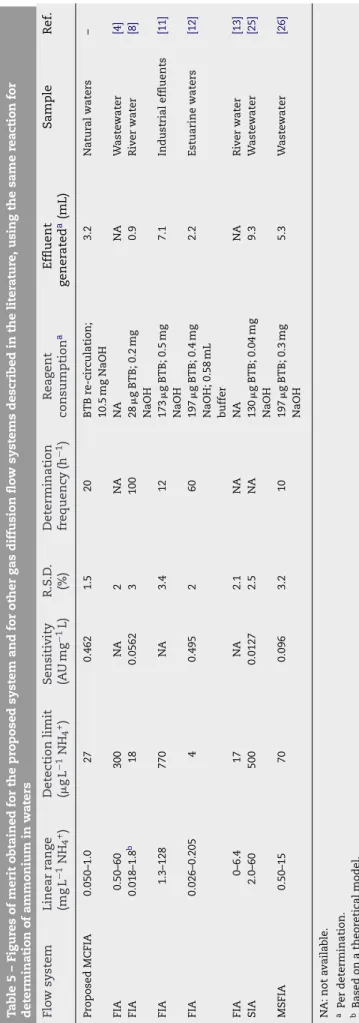
Experimental Certified value and acceptance limit Deionised water 100.3± 1.0a 100.9 Surface water 100.5± 1.6a 100.2–101.5 Tap water 101.0± 1.2a a Standard deviation (n = 10). Ta b le5–F igur es of mer it obtained for the pr oposed system and for other gas diffusion flo w systems descr ibed in the liter a tur e, using the same reaction for determina tion of ammonium in w a ters Flo w system Linear rang e (mg L − 1NH 4 +) Detection limit ( gL − 1NH 4 +) Sensiti vity (A U m g − 1L) R.S .D . (%) Determination frequenc y (h − 1) Rea g ent consumption a Effluent g ener ated a(mL) Sample Ref. Pr oposed MCFIA 0.050–1.0 27 0.462 1.5 20 BTB re-cir culation; 10.5 mg NaOH 3.2 Natur al w aters – FIA 0.50–60 300 N A 2 N A N A N A W aste w ater [4] FIA 0.018–1.8 b 18 0.0562 3 100 28 g BTB; 0.2 mg NaOH 0.9 Ri v e r w ater [8] FIA 1.3–128 770 N A 3.4 12 173 g BTB; 0.5 mg NaOH 7.1 Industrial effluents [11] FIA 0.026–0.205 4 0.495 2 6 0 197 g BTB; 0.4 mg NaOH; 0.58 mL buffer 2.2 Estuarine w aters [12] FIA 0–6.4 17 N A 2.1 N A N A N A Ri v e r w ater [13] SIA 2.0–60 500 0.0127 2.5 N A 130 g BTB; 0.04 mg NaOH 9.3 W aste w ater [25] MSFIA 0.50–15 70 0.096 3.2 10 197 g BTB; 0.3 mg NaOH 5.3 W aste w ater [26] N A : not a v aila b le . a P e r determination. b Based on a theor etical model. Interference studies
concentration of 10.0 mg L−1was also evaluated. None of the studied species revealed to interfere in the flow methodol-ogy, since the obtained relative deviations were lower than 5% of the peak signal for an ammonium standard of 100g L−1. Regarding volatile amines[18], interference was not expected in natural waters due to their low content (usually at least 100 times lower than ammonium).
Water samples were injected into the flow system with re-circulation of the acceptor stream, and the ammonium concentration was calculated by interpolation of a previously established calibration curve.
To assess the accuracy of the methodology, recovery assays in surface and tap waters were performed. Recovery values close to 100% were achieved in the four levels of concentration studied for surface and tap waters (Table 3).
To further validate the accuracy of the method, the certified reference material was prepared in different types of waters (as recommended by the manufacturer) and injected in the proposed flow manifold. The results of the analysis and the corresponding standard deviations are presented inTable 4. The obtained ammonium concentrations were included in the acceptance limits mentioned in the certified material specifi-cations.
The repeatability of the system was assessed from 10 consecutive injections of the certified material prepared in different water samples. The corresponding relative standard deviation values were lower than 1.5%.
Conclusions
The proposed flow approach combines the advantages of multi-commuted and flow injection systems. The position-ing of the propulsion device before the commutation valves produces a positive pressure facilitating the incorporation of the mass separation device and avoiding the formation of air bubbles. It also permits reagents re-circulation, introducing only the required amount for the determination. Additionally, stopped-flow methods are easily accomplished, as well as the use of variable injection volumes.
The system demonstrated robustness and good accu-racy, indicated by the certified sample results and the good recoveries, achieved with distinct water samples. The pro-posed flow system was compared with other GD-flow analysis methods for ammonium determination based on the same reaction and detection system (Table 5). The method described herein reveals sufficient sensitivity and detection limit to be applicable to natural waters with low levels of ammonium. Additionally, it can be an advantageous alternative for ammo-nium determination as it consumes a very limited amount (green chemistry) of the BTB reagent considered a slightly pol-luting substance, produces low effluent volumes and makes use of simple and low cost instrumentation.
Acknowledgements
Sara Oliveira and Ildik ´o T ´oth thank Fundac¸ ˜ao para a Ci ˆencia e a Tecnologia (FCT) and FSE (III Quadro Comunit ´ario) for the grants SFRH/BD/23782/2005 and SFRH/BPD/5631/2001, respec-tively. The authors are also grateful to Departamento de Qu´ımica F´ısica da Faculdade de Farm ´acia da Universidade do Porto.
r e f e r e n c e s
[1] B.F. Reis, M.F. Gin ´e, E.A.G. Zagatto, J.L.F.C. Lima, R.A. Lapa, Anal. Chim. Acta 293 (1994) 129.
[2] V. Cerd `a, J.M. Estela, R. Forteza, A. Cladera, E. Becerra, P. Altimira, P. Sitjar, Talanta 50 (1999) 695.
[3] International Organization for Standardization, ISO 11732, 2005.
[4] A. Cerd `a, M.T. Oms, R. Forteza, V. Cerd `a, Anal. Chim. Acta 311 (1995) 165.
[5] R. Tryzell, B. Karlberg, Anal. Chim. Acta 308 (1995) 206. [6] G. Schulze, C.Y. Liu, M. Brodowsky, O. Elsholz, W. Frenzel, J.
Moller, Anal. Chim. Acta 214 (1988) 121.
[7] W.E. van der Linden, Anal. Chim. Acta 151 (1983) 359. [8] M. van Son, R.C. Schothorst, G. den Boef, Anal. Chim. Acta
153 (1983) 271.
[9] J.F. van Staden, Anal. Chim. Acta 261 (1992) 453.
[10] R. Nakata, T. Kawamura, H. Sakashita, A. Nitta, Anal. Chim. Acta 208 (1988) 81.
[11] K.N. Andrew, P.J. Worsfold, M. Comber, Anal. Chim. Acta 314 (1995) 33.
[12] S.M. Gray, P.S. Ellis, M.R. Grace, I.D. McKelvie, Spectrosc. Lett. 39 (2006) 737.
[13] J.R. Clinch, P.J. Worsfold, F.W. Sweeting, Anal. Chim. Acta 214 (1988) 401.
[14] S.W. Willason, K.S. Johnson, Mar. Biol. 91 (1986) 285. [15] C. Pasquini, L.C. Faria, Anal. Chim. Acta 193 (1987) 19. [16] B.F. Reis, J.A. Vieira, F.J. Krug, M.F. Gin ´e, J. Braz. Chem. Soc. 8
(1997) 523.
[17] X. Su, L. Nie, S. Yao, Talanta 44 (1997) 2121.
[18] P.O.J. Hall, R.C. Aller, Limnol. Oceanogr. 37 (1992) 1113. [19] P.B. Martelli, J.A.G. Neto, E.A.G. Zagatto, S.M.B. Brienza,
M.C.B.S.M. Montenegro, J.L.F.C. Lima, Anal. Chim. Acta 317 (1995) 239.
[20] J.F.C.C. Lima, C. Delerue-Matos, M.C. Vaz, Anal. Chim. Acta 385 (1999) 437.
[21] R. Liu, B. Sun, Anal. Lett. 30 (1997) 1255.
[22] A.M.R. Ferreira, J.L.F.C. Lima, A.O.S.S. Rangel, Aust. J. Soil Res. 34 (1996) 503.
[23] R.J. Watson, E.C.V. Butler, L.A. Clementson, K.M. Berry, J. Environ. Monit. 7 (2005) 37.
[24] R. Liu, B. Sun, I. Johns, Analyst 120 (1995) 2845.
[25] M.T. Oms, A. Cerd `a, A. Cladera, V. Cerd `a, R. Forteza, Anal. Chim. Acta 318 (1996) 251.
[26] J. Klimundov ´a, R. Forteza, V. Cerd `a, Int. J. Environ. Anal. Chem. 83 (2003) 233.
[27] J.S. Canham, G. Gordon, G.E. Pacey, Anal. Chim. Acta 209 (1988) 157.
[28] Z. Zhi, A. R´ıos, M. Valc ´arcel, Anal. Chim. Acta 293 (1994) 163. [29] International Union of Pure and Applied Chemistry (IUPAC),
Pure Appl. Chem. 67 (1995) 1699. Determination of ammonium in water samples