Dissertation Advisor:
Ph.D. PROFESSOR ANDRÉ MATA Dissertation Seminar Coordinator:
Ph.D. PROFESSOR TERESA GARCIA-MARQUES
A dissertation submitted as a partial fulfilment of the requirements for the degree of: MASTER IN PSYCHOLOGY
Specialization in Social and Organizational Psychology 2017
SOCIAL FILTERING OF
REASONING PROBLEMS
MAFALDA FONTINHA
AZEVEDO MASCARENHAS
II
Master’s dissertation conducted under the orientation of Ph.D. Professor André Mata, presented at ISPA – Instituto Universitário to obtain the degree of Master in the specialty of Social and Organizational Psychology.
III
Acknowledgments
Não podia escrever esta página em inglês, porque há coisas que só se conseguem escrever e descrever na nossa língua materna.
Não podia passar por esta página, sem um agradecimento muito especial aos meus pais, que embora já não estejam presentes na minha vida, foram os meus primeiros educadores, aqueles que me deram os recursos para aprender, que me estimularam a querer sempre saber mais e que me mostraram que devemos lutar por aquilo em que acreditamos; sobretudo à minha mãe que me disse que podia ser o que quisesse, mas que fosse a melhor. Quero também agradecer aos meus padrinhos, na ausência dos meus pais, estiveram sempre presentes nos momentos importantes, que me apoiaram por entre indecisões do caminho a seguir, que me ajudaram a olhar de outros lados para os mesmos problemas. Sem eles, eu não teria chegado ao fim deste percurso.
Quero também agradecer ao meu namorado que, apesar de às vezes não me deixar trabalhar, me mostrou que descansar também é importante e que o amor é mais importante que tudo o resto. Mas sobretudo, tenho que lhe agradecer não como namorado, mas como colega de curso porque sempre acreditou nas minhas capacidades, ensinou-me a gostar desta faculdade e incentivou-me a seguir os meus sonhos. Obrigada também pelas discussões infinitas sobre psicologia, em que nunca chegamos a consensos, e muitas vezes acabamos chateados, mas que me ajudam a ir para lá daquilo que consigo ver quando penso nestes temas sozinha.
Queria agradecer à Carolina e à Eliana, porque é muito mais fácil fazer trabalhos pela noite dentro, quando estamos com as nossas amigas. E porque me aturaram nos meus dias de mau feitio puro. Um obrigada também ao Pedro, que se juntou mais tarde à equipa, mas com quem pude partilhar o gosto pela investigação e a esperança até ao último momento de entrega.
Depois quero agradecer ao meu orientador, o Professor André Mata, que acreditou nas minhas competências de investigação e me deu uma oportunidade de seguir este sonho. Um
IV
obrigada também pela calma que me transmitiu ao longo de todo este processo que é escrever uma tese.
Quero agradecer à Professora Teresa Garcia-Marques, coordenadora no seminário de tese, que nos acompanhou todas as semanas, com paciência e conselhos, mesmo quando parecia que as nossas teses estavam estagnadas no tempo. Obrigada por acreditar nas nossas capacidades, mas sobretudo obrigada pela exigência, pelos prazos e pelas discussões, sem as quais esta tese não seria possível.
Ao Professor Pedro, que apesar de ser o meu orientador do seminário de estágio, também me foi ajudando a gerir o meu tempo e as minhas emoções por todo este percurso que é escrever uma tese e que certamente será útil nos próximos anos, espero, como futura investigadora.
A todos os outros professores do mestrado em Psicologia Social e das Organizações pelo que me ensinaram, mas sobretudo pela boa disposição e disponibilidade para os alunos. Estiveram connosco em jantares de turma, na organização de eventos, acompanharam-nos no nosso percurso e agora vêem-nos a partir.
Para terminar, quero agradecer também aos professores da licenciatura. Uns foram mais inspiradores que outros, uns ensinaram mais teoria, outros mostraram-nos outras coisas muito mais importantes, mas todos contribuíram para a pessoa que sai deste curso.
V
Resumo
Em estudos anteriores verificou-se que pessoas que resolvem problemas de raciocínio de forma intuitiva diferem daquelas que os resolvem de forma deliberativa na sua capacidade de prestar atenção à informação crítica (Mata et al., 2014, 2017). Neste estudo, iremos utilizar recordações livres para compreender melhor este fenómeno. É esperado que as pessoas que raciocinam de forma intuitiva não recordem as partes críticas.
Este estudo tem também como objetivo compreender o impacto social destas representações incorretas. Para tal, utilizou-se um paradigma de reprodução serial. Se os participantes receberem reproduções incorretas, eles acabarão por dar uma resposta incorreta, uma vez que estão a raciocinar com base em premissas erradas. Mesmo que tenham conhecimentos lógicos que lhes permitam chegar à resposta certa, não serão capazes de o fazer se os problemas que lhes são transmitidos não tiverem informação suficiente.
Foi pedido a cada participante que respondesse a três problemas e que escrevesse uma recordação do problema que tinha acabado de ler, o mais exata possível.
Confirmou-se uma correlação significativa positiva entre a precisão da memória e a performance, bem como um efeito ao longo das gerações, já que à medida que mais erros se iam acumulando na reprodução dos problemas, mais erros resultavam daí.
Para resolver problemas de raciocínio, não chega uma boa capacidade de raciocínio é também necessária a capacidade de representar corretamente o problema na mente. O efeito ao longo das gerações é relevante num mundo onde estamos constantemente a receber informações dos outros.
Palavras-chave: reprodução serial; problemas de raciocínio; deteção de conflito; filtragem
VI
Abstract
Previous studies have found that intuitive problem-solvers differ from deliberative ones in their ability to pay attention to critical information in a problem (Mata et al., 2014, 2017). In this study, we will use free recall to further explore these processes. It is expected that intuitive problem-solvers fail to recall those critical parts.
This study also addresses the social impact of those incorrect representations. To do so, a serial reproduction paradigm was used. If participants receive a misrepresented problem, they are bound to give an incorrect answer, as they are reasoning based on wrong premises. Even if they have logical knowledge that allows them to give a right answer, they will not be able to do it if the problems they read do not have enough information.
Participants were asked to answer three reasoning problem, one at a time and reproduce the problem they just read as accurately as possible.
We found a significant correlation between reasoning performance and accuracy of memory, as well as a downstream effect throughout the generations, as more and more errors accumulated in the reproduction of the problems, and consequently more and more reasoning errors resulted from that.
To solve reasoning problems, not only a good reasoning ability is needed, but also an ability to correctly represent the problem in the mind. The effect found throughout the generations is relevant in a world where we are constantly receiving information from other people.
Key-words: serial reproduction; reasoning problems; conflict detection; social filtering;
VII
Index
Acknowledgments ... III List of tables and figures ... X Tables ... X Figures ... XI
Introduction ... 1
Problem ... 1
Detection of conflict in reasoning problems ... 2
Serial Reproduction ... 5
Approach to the problem ... 8
Method ... 11
Participants ... 11
Design ... 11
Materials ... 12
Procedure... 14
Replacement of invalid recalls ... 15
Dependent variables ... 16
Results ... 18
Participants considered for the data analysis ... 18
Computation of dependent variables ... 18
VIII
Hypotheses testing ... 20
Discussion ... 22
Hypothesis confirmation ... 22
Implications ... 23
Limitations and Future studies ... 25
Conclusion ... 27
References ... 28
Appendices ... 30
Appendix 1 - Literature Review ... 31
Index ... 31
Introduction ... 32
Serial Reproduction ... 32
Conflict detection in reasoning problems ... 37
Cognitive processes involved ... 40
Conclusion ... 42
References ... 43
Appendix 2 – Tables ... 45
Method ... 45
Results ... 50
Appendix 3 – Generation 1 questionnaire (with original problems) ... 55
IX
Recalls from the first generation (with replacements) ... 58 Recalls from the second generation (with replacements) ... 66 Recalls from the third generation ... 74
Declaration of Originality
I declare on my word of honour that the work presented is original and all the citations are correctly identified. I am aware that the utilization of non-identified elements of
X
List of tables and figures
Tables Table 1 ... 2 Table 2 ... 12 Table 3 ... 13 Table 4 ... 16 Table 5 ... 17 Table 6 ... 45 Table 7 ... 45 Table 8 ... 45 Table 9 ... 46 Table 10 ... 46 Table 11 ... 46 Table 12 ... 47 Table 13 ... 47 Table 14 ... 48 Table 15 ... 48 Table 16 ... 49 Table 17 ... 50 Table 18 ... 50 Table 19 ... 50 Table 20 ... 51 Table 21 ... 51 Table 22 ... 52 Table 23 ... 52
XI
Figures
Figure 1 – Mean Deliberative answers to the original problem ... 19 Figure 2 – Double mediation model ... 21
1
Introduction
Problem
Often, we associate the ability to answer a reasoning problem exclusively to the ability a certain person has to arrive to a right answer. But previous studies (Mata, Schubert, & Ferreira, 2014; Mata, Ferreira, Voss, & Kollei, 2017) have found that when reading reasoning problems, incorrect responders tend to pay less attention to all the premises which are necessary to solve the problem correctly. Will they also misremember the problem? This would mean that they might be basing their answers in the wrong premises, which can be the cause of their incorrect responses.
Moreover, what is the social impact of misremembering the problem? In a society where we seldom go to the source, we hear a lot of stories that are told to us by others. We think we are the generation with the most information ever, but most of us live by the stories that others tell us. This creates a problem: can we rely on information that is told to us by other people? We know from Bartlett’s (1932/1972) classic studies that in transmitting information, a lot of details can get lost. In the particular case of reasoning problems, when information is lost by one person’s recall how will that impact the answers of the next responders?
Previous studies found that the difference between intuitive and deliberative responders might not be a mere matter of logical knowledge, but also a matter of proper reading and comprehension (Mata et al., 2014). People do not read properly the problems and ignore critical information that allows for a correct resolution of the problem, and that is why they sometimes respond incorrectly. If they were to retell the problem to another person, would they be able to reproduce it properly? Our hypothesis is that if they are unable to spot the conflict when they first encounter it, and afterwards try to reproduce the problem, they will do so in a distorted manner, which does not preserve the conflict. Therefore, other people who receive the misremembered problem will inevitably end up giving the same answer that the one who
2
reproduced it, since they do not have information to arrive at the correct answer. Not because they did not know how to solve the problem, but because they were not told the right problem.
Detection of conflict in reasoning problems
Cognitive reasoning problems (CRT) have a deliberative or intuitive answer. The most know example is the classic problem of the bat and the ball, where the bat costs 1 dollar more than the ball. And the question is how much does the ball cost? The key component in this problem is the presence of a conflict, an element that creates two possibilities of resolution: one that most often comes to the mind (ten cents) and another that comes after a longer thinking period (five cents). This element is the “more than”. Intuitive responders tend to answer ten cents, since they read the problem as if it said: “the bat costs 1 dollar” and miss the “more than the ball”. On the other hand, deliberative responders take into consideration all the sentence. They might think about the intuitive answer (Mata, Ferreira, & Sherman, 2013), but end up arriving to the right answer: five cents.
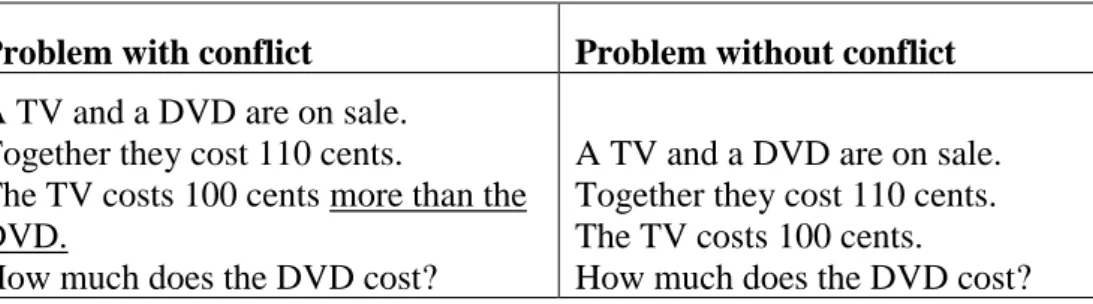
Table 1- Conflict and no-conflict version of a CRT type problem Problem with conflict Problem without conflict
A TV and a DVD are on sale. Together they cost 110 cents.
The TV costs 100 cents more than the DVD.
How much does the DVD cost?
A TV and a DVD are on sale. Together they cost 110 cents. The TV costs 100 cents. How much does the DVD cost?
Recent studies found that the ability to solve this kind of problems might not be only a matter of logical knowledge, but also of a process that precedes the reasoning about the problem. When people read the problem, some do not pay attention to all the information in it. In a CRT problem, if people do not pay attention to the conflict (the underlined part of the problem in Table 1), they will not be able to give a correct answer, as they end up answering to the no-conflict version of the problem (see the no-conflict version of the problem in Table
3
1). This means that attentional processes might as well have an important role in the resolution of this type of problems.
There are various explanations for why some people give an intuitive or a deliberative answer. A theory by De Neys and Bonnefon (2013) focuses on the moment when the bias might occur in the reasoning process. They propose that theories of bias can be situated in three moments:
• a “storage failure” - at an earlier stage, when it is considered that intuitive responders do not have the knowledge to solve this type of problems;
• a “monitoring failure” - proposes that intuitive responders are unable to monitor the conflict in the problem;
• a “inhibition failure” - bias can occur at a later stage takes place, when it is proposed that conflict is monitored, but there is a failure to inhibit the intuitive answer.
A different explanation might be at hand for explaining individual differences in reasoning problems: a representation or comprehension failure, in which subjects “seem to fail to represent or understand the problem accurately” (Mata et al., 2017, p. 6).
The inaccurate representation of information read is already discussed in psycholinguistics. There is evidence that sentences are not exhaustively analysed and that we are happy to store merely good enough-representations (Barton & Sanford, 1993; Erickson & Mattson, 1981; Ferreira, Bailey, & Ferraro, 2002). Ferreira et al. (2002) propose a good-enough representation theory of language processing. According to them “comprehension is more shallow and incomplete than psycholinguists might have suspected” (Ferreira et al., 2002, p. 14). Representations of a sentence are often incomplete and supported by the context or the compreehender schemas. Good enough representations allow people to communicate in a more efficient way. Paradoxically they might cause problems in communication. In the example of
4
a reasoning problem, a good enough representation such as a version of the problem without the conflict (see Table 1) might be faster to process and to answer, but it will result in an incorrect answer and the loss of important information.
The good-enough representation might result from selective attention, similar to the processes that happen when change blindness occurs, since the inability to detect change might result from a lack of attention towards the critical parts of the text (Sturt, Sanford, Stewart, & Dawydiak, 2004).
Erickson and Mattson (1981), divide sentence comprehension in three processes: an encoding process, a lexical access process and a construction process. On the last process only a global representation of the sentence is stored. This representation might not include all the information read.
Mata et al. (2014) studied if an incorrect representation of the problem could be the cause for intuitive responses. A good-enough, but incomplete, representation of the problem could lead people to give “right answers to the wrong questions” (Mata et al., 2014, p. 462). A good representation of the problem would be one that preserves the conflict, as opposed to a good-enough representation which would not preserve the conflict, but in which the subject would be confident enough – see Table 1. Across a series of studies, a change detection paradigm was used to test whether people who solved a problem deliberatively differed from the ones who solved the problem intuitively in their ability to correctly identify the conflict. After solving each problem, participants were presented with either the same version of the problem or a no-conflict version of the same problem (see Table 1) and asked if they detected any changes from the first to the second problem. In all studies, it was found that performance was positively correlated with conflict detection, providing evidence that a good representation, and not merely a good-enough (e.g., a bat and a ball cost 110 cents, the bat cost 100 cents, how much is the ball?) representation of the problem is needed to answer correctly. Moreover,
5
detection of irrelevant changes did not predict a better performance on reasoning problems. In this study a two stage pattern of bias emerged, since some incorrect responders were able to implicitly detect conflict, which could be misrepresenting the conflict in the problem (Mata et al., 2014). This provides evidence that conflict monitoring and conflict representation are two different processes and that the occurrence of conflict detection does not imply a correct representation, neither does the absence of a correct representation imply that there was no conflict monitoring.
Another study used eye-tracking, it was found that deliberative problem-solvers spend significantly more time paying attention to the conflict which means that attention might be crucial to the reasoning process (Mata et al., 2017). Even if intuitive responders spend more time reasoning, if they do not focus their attention in the conflict, they would hardly arrive to a right answer. Correct responders distinguish conflict from the no-conflict version of the problems, in that they spend more time looking at the critical part of the problem. Incorrect responders did not pay more attention to any of the sentences of the conflict version than to the sentences of the no-conflict version. Only attention to the critical premise was correlated with performance.
Serial Reproduction
We were not only interested in the intra-individual consequences of misrepresenting the problem, but we were also interested in understanding how the misrepresentation of one person could affect other people responses. Hence, we decided to use a serial reproduction paradigm to understand what would be the social impact of misrepresenting the problem.
The serial reproduction paradigm refers to the reproduction of information throughout a chain of people. The first one receives an original piece of information and should reproduce it to another participant, which in turn receives the information and should reproduce it again
6
to the next one. The process goes on consecutively, resulting in a distortion of the initial information transmitted (Bartlett, 1932/1972). In serial reproduction, each set of participants in a particular moment is called a generation. A chain is a series of reproductions (e.g., in this study we used three generations of participants, with 30 participants in each generation, meaning we have 30 chains with 3 recalls each).
Initially Bartlett (1932/1972), experimented on serial reproduction of folk-stories, descriptive and argumentative prose passages and pictures. In his studies, participants read the passages twice and after a 15 to 30 minutes interval were asked to reproduce it. He found that the passages tended to become smaller, loose supernatural or non-scientific elements, becoming more rational.
Bartlett (1932/1972) identified some of the processes involved in the distortion of the information such as:
• omissions - when a certain part of the text disappears;
• rationalisation – the need to understand the text as a whole, connecting parts that might not be connected and rational interpretations for the information provided;
• transformation of detail – transforming unfamiliar information to more familiar one, this type of change tends to persist throughout the generations (e.g., transformation of strange names to more familiar names);
• and, order of events – change of the order of events to give more. In the case of the present thesis, we are mainly interested in the omission of the conflict in each problem.
His most notorious finding was that after a few generations, the reproductions “would hardly ever be connected to the original” (Bartlett, 1932/1972, p. 171). Bartlett notes that despite that: “the subjects may be very well satisfied with their efforts, believing themselves to
7
have passed on all important features with little or no change, and merely, perhaps, to have omitted unessential materials” (Bartlett, 1932/1972, p. 175). This means that not only do participants transform the text in a way that could hardly be connected to the original, but they are also unware of this and confident in their reproduction.
Though many authors focus on the inaccuracy of the memory processes described by Bartlett (Brissey, 1961), Ost and Costall (2002) highlight that Bartlett proposed a schema theory of memory, implying that material which is consistent with a previous schema will be better remembered. Therefore, a reproduction accuracy depends upon conditions of information processing and previous schemas (Ost & Costall, 2002).
Though acknowledged for his findings on serial reproduction, Bartlett (1932/1972) is often considered to have lacked the scientific rigorousness of more modern days. Despite that, the effect was reproduced many times in more controlled conditions (e.g., Allport & Postman, 1947/1965; Bangerter, 2000; Lyons & Kashima, 2006).
Following Bartlett’s studies, serial reproduction became a paradigm to study the transmission of information and has been mainly used to study rumours, stereotypes and cultural transmission (e.g., Kashima, 2000). Some studies use images (Allport & Postman, 1947/1965) or stories (Kashima, 2000) that often have incongruent and/or ambiguous information that can lead to distortion.
Kashima (2000) has used serial reproduction to study the recall of stereotype consistent and inconsistent information in five-people chains. He found that individually, people recall more stereotype inconsistent information, but collectively more stereotype consistent information is preserved, which could be due to either a lack of motivation by the last members of the chain or a choice to communicate only what you can make sense of (at the end of the chain, what you can make more sense of is stereotype consistent information)(Kashima, 2000). He also found a tendency to recall more stereotype consistent than inconsistent information
8
when they had an intention to communicate (Lyons & Kashima, 2006), versus a situation where they were only remembering information. When people perceive their stereotypes to be shared with their listener, they are more likely to pass on more stereotype consistent information (Clark & Kashima, 2007).
The method of serial reproduction has not yet been used to study the transmission of reasoning problems. Bartlett (1932/1972) found a tendency to eliminate information which is not congruent with the representation formed (Allport & Postman, 1947/1965; Bartlett, 1932/1972). In this study, we are expecting that the conflict in the problem (the underlined sentence in Table 1) might be lost if people do not form a correct representation of the reasoning problem.
Approach to the problem
If an incorrect representation of the problem is present, the ability of incorrect responders to reproduce the problem will be affected and that might have an impact on the information that passes on to the next generation. An incorrect representation of the problem might have an impact not only at an individual level, but might result in a collective inability to solve the problem correctly.
Serial reproduction was never used to study the transmission of reasoning problems. Conversely, conflict detection of reasoning problems was never studied with the use of free recall to access representations, neither was the social impact of misrepresenting the problems investigated.
Previous studies have used different methods to access the representation of the problem, namely: a change detection paradigm, where participants are shown a similar or different sentence and asked if they detect any changes (Mata et al., 2014). To detect changes, people have to compare the problem they are reading to the one that they have previously read
9
and that would be stored in their minds. Another study, used eye-tracking to trace the attention participants pay to certain parts of a problem (Mata et al., 2017). If participants do not pay attention to a certain part of a problem, it is unlikely that they will correctly store it in their memory.
In the present dissertation, we want to merge both literatures and will use a serial reproduction paradigm to study the transmission of reasoning problems. We will analyse results both at an intra-individual level, assessing the relation between performance and accuracy of the memory of each participant, and at a collective level, assessing the impact of misrepresenting the problem throughout generations.
Our first hypothesis is that intuitive problem-solvers will make an incorrect representation of the problem in their minds and as a result they will not be able to reproduce the problem with the conflict. Therefore, throughout the generations there will be fewer and fewer problems with the conflict preserved, since participants will read less and less problems with the conflict preserved.
That leads us to our second hypothesis that by the last generation, since participants do not have access to the information that allows them to deliberate, there will be fewer deliberative answers. We will check if participants would give a deliberative answer to the original problem, by giving them both the (potentially distorted) recall of another participant and the original untransformed problem. This will allow us to know if the expected decrease in deliberative answers is due to participants not being able to arrive at a deliberative answer, or a result of participants in subsequent generations reading less problems with the conflict preserved.
The independent variable is the generation to which participants were assigned. Participants were assigned to the generation by order of participation.
10
Other than generation, no variables were systematically assigned to participants. We collected the participants answer to the recall, the recall produced by the participant and the answer to the original problem.
All participants will answer each problem twice, the first time they will see a recall (first-generation participants will read the original problem) and the second time all participants will be presented with the original problem. This allowed us to know if they would give an intuitive or deliberative answer to the original problem, when the first problem presented had no conflict (on the first-generation all participants read the original problem twice).
11
Method
Participants
Questionnaires were collected using Prolific. Prolific is a sample pool where participants are paid to answer questionnaires. We collected a sample of 30 participants per generation, over 3 generations, making a total of 90 participants who will be considered for the data analysis.
Since the experiment was held online in English, a filter was used for participants who were English natives. Three participants indicated another native language in the questionnaire (two referred French and one German, corresponding to 3.3% of participants) – see Table 6 – Appendix 2. Concerning nationalities, 59 were British (65.6%), 20 American (22.2%) 5 Canadian (5.6%), 2 Indians (2.2%) and one Singaporean, one Irish and one German (1.1% each) – see Table 7 – Appendix 2.
Participants were aged, on average, 34.18 years old (DP=11.87) – see Table 8 – Appendix 2. A One-Way ANOVA was performed to check for significant differences in age between generations. Mean age was not significantly different between generations, F(2,87) =1.18, p=.31 – see Table 9 – Appendix 2.
Lastly, relative to gender, 60 were men (66.7%) and 30 were women (33.3%) – see Table 10. A chi-square test was performed to examine if there are significant differences of gender between generations. Differences between generations are marginally non-significant, 2(2, N = 90) = 57, p =.06– see Table 11 – Appendix 2.
Design
This is a between subjects design in which participants are assigned to a generation in participation order (the first 30 are assigned to the first generation, the next 30 to the second
12
one and the last 30 to the third one). There is an experimental hypothesis and a correlational one.
Materials
The study was programmed in SoSci Survey. We used three CRT type problems that had already been used in a previous study (see Appendix 3).
Since we needed to use the answers produced by the previous generation for the next one, we always needed an intermediary phase where we analysed the content produced by each participant and validated it. Materials for the three generations differ as described below.
Original materials (1st generation)
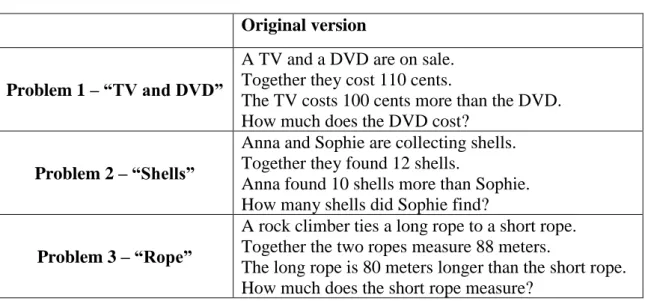
All the problems had a “bat and ball” structure: “a sum of two things is x”; “one is more y than the other”; “how much is the other?”. Problems had all the same structure and were previously used in a study that used a conflict detection paradigm with reasoning problems (Mata et al., 2014) – see below in Table 2 – Original problems usedTable 2 all the problems used.
Table 2 – Original problems used
Original version
Problem 1 – “TV and DVD”
A TV and a DVD are on sale. Together they cost 110 cents.
The TV costs 100 cents more than the DVD. How much does the DVD cost?
Problem 2 – “Shells”
Anna and Sophie are collecting shells. Together they found 12 shells.
Anna found 10 shells more than Sophie. How many shells did Sophie find?
Problem 3 – “Rope”
A rock climber ties a long rope to a short rope. Together the two ropes measure 88 meters.
The long rope is 80 meters longer than the short rope. How much does the short rope measure?
13
Validation of problems for the other generations
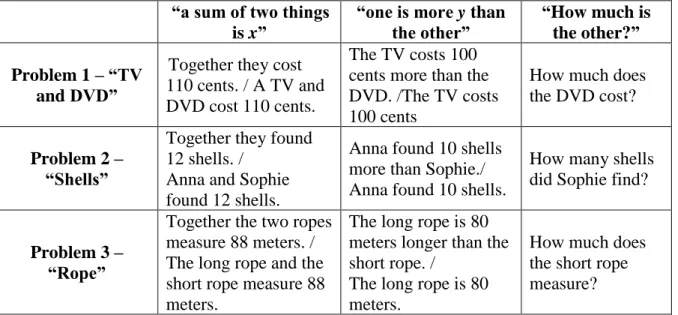
Problems to be presented to the next generation were selected from the ones provided by participants of the first generation. Each problem had three parts that had to be present for a recall to be considered valid – see Table 3 below for a detailed analysis of each problem.
Table 3 – Structure of the problems used “a sum of two things
is x”
“one is more y than
the other” “How much is the other?” Problem 1 – “TV
and DVD”
Together they cost 110 cents. / A TV and DVD cost 110 cents.
The TV costs 100 cents more than the DVD. /The TV costs 100 cents
How much does the DVD cost?
Problem 2 – “Shells”
Together they found 12 shells. /
Anna and Sophie found 12 shells.
Anna found 10 shells more than Sophie./ Anna found 10 shells.
How many shells did Sophie find?
Problem 3 – “Rope”
Together the two ropes measure 88 meters. / The long rope and the short rope measure 88 meters.
The long rope is 80 meters longer than the short rope. /
The long rope is 80 meters.
How much does the short rope measure?
This selection had as criteria of elimination:
a) recalls which missed at least one of the critical statements: “a sum of two things is x” or “one is more y than the other” (e.g., “Tv cost 100 more, both 110.”);
b) if a recall just failed to have a question (i.e., How much is the other?) we introduced the original question from the problem at the end of the recall;
c) recalls which were ambiguous or undefined (e.g., “Anna and Sophie collecting shells, 12 Anna had 10 more”);
d) recalls which gave the answer to the problem (e.g., A climber ties two ropes together. The longer one is 80m long, the other is 8 metres long);
e) Spelling, grammatic and inconsistencies were corrected (e.g., “Tv and dvd” was replaced by “TV and DVD”), but we did not correct different names given to the characters or change units (e.g., “pounds” to “cents” or “Michelle” to “Sophie”);
14
f) each recall was adapted in such that any comments on the problem, quality of the story or answers to the problem were excluded (e.g., A climber ties two ropes together. The longer one is 80m long, the other is 8 metres long).
Procedure
Participants were welcomed to the study and asked to give their consent. They were informed that they were free to leave the study at any time.
After giving their consent, they were asked questions about gender, age, nationality and native language. In the first generation, they were then presented three problems.
For each problem, they had to complete three tasks: answer the problem, recall it and answer it again. On the first screen, they were asked to solve the problem, in the next screen they were asked to recall the problem they had just seen and write it down as precisely as possible. And in the third screen they were presented the same (original) problem and told they could see the same or a slightly different problem. If it were to be the same, they should answer the same, if it was different from the previous one, they should answer differently. This would allow to understand if given the correct information (the conflict version of the problem) participants would be able to give a deliberative answer. This process was repeated three times, with three different problems. The order of the problems was randomly assigned.
Only on the first generation they saw the exact same problem twice, this step was present so we could compare data between generations and the procedure would be equal throughout generations. For the other two generations, the procedure was the same, but the first time the problem was presented it was not in its original version but rather the recall from the previous participant of that chain. After answering the problem, the previous participant had written, the participant was asked to recall this problem and lastly shown the original problem
15
(here again they were told they could see the same problem or a slightly different one and that they should answer differently, if they thought the problem was different).
Lastly, participants were thanked for their participation and redirect to the prolific completion page to prove they have completed the study.
Participants recall was not only used to be presented to the next generation, but we are also interested in evaluating if recalls preserved the conflict.
Participants who had at least a valid story were kept in the study and only their invalid problems were replaced. All the participants who had more than a valid story were placed as the first member of one of the 30 chains. To replace invalid problems, we had to collect more answers and then randomly assign recalls to replace the problems that were missing.
Replacement of invalid recalls
On the first-generation problems, twelve recalls were invalid. Since we could not use invalid problems, and we needed three problems in each chain, we collected more answers to make up for those invalid recalls. On the first generation, problems collected in this second moment were then randomly assigned to each chain.
For the second generation, a total of eleven recalls were invalid. To have complete chains, when a participant had at least one invalid recall, we collected again the same chain where invalid recalls were present, even if just one recall was invalid. Therefore, we re-collected answers for seven chains.
On the third generation only one collection was necessary, since the recalls from those participants would not be used. All the problems used can be found in appendix 3.
16
Dependent variables
Summing up, we collected a recall and two answers for each problem. The first-time participants could be presented the original problem (only in the first generation) or a recall (on the second and third generation) and the second time they would answer the original problem.
Recalls
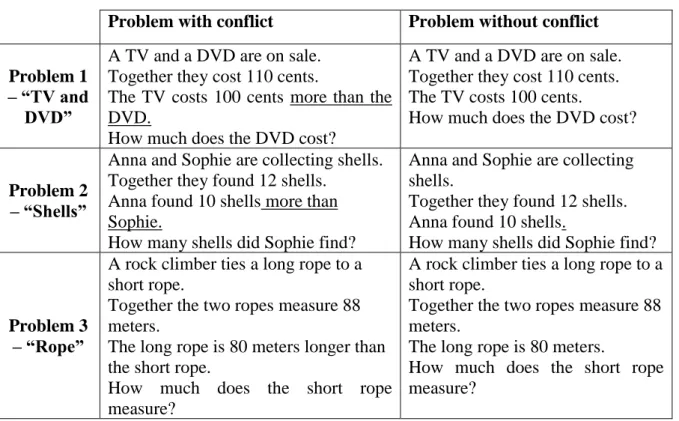
Other than validating the problems, we evaluated the presence of conflict on a recall: for each problem, we assessed if conflict was present (see Table 4 for a conflict and no-conflict version of each problem). This process was conducted by two people. The first one made the first classification, the second one reviewed that classification and lastly the first one rechecked if everything was correctly assessed.
Table 4 – Problems with and without the conflict
Problem with conflict Problem without conflict
Problem 1 – “TV and
DVD”
A TV and a DVD are on sale. Together they cost 110 cents.
The TV costs 100 cents more than the DVD.
How much does the DVD cost?
A TV and a DVD are on sale. Together they cost 110 cents. The TV costs 100 cents. How much does the DVD cost?
Problem 2 – “Shells”
Anna and Sophie are collecting shells. Together they found 12 shells.
Anna found 10 shells more than Sophie.
How many shells did Sophie find?
Anna and Sophie are collecting shells.
Together they found 12 shells. Anna found 10 shells.
How many shells did Sophie find?
Problem 3 – “Rope”
A rock climber ties a long rope to a short rope.
Together the two ropes measure 88 meters.
The long rope is 80 meters longer than the short rope.
How much does the short rope measure?
A rock climber ties a long rope to a short rope.
Together the two ropes measure 88 meters.
The long rope is 80 meters.
How much does the short rope measure?
We will use two measures: the mean of recalls where conflict was preserved and the mean of problems read with conflict. The first measure reports to the recalls that preserved the
17
conflict, produced by the participant. The second measure reports to the problems that were presented to a certain participant with conflict.
Answers to the problem
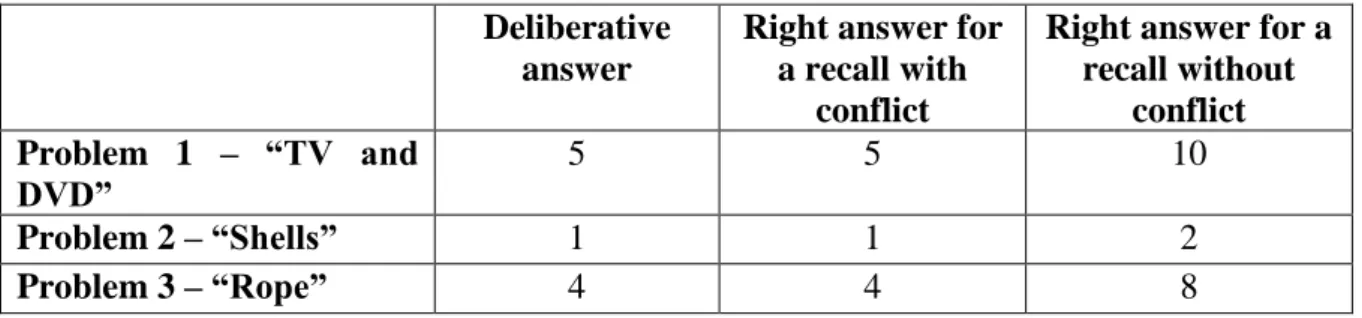
We evaluated participants answer to the first time the problem was presented, as either intuitive or deliberative – you can see in Table 5 what was considered a deliberative answer, answers different from this one were considered intuitive.
We also evaluated if the answer was right or wrong considering the absence or presence of conflict on the recall of the problem presented. If the recall preserved the conflict, a correct answer would be the same as a deliberative answer. If the recall failed to preserve the conflict, then the right answer would be different – you can see in Table 5 what were the correct and incorrect answers for each type of recall. For the first generation those measures are equal, since all problems were presented in its original form, with conflict.
Table 5 – deliberative answer, right answer for a recall with conflict and right answer for a recall without conflict for each problem
Deliberative answer
Right answer for a recall with
conflict
Right answer for a recall without conflict Problem 1 – “TV and DVD” 5 5 10 Problem 2 – “Shells” 1 1 2 Problem 3 – “Rope” 4 4 8
The second time the problem was always presented in its original form, therefore we only evaluated if the answer was intuitive or deliberative. This last measure allows us to understand if participants who were presented a problem without the conflict the first time, would give a different answer when presented the problem with conflict.
Therefore, we have three variables from the answers given to the problem: the mean of deliberative answers; and the mean of correct answers the first time and the second time the problem was presented.
18
Results
Participants considered for the data analysis
We needed 30 participants for each generation. We started by collecting 30 answers per generation, when recalls were invalid we had to collect more answers. In total we collected 110 answers, from which 3 participants were completely invalid (i.e., all the recalls from this participants were invalid) . Since in the third generation we did not need to use the recalls, no extra answers were collected. On the final data set we will use the first 30 answers collected in each generation. Only participants with all the recalls invalid were replaced in the database (3 participants met this criteria).
Computation of dependent variables
We found a significant correlation between recalls with conflict for problem 1, 2 and 3 (1 and 2 , r(87)=0.34, p<.01. 1 and 3, r(88)=0.43, p<.01. 2 and 3, r(87)=0.27, p=0.01) and the number of problems 1, 2 and 3 read with conflict (1 and 2 , r(88)=0.43, p<.01. 1 and 3,
r(88)=0.47, p<0.01. 2 and 3, r(88)=0.26, p<.01) we will use the mean of recalls with conflict
and the mean of problems read with conflict (see
Table 12 and Table 13).
Since the number of deliberative answers to problem 1, 2 and 3 (1 and 2, r(88)=0.76;
p<.01. 1 and 3, r(87)=.78; p<.01. 2 and 3, r(87)=0.72, p<.01) and the number of right answers
19
r(87)=0.66, p<.01. 2 and 3, r(87)=0,64, p<.01), we will use the mean of deliberative answers
and the mean of right answers (see Table 14 and Table 15 ).
Likewise, the number of correct answers to the second time problem 1, 2 and 3 were presented were significantly correlated (1 and 2, r(88)=0.86, p<.01. 1 and 3, r(87)=0.84, p<.01. 2 and 3, r(87)=0.27, p<.01), we will also use the mean of correct answers for the original problem (see Table 16).
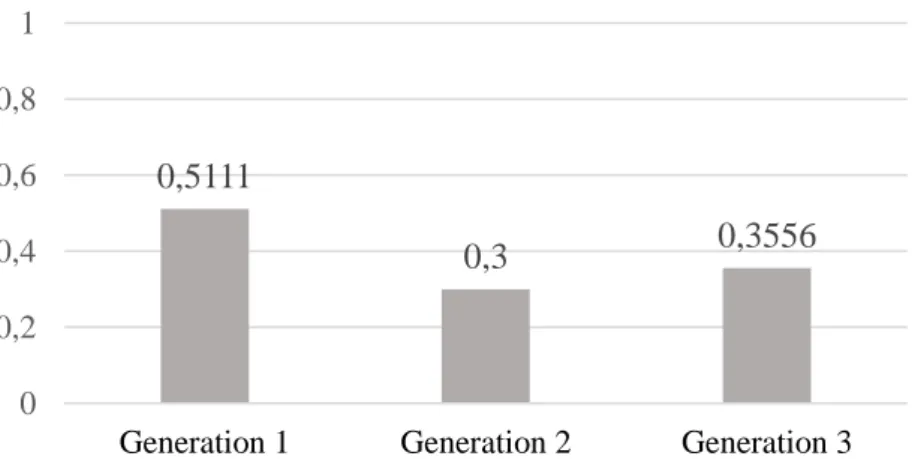
Control variable – deliberatives across generations
We started by checking for differences of correct answers across generations. Correct answers to the original problem should not be significantly different across generations. To test this, we ran a one-way ANOVA. Means were not significantly different across generations, F(2,87)=1.78, p=0.17 (see Table 17– Appendix 2 and Figure 1, below). Neither a posteriori multiple comparisons nor planed contrasts between generation 1 and 2 or generation 1 and the other two generations held significant results. Which means there were no differences in a priori capacity to give deliberative answers.
Figure 1 – Mean Deliberative answers to the original problem
0,5111 0,3 0,3556 0 0,2 0,4 0,6 0,8 1
Generation 1 Generation 2 Generation 3
20
Hypotheses testing
Our first hypothesis was that people who give an intuitive answer will reproduce the problem without the conflict. To test this, we performed a Pearson correlation1 between the
mean of deliberative answers and the mean of recalls with conflict. We found a significant positive correlation between the mean of deliberative answers and the mean of recalled problems which preserve the conflict, r(88)=0.44, p<.01 (see Table 19– Appendix 3).
This also means that there will be fewer reproduced problems with the conflict in generation 3 than in generation 1. To test this hypothesis, we conducted a Pearson correlation between the mean of recalls with conflict and the generation to which participants were assigned. We found a significant cognitive correlation between the mean of problems recalled with conflict and the generation, r(88)=-0.26, p=0.01 (see Table 20– Appendix 3). Meaning that throughout the generations fewer problems were recalled with conflict.
Our second hypothesis was that by the third generation there will be fewer deliberative answers. To test this, we will also do a Pearson correlation2. It is expected that as the
generations go by there will be less participants with deliberative answers. We found a marginally significant negative correlation between the mean of deliberative answers and the generation, r(88)=-0.20, p=0.06 (see Table 21– Appendix 3) which suggests that throughout the generation there are less deliberative answers.
Lastly, we decided to test a double mediation hypothesis whereby the effect of the generation on deliberative answers is mediated by the mean of recalls with conflict, which in turn is mediated by the mean of problems read with conflict (see a graphic representation of the model below, Figure 2).
21
Figure 2 – Double mediation model
We decided to test this hypothesis by testing the indirect effect with bootstrap analysis (Hayes, 2013). This analysis produces a confidence interval for the statistic, which if different from zero is significant. To test the double mediation, we used the ad-on PROCESS for SPSS. We used the model 6, defining mean deliberative answers as the outcome variable, mean problems read with conflict and mean recall with conflict as the mediator variables, generation as the independent variable and used 5000 bootstraps. The model is significant, CI = [0,09; -0,02] – see full output for Bootstrap analysis in Table 23 – Appendix 2.
Generation Mean of problems read with conflict Mean of recalls with conflict Mean of deliberative answers
22
Discussion
This study analysed processes of memory of reasoning problems both at an individual and collective level. We analysed performance and free recalls for individuals, and the social impact of misrepresenting the problems throughout the generations of serial reproduction.
Hypothesis confirmation
The first hypothesis was that people who give an intuitive answer will reproduce the problem without the conflict. This hypothesis was confirmed both at an individual level – participants who gave an intuitive answer were more likely to have a recall which did not preserve the conflict; and at a collective level – because of what happened at an individual level throughout the generations there were less and less problems which preserved the conflict.
Though our hypothesis was confirmed, we found some recalls that were almost exact. Even though the problems are small and there was no distraction task, this could indicate one of two things: a) that participants are memorizing the problem or, b) since the data was collected online, participants might be copying the problems from the first screen and pasting it to the next one (obviously they could only do this for the second and third problems). To address this, in future studies, we suggest the use of an extra space between two words of the problem, if this is present and the text is the same it is unlikely that the participant spotted and reproduced the two spaces, but more likely he copied the text and did not notice the presence of an extra space.
It is also important to mention that if this is correct, this will increment the effect, not decrease it. Since the exact recall has the conflict, people who copy the problem, can be either deliberative or intuitive problem-solvers, so it is likely that the number of problems without the conflict would increase.
23
Our second hypothesis was that by the last generation there would be fewer deliberative answers and this hypothesis was confirmed as well. We found a negative correlation between the number of deliberative answers and the number of the generation participants were at. This result was marginally significant and this might be a result of the situation described before of possible copying of the original problems, which increased the maintenance of problems that preserved the conflict.
Participants did not differ significantly across generation in their ability to give a deliberative answer, as we found no significant differences between their answers to the original problems throughout the generations, only answers to the recalls of previous participants suffered this effect throughout the generation.
With the confirmation of both the first and the second hypotheses, we decided to test a sequential double-mediation model. We previewed that the effect of the generation on deliberative answers would be mediated by the number of problems recalled with conflict, which in turn would be mediated by the number of problems read with conflict. This indirect effect was significant.
If they are unable to spot the conflict, or if the conflict is no longer in the problem, they will also be unable to reproduce it. The result is that, no matter how deliberative you are, you end up giving an intuitive answer. This is especially relevant in a world where we rely so much on what other people tell us, namely through social media.
Implications
At an individual level, we normally associate deliberative problem-solving to be a result of sound reasoning as opposed to intuitive responders who are normally thought of as not having the ability to reason correctly. This study is one more in a series of studies that (Mata et al., 2014, 2017) are considering a previous step that is the basis for sound reasoning. For
24
sound reasoning to occur, a correct representation of the problem must be formed in the mind. Previous studies (Mata et al., 2014, 2017) could only account for attention processes, as they used eye-tracking and conflict detection paradigms. In this study, we wanted to go one step further and test if performance was also correlated to memory. Though you should infer that if attention is not paid to a certain part of the problem, this part will probably not be remembered and therefore it is probably not represented in the mind.
With reasoning abilities being so important in our days, it would be important to train people to recognize the critical parts of information in a problem, to facilitate the formation of a good representation of the problem. Which in turn could have a positive impact in the ability to solve this type of problems.
But probably the most stunning result is the impact that these individual misrepresentations have in the group. This study is promising since serial reproduction was never applied to the recall of reasoning problems.
On a chain only made exclusively by deliberative responders, no information would be lost. But in the moment an intuitive responder enters the chain there is a chance that information will be lost. It is important to note that not all intuitive responders have a recall which does not preserve the conflict, and so not everyone who gives an intuitive answer compromises the chain in the same way. If a participant who gives an intuitive answer, in a certain moment of a chain, does not preserve the conflict in his recall, the information is lost and can no longer be restored throughout that chain. From the moment the conflict is not preserved in a particular chain, participants can no longer arrive to a deliberative answer. Since they will be basing their answers on the wrong premises. Therefore, we can also consider that the number of deliberative answers in a certain chain is a consequence of the moment of the chain when a no-conflict recall appears.
25
Today we have more information than ever before. Although the original information is often available, we tend to rely on what other people tell us. Participants in this study were shown the original problems afterwards and able to give a deliberative answer, in case they wanted so. They were given all the information they needed, to decide correctly. In the real world are we given all the information? Often, we rely on information that another person gives us. Frequently we have no information on the person ability and willingness to pass on a correct representation of the information.
People at the end of a chain are subject to the information it is passed on to them, and no matter how deliberative they are, they are not going to be able to make correct judgments if they are given incomplete information.
It should be tested whether this hypothesis holds true in daily life settings such as when sharing a post through Facebook or when talking with other people. In those cases, transmission might not occur only on a one to one basis but one sharing moment might impact a bigger number of people (e.g., a post on Facebook can reach thousands of people in minutes).
Limitations and Future studies
In this study, we only used CRT type problems, other studies should cover other type of problems, such as syllogisms, base rates or semantic illusions. E.g., “A computer virus is spreading through the system of a computer. Every minute, the number of infected files doubles. If it takes 100 minutes for the virus to infect all of the system, how long would it take for the virus to infect half of the system?” (Mata & Almeida, 2014, p. 359) and the right answer would be “99”. When recalling the problem if people fail to remember that “the number of infected files doubles every minute”, the next responder will be unable to arrive at the original deliberative answer. For the study to be replicated, these problems should have a critical part
26
that if it is not remembered or if it is misrepresented will result in the inability to give a deliberative answer.
We only used three generations of participants. Even though results were quite similar from the second to the third generation, which makes us believe that they would hold stable throughout the generations, it would be interesting to replicate the study with more generations.
In this study, a participant from a subsequent generation would receive a complete set of recalls from a previous participant (except for the case where replacements had to be made). In our daily lives, we receive information from many sources. This might have a different impact on how we perceive information and therefore how we represent that information, and ultimately the world.
This study does not account either for the great amount of information that we receive, often at the same time. With such a high cognitive load, it would be easier even for a deliberative to pay attention to the critical parts of the problem and to pass it on without preserving the conflict to the next generation. A next study could have participants doing this same task but with another task at the same time, which could simulate the way we are processing different sets of information at the same time (e.g., when we are watching TV, checking the telephone and writing a thesis at the same time).
27
Conclusion
We found a correlation between performance and free recalls and we found a social impact of this effect throughout the generations. These two findings are relevant at individual and social level.
If you would only remember two things from this thesis, please remember that reasoning problems do not require only logical knowledge, but also attention to the critical part and a correct representation formed in the mind. Without it, people could have great reasoning skills, and still be unable to arrive to the right answer, in sum, they would be giving “right answers to the wrong problem” (Mata et al., 2017).
The other takeaway message is the social impact of misremembering the problem. The impact of misrepresenting the problem goes beyond the individual level. In a world where we are constantly receiving and passing information to others this is something to consider, how much of the information we receive daily can be misrepresented or misremembered, without the individual even being conscious of their lack of precision.
28
References
Allport, G. W., & Postman, L. J. (1947/1965). The Psychology of Rumour. New York: Russel & Russel Inc.
Bangerter, A. (2000). Transformation between scientific and social representations of conception: The method of serial reproduction. The British Journal of Social Psychology,
39(4), 521–535. http://doi.org/10.1348/014466600164615
Bartlett, F. (1932/1972). Remembering : a study in experimental and social psychology. New York: Cambridge University Press.
Barton, S. B., & Sanford, A. J. (1993). A case study of anomaly detection: shallow semantic processing and cohesion establishment. Memory & Cognition, 21(4), 477–487. http://doi.org/10.3758/BF03197179
Brissey, F. L. (1961). The Factor of Relevance in the Serial Reproduction of Information.
Journal of Communication, 11(4), 211–219. http://doi.org/10.1111/j.1460-2466.1961.tb00007.x
Clark, A. E., & Kashima, Y. (2007). Stereotypes help people connect with others in the community: a situated functional analysis of the stereotype consistency bias in communication. Journal of Personality and Social Psychology, 93(6), 1028–39. http://doi.org/10.1037/0022-3514.93.6.1028
De Neys, W., & Glumicic, T. (2008). Conflict monitoring in dual process theories of thinking.
Cognition, 106(3), 1248–1299. http://doi.org/10.1016/j.cognition.2007.06.002
De Neys, W., & Bonnefon, J. F. (2013). The 'whys' and 'whens' of individual differences in thinking biases. Trends in cognitive sciences, 17(4), 172-178.
Erickson, T. D., & Mattson, M. E. (1981). From words to meaning: A semantic illusion.
Journal of Verbal Learning and Verbal Behavior, 20(5), 540–551. http://doi.org/10.1016/S0022-5371(81)90165-1
Ferreira, F., Bailey, K. G. D., & Ferraro, V. (2002). Good-Enough Representations in Language Comprehension. Current Directions in Psychological Science, 11(1), 11–15.
Hayes, A. F. (2013). Introduction to Mediation, Moderation, and Conditional Process
Analysis: a Regression-Based Approach. New York: The Guilford Press.
Kashima, Y. (2000). Maintaining cultural stereotypes in the serial reproduction of narratives.
Personality & Social Psychology Bulletin, 26(5), 594–604. http://doi.org/10.1177/0146167200267007
29
The Influence of Stereotype Sharedness. Journal of Personality and Social Psychology,
85(6), 989–1005. http://doi.org/http://dx.doi.org/10.1037/0022-3514.85.6.989
Lyons, A., & Kashima, Y. (2006). Maintaining stereotypes in communication: Investigating memory biases and coherence-seeking in storytelling. Asian Journal of Social
Psychology, 9(1), 59–71. http://doi.org/10.1111/j.1467-839X.2006.00184.x
Mata, A., Ferreira, M. B., & Sherman, S. J. (2013). The Metacognitive Advantage of Deliberative Thinkers: A Dual-Process Perspective on Overconfidence. J Pers Soc
Psychol, 105(3), 353–373. http://doi.org/10.1037/a0033640
Mata, A., & Almeida, T. (2014). Using metacognitive cues to infer others' thinking. Judgment
and Decision making, 9(4), 349.
Mata, A., Ferreira, M. B., Voss, A., & Kollei, T. (2017). Seeing the conflict: an attentional
account of reasoning errors. Psychonomic Bulletin & Review.
http://doi.org/10.3758/s13423-017-1234-7
Mata, A., Schubert, A. L., & Ferreira, M. B. (2014). The role of language comprehension in reasoning: How “good-enough” representations induce biases. Cognition, 133(2), 457– 463. http://doi.org/10.1016/j.cognition.2014.07.011
Mevel, K., Poirel, N., Rossi, S., Cassotti, M., Simon, G., Houdé, O., & De Neys, W. (2015). Bias detection: Response confidence evidence for conflict sensitivity in the ratio bias task.
Journal of Cognitive Psychology, 27(2), 227–237.
http://doi.org/10.1080/20445911.2014.986487
Ost, J., & Costall, A. (2002). Misremembering Bartlett: a study in serial reproduction. British
Journal of Psychology, 93(2), 243–255. http://doi.org/10.1348/000712602162562
Sturt, P., Sanford, A. J., Stewart, A., & Dawydiak, E. (2004). Linguistic focus and good-enough representations: An application of the change-detection paradigm. Psychonomic Bulletin
30
31
Appendix 1 - Literature Review
Index
Introduction ... 32 Serial Reproduction ... 32 Conflict detection in reasoning problems ... 37 Cognitive processes involved ... 40 Conclusion ... 42 References ... 43
32
Introduction
This thesis studies serial reproduction of reasoning problems, to date no studies have been made combining those two topics, therefore this literature review will cover previous research in serial reproduction and conflict detection in cognitive reasoning problems (CRT).
The first topic covered will be the serial reproduction. From Bartlett, through Allport until more recent studies.
Next, the concept of conflict detection of CRT problems will be presented. In this topic, some studies on attentional processes involved in the CRT literature will be covered with more depth, including some studies on language processing.
Lastly, some topics of attention and memory, relevant for this thesis will be addressed. This is a longer review about the topic of this thesis that complements the introduction/literature review done in the first part of this dissertation.
Serial Reproduction
We will start this literature review by focusing on the method of serial reproduction. Serial reproduction was first introduced, in 1932, by Bartlett on his famous book Remembering. The serial reproduction paradigm refers to the reproduction of information throughout a chain of people. The first person in that chain receives an original piece of information and should reproduce it to another participant, which in turn receives the information and should reproduce it again to the next one. The process goes on consecutively, resulting in a distortion of the initial information transmitted (Bartlett, 1972). In serial reproduction, each set of participants in a particular moment is called a generation. A chain is a series of reproductions (e. g., in this study we used three generations of participants, with 30 participants in each generation, meaning we have 30 chains with 3 recalls each).
Initially Bartlett (1932/1972), experimented on serial reproduction of folk-stories, descriptive and argumentative prose passages and pictures. In his studies, participants read the
33
passages twice and after a 15 to 30 minutes interval, they were asked to reproduce it. He found that the passages tended to become smaller, in the case of the folk story more supernatural parts were left behind throughout the generations.
Bartlett (1932/1972) identified some of the processes involved in the distortion of the information such as:
• omissions (when a certain part of the text disappears); • rationalisation – the need to understand the text as a whole;
• transformation of detail – transforming unfamiliar information to more familiar one, this type of change tends to persist through out the generations (e.g. transformation of strange names to more familiar names);
• and, order of events – change of the order of events to give more. In the case of the present thesis, we are mainly interested in the omission of the conflict in each problem.
After a few generations, the reproductions “would hardly ever be connected to the original” (Bartlett, 1932/1972, p. 171). Bartlett (1932/1972) also found common trends of change among all the recalls:
• the most unstable elements were proper names and story titles;
• a general bias towards the concrete - opinions, arguments, pieces of reasoning and deductions tend to be omitted;
• loss of individual characteristics or peculiarities, and there is a tendency for arguments and opinions to go towards social conventions;
• abbreviations – though a reproduction could be longer, the reproductions tended to be abbreviated throughout generations.
• Rationalisation – in the folk-tale it would mean a reconstruction of the text to give it a meaning as a whole. In the case of the argumentative and descriptive
34
texts, this was traduced in a tendency to generate a text that was apparently less coherent. This happened because in the last case, because the setting was familiar and the cohesion between the text needed not to be created. “So long as material can be reduced to any form which an ordinary member of a given social group will accept with a minimum of questioning all is well.” (Bartlett, 1932/1972, p. 175).
Bartlett makes an interesting note on the serial reproduction process, though it “normally brings about startling and radical alterations (…) the subjects may be very well satisfied with their efforts, believing themselves to have passed on all important features with little or no change, and merely, perhaps, to have omitted unessential materials” (Bartlett, 1932/1972, p. 175). This means that not only do participants transform the text in a way that could hardly be connected to the original, but they are also unware of this and confident in their reproduction.
He also refers that changes in real life would be easier and more prominent. This happens frequently in the popular game “broken phone” where a person creates a sentence and passes on in a low voice to another person, this goes on in a circle and we all know that most of the times the end sentence is nothing like its original version. For Bartlett, this meant that the reproductions were more like constructions formed based on the impression that was made when people read the material.
Though accounted for his findings in the serial reproduction, Bartlett is often considered to have lacked the scientific rigorousness of more modern days. Despite that, the effect was reproduced many times in more controlled conditions (Bangerter, 2000; Lyons & Kashima, 2006).
Though many authors focus on the inaccuracy of the memory processes described by Bartlett (Brissey, 1961), using Bartlett to justify the memory inaccuracies, Ost and Costall
35
(2002), highlight that Bartlett proposed a schema theory of memory, implying that material which is consistent with a previous schema will be better remembered. A reproduction accuracy can, therefore, depend upon conditions and previous schemas (Ost, & Costall, 2002). Though normally, in an incongruent world, we will miss on same details to improve the congruency of the story. If the details are congruent with previous schemas we will remember it better.
Allport and Postman (1947/1965) used the serial reproduction to study rumours, in the aftermath of Pearl-Harbour. They used pictures with details and a central action that could generate distortion. They presented a picture to the first subject and asked him to reproduce it as exactly as possible to a second participant that would enter the room later, but could not see the original picture. Then a third participant would enter the room and the second participant would recall the information the first participant had just told him. They found, similarly to Bartlett, that recalls tended to become shorter, more congruent with previous schemas and some details would become more salient. They propose a three-part pattern of distortion in which three processes are involved in the transformation and deterioration of the problems:
• Leveling - associated with Bartlett’s omissions, is the process by which many important details are omitted. This happens not just by the inaccuracy of memory, but as a result of misinterpretation caused mainly by biases and preconceptions;
• Sharpening – a process by which the details which are preserved become more salient and are accentuated as a result of the previous interpretation. Overall, the story gains more coherence, losing its complexity;
• Assimilation – the process that underlies leveling and sharpening. The rumour goes in a direction that conforms with a person previous experience and attitudes, preconceptions and bias.