Does the ownership structure of companies in the gas transmission
industry impact performances?
Pedro Fernando Nunes
[email protected]
Master Dissertation
Master in Finance
Supervisor:
Isabel Soares, PhD
September 30, 2015
i Bibliographical Note
Pedro Fernando da Silva de Sousa Nunes holds a Bachelor in Economics by the University of Porto School of Economics and Management.
Since 2012 he works at PricewaterhouseCoopers (“PwC”), in the Tax department. He has since then developed consulting functions on different areas, from Indirect Taxation to Transfer Pricing, area in which he currently advises PwC’s clients.
He is currently pursuing a Master in Finance by the University of Porto School of Economics.
ii Acknowledgements
I am very grateful for the comments and all the guidance provided by my supervisor, Professor Isabel Soares.
I also want to thank my wife, who gave me all the support I needed in this period and had a decisive role in my life to go through this very demanding process. Without her it would not have been possible.
iii Abstract
This study intends to analyse the impact of the ownership structure on the corporate performance in the gas transmission industry. Most of the existing studies on the ownership structure and its influence on the value of the companies or on their performances are not focused in specific sectors or industries. Hence, the present study intends to complement the already existing approaches focusing on this particular industry. The subject of the study is relevant and pertinent as it is a regulated industry which has a strong impact on the prices charged to the final consumers, and also due to the vulnerability of the European Natural Gas sector because of the high dependency of imports. This study is intended to contribute to the scarce empirical literature on the gas industry particularly under the performance-ownership structure perspective.
Key words: ownership structure, state ownership, corporate performance, efficiency,
oil & gas, gas transmission
iv
Contents
1. Introduction ... 1 2. Literature Review ... 3 2.1. Ownership Structure ... 3 2.2. State Ownership ... 5 2.3. Corporate Performance ... 6 2.4. Ownership unbundling ... 72.5. Gas Transmission industry analysis ... 8
2.6. Theoretical framework to address ownership structure impact on performance .... 10
2.7. Critical analysis of the literature ... 12
3. Methodology ... 15
3.1. Model design ... 15
3.2. Data and Sample ... 16
3.3. Discussion of results ... 25
3.3.1. Dependent variable measured by ROA, ROE and Market-to-Book ratio ... 25
3.3.2. Dependent variable measured by Daily stock returns ... 26
v List of Tables
Table 1 - Final set of TSO Companies ... 18
Table 2 - TSO's profitability analysis ... 21
Table 3 - Correlation matrix ... 23
Table 4 - Panel data regressions of performance: 1999-2014 ... 24
1
1.
Introduction
The influence of the ownership structure in the performance and value of the companies is a hot topic in Finance and Economics. State ownership, for instance, is viewed as inefficient, because the political motives of the government are not aligned with the profit motives (Leung & Cheng, 2013), the main argument for privatizations worldwide.
With this work it is intended to analyse the influence of the ownership structure in the performance of companies. More specifically, the main focus of this work will rely on the oil&gas industry, namely in the transmission of gas in high pressure.
Additionally, as the sector mentioned is very specific, it is intended to assess if the State presence in the ownership structure of companies affects its performance positively or negatively, or if there is a critical level of State ownership above which the performance of companies is negatively influenced.
Due to the definition of the dependent variable, it will be searched a relationship between the ownership structure and the performance, measured by the market values or by appropriate financial indicators.
To achieve so, the goal of this work is to perform a comparative study of the performance of companies in the sector with different ownership structures across Europe, in order to capture differences in the ownership structures throughout the continent.
Moreover, this work aims to assess if the presence of the State in the ownership of companies has a significant impact in their performance, and if it has, in what direction it is reflected (positive or negative).
Furthermore, other factors linked to the presence of the State may influence the performance of companies, such as efficiency or the political activity (Hadani, 2011).
2
The relationship between ownership and firm performance has been highly subject to research. However, the empirical evidence has not yet provided conclusive results (Yu, 2013), leaving the scientific community with mixed results so far, which reinforces the importance of its study. As far as we know, the gas transmission industry has not been addressed under this perspective, which can be considered as a gap in the literature.
Additionally, the energy industry is of the utmost importance in the world, as the economies of developed countries show a huge energetic dependence on the countries that have the resources to produce energy. Consequently, the companies in this industry play a very important role in the economy.
Studying the factors that influence these companies’ performance is very important in the field of finance, as it may lead to the search for the definition of an optimal structure for companies of this industry.
Moreover, it may lead to the study of the ownership structure that provides the best results in terms of efficiency, because it is reflected in the prices charged to the consumers.
Given the framework given by the literature review and the purpose of this work, the main questions to put are:
Does the ownership structure of companies in the gas transmission industry impact their performances?
How does the State Ownership affect the performance of the companies in the gas transmission industry?
This Dissertation is organised as follows: in chapter 2, it is performed a literature review on the subject being analysed and the definition of the most relevant concepts addressed in the study; in chapter 3, it is presented the methodology and the sample, as well as the specification of the model used; in chapter 4, the conclusions of the study are presented.
3
2.
Literature Review
It has been given significant attention to the ownership issue and its impact on corporate value or performance. In this section, it will be performed a review of the literature on the relationship between ownership structure and corporate performance.
Firstly, it will be presented the most relevant concepts for the work, such as ownership structure, state ownership, corporate performance and main indicators to analyse and measure it. Then, it will be performed a critical analysis to the literature.
To begin with, it is important to define the relevant concepts that the present work will address.
2.1. Ownership Structure
The ownership structure refers to the shareholders of the companies and the way the shares are distributed by them. It demonstrates the decisional power of each shareholder on the company and the concept can be defined as the structure of shareholdings of a firm, according to Wu (2011) and Karathanassis and Drakos (2004).
For instance, a shareholder with more than 5% stake on a company’s equity is said to be a blockholder, because this percentage is high enough for the shareholder to have the incentive and ability to influence and monitor the decisions taken in the company (Denis, 2001). This is a very important concept for this study, as for the industry under analysis the main players do not run their businesses in perfect competition conditions. Such as happens in the electricity industry, regulation in the natural gas transmission industry is primarily motivated by the existence of natural monopoly conditions and externalities, whether it is a state owned or a private monopoly (Steiner, 2000), as electricity transmission and distribution are currently characterized by natural monopoly cost conditions (Kiesling, 2006).
4
According to Steiner (2000), characteristics such as the non-storability reduce the size of markets according to the time dimension, as the size of the market is determined by instantaneous demand rather than demand over a longer time period. Hence, the probability that a single firm can supply consumers in a certain market at minimum efficient scale is higher.
Consequently, operating and capital costs per customer decrease and these conditions lead to increasing returns to scale and cost efficiencies to be realised by a monopoly market structure.
Additionally, natural gas markets exhibit properties of networks. Natural monopolies have as main characteristic lower average costs as production increases. Network externalities generate changes in value as participation increases. Accordingly, positive network externality occurs when the value of a product or service increases as more people use it (Economides, 1995).
In the context of this study, it is important to figure out if (and how) the ownership structure of these monopolist companies influences their performances, in a regulated market in which competition is promoted but also where competitive entries erode economic rents.
The current regulatory environment in which the natural gas industry operates is much less stringent and relies more heavily upon competitive forces than in the past. The last twenty years have seen dramatic changes throughout the industry, spurred by its ever-changing regulatory environment. However, despite the restructuring and deregulation of some portions of the natural gas supply chain, there is still significant regulatory oversight of the industry in the transportation and distribution of natural gas. This oversight is necessary to ensure that those market participants that possess monopoly power in the industry do not abuse this power or distort the smooth and efficient functioning of the natural gas markets.
5
One of the main aims of the Third Package is setting non-discriminatory rules for
access conditions to natural gas transmission systems taking into account the special characteristics of national and regional markets with a view to ensuring the proper functioning of the internal market in gas, a goal that is in line with the above-mentioned
anti-abuse principle.
Regulatory action recently has focused on unbundling retail prices into separate generation, transmission, distribution and retailing cost charges. Additionally, it has focused on allowing retail consumers to choose among a large number of competing generation service suppliers (Kiesling, 2006).
2.2. State Ownership
State ownership is a very well-known concept and there is yet no consensus on the effect it has on the performance of companies. It is the percentage of shareholdings by government agencies and affiliated state owned entities (Hsueh‐Liang, 2007).
In the political arenas, the discussion on the privatization of companies that are owned by the state is a hot topic. In countries struggling with strong budgetary constraints, the privatization of companies owned by the state has been adopted as a measure to generate cash and reduce expenditure and public debt.
In this context, the discussion on the sale of companies of the state in strategic sectors for the countries arises, as the governments applying privatization strategies argue that the presence of the state is bad for their performance because it makes them less efficient, while the opponents state that privatization processes imply loss of welfare for the populations. The sector of electricity and gas is a very clear example of this issue.
The pace of change in the economic and technological characteristics of the electricity, hence, natural gas, supply industries have stimulated the evolution of regulation, ownership, and market structure. As transmission and distribution are currently characterized by natural monopoly cost conditions (Kiesling, 2006), the industry as a whole is taken to be a natural monopoly, suggesting that an efficient regulatory framework is a legal monopoly.
6
However, monopoly leads to deadweight losses when a profit-maximising monopolist charges prices that exceed marginal cost (Steiner, 2000). According to Steiner (2000), this led governments to adopt one of two approaches to the electricity sector: publicly owned, integrated monopoly, or privately owned regulated firms. Several countries (e.g. Ireland, France, Greece, and Italy) chose to consolidate and nationalize their electricity supply industries into owned, legal monopolies under the assumption that a state-owned enterprise does not maximise profit, so public ownership should lead to greater consumer welfare. In the case of private but regulated monopolies firms have the goal of maximising profits.
In these cases, regulation is the tool used to reduce perverse impacts on consumer welfare. This is important, because it addresses the main purposes of this study, to assess if the presence of the state as a shareholder impacts in the goal definition of the companies, and their performances as a consequence.
For purposes of this work, it will be computed directly and indirectly, if the State does not hold directly stocks of a company, but instead controls a shareholder of that company.
2.3. Corporate Performance
The term performance applied in the corporate world usually defines the profitability obtained by a company for a certain financial year, and sometimes refers to the quality of the products sold or the services provided by a company. This concept is also related to firm market value, according to Wu (2011), among other authors.
For purposes of this work, the performance of the companies is quantified with different indicators.
In order to compare all of the companies, listed and non-listed, it will be used the Return on Assets (ROA), calculated by dividing the Net Income by the Total Assets, and the Return on Equity (ROE), calculated by dividing the Net Income by the shareholder’s equity, to measure profitability.
7
These profitability indicators are appropriate to analyse the performance of the companies and have a high correlation with the market-to-book ratio, according to Palich, Carini, and Seaman (2000) and (Thomsen & Pedersen, 2000), which will be used as a proxy for the firm value. The market-to-book ratio is measured as the market value of equity plus the book value of debt divided by the book value of total assets.
Additionally, daily stock returns will be used to measure the performance of listed companies, as this measure also has a high correlation with the market-to-book ratio, according to the authors mentioned.
Assuming no dividends, daily stock returns will be given by the following formula:
𝑅′𝑡 =
𝑃𝑡𝑃𝑡−1 − 1, (2.1.)
where Pt is the stock closing price on day t.
2.4. Ownership unbundling
Ownership unbundling is a very important concept in this specific industry, specifically due to the regulatory environment that surrounds the gas industry.
This concept is defined as the strictest regulatory regime of vertical disintegration, as the company that owns and operates the transmission assets is fully separated from the rest of the system, it does not participate in further business activities in retail or production and import (Growitsch & Stronzik, 2014).
8
2.5. Gas Transmission industry analysis
The industries related to natural resources necessary to produce energy are of critical importance to overall economies around the world. The gas industry is not an exception, as there is the need by the consumers to have competitive markets.
According to the ACER/CEER (2014), in competitive markets, retail and wholesale markets are closely interrelated. High liquidity and efficiency, combined with transparent and non-discriminatory gas network access mechanisms, are important in promoting competition and efficient price formation in the EU gas value chain.
According to Roland Berger (2014), in the Study regarding grid infrastructure
development: European strategy for raising public acceptance, throughout Europe
efforts have been made to develop and integrate the power transmission networks in order to provide a safe, reliable, sustainable and affordable supply of energy to citizens in Europe, as this is of major importance for the well-being and quality of life of people in Europe.
Transmission System Operators (TSO’s)
The main players in the part of the supply chain of gas are the TSO’s, which are companies which own and operate electrical power transmission grid lines (high-voltage main power lines) and are in charge of the transportation of electrical energy. Usually, these companies are the main owners of grid development projects, as they are the main entity responsible for planning and constructing new grid lines.
In straight connection with the main issue of the present study, which is the impact of the state ownership in corporate performance, TSO’s are usually private sector companies in which governments may have a significant share. In the EU, the grid covered by one TSO comprises normally the entire area of a Member State. As these companies don’t face competition in their coverage areas, which is why they characterize these markets as “natural monopolies”, there is high regulation by the government authorities, including Regulators and Permitting authorities.
9
Consequently, their freedom in planning and constructing new grid lines is limited by the restrictions defined by these entities.
The main revenues of TSO’s come from the charges they receive for the transmission of gas or electrical energy. The need for grid development projects may be driven by bottlenecks in the system, demand management and integration of renewable energy production.
As the main project developers, these companies are involved in every stage of grid projects with a continuously vital role. Additionally, regarding the channels for participation, they are also the most important communicators in grid projects. In their communication campaigns they can make use of all available communication measures.
On one hand, addressing the potential offered by renewables integration, resolution of bottlenecks and other drivers represents a big opportunity for grid development. On the other hand, the regulations faced impose strict restraints on these operators. Because of these restraints, TSO’s usually can’t choose freely where and with which design to build grid lines and their profit margins normally are limited.
This makes it more relevant to study if the presence of the state in the ownership structure impacts in the profitability or performance of firms in this industry, because they are strongly dependent on political decisions, given that any change of legislation can have strong effects on their businesses.
Regulators
Another crucial player in the gas markets is constituted by the regulation entities. In the gas market (and electricity as well), the regulatory agencies are in charge of ensuring non-discriminatory third-party access to networks and of regulating the fees. Additionally, they are responsible for ensuring network security and supply (ACER/CEER, 2014).
10
Their main function is to promote competition, hence, protecting the interests of consumers. The interests of the consumers are usually seen in the broadest sense. Its analysis takes into account the reduction of greenhouse gases and the security of the supply of gas or electricity, and not only prices charged to the consumers.
Either by identifying investment gaps within national power lines (and at an European level with respect to cross-border capacities), or by the planning of new grid lines, regulators have a very important influence in the markets, as they assess and monitor the implementation of the investment plans of TSO’s.
Moreover, they play an important role in determining the resources that TSO’s can allocate for choice of technology, stakeholder engagement and other aspects of the projects, since they have to sign off on TSOs’ investment plans.
2.6. Theoretical framework to address ownership structure impact
on performance
The awareness that ownership affects performance is firstly based in the misalignment between the goals of managers, owners or individual shareholders (or groups of shareholders), because of the existence of different incentives (Karathanassis & Drakos, 2004).
The existence of different types of shareholders also deserves particular attention in the business research’s agenda. Differences in the type of shareholder may imply the existence of differences in the goals for the company, such as it is described in the agency theory (Jensen & Meckling, 1976), which makes it very important in a context of value maximization of the firm for the shareholders.
Analysing more specifically the types of shareholding, the presence of the State in the ownership seems to play a very important role.
As mentioned above, transmission and distribution are characterized by natural monopoly cost conditions (Kiesling, 2006) and monopoly leads to deadweight losses when a profit-maximising monopolist charges prices that exceed marginal cost (Steiner, 2000).
11
By adopting publicly owned, integrated monopoly, or privately owned regulated firm models, governments indicate that the presence of the state as a shareholder makes a significant difference in the electricity and gas sector, whether because it internalizes losses in order to increase the general welfare, or because it has a positive effect in the business of the companies.
State ownership in some cases imply that companies have privileged channelling of funds to the company by the governments and political connections (Yu, 2013), as an example of a positive influence, but also because it shows value-reducing effects on the companies’ performance (Wu, 2011) due to increased bureaucracy for high levels of state ownership.
The importance of state ownership becomes strengthened when combined with environments with high market rivalry and high corporate ownership ties (Wu, 2011). According to this author, a competitive environment, characterized by the absence of production rents, goes against the negative influence of minority state ownership on the perceived value of a firm in the marketplace. In markets in which the competition is higher, in which the ability to design and implement competitive strategies is essential to corporate success, information about managerial efforts is also more accessible for both public and private owners, and the interests of both are more likely to match.
Moreover, high competition brings out market-imposed disciplines, which make shareholders develop their financial and business acumen, adapt to changes in technology, and be more attentive to cost–revenue relationships. On the other hand, state ownership in minority is more likely to behave passively and follow the value-maximizing goal in such a context.
The industry may also be an important factor of influence when it comes to the importance of the state ownership in the performance. For instance, technological preferences have influenced ownership and market structure. Certain generating technologies have frequently resulted in state-ownership. The State normally has the property rights and the financial resources necessary to engage in large-scale projects. Larger-scale technologies with high fixed costs often lead to State financing, while smaller scale technologies tend to benefit private ownership (Steiner, 2000).
12
Although the State plays, as it was mentioned above, a very important role in the performance of companies, it is also important to mention the role of institutional investors, as they seem to be positively related to the corporate value of the firms (Karathanassis & Drakos, 2004).
2.7. Critical analysis of the literature
The literature review presented above provides tools and arguments regarding the impact of the ownership structure in the corporate performance.
Wu (2011) and Gunasekaragea, Hessb, and Hu (2007) propose a non-linear relation between state ownership and the performance of firms, as there is a certain level above which the increase in the state ownership decreases the performance and corporate value. Additionally, Karathanassis and Drakos (2004) find that corporate performance is positively influenced by institutional investors.
Since the gas industry network segments (transmission and distribution) are regulated, the expected gains of this activity are relatively controlled, as are the costs of operating it. Either by identifying investment gaps within national power lines (and at an European level with respect to cross-border capacities), or by the planning of new grid lines, regulators play a very important role in the markets, as they assess and monitor the implementation of the investment plans of TSO’s. Furthermore, they are important in determining the resources that TSO’s can allocate for choice of technology, stakeholder engagement and other aspects of the projects, since they have to sign off on TSOs’ investment plans. The regulatory policies play a very important role, as past and current policies have led to a profit decline for midstream energy companies (Weijermars, 2011).
Hence, the ownership structure is likely to have an important role in the setting of the strategic goals for the firms and, consequently, in their performance. However, no literature has until now focused on the gas transmission industry.
13
Several studies clearly stress the importance of state ownership, as it remains high in sectors that strategic, such as the oil, natural gas, mining or publishing, among other (Wei & Varela, 2003), and shows a positive relationship with state ownership (Ng, Yuce, & Chen, 2009). This relation between state ownership and strategic industry status is explanatory of the importance of the study being performed.
Moreover, in countries where investment protection is very poor, the legal system and regulatory enforcement are weak, Boubakri, Cosset, and Guedhami (2005) conclude that companies that have lower state ownership levels might have large controlling shareholder or mixed ownership structures. In this context, and taking into account that investors do not have incentives or resources to control management, dispersed ownership creates a free-rider problem (Ng et al., 2009).
Companies that have a large controlling shareholder that has the ability and the power to supervise and channel funds from small investors do not benefit from small state ownership (Claessens, Djankov, & Lang, 2000) (La Porta, Lopez-de-Silanes, & Shleifer, 1999).
However, when the state ownership increases, the government and other state agencies put more effort in the firms in which the state has larger shareholdings, as they gain preferential treatment by the government itself. In these cases, it is clear that state ownership has a positive impact in the firms’ performance. Additionally, due to the regulatory environment surrounding the gas transmission industry, the ownership (un)bundling may also impact the performance of firms, although it does not affect significantly the prices (Growitsch & Stronzik, 2014).
The natural gas industry in Western Europe has been experiencing drastic changes induced by the unbundling of the national companies, followed by the liberalization of gas trade and the regulation of gas transmission (Pelletier & Wortmann, 2009).
Again, there is no literature that analyses the impact of the type of regulation on the performance of the firms in the gas transmission industry.
14
This constitutes a gap in the literature, which reinforces the importance of studying this relationship in this stage of the value chain of production and distribution of gas, the gas transmission.
15
3.
Methodology
In order to assess the relations abovementioned, in this section it will be presented a model that assesses the relation between state ownership and performance and estimates the impact on the performance of the companies.
Firstly, it will be presented the process of construction of the sample, by means of an acceptance/rejection matrix, in order to obtain only companies that constitute TSO’s.
Then, it will be presented a description of the main financial indicators in order to compare, as a way of introduction, the profitability.
Afterwards, it will be presented the model built to assess the impact of state ownership in the performance of these companies.
3.1. Model design
Panel data is used to test the relationship between state ownership and corporate performance. The econometric model is specified below:
𝑌𝑖𝑡 = 𝛽𝑋𝑖𝑡 + 𝛼𝑖𝑡 + 𝛾𝑖𝑡 + 𝜀𝑖𝑡 (3.1.)
Here, Yit represents dependent variables to measure corporate performance for firm i at time t, including stocks daily returns, market-to-book ratio, ROA and ROE. Xit represents the explanatory variable, state ownership, β is the coefficient to be estimated, αi is the firm fixed effect and 𝛾t is the date fixed effect.
The panel data analysis techniques are used to analyse the impact of state ownership in corporate performance. According to Gujarati (2004), panel data is better to study the dynamics of change.
Additionally, according to Hsiao (1986), panel data models provide several advantages comparing to cross-sectional data models or to the time series, because it control the heterogeneity of individuals. Panel data give models a greater amount of information, higher data diversity, less multicolinearity between variables, more degrees of freedom and a more significant efficiency in estimates.
16
Panel data include fixed effects and random effects estimators. In the present work, these estimators are compared by using the Hausman test.
Dependent variable and explanatory variables
The dependent variable is the performance of the companies, measured, as abovementioned, by:
Market-to-book ratio; Daily stock returns; ROA; and
ROE
As above-mentioned, state ownership is the main explanatory variable, which is measured by the percentage of state ownership, and the quadratic form of the state ownership is also tested in this work, as it has been shown by previous empirical evidence that state ownership has a quadratic function with firm performance (Wei, Xie, & Zhang, 2005), (Gunasekarage, Hess, & Hu, 2007), (Tian & Estrin, 2008).
3.2. Data and Sample
The construction of the sample began with the search of companies that operate in the gas transmission activity. This search was firstly carried out in the website of Gas Infrastructure Europe (GIE)1. This is an association representing the interest of the infrastructure industry in the natural gas industry, such as Transmission System Operators (TSO’s). Currently, it has 68 members in 25 European countries.
In order to refine the sample to get only the companies that operate in gas transmission, an acceptance/rejection matrix was constructed in order to document this process. Only companies that operate in the transmission of gas in Europe were accepted. The final set is constituted by 28 companies.
1
17
The search process started with the identification of the official website of the company, source from which one can obtain the relevant information regarding the activity carried out by each company and the financial data for the calculation of the performance indicators.
By analysing the information in the websites and the annual reports, companies that do not carry out the activity of transmission of gas were rejected. Additionally, in order to provide more details to the search process, it were documented the companies that simultaneously perform the activity of transmission of gas and electricity. Moreover, it was detailed the ownership structure of each company, with the purpose of classifying each one of them as state owned or private.
This process led to the rejection of 40 entities, leaving the final set with 28 gas transmission companies.
The following table contains relevant information regarding the activity and ownership status of each of the companies of the final set in the year of 2014.
18
Table 1 - Final set of TSO Companies
Company Activity Ownership
Bulgartransgaz EAD Bulgartransgaz EAD is a combined operator performing licensed activities of natural gas
transmission and storage. State owned
Enagás S.A. Enagas is the Technical Manager of the Spanish Gas System and the main carrier of natural
gas in Spain. State Owned
Eustream, a.s. Transport natural gas in Slovakia and through Slovakia to the European markets. State owned
Fluxys S.A. (LNG) Natural Gas transmission Private
Földgázszállító Zrt. high-pressure natural gas transmission State owned
Gas Connect Austria GmbH
Gas Connect Austria is Europe’s gas transportation partner in Austria.
With an approximately 930-km-long natural gas high-pressure pipeline grid in Austria and an entry/exit volume of 111 billion cubic meters per year, Gas Connect Austria has established itself firmly on the European natural gas landscape.
State owned
Gaslink Independent System Operator Ltd.
From July 4th 2008, Gaslink is the Transmission System Operator (TSO) and Distribution System Operator (DSO) and is responsible for operating, maintaining and developing Ireland's natural gas transmission and distribution systems.
Private
Gassco AS As operator, Gassco is responsible for safe and efficient gas transport from the Norwegian
continental shelf and will be a leading gas transporter in Europe State owned
19
Company Activity Ownership
Gasunie Transport Services B.V.
Gasunie Transport Services B.V. (GTS) is owner and the national transmission operator in the Netherlands. GTS is responsible for the management, operation and development of the gas transport system in the Netherlands.
State owned
Gate terminal B.V.
Gas storage
supply, a buffer between supply and continuous supply of natural gas, evaporation, runoff
State owned GRTgaz S.A. GRTgaz owns and operates the longest high-pressure natural gas transmission network in
Europe State owned
Hellenic Gas Transmission
System Operator S.A. Gas transmission State owned
Interconnector (UK) Limited IUK is a joint venture company dedicated to the safe, efficient and flexible transportation of
gas. Private
N.V. Nederlandse Gasunie Gasunie is a European gas infrastructure company. We provide the transport of natural gas and
green gas in the Netherlands and the Northern part of Germany. State owned National Grid Gas plc
We are an international electricity and gas company based in the UK and northeastern US. We play a vital role in connecting millions of people safely, reliably and efficiently to the energy they use.
Private
NET4GAS, s.r.o.
We hold an exclusive gas Transmission System Operator (TSO) licence in the Czech Republic, operating more than 3,800 km of pipelines, guaranteeing secure and reliable gas transport
Private Ontras Gastransport GmbH ONTRAS is a trans-regional gas transmission system operator in the European grid system Private
Open Grid Europe GmbH Germany's leading gas transmission company Private
Operator Gazociągów Przesyłowych GAZ-SYSTEM S.A
GAZ-SYSTEM’s key task is the transport of gas via the transmission network throughout the country to supply with gas the distribution networks and final customers connected to the transmission system.
20
Company Activity Ownership
PLINACRO d.o.o. Gas transmission State owned
Plinovodi d.o.o. Plinovodi d.o.o. is a company managing the natural gas transmission network. State owned
REN Gasodutos S.A Gas transmission State owned
Snam Rete Gas S.p.A. Snam Rete Gas is the leading Italian company in the transportation and dispatching of natural
gas. State owned
Swedegas AB Gas transmission Private
Trans Austria Gasleitung GmbH Trans Austria Gasleitung GmbH is a natural gas undertaking responsible for the transportation
of natural gas State owned
TRANSGAZ S.A. Gas transmission State owned
Transport et Infrastructures Gaz
France, S.A. We offer and develop natural gas transport and storage solutions for the European market, State owned
21
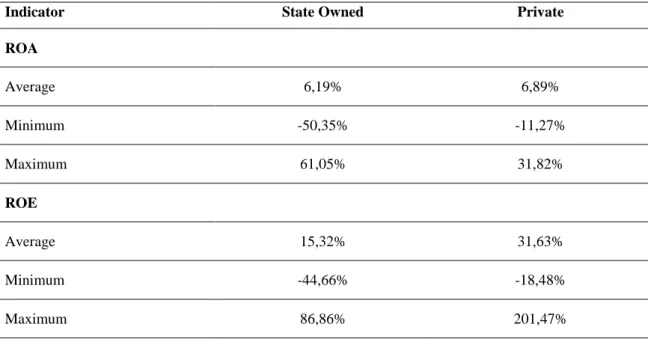
Taking into account the status of these companies in 2014, they were divided into two sub-samples: state owned companies and private companies. A brief financial analysis was performed to their profitability from1999 to 2014.
This analysis was performed by comparing the indicators ROA and ROE of the companies for the period mentioned, considering the ownership status at 2014. The following table shows the main descriptive statistics regarding the profitability of these companies.
Table 2 - TSO's profitability analysis
Indicator State Owned Private
ROA Average 6,19% 6,89% Minimum -50,35% -11,27% Maximum 61,05% 31,82% ROE Average 15,32% 31,63% Minimum -44,66% -18,48% Maximum 86,86% 201,47%
Source: The author, upon calculation of the descriptive statistics of the indicators obtained in the database Amadeus.
The table above shows that, for the period considered, the companies that were private at the end of 2014 had a better profitability than the state owned ones.
The average ROA and ROE is higher for the private companies, but also the extreme values (i.e. minimum and maximum) are more favourable to the private ones. A question is to be asked:
One may say, according to this data, that private companies in the gas transmission industry outperform the stated owned ones?
22
The analysis performed is a very static one, as it is considered that companies have the same ownership status throughout the whole period. It happened that the ownership structure of these companies has changed during this period, so this becomes a dynamic process.
Hence, there is the need to capture the impact of the state ownership on companies’ performance when it changes. In order to do so, a model was built to estimate this relation but using panel data, varying the state ownership of these companies across time.
As it was referred before, the performance of the companies is measured by different variables, ROA, ROE, daily stock returns and market-to-book ratio. The data for the market variables was exported from the Datastream database and the data for the profitability indicators was obtained from the Amadeus database and from the companies’ annual reports.
Regarding the market data, it is important to state that some of the companies analysed are not the TSO’s, but their holding companies. For purposes of this analysis, it is assumed that the behaviour of the market performance of these companies is a good proxy of the behaviour of the firm that actually performs the activity of transmission of gas, as the market performance of those listed holdings is influenced by the performance of the TSO’s, their subsidiaries.
23 Multicolinearity Test
Before analysing the regression results for each of the proxies of firm performance, the correlations for each model are calculated in order to test multicolinearity. The tables below show the results for correlation.
Table 3 - Correlation matrix Model using ROA
ROA State Ownership
ROA 1 -0.101646
State Ownership -0.101646 1
Model using ROE
ROE State Ownership
ROE 1 -0.281903
State Ownership -0.281903 1
Model using daily returns Returns State Ownership
Returns 1 -0.004813
State Ownership -0.004813 1
Model using Market-to-book
ratio Market-to-book ratio State Ownership
Market-to-book ratio 1 -0.372954
State Ownership -0.372954 1
Multicolinearity refers to variables where two or more variables are linearly related. The table above shows that the correlations of each of the variables are weak, which suggests that the regression is not affected by the presence of multicolinearity.
Additionally, a Hausman test is performed to identify whether the fixed effects model is better than the random effects model. For models using ROA, ROE and Market-to-book ratio, random effects model is better. For model using daily returns, fixed effects model is better.
24
However, in order to figure out what is the most appropriate estimator to use, two questions must be answered. The first is related with the goals of the study and the second regards the context of the data, how it was collected and the environment that generated the information (Hsiao, 1992). The choice is dependent on whether the intention is to make an inference about the population taken from a random sample of it (in this case random effects is the most appropriate one) or to study the behaviour of a concrete individual unit (in this case fixed effects is the most appropriate one, because it is irrelevant if the sample is random or not. In the present study, the focus is on a specified number of companies, so all inferences will have to be conditional regarding the specific group being analysed.
This means that it is not possible to find out a sample of companies as a random sample of a population with a tendency to infinite dimension, because it is very likely that it will represent almost all the population under analysis. Hence, the most appropriate estimators are the fixed effects estimators (Judson & Owen, 1999), because the results will be consistent and efficient.
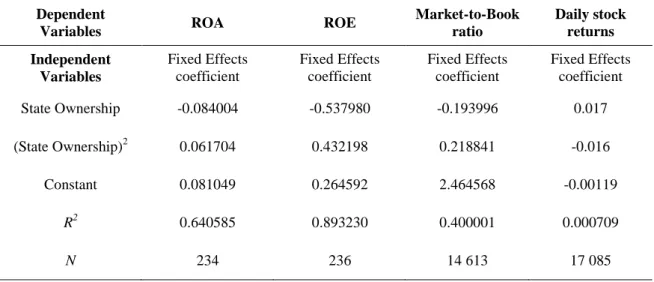
All models include the quadratic terms of state ownership. The following table shows the results of the panel data regressions.
Table 4 - Panel data regressions of performance: 1999-2014 Dependent
Variables ROA ROE
Market-to-Book ratio Daily stock returns Independent Variables Fixed Effects coefficient Fixed Effects coefficient Fixed Effects coefficient Fixed Effects coefficient State Ownership -0.084004 -0.537980 -0.193996 0.017 (State Ownership)2 0.061704 0.432198 0.218841 -0.016 Constant 0.081049 0.264592 2.464568 -0.00119 R2 0.640585 0.893230 0.400001 0.000709 N 234 236 14 613 17 085
25
3.3. Discussion of results
3.3.1. Dependent variable measured by ROA, ROE and Market-to-Book ratio
Model using ROA reveals a U-shaped relation between state ownership and ROA. This means that initially, state ownership has a negative impact on ROA, but after a certain percentage of ownership, the increase in state ownership has a positive impact in ROA.
The same relationship between state ownership and firm performance is obtained in models using ROE and daily market data for the market-to-book ratio.
Although in Europe investor protection is considerable, these results suggest that lower levels of state ownership decrease firm value or firm performance, which is consistent with the literature on this subject in countries with weak investor protection (Boubakri et al., 2005).
Dispersed ownership creates a free-rider problem, according to Ng et al. (2009), as small investors do not have the resources or the incentives to control and monitor the management, increasing the threat of the managers not acting in the shareholders’ best interests, deepening the agency problem inside the firms.
Consequently, low levels of state ownership do not benefit firm performance and have a negative impact on it. According to Kurt, Abeyratna, and Martin (2010), firms that are owned and dominated by state agents, such as government, maintain a more important position on the market, and consequently outperform those firms with lower levels of state ownership.
When the level of state ownership is high, the state or the government (personified by the bureaucrats) make additional and more diligent efforts in the firms in which it has higher shareholdings. As an example, large product orders or preferential treatment when it comes to loans, are benefits or preferential treatment that companies with higher levels of state ownership gain, according to Tian and Estrin (2008) and Sun (2002).
26
The variables do not present, however, individual statistical significance, a fact that suggests that the relationship obtained between the variables is not sufficient to infer to the remaining companies of the industry throughout the world, as the size of the sample is small and may limit the robustness of the estimations.
3.3.2. Dependent variable measured by Daily stock returns
On the other hand, the results obtained for the model using daily stock returns point out in a different direction.
These results show a different relationship between state ownership and firm performance, as it reveals an inverted U-shaped relationship between these two variables. So, for low levels of state ownership the performance is positively influenced and for higher levels of state ownership this has a negative impact in firm value and performance.
This behaviour of the performance of the stock prices of the listed companies of the sample may derive from a trade-off between the benefits of investors’ confidence (which has a positive relation with the increase of state ownership) and the risk of political interference, which has a negative impact in the investors.
Additionally, it may have its origins in the privileged channelling of funds to the company by the governments and political connections (Yu, 2013), as an example of a positive influence, but also on the state ownership value-reducing effects on the companies’ performance (Wu, 2011).
Contrarily to what is verified in the analysis of the indicators mentioned above, the variables present individual statistical significance, a fact that suggests that the relationship obtained between the variables allows inferring to the remaining companies of the industry.
27
4.
Conclusions
In this work, the relationship between ownership structure and corporate performance is tested in the gas transmission industry in Europe.
More specifically, state ownership impact on firm value and firm performance is tested, because it is the most relevant variable to assess, given the industry under analysis. Twenty-eight companies were selected as the most appropriate to measure this relationship, as they configure functionally TSO companies, operating in the gas transmission industry in Europe.
The empirical work presented makes it possible to draw the above-mentioned relationship. It can be concluded that for models using ROA, ROE and daily market data for the market-to-book ratio, the results show a U-shaped relation between state ownership and firm performance, which is consistent with the literature on this subject in countries with weak investor protection, according to Boubakri et al. (2005). These results are puzzling taking into account that Europe has a developed financial system that ensures investors’ protection, and further research should be made in order to address this behaviour.
It is also possible to conclude that low levels of state ownership do not benefit firm performance and have a negative impact on it. According to Kurt et al. (2010), firms that are owned and dominated by state agents, outperform firms with lower levels of state ownership.
Additionally, for one of the proxies of firm performance, the daily stock returns, the results showed a different relationship between the variables, as the results reveal an inverted U-shaped relationship between state ownership and firm performances.
The cause of this relationship may rely on a trade-off between the benefits of investors’ confidence (which has a positive relation with the increase of state ownership) and the risk of political interference, which has a negative impact in the investors.
28
It may also be caused by the privileged channelling of funds to the company by the governments and political connections (Yu, 2013), as an example of a positive influence, but also because state ownership shows value-reducing effects on the companies’ performance (Wu, 2011).
However, further research should be carried out in order to find out the root of the differences in the performance when measured by these two different market indicators, i.e., the market-to-book ratio and the daily stock returns, as they convey different sentiments by the investors regarding the same variable, the state ownership in TSO companies.
The model designed and applied for this study presents results consistent with the behaviour of the variables as explained in the literature. However, the variables do not present individual statistical significance, which can be assignable to the reduced size of the sample, that may not represent correctly the entire population, i.e., all the companies in the industry being analysed. Nevertheless, the choice of the estimators proves to be the most appropriate, as referred before, as the indicator R2 provides very positive results for almost all the indicators, thus indicating that the quality of the regression, despite of its significance, is high.
However, the model has some limitations, namely in the assumption that the market indicators show a similar behaviour for the TSO’s and for their holding companies’, which are the ones whose results are incorporated in the study, for the indicators market-to-book ratio and daily stock returns.
Additionally, the statistical significance of the variable and its quadratic form in some indicators may put in question the relationship that was concluded to be in line with the one explained in the existing literature. Hence, additional research needs to be performed in order to find a sample that can be representative of the industry, potentially expanding the analysis to other continents.
29
Even considering these limitations, the study constitutes a contribution to the scarce literature on the relationship between state ownership and corporate performance in the gas transmission industry for this specific sample, as the quality of the regression, measured by the indicator R2, is significantly high for almost every indicator of the corporate performance.
30
Appendices
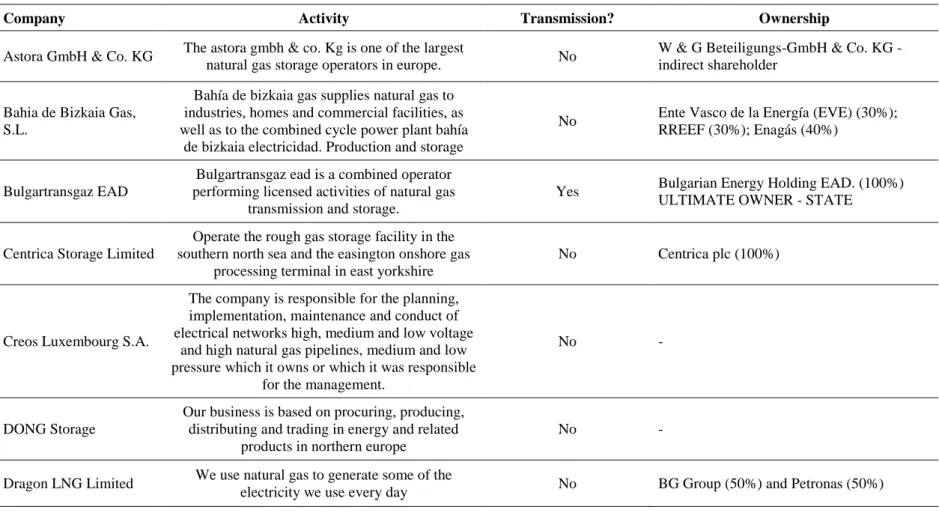
Table 5 – Search process of TSO’s
Company Activity Transmission? Ownership
Astora GmbH & Co. KG The astora gmbh & co. Kg is one of the largest
natural gas storage operators in europe. No
W & G Beteiligungs-GmbH & Co. KG - indirect shareholder
Bahia de Bizkaia Gas, S.L.
Bahía de bizkaia gas supplies natural gas to industries, homes and commercial facilities, as well as to the combined cycle power plant bahía
de bizkaia electricidad. Production and storage
No Ente Vasco de la Energía (EVE) (30%); RREEF (30%); Enagás (40%)
Bulgartransgaz EAD
Bulgartransgaz ead is a combined operator performing licensed activities of natural gas
transmission and storage.
Yes Bulgarian Energy Holding EAD. (100%) ULTIMATE OWNER - STATE
Centrica Storage Limited
Operate the rough gas storage facility in the southern north sea and the easington onshore gas
processing terminal in east yorkshire
No Centrica plc (100%)
Creos Luxembourg S.A.
The company is responsible for the planning, implementation, maintenance and conduct of electrical networks high, medium and low voltage
and high natural gas pipelines, medium and low pressure which it owns or which it was responsible
for the management.
No -
DONG Storage
Our business is based on procuring, producing, distributing and trading in energy and related
products in northern europe
No -
Dragon LNG Limited We use natural gas to generate some of the
31
Company Activity Transmission? Ownership
Dunkerque LNG, SAS Owns and manages a lng terminal No
65% of which is owned by EDF Group , 25% by the Fluxys Group and 10% by the Total Group
E.ON Gas Storage GmbH
E.on gas storage gmbh pools decades of experience and all the e.on group’s competence in
gas storage throughout europe
No As a subsidiary of E.ON Global Commodities SE
Edison Stoccaggio
S.p.A. Gas storage No -
Electricité de France,
S.A Production and distribution of electricity and gas No State (84,49%) and 15,51% private investors Elengy S.A.
Owns and operates the lng terminals of montoir-de-bretagne, on france’s atlantic coast, and
fos-tonkin, on the shores of the mediterranean.
No PART OF THE GDF SUEZ GROUP
Enagás S.A. Enagas is the technical manager of the spanish gas
system and the main carrier of natural gas in spain. Yes
Sepi and Oman Oil Company S.A.O.C, with a 5% share each. Enagás is one of the Spanish stock market companies with highest free float (90%)
Energinet.dk
Own, operate and construct the large gas pipelines and make them available on equal terms to the
enterprises that produce and transport the gas.
No We are a non-profit enterprise owned by the Danish Climate and Energy Ministry. Eustream, a.s. Transport natural gas in slovakia and through
slovakia to the european markets. Yes
SPP Infrastructure, a.s. (100%) ultimate owner - state
Fluxys S.A. Gas transmission No group fluxys
32
Company Activity Transmission? Ownership
Földgázszállító Zrt. High-pressure natural gas transmission Yes MOL MAGYAR OLAJ-ES GAZIPARI RT. (100%) Which is owned by the state in 24% Fosmax LNG, SAS
Commercially exploits the regasification capacities of the terminal and led the project to construct it (studies, purchasing, construction and
start-up)
No subsidiary of Elengy in which the latter has more than a 70% stake
Gas Connect Austria GmbH
Gas connect austria is europe’s gas transportation partner in austria.
With an approximately 930-km-long natural gas high-pressure pipeline grid in austria and an entry/exit volume of 111 billion cubic meters per
year, gas connect austria has established itself firmly on the european natural gas landscape.
Yes
Gas Connect Austria is a wholly owned subsidiary of OMV, which is owned by the State
Gaslink Independent System Operator Ltd.
From july 4th 2008, gaslink is the transmission system operator (tso) and distribution system operator (dso) and is responsible for operating, maintaining and developing ireland's natural gas
transmission and distribution systems.
Yes independent subsidiary of Ervia (formerly Bord Gáis Éireann)
Gassco AS
As operator, gassco is responsible for safe and efficient gas transport from the norwegian continental shelf and will be a leading gas
transporter in europe
Yes
All the
shares are owned by the Ministry of Petroleum and
Energy on behalf of the Norwegian government.
Gasum Oy Gas transmission Yes
The Finnish state owns 75%, of which Gasonia Oy's holding 48.5 % and National Emergency Supply Agency´s holding is 26.5 %.
OAO Gazprom owns 25 %. Gazprom is a Russian natural gas and oil group and the world’s leading producer of natural gas.
33
Company Activity Transmission? Ownership
Gasunie Transport Services B.V.
Gasunie transport services b.v. (gts) is owner and the national transmission operator in the
netherlands. Gts is responsible for the management, operation and development of the
gas transport system in the netherlands.
Yes
The issued shares are held by N.V. Nederlandse Gasunie.
Ultimate owner - State
Gate terminal B.V.
Gas storage
supply, a buffer between supply and continuous supply of natural gas, evaporation, runoff
Yes NV Dutch Gasunie (Gasunie) and Koninklijke Vopak NV (Royal Vopak) GAZPROM Germania
GmbH Natural gas storage No GAZPROM EXPORT, A 100%
GNL Italia S.p.A. Owns and manages the liquefied natural gas (lng)
regasification plant at panigaglia, la spezia. No GNL Italia is part of the Snam group GRTgaz S.A.
Grtgaz owns and operates the longest high-pressure natural gas transmission network in
europe
Yes 75% GDF Suez; 25% societe d'infrastructures gazières Hellenic Gas
Transmission System Operator S.A.
Gas transmission Yes
DESFA S.A. is 100% subsidiary company of DEPA S.A.
Ultimate owner - state Interconnector (UK)
Limited
Iuk is a joint venture company dedicated to the
safe, efficient and flexible transportation of gas. Yes
25% Fluxys Europe B.V.; Caisse de dépôt et placement du Québec (CDPQ) 23,5%; Gasbridge 1 B.V. 15,75%; Gasbridge 2 B.V. 15,75%; CDP Groupe Infrastructures Inc. (CDPGI) 10% and Gazprom 10% Magyar Földgáztároló
34
Company Activity Transmission? Ownership
MMBF Földgáztároló Zártkörűen Működő Részvénytársaság Gas storage No - N.V. Nederlandse Gasunie
Gasunie is a european gas infrastructure company. We provide the transport of natural gas and green
gas in the netherlands and the northern part of germany.
Yes The Dutch State is our only shareholder.
NAFTA a.s. Natural gas storage and underground facility
development No
SPP Infrastructure, a.s. holds the majority 56.15 % stake; Czech Gas Holding Investment B.V. owns a 40.45 % stake.
National Grid Gas plc
We are an international electricity and gas company based in the uk and northeastern us. We
play a vital role in connecting millions of people safely, reliably and efficiently to the energy they
use.
Yes
individual shareholders, who represent more than 95% of the total number of shareholders on our share register
National Grid Gas plc (Grain LNG)
Grain lng is national grid’s liquefied natural gas (lng) facility at the isle of grain, near london. The
uk’s first truly commercial lng importation terminal, we are the largest, by capacity, in europe and eighth largest in the world - with the ability to supply 20 per cent of the uk’s forecast gas demand
No -
Nederlandse Aardolie Maatschappij B.V
Our main objectives are to sustain production from existing fields, explore for and develop new fields, and obtain more gas from existing fields by
using innovative techniques.
No shareholders Shell (50%) and ExxonMobil (50%).
NET4GAS, s.r.o.
We hold an exclusive gas transmission system operator (tso) licence in the czech republic, operating more than 3,800 km of pipelines, guaranteeing secure and reliable gas transport
35
Company Activity Transmission? Ownership
OLT Offshore LNG Toscana S.p.A.
Holds and manages the property of the floating
regasification terminal “fsru toscana”. No
IREN GROUP with 49.07%, ; E.ON GROUP with 48.24%; GOLAR LNG with 2.69%
OMV Gas Storage
GmbH Gas storage No
43.3% free float, 31.5% ÖIAG
(representing the Austrian government), 24.9%
International Petroleum Investment Company
(IPIC) and 0.3% own shares. Ontras Gastransport
GmbH
Ontras is a trans-regional gas transmission system
operator in the european grid system Yes
VNG-VERBUNDNETZ GAS AKTIENGESELLSCHAFT - 100% Open Grid Europe
GmbH Germany's leading gas transmission company Yes subsidiary of E.ON Ruhrgas in 2004. Operator Gazociągów
Przesyłowych GAZ-SYSTEM S.A
Gaz-system’s key task is the transport of gas via the transmission network throughout the country to supply with gas the distribution networks and final customers connected to the transmission
system.
Yes Legal form: joint-stock company (100% shares belong to the State Treasury Operator Systemu
Magazynowania Sp. z o.o.
Storage system operator No
PGNiG S.A. has created a special purpose vehicle company under the name of Operator Systemu Magazynowania Sp. z o.o. (OSM)
PLINACRO d.o.o. Gas transmission Yes DIE REGIERUNG DER KROATIEN
(100%) Plinovodi d.o.o. Plinovodi d.o.o. Is a company managing the
natural gas transmission network. Yes
Government of Republic of Slovenia designated the company Plinovodi d.o.o. as a transmission system operator.
Podzemno skladište
36
Company Activity Transmission? Ownership
POZAGAS a.s.
This company owns and operates the láb 4 natural gas storage facility situated in the eastern part of
the vienna basin close to the town of malacky.
No
SPP Infrastructure a.s. | 35% NAFTA a.s. | 35%
GDF International S.A. | 30% RAG Energy Storage
GmbH Gas storage No Rohöl-Aufsuchungs Aktiengesellschaft
Regasificadora del Noroeste, S.A
Receives, stores and transforms liquefied natural
gas (lng) in a terminal located in mugardos No -
REN Armazenagem S.A. Gas storage No REN GÁS (100%), owned by REN SGPS
(100%)
REN Atlântico S.A - No REN GÁS (100%), owned by REN SGPS
(100%)
REN Gasodutos S.A Gas transmission Yes REN GÁS (100%), owned by REN SGPS
(100%)
RWE Gas Storage, s.r.o. Gas storage No RWE Česká republika a.s
RWE Gasspeicher GmbH
Our team develops, operates and markets a range
of different storage types No -
Snam Rete Gas S.p.A. Snam rete gas is the leading italian company in the
transportation and dispatching of natural gas. Yes
CDP Reti S.r.l - 30% eni S.p.A. - 8,54%
Other shareholders - 61,41% ultimate owner - state South Hook LNG
Terminal Company Ltd.
One of the largest liquefied natural gas (lng)
terminals in europe No
Qatar Petroleum International (QPI) is the majority Shareholder in South Hook LNG with a 67.5% share
37
Company Activity Transmission? Ownership
Stogit S.p.A.
For the storage of gas stogit uses depleted fields, thus safeguarding places and preserving environment. Gas is stored in the same safety conditions nature preserved it for million years.
No snam group
Storengy Deutschland Leine GmbH
Storengy deutschland gmbh is one of the leading companies for the underground storage of natural
gas in germany
No Storengy is a subsidiary of GDF SUEZ Storengy S.A. Storengy designs, develops and operates all types
of storage facilities No Storengy is a subsidiary of GDF SUEZ
Swedegas AB Gas transmission Yes
Swedegas has been owned since 2010 by EQT Infrastructure.
EQT Infrastructure is part of EQT, which is a group of private equity funds with various investment specialisations.
Swissgas AG Distribution of gas No -
TAQA Energy B.V.
Oil and gas exploration and production, pipelines, underground gas storage, power generation and
water desalination
No
Abu Dhabi Water and Electricity Authority (ADWEA): 52.4 per cent
- Fund for the Support of Farm Owners: 21.7 per cent
- Other Abu Dhabi government entities: 0.4 per cent
38
Company Activity Transmission? Ownership
Terminale GNL Adriatico S.r.l.
Operates the lng terminal located offshore italy, in the northern adriatic sea, that is the world’s first
offshore gravity based structure (gbs) for unloading, storing and regasifying liquefied
natural gas (lng)
No
ExxonMobil Italiana Gas (70.7%) – an ExxonMobil subsidiary, Qatar Terminal Company Limited (22%) - a Qatar Petroleum subsidiary, and Edison (7.3%)
Trans Austria Gasleitung GmbH
Trans austria gasleitung gmbh is a natural gas undertaking responsible for the transportation of
natural gas
Yes
CDP GAS S.r.l. now holds 84.5 % of the shares and Gas Connect Austria GmbH holds 15.5 % of the shares
Ultimate owner - State
TRANSGAZ S.A. Gas transmission Yes
The Romanian State by the General Secretariat of the Government 6.888.840
58,5097 %
Shareholders - Natural and Legal Persons 4.885.004
41,4903 % Transport et
Infrastructures Gaz France, S.A.
We offer and develop natural gas transport and
storage solutions for the european market, Yes TOTAL S.A. (100%) VNG Gasspeicher
GmbH Gas storage No
wholly-owned subsidiary of VNG-Verbundnetz Gas AG
39
References
ACER/CEER. (2014). Annual Report on the Results of Monitoring the Internal Electricity and Natural Gas Markets in 2013.
Berger, Roland. (2014). Study regarding grid infrastructure development: European strategy for raising public acceptance.
Boubakri, Narjess, Cosset, Jean-Claude, & Guedhami, Omrane. (2005). Postprivatization corporate governance: The role of ownership structure and investor protection. Journal of Financial Economics, 76(2), 369-399. doi:
http://dx.doi.org/10.1016/j.jfineco.2004.05.003
Claessens, Stijn, Djankov, Simeon, & Lang, Larry H. P. (2000). The separation of ownership and control in East Asian Corporations. Journal of Financial
Economics, 58(1–2), 81-112. doi: http://dx.doi.org/10.1016/S0304-405X(00)00067-2
Denis, Diane K. (2001). Twenty-five years of corporate governance research … and counting. Review of Financial Economics, 10(3), 191-212. doi:
http://dx.doi.org/10.1016/S1058-3300(01)00037-4
Economides, Nicholas. (1995). The Economics of Networks. International Journal of
Industrial Organization, 14(2).
Growitsch, Christian, & Stronzik, Marcus. (2014). Ownership unbundling of natural gas transmission networks: empirical evidence. Journal of Regulatory Economics,
46(2), 207-225. doi: 10.1007/s11149-014-9252-0
Gujarati, Damodar N. (2004). Basic Econometrics (McGraw-Hill Ed. 4 ed.).
Gunasekarage, Abeyratna, Hess, Kurt, & Hu, Amity. (2007). The influence of the degree of state ownership and the ownership concentration on the performance of listed Chinese companies. Research in International Business and Finance,