Building informative audio-visual content automatically:
a process to define the key aspects
Telmo Silva1[0000-0001-9383-7659], Liliana Reis1[0000-0003-2638-325X], Carlos Hernández 1[0000-0001-5941-2032], Hilma Caravau1[0000-0002-2767-1387]
1 CIC.DIGITAL/Digimedia, Department of Communication and Arts, University of Aveiro, Aveiro, Portugal
[email protected], [email protected], [email protected], [email protected]
Abstract. Related to the population ageing that most of the countries are
witness-ing, several new challenges emerged in areas such as health and social care. Of-ten, governments and entities does not have human, physical and infrastructural means available or in sufficient number to support all citizens’ needs. This trend requires different approaches to address their related problems. In this context, several technologies have recently emerged and have been explored as an im-portant ally to cope with seniors’ needs. Interactive television (iTV) infrastruc-ture have a lot of potential to deliver adapted solutions to seniors, although it is essential that such products are designed and developed with inputs from poten-tial end users. The application of a participatory design approach is a key factor to assure high levels of final products’ adoption. In line with this, the present paper describes the process of data collection that aims to analyse the audio-vis-ual elements that compose a set of videos that will be transmitted by an iTV plat-form and that intents to deliver inplat-formative contents about social and public ser-vices to Portuguese elders. The results will provide guidelines for the develop-ment of similar products that address older people’s needs.
Keywords: audio-visual content, iTV platform, elderly
1
Introduction
Population ageing is an undeniable fact, faced by almost all countries. As a result of improvements in living conditions, such as access to better food and nutrients, water and enhancements in sanitation and health systems, since 1970 the world average age of death has increased 35 years, with declines in death rates in all groups of the age pyramid [1]. According to projections, this tendency will persist and the number of elderlies will increase dramatically in the medium-term future. Challenges and oppor-tunities that come with ageing, both at personal and community level, are drawing the attention of several sectors of society. One example of this is the increased concern shown by Governments and civil societies to follow the World Health Organization recommendations to promote healthy and active ageing [2].
The quick evolution and the high volume of technological innovations related to seniors’ needs that have emerged in the last decades show that this is a dynamic area.
The huge relevance of this subject is assumed both by the academic and industrial mar-ket as well as by the European authorities who believe there is great potential for the development and implementation of a wide range of new technologies. Health care, disability support and remote support for the elderly are some of the areas in which technologies can play a key role [3].
One of the pillars that influence the quality of life in advanced age stages and im-prove the empowerment of older people is related to the access to information and knowledge [4]. Increasingly, it is important to build inclusive digital environments that promote the ease of digital and social access, so that the elderly can maintain and im-prove their quality of life [5]. Although, several times, technologies developed did not consider the needs and expectations of the target population which affect the perceived benefits and, consequently, the level of older people’s adoption and use of technologies [6]. To avoid this problem and to transform technology into a real asset for the elderly, it is important that they become involved from the onset in the process of building and developing the products, through the listening of their perceptions and expectations.
Therefore, the aim of this paper is to present and analyse the data collected with a sample of Portuguese seniors with the purpose of defining the audio-visual elements that compose the videos to be transmitted by an interactive television (iTV) platform, specifically for the elderly population. In addition to the present introduction, this arti-cle is organized in the following sections: section 2 presenting a theoretical framework on the questions of population ageing, the importance of technologies to support sen-iors’ information needs and the attention that should be taken when building audio-visual content for this population segment; section 3 a brief description of the +TV4E academic project; section 4, which illustrates the methodological steps followed to de-fine the elements that will compose the videos delivered through the +TV4E platform; section 5, where the obtained results are presented and discussed in detail, and finally, section 6 that presents some of the conclusions drawn from this study and orientations for future work in this field.
2
Theoretical Framework
The expected slowdown in population growth in the next 90 years, due to the reduction in fertility rates, will increase the number of older people over time. By 2017, around 13 per cent of the global population are people with 60 years or over, which corresponds to 962 million citizens. By 2030 is expected that this number will increase to 1.4 billion, reaching nearly 2.1 billion in 2050, and could rise to 3.1 billion in 2100 [7].
Portugal follows this demographic trend and it is expected that this process will be accentuated. The last report indicates that between 2015 and 2080, the number of peo-ple with 65 years or over will increase from 2,1 to 2,8 million, accompanied by a sig-nificant reduction in the number of inhabitants in the national territory (from 10,3 to 7,5 million people) [8]. It is also expected that the highest number of elderly will be reached around 2040, moment when this growth trend will decline. Although, popula-tion ageing index will be more than double between 2015 and 2080, with 147 elderlies in 2015 reaching 317 older people in 2080 [8].
To better understand the ageing concept it is important to refer that this is a natural, universal, progressive and irreversible process influenced by the interaction of internal (genetic traits) and external factors (e.g. education, life styles) [9]. In biological terms (primary ageing), the human body suffers several physiological and anatomical deteri-orations gradually. Structural and functional modifications have significant implica-tions in the individuals’ functionalities. Delay in reaction time, difficulty to control pos-ture and balance, loss of fine motor skills, hearing impairment and reduced visual acuity are some of the typical functional changes related with the ageing process [10]. These changes can influence and limit the individuals’ ability to respond to situations in their daily lives, endangering the promotion of an active life.
The concept of “active ageing”, adopted by the World Health Organization, advo-cates that a longer life must be accompanied by continuous opportunities in health, participation and security in order to enhance quality of life (QoL) [2]. QoL is a broad ranging and complex concept, and at advanced stages of life is highly influenced by the individuals’ ability to maintain autonomy and independence [2]. Concerning this, get-ting proper information may represent a key factor to face daily living challenges pro-moting an autonomous and independent ageing process [11], reinforcing the pillar of participation that determines active ageing. Even if accessing information concerning the world that surrounds us is often dependent on a proactive attitude of the individuals and, nowadays, often requires minimum levels of digital literacy so that the information accessed is perceived as a whole. Unfortunately, often times many people do not ac-complish these criteria, staying away from the information that is passed to them by others (e.g. information sources, informal caregivers) and sometimes they do not un-derstand the information meaning [12]. One of the possible ways to answer this notori-ous requirement is through the use of technologies available to most citizens [13].
Today's society is characterized by high levels of information dependence, with the communication networks playing a key role to fulfil these needs, promoting economic and social development [3]. The emergence of new digital technologies, such as the appearance of personal computers and the Internet, led to a technological revolution that transformed the citizens' experience by easing the access to information and enter-tainment contents [12, 14].
Regarding the older population’s needs referred above, it is unquestionable that providing adequate information helps the elderly to support the daily decision-making process. There are several information sources to achieve informative contents, such as journals, radio, books, magazines, pamphlets, social networks, etc. [15]. In addition to the internet, television (TV) has also been one of the great discoveries and agents of change in societies in the last decades [16]. TV is still in a prominent position as the preferred information source for the Portuguese elderly [15], which is confirmed by the high average of daily television consumption among people with 65 years or more (5 hours and 8 minutes a day watching TV) [17].
Taking benefit of the advances of the technological world, several products, that aim to support the ageing process, were developed. These products cover a wide range of areas such as health, social and informational fields [3, 12]. The combination between traditional TV with features available via the internet, lead to the development of iTV
platforms, a technological basis with an enormous potential for the creation and appli-cation of gerontechnological solutions. The potential of iTV platforms was already rec-ognized by the European Commission a decade ago, by providing public entities with the means to make Information Society services accessible to all citizens [12]. In this context, and concerning the informative needs and expectations among Portuguese el-derly [15], is under development an academic project that aims to promote seniors info-inclusion through an iTV platform. Following, more details about +TV4E project will be presented.
3
+TV4E Project
The +TV4E project, is a Portuguese action-research project headed by the University of Aveiro that aims to promote the info-inclusion and improve the QoL of Portuguese seniors through the transmission of video spots with informative content about social and public services. These videos include an audio track narrating the news content that is crawled from specific internet sites. This project comes up with an iTV platform, running in set-top boxes, to enrich the TV viewing experience with the integration of high-valued informative contents. The system that supports the platform will be devel-oped in a personalized way, considering the user’s preferences, needs and expectations so that only relevant content for the user are sent. The information presented in the videos is aggregated into seven macro-areas of interest, previously studied with experts in public health and public policies, as well as, with a sample of Portuguese seniors, titled Assistance Services of General Interest for Elderly (ASGIE) [15]. These seven areas are: (1) health care and welfare services; (2) social services; (3) financial services; (4) culture, informal education and entertainment; (5) security services; (6) local au-thority services and (7) transport services.
The video spots delivered through the platform are automatically produced based on web news and, regularly, the system verifies if there are new contents on the infor-mation sources that feed the platform, generating new informative videos. To achieve this, an algorithm selects content from different web sources and builds audio-visual pieces on its own. Technologically, this is one of the differentiator element of this pro-ject. The video spots are then injected into the linear television transmission, while the regular TV broadcast is locally paused and resumed after the presentation of the in-formative video. Regardless the macro-area of interest information, all videos have a similar structure and are composed by a set of elements with a defined ordered, follow-ing presented: (1) intro card with +TV4E logo animation, with a plain colour back-ground; (2) card with the logo, and a conforming colour background that identifies the ASGIE targeted by the video; (3) video with the corresponding title, description and background images, specific to the macro-area of information; (4) project logo with one of the ASGIE related background images and (5) another card (project logo with a plain colour background). As is noted in the previous description of the cards’ flow, there are several audio-visual elements that compose each video card, specifically: icon that identifies each specific ASGIE; specific colour background associated with each
macro-area of information; background images palette defined to each ASGIE; opac-ity/transparency of images; background music; audio track that narrates the news arti-cle; font size shown as video caption. In addition, there are functional components in-tegrated into the informative videos, such as: narration’s speed; video length; reading's synchronization with transitions between screens and narration speed; transition effects between screens and news’ interest.
Technological solutions must be adapted to the needs and expectations of end users to promote the technology acceptance [18]. This process is even more important when the target population is the elderly. In line with this, is crucial that from the outset of the product development process, potential end users are involved through a participative design approach to create a valuable product, easy-to-use and that fulfils seniors’ needs, increasing the chances of guaranteeing a comfortable experience [11]. Thus, some of the audio-visual and functional elements that will compose the video spots delivered through the +TV4E platform will be created with a sample of Portuguese seniors, sup-ported by the inputs gathered participatory design approach.
Although is the intention of the +TV4E research team, the complexity and slowness entailed to the creation process does not allow the development of all the elements con-cerning the inputs from seniors. However, this constraint was surpassed by a test per-formed with a sample of seniors, in which all elements were presented in an aggregated form, described further.
4
Methodology
The present study was held within the +TV4E project’s context and it focuses on the validation of functional and technical aspects of audio-visual informative videos in col-laboration with senior users. These video spots, brought to elderly people’s televisions through the +TV4E platform, intends to show new and updated information from cred-ible sources, in order to contribute to the seniors’ independency and autonomy.
Czaja and Sharit (2012) affirm that seniors are willing to adopt and use new techno-logical systems, but there are obstacles that interfere with that, including lack of access and knowledge of potential benefits of the technologies, lack of technical support, costs, fear of failing and the complexity of interfaces that are frequently designed and devel-oped without considering their needs. So, an interactive system directed to the senior population should be designed and developed taking some important factors into ac-count, for it to become a valuable instrument [20]. It is essential that their perspectives and needs are well represented in the final product and that ageing process and age-related changes are kept in consideration during its development.
Considering this, the present study was conducted through a research development methodology due to its collaborative nature. It was developed with potential users who tested and evaluated audio-visual solutions to reach a conclusion, through participative design sessions adequately organized to validate certain aesthetical and technical ele-ments of the videos.
It was always intended to include seniors in the study who could contribute with their personal inputs about the best and most adequate ways to design the final product.
During the videos’ construction process, this research counted on the collaboration from two Senior Universities that invited some of their students for the data collection sessions. The participants were selected by convenience. It is often difficult to select a random sample or even a systematic sample and so the research team contacted two universities in Aveiro region, mainly due to localization motives and to guarantee that the participants would form a solid and consistent sample in every data collection ses-sions, establishing empathizing with the project. This led the participants to start feeling familiarized with these sessions’ goals. However, it was considered that a convenience sampling could suffer biased and cannot be representative of the whole population. Each one of the sessions was aimed to test, discuss and validate audio-visual elements about the information’s presentation in the videos, registering the gathered opinions from the seniors for the videos ’design. The Senior University of Curia and the Senior University of Cacia were the two institutions that accepted the invitation to participate in the audio-visual elements definition process of the videos to be transmitted through the +TV4E platform. The involvement of two different institutions guaranteed a greater number of inputs and a diversity of the sample considering their different environmen-tal influences.
The present paper focuses on the final design session. The previous sessions were focused on validating several elements composing the audio and visual structure of the videos including textual elements, sound elements, iconography and colour distinction for each ASGIE. After testing and validating these aspects the research team returned to the universities to obtain a final opinion about the most important aspects and to validate the overall result.
All the previous data (text, sound, icons and colours) was gathered at specific mo-ments and relatively far between. So, there came a need to bring, once more, the ob-tained results and the adjusted solutions to potential users, in order to validate them all together, with a more general point of view. Besides these elements, the team also de-cided to ask seniors about some other audio-visual aspects that were not tested until then but revealed to be essential to the project’s refining.
In this line, a final focus group session was planned with 8 participants from the Senior University of Cacia, at May 31st, 2017. A distance of 3 meters between the tel-evision (a full HD TV set with 42’’) screen and the participants were assured and the session was recorded in audio format upon their approval. The elements tested in this moment were: text characters size; speech velocity; music perception; iconicity level; colour distinction; video’s duration; reading synchronization with transitions and speed; screen’s transitions; background images; background opacity and the infor-mation’s interest.
In an initial moment, the participants were shown different videos already generated by the platform, in order to analyse all the elements that the team intended to work with the sample in this focus group. After this, each variable established to talk about was tested one by one.
Firstly, regarding textual elements, the informative text’s font size was shown at 55 pts which was the size agreed in a previous data collection moment with the same par-ticipants. After watching the video example, the participants were asked about their
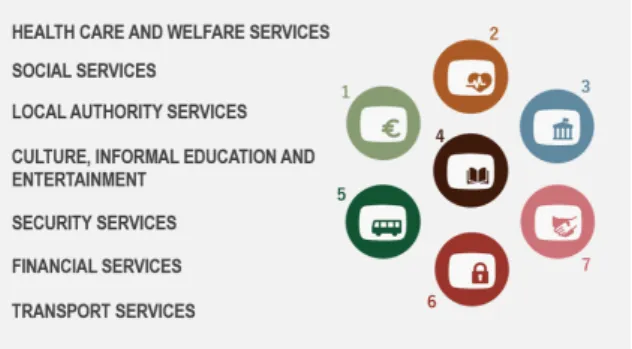
opinion concerning the difficulty and the effort towards reading the text at the estab-lished font size. Sound elements were after discussed, specifically music perception and speech speed. Two video spots from the same ASGIE (Local Authority Services) were shown, yet with different duration times (23 seconds and 1 minute and 23 seconds). Both videos were narrated by a feminine voice generated by a text-to-speech tool, as it was the preferable genre in a previous moment with the senior participants. This time, the participants were asked if the background music caused some kind of distress and if the speech’s speed was the most adequate. Regarding iconography, an association exercise was planned, showing to the participants an image where they could see a list of all the ASGIE accompanied with the icons set without associated labels, that was designed based on their previous inputs and opinions (see Fig. 1).
Fig. 1. ASGIE’s list with the icons developed
The participants were asked to connect each icon with the correct ASGIE. This exercise aimed to assure that the icon design was perceptible and that it would be easy to asso-ciate each symbol to its correspondent area.
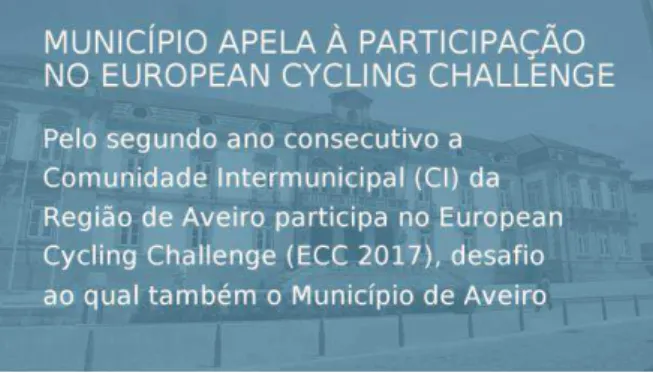
To validate the colours associated with each ASGIE, the discussion process was held through the visualization of each introduction bit of the videos, one by one, from the different 7 areas. The introduction of the videos consists of a brief animation, displaying the platform’s logo transitioning to a coloured background with the ASGIE icon on it, as explained in Fig. 2.
Fig. 2. Transition screens in the intro moment
The use of colours to distinguish each ASGIE, not only contributes for the identity of each one, but also helps the senior to easily and quickly identify the kind of informative
content to expect. The participants were questioned if they would change any of the colours, if some colour was too strong or distressful, or if some of them were too similar between them.
These were the elements that were brought previously for testing and now were val-idated in this final moment. The other aspects that were not tested before were consid-ered convenient and relevant to be put to test, as they could still be improved or ad-justed. These variables were the transitioning effects between screens, the selection of background images for each ASGIE and the coloured background opacity.
The interest had on the information was assessed using different screens from five of the defined ASGIE, showing news content created in the past week. The other two ASGIE were not had in consideration because their information sources were not avail-able (Social Services and Transports). For the Health Care and Welfare macro-area two different news articles were shown, presenting different contexts, one was political re-lated and the other focused on the general-interest.
To evaluate the transition effect between screens, the participants were displayed with various examples of effects different from the already established in the showed videos, both based on vertical and horizontal movements. Afterwards, the participants were asked if they had any suggestion regarding transition effects that could give a better viewing experience for them or if the transition effect made any significant dif-ference for the information comprehension.
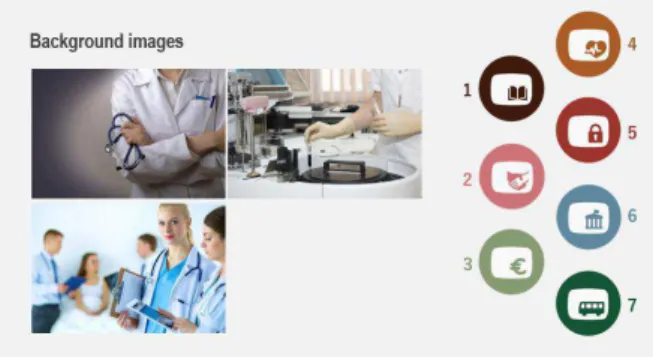
For the background images of each ASGIE, the participants were presented with a series of slides. Each slide contained a set of images within the same thematic accom-panied with the 7 icons. Subsequently, the participants were instructed to associate each set of images with one of the icons, in a similar approach used in the association exer-cise for the icons. The image below (Fig. 3) represents an example of a slide showed to the participants, in this case, for the Health Care and Welfare Services ASGIE.
Fig. 3.Slide show of Health Services ASGIE presented
Finally, it was necessary to obtain validation regarding colour opacity from the back-ground layered on the image during the informative content exhibition. In this field, it was presented a slide with a background image beneath a coloured layer with three different transparency levels (5%, 15% and 25%), as shown in Fig. 4. The participants were asked to come to an agreement about which level would work best, considering the image perception and the reading process.
Fig. 4. Slide with background image with coloured layer
The next section presents and discusses the results achieved.
5
Results and Discussion
After putting in practice the presented methodology, the following results were achieved:
1.Font size – Excepting one participant, every other felt comfortable with the font size, used in the title and content of the news, and considered it easily readable. Confirming the previous results from other data collection moments.
2.Speech speed – From the videos shown, the participants considered that the longest one had a lower speech speed than the shortest one, stating that the narration of the shortest was not only fast, but as well hard to understand. This is an interesting observation since both have the same speed. This result may be due to the lower speed and bigger difficulty seniors have in processing data when much is presented in a short space of time.
3.Music perception – The background music did not cause or seemed to cause any disturbance on the perception the participants had of the narration of the informa-tive content. Being so, this element is properly working as a link for better compre-hending the speech synthesis.
4.Iconicity – In this test, it was clear that every icon was successfully associated with its correspondent ASGIE by every participant. It was also noticeable that the pre-vious data gathered was accurate enough to design icons easily perceivable by sen-iors.
5.Colour distinction – The colours used were approved by every participant, which found them proper for each ASGIE, validating, as well, other moments of data col-lection.
6.Video duration – The preferred video was the one having a duration of 1 minute and 23 seconds. For the participants, because they perceived it as having a slower paced speech, this one was more comprehensible and clear, which is one of the main reasons why they chose it. The videos produced by the Automated Video En-gine (AVE) do not have a time limitation because their duration is dependent on
the size of the news content it has, though there exists room for improvements. In this manner, some more data must be collected in other sessions or at least during a phase of testing in a domestic environment.
7.Reading synchronization with transition duration - The synchronization respects to the news description text shown according to what is being narrated in the moment of a transition for another slide. Being verified, in some occasions, a certain delay between both to narration and the text. For the participants, there was no objection regarding this subject and it was stated that the moment of transition between screens was easily understandable, having in mind, once again, both the narration and text being presented.
8.Animated screen transitions – From the presented transition animations, none seemed to convince the participants to have some added value for the informative audio-visual content.
9.Background images – During the tests every image was correctly associated with its correspondent ASGIE, with the exception of Social Services, where some noto-rious difficulties were felt in this task, referring that the image was ambiguous. For both Financial Services and Security Services, some feedback was exchanged in relation to images that could be used. For Financial Services were suggested images containing elements such as money or graphs related to the stock market, and for Security Services more involving cops and less involving certain aspects that could offend the sensibility of some viewers. For instance, one image shown for this area was a black man in handcuffs, which was considered to presumably lead to some misinterpretations regarding prejudice against a certain ethnic group, as it was pre-dictable.
10.Background opacity – The entire sample chose the transparency level of 15%, which matches the opacity already in use for the videos being produced in the con-text of the project.
11. Information interest – There was a lack of interest in one of the news article about Health Services. It was related to a visit from a political entity to a Portuguese Hos-pital that was followed by a political commentary. The participants stated that they prefer that each ASGIE focuses on the general-interest rather than approaching a specific context, which in the present study was a political approach to the Health Care and Welfare Services macro-area.
Although it was difficult to maintain the seniors focused on the discussion, their con-tribution was important, providing, through their opinion and perspective, relevant ap-proaches to improve several aspects of the informative audio-visual content. In general, the participants showed very interest on the informative videos, as they complimented and appreciated the informational pertinence of the presented content. This supports the idea that the engine, that is providing informative audio-visual content, is well prepared to gather data in several web pages and create, according to each ASGIE, the informa-tive videos.
As the AVE is developed in such way allowing to easily change certain key aspects of all the process (such as font size, speech speed, information sources, background
images and colours, music volume) some simple solutions can be made in order to ad-just the videos accordingly to the senior’s expectations gathered in this focus group. These adjustments do not reveal major problems in any of the video components but result important to make them suitable for the potential end users.
6
Conclusions and Future Work
As it was understood, iTV platforms have a great potential to spread information amongst the elderly population, which can represent an important ally to ageing well. Developing technological products that have in consideration the potential end users’ inputs will enhance the possibilities of success of its use. Regarding the specific subject addressed in this work, the moments carried on, were essential to define elements that will be included in the video spots of +TV4E platform according to seniors’ prefer-ences. Globally, the presented elements pleased all the participants. It is also high-lighted the importance and the added value of the end users’ participation in the devel-opment of the iTV platform that, despite their low digital literacy levels, do an effort, get involved and understand the requested topics.
After several moments of data gathering, this process, being the last in the +TV4E project’s schedule, has revealed a big significance for the validation and evaluation of numerous components and features of the informative audio-visual content, some tested with the Universities of Cacia and Curia, and others such as this, with only one of the Universities. The validation of previously obtained data allows to identify and closure new problems as well as making sure that the data being used is trustworthy.
The trajectory of the +TV4E project is defined by most of the information obtained within these moments, where the small elements analysed are all put together, acting as an influence for other similar ones and serving as important links for the end result.
7
Acknowledgements
The research leading to this work has received funding from Project 3599 – Promover a Produção Científica e Desenvolvimento Tecnológico e a Constituição de Redes Temáticas (3599-PPCDT) and European Commission Funding FEDER (through FCT: Fundação para a Ciência e Tecnologia I.P. under grant agreement no. PTDC/IVC-COM/3206/2014).
References
1. He, W., Goodkind, D., Kowal, P.: An Aging World: 2015 International Population Reports. Washington DC (2016).
2. Kalache, A., Gatti, A.: Active Ageing: a policy framework. (2002).
3. Queirós, A., Rocha, N.P.: A Importância das Tecnologias. In: Teixeira, A., Queirós, A., and Rocha, N.P. (eds.) Laboratório vivo de usabilidade (Living Usability Lab). pp. 47–61. ARC Publishing (2013).
4. Asla, T., Williamson, K., Mills, J.: The role of information in successful aging : The case for a research focus on the oldest old. Libr. Inf. Sci. Res. 28, 49–63 (2006). doi:10.1016/j.lisr.2005.11.005
5. Vechiato, F.L., Vidotti, S.A.B.G.: Recomendações de usabilidade e de acessibilidade em projetos de ambientes informacionais digitais para idosos. Tendências da Pesqui. Bras. em Ciência da Informação. 5, (2012).
6. Hernández-Encuentra, E., Pousada, M., Gómez-Zúñiga, B.: ICT and Older People: Beyond Usability. Educ. Gerontol. 35, 226–245 (2009). doi:10.1080/03601270802466934
7. United Nations: World Population Prospects: The 2017 Revision, Key Findings and Advance Tables. , New York, USA (2017).
8. Instituto Nacional de Estatística: Projeções de População Residente 2015-2080. (2017) 9. Fechine, B.R.A., Trompieri, N.: O processo de envelhecimento: as principais alterações que
acontecem com o idoso com o passar dos anos. InterSciencePlace. 1, 106–132 (2015). 10. Berger, L., Mailloux-Poirier, D.: Pessoas Idosas - Uma Abordagem Global. Lusodidacta,
Lisboa (1995).
11. Reis, L., Caravau, H., Silva, T., Almeida, P.: Automatic creation of TV content to integrate in seniors viewing activities (no prelo). Procedia Comput. Sci. (2017)
12. Silva, T., Abreu, J., Antunes, M., Almeida, P., Silva, V., Santinha, G.: +TV4E: Interactive Television as a support to push information about social services to the elderly. In: Conference on Health and Social Care Information Systems and Technologies, CENTERIS. pp. 1–6 (2016)
13. Caravau, H., Silva, T.: +TV4E: an interactive television platform as a support to broadcast information about social services. In: Proceeding of III Congreso Internacional de Ingeniería Informática y Sistemas de Información (CIISI 2016). pp. 504–512. , Habana, Cuba (2016) 14. Silva, T.: Identificação de utilizadores seniores em televisão interativa (iTV),
https://ria.ua.pt/handle/10773/13171, (2014)
15. Silva, T., Caravau, H., Campelo, D.: Information Needs about Public and Social Services of Portuguese Elderly. In: Proceedings of the 3rd International Conference on Information and Communication Technologies for Ageing Well and e-Health (ICT4AWE). pp. 46–57. , Porto, Portugal (2017)
16. Carlos, M., Silva, T.: Seniors, iTV and content about Social Services clarifying the relationship. Netw. Knowl. J. MeCCSA Postgrad. Netw. 10, 64–75 (2016)17. Entidade Reguladora para a Comunicação Social: As novas dinâmicas do consumo audiovisual em Portugal 2016. , Lisboa (2016).
18. Chen, K., Chan, A.H.S.: A review of technology acceptance by older adults. Gerontechnology. 10, 1–12 (2011). doi:10.4017/gt.2011.10.01.006.00
19. Czaja, S.J., Sharit, J.: Designing Training and Instructional Programs for Older Adults (Human Factors & Aging). Taylor & Francis Group, LLC, Boca Raton (2013).
20. Nunes, F., Kerwin, M., Silva, P.A.: Design Recommendations for TV User Interfaces for Older Adults: Findings from the eCAALYX Project. Proc. 14th Int. ACM SIGACCESS Conf. Comput. Access. - ASSETS ’12. 41 (2012). doi:10.1145/2384916.2384924