A Work Project, presented as part of the requirements for the Award of a Master Degree in Management from NOVA – School of Business and Economics.
INTEGRATING CONTROL WITH FRANCHISEES’ AUTONOMY: A FRAMEWORK BUILT FOR ARTISANI’S FRANCHISING
ANA CATARINA FERNANDES SERRANO MARQUES, 3845
A Project carried out on the Master in Management Program, under the supervision of: Professor Emanuel Gomes
INTEGRATING CONTROL WITH FRANCHISEES’ AUTONOMY: A FRAMEWORK BUILT FOR ARTISANI’S FRANCHISING
Abstract
Although standardization is the norm in franchising, autonomy is desired by franchisees, which may lead to potential control issues. This qualitative research follows a problem-solving format and is focused on the control challenge faced by Artisani’s franchising, a Portuguese artisanal ice cream company, characterized by low standardization. The aim was developing the overall control system for the chain. Primary data was collected through interviews with the management team and one franchisee, and then crossed with secondary sources. The results implicate that control should be adapted to franchisees’ level of experience and characteristics to ensure compliance, while maintaining their autonomy.
Keywords: Artisani, franchising, control system, autonomy
Acknowledgments
First, it is necessary to thank Artisani, particularly to Dra. Luísa Lacerda and to João Gaspar for their availability and sympathy, which were key for the development of this project. Then, I also need to thank my advisors: Professor Sónia Dahab in the initial stage, helping me with the definition of the theme and establishing the first contact with Artisani; and then Professor Emanuel Gomes, who provided me support and guidance through the key stages of the Work Project, even though he became my advisor only in the beginning of October. This change of advisor was a challenge; yet, I believe it was surpassed and ended it up enriching the final result, so I am very thankful to both.
Additionally, on a more personal note, I would like to thank my family, Tiago and my closest friends who supported and motivated me throughout the whole process.
Introduction
Control mechanisms are indispensable in franchising (Cavusgil et al., 2014; Das and Teng, 2001). As it consists on a hierarchical and interdependent relationship between legally independent parties (Beshel, 2010), power unbalances and goal conflicts can arise, leading to non-compliance and damaging the network’s performance (Boulay, 2010). Control minimizes that risk and protects the value of the brand (Cavusgil et al., 2014; Dant and Gundlach, 1999), even though it can be difficulted by franchisees’ desire for autonomy.
The dichotomy of control and autonomy was analyzed by Davies et al. (2011), who built on Pizanti and Lerner’s (2003) conclusions, while the relationship between trust and control was widely studied by Das and Teng (2001) - without a focus on franchising - and by Yakimova et
al. (2018) whose research explained how social control motivates franchisees’
brand-supportive behavior. So, although control in franchising has been researched, conclusions were fragmented, lacking a focus on the overall management control system within a single franchising chain (Verbieren et al., 2008). This project aims to contribute to fill that gap, through a problem-centered, case study approach, by developing a control system for Artisani’s franchising (By Artisani), created in 2014 and now representing between 20-25% of revenue. Artisani is the commercial brand of Sabores do Dia- Gelados Artesanais Lda., a Portuguese artisanal ice cream company. Control is a current challenge, because the same mechanisms are used for all franchisees, when each one has its own identity, due to the unusual high level of autonomy provided. Therefore, the objective is suggesting a framework of adaptable control, to satisfy the franchisor’s need for compliance without compromising franchisees’ autonomy. The study has six sections. First, the literature review, grouped by themes regarding control in franchising, to provide a theoretical background. It is followed by research methods, including the context of the study, as well as the data collection and analysis methodology. Next, there is
the diagnosis of the issue, and then the analysis of current control mechanisms. The consequent section regards the proposed solution, and the final one includes discussion and conclusions. Literature review
1.The standardization-adaptation paradox. As the owner of a brand replicated by independent entrepreneurs, the franchisor must ensure a certain level of quality and consistency. That is one of the main drivers for standardization (Kauffmann and Eroglu, 1999; Hornsby, 2011). However, in spite of being the norm, standardization may not be the most suitable option (Liu et al., 2014; Gillis et al., 2018). Franchisees’ motivation can be an inhibitor (Kauffmann and Eroglu, 1999), due to concerns related with product/service fit, free riding (Gillis, 2018), and their desire for autonomy (Dant and Gundlach, 1999). Zeng et al. (2012) researched the authenticity–standardization paradox in the food service sector and concluded that even though food is the core element for perceived consistency, elements related with the store’s atmosphere, e.g. music and decoration, can create the feeling of a common experience, ensuring, simultaneously, consistency and local markets’ authenticity. So, if consistency is guaranteed for the franchisor, a less standardized system can be positive for franchisees, due to their entrepreneurial preferences (Davies et al., 2011), although it difficults control.
2.Control’s relevance in franchising: The business system transferred from the franchisor to the franchisee is composed mainly by know-how, procedures and methodologies (Fernandes, 2016), and according to the knowledge-based view of the firm (KBV), globalization turned knowledge into “the most strategic resource” and learning into “the most fundamental activity for competitiveness” (OECD, 1996), so these resources and capabilities must be protected. Control has that goal, as it refers to a set of procedures and instruments used to monitor behaviors and activities of franchisees, and to establish standards, so that the franchisor can evaluate, direct and compensate them (Anderson and Oliver, 1987), making them more predictable and facilitating the pursuit of common objectives (Leifer and Mills, 1996).
Research defined two types of formal control – behavior and outcome (Anderson and Oliver, 1987; Heide et al., 2007) - and one type of informal one - social control (Das and Teng, 2001; Yakimova et al., 2018). Behavior control regards the definition of how procedures should be conducted, e.g. defining and monitoring the approach to customers or doing checkups of operating methods (Heide et al., 2007), so it includes the franchisor’s support function (Quinn and Doherty, 2000). Outcome control aims to achieve a certain performance level, and consists on defining, monitoring and evaluating outcomes, e.g. sales revenue, product quality or customer satisfaction (Das and Teng, 2011; Crosno and Tong, 2018). Among the two, outcome control allows for higher autonomy, so as franchisees become more experienced, this type of control positively influences their satisfaction, while behavior control does not have a positive neither a negative effect (Mellewigt et al., 2011). Distinctively, social control comprises setting a common culture and values to increase franchisees’ commitment and the probability of an alignment of goals (Yakimova et al., 2018). Therefore, both types of control are complementary to concurrently maintain compliance and trust in the relationship (Yakimova et al., 2018). 3. Trust’s impact on control: Franchising comprises an interdependence between both parties, with an underlying asymmetry of power, which increases the likelihood of conflicts (Davies et al., 2011). Trust acts on it as a cohesive element (Davies et al., 2011), being defined as “the willingness of a party to be vulnerable to another, despite the ability to monitor or control it” (Mayer et al, 1995). It can be based on reputation and built through communication, or related with the partner’s ability to perform well, which depends on defining mutual interests, to inhibit conflicts and increase the sense of reliability (Das and Teng, 2001). Trust decreases the perceived total risk- composed by performance and relational risk, respectively related with not reaching objectives and not having cooperation (Das and Teng, 2001)- acting mostly on its relational component through the enforcement of positive relationships (Dickey et al., 2008). Control also aims to reduce risk, sharing that goal with trust: output control is more effective
with performance risk and behavior control with relational risk (Das and Teng, 2001). However, the relationship between both concepts depends on the type of control. Formal control has a negative and substitutive relationship with trust (Sengun and Wasti, 2009; Long, 2018), while social control, which defines common goals and rules and increases mutual understanding, positively impacts trust instead (Kalkman and de Waard, 2017). Furthermore, the intent of formal control is also significant in terms of perceived trust, as it may be designed to strictly avoid deviation from franchisor’s terms (coercive control) or to create a system of regular feedback, flexibility and support (enabling control), which is better perceived by franchisees (Yakimova et al., 2018). Thus, control and trust are linked concepts that must be integrated, and if the franchisor focusses on motivating cooperation through control, franchisees can perceive it as a demonstration of trustworthiness (Long, 2018) and it achieves better results. 4. The relationship between control and autonomy: Autonomy, often desired by franchisees, is “the capacity or will for independence regarding actions and thoughts” (Dant and Gundlach, 1999). Franchisors should balance between standardization and efficient local adaptation (Kauffman and Eroglu, 1999), since not attending that desire for autonomy can lead to diminished compliance (Davies et al. 2011), but excessive autonomy may be averse to authority and control (Dant and Gundlach, 1999). Pizanti and Lerner (2003) gathered two approaches regarding the balance between both concepts and suggested a third one. (1) High levels of control and standardization - the franchisor applies strong control and demands compliance with the agreement and submission to a hierarchical system; (2) Entrepreneurial franchising- by giving franchisees some participation in the definition of business processes, the franchisor can simultaneously increase their compromise, satisfy their need for autonomy, and satisfy its own need for compliance (Bills, 1998; Dant and Gundlach, 1999; Davies et al., 2011). (3) Conceptual model to balance between control and autonomy (with the limitation of being
focused on Israel’s market), concluding these are not paradoxical concepts and that control must consider the chain’s characteristics to be effective.
5. Control mechanisms: A table with contributions by author can be found on appendix A. 5.1. Behavior control. It can include policies and procedures, as a part of the contract, determining behavior standards and associated rewards or penalties, as well as training for regulation and standardization of methodologies (Das and Teng, 2001). Yakimova et al. (2018), through the combination of enabling and coercive dimensions, stated that franchisors should create methodologies to monitor compliance, but also to implement remedial actions when necessary. That is part of its support function, which additionally includes the development plan, norms manual, support for store opening, ongoing visits and training of franchisees’ staff (Doherty and Alexander, 2006). All these allow for an alignment of methods.
5.2. Output control. Among the mechanisms suggested are setting objectives; planning and budgeting to conduct an evaluation of results; performance monitoring and implementation of adjustments. These should be done while ensuring that the necessary resources and support are assigned to each objective (Das and Teng, 2001). Brookes and Roper (2011) specified that targets should be mainly financial and as reinforced by Yakimova et al. (2018), the target definition should be shared by both parties, to promote an alignment of interests and reduce performance gaps. Research also highlighted institutionalized control mechanisms like lawsuit clauses in the contract, for a clear understanding of outputs (e.g. sales projections) and associated rewards or consequences (Das and Teng, 2001; Brookes and Roper, 2011). However, coercive control mainly exercised through the franchising agreement is not the most effaceable, working primarily as a safeguard and not used on a daily basis (Doherty and Alexander, 2006). 5.3. Social control. The goal is creating a shared vision, culture and values. That could be achieved through shared participation in decision-making processes and implementation of activities such as ceremonies, frequent socialization moments, and increased communication
regarding procedures and the value of innovations, highly relevant when parties are independent to increase their motivation to implement them (Das and Teng, 2001; Yakimova et al., 2018). That communication must be multi-directional, not only franchisor-franchisee (Brookes and Roper, 2011). Additionally, Yakimova et al. (2018) proposed “social-comparison-activating-procedures” consisting on brand performance monitoring, through cross-unit business standards, to encourage comparisons with best performers and the share of best practices. 6. Control effects: In theory, control stimulates the drive to act in the franchisor’s best interest and increases the engagement with duties and responsibilities, however mechanisms may not always lead to the desired outcomes (Crosno and Tong, 2018). Both disciplining and crowding out effects can arise. Disciplining effects are positive and happen when control succeeds in ensuring franchisees’ effort to benefit the franchisor, through better preparation and access to more information (Crosno and Brown, 2015). Besides, they realize that opportunistic actions are easier to discover (Antia et al., 2006). Crowding out effects, however, are negative, unintended and can happen when mechanisms decrease franchisees’ incentive to act on franchisor’s best interests. Four possible causes were identified: high costs associated with control; the impact on autonomy; perception as lack of trust; and control seen as unfair (Crosno and Brown, 2015). Such effects and control’s efficacy can be related with franchisees’ experience. In initial stages, behavior control tends to perform better, as inexperienced franchisees usually are more receptive to procedures to increase their competence, and they require more guidance and effort from the franchisor. Outcome control attains better results later, since defining performance objectives may put too much pressure on recent franchisees that are still adapting to business methods (Crosno and Tong, 2018; Mellewigt et al., 2011). Thus, instead of two dichotomous concepts, formal control and autonomy are complementary. These should be adapted to perceived risk and to franchisees’ level of experience, and combined with trust-building procedures, through social control, as discussed before.
Research Methods
1. Context of the study. According to the World Franchising Council and the Portuguese Franchising Association (APF), from 2015 to 2017, Portugal ranked in the 27th position overall, and 8th in Europe regarding the number of franchised brands, showing the current relevance of this strategy. In 2016, the market was dominated by national brands and most networks had until 4 units (Mateus, 2017). By sectors, services were dominant (66%), with restaurants and hospitality in third (11%) - 4% in the business of ice creams, juices or yogurts (APF, 2016). The main reasons to create franchises were the existent awareness and credibility of the brand, financial rentability and the know-how previously tested in the market (APF, 2016).
In 2017, the national ice cream sector registered a revenue growth of 2% and an average consumption per capita of 6.6 kg (Statista, 2018). Concerning the volume consumed (kg) by category (appendix B), Take-home and Bulk Ice cream was dominant (53.9%), followed by Impulse Ice Cream (33.6%) and then Artisanal Ice Cream (12,5%) (Canadean, 2015). The results for this last category may be explained by its average price/kg - the highest (12,9€) - and by less distribution channels, creating the need to find alternative strategies to increase results. The franchising network selected as an object of study, Artisani, operates in that category and currently includes 12 franchised units. Regarding competition, despite the unavailability of market shares, Santini, Geladaria D’Avvero and Nannarella were highlighted by the manager. Among these, none has adopted franchising as a strategy. But others like Gelados de Portugal or Amorino also use franchising, although none has a model with such low standardization like
Artisani. That is its distinctive trait and allows for less resources applied to expand to a new
location (check appendix C to see the opening costs of one of Artisani’s owned-stores, which in franchising are supported by the franchisee). However, this option includes less control over product and service quality than owned-stores, and “artisanal ice cream is a very sensitive product with a strict production process and a high concern for quality” (Luísa Lacerda, 2018).
2. Data collection and analysis. This study follows a problem-centered approach, as the research problem was defined with the company. It has a case study format, because it is focused on exploring the matter of control within a single franchising network, in the everyday context in which occurs (Yin, 2009). The objective is understanding current gaps and then, based on a combination of the literature analyzed with the company’s information, suggest a customized solution. The unusual lack of standardization in the chain and the high autonomy of franchisees regarding brand and performance management, makes it an intrinsic case study (Stake, 1995). The literature review section was built with the most relevant information collected from articles regarding control in franchising or in strategic alliances from online databases (e.g. Emerald Insight, Sage Journals, Science Direct, Google Scholar), and then categorized into themes according to keywords. After, it was necessary to gather inputs about Artisani’s franchising system. Primary data was gathered utilizing a qualitative approach, through two separate semi-structured interviews (consult appendix D), which lasted between 30-45 minutes, with the general manager, Luísa Lacerda, and with the marketing manager, João Gaspar. The first one had the goal of diagnosing control issues. It included questions regarding the company’s situation and the franchising system. Control was jointly defined as the research problem, so current control mechanisms were the focus. By crossing these data with the literature review, it was possible to develop the framework of control and associated mechanisms. After that, there was another interview, focused on the discussion of the proposed system to collect additional contributions and analyze its applicability. The perspective of franchisees was also necessary to mitigate potential resistance and crowding out effects. So, one of the franchisees, pointed by the manager due to high participation in decision-making processes, was interviewed to provide its opinion of the proposed solution. Even though qualitative data can be considered as less rigorous, that can be amended by limiting the scope, design and goals of the research (Buber et al., 2004), which was done. The extension of data
from the interviews allowed for a manual analysis and categorization, which was then complemented with information from Artisani’s franchising agreement, mystery client reports and the brand book (documents that involve both parties), to check for bias. These documents are confidential, nonetheless can be consulted upon request.
Diagnosis of the issue
By Artisani stores do not present the typical level of standardization of franchising (see appendix E). Franchisees are granted with a relatively high level of autonomy, mostly regarding brand and goal setting. Lower standardization allows for lower effort and costs for Artisani and satisfies entrepreneurial motivations of franchisees. Still, excessive autonomy may negatively impact control (Dant and Gundlach, 1999). The motivation to create By Artisani stores was fighting seasonality, so initially, franchisees had another core business and Artisani’s product was a complement, benefiting from their sales. Due to that, it was not even referred by the company as franchising. Currently it is, and the network already includes franchisees with ice cream as core business as well, which are responsible for a higher amount of sales. Yet, control remained the same for all franchisees, without any adaptation to their specificities. 1. Franchisor and franchisee’s responsibilities
The franchisor owns all rights over production and distribution know-how associated with the brands Artisani and By Artisani. The ones regarding distribution know-how and the use of the second brand are transferred to the franchisee during the period of the agreement. The franchisor is additionally responsible for the store’s architectural project and layout, charging the final cost to the franchisee after it is concluded, in an effort to ensure image consistency for customers (SISAB Portugal, 2018). Included in Artisani’s responsibilities are also the menu definition and design, 100 hours of training to all employees which will handle the ice cream, and staff from owned-stores to assist at inaugurations. The franchisee, on the other hand, is responsible for the exploration of the business unit, complying with Artisani’s operating
methods. It must pay an initial fee with a value between 3.000-10.000€ but no royalties and can have its own brand, with the requirement of adding “By Artisani”. Moreover, franchisees have freedom to define selling prices for the products, allowing each one to define its margin of profit, although Artisani shares the reference price to which they are sold in owned-stores. Franchisees must exclusively acquire the products from Artisani or indicated suppliers. A 25% discount over ice cream’s price per kg is granted if ordered in solid state, and 30% in liquid state, as this last one ensures better quality, so it should be encouraged.
Table 1. Franchisor and franchisee’s rights and obligations derived from the franchising agreement
Franchisor Franchisee
Rights - Create or adapt franchisee’s logotype
- Define certain elements of store’s image (i.e. flavor tags, menu, uniforms, wall pictures)
- Define store’s layout and conduct the project with an architect of its choice
- Use the brand “By Artisani”
- Receive Artisani’s distribution know-how and methodologies
- Have its own brand and manage operations with independence
- Define selling prices in the store Obligations - Provide the products
- Provide 100 hours of training to franchisee’s staff - Share contacts of complementary products’ suppliers - Share its methodologies and procedures
- Provide technical support necessary to store’s implementation
- Grant a commercial discount of 25% or 30% over the prices per kg of each flavor
- Pay the initial fee (€3K-€10K) and the architectural project to Artisani - Acquire any product exclusively to the franchisor or any other suggested supplier - Achieve ≥ 85% score at monthly Mystery Client performance evaluations
- Communicate any promotions to Artisani for an approval of conditions and promotional materials
2. Perceived risk: Currently, some standardization is imposed through the use of same suppliers, and through certain elements of stores’ atmosphere, coincident with the ones identified by Zeng et al. (2012) to build a common experience for customers. However, each franchise has its own identity and control is necessary to avoid the brand’s fragmentation. The lack of control over product and service quality at franchised units, especially with a product as sensitive as artisanal ice cream, is a major concern, as customers may have the same expectations for franchised units as for owned-stores, and in the case of significant gaps,
service at franchised units have been made directly to Artisani before”, proving that product and service quality are perceived as a franchisor’s responsibility. Additionally, the impact of non-compliance by franchisees depends if ice cream is or not the core business. Non-compliance of franchises with ice cream as the core business comprises more risk for Artisani for two reasons: (1) These represented 73% of total sales from Artisani to franchised stores (consult appendix F) in August of 2018 (the strongest month in terms of sales, and thus representative of full capacity), meaning that these comprise higher relevance for the franchisor in terms of results and in case of non-compliance, those results can be compromised, encompassing further risk for Artisani; (2) It is more likely that customers have higher expectations regarding the level of product and service quality at these units, because the purpose of their visit is solely consuming ice cream and Artisani’s brand may be one of the decision drivers, contrary to units with other core business, like a restaurant.
Artisani recognizes that until the inauguration much support is provided, but then franchisees gain more independence and the company does not gather information regarding their business performance, neither defines goals for each one. Artisani knows the amount of ice cream it provides to each franchisee, but not if it is actually sold to the final customer. Thus, the company faces high performance risk (Das and Teng, 1996). Moreover, franchisees may show an absence of brand commitment, due to the positioning of By Artisani as a sub-brand, and the lack of royalty fees may negatively impact their motivation to contribute to Artisani’s goals and strategic plans, representing relational risk (Das and Teng, 1996).
Hence, Artisani needs to implement further control mechanisms to track franchisees’ performance and define the level of support it should give to each one, accordingly.
Analysis
1. Currently used control mechanisms: The high level of autonomy of franchisees implies the need for control. The brand By Artisani has reduced relevance in franchisees’ logotypes,
exactly because the company recognizes the risk associated with the current franchising system and wants to protect the brand. The franchisor does not make distinctions on the level of control according to the franchisee. There are five control mechanisms used: the franchising agreement, mystery client reports, the brand book, training to staff and occasional visits by the management team, not periodically scheduled.
1.1. The franchising agreement: is the legal document that regulates the relationship, as the parties involved are independent (Beshel, 2010). It is a mechanism of formal control, both behavior and output, considered a compliance-promoting procedure according to Yakimova et
al. (2018), since its main goal is to ensure compliance, by stating which are the conditions
franchisees have to follow, mainly respecting all of Artisani’s methodologies and procedures, in an effort to ensure quality for customers. That is controlled by demanding a minimum score of 85% in monthly mystery client reports. However, a gap that may be reflected in the efficiency of the contract is the lack of associated punishments or rewards for compliance, for each obligation. Only one clause of the contract mentions that the termination can happen in case the parties do not comply, and in case that termination is verified the franchisee has to remove the brand from the store. However, the fact is that research showed the agreement functions mostly as a safeguard, not as a daily source of control (Dohorty and Alexander, 2006).
1.2. The monthly mystery client (MC) report: based on a defined set of criteria that should be evaluated and communicated to Artisani, with a score of 0-100%. According to Luísa Lacerda, if the score is under 85%, improvement measures are suggested, although there is not a formal plan defined. The MC orders the same product every time: a cone/cup with one scoop of a flavor of choice. Through that order, it must evaluate the existence of suggestive sales and if the tasting of additional flavors is offered, registering the employee’s name, as well as the traffic in store. The final score is a combination of the presence or absence of several requirements regarding the store, product and service. In terms of the store, it evaluates the
cleanness and overall atmosphere (e.g. WC, ice cream showcasing, and existence and positioning of informational signs). Concerning the product, requirements are related with storing conditions, presentation, flavor, texture and quantity served, although the last three are to be evaluated subjectively, according to own expectations. Regarding service, the posture, presentation of employees and their interaction with customers are the criteria. Additionally, there is a section for qualitative comments. Thus, this instrument is classified as behavior control, since although it sets a performance objective through a minimum score, the elements involved are mostly related with how procedures should be conducted (Heide et al., 2007). 1.3. The brand book: concerns a list of requirements for the use of the brand By Artisani and design norms for communication materials. Consequently, concerns behavior control, as it gathers a group of procedures to be followed in terms of brand communication.
1.4. Training: totalizes a hundred hours and is grouped into six modules- 1. Artisani’s presentation; 2. Differences between Artisanal and Industrial ice cream; 3. Product’s knowledge; 4. Practical training; 5. Customer service; 6. Introduction to HACCP (Hazard Analysis and Critical Control Point)- Hygiene and Food Safety. This allows for the transference of methodologies and procedures to franchisees’ staff, so it is classified as behavior control. Nonetheless, training happens before inauguration and no more periodical sessions are planned, although franchisees can require it in case of new hires for example.
1.5. Visits from Artisani’s managers: may happen to evaluate conditions and discuss any matters related with the relationship between both parties but are not systematically defined. Through this analysis, following Pizanti and Lerner’s (2003) study concerning control and autonomy, it is possible to conclude that currently, Artisani presents an “entrepreneurial franchising”. Franchisees are granted with high levels of autonomy to organize their operations, define their own brand, goals and how to achieve them, with reduced franchisor’s interventions.
Besides, there is a focus on behavior control instead of outcome control and a total absence of social control mechanisms.
Proposed solution
As previously stated, control is a challenge for By Artisani’s network. The franchisor has been focusing on behavior control for all franchisees, which is understandable since the network was created only four years ago, and the initial lack of has led to the rise of behavior control instead of output control. In the beginning, behavior control tends to perform better, as franchisees need more guidance and support and are more receptive to it. However, output control allows for higher autonomy and thus, has a more positive effect on franchisees’ satisfaction as they become more experienced (Mellewigt et al., 2011; Crosno and Tong, 2018). Moreover, due to the lack of performance monitoring, performance risk is a concern for Artisani, and according to Das and Teng (2001), output control is more effective to deal with it. Yet, it is essential to avoid the causes of crowding out effects and stimulate disciplining effects. That can be reached through the integration of social control mechanisms with formal ones (Yakimova et al., 2018) and by focusing on enabling instead of coercive procedures, giving more support, feedback and flexibility, alternatively to imposing constraints. That will positively impact trust, and motivate a brand-supportive behavior, while maintaining franchisees’ autonomy, avoiding the first causes of crowding out effects. Other causes are control seen as unfair, and the costs associated (Crosno and Brown, 2015), so it is important to ensure franchisees will not have financial obligations to sustain control.
1. Proposed control mechanisms
1.1. Behavior control: Artisani’s current mechanisms can be maintained, but with adjustments. For the MC report, corrective measures must be previously defined and associated to flaws on each dimension evaluated: the store, the product and the service. For service issues, further training at owned-stores should be provided, focused on remembering and practicing the
“customer service” module; for product issues it could be practical training sessions of the handling procedures in Artisani’s factory or owned-stores; and for store issues the measures can include the suggestion of an external cleaning service or the repairment/substitution of damaged equipment. In addition, periodic training sessions after the store’s inauguration are also suggested, according to needs, to ensure the maintenance of quality standards, include employees hired posteriorly and cover recent innovations. Visits from the management team should be maintained, but scheduled for each franchisee, according to their performance. Some should be scheduled with the franchisee and allow for preparation, and others not combined or unannounced, to monitor the state of operations in their everyday context.
1.2. Output control: Currently, Artisani has no defined mechanisms of output control. Hence, it is proposed that both parties jointly outline performance objectives. This shared participation in decision-making processes allows for a sense of trust and for an alignment of goals, decreasing conflicts. Furthermore, it is not enough to set goals, it is necessary to monitor them and implement adjustments if needed. Thus, Artisani must create a periodical performance report for each franchisee, including the following elements, for which individual targets should be set according to stores’ location and if ice cream is the core business or not:
Table 2. Proposed elements for each franchisee’s Performance Report
A template report can be found in appendix G, with illustrative data.
At the moment, Artisani defines sales objectives for owned-stores, based on previous sales, and is planning to monitor if the portions served follow the standards imposed, by crossing the number of units sold of each size with the total quantity of ice cream sold. The suggestion is to do the same for franchised stores, to control the portions; while to monitor the achievement of Product Volume of purchases to Artisani (kg and €) Volume of sales (kg and €) Volume of sales (by type of unit) Defined sales objective (kg and €) Deviation (%) Number of customers’ complaints (at Zomato or Google Business) Customer Satisfaction (at Zomato or Google Business) Mystery Clients’ Score
the objective, by flavor. Additionally, customer satisfaction should also be evaluated, which can be done through the number of complaints, as well as the score in Zomato or Google Business. Finally, to gather all information about performance in the same report, Mystery Client scores should be included too. To take the most advantage of this tool, it is proposed to create a yearly business review meeting with each franchisee to discuss their results, define a development plan and establish objectives for the following year.
1.3. Social control: It is inexistent in Artisani’s present control system, but necessary to create an environment of trust, common values and a shared culture. Thus, it should be applied equally to all franchisees. The mechanisms suggested are the creation of quarterly informal gatherings for the entire network and a formal one at least once a year. This could be for example, an awards gala to distinguish the top performer, as the “Best franchisee of the year” and the prize of going with Luísa Lacerda to Sigep Rimini, the most important trade fair for artisanal production of ice cream (appendix H). This would enable the share of best practices, franchisees’ socialization and would motivate them to achieve excellence. More regular communication between parties is also encouraged to increase their incentive to act in Artisani’s best interests and promote a sense of trust. For that effect, a fortnightly newsletter to share information, promotions or events is proposed.
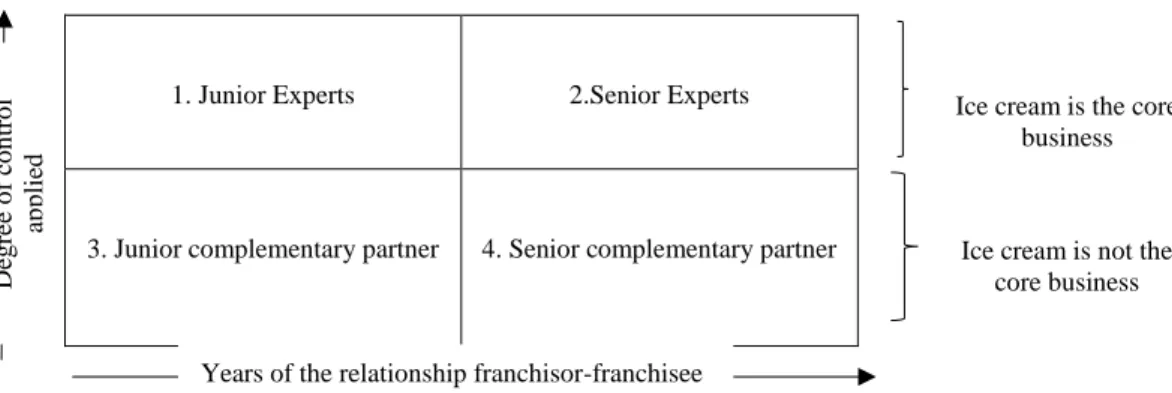
2. Control matrix: Control and autonomy are complementary concepts, so the approach suggested integrates both and allows to systemize the adaptation of measures to each franchisee. Figure 1- Control Matrix proposed for By Artisani’s chain
1. Junior Experts 2.Senior Experts
3. Junior complementary partner 4. Senior complementary partner
Years of the relationship franchisor-franchisee
De g re e o f co n tro l ap p li ed
Ice cream is the core business
Ice cream is not the core business
The framework is a control matrix with four quadrants, each one associated with a certain combination of control procedures, since these must be tailored to each franchisee, according to the degree of risk for Artisani in case on non-compliance (directly related with ice cream being the core business or not, as explained in section 2 of “Diagnosis of the issue”) and years of experience, because as explained in the literature review, more experienced franchisees have distinct control needs and preferences than others with reduced experience. According to Luísa Lacerda, one year is the necessary period for a franchisee to acquire the necessary competences, so that is the period considered. Outcome control has a positive effect in the satisfaction of experienced franchisees, since it respects their desire for autonomy. Less experienced franchisees require more behavior control as they need training and support about operating methods. Thus, according to the relationship’s length, it is necessary to balance between behavior and outcome control. The categorization of franchisees according to the matrix can be consulted in appendix I and shows a balanced distribution among quadrants.
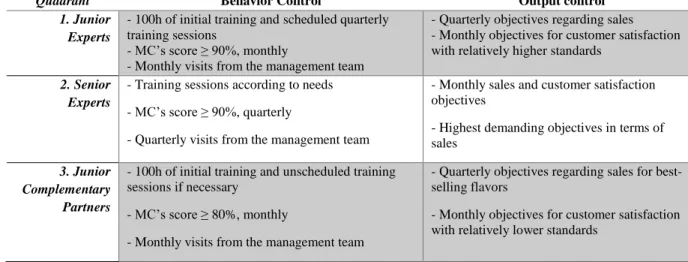
2.1. Junior Experts: Franchisees with less than one year of activity and ice cream as core business. The lack of experience combined with the required high service and product quality, creates the need for further control, mostly behavior. Artisani should maintain the initial training but should also include quarterly training sessions to ensure the maintenance of service quality. Mystery client visits must continue to have a monthly frequency to evaluate compliance and implement correcting measures timely. The minimum score should be 90%, since they will have more support and therefore a better result should be demanded. At this stage, visits from the management team should also occur monthly to do on-site checkups of operating methods. Regarding output control, these franchisees should have quarterly objectives, instead of monthly, to avoid an overburden before they dominate operating methods fully. Performance evaluation should attribute higher relevance to customer satisfaction at this stage.
2.2. Senior Experts: Ice cream is their core business, but they are more experienced, so output control must be dominant. They already know the operating methods, and unless changes are introduced, behavior control can be less frequent. Consequently, visits by the management team and by mystery clients should happen quarterly. That allows for a higher level of perceived trust and autonomy. The minimum score should also be 90%. Output control can be applied through the definition and monitor of monthly targets with high relevance to sales objectives. 2.3. Junior Complementary Partners: Ice cream is a complementary business, so the level of control and overall support can be lower when compared to the first quadrant. Suggested measures include the initial training and unscheduled further sessions, if necessary. Visits by the management team and by mystery clients should be monthly, as their lack of experience demands high support and monitoring. The MC should have a minimum score of 80%. Output control should be more focused on customer satisfaction instead of sales.
2.4. Senior Complementary Partners: Ice cream is a complementary business, but they are part of the network for more than a year. Behavior control should include training if necessary, mystery client evaluations happening quarterly, and quarterly visits from Artisani’s management team. Output control measures should be dominant and include sales and customer satisfaction targets. Sales targets should be less demanding than the ones defined for the second quadrant, as these franchisees depend less on ice cream sales and thus their focus is different. Table 3- Quadrants’ comparison
Quadrant Behavior Control Output control
1. Junior Experts
- 100h of initial training and scheduled quarterly training sessions
- MC’s score ≥ 90%, monthly
- Monthly visits from the management team
- Quarterly objectives regarding sales - Monthly objectives for customer satisfaction with relatively higher standards
2. Senior Experts
- Training sessions according to needs - MC’s score ≥ 90%, quarterly
- Quarterly visits from the management team
- Monthly sales and customer satisfaction objectives
- Highest demanding objectives in terms of sales
3. Junior Complementary Partners
- 100h of initial training and unscheduled training sessions if necessary
- MC’s score ≥ 80%, monthly
- Quarterly objectives regarding sales for best-selling flavors
- Monthly objectives for customer satisfaction with relatively lower standards
4. Senior Complementary Partners
- Training sessions according to needs - MC’s score ≥ 80%, quarterly
- Quarterly visits from the management team
- Monthly sales and customer satisfaction objectives
- Sales objectives should be focused only on best-selling flavors
The proposed control system for Artisani includes mechanisms of all types of control. Formal control mechanisms can be adapted to each franchisee’s characteristics, while social control is the same for all, because the goal is to create a common culture and increase trust among the network. Some of Artisani’s current mechanisms were maintained, with improvements, and new ones were suggested to fill existent gaps and decrease the perceived risk for the franchisor, without compromising franchisees’ autonomy, a key element of the current business strategy. An estimation of costs for one year, based on information provided by the company regarding the unitary cost of current mechanisms, and on the frequency of each one multiplied by the number of franchisees in each quadrant can be found in table 4, which summarizes the whole control system. Costs for the quarterly training sessions to franchisees in the first quadrant were calculated assuming these would be provided to the three franchisees simultaneously and will decrease in following years if no new franchisees are added to the network.
Table 4- Summary of the control system proposed
Mechanism Type of Control
Depends on the matrix?
- Y/N
Periodicity Unitary Cost (€)
Estimated total cost per
year (€)
Responsible
MC Report Behavior Y Monthly/Quarterly 20 1.920 Outsourced Training sessions Behavior Y Quarterly/according to needs 1.000 4.000 Artisani’s staff from owned-stores Managers’ visits Behavior Y Monthly/quarterly/
unscheduled N/A N/A
Artisani’s commercial
director Performance
Report Output Y Monthly 0 0
Artisani and Franchisees
Awards gala Social N Yearly TBD TBD Artisani
Franchising
Newsletter Social N Fortnightly
10€ (monthly
subscription) 120 Artisani Informal
meetings Social N Quarterly N/A N/A
Artisani and Franchisees Business
review meeting
Output N Yearly N/A N/A Artisani
Discussion and conclusions
This study was focused on developing a control system for Artisani’s franchising, to satisfy the franchisor’s need for control without jeopardizing franchisees’ current high level of autonomy. Previous research regarding control in franchising was fragmented, focusing on specific issues, instead of the overall management control system within a single franchising chain. Besides, the unusual high autonomy in Artisani’s franchising makes it an intrinsic case study, which adds more value in terms of theoretical implications. The proposed solution provides an integration of the most relevant and recent concepts of research regarding control and franchisees’ autonomy; and highlights the influence of their level of experience (Dant and Gundlach, 1999; Mellewigt et al., 2011; Crosno and Tong, 2018). It also integrates formal and social control for better results (Yakimova et al., 2018; Das and Teng, 2001; Brookes and Roper, 2011). Hence, it is more comprehensive and complete, since authors tended to focus either on the relationship between the formal types of control, or in the integration of overall formal control with social control, without an approach that would integrate all elements simultaneously. Another addition to theory comes from allowing for adaptation to each franchisee’s profile, considering more elements besides their level of experience.
For managers, the study highlights that standardization and autonomy can be integrated in franchising, and that control issues that may arise from that can be managed, as long as there is a complete control system adapted to the chain, to maintain trust and also to motivate, instead of imposing, compliance. Thus, it provides guidelines for any franchising control system and brings attention to the need of being careful before deciding on a “one-size-fits-all” approach for control. Additionally, franchising in the Artisanal Ice Cream sector was until now very unexplored, due to managers’ concern that with a product as sensitive, product/service quality monitoring would be an issue. So, this study provides insights on how to develop control to make franchising a suitable strategy for this market.
Nonetheless, it presents some limitations. First, there is a design limitation, since it is a qualitative case study, specific for Artisani’s franchising, directly related with its particular low standardization and inherent higher risk of non-compliance, depending on the core business of the franchisee. In most franchising chains, standardization is higher, so control mechanisms can be more standardized too. Thus, due to the uniqueness of Artisani’s franchising, the proposed system cannot be generalized or directly implemented by other companies. Consequently, future research should focus on the development of a more general control system for franchising, including practical control mechanisms, but allowing for some extent of adaption according to the firm or sector.
Therefore, this study can be considered a basis for future multiple case study approaches in the future, including firms with different characteristics and from different industries, as well as quantitative research to build on this framework with more data collected for example through surveys applied to franchisees, as the focus was mainly on franchisor’s considerations.
References
Anderson, Erin, and Richard Oliver. 1987. “Perspectives on behavior-based versus outcome-based salesforce control systems”. Journal of Marketing, 51(4): 76–88.
Antia, Kersi, and Bergen, Mark, and Dutta, Shantanu, and R.J. Fisher. 2006. “How does enforcement deter gray market incidence?”. Journal of Marketing, 70(1): 92–106. APF. 2016. “Franchising em Portugal: 1º estudo de franchising em Portugal”. Accessed
October 8. http://www.associacaofranchising.pt/estatisticas
APF and WFC. 2017. “O impacto económico do Franchising a nível Mundial”. Accessed October
7.http://www.portugalglobal.pt/PT/Acoes/ModulosTematicos/Documents/2018/Apresen tacao-associacao-modulo-franchising.pdf
Bergen, Mark, and Dutta, Shantanu, and Walker Orville. 1992. “Agency Relationships in Marketing: A Review of the Implications and Applications of Agency and Related Theories,” Journal of Marketing, 56: 1–24
Beshel, Barbara. 2010. An Introduction to Franchising. Washington: IFA Educational Foundation.
Bills, D. 1998. “Community of Interests: Understanding the Relationships between Franchisees and Franchisors”. Research in Social Stratification and Mobility 16: 351–69.
Birkeland, Peter. 1995. “The Sociology of Franchising: Trust and Control in the Service Economy”. Department of Sociology, The University of Chicago.
Boulay, Jacques. 2010. “The role of contract, information systems and norms in the governance of franchise systems”. International Journal of Retail and Distribution Management, 38 (9): 662-676.
Brookes, Maureen, and Angela Roper. 2011. "International master franchise agreements: An investigation of control from operational, relational and evolutionary perspectives",
European Journal of Marketing, Vol. 45 (7/8): 1253-1276
Buber, Renate, and Gadner, Johannes, and Lyn Richards. 2004. Applying Qualitative Methods
to Marketing Management Research. Chicago: Palgrave macmillan
Canadean. 2015. “Consumer and Market Insights: Ice Cream Market in Portugal”. Accessed October 10. https://www.marketresearch.com/product/sample-9053423.pdf
Cavusgil, S. Tamer, and Knight, Gary and John Riesenberger. 2014. International Business:
The New Realities (3rd ed.). Harlow: Pearson Education
Crosno, Jody, and James Brown. 2015. “A meta-analytic review of the effects of organizational control in marketing exchange relationships”. Journal of the Academy of Marketing
Science, 43(3): 297–314.
Crosno, Jody, and Pui-Ying Tong. 2018. “Just going through the motions? An empirical investigation of control, compliance, and performance in franchisor-franchisee relationships”. Journal of Business Research 92: 360–373.
Dant, Rajiv and Gregory Gundlach. 1998. “The challenge of autonomy and dependence in franchised channels of distribution”. Journal of Business Venturing 14: 35–67.
Das, T. K., and Bing-Sheng Teng. 1996. “Risk types and inter-firm alliance structures”. Journal
of Management Studies 33: 827–843
Das, T. K., and Bing-Sheng Teng. 1998. “Between trust and control: Developing confidence in partner cooperation in alliances”. Academy of Management Review 23: 491– 512. Das, T. K., and Bing-Sheng Teng. 2001. “Trust, Control and Risk in Strategic Alliances: An
Integrated Framework”. Organization Studies 22 (2): 251–283
Davies, Mark, and Lassar, Walfried, and Manolis, Chris, and Prince, Melvin and Robert Winson. 2011. “A model of trust and compliance in franchise relationships” Journal of
Business Venturing 26 (3): 321-340
Dickey, Michael, and D. Harrison McKnight, and Joey F. George. (2008). “The role of trust in franchise organizations”. International Journal of Organizational Analysis, Vol. 15 (3): 251-282
Dohorty, Anne Marie, and Nicholas Alexander. 2006. “Power and control in international retail franchising”. European Journal of Marketing, Vol. 40 (11/12): 1292-1316.
Fernandes, Filipa. 2016. “Adaptação do Modelo de Franchising, no setor ótico, em tempo de crise: O Caso Opticalia”. Accessed October 5.
https://repositorio.ipl.pt/bitstream/10400.21/7208/1/Vers%C3%A3o%20Definitiva%20 Disserta%C3%A7%C3%A3o_Filipa%20Fernandes.pdf
Gillis, William E., and Combs, James G., and Xiaoli Yin. 2018. “Franchise management capabilities and franchisor performance under alternative franchise ownership strategies”.
Journal of Business Venturing.
Heide, Jan B., and Wathne, Kenneth H., and Aksel I. Rokkan. 2007. “Interfirm monitoring, social contracts, and relationship outcomes”. Journal of Marketing Research, 44(3): 425– 433.
Hornsby, Gilpatrick. 2011. “Consistency between Franchised and Company-Owned Locations. A Study of Sonic Drive-In Food Safety Scores in the State of Oklahoma”. Oklahoma State University.
Kalkman, Jori, and Erik J. de Waard. 2017. “Inter-organizational disaster management projects: Finding the middle way between trust and control”. International Journal of Project
Kaufmann, Patrick, and Sevgin Eroglu. 1999. “Standardization and adaptation in business format franchising”. Journal of Business Venturing, 14: 69–85
Lane, Christel, and Reinhard Bachmann. 1996. “The social constitution of trust: Supplier relations in Britain and Germany”. Organization Studies 17/3: 365–395.
Leifer, Richard, and Peter Mills. 1996. “An information processing approach for deciding upon control strategies and reducing control loss in emerging organizations”. Journal of
Management 22 (1): 113–137.
Liu, Tsung-Chi, and Chen, Jengchung, and Po-Yi Hsu. 2014. "Opportunity recognition and cooperation flexibility of entrepreneurial franchisees". Industrial Management and Data
Systems, 114(4): 506-525.
Long, Chris P. 2018. “To control and build trust: How managers use organizational controls and trust-building activities to motivate subordinate cooperation”. Accounting, Organizations
and Society 70: 69-91
Mateus, Cátia. 2017. “Franchising assegura 117 mil empregos”. Accessed September 28.
http://expressoemprego.pt/noticias/franchising-assegura-117-mil-empregos/4375
Mayer, Roger, and Davis, James, and F. David Schoorman. 1995. “An Integrative Model Of Organizational Trust”. Academy of Management Review 20 (3)
Mellewigt, Thomas, and Ehrmann, Thomas, and Carolin Decker. 2011. “How Does the Franchisor’s Choice of Different Control Mechanisms Affect Franchisees’ and Employee-Managers’ Satisfaction?”. Journal of Retailing 87: 320–331.
OECD. 1996. “The knowledge-based economy”. General Distribution OCDE/GD (96)102. Quinn, Barry, and Anne Marie Doherty. 2000. “Power and control in international retail
franchising – Evidence from theory and practice", International Marketing Review 17 (4/5): 354-372
Sengun, Ayse, and S. Nazli Wasti. 2009. “Revisiting Trust and Control: Effects on Perceived Relationship Performance”. International Small Business Journal 27 (1): 39-69
SISAB Portugal. 2018. “O melhor gelado artesanal português”. Accessed October 16.
https://www.sisab.pt/noticias/o-melhor-gelado-artesanal-portugues/
Stake, Robert. 1995. “The art of case study research”. London: Sage Publications Ltd.
Statista. 2018. “Ice Cream Market in Portugal”. Retrieved from Statista database
https://fesrvsd.fe.unl.pt:2351/outlook/40100400/147/ice-cream/portugal
Pizanti, Inbar., and Miri Lerner. 2003. “Examining Control and Autonomy in the Franchisor-Franchisee Relationship”. International Small Business Journal 21(2): 131–159
Verbieren, Sofie, and Cools, Martine, and Alexandra Van den Abbeele. 2008. “Franchising: a literature review on management and control issues” Review of Business and Economic
Literature 3 (4): 398-443
Yakimova, Raisa., and Owens, Martin, and Jörg Sydow. 2018. “Formal control influence on franchisee trust and brand-supportive behavior within franchise networks”. Industrial
Marketing Management.
Yin, Robert. 2009. “Case Study Research Design and Method”. (4th ed.). Thousand Oaks: Sage Zeng, Guojun, and Go, Frank, and Henk de Vries. 2012. “Paradox of authenticity versus standardization: Expansion strategies of restaurant groups in China”. International
APPENDICES Appendix A- Control mechanisms identified by author
Authors Categories of mechanisms Mechanisms
Brookes and Roper (2011)
- Social/Relational Control
- Operational Control
- Participative decision making; multi-directional communication; shared norms and culture
- Quality control processes; financial targets set and monitored centrally; management by contract
Das and Teng (2001)
- Behavior Control
- Output Control - Social Control
- Policies and Procedures for behavior standards with rewards or penalties; staffing and training sessions - Setting objectives, planning and budgeting - Construction of a shared decision-making process;
frequent socialization moments Doherty and
Alexander (2006)
N/A - Franchising agreement
- Support activities
- Creation of chemistry and shares values Yakimova et al. (2018) - Compliance- promoting-procedures - Marketing-trust-building-procedures - Social-comparison-activating-procedures
- Compliance monitoring, remedial actions, rewards and threat of punishment for service delivery and store’s image
- Goal setting and planning, goal support and monitoring, and manager communications. - Cross-unit branding performance monitoring
information (e.g. awards ceremonies) Source: Author’s Analysis
Appendix B- Ice cream categories definition Category Definition Take-home and Bulk Ice
Cream
Ice cream in the form of multiple-serving ice cream tubs (e.g. Carte D’Or) and ice cream cakes (e.g. Vienetta), for take-home and bulk consumption.
Impulse- Single Serve Ice Cream
Includes the formats of single-serve tubs, packaged cones (e.g. Cornetto), ice cream sandwiches and coated ice creams (e.g. Magnum).
Artisanal Ice Cream Original from Italy, this ice cream is traditionally produced in smaller quantities per day by local producers. Includes a strong concern with the quality and freshness of ingredients, following specific recipes and techniques.
Appendix C- Costs of opening an owned-store (e.g. Álvares Cabral Store)
Source: Ferreira, I. (2017). “New Challenges in the Artisanal Ice Cream Market: The marketing strategy to enhance Artisani’s brand awareness”. Católica Lisbon School of Business and Economics
Appendix D- Interview Scripts
Appendix D.1- First Interview with Luísa Lacerda and João Gaspar Date: 16/10/2018 Duration: 30-45 minutes
Company’s background and current status 1. Companys’s history
2. Why not expanding internationally?
3. Current challenges and identified threats and opportunities? 4. Goals for the short-term?
5. How significant is franchising in terms of results? The franchising network
6. What was the motivation to develop the franchising network? 7. Why the specific format of “By Artisani”?
8. Why choosing to have such high adaption? Did you face any issues? 9. How do you integrate owned-stores with franchised ones?
10. Can you show me an example of the contract with the franchisees? 11. Which are Artisani’s and franchisees’ responsibilities?
Current control mechanisms
12. How is communication between you and the franchisees, and the franchisees among themselves? Which channels are used?
13. Are there any objectives defined for each of them or do they have to do it themselves? 14. Do you have any particular store that serves to test new concepts or alterations to business
methods?
15. Do you track the results for franchisees vs owned stores? (e.g. sales, customer satisfaction, etc.)
17. When one of the franchisees has a performance below expectations, what is done? And when the results are outstanding, do you ask them to share their best practices?
Appendix D.2- Last Interview with Luísa Lacerda and João Gaspar Date: 21/11/2018 Duration: 45 minutes
Presentation of conclusions from analysis and the proposed control system Information to complete the control system
1. Which KPI’s do you use in owned-stores to evaluate performance? Can those be extended to franchisees? Are there any specific objectives that could be defined for franchisees? 2. Which frequency should performance evaluations have for each type of franchisee?
3. Currently, you provide 100 hours of initial training to franchisees’ staff. When there are new hires or innovations, do you feel the need to give more training?
4. Why do you currently do Mystery Client evaluations for all stores monthly? Isn’t it
redundant for franchisees who consistently present the same level of performance? Do you consider the frequency could be adapted?
5. Which period do you consider adequate for a franchisee to be consider experienced? 6. In your opinion, does non-compliance of franchisees with ice cream as core business
represent more, less or equal risk when compared to franchisees without ice cream as core business?
7. Which type of franchisees asks for more support and guidance?
8. Would it be possible, and would it make sense to create rewards for the best performers? Which rewards do you suggest?
9. From 0-10, how useful would it be to have a control report to monitor franchisees’ results? Which elements should be included?
Appendix D.3- Interview with franchisee (Loungelato by Artisani) Date: 23/11/2018 Duration: 30 minutes
Presentation of conclusions from analysis and the proposed control system Information to complete the control system and franchisee’s perspective 1. Do you agree that control is currently lacking in the network?
2. From 0-10, how relevant do you consider franchisor’s control?
3. Which improvements do you consider that could be implemented in current control mechanisms? In your opinion are those efficient?
4. Which period do you consider adequate for a franchisee to be consider experienced? 5. Due to your previous experience as a McDonald’s franchisee, do you consider Artisani
could benefit from any control mechanism that franchising chains with more standardization currently implement?
6. Do you consider that the current level of communication is adequate? Would you like to have more contact with other franchisees or in your opinion that is not necessary? 7. Would it be possible, and would it make sense to create rewards for the best performers?
Which rewards do you suggest?
8. Do you believe a more structured control system could benefit not only Artisani, but also franchisees and the network as a whole?
Appendix E- By Artisani’s image
Source: Artisani’s website
Sweet and Salty By Artisani Dolce Tentazione By Artisani
Vela Latina By Artisani
La Gelateria By Artisani Sabóia By Artisani
Armazéns Congrumbeiro By Artisani
Lilla Vanilla By Artisani Elétrico 28 By Artisani
USpot By Artisani Solo Gelato By Artisani Loungelato By Artisani
Appendix F- Artisani’s sales to each type of franchisee in August 2018
Source: Derived from appendix V-I
Appendix F.1- Sales of each By Artisani in August 2018 (the month with higher demand- representative of full capacity)
Source: Artisani
27%
73%
Without Ice Cream as core business With Ice Cream as core business
Franchisee Location
Value of Artisani's sales to each store (€)
With Ice Cream as core business
Vela Latina By Artisani Belém 6.289,2
LounGelato By Artisani Odivelas 5.614,3
Solo Gelato By Artisani Cacilhas 12.935,06
Dolce Tentazione By Artisani Algés 2.290,82
La Gelataria By Artisani Marina de Cascais 1.510,64
Lila Vanilla By Artisani Alvor 5.163,94
Without Ice Cream as core business
Sweet and Salty By Artisani Coimbra 625,73
USpot By Artisani Linda-a-Velha 3.446,43
Capricciosa By Artisani Carcavelos 4.347,35
Elétrico 28 By Artisani Freeport Alcochete 2.289,83
Sabóia By Artisani Monte Estoril 1.240,39
Appendix G- Template Report for Performance Evaluation with illustrative data
Appendix H- Sigep Rimini
Source: Sigep’s website
Appendix I- Categorization of franchisees according to the control matrix
Franchisee Years as franchisee Ice cream is core business (Y/N) Quadrant in the matrix
Vela Latina 1 Y 2 Dolce Tentazione 1 Y 2 Sweet and Salty -1 N 3 Armazéns Cogumbreiro 1 N 4 Sabóia 1 N 4 La Gelateria -1 Y 1 Lila Vanilla 1 Y 2 Elétrico 28 1 N 4 Cappriciosa 1 N 3 Solo Gelato -1 Y 1 Loungelato -1 Y 1 U Spot -1 N 3