i
How do stakeholders perceive Corporate
Sustainability initiatives?
A case study on SONAE MC
Sruti Gordhandas
Advisor:
Professor Susana Frazão Pinheiro
Dissertation submitted in partial fulfillment of requirements for the degree of MSc in Business Administration, at the Católica-Lisbon School of Business and Economics,
ii
Sumário Executivo
Título: Como são percepcionadas as iniciativas de Responsabilidade Social das Empresas pelos stakeholders? – Estudo de Caso sobre a Sonae MC
Autor: Sruti Gordhandas
Considerando o poder e a responsabilidade das empresas, os consumidores finais e os clientes governamentais estão a conduzir as estratégias das organizações para um desenvolvimento de actividades, produtos e serviços mais sustentáveis.
Para responder a pressões e a exigências externas, as empresas começaram a publicar seus planos estratégicos para a responsabilidade social, bem como a evolução dos mesmos ao longo dos anos.
Esta tese ambiciona compreender se os stakeholders têm conhecimento das iniciativas de sustentabilidade da Sonae MC, uma empresa de retalho que opera em Portugal, bem como identificar os assuntos mais reconhecíveis para cada grupo de stakeholders. Um segundo objectivo deste estudo é contabilizar em que medida a empresa publica Indicadores Económicos, Ambientais e Sociais, de acordo com as orientações da Global Reporting Initiative. Neste mesmo contexto, faz parte dos objectivos desta tese promover a aplicação de ferramentas de medição da sustentabilidade, de modo a que as organizações possam monitorizar o seu desempenho, bem como comunicá-lo de acordo com uma directriz universal de padrão de comunicação. Os dados para esta análise foram fornecidos pela Sustentare
Consulting.
Para os stakeholders analisados, é possível afirmar que eles estão, no geral, cientes do compromisso de sustentabilidade da Sonae MC e, além disso, revelam diferentes áreas de interesse em iniciativas sustentáveis. No que diz respeito à publicação de Indicadores, a empresa divulgou apenas 13% dos mesmos no seu Relatório de Sustentabilidade 2009. Embora GRI seja um instrumento complexo para se dominar, a Sonae tem vindo a utilizá-lo progressivamente nos seus relatórios nos últimos anos, mas ainda há uma considerável lacuna na informação publicada.
iii
Abstract
Title: How do stakeholders perceive corporate sustainability initiatives? A case study on SONAE MC
Author: Sruti Gordhandas
Considering the power and the responsibility of the companies, end costumers as well as government are driving organizations’ strategies for developing more sustainable activities, products and services.
To respond to external pressures and demands, companies started publishing their strategic plans for corporate social responsibility as well as their progress over the years.
The rationale of this thesis is to understand whether stakeholders are aware of sustainability initiatives led by Sonae MC, a retail company acting in Portugal, as well as to identify the most interesting subjects for each group of stakeholder. A second aim of this study is to account to which extent is this company publishing Economic, Environmental and Social Indicators, according to the Global Reporting Initiative Guidelines. On the same context, it is part of the objectives of this thesis to promote the application of sustainability measurement frameworks, so that organizations can track their performance as well as communicate it according to a universal sustainability standard reporting guideline. The data for this analysis was provided by
Sustentare Consulting.
For the stakeholders analyzed it is possible to conclude that they are generally aware of Sonae MC’s engagement in CSR and that they have different interests of sustainable initiatives. Concerning the Reporting framework, the company published only 13% of the Indicators in its 2009 Sustainability Report. Although this is a complex tool to master, Sonae has been progressively using it in its Reports in recent years, but there is still an opportunity to fill in further information gaps.
iv
Table of Contents
Sumário Executivo ii Abstract iii Table of Contents iv Table of Figures v Table of Exhibits v Acknowledgements vi 1.Introduction 7 1.1 Current Context 71.2 Aim and Purpose 8
1.3 Dissertation Structure 9
2. Literature Review 10
2.1 Corporate Social Responsibility Insights 10
2.2 CSR in Portugal 17
2.3 Organizational Tools 19
2.3.1 United Nations Global Compact 19
2.3.2 Global Reporting Initiative 20
2.3.3 World Business Council for Sustainable Development 21
2.3.3.1 BCSD Portugal 22
3. Case Study 23
3.1 SONAE SGPS Corporate Profile 23
3.1.1 Organization 23
3.1.2 Mission and Values 23
3.1.3 Business Units 24
3.1.4 Code of Conduct 24
3.1.5 CSR Concerns 25
4. Teaching Notes and Methodology 32
4.1. Research Questions 32
4.2 Synopsis 32
4.3 Data Analysis 33
4.3.1 Suppliers 33
4.3.2 Municipalities 35
4.3.3 NGOs and IPSS 36
4.3.4 Employees 37
4.3.5 Consumers 38
4.3.6 Main Conclusions 40
v
4.4.1 The Framework 41
4.4.2 GRI applied to SONAE MC – results’ summary 43
5. Conclusions and Future Research 46
References 48
Table of Appendices 50
Table of Figures
Figure 1 – Economic value creation through the integration of social, environmental and governance dimensions
11
Figure 2 – Stakeholder mapping: the power/interest matrix 16
Figure 3 – CSR Reporting per sector 19
Figure 4 – GRI Reporting trends and GRI reporting per region 20
Figure 5 – Company’s Values 23
Figure 6 – Outlook for Portugal 31
Figure 7 – Dialogue with stakeholders and value creation 33
Figure 8 – Suppliers’ Perceptions 34
Figure 9 – Municipalities’ Perceptions 35
Figure 10 – Employees’ Perceptions 38
Figure 11 – Consumers’ Perceptions 39
Figure 12 – Standard Disclosures: Profile Parameters 45
Figure 13.1 – Standard Disclosures: Performance Indicators 45
Figure 13.2 – Uncovered Performance Indicators 45
Table of Exhibits
Exhibit 1 – Sonae SGPS Key Facts 28
Exhibit 2 – Business Areas 28
Exhibit 3.1 – Sonae MC Brands 28
Exhibit 3.2 – Stores per region 29
Exhibit 4 – Review of Sonae’s major sustainability milestones 29
Exhibit 5 – Review of main activities supported in 2009 29
vi
Acknowledgements
I would firstly like to express gratitude to Professor Susana Frazão Pinheiro for sharing her knowledge and expertise during the development process of this Dissertation as well as for her availability, precious recommendations and orientation.
Without the contribute of Sustentare Consulting, the access to information would not be possible; I appreciate all the encouragement and discussions that we had, they were very fruitful and contributed with valuable inputs on the elaboration of this thesis.
I humbly thank Sonae and in particular to Sonae MC for their interest on this case-study. For their support, patience and sense of belonging, I sincerely show appreciation to all my Friends and Family; to my parents, for their unconditional love, inspiration and warm hugs whenever required. The Eternal Strength and their blessings were fundamental to overcome all the obstacles and emotions during this Dissertation.
With regard to excellence, it is not enough to know, but we must try to have and use it.
7
1. Introduction
1.1 Current Context
Corporate Social Responsibility (CSR) has become an important theme of public interest, in both developed and developing countries. It is ascertaining a significant part of major discussions over business, globalization and sustainable development.
In addition, organizations across most business sectors are increasingly embracing CSR, assumed as the way companies integrate social, environmental and economical concerns into their culture, values, decision-making process and operations (Branco & Rodrigues, 2006), as a strategy adopted to preserve their reputations, legitimacy and to guarantee their survival, as well as to respond to contemporary subjects and challenges. CSR differentiates enterprises from their competitors, since it attracts better talent, improves companies’ risk management practices while it also allows them to gain a social license to operate (Godos-Díez et al., 2010). Despite the existence of a plurality of concepts on CSR, they are all unanimous in their core idea which identifies three fundamental components of sustainable development; they are the Environment, Economy and Society, or the Triple Bottom Line. Even if in practice the concept has evolved into more operational terms and in different scales, adapting to concrete situations, the universally accepted definition of the 1987 United Nations’ (UN) conference will be on the basis of this dissertation. It presented sustainable development as the “development
that meets the needs of the present without compromising the ability of future generations to meet their own needs” (World Commission in Environment Development, WCED, 1987).
There is an urgent need to better integrate voluntary initiatives to governmental regulation; CSR is increasingly recommended and a desired contribution for the development of enhanced practices within the enterprises, creating wealth and improving communities’ societal and environmental living conditions.
Companies are, more than ever, recognizing that they are a vigorous member of the ecosystem that influences and is influenced by the Triple Bottom Line. It is also organizations’ responsibility contributing to reduce these problems. By improving the community’s living conditions and increasing their income, they are developing the market and generating future benefits for both people and companies. Additionally, organizations that have a high public profile, more than those that are less known, are more keen to present a positive social image through community involvement initiatives, since such activities are not only expected to
8 attract consumers but also assure their continuation to the society. This means that they are highly motivated to contribute to a better world and a more developed society.
On the other side, the society is substantially interested in monitoring CSR progress. For this propose, additionally to the strategic motivation, organizations have incentives to voluntarily provide information to their stakeholders. Guidelines that companies need to follow to measure CSR have been developed: besides the global benchmarks such as the United Nations Declaration for Human Rights and the International Labor Organization’s (ILO) labor standards, voluntary standards are recognized. The most broadly accepted reporting framework is the Global Reporting Initiative (GRI) that has developed a common guideline for sustainability reporting.
Nowadays, more that whether engage in CSR, enterprises are searching for ways of how to do it in the most effective way, in order to maximize corporate value as well as social value. The subsequent case study presents a Portuguese sub-holding company, Sonae MC, part of the Sonae SGPS Group that is facing this challenge.
1.2 Aim and Purpose
The case study has two objectives. The first, understanding the real interest of stakeholders concerning Sonae MC’s Sustainability Reporting practices and to confront this trend of general awareness on CSR. Within this subject, it will be interesting to identify which themes out of the Triple Bottom Line are more noticed by the stakeholders. Secondly, to present the GRI framework, as a tool to assess CSR performance and encourage its application. In this dissertation Sonae’s 2009 Sustainability Report will be evaluated, in terms of which information is already published and what is still left to do.
To comply with these objectives, the following research questions were proposed:
RQ#1: Are stakeholders aware of Sonae MC’s Sustainability Report? and What are the main topics of interest for each stakeholder?
9
1.3 Dissertation Structure
This study is structured in five sections that begin with an overview on the current context, the aims and purposes and the guiding research questions of the dissertation.
The second chapter corresponds to the Literature Review that introduces the previous studies on CSR: its history, its inevitable global reach in addition to its strategic implementation, the increasing relevance of the stakeholders in this subject and an outlook for Portugal on CSR issues. The last part of this section aspires to provide a review on the available non-mandatory organizational tools to measure CSR initiatives.
Next, the third section presents how the Sonae group is organized, its mission and value statements, the relevance of its Code of Conduct and Ethics as well as the CSR concerns and practices for Sonae MC over the years.
Chapter four is related to the Teaching Notes and the Methodology used to respond the proposed research questions and lastly, chapter 5 presents the conclusions and the main results of the study, some challenges for companies in the Retail industry and potential future research suggestions.
10
2. Literature Review
During the literature search, many approaches related to CSR were found. In this chapter, I will present the most important empirical insights on this issue, in order to assure a consistent basis and self preparation for the case study. Starting by a broader scope of CSR history and its multiple definitions, I will conduct this chapter by exploring the relevance of CSR for strategy, the role of globalization in promoting CSR activities, stakeholders’ engagement on CSR and finally an approach to CSR in Portugal. Although for this topic some difficulty was faced in finding an extensive literature, the application of this study is aimed at a company of the Portuguese reality.
Lastly, I will review the most relevant non-obligatory organizational tools created with the aim to provide enterprises with insights, guidance and structures for sustainability reporting and communication.
2.1 Corporate Social Responsibility Insights
The concept of CSR has its roots in philanthropy, which was developed and formally recognized during the beginning of the XXth century identified in charitable initiatives (Savitz, 2006), though companies have been engaged in activities that today are named after CSR from the times of the Industrial Revolution. Sustainability subjects that are discussed nowadays have references in Malthus, Mill and Ricardo, in the XVIIIth and XIXth centuries who, focusing on the problem of food scarcity, identified the relevance of natural resources for the economic development (Davis et al, 2006; Sustentare, 2008).
Before long it expanded to include human and worker’s rights, but it was only in the last forty years of the XXth century that societies awoke (Savitz, 2006) to societal and environmental impacts and business expectations changed, towards these impacts. It was due to the shock oil and its consequent increases in prices of goods and the consciousness of infinite needs that the debate about the tradeoff between the environment and the economic growth was starting to be present in international meetings.
Since then, the term CSR is widely used and a general idea arose: those who have greater power have a greater responsibility towards the Triple Bottom Line. After the 90’s, businesses began to understand that their social and environmental impact could have strategic implications, and not only are companies “increasingly being held responsible for their own
11 activities, but for those of their suppliers, the communities where they are located, and the people who use their products” (Savitz, 2006).
As Savitz, Porter and Kramer claim, while in the past CSR initiatives were concerned to minimize the negative impacts as a result of companies’ value chains almost as a moral obligation, today these concerns are much broader. Firms see in sustainability an opportunity to better interact with the community, which will provide them with new business opportunities as well as increase their awareness on the market.
Figure 1 – Economic value creation through the integration of social, environmental and governance dimensions
Source: Sustentare, 2008 (translated by the author)
CSR is a tendency in today’s economic world as, when it is aligned with the mission and values and corporate strategy, it has a great potential and it is an opportunity to sustain business on the long-term.
Through economic trade, foreign direct investment and capital flows, businesses today have a transnational scope, not only to what production process, outsourcing, sources of raw material are concerned but also to market expansion and product diversification. International trade,
Social
Environ-mental
Govern-ance
Value Creation for Shareholders and Other Stakeholders
Efficient use of natural resources; -Pollution prevention;
-Environmental policy; -Environmental management;
-Creation of products and services environmental socially and responsible.
-Internal Human Resources Policy; -Non-discrimination; -Training and career progression; -Communication; -Community Involvement; -Social support; -Volunteering. -Values; -Business principles; -Transparency; -Responsibility; -Codes of conduct Compliance; - Knowledge sharing; -Risk management; -Relationship with investors.
Economic Value
12 communication and transportation expanded enormously during the XXth century. Globalization is the result, as a process of integration of economies, societies and cultures to a global network. CSR, therefore, accompanies the internationalization of the supply chain management of companies seeking new markets, new products, skilled and/or cheaper labor, leading to the development of relations with suppliers, consumers and other stakeholders. Global competitiveness and sustainability become inseparable in this context, driven by transparency and international management. International companies enter local markets, where the distinction between national and international firms becomes harder, by which local enterprises are demanded to be more competitive and governments, on their side, to attract foreign direct investment (Lee, 2008).
Under these circumstances, CSR practices become a natural extension of the enterprise’s activities, and in the expansion of cross-border business. If even before companies became transnational there was a concern for the local/regional communities, globalization emphasises concerns about the working conditions, the level of education, pollution or energy consumption at an international scale.
National and international policies have been arising to foster a more proactive participation of the enterprises in solving social, educational, and environmental issues. Society’s interest as well as government and mass media pressure to companies have contributed to the emergency of sustainable practices (Savitz, 2006, Porter and Kramer, 2006).
Beyond the concern with the surrounding atmosphere, CSR can offer a solid foundation to balance the short-term costs it incurs (Porter and Kramer, 2006). This is to say that by doing good, companies can enlighten their self-interest on image and brand awareness but also on gaining stakeholders’ approval on these initiatives. Living in an interdependent world,
“Successful corporations need a healthy society (…) at the same time, a healthy society needs successful companies” (Porter and Kramer, 2006).
According to Freeman (1984) who introduced the concept of stakeholder, as long as anyone or any group affects or is affected by the objectives of a company, then managers should be concerned with them.
If firms partner with external stakeholders, whether they are the government, the media, activists, organizations, consumers or suppliers, not only corporations gain publicity because they influence public opinion, but by including their voice on the decision making process, it reduces the risks from stakeholder opposition and it controls social sanctions (Godos-Díez et
13 al., 2001, cit. Sen et. al, 2006). For these corporations that are motivated to work with the stakeholders, as Savitz (2006) concludes, it “represents a significant competitive advantage”. Sustainability cannot take place without socially responsible managers; these are the core figures within firms that should be ready to sacrifice short-term objectives in goodwill of social welfare. According to Godos-Díez et al. (2010), top managers should embrace the responsibility to integrate ethics and social responsibility within the core strategies of the corporation. By assuming this task, top managers are strengthening the relationship with the stakeholders but also increasing their legitimacy (Godos-Díez et al., 2010, cit. Sethi, 1979), reducing risks and costs and investing in long-term sustainable business that surpass the short-term investment on ethics and social responsibility.
A recent study developed by United Nations Global Compact (UNGC) and Accenture reports how collaboration is critical for CEOs (2010). The increasing role of the stakeholders demonstrates the need to map together the response to surpass economic, environmental, and social objectives.
In fact, 58% of the CEOs have identified consumers as the core stakeholder group that will impact the way they manage societal expectations (UNGC-Accenture, 2010); as sustainability awareness increases, they are changing their demand of products and services, and companies are now responding to a higher standard which in many cases means a shift of their operations. More than press releases, marketing and philanthropy, it “means involving stakeholders in the decisions and activities that define your business” (Savitz, 2006), which diminishes stakeholder opposition and creates new value to be shared by the partners, as this mixes up different expertise.
Despite the fact, this sometimes happens under the pressure from regulatory institutions, the media or local activists, where national authorities increasingly lose power towards the international regulations. In the past, multinational companies like Nestlé have faced NGO’s and activists’ judgment for the way they promoted their products in developing countries. In fact, in a time where there had been a significant increase of malnutrition and gastroenteritis in Africa and the public was either uninformed or the laws and procedures were absent, Nestlé faced controversy with the “Farine Lactée”. Nestlé was criticized for promoting a product that was meant to provide nutrition to babies whose mothers were not able to nurse them, that was claimed to be healthier than mother’s milk. The boycotts against Nestlé’s aggressive and unethical campaigns started in 1974 and it only ended ten years later, when the company agreed to follow the rules of the WHO/UNICEF International Code of Marketing
14 Breast-Milk Substitutes as a result of the 34th World Health Assembly (WHA), Resolution WHA34.22, 1981 (Pomerantz, L.).
Companies learnt that in spite of the fact that the lacks of effective jurisdiction in some regions, local markets and communities have the support of NGO and other profit, non-governmental organizations. Today, the international business faces a challenge, which is to democratize commerce. In the words of Prahalad (2010), it means “bringing the benefits of globalization to all micro consumers, micro producers, micro innovators, micro investors and micro entrepreneurs (…) all must be treated with dignity and self-esteem (…)”.
Apart from controversies in developing countries, enterprises such as McDonalds and Philip Morris are frequently judged for using CSR as a way to improve brand awareness by promoting products that lead to health problems. In fact, criticism of CSR states that companies may integrate CSR into their marketing and communication departments as a mean to maximize its profits and using sustainability to switch attention from the real agenda of the enterprise. When these issues come to public, “consumers are more sensitive to «irresponsible» than to «responsible» corporate behavior. In other words, there is an asymmetric effect and «doing bad» hurts more than «doing good» helps” (Bhattacharya & Sen, 2004).
Regardless of this, consumer attitudes towards CSR go beyond purchasing behavior. When defining CSR strategies and engaging in sustainability to make a difference, companies must consider the domains that are related to their business agenda (Kanter, 1999; Porter & Kramer, 2006) but also issues that concern communities, whether it is environment friendly products, climate change, support of arts, educational and health programs, support to disabled people, concern for employee involvement, marketing controversies and innovation/R&D. Bhattacharya & Sen’s research (2004) concludes that when companies “are perceived to have distinguished themselves on the CSR platform”;they benefit from loyalty, resilience, word of mouth and price premium, as enterprises; “seem to enjoy a loyal following among a segment of their consumers”; and that consumers are willing “to overlook or even forgive a company when there is an occasional, possibly inadvertent, lapse on its part”. As customers are in favour of the company’s sustainability initiative, they seem to be keen “to talk positively about the socially responsible company”, unless they realize that these initiatives are fulfilled at the expense of investments in the company’s core business”.
By tracking the society’s needs, the better enterprises are integrating sustainability into their daily business practice. As Kanter (1999) entitles as “strategic business development”, when companies apply their technical and financial resources to chronic social and economical
15 problems of the market, they are challenged to search for innovative solutions, which encourages their own development and learning process. By establishing the right partnerships, amid the private and the public interest, a profitable and sustainable change for both sides is shaped. Just like Prahalad (2010) stated, “increasingly, large private sector firms and civil society organizations are trying to work together in a collaborative fashion” and Savitz (2006), “Sustainability requires a detailed understanding of your interdependence in relation to those with whom you interact (…) it means embracing and partnering with your stakeholders”.
But neo-liberal movements inspired in Milton Friedman (1970) criticize the stakeholder engagement by following his proposal that “there is one social responsibility of business – to use its resources and engage in activities designed to increase its profits”.
Managers and executives, as responsible for profit maximization for shareholders, are in this context criticized and accused of irresponsibility for giving up on profits on behalf of kindness (The Economist, 2008). The same article states another main objection to CSR, which is that in democracies, it is the governments’ role to ensure that human rights, societal interests and the environment are respected.
In reality, businesses need a sustainable planet; if not, they are risking their survival on the long term (Handy, 2002). By investing on local education, technology, health and society, enterprises are investing on their own continued existence, as they need a market to serve, skilled working forces, and opportunities for new product development. As verified by Savitz (2006),
“Responding to the demands of sustainability is a necessity, not an option”.
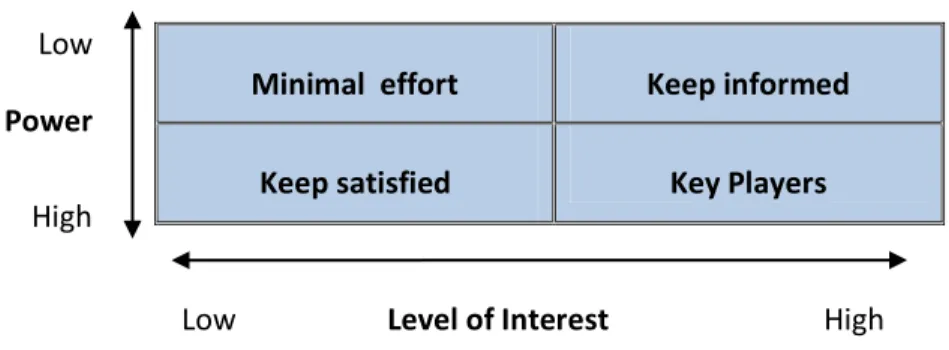
But to embrace new opportunities strategically, managers need to clearly identify who are the stakeholders, categorize and prioritize them and decide which actions to take in relation to these stakeholders (Clifton & Amran, 2011). To do this, Johnson et al. (2005) introduced a stakeholder matrix that allows mapping and analyzing the power and the interest of the stakeholders.
Within the context of the development and implementation of corporate strategies, the power/interest matrix allows classifying the stakeholders in relation to these two attributes, demonstrating their degree in supporting or not a particular policy as well as to evaluate which type of relationship the organization has with each group of the quadrants. Johnson states that it is common conflicts to happen concerning the importance of many dimensions of strategy;
16 expectations cannot be achieved all together, and therefore a negotiation will need to happen to set priorities and deadlines.
Figure 2 – Stakeholder mapping: the power/interest matrix
Minimal effort Keep informed
Keep satisfied Key Players
Source: Exploring Corporate Strategy, 2005
The increasing social interest on corporate sustainable initiatives as well as the need for enterprises to be transparent and to promote their reputation, demand assessment tools to evaluate sustainability performance and incentive the reporting of these achievements, giving a similar value to CSR practices as the financial performance on yearly Accounting reports have. This means that the finest CSR strategies and plans must be quantifiable and tracked over time, to create goodwill and to improve local and global relations. Firms that work hard to integrate social responsibility on their core strategies, by being objective, proactive and by making the right choices of where to intervene and where to spend on social responsibility will generate more profits both to the corporation and to society and succeed in gaining a core competency in comparison to their competitors. The shared value of CSR relies on this inside-out and inside-outside-in interaction, on “corporate integration” (Porter and Kramer, 2006).
The need for communicating sustainable strategies as well as achieved goals on sustainable issues led to the development of international organizations that regulate companies’ activities and its progress, by creating frameworks that measure their sustainability performance and promote the publishing of the Sustainability Report. The independent organizations are accounting for companies’ performance on social responsibilities, which illustrate the importance given by firms to this challenge but also its strategic value. Corporations have started publishing sustainability performance reports: it is a way of strengthening their businesses, improving risk management and at the same time, of providing information to the shareholders and stakeholders of how their funds are being invested and increasing benefits to the society.
Level of Interest Power High High Low Low
17 Still, some countries as Portugal have the reporting of social and environmental performance as non-mandatory for companies (see Appendix 1 for examples of countries that have adopted laws for this).
2.2 CSR in Portugal
Portugal, as part of the Unites Nations (UN), the Organization for Economic Cooperation Development (OECD) and as a state-member of the European Union (EU), has been incorporating in its policies a set of rules that demonstrate the evolution of CSR at the national level. Similar to other state-members, sustainable development in Portugal has its origins in international documents and initiatives in environmental policies that gradually involved social and economical dimensions.
The original text of the Constitution of the Portuguese Republic (1976), referred in the article 66 the "right to a healthy living human environment and ecologically balanced”1.
In 1987, the Law on Environment was approved, involving the key legal requirements on environmental protection. As a member of the UN, Portugal ratified in 1992 the documents resulting from the Earth Summit: Portugal adopted the Local Agenda 21 which aimed to prepare and implement a local and long term strategic plan, in the sustainable development process (Sustentare, 2008). The government adopted the Millennium Declaration and, in 2000, it undertook the Millennium Development Goals and integrated all the dimensions of sustainable development onto national policies. In the same year, RSE Portugal2 is founded, with the aim of promoting CSR and contributing to sustainable development and competitiveness through design, implementation and support of educational, training, social, cultural, scientific, environmental, civic and economic, national, international and transnational programs and projects.3
As a result of managers and entrepreneurs’ will, in 2002 is created the Portuguese Association of Business Ethics4. This Association created the Portuguese Global Compact network, assuming the responsibility for the implementation, dissemination and promotion of the United Nations Global Compact (UNGC).
1
artigo 66º da Constituição da República Portuguesa de 1976 refere o “direito a um ambiente de vida humano sadio e ecologicamente equilibrado”.
2
RSE stands for CSR in Portuguese, Responsabilidade Social das Empresas
3 That merged with GRACE in 2009, according to http://www.grace.pt/noticia.php?id=89 4 APEE, Associação Portuguesa de Ética Empresarial
18 In the same year, while preparing the Johannesburg World Summit, Portugal presented its National Strategy for Sustainable Development, ENDS5, which was later approved in 2007, as well as its implementation plans6.
In 2008 Portugal implemented the Directive on Environmental Liability for national law in national legislation, incorporating the principle of the polluter pays, with regard to the prevention and remedying of environmental damage resulting of economic activities (Sustentare, 2008).
In addition to progressive legislation and directives incorporation by the government, Portuguese firms are increasingly committed to sustainability and to reporting corporate responsibility, driven by innovation and employee motivation. There is evidence of this on the KPMG (2008) sustainability report, in which Portugal was part of this type of surveys for the first time. It demonstrates that the analyzed companies have a strong showing: 49% have stand-alone reports, out of which 37% have a public available corporate strategy, whilst 38% report on business opportunities/financial value of corporate responsibility and 47% address supply chain risks. In spite of these numbers, there are some sectors that fully report while in others only one third or less reported (Figure 3), such as the construction(33%) and the pharmaceuticals (25%) and other services (0%); when compared to other countries,
“Companies need to understand the benefits of this process and kind of analysis, especially with regard to materiality” (KPMG, 2008), but also with regard to the stakeholders, perceived as a relational network, that considers interdependency and power. According to Sustentare’s companies’ global analysis (2009) confirmed that 95,8% identify its most important stakeholder groups for their activities, 84,4% of the companies report their approaches to stakeholder involvement and 62,5% spotted out that measures are taken to address the concerns and the issues raised by stakeholders.
Yet, further research on Portuguese corporate sustainability is beginning to take its first steps, which limits this literature review.
5
ENDS, Estratégia Nacional de Desenvolvimento Sustentável
6
Portuguese Council of Ministers Resolution no. 109/2007,
19 Figure 3 – CR Reporting per sector
Source: International Survey of Corporate Responsibility Reporting 2008, KPMG
2.3 Organizational Tools
Following are presented institutions that were created to underpin Social Responsibility in organizations. The management tools they created allow companies to act systematically towards sustainability, as well as disclose their actions in a structured and reliable way. They also provide shareholders with the opportunity to make investment decisions that meet sustainability and profitability requirements whilst they guide consumers who are willing to reward sustainable management practices. The first one, World Business Council for Sustainable Development (WBCSD) is an international platform that links companies from more than thirty countries.
2.3.1 UNITED NATIONS GLOBAL COMPACT
7The United Nations Global Compact (UNGC) is a strategic policy initiative for businesses, endorsed by chief executives that are committed to aligning their operations and strategies with ten universally accepted principles. By doing so, business, as a primary driver of globalization, can help ensure that markets, commerce, technology and finance advance in ways that benefit economies and societies everywhere. With over 8700 corporate participants and other stakeholders from over 130 countries, UNGC is the largest voluntary corporate responsibility initiative in the world.
The Global Compact pursues two complementary objectives:
1. Mainstream the ten principles in business activities around the world (Appendix 2)
20 2. Catalyze actions in support of broader UN goals, including the Millennium
Development Goals (MDGs)
2.3.2 Global Reporting Initiative
8Top companies are increasingly publishing Sustainability reports to express their commitment to society and to the environment. Globally, GRI is the leading sustainability monitoring and reporting framework as over 1800 companies based their reports on the Global Initiative Framework, since it standardizes the criteria to execute them and also benefits reporting
organizations and report users. There was a 29% increase on GRI Reporting from 2008 to 2009.
Being committed to continuous improvement and application internationally, the Global Reporting Initiative (GRI) spreads the outlooks of CSR from the corporate and the customer’s point of view to a global reporting point perspective. This outlook is accepted worldwide and it is not biased, as the GRI's Reporting Framework is developed through a consensus-seeking,
multi-stakeholder process, where the participants are drawn from global business, civil society, labour, academic and professional institutions.
GRI’s core goals include the mainstreaming of disclosure on environmental, social and governance performance.
The global importance of the disclosure of environmental, social and economical indicators and the corresponding performance of the companies led to the establishment of the GRI in 1997, promoted by the civil partnership between Ceres and United Nations Environment Program (Sustentare, 2008). 45% of the world GRI Reports were produced Europe (Figure 4). Figure 4 – GRI Reporting trends and GRI reporting per region
Source: www.globalreporting.org
21
2.3.3
World Business Council for Sustainable Development
9Founded on the eve of the 1992 Rio Earth Summit, the World Business Council for Sustainable Development (WBCSD) is one of the most influent international organizations as far as promoting Sustainable Development is concerned.
Being a CEO-led global association of around 200 enterprises since 1995, the Council provides a
platform for companies to explore sustainable development, share knowledge, experiences and best practices, and to advocate business positions on these issues in a variety of forums, working with governments, non-governmental and intergovernmental organizations.
It is composed by associates from more than 30 countries and 20 major industrial sectors. The
Council also benefits from a global network of some 60 national and regional business councils and regional partners9.
In Portugal, BCSD was created in 2001 with the support of three companies: Sonae, Cimpor and Soporcel.
2.3.3.1 – BCSD Portugal
10By entrepreneurial initiative BCSD Portugal - Conselho Empresarial para o Desenvolvimento Sustentável, member of the network of 60 national nonprofit organizations of WBCSD, was founded in 2001, by Sonae, Cimpor, Soporcel and other 33 national companies, already associated with WBCSD. BCSD Portugal has more than one hundred associates that act in more than 20 areas of activity.
With the Mission of believing in the role of enterprises as an integral part of society, the BCSD
Portugal seeks action that led to these as a catalyst for change toward sustainable development by promoting eco-efficiency in business, innovation and social responsibility.
BCSD Portugal’s Objectives are:
-Disseminate the principles that characterize sustainable development (economic growth, environmental balance and social progress);
-Since cooperation between the business community, governments and civil society to promote Sustainable Development;
9http://www.wbcsd.org/templates/TemplateWBCSD5/layout.asp?type=p&MenuId=NjA&doOpen=1&ClickMenu=LeftMenu 10 http://www.bcsdportugal.org/apresentacao/82.htm
22
-Promote educational and training activities to disseminate the principles of sustainable development;
-Implement projects and case studies that illustrate and stimulate sustainable development. -Join or promoting other initiatives that contribute to sustainable development of the Portuguese business;
23
3. Case Study
3.1 SONAE SGPS - Corporate Profile
3.1.1 Organization
Sonae SGPS S.A. is a diversified holding group engaged in retail, shopping center, telecommunications and insurance brokerage businesses. The group primarily operates in the US, Europe, Asia and Africa. It is headquartered in Maia, Portugal (DataMonitor, 2010) and currently employes 40,025 people11. The group started its activity with wood derivatives in 1959, but it was only in the 1980’s that Sonae diversified its business to retail, through the acquisition of a supermarket chain. It was only with the opening of the first Portuguese hypermarket in Matosinhos (Continente) that Sonae really entered to this business in 1985, which today is one of the core businesses of the Holding (Exhibit 1).
Through the new business structure implemented in 2009, Sonae assumed itself as a retail company that has two core partners: the shopping centers and telecommunications.
3.1.2 Mission and Values
“To create long-term economic and social value, bringing the benefits of progress and innovation to an even increasing number of people”
Figure 5 – Company’s Values
Values
Ethics and Trust
People at the centre of our success Ambition
Innovation
Social Responsibility Frugality and Efficiency
Cooperation and Independence
Source: “Sonae Around Your World” company brochure
24
3.1.3 Business units
On the year that Sonae celebrated its 50th anniversary, a new business organization was put into effect. Through this, the Holding assumed Retail to be its core business, which is composed by Sonae MC and Sonae SR, food based retailers and specialized retail with sports, textiles and electronics formats, respectively.
Apart from these, the Holding owes two core partnerships, two related businesses and one active investment. The core partnerships are formed by Sonae Sierra, the shopping center specialist, and Sonae Com, an integrated group of mobile, fixed and multimedia communications for individual and business customers in Portugal. Sonae RP is a related business of retail real estate assets and Investment Management is the responsible for mergers and acquisitions, as displayed on Exhibit 2.
3.1.4 Code of Conduct and Ethics
Sonae has a Code of Conduct and Ethics that incorporates CSR policies and values. This Code synthesizes the values of the company and states the principles that guide employees’ daily work, providing them with the essential guidance to the understanding of their responsibilities. A booklet is distributed to the workers, which contains personal conduct policies concerning their relationship with stakeholders, primarily Sonae’s suppliers and customers.
To ensure the compliance of these principles, an Ethics Committee has been created. Among others, their responsibility is to clarify the concepts of the Code and to keep it updated, to make decisions when cases that are not covered by this set of rules happen and to pick the disciplinary measures and sanctions to be applied after examining non-compliance situations. Additionally, Sonae has adopted the Whistle blowing policy: internal irregularities should be communicated to the respective responsible, in order to assure a healthy and balanced work
environment. There is also the ombudsman character that eases the reporting of complaints as
well as guarantees independence and freedom of opinion, as he reports directly to the Chairman of the Board of Directors, to employees and to the general public12.
12
According to Wikipedia, an ombudsman is a person who acts as a trusted intermediary between an organization and some
internal or external constituency while representing not only but mostly the broad scope of constituent interests (as of 29/03/2011
25
3.1.5 CSR concerns
Social responsibility has been part of Sonae’s activities over the years. Support to the community, to the environment and progress related to proper governance, by adopting a
policy of transparency and internal rules designed to guarantee the ethical and responsible behavior of the organization (R&A, 2009) have been a concern for the Group.
Gradually over the time, Sonae has been adapting and integrating a set of Sustainability policies into the group management model but also into the individual business units’ culture. However, it was only in 1995 that Sonae exposed itself on corporate social responsibility issues.
Sonae was one of the first Portuguese companies joining the WBCSD in 1995 and is one of the founders of BCSD in Portugal (established in 2001), to which Sonae was invited to chair during its first three years. This was a significant landmark not only for the firm but it also worked as an awakening sign for the Portuguese companies, showing the importance of CSR. On the same year, Sonae launched “Projecto Horizonte”, the first project than involved all the companies of the group and that served as a basis to extend the group’s Environmental Forum to the sub-holdings and for the development of the environmental policy and environmental management system of Sonae, which proves the group's commitment to combine the socio-economic development with environmental protection, supported by the principles of eco-efficiency.
By signing up to the UNGC in 2004, the group adopted a set of ten principles and values concerning Human Rights, Labour Standards, Environment and Anti-Coruption (UNGC, 2000). Despite having subscribed these principles, Sonae needed to guarantee that, for instance, forced or child labour was not practiced on national and international suppliers’ factories. With the increasing demand of suppliers particularly in Asia, it became urgent to ensure that such practices were not carried out. For this reason, Sonae settled an office in China, responsible for doing business in Asia as well as for auditing and monitoring factories and their working conditions (Appendix 3 shows Sonae’s Auditing Checklist).
Business activities developed by Sonae are promoting not only safety and quality but also the implementation of processes that involve sustainability towards the environment and the society. While developing its procurement activities, employees at the company are concerned with human rights, child labor, environment and corruption; these concerns are reflected on the clauses of the contracts Sonae signs with its national and international producers which are followed by visits of internal and external audit teams, in order to check the clauses’
26 fulfillment. Through the evaluation of supplier sustainability performance, training courses are provided to improve the business relationship, which state the concerns of the group towards its Human Resources.
By having more than 40,000 employees, Sonae is the major employer in Portugal. The educational background is very diversified within the firm, where a significant percentage of employees (83%) completed the Secondary school or less, around 14% have a University degree and only 3% completed further studies.
In this context, Sonae invests in training and educational programs, increasing the population’s educational qualifications through participation in the “Novas Oportunidades” Programme13 and by opening the Sonae Learning Centers, where training and specific is given, and where conferences, seminars, and social events take place.
Other common practices at Sonae are related to internal mobility and knowledge, and expertise sharing. For these, two internal commissions have been created as well as three advisory groups, responsible for reviewing and proposing changes to the Holding’s policies in Human Resources, Risk Management and Information and Communication technologies. Sonae has progressively minimized related risks and identified new business opportunities (R&A, 2010). Exhibit 4 shows Sonae’s major sustainability milestones and how the Group has been progressively working to reduce its activities’ negative impact and involving the Holding and the employees in economic, social and environmental areas. A new business structure was implemented, with the support of suppliers, employees and shareholders, in order to generate
economic and social growth in a sustainable manner14. The risk management of social and
environmental issues is considered to be a cornerstone of Sonae’s sustainability strategy (…). Through the risk management process, Sonae controls uncertainties and threats that can impact its businesses, with the aim of creating value. The methodology used in this process is based on international standards, namely the Enterprise Risk Management – Integrated Framework of the Committee of Sponsoring Organizations of the Treadway Commission14. The first Sustainability Report for the Group was published in 2007 that described the holding’s strategy but also its social responsibility initiatives, concerned to financial transparency, environmental management, employee safety, product innovation, and philanthropic activities. Earlier in 2000, the group had published its first Environmental Report, a milestone for social responsibility and green actions for all the sub-holdings. However, from all the
13 A government initiative programme, aiming to increase the education level of the population 14 Report & Accounts, 2010
27 business units, it was Sonae Sierra that published the first Corporate Responsibility report in 2004, to respond to its key stakeholders’ expectations.
The publication of environmental reports is creating awareness of eco-efficiency and environment-friendly performance to all the stakeholders in relation to the group. On the other side, by organizing conferences and workshops information and best practices concerning products, services, processes, logistics, transport and warehouse facilities are shared, encouraging to reduce Sonae’ ecological footprint. Finally, sponsorship of activities to reward innovatory environmental projects as well as initiatives of social and environmental nature (known as Hipernatura Continente), with the goal of recovering public gardens are indicative of Sonae’s invitation to society towards ecological issues. In addition to green initiatives, Sonae has been ranging its interest towards acting locally and globally, where its trade runs. Sonae is a supporter of Culture, Education, Health, the Environment, Science and Social solidarity initiatives. The main activities sponsored in 2009 are described on Exhibit 5. Today, the Report follows guidelines and reporting standards defined by external organizations, as the GRI and the UNGC. The Report also states the different stakeholders’ perspective on CSR issues, which will be explored on the next chapter. Interviews were conducted so as to understand how they experience a sub-holding of the group’s activities, if they are aware of what has been done as far as CSR is concerned, as well as to the publishing of the Sustainability Report. This analysis will be helpful to answer my dissertation’s research questions.
As an assumed Retail company it is, the focus of this study will be particular to Sonae MC; it is engaged in the management of supermarkets and retail chain stores in Portugal, Spain, Brazil and Hungary. The subsidiary has interests in a range of food and non food retail (Continente and Continente Modelo, Continente Bom Dia and Continente Ice), health, well being and eye care (Well’s), cafeteria and restaurants (Bom Bocado) and bookshops (Book.it)15. Exhibit 3.1 is the evidence for these brands, and Exhibit 3.2 presents the distribution of the retail stores by region, which sum up to more than 170.
The major environmental and social impacts of Sonae MC are described on Exhibit 6.
28 Exhibit 1 – Sonae SGPS Key Facts
Head Office Sonae SGPS SA
Maia PORTUGAL Revenue / Turnover 5,665 M€ SONAE MC: 3,106 M EBITDA 633 M€ SONAE MC: 199 M€ CAPEX 614 M€ SONAE MC: 137 M Employees * 40,025 SONAE MC: 10,192
Source: Sonae Report & Accounts, 2009 *2010
Exhibit 2 – Business Areas
Source: Report and Accounts, 2009
Exhibit 3.1 – SONAE MC Brands
29 Exhibit 3.2 – Stores per region
Exhibit 4 – Review of Sonae’s major sustainability milestones
1995 Launch of Project Horizon aimed at strengthening environmental management as a factor of differentiation and competitive advantage; Membership of the World Business Council for Sustainable Development.
1996 Creation of the Environment Forum to discuss best practices, share experiences and exchange information on the environment.
1999 Launching of the Eco2 XXI programme to achieve effective implementation of actions aimed at increasing eco-efficiency.
2000 Board approval of Sonae's Environmental policy and Environmental Management System.
2001 Creation of the Business Council for Sustainable Development Portugal, with Sonae as a founding member; Publication of Sonae's first Environmental Report.
2004 Sonae signs up to the United Nations Global Compact.
2005 Signing up to the World Safety Declaration; Creation of the Sustainability Forum, which evolved out of the Environmental Forum.
2007 Publication of Sonae's first Sustainability Report.
2008 Signing up to the business HIV/AIDS Code of Practice; Signing up to the United Nations Declaration of Human Rights.
2009 Signing up of to the United Nations Declaration against corruption. Source: Report and Accounts, 2009
Exhibit 5 – Review of main activities supported in 2009
(i). Founder member of “Casa da Música” and “Fundação de Serralves”, two Portuguese cultural benchmarks;
(ii). Patron of IPATIMUP - Institute of Molecular Pathology and Immunology of the University of Porto, a benchmark in oncological research;
(iii). Sponsor of the Green Project Awards, the goals of which are: to reward and recognize best practice in projects implemented in Portugal, which promote sustainable development; to move towards making society more aware of the overall importance of environmental, economic and social equilibrium; to give visibility to entities and/or institutions with concerns
C o nt inent e •Continente Centro •Continente Norte •Continente Sul C o n ti n en te M o d el o •Modelo Centro Sul •Modelo Centro •Modelo Centro Norte •Modelo Madeira •Modelo Norte •Modelo Sul C o nt inent e Bo m D
ia •Bom Dia Norte •Bom Dia Sul
30
and actions concerning social responsibility;
(iv). Support to COTEC Portugal – Business Association for Innovation.
(v). Sponsored “Causa Maior”, a project aimed at improving the life quality of senior citizens, and which helps to fight social exclusion and isolation, and promotes a more active social life for elderly people, in partnership with the Portuguese Red Cross;
(vi). Invested in community education with various initiatives: “Tudo a Ler”, as part of support to the Portuguese National Reading Plan, and with the aim of encouraging reading with the donation of books to various schools; ”Escolas ”, which donates sports equipment or
technological equipment; “e-initiatives programme”, which aims at promoting info-inclusion among students and teachers, facilitating access to information technologies and the internet; (vii). Involvement in voluntary social schemes, in which employees are encouraged to participate and are allowed to use work time to do so; Sponsorship of “Projecto Sorriso”, a programme involving volunteer work to support Portuguese welfare institutions; Sponsorship of “Idade Maior”, a initiative aimed to help the integration of elderly people providing appropriate technology training; Sponsorship of “Porto de Futuro”, aimed at supporting schools in the Porto area, through consultancy support for their general management, support for training courses, offer of teaching materials and other donations for educational purposes;
(viii). Launch of community panels in shopping centres, aimed at encouraging debate and the exchange of ideas regarding the environment, health, safety and work, among others, between the community and the shopping centre’s management.
Source: Report and Accounts, 2009
Exhibit 6 – Major environmental and social impacts of Sonae MC
Environmental: Energy and GHG emissions Transportation
Waste
Water Consumption
Impacts resulting from supply chain Social: Creation of jobs indirectly and directly
Satisfaction and investment in employees
Health and safety (employees, customers and visitors) Food safety
Supply Chain
Community Involvement Source: Sustainability Report, 2009
31 Figure 6 – Outlook for Portugal16
Geography/Population:
Total Area 92,090 sq km
Population 10, 632.5
Active Population (2010 est.) 5.57 million
Population aged 25-64 with below upper secondary level of education
72.54441643
Population aged 25-64 with tertiary level of education
13.69209585
Dominant religion (2001 census) Catholic 84.5%
Economic Performance:
GDP (2008) 247.325562
GDP per capita (2008) 23 283.36
GDP Evolution: 0.036472
Public debt (2010 est.) 83.2% of GDP
Inflation rate (2010 est.) 1.1%
Unemployment Rate (total) 7,8%
Unemployment Rate (men) 6,6%
Unemployment Rate (women) 9,1%
International Trade:
International trade in goods and services 37.74863026
Import of goods 90.10563774
Export of goods 55.94069139
Balance of payments -12.09172265
Sources: http://stats.oecd.org/index.aspx?queryid=556 https://www.cia.gov/library/publications/the-world-factbook/geos/po.html
32
4. Teaching Notes and Methodology
After having reviewed the Literature on CSR related to the subject of this dissertation and having exposed the proposed case study, it is now important to clearly state the research questions that conducted this dissertation. To further address them, questionnaires and interviews were made in Portugal, where majority of Sonae MC’s operations takes place. Considering this, it becomes evident that the data analysis and conclusions will be referent to this country only.
The research questions are structured in a way that can be used in a class setting, applied to other national or international companies. These questions consist on a starting point for discussion in class, considering sustainable development and business ethics courses. Issues like the need and the importance of these and other stakeholders; the benefits arising from the business-environment relationship, both for companies and the society; the accountability of CSR as a strategic and a communicating tool will lead to rich debates. Further suggestions for research will be made at the end of this study.
4.1 Research Questions
The research questions are the following:
RQ#1: Are stakeholders aware of Sonae MC’s Sustainability Report? and What are the main topics of interest for each stakeholder?
RQ #2: How to evaluate CSR performance?
4.2 Synopsis
The study of CSR at Sonae MC is of value added when interviews to the main stakeholders are conducted. By understanding stakeholders’ expectations, companies can align a reliable and effective strategy for sustainability. This consultation task is fulfilled by internal departments or by an external consulting firm, Sustentare Consulting. In addition, the application of the GRI Framework on the last section of this chapter will allow understanding how to evaluate Sonae MC’s performance, having in mind the GRI Indicators.
Sustentare collected data in order to prepare the Sustainability Report of the Group, as it has
been doing in previous years for the sub-holding companies. Therefore, this firm provided the data concerning Sonae MC, composed by questionnaires spread to suppliers, municipalities,
33 NGOs and Private Institutions of Social Solidarity (IPSS)17. Other surveys that will be used in this dissertation were carried out by Sonae MC towards their employees, Social Climate Diagnostics18, and towards a sample of their retail shops’ clients.
Figure 7 – Dialogue with stakeholders and value creation
Source: Sustentare, 2008 (adapted and translated by the author)
4.3 Data analysis
The following analysis will allow us to draw conclusions regarding Sonae MC’s stakeholders’ perspectives on CSR practices.
4.3.1 Suppliers
The first analysis will be based on the questionnaires distributed to Sonae MC’s suppliers in June 2010 (accessible on Appendix 5).
Even though 108 e-mails were sent, only 29 answers were received back. Despite this, 52% of the suppliers knew that Sonae MC published a Sustainability Report in the previous year; out of those, about 93% responded that they have read it, partially or totally. 80% accessed to the
17Instituições Particulares de Solidariedade Social - IPSS are incorporated non-profit institutions, on the initiative of individuals, in
order to give organized expression to the moral duty of solidarity and justice between individuals and provided they are not administered by the State or a municipal body (as stated on http://www2.seg-social.pt/left.asp?01.03)
18 Estudo de Clima Social
Shareholder Value Value creation process Licence to operate ENTERPRISE Customers Suppliers Employees NGOs Government
34 electronic version, either through the Holding’s website or by e-mail, a number that is expected to reach 89%, according to the answers to the question “How do you expect to have access to Sonae’s Sustainability Report or other information related to sustainability?”. Just as much of the same number of suppliers (90%) prefer to see the information presented in the Sustainability Report as an objective, straight to the point and schematic document, rather than an extended and detailed qualitative/quantitative data.
The key issues and that best meet the suppliers’ expectations were said to be: “the firm’s commitments for 2009 and 2012” (available on Appendix 4) and “the message from the CEO”, accounted for 80% and 60% respectively.
Out of a list of economic and governance, environmental, and social issues that Sonae MC should include in its Sustainability Report, participants were asked to elect the two most relevant in each category.
For suppliers, “Policies and practices for the selection of local suppliers” and the “Disclosure of the sustainability strategy and future commitments” are the most pertinent issues valuated in 69% and 76% correspondingly, concerning the economical and governance category. As far as the environmental issues are concerned, the “inclusion of environmental aspects into consideration and selection of suppliers” is accounted for 52% and “Energy efficiency, CO2 emissions and use of alternative energies” for 31%. Finally, regarding the social issues category, the most frequent answers were the “Inclusion of social analysis and selection of suppliers” (52%) and “Evaluation of customer satisfaction” (45%).
Figure 8 – Suppliers’ Perceptions
Were aware of the Sustainability Report: 52% Accessed it electronically (website + e-mail): 80% Have totally/partially read it: 93%
In future, expect to see the Report as a schematic document: 90%
Relevant Topics:
Economic and governance: “Policies and practices for the selection of local suppliers” and “Disclosure of the sustainability strategy and future commitments”
Environmental: “Inclusion of environmental aspects into consideration and selection of suppliers” and “Energy efficiency, CO2 emissions and use of alternative energies”
Social: “Inclusion of social analysis and selection of suppliers” and “Evaluation of customer satisfaction”