Universidade de Lisboa
Faculdade de Farmácia
Pharmacy customers’ attitudes regarding
self-care in the Midlands, England
Gabriela Nunes Moutinho Moniz Ribeiro
Mestrado Integrado em Ciências Farmacêuticas
Universidade de Lisboa
Faculdade de Farmácia
Pharmacy customers’ attitudes regarding
self-care in the Midlands, England
Gabriela Nunes Moutinho Moniz Ribeiro
Monografia de Mestrado Integrado em Ciências Farmacêuticas apresentada à Universidade de Lisboa através da Faculdade de Farmácia
Orientador: Dr. Helen Boardman
Co-Orientador: Prof. Afonso Cavaco
Resumo
De acordo com o Despacho 17690/2007, de 23 de julho, “A automedicação é a utilização de medicamentos não sujeitos a receita médica (MNSRM) de forma responsável, sempre que se destine ao alívio e tratamento de queixas de saúde passageiras e sem gravidade, com a assistência ou aconselhamento opcional de um profissional de saúde”. A prática da automedicação tem vindo a aumentar, porque permite aos utentes tratar sintomas ou doenças leves e autorreconhecidas, sem ter de recorrer a médicos, com quem tem de se marcar consulta, poupando assim tempo e dinheiro. A compra de medicamentos disponíveis e autorizados para a prática de automedicação, se se realizar em farmácias, conta com a participação de profissionais de saúde bem informados e que dispõem de protocolos de tratamento para que a escolha do doente seja a melhor e a mais adequada para a situação. Portanto, além das vantagens já enumeradas, para o utente alia-se ainda a vantagem do facto de este adquirir um grande controlo na gestão da sua própria saúde. Resta então aferir se esta escolha que os utentes fazem em postos de saúde que vendam este tipo de medicação é a melhor possível, ou seja, se os utentes estão suficientemente informados sobre medicamentos e sobre as doenças mais comummente autotratáveis para que possam comprar o medicamento correto para a situação. Assim, realizou-se um estudo em Nottingham, Inglaterra, que consistiu na realização de um questionário aos utentes de 31 farmácias comunitárias, que incluía várias questões sobre experiências na farmácia comunitária, e, entre elas, questões sobre automedicação.
Após analisados os resultados, concluiu-se que, no geral, os utentes já sabiam que medicamento queriam comprar quando chegaram à farmácia. Aqueles que pediram conselho ao profissional de saúde que trabalhava na farmácia estavam satisfeitos com as questões que lhe foram colocadas, e aqueles que quiseram procurar informação sobre medicamentos faziam-no com o farmacêutico, com o médico, através do folheto informativo ou na internet. Concluiu-se que 39% de todos os 7154 inquiridos vai à farmácia porque gosta de gerir as suas próprias necessidades de saúde e porque só vai ao médico quando é realmente necessário. Verificou-se ainda, ao colocar-se questões sobre a segurança e efetividade dos medicamentos, que a maioria dos utentes está bem informado, mas que existe uma diferença estatisticamente significativa entre géneros
(as mulheres estão melhor informadas), entre idades (os utentes com menos de 50 anos estão melhor informados) e entre utentes elegíveis para prescrições grátis e não (os últimos estão melhor informados). A grande maioria dos inquiridos está satisfeito com a variedade de medicamentos disponível para se automedicar, mas 15% aqueles que não estavam desejou poder comprar antibióticos sem receita médica, o que torna pertinente a preocupação de que as campanhas de sensibilização para o uso correto de antibióticos não estejam a chegar a um número suficiente de pessoas.
Orientador: Dr Helen Boardman, School of Pharmacy, University of Nottingham Co-orientador: Professor Afonso Cavaco, Faculdade de Farmácia da Universidade de Lisboa
Abstract
Self-medication is increasing, because it allows patients to treat symptoms or mild and self-recognized illnesses without having to recur to doctors whom they have to get an appointment with first, thus saving time and money. When buying available medicines in pharmacies, there is the presence of well-informed healthcare professionals with minor aliment schemes, so that the patients’ choice is the best fitted for the situation. Thus, another advantage of medication is the fact that the patient becomes self-empowered to manage its own health. What needed to be discovered next was if the patients’ choice was the best possible, if the patients were sufficiently informed to make a good decision and buy the right medicine for their illness. Therefore, a study was conducted in Nottingham, England, that consisted in administering a questionnaire to the customers of 31 community pharmacies. This survey consisted in questions about patients’ experiences in pharmacies, including a self-care section.
The results demonstrated that, generally, the customers already knew which medicine they wanted to buy when they went to the pharmacy. Those who asked for advice to the pharmacy staff were happy with the amount of questions asked, and the information sources used by those who wanted to have more medicine information were the pharmacist, the doctor, the leaflet or the internet. 39% of all the 7154 inquired goes to the pharmacy because they like to manage their own health needs and because they only go to the doctor when they really must. When asking questions about safety and effectiveness of available medicines, most patients are well-informed, but there’s a statiscally significant difference between gender (woman are better informed), age (under 50 years old are better informed) and eligibility for free prescriptions (those who were not were better informed). The great majority of the customers are satisfied with the amount of medicines available to purchase to self-medicate, but 15% of those who were not wanted to be able to buy antibiotics without a prescription. This finding leads to believe that antibiotic awareness campaigns are not reaching enough people.
List of Abbreviations
EAAD – European Antibiotic Awareness Day GP – General Practitioner
GSL – General Sales List Medicine NHS – National Health Service OTC – Over-the counter
P – Pharmacy Medicine
POM – Prescription Only Medicine UK – United Kingdom
WAAW – World Antibiotic Awareness Week WHO – World Health Organization
Contents: Abstract ... 5 List of Abbreviations ... 6 Introduction ... 8 Methods ... 10 Results ... 12
Managing own health ... 13
Buying medicines ... 14
Self-selection of medicines ... 15
Information about OTC medicines ... 16
Opinions on OTC medicines ... 17
Availability of OTC medicines ... 18
Discussion ... 22 Conclusion ... 26 References ... 27 Annex ... 30 Annex I ... 30 List of Tables: Table 1 - Demographic characteristics ... 12
Table 2 - Reasons given for visiting a pharmacy ... 13
Table 3 - Questions asked by the pharmacy staff when buying a medicine ... 14
Table 4 – Decision making ... 15
Table 5 - Self-selection of medicines ... 15
Table 6 - Sources of advice about non-prescription medicines ... 16
Table 7 – OTC medicines correct dose information ... 17
Table 8 - Safety and effectiveness of OTC medicines ... 17
Introduction
According to the World Health Organization (WHO), self-care is “what people do for themselves to establish and maintain health, prevent and deal with illness” (1). It is a wide-ranging concept that includes hygiene, nutrition, lifestyle, environmental factors, socioeconomics factors and self-medication - “the selection and use of medicines by individuals to treat self-recognized illness or symptoms” (1). People have been performing different types of self-care activities, but the demand for self-medication is increasing. (1) This comes as a result of a variety of factors, among them perceptions about the mildness of the symptoms, avoiding an unnecessary doctor’s appointment (2) and the ease of going to the pharmacy to see trustworthy staff with quick and effective minor ailment schemes, to better advice the patient. This allows pharmacists to have a bigger involvement in the patients’ health (2) and, because the patient does not need to make an appointment (3), it saves time (2) for both the patient and the hospital or GP staff. The number of people that recur to self-care is also growing because it is a gesture of self-empowerment: the patients keen to be responsible for the decisions regarding their own health (4).
Despite the numerous benefits of self-care and self-medication, there are also some risks that need to be paid attention to. There is the probability that there is an incorrect use of the OTC product, that the OTC product is masking a more serious situation and delaying its discovery, and there is a risk of the patient doing polypharmacy or having medicine interactions with the medicines already using (2).
Self-care is a major reason for visiting community pharmacies all over the world (5). The availability of medicines allows patients the option of self-care (3) which is promoted by a Government keen to see individuals take greater responsibility for their health and reduce costs to the health service related to minor ailments. Pharmacies in the United Kingdom (UK) can supply 3 types of medicines: Prescription-only Medicines (POM), Pharmacy Medicines (P) and General Sales List Medicines (GSL) (6). POM can only be dispensed with a doctor’s prescription. The National Health Service (NHS) states that each medicine dispensed with a prescription costs £8.60 per item, unless the patient is entitled to free prescriptions. A person is entitled to free prescriptions if, at the time of the prescription, is under 16 years old or over 60; is 18
months; has a specified medical condition (permanent fistula, hypoadrenalism, diabetes insipidus or mellitus, hypoparathyroidism, myasthenia gravis, myxoedema, epilepsy, cancer under treatment or a permanent physical disability that requires the help of another person); holds a war pension or is an NHS inpatient (7). Pharmacy Medicines are available for over-the-counter (OTC) supply only in pharmacies, and need to be sold with the supervision of a pharmacist (8). GSL medicines can be sold across a wide range of outlets including retail stores, supermarkets, petrol stations and vending machines in shops, without supervision of an healthcare professional (6, 9). Reclassification of medicines from POM to OTC status leads to the increasing availability of medicines in pharmacies and further opportunities for self-care (10). Currently, there are studies describing what are the most commonly self-medicated illnesses and how is the pharmacy provision of the medicines for it. However, there are not studies based on the self-care medications purchase experiences of a large number of pharmacy customers in the UK Midlands area, considering if people seek advice or not when buying an OTC medicine, and which conditions they wanted them to be available to purchase a medicine for without a prescription. Therefore, this study investigates pharmacy’s customers’ attitudes when managing their own health through self-care. It seeks to determine if the patients use the pharmacies to do it, if they want to make the decisions by themselves or if they want help to do it, how they make the decisions, how the patients find the information to do it, what information they already have on OTC medicines and what they feel about the available options.
Methods
The study used a pharmacy customer survey administered in person by Pharmacy students to collect data from 31 pharmacies in the Nottingham area. Ethical approval for the study was given by the School of Pharmacy Ethics Committee, University of Nottingham. A questionnaire was designed by academics at the University of Nottingham based on discussions about topics with the local Pharmaceutical Committee (representing all pharmacies in the area), the Local Professional Network for Pharmacists (part of the NHS locally) and pharmacists from the pharmacies and pharmacy chains participating in the study. The questionnaire consisted of several sections including asking about experiences when visiting pharmacies and self-care activities. The final questionnaire was agreed with these stakeholders. The questionnaire was tested for face and content validity with the stakeholders and students doing their final year project with minor adjustments made to improve the clarity of some questions. The final questionnaire included 50 questions (Annex I) but this study will only address to questions number 1-5, 8, 11-15, 20-21, 23-27, and 48- 50, summing up a total of 21 questions.
The 31 pharmacies recruited to the project included independent, small multiples and large chain pharmacies easily accessible by public transport for the undergraduate students. A total of 81 students were allocated to the project for their final year dissertation. They received training in approaching potential participants and administering the questionnaire, including practice with people from our simulated patient group and staff volunteers. Two or three students were allocated to each pharmacy and they administered the questionnaires over a 4 week period during February and March 2015. Customers who appeared to be aged over 18 were invited to participate and students approached the next available customer after each questionnaire was complete. Students kept a log of people approached but who declined to participate including their estimated age and gender. Data from the questionnaires were entered into a prepared database, PharmOutcomes, and 30% checked for accuracy of data entry by another student. Data were then downloaded as a CSV file and uploaded to the statistics program SPSS 22 for analysis. Data analysis consisted of frequency counts with percentages. Cross-tabulations with Chi-squared tests were used to
investigate associations between customers’ attitudes in self-care and demographic characteristics.
Results
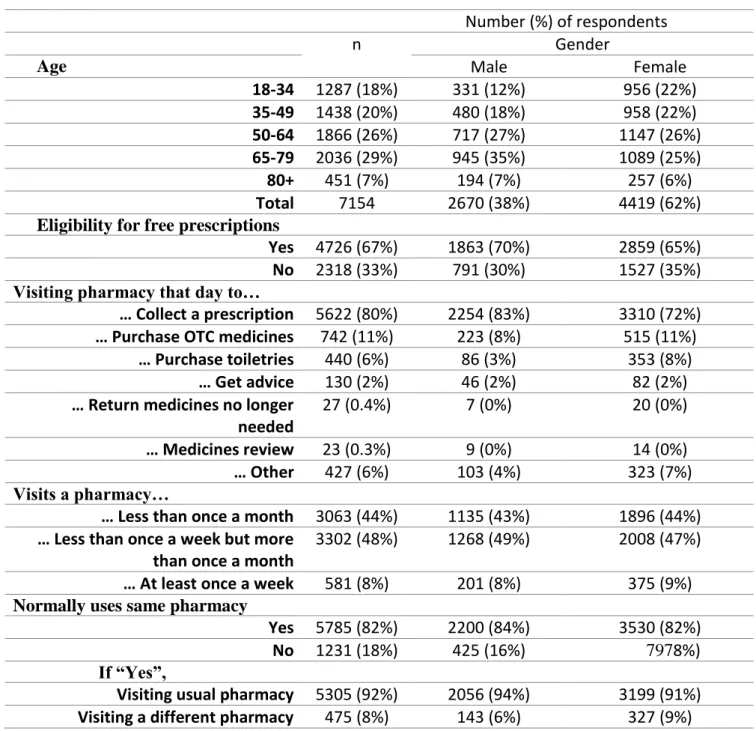
A total of 7154 questionnaires were completed, determining a response rate of 49%, with 7463 customers refusing to take part of the survey. Most of the responders (62%, n=4419) were female and 62% (n=4355) were aged 50 years and over (Table 1).
Table 1 - Demographic characteristics (n=7154)
Number (%) of respondents
n Gender
Age Male Female
18-34 1287 (18%) 331 (12%) 956 (22%) 35-49 1438 (20%) 480 (18%) 958 (22%) 50-64 1866 (26%) 717 (27%) 1147 (26%) 65-79 2036 (29%) 945 (35%) 1089 (25%) 80+ 451 (7%) 194 (7%) 257 (6%) Total 7154 2670 (38%) 4419 (62%)
Eligibility for free prescriptions
Yes 4726 (67%) 1863 (70%) 2859 (65%)
No 2318 (33%) 791 (30%) 1527 (35%)
Visiting pharmacy that day to…
… Collect a prescription 5622 (80%) 2254 (83%) 3310 (72%)
… Purchase OTC medicines 742 (11%) 223 (8%) 515 (11%)
… Purchase toiletries 440 (6%) 86 (3%) 353 (8%)
… Get advice 130 (2%) 46 (2%) 82 (2%)
… Return medicines no longer needed
27 (0.4%) 7 (0%) 20 (0%)
… Medicines review 23 (0.3%) 9 (0%) 14 (0%)
… Other 427 (6%) 103 (4%) 323 (7%)
Visits a pharmacy…
… Less than once a month 3063 (44%) 1135 (43%) 1896 (44%)
… Less than once a week but more than once a month
3302 (48%) 1268 (49%) 2008 (47%)
… At least once a week 581 (8%) 201 (8%) 375 (9%)
Normally uses same pharmacy
Yes 5785 (82%) 2200 (84%) 3530 (82%)
No 1231 (18%) 425 (16%) 7978%)
If “Yes”,
Visiting usual pharmacy 5305 (92%) 2056 (94%) 3199 (91%)
Male responders were more likely to be aged 50 or over (70%, n=1856) compared with females (56%, n=2493; Χ2=162.434, p<0.001). Non-responders did not differ in gender
compared with responders - 39% (n=2875) of non-responders were male and 38% (n=2670) of responders (Χ2=1.293, p=0.256). However, they were more likely to be estimated as under 50 (51%, n=3810), compared with responders reporting being aged under 50 (38%, n=2725; Χ2=234.135, p<0.001).
The majority of the customers (n=5622, 80%) were in the pharmacy that day to collect a prescription, with 11% (n=742) being there to buy an OTC medicine. Most of the customers (82%, n=5785) reported that they normally use the same pharmacy and of those 92%, n=5305 were visiting their usual pharmacy that day.
Managing own health
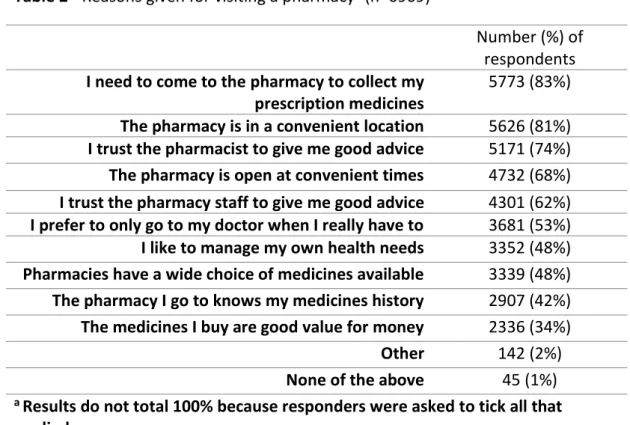
One of the aims of this study was to find out whether or not people like to manage their own health including using a pharmacy, so customers were asked to select from a list why they visit a pharmacy (Table 2).
Table 2 - Reasons given for visiting a pharmacya (n=6969)
Number (%) of respondents
I need to come to the pharmacy to collect my prescription medicines
5773 (83%)
The pharmacy is in a convenient location 5626 (81%)
I trust the pharmacist to give me good advice 5171 (74%)
The pharmacy is open at convenient times 4732 (68%)
I trust the pharmacy staff to give me good advice 4301 (62%)
I prefer to only go to my doctor when I really have to 3681 (53%)
I like to manage my own health needs 3352 (48%)
Pharmacies have a wide choice of medicines available 3339 (48%)
The pharmacy I go to knows my medicines history 2907 (42%)
The medicines I buy are good value for money 2336 (34%)
Other 142 (2%)
None of the above 45 (1%)
a Results do not total 100% because responders were asked to tick all that
The most common reasons given were to collect prescription medicines (n= 5773, 83%), followed by the pharmacy being in a convenient location (n=5626, 81%) and they trusted the pharmacist to give them good advice (n=5171, 74%).
Additionally, 53% (n=3681) of the responders reported that they prefer to go to the doctor only when they really have to and 48% (n=3352) that they like to manage their own health needs, suggesting that customers use the pharmacy to enable them to manage their health. Most of the responders (n=2818, 84%) that said that they like to manage their own health also said that they only go to the doctor when they have to. Overall, 39% (n=2818) of all responders gave both reasons for visiting pharmacies.
Buying medicines
An important part of pharmacy staff’s role is to ensure that the customers are buying medicines suitable for their condition, and to ensure they are used in a way that is as effective and safe as possible. As part of this process, it is usual for the pharmacy staff to ask customers questions about the user’s health and the purpose of the purchase. Most responders reported feeling they were asked about the right amount of questions, 84% (n=5206) when they ask about symptoms and 83% (n=5194) when requesting a specific medicine (Table 3).
Table 3 - Questions asked by the pharmacy staff when buying a medicine (n=7154)
Number (%) of respondents n Too many questions About the right amount of questions Too few
questions Not sure
When asking about symptoms, I feel I am asked
6213 138 (2%) 5206 (84%) 178 (3%) 691 (11%)
When asking for a specific medicine, I feel I am asked
6252 238 (4%) 5194 (83%) 218 (3%) 602 (10%)
Less than 10% people reported feeling they were asked too many (4%, n=238; 2%, n=138) or too few (n=218, 3%; n=178, 3%) when buying or needing help to buy medicines, respectively.
When asked about the last time they purchased a medicine, two thirds of responders (n=3680, 70%) had already decided which medicine they wanted to buy, with nearly a quarter (n=1412, 26%) wanting pharmacy staff to help them choose and only a very few (n=233, 4%) wanting to look at what was available and make their own decision (Table 4).
Self-selection of medicines
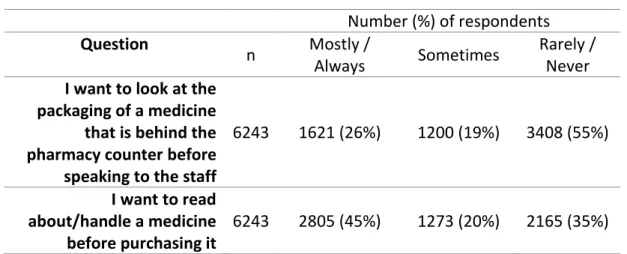
More than half (55%, n=3408) of respondents reported that they rarely or never want to look at the packaging of a medicine behind the counter before discussing the purchase with pharmacy staff (Table 5).
Table 4 – Decision making (n=5505)
Number (%) of respondents n Knew which
medicine to buy
Wanted help from the pharmacy staff
to select it
Wanted to look at the available ones and make my own choice
The last time I purchased a medicine from a pharmacy, I
5505 3680 (70%) 1412 (26%) 233 (4%)
Table 5 - Self-selection of medicines (n=7154)
Number (%) of respondents Question n Mostly / Always Sometimes Rarely / Never
I want to look at the packaging of a medicine that is behind the pharmacy counter before speaking to the staff
6243 1621 (26%) 1200 (19%) 3408 (55%)
I want to read
More respondents (45%, n=2805) reported wanting to handle or read about a medicine before making a purchase, however, less than half of the customers wanted to do so.
Information about OTC medicines
Spoken advice from the pharmacist or pharmacy staff was the most reported way of obtaining information about OTC medicines (n=5193, 82%), as well as the preferred choice to do so (n=3389, 55%) (Table 6).
I get advice and information about
OTC medicines from…a (n=6326)
My preferred choice for advice and information about OTC medicines would be from… (n=6179)
Number (%) of respondents
… Spoken advice from the pharmacist/pharmacy staff
5193 (82%) 3389 (55%)
… Spoken advice from the doctor
3352 (53%) 1200 (19%)
… The internet 2522 (40%) 738 (12%)
… Written advice on the medicine packaging
2489 (39%) 229 (4%)
… Written advice in a leaflet
2242 (35%) 192 (3%)
… Family and friends 1821 (29%) 274 (4%)
… Electronic kiosk in the pharmacy
59 (1%) 3 (0%)
I do not want advice 113 (2%) 90 (1%)
Other 161 (3%) 64 (1%)
a Results do not total 100% because responders were asked to tick all that
applied
Spoken advice from the doctor was the second most reported method (n=3352, 53%), followed by the Internet (n=2522, 40%) and written advice on packaging (n=2489, 39%) and in leaflets (n=2242, 35%).
When asked on how they know which dose to take when using an OTC medicine
written on the label or leaflet, 14% (n=917) said they follow advice from pharmacy staff and 14% (n=890) said they had used it before, and therefore, knew what to do. 196 responders (3%) gave other answers (Table 7).
Opinions on OTC medicines
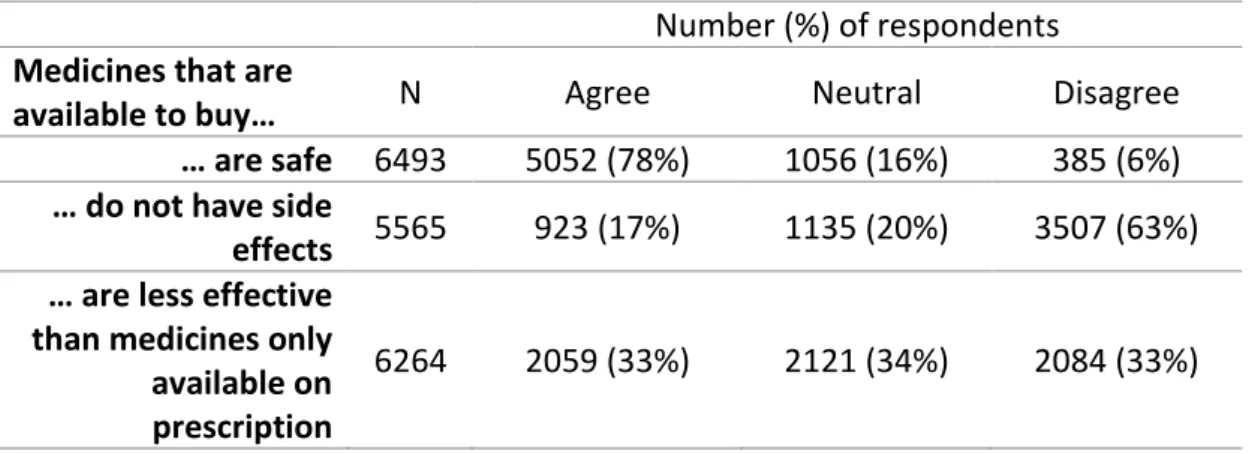
There were some questions asked in the survey with the purpose to understand if the customers had some general knowledge about OTC medicines, regarding their safety and effectiveness. Most customers (n= 3507, 63%) were aware that OTC medicines have side effects (Table 8), whilst 17% (n=923) believe that they do not.
Table 7 – OTC medicines correct dose information (n=6379)
When I use a non-prescription medicine, I know which dose to take
because… Number (%) of
respondents
… I follow the instructions on the label/leaflet 4376 (69%)
… I follow the advice of the pharmacy staff 917 (14%)
… I have generally used it before and I know what to do
890 (14%)
Other 4732 (68%)
Table 8 - Safety and effectiveness of OTC medicines (n=7154)
Number (%) of respondents
Medicines that are
available to buy… N Agree Neutral Disagree … are safe 6493 5052 (78%) 1056 (16%) 385 (6%)
… do not have side
effects 5565 923 (17%) 1135 (20%) 3507 (63%) … are less effective
than medicines only available on prescription
Males were more likely to agree that medicines that are available to buy do not have side effects, compared with females (21% vs 14%, respectively, Χ2=53.970, p<0.001).
Customers aged under 50 years old were more likely to think OTC medicines have side effects compared with customers aged over 50 years old (65% vs 62%, respectively, Χ2=6.856, p=0.032). Similarly, those eligible for free prescriptions were more likely to
agree that medicines that are available to buy do not have side effects compared with the ones who weren’t (18% vs 14%, respectively, Χ2=17.821, p<0.001).
Three quarters (78%, n=5052) of the customers agreed that the medicines that are available to buy are safe. Unlike the previous statement, there was no significant difference in the answers given by gender (Χ2=5.824, p=0.054), age (Χ2=0.852, p=0.653) or eligibility for free prescriptions (Χ2=2.808, p=0.246).
Respondents expressed less certainty about the statement “Medicines that are available to buy are less effective than medicines only available on prescription”, with one third each agreeing, being neutral and disagreeing (33%, n=2029; 34%, n=2121; 33%, n=2084 respectively). However, males were more likely to agree that OTC medicines are less effective compared with females (42% vs 27%, respectively, Χ2=165.885, p<0.001). Customers aged over 50 years old were more likely to think that medicines available to buy are less effective than medicines only available on prescription, compared with customers aged under 50 years old (36% vs 28%, respectively, Χ2=62.656, p<0.001). Likewise, those eligible for free prescriptions were more likely
to think that medicines only available on prescription were more effective than OTC medicines, compared with the ones who were not eligible for free prescriptions (35% vs 28%, respectively, Χ2=40.251, p<0.001).
Overall, females, under 50 years old and those not eligible for free prescriptions were more informed about safety and effectiveness of OTC medicines.
Availability of OTC medicines
When asked about the range of medicines available to purchase, most of the responders (83%, n=5199) said that they can mostly or always find a suitable medicine to treat a condition themselves. However, 645 (10%) of them said that there are conditions they would like to self-treat where there is not a medicine available without prescription. They were asked to report those conditions, and the results were classified according to
with 19% (n=118) responses, primarily diseases such as psoriasis and eczema. The next most suggested categories were Respiratory System, Nervous System and Infection, each suggested by 16% of respondents (n=99, 96 & 97 respectively). Respiratory System included cough, cold symptoms and asthma; Nervous System included mainly pain and mental health disorders such as depression and anxiety. One-sixth (15%, n=84) of those customers who stated a condition responded about infections in that they wanted to be able to purchase antibiotics without a prescription.
Table 9 - Categories of conditions responders would like to manage themselves (n=607) Number (%) of respondents 1 - Gastro-intestinal system 36 (6%) Disorders of gastric acid
and ulceration 17 (3%) Others 19 (3%) 2 - Cardiovascular system 29 (5%) Blood clots 6 (1%) Blood pressure conditions 10 (2%) Vascular disease 6 (1%) Others 6 (1%) 3 - Respiratory system 99 (16%) Airways disease, obstructive 29 (5%) Allergic conditions 13 (2%) Cough and congestion 54 (9%) Others 2 (0%)
4 - Nervous system 96 (16%)
Mental health disorders 33 (6%) Pain 43 (8%) Others 20 (3%) 5 - Infection 97 (16%) Bacterial infection 84 (15%) Others 11 (2%) 6 - Endocrine system 14 (2%)
Sex hormone responsive conditions
6 (1%) Others 8 (1%)
7 - Genito-urinary system 5 (1%)
8 - Immune system and malignant disease
8 (1%)
9 - Blood and nutrition 2 (0%)
10 - Musculoskeletal system
54 (9%) Arthritis 14 (2%) Pain and inflammation
in musculoskeletal disorders 25 (4%) Others 12 (2%) 11 - Eye 20 (3%) Eye infections 9 (2%)
Others 7 (1%)
12 - Ear, nose and oropharynx 28 (5%) Nasal infection 7 (1%) Others 18 (3%) 13 - Skin 118 (19%) Inflammatory skin conditions 48 (8%) Others 59 (10%) 14 - Vaccines 1 (0%) Total 607 (100%)
Discussion
Most of the customers already know what medicine they want to buy when they go to a pharmacy, meaning that they want to make the decisions about their health. This supports the idea that the people’s will to manage their own health is arising. When patients are looking for new information or advice on some medicines, the pharmacy staff is the most reliable source to do so, and 39% of all customers believe that the pharmacy is the place to go when they want to manage their own health and avoid a doctor’s consultation. Customers most reported category of conditions they would like to treat by themselves, without a prescription, is Skin problems.
Although Nottingham’s population has nearly a 50/50 distribution of gender (11), this study shows that most customers in community pharmacies are females, which mirrors other studies of community pharmacy customers (12, 13) in the UK, and also in Portugal (14, 15). Reasons why more women use pharmacies may be that mothers are more likely to manage their children’s health (16), and women are more likely to spend time with self-care than men (17). Older people are also more likely to be more concerned about their health (17), especially because they are more likely to be using multiple medicines (18). Those eligible for free prescriptions are also more likely to visit a pharmacy, probably because they tend to be older (19), and because collecting prescriptions is the main reason reported for visiting the pharmacy that day. The second most common reason customers were visiting the pharmacy that day was to purchase an OTC medicine, which also reflects previously published literature (12, 20-22).
Even though the majority of the pharmacy’s customers is there to collect a prescription, there’s still a significant number of people that believe that a pharmacy is the correct place to go when they want to manage their health on their own. Knowing how to take care of self health is very important and even incentivized by the UK Government (23), but it is also equally important that the person is well informed to do so. Therefore, it would be interesting to assess the effects of public health campaigns in the pharmacies, such as health promoters approaching the customers to talk to them about medication general knowledge with short and simple facts or even the basic distribution of leaflets containing the same content to educate the population. That
medicines information, but also health advice, and the whole community would benefit from that (24).
The fact that most of the customers does not need help to choose a medicine can derive from several reasons: having used it before with good results, had already received advice from a healthcare professional previously or trusting their own judgement (25). Despite what was stated previously, one quarter of the customers in fact wanted help to choose a medicine, the last time they bought one. When asking the pharmacy staff for help to decide, most of the customers reported feeling they were asked the right amount of questions. However, it is not known whether the questions they are asked are the right ones and sufficient to ensure the safe and effective use of the medicine. What is now needed is a study that describes what are the questions asked by the pharmacy staff when dispensing a non-prescription medicine to a patient, to investigate if they ask the correct ones. If not, it should be implemented some mandatory short courses to the pharmacy staff regarding the most commonly self-treated illness, assuming that in the case of the prescription medicines, the patients are already well informed by their doctors. Most importantly, this study should be performed in all the non-pharmacy OTC selling points and involving the staff that is not pharmacist, because they have received less training in this matter (26).
This study has verified that 70% of the customers make the decision of which medicine to purchase on their own, even before entering the pharmacy. However, is it certain that those decisions are correctly made and sufficiently informed, once only 45% of customers reported wanting to read about a medicine before purchasing it? It is crucial that the consumers want to find out more about the products they use. When customers are looking for general information about OTC medicines, the most frequently reported source of information are health care professionals, with pharmacists and pharmacy staff used more than doctors, and this finding matches other studies performed in Portugal (14, 27). The next most used source is the internet, used by 40% of the customers. Young people are relying on the internet to find information about OTC medicines and information about health in general (28), meaning that it should be of general knowledge which are the trustworthy websites for consulting. Further investigation needs to be carried out to figure out how it would be the best way to spread what are the trustworthy websites for internet users, and incentivize those who do not use the Internet to at least read the leaflet of every medicine they use.
These findings suggest that regarding the safety and effectiveness of OTC medicines, females, customers aged under 50 years old and people not eligible for free prescriptions tend to be better informed. Females are known to be more likely to manage their children’s health, as said above, so that may be one of the reasons they have a tendency to seek more information about health products and medicines. Younger people (aged under 50 years old) are probably better informed because they are more likely to have a higher educational level (29), or because they are not in a society where the professional holds all the information, not being the only reliable source. If there is still a large part of the population that is not as well informed as it should be about this subject, what is now needed is to divulge medicines information to the entire population. One solution would be to integrate a module in the mandatory years of primary and secondary education that introduces the basic concepts of medicine to students. There has been a study in Portugal that asked similar questions to the patients, regarding safety and effectiveness of OTC medicines, but has not made correlations of the answers with the respondents’ age or gender (30).
Most people are satisfied with the available medicines that they purchase without a prescription, but 10% of the customers wanted to purchase a medicine that is not currently available over-the-counter and that needs to be obtained through a prescription. Skin conditions were the most reported area, but there are currently a high number of diseases that fit this category that are already available over-the-counter. Therefore, there is more interest in investigating the fact that the category “Nervous System” is so high-ranked, with customers wanting to be able to buy antidepressants and anxiolytics without a doctors’ prescription. Also high-ranked, with 15% of the responses, is the will to purchase antibiotics without a doctor’s prescription. That will could mean that customers are not aware of the consequences of unnecessary use of antibiotics, that can lead to antibiotic resistance, a serious worldwide health care problem (31), among other concerns. Similar antibiotic related concerns have also been reported in Portugal (32). To raise people’s awareness, the public health campaigns must continue and should be even more divulged, so they can reach the highest possible number of people in the community, such as the European Antibiotic Awareness Day (EAAD), the UK’s Antibiotic Guardian campaign and the World Antibiotic Awareness Week (WAAW) (33).
This study has described the self-medication tendencies in the Midlands, England. When comparing to the tendencies in Portugal, similar studies of decision making when purchasing OTC medicines or conditions that the patients would like to treat by themselves have not been performed yet. Further work on this area could be elaborated.
The limitations of this study include the fact that the students that performed the survey in the participating community pharmacies were not sufficiently trained to administer the questionnaire. There should have been a proper training that included learning how to elucidate the respondent on how to reply to each question the way the investigator intends, and not allow the respondents to reply according to their own interpretation of the question. It was clear in the interpretation of the results that some respondents did not fully understand what was asked in some questions and the questionnaires’ administrator did not clarify the responders correctly. Also, some discrepancies within the same responded survey were found and not spotted by the survey administrator. Another limitation could be the lack of a formal pilot survey, although it might not be a valid limitation, considering the high and long experience of the creators of the questionnaire in doing so for other investigations.
The strengths of this study include the very high number of participants and the high number of questions asked to each, that allowed the statistic association made to find conclusions to be valid. Even though the Nottingham population representation is not assured in this investigation, the responses are ample enough to have an accurate idea of the community pharmacy customers’ perceptions and attitudes regarding self-care. Another strength was the diversity of questions asked to each respondent. There has not been a previous study that had already showed some of the conclusions elaborated in the present study.
Continuation of this work should be to administer the same questionnaire in other OTC selling points, and not just community pharmacies, to have a wider perception of the patients’ attitudes in self-care and also detect the most problematic areas that can appear from the lack of pharmaceutical surveillance in these retail outlets. There should also be further investigation about patients believes regarding effectiveness and safety of OTC medicines, including interactions and missing doses, so after that, there can be studies performed to discover how to enhance the community’s knowledge.
Conclusion
The fact that almost 40% of the responders reported that they go to the pharmacy to manage their own health, because they do not want to go to the doctor unless they really have to, indicates that pharmacies can be the answer to diminish the amount of people that go to hospitals with minor illnesses, and therefore, reduce the waiting time for patients and make a better use of the available resources (4).
Knowing that the willingness for self-care is increasing, and that customers use community pharmacies to help them do that, further work should be done to investigate if the pharmacy staff is asking the correct questions to patients. Further work should also be done to educate people and to ensure that they are managing their conditions in a safe and effective way. The proportion of the population understanding of the risks associated with all medicines needs to increase so that these can be used as safely as possible.
References
1. Organization WH. Report of 4th WHO consultative group on the role of pharmacist: the role of the pharmacist in self-care and self-medication. Geneva: WHO. 1998.
2. Hughes CM, McElnay JC, Fleming GF. Benefits and risks of self medication. Drug safety. 2001;24(14):1027-37.
3. Tucker R, Stewart D. Why people seek advice from community pharmacies about skin problems. International Journal of Pharmacy Practice. 2015;23(2):150-3. 4. Paudyal V, Hansford D, Cunningham S, Stewart D. Pharmacy assisted patient self care of minor ailments: a chronological review of UK health policy documents and key events 1997–2010. Health policy. 2011;101(3):253-9.
5. Brata C, Gudka S, Schneider CR, Clifford RM. A review of the provision of appropriate advice by pharmacy staff for self-medication in developing countries. Research in Social and Administrative Pharmacy. 2015;11(2):136-53.
6. Service NH. NHS Choices - Medicines Information Available at http://www.nhs.uk/conditions/Medicinesinfo/Pages/Introduction.aspx [03/04/2017]. 7. Choices N. NHS in England: help with health costs 2017 [15/10/2017].
8. Ireland PSoN. Medicines for Human Use: POM, P, GSL & General Pharmacy Regulations. 2010.
9. Government U. Pharmacy, prescription-only (POM), and general sale list (GSL) medicines: apply to move your medicine to a different classification. 2014.
10. Paudyal V, Hansford D, Cunningham S, Stewart D. Pharmacists' adoption into practice of newly reclassified medicines from diverse therapeutic areas in Scotland: A quantitative study of factors associated with decision-making. Research in Social and Administrative Pharmacy. 2014;10(1):88-105.
11. Statistics OfN. ONS Mid-Year Population Estimates 2015 https://www.ons.gov.uk/peoplepopulationandcommunity/populationandmigration/pop ulationestimates/datasets/populationestimatesforukenglandandwalesscotlandandnorthe rnireland [07/04/2017].
12. Boardman H, Lewis M, Croft P, Trinder P, Rajaratnam G. Use of community pharmacies: a population-based survey. Journal of Public Health. 2005;27(3):254-62. 13. Watson MC, Hart J, Johnston M, Bond CM. Exploring the supply of non-prescription medicines from community pharmacies in Scotland. Pharmacy world & science. 2008;30(5):526-35.
14. de Melo MN, Madureira B, Ferreira APN, Mendes Z, da Costa Miranda A, Martins AP. Prevalence of self-medication in rural areas of Portugal. Pharmacy World and Science. 2006;28(1):19-25.
15. Paula Martins A, da Costa Miranda A, Mendes Z, Soares MA, Ferreira P, Nogueira A. Self‐medication in a Portuguese urban population: a prevalence study. Pharmacoepidemiology and drug safety. 2002;11(5):409-14.
16. Bertille N, Fournier-Charrière E, Pons G, Chalumeau M. Managing fever in children: a national survey of parents' knowledge and practices in France. PloS one. 2013;8(12):e83469.
17. Shandra CL, Sonalkar N. Health self-care in the United States. Public health. 2016;138:26-32.
18. Herr M, Robine JM, Pinot J, Arvieu JJ, Ankri J. Polypharmacy and frailty: prevalence, relationship, and impact on mortality in a French sample of 2350 old people. Pharmacoepidemiology and drug safety. 2015;24(6):637-46.
19. Team PaM, Centre HaSCI. Prescriptions Dispensed in the Community: England 2004-14. 2015.
20. Anderson C, Blenkinsopp A, Armstrong M. Feedback from community pharmacy users on the contribution of community pharmacy to improving the public's health: a systematic review of the peer reviewed and non‐peer reviewed literature 1990– 2002. Health Expectations. 2004;7(3):191-202.
21. Eades CE, Ferguson JS, O'Carroll RE. Public health in community pharmacy: a systematic review of pharmacist and consumer views. BMC public health. 2011;11(1):582.
22. Hassell K, Noyce P, Rogers A, Harris J, Wilkinson J. Advice provided in British community pharmacies: what people want and what they get. Journal of health services research & policy. 1998;3(4):219-25.
23. Framework NCPC. Essential Service – Support for self-care 2004.
24. Meyerson BE, Ryder PT, Richey-Smith C. Achieving pharmacy-based public health: a call for public health engagement. Public Health Reports. 2013;128(3):140-3. 25. Taylor J. Reasons consumers do not ask for advice on non‐prescription medicines in pharmacies. International Journal of Pharmacy Practice. 1994;2(4):209-14.
26. Alkhateeb FM, Shields KM, Broedel‐Zaugg K, Bryan A, Snell J. Credentialing of pharmacy technicians in the USA. International Journal of Pharmacy Practice. 2011;19(4):219-27.
27. Peixoto J. Automedicação no adulto. Universidade Fernando Pessoa. Ponte de Lima. 2008.
28. Baheiraei A, Khoori E, Foroushani AR, Ahmadi F, Ybarra ML. What sources do adolescents turn to for information about their health concerns? International journal of adolescent medicine and health. 2014;26(1):61-8.
29. O'neill BC, Balk D, Brickman M, Ezra M. A guide to global population projections. Demographic Research. 2001;4:203-88.
30. Nogueira RMA. Análise da automedicação em Portugal e seus intervenientes 2011.
31. Wood F, Phillips C, Brookes-Howell L, Hood K, Verheij T, Coenen S, et al. Primary care clinicians' perceptions of antibiotic resistance: a multi-country qualitative interview study. Journal of Antimicrobial Chemotherapy. 2012:dks338.
32. Amaral O, Lages A, Sousa L, Almeida L, Santos J, Dias M, et al. Automedicação em jovens e adultos da região Centro de Portugal. Millenium. 2014;47:97-109.
Annex
Annex I
Survey applied in the 31 Community Pharmacies in Nottingham. Pharmacy ID Researcher ID Questionnaire ID Date D D M M Y Y Time started H H M M
Community Pharmacy Services
Survey
Instructions to researchers
Questionnaire will be administered by Pharmacy students to patients and customers in the pharmacy no specific groups will be targeted or excluded as we are seeking a wide breadth of views. The only exceptions to this are, this survey is not intended to be completed by those under the age of 18. Potential participants should not be approached if they appear to lack capacity, if you feel completing the survey may cause distress.
Introduction to participant
Hello my name is [ ]. Would you have approximately 10 minutes
to take part in a survey about the services community pharmacies
provide?
Thank you, your participation is appreciated. This study is being
conducted by the University of Nottingham, School of Pharmacy in
survey will be used to inform pharmacies locally about what patients
want from pharmacy. At the end of the survey I will give you a small
leaflet with these details and also the university contact details should
you have any queries or wish to receive a summary of the results.
All data from this research will be treated anonymously and individuals
will not be able to be identified. The information received will be
analyzed, fed back to the pharmacy where it was collected to inform
service design and may be published in academic research papers.
Visiting pharmacies
1. Why did you visit this pharmacy today? (Tick ALL that apply) To collect a prescription Purchase over the counter medicines Medicines review Purchase toiletries
For advice Return medicines no longer needed Other (specify) Prefer not to say
2. Do you normally use the same pharmacy? Yes No
3. Is this the pharmacy you normally use? Yes No
4. How often do you use a pharmacy? At least once a week
Less than once a week but more than once a month Less than once a month
5. Here are some reasons people have given for visiting a pharmacy, which of these, if any, apply to you? (Tick ALL that apply)
I trust the pharmacist to give me good advice I trust the pharmacy staff to give me good advice I prefer to only go to my doctor when I really have to I like to manage my own health needs
I need to come to the pharmacy to collect my prescription medicines The pharmacy is in a convenient location
The pharmacy is open at convenient times
The pharmacy I go to knows my medicines history The medicines I buy are good value for money
Pharmacies have a wide choice of medicines available Other (specify) None of the above
6. When thinking about using a pharmacy to buy a medicine; to what extent do you agree or disagree with the statement “I trust the pharmacy team”
Strongly agree Agree Neither agree nor disagree Disagree Strongly disagree
Thinking about the last time you bought a medicine from a pharmacy
7. What was the last medicine you purchased? I can’t remember Prefer not to say
8. When you purchased this medicine did you (Tick ONE only): Know which medicine you wanted to buy
Want the pharmacy staff to help you select a medicine;
Want to look at the medicines available and make your own choice 9. The medicine you bought was good value for money
Strongly agree Agree Neither agree nor disagree Disagree Strongly disagree 10. Why did you think it was/was not good value for money?
The following questions ask about when you purchase ANY medicine in a pharmacy
11. Do you want to read about/handle a medicine before you purchase it? Always Mostly Sometimes Rarely Never
12. When a medicine is behind the pharmacy counter would you want to look at the packaging BEFORE speaking to the pharmacy staff?
Always Mostly Sometimes Rarely Never
When you purchase any medicine the pharmacy staff may ask you some questions to ensure suitability of a medicine.
13. When you ask for a medicine by name (for example “Can I have a box of…”) do you feel that you are asked:
Too many questions
Not sure
14. When you want advice about symptoms you are suffering from do you feel that you are asked:
Too many questions
About the right amount of questions Too few questions
Not sure
Thinking about when you use a medicine you can buy without a prescription
15. When you use a non-prescription medicine, how do you know what dose to take?
(Tick ONE only)
I have generally used it before and I know what to do I follow the instructions on the label/leaflet
I follow the advice of the pharmacy staff
I follow advice from others e.g. family members, friends etc. I use my own judgment
Other (specify)
16. When you use a non-prescription medicine, how easy or difficult are the written information you get with the medicine? Do you understand: All of it Most of it Some of it A little of it None of it
17. What information did you find difficult to understand, if any? (Tick ALL that apply)
What the medicine is and what it is used for
Warnings about things to consider before taking the medicine How to take the medicine
Information about side effects How to store the medicine
Further information such as other ingredients, manufacturer details I didn’t find any of the information difficult to understand
18. If you had a problem with a non-prescription medicine you have bought, what would you do FIRST? (Tick ONE only)
Ask a family member or friend for their advice Search on the internet
Speak to the pharmacist/pharmacy staff Speak to the doctor
Ring NHS 111
Call for an ambulance Other (specify)
19. If you think a non-prescription medicine you have bought isn’t working, what would you do FIRST? (Tick ONE only)
Keep using the medicine as instructed Increase the dose of the medicine Stop using the medicine
Ask a family member or friend for their advice Search on the internet
Speak to the pharmacist/pharmacy staff Speak to the doctor
Ring NHS 111
Call for an ambulance Other (specify)
Information about non-prescription medicines
20. How do you get advice and information about non-prescription medicines? (Tick ALL that apply)
21. Of your choices above which would be your PREFERRED choice for advice and information about non-prescription medicines? (Tick ONE only)
Q20 Q21
Spoken advice from the pharmacist/pharmacy staff Spoken advice from the doctor
Family and friends
Written advice in a leaflet
Written advice on the medicine packaging Electronic kiosk in the pharmacy
From the internet I don’t want advice Other (specify)
22. If you use the internet for medicines information which websites have you used?
(Tick ALL that apply)
NHS Choices (www.nhs.uk) Patient.co.uk (www.patient.co.uk)
WebMD (www.webMD.com) Net Doctor (www.NetDoctor.co.uk)
Electronic Medicines Compendium (www.medicines.org.uk) Wikipedia (www.wikipedia.org)
I don’t use the internet for information about medicines
Opinions about medicines
23. Medicines that are available to buy are safe
Strongly agree Agree Neither agree nor disagree Disagree Strongly disagree 24. Medicines that are available to buy do not have side effects
Strongly agree Agree Neither agree nor disagree Disagree Strongly disagree 25. Medicines available to buy are less effective than medicines only available on
prescription
Strongly agree Agree Neither agree nor disagree Disagree Strongly disagree
About the range of medicines available to purchase
26. When you need to buy a medicine to treat a condition yourself, how often are you able to find a suitable one?
Always Mostly Sometimes Rarely Never 27. Are there any conditions you would like to self-treat but there is not a
medicine available? Yes No
If you said yes, what are these conditions?
Services in the pharmacy
Pharmacies provide a range of services in addition to the supply of medicines. The questions that follow ask about these services
28. What services or purchases have you used a pharmacy for in the last 3 months?
(Tick ALL that apply)
Obtaining prescription medicines Getting advice about medicines
Consultation with the pharmacist Purchase of toiletries Medicines check-up/review Purchase of baby products Specific service provided by the pharmacy (e.g. smoking cessation, diabetes screening)
Purchase of other non-medicinal products Other (specify)
29. Which of the following services should pharmacy provide in addition to advice about medicine and health? (Tick ALL that apply)
30. If these services were available, but a fee would be payable; which services would you be willing to pay for? (Tick ALL that apply)
Q29 Q30
Medicines review
Support for stopping smoking
Repeat prescription medicine management Support for substance misusers
Flu vaccinations Travel vaccinations
Sexual health advice/treatment and contraceptive supply
Support for common/minor ailments e.g. pharmacy first scheme Home visits for review and advice
Alcohol screening
Health and wellbeing check
Screening for health conditions e.g diabetes screening
Monitoring of medical conditions e.g. blood pressure checks, routine blood tests Weight management
Specialist support to help people remember to take their medicines Support for patients being discharged from hospital
Appointment with other health professional e.g. nurse, physiotherapist etc. (specify) 1. 2. 3. Other(specify) 1. 2. 3. Flu vaccination
The following questions relate to one of the services currently being offered by some pharmacies in this area, the seasonal flu vaccination
31. Are you eligible to receive a flu vaccination on the NHS? (See separate card for criteria)
SECTION 1
32. Have you taken up the offer to have the flu jab this year?
Yes (go to 33) No (go to 35) No but I am going to get one (go to 33)
33. Where did/will you have your flu jab?
GP surgery – special flu clinic GP surgery – routine appointment Pharmacy NHS Walk in Centre
Other (specify) Hospital clinic
34. Why did/will you have your flu jab? (Tick ALL that apply) The NHS/my doctor told me to
My work (paid or voluntary) told me to
My health means flu would be very serious for me I have a family member who has a serious illness I have a caring responsibility which means I can’t be ill I am worried I will miss work
I need to protect others (colleagues/clients etc.) Other (specify)
Go to section 3
35. Why did you decide not to have the flu vaccination? (Tick ALL that apply) Don’t see the need Didn’t have time
No GP appointments available at all No GP appointments available at a convenient time
Previous bad experience Concerns about adverse reactions and side effects
Wasn’t well enough to receive the vaccine Other (specify)
Go to section 3
SECTION 2
The flu vaccination is available privately for those ineligible to receive it on the NHS or who wish to pay for it themselves.
Yes (go to 37) No (go to 40) No but I am going to get one (go to 37)
37. Where did/will you have your flu vaccination?
GP Surgery Community Pharmacy Community Clinic NHS Walk in Centre Other (specify)
38. Why did/will you have your flu jab? (Tick ALL that apply) The NHS/my doctor told me to
My work (paid or voluntary) told me to
My health means flu would be very serious for me I have a family member who has a serious illness I have a caring responsibility which means I can’t be ill I am worried I will miss work
I need to protect others (colleagues/clients etc.) Other (specify)
39. If recommended by work (paid or voluntary) who paid/will pay? Work (directly or via claim) Self-funded
Go to section 3
40. Why did you decide not to have the flu vaccination? (Tick ALL that apply) Didn’t know I could have one privately
Didn’t want to pay for it Don’t see the need Didn’t have time
Concerns about adverse reaction or side effects Previous bad experience
Other (specify)
Go to section 3 Section 3
Pharmacists have been providing flu vaccinations in the pharmacy and it has been suggested that pharmacists can supply and administer other vaccines such as travel vaccinations. The next questions ask your opinions about this.
41. When you need a vaccination, would you PREFER to receive your vaccination at: (Tick ONE only)
Specially arranged clinic e.g. in a community centre Place of work I don’t have a preference
42. If you had your vaccination in the pharmacy, assuming the individual had been trained, would you be happy to have the vaccination given by: (Tick ALL that apply)
The pharmacist The counter assistant Nurse
I wouldn’t be happy to have the vaccination in the pharmacy
43. What concerns or worries might you have about receiving a vaccination in the pharmacy as opposed to anywhere else?
44. If you were to have a vaccination in the pharmacy, would you be happy for the pharmacy to provide information to your GP about that vaccination? Yes No
45. Please can you tell us why you said yes or no?
46. Would you be happy for the pharmacist to have access to your GP record to enable them to check that you are suitable for, and it is appropriate and safe for you to have the vaccination?
Yes No
47. Please can you tell us why you said yes or no?
About you
48. Are you:
18-34 35-49 50-64 65-79 80+ Prefer not to say
50. Are you eligible for free prescriptions? Yes No Prefer not to say