2
ndINTREPID Report
Interdisciplinarity, the Social Sciences and the
Humanities and Responsible Research and
Innovation in EU Research
By Olivia Bina
With contributions from:
Marta Varanda, Carlo Sessa, Helena Guimarães and Doris Alexander
April 2017
Acknowledgements
We are extremely grateful to all the participants who joined the Special Session on EU Research Funding (held in January 2017 as part of an international conference), and to the six keynote speakers who agreed to come and share their experience and knowledge with us, setting the scene for our discussions. Finally, we are grateful for to the Calouste Gulbenkian Foundation for hosting our conference and the Special Session on EU funding, and to the COST Action TD1408: INTREPID, for funding the event:
Interdisciplinarity in research programming and funding cycles (INTREPID) http://www.intrepid-‐cost.eu/
A Policy Brief based on this report is available here: http://www.intrepid-‐cost.eu/wp-‐ content/uploads/2017/05/EU-‐research-‐ID-‐SSH-‐RRI-‐Policy-‐BRIEF.pdf
Contents
ACKNOWLEDGEMENTS ... 2BACKGROUND ... 4
THE “EU SPECIAL SESSION” ... 4
THIS POLICY BRIEF ... 5
WORLD CAFÉ GROUPS AND PROCESS ... 5
DISCUSSION, CONCERNS AND QUESTIONS ... 6
Interdisciplinary research: paradox or gap? ... 6
University: late-‐comer or left behind? ... 7
Innovation battleground: where are the social sciences, the humanities and the arts? 8
The 5% share of budget going to SSH partners out of the total 2015 call budget for Societal Challenges and LEITs ... 10
TEN KEY RECOMMENDATIONS ... 11
DETAILED RECOMMENDATIONS ... 15
INTERDISCIPLINARITY -‐ SUGGESTIONS AND RECOMMENDATIONS ... 16
SSH -‐ SUGGESTIONS AND RECOMMENDATIONS ... 20
RRI -‐ SUGGESTIONS AND RECOMMENDATIONS ... 22
REFERENCES ... 24
ANNEX 1 WORLD CAFÉ ICE-‐BREAKING QUESTIONS ... 25
“Knowledge is extracted from a fully integrated world. Knowledge is ‘dis-‐integrated’ by disciplinary units called Departments in Universities. How can knowledge, discovery and dissemination be re-‐integrated?” Richard Zare, BioX initiative, Stanford University (cited in: EURAB 2004)
Background
The initial scope of this world café session on interdisciplinarity (ID), social sciences and humanities (SSH) and responsible R&I in EU funding, was based on the preliminary findings of a short term scientific mission (STSM, 3-‐9 April 2016) held at DG Research and Innovation in Brussels, to explore different aspects of how ID was being understood and integrated in programming and funding policies (Bina 2016). The interviews held at DG R&I raised a number of interesting questions about the use of the terms and concept of ID in the context of H2020 programming and funding (EUCO 2013).
In the conclusion of our report to DG R&I summarising the findings from the interviews held, we suggested organising a workshop to discuss some of the key issues identified. Eventually, the opportunity arose to create such event as part of a larger international conference on interdisciplinarity and the need to open up the social sciences. The conference details can be found here: http://www.intrepid-‐cost.eu/lisbon-‐conference/
Box 1 Scope of the short term scientific mission (STSM) at DG R&I
Meetings with top officials and technical staff from DG R&I focused on one or more of the following areas:
-‐ Definitions, perceptions, views, expectations of/for ID research; -‐ Leadership, policy and strategic choices in support of ID; -‐ The practice of designing ID calls;
-‐ The evaluation of ID programs, projects;
-‐ The role of Social Sciences and Humanities in ID research.
Overall, these areas were discussed with four top officials and two officers from DG R&I, a top official from the Joint Research Centre in Brussels (which contributed to the building of the Societal Challenges) and two national experts responsible for promoting H2020 research at home and national interests within its Programmes. Direct quotes were kept anonymous. (Bina 2016)
The “EU Special Session”
The workshop would explore both theoretical and practice-‐related challenges of linking SSH and interdisciplinarity in research policy, programming and funding by the EU. The aim was to identify a range of recommendations towards informing the next programming period (FP9) from the perspective of ID, SSH and RRI, and possibly contribute to inform the final programming stage of H2020 (2018-‐2020)report.
Special Session (a total of 4.5 hours), intended to offer participants:
• An overview of the status and challenges of SSH and ID in EU research funding: o Keynote Peter Fisch (of peter.fisch.eu)
o Keynote Angela Liberatore (ERC, EC) o Keynote Rosario Macario (IST, ULisboa).
• An overview of the implications of two recent reports: one on interdisciplinarity (Wernli and Darbellay 2016) and one on the performance of the social sciences and humanities (SSH) (Birnbaum et al. 2017 ; see also: Hetel et al. 2015):
o Keynote presentation by Katrien Maes (League or European Research Universities -‐LERU)
o Keynote presentation by Philippe Keraudren (DG R&I)
o Discussant: Doris Alexander, Research Development Office, Trinity College Dublin, the University of Dublin.
• An opportunity to brainstorm and discuss recommendations in small break out groups, using the World Café approach, with a view to identify questions and recommendations for the future treatment of SSH, interdisciplinarity and RRI in EU programming.
This policy brief
This brief offers a detailed account of the ideas, comments, questions and recommendations discussed and proposed during the workshop: both through the presentations of invited speakers (mentioned above) that were intended to present facts and cause participants to think about a range of issues, and through the discussions that followed in the World Café final session. The text was initially drafted by the three organisers of the World Café, based on the write up of the cards bearing ideas and recommendations written by participants during the three rounds of World Café. It was then circulated to all participants for comments and feedback. This policy brief is based on the revised report.
List of Acronyms
-‐ ID – interdisciplinary / interdisciplinarity -‐ IDR -‐ interdisciplinary research
-‐ RRI -‐ responsible research and innovation -‐ SSH -‐ social sciences and humanities
World Café groups and process
The three world café groups had roughly nine participants each, plus a facilitator and an assistant to the facilitator. The groups were composed following a criteria of diversity according to seven categories:
1) ID/TD experts
2) International Science officers/Research Programme Officers (university sector) 3) Portuguese science officers (the event took place in Lisbon, Portugal)
4) Social science researchers 5) Humanities researchers 6) Natural science researchers 7) Phd Students and post docs
Most of the participants had been invited to join the event by the organisers, and this was meant to ensure a good distribution of skills and perspectives. Five participants were attendees who joined on the day. The diversity was less well distributed amongst the three tables due to a few last minute cancellations from the humanities (more specifically philosophy) and the natural sciences, but we still managed to have representatives from all seven categories.
The process was that of a simple World Café: we planned to discuss three themes (ID, SSH, and RRI), each theme had a facilitator and an assistant who were allocated to a thematic table, participants were divided into three groups, each group had 20-‐25 minutes to discuss at one table/theme and was then asked to move to the next table/theme. The organisers had prepared and circulated a list of questions for each theme, as an ice-‐breaker (Annex 1), but these were not really used. Having listened to the keynote speakers discussing the status and challenges of SSH and interdisciplinarity in EU Funding, and from the perspective of ERC’s experience, of the League of European Research Universities (LERU) report on ID (Wernli and Darbellay 2016) and DG R&I report on SSH in H2020 (Birnbaum et al. 2017) -‐ participants opened up the discussion.
Discussion, concerns and questions
Interdisciplinary research: paradox or gap?We start with a possible paradox. Interdisciplinarity is being encouraged in science policy discourse and among funding agencies. It is considered a central quality of EU’s Horizon 2020 programme (EUCO 2013), which targets Societal Challenges designed to cross disciplinary boundaries in order to address complex and interdependent problems. Yet scholars who study interdisciplinarity, and institutions that track its progress, tells us that it remains poorly rewarded in terms of funding, of recognition and career advancement. More than a paradox, as some suggest, this situation may be pointing to an increasing gap between the definition of science policy and in particular its research funding agenda on the one hand, and the status, structures and governance of one of the main providers of such research: universities – on the other. While programmes such as H2020, increasingly embrace both inter and transdisciplinarity as a mode of science, requiring researchers to be collaborators with citizens, public bodies, and community organisations, most academic institutions meant to deliver such science are still ill-‐equipped to enable, assess, account and reward for this work.
Main Conference Keynote Speakers, Final Panel (from left to right): Callard, Wittrock, Wallerstein, Mäki, and Turner. Photo: Olivia Bina
University: late-‐comer or left behind?
In her keynote, Felicity Callard1 delivered a compelling talk on the importance of
interdisciplinary experimentation, illustrating through her own research, ‘how to harness the promise and liveliness of an interdisciplinarty space’. Her account seems a far, if inspiring, cry from the many voices criticizing universities’ performance in creating and enabling such ‘spaces’.
Even the carefully worded position of the League of European Research Universities (LERU) (Wernli and Darbellay 2016), argues that ‘disciplinarity and interdisciplinarity are equally important to advance science and to solve unprecedented societal challenges’. Yet, in 2016, their report lists 66 recommendations, which are often a re-‐wording (and a necessary update) of findings and recommendations voiced over decades. Not least by the Gulbenkian Commission (1996) whose report’s 20th anniversary gave rise to our conference: ‘Foundations may give grants to imaginative groups of scholars but departments decide on promotions or course curricula’.2
1 See:
https://www.youtube.com/watch?v=PV4dyfPpZ6I&index=3&list=PLMFo9AyqmIbiuCQBPPHIIOLgXnemhNo8g 2 Gulbenkian Commission (1996) Open the social sciences: Report of the Gulbenkian Commission on the restructuring of the social sciences, Gulbenkian Commission on the Restructuring of the Social Sciences, Stanford University Press.
Our focus in INTREPID – and at this Special Session -‐ is research programming and funding, based on the understanding that, as Lyall3 and others have demonstrated, ‘decisions that
funders make ...have a major impact on how interdisciplinary research is shaped, the extent of integration, and ultimately its effectiveness’. Yet, the keynote presentations and the discussions during the World Café left little doubt that universities were both ‘late-‐comers’ (see Lawrence)4 to the rethinking of disciplines and interdisciplinarity, and at risk of being left behind as science policy takes its own direction, almost irrespective of academia’s well documented challenges.
In 2004 two reports explored EU funding’s performance in terms of interdisciplinary research. Bruce and colleagues (2004) found that the EC could not deliver better interdisciplinarity alone since ‘many of the constraints operating against interdisciplinary research emanate from academic systems in European universities, which still discriminate against inter-‐disciplinary research’. The same year the European Research Advisory Board (EURAB 2004) recommended: 1) a reassessement, where useful of disciplinary demarcations; 2) a removal of institutional barriers to interdisciplinary research; 3) a rethinking of associated research training. LERU’s 2016 report revisists, updates and expands on similar governance changes.
Are the ‘institutions of learning’ giving enough space to discuss the obstacles and changes ? Even if to conclude that they do not agree with some, or most, of the science agenda(s) pressing for greater interdisciplinarity? It seems not. While ‘LERU is convinced that academic institutions should remain the primary locus of scientific knowledge production and transmission’ (Wernli and Darbellay 2016), many at our Conference noted that research is increasingly taking place elsewhere, in private funded organisations and enterprises (for example : Niel’s https://www.42.us.org/). This is to be welcomed, since the challenges of the 21st century need all the attention they can get. But significant concerns were also raised in terms of oversight, privacy and other ethical dimensions, many of which are now commonly framed under the label of ‘RRI’ in EU funding contexts.
Innovation battleground: where are the social sciences, the humanities and the arts? As mentioned, EU’s Horizon 2020 programme represented a major shift away from a structure based on disciplinary areas, to one based on Grand Societal Challenges (later the ‘grand’ was dropped’, from GSCs to SCs), intended to promote largely interdisciplinary inquiries. Consistent with the history of European research funding from the 1950s onward, which was driven by industrial competition (eg EURATOM and CERN) and then economic innovation (1990s onward with Framework Programmes), these SCs are largely reflective of a techno-‐scientific understanding of innovation. As Peter Fisch5 argues in his keynote, the interpretation of innovation in current EU programmes remains far too ‘technological’. Attention, and funds, for the role of social innovation in addressing SCs remains limited, by comparison (see for example TRANSIT).
3 See http://www.intrepid-‐cost.eu/wp-‐content/uploads/2017/03/Catherine-‐LYALL-‐Gulbenkian-‐January-‐2017.pdf 4 See http://www.intrepid-‐cost.eu/wp-‐content/uploads/2017/03/Lawrence-‐Lisbon-‐01-‐2017.pdf
Our conference keynotes6 repeatedly warned against such bias. In his keynote, Bjorn Wittrock listed ‘grand questions’ including the role of the EU in today’s world, what is life and what relation between human and non-‐human, which all required the contribution of SSH (and we could add the arts).
The EC has produced a second monitoring report by Birnbaum and colleagues (2017) on ‘Integration of Social Sciences and Humanities in Horizon 2020: Participants, Budget and Disciplines’. This was presented by Philippe Keraudren,7 of DG Research and Innovation (Unit B6 Open and Inclusive Societies). The following numbers can be found in the report:
• SSH-‐FLAGGED TOPICS: Overall, 37% of topics were 'flagged' for SSH in the WP 2014-‐ 2015, and 41% in WP 2016-‐17.
• SSH COORDINATION: In total, 62 of 235 (26%) projects funded under the SSH-‐
flagged topics in the Societal Challenges and the LEIT parts of Horizon 2020
are coordinated by an SSH partner.
• SSH SHARE OF BUDGET: The share of budget going to SSH partners (i.e. € 197 million) amounts to 5% of the total 2015 budget of €3,7 billion and 22% of the budget of SSH-‐flagged topics of €888 million (which includes the Arts).
• SSH NATIONAL EXPERTISE: Concentration of funded SSH partners coming from a handful of countries (6 countries account for 52% of funded SSH partners): UK, Italy, Germany, Spain, Belgium and France.
• SSH DISCIPLINES: Discipline prevalence in SSH-‐flagged topics in 2015 by percentage share of expertise -‐ highest: experts in economics 26%, and lowest: in geography and demography 1%. See table below.
• QUALITY OF INTEGRATION: Quality of SSH integration in projects funded under SSH-‐ flagged topics in 2015: Good: 39%; Fair 29%; Weak 18%; and None 24%.
6 See video links here: http://www.intrepid-‐cost.eu/lisbon-‐conference/
7 See http://www.intrepid-‐cost.eu/wp-‐content/uploads/2017/03/Keraudren-‐Interdisciplinarity-‐Lisbon-‐18-‐Jan-‐
Source: Birnbaum and colleagues (2017)
The 5% share of budget going to SSH partners out of the total 2015 call budget for Societal Challenges and LEITs
Inevitably, the figure that stands out is the 95% of funds going to all other disciplines that are not SSH and the arts – which together receive the remaining 5%. Despite the effort to further strengthen the integration of SSH in programmes and calls, it is difficult not to view these results as falling short of expectations. Especially considering it is almost impossible to see any improvement compared to the previous report by Hetel and colleagues (2015). On this basis, many questions and concerns could be raised. These will be mentioned based on the discussions held in January. A question is: how responsible are the representatives (institutions and individuals) of SSH and the arts for their lack of integration, and most importantly leadership? Some have argued that a shift is needed, from victimisation to empowerment, and to finally embrace their transformative promise (UNESCO-‐ISSC 2010). As for concerns, there is a potential ‘elephant in the room’: perhaps it is not the 5% to the SSH and Arts that should worry us most, but rather the destination and direction of the remaining 95%. The latter contributes to build our future through techno-‐science in all fields from human health to possible uses of resources located in outer space. Apart from a contribution of economists (judging from the table above), what other disciplinary perspectives and worldviews are being brought to bear in the framing of problems and solutions? The answer to this question is likely to have a direct impact on our future.
The report itself concludes stating: ‘the ambition is to make SSH an integral part of new research questions to a larger extent in the last Work Programme 2018-‐2020 of Horizon 2020’ (Birnbaum et al. 2017: 43).
World Café Interdisciplinarity Table. Photo: Olivia Bina
Ten Key Recommendations
On the basis of the above themes and many others raised throughout the Special Session, here is a summary of ten key recommendations aimed at the final research programming period of H2020 and the next (9th) EU Framework Programme. Where relevant, we included footnotes with additional comments based on insights gathered through the interviews held with DG R&I (Bina 2016).
1) The EC should be clear about its understanding of ID: ID is not a goal, nor an obligation, nor should ID be watered down by suggesting that a whole EU
Framework Programme is ID in its coverage, nor should ID be equated solely with the problem of integrating SSH in the current programme. A clear statement of its understanding of ID, even if broad, would help in terms of guidance and during evaluation.
Comment: Given the wide range of terms (multidisciplinarity (MD), interdisciplinarity (ID) and transdisciplinarity (TD)) and the even wider possible interpretations in academic and policy documents, the objective here is to ensure clarity regarding the use of these terms, and the range of meanings associated with them by EU policy and programming (and also DG R&I officers)8. This would help reveal the implicit and explicit arguments being used to
8 In her interviews, Bina (2016) found that: ‘most interviewees did not offer a definition of ID, and many used MD and ID interchangeably in conversation’, and that the term ‘transdisciplinarity’ was almost never used by interviewees. ‘Most confirmed that their Units would refer to some of its characteristics, but rarely to the term itself. The most relevant of these is the involvement of stakeholders and society in research, including ideas of
frame discourses around ID, and to develop positions in favour or against the funding of ID and the promotion of ID knowledge.
2) Proponents should define ID in their proposals: What is their interpretation of ID? What is the function of each discipline included and how will they be integrated? And crucially: Why is ID required, and how will it be carried out?
Comment: While much of the discussion focused on the EU for its role in funding research, participants also discussed the role and responsibility of researchers and applicants in influencing the success rate of ID proposals. It seemed clear that the most important, often missing, dimension was not just a clear definition of ID by the proponents, but a justification as to why an ID approach was deemed useful or necessary, and how such approach would be designed and implemented.
3) The EC should give greater weight to open calles and bottom-‐up ideas: reduce the current focus on WP calls in favour of more open calls (see, for example, the
experience of ERC discussed by Angela Liberatore), including the option of open calls linked to target areas, and more bottom up definition of priorities (including by scholars themselves: ‘give researchers some credit’!).
Comment: There was a general feeling that the WP structure had at least two limitations: 1) it reduces significantly the possibility for the research community (in and beyond academia) to identify and frame its own inquiries, including high-‐risk, creative experimentation with the ‘right to fail’; 2) it reinforces what was generally perceived as the techno-‐scientific bias of a significant part of H2020 (but also of previous FPs). Opening up a greater proportion of research funding to bottom up inquiries was seen as essential.
4) Reinforce the societal component of Societal Challenges : SSH integration (and ‘flagging’) is not enough. The practice of flagging SSH-‐relevant themes in current WPs is useful but does not address the bias of the overall programme and of the interpretation of the societal challenges; responsibility also lies with the SSH community, which should find its voice (‘from victimisation to empowerment’) in contributing to shape the research questions that will need answering. It is desirable that EC programming should actively promote STEM-‐SSH interaction (for example: seed funding could be made available in pre-‐proposal processes allowing for a more balanced STEM-‐SSH partnership and joint concept definition).
Comment: Participants were clearly affected by the presentations by Fisch, Keraudren, Liberatore and Alexander, on the status of EU SSH funding.9 The figure of 5% (see also above) almost imposed a call for rethinking the architecture of the programme and its definition of priorities. However, many also reflected on the responsibility of the SSH community, suggesting it could, and should, do more to influence and shape funding programmes.10
co-‐creation of knowledge. In fact, according to one interviewee, it is TD, co-‐design and co-‐production with society: “Including the needs of society” -‐ rather than ID that really characterises the innovative nature of H2020, given that a certain level of integration of the natural and social sciences had already shaped FP5, FP6 and FP7’ (Bina 2016: 5).
9 Find the videos and powerpoints under ‘Special Session’ here: http://www.intrepid-‐cost.eu/lisbon-‐conference/ 10 The role of Social Sciences and Humanities in ID research was perhaps the most controversial of all topics discussed at the interviews held at DG R&I. It certainly raised the strongest opinions revealing a somewhat polarised discourse:
5) The EC should diversify and balance its Evaluation Panels: it could do more to draw from existing international reviews of good practice to shape its own guidance; ID is a competence and requires competent researchers to be present in panels
evaluating ID proposals; similarly, proposals responding to SSH-‐flagged calls should be evaluated by panels including experts with SSH competence.
Comment: The discussions seemed to suggest that there is a misunderstanding among funders, whereby evaluating ID research can be done by a range of experts holding different disciplines. In her presentation at the Conference, Lyall11 explained what is wrong with this assumption: ‘disciplinary evaluation panels look for disciplinary weaknesses, not for interdisciplinary strengths’. A lot has been written on this topic but it was felt that lessons were still to be learnt.12 Similar concerns and recommendations were offered in relation to the evaluation of SSH projects.
6) Training is needed at multiple levels: researchers, teachers, evaluators, and policy officers
• Researchers : ID research entails a different way of thinking and
collaborating that requires training, among other: in facilitation and trust-‐ building, in listening, in creative thinking.
• Teachers :Universities should promote ID-‐specific training for teachers and for researchers;
• Science Policy officers The EC should train staff in DG R&I so that it is more familiar with the characteristics and qualities of ID research;
• Evaluators The EC should consider funding online training courses for evaluators to obtain the necessary competences for evaluating ID research. Comment: Participants felt that there is a tendency, in academia, to assume that ID research is not something you need to learn or be trained it. It is something that some academics start doing (or at best: learn-‐by-‐doing). Yet, ID requires competencies that often have to be acquired, including facilitation and trust-‐building, listening, and creative thinking. This competencies are required for anyone dealing with ID, be it funding it, evaluating it or actually doing ID research. All require a high level of interdisciplinary collaboration (e.g. to frame calls in ID terms 13 ).
‘SSH integration in the context of programmes and funds allocated by H2020, was often discussed as a measure of ID itself. And, to that effect, a sign that ID is not progressing and may possibly be getting worse. The need for a ‘flagging’ mechanism that evaluates and allows SSH themes and relevance to be highlighted across all SCs, was seen as much as a sign of difficulties, as of progress -‐ towards successful ID: “It is almost a common joke: did you see they are shrinking it [SSH research programmes] again?”’ (Bina 2016:10).
11 See: http://www.intrepid-‐cost.eu/wp-‐content/uploads/2017/03/Catherine-‐LYALL-‐Gulbenkian-‐January-‐
2017.pdf
12 Interviewees in DG R&I confirmed that: ‘Evaluation of ID projects is “the major difficulty... This is the grand challenge”, and is comparable to the difficulty encountered with radical innovation. In this sense, the experience of DG R&I appears consistent with much of the literature which identifies evaluation, and in particular fair treatment of ID proposals, as a major stumbling block. A system based on hearings could increase fair treatment, but it would lose the confidentiality dimension. Alternatively, the role of the full evaluation panels could be discussed in line with the experience of ERC’s panel meetings… With reference to more general peer review systems, it was noted that they are generally “based on the same field, same mindset” making the appreciation and valuing of ID ideas more difficult’ (Bina 2016: 8).
13 Demand for ID research ‘places significant pressure on DG R&I officials who may not have the experience of conceptualizing the specific problems in ID terms, and of writing a call’s text accordingly: “staff does not feel fully confident… [it is] not easy for policy officers”. Another difficulty is the need for capacity building in framing the Impact section of calls in respect of an overall ID approach’. (Bina 2016: 8)
7) The answer is more time and funds, not less: ID research requires more time, and more funding. Just completing an integrative literature review will add a significant additional step in a research process. This is all the more relevant when ID is extended to include transdisciplinary practices.
Comment: Almost invariably, discussions about how to do ID and how funding bodies can enable this to happen, confirmed what is already argued in much of the ID literature (and most recently in LERU’s report presented by Maes at the Session14): researchers embarking in ID research are confronted with challenges that require significantly more time compared to mono or multi disciplinary endeavours, including building mutual trust and
understanding, intelligible –if not common-‐ language, to mention a few steps. More time already amounts to more money, but in fact what participants argued is also that there is a need for funding events such as workshops to create the opportunity and space for such steps to happen. When ID is extended to include transdisciplinary practices, the demand for time and funding is likely to increase further. And yet, to date, the average 3 year period remains the rule. Considering the increasing call for such forms of knowledge creation in EU funding programmes, this recommendation is likely to be even more relevant.
8) Licence to fail: the current ethos of research, funding, and general performance evaluations throughout academia is increasingly less likely to accept failure. This goes against the grain of experimentation and creativity (see Felicity Callard) in general, and of ID in particular, given its high-‐risk implications.
Comment: The high-‐risk dimension of ID (and transdisciplinarity) is often underestimated. Participants discussed this from multiple perspectives. Partly relating to the implications for time and funding (point 6 above) and partly reflecting on the broader issue of careers, especially for young scholars (point 9 below). The space for ‘failure’, seemed increasingly at odds with the emphasis on ‘impact’, which reflects different combinations of economic and societal criteria.
9) Universities must do much more to support ID among the young, and funding agencies should help: plenty of evidence shows that early career researchers risk being significantly disadvantaged if they pursue ID paths.
Comment: An overview of the role of universities in relation to ID, and of their performance to date, was presented by Katrein Maes for LERU (before the World Café).15 During discussions Universities were inevitably entangled in the way we discussed funding for ID since a significant part of the research community still originates from them. Here the situation described was largely one where ‘much needs to be done’. Considering that LERU’s report discusses the experience of some of the top universities in Europe, the margin for improvement is significant.
10) Make RRI central to transdisciplinarity: Responsible Research and Innovation (RRI) should become a central concept for governing and directing transdisciplinary research and policy co-‐creation practices.
Comment: The aim of RRI is to stimulate the use development and use of new technologies and innovations for social benefit, whilst also being much more mindful (compared to the
14 See http://www.intrepid-‐cost.eu/wp-‐content/uploads/2017/03/Maes_Interdisciplinarity_Lisbon-‐.pdf 15 See: http://www.intrepid-‐cost.eu/wp-‐content/uploads/2017/03/Maes_Interdisciplinarity_Lisbon-‐.pdf
past) about wider societal, ethical, environmental, cultural, economic and regulatory contexts influencing the adoption of solutions, as well as of possible impacts (either expected or unintended consequences) of research outcomes. As opposed to adopting a top-‐down policy design and implementation process, policy co-‐creation entails collaboration between experts, policy-‐makers and citizens in setting agendas, designing solutions, and implementing these. The diffusion of policy co-‐creation processes, with the experimentation of new transdisciplinary approaches and tools (e.g. open platforms to gather citizens ideas), can foster new forms of “problem solving democracy”, helping society to better integrate in science and innovation on the one hand, and helping research and innovation to become more responsive to citizens needs and desires on the other. Responsiveness would result from taking an ex-‐ante responsible innovation stance, ensuring an inclusive design of solutions, rather than an ex-‐post user acceptance approach. To facilitate the integration of society in mainstream development of science and innovation it is recommended to include systematically the historic perspective of learning about consequences of past experience, in order to reflect about possible unintended consequences of technology.
Detailed recommendations
The following is a detailed account of two sets of ideas and recommendations: 1) those arising from the world café and recorded here almost verbatim, and 2) those arising from the presentations of keynote speakers invited to the EU Special Session (see details above). The first input is in BLACK text, the second is in BLUE. The material was organised and labelled under themes defined by the three organisers of the Session, and presented in Table 1.
While most of the discussion was purposefully targeting EU research programming and funding, we believe that many of these recommendations can also be relevant to national and international research agencies and councils.
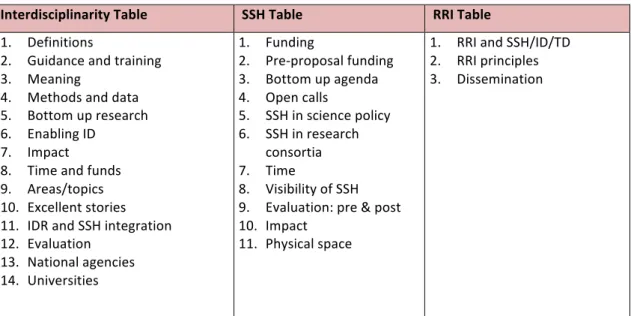
Table 1: Themes discussed
Interdisciplinarity Table SSH Table RRI Table
1. Definitions
2. Guidance and training 3. Meaning
4. Methods and data 5. Bottom up research 6. Enabling ID
7. Impact 8. Time and funds 9. Areas/topics 10. Excellent stories 11. IDR and SSH integration 12. Evaluation 13. National agencies 14. Universities 1. Funding 2. Pre-‐proposal funding 3. Bottom up agenda 4. Open calls
5. SSH in science policy 6. SSH in research
consortia 7. Time
8. Visibility of SSH 9. Evaluation: pre & post 10. Impact
11. Physical space
1. RRI and SSH/ID/TD 2. RRI principles 3. Dissemination
Interdisciplinarity -‐ Suggestions and recommendations
ID Theme Recommendations
Give meaning to
ID and IDR EU research policy: • Interdisciplinarity is not a goal in itself but rather a response to many problems framed by disciplines that call and encourage ID approaches to research.
• IDR should not be an obligation, nor should ID be watered down by suggesting that a whole EU Framework Programme is ID in its coverage. • ID and IDR may include the scope of integrating SSH in non-‐SSH agendas,
but SSH integration is not all there is to IDR (IDR is a broader concept than SSH integration)
• Research policy should focus on quality not quantity of IDR research being funded
• A greater effort is needed to make reference to ID and IDR meaningful, and thus effective and useful towards goals such as RRI.
Definition & guidance on ID
EU research policy:
• A definition of IDR, and a description of possible benefits why research might require an ID approach, would provide a common reference to the research and evaluation communities
• Define IDR so it is clearly shown not to be the same as SSH
• Provide more guidance on what is meant and expected by excellence in IDR (given that disciplinary cultural differences exist)
• Guidance: point out barriers and good practice on how to overcome them (see also “methods and data”, below).
Definition of ID; Proposals – say
why and how
Applicants to EU funding:
• Proponents should not just define their notion of IDR.
• It is even more important that they explain –in their application-‐ why their research question demands an ID approach and how this should be operationalized.
• Proponents should be asked to demonstrate how the ‘sum’ of the disciplines involved can achieve a greater perspective/output than the disciplinary perspectives themselves.
• For example, proposals should specify either how disciplines will be working together within a WP, or how they will collaborate and communicate meaningfully across WPs.
• There is a need for early communication and discussion in cross-‐ disciplinary teams about how and when to integrate.
• Allocation of sufficient time for a meaningful synthesis is critical – the time required can be longer than for a more monodisciplinary project.
Fundamental and applied IDR
• Promote IDR to pursue agendas that can question and clarify concepts, link IDR not just to problem solving research but also to basic research, that is: promote IDR all along the research spectrum from basic to applied. ID in practice:
Methods and data
Applicants to EU funding:
• Promote dialogue and training involving multiple disciplines.
• Promote the extensive sharing of data sets through open access across disciplines to encourage multiple readings and interpretations.
Enabling ID: EU Calls/Topics and training
EU research policy:
• Calls and topics should be conceived and drafted by collaborative, interdisciplinary teams
• Promote “Sister Projects”: systematic companion research by both the hard and the social sciences – already under way in some digital fields (e.g.
ID Theme Recommendations
H2020-‐ICT-‐35-‐2016. Enabling responsible ICT-‐related research, which includes funding for sister projects intended to be very small RIA (300K – 500K) aiming to bring value beyond narrow disciplinary boundaries). Give consideration as to whether this approach could be used in other H2020 programmes
• In the proposal templates, include ‘interdisciplinary’ and ‘transdisciplinary’ as one of the scientific areas that proponents may choose.
• Help disseminate good practice in IDR.
• Help disseminate good practice in the evaluation of IDR.
• Adopt and communicate clear strategies regarding interdisciplinary
research. Training:
• DG R&I: The Commission should consider running or funding training courses (eg MOOC-‐massive online course) on IDR good practice – for evaluators, researchers, project officers etc. This could be enabled perhaps with synergy through the ERASMUS programme
• Fund research on the practice of interdisciplinary research and team
science, which in turn can improve the science and practice of interdisciplinarity.
Impact of
research EU research policy: • Policy should both praise courageous agendas embracing ID and TP approaches, and welcome failure as a necessary part of the scientific process. The concept is that early ‘failure’ leads to learnings which are useful for other researchers. This has implications for how “impact” is conceptualised and framed.
• Impact should include not just short term tangible effects (new jobs, additional turnover, product improvements...), but also long term structural effects which are more linked to ID and TD research practice: training, community building, disruptive ideas and social innovation.
• Design innovative mechanisms to support high-‐impact and/or high-‐risk
interdisciplinary research.
• But, introducing “direct applicability” as a selection criterion and the focus on high “technology readiness levels” does not (necessarily) help IDR, nor SSH integration.
Extra time and
funds
EU research policy:
• Mutual learning and the building of a common understanding about issues and approaches, are a conditio sine qua non of IDR. Such IDR research needs extra time, and thus funds.
• A commitment to ID research agendas is, necessarily, a commitment to additional resources. Otherwise we are setting up for diminished results, or more likely, failure.
• Create specific interdisciplinary research opportunities with earmarked
funds.
• Allocate enough time -‐ typically five years -‐ to carry out ID research projects.
Identify and
target IDR
areas/topics
EU research policy:
• Identify and specify those thematic areas/specific topics which require an ID approach: gender issues, urban studies, all aspects of
sustainability, and so on.
• Identify broad topics and promote a broad concept of innovation that can embrace natural science and technology, as well as the arts, the humanities and the social sciences (social, human, and technological