Master’s Work Project Report
CEMS BP: DNB ‘Adjusting to Open-Plan Office’
Jorge Duarte Nº 15/777Msc in Management June 1st
Table of Contents
1. Company and Business Project Background 3
2. Recommendations Analysis 5
2.1 Site Manager 5
2.2 Cross Units Lunch 6
2.3 Project Tables 6
2.4 Monitor Employee Movement 7
2.5 Mobile Application 7
2.6 Business Units Guidelines 8
2.7 Seasonal Rotations 9
2.8 New Measurement Systems 9
2.9 Recruitment 10
2.10 Performance Environment Firm 10
3. Reflection on Learning 11
3.1 Knowledge and Masters content 11
3.2 Personal Experience 11 Bibliography 13 Appendixes 14 Appendix A – Survey 14 Appendix B – Interviews 16 Appendix C – Figures 20
1. Company and Business Project Background
DNB is Norway’s largest financial group and currently operates 190 offices in Norway. The DNB group is the result of various mergers and acquisitions. DNB is organized as a publicly traded company and it is listed on the Oslo stock exchange. Currently the largest owner is the Norwegian state with approximately 34 per cent of the total shares. The main office of the group is in Bjørvika, Oslo. The group operates within several different sectors, and in certain services the group is a major global player. In addition to support functions such as HR, Communication, Risk management and Group Finance, the group is organized by functional divisions namely: Private Market Norway, Business Market Norway, STI - large customers and international, DNB Markets, Wealth Management, Product and IT and Operations (DNB 2014).
In December 2013, DNB consolidated all its Bergen different venues into a new flagship building in Solheimsviken, Bergen. Currently there are nineteen different departments working in this office, which all have various tasks and backgrounds ranging from real estate and private banking to IT services and insurance. The physical consolidation is completed of the building and equipped with the latest technologies, distinct workstations for different work modes and several social zones. Despite that DNB consolidated their different offices into a new single building just across Bergen town, from a cultural perspective, employees might as well have been landing on a new planet. Thus, DNB practices a new office concept of free seating and clean desk policy within each business unit that for most employees was something entirely new. Therefore, the CEMS research team main challenge was to understand in depth, how can DNB use the new office facilities to increase collaboration between colleagues and business entities, how to maintain high work performance in plan landscape, to establish efficient work procedures in open-plan landscape, and lastly, how to benefit from open-open-plan landscape in development of business culture. In order to understand the topics mentioned above DNB specifically requested the CEMS research team to gather information from successful and unsuccessful changes from office to open-plan landscape, identify employees individual needs and recommend concrete actions to ensure achievements of the aims revealed.
The extensive office layout theories revised during this project demonstrate that is possible to establish a direct relationship between physical office environment and employee productivity (CABE 2011). This relation is translated in terms of job satisfaction, behaviour and performance that affect concentration and efficiency within the workplace (Kamarulzaman et al. 2011). From a theoretical scope we conclude that there is no right or wrong answers when it comes to choosing different workspace designs. The right answer is the unique one, meaning that a company business strategy, corporate culture, industry, employee population, history and leadership all make it exclusive and distinctive from other firms (Herman Miller 2013a).
Further, there are no specific goals at DNB in Solheimsviken touching parameters as collaboration, efficient area usage, and work performance in relation to the new facilities (chief of staff interview). Despite the recent organizational changes in the environment, there has been no noticeable structural change. Thus, some departmental managers are located outside Solheimsviken so they cannot facilitate efficient collaboration across different departments. DNB currently has good information on the building facilities, but there is a lack of information regarding how the facilities are being used or having someone in charge able to educate employees to use them properly.
According with our research DNB employees feel very positive to neutral in terms of its overall evaluation. Nevertheless, there are particular personal issues that some employees struggle, as the clean desk policy, time to set up a workstation, lack of available meeting rooms for large groups, drop in “inner communication” in some departments (to avoid disturbances or sensitive information), silent rooms being used as phone booths, small toilets, no parking space, problem with the availability of individual workstation in some departments, and the unpopularity of the project tables among workers. In order to tackle the main issues mentioned above the research team revised office layout theories and provided appropriate recommendations that I would like to developed more in depth along this project.
2. Recommendations Analysis
This was a challenging business project due to the overall success of DNB office change to Solheimsviken from stakeholders’ standpoint. Thus, future researchers may even find very interesting to compare DNB’s first chaotic move to an open landscape with its headquarters in Oslo to the very smooth and organized transition of Solheimsviken in Bergen. I have chosen to focus on the recommendation analysis because it covers the key points that will support the client to extract the most of their real estate value in Solheimsviken. The original approach to this topic was to develop eight valuable recommendations in order to tackle some issues that the organization is facing or might face in the future. I strongly agree with the recommendations provided in our business project, but it is my perspective that the research team could have develop more in depth and that others suggestions should have taken place as well. A major limitation of the approach used was that these recommendations were based on the responses and opinions of a small sample of employees interviewed in comparison with the size of the organization. This was due to the fact that throughout the duration of the assignment DNB representative was only able to meet with the research team three times. Besides, in terms of official data, we were only provided with a small PowerPoint presentation and one outline of the building layout of the new facilities in Solheimsviken (both in Norwegian).
2.1 Site Manager
Leadership is a keystone for establishing supportive collaboration cultures, especially in teams and communities. This is based on how leaders mainly embed their beliefs, values and assumptions in the fabric of their organization (Callehan et. al 2010).DNB has done a tremendous job moving to Solheimsviken, but it is important to stimulate the development further. Although, there is no one in charge for the future development in the new building in terms of efficient area usage and other concerns. Thus, in order to maximize the potential upside of the consolidation it is important that this task is allocated to a specific person. Maybe this task should be given to the site manager or chief of staff since he is responsible for all the activities in Solheimsviken. The position should be delegated from the top management in DNB, and the person should be given both the authority and the resources needed to ensure a desired development. Currently collaboration has increased in some departments
due to random encounters and smaller distances, but in order to reap the potential benefits this is a process that needs to be further managed. The role of the site manager or chief of staff could include:
• Finding opportunities in Solheimsviken where better collaboration would make a difference to the quality of financial products and services of the bank • Connecting people and ideas so new collaboration can flourish
• Helping workers to learn and adopt collaboration practices and tools
• Collecting data of how collaborations really work, for the times need to justify the role. Keeping up to date with the field of collaboration.
2.2 Cross Units Lunch
In order to stimulate interaction across different business units, employees need an arena in which they can meet. Socializing is important to generate collaboration, but this would be very expensive to do during work-hours. Based on this, the idea of the free lunch is a relatively cheap solution for DNB. The idea is that one business unit may book lunches with other business units that are somewhat connected or have something to learn from each other. The two business units meet voluntarily at a lunch paid by DNB. This will stimulate social interaction and because DNB is the common denominator it is expected that the units will talk about work. These lunches can be set up in the meeting rooms close to the cantina or at a reserved table in the actual cantina. Managers of the business units in question can initiate this, or more senior managers who see the potential of increased collaboration across the units in question.
2.3 Project Tables
In Solheimsviken there are three types of workstations, namely individual workstation designed for most of the individual work, concentration workstations designed for work that requires a high degree of concentration and finally the project tables designed for work that requires some degree of interaction as teamwork and small meetings. In addition, there are several meeting rooms that are intended to be used mainly for internal activity but also customer meetings. However, currently there seems to be no difference how individual desks and project tables are being used. Thus, they are placed in the same area where employees are supposed to do individual
work where noise is not really “tolerated”. Therefore, my suggestion is that project tables should be more isolated or even replaced for individual workstations. If project tables are more isolated it is easier to stimulate more interaction in this particular area. This can be achieved by introducing movable walls making a barrier between project tables and the rest of the office. The employees at DNB seem to take a great care not to disturb their colleagues and a more isolated project table may result in more interactions. The other solution is to replace the project tables for individual workstation. According with the interviews conducted by the research team employees are not satisfied with the project tables because they are only equipped with one screen per seat, they are not adjustable in height and working in teams in this tables without disturbing the other co-workers seems to be a challenge. Additionally, every time there is group work or specific task that request more interaction DNB staff books a meeting room immediately. Finally, project tables are only used in last case scenario when there are no available individual workstations for employees and there is no other option besides working in the project table.
2.4 Monitor Employee Movement
Designing the optimum work environments for different types of workers requires an in-depth understanding of the movement of people within these environments (Cisco 2007). Therefore, the bank could monitor employee movement using radio frequency ID or Wi-Fi tracking devices. To avoid introducing privacy concerns, DNB should not associate the tracking with a particular individual. Instead, it might track a badge that employees are asked to grab out of a bin when they arrive at work, for instance. To enhance safety and security, DNB IT services must investigate the use of optical tools to monitor the number of people who enter and leave the building. For example, when a person with a DNB badge enters a building, another person without a badge might come in directly after. It is important for DNB Security to be able to monitor this activity and track people coming in the building. Similarly, it is relevant to be able to track the number of people in a building in the event of an emergency to ensure that nobody is trapped and unaccounted for.
2.5 Mobile Application
technological and digital world, since individuals are spending more time in new communication channels, such as mobile applications (Booz & Co 2010). I believe that DNB should create a new mobile app for their employees in Solheimsviken, as it would be an up-to-date source of information, an effective facilitator for some procedures and a powerful vehicle to increase efficiency in the building. In this application, only DNB in Solheimsviken staff would have access to it, through employee ID and pin code respectively. This application should be compatible with different operation systems and workers would be able to book meeting rooms and company cars, check the bus timetable and the daily menu at the cantina and restaurant. Since some departments do not have individual workstations1
for all their staff I consider that would be relevant to have an option that they could check the availability every day. In some units employees arrive earlier to work just to have an individual workstation, preferably next to the window with the sea view. Finally, in this mobile application employees could interact with each other through private chat or group message.
2.6 Business Units Guidelines
In Solheimsviken there seems to be a lack of understanding of how employees should behave in certain circumstances and how to use the different workstations appropriately. There is also large difference how workers experience the office regarding to noise. According with the interviews conducted certain individuals’ feel that the workplace is too quiet, while others perceive it as too noisy compared to previous facilities in Bergen. For instance, some employees do not seem to have a problem answering personal phone calls in the open space wile others rush to the silent room or social zone to answer it. Despite the existence of official office rules there is a lack of embracement by the employees, as each unit has a different set of perceived rules among co-workers. While costumer services has higher noise levels in the open plan, IT services is characterized by that absent of it (programming requests a high degree of concentration). Therefore, with help and support of top-level management and departmental senior managers, DNB could create distinctive guidelines per business unit. These standards would be created on a basis of surveys, focus groups, interviews, and in depth understanding of different work modes and
1 Individual workstation is by far the preferred workstation by DNB employees due to its flexibility, easy
environments of each business division. Basically, each department would have different procedures depending on their functions and tasks. Lastly, for the social zones, common areas, cantina and restaurant, DNB could enforce a general guideline that would apply to all employees at Solheimsviken.
2.7 Seasonal Rotations
DNB employees were accustomed to work in the same cube or office every day and now nothing belongs to them except their personal locker. The building is extremely flexible, as the chief staff says “you can move one unit from this building to another building in one day. It does not matter”. Nevertheless, DNB personnel mindset is still in the adapting phase and that is why employee efficiency decreased in the short-term (according with the site manager). Taking into consideration our interviews outcome, the older and more senior the employees, the more resistant they are the new concept of free-seating and clean desk policy. Hence, in order to speed up the adaptation phase, to enforce the free seating model further and contribute to maintaining a high mobility of the employees it may be a good idea to explore the possibility of seasonal or annual rotations of different units. Rotation of units will also contribute to the sense of equality among workers and to broaden the interaction across the organization. If business units change location every season, employees will be forced to move from their workplace “comfort zone”, and interact more with unfamiliar and workers. This will result in network collaboration that starts with individual action and self-interest, which then accrues to the network as individuals contribute or seek something form this network. This sort of network activity benefits the individual and network of people reciprocally over time (Callehan et. al 2010).
2.8 New Measurement Systems
DNB uses two different internal evaluations, namely the MAT evaluation and HMS evaluation (Health – environment – security). Due to the confidentiality of these evaluations, they were not disclosed to the researchers. Nonetheless, these evaluations do not measure parameters such as employee efficiency, collaboration and area usage as well as other soft values (as the chief of staff explained) that have an impact in productivity. Therefore, it may be interesting to measure these parameters, as they will provide insights on how the organization is using the new facilities. In Appendix part 2 there is a draft survey on how questions can be asked to measure some of these
variables.
2.9 Recruitment
The turnover rate in DNB is low, as employees seem to be faithful to the company. However, due to the latest workplace environment and cultural change in Solheimsviken the bank needs to prevent recruiting people based only on their university degree and years of experience in a specific field. Now, in days of rapidly shifting work and knowledge, DNB needs to recruit learners and collaborators so the optimal workplace can be achieved.
2.10 Performance Environment Firm
Even though DNB planned ahead this change for the new headquarters in Bergen, they should not have taken any gambles in this transition, as they did in Oslo (ineffective change). I strongly believe that the research team has done a magnificent job with the Business Project taking into account the limited material and official data supplied by the bank. Consequently, if DNB wants more accurate results and analysis, they should consider recruiting an external consultancy firm expert in performance environments. These types of firms escort their clients through the challenges of change, give management the skills needed to lead the way and capture data for continuous improvement (Herman Miller 2013b). Dozens of managers lost their private offices and multiple collaboration zones popped up by giving DNB employees a green light to interact in a way that simply was not possible before frequently and spontaneously. Sounds pleasant enough, but change often means resistance. In order to help DNB close this culture gap an external firm expert in performance environments will support the bank to get more value from their real estate. This includes Change Management, which guides clients trough the transition to a new work environment; Change Leadership, which gains buy in at the top so it can be cascaded through the ranks; and Pre and Post Occupancy Evaluation which measures how well change accomplish its goals (O’Neill 2008).
Finally, by hiring and external firm the bank can avoid internal biased views related to the change. For instance, when the research team asked the chief of staff how the new building is working his answer was, “I think that we though about everything and that is why the transition was so successful. I would not change anything”, which clearly is not the case with particular DNB employees interrogated.
3. Reflection on Learning
3.1Knowledge and Masters content
Working on a Business Project with a team formed by one Portuguese, one American, one Chinese and finally one Norwegian helped us to be more creative and efficient since every person knew how to properly behave in an international environment. Our Global Management Practice (GMP) classes also allowed us to adapt and understand each member of the group in order to obtain the best possible outcome as a team. In this dimension, a specific class topic called “Global Teams” played a relevant role in managing tasks and group processes in a cross cultural team as ours. Also, in this course I was able to better understand the Norwegian culture in terms of gender equality, flat organizational structures, low levels of corruption and passion for fitness and outdoor activities. This was crucial to create and interpret the interview surveys2 for the DNB employees in Solheimsviken. It is undeniable that doing a project in Norway is completely different than doing a project in Portugal and therefore, I had to adjust my knowledge and understanding to a different environment. Moreover, human resources management (HRM) was significant to understand the role of HR in designing the optimal office environment. HR functions need to go beyond their first needs of hiring employees, paying employees, and dealing with benefits to make sure that employees are aligned with the company strategy.
In this Business Project I had the opportunity to broaden my knowledge in terms of office layout theories and the impact that a pleasant office environment has inside of an organization. It was extremely valuable for me to analyze several articles, case studies and books regarding this topic. This gave me insights of different office layout concepts, physical office environment and productivity, the importance of measurements of performance, and the influence of office redesign through organizational commitment.
3.2 Personal Experience
I can affirm that the socializing skills that I gained while study with diverse people, from distinctive nationalities facilitated me to comprehend other business practices and more importantly to understand how to interactive with my Business Project teammates. One of my main objectives was to assure that the team spirit would continue to be positive throughout the semester between all members of the group.
Indeed, having a strong individual performance is important but at the end, a good team spirit is crucial. My communication skills were also important to transmit my messages in a clear way, and make sure that our group was moving in the right direction. Further, throughout the durations of this assignment I was a proactive member by motivating and challenging my teammates to give their best. In this dimension I decided that I could lead by example in situations that no one stepped forward. This was the specific case of the theoretical background, which I decided to educate myself and learn the most that I could in this specific area. Lastly, I was particularly committed during the project, as my experience taught me that the difference between a good and an excellent team member has more to do with the passion and desire to develop a strong assignment.
During this project I came to realize some weaknesses as well. When our group confronted some challenges with the client or even with our tutor, I found sometimes to be impatient and judgmental which can be contra productive. Also, being in charge of relevant parts of the project led me to be perfectionist and lose considerable amount of time with irrelevant details. However, I am improving my weaknesses both by trying to learn to calm my edginess and impatience and to step back before jumping to rush conclusions. I also need to remember that ‘keep it simple’ can be extremely efficient.
Finally, I have to admit that at the beginning, I did not expect this business project would to have such a positive impact on my academic experience. Dealing with a real client with a real business problem it may be the best pre-experience before moving to the job market. Today, I feel a more experienced candidate, driven to find solutions and alternatives, which is fundamental in the global hectic business environment.
Bibliography
Booz & Company 2010, The Rise of Mobile Application Stores Gateways to the World of Apps, Booz & Company, viewed 15 April 2014
http://www.strategyand.pwc.com/media/file/The_Rise_of_Mobile_Application_Store s.pdf
Callahan, S., Schenk, M. & White, N. 2010, ‘Building a Collaborative Workplace’, Anecdote, Sydney
http://www.anecdote.com/pdfs/papers/AnecdoteCollaborativeWorkplace_v1s.pdf CABE 2011, The Impact of Office Design on Business Performance, London, viewed 10 April 2014
http://webarchive.nationalarchives.gov.uk/20110118095356/http:/www.cabe.org.uk/fi les/impact- office-design-full-research.pdf.
Cisco 2007, How Cisco Designed the Collaborative Connected Workplace Environment, Cisco, viewed 28 March 2014,
http://www.cisco.com/web/about/ciscoitatwork/downloads/ciscoitatwork/pdf/Cisco_I T_Case_St udy_Connected_Workplace_POC.pdf
DNB 2014a, Industry sectors, DNB, viewed 26 March 2014,
https://www.dnb.no/en/corporate-and-institutions/industry-expertise.html
DNB 2014b, About us, DNB, viewed 26 March 2014, https://www.dnb.no/en/about-us
Herman Miller 2013a, The Private-to-Open Spectrum, Herman Miller, viewed 6 March 2014,
http://www.hermanmiller.com/content/dam/hermanmiller/documents/research_summ aries/wp_Private_to_Open.pdf
Herman Miller 2013b, British Columbia Lottery Corporation (BCLC), Herman Miller, viewed 5 April 2014,
http://www.hermanmiller.com/content/dam/hermanmiller/documents/case_studies/CS _BCL_FULL.pdf
Kamarulzaman, N., Saleh, A.A., Hashim, S.Z., Hashim, H. & Abdul-Ghani, A.A. 2011, An Overview of the Influence of Physical Office Environments towards Employees. The 2nd International Building Control Conference. Shah Alam: Universiti Teknologi MARA Perak
O’Neill, M 2008, Open Plan and Enclosed Private Offices – Research Reviews and Recommendations, Knoll Inc, East Greenville, viewed 9 March 2014
Appendixes: Appendix A - Survey Workplace: A2 Department/unit: DNB Markets Age: 42
The first questions are about the open plan office. Indicate on the scale from 1 to 5 how much you agree to the following statements. 1 indicates you strongly disagree. 5 indicate that you strongly agree.
Noise
There is too much noise and it disturbs me: 1 2 3 4 5 The office is too quiet and I feel like I disturb
others if I make any noise, even a phone call: 1 2 3 4 5 Choice of workplace
I sit at the same desk every day: 1 2 3 4 5
I change desks a lot, even on the same day: 1 2 3 4 5
My job is the same tasks every day: 1 2 3 4 5
Consolidation
I feel I know more about my job after we moved
to Solheimsviken 1 2 3 4 5
I know more about DNB after we moved to
Solheimsviken 1 2 3 4 5
Distractions
There are a lot of distractions in the office: 1 2 3 4 5
Distractions are bad for my work: 1 2 3 4 5
Most distractions are work related and
I often learn from them: 1 2 3 4 5
The second part consists of various questions related to the work place. Mark the appropriate answer.
Collaboration
How many times have you helped a colleague in matters related to work the last 7 days?
0 1-3 3-5 7-10 10- or more
How many times did you receive help from a colleague in work related matters the last 7 days?
0 1-3 3-5 7-10 10- or more
Have you learned anything from a colleague that will improve your workflow I during the last 7 days?
Have you taught a colleague anything that will improve his or her workflow in the future during the last 7 days?
0 1-3 3-5 7-10 10- or more
How many new colleagues have you gotten to know during the last 15 days that you think it may be beneficial to know in the future?
0 1-3 3-5 7-10 10- or more
Privacy
How many times have you experienced that you have been unable or felt uncomfortable to talk about a sensitive work related subject due to risk of other listening to the conversation during the last 14 days?
A: with colleagues: 0 1-3 3-5 7-10 10- or more B: with customers: 0 1-3 3-5 7-10 10- or more Desk choice
What is you main reason for choosing where to sit? (Individual desk, project table or quiet desk)
1. The view.
2. I take whatever desk is available. 3. The tasks I am doing that day. 4. The need to sit with my unit.
5. Other: ………
Appendix B – Interviews:
Interview 1: Interview Questions for Chief of Staff DNB
“The purpose of this interview is to get information relevant for solving the DNB CEMS business project. Is it ok that we record this? And is it ok that we use your name in the report?”
1. What is your name and position at DNB? Age?
2. Can you tell us a bit about your role in DNB? How long have you worked in DNB?
3. In DNB, are there a lot of projects requiring extensive group work in the office or more individual-based? (Maybe depends on the department or the project per se?) 4. What would you say are the core departments of DNB? (In terms of importance/
number of employees)
5. How would you describe DNB’s corporate culture? Is DNB attempting to change it? If so, how?
6. We know that DNB in Bergen is working to achieve a “one DNB” Business culture - uniting the previously separated units. How is this going? Is this measured in any way?
7. How many different types of workstations are available to the employees? Are all the floors and departments designed in the same way? Do any of the business units have special solutions?
8. We have been told that DNB is one juridical unit, does that imply that there are no legal barriers for information flows within the company?
9. Results of the MAT evaluation, any other evaluation we could include in our data?
10. Tell us a bit of your role in this relocation process.
11. How do you feel the new facilities are working out for the company and employees?
12. In your opinion, what is the goal of this open space office plan? What would DNB want us to achieve out of this project? (If there are a few, then can you prioritize them?) E.g. Cost saving, increasing efficiency or collaboration etc.
13. How do you or DNB usually measures these goals? (e.g. Efficiency, increasing collaboration etc.)
14. Have you had to deal with any significant setback in the new building? Have you found any new problems now that things are settled?
15. To your knowledge, are there any divisions/groups that are particularly satisfied/dissatisfied with the new buildings?
16. Research indicates that noise is the single biggest problem in a open plan office environment, have you implemented any measurements to manage this?
17. Are workspaces being used as originally intended in the plan? Do you feel “under used”?
18. What is your big ‘Aha’ moment in the new office up until now?
19. We are a little bit curious about your clean-desk policy, could you tell us a bit more about the justifications behind this policy?
20. Regarding to the senior managers, do they also work in the workstations or do they still work in a private office? If so, why?
21. As a senior manager in your position, have you encountered any difficulties with this new office layout? If yes, could you elaborate a little? (Personal opinion) a. If not, have you heard any of your colleagues complaining anything or they are
satisfied with the current arrangement?
22. Is DNB currently enforcing a mandate of rules that should apply in the workstations? (e.g. What calls can/can’t be answered in the shared space? How to keep the noise down there? Etc.…) If not, would you like one to be in the future? 23. Were all specific department needs considered in the planning? Could you give us
an example? (Marketing Department vs. IT Department, Customer service) 24. Do you think the new offices are more beneficial for certain work
styles? (Introvert vs. extrovert, concentration ability, etc.)
25. Can you point out 3-5 specific ways the new facilities will benefit the corporate culture? What about the corporate strategy?
26. If there were still space for improvement here, what advice would you give our research group?
Interview 2: Questions for normal employees, middle management
“The purpose of this interview is to get information relevant for solving the DNB CEMS business project. Is it ok that we record this? The interview is anonymous”
1. What is your job, department etc. Age? How long have you been with DNB? 2. Do you feel less or more comfortable in this workplace compared to your
previous workplace?
3. Is there any detail that bothers you?
4. Do you have a preferred workstation? Is there one you don't like? 5. Has your interaction with your co-workers changed?
6. Do you think that this new office layout fits your daily job? Does the new facilities allow you to work more efficiently than before?
7. Do you think this new building helps DNB to become more like one company, more integrated?
8. What three characteristics of the new work environment have had the greatest positive/and negative influence on your work?
9. Why do you think DNB moved into this building? What is the management’s goal?
10. What is your big “Aha” during the first three months after you moved into this new building?
11. If you were CEO, what would you change or improve? 12. With whom do you usually eat lunch?
13. Are there any office rules or guidelines in your business unit that you are aware of?
Interview 3: Questions for competitor
“The purpose of this interview is to get information relevant for solving the DNB CEMS business project. Is it ok that we record this? Neither the your identity or the identity of your company will be disclosed ”
1. When did you move into the new office?
2. Are there any rules for using the office? Or guidelines? 3. How many departments are located in this new building
4. How many different types of workstations are available to the employees? Are all the floors and departments designed in the same way? Does any of the business units have special solutions?
5. In your opinion, what is the goal of this open space office plan? What would DNB want us to achieve out of this project? (If there are a few, then can you prioritize them?) e.g. Cost saving, increasing efficiency or collaboration etc. 6. How do you or DNB usually measures these goals? (e.g. Efficiency,
increasing collaboration etc.)
7. To your knowledge, are there any divisions/groups that are particularly satisfied/dissatisfied with the new buildings?
8. Research indicates that noise is the single biggest problem in a open plan office environment, have you implemented any measurements to manage this? 9. Are workspaces being used as originally intended in the plan? Do you feel
“under used”?
10. Regarding to the senior managers, do they also work in the workstations or do they still work in a private office? If so, why?
11. Have you heard any of your colleagues complaining anything or they are satisfied with the current arrangement?
12. Can you point out 3-5 specific ways the new facilities will benefit the corporate culture? What about the corporate strategy?
13. Are there any other advantages or disadvantages that you would like to mention?
Appendix C – Figures
Figure 1 Workstations: T.L., Project workstation, B.L., Individual Workstation, T.R – Quiet desks. (Source: DNB)
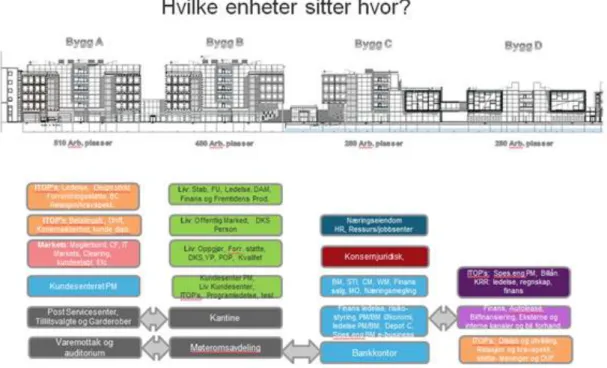
Figure 2 Placement of the different departments (Source: DNB (original quality))