Engenharia
Test automation and code dependencies in highly
complex environments
Diogo Manuel Raposo Oliveira
Dissertação para obtenção do Grau de Mestre em
Engenharia Informática
(2
ociclo de estudos)
Orientador: Prof. Doutor João Paulo Fernandes
Co-Orientador: Prof. Doutor Simão Melo de Sousa
Acknowledgements
First of all I would like to thank Professor João Paulo Fernandes and Professor Simão Melo de Sousa for coordinating this dissertation. I would like to thank you for all your constant support and feedback regarding my dissertation, and for proposing me a challenging and very interest-ing research subject. Also, I would like to thank you for spendinterest-ing part of your personal time to help me and support me.
Then, I would like to thank Miguel Costa Antunes and António Melo for coordinating this dis-sertation in the industrial context of OutSystems. Your support was simply amazing. I will not forget the personal time you spent to help me. Really, it was great to work with you!
I would also like to thank all the people whom I have worked with at OutSystems and that helped me during this time. Special thanks do Bruno Loureiro, Jandira Peres, Ricardo Martins, Carlos Almeida, João Miranda, João Rosado, Rui Eugénio, Sérgio Silva, Stoyan Garbatov, and any other person that helped me and that I might have forgotten to mention here.
Now in portuguese...
Gostaria de começar por agradecer às pessoas mais importantes da minha vida, que são os meus pais e o meu irmão. Aos meus pais, um muito obrigado por tudo o que sempre zeram por mim e que me permitiu chegar a esta fase da minha vida. Devo-vos muito daquilo que sou como pessoa, e devo-vos todas as condições que sempre me deram para tudo!
Ao meu irmão, um agradecimento especial por todo o apoio que sempre me deu, pela preocu-pação que sempre teve comigo, e pelo incondicional apoio e ajuda em tudo o que precisei. À Joana, a minha namorada, um obrigado por tudo. Mesmo em momentos mais complicados, a tua ajuda foi preciosa, e o teu apoio fez relamente a diferença.
A todas as pessoas com quem partilhei o último ano da minha vida mais de perto, em especial: o meu irmão, Jorge Oliveira, o Tiago Logrado, o José Braz, a Cátia Martins e a Margarida Ro-drigues. Um obrigado por todo o vosso apoio em todas as alturas.
Um grande obrigado ao meu amigo Nuno Garcia, por tudo o que partilhámos na vida pessoal e no decorrer das nossas dissertações! Um grande obrigado ao Francisco Vigário pelas conversas diárias sempre bem humoradas.
Um grande obrigado a todos os meus amigos da minha Covilhã com quem fui partilhando os últi-mos tempos, em especial: Vitor Rolo, Pedro Santos, Vitor Pereira, André Reis, Rodrigo Simões, Pedro Fael, José Tourais, Bruno Aguilar, Samuel Casteleiro, Nélson Belo, Sérgio Pinto, Patrício Albuquerque, João Real, António Duarte, João Amaral e Nuno Martins.
Um obrigado à Ana Ramos, ao Carlos Silva e à Flávia Silva.
não me esquecerei disso.
Um obrigado a todos aqueles que não tenha mencionado, mas que em alguma altura da minha vida estiveram ao meu lado e me apoiaram. O facto de ter escrito estes agradecimentos 5 minutos antes de imprimir a dissertação obrigou-me a pouco tempo para esforço de memória. Obrigado a todos mais uma vez, depois pago um copo a quem me esqueci de agradecer!
Resumo
A sociedade moderna evolui nos dias de hoje a um ritmo nunca antes observado. A este res-peito, pode ainda constatar-se que o desenvolvimento tecnológico tem sido um dos principais pilares que sustentam essa evolução. Neste contexto, os sistemas de software são essenciais, e é cada vez mais importante assegurar que esses sistemas chegam ao mercado em tempo útil e com garantias de qualidade. Na tentativa de assegurar estes objetivos, têm sido propostas novas metodologias e ambientes de desenvolvimento de software, bem como modernas ferra-mentas que permitem a sua evolução e integração contínua, e ainda estratégias cada vez mais evoluídas para veri cação e validação de software.
No que diz respeito à veri cação e validação de software, que de diferentes formas procura assegurar a sua qualidade, o desenho e execução de testes desempenha um papel central. Con-tudo, a constante evolução dos sistemas de software implica que os artefatos de teste evoluam ao mesmo ritmo. De facto, observa-se também para esses artefatos uma evolução rápida, e em particular um aumento muito signi cativo do número de casos de teste com que é necessário lidar.
Um grande desa o da engenharia de software moderna prende-se precisamente com a necessi-dade de desenvolver mecanismos que permitam que a fase de execução de testes de software implique menos custos a nível de tempo e dinheiro, mas também de esforço humano. E esta re-dução deverá necessariamente ser conseguida sem colocar em causa a qualidade desta mesma fase.
No presente trabalho é proposta uma técnica de seleção automática de casos de teste de
soft-ware, que pretende, em cada iteração da execução de testes, apenas selecionar para execução
testes cujo resultado possa ser in uenciado pelas alterações que tenham sido feitas ao código do software a ser testado ou aos próprios testes. A técnica proposta na presente dissertação baseia-se na análise de dependências estáticas e dinâmicas entre os testes de software e o código do próprio software, bem como na identi cação de alterações entre duas versões do mesmo software.
O desenvolvimento, implementação e validação da técnica proposta na presente dissertação foram conduzidos no contexto industrial de uma empresa internacional de desenvolvimento de software. Foram utilizados cenários de desenvolvimento de software reais para ns de experimentação e validação da técnica de seleção automática de casos de teste de software, e os resultados nais demonstram que a técnica proposta não colocou em causa a capacidade de deteção de falhas no software e apresentou benefícios signi cativos relativamente à redução do tempo dispendido na execução de testes.
Palavras-chave
Resumo alargado
O desenho e execução de testes de software são amplamente utilizados para validar que os sistemas de software se comportam como esperado, de acordo com os seus requisitos. Efetiva-mente, os testes de software são a técnica mais utilizada para encontrar falhas nos sistemas de
software antes de estes serem disponibilizados aos seus utilizadores nais.
Nos dias de hoje, observa-se uma evolução cada vez mais acentuada das metodologias, tecnolo-gias e paradigmas utilizados no desenvolvimento de software. Esta evolução, aliada ao facto de diversos sistemas de software serem desenvolvidos e/ou melhorados ao longo de vários anos, fazem com que a tarefa de testar esses sistemas seja cada vez mais exigente a diversos níveis. Em particular, têm surgido metodologias de desenvolvimento cada vez mais ágeis, e paradigmas de desenvolvimento que permitem a integração e monitorização contínua de software. Numa tentativa de melhorar a produtividade no seu desenvolvimento, estes avanços requerem o pro-cesso de desenvolvimento de software ocorra em iterações (de desenvolvimento e teste) cada vez mais rápidas.
O objetivo do trabalho abordado neste dissertação está relacionado com a otimização da fase de desenvolvimento de software no que diz respeito à execução de testes em ambientes com-plexos e de larga escala. Assim, pretende-se, sem comprometer a qualidade da fase de testes, reduzir o tempo dispendido na execução automática de testes de forma a que os programadores possam obter feedback sobre o código que desenvolveram.
Com este objetivo em mente, pretende-se ao longo do trabalho apresentado nesta dissertação propor uma solução que tenha a capacidade de selecionar apenas os casos de teste que estejam relacionados com as alterações que foram efetuadas ao código do software a ser testado. Uma solução deste género, se provada e caz e segura, garantiria que apenas os testes estritamente úteis são executados em cada iteração do desenvolvimento de software, com o aumento de e ciência que daí advém.
Em resultado do levantamento do estado da arte que foi realizado, foi possível constatar que já foram desenvolvidos alguns esforços, tanto em contexto académico como industrial, com vista à otimização da fase de testes de software. Estes trabalhos foram cuidadosamente estudados no contexto da presente dissertação, com o objetivo de identi car oportunidades de investigação e de evolução para as soluções propostas até à data, bem como identi car potenciais lacunas ou pontos fracos que esses mesmos trabalhos apresentem. Se, por um lado, a maioria destes trabalhos aponta diversas bases e direções interessantes para uma investigação continuada e sustentada, por outro lado existem diversos pontos fracos que fazem com que os trabalhos es-tudados não sejam apropriados para utilização em contextos reais, de larga escala e com uma complexidade elevada, por possuírem signi cativas limitações ou assunções que di cilmente são espelhadas em cenários industriais.
A solução proposta nesta dissertação para resolver o problema da seleção de casos de teste de
software em ambientes complexos é uma solução que utiliza mecanismos de análise estática
teste de software e diversas partes do código desse mesmo software. Este tipo de análise de dependências, aliado à identi cação das alterações que foram feitas ao código do software, permitem que para cada iteração do processo de desenvolvimento de software seja selecionado um conjunto especí co de testes cujo seu resultado possa ser in uenciado devido às alterações efetuadas.
A solução proposta é, portanto, uma técnica de seleção de casos de teste de software que uti-liza informação de dependências de código provenientes de vários tipos de análises de código diferentes, e que é pensada para aplicação em contextos reais e de forma automatizada, sem que seja necessária intervenção humana. A técnica proposta é uma técnica que tem a capaci-dade de se adaptar a sistemas complexos e de natureza distribuída, sendo também escalável e com capacidade de se adaptar ao constante crescimento dos sistemas de software. Para além disso, a técnica proposta não assume que sejam necessárias quaisquer tipo de adaptações aos ambientes dos sistemas de software em que venha a ser aplicada.
A técnica de seleção automática de casos de teste apresentada foi implementada em prática num ambiente real, e nomeadamente no contexto de uma empresa internacional de desenvolvi-mento de software que enfrenta todos os desa os de escala e complexidade que a indústria de desenvolvimento de software enfrenta em geral nos dias que correm. Esta mesma implemen-tação foi utilizada para realizar a seleção de testes de software num contexto de desenvolvi-mento de software real, num conjunto de casos reais não escolhidos nem fabricados de forma arti cial.
Na presente dissertação diversas formas de avaliação foram utilizadas para analisar a funcional-idade dos diversos passos da técnica de seleção de casos de teste proposta em particular, bem como a técnica na sua totalidade e a sua e cácia na seleção dos casos de teste que efetiva-mente deveriam ser selecionados. Entre outro tipo de validações, foi criado um mecanismo de validação automatizada que permite aplicar a técnica sempre que existam novas alterações do código e essas alterações sejam enviadas para o sistema de controlo de versões, e comparando os resultados da execução dos testes selecionados com os resultados da execução de todo o conjunto de testes existente.
Relativamente aos resultados obtidos, nos diversos cenários de validação a técnica proposta na presente dissertação apresentou o comportamento esperado, sendo capaz de selecionar casos de teste relacionados com alterçaões ao código, e ainda assim sem comprometer a capacidade de deteção de falhas. Vários casos foram observados a partir da metodologia de validações automatizadas referido acima, e em todos os casos todos os testes selecionados detetaram as mesmas falhas que a bateria de testes completa teria detetado.
Abstract
Modern society is nowadays evolving at a pace that has never been witnessed before. Regarding this evolution, it can be also observed that the technological evolution has been one of its main pillars. In this context, software systems have a crucial role and it is increasingly important to ensure that these systems reach the market on time and with quality guarantees. In order to ensure these goals, several new methodologies and software development environments have been proposed, together with modern tools that enable software systems evolution and con-tinuous integration, as well as increasingly advanced strategies for software veri cation and validation.
Concerning software veri cation and validation, which in different ways aim to ensure software quality, design and execution of software tests play a key role. However, the constant evolution of software system implies that test artifacts are able to evolve at the same pace. In fact, these artifacts are indeed evolving fast as well, and this implies that it is needed to deal with test suites of constantly increasing size.
A major challenge of modern software engineering has to do precisely with the need to de-velop mechanisms that allow the software tests execution stage to imply less costs in terms of time and money, but also of human effort. These mechanisms must necessarily achieve a re-duction in terms of costs without jeopardizing the quality of the software tests execution stage. In this dissertation an automatic test case selection technique is proposed, which aims, in each iteration of software test executions, to only select for execution test cases whose results might be in uenced by the changes that have been made to the code of the software under test. The proposed technique is based on static and dynamic dependency analysis between software tests and the software code (and the code itself), as well as on the identi cation of the differences between different software code versions.
The development, implementation and validation of the technique presented in this dissertation were conducted in the industrial context of an international software house. Real development scenarios were used to conduct experiments and validations, and the nal results demonstrated that the proposed technique is effective in terms of its software fault detection capabilities and also showed signi cant bene ts in what concerns the time spent running software tests.
Keywords
Contents
1 Introduction 1
1.1 Context and Motivation . . . 2
1.2 Problem Statement and Goals . . . 3
1.3 Research Methodology . . . 4
1.4 Proposed Solution . . . 5
1.5 Main Contributions . . . 6
1.6 Document Structure Overview . . . 7
2 Industrial Context 9 2.1 Introduction . . . 9
2.2 The Company and its main Product . . . 9
2.3 The Development Team, Methodology and Paradigms . . . 12
2.4 Platform Development, Feedback and Quality Assurance . . . 13
2.5 Speci c Problem Formulation . . . 14
2.6 Conclusion . . . 15
3 State of the Art 17 3.1 Introduction . . . 17
3.2 Infrastructure Improvements and Test Distribution . . . 17
3.3 Test Suite Optimization Techniques . . . 18
3.3.1 Test Suite Minimization . . . 19
3.3.2 Test Case Prioritization . . . 22
3.3.3 Test Case Selection . . . 23
3.4 Conclusion . . . 26
4 Proposed Solution 29 4.1 Introduction . . . 29
4.2 Test case selection technique . . . 29
4.2.1 Changes Identi cation . . . 34
4.2.2 Incremental Static Dependency Analysis . . . 35
4.2.3 Test Case Selection . . . 37
4.2.4 Test Cases Execution and Incremental Runtime Dependency Analysis . . . 38
4.3 Conclusion . . . 40 5 Solution Implementation 41 5.1 Introduction . . . 41 5.2 Toolset . . . 41 5.2.1 Programming Languages . . . 42 5.2.2 Tools . . . 42 5.2.2.1 NUnit . . . 42 5.2.2.2 PostSharp . . . 42 5.2.3 Libraries . . . 43 5.2.3.1 SharpSVN . . . 43 5.2.3.2 Mono.Cecil . . . 43
5.2.3.3 .NET Compiler Platform ("Roslyn") . . . 44
5.2.3.4 QuickGraph . . . 44
5.3 Implementation Details . . . 44
5.3.1 Implementation Decisions . . . 44
5.3.2 Implementation Steps . . . 46
5.3.2.1 Changes Identi cation . . . 46
5.3.2.2 Static Dependency Analysis . . . 47
5.3.2.3 Test Case Selection . . . 48
5.3.2.4 Code Instrumentation and Runtime Dependency Analysis . . . 49
5.4 Conclusion . . . 51
6 Results and Discussion 53 6.1 Introduction . . . 53
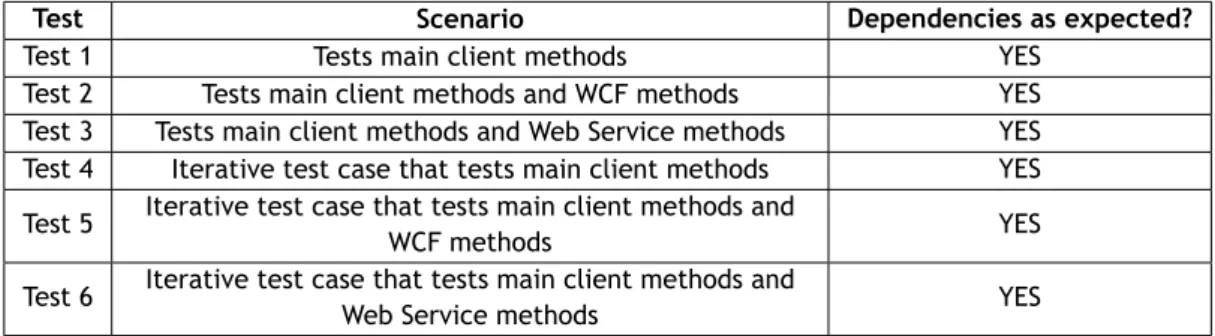
6.2 Laboratory Validations . . . 54
6.3 Validations in real scenarios with fabricated failures . . . 56
6.4 Reintegrate Validations . . . 57
6.5 Continuous Integration Validations . . . 60
6.6 Evaluation Metrics . . . 62
6.7 Conclusion . . . 63
7 Conclusion 65 7.1 Conclusion and Final Results . . . 65
7.2 Future Work . . . 66
List of Figures
1.1 Test Selection Methodology Overview . . . 6
2.1 The OutSystems Platform - Integrated Development Environment (IDE) Samples . 10 2.2 The Components and Interactions of the OutSystems Platform . . . 11
2.3 The OutSystems Platform Architecture Overview . . . 12
2.4 OutSystems Development Feedback Loop . . . 13
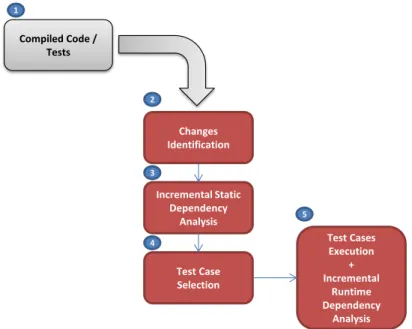
4.1 Flow of an iteration of the test selection technique . . . 33
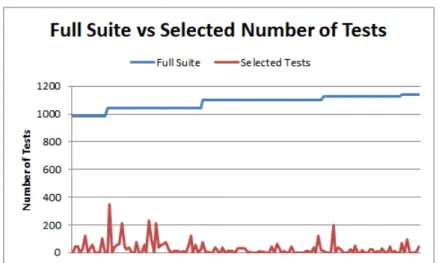
6.1 The number of tests executed in the full baseline tests vs selected tests . . . 61 6.2 The execution time of tests executed in the full baseline tests vs selected tests . 62
List of Tables
6.1 Results of laboratory validations . . . 55 6.2 Comparison of execution time and detected failures of both full tests baseline
and selected tests after introducing the bug on scenario a) . . . 57 6.3 Comparison of execution time and detected failures of both full tests baseline
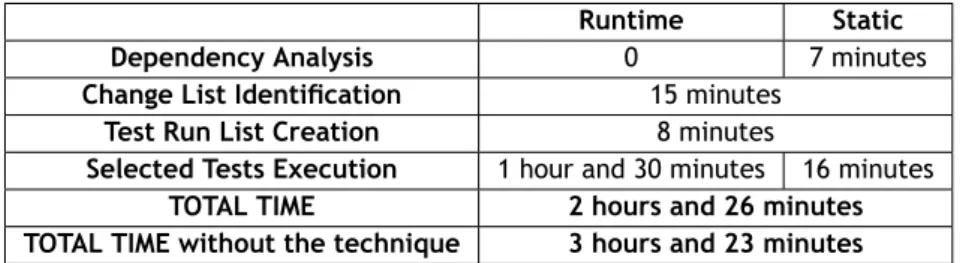
and selected tests after introducing the bug on scenario b) . . . 57 6.4 Execution times of the different steps of the test selection technique . . . 59 6.5 Tests selected by static and runtime kinds of dependency analysis . . . 59
Acronyms
PaaS Platform as a Service QA Quality Assurance
IDE Integrated Development Environment DE Development Environment
PS Platform Server
ILP Integer Linear Programming EFSM Extended Finite State Machine CDG Control Dependence Graph PDG Program Dependence Graph SDG System Dependence Graph CFG Control Flow Graph
ICFG Intraprocedural Control Flow Graph JIG Java Interclass Graph
VCS Version Control System SVN Apache Subversion
AOP Aspect-oriented Programming API Application Programming Interface
ECMA European Computer Manufacturers Association CIL Common Intermediate Language
SOAP Simple Object Access Protocol DSL Domain Speci c Language
Chapter 1
Introduction
Software testing is by far the most widely used technique to nd defects in software and partic-ularly in the context of industrial software development. It is also well accepted that the more a program is exercised in different ways and with different kinds of concrete tests, the more chances exist of encountering (and later removing) its faults [MS04, Sin11].
In the context of high-scale and complex systems that are being developed and evolving for several years, the need to thoroughly test those systems leads to the consumption of signi cant amounts of resources, such as human effort, time and money. In particular, the time taken to test a real software system is often an obstacle to achieve short release cycles, which are more and more frequently aimed by companies.
Apart from the scale and complexity of software systems, it is relevant to mention that code and tests are also frequently changed/added/removed due to new functional requirements, maintenance operations and even technological evolutions. Indeed, regular updates to code and tests, and complex dependencies between different distributed software components, dra-matically increase the dif culty to know (and then select) which tests should be executed due to the changes that were done. This becomes even more relevant considering that modern software development methodologies include continuous integration practices, which demand frequent development cycles and a fast feedback on the impact of changes. This is nowadays a common and context independent scenario, since the industry is suffering heavily from this problem.
Continuous integration is a software development practice where members of a team integrate their work in a frequent way, at least once per day [DMG07]. Under a continuous integration model developers need to get fast feedback, ideally within the minutes time scale, every time they make a change in the code to check whether that change did not introduce a bug caught by tests (existing tests or newly created tests).
This dissertation elaborates on the subject of optimizing the software development feedback loop time, which is the time that a software developer has to wait before getting feedback about his latest changes to the source code of the software being developed (Quality Assur-ance (QA) feedback, speci cally). This is crucial in order to provide software developers with a fast but at the same time valuable feedback about the impacts their changes have in the soft-ware behavior, and therefore to enhance developers productivity and achieving more frequent software releases.
In order to improve the feedback loop time a test case selection technique is proposed. The proposed technique is able to realize the static and dynamic dependencies between source code and test cases, so that the pieces of source code that are executed by each test case are always known. So, when the source code base is changed, the goal is to select for execution
only those test cases that exercise the changed code.
Furthermore, the proposed technique was implemented in a real software development environ-ment. This environment also provided a challenging context for the evaluation of the described technique. The evaluations that were conducted considered a signi cant number of scenarios and in all those scenarios the proposed solution demonstrated to be effective.
In the remainder of this chapter, the context and motivation of this dissertation are described, the problem to be solved and dissertation goals are de ned, the research methodology is pre-sented, followed by an overview of the proposed solution, main contributions of this work and
nally an overview of the structure of the current document.
1.1 Context and Motivation
The work presented in this document was conducted in the real software development context of OutSystems1, an international software house with its Research & Development group based in Portugal. Speci cally, all the work that is related with this dissertation was conducted at OutSystems Research & Development group in the R&D Productivity Team, and was supported with a scholarship sponsored by OutSystems.
OutSystems develops a platform, which is called the OutSystems Platform, that is in fact a piece of software that is highly complex, of distributed nature, with a large test suite, and that has evolved through many years. This is, therefore, a scenario that ts the conditions mentioned above in nowadays general software systems. This renders OutSystems as a perfect context to solve the problem of fast feedback loops and, better than that, a perfect context to test the proposed solution that will be described in a real industrial software development context. In OutSystems, Agile software development methodologies are used and in this context fast feedback is a cornerstone. Furthermore, continuous integration is also a reality in many Agile software development contexts and this demands practices such as software developers inte-grating their work in a frequent way. This continuous integration implies necessarily that a developer has a feedback that is both valuable and fast. Therefore, achieving a fast feedback loop is the main goal of this dissertation.
Although the speci c context of OutSystems served as a use case for the presented technique, the problems that are being solved are recurring concerns in industry.
In fact, industry often deals with scenarios where both software code and automated test cases are being developed over the years and by many different developers, many of which might not be available these days. Furthermore, test suites tend to grow with time, becoming large test suites with thousands of tests. In such a context, it is simply not affordable to manually select a test subset: even if the rationale for the creation of a particular test is still clear (which often is not), the number of tests in the suite invalidates any accurate manual or empirical selection. If this was the practice, important tests could be left out, which would not provide a valuable
feedback and entail great risks. So, the really valuable and effective feedback is only obtain-able by executing the entire test suite, unless there is an automated mechanism to effectively select relevant test cases based on rational and proven techniques (which is the focus of the presented work).
In fact, and as mentioned before, there are already several papers and articles published com-ing from both academic and industrial research that aim to solve the problem of selectcom-ing which test cases shall be executed due to a set of code changes. The great majority of those approaches are either focused on standalone or simple programs without complex interactions or require the programmer to manually de ne dependency information. Furthermore, even the few that aim to scale to large systems use fabricated validation scenarios or a very few number of validation scenarios, and usually with some restrictions.
The main motivation for this work is, therefore, to propose an automated test case selection technique that is designed and able to select test cases related to code changes. Where this work brings innovation is in the fact that the proposed test selection technique a) aims to work on highly complex, distributed and dynamic systems and b) does not require any help or hint from the developers that create the code and tests. Furthermore, another goal is to demonstrate that the test selection technique proposed on this dissertation is able to work on real and unconstrained scenarios, presenting a signi cant number of validations using real data (real software and real test cases).
1.2 Problem Statement and Goals
The context and motivation described above clearly states that the software industry in general is heavily suffering from the fact that fast feedback and release loops are not easy to achieve in large systems that are being developed for several years. The code and test suites that intend to test that code grow with time, and software maintainability tends to become harder and implying more costs. Besides this, technical debt [SSS15] tends also to dramatically increase with time.
Therefore, it is important to develop techniques that aim to achieve fast feedback. The abil-ity to select which test cases shall be executed due to some speci c code changes is crucial towards this fast feedback, and therefore this is the problem that this dissertation aims to solve. So, more formally, the problem that this dissertation aims to solve and that is speci cally con-cerned about test case selection, might be de ned as follows:
Problem Statement. (Test Case Selection Problem)
Given: A program, µ, a modi ed version of µ, µ', and a test suite, τ, that was designed to test
µ.
Problem: Find the smallest subset of τ, τ', with which to test µ', such that τ' includes all the tests that exercise the differences between µ' and µ.
This statement can be considered a simple adaptation of the test case selection problem as originally proposed in [RH96a].
The main goal of this dissertation is to solve the problem of test case selection on highly com-plex environments. More concisely, the challenge tackled in this work should include solutions that meet the following requirements:
R1) It must be suitable to a multi-process and multi-program environment, where there are several applications and services that interact with each other.
R2) It must be suitable to automated tests that execute code that crosses the boundaries of several processes.
R3) It must be suitable to be applied to an existing large system (code and tests) without the need to change its code and tests.
R4) It must scale to large and continuously growing systems.
R5) It needs to be ef cient in what concerns execution performance in practice, which will allow its usage on a continuous integration environment.
R6) It must deal with a constantly changing code base and test suite.
R7) It must apply to real environments, within real, unconstrained, validation scenarios.
Furthermore, a sub-product of the described main goal is to, apart from solving the generic problem that is presented here, implement a solution prototype and validate that prototype in the real context of a real software development company.
1.3 Research Methodology
To achieve the goals mentioned in the previous section, the work conducted during this disser-tation was divided in different tasks. First, the described problem and existing related work were studied, and only then a solution was proposed, implemented, and validated.
Concisely, the research methodology used in this dissertation comprised the following tasks:
1. Characterization of the problem domain, and speci cally the industrial context that led to the formulation of the general problem that is to be solved. Also, this step is crucial for preparing the research work that has to be done next.
2. Formulation and characterization of the problem that is to be solved during the work. 3. Survey on the academic and industrial publications that exist so far, so that a concise
perspective of the fast feedback loop problem might be elaborated.
4. Proposal of a solution to the stated problem in an abstract and generic way, without any requirements that are too dependent to a speci c industrial context.
5. Implementation of the proposed solution in a practice and in the context of a real software development context.
6. Evaluation of the behavior of the proposed and implemented solution, speci cally demon-strating the theoretical feedback time reductions and measuring actual feedback time reductions, using real and not fabricated nor chosen scenarios from daily software devel-oper activities.
7. Analysis of the implemented solution and its evaluation results, pointing out future re-search directions and possible future work still needed to be done.
1.4 Proposed Solution
A brief overview on the proposed solution is given on this section, yet without a very detailed description, which will be made on Chapter 4.
The OutSystems Platform is a complex software of distributed nature, and therefore it has sev-eral components that interact with each other. This means that the platform as a whole, while executing, has several system processes executing at the same time and communicating with each other.
In order to select in an automated way which test cases should be executed when a change in the source code is made, there must be some kind of relationship or dependency information between the source code of the platform and the test cases that are designed to test that same platform.
This context renders a solution that only relies on static code dependency analysis unsuitable to understand all these complex interactions, since this is not a context where a traditional self-contained system exists and enables that analysis to understand the full possible execution
ows.
Then, recording the execution paths while tests are executing is also relevant, speci cally be-cause this kind of runtime dependency analysis has the ability to record the execution path of the platform between different processes and, therefore, between different platform compo-nents.
Furthermore, runtime dependency analysis records the actual execution path, while static de-pendency analysis produces as its dede-pendency analysis all the possible execution paths that a program might follow when triggered by the execution of a speci c test case. This renders the runtime dependency analysis more accurate. On the other hand, static dependency analysis has the ability to better deal with the introduction of new test cases or structural changes in the source code.
The solution that is proposed on this dissertation to solve the problem of fast feedback loops is a solution that relies on selecting a subset of the full test suite that shall be executed upon speci c changes of code, tests, or both code and tests.
So, this means that, by using and combining both static dependencies and runtime dependen-cies of previous test executions between test cases and the source code, and by relating those dependencies with changes that were made in the source code, this work proposes a methodol-ogy for selecting test cases that are speci cally related with the changes that are made in the source code and tests.
Both static and runtime dependency information are computed incrementally, which means that only changed parts of the source code or tests are computed on each execution of the proposed methodology.
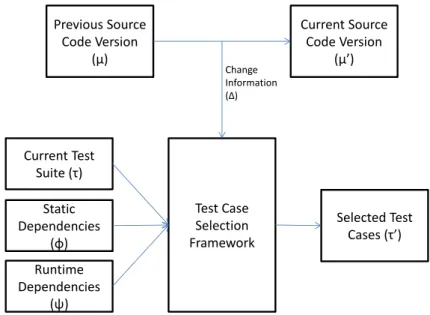
In Figure 1.1 an overview of the proposed test selection methodology is illustrated, using a scenario where changes were performed to the previous code revision, originating a new code revision (the current one) that needs to be tested.
Previous Source Code Version (μ) Current Source Code Version (μ’) Test Case Selection Framework Current Test Suite (τ) Change Information (Δ) Runtime Dependencies (ψ) Static Dependencies (φ) Selected Test Cases (τ’)
Figure 1.1: Test Selection Methodology Overview
The proposed solution to the problem of fast feedback has the ability to scale, is ef cient and is safe in the sense that it revealed the ability to select the correct test cases to execute, as will be described and shown during the rest of this document.
1.5 Main Contributions
The work described on this dissertation led to both practical (relevant to the industry) and re-search oriented contributions. Then, the main contribution of this dissertation is the following:
• Proposal of a test case's automated selection methodology, which is based on both static and runtime dependency information between test cases and software code (and between software code itself). The proposed methodology consists on identifying the changes be-tween two different source code versions and on the ability of relating those changes with test cases. More speci cally, the presented methodology relies on a static analysis of the dependencies between test cases and code, and also on runtime analysis of dependencies
between test cases and code (by recording the actual test case code execution paths), without requiring an explicit input from the programmer.
After having the source code changes information and test/code dependencies, the pro-posed methodology is then able to select a subset of the full test suite that, when related with the changes made, has the same coverage and fault-detection capability as execut-ing the full test suite. This approach is suitable not only for regression testexecut-ing, but also for continuous testing with continuous introduction of newly created test cases.
In order to achieve the main contribution of this work, previous contextualization and research were conducted and they led to the following contributions:
• Presentation of a complete and concise characterization of a real industrial software de-velopment scenario, so that the de ned problem and its solution emerge from require-ments that exist in the software industry.
• Wide survey on the subject of feedback loop optimizations and test optimizations, present-ing related works to these main topics and the different approaches that were presented until these days, also with a critic and constructive perspective of those approaches' advantages and weaknesses.
As a by-product of the main contribution, two other relevant contributions emerged from this work:
• Proposal of an automated validation methodology that uses data from real software de-velopment scenarios.
• Elaboration of a scienti c paper that has been submitted to the Software Engineering In Practice (SEIP) Track of the International Conference on Software Engineering (ICSE).
1.6 Document Structure Overview
This dissertation is organized in seven main chapters. Of those seven chapters, ve make part of the body of this dissertation. Those chapters are preceded and succeeded by the Introduction and the Conclusion chapters, respectively. Each of the seven chapters of this dissertation can be summarized as follows:
• Chapter 1 introduces the topic of this dissertation, starting with a contextualization of
the problem and the motivation for solving it. Then, a more concise description of the problem is presented, together with the expected goals for the present work. The ap-proach for solving the problem is presented next, followed by the main contributions of the work depicted in this dissertation. In last, an overview of this document's structure is presented.
• Chapter 2 concisely describes the industrial context where the work that led to this dissertation was conducted, speci cally OutSystems industrial context, mentioning all the relevant details that are crucial for a correct understanding of the problem and the necessity of solving it.
• Chapter 3 presents a wide and detailed state of the art on the areas of software devel-opment, fast feedback and test suite optimizations in general. In this chapter an analysis
is done on the different approaches found in the literature, explaining the advantages and weaknesses of each of those presented approaches, as well as understanding where innovation opportunities exist and how.
• Chapter 4 contains the proposed solution for the problem of fast feedback, which is a test case selection methodology that uses information from both static and runtime code analysis. This chapter intends to present an algorithmic, abstract and generalized description of the presented solution, in order for it to be suitable for implementation in different industrial contexts.
• Chapter 5 details a practical implementation of the solution presented in Chapter 4. Speci cally, a set of technologies and languages that were used in that implementation are described. Then, each different step of the implementation is fully described, with all the implementation details that are relevant to understand how the implemented solution works in practice and how can that implementation be reproduced in this or other contexts.
• Chapter 6 presents the validation methodologies that were used to demonstrate the func-tionality and correctness of the proposed solution, and that were conducted in the context of OutSystems daily development tasks with real and not selected nor fabricated data. Then, validation results are presented with several relevant measures, along with actual feedback time reductions.
• Chapter 7 includes some nal remarks and summarization of the work presented in the body of this document. Furthermore, it also presents the main conclusions of this disser-tation, together with some directions for future work.
Chapter 2
Industrial Context
This chapter presents and characterizes the industrial context where the presented work was conducted. The main goal for this chapter is to make clear all the relevant details about how OutSystems develops its main product, and from there understand where resides the problem of fast feedback, de ne a speci c eld of intervention and set the relevant research areas that will be further studied in Chapter 3.
2.1 Introduction
The challenge of being able to release software on a frequent pace has become crucial for most software development companies. Indeed, only with fast release cycles it is possible to satisfy the continuously evolving needs of customers: this permanent evolution is in itself a consequence of the dynamic nature of modern businesses, and a nature that software needs to support.
While the need for practices, methodologies and tools that speed up the software development life cycle can also be witnessed at OutSystems, this is by no means a need that is speci c of that company. In the particular case of OutSystems, this need led to the creation of a Produc-tivity Engineering Team, which focuses precisely on continuously improving tasks that relate to software development, and therefore aim at increasing the productivity of developers.
In this chapter, the industrial context of OutSystems is described. While this context is particu-lar of that company, it is believed that the characteristics that are relevant for this dissertation are common to most software development companies that have adopted modern development methodologies with continuous integration. This will help to clarify the wide applicability and potential of the proposed technique. OutSystems and its main product are described, as well as the development processes and methodologies that have been adopted, and also its technologi-cal setting. Furthermore, some detail on its infrastructure is given, together with the status of the current most relevant challenges it faces.
2.2 The Company and its main Product
OutSystems is an international software house that develops a speci c product, which is the OutSystems Platform. This software is provided as a Platform as a Service (PaaS) solution that provides customers with an IDE which relies on designing mobile and web applications using visual models. Furthermore, it also includes a full application lifecycle management for the de-veloped applications, and is prepared for applications that scale from small to large enterprise installations with hundreds or thousands of users.
Applications developed with the OutSystems Platform allow customers to immediately lever-age the bene ts of visually generating (e.g., using drag and drop capabilities) standard and optimized Java or C# code, developing only once for all devices (cross platform), and with different stack combinations (different combinations of application servers, operating systems, and databases).
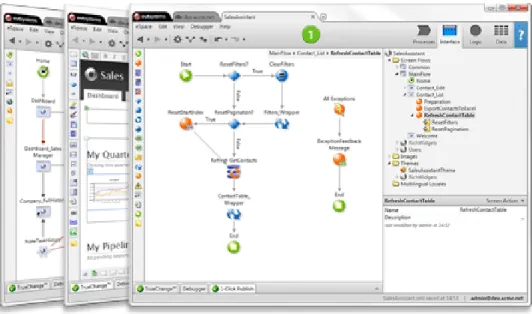
Figure 2.1 presents an example of the business logic of a program de ned using a visual model. This de nition is made within the IDE that is included in the OutSystems Platform, which is called Service Studio.
Figure 2.1: The OutSystems Platform - IDE Samples
The application lifecycle management allows users to have a full control over deployed appli-cations, including monitoring and troubleshooting capabilities, and also managing applications across different environments.
In what concerns the platform architecture, its components can be divided in two big groups -the Development Environment (DE) and -the Platform Server (PS).
The DE is composed of two major components - Service Studio and Integration Studio. The rst one is the desktop environment already illustrated in Figure 2.1, and that allows customers to use visual models in order to create mobile and web applications, that are then compiled and deployed to several devices at once by the PS. The second one is also a desktop environment that allows users to integrate external libraries, services and databases in developed applica-tions, extending the OutSystems Platform with additional functionality.
The PS is a set of components and services that take care of all the steps necessary to generate, build, package and deploy native C# and Java web applications on top of different application servers, database engines and even operating systems. Also, it has two main browser based tools - Service Center and LifeTime - from where customers can manage, monitor and trou-bleshoot the OutSystems Platform application's portfolio, as well as managing it across differ-ent environmdiffer-ents, de ne security polices and manage the complete lifecycle of applications,
from development to production.
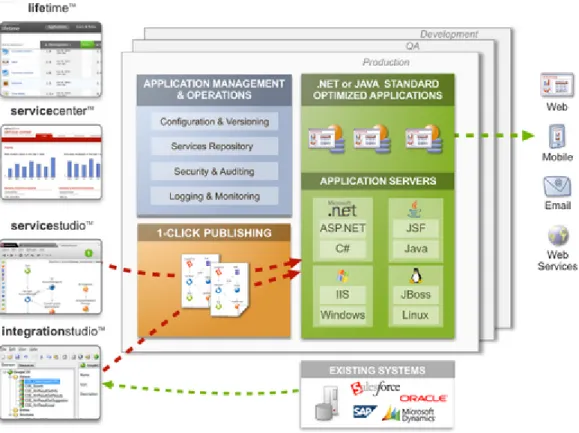
In Figure 2.2 an overview of the OutSystems Platform components and their interactions is pre-sented.
Figure 2.2: The Components and Interactions of the OutSystems Platform
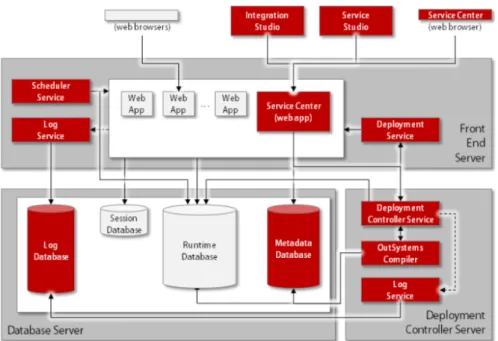
In order to provide more detail about the platform's architecture and complexity, in Figure 2.3 an overview of the platform architecture is presented.
Figure 2.3: The OutSystems Platform Architecture Overview
It is concluded from the presented description and architecture diagram that the OutSystems Platform is indeed a large and very complex piece of software, with different components, developed in different technologies and designed to work on top of different technologies, and all interacting with each other. In the next sections more details will be given in what concerns the platform development and its actual feedback ow.
2.3 The Development Team, Methodology and Paradigms
OutSystems has dozens of collaborators organized in different teams working actively and exclu-sively on the development of the OutSystems Platform on a daily basis. This means that dozens of collaborators are developing new code, changing existing code and creating test cases daily, several times each day. Collaborators are spread among several teams that have speci c tasks and speci c goals, and usually each of those teams works on more speci c parts of the Plat-form's code.
The code that contributes to a given release is therefore developed by several different project teams. In some releases, each project team works on its own code branch that is periodically reintegrated to the common release branch. In other releases, several teams work directly on the release branch. Whatever is the case, all test cases are executed so that the software developers might have a good con dence that their changes in the code did not break it or to make sure that they adapted the tests accordingly to the desired changes.
The company uses Agile methodologies in software development, which is also relevant for the context of this work regarding the fact that Agile methodologies require fast feedback loops and frequent software releases. In fact, in a book that compares two different avors of Agile software development [Kni10], Kniberg concludes that "generally speaking you want as short a
Also, continuous integration is an interesting practice in the context of Agile software devel-opment, and its foundations help to reach the already mentioned fast feedback loops and fast integration and release cycles. Currently, there are efforts being conducted in order to achieve really fast continuous integration environments where developers can be noti ed very soon about the impact of their changes in the code, and this is precisely where this work becomes necessary. In Section 2.4 more details will be given in what concerns the current feedback ow of OutSystems, how is the platform developed in general, how software quality is achieved and where possible optimization points are found.
2.4 Platform Development, Feedback and Quality Assurance
The OutSystems Platform's code is in its majority written in .NET, speci cally using the C# pro-gramming language. Some other languages are also used, such as JavaScript and TypeScript. These languages are used to develop different modules that make part of the OutSystems Plat-form, such as desktop environments and web services. Since the platform is available for both.NET and Java, an internal tool is also responsible for translating the .NET code to Java
(includ-ing the translation of test code).
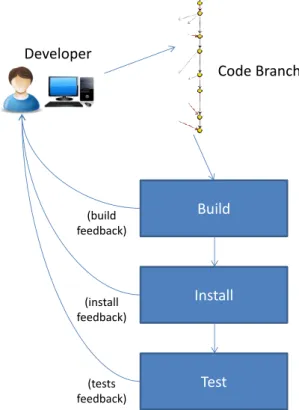
In what concerns the current feedback loop, after a developer performs changes in the code of the platform, there are three main steps to assure that the platform is still behaving as ex-pected: a) build the platform code, b) install the platform code in different environments with different con gurations and c) execute a battery of automated tests. This loop will provide a constant feedback about the impact of changes in the platform to the developer. Figure 2.4 contains a visual representation of this feedback loop.
Developer
Code Branch
Build
Install
Test
(tests feedback) (install feedback) (build feedback)Describing those steps more speci cally, the build stage builds the platform code for a given code revision of a given branch, producing the build artifacts that are necessary for the plat-form to be installed. This stage itself provides feedback already, since if the build fails the developers get immediate feedback of the cause of failure.
Then, and since the OutSystems Platform supports a lot of different stack combinations, the platform's built code is installed in a myriad of testing machines with different con gurations. Also, if the installation fails the developers get the information that something went wrong. If both build and install steps are successful, then a battery of automated tests is executed in every testing machine where the platform was installed. This is the step where a full battery of automated tests that include unit, integration and system tests are executed in order to guarantee a stable state of the Platform's code.
To perform all these feedback loop stages, developers also have access to a tool that allows them, among other things, to a) request builds for a given branch, b) request the installation of a given build in a myriad of testing machines with different con gurations and c) request the execution of tests on the testing machines and monitor the results of that execution (check which tests are in queue, which succeeded, which failed).
The OutSystems Platform is being developed for several years already, and therefore its code base and test suite have grown with time. At the moment, OutSystems test suite has more than 10.000 tests being executed to validate its software and all of these tests are automated. Executing all the automated unit, integration and system tests currently takes several hours. This is, in fact, the biggest motivation for this work: being able to have automated systems that reduce the feedback loops even when software is large and complex, and guaranteeing that is has been as thoroughly tested as possible.
2.5 Speci c Problem Formulation
In Chapter 1, and speci cally in Section 1.2, the generic problem was already de ned. Consid-ering the context of the current chapter, and speci cally in Section 2.4, the problem might be de ned in a more concise and speci c way. So, what is desired to be achieved is a solution to the problem described below.
Speci c Problem Statement. (Tests Feedback Loop Optimization)
Improve the way that tests are orchestrated so that software developers might be noti ed as soon as possible about the results of tests executions. This fast feedback is to be obtained by only executing all tests in the suite when this is strictly necessary.
Speci cally, de ne a methodology that is able to relate speci c test cases with speci c code changes, so that a partial execution of the full test suite might suf ce to guarantee software quality.
2.6 Conclusion
In the current chapter, an overview of the industrial context for this dissertation was presented. Speci cally, OutSystems and the product it develops were described, and also how the company develops it and how software quality is guaranteed.
Understanding this context was crucial to understand where feedback loop optimizations could take place, and it became clear that optimizations should emerge from one of the QA steps, which is test cases execution.
For a developer to bene t from feedback it must be fast, which means that test cases execution must be fast enough for a developer to get feedback as soon as possible.
The description of the OutSystems context that was made in this chapter also helps to clarify why this research has focused on optimizing test orchestration and feedback. This is the main reason why this chapter comes before the State of the Art (Chapter 3), because this industrial contextualization is crucial for pointing the correct research directions.
Chapter 3
State of the Art
This chapter presents the current state of the art on areas that are related with fast feedback loops. To be more concise, research areas that are related with optimizing the time that test suites take to execute are interesting for the context of the problem that is being solved. It is of a great interest to understand what has been done so far in both academic and industrial works in order to optimize software tests execution and orchestration.
3.1 Introduction
In software engineering, the concept of feedback loop can be de ned as a sequence of steps of the development process that permit continuous software corrections and improvements. Executing a battery of tests that intend to test the software code logic, integrations between different components, and even simulate software behavior as a whole is a very important step in this loop.
Improving the feedback loop time is very important to improve the overall productivity of soft-ware development. Indeed, the faster the feedback loop, the higher the number of corrections and improvements that are possible per time unit.
The problem of achieving fast software development feedback loops has been extensively stud-ied in the past. In fact, several works that can be found in the literature have focused in solving this problem.
These works have been developed both in academic and industrial contexts, and they might be divided in several categories in what concerns how they approach the problem. In fact, there are different approaches that focus on different parts of the software development steps. Some approaches are focused on infrastructure improvements while other approaches are focused on tests improvement.
The different main topics found during this research work that address the nal goal of achieving fast feedback loops might be divided in the following categories:
• Infrastructure improvements and Test Distribution, which are described in section 3.2; • Test suite optimization techniques (test suite minimization, selection and prioritization),
which are described in section 3.3.
3.2 Infrastructure Improvements and Test Distribution
Several works in the area of fast feedback involve infrastructure improvements or a better us-age of available infrastructure resources.
In these lines, one natural infrastructure improvement is achieved by increasing the resources that are available for processing tests, which means, increasing machine power available (by increasing the number of existing machines or their hardware capabilities). This solution is able of improving the feedback loop time until a bottleneck is reached, which occurs when the avail-able budget ends. Furthermore, as software and test suites grow, it is simply not affordavail-able to continuously invest on hardware or machines.
Another approach that is related with infrastructure is allowing a better usage of the available infrastructure resources, and this is a eld of research that is related with test distribution. This means, in practice, using techniques such as parallelization to execute a battery of tests. If the ability to split tests across different machines exists, or the ability to run several tests at the same time in the same machine, the overall time spent in executing a full test suite will be reduced.
Nowadays it is easier and cheaper to allocate computational resources than it was some years ago, mainly due to the proliferation of Virtualization [VMW], Grid [FK03] and Cloud [Wei07] technologies. This means that tests distribution does not imply as many costs and effort as it did some years ago.
During the year of 2001, Kapfhammer published a description of the conceptual foundations of tests distribution, along with a design and implementation of an approach that is able to distribute the execution of test suites across multiple machines [Kap01]. This idea relies on the principle that the workload needed to process a full test suite might be split across different machines, which will reduce time costs of testing activities, depending on the number of ma-chines available. This speci c work included the proposal of a tool, Joshua, that is an extension of the well known JUnit testing framework.
Later, a framework called Metronome was introduced for grid environments, prividing auto-mated software build and test services for multi-platform systems that are based on grid tech-nologies [PCG+06].
Yet another framework was developed, which is called GridUnit. This is a framework for dis-tributing the execution of JUnit-based test suites [DCBM06].
In the past, some work was already conducted at OutSystems regarding tests distribution, paral-lelization and capabilities of executing several test cases at the same time. Therefore, this will not be the way to go on this dissertation work. Furthermore, tests distribution will not solve the problem of always executing the full test suite, it is too dependent on hardware resources and system growth will always imply more costs and human effort.
3.3 Test Suite Optimization Techniques
Several test suite optimization techniques were proposed in order to achieve more ef cient feedback loops, and speci cally to optimize the time in which test cases execute or optimize their fault-revealing capabilities. Some of the main aspects that are crucial for any of those
techniques to be suitable in practice are its ef ciency and safety. Ef ciency is the ability of the techniques to save signi cant costs when compared to a full test suite execution. Safety is the ability of the techniques to guarantee that all test cases that are related to code modi cations are executed, and that no tests that are relevant are excluded from the test suite.
In this section three techniques and works related with tese techniques will be presented: test suite minimization, test case prioritization and test case selection.
3.3.1 Test Suite Minimization
Test suite minimization is a technique that aims to remove redundant test cases from a test suite. There are several de nitions of redundancy, but in the techniques that are presented next a test case is redundant if a) it is no longer meaningful for the program under test; b) it has the exact same testing coverage than any other test case.
The concept behind test suite minimization is the idea of permanently removing test cases that are considered redundant.
Harrold et al. propose an approach to address the test suite minimization problem that aims to identify redundant and obsolete test cases based on tests relationship with testing requirements [HGS93]. These authors de ne the problem of test suite minimization assuming that each test case has a relationship with some kind of requirement - software requirement or test coverage requirement, as follows [HGS93]:
De nition 1. (Test Suite Minimization Problem)
Given: A test suite T, a speci c set of testing requirements r1,...,rn that must be satis ed
in order to provide the desired testing coverage of the program under test, and subsets of T, T1,...,Tn, each one associated with each of the ri's such that any one of the test cases tj that
belong to Tican be used to test ri's.
Problem: Find a representative set, T', of test cases from T that satis es all ri's.
Tests are classi ed as obsolete if they are not testing any test requirement anymore. A speci c test is classi ed as redundant if there is any other test that tests the same testing requirement as the rst one. This approach requires a strong and regularly updated set of testing require-ments as well as a mapping between test requirerequire-ments and test cases. Empirical studies were carried on a very small test suite (around 20 tests).
Offut et al. approach the problem as a minimal set cover problem [OPV95], using mutation test-ing. Mutation testing is a testing technique that involves modifying a program in speci c small parts. Each of these modi cations is called a mutant. Test cases shall detect these mutations, and if they do, this is called killing the mutants. The authors apply mutation testing techniques and then identify the minimal set that covers all the mutants (which means, that is able to kill all the mutants). Tests are rst executed in different orders and the minimal set that obtains the maximum mutation score is selected. Empirical studies were made with a set of around 40 tests and 48 lines of code, reducing sizes of test suites by over 30%.
Chen et al. propose an approach that also assumes from the beginning a correspondence be-tween each test and a set of test requirements [CL96]. A test suite is de ned, in this context, as a set of test cases that can collectively satisfy the whole set of test requirements. The authors also de ne the concept of an essential case test, which is a test that will make a requirement uncovered it if removed. In the proposed approach the authors start by selecting all essential test cases and then make use of greedy algorithms to select further test cases that satisfy the maximum number of unsatis ed test requirements, until all the requirements are satis ed. On an alternative approach, they start by removing redundant test cases and then apply the rst mentioned heuristic. The authors only present the results of simulations, but not any empirical results on real data.
Marré and Bertolino published a technique for coverage testing using spanning sets [MB03]. Their work is not speci cally focused on test suite minimization, but it might be used as a di-rection to achieve that minimization, since tests might be selected (or removed) according to a speci c coverage criteria. This approach is an alternative to the already existent approaches focused on requirements, focusing instead on representing the structure of the system under test using a decision-to-decision graph (ddgraph), which has a single entry and a single exit point. Marré and Bertolino's work is focused in unit tests. The authors mention, according to empirical studies they performed, that their technique is not totally effective, although it is more accurate than some previously existent approaches. The proposed approach is therefore based in nding a minimal set of tests that traverse all possible paths of the ddgraph. This still a weak assumption since ddgraphs alone are not enough to guarantee safety.
Tallam and Gupta presented an approach with a new greedy heuristic that aims to select a minimal subset of a test suite that covers the testing requirements that are also covered by the original suite [TG05]. This approach improves some redundancy present on previously pre-sented greedy heuristics, which also improves the reduction ef ciency.
Black et al. extended extended previous work of Chen et al. [CL96] by combining two test-ing criteria [BMK04], and both taken in account for test selection. This can be referred as a bi-criteria approach that, in this case, takes in account def-use (de nition and usage) coverage criterion and fault-detection history for each test case.
Jeffrey and Gupta also extended previous work of Chen et al. [CL96] by applying a second set of test requirements (another criterion) after the rst (but not simultaneously) [JG07], includ-ing then some tests that were before marked as redundant but that are not redundant for this second set of test requirements. This helped to improve the fault-detection capabilities of the test suite, making it larger on the other hand. The authors call this technique a selective re-dundancy technique. It is relevant to mention that a test case is only analyzed with the second criterion when it is marked as being redundant by the rst criterion.
Hsu and Orso developed a framework (MINTS) for multi-criteria test suite minimization based on user input (the user assigns a priority to each of the given criteria) [HO09]. The authors men-tion possible criteria such as coverage data, execumen-tion cost and fault-detecmen-tion capabilities (or expectancy). Then, an Integer Linear Programming (ILP) formulation is made in order to solve the addressed problem, with an weighted-sum approach, prioritized optimization or an hybrid approach, using de ned criteria as constraints to the ILP formulation. This approach proved
to be more effective than previous single-criterion approaches in what concerns reducing the cardinality of a test suite (especially when it is large), but it is still not able to be considered as a safe technique.
McMaster and Memon propose an approach based on call-stack coverage generated by the test suite [MM05, MM08], which is a dynamic approach (since call-stack information is gathered during runtime) and has a wider applicability than other techniques, because it is language independent. Anyway, although the authors claim that their approach is able to produce fa-vorable trade-offs between the reduction in test suite size and reduction in fault detection effectiveness, the technique is still not a safe technique.
Harder et al. presented an approach to test suite minimization using operational abstraction [HME03], which is a different approach from the ones already presented until now that share the fact of being based on some kind of coverage criteria. Operational abstraction is a for-mal mathematical description of a program's behavior, which has scaling costs that are hard to predict. This operational abstraction is obtained from program executions, so it is a dynamic approach. The basic idea is constructing a new test suite from scratch, where test cases are executed (in some order) and they are added to the test suite if they improve the existent operational abstraction. If they do not change anything in the operational abstraction, they are not added to the test suite. Still, as happens with many minimization techniques, this tech-nique does not ensure that a removed test case was not relevant to detect a speci c fault that other tests are not able to detect. Still, empirical studies demonstrated that more faults are detected when compared to branch coverage-based approaches. Also, this work can be used as a coverage criterion for previous approaches.
Schroeder and Korel propose an approach that is focused on black-box testing [SK00]. The au-thors identify possible redundancies by verifying the impact that test inputs have in the outputs of the program being tested. Test inputs that produce the same outputs might have redundan-cies, so it does not make sense, in the authors' opinion, to execute them all. This approach makes sense in a context where the system under test is composed of unmanaged code, which means, when the code of the system under test is not available.
Vaysburg et al. propose an approach that makes use of Extended Finite State Machine (EFSM) system models [VTK02], capturing dependencies (static and dynamic) between EFSM elements in order to reduce test suite by identifying tests that exhibit the same pattern of interactions. Anyway, this approach assumes that tests are requirement-based and there is a model-based system representation. Korel et al. and Chen et al. also proposed some extensions to this approach [KTV02, CPU07], with automatic identi cation of changes in the model and a more complex model of changes, respectively.
Kaminski and Ammann propose an approach using a logic criterion to reduce test suites car-dinality [KA09]. Furthermore, this approach also provides guarantees in what concerns fault detection capabilities in testing predicates over Boolean variables. Still, this approach assumes that there is a formal description of a program.
In general, test suite minimization techniques aim to reduce the size of a test suite, but those techniques represent a one time improvement. Large test suites that are often found in large
and complex systems, even when minimized, will still be too slow to solve the problem of fast feedback. Furthermore, redundancy is a very vague de nition in the majority of these techniques.
3.3.2 Test Case Prioritization
Test case prioritization is a technique that aims to prioritize some test cases of a test suite in what concerns their execution order. The main goal behind test case prioritization is the ability to detect faults as soon as possible. In the optimal scenario, all the test cases that have a greater probability of revealing failures shall be executed rst. This means that test cases that have a higher probability of nding software defects shall be executed rst. On the other hand, test cases that have a lower probability of nding defects according to the latest code changes shall be executed at the end.
Anyway, test case prioritization techniques might also be used to achieve other goals than early fault detection, although this one is the most common. Several heuristics are generally used to prioritize test cases execution, and the used heuristics are the main difference vector between different proposed techniques.
Rothermel and Harrold formalized the de nition of test case prioritization as follows:
De nition 2. (Test Case Prioritization Problem)
Given: A test suite T, the set of permutations of T, PT, and a function from PT to real num-bers, f : PT → R.
Problem: Find T' such that ∀ T ∈ PT, T 6= T' =⇒ f(T') ≥ f(T ).
Rothermel et al. published a work where their approach is to test different heuristics for test case prioritization, evaluating the impact that each of those has in early software fault detec-tion [RUC01]. Speci cally, the approach proposed by the authors takes in account nine different test case prioritization techniques that vary on what concerns the used heuristics.
The base scenario is executing tests with no prioritization at all, that serves as a baseline for reference. Then, the authors performed some experiences using the following ordering criteria:
• Randomized ordering,
• rate of fault detection optimization ordering, • early statement coverage ordering,
• early statement coverage ordering taking in account previous tests statement coverage, • early branch coverage ordering,
• early branch coverage ordering taking in account previous tests branch coverage, • early fault detection probability ordering, or