UNIVERSIDADE DO ALGARVE
BYCATCH AND DISCARDS
OF COMMERCIAL TRAWL FISHERIES
IN THE SOUTH COAST OF PORTUGAL
Maria Esmeralda de Sá Leite Correia da Costa
Tese para obtenção do Grau de Doutor
Doutoramento em Ciências e Tecnologias das Pescas
(Especialidade em Biologia Pesqueira)
Trabalho efectuado sob a orientação de:
Professora Doutora Teresa Cerveira Borges
UNIVERSIDADE DO ALGARVE
BYCATCH AND DISCARDS
OF COMMERCIAL TRAWL FISHERIES
IN THE SOUTH COAST OF PORTUGAL
Maria Esmeralda de Sá Leite Correia da Costa
Tese para obtenção do Grau de Doutor
Doutoramento em Ciências e Tecnologias das Pescas
(Especialidade em Biologia Pesqueira)
Trabalho efectuado sob a orientação de:
Professora Doutora Teresa Cerveira Borges
BYCATCH AND DISCARDS
OF COMMERCIAL TRAWL FISHERIES
IN THE SOUTH COAST OF PORTUGAL
Declaração de autoria de trabalho
Declaro ser autora deste trabalho, que é original e inédito. Autores e trabalhos
consultados estão devidamente citados no texto e constam da listagem de
referências incluída.
Maria Esmeralda de Sá Leite Correia da Costa
Copyright © Maria Esmeralda de Sá Leite Correia da Costa
A Universidade do Algarve tem o direito, perpétuo e sem limites geográficos, de arquivar e publicitar este trabalho através de exemplares impressos reproduzidos em papel ou de forma digital, ou por qualquer outro meio conhecido ou que venha a ser inventado, de o divulgar através de repositórios científicos e de admitir a sua cópia e distribuição com objetivos educacionais ou de investigação, não comerciais, desde que seja dado crédito ao autor e
Cover image:
Bycatch @ Mercator Media
À minha filha Rita, ser de luz, que veio dar à minha vida
uma nova força, energia e razão de viver.
E a meus Pais, razão da minha existência, a quem devo tudo o que sou.
In fact, the existence of bycatch and discards is not recent. It dates back
biblical times, although according to social criteria different from the current
epoch:
47
The Kingdom of Heavens is still similar to a net that, thrown
to the sea, catch all kind of fish species.
48As soon as it is full, the
fishermen haul it to the beach, sits down and selects the good ones
to the great basket and the bad ones throw them away.
† • † • †
Na verdade, a existência do bycatch e das rejeições não é recente. Remonta
deste os tempos bíblicos, embora segundo critérios sociais diferentes da época
actual:
47
O Reino dos Céus é ainda semelhante a uma rede que,
lançada ao mar, apanha toda a espécie de peixes.
48Logo que ela
se enche, os pescadores puxam-na para a praia, sentam-se e
escolhem os bons para as canastras e os ruins deitam-nos fora.
Abstract
Bycatch and discards are a cause of great concern in commercial world fisheries, with important ecological, economic and conservation implications. With the recent inclusion of a discards ban (‘landing obligation’), in the reform of the EU CFP, these issues have gained a tremendous attention from the economic, scientific, political and social point of view. Demersal trawl fisheries off the southern coast of Portugal capture an extraordinary diversity of species and generate considerable amounts of bycatch and discards. Bycatch includes commercially valuable target-species and bycatch species with low or no commercial value, but the great majority consists of unmarketable species, that are discarded. Bony fishes are dominant in bycatch and discards and the most discarded are of low or no commercial value. The reasons for discarding are fundamentally economic in nature (lack of commercial value) for bycatch species, and legal and administrative (legal minimum landing size) for commercially important species. The study of the reproductive biology of Galeus melastomus, discarded by crustacean trawls, suggests that a minimum landing size should be established for this species, and explains the importance of such a study in the assessment and management of fisheries. The discovery of a new species of the ray Neoraja iberica n. sp. contributes to the knowledge of the local marine biodiversity in Portuguese waters and of the global marine biodiversity. The three cases of abnormal hermaphroditism recorded in Etmopterus spinax, are the first cases known to date of hermaphroditism in this species. There is a need to find solutions to the problem of bycatch and discards of trawl fisheries in the Algarve coast. A combination of technical, regulatory and economic measures to minimize bycatch and reduce discards, before implementing a ‘landing obligation’, is thought to be the best approach to apply in the southern Portuguese multispecies trawl fisheries.
Key-words: Bycatch discards biodiversity cartilaginous fishes commercial trawl fisheries South coast of Portugal (Algarve).
Resumo
Com a exploração crescente e contínua da maioria dos recursos marinhos ao longo do tempo, facilitada pela modernização da tecnologia nas artes de pesca, as capturas acessórias (bycatch), e a consequente rejeição de organismos marinhos ao mar passaram a ser rotina da maioria das pescarias comerciais a nível internacional. Somente no início do Século XX com a percepção dos elevados níveis de bycatch (38,5 milhões de toneladas, equivalente a 40,4% da captura total), e de rejeição (média de 7,3 milhões de toneladas de peixe por ano, correspondente a uma taxa global de captura de 8%), se tomou consciência de que, para além do desperdício de matéria-prima que representam, têm importantes implicações ecológicas, económicas e de conservação. Então, o bycatch e as rejeições tornaram-se objecto de preocupação cada vez mais crescente e do esforço mundial no sentido de gerir e conservar os recursos marinhos pesqueiros.
Actualmente, com a inclusão no recente regulamento da Política Comum das Pescas, da proibição das rejeições (‘obrigação de desembarque‘) e da necessidade de desenvolver medidas que permitam a redução dos actuais níveis elevados de bycatch e a eliminação das rejeições, torna-se não só imprescindível, mas também urgente, proceder a uma correcta identificação e quantificação dos níveis destas duas componentes da captura, à determinação da sua variabilidade no espaço e no tempo, e adquirir conhecimento profundo e claro sobre as razões que levam à prática das rejeições de organismos ao mar. Essa atitude tornará possível efectuar mudanças nas práticas de rejeição, auxiliar no processo de amostragem e permitir a criação de protocolos e medidas que visem tanto o cumprimento da ‘obrigação de desembarque’ como uma gestão mais eficiente do bycatch e das rejeições.
Neste estudo o bycatch total é considerado como sendo a porção da captura total que abrange todas as espécies capturadas acessoriamente (não-alvo), e que tem duas componentes muito importantes: o bycatch comercial, de espécies com valor comercial e que podem ser, subsequentemente, desembarcados e comercializados; e aquele rejeitado (designado por ‘rejeição’ ao longo do trabalho), composto quer por espécies comercializáveis quer, na sua grande maioria, por espécies que não têm qualquer valor comercial, e que são rejeitadas ao mar.
A presente tese tem por objecto principal o bycatch e as rejeições provenientes dos dois métiers da frota de arrasto demersal - o arrasto para crustáceos e o arrasto para peixes - das pescarias comerciais que se verificam nas águas da costa Sul de Portugal (Algarve),
avaliando em termos de quantidade e composição de espécies, analisando a sua variabilidade e identificando as possíveis e principais causas que levam à prática das rejeições nestas pescarias, em particular. Neste estudo também se analisam as abundâncias e biomassas de espécies rejeitadas (entre métiers e dentro de cada métier), a dominância das espécies presentes na rejeição e as taxas (em número e peso) com que são rejeitadas.
Todas as análises foram baseadas em dados recolhidos durante 25 meses consecutivos (de Fevereiro 1999 a Março 2001) e resultaram da aplicação do método directo de amostragem, que consiste na actividade de um observador qualificado presente a bordo das respectivas embarcações. Durante este estudo surgiram algumas dificuldades que condicionaram o progresso contínuo e eficaz da amostragem inicialmente planeada, nomeadamente: a impossibilidade de não se poder ir a bordo das embarcações, quer por recusa inicial do consentimento, quer por quebra dos compromissos estabelecidos com os respectivos mestres ou armadores; as condições meteorológicas adversas que impossibilitaram, em muitas situações, as actividades e operações normais de pesca; e as situações políticas (greve) geradas pelos armadores da pesca de arrasto para peixes que se estenderam por um longo período de tempo.
Apesar das limitações sofridas neste estudo, os quais podem ocorrer em qualquer estudo de natureza científica, as conclusões a tirar dele são no sentido de que a pesca por arrasto na costa do Algarve, independentemente do métier que se considere, e em resultado da não selectividade inerente à rede de arrasto, captura uma extraordinária diversidade de espécies e gera quantidades consideráveis de bycatch que, por serem compostas na sua maioria por espécies sem valor comercial e por indivíduos de espécies-alvo abaixo o tamanho mínimo legal, dão lugar à sua rejeição em elevadas proporções.
Feita comparação das diversas componentes da captura, verificou-se que, apesar da proporção de bycatch a ser comercializado por ambos os métiers não ser muito distinta, o bycatch total capturado pelo arrasto de peixes excede largamente a captura de espécies-alvo, quando comparado com o arrasto para crustáceos, no qual a captura de espécies-alvo é consideravelmente superior. Crê-se que esta diferença se deva, essencialmente, à duração do tempo de arrasto, que é cerca de quatro vezes inferior no arrasto para peixes. Verificou-se também que o arrasto para peixe rejeita maiores proporções de organismos, e a taxas (em kg/h) consideravelmente superiores, presumindo-se que este facto esteja relacionado com a captura de pequenos organismos pelágicos (e.g. trombeteiro, Macroramphosus spp.) cuja
distribuição em profundidade se sobrepõe ao intervalo de profundidade explorado pelos arrastões.
A aplicação de testes e análises estatísticas aos dados das capturas, bem como de análises multivariadas aos dados de abundância e biomassa de cada espécie presente nas rejeições, veio revelar não haver padrões sazonais significativos quer nas diversas componentes da captura, quer na taxa de rejeição dessas espécies, sugerindo que a variação das capturas seja, provavelmente, reflexo da persistência na composição das comunidades de peixes demersais ao longo do tempo, e que não existem quaisquer alterações no comportamento de pesca, sempre sujeita a operações determinadas em ordem a tirar a maior vantagem da disponibilidade das espécies comercialmente mais importantes. A maior quantidade de rejeições registadas pontualmente nas estações do outono e inverno é relacionada com a diminuição de preços do mercado local para algumas espécies comerciais de bycatch que de outra forma seriam retidas.
Nas águas continentais portuguesas o arrasto demersal corresponde a uma pescaria multiespecífica, o que é claramente confirmado pela diversidade de espécies, pertencentes a um grande leque de famílias, encontrada durante este estudo. Contudo, a diversidade de espécies capturada pelo arrasto para peixes é inferior à capturada pelo arrasto para crustáceos, em virtude de no primeiro a pesca ser levada a cabo durante menos tempo, em áreas mais restritas e numa gama de profundidades mais baixas.
Em ambos os métiers os peixes ósseos dominam as capturas de bycatch e rejeições, representando uma percentagem extremamente elevada de rejeição em termos de abundância e biomassa. As espécies que mais contribuíram para o bycatch comercial foram as dos peixes cartilagíneos (e.g. pata-roxa, Scyliorhinus canicula) no arrasto para crustáceos, e a cavala (Scomber colias) e a sardinha (Sardina pilchardus) no arrasto para peixes, cuja comercialização depende da quantidade total capturada e dos preços de mercado praticados consoante a época do ano. De entre um número limitado de espécies de peixes ósseos dominantes nas rejeições de baixo valor comercial e, na sua maioria, sem valor comercial, mas particularmente relevantes na cadeia alimentar, salientam-se no arrasto para crustáceos, por ordem decrescente de importância: (1) o verdinho (Micromesistius poutassou), o trombeteiro e a mini-saia (Capros aper) em abundância, e em biomassa (2) o verdinho, o leitão (Galeus melastomus), a mini-saia e o congro (Conger conger); e no arrasto para peixes, (3) o trombeteiro e a mini-saia em abundância, e em biomassa (4) a cavala, a pata-roxa, o trombeteiro e a boga (Boops boops).
Este estudo permite concluir que as razões que levam à prática das rejeições, em particular nas pescarias de arrasto na costa Sul de Portugal, são fundamentalmente de natureza económica para as espécies de bycatch, pois que a maioria não tem valor comercial (e.g. trombeteiro, mini-saia, maioria de peixes cartilagíneos e invertebrados marinhos), e de natureza jurídico-administrativa para as espécies-alvo de importância comercial, em virtude de a maioria dos indivíduos ser inferior ao tamanho mínimo legal de desembarque (e.g. pescada, esparídeos do género Pagellus, gamba-branca Parapenaeus longirostris). As espécies-alvo, como as espécies bycatch, são igualmente rejeitadas por causa do estado de degradação ou da má qualidade dos indivíduos, em resultado de lances de longa duração, o que sucede em particular nas espécies menos resistentes à deterioração (e.g. pescada, verdinho, abróteas Phycis spp.). Razões económicas importantes que levam à rejeição de espécies bycatch são também a inexistência de mercados disponíveis para muitas espécies comerciais de bycatch (e.g. cabras Trigla spp., maioria de peixes cartilagíneos) e o baixo valor comercial de algumas espécies (e.g. verdinho, leitão, pata-roxa).
A constatação de que os peixes cartilagíneos são uma componente bastante importante tanto no bycatch como nas rejeições resultantes da pesca por arrasto na costa Algarvia, aliado ao seu baixo potencial reprodutivo (e.g. longos períodos de gestação, baixa fecundidade, idade tardia a que atingem a maturidade), em particular nas espécies demersais, que os torna muito mais vulneráveis à pressão exercida pela pesca do que a maioria dos peixes ósseos, e com pouca capacidade de recuperarem após grandes declínios nas suas populações, motivaram nesta tese o estudo específico da biologia reprodutiva de uma das espécies de tubarões de profundidade rejeitadas. A escolha recaiu sobre o leitão, Galeus melastomus Rafinesque, 1810 (Chondrichthyes: Scyliorhinidae), em virtude de ser uma das espécies de elasmobrânquios mais capturadas como bycatch e a segunda espécie de peixe mais rejeitado em biomassa pelo arrasto para crustáceos. Além disso, toda a informação biológica de base, em particular sobre a biologia reprodutiva em relação a esta espécie, era inexistente anteriormente a este trabalho. Em face das análises dos estados de maturação, períodos de postura, idade de primeira maturação e actividade reprodutiva de machos e fêmeas, sugere-se que sejam aplicados tamanhos mínimos de desembarque a esta espécie de elasmobrânquio, e põe-se em evidência a utilidade de um estudo desta natureza na avaliação e gestão das pescarias.
Esta tese inclui mais dois estudos posteriores à sua planificação, que surgiram no decorrer da amostragem. Um desses estudos refere-se à descoberta de uma nova espécie de raia à qual
foi atribuído o nome científico de Neoraja iberica n. sp. e o nome comum de raia pigmeia ibérica. Este estudo, no qual se pode encontrar uma pormenorizada e completa descrição taxonómica desta espécie, contribui quer para o conhecimento da biodiversidade marinha nas águas portuguesas, quer para o da biodiversidade marinha global. O outro estudo refere-se à descoberta de três casos de hermafroditismo anormal encontrado na lixinha-da-fundura, Etmopterus spinax (Linnaeus, 1758) (Chondrichthyes: Etmopteridae), considerados como os primeiros conhecidos, até à data, de hermafroditismo registado nesta espécie, e o segundo em elasmobrânquios registado nas águas portuguesas. Este estudo, para além de descrever os espécimes hermafroditas, faz referência ao facto de o hermafroditismo ser uma condição de reprodução extremamente rara dentro do grupo dos elasmobrânquios e discute este fenómeno em outras espécies de tubarão.
Os resultados deste estudo são no sentido de demonstrar que o bycatch e as rejeições provenientes da pesca comercial por arrasto demersal na costa do Algarve constituem, efectivamente, um problema nas pescarias portuguesas, para o qual é necessidade urgente procurar soluções que permitam inverter esta situação. Nesta linha, e neste estudo, se referem as medidas técnicas, regulamentares e socioeconómicas actualmente disponíveis que possibilitam a minimização do bycatch e a redução das rejeições. E, no final do trabalho, se deixa opinião sobre aquelas que melhor se adequarão às pescarias de arrasto na costa Sul de Portugal, tendo em conta os resultados obtidos.
Palavras-chave: Bycatch rejeição biodiversidade peixes cartilagíneos pesca comercial de arrasto costa Sul de Portugal (Algarve).
Support
This study was funded by the Portuguese Foundation for Science and Technology (Fundação para a Ciência e a Tecnologia (FCT) through a PhD grant under the program PRAXIS XXI (Ref. BD/18116/98) and supported by Fundo Social Europeu (FSE) under the “III Quadro Comunitário de Apoio”. Part of this study was inserted in two scientific research projects under the auspices of the European Union (DG XIV), namely “Analysis of Fisheries Discards from the south coast of Portugal (DISCALG)” Study project No. 97/0087 and “Managing By-Catch and Discards: A Multidisciplinary approach (BYDISCARD)” Study project No. 99/058.
Apoio
Este estudo foi financiado pela Fundação para a Ciência e a Tecnologia (FCT) através de uma bolsa de Doutoramento no âmbito do Programa PRAXIS XXI (Ref. BD/18116/98) e recebeu o apoio do Fundo Social Europeu (FSE) no âmbito do III Quadro Comunitário de Apoio. Parte deste estudo inseriu-se nos projectos de investigação “Analysis of Fisheries Discards from the south coast of Portugal (DISCALG)” Study project No. 97/0087 e “Managing By-Catch and Discards: A Multidisciplinary approach (BYDISCARD)” Study project No. 99/058.
Agradecimentos/Acknowledgments
Devo expressar o meu sincero agradecimento à minha orientadora Prof.ª Dr.ª Teresa Cerveira Borges pela oportunidade que me deu em trabalhar na área de investigação na qual se insere esta tese, área que sempre me entusiasmou e em que almejei enveredar, bem como pelo seu incentivo, que foi determinante na minha decisão em me propor a realizar um trabalho desta natureza. Grata, igualmente, por todo o apoio recebido e pela amizade construída ao longo dos anos em que participei nos projectos de investigação da sua responsabilidade, e que perdura.
Ao Prof. Dr. Karim Erzini, expresso o meu especial agradecimento por todo o apoio, orientação e aconselhamento prestados, quer nas análises estatísticas quer na apreciação de todo o manuscrito, pela sua incondicional disponibilidade em que esteve sempre que necessitei (e foram muitas as oportunidades!); mas, acima de tudo, pela forma amigável com que sempre me tratou e incentivou, que vem já desde os tempos em que era estudante universitária.
To Dr. Matthias Stehmann, the major reference in elasmobranch taxonomy and also (I dare to say) my dearest friend, I will always be eternally grateful for making one of my professional dreams come true. Thank you for sharing with me your endless knowledge in such an enthusiastically and passionate way, and for showing me the wonderfull path of the classic taxonomy that, despite the meanders it might have, it would certainly be an area that would give me an enourmous pleasure to follow. At the time when we met personally (September. 2006), which coincided with the time I found myself somewhat disenchanted with the research and passing for some personal problems, the experience I had with Matthias was definitely a "breath of fresh air" in my life. Thank you also for having provided me your proposal of maturity scales for cartilaginous fishes and confirmed some of deepwater sharks maturity stages that I was in doubt, as well as for all your unconditional support. It was an honour knowing you and a privilege working with you!
Au Docteur Christian Capapé, une de mes grandes références du monde admirable des elasmobranches dès mon temps d´étudiant de faculté, j´aimerais remercier sa précieuse collaboration dans l´élaboration de l´article sur l´ hermaphroditisme de l´Etmopterus spinax ainsi que son indispensable aide à la préparation du manuscrit. Nous avons réussi à le faire en
inconditionnels. De plus, c’est rare d‘avoir une collaboration de ce genre, surtout de la part de quelqu’un que l’on ne connaît pas personnellement. Je vous remercie également tous les mots affectueux et d’encouragement qui m’ont stimulée professionnellement. Cela a été un grand honneur d’avoir travaillé avec vous!
O meu agradecimento às Capitanias de Olhão e de Portimão pela disponibilidade em conceder as autorizações legais imprescindíveis ao embarque nos arrastões de pesca comercial que operam na costa Algarvia; e a todos os mestres e pescadores que me possibilitaram o acesso a bordo das suas embarcações, sem o que o presente trabalho não poderia ter-se realizado. Em particular, agradeço ao Mestre Miguel Aleta do arrastão para crustáceos “Gamba”, e ao Mestre José Viegas do arrastão para peixes “Maré Alta”, que sempre ajudaram a amenizar o tédio que me assaltava durante as (infindáveis) horas de arrasto, transmitindo-me as suas interessantes histórias de “lobos-do-mar”, e que me ensinaram as realidades duras da pesca. A todos os mestres e respectivas tripulações agradeço o bom acolhimento a bordo e os mimos que deles recebi. Já lá vão 12 anos (!), mas recordo-os com simpatia sempre que, por algum motivo, menciono os tempos passados no mar Algarvio.
Endereço agradecimento especial ao João Gomes que, com os seus preciosos conhecimentos, abriu os meus horizontes para o mundo maravilhoso dos peixes ósseos, que me permitiu definir melhor o meu caminho e traçar novo rumo. Grata também pelas maravilhosas conversas e momentos passados no laboratório e pela amizade construída desde então.
J’aimerais aussi remercier à Marine Girard, que j’ai connue en Septembre 1998 à l’occasion de “ICES Annual Science Conference”, de m’avoir aidé à donner les pas d’identification des systèmes de reproduction des mâles et des femelles des requins de profondeur. Une aide précieuse qui m’a permis de faire mon parcours solitaire dans l’étude de leur biologie reproductive.
Je remercie également à Drª. Marie Henriette-Du-Buit son indispensable prise en charge lors de mon séjour à la Station de Biologie Marine du Muséum National d'Histoire Naturelle et Collège de France, à Concarneau, en Mars 1999.
Não posso esquecer os amigos e membros do já extinto grupo “BIOPESCAS” da Universidade do Algarve, Carla Pais, João Sendão, Inês Gonçalves, Sónia Olim e Jorge
Ramos, cuja amizade, companheirismo e inter-ajuda foram de extrema importância. Os momentos passados quer no mar, quer no laboratório, durante longos anos geraram entre nós uma amizade que nos une, e unirá. Impõe-se que distinga, neste grupo, a Carla Pais, o João Sendão e a Inês Gonçalves pelos incentivos e ajudas que deles recebi para agilizar e terminar esta tese, devendo a este a elaboração dos mapas das figuras 2.1 e 5.13 deste meu trabalho.
O meu especial agradecimento à Aida Campos e ao Paulo Fonseca pelos encorajamentos que deles recebi e que foram determinantes para eu me entregar à finalização da tese. Particularmente a ti, Paulo, agradeço a disponibilidade que me foi concedida, sem qualquer hesitação, sempre que necessitei, a prontidão na cedência de qualquer tipo de informação de que precisei para a concretização desta tese, os teus valiosos comentários, críticas e sugestões feitas ao capítulo das rejeições e, principalmente, o carinho e o incentivo que sempre me deste para colocar um ponto final (parágrafo) nesta etapa profissional.
À Carla Viegas agradeço a paciência e a coragem para me ouvir falar sobre os temas deste trabalho, me ter aturado os maus humores e sempre me ter incentivado a prosseguir e terminar a tese. Não houve quem mais me tivesse acompanhado e dado carinho nesta última fase como tu, Carla. Muito obrigada!
Agradeço ao Pedro Lino a preciosa ajuda na análise da minha “infindável” base de dados, e os seus vitais alertas nos cálculos, e ajuda na formatação da tese.
Obrigada, Raquel Machás, pela preocupação constante que te mereci nos meus momentos menos bons.
Na identificação de espécies, foram-me úteis os conhecimentos colhidos juntos de especialistas: João Sendão (cefalópodes), Margarida Machado (invertebrados), Margarida Cristo (crustáceos) e Estibaliz Berecibar (algas), aos quais agradeço a colaboração.
Na preparação dos mapas das figuras 3.1 e 6.1 desta tese, foi imprescindível a amável colaboração de Luís Bentes, pelo que lhe endereço o meu muito obrigada.
Agradeço, ainda, o apoio que recebi de: Jorge Gonçalves, Rui Coelho, Pedro Monteiro e Mafalda Rangel com a cedência de bibliografia de que necessitei; Frederico Oliveira por me ter proporcionado o PRIMER para elaborar análises estatísticas; Álvaro Patrício e Carla Lima
na resolução dos problemas que tive com o meu portátil; e Luís Pereira pela ajuda em dificuldades relativas à formatação da tese.
A todos os meus restantes amigos e colegas que, embora sem colaboração directa no meu trabalho, sempre se preocuparam em incentivar-me na minha progressão profissional, o meu agradecimento sincero.
À minha numerosa e querida família por todo o carinho, apoio e compreensão recebidos, em particular à minha irmã Ana Paula que me mimou numa fase difícil do meu percurso, largando “tudo” para me socorrer, muito obrigada. Ao meu irmão Pedro e à minha sobrinha Maria, devo as adaptações feitas a algumas imagens que compõem a capa e alguns capítulos desta tese. O meu agradecimento a ambos.
À minha mãe Madalena e ao meu pai Avelino, a quem devo, literalmente, a “minha vida” e a educação recebida, agradeço profundamente por me terem deixado seguir o meu sonho, apoiando a minha escolha do curso que elegi, ajudando-me e incentivando-me a terminar a tese e por nunca terem deixado de acreditar em mim. Embora não me ocorram palavras que considere suficientes para exprimir, convenientemente, o que sinto, a ti, Mãe, que foste a única a compreender-me na altura em que mais necessitava de apoio, e a ti, Pai, meu único companheiro, conselheiro e fiel amigo de conversas sobre o tema da tese, penso que me compreenderão se, simplesmente, vos disser que vos Amo Muito.
Agradeço ao meu marido Luís por me amar e ter estado sempre a meu lado suportando, entre tantas outras coisas, as minhas ausências “de espírito” resultante de longas horas diárias agarrada ao seu rival “Asus” e o meu mau feitio quando as coisas não corriam bem; e à nossa filha Rita que me iluminou e me conduziu à felicidade eterna, a quem devo muita da força e energia de que precisava para completar esta etapa da minha vida. E desculpa-me, filha, de todas as situações em que não consegui corresponder ao teu apelo - “Mãe, vem para o pé de mim, sinto-me sózinha!” - partindo o meu coração!
Esta tese só foi possível em face da atribuição da bolsa de doutoramento PRAXIS XXI: BD/18116/98 pela Fundação para a Ciência e a Tecnologia (FCT) e do apoio do Fundo Social Europeu (FSE) no âmbito do III Quadro Comunitário de Apoio.
A todos quantos, involuntariamente, tenha deixado de fazer referência como meus apoiantes (o tempo passa e a memória esvai-se), quero deixar aqui expresso o meu agradecimento.
Index of Figures
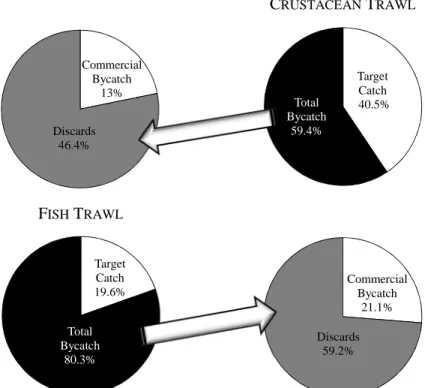
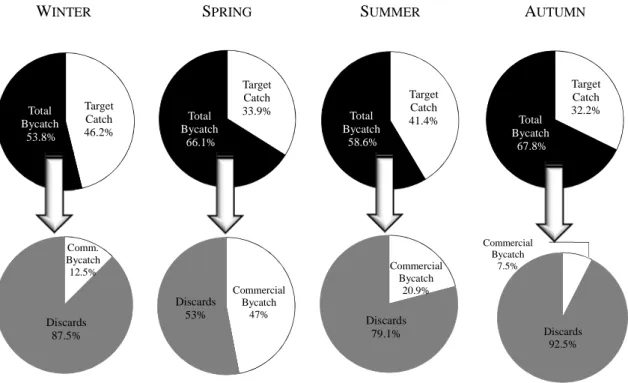
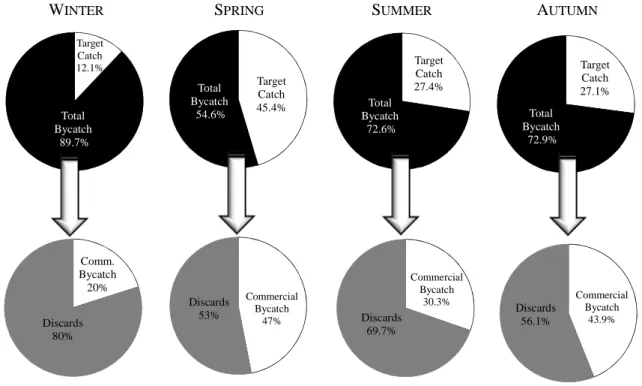
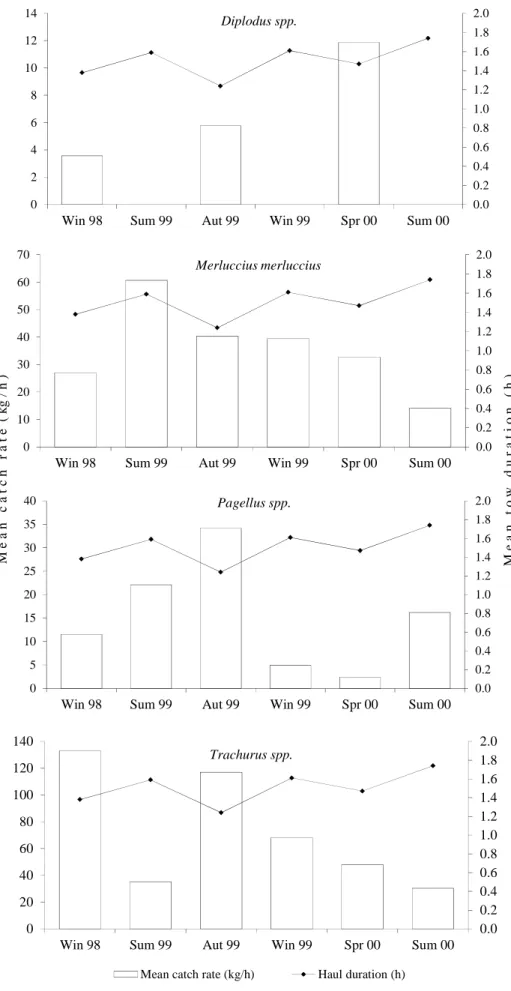
Figure 2.1 - Algarve region, showing the main fishing ports in the region. ... 32 Figure 2.2 - Overall catch composition of the crustacean trawl and fish trawl. ... 37 Figure 2.3 - Overall catch composition of the crustacean trawls according to season. ... 40 Figure 2.4 - Overall catch composition of the fish trawls according to season. ... 41 Figure 2.5 - Contribution of each class of organisms to the biodiversity of the total, target and bycatch catches in the two types of trawlers. Each bar represents the percentage of the species in that class in relation to the total number of species present. ... 43 Figure 2.6 – Mean catch rates and mean tow duration for crustacean trawl target species. .... 48 Figure 2.7 – Mean catch rates and mean tow duration for fish trawl target species. ... 49 Figure 2.8 - Length frequency distribution of the crustacean trawl target species (LMLS-Legal Minimum Landing Size). ... 51 Figure 2.9 - Length frequency distribution of the fish trawl target species Trachurus spp. (Horse mackerels) (LMLS-Legal Minimum Landing Size). ... 52 Figure 2.10 – Length frequency distribution of the fish trawl target species Merluccius merluccius (European hake) (LMLS-Legal Minimum Landing Size). ... 53 Figure 2.11 – Length frequency distribution of the fish trawl target species Pagellus spp. (Seabreams) (LMLS=Legal Minimum Landing Size). ... 54 Figure 2.12 – Length frequency distribution of the fish trawl target species Diplodus spp. (Seabreams) (LMLS-Legal Minimum Landing Size). ... 55 Figure 2.13 – Length frequency distribution of the fish trawl target species Scomber spp. (Mackerels) (LMLS-Legal Minimum Landing Size). ... 56 Figure 2.14 – Length frequency distribution of the fish trawl target species Sardina pilchardus (European pilchard) (LMLS-Legal Minimum Landing Size). ... 57 Figure 3.1 – Map of the southern Portuguese coast (Algarve) showing the trawling positions of the crustacean and fish trawl métiers, during the period of study. ... 69 Figure 3.2 – Mean rate (kg/h) per tow of each fraction of the catch (total, retained and
discarded) and discard proportions (DP) by métier. ... 79
Figure 3.3 – Number of species (%), per taxa, discarded by crustacean and fish trawls. ... 82 Figure 3.4 – Number of species (%), per taxa, discarded by crustacean and fish trawls, according to their frequency of discarding (occasional, frequent, systematic). ... 83 Figure 3.5 – Most frequent (>40% of tows) species in crustacean and fish trawl métiers. Each bar shows the percentage of fishing operations where the species was present. ... 85 Figure 3.6 – Dendogram obtained by cluster analysis of the discarded species abundance for the crustacean trawl ( ) and fish trawl ( ) métiers (163 tows). The 3 groups defined at similarity level of 13% are indicated (dashed line). ( : A,B,C,D; : E,F,G). ... 86 Figure 3.7 – Dendogram obtained by cluster analysis of the discarded species biomass for the crustacean trawl ( ) and fish trawl ( ) métiers (163 tows/métier combinations). The 5 groups defined at similarity level of 13% are indicated (dashed line). ( : A,B,C; : D to K). ... 87
Figure 3.8 – MDS plot of the discarded species abundance for the crustacean trawl ( ) and fish trawl ( ) métiers (163 tows/métier combinations) with superimposed clusters at similarity levels of 13% (dashed line). ... 88 Figure 3.9 – MDS plot of the discarded species biomass for the crustacean trawl ( ) and fish trawl ( ) métiers (163 tows/métier combinations) with superimposed clusters at similarity levels of 13% (dashed line). ... 88 Figure 3.10 – MDS plot of the discarded species abundance for the crustacean trawl (CT) and fish trawl (FT) métiers (163 tows/métier combinations) with superimposed mean depth values (continuous line). The area of the circles is proportional to the average depth of the tows. .... 89 Figure 3.11 – MDS plot of the discarded species biomass for the crustacean trawl (CT) and fish trawl (FT) métiers (163 tows/métier combinations) with superimposed mean depth values (continuous line). The area of the circles is proportional to the average depth of the tows. .... 89 Figure 3.12 – k-dominance curves for the discarded species abundance and biomass, by métier. ... 95 Figure 3.13 – k-dominance curves for the species abundance (upper) and biomass (lower) discarded by crustacean and fish trawl métiers, per season. ... 97 Figure 3.14 – Abundance (n/h) and biomass (kg/h) discard rates of fishes and cephalopods, by métier. ... 101 Figure 3.15 – Total estimated abundance (n), biomass (kg) and discard rates, in abundance (n/h) and biomass (kg/h), of cephalopod species discarded by crustacean trawls. ... 103 Figure 3.16 – Total estimated abundance (n), biomass (kg) and discard rates, in abundance (n/h) and biomass (kg/h), of cephalopod species discarded by fish trawls. ... 104 Figure 3.17 – Total estimated abundance (n), biomass (kg) and discard rates, in abundance (n/h) and biomass (kg/h), of cartilaginous fish species discarded by crustacean trawls. ... 107 Figure 3.18 – Total estimated abundance (n), biomass (kg) and discard rates, in abundance (n/h) and biomass (kg/h), of cartilaginous fish species discarded by fish trawls. ... 108 Figure 3.19 – Total estimated abundance (n), biomass (kg) and discard rates, in abundance (n/h) and biomass (kg/h), of the most discarded bony fish species in crustacean trawls. ... 110 Figure 3.20 – Total estimated abundance (n), biomass (kg) and discard rates, in abundance (n/h) and biomass (kg/h), of the most discarded bony fish species in fish trawls. ... 112 Figure 3.21 – Most discarded species of the crustacean and fish trawl métiers. ... 113 Figure 4.1 – Length distributions of Galeus melastomus. ... 151 Figure 4.2 – Frequency distributions of Galeus melastomus by sex and maturity stages. Specimens between 9 and 36 cm total length (TL) are not represented because they were all immature. ... 152 Figure 4.3 – Relationship between total length and inner (left) claspers length (CLi) for males of Galeus melastomus across stages of maturity. ... 155 Figure 4.4 – Relationships of total length to (A) testes weight (TeW); (B) testes length (TeL); and (C) testes width (TeWi), in Galeus melastomus males, according to maturity stages. ... 156 Figure 4.5 – Relationships between total length and (A) clasper length (CL) and testis weight (TeW), (B) CL and testes length (TeL) and (C) CL and testes width (TeWi) in Galeus
Figure 4.6 – Scores of maturity stages (groups 1 to 4) for the two discriminant functions axes of the DA for Galeus melastomus males. Triangles represent mean values. ... 159 Figure 4.7 – Relationship between total length and (A) ovary width (OWi); (B) ovary weight (OWe); and (C) ovary length (OL), in Galeus melastomus females, across stages of maturity. ... 162 Figure 4.8 – Relationship between (A) oviducal gland width (OgWi) and total length and (B) oviducal gland length (OgL) and total length, in Galeus melastomus females, across stages of maturity. ... 164 Figure 4.9 – Relationship between uterus width (UWi) and total length, in Galeus melastomus females, across stages of maturity. ... 165 Figure 4.10 – Scores of maturity stages (groups 1 to 4) for the two discriminant functions axes of the DA for Galeus melastomus females. Triangles represent mean values. ... 166 Figure 4.11 – Correspondence analysis (CA) plot displaying variable scores in the first two dimensions for Galeus melastomus. Letters A to F represent maturity stages, numbers 1 and 2, associated with maturity stages, correspond to sex (1-♀, 2-♂) and seasons are represented by Wi-winter, Sp-spring, Su-summer and Au-autumn. ... 167 Figure 5.1 – Neoraja iberica n. sp., 322 mm TL mature male holotype, MB 4869, close ups of mouth/nasal region (A), pelvic fins and claspers dorsally (B) and enlarged tail section dorsally (C) showing transition from regular median thorn row to its becoming irregular and almost disappearing in posterior half of tail.. ... 183 Figure 5.2 – Neoraja iberica n. sp., 322 mm TL mature male holotype, MB 4869, close ups of head dorsally (A) and of left wing tip with alar thorn field (B). ... 184 Figure 5.3 – Neoraja iberica n. sp., 322 mm TL mature male holotype, MB 4869, in total dorsal (A) and ventral (B). ... 186 Figure 5.4 – Neoraja iberica n. sp., 322 mm TL mature male holotype, MB 4869, opened left glans clasper showing components and coverage with dermal denticles. Abbreviations: cf=cleft, dd=dermal denticles, di=dike, fn = funnel, hp = hypopyle, ps = pseudosiphon, rb = ribbon, , rh = rhipidion, sh = shield, sp = spike, st = sentinel, sl = slit, tb = terminal bridge. ... 187 Figure 5.5 – Neoraja iberica n. sp., 318 mm TL mature male paratype ZMH 25429, dorsal view of left clasper showing extension of pseudosiphon and coverage with dermal denticles (A), and opened left glans clasper (B). Abbreviations as in Fig. 5, and ap = apopyle, = posterior pelvic lobe. ... 191 Figure 5.6 – Neoraja iberica n. sp., 318 mm TL mature male paratype ZMH 25429, left clasper skeleton in dorsal (A) and ventral (B) views. Abbreviations for cartilages: at1-at2=accessory terminals 1 and 2, ax=axial, dm=dorsal marginal, dt1-dt2-dt3= dorsal terminals 1, 2, 3 resp., tb=terminal bridge, vm=ventral marginal, vt=ventral terminal. ... 191 Figure 5.7 – Neoraja iberica n. sp., 318 mm TL mature male paratype ZMH 25429, individual cartilages of left clasper in dorsal and ventral views (left and right, resp.): distally fused dorsal terminal 1 and ventral terminal cartilages (A), accessory terminal 1 (B) and at2 (C) cartilages. ... 192 Figure 5.8 – Neoraja iberica n. sp., X-ray of cranium of 322 mm TL mature male holotype (MB 4869) (A) and dissected cranium of 230mm TL juv. female paratype (ZMH 25427) in
dorsal (B) and ventral (C) views different in size and shape in left and right element of the male. ... 193 Figure 5.9 – Neoraja iberica n. sp., left and right scapulocoracoids of 230 mm juv. female (ZMH 25427) (A) and 252 mm TL juv. Male (ZMH 25428) (B) paratypes in lateral views. Abbreviations: af = anterior fenestra, msc = mesocondyle, mtc = metacondyle, pdf = postdorsal fenestra, prc = procondyle, pvf = postventral fenestra, rc = rear corner, scp = scapular process. ... 194 Figure 5.10 – Neoraja iberica n. sp., X-rays of pelvic girdles in dorsal views of 322 mm TL mature male holotype (MB 4869) (A) and juv. female of 262 mm TL (TCWC 13204.01) paratype (B). ... 195 Figure 5.11 – Neoraja iberica n. sp., 316 mm TL mature female paratype, ZMH 25434, in total dorsal (A) and ventral (B) views, plus enlarged mouth/nasal region (C). ... 197 Figure 5.12 – Neoraja iberica n. sp., 129 mm juv. female (MB 4873b) (A) and 143 mm TL juv. male (ZMH 25432) (B) paratypes showing distinct juvenile dorsal colour pattern. ... 198 Figure 5.13 – Atlantic south coast of the Iberian Peninsula from Strait of Gibraltar to Cabo de São Vicente, with 100 m and 500 m continental slope isobathic lines. Rectangles indicate capture areas of the Portuguese Neoraja iberica samples off Faro during the 1999-2000 and 2005-2006 project periods and the Spanish samples within the Gulf of Cadiz during 1994-1997, 1999-2000 and 2001-2004 surveys. ... 199 Figure 5.14 – Raja fullonica of Vaillant (1888) (non Linnaeus); mature male about 260 mm TL (MNHN 83-149) = Neoraja sp.; skeletonised left clasper in dorsal (A) and ventral (B) views. Abbreviations as in figure 9; plus dt4 = dorsal terminal 4. Vaillant’s original plate 4 illustrations (C) of this specimen. ... 202 Figure 6.1 – Etmopterus spinax. Map of southern Portugal showing the capture areas of the three abnormal hermaphroditic specimens. ... 210 Figure 6.2 – Etmopterus spinax. Ventral view of the abdominal cavity of the first abnormal hermaphroditic specimen, showing normal female reproductive organs and claspers. LC, left clasper; RC, right clasper; LOG, left oviducal gland (underneath the ovary); LO, left ovary; RO, right ovary; Oc, oocyte; LU, left uterus; RU, right uterus. ... 210 Figure 6.3 – Etmopterus spinax. Ventral view of the abdominal cavity of the second abnormal hermaphroditic specimen, showing normal female reproductive organs and claspers. LC, left clasper; RC, right clasper; LOG, left oviducal gland; ROG, right oviducal gland; LO, left ovary; RO, right ovary; Oc, oocyte; LU, left uterus; RU, right uterus. ... 211 Figure 6.4 – Etmopterus spinax. Ventral view of the abdominal cavity of the third abnormal hermaphroditic specimen, showing internal normal female reproductive organs and male claspers. LC, left clasper; RC, right clasper; LOG, left oviducal gland; ROG, right oviducal gland; LO, left ovary; RO, right ovary; Oc, oocyte; LU, left uterus; RU, right uterus. ... 212
Index of Tables
Table 2.1- Estimates of the total, target and retained catches and of total, commercial and discarded bycatch, for the number of trips and fishing operations (tows). ... 35 Table 2.2 - Target and commercial bycatch species caught by crustacean trawl off southern Portugal during 1999-2001 (per tow) (s.d.-standard deviation). ... 38 Table 2.3 - Target and commercial bycatch species caught by fish trawl off southern Portugal during 1999-2001 (per tow) (s.d.-standard deviation). ... 39 Table 2.4 - Species composition, in number, of the bottom trawl catches off southern Portugal from1999 to 2001 (CT-crustacean trawl; FT-fish trawl; C&FT-coincident in both trawls). ... 42 Table 2.5 - Mean catch (kg) and mean catch rate (kg/h) of commercial target species captured by crustacean trawl off southern Portuguese coast during the study period (c.v.= coefficiente of variation). ... 45 Table 2.6 - Mean catch (kg) and mean catch rate (kg/h) of commercial target species captured by fish trawl off southern Portuguese coast during the study period (c.v., coeficiente of variation). ... 46 Table 3.1 – Estimates of quantities (kg) and rates (kg/h) of the total, retained and discarded catches and the discard proportion (DP) for the number of trips and fishing operations (tows) for the crustacean trawl (CT) and fish trawl (FT). ... 76 Table 3.2 - Number of species caught in crustacean and fish trawls according to frequency of discarding (1-occasional, 2-frequent, 3-systematic). The number of species coincident in both métiers is in parentheses. ... 81 Table 3.3–SIMPER results for the abundance of the discarded species between crustacean (CT) and fish (FT) trawl métiers. Parameters include: average contribution to abundance (Av. Abund) and to dissimilarity (Av. Diss), dissimilarity/standard deviation (Diss/SD), contribution of the dominant species to the dissimilarity % (Contrib%) and cumulative dissimilarity % (Cum.%). ... 91 Table 3.4 –SIMPER results for the biomass of the discarded species between crustacean (CT) and fish (FT) trawl métiers. Parameters include: average contribution to biomass (Av. Biom) and to dissimilarity (Av. Diss.), dissimilarity/standard deviation (Diss/SD), contribution of the dominant species to the dissimilarity % (Contrib%) and cumulative dissimilarity % (Cum.%). ... 92 Table 3.5 – Main species contributions (Contrib%) to the average dissimilarity (Av. Diss.%) on seasonal abundance and biomass of the discarded species in crustacean trawl métier (W-winter, S-spring, M-summer, A-autumn). ... 93 Table 3.6 – Main species contributions (Contrib%) to the average dissimilarity (Av. Diss.%) on seasonal abundance and biomass of the discarded species in fish trawl métier (W-winter, S-spring, M-summer, A-autumn). ... 94 Table 3.7 – Dominance frequencies for the abundance and biomass values of the most dominant (≥ 2%) discarded species for each métier... 96 Table 3.8 – Dominance frequencies for the abundance values of the most dominant (≥2%) discarded species, by season, for each métier. ... 98
Table 3.9 – Dominance frequencies for the biomass values of the most dominant (≥ 2%) discarded species, by season, for each métier. ... 99 Table 3.10 – Total estimated discarded abundance and biomass and discard rates, in number (n/h) and weight (kg/h), for each cephalopod species discarded by crustacean trawl (CT) and fish trawl (FT) (% Ceph–percentage of all cephalopods; % All–percentage of all fish and cephalopod species). ... 102 Table 3.11 – Total estimated discarded abundance and biomass and discard rates, in number (n/h) and weight (kg/h), for each cartilaginous species discarded by crustacean trawl (CT) and fish trawl (FT) (% Chon–percentage of all cartilaginous fishes; % All–percentage of all fish and cephalopod species). ... 106 Table 3.12 – Total estimated discarded abundance and biomass and discard rates, in number (n/h) and weight (kg/h), for the 25 bony fish species most discarded by crustacean trawl (% Ost–percentage of all bony fishes; % All–percentage of all fish and cephalopod species). .. 109 Table 3.13 – Total estimated discarded abundance and biomass and discard rates, in number (n/h) and weight (kg/h), for the 25 bony fish species most discarded by fish trawl (% Ost– percentage of all bony fishes; % All–percentage of all fish and cephalopod species). ... 111 Table 3.14 – Discard reasons for the 93 fish and cephalopod species selected for statistical analysis, along with all cephalopod and cartilaginous fish species (T-Target; B-Bycatch; D-Discard; NCV-no commercial value; LCV-low commercial value; MLS-minimum landing size; DPQF-damaged or poor quality fish; NRMA-no readily market available). In bold are the main reasons for discarding. ... 116 Table 3.15 – Discard proportions in small scale fisheries. ... 121 Table 3.16 – Discard proportions in Mediterranean trawl fisheries. ... 123 Table 3.17 – Discard proportions in the Northeast Atlantic trawl fisheries. ... 124 Table 3.18 – Factors conditioning the variability in discards. ... 127 Table 4.1 – Summary data for Galeus melastomus examined in each season (N-number; Min.-minimum; Max.-maximum; SD-standard deviation). ... 151 Table 4.2 – Internal reproductive organ measurements of Galeus melastomus males in each maturity stage (N-number of specimens; SD-standard deviation). ... 154 Table 4.3 – Discriminant Analysis (DA) output for Galeus melastomus males. ... 159 Table 4.4 – Internal reproductive organ measurements of Galeus melastomus females in each maturity stage (N-number of specimens; SD-standard deviation). ... 160 Table 4.5 – Discriminant Analysis (DA) output for Galeus melastomus females. ... 166 Table 4.6 – Comparison of maximum total length (TL) and size at first maturity by sex of Galeus melastomus for various geographical subareas. ... 168 Table 4.7 – Comparison of egg capsules dimensions of Galeus melastomus for various geographical subareas. ... 171 Table 5.1 – Neoraja iberica n.sp., morphometrics 40 type specimens: holotype in mm and % TL; mature female, small juvenile female and male paratypes as % TL; all 40 types with min-max-mean values % TL. ... 185 Table 5.2 – Neoraja iberica n. sp.: snout angle and meristics of the holotype and 35-37
Table 5.3 – Neoraja iberica n. sp.: cranial morphometrics of the holotype (X-ray), two dissected juveniles and three more paratypes (X-rays) as per cent of the nasobasal length. . 188 Table 5.4 – Neoraja iberica n. sp.: scapulocoracoid morphometrics as per cent of maximum length of left and right dissected elements of two immature paratypes. ... 189 Table 5.5 – Neoraja iberica n. sp.; pelvis morphometrics of the holotype (X-ray), a juvenile paratype couple (dissected and X-rays) and three more paratypes (X-rays), and relation max. width shoulder girdle / pelvis. (*: from level of max. width / from level of ant. contour. **: from level of max. width). ... 189 Table 6.1 – Etmopterus spinax. Normal and abnormal cases of hermaphroditism recorded in shark species from different marine regions including the specimens described in this note. ... 215 Table 7.1 – Measures to minimize bycatch and reduce discards. ... 225 Table 7.2 – Extract of the most recent EU Regulation of the European Parliament and of the Council on the Common Fishery Policy (EU, 2013). ... 229
List of Publications
Costa ME, Erzini K and Borges TC. 2008. Bycatch of crustacean and fish bottom trawl fisheries from southern Portugal (Algarve). Scientia Marina 72(4): 801-814 (Part of Chapter 2).
Costa ME, Borges TC and Erzini K. Discards composition and rates from the coastal bottom trawl fisheries off the southern (Algarve) Portuguese waters. In preparation (Part of Chapter 3).
Costa ME, Erzini K and Borges TC. 2005. Reproductive biology of the blackmouth catshark, Galeus melastomus (Chondrichthyes: Scyliorhinidae) off the south coast of Portugal. Journal of the Marine Biological Association of the United Kingdom 85: 1173-1183 (Part of Chapter 4).
Stehmann MFW, Séret B, Costa ME and Baro J. 2008. Neoraja iberica n.sp., a new species of pygmy skate (Elasmobranchii, Rajidae) from the southern upper slope of the Iberian Peninsula (Eastern North Atlantic). Cybium 32(1): 51-71 (Chapter 5).
Costa ME, Borges TC. and Capapé C. 2013. Cases of abnormal hermaphroditism in velvet belly Etmopterus spinax (Chondrichthyes: Etmopteridae) from the southern coast of Portugal. Cahiers de Biologie Marine 54: 309-317 (Chapter 6).
Contents
Abstract ... i Resumo ... iii Support ... ix Apoio ... ix Agradecimentos/Ackowledgments ... xi Index of Figures ... xvii Index of Tables ... xxi List of Publications ... xxv Contents ... xxvii Prologue ... xxxi Chapter 1 General Introduction ... 1 Review of the current state of knowledge on bycatch and discards ... 3 Bycatch and discard amounts in the global context of fisheries ... 11 Bycatch and discards in the European Union context ... 13 Bycatch and discards in the Portuguese fisheries context ... 15 The fishing activity in Portugal ... 21 Portuguese fishing fleet ... 21 Demersal trawling in Portugal and its legislative framework ... 22 Crustacean trawl métier ... 22 Fish trawl métier ... 23 Trawling fleet on the South coast of Portugal (Algarve) ... 24 Framework of the study and its objectives ... 24 Chapter 2 Bycatch of crustacean and fish bottom trawl fisheries from southern Portugal (Algarve) ... 27Abstract... 29 Introduction ... 29 Material and methods ... 31 Data collection ... 31 Characteristics of fishing gears sampled ... 32 Catch components definitions ... 33 Data analysis ... 33 Results... 34
Fishing vessels and licences ... 34 Sampling effort ... 34 Catch composition ... 37 Species composition ... 41 Mean catch rates of target species ... 44 Size frequency distributions ... 50 Discussion... 57 Chapter 3 Discards composition and rates from the coastal bottom trawl fisheries off the southern (Algarve) Portuguese waters ... 63
Abstract... 65 Introduction ... 65 Material and methods ... 68 Data collection ... 68 Data analysis ... 70 Results... 74 Sampling effort ... 74 Catch composition and discard estimates ... 74 Species composition ... 80 Global analysis ... 80 Species occurrence ... 84 Abundance and biomass of discarded species ... 86 Between métiers ... 86 Analysis by tow ... 86 Within métiers ... 93 Analysis by tow/season ... 93 Species dominance in the discards ... 94 Abundance and biomass discards and discard rate of species ... 100 Global analysis ... 100 Analysis by species group ... 100 Reasons for discarding ... 114 Discussion... 118 Discard estimates ... 119 Discards variability ... 126
Species composition ... 129 Discards abundance and biomass ... 131 Micromesistius poutassou (Blue whiting) ... 133 Capros aper (Boarfish) ... 134 Macroramphosus scolopax (longspine snipefish) ... 134 Boops boops (bogue) and Conger conger (European conger) ... 135 Scyliorhinus canicula (small-spotted catshark) and Galeus melastomus (blackmouth catshark) ... 136 Target species ... 138 Discard reasons ... 139 Final considerations ... 140 Chapter 4 Reproductive biology of the blackmouth catshark, Galeus melastomus, (Chondrichthyes: Scyliorhinidae) off the south coast of Portugal ... 143
Abstract... 145 Introduction ... 145 Materials and methods ... 146 Sampling ... 146 Measurements ... 147 Assessing maturity ... 147 Sex ratio ... 148 Maturity stages and Spawning period... 148 Size-at-maturity ... 148 Males ... 148 Females ... 149 Reproductive activity ... 150 Results... 150 Length frequency distributions ... 150 Sex ratio ... 151 Maturity stages and egg-deposition period ... 152 Size at maturity ... 153 Male ... 153 Female ... 160 Reproductive activity ... 166
Discussion... 167 Chapter 5 Neoraja iberica n. sp., a new species of pygmy skate (Elasmobranchii, Rajidae) from the southern upper slope of the Iberian Peninsula (Eastern North Atlantic) ... 173
Abstract... 175 Introduction ... 175 Materials and methods ... 177 NEORAJA IBERICA N. SP... 178 Material examined ... 178 Diagnosis ... 180 Description of the holotype ... 181 Variation in paratypes ... 195 Size ... 198 Distribution ... 198 Etymology ... 199 Interspecific comparison ... 199 Discussion... 203 Chapter 6 Cases of abnormal hermaphroditism in velvet belly Etmopterus spinax (Chondrichthyes: Etmopteridae) from the southern coast of Portugal ... 205
Abstract... 207 Introduction ... 207 Material and Methods ... 208 Results... 209 Discussion... 212 Chapter 7 General Discussion and Final Remarks ... 217 References ... 243
Prologue
Uncontrolled fishing effort has led the international community to seek rules to protect marine resources. Although various technical measures aimed at reducing bycatch have been implemented, these are largely ignored in several European fisheries. Consequently, unacceptable levels of bycatches are discarded in these fisheries, which is the cause of great concern due to the negative impacts on the fishery stocks and on the marine ecosystem. For this reason, the European Union (EU) has made regulations with directives (EC No. 1639/2001, renovated by Decision 2010/93/EC) requiring its members to gather information on the levels of discards of species which are commercially exploited, and to report this to the European Community. From their reports it appears that Portugal has complied fully and that
complete and detailed data are still scarce.
Recent proposals from the European Commission (EC) faced the problem of discards as a
priority and establish procedures in order to reduce unwanted bycatches. The inclusion of a
‘landing obligation´ (discard ban) of all commercial stocks in the recent (11st December,
2013
)
Regulation of the EU Common Fisheries Policy (CFP) is one of the most emblematicand demanding proposals in terms of implementation in the area of CFP reform.
This work incorporates the data collected during the survey conducted during the years 1999-2001 and relates them with the more recent scientific publications. Beyond the intention of completing this phase of my scientific training, in this work I tried to contribute to the information on bycatches and discards of trawl fisheries in the south coast (Algarve), by providing better knowledge on the scale of the problem, the species involved and the reasons that contributed to the level of bycatches and discards found, as well as identifying the various measures available that can be used to minimise them, leading to fishing practices with less waste and a more rational use of marine resources. By providing this information, it is hoped that this work will be useful both in the assessment of fishery resources in our country and for the evaluation of Portuguese fisheries in national and/or regional programs, which certainly
Chapter 1
General Introduction
Review of the current state of knowledge on bycatch and discards
Since the increasing and continuous exploitation of most marine resources over time, as a result of improvements in fishing technologies, bycatches and discards have been a matter of great concern in the global context of commercial fisheries (Alverson and Hughes, 1996; Hall, 1996; Hall and Mainprize, 2005; Hall et al., 2000; Northridge, 2009). The confirmation that the discarded bycatch constitutes an important source of wasted marine resources unfavorable to its rational use (to the extent that it is harvested but not consumed), occurred in the 1970s (Allsopp, 1982; Matsuoka, 2008; Slavin, 1982) and, thereafter, there was a growing interest and increasing dissemination of this subject. In the 90s, estimates of discards made by The Food and Agricultural Organization of the United Nations (FAO) (Alverson et al., 1994) and the creation of the FAO Code of Conduct for Responsible Fisheries (FAO, 1995) led to the globalization of this phenomenon, causing concern to the scientific community about the problems originated by the bycatch and the discards associated with it (Alverson & Hughes, 1995; Crean & Symes, 1994; FAO, 1996; Hall and Mainprize, 2005; Hall et al., 2000;
Kelleher, 2005; Klima, 1993; Kumar and Deepthi, 2006; Matsuoka, 2008; Murawski, 1995;
Tillman, 1993).
The knowledge about the alarming levels of bycatch and discards and the resulting ecological, economic and conservation consequences, attracted the attention of the international scientific community, and determined their research and management actions, in seeking solutions to the reduction of bycatch and discard levels as well as of the inherent economic, political and ecological implications, leading to an evolution of fisheries
management strategies (Dunn et al., 2011; Hall, 1996; Hall and Mainprize, 2005;Hall et al.,
2000, ICES, 2008a; Lewison et al., 2004a; Olsen, 1995). The demand for such solutions has intensified greatly over the last two decades (ICES, 2008a), with a growing number of studies, aiming to obtain a deeper knowledge of the bycatch (e.g. Andrew et al., 1995; Castriota et al., 2001; Damalas and Vassilopoulou, 2011; Queirolo et al., 2011; Pálsson, 2005) and discard levels (e.g. Allain et al., 2003; Catchpole et al., 2005a; Cetinić et al., 2011; Cotter et al., 1995; Damalas and Vassilopoulou, 2011; Fernandes et al., 2011), the discarding practices (e.g. Tingley et al., 2000; Tzanatos et al., 2007; Ulleweit et al., 2010), the destination of discards as an energy flow to subsequent consumption by organisms (e.g. Castro et al., 2005; Catchpole et al., 2006; Erzini et al., 2003; Hill and Wassenberg, 1990, 2000; Svane et al., 2008) and their effects on the ecosystem (e.g. Cabral et al., 2002;
Tsagarakis et al., 2008), the mortality or survival of bycatch and/or discarded species (e.g. Carruthers et al., 2009; Chopin et al., 1995; Davis, 2002; Düzbastilar et al., 2010; Kaiser and Spencer, 1995) and the development of technology that would allow the reduction of bycatch and discards levels (Broadhurst, 2000; Enever et al., 2010; He and Balzano, 2013; Lucchetti, 2008; Revill et al., 2006; Sardà et al., 2006; Stone and Bublitz, 1995).
Both bycatch and discards still represent concepts difficult to define in a satisfactory way (Alverson and Hughes, 1996; Alverson et al., 1994; Crowder and Murawski, 1998; Davies et al., 2009; FAO, 2010a,b, 2011a; Hall, 1996; ICES, 2008; Kelleher, 2005). The definition of
bycatch varies among countries and researchers (Alverson et al., 1994; Crean and Symes,
1994; Crowder and Murawski, 1998; Davies et al., 2009; Hall, 1995; 1996; Hall and Mainprize, 2005; Kelleher, 2005; Morizur et al., 2004) but, generally, the term `Bycatch` has commonly been used to define the catch of species for which there is no direct effort, i.e., to which fishing is not directed (Andrew and Pepperell, 1992; Anon., 2003; CEC, 1992b; Clucas, 1997; Kennelly, 1995; Saila, 1983; Perret et al., 1995; Romine, 1995; Smith, 1995). Part of this bycatch could be retained, landed and marketed if the species have some commercial value. Depending on the nature of the fisheries, local custom, or any other reasons that do not comply with existing legal norms, part of this bycatch is returned to the
sea (Alverson et al., 1994;Bache, 2003;Saila, 1983), forming the so-called 'Discards' which
is commonly defined as the part of the bycatch that is not used and is, therefore, thrown overboard (Anon., 2008; Bache, 2003; Catchpole et al., 2005b; Clucas, 1997; Elliston et al., 2005; CEC, 1992b, 2002; Kelleher, 2005; Saila, 1983).
According to Hall (1995), bycatch can be classified according to the type and level of impact it exerts (critical, sustainable/non-sustainable, non-biological, unknown-level, ecosystem-level and charismatic). Discards can also be grouped into several categories according to the frequency with which they are discarded (occasional, frequent, regular), to the public sensitivity (sensitive or protected species) and to their economic importance (species with or without commercial value) (CEC, 1992b).
In any fishing activity, the bycatch is usually considered unavoidable and happens with any type of fishing gear and in any region of the world (Kennelly and Broadhurst, 1995; Larsen, 2000; Murawski, 1995; Perret et al., 1995; Poulsen, 1995; Romine, 1995; Saila, 1993; Zann, 2000), and the discarding of fish and other organisms is a common practice in most international fisheries (Alverson et al., 1994; Elliston et al., 2005; Rochet et al., 2002). Many fisheries around the world exhibit high spatial and temporal variability in the bycatch and
discarding (Alverson et al., 1994; Andrew and Pepperell, 1992; Cotter et al., 1995; Crean and Symes, 1994; Howell and Langan, 1987; Kelleher, 2005; Kennelly, 1995; Liggins and Kennelly, 1996; Margeirsson et al., 2012; Morizur et al., 2004; Stobutzki et al., 2001), which can be related to the technical characteristics of the vessels and gears, fishing strategies, environmental factors, composition and biology of exploited species and legal market constraints (Kelleher, 2005; Rochet and Trenkel, 2005). The amounts and composition of bycatch and corresponding discards, vary considerably depending on a variety of factors, including the nature of fish stocks, the methods and fishing gear used, the selectivity of the fishing gear, the fishing areas (habitat), the target species and their availability and market value, the duration of trip and fishing hauls, the fishing depth and seasons (CEC, 1992b;
Cotter, 1995; Hall, 1996; Kelleher, 2005; Larson et al., 1996; Maguire et al., 2006; Saila,
1983).
Nevertheless, the importance of discards, compared to the landings, depends largely on the fishing gear used (Alverson et al., 1994; Rochet et al., 2002), with the selectivity of the gears being one very important factor on which the amount of bycatch depends (Anon., 1999, 2000, 2004; Bache, 2003; Kennelly, 1995). Although many gears are selective in terms of size, certain gears are not selective in terms of species. In demersal fisheries, the fishing fleets that use non-selective fishing gear, as is the case of demersal trawls which capture almost everything in their path (and therefore have low species selectivity), the bycatch and discard rates are potentially higher than those produced by fishing fleets using more selective fishing gear, such as purse seiners and longlines (Alverson et al., 1994; Broadhurst et al., 2007; Klima, 1993; Kelleher, 2005; Kennelly, 1994, 1995; Kennelly and Broadhurst, 1995; Saila, 1983). Nevertheless, this situation should not be generalized since, in some crustacean trawl fisheries, the ratio of bycatch:catch shows low values (Hall et al., 2000).
The demersal trawl fisheries, especially trawling for crustaceans, have been the focus of particular attention due to the non-selectivity of the fishing gear. This results in high levels of bycatch and discards of individuals of target species below minimum legal size, of juveniles of certain species, which upon reaching larger size are caught intentionally by other commercial and/or recreational fisheries (Alverson et al., 1994; Andrew and Pepperell, 1992; FAO, 1996; Fennessy, 1994; Howell and Langan, 1987; Kennelly, 1995, 1998; Saila, 1983), as well as of endangered or threatened protected species (Lewison et al., 2004a,b; Matsuoka, 2008).