Engineering
ISSN: 1809-4430 (on-line)
_________________________
2 Western Parana State University – UNIOESTE - Campus of Cascavel/ Parana - PR, Brazil.
COMPOSTING TIME REDUCTION OF AGRO-INDUSTRIAL WASTES
Doi:http://dx.doi.org/10.1590/1809-4430-Eng.Agric.v36n6p1206-1217/2016
MÔNICA S. S. DE M. COSTA1*, LEOCIR J. CARNEIRO2, LUIZ A. DE M. COSTA2,
DERCIO C. PEREIRA2, HIGOR E. F. LORIN2
1*Corresponding author. Research Group on Water Resources and Environmental Sanitation, Western Parana State University – UNIOESTE - Campus of Cascavel/ Parana - PR, Brazil. E-mail: [email protected]
ABSTRACT: The agro-industrialization of animal products has led to a significant waste generation, which has been stabilized by composting process in specialized plants. Waste stabilization time on composting depends on the handling used. 12 treatments were performed, three frequency turnings combined with two environmental conditions (with and without coverage of the composting area) and with and without commercial inoculant, whose results were submitted to multiple regression analysis. Windrows turned twice a week in the first month had adequate temperature control and stabilization time of 83.5 and 95.5 days for uncovered and covered windrows, respectively. Uncovered windrows have accelerated the process in 10 days on average, with the disadvantage of increasing nutrient losses. The weekly inoculation of Bacillus (subtilis, licheniformis and polymyxa) and Yarrowia lipolytica had no significant effect (p≥0.05).
KEYWORDS: environmental conditions, inoculation, turnings
INTRODUCTION
The western region of the State of Paraná is one of the most developed concerning the process of agro-industrialization. In the last years the more acceptable destiny for the wastes generated in the process has been the composting process. Several composting plants were installed near the production centers, generally cooperatives, and have worked with outdoors windrows turning system. In this sense, efforts have been made to optimize the use of composting area, which is one of the bottlenecks of the activity, once the higher permanence of the windrows in the composting area increases the production costs of organic compost, because it involves greater available area for the process. In Spain, JURADO et al. (2014) reported that, despite the recent adoption of management practices, many problems regarding composting time and required area still pose an obstacle to adequate composting and generation of good quality final compost.
Although the isolated effects of turning frequency (GETAHUN et al., 2012; COOK et al.,
2015), environmental conditions concerning the presence or absence of cover (MAREŠOVÁ &
KOLLÁROVÁ, 2010) and use of inoculum (XI et al., 2012; JIANG et al., 2015a) are known in the composting process, the integrated effect of these factors in the composting time of the agro-industrial wastes become an important information, mainly to composting plants.
The frequent turnings promote better aeration in the composting piles. Composting piles submitted to high frequency of turnings get ready in a shorter time when compared to static piles (CÁCERES et al., 2006; GUO et al., 2012). However, the loss of N is strengthened (CARNEIRO et al., 2013; COOK et al., 2015). Greater aeration rates offered by turnings modify the thermodynamic factors that affect the generation and transference of the heat in the composting system, such as moisture and water vapor transport, natural aeration, volatilization, oxygen status and patterns of temperature distribution (MASON & MILKE, 2005). These factors, will directly affect the microbiologic activity and consequently, the organic material degradation, which will impact on the composting time.
the exhalation of undesirable odors and nutrients leaching (JIANG et al., 2015b; CARNEIRO et al., 2013). On the other hand, the lack of water decreases the biological activity (KIEHL, 2010).
The micro-organisms inoculation in composting can accelerate the process (JIANG et al., 2015b). However, the micro-organisms should be selected depending on the temperature and the waste (VARGAS-GARCIA et al., 2010). Fibrous wastes inoculated with ligninolytic enzymes present higher microbial activity and consequently higher degradation rate of lignin and hemicellulose (FENG et al., 2011). As well as the termophilic lipolytic micro-organisms inoculation in the composting of greasy wastes such as food wastes, results in higher degradation (KE et al., 2010).
In this scenario, the conjoint study of the factors that influence the composting time becomes necessary, mainly in real conditions. The inoculum use, the composting area covering and the frequency of mechanical turnings increase the process costs. Knowing the real need of each factor is important for a more sustainable compost production.
The aim of this study is to assess the effect of the turnings frequency, the environmental conditions and the inoculum use on the composting time of agro-industrial wastes.
MATERIAL AND METHODS
The wastes used were provided by COPACOL – Cooperativa Agroindustrial Consolata Ltda., located in city of Cafelândia – State of Paraná. These wastes are the hatchery wastes, the floatation sludge, the ash and the coal from the boiler, the cleaning and pre-cleaning grain wastes, the solid fraction of swine excreta and the solid fraction obtained through the wash of the trucks used for chicken transportation.
The wastes of the grain cleaning and pre-cleaning were divided in four classes, namely as corn peel, corn cob, wheat bran and wheat middling. The corn peel is the thinner part of the corn processing, the majority represented by the grain casing. This waste generally is retained in the cyclone of the grain processing unity. Corn cob: the coarser material from the corn pre-cleaning, basically composed by cob, pieces of stem, and corn grains. Wheat bran: thin wastes from wheat processing. Grains and ground straw that would be sold for animal feed, but because of its poor quality remain at the processing unity. Wheat middling: broken and empty grains and wheat peel. This is the coarser waste from wheat processing.
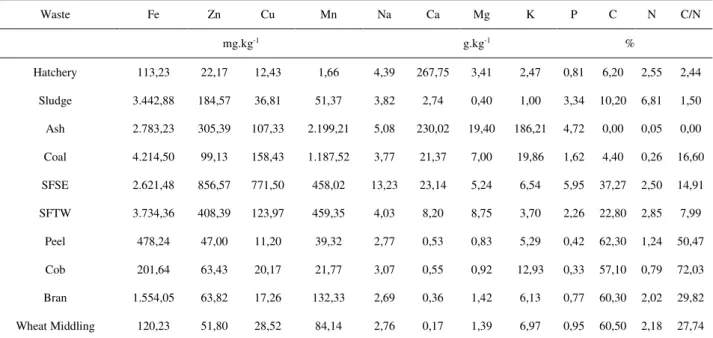
The wastes characterization is presented in Table 1.
TABLE 1. Chemical characterization of wastes used in the experiment.
Waste Fe Zn Cu Mn Na Ca Mg K P C N C/N
mg.kg-1 g.kg-1 %
Hatchery 113,23 22,17 12,43 1,66 4,39 267,75 3,41 2,47 0,81 6,20 2,55 2,44
Sludge 3.442,88 184,57 36,81 51,37 3,82 2,74 0,40 1,00 3,34 10,20 6,81 1,50
Ash 2.783,23 305,39 107,33 2.199,21 5,08 230,02 19,40 186,21 4,72 0,00 0,05 0,00
Coal 4.214,50 99,13 158,43 1.187,52 3,77 21,37 7,00 19,86 1,62 4,40 0,26 16,60
SFSE 2.621,48 856,57 771,50 458,02 13,23 23,14 5,24 6,54 5,95 37,27 2,50 14,91
SFTW 3.734,36 408,39 123,97 459,35 4,03 8,20 8,75 3,70 2,26 22,80 2,85 7,99
Peel 478,24 47,00 11,20 39,32 2,77 0,53 0,83 5,29 0,42 62,30 1,24 50,47
Cob 201,64 63,43 20,17 21,77 3,07 0,55 0,92 12,93 0,33 57,10 0,79 72,03
Bran 1.554,05 63,82 17,26 132,33 2,69 0,36 1,42 6,13 0,77 60,30 2,02 29,82
Wheat Middling 120,23 51,80 28,52 84,14 2,76 0,17 1,39 6,97 0,95 60,50 2,18 27,74
All the windrows have the same composition and contained 300 kg of wastes in natural weight (NW). The composition of the windrows was proportional to the amount of wastes generated in the cooperative. Necessary amount of cleaning and pre-cleaning wastes were used to balance the C:N ratio. The wastes and its respective amount used in kg were: corn cobs (7.5); hatchery waste (5); floatation sludge (31); ash (1); wheat barn (120); wheat middling (120); corn peel (7.5); solid fraction of trucks wash (2); solid fraction of swine excreta (1) and coal (5). The experiment was conducted at the Experimental Center of Agricultural Engineering (NEEA) pertaining to Western Parana State University (UNIOESTE), were there are two composting areas, one built in wood with a concrete floor and cover, and the other an outdoor area floored with PVC (5 mm) canvas to avoid soil contamination.
The 12 treatments were composed by the combination of the three turnings frequencies (F1, F2 and F3), with or without covering of the composting area (C1 and C0), with and without the use of PCB (B1 and B2). The frequencies F1, F2 and F3 correspond to turnings of one, two and three times per week during the first month. In the second month, the turnings were twice a week to F3 and once a week to the other turning frequencies. In the subsequent months the windrows were turned only once a week.
The PCB is a commercial inoculum composed by Bacillus (subtilis, licheniformis e polymyxa) and Yarrowia lipolytica in the concentrations of 3.5 x 10⁶ and 5.5 x 10⁶ CFU g-1, respectively. Following the manufacturer recommendation, the amount used was 20 mL m-3 week-1. As the windrows have approximately 0.5 m3, it was used 10 mL of the productdiluted in 10 L of water in each windrow, weekly, until the stabilization of the material. The windrows in which PCB was used, they were weighted, measured and handled with different equipment to avoid the material contamination by micro-organisms presented in the commercial inoculant.
The temperature was monitored with mercury thermometer in four points per windrow at 20 cm deep. This parameter was used as an indicator of the end of the process, which happens when the windrow reaches the environmental temperature, with a variation of ±3°C for three consecutive days.
The parameters of moisture, mass and volume were weekly monitored. The moisture was measured using an oven, according to APHA (2012) – 2540 B method. The mass was monitored weighting the windrow with a digital balance, while the volume was determined using a wooden box with known dimensions.
The collection of samples to determine pH, electrical conductivity (EC), carbon and nitrogen (for C:N ratio determination) were in the first turning (three days after windrows assembly), at 28 and 56 days and in the end of the process, always after the turnings. It was collected six sub-samples per windrow, which were homogenized resulting in only one sample that was wrapped in a plastic bag, refrigerated and analyzed at the Laboratoty of Agroindustrial Wastes Analysis – LARA. The pH and EC were determined using a countertop pH meter and conductivity meter, respectively, in triplicate. The preparation of the samples followed CUNHA-QUEDA & DUARTE (2008).
To Carbon and Nitrogen determination it was used the methodologies of KIEHL (2010) and MALAVOLTA et al. (1989), respectively.
The final data of composting time, mass and volume percentual reduction, pH, EC and C: N rate reduction was submitted to multiple linear regression analysis in relation to the turnings, composting area covering and PCB inoculation.
RESULTS AND DISCUSSION Temperature and moisture
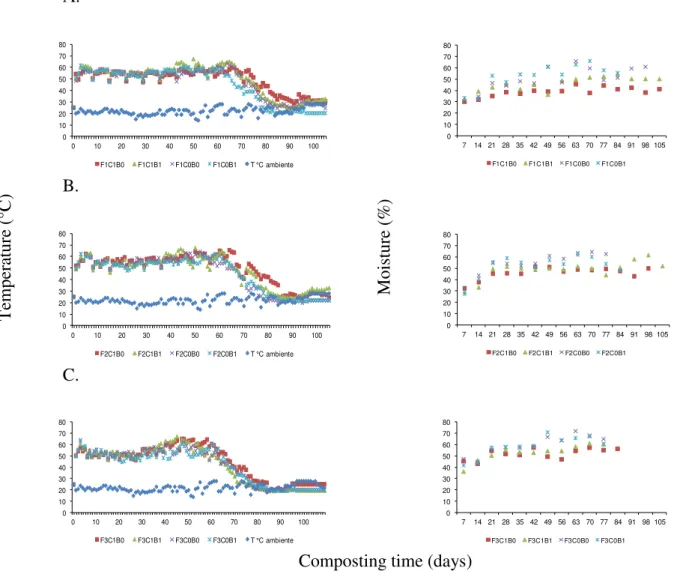
remained heated for longer when compared to the windrows turned twice or three times per week (Figure 1). The frequent turnings allow higher aeration rates; consequently lower average temperatures (RASAPOOR et al., 2009; GETAHUN et al., 2012). According to MASON & MILKE (2005) excessive aeration or frequent turnings in windrows will result in composting mass cooling with consequent impact in the profile of temperature/time. The authors also comment that the thermodynamic factors which affect the heating generation and transfer in the composting system, such as moisture and water vapor transport, natural ventilation, volatilization, oxygen status and patterns of temperature will directly affect the microbiological activity and, consequently, the organic material degradation, which will impact in the composting time.
Te mper atur e (° C ) A. Mois ture (% ) 0 10 20 30 40 50 60 70 80
0 10 20 30 40 50 60 70 80 90 100
F1C1B0 F1C1B1 F1C0B0 F1C0B1 T °C ambiente
0 10 20 30 40 50 60 70 80
7 1421 28 35 42 49 56 63 70 77 84 91 98 105
F1C1B0 F1C1B1 F1C0B0 F1C0B1 B. 0 10 20 30 40 50 60 70 80
0 10 20 30 40 50 60 70 80 90 100
F2C1B0 F2C1B1 F2C0B0 F2C0B1 T °C ambiente
0 10 20 30 40 50 60 70 80
7 14 21 28 35 42 49 56 63 70 77 84 91 98 105
F2C1B0 F2C1B1 F2C0B0 F2C0B1 C. 0 10 20 30 40 50 60 70 80
0 10 20 30 40 50 60 70 80 90 100
F3C1B0 F3C1B1 F3C0B0 F3C0B1 T °C ambiente
0 10 20 30 40 50 60 70 80
7 14 21 28 35 42 49 56 63 70 77 84 91 98 105
F3C1B0 F3C1B1 F3C0B0 F3C0B1 Composting time (days)
FIGURE 1. Daily temperature and weekly moisture in the turned windrows once a week (A), twice a week (B) and three times a week (C).
Initially, the windrows presented lower moisture due to the characteristics of the used wastes. With the turnings and watering, the windrows stayed in the adequate level of moisture, between 50 and 65% (KIEHL, 2010).
the final phase, after the 45th day, should be done in covered area or inside a shack to avoid the nutrients leaching.
Composting time
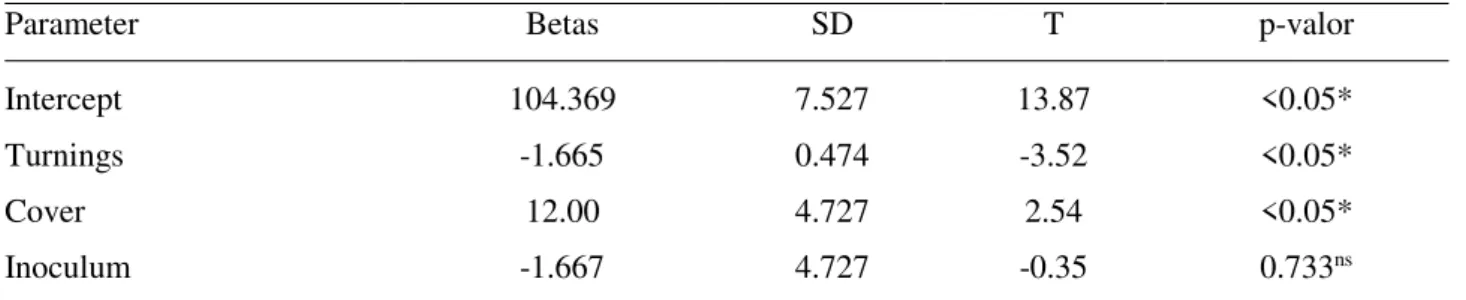
The composting process was considered concluded when the windrow temperature reached the environmental temperature, with a variation of ±3°C remaining at least three days. The composting times were submitted to multiple regression analysis (Table 2).
TABLE 2. Analysis of the parameters related to composting time variable.
Parameter Betas SD T p-valor
Intercept 104.369 7.527 13.87 <0.05*
Turnings -1.665 0.474 -3.52 <0.05*
Cover 12.00 4.727 2.54 <0.05*
Inoculum -1.667 4.727 -0.35 0.733ns
SD = Standart deviation; T = Test value T; ns = not significative at 5%; * = significative at 5%.
The inoculum variable was not significant (p>0.05) and was removed from the model which was summarized to:
CT = 103.54 – 1.67 T + 12.0 C In which,
CT = Composting time estimate (days); T = Turnings at the first 60 days, C = Covering.
The composting times estimate for uncovered windrows are 90.2; 83.5 and 70.1 days for the windrows submitted to the turnings frequencies F1, F2 and F3 respectively. For the covered windrows the estimate times are 102.2; 95.5 and 82.1 days for the windrows submitted to the turnings frequencies F1, F2 and F3 respectively.
Therefore, the windrows conducted in the outdoor area presented shorter composting time, approximately 10 days. While the windrows submitted to three times a week turnings in the first month, regardless the presence of covering, presented shorter composting time, at about 20 days when compared to the windrows turned once a week.
Considering the environmental conditions effect on the composting time, we can observe that at the outdoor area the windrows remained for longer in the ideal track of moisture due to the precipitation, even having been submitted to excessive periods of humidity, as at the 60 days (Figure 1). The maintenance of the humidity in the track of 60% explains the shorter composting time at the uncovered windrows. Besides that, the watering is homogenously realized, which permits that the water infiltrates the whole profile of the windrow. However, care must be taken because in materials with less porosity the excess of humidity can cause anaerobiosis and make the process slower and with strong odors (MAGALHÃES et al., 2006). Besides that, the produced compost at the outdoor area presents lower amount of nutrients due to leaching such as demonstrated by CARNEIRO et al. (2013).
homogenize the material, increase the initial velocity of degradation, control the temperature in the phase of high peaks and promote the lower losses of N, as shown in CARNEIRO et al. (2013).
The use of inoculants can interfere in the degradation of lignin or grease, depending on the used micro-organisms and, consequently in the composting time (ZENG et al., 2010; FENG et al., 2011). However, the micro-organisms must be selected according to the temperature track and the kind of waste used in order not to inhibit the microbial activity. In this study, because it is a test of a commercial product, it was not possible to choose the micro-organisms adaptable to composting process, so we did not observe any effect of the inoculation on the composting time.
Mass and volume reduction
The mass and volume reduction is a result of the organic matter degradation during the composting process (PETRIC et al., 2009).
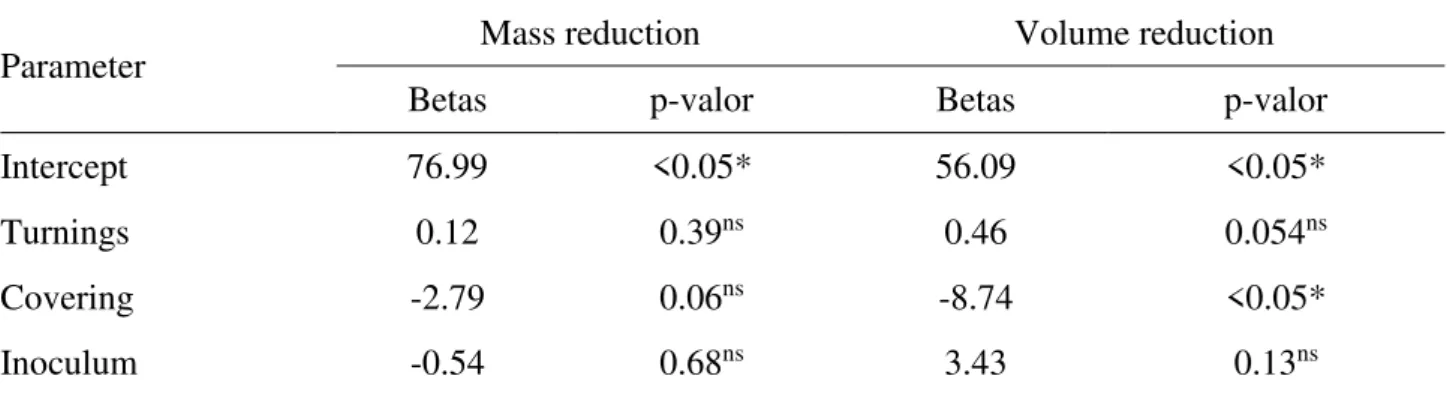
We can observe in Table 3 that the final reduction of mass was not influenced by the studied
factors (p≥0.05), represented by the treatments average (77%). This value is considered high when
compared to the values found by SUNADA et al. (2015) in the composting of agro-industrial wastes from broiler slaughter (50.1%). This fact can be explained by the high degradability of the wastes used in this study and by the adequate C: N ratio.
TABLE 3. Analysis of the parameters related to mass and volume reduction variables.
Parameter Mass reduction Volume reduction
Betas p-valor Betas p-valor
Intercept 76.99 <0.05* 56.09 <0.05*
Turnings 0.12 0.39ns 0.46 0.054ns
Covering -2.79 0.06ns -8.74 <0.05*
Inoculum -0.54 0.68ns 3.43 0.13ns
ns = not significative at 5%; * = significative at 5%.
Concerning the volume reduction, we can observe in Table 3 that the variables turnings and inoculum were not significant at 5% by T Test (p>0.05), while the covering and intercept were significant (p>0.05). It is recommended in this case to remove the non-significant variables; however, the removal of the variable turning would make the coefficient of determination lose the sense because this variable is quantitative while the others are qualitative. Thus we have opted to the removal of the variable inoculum; therefore it started to have two replicates for each combination of turning frequency with the condition of covered and outdoor. The model of volume reduction was summarized as:
VR = 58.6 + 0.461 T – 8.74 C In which,
VR = Volume reduction (%); T = Turnings,
C = Covering.
uncovered windrows under heavy rains lose material by drag. Other factors such as waste composition, turning frequency, particle size and windrows size can favor the mass and volume loss in composting process.
pH and electrical conductivity
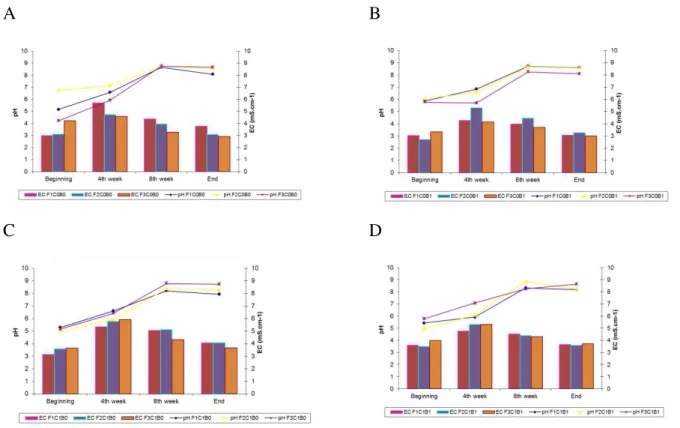
The initial pH stayed around 5, then was near neutrality at the 28th day, but reached its maximum value at the 56th day, with values near to 9. We can observe in Figure 2 that from the 8th week there was a slight acidification caused by some organic acids release (CÁCERES et al., 2006; BRITO et al., 2009).
The EC values increased from the 1th to the 4th week. After this, they decreased being at the end of the process near the initial levels. The organic substances degradation release mineral salts, increasing EC in the first days of composting (HUANG et al., 2004; CÁCERES et al., 2006). However, after a period of great degradation, the windrows presented a reduction in EC, mainly in the uncovered windrows, due to nutrients leaching (CARNEIRO et al., 2013).
A B
C D
FIGURE 2. pH and EC in the uncovered windrows without PCB (A) and with PCB (B); covered without PCB (C) and with PCB (D).
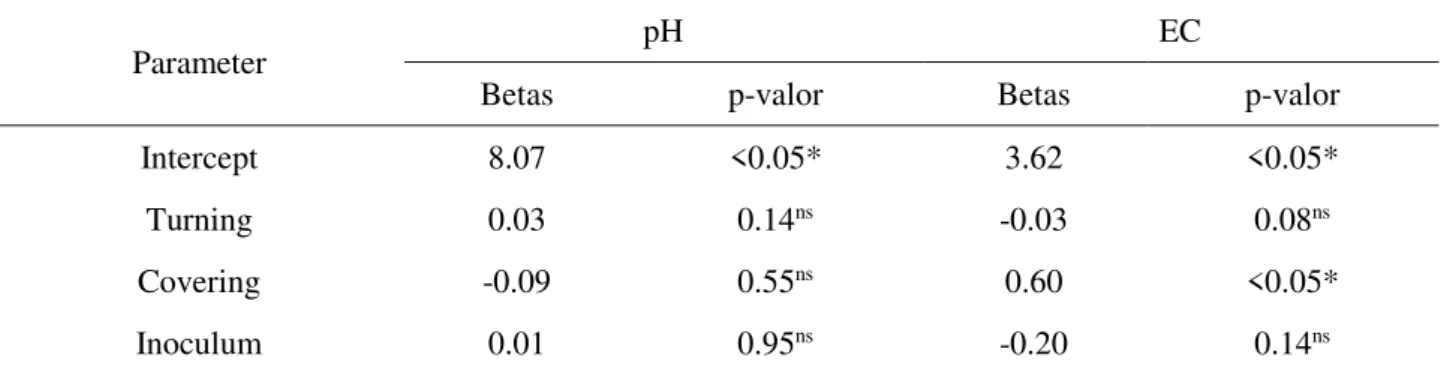
TABLE 4. Analysis of the parameters related to pH and EC variables.
Parameter pH EC
Betas p-valor Betas p-valor
Intercept 8.07 <0.05* 3.62 <0.05*
Turning 0.03 0.14ns -0.03 0.08ns
Covering -0.09 0.55ns 0.60 <0.05*
Inoculum 0.01 0.95ns -0.20 0.14ns
ns = Not significant at 5%; * = significant at 5%.
The inoculum variable was not significant and was removed from the model, which was summarized as:
EC = 3.52 – 0.0252 T + 0.603 C In which,
EC = Electrical conductivity (mS cm-1); T = Turnings;
C = Covering.
Applying the original values to the model, the EC of the final compost to the windrows turned once a week would be 3.32 and 3.92 mS cm-1 for the uncovered and covered conditions, respectively. Thus, the lack of covering of the composting area results in EC values around 15% less when compared to the windrows in the covered area.
C:N Ratio
The relation between the elements carbon and nitrogen express the ease and the speed in which the organic wastes degrade. Material with high C:N ratio remains for longer in the composting area, while, those with lower C:N ratio quickly degrade, losing high amounts of N in the atmosphere.
In the composting process the C:N ratio indicates the compost degree of maturity because its reduction is caused by organic carbon decomposition by the micro-organisms. When the C:N ratio does not decrease anymore the compost is considered stabilized (BERNAL et al., 2009). Figure 3 shows the C:N ratio behavior during the process.
There was a reduction in the C:N ratio during the period in all treatments showing that the option in finishing the process due to temperature coincided with the decrease of this parameter. Other researchers have found reductions in this parameter (ZHU, 2004, LI et al., 2008; CAYUELA et al., 2009; GAO et al., 2010).
FIGURE 3. C:N ratio in the covered (A) and uncovered (B) windrows.
Based on the reductions of C:N ratio we have held a multiple regression analysis aiming to determine the influence of the turnings, inoculation and composting area covering related to compost C:N ratio (Table 5).
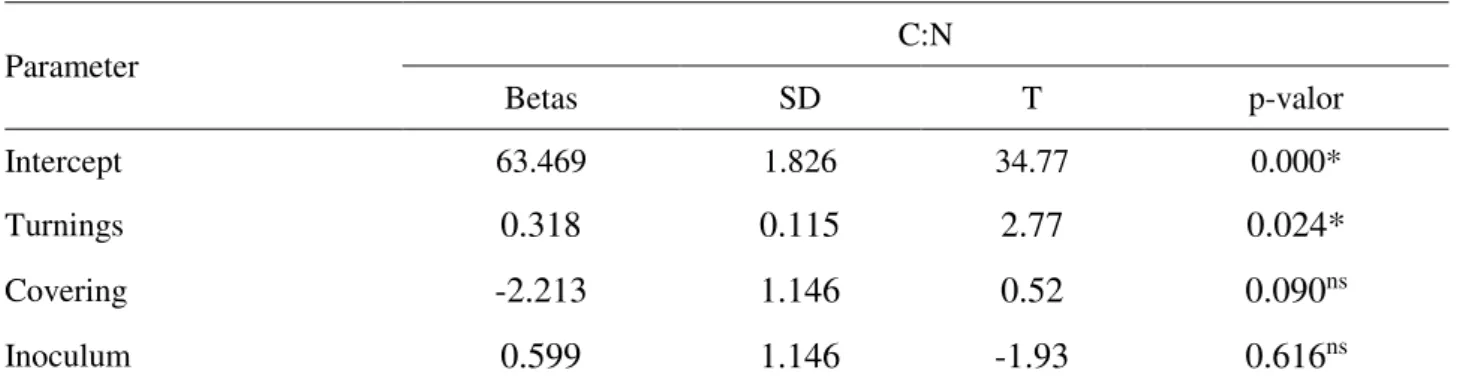
TABLE 5. Analysis of the parameters related to C:N ratio reduction.
Parameter C:N
Betas SD T p-valor
Intercept 63.469 1.826 34.77 0.000*
Turnings 0.318 0.115 2.77 0.024*
Covering -2.213 1.146 0.52 0.090ns
Inoculum 0.599 1.146 -1.93 0.616ns
SD = Standard Deviation; T = Test T value; ns = Not significant at 5%; * = significant at 5%.
The turnings were significant in the reduction of C:N ratio (p<0.05). The variables inoculum and composting area covering were not significant (p>0.05), therefore, they must be removed from the model. The model is described below:
CNR = 62.7 + 0.318 T In which,
CNR = C:N ratio reduction (%), T = Turnings.
The estimate reductions for C:N ratio are 62.5; 66.52 and 69.1% for the turning frequencies F1, F2 and F3, respectively. Similar reductions were reported by BRITO et al. (2009) in the composting of cattle slurry solid fraction and KARNCHANAWONG & SURIYANON (2011), in the composting of food wastes, while CEKMECELIOGLU et al. (2005) report lower reductions around 36%.
Although the turnings influence in the C:N ratio of the final compost, all the windrows presented ratios less than 10, therefore the compost can be considered stabilized. The C:N ratio of the final compost is subjected mainly to the used wastes as a carbon source, its degradability and the availability of carbon to the micro-organisms.
CONCLUSIONS
The frequent turnings in the beginning of the composting promote adequate control of the temperature and accelerate the process. Uncovered windrows present less composting time and great volume reduction; however they lose nutrients by leaching.
REFERENCES
APHA – AMERICAN PUBLIC HEALTH ASSOCIATION. Standard methods for the
examination of water and wastewater – Método 2540 B. 21th ed. Washington, DC: APHA, 2012. ALI, M.; KAZMI, A.A.; AHMED, N. Study on effects of temperature, moisture and pH in
degradation and degradation kinetics of aldrin, endosulfan, lindane pesticides during full-scale continuous rotary drum composting. Chemosphere, Oxford, v.102, p. 68–75, 2014.
BERNAL, M.P; ALBURQUERQUE, J.A.; MORAL, R. Composting of animal manures and
BRITO, L. M.; AMARO, A. L.; FERNANDES, A. S. Efeito do arejamento no processo de compostagem da fracção sólida do chorume de pecuária leiteira. Revista de Ciências Agrárias, Recife, v.32 n.1, p. 298-311, 2009.
CÁCERES, R.; FLOTATS, X.; MARFÀ, O. Changes in the chemical and physicochemical
properties of the solid fraction of cattle slurry during composting using different aeration strategies. Waste Management, Elmsford,v. 26, p. 1081–1091, 2006.
CARNEIRO, L. J. ; COSTA, M. S. S. DE M. ; COSTA, L. A. DE M. ; MARTINS, M. F. L. ; ROZATTI, M. A. T. Nutrient loss in composting of agroindustrial residues. Engenharia Agrícola, Jaboticabal, v. 33, p. 796-807, 2013.
CAYUELA, M. L.; MONDINI, C.; INSAM, H.; SINNICO, T.; FRANKE-WHITTLE, I. Plant and animal wastes composting: Effects of the N source on process performance. Bioresource
Technology, New York, v. 100, p. 3096-3106, 2009.
CEKMECELIOGLU, D.; DEMERCI, A.; GRAVES, R. E.; DAVITT, N.H. Applicability of optimised in-vessel food waste composting for windrow systems. Biosystems Engineering, London, v. 91, p. 479-486, 2005.
COOK, K.L.; RITCHEY, E.L.; LOUGHRIN , J.H.; HALEY, M.; SISTANI, K.R.; BOLSTER, C.H. Effect of turning frequency and season on composting materials from swine high-rise facilities. Waste Management, Elmsford, v.39, p. 86–95, 2015.
CUNHA-QUEDA, A.C.; DUARTE, E.A. Guia de métodos de análise laboratorial para apoio às sessões laboratoriais. Lisboa: Universidade Técnica de Lisboa - Instituto Superior de Agronomia. 2008. 43p.
FENG, C.L.; ZENG, G.M.; HUANG, D.L.; HU, S.; ZHAO, M.; LAI, C.; HUANG, C.; WEI, Z.; LI, N. Effect of ligninolytic enzymes on lignin degradation and carbon utilization during lignocellulosic waste composting. Process Biochemistry, New York, v. 46, p.1515–1520, 2011.
GAO, M.; LI, B.; YU, A.; LIANG, F.; YANG, F.; SUN, Y. The effect of aeration rate on
forcedaeration composting of chicken manure and sawdust. Bioresource Technology, New York, v. 101, p. 1899-1903, 2010.
GETAHUN, T.; NIGUSIE, A.; ENTELE, T.; VAN GERVEN, T.; BRUGGEN, B. Van der. Effect of turning frequencies on composting biodegradable municipal solid waste quality. Resources, Conservation, and Recycling, Amsterdam, v. 65, p. 79– 84, 2012.
GRIGATTI, M.; CAVANI, L.; CIAVATTA, C. A multivariate approach to the study of the
composting process by means of analytical electrofocusing. Waste Management, Elmsford,v. 27, p. 1072–1082, 2007.
GUO, R.; LI,G.; JIANG, T.; SCHUCHARDT, F.; CHEN, T.; ZHAO,Y.; SHEN, Y. Effect of aeration rate, C/N ratio and moisture content on the stability and maturity of compost. Bioresource Technology, Elmsford, v. 112, p.171–178, 2012.
HUANG, G.F., WONG, J.W.C., WU, Q.T., NAGAR, B.B. Effect of C/N on composting of pig manure with sawdust. Waste Management, Elmsford, v.24, p.805–813, 2004.
JIANG, J.; LIU, X.; HUANG, Y..; HUANG, H. Inoculation with nitrogen turnover bacterial agent appropriately increasing nitrogen and promoting maturity in pig manure composting. Waste Management, Elmsford, v. 39, p. 78–85, 2015a.
JIANG, T.; LI, G.; TANG, Q.; MA, X.; WANG, G.; SCHUCHARDT, F. Effects of aeration
JURADO, M.M; SUÁREZ-ESTRELLA, F.; VARGAS-GARCÍA, M.C.; LÓPEZ, M.J.; LÓPEZ-GONZÁLEZ, J.A.; MORENO, J. Increasing native microbiota in lignocellulosic waste composting: Effects on process efficiency and final product maturity. Process Biochemistry, New York, v.49, p.1958-1969, 2014.
KARNCHANAWONG, S.; SURIYANON, N. Household organic waste composting using bins with different types of passive aeration. Resources, Conservation, and Recycling, Amsterdam, v. 55, p. 548–553, 2011.
KE, G-R.; LAI, C-M.; LIU, Y-Y.; YANG, S-S. Inoculation of food waste with the thermo-tolerant lipolytic actinomycete Thermoactinomyces vulgaris A31 and maturity evaluation of the compost. Bioresource Technology, New York, v. 101, p. 7424–7431, 2010.
KIEHL, E. J. Novo fertilizantes orgânicos. Piracicaba: Agronômica Ceres, 2010. 238 p. LI, X.; ZHANG, R.; PANG, Y. Characteristics of dairy manure composting with rice straw. Bioresource Technology, New York, v. 99, p. 359–367, 2008.
MAGALHÃES, M. A. de MATOS; A. T. de; DENÍCULI, W.; TINOCO, I. F. F. Compostagem de bagaço de cana-de-açúcar triturado utilizado como material filtrante de águas residuárias da
suinocultura. Revista Brasileira de Engenharia Agrícola e Ambiental, Campina Grande, v.10, n.2, p.466–471, 2006.
MALAVOLTA, E.; VITTI, G.C.; OLIVEIRA, S.A. Avaliação do estado nutricional das plantas: princípios e aplicações. Piracicaba: POTAFOS, 1989. 201 p.
MAREŠOVÁ, K.; KOLLÁROVÁ, M. Influence of compost covers on the efficiency of biowaste
composting process. Waste Management, Elmsford, v. 30, p. 2469–2474, 2010.
MASON, I.G.; MILKE, M.W. Physical modelling of the composting environment: A review. Part 1: Reactor systems. Waste Management, Elmsford, v.25, p.481-500.
doi:10.1016/j.wasman.2005.01.015.
ORRICO JUNIOR, M. A. P.; ORRICO, A. C. A. & LUCAS JUNIOR, J. de. Compostagem dos resíduos da produção avícola: cama de frangos e carcaças de aves. Engenharia Agrícola, Jaboticabal, v.30, n.3, p. 538-545, 2010.
PETRIC, I.; SESTAN, A.; SESTAN, I. Influence of wheat straw addition on composting of poultry manure. Process Safety and Environmental Protection, Basingstoke, v. 87, p. 206-212, 2009. RASAPOOR, M.; NASRABADI, T.; KAMALI, M.; HOVEIDI, H. The effects of aeration rate on generated compost quality, using aerated static pile method. Waste Management, Elmsford,v.29, p. 570–573, 2009.
SADEF, Y.; POULSEN, T.G.; BESTER, K. Impact of compost process temperature on organic micro-pollutant degradation. The Science of the Total Environment, Amsterdam, v. 494–495, p. 306–312, 2014.
SUNADA, N.DA S.; ORRICO, A.C.A.; ORRICO JUNIOR, M.A.P.; CENTURION, S.R.; OLIVEIRA, A.B.DE M.; FERNANDES, A.R.M.; LUCAS JUNIOR, J.DE.; SENO, L.DE O. Compostagem de resíduo sólido de abatedouro avícola. Ciência Rural, Santa Maria,v.45, n.1, jan. 2015. Disponível em:
<http://www.scielo.br/pdf/cr/2014nahead/0103-8478-cr-0103-8478cr20120261.pdf>. Acesso em: 12 jul. 2015. doi:10.1590/0103-8478cr20120261
VARGAS-GARCIA, M. C.; SUÁREZ-ESTRELLA, F.; LÓPEZ, M. J.; MORENO, J. Microbial population dynamics and enzyme activities in composting processes with different starting materials. Waste Management, Elmsford, v. 30, p. 771-778, 2010.