Copyright © 2010 Carlos Filipe Campos Rompante da Cunha, Emanuel Soares Peres Correia,
Raul Manuel Pereira Morais dos Santos, and Manuel José Cabral dos Santos Reis. This is an open access article distributed under the Creative Commons Attribution License unported 3.0, which permits unrestricted use, distribution, and reproduction in any medium, provided that original work is properly cited.
Contact Author: Carlos Filipe Campos Rompante da Cunha, e-mail: [email protected]
Enhancing Tourism through
Viticulture Enterprises in Douro
Region: The Inov@Douro Model
Carlos Filipe Campos Rompante da Cunha
1,3, Emanuel Soares Peres Correia
2,3,
Raul Manuel Pereira Morais dos Santos
2,3, and Manuel José Cabral dos Santos Reis
21
Polytechnic Institute of Bragança, 5301-854 Bragança, Portugal
2
University of Trás-os-Montes e Alto Douro, 5001-801 Vila Real, Portugal
3
! " # $
____________________________________________________________________________________
Abstract
This paper describes a business and technological model proposal, known as Inov@Douro, intended to support and to promote competitive and sustained precision agriculture practices in the Portuguese Douro Region. Our approach is based on a distributed cooperative network, tailored to meet the specific needs of viticulture enterprises which also explore tourism as a valuable national and international business source. We present the Inov@Douro model from the knowledge generation point-of-view, intended to support the multidisciplinary concept of a cooperation approach among regional partners. This model aims to represent a new working style for this unique region. As a guideline to attain the implementation of such a model, information technology and infrastructures tools are discussed in order to promote precision agriculture practices while giving valuable and dynamic tourist information to the general public.
Keywords: Cooperative networks, Model, Precision viticulture, Tourism
_________________________________________________________________________________________________________________
Introduction
Precision Viticulture (PV) in the Portuguese Douro Demarcated Region (DDR) is still at its
early development stage despite the
economic, social and environmental benefits that may be achieved. The DDR is located in northeast Portugal, and consists mostly of steep hills (slopes reaching 15%) and narrow valleys that flatten out into plateau above 400m. The Douro River digs deeply into the mountains to form its bed, and the dominant element of the landscape are the vineyards, planted in terraces, fashioned from the steep
point of view, a fundamental success driver for a sustained development of the DDR in winemaking and tourism which is the key to the present proposal.
Although the lack of technology adoption, the current trend in the field of information
technology (IT) made possible the
monitoring of a comprehensive set of parameters that reflect the behavior of a given physical process. Many of these parameters reflect not only the evolution of a given process or its magnitude, but it also allows inferring about its dynamic. However, the monitoring of these parameters will only result in a real added value to production and economic processes if data gathering is followed by proper processing. The main
goal should always be information
production and sustained knowledge
generation, fostering their distribution by the entities interested in taking advantage of the generated knowledge, applying it in their working practices.
Precision Agriculture (PA), is information intense (Stafford, 2000), it is technological based (Cox, 2002), but some studies have shown that, although there is generally an optimism related to PA, there are some difficulties in verifying the economic gains (Pedersen et. al., 2003) regarding its sustainability. There are also concerns about the lack of computer literacy, integration, requirement of inputs (data) and effective fitting of existing information and farmer working patterns (Alvarez and Nuthall, 2006). The majority of farmers never used DSS or computers planning models. Instead, farmers' focus is the production and the optimization and not the technology itself. We believe this is why PA is not really widespread. Based on this fact, a key issue
must be addressed: how to sustain effective PA practices in DDR? If we analyze what other industries/areas have done in the last few years, concerning information systems, we will notice an enormous difference on the
introduction, assimilation, results, and
perspective that IT have aided to achieved. It is also interesting to notice that many of that successfully applied technologies could offer enormous benefits to PA (the base capability and needs are the same; the application field is the only difference).
This paper describes a business and technological model proposal that aims to contribute for implement real large scale competitive and sustained PA for the DDR that can also be applied to other places, beyond DDR. Our approach is to use a distributed cooperative network model, along with the analysis of operational issues such as acquisition, transmission, data aggregation, and information integration but,
based on a knowledge generation
perspective. The presented cooperative model covers economical and technological view points. Its focus is to promote PA
practices (e.g., plague and diseases
detections, DSS, etc.), while creating
economical sustainability viability of the model (e.g., tourism support). The paper ends with the discussion of tourism as a key area, capable to bridge the gap between PA needs and economic viability on DDR.
Cooperative network: new farm and farmer concept
Organizations sought new types of
interconnected. This interconnection movement translates and materializes the networking concept, which can be seen as the capability that organizations enclose to establish cooperative mechanisms with other organizations, through fast and efficient
interconnection of business products
supported by technological platforms
(Osterle et. al., 2001). There are many cooperation examples among pharmacy organizations (e.g., R&D projects) or open-source communities (e.g., software systems development) (Buxmann and Koning, 2000). However, even though several activity sectors have changed their business models, the agriculture sector has not followed the same pattern. Therefore, it is crucial to understand why this happens. Some of the barriers to information systems adoption are reported in Alvarez and Nuthall (2006): failure in fitting with farmer working patterns; requirements of data inputs that are not familiar or available; lack of computer literacy; lack of integration; and unclear cost-benefit relationship. We think that the two major reasons for the non adoption by natural evolution of new business models and IT in PA, as it was done
in other industries, are: inadequate
information supply based and focused on the farmer; and incorrect and invisible data integration capable to generate applicable knowledge for strategic management. But if these aspects do explain the low IT introduction, they do not explain the lack of cooperation among farmers and several organizations related with agriculture. So what is the major goal of cooperation? What can be their gains?
We follow the vision that the best results are achieved when every organization within a cooperative group, do what is best for him-self and the group. This vision is sustained by the gains that can be achieved by
interconnecting several and complementary
data, information sources, skills, and
knowledge. Whenever in a group everyone can try to eliminate its weaknesses and generate new strengths.
The majority of farmers has never used DSS or computerized planning models, they are
focused on production, rather than
exploration research, and they do not have time to do data interpretation (Kuhlmann and Brodersen, 2001). What they really want is that someone or something gives her/him an action course, a recipe that will save time and prevents or solves their problems (Burrell at. al., 2004). We sustain that cooperation can bridge the gap between the farmer's needs and profile technological opportunities, if we interconnect the concept of a farm lab and multi information (and services) providers. When we interconnect one specific farm with other farms we will be able to share public data, information, and knowledge, so everyone can cross them with
their private data, information, and
knowledge. The result will be new better
public and private information and
knowledge. But as previously mentioned, farmers do not have the necessary skills to carry out and support those interconnections (e.g., IT needs, consulting advising). Typically these skills exist, though they are scattered
by technological enterprises, sector
associations, biologic advisers, research labs, and many other. The cooperative perspective translates the benefits of interconnecting those different enterprises and the farms network, creating cooperative networks that
interchange data, information, and
knowledge. Under these cooperative
Information sources
In PA practices, classical information sources
are usually obtained through data
acquisition. There are several instruments
capable of measuring many relevant
variables for productive systems (e.g., temperature and humidity). Geographic Information Systems (GIS) are also important data sources (e.g., imagery remote sensing). The main goal of the sensors' network is to promote a proactive computing capability that enables the ability of interpreting data, and trigger concrete actions, for example, fight plagues (Wang et. al., 2006) or pests (Koumpouros et. al., 2004). The recent technological advances in sensors and wireless communications have lead to sensors' networks that are being seen as one of the most important tools to a timely detection of problems through continuous monitoring and surveillance of the base parameters that can be capable of trigger perception of undesirable events on farms.
Although sensors are capable of providing data, there is a huge gap between having data and having applicable information. In our case, this perspective is sustained by the previously noted fact that farmers usually do not have the right skills to interpret data, generate information, and truly explore the knowledge that could be attained through data. If a farmer is capable to start a relation with IT specialists and other complementary specialists (e.g., crop consulting advisor), then he can manage a symbiotic relation giving him the possibility to integrate data and generate information. This could also
afford for information storage on
repositories and several important services
for farmer's daily work and farm
management. By giving the farmer some decision support we will be contributing with some proactive actions that he will apply on
his work. If the results of these actions are stored in the information repository we can achieve a second level of knowledge generation: the analysis and transformation
of information based on rules and
procedures that will be embedded on a DSS. This materializes the Online Analytical Processing (OLAP) along with the application of data mining.
In a cooperative network the perspective of farm information source is far larger than a sensor and GIS basis; it must include public and private sources of other farms and other complementary private industries, and also governmental entities.
Tailor the information to farmers needs Farmers have particular needs. They may not have the necessary skills or focus for IT and OLAP analysis, but they sure want to have better support information for their daily work and some help to crops and soil management; for example, by having timely diseases detection systems and adequate advising to apply the correct treatments. If, for example, a particular industry has constantly asked the IT market to develop a new technology to support its needs, the agricultural sector has not followed the same criteria/philosophy. There are researchers and some IT industry groups which are pressing for the materialization of the farm lab concept. The problem can be now formulated: how to tailor information to the needs of farmers if they do not define their information profile? To address this issue, we must first note that every individual has unique characteristics, such as the academic literacy, capability of contents assimilation, and the information needs to its working system process.
users there are divergent perspectives about the criteria and the needs for a successful working environment (Bair, 1995). These divergences will necessarily conduct to systems that are poorly configured to the end users and almost unhelpful. In this context, we assume that it is necessary to analyze function by function needs, or even individual by individual needs, as well as the
way and the shape of information
representation that is provided. The
challenge will be the development of technological platforms for the management of agricultural systems able to monitor and
control, while providing friendly
management interfaces, configured to the farmer's profile.
Knowledge generation
The cooperative network approach
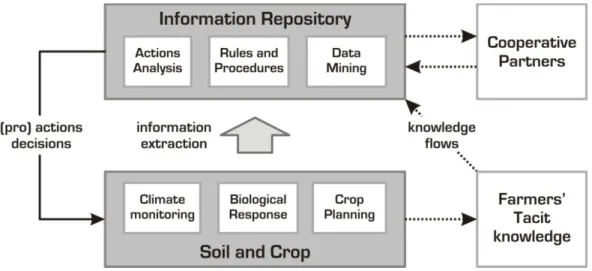
introduces a new philosophy for knowledge generation. Figure 1 shows the most
important relationships for knowledge
generation and integration. The main bases are the information sources that can be achieved by classic methods, like data acquisition networks and GIS, human being tacit knowledge, and, most important for this
approach, the public and private information and knowledge of all partners that contribute to the (cooperative) network (and with whom the share of information and
knowledge is made). The distributed
knowledge bases that can be achieved by cooperation can also be used to make high level decisions for the management of the premises of connected members, presented in Sigrimis et. al. (1999) as Virtual Agricultural Networks. The next step should be the storage of that information and knowledge on farm repositories. The analysis and transformation information processes, as well as rules, store procedures, and trigger mechanisms, should also be made there. This layer is the decisions supplier to the extent that should advise the farmer on the need to implement actions, either being reactive or proactive (most desirable) actions. Lastly, it is of primordial importance to analyze the return of those actions, either because they have been successful or unsuccessful (by the nature of the actions taken or unexpected or
uncontrollable issues). The resulting
conclusion should necessarily be stored in the repository and will contribute to improve future decisions for similar initial conditions.
Fig 1. Cooperative generation of knowledge perspective
Organizations are increasingly focused on their core competencies and on finding other complementary and needed competencies
through cooperation (Kitchen, 2008).
Precision agriculture is information intensive and the needed skills to support and sustain an integrated farm concept are much larger than the farm perimeter. To achieve these goals, cooperative connections must be established between partners that have
complementary skills or interests in
exploiting PA natural resources, in an
economical sustained perspective (e.g.,
tourism and DDR precision viticulture procedures).
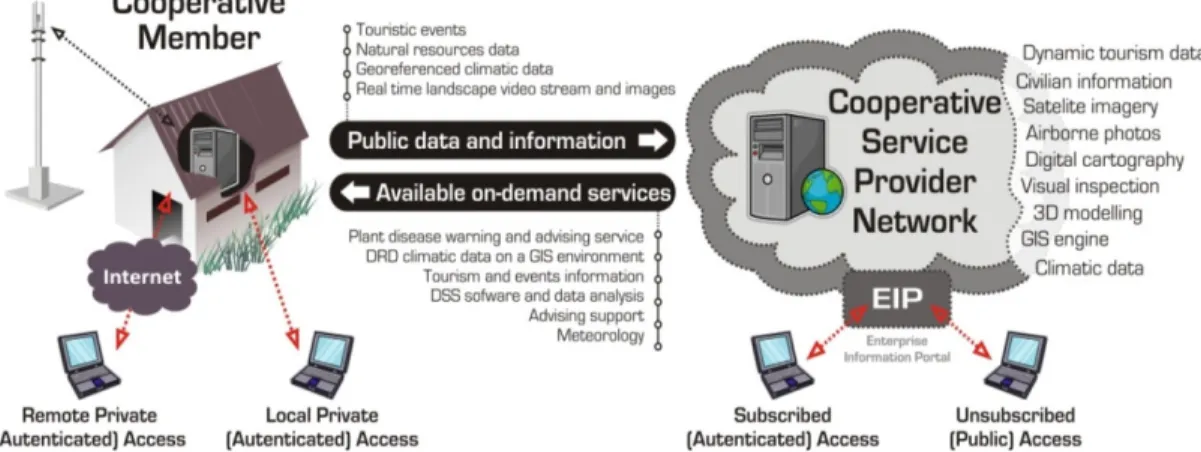
Our cooperative network model is presented in Figure 2, where a cooperative model, is used to translate the PA cooperation
mechanisms, aiming a sustained
implementation. The new business
perspective can be described as:
• A "cooperative network", which can
be defined as a cooperation
infrastructure among different farms that translates the interchange of
public data and/or public
information. The main goal is to share information and knowledge, and cross that information with other information types and sources. The result will certainly be a more precise information and knowledge in order to face the farmer daily work, as planning and management issues. This interoperability offers
the organizational system the
management mechanisms that
maximize opportunities to exchange and re-use the internal or external information (Miller, 2000).
• Cooperative service provider
network can be defined as an information and services repository that provides effective help to farmers' needs. It represents the public information library for PA, through the capability to integrate the PA sector knowledge, as well as complementary knowledge archived by cooperation with other external
entities (e.g., meteorological
services, GIS providers, universities). One of its main contributions to farmers is the ability to provide,
low-cost, public information (e.g.,
meteorological information, satellite images) and services (e.g., soil, crop, business, and IT advising) that individual farmers cannot achieve because it is economically enviable.
• External partner’s entities can be
defined as external partnerships that are made. They can work in two different perspectives: the way to
acquire data, information and
external knowledge that
complement the support to farmers' needs; a platform to support services based on PA natural resources (e.g. rural tourism).
• Summarizing, it is desirable to
Fig 2. Cooperative model illustrating the major business information/services interchange
The materialization of this concept
represents an enormous multi-domain
challenge (Schulze et. al., 2007) (e.g.,
sociological, effective farmers' needs
comprehension, IT infrastructure). The
architecture of the information system, being a concept enabler, is a vital issue to support the cooperative network.
Technological cooperative network model proposal
The cooperative network business model necessarily builds upon Information Systems
(IS). Its perspective must be IT
multidisciplinary to bridge the gap among
collecting and transmitting raw data,
integrating those data to generate helpful information, and finally to extract knowledge in a time analysis perspective. PA is information intense, but only an integrated IS, capable of fusing engineering and
agronomic knowledge, can effectively
increase value from data collection to strategic management (Kitchen, 2008). The presented model covers intelligent data acquisition, transmission, integration, and information access issues, as well as a cooperative enterprise information portal (EIP) concept. The core perspective is to support effective farmers' daily needs, by
letting the farmer decide what type of data and information he needs, paralleled with
data, information and knowledge
cooperation, among several farms, as well as with complementary organizations that have core skills which can be applied to agronomic needs.
Wireless sensor networks for vineyard variability studies
The PA information is achieved through several levels of technology and networking. One of those levels is the hardware itself where microelectronics and sensors are of main importance. The use or development of
sensors for infield measurements or
integrated in agricultural machinery has motivated further research in this area.
Devices, equipment and responsive
mechanism actuators also needs some research. More specifically, wireless sensors are special enablers of several sensor applications, such as monitoring remote areas and locations, where otherwise would be very difficult to collect data (Wang et. al., 2006). Sensor networks are responsible for raw data acquisition.
span across the day and year. This uniqueness demands the existence of distributed monitoring, with processing capabilities to help farmers understanding vineyards variability so that they can manage them effectively, improving the quantity and quality of their wines. To face this challenge, wireless sensor network are commonly used to measure key parameters in variability studies.
Gateway as a field server
Studies involving vineyard variability require a huge amount of sensor data which makes the task of getting meaningful information from disparate sensors nodes deployed as WSN not trivial one. Besides network availability and scalability, traffic overhead, node hardware and energy issues, the heterogeneity of each sensor node or data
acquisition device, makes extraction,
aggregation and making available sensor data at the processing elements much harder. To address these issues, each management zone, or cluster, has a sink node operating as a cluster head (CH) that is responsible for
storing all rules and procedures of
programmed and real-time sensor
acquisition (i.e., defines the sensor and actuators network behavior), as well as providing multi-protocol network access (e.g., Bluetooth, Wi-Fi) to query past and real-time field acquired data (Morais et. al., 2008). This CH is the link between the "acquisition area" and the farm operation centre. This last is translated by a data base server and application server responsible for the integration of the network sensor acquired data, GIS information as well as other data and information that the farmer is interested to integrate. It also does the
management of the cluster head rules and procedures. Everything is finally mixed with top rules and procedures that try to act proactively anticipating possible problems, react to undesirable scenarios, and extract knowledge on a time basis perspective. The aim is to provide daily planning information to help the farmer to achieve his objectives.
The main functions of the CH are: sensor network coordination. To achieve this, the CH is composed by a database with rules and procedures. It describes how the sensor network is intended to work (e.g. define when to capture data such as temperature, image acquisition) as well how the network must behave (reactive or pro-active) when a set of factors are presented (e.g. send an order to an irrigation management system if a humidity parameter is low). As second objective, the CH must be able to report
relevant information to the office
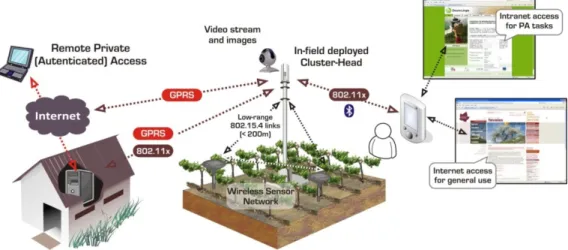
Fig 3. Accessing public and private data through in-field cluster-head, as a sink node for wireless sensor network data and as a public service provider
The office management level
The office management is the farm lab command center, represented by a computer based system, having a data warehouse where all the data acquired by the sensor network is stored, as well as different data introduced by the farmer whether to express tacit knowledge or by acquisition from other information sources. It also should have several services that will help farmers' with daily activities and management work. To achieve the status of "farm lab" some requisites need to be satisfied. In Murakami et. al. (2007) is described the major requirements for PA. From our perspective, in a cooperative scenario, the following features must be included:
• The system must support secure
cooperative interconnections with other systems.
• The knowledge generation needs to
support business intelligence,
information management, OLAP and content management mechanisms.
All this is needed to transform data and obtain real-time information and sustained knowledge.
• Cooperative functions, such as
sharing public data to other
cooperative network partners.
• Pro-active mechanisms/services,
providing alert and response to an emerging scenario. This response can be farm based or act in a wider extension being able of triggering response mechanisms to the full
extension of the cooperative
network.
• Capability to have upload services.
The possibility of uploading new services (developed by partners
such as R&D organization),
The combination of data acquisition, cluster head and farm repository will be an operational help to daily farmer activities and the information management will help on the management of soil and crop planning; finally, the generated knowledge
will lead to better operational and
management solutions in the future (i.e. in
similar scenario). But although the
aforementioned model covers the farm perimeter; cooperative model extends the farmer dimension by the need to enlarge the information, knowledge and skills to others sources and at the same time have a share perspective of public data, information and knowledge to the farms that cooperate with
us as to other organizations included on the cooperative network (e.g. R&D organizations, tourism sector, e-government). The result will be a cooperative network supported by an IT infrastructure capable to respond to farmer perimeter needs, support cooperation to several organizations, and integrate the public sector knowledge as well provides services to the sector and complementary sectors. The presented technological model also can effectively respond to the tourism sector by being an enabler of services based
on the PA information system. The
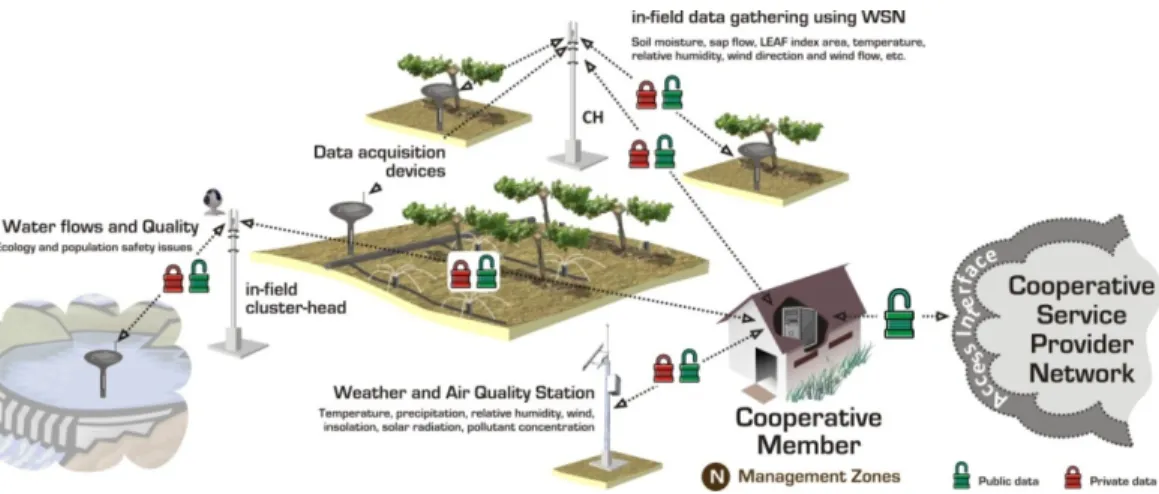
technological infrastructure designed to support the cooperative network business model concept can be seen in Figure 4.
Fig 4. Technologic infrastructure model with illustration of public and private data
Enterprise information portal
The EIP can be defined as a unified architecture, capable of combining powerful tools that can provide knowledge to the business decision support systems. This support can be distributed to different organization levels (i.e. operational, tactic and strategic level) and its main goal is to provide knowledge to the PA sector characterized by having great amount of
data, poor information resources and an inexistent stored knowledge repository.
external needs, like tourism industries that in DDR have mutual interests. Also EIP can be an interconnecting gateway between the PA sector and the governmental entities, focused on farmers (e.g. agro financial programs, agriculture ministry).
Services platform over the cooperative network infrastructure
In the DDR, there is a natural interconnection between tourism and viticulture. It is the vine, mainly the well known Oporto wine and rural and agro-tourism that drive and sustain the economic activity in the region. The
proposed business and technological
architecture can simultaneously cover the needs of PA and tourism, achieving, with this symbiotic relation, the support for the
economical sustainability of PA
requirements. The same range of data and also the same technological infrastructure that can help farmers to drive successfully crop and soil management, can also support tourism services. One first feature is image acquisition. Supported by the CH it can be a valuable tool in order to predict diseases like mildew (Helly et. al., 2004) (i.e. image analysis into diagnostic expert system) on vineyards as well as to support video streaming to tourism services. One second issue is the fact that EIP can support PA information to farmers as well as having information support to tourism services (e.g. wines tasting schedules, wines brands information).
As illustrated in Figure 5, the same
technologic infrastructure can acquire
process and supply information to PA services as well as to tourist services. As it was previously focused, companies that exploit the viticulture and wine, also provide several tourist services. With our approach, we promote a common platform to achieve the desired breakthrough to PV effectiveness in DDR and, at the same time, we also
provide an infrastructure, capable of
supplying end-user services and/or
information to partners that have interest on the exploitation of PV information (e.g. universities viticulture R&D or wine sailors), as also the supply of tourism-related information for partners like tourism agents. As an example, results on the use of the presented infrastructure can be seen in Figure 5. The SIGPV prototype is presented.
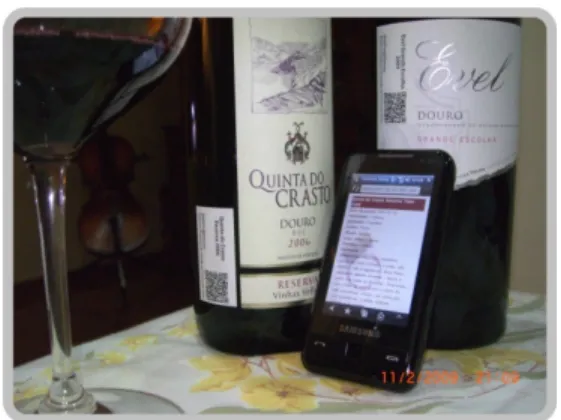
Created for winemakers, using
contextualization mechanisms, like visual tags (e.g. QR Code), wine information and services are delivered to consumers. It also acts as a bridge to tourism dynamic services and e-commerce. This information and services are stored in the cooperative network. Also showed is the use of the same technology in PV practices, namely in the
collecting and consulting of in-field
information, helping to promote DSS infield-centered instead of actually existent office-centered systems.
By using a common infrastructure as a
cooperation support, a sustainable
a) Illustration of an access to tourist information on a vine using a mobile device
b) Illustration of the SIGPV application and the use of QR Code placed on wine bottles to render dynamic tourism services and events
c) Illustration of uploaded photos and data about vineyard mapped points
d) Illustration of the use of mobile devices and QR Code in a site-specific management tool supporting PV practices
Fig 5. Examples of developed applications, for PV and tourism, over the proposed cooperative network using the same technological infrastructure
Discussion and final remarks
This paper describes a cooperation network model that can revolutionize the concept of PA support, management philosophy and sustainability. In the first part of the paper we introduce the concept of cooperative network. A clear definition of the concept and its applicability to the PA sector was provided. This first part also described the
business and knowledge generation
perceptive of the concept and the major gains that can be achieved.
In the second part of the paper we described
the proposed cooperation network
technological support model. This model covers the most relevant aspects from data
acquisition and sharing to hi-level
integration information and knowledge.
effective implementation and its economical sustainability. The DDR tourism has natural harmoniousness associated to viticulture farms but, unfortunately, in the moment
there aren't any relevant symbiotic
relationships or cooperation channels. By promoting cooperation between farms and tourism sector, we enable PA has a natural source to tourism services like previously exemplified. In a world where cooperation seems the unique way to overcome the new challenges of survival where major sectors like banking are merging and performing acquisitions, PA needs to give a decisive step towards a development that despite being late, needs to be given urgently, otherwise the concept of PA in the DDR, will never really be materialized.
References
Alvarez, J. and Nuthall, P. (2006) Adoption of computer based information systems: The case of dairy farmers in Canterbury, NZ, and Florida, Uruguay. Computers and Electronics in Agriculture, 50 (1), 48 – 60.
Bair, J. (1995) Implementation
Requirements, Layna Fischer (Ed.).
Burrell, J. and Brooke, T. and Beckwith, R.
(2004) Vineyard computing: Sensor
networks in agricultural production. IEEE Pervasive Computing, 3 (1), 38–45.
Buxmann, P. and Konig, W. (2000)
Inter-Organizational Cooperation with Sap
Systems: Perspectives on Logistics and Service Management. Springer-Verlag New York, Inc., Secaucus, NJ, USA.
Cox, S. (2002) Information technology: the global key to precision agriculture and sustainability. Computers and Electronics in Agriculture, 36 (2-3), 93 – 111.
Davenport, T. H. (2000) Mission Critical: Realizing the Promise of Enterprise Systems, Harvard Business School Press, Boston, MA, USA.
Espigueiro (2000) Douro Vinhateiro,
[Online], [Retrieved May 07, 2003],
http://www.espigueiro.pt/douro-vinhateiro/uk/index_uk.html
Helly, M. and Rafaea, A. and El-Gamal, S. and Whab, R. A. (2005) Integration diagnostic expert system with image processing via
loosely coupled technique. Agricultural
Research Center.
Koumpouros, Y. and Mahaman, B. D. and Maliappis, M. and Passam, H. C. and Sideridis, A. B. and Zorkadis, V. (2004) Image processing for distance diagnosis in pest management. Computers and Electronics in Agriculture, 2004, 44 (2), 121 – 131.
Kitchen, N. R. (2008) Emerging technologies for real-time and integrated decisions. Computers and Electronics in Agriculture, 61 (1) 1-3.
Kuhlmann, F., Brodersen, C., Information
technology and farm management:
developments and perspectives. Computers and Electronics in Agriculture, 2001, 30 (1-3), 71 – 83.
Miller, P. (2000) Interoperability. what is it and why should i want it? Ariadne.
Morais, R. and Fernandes, M. A. and Matos, S. G. and Serôdio, C. and Ferreira, P. and Reis, M. (2008) A ZigBee multi-powered wireless acquisition device for remote sensing
applications in precision viticulture.
Computers and Electronics in Agriculture, 62 (2) 94-106.
Murakami, E. and Saraiva, A. M. and Luiz C. M. and Ribeiro J. and Cugnasca, C. E. and Hirakawa, A. R. and Correa, P. L. P.(2007) An infrastructure for the development of
distributed service-oriented information
Osterle, H. and Fleisch, E. and Alt, R. (2001) Business Networking: Shaping Collaboration between Enterprises. Springer-Verlag New York, Inc., Secaucus, NJ, USA.
Pedersen, S. M. and Fountas, S., and Blackmore, S. and Pedersen, J. L. and Penadersen, H. (2003) Adoption of precision farming in Denmark. In: Stafford, J., Werner, A. (Eds.), Proceedings of the 4th European
Conference on Precision Agriculture.
Academic Publishers, Wageningen, 533–538.
Stafford, J. V. (2000) Implementing Precision Agriculture in the 21st Century. Journal of Agricultural Engineering Research, 76, 267– 275.
Tapscott, D. (2009), Winning Through Relationship Capital. [Online] [Retrieved March 12, 2009]. Available:
http://www.leighbureau.com/speakers/dtap scott/topics/relationshipcapital.pdf
Wang, N. and Zhang, N. and Wang, M. (2006) Wireless sensors in agriculture and food industry – Recent development and future perspective. Computers and Electronics in Agriculture, 50, 1–14.
Sigrimis, N. and Hashimoto, Y. and Munack, A. and Baerdemaker, J. D. (1999) Prospects in agricultural engineering in the information age - technological development for the producer and the consumer. International Commission of Agricultural Engineering.