DOI 10.1007/s11107-015-0524-0
Maximally node and SRLG-disjoint path pair of min-sum cost
in GMPLS networks: a lexicographic approach
Teresa Gomes1,2 · Luísa Jorge2,3 · Paulo Melo2,4 ·
Rita Girão-Silva1,2
Received: 2 September 2014 / Accepted: 15 June 2015 / Published online: 30 June 2015 © Springer Science+Business Media New York 2015
Abstract Path protection is a fast and capacity-efficient approach for increasing the availability of end-to-end con-nections. However, sometimes it is not possible to obtain a fully disjoint path pair. In this case, it may be admissible to consider a path pair which is as disjoint as possible, and thus provide the best (in a certain sense) level of the single-fault protection that can be ensured using this type of approach. A shared risk link group (SRLG) is a group of links which have a common risk of failure. Two new heuristics for solving the min-sum maximally node and SRLG-disjoint path pair are presented. The relative performance of the new heuristics and also of two other previously proposed heuristics is evaluated using four different networks. Results, regarding accuracy and execution time of the studied heuristics, show that one of the new proposed algorithms can be a good compromise for use in the Generalized Multi-protocol Label Switching control plane.
B
Teresa Gomes [email protected] Luísa Jorge [email protected] Paulo Melo [email protected] Rita Girão-Silva [email protected]1 Department of Electrical and Computer Engineering,
University of Coimbra, 3030-290 Coimbra, Portugal
2 INESC Coimbra, 3000-033 Coimbra, Portugal 3 Polytechnic Institute of Bragança, 5301-857 Bragança,
Portugal
4 Faculty of Economics, University of Coimbra,
3004-512 Coimbra, Portugal
Keywords Min-sum · SRLG maximally disjoint · Multi-objective
1 Introduction
Path protection is an effective recovery approach to increas-ing the availability of end-to-end connections. In normal conditions of the network, i.e., when there are no faults, the AP (active path, working path or primary path) is used. When a fault occurs, preventing the traffic from being car-ried in the AP, the BP (backup path or secondary path) is used to carry that traffic. For a network to be reliable, both paths must not share a common risk of failure. In this context, the concept of shared risk link group (SRLG) was introduced for the failure management in some telecommu-nication networks (e.g., Generalized Multi-protocol Label Switching—GMPLS). GMPLS [12] is deployed in the con-trol plane of optical networks and is a technology that adaptively maps traffic flows onto the physical topology of a network and allocates resources to these flows [17]. There-fore, GMPLS performs a mapping between the IP and optical layers, so that all the necessary traffic-engineering functions, along with different protection and restoration capabilities, can be supported.
An SRLG is a group of network links that share a com-mon risk, e.g., by sharing a physical resource, like a cable, for which a failure is equivalent to a failure of all the links in that group. The routing protocols in GMPLS networks sup-port the distribution of SRLG information, and efforts have been made to extend the Resource ReserVation Protocol-Traffic Engineering (RSVP-TE) [2] to support the automatic collection of SRLG information [30].
any common SRLGs with the links along the BP, so that a failure-independent protection can be provided to a connec-tion. When no SRLG-disjoint path pairs can be obtained, then the aim of the routing algorithms can be the attainment of the least SRLG-coupled (maximally SRLG-disjoint) path pair. A path computation element (PCE) [5] should be able to efficiently calculate maximally SRLG-disjoint path pairs (which may possibly be totally SRLG disjoint).
Algorithms for obtaining totally disjoint SRLG path pairs can be found in [19,24,28]. In [19], a link-disjoint algo-rithm is extended to SRLG-disjoint routing, originating the CoSE (Conflicting SRLG Exclusion) algorithm. This algo-rithm solves the SRLG-disjoint path problem formulated as a min–min problem. In [7], a new version of the CoSE heuris-tic is proposed, to solve a min-sum problem, designated as CoSE-MS. In [24], the SRLG-disjoint path problem is also formulated as a min-sum problem and it is solved by an iter-ative heuristic, the Iteriter-ative Modified Suurballe’s Heuristic (IMSH). In [28], a trap avoidance (TA) scheme is proposed, where the considered algorithm tries to avoid falling into traps (i.e., situations where the algorithm is not able to find SRLG-disjoint path pairs although they exist). In [11], seg-ment protection is used for the purpose of avoiding traps. Other algorithms for obtaining SRLG-disjoint path pairs can be mentioned. In [15], an algorithm (weighted SRLG or WSRLG) based on thek-shortest path algorithm is consid-ered, where costs are assigned to the links according to the number of SRLG members related to a link. The idea of assigning costs to the links according to the risks they share with other links is also considered in [29], where an active SRLG-diverse path selection (ASPS) algorithm is proposed. This algorithm allows for an improvement on the resource utilization ratio (as bandwidth resources are shared among BPs) and for the consideration of differentiated reliability (DiR) requirements of different customers. A shared protec-tion context is also considered in [18]. A hybrid protecprotec-tion scheme is proposed in [21], where path and shared-link protections are jointly used in WDM networks with SRLGs. In [25], two different algorithms are proposed to calculate an optimal path pair for a given origin-destination pair. In this context, the optimality of a path pair may be defined in two different ways, leading to two different ver-sions of an impairment aware optimal path pair problem. A different context is considered in [4], where the authors try to find a AP and several BPs from a pre-computed routing table with the minimal total additional bandwidth to carry a specific connection.
The focus of this paper is finding maximally disjoint SRLG path pairs, for coping with situations where no SRLG-disjoint path pairs can be obtained in the network. There are some variants of SRLG-disjoint path pair calculation algo-rithms, in order to calculate maximally disjoint SRLG path pairs. In [19], a variant of the CoSE, the Modified CoSE, is
proposed. In this algorithm, if there is no SRLG-disjoint path pair, then the SRLG path pair where the AP is shortest and the BP has the smaller number of common SRLGs with the AP will be used. In [23], a variant of the TA algorithm [28] designated TA-max is proposed. In TA-max, the candidate APs are considered iteratively (in order to ascending cost) and a BP with minimum cost is calculated for each candidate AP. The final solution is the path pair with the least number of common SRLGs.
In [10], the author proves that the diverse routing prob-lem is NP complete, but ILP formulations may still be viable methods to solve this problem. Formulations for finding two diversely SRLG paths with minimum total cost or least cou-pled SRLG paths are proposed. In [26], a two-step method is used to solve the network provisioning problem. In the first step, the diverse routing problem is formulated using ILP to find optimal routes with the minimum objective value (either cost or distance). The solution might be total or maximally SRLG-diverse routes (if no SRLG-diverse routes exist). The second step consists of a dense wavelength divi-sion multiplexing system selection, regenerator placement and wavelength assignment.
In [14], a heuristic restoration scheme called Two-Step Partial Protection Risk Algorithm is proposed. With this partial SRLG-diversity algorithm, three major problems are tackled: network survivability, optimization of spare band-width and the possibility of differentiated classes of service. In [6], a method is proposed to abstract a detailed topol-ogy into an aggregated topoltopol-ogy which only shows limited information about the network, due to confidentiality and management considerations. This topology aggregation is SRLG aware and a pair of inter-domain paths with a min-imum set of common SRLGs may be obtained, in order to generate a more survivable aggregated topology. In [20], maximally SRLG-disjoint paths are obtained with an algo-rithm based on an ant colony optimization approach. The application of this algorithm is limited to networks where a link can belong to a maximum of two SRLGs. In [22], the aim is the minimization of the network cost while ensuring the network survivability. The links with higher degree of usage are considered as critical links, as the survivability of the network may be severely affected in the event of failure of such links. An approach is proposed, in which a partial criti-cal duct-disjoint BP is provided by choosing the BP with the least number of critical ducts (i.e., ducts that carry critical links) to make the impact of duct failures as low as possi-ble.
solving the problem is also presented. Results show that one of the new proposed heuristics is adequate for use in the con-trol plane of GMPLS networks, because it achieves a good compromise between accuracy and execution time.
The paper is organized as follows: In Sect.2, the problem of calculating a maximally node and SRLG-disjoint path pair of minimal additive cost is formulated as a multi-objective problem; in Sect. 3, the two heuristics are presented; in Sect.4, the experimental conditions are described and the performance of the algorithms is evaluated; some conclu-sions are presented in Sect.5; an illustrative example of the heuristics is given in “Appendix.”
2 Problem formulation
In this section, we formulate the problem of calculating a maximally node and SRLG-disjoint path pair of minimal additive cost, as a multi-objective problem. ConsiderG =
(V,A), the directed graph representing the network, where
V = {v1, . . . , vn}is the set of nodes and A= {a1, . . . ,am}
is the set of arcs, such that∀i∈{1,2,...,m}ai = (vj, vh)and
vj, vh ∈ V. The cost of using an arc a = (vi, vj) ∈ A
in a path is given byl(a)orl(vi, vj)and is assumed to be
nonnegative.
Letsandt (s,t ∈ V) denote the source and destination nodes, respectively, of the path pair to calculate. Note that arc disjointness is ensured in [10] by SRLG diversity (assuming each arc belongs at least to one SRLG). In this work, however, it will be considered that some arcs do not belong to any SRLG (each of those arcs could have been considered as defining an SRLG with a single element, but that was not our approach). This allows to distinguish between paths sharing an edge that does not belong to any SRLG and sharing edges that belong to one or more SRLGs.
LetRbe the set of risks in the network. LetArbe the
(non-empty) set of arcs affected by riskr∈ R. We do not assume that each arca ∈ Abelongs to at least one Ar (r ∈ R), so ∪r∈RAr may be only a subset of A. The set of all SRLGs
in the network isψ = {Ar :r ∈ R}. The set of SRLGs to
which an arca∈ Abelongs will be designated byϕa.
Letδ(vi)+ be the set of arcs in A emergent from node
vi ∈ V and δ(vi)− be the set of arcs in A incident on
nodevi ∈ V. A path is a sequence of nodes (all different)
froms tot, (s,t ∈ V), and is represented by p = s ≡
v1, v2, . . . , vu ≡ t, where∀i∈{1,...,u−1}(vi, vi+1) ∈ A,u being the number of nodes in the path. LetVpbe the set of
nodes in the pathp andApbe the set of arcs that form the
path, Ap = ∪i∈{1,...,u−1}(vi, vi+1). The set of arcs symmet-rical to the arcs inApis A¯p. The set of SRLGs which may
affect a path p will be designated by ψp. The set of arcs
affected by the SRLGs in the setψp will be designated by
Aψp and is defined by∪Ar : Ar ∈ψp.
Let a path pair be represented by(p,q). We wish to obtain a path pair such that it is maximally node and SRLG disjoint and has minimal cost. The cost of path pair(p,q)is given by
c(p,q)= a∈pl(a)+a∈ql(a). When there is no fully node and SRLG-disjoint path pair for a given source and des-tination nodessandt, the problem becomes a multi-objective optimization problem. Given a path pair(p,q)fromstot, the objective functions (o.f.) are:
f1(p,q)= |(Vp∩Vq)\{s,t}| (1)
f2(p,q)= |Ap∩Aq| (2)
f3(p,q)= |ψp∩ψq| (3)
f4(p,q)=c(p,q) (4)
Function f1(p,q)returns the number of intermediate com-mon nodes of pandq; the result is 0 if the path pair is node disjoint. Function f2(p,q)returns the number of common arcs of pandq; the result is 0 if the path pair is arc disjoint. Function f3(p,q)returns the number of common SRLGs of
p andq; the result is 0 if the path pair is SRLG disjoint. Function f4(p,q)returns the path pair cost.
LetP be the feasible design space of paths pairs(p,q), fromstot, such that p =q. A lexicographic approach for ranking the solutions was considered [13], where each of the optimization problems should be solved sequentially:
Minimize(p,q)∈Pfi(p,q) (5)
subject to p = q and fj(p,q) ≤ fj(p∗j,q∗j),j =
1,2, . . . ,i −1 when i > 1, i = 1,2,3,4, where fi is
the i-th o.f. andi represents the position (order of impor-tance) of a function in the preferred sequence. The path pair
(p∗j,q∗j)represents the optimum of the j-th o.f., found in the
j-th iteration. After the first iteration (j = 1), fj(p∗j,q∗j)
is not necessarily the same as the independent minimum of
fj(p,q), because of the new constraints. The vector of o.f. [f1(p,q),f2(p,q), f3(p,q),f4(p,q)]Tis a point in the cri-terion space.
A solution(p′,q′)lexicographically dominates a solution
(p,q)if fk(p′,q′) < fk(p,q), withk=mini : fi(p,q) =
fi(p′,q′).
3 Algorithms for maximally node and
SRLG-disjoint routing
and the second, Modified IMSH (MdIMSH), is a modifica-tion of IMSH [24].
In this section, two new heuristics are proposed: Modified Trap Avoidance (MdTA) and Modified Weighted-SRLG path selection algorithm (MdWSRLG). The first one extends the Trap Avoidance algorithm [27] and the second one extends the Weighted-SRLG path selection algorithm (WSRLG) [15] for obtaining maximally SRLG-disjoint path pairs.
A solution to the multi-objective optimization problem formulated in the previous section is searched using these four heuristics (see “Appendix” for illustrative an exam-ple). The first solution obtained by the four heuristics is the same: The maximally node-disjoint path pair of min-sum cost between the considered end nodes is calculated [3]. If such a solution exists, it will correspond to the solution with the smallest number of nodes and arcs in common. If the path pair is SRLG disjoint, then it is an optimal solution, and the algorithms end. Otherwise a solution with the smallest number of SRLGs in common will be sought.
Two ancillary heuristics, originally proposed in [8], are reviewed in the next subsection.
3.1 Ancillary heuristics
The modified Bhandari’s edge-disjoint shortest path pair heuristic (MBH) and the Modified Suurballe’s Heuristic (MSH) were presented in [7] and [24], respectively. Both were extended for obtaining maximally node-disjoint path pairs in [8]. The new heuristics MdTA and MdWSRLG use extended versions of MSH and MBH (MSHE and MBHE, respectively).
LetG′be the graph where the seed pathp′gis calculated; that is, p′g is the shortest path inG′ which will be used to compute a path pair from nodes to nodet in the original networkG. The MBHE can only be used when the seed path is calculated in the original network, that is ifG′=G.
The network transformation in MBHE and MSHE, required for obtaining a maximally node and SRLG-disjoint path pair, uses an adaptation of the vertex-splitting method 2 in [3]—see Fig.4 in “Appendix”. Given a seed path p′g
(the shortest path inGin the case of the MBHE), consider a copy of the original graphGg=G, where the intermediate nodes ofp′gare divided in two nodes connected by two sym-metrical arcs, such that for allvi ∈Vp′
g\{s,t},vi is replaced
by two nodesv′i andv′′i, arc(vi′′, vi′)with null cost and arc
(vi′, vi′′)with a costy, whereyisa∈Al(a)+ε, whereε >0 is an arbitrary positive number. Furthermore, all the arcs in
δ(vi)+will now emerge fromvi′′and all the arcs inδ(vi)−
will now be incident onvi′,∀vi ∈ Vp′
g\{s,t}. Then, assign
the costl(ai)+x, wherex = (|V| −1)y, to each arc of
p′g, originally of costl(ai). To the symmetrical arc (which
has to be created if it does not exist) assign the cost−l(ai)
in the case of MBHE and the cost 0 in the case of MSHE, for allai ∈ Ap′
g. Finally, all the other arcs in SRLG conflict
withp′g(Aψp′ g\(Ap
′
g∪ ¯Apg′)) have their costs increased byx.
Next the minimum cost path, p′′g, in the modified network is calculated by recurring to the modified Dijkstra’s algorithm [3]. The graphGgis transformed back into the original graph
G(the divided nodes are collapsed, and the costs are reset to their original value). After removing the possibly existing interlacing arcs (the arcs inA¯p′
g∩Ap′′g), a path pair(pg,qg)
is obtained. However, if p′g = p′′g, then pg =qg = ∅, and
no maximally disjoint path pair could be obtained using p′g
as the seed path.
3.2 Modified Trap Avoidance (MdTA) algorithm
The heuristic Trap Avoidance was proposed for solving the min–min SRLG-disjoint path pair problem. It sequentially removes the mostrisky link[27] from the network, calculates the candidate AP in this reduced network and then tries to obtain an SRLG-disjoint BP in the original network, where the cost of the forward arcs of the AP is changed to infinity and the cost of the reverse arcs of the AP and of the arcs with SRLG in common with the AP takes a very large value. The algorithm ends as soon as an SRLG-disjoint path pair is obtained or if no candidate AP can be found in the pruned network or the number of allowed iterations was reached.
The first best current solution of MdTA is the maximally node disjoint path pair, of min-sum cost [3] between the considered end nodes, similar to the previously proposed heuristics. If the path pair is SRLG disjoint, the algorithm ends with an optimal solution. Otherwise it proceeds into the main cycle of MdTA. Note that if the first obtained path pair is not arc disjoint, the set of common arcs in that path pair is the set of critical arcsKA, that is the set of arcs that cannot be
removed, if a seed path is to be successfully calculated. This main cycle of MdTA uses MSHE. The seed path required by MSHE is calculated in the pruned network (as the candidate AP in TA). If the resulting path pair is not SRLG disjoint, the most risky arc must be identified. The most risky arc selec-tion is done differently from [27] and is described by the following algorithm.
Most Risky Arc (MostRiskyArc(KA,pg, ψx))
Require: KA, the set of critical arcs for the considered node
pair; pg, the seed path;ψx the set of common SRLGs in
the path pair obtained by MSHE usingpgas seed path.
Ensure: Returns the most risky arcaR (aR∈ pg) or 0 if all
the links in pgbelong toKA
1: aR ←0 ⊲Signals no risky arc was found
2: AT ← Apg\KA ⊲Set of candidates for most risky arc
3: if AT = ∅then
4: aR←element from AT
6: ifCountR(a, ψx) >CountR(aR, ψx)then
7: aR←a
8: end if
9: end for 10: end if 11: returnaR
where CountR(a, ψx) returns the number of SRLGs in
ψx that contain arca. SoMostRiskyArc(KA,pg, ψx) in
MdTA returns the arc in the seed path (pg), not contained in
KA, which appears more often in the SRLGs shared by the
resulting path pair (ψx). If the setψx is empty, the algorithm
returns an arbitrary arc fromApg\KA.
LetT designate the set of links of the BP which share an SRLG with the AP, and X designate the set of SRLGs of the links in setT. In TA [27] the most risky link is the link of the AP which belongs to the largest number of SRLGs in X. UsingMostRiskyArc, set X is replaced by setψx
(the set of common SRLGs in the path pair obtained by the MSHE using pgas seed path) and the path from which the
most risky link is selected is the seed path pg, which may
not coincide with the candidate AP calculated by the MSHE. This approach tries to increase the possibility of obtaining a seed path for the MSHE, which will result in a maximally SRLG-disjoint path pair of min-sum cost.
Algorithm MdTA follows an approach similar to TA, but uses the new heuristic MSHE and requires the knowledge of the seed path which was calculated in the modified graph. Given the shortest path (pgin line 9 of the algorithm) in the
modified graph, and using it as the seed path in the MSHE, a path pair is calculated,(p,q). Then, the best current solution,
(pb,qb), is possibly updated in line 14 of MdTA. If p and
q are not SRLG disjoint, the setψx = ψp∪ψq is used
by the functionMostRiskyArc(KA,pg, ψx) to obtain the
most risky arc. In MdTA,G∗=(V∗,A∗)is the pruned graph from which the seed pathpgis calculated (initiallyG∗=G).
Modified Trap Avoidance (MdTA)
Require: Network directed graphG = (V,A); node pair
(s,t);l(a)≥ 0 cost of the arc, for alla∈ A;ψ, the set of SRLGs in the network;imax, the allowed number of iterations withimax≥1
Ensure: Returns a path pair fromstot, seeking to solve the problem in Eq. (5);(pb,qb)=(∅,∅)if no solution exists
1:(pb,qb)←MaxNodeDisj(s,t) ⊲(pb,qb)=(∅,∅)if
no maximally disjoint path exists
2:i ←1 ⊲This was the first iteration 3:if(pb,qb) =(∅,∅)∧ψpb ∩ψqb = ∅then ⊲First
solution exists and is not SRLG-disjoint
4: KA← Apb ∩Aqb ⊲Critical arcs
5: st op← f alse ⊲There is at least one seed path
6: G∗←G ⊲V∗=V,A∗=A
7: while ¬Empty(A∗)∧ ¬st op∧i <imaxdo
8: i ←i+1 ⊲Current iteration
9: pg←shortest path inG∗
10: if pg= ∅then ⊲pgdoes not exist
11: st op←tr ue ⊲No more seed paths
12: else ⊲pgexists
13: (p,q)←MSHE(G, ψ,l,pg)
14: (pb,qb)←MayUpdateSol(pb,qb,p,q)
15: ψx ←(ψp∩ψq)\K
16: aR←MostRiskyArc(KA,pg, ψx)
17: A∗← A∗\{aR}
18: end if
19: end while 20: end if
21: return(pb,qb)
Algorithms TA and MdTA target different problems. The first addresses the min–min SRLG-disjoint path pair prob-lem, and the second addresses the maximally node and SRLG-disjoint path pair of minimal additive cost, formulated as a multi-objective problem. MdTA borrowed from TA the idea of successively pruning the most risky link from the net-work. However, the calculation of the path pair is different from TA, because instead of calculating the BP in a network where the directed arcs of the AP have their cost changed to infinity and every arc in SRLG conflict with the AP is changed to a large cost, MdTA uses MSHE for increasing the possibility finding a path pair of max-sum cost. Addi-tionally, the selection of the most risky arc (as explained in the previous paragraph) is also adapted, taking into account the use of the MSHE in MdTA.
3.3 Modified Weighted-SRLG (MdWSRLG) algorithm
The Weighted-SRLG (WSRLG) searches for K-shortest SRLG-disjoint paths based on an approach that treats the number of SRLGs that affect a link as part of the link cost [15]. In [15], the authors claim that although they do not seek to optimize the total cost of the obtained set, the obtained set contains cost-effective disjoint paths. WhenK =2, we have a disjoint path pair.
The simple iterative approach for obtaining a set of K
The weighted-SRLG approach aims to improve the effec-tiveness of the simple iterative approach by modifying the cost of all the network links, in each iteration, before the
K(s,t)algorithm is executed. In each iteration, the cost of the network links is given by Eq. (6). A binary search method is used for the value ofα. The value ofαincreases as the num-ber of iterations increases, whenever the target value of K
disjoint paths is not obtained; if the obtained value isK, then
αis decreased. Observing Eq. (6), asαdecreases the contri-bution of the original cost of a link to its new cost increases, while the contribution of the number of SRLGs that affect the link decreases.
lw(a)= 1−α
lmax
l(a)+ α ¯
ϕmax
max{ ¯ϕa,1} (6)
where:
– lw(a)is the cost of linkain MdWSRLG.
– αis a parameter defined by the binary search method. – lmaxis maxal(a), the largest of the original costs of the
network arcs.
– ϕ¯aisAr∈ϕa|Ar|, the sum of the size of the SRLGs arc
abelongs to. – ϕ¯maxis maxaϕ¯a.
– max{ ¯ϕa,1}is the maximum betweenϕ¯aand 1.
The modified version of the WSRLG algorithm (MdWS-RLG) allows to search for a maximally node and SRLG-disjoint path pair. The initial solution to the MdWSRLG algorithm is the maximally node-disjoint path pair of min-sum cost, obtained in the original network. If the initial path pair exists and is SRLG disjoint, that pair is the best possible solution and so the algorithm ends. Otherwise, while the con-vergence condition for the value ofαis not met, the following steps are executed: The value ofαis updated; the cost of all links in the network is modified according to Eq. (6); the shortest path in this network is calculated; the MBHE is used to calculate a maximally node and SRLG disjoint path pair; then, a possible update of the current best solution is done according to Eq. (5); finally, the value ofαmax is updated.
Modified Weighted-SRLG (MdWSRLG)
Require: Network directed graphG = (V,A); node pair
(s,t);l(a) ≥ 0 cost of the arc, for all a∈ A; ψ set of SRLGs in the network;ǫconvergence parameter; initial value ofαmi nandαmax
Ensure: Returns a path pair fromstot, seeking to solve the problem in Eq. (5);(pb,qb)=(∅,∅)if no solution exists
1:(pb,qb)←MaxNodeDisj(s,t) ⊲(pb,qb)=(∅,∅)if
no maximally disjoint path exists
2:i ←1 ⊲This was the first iteration 3:if(pb,qb) =(∅,∅)∧ψpb ∩ψqb = ∅then ⊲First
solution exists and is not SRLG-disjoint
4: whileαmax−αmi n> ǫdo
5: α←(αmi n+αmax)/2
6: Re-calculatelw(a), for alla∈ A, using Eq. (6) 7: ps ←Shortest path fromstotusing costslw 8: (p,q)←MBHE(G, ψ,lw,ps)
9: (pb,qb)←MayUpdateSol(pb,qb,p,q)
10: αmax ←α
11: end while 12: end if
13: return(pb,qb)
One must recall that algorithms WSRLG and MdWSRLG have different objectives. The first one seeks to obtain a set of
KSRLG-disjoint paths, while MdWSRLG seeks to calculate a maximally node and SRLG-disjoint path pair of minimal additive cost. Hence, instead of just pruning from the network the arcs in SRLG conflict with the seed path (the approach used in WSRLG), MdWSRLG uses MSHE in order to make it more likely to obtain a maximally disjoint solution and also a solution of lower cost.
4 Results analysis
To analyze the proposed heuristics performance, tests were run in four networks from [16]. For each network, edge costs were taken as the integer component of the first of the module costs present in the cited networks.
For each network, SRLGs in number equal to half of the number of edges in that network were generated. For each generated SRLG, the target number of edges was randomly (uniformly) selected from the set{2,3,4}. Each edge was assigned a target number of SRLGs uniformly selected in the set{0,1,2,3,4}. Each SRLG was defined through random (uniform) selection of a node, and selecting the candidate edges for that SRLG as those with an end node at a distance less thandfrom the selected node. For each SRLG, each suit-able edge (one that still has not exceeded its assigned SRLG target) is selected for inclusion to the present SRLG with a probability of 10 %. The value ofdwas defined for each net-work taking into account the average and minimum length of all the node pairs in that network (with each length computed using the straight-line distance between GPS coordinates of the nodes). In this way, while SRLG are not strictly local, the edges in each SRLG are located in ad-radius neighbor-hood. Considering that edges in close geographical proximity should share common risk faults, the procedure used to gen-erate the SRLG should probably result in a realistic SRLG distribution.
Table1presents the networks used in the tests performed, wherenis the number of nodes,mthe number of edges andδ
Table 1 Network data and exact algorithm results (networks from [16])
Network n m δ CPU time (s) Fully disjoint solutions (%) Avg. number of common SRLGs nobel-eu 28 41 2.9 5.06E-02±1.75E-03 65.19±3.934 1.4±0.15
cost266 37 57 3.1 6.65E-02±4.05E-03 82.48±5.638 1.2±0.12 germany50 50 88 3.5 7.26E-02±2.54E-03 94.75±3.156 1.0±0.01 ta2 65 108 3.3 8.92E-02±2.66E-03 79.84±1.668 1.0±0.01
Ignoring the SRLGs, networks nobel-eu, cost266 and germany50 are biconnected; that is, they would remain con-nected if any single node was removed. Network ta2 is connected, but not biconnected. Originally, all those net-works were undirected, but in the algorithms each undirected edge was replaced by a pair of symmetrical arcs (directed edges), with opposite directions, both with cost equal to the cost of the replaced undirected edge; if the undirected edge belonged to a given SRLG then the corresponding symmet-rical arcs will also belong to that same SRLG..
The CPU time per node pair was calculated from the total CPU time for solving for all node pairs in a Dell Precision 7500, Intel(R) Xeon(R) CPU X5660 (Six Core, 2.80 GHz, 6.4 GT/s, 12 MB), with 48 GB of RAM.
For each of the four networks in Table 1, ten dif-ferent random seeds were used to generate ten difdif-ferent SRLG distributions (ψ). Those ten networks with the same topology but different ψ were then used in the tests with each heuristic, and their results averaged. Each heuris-tic was executed with a maximum number of iterations
(imax ∈ {5,10,25,50,100,250,500,1000}), but in the
fol-lowing figures and tables, results will be presented only for (imax ∈ {5,10,50,100,500,1000}). Unless otherwise
stated, results are presented considering all node pairs for all networks and with 95 % confidence intervals (CI). The results in Table1were obtained using a linear integer programming formulation (henceforth called the Exact Algorithm), solved using CPLEX version 12.5 [1].
4.1 Performance evaluation of the four heuristics
Using the exact algorithm, Table1presents average CPU time spent per node pair in seconds, percentage of fully disjoint solutions and average number of common SRLG for non-SRLG disjoint path pairs. In this table, we can see that the times increase with network dimension and range between 50ms to about 90ms per node pair.
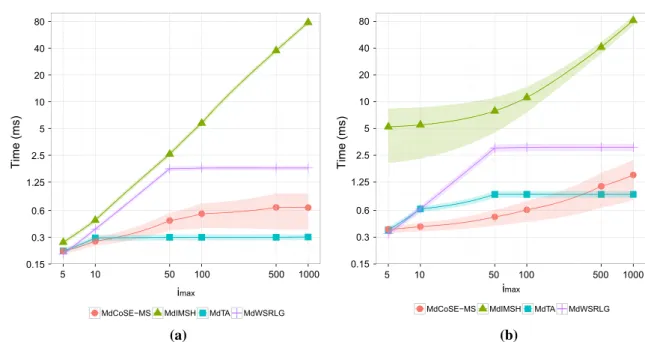
The average CPU times per pair for each heuristic are presented only for the nobel-eu network (in Fig. 1a) and the ta2 network (in Fig.1b), because the pattern is simi-lar in the other two networks. In all figures, the width of the CI is represented by a shadow around the average value. Since in Fig.1 the y axis uses logarithms, the upper and lower CI appear of different size, although they are identical.
In the considered networks, the time per node pair usually increases for all heuristics with the maximum number of iter-ations allowed (imax), but at different rates depending on the
heuristic, network andimaxvalue. For smaller values ofimax
(imax ≤ 500), all heuristics are faster than the exact
solu-tion, but when more iterations are allowed (imax >500) the
MdIMSH heuristic can on average take longer per node pair than the exact solution. For all networks, the fastest heuristics are MdTA and MdCoSE-MS, followed by MdWSRLG, with MdIMSH as the slowest one, for larger values ofimax. The
values per pair range are below 10ms for all heuristics with
imax ≤50, but can go up to 85ms per node pair for MdIMSH
withimax =1000. The fact that for some heuristics the
aver-age time per node pair does not increase withimax suggests
that for those heuristics the bound on the number of maxi-mum iterations is not active (i.e., that those heuristics stop iterating before reachingimax).
To examine the quality of the heuristic results, we checked the number of path pairs in the network for which the heuris-tic reached the exact (optimal) solution (or an alternative optimum, i.e., solutions with the same values for arc disjunc-tion, node disjuncdisjunc-tion, SRLG disjunction and the cost of the pair of paths of the exact solution). Notice that the optimal solution was not always fully disjoint, because of common SRLG(s) and/or, in the case of ta2 network, topological rea-sons.
In Fig. 2a (cost266 network) and Fig. 2b (germany50 network), we can find the percentage of node pairs where the heuristic reaches a solution equivalent to the optimal. Although small variations in actual percentage exist per net-work, it can be seen that the MdIMSH reaches the optimal more often, followed by the MdTA heuristic—which is also true for the nobel-eu and ta2 networks (not shown). Both MdCoSE-MS and MdWSRLG reach the optimum much less often, and particularly increasingimax almost does not
solu-0.15 0.3 0.6 1.25 2.5 5 10 20 40 80
5 10 50 100 500 1000
imax
Time (ms)
●MdCoSE−MS MdIMSH MdTA MdWSRLG
0.15 0.3 0.6 1.25 2.5 5 10 20 40 80 ● ● ● ● ● ● ● ● ● ● ● ● ● ● ●●●●●●● ● ● ● ● ● ● ● ●●● ● ● ● ● ● ● ● ● ● ● ● ● ● ● ● ● ● ● ● ● ● ● ● ● ● ● ● ● ● ● ● ● ● ● ● ● ● ● ● ● ● ● ● ● ● ● ● ● ● ●●●●●● ● ● ● ● ● ● ● ● ● ● ● ● ● ● ● ●
5 10 50 100 500 1000
imax
Time (ms)
●MdCoSE−MS MdIMSH MdTA MdWSRLG
(a) (b)
Fig. 1 Average CPU time per node pair (in milliseconds).anobel-eu network.bta2 network
50% 60% 70% 80% 90% 100%
5 10 50 100 500 1000
imax
P
ercentage
MdCoSE−MS MdIMSH MdTA MdWSRLG
50% 60% 70% 80% 90% 100%
5 10 50 100 500 1000
imax
P
e
rcentage
MdCoSE−MS MdIMSH MdTA MdWSRLG
(b) (a)
Fig. 2 Percentage of pairs with the optimal solutions.acost266 network.bgermany50 network
tions than MdCoSE-MS, for all values of imax; MdIMSH reaches about 10 % more optimal solutions than MdTA for
imax ≥50.
4.2 Further analysis between MdIMSH and MdTA
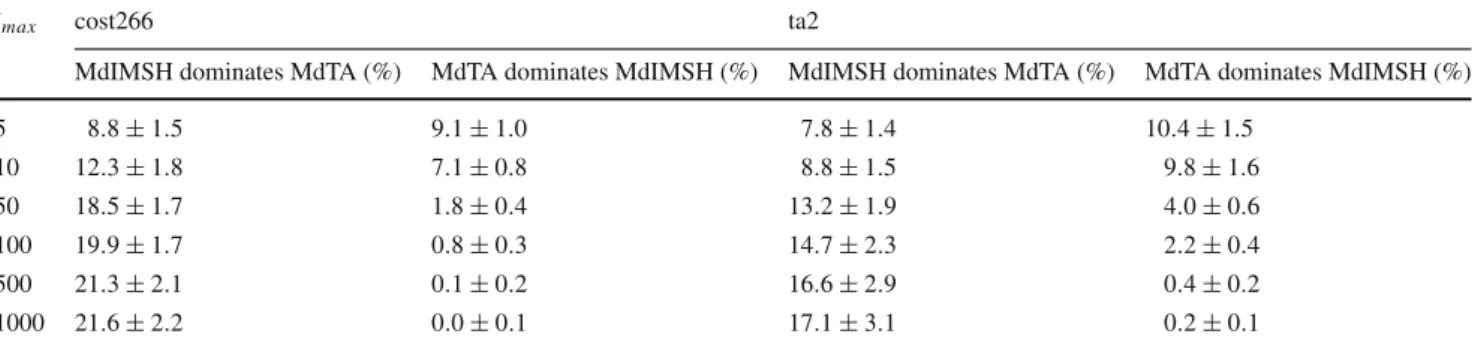
Since MdIMSH and MdTA provided the best results regard-ing the number of optimal solutions found, they were chosen for additional study. Both heuristics were compared for lex-icographic dominance (according to the criteria presented in Sect.2). This is illustrated in Table2, which shows the per-centage of node pairs where dominance is found, for cost266
and ta2 networks. It can be seen that forimax >5, MdIMSH
dominates MdTA in more pairs than it is dominated. How-ever, it can also be seen that in the majority of pairs the heuristics return the same or incomparable solutions.
heuris-Table 2 Average dominance relation between heuristics
imax cost266 ta2
MdIMSH dominates MdTA (%) MdTA dominates MdIMSH (%) MdIMSH dominates MdTA (%) MdTA dominates MdIMSH (%)
5 8.8±1.5 9.1±1.0 7.8±1.4 10.4±1.5
10 12.3±1.8 7.1±0.8 8.8±1.5 9.8±1.6
50 18.5±1.7 1.8±0.4 13.2±1.9 4.0±0.6
100 19.9±1.7 0.8±0.3 14.7±2.3 2.2±0.4
500 21.3±2.1 0.1±0.2 16.6±2.9 0.4±0.2
1000 21.6±2.2 0.0±0.1 17.1±3.1 0.2±0.1
tics, MdIMSH usually reaches a percentage of fully disjoint solutions very similar to the exact results, forimax > 50,
while MdTA is usually slightly worse (about 2–5 % for larger values ofimax).
The AP in MdTA is calculated in a successively pruned network, and hence, MdTA does not perform many itera-tions. In fact, forimax >50, the average number of iterations
made by MdTA is constant on average and less than 8 for the considered networks. In contrast, MdIMSH performs more iterations (about 60–75 % of the allowed value forimax). The increasing number of iterations of MdIMSH withimaxhelps explain both its better results and increased time expenditure when compared to MdTA.
Table1shows the average number of SRLGs in common for path pairs which are not SRLG disjoint, obtained using the exact algorithm. It can be seen that the average number of SRLGs in common decreases with network size, reaching almost one unit value for the larger networks. It was observed that as expected both heuristics have on average more SRLGs in common than an optimal solution. Forimax >50,
how-ever, MdIMSH finds non-disjoint paths with nearly as few SRLG in common as the exact solution and MdTA has con-sistently worse performance than MdIMSH.
The performance of the algorithms was also evaluated using a PCE, model UNICOM-V5, G2_LE CPU (PowerPC compatible core) with 330MHz core clock, 128 MB of RAM. The average CPU time per node pair was verified to be below 160 and 16 ms for the MdIMSH and MdTA algo-rithms, respectively, for the ta2 network when the number of iterations was 50 (for the other networks and same num-ber of iterations, the CPU times were smaller). Hence, MdTA can be used in the control plane of a GMPLS network using PCEs, while MdIMSH is more adequate for the management plane.
5 Conclusion
Two heuristics, MdWSRLG and MdTA, were proposed for solving the min-sum maximally node and SRLG-disjoint path pair. This problem was also formulated as a multi-objective optimization problem. The relative performance of
these heuristics and of two other (MdIMSH and MdCoSE-MS [8]) was evaluated using four networks from [16], where SRLGs were generated, taking into account the edges geo-graphical proximity. MdIMSH and MdTA provided the best quality results regarding the number of exact solutions found and were further analyzed. It was shown that MdIMSH’s solutions dominated a significant number of the solutions obtained by MdTA. MdIMSH also had better performance than MdTA regarding the average number of node and SRLG-disjoint path pairs, and the average number of common SRLGs for path pairs which are not SRLG disjoint. How-ever, the number of iterations used by MdTA is on average smaller than MdIMSH, resulting in lower CPU time. Hence, it appears that MdTA can be a good compromise for using the GMPLS control plane and MdIMSH for the GMPLS man-agement plane.
Acknowledgments We thank Sérgio Mendes for implementing part of the code used in this work. The authors acknowledge financial sup-port through project QREN 23301 PANORAMA II, co-financed by European Union’s FEDER through “Programa Operacional Factores de Competitividade” (POFC) of QREN (FCOMP-01-0202-FEDER-023301), by the Portuguese Foundation for Science and Technology under project grant UID/MULTI/00308/2013 and by PT Inovação R&D Project “End to End Protection considering SRLGs-II”.
Appendix: illustrative example
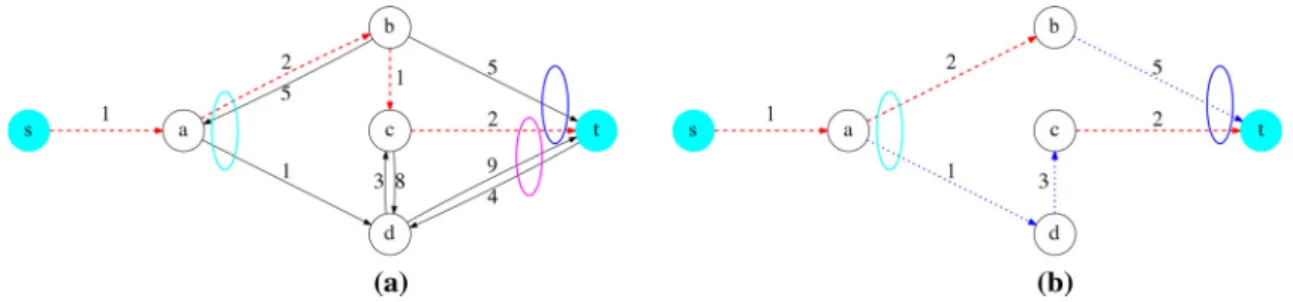
This appendix will try to clarify the main differences between the considered heuristics. The network which will be used in this example is in Fig. 3a, where the ellipses repre-sent different SRLGs and the arcs in dashed red reprerepre-sent the shortest path from s to t. Let the SRLGs be A1 = {(a,b), (a,d), (b,a)}, A2 = {(b,t), (c,t)} and A3 = {(c,t), (d,t), (t,d)}.
Fig. 3 aNetwork with SRLGs as ellipses and shortest path fromstotindashed red.bSubgraph representing the maximally node-disjoint path pair of min-sum cost fromstot(Color figure online)
Fig. 4 Transformed network using as seed the shortest path:ain MBHE, used by MdCoSE-MS and MdWSRLG.bin MdCoSE-MS, IMSH and MdTA
common. This is the initial solution, and the algorithms will seek to improve.
After calculating the seed paths,a,b,c,t, the network is modified, as illustrated in Fig.4a, b for MBHE and MSHE, respectively.
The maximally node-disjoint path pair of min-sum cost is not SRLG-disjoint, and hence, algorithm IMSH will sequen-tially generate paths untilimaxis reached (or no more paths exists), by non-decreasing cost, using each of them as a seed path in the MSHE, seeking to obtain a maximally node and SRLG-disjoint path pair. In this example, the usedk-shortest path enumeration algorithm will generate five paths, and the best solution (path pair(s,a,b,t,s,a,d,t)of cost 19) will be obtained using the third shortest paths,a,b,tas seed path.
MdWSRLG will always use MBHE in each iteration, because the seed path is always the shortest path (in the net-work where the costs have been modified)—note that MBHE tends to obtain path pairs with smaller cost than MSHE. MdWSRLG will change the cost of the edges according to Eq. (6), increasing the importance of the original link cost. In the case of the network in the example, the optimal solution is found withα=0.5, but the algorithm will keep trying to improve this solution, until the convergence condition forα
is met.
Algorithm MdCoSE-MS starts by using MBHE with seed paths,a,b,c,t, obtaining the maximally disjoint path pair of Fig.3b. The set of common SRLGs is{A1,A2}. The con-flicting SRLG set will be{A2}, because{A1}is the critical
SRLG set (if the links inA1are removed, no seed path can be found). The algorithm will then remove the arcs in A2from the network before calculating a new seed path—the goal is to obtain a seed path that does not use the SRLG(s) that was (were) common to the previously obtained path pair. These arcs are re-inserted in the network before calling MSHE with seed paths,a,d,t, resulting in the optimal path pair. As the set of common SRLGs of that path pair is{A1}(the critical SRLG set), the algorithm ends.
Algorithm MdTA first identifies {(s,a)}the critical arc set (see line 4 of algorithm MdTA). MSHE, with seed path s,a,b,c,t, will obtain the path pair in Fig.3b. Then, the most risky arc (see functionMostRiskyArc), that is the arc
in the seed path considered responsible for MSHE not being able to find a node and SRLG-disjoint path (excluding arc
References
[1] IBM ILOG CPLEX Optimization Studio V12.5. IBM (2012) [2] Awduche, D., Berger, L., Gan, D., Li, T., Srinivasan, V., Swallow,
G.: RSVP-TE: extensions to RSVP for LSP tunnels. IETF RFC 3209 (2001)
[3] Bhandari, R.: Survivable Networks, Algorithms for Diverse Routing. Kluwer Academic Publishers, Norwell, Massachusetts (1999)
[4] Cheng, X., Shao, X., Wang, Y.: Multiple link failure recovery in survivable optical networks. Photonic Netw. Commun.14, 159– 164 (2007)
[5] Farrel, A., Vasseur, J.P., Ash, J.: A path computation element (PCE)-based architecture. ITEF RFC 4655 (2006)
[6] Gao, C., Zhu, Y., Jue, J.: SRLG-aware topology aggregation for survivable multi-domain optical networks. In: 2011 IEEE Inter-national Conference on Communications (ICC), pp. 1–5 (2011). doi:10.1109/icc.2011.5963224
[7] Gomes, T., Fernandes, L.: Obtaining a SRLG-disjoint path pair of min-sum cost. In: Rak, J., Tipper, D., Walkowiak, K. (eds.) RNDM 2010–2nd International Workshop on Reliable Networks Design and Modeling, Colocated with ICUMT 2010, pp. 116–122. ISBN: 978-I-4244-7283-3. Moscow (2010)
[8] Gomes, T., Jorge, L., Melo, P., Girão-Silva, R., Mendes, S.: Calcu-lating a maximally node and SRLG-disjoint path pair of min-sum cost in GMPLS networks. In: 9th International Conference on Design of Reliable Communication Networks—DRCN 2013, pp. 314–321. Budapest, Hungary (2013)
[9] Gomes, T., Simões, C., Fernandes, L.: Resilient routing in optical networks using SRLG-disjoint path pairs of min-sum cost. Telecommun. Syst. J., 1–13 (2011). doi:10.1007/ s11235-011-9574-5
[10] Hu, J.Q.: Diverse routing in optical mesh networks. IEEE Trans. Commun.51(3), 489–494 (2003)
[11] Luo, H., Li, L., Yu, H.: Insights for segment protection in sur-vivable WDM mesh networks with SRLG constraints. Photonic Netw. Commun.14, 361–368 (2007)
[12] Mannie, E.: Generalized multi-protocol label switching (GMPLS) architecture, IETF RFC 3945 (2004)
[13] Marler, R., Arora, J.: Survey of multi-objective optimization meth-ods for engineering. Struct. Multidiscip. Optim.26(6), 369–395 (2004). doi:10.1007/s00158-003-0368-6
[14] Mendonça, J., Naser, H.: Class of service with partial protection in multilayered networks with SRLG constraints. In: Proceed-ings of the IEEE Symposium on Computers and Communications (ISCC’10), pp. 279–284. Riccione, Italy (2010)
[15] Oki, E., Matsuura, N., Shiomoto, K., Yamanaka, N.: A disjoint path selection scheme with shared risk link groups in GMPLS networks. IEEE Commun. Lett.6(9), 406–408 (2002)
[16] Orlowski, S., Pióro, M., Tomaszewski, A., Wessäly, R.: SNDlib 1.0-survivable network design library. Networks55(3), 276–286 (2010). doi:10.1002/net.20371
[17] Palmieri, F.: GMPLS control plane services in the next-generation optical Internet. Internet Protoc. J.11(3), 2–18 (2008)
[18] Pan, X., Xiao, G.: Heuristics for diverse routing in wavelength-routed networks with shared risk link groups. Photonic Netw. Commun.11, 29–38 (2006)
[19] Rostami, M.J., Khorsandi, S., Khodaparast, A.A.: CoSE: A SRLG-disjoint routing algorithm. In: Proceedings of the Fourth European Conference on Universal Multiservice Networks (ECUMN’07). Toulouse, France (2007)
[20] Rostami, M.J., Zarandi, A.A.E., Hoseininasab, S.M.: MSDP with ACO: a maximal SRLG disjoint routing algorithm based on ant colony optimization. J. Netw. Comput. Appl.35, 394–402 (2012)
[21] Shao, X., Xiao, G., Zhou, L., Cheng, X., Wang, Y.: Hybrid pro-tection in WDM networks with shared risk link groups. Photonic Netw. Commun.12, 295–307 (2006)
[22] Sheela, D., Chellamuthu, C.: A cost effective approach for WDM network protection under critical duct constraints. WSEAS Trans. Commun.11(3), 103–112 (2012)
[23] Silva, J., Gomes, T.M., Fernandes, L., Simões, C., Craveirinha, J.: An heuristic for maximally SRLG-disjoint path pairs calculation. In: 3rd International Congress on Ultra Modern Telecommunica-tions and Control Systems (ICUMT 2011 Budapest). Budapest, Hungary (2011)
[24] Todimala, A., Ramamurthy, B.: IMSH: An iterative heuristic for SRLG diverse routing in WDM mesh networks. In: 13th Interna-tional Conference on Computer Communications and Networks, ICCCN’2004, pp. 199–204 (2004). doi:10.1109/ICCCN.2004. 1401627
[25] Wang, S., Li, L.: Impairment aware optimal diverse routing for survivable optical networks. Photonic Netw. Commun.13, 139– 154 (2007)
[26] Xu, D., Li, G., Ramamurthy, B., Chiu, A., Wang, D., Dover-spike, R.: On provisioning diverse circuits in heterogeneous multi-layer optical networks. Comput. Commun.36(6), 689–697 (2013). doi:10.1016/j.comcom.2012.08.014. Reliable Network-based Services
[27] Xu, D., Xiong, Y., Qiao, C.: Novel algorithms for shared segment protection. IEEE J. Sel. Areas Commun.21(8), 1320–1331 (2003) [28] Xu, D., Xiong, Y., Qiao, C., Li, G.: Trap avoidance and protec-tion schemes in networks with shared risk link groups. J. Lightw. Technol.21(11), 2683–2693 (2003)
[29] Yan, W., Junhui, Z., Jiazhi, Z.: New SRLG-diverse path selection algorithm in survivable GMPLS networks. J. Syst. Eng. Electron. 20(2), 412–419 (2009)
[30] Zhang, F., Li, D., de Dios, O.G., Margaria, C.: RSVP-TE exten-sions for collecting SRLG information. IETF Draft (2014)
Teresa Gomes is Assistant Professor in telecommunications at the Department of Electrical Engineering and Computers of the Faculty of Sciences and Technology of the University of Coimbra, Portugal, since 1998, with tenure since 2003, and a researcher at the INESC Coimbra, a nonprofit R&D institute. She obtained a M.Sc. in computer science (1989) and Ph.D. in electrical engineering-telecommunications and electronics (1998), all at the University of Coimbra. She is the author/co-author of more than 50 technical publications in international journals and conference proceedings and of one European Patent. Her main present interests are routing, protection and reliability analysis models and algorithms for optical, MPLS and GMPLS networks.
Paulo Melois a teacher at the Faculty of Eco-nomics of the University of Coimbra and a researcher at INESC Coimbra. He has got a PhD degree in Management, following a M.Sc. degree in Systems and Automation and a B.Sc. degree in Computer Science. He has published several dozen papers in peer-reviewed publications and has been in the organizational and scientific committees in various international meetings, in areas com-prising decision science, services science, group decision support, information systems research and user experience evaluation. He has been lead researcher, co-lead or participant in several research and development projects (funded by grants provided either by national or European funding institutions or by industry partners).
![Table 1 Network data and exact algorithm results (networks from [16])](https://thumb-eu.123doks.com/thumbv2/123dok_br/16985064.763222/7.892.76.821.109.219/table-network-data-exact-algorithm-results-networks.webp)