ECCM 2010
IV European Conference
on Computational Mechanics
Solids, Structures and Coupled Problems
in Engineering
Palais des Congrès, France
May 16-21, 2010
Table of Contents
Conference organization 2
Plenary and semi-plenary lectures 8
Parallel sessions of Monday 10
Parallel sessions of Tuesday 30
Parallel sessions of Wednesday 46
Parallel sessions of Thursday 62
Parallel sessions of Friday 78
Access and conference rooms plans 85
C
o
n
fe
re
n
c
e
Conference organization
Greetings from the co-chairmen of ECCM 2010
Welcome to the Fourth European Conference on Computational Mechanics “Solids, Structures and Coupled problems in Engi-neering”.
What are the reasons of the tremendous success of this edition of the Conference, with over 2,100 submitted abstracts and about 1,700 papers to be presented? Of course this is the first time this Conference is co-organised under the umbrella of national associations of two countries very active in the field (CSMA in France and GAMM and GACM in Germany). Of course Paris is an attractive city. Nevertheless, the main reason is surely the overwhelming response to the call of mini-symposia and the commitment to all people involved in mini-symposia organization. Clearly the success of the Conference is the success of the entire community!
We would like to express our gratitude to all the sponsors for their strong support of the conference and its main subject “Computational Mechanics”. We also wish to thank Professor Oñate and Cristina Forace from CIMNE for their help in the dissemination of the information, and Professor Mota-Soares who, as organizer of ECCM 2006, helped us in launching this Conference. Also very helpful was the support of Professors Schrefler and Perego, who generously shared their experience as organizers of WCCM 2008 in Venice. This conference could not have been organized without the incredible commitment of the CEA and especially of Thierry Charras (General Secretary) and Antoine Letellier (Web site). Finally, the active involvement of Marc Bonnet and Hachmi Ben Dhia in the scientific management, and of David Néron in the programme edition, were also essential.
We hope this Conference will meet your expectations, both scientifically and socially, and we are very proud to be able to welcome all of you in Paris.
O. Allix and P. Wriggers Chairmen of the Conference
Greetings from the President of ECCOMAS
On behalf of the European Community on Computational Methods in Applied Sciences (ECCOMAS) it is a great pleasure for me to welcome you to the IV European Conference on Computational Mechanics in Solids, Structures and Coupled Problems in Engineering (ECCM 2010) here in Paris. The ECCM Conference, together with the ECCOMAS congress and the European Conference on Computational Fluid Dynamics (CFD), constitute the three main scientific events of ECCOMAS organized ev-ery four years. ECCOMAS is a scientific organization grouping European associations with interests in the development and applications of computational methods in science and technology. The mission of ECCOMAS is to promote joint efforts of European universities, research institutes and industries which are active in the broader field of numerical methods and computer simulation in Engineering and Applied Sciences, to address critical societal and technological problems with particular emphasis on multidisciplinary applications. In addition to these three large-scale European events, ECCOMAS supports regional confer-ences, endorses thematic conferences and workshops, promotes young investigators conferences and courses and encourages the organization of open industrial days within its fields.
The main objective of the ECCM Conference series is to provide a forum for presentation and discussion of state-of-the-art advances in scientific computing applied to solids, structures and coupled problems in engineering, including basic methodologies, scientific developments and industrial applications, and to serve as a platform for establishing links between research groups of academia and industry with common as well as complementary activities. The previous ECCM Conferences were held in Munich in 1999, Cracow in 2001 and Lisbon in 2006. The ECCM 2010 Conference inaugurates the awarding of the Euler Medal for outstanding and sustained contribution to the area of computational solids and structural mechanics and coupled problems in engineering. This Medal, together with the O.C. Zienkiewicz Award for young scientists in the field of computational engineering sciences, is awarded biannually at the ECCOMAS Congresses and the ECCM Conferences.
I would like to take this opportunity to thank the Chairmen of the ECCM 2010 Conference, Professors Oliver Allix and Peter Wriggers and their teams for the excellent organization and for the impressive number of participants, reaching almost 2,000, which is a landmark in the history of the ECCM Conferences and to extend my best wishes to all the participants for an enjoyable and fruitful experience, both from the scientific and cultural points of view.
M. Papadrakakis President of ECCOMAS
C o n fe re n c e
Organizing institutions
• ECCOMAS12European Community on Computational Methods in Applied Sciences
• IACMInternational Association for Computational Mechanics
• ECCSM3 Computational, Solid and Structural Mechanics Com-mittee
• CSMAFrench Computational Structural Mechanics Association
• GACMGerman Association for Computational Mechanics
• GAMMGesellshaft für Angewandte Mathematik und Mechanik
• CEA
• ENS Cachan
• Ecole Polytechnique
• Ecole Centrale Paris
Organizing committee
• O. Allix (Conference Chairman), ENS Cachan, France
• P. Wriggers (Conference Chairman), Leibniz Universität Hannover, Germany
• T. Charras (General Secretary), CEA, France
• H. Ben Dhia, Ecole Centrale Paris, France
• M. Bonnet, Ecole Polytechnique, France
• D. Néron, ENS Cachan, France
• A. Letellier, CEA, France
International programme committee
• E. Oñate (President of IACM), Polytechnic University of Catalunya, Spain
• H. Mang (Vice-President of ECCOMAS), Technical Uni-versity of Vienna, Austria
• M. Papadrakakis (President of ECCOMAS), National Technical University of Athens, Greece
• O. Allix (Conference Chairman), ENS Cachan, France
• P. Beckers, University of Liège, Belgium
• A. I. Borovkov, Polytechnical University of Saint Peters-burg, Russia
• R. de Borst, Technische Universiteit Eindhoven, The Nether-lands
• T. Burczynski, Silesian University of Technology, Poland
• D. Givoli, Israel Institute of Technology, Israel
• M. Kleiber, Polish Academy of Science, Poland
• P. Ladevèze, ENS Cachan, France
• C. A. Mota Soares, Technical University of Lisbon, Por-tugal
• R. Ohayon, CNAM Paris, France
• D.R.J. Owen, University of Wales, United Kingdom
• E. Ramm, University of Stuttgart, Germany
• B. Schrefler, University of Padua, Italy
• E. Stein, University of Hannover, Germany
• N.E. Wiberg, Chalmers University, Sweden
• P. Wriggers (Vice Chairman), IKM/LUH, Germany
1
Meeting of the Managing Board of ECCOMAS on Sunday, 14:00
2Meeting of the General Assembly of ECCOMAS on Wednesday, 18:30 3
Meeting of the ECCSM Committee on Wednesday, 12:40 to 14:00
Local programme committee
• O. Allix, LMT, ENS Cachan, France
• H. Ben Dhia, LMSS-MAT, Ecole Centrale Paris, France
• M. Bischoff, Universität Stuttgart, Germany
• M. Bonnet, LMS, Ecole Polytechnique, France
• P. Cartraud, GeM, Ecole Centrale Nantes, France
• P. Chabrand, LMA, Université de la Méditerranée, France
• A. Combescure, LaMCoS, INSA Lyon, France
• F. Feyel, ONERA Châtillon, France
• S. Reese, Ruhr-Universität Bochum, Germany
• J. Schröder, Universität Stuttgart, Germany
• P. Verpeaux, CEA Saclay, France
• W. Wall, Universität Munich, Germany
• P. Wriggers, IKM, Leibniz Univeristät Hannover, Ger-many
International advisory board
• P. Alart, France
• D. Aubry, France
• T. Belytschko, USA
• M. Bendsoe, Denmark
• P. Bergan, Norway
• D. Beskos, Greece
• N. Bicanic, United Kingdom
• M.H. Bodoruglu, Turkey
• S. Cescotto, Belgium
• J-L Chenot, France
• P. Chinesta, France
• C. Comi, Italy
• A. Corigliano, Italy
• E. De Arantes e Oliveira, Portugal
• P. Díez, Spain
• J.C. De Sá, Portugal
• A. Eriksson, Sweden
• C. Farhat, USA
• Z. Gaspar, Hungary
• M. Geers, Netherlands
• M. Geradin, Italy
• E. Van der Giessen, Netherlands
• P. Hansbo, Sweden
• G. Holzapfel, Austria
• A. Huerta, Spain
• T.J.R. Hughes, USA
• A. Ibrahimbegovic, France
• S. R. Idelsohn, Argentina
• J. Korelc, Slovenia
• W.K Liu, USA
• T. Lodygowski, Poland
• E. Lund, Denmark
• P. Martins, Portugal
• K.M. Mathisen, Norway
• H. Matthies, Germany
• C. Miehe, Germany
• N. Moes, France
• P. Neittaanmäki, Finland
• J.T. Oden, USA
• N. Olhoff, Denmark
• X. Oliver, Spain
• U. Perego, Italy
• D. Peric, United King-dom
• P. Pimenta, Brazil
• F.G. Rammerstorfer,
Austria
• E. Rank, Germany
• B.D. Reddy, South Africa
• K. Runesson, Sweden
• E. Sacco, Italy
• G.I. Schueller, Austria
• O. Sigmund, Denmark
• S. Sloan, Australia
• J. Soric, Croatia
• R. Stenberg, Finland
• S. Stupkiewicz, Poland
• W. Wagner, Germany
• Z. Waszcyszyn, Poland
• N.E. Wiberg, Sweden
• G. Zavarise, Italy
• T.I. Zohdi, USA
ECCM 2010
IV European Conference on Computational Mechanics Palais des Congrès, Paris, France, May 16-21, 2010
Out of Plane Bending in Curved Pipes
L. Madureira1, E. Fonseca2, F. Q. Melo3
1
Faculdade de Engenharia, Universidade do Porto, Portugal, [email protected]
2 Instituto Politécnico de Bragança, Portugal, [email protected] 3 Universidade de Aveiro, Portugal, [email protected]
Piping structures have large application in power generation and chemical plants. Given their
complexity and construction safety standards, the development of accurate numerical methods has
been analyzed by several authors [1,2,3] with trigonometric solutions. Also pipe finite elements, with a
considerable amount and complexity of work, has been used to define accurate models for numerical
approach of the stress field [4,5,6,7].
In this work both analytical and numerical approaches are presented. A mathematical analytical
solution is derived using a mixed formulation where unknown functions are combined with Fourier
series [8]. Using a minimization criterion for the total energy involved in the process a system of
second order ordinary differential equations is obtained and then solved using the MAPLE
®mathematical package. Numerical simulation was performed using the Finite Element Method for the
same steel pipe under out-of-plane bending and results are compared showing that good agreement can
be reached if more terms are included in the Fourier expansion. In this example four terms were
considered.
The shell is considered thin and inextensible in longitudinal direction and the Kirchoff model is
used. The curvature radius
R
is much larger than
r
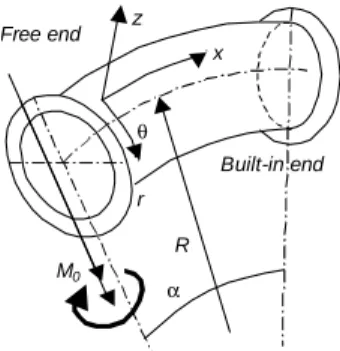
, the section radius, as depicted in Figure 1. The
solution for the three dimensional out-of-plane bending uses a set of trigonometric functions that is
complementary of the in-plane case
.
R r
x
θ
z
α
Built-in end
M0 Free end
Fig. 1 -Out-of-Plane bending moment
M
0in a rigid flanged curved pipe
The results of the example studied here with both analytical and finite element techniques are
shown in Figures 2 and 3 where a comparison with experimental results obtained by Smith and Ford
[9] is included.
An out-of-plane bending moment in a rigid flanged curved pipe was performed (with two
type of element is particularly well suited to model curved shells. The element has six degrees of
freedom at each node: translations in the nodal x, y, and z directions and rotations about the nodal x, y,
and z-axes. The deformation shapes are quadratic in both in-plane directions. The element has
plasticity, stress stiffening, large deflection, and large strain capabilities.
Fig.2 Axial stress distribution for out-of-plane loading (---ANSYS and
―
Fourier expansion)
Fig.3 Axial stress distribution for out-of-plane loading compared to Smith and Ford [9]
These results show that a good accuracy is obtained when compared both with finite element
methods and experimental results published in the literature.
References
[1] Thomson G., Stress Analysis in Smooth Bend Pipes, PhD Thesis, University of Strathclyde, Scotland, 1980.
[2] Bathe K-J and Almeida C, "A simple and effective pipe elbow element - linear analysis", Trasn. ASME, Journal of Applied Mechanics, (1980) Vol 47, pp.93-100
[3] Bathe K-J and Almeida C, "A simple and effective pipe elbow element - pressure stiffening effects", Trasn.
ASME, Journal of Applied Mechanics, (1982) Vol 49, pp. 914-916
[4] Melo F and Castro P, "The linear elastic stress analysis of curved pipes under generalized loads using a reduced integration finite ring element", Journ. of Strain Analysis, (1997) Vol 32, N 1.
[5] Othsubo H and Watanabe O, "Stress Analysis of Pipe Bends by Ring Elements", Trasn. ASME, Journal of
Applied Mechanics, (1978) Vol 100, pp.112-121
[6] Wilczek E, Statische Berechnung eines Rohrkrümmers mit Realen Randbedingungen (Static analysis of
curved pipes with realistic boundary conditions) PhD thesis (in German), Technischen Hochschule Aachen,
Aachen. 1984
[7] Kitching R, Smooth and Mitred Pipe Bends, Chap. 7 in "The Stress Analysis of Pressure Vessels & Pressure Vessels Components" Ed. by S. S. Gill, Pergamon Press 1970
[8] Madureira L and Melo F, “Stress analysis of curved pipes wiyh hybrid formulation”. Pressure Vessels &
Piping Vol 81 N3, 2004, pp 243-249
[9] Smith R and Ford H, “ Experiments on Pipe Lines and Pipe Bends Subjected to Three-Dimensional Loading” Journal of Mechanical Engineering Science, 1967, 9:2, pp 124-137.
-3 -2 -1 0 1 2 3
0 90 180 270 360
Stress Factor
Extrados Intrados Extrados
Ansys Midle
Pipe dimensions
r = 0.05 m
R=0.2m