CASE STUDY:
LISBON - A DREAM DESTINATION?
Diogo Alexandre Almeida Alves
Project submitted as partial requirement for the conferral of MSc. Business Administration
Supervisor: Professor Paulo Rita, ISCTE Business School, Department of Marketing, Operations and Management
- Spine –
L
IS
B
ON
–
A
DR
E
AM
DE
S
T
INA
T
ION
?
Diog
o
Alexan
d
re
Alm
ei
d
a
Alves
I
RESUMO
O turismo é um fenómeno marcante do século XXI, assumindo importância nas mais variadas esferas que compõem a vida em comunidade, constituindo uma égide económica, política, cultural e social difícil de encontrar em outros sectores da sociedade.
Este caso pedagógico insere-se nessa problemática, partindo de um conjunto de tendências de turismo internacionais para a focalização num destino específico, a capital de Portugal, Lisboa. Tendo em vista uma discussão globalizante e integrante dos diversos temas que confluem para a gestão estratégica e promoção de um destino turístico enquanto marca, serão apresentados um conjunto de dados que servirão de base para um estudo aprofundado do mercado turístico lisboeta, avaliando primordialmente as dimensões de posicionamento e imagem percebida do destino, partindo ainda de determinadas características que definem o perfil do seu público-alvo. Lisboa enquadra-se num cenário competitivo forte, no qual procura distinguir-se dos principais destinos Europeus através de uma estratégia holística que tem por base um alinhamento entre os diversos produtos turísticos da cidade e região e que contribuem para o seu posicionamento genérico enquanto destino turístico.
Para facilitar o entendimento do caso será efectuada uma abordagem ao tema de marketing estratégico de destinos turísticos, no que toca sobretudo aos conceitos de marca, imagem e comportamentos do consumidor em turismo.
O cariz pedagógico é atribuído pela actualidade e recente importância de Lisboa no panorama internacional do turismo espelhando uma perspectiva futura optimista e contribuindo decisivamente para a alavancagem da sociedade portuguesa, não só a nível económico como também social e espiritual.
Palavras – chave: Comportamento do Consumidor, Posicionamento e Imagem de Marca, Marketing Estratégico de Destinos Turísticos, Lisboa
JEL Classification System: M31 - Marketing
II
ABSTRACT
Tourism is a noticeable phenomenon of the XXI century, assuming critical importance in the several spheres that compose life in community, constituting an economic, political, cultural and social aegis hard to find in other areas of society.
This case study is edged under this problematic, starting from a set of international tourism trends to focus on a specific destination, the capital of Portugal, Lisbon.
Key facts will be presented, seeking for a globalizing and integrating discussion around the diverse themes that comprise the strategic management and brand promotion of a tourism destination, involving a deep study of the Lisbon tourism market, primarily evaluating its perceived image and positioning dimensions and relating to its specific target markets profile characteristics.
Lisbon is framed on a strong competitive scenario, striving for a differentiation relatively to the main European destinations through holistic strategies based on a principle of alignment between the several tourism products of the city and region that contribute for its overall positioning as a destination.
A literature review will be presented, in order to contribute for a generic comprehension of the case study, highlighting key concepts of destination strategic marketing, such as branding, image and consumer behavior in tourism.
The educational character is attributed by the hot topic and recent importance of Lisbon in the international tourism panorama reflecting an optimistic future perspective, aiming at decisively contributing to the leverage of the Portuguese society, not only at an economic level, but also considering a social and spiritual dimension.
Keywords: Consumer Behavior, Brand Positioning and Image, Destination Marketing, Lisbon
JEL Classification System: M31 - Marketing
III
ACKNOWLEDGMENTS
This case study is a universe of words and ideas whose inspiration was definitely influenced by the key people that provided me the necessary support, motivation, helping me to anticipate inaccuracies that end up being important lessons learnt.
First of all and most important, a very special thanks to my family, especially to my Mother and Father that were always there to help me in the good and bad moments, criticizing in a constructive way but incentivizing me continuously to strive for excellence. Moreover, the opportunities they offered me throughout all my life were critical for the deepening of the contents of this case study, and to them I owe the world perspective I have today.
A distinctive thanks to my grandparents, uncle and little brother Miguel, whose childhood, permanent bliss and happiness energetically contributed to an enjoyable and positive writing. I am also grateful to my supervisor Prof. Paulo Rita, for the rationale structuring and essential guidance that oriented my thesis.
Furthermore, I express my sincere thanks to my very good friends Joana, Jorge, Tiago, Catarina and Hélia that helped me to win the war, despite some battles that seemed lost since the beginning. Thanks also to Susana, for being the special one in my life.
I express my gratitude also to my professional work team, always cheerful and exultant, feeling a vibrant atmosphere that helped me to go home every day with a smile in my face and ready to face this challenge.
Finally, I would like to thank to all of my friends around the world, with whom I have lived unique and unforgettable experiences. For all of you who are in Lisbon, London, Hong Kong, Paris, Luanda or in other parts of the world a very special thank you for giving me this idea to which all of you have contributed with singular moments forever held in my memory.
IV
INDEX OF CHARTS
Chart 1 - Regional Shares (%) per Tourist Arrivals (in 1980, 2010 and Forecast for 2030)... 4
Chart 2 - Occupancy Rates (%) in the City of Lisbon (Aug 2010 - Sept 2011) ... 9
Chart 3 - Age Groups of Foreign Tourists: City of Lisbon (% of respondents) ... 22
Chart 4 - Marital Status of Foreign Tourists: City of Lisbon (% of respondents) ... 23
Chart 5 - Lisbon as Sole or Secondary Destination: City and Region (% of respondents) ... 23
Chart 6 - Foreign Tourists Accommodation: City of Lisbon (% of respondents) ... 24
Chart 7 – Foreign Tourists Overnight Stays in Lisbon´s Hotels: City and Region (% of respondents)... 24
Chart 8 - Patterns of visit to Lisbon: City and Region (% of respondents) ... 25
Chart 9 - Age Group by Portuguese or Foreign Tourists (% of respondents) ... 25
Chart 10 - Marital Status by Portuguese or Foreign Tourists (% of respondents) ... 26
Chart 11 - Average Daily Expenditure (€) per Tourist Origin ... 26
Chart 12 - Type of Airline Company used to fly to Lisbon (per Tourist Origin, % of respondents) ... 27
Chart 13 - Sample Distribution per Country (% of respondents) ... 27
Chart 14 - Source of information to visit Lisbon (per Tourist Origin, % of respondents) ... 28
Chart 15 - Motives to visit Lisbon as a city break (per Tourist Origin, % of respondents) ... 28
Chart 16 - Expectations Level regarding Lisbon´s leisure (per Tourist Origin, % of respondents) ... 29
Chart 17 - Perceived Lisbon´s Target Groups by foreign tourists (% of respondents) ... 29
Chart 18 - Motives to visit Lisbon by Golf Players (% of respondents) ... 30
V
INDEX OF FIGURES
Figure 1 - Periodic Publications (Follow Me Lisboa, My Own Lisbon, Touring Lisboa) ... 17
Figure 2 - Bolsa de Turismo de Lisboa (International Tourism Exhibition) ... 17
Figure 3 - Mutually Reinforcing Activities - Brand Values of Lisbon Positioning ... 47
Figure 4 - Relationship between perceived image, tourist behaviors and destination promotion ... 51
Figure 5 – The Key Learnings Wheel ... 52
Figure 6 - Strategic Groups for Lisbon (Markets and Promotion orientation) ... 57
Figure 7 - Strategic Groups for Lisbon´s Tourism Products attained to Spain (Product and Promotion orientation) ... 58
VI
INDEX OF TABLES
Table 1 - Inbound Tourist Arrivals: Overnight Visitor Growth (Millions) ... 3
Table 2 - Outbound Tourist Visits: Overnight Visitor Growth (Millions) ... 3
Table 3 – Key Hotel Industry Indicators (Jan-Aug; 2008-2011) ... 7
Table 4 - Lisbon Foreign Tourists Origin (Jan-Aug, 2010 & 2011) ... 8
Table 5- Commercial traffic to Lisbon by air and sea (Jan – Aug; 2008-2011) ... 9
Table 6 - Motives to visit Lisbon (per origin of visitor) ... 11
Table 7 - Motives to visit Lisbon (per tourism product and tourist origin) ... 12
Table 8 - Promotion aim (Tourists vs. Trade) per Target Market ... 18
VII
TABLE OF CONTENTS
RESUMO ... I ABSTRACT ... II ACKNOWLEDGMENTS ... III INDEX OF CHARTS ... IV INDEX OF FIGURES ... V INDEX OF TABLES... VI 1. CASE STUDY ... 11.1. Background Issue: Lisbon – A dream destination? ... 1
1.2. Case Study Context ... 2
1.2.1. International Tourism ... 2
1.2.1.1. Global Tourism Outlook ... 2
1.2.1.2. Trends in International Tourism ... 4
1.2.2. The Lisbon case ... 5
1.2.2.1. National Context – The tourism in Portugal ... 5
1.2.2.2. Lisbon – The city of seven hills ... 6
1.2.2.3. Lisbon Tourism Outlook ... 7
1.2.2.4. Lisbon Tourists Profile ... 10
1.2.2.4.1. Satisfaction Survey - Inquérito Grau Satisfação (2009) ... 10
1.2.2.4.2. Motivational Survey - Inquérito Motivacional (2009) ... 11
1.2.2.4.3. Online survey (2010): ATL´s Strategic Plan 2011-2014 ... 13
1.2.2.5. Recent Trends in Lisbon Tourism ... 15
1.2.3. Lisbon – Promotion and Competition ... 16
1.2.3.1. Lisbon Tourism Promotion ... 16
1.2.3.2. Lisbon Main Competitors ... 19
1.2.4. Lisbon´s Tourism – The future ... 20
1.3. Case Study Questions ... 21
VIII
2. TEACHING NOTES ... 31
2.1. Case Study Target ... 31
2.2. Educational Objectives ... 31
2.3. Literature Review ... 32
2.3.1. Destination Branding ... 32
2.3.2. Cooperative Destination Branding ... 33
2.3.3. Destination Branding vs. Destination Image ... 33
2.3.4. Dimensions of Image ... 34
2.3.5. Consumer Behavior in Tourism ... 35
2.4. Analytical Frameworks Presentation ... 37
2.5. Action Plan... 39
2.6. Action Plan Questions ... 40
2.7. Case Study Resolution Proposal ... 41
2.8. Case Study Resolution Slides ... 61
2.9. Management Lessons ... 68
1
1. CASE STUDY
1.1. Background Issue: Lisbon – A dream destination?
Diogo had the dream of travelling around the world. Originally from Lisbon, he managed to live and travel to different world destinations, from Europe (UK, France, Spain, etc.) to Asia (Hong Kong, Singapore, Malaysia, etc.) or Africa (Angola). Each destination provided him remarkable experiences, a blend of emotions and feelings signifying unique meanings attributed to each destination.
The stimulus of meeting new people and cultures, getting other perspectives of the world and defying the challenge of experiencing diverse continental stages were always a motivation. Hence, the higher the mountain, the bigger the challenge. That was what he felt while climbing the Mount Kinabalu, a 5.000 meter mountain in Malaysia. Despite the obvious fatigue, the misfortune of a recent motorbike accident in the Philippines and a sudden thunderstorm along the climbing, nothing was comparable to the image of the sunshine in the top of that mountain. Undoubtedly, one of the most treasured recalls he certainly has.
Continuing the trip around Asia, he visited Tai Po, Hong Kong, where a wishing tree marks a ritual in which visitors should write down their wishes in a paper attached to oranges onto branches, throwing it against the tree. If they hang, the wishes will be realized. Spiritualism and mind liberation outlined that experience. From tradition to modernity in Mong Kok, everything pointed out to shopping, due to an immense area full of markets and entertainment!
Good vibrations were present everyday with the Angolan rhythms of Kisomba and Kuduro, expressions of a cultural resistance of a nation, an anthem to the celebration of freedom. Culture and history were also key reasons for him to live in Paris, remembering the traditional and unforgettable visits to the Eiffel Tower and Notre Dame Cathedral. Remarkable was also London, always looking at the clock of Big Ben, observing the seconds passing by at the speed of light. What a vibrant city!
2 Coming back to his hometown, he decided to revisit the Belem Tower and to visit for the first time Sintra´s Palácio da Pena, two world heritage sites recognized by UNESCO. Ancestry was the word that immediately came up to his mind, observing splendid architectural demonstrations of history. Similarly, walking around Baixa - Chiado area, he started to imagine how Lisbon was in the old times, whereas the visits to the modern and business area of Parque das Nações remembered the extraordinary Expo 98´, a world showpiece of different cultures and backgrounds.
Throughout his childhood, he was used to travel between Lisbon and Leiria to visit his family. Once, returning home, he said to his parents “Are we in Las Vegas? It is so shining!” Was his perception right? Is Lisbon a dream destination?
1.2. Case Study Context
1.2.1. International Tourism
1.2.1.1. Global Tourism Outlook
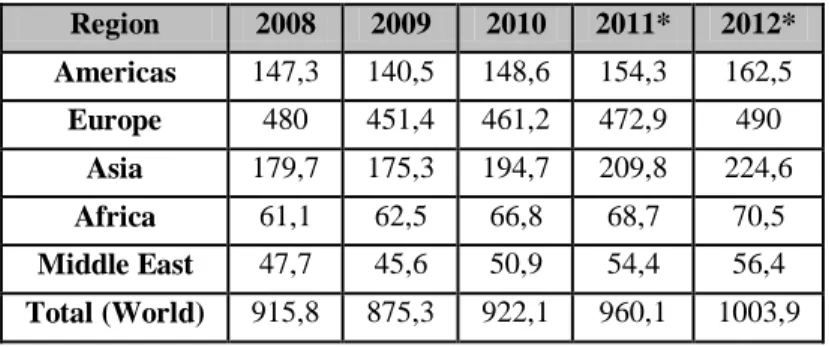
Despite the downward pattern registered in 2009 due to the overall world economic crisis, international tourism presents positive prospects for the future, forecasting 1 billion inbound tourist arrivals in 2012 (Table 1).
Europe continues to be the regional area with the higher number of inbound tourist arrivals with around half of total. Even though, Europe is the continent with the lowest growth between 2008 and 2011. In 2011, Eastern Europe is expected to increase in 5,6% compared to the 1,5% of the projected evolution for the EU15.
Asia is the continent with the highest progress, rising 11% between 2009 and 2010. Furthermore, it is the region which is expected to grow more in 2011 and 2012.
Contrastingly to the major continents regarding inbound tourist arrivals, Africa did not have a descending trend in 2009, registering a constant development since 2008 till 2012 (forecast). Latin America is driving the growth of inbound tourism in the American continent, with predicted increase of 9,4% from 2011 to 2012, compared to the expected 4,3% of North America.
3 Table 1 - Inbound Tourist Arrivals: Overnight Visitor Growth (Millions)
Region 2008 2009 2010 2011* 2012* Americas 147,3 140,5 148,6 154,3 162,5 Europe 480 451,4 461,2 472,9 490 Asia 179,7 175,3 194,7 209,8 224,6 Africa 61,1 62,5 66,8 68,7 70,5 Middle East 47,7 45,6 50,9 54,4 56,4 Total (World) 915,8 875,3 922,1 960,1 1003,9
Source: European Travel Commission * Forecast for 2011 and 2012
Regarding outbound tourist visits, Europe is also the continent that catalogs the highest number of residents travelling in another country, but presenting the slowest recovery in terms of visitor forecasted growth, being expected to increase to higher levels than the ones of 2008 only in 2012. Asia is again the fastest growing continent, reaching a 10% evolution between 2009 and 2010, followed by Middle East with 7,6% and Americas with 6,8%.
Latin America is forecasted to present the highest % change in outbound visits in 2011 with 11,2%, whereas Oceania (included in the Asian group according to the European Travel Commission) was the region that recorded the superior increase of all with 11,7% from 2009 to 2010 (Table 2).
Table 2 - Outbound Tourist Visits: Overnight Visitor Growth (Millions)
Region 2008 2009 2010 2011* 2012* Americas 137,9 134,6 143,8 149,4 158,5 Europe 571,4 535,2 549,6 568,4 586,6 Asia 250,7 250,5 274,6 299,1 321,5 Africa 37,9 35,1 37 38,3 40,3 Middle East 71,4 63,5 68,3 73,4 77,6 Total (World) 1069,4 1018,9 1073,2 1128,6 1184,5
Source: European Travel Commission * Forecast for 2011 and 2012
4 1.2.1.2. Trends in International Tourism
According to the World Tourism Organization (WTO) within the study “Tourism towards 2030”, the international tourist arrivals will reach 1,8 billion in 2030 assuming a positive growth mainly driven by emerging economies, who are likely to overtake the advanced economies in inbound tourism by 2015. Europe will continue to be the region with higher number of international tourist arrivals, and Asia - Pacific will be the fastest growing region.
In fact, if we consider an evolution of the shares of each world area in the international tourism, the Americas and specially Europe significantly decrease their shares from 23% and 63% in 1980 to 16% and 51% in 2010 respectively, forecasting a constant decrease till 2030.
Adversely, Asia represented only 8% of the international tourism shares in 1980 while it is expected to reach 30% in 2030 (Chart 1).
Chart 1 - Regional Shares (%) per Tourist Arrivals (in 1980, 2010 and Forecast for 2030)
Source: UNWTO World Tourism Organization
Asia is the paradigm for the enhancement of the emerging economies in the international tourism scenario proven by the rising demand and increasing middle class in those societies. Contrastingly, Europe has registered lower levels of economic growth than in past decades. Alongside with those relevant economic aspects, also socio-demographic characteristics have a big impact on tourism. According to Eurostat, between 2010 and 2030, the overall population growth in Europe should be of around 0,2%, while the evolution of the population with more than 65 years old should be of 1,7% revealing a rising aging population. This has potential impacts on
5 tourism, with the escalating “Silver Age” market (acronym for seniority, people aged between 50 and 70 years old) turning into an extremely attractive segment for tourism programs. From 2005 till 2008, the number of trips of this segment increased in around 7 %, with growth prospects. Furthermore, the decline of birth rates and shifts in the traditional family model also impacts on the typical tourist profiles.
The crescent “sophistication” of the societies also diversified the purposes for inbound tourism, giving a special emphasis to the balance between leisure and business, due to international globalization.
The so called generation “Xtra-money to spend” (people between 30-40 years old) gives special relevance to experiential trips, seeking for eco-friendly products, travelling for health and well-being reasons or well-being avid consumers of luxury products.
1.2.2. The Lisbon case
1.2.2.1. National Context – The tourism in Portugal
According to the website of AICEP Portugal, the Portuguese Agency for Investment and External Commerce, tourism is currently Portugal´s primary export. This fact has been reinforced in the first semester of 2011, in which Portugal registered the highest number of receipts in its history, culminating with the month of June to be the best on record, reporting a 10,3% y-on-y variation, higher growth than in periods of remarkable events like the Expo 98 or the Euro 2004. During the first 6 months of 2011, foreign tourists spent 3.246 billion euros in Portugal, representing an almost 9% increase compared to the previous year.
In terms of foreign tourists nationality, the main ones contributing for this record were the Brazilian (up to 40,5% and with the biggest y-o-y increase), the Americans (with a 22,1% increase), the Belgian (showing a 15% growth) and the French (improving 14,2%). The passenger traffic at Portugal´s major airports rocketed to all-time records, targeting results of 3.2 million passengers in the month of July. Tourism represented 14% of Portugal´s service, goods and exports in 2010, these results are estimated to increase dramatically being a critical part to face the current economic recession.
6 1.2.2.2. Lisbon – The city of seven hills
Lisbon is known as the city of seven hills, a nickname that enriches its cultural and historical background, reviving the legend that Lisbon was originally built over seven hills.
The region of Lisbon1 highlights the capital city of Portugal which undeniably is one of the main tourism destinations of the country. Its development potential and intrinsic tourism natural ability is enormous and Lisbon presents a high attractiveness for several segments of tourism demand, fulfilling different travel motivations.
Lisbon is a vibrant city with a wide offer of tourism accommodation, leisure and entertainment, while based upon unique territorial foundations and several expressions of history and culture (Belém Tower, Jerónimos Monastery and the historic village of Sintra are classified by UNESCO as world heritages sites).
Moreover, Lisbon is well known by its traditional character. Some important examples are the gastronomy and wine routes (around 71% of the visitors in 20092 experienced activities related to the enological and gastronomic heritage), and the unique fado music genre, recently recognized as world´s intangible cultural heritage by UNESCO.
In order to boost tourism promotion, each municipality of Lisbon´s region has been developing an integrated effort with the capital city to create synergies between the different tourist attractions. Hence, a significant parcel of tourists that come to the city aim at complementing their experiences with a visit to the surrounding areas of Lisbon´s region for diverse purposes (cultural touring, nautical tourism in Cascais or religious tourism in Fatima are some examples).
According to the Lisbon Tourism Association (Associação de Turismo de Lisboa - ATL), Lisbon is characterized by:
Three micro-centralities: the historical center (typical neighborhoods including Baixa-Chiado area), the heritage area of Belém, full of history and tradition; and Parque das Nações, a renewed and modern area of the city that hosted the universal Expo 98´ nearby the Tejo river and full of nightlife and entertainment;
1
According to the Lisbon Tourism Observatory, the region of Lisbon is composed by the metropolitan area of Lisboa and Vale do Tejo plus the territories of the West Old Regions, Ribatejo, Templários and Leiria/Fátima 2
According to Satisfaction Survey - Inquérito de Satisfação 2009 conducted by the Lisbon Tourism Association (ATL)
7
Two macro-centralities: Cascais/Estoril well known by the natural landscapes, amazing beaches and high quality of tourism and leisure infrastructures; and Sintra, a world heritage site, rich in biodiversity and landscape driven, complemented by a blend of experiences (from golf to cultural touring with some of the most beautiful palaces of the country).
Although Lisbon´s orientation for tourism, next years are going to be crucial to plan its development, being directed by strong criteria of quality and sustainability, aiming at defining a common vision and strategy to apply to the whole region and corresponding municipalities.
1.2.2.3. Lisbon Tourism Outlook
According to the Lisbon Tourism Observatory (Observatório de Turismo de Lisboa), after the underperformance registered in 2009 due to the economic recession, Lisbon tourism has been recovering, reaching 6 million of overnight stays in 2011 (from January to August), representing an increase of 28% compared to the same period in 2008. The number of guests demonstrated a 25% rise in the same period.
Foreign tourists are the ones that mostly contribute to this upsurge, signifying 64% of the total guests and 71% of the overnight stays. Adversely, the number of Portuguese guests registered a negative growth of -0,2% from 2010 to 2011. The weight of internal and external markets for the global tourism indicators has been steady since 2008, revealing the high dependency of Lisbon in foreign visitors. Overall, the total income of hotel industry rose from around 330 million € in 2009 to 371 million € in 2011 (Table 3).
Table 3 – Key Hotel Industry Indicators (Jan-Aug; 2008-2011)
Indicators 2008 2009 2010 2011
Guests 2.617.887 2.458.000 2.627.240 2.765.774
Overnight Stays 5.836.885 5.427.000 5.795.098 6.216.274
Total Income 382.679.111€ 329.959.000€ 349.735.679€ 371.401.115€
Source: Lisbon Tourism Observatory, INE
8 Spanish tourists embody around 20% of total foreign tourists that visited Lisbon during the year of 2011. Despite being the most representative, it was the only of the top-10 ranked countries by foreign tourist origin that registered a negative variation when compared to the same period of the latter year. Contrastingly, Brazilian and French tourists´ visits to Lisbon have increased in more than 20% compared to 2010 (Table 4).
Table 4 - Lisbon Foreign Tourists Origin (Jan-Aug, 2010 & 2011)
Markets Nr. Tourists in 2011 Growth Rate 2010-2011 Spain 871.444 -0,7% Germany 353.395 3% UK & Ireland 363.556 8,9% Italy 322.295 3,8% France 419.634 22%
Belgium & Netherlands 273.484 11,8%
Scandinavia 238.433 10,9%
USA 241.490 5,7%
Brazil 418.526 24,1%
Source: Lisbon Tourism Observatory, INE
Note: Data considering the cumulative Periods between January and August of each year
The city and region of Lisbon present similar patterns in terms of Hotel occupancy rates and average prices considering the cumulative period from January to August, and forecasting a positive growth.
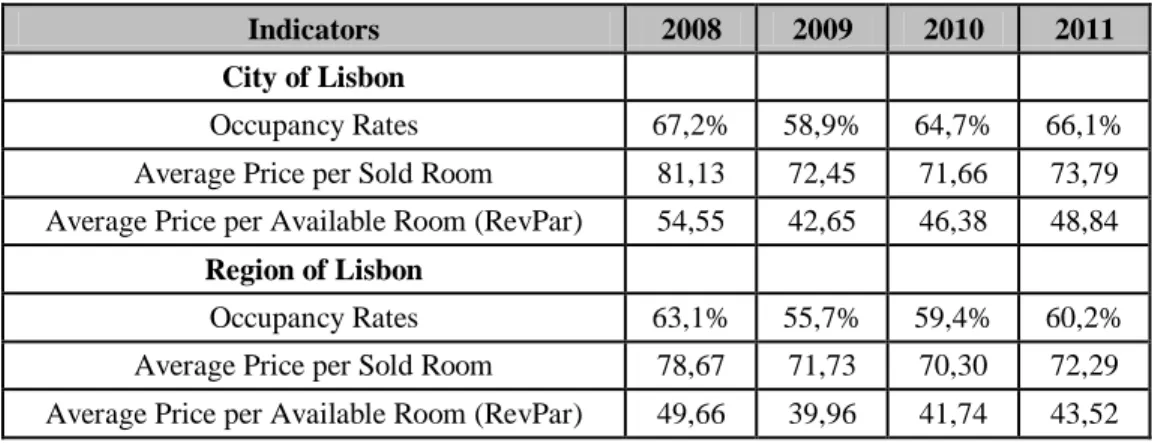
The highest occupancy rates in the city of Lisbon were registered in 2008, for both city and region. The hotel average prices per room (sold and available) reached the peak in the same year. Furthermore, this reveals a price decrease tendency since 2008 till 2011, mainly marked by the negative effect caused by the year of 2009, with lower occupancy rates and inferior average prices. More details about the occupancy rates and average prices of the hotels of the city and region of Lisbon can be found in Table 10 (Appendixes).
Regarding seasonality, the hotel occupancy rates demonstrate erratic patterns, with a peak in the month of September in both 2010 and 2011 reaching 85%. Opposite to this, the first 2 months of the current year reveal occupancy rates below 50%, while the 3 summer months present an average of 75% (Chart 2).
9 Chart 2 - Occupancy Rates (%) in the City of Lisbon (Aug 2010 - Sept 2011)
Source: Lisbon Tourism Observatory, INE
The commercial traffic by air (especially motivated by the rise of low cost airline companies) and sea has been increasing since 2008, with upward patterns in terms of number of flights and cruises comparing homolog periods.
Between January and August of 2011, the Lisbon airport registered almost 10 million passengers and 94 thousand flights, meaning a positive variation of 1,50% compared to 2010.
The positive tendency is also reflected in the number of cruises arriving to Lisbon harbor, that presents a positive growth of 13,30%, significant mark as the homolog variations of previous periods have been always negative (Table 5). This optimistic trend is reinforced by the recognition of Lisbon as the leading Cruise Destination in Europe by the World Travel Awards in 2009.
Table 5 - Commercial traffic to Lisbon by air and sea (Jan – Aug; 2008-2011)
Indicators 2008/2009 2009/2010 2010/2011
Number of flights (Lisbon Airport) -5,80% 4,80% 1,50%
Number of cruises (Lisbon Harbour) -9,70% -5,40% 13,30%
Source: Lisbon Tourism Observatory
Note: Data considering the cumulative Periods between January and August of each year
0% 20% 40% 60% 80% 100%
10 1.2.2.4. Lisbon Tourists Profile
1.2.2.4.1. Satisfaction Survey - Inquérito Grau Satisfação (2009)
The following paragraphs highlight the results of a survey conducted by the Lisbon Tourism Observatory and applied during 2009 in Lisbon with 3059 interviews made to foreign visitors in order to access their level of satisfaction with the destination.
Regarding socio-demographic considerations in the city of Lisbon, the male gender was preponderant, with 61,3% of the overall respondents, while 27,4% had between 25-34 years old and 27,2% was in the range between 45 and 54 years old (Chart 3 - Appendixes). 63% of the respondents were under marital status whereas 25% were single (Chart 4 - Appendixes).
Lisbon´s weight as the sole destination of the trip to Portugal has gone down from 69,8% in 2008 to 44,9% in 2009, while the importance of the overall region of Lisbon is considerably higher with 54,3% as unique destination chosen. Contrastingly, the city of Lisbon has increased its weight as a secondary destination, having increased from 12,8% in 2008 to 29,3% in 2009 (Chart
5 - Appendixes).
Additionally, 93% of the foreign tourists stayed in hotels compared to the 82% of 2007, whereas only 3,4% stayed in family or friends´ house (Chart 6 & 7 - Appendixes). The average overnight stay of foreign tourists in Lisbon was of around 5 nights, clearly preponderant on the overall visits to Portugal, whose average of overnight stays was of about 7 nights.
66% of the respondents revealed it was their first visit to the city while the weight of visits to the region was higher than the visits to the city in the case of those who had already been once or twice in Lisbon (Chart 8 - Appendixes).
2/3 of the overall visitors consider the likelihood of returning to Lisbon as a good option and 99% would recommend the city and region to friends and relatives.
11 1.2.2.4.2. Motivational Survey - Inquérito Motivacional (2009)
In order to access the main motivations to travel, the Lisbon Tourism Observatory developed a group of interviews comprised in the Motivational Survey of 2009 (Inquérito Motivacional de 2009) to a sample of 4.379 tourists hosted in the overall region and city of Lisbon. Interesting results were found, specially related to the difference between foreign and national tourists.
Motives to visit Lisbon
While 86% of the foreign came to Lisbon due to leisure motives, only 31% of nationals considered Lisbon for leisure and recreational purposes. Business was the number one motivation amongst the nationals (Table 6).
Table 6 - Motives to visit Lisbon (per origin of visitor)
Motives to visit Portuguese Foreign
Leisure 31,3% 85,9%
Business 47,7% 9,9%
Health 3,7% 0,2%
Visits to friends/relatives 7,5% 2,4%
Others 9,7% 2,6%
Source: Motivational Survey 2009 – Region of Lisbon (Área Promocional de Lisboa)
Some differences were found regarding the motives to visit Lisbon as city or/and as region. Regarding short breaks, the Spanish tourists were the “champions”, while the British/Irish and Dutch/Belgian prioritized the short breaks in the region compared to the city. Furthermore, the region of Lisbon has also a bigger importance for the majority of tourists in relation to touring purposes.
Among foreign tourists, the Americans presented the higher business motivation followed by the British/Irish but far away from the importance attributed to MICE (Meetings, Incentives, Conventions and Exhibitions) by the national tourists, being the most representative group (19%) in the total average of 10% of respondents that considered MICE as the main motive to visit Lisbon (Table 7).
12 Table 7 - Motives to visit Lisbon (per tourism product and tourist origin)
Markets
Short breaks Touring MICE
Region City Region City Region City
Spain 37% 44% 22% 10% 3% 5% Germany 32% 31% 14% 11% 4% 6% UK/Ireland 41% 28% 12% 11% 3% 7% France 33% 34% 30% 15% 2% 4% Brazil 22% 22% 18% 16% 4% 4% Italy 38% 33% 14% 7% 2% 3% Netherlands/Belgium 41% 35% 16% 11% 2% 3% Scandinavia 29% 27% 14% 14% 5% 6% USA 28% 26% 13% 11% 7% 9% Portugal 12% 8% 1% 0,4% 16% 19% Average 25% 24% 11% 8% 8% 10%
Source: Motivational Survey 2009 – City and Region of Lisbon (Cidade e Área Promocional de Lisboa)
Other important characteristics
In the region of Lisbon, more than half of the foreign respondents were in the range between 36 and 55 years old and 14% had more than 65 years old (with a special emphasis for leisure tourism). Contrastingly, only 5% of Portuguese were on this range, revealing a higher propensity for the interval between 26 and 35 years old with 26% against 16% of foreign tourists (Chart 9 –
Appendixes).
The big majority of foreign and national tourists were married or together, while there is an upper weight of singles in the case of business tourism. The weight of couples is significantly high in the case of UK and Ireland (81% of total respondents) and the importance of singles is relevant in the case of the Brazilian (23%) and Portuguese with 19,6% (Chart 10 – Appendixes).
The Brazilian, Scandinavian and American revealed the highest average daily expenditures level of all (964€, 800€ and 750€ respectively), above the 595 € of average expenditure of the total foreign tourists (Chart 11 – Appendixes). The British and Irish were the ones to spend less due to the lowest impact of the transportation component, as 56,5% of them chose low cost flights, a much higher percentage than the 2nd ranked Germany with 31,8% (Chart 12 – Appendixes).
13 1.2.2.4.3. Online survey (2010): ATL´s Strategic Plan 2011-2014
In order to complement the previous studies, the Lisbon Tourism Association (ATL – Associação de Turismo de Lisboa) prepared an online survey to be applied to individuals in their country of origin in Europe. The sample distribution was different according to the relative importance of each country in terms of overnight stays in the region of Lisbon (Chart 13 - Appendixes). The chosen countries were: Germany, Belgium, Spain, France, Netherlands, Italy and United Kingdom. Several dimensions have been analyzed:
Preferred source of information about Lisbon
The main source of information is family and friends that visited the destination before. This is valid for all the countries considered with more than 50% of the preference, except for Germany and Netherlands in which the travel guides are the preferred mean to access information about the capital of Portugal. Internet is in the top 3 among all the nations studied, with around 30% to 40% of the preferences (Chart 14 – Appendixes).
Motives to/not to visit the Region of Lisbon as a City Break
The curiosity about the destination was the major motive for foreign tourists to choose Lisbon as a city break, especially for Germans (89,5%) and Dutch (76%), while the Spanish mainly travel due to the proximity to Portugal (54,1%) while the Belgian and British (37,5%) value the good weather conditions and the French give preference to the good accessibilities of Lisbon (53,8%). This information is presented in the Appendixes section, Chart 15.
Motives to/not to visit the Region of Lisbon as a Business Trip
The majority of 114 respondents on this scope chose Lisbon for business trips mainly because the company in which they work operates in the region, in exception of the Belgian and Italian that went to Lisbon mainly due to its direct flight connections.
The lack of relevant business events and conferences is pointed out by the respondents as the second major reason to not select Lisbon as a destination for business trips.
14
Expectations: Pre-visit vs. After visit results
The majority of the respondents revealed that the visit to Lisbon matched their previous expectations in terms of leisure destination with particular highlight to the Germans (78,9%) and Italians (74,1%). In the same item, the visit to Lisbon was overwhelming to French and Spanish, with more than half of the respondents to consider their visit results above their initial expectations (Chart 16 – Appendixes).
Despite the good perceptions of French and Spanish regarding leisure tourism, they are also the most skeptical regarding Lisbon as a business destination. In exception of France, Spain and Italy, the sample is not representative lower than 5 respondents in the other considered countries regarding business tourism.
Target market of Lisbon
The majority of respondents consider Lisbon to be a city targeted primarily to adult couples, with particular highlight to Germany and France (75,7% and 72,7% of the total country respondents), while the Belgian and the British consider that the secondary target market of Lisbon should be senior retired couples, whereas the other considered countries chose as 2nd main target the attractiveness of Lisbon to young couples without children (Chart 17 – Appendixes).
Key attributes to visit Lisbon
This indicator complements the information of the previous points, highlighting the importance of different attributes identified in Lisbon according to each nationality and reflecting the diverse cultural backgrounds among the countries considered.
For Germans and Dutch, the most important aspect for leisure tourism was the accommodation, while for Belgian, British and French was the hospitality and kindness of the Portuguese. For Spanish and Italian the most valued characteristic was its value for money character.
The Italian, French and British considered Lisbon to be a city with excellent weather conditions, whereas the Dutch, Belgian and Spanish attributed the adjective “beautiful” to Lisbon and the Germans give more importance to the culture and history of the city. Furthermore, while for German, Dutch, Belgian and British the main differentiation elements of Lisbon are related to its culture, climate is the keyword for Italian and French, whereas the Spanish feel close to Lisbon due to its geographical proximity and language.
15 1.2.2.5. Recent Trends in Lisbon Tourism
The National Strategic Plan for Tourism (PENT - Plano Estratégico Nacional do Turismo) elaborated in 2006 had the objective of fostering the development of tourism in Portugal and defined the tourism priorities for Lisbon for the next 10 years.
The strategic direction given by the PENT helped Lisbon to reach a status of one of the most appreciated cities in the international tourism panorama. Nowadays, Lisbon is characterized by having a diversified offer of tourism products:
A top City Break
The World Travel Awards known as the travel industry Oscars recognized Lisbon as the European Leading City Break Destination in both 2009 and 2010, being Europe´s overall leading destination in 2009.
A colossus among backpackers
According to the Lisbon Tourism Association website referencing the Portuguese Association of Hostels, the number of active hostels rose in 50% from 2008 to 2010, while the overall capacity (number of beds) increased in 90%. Budget travelers consider Lisbon hostels as the best in the world, as recognized by the largest Hostels website (www.hostelworld.com) that attributed the 2011 Hoscars Awards to three hostels in Lisbon (Travellers House, Lisbon Lounge Hostel and Living Lounge Hostel) considered as top 3 worldwide!
At the heart of Golf industry
According to the IAGTO (International Association of Golf Tour Operators), Lisbon was selected as Europe´s Golf Destination of the year 2007, having won the prize for the best golf resort in 2007 and 2009.
A survey to foreign golf players conducted in 2010 by the Lisbon Tourism Observatory revealed that 38,1% of the players came to Lisbon only with the purpose of playing golf. The majority of the respondents had already visited the Lisbon Region before and assume they will return to play golf or to other leisure purposes. The motives to visit Lisbon by Golf players can be found in the
16
Rising MICE Industry
Lisbon was recently considered as the eighth most sought after destination in the world for executives as stated by the International Congress and Convention Association (ICCA).
The international chain “Great Hotels of the World” goes beyond this analysis, ranking Lisbon in the top 5 world destinations to host MICE. Moreover, a survey directed by the Lisbon Tourism Observatory to congress participants in 2010 revealed that Lisbon was considered the city where the best congresses took place ahead of London, Madrid or Paris.
Shopping upcoming destination
According to the Globe Shopper City Index Europe elaborated by the Economist Intelligence Unit (EIU), Lisbon is the 7th best city for shopping behind London, Madrid, Barcelona, Paris, Rome and Berlin. This ranking is positively influenced by the “Affordability” character of the city, sustained by competitive prices. Furthermore, the “Culture & Climate” parameter had the highest consideration among the top 10 ranked cities, while the “Hotels & Transports” item diminishes the overall score mainly due to the worse accessibilities to downtown when compared to its European pairs.
1.2.3. Lisbon – Promotion and Competition
The Lisbon Tourism Association (ATL) has developed efforts to develop Lisbon brand, mostly by investing in tourism promotion in the major source markets of foreign tourists as well as by benchmarking on the destination strategies of its main competitors within a European context.
1.2.3.1. Lisbon Tourism Promotion
According to the 2010 Budget and Activity Plan of ATL comprised in the Strategic Plan for 2011-2014, around 11,5 million euros were spent in tourism promotion with a priority given to the promotion of Lisbon brand aimed at both tourist and trade targets under the slogan “Lisboa Viva” (Lively Lisbon).
17 Almost 2 million euros were spent in brand building through several below and above the line actions such as TV spots, online advertising or PR´s, or through the presence in trade fairs or workshops (some examples in Figures 1 & 2 below).
Figure 1 - Periodic Publications (Follow Me Lisboa, My Own Lisbon, Touring Lisboa)
Source: Lisbon Tourism Association
Figure 2 - Bolsa de Turismo de Lisboa (International Tourism Exhibition)
18 18% of the overall budget was spent on the enhancement of Lisbon as a city break destination, whereas 14% was destined to reinforce the capabilities of the city to become an important MICE hub.
The Spanish tourists were the preferred target for Lisbon tourism promotion (15,6% of the total), followed by the German and British (with 9,1% and 8,1% respectively). Even though, in the two latter countries, the promotion prioritizes trade purposes whereas for Spain, Brazil, Italy, Belgium and Netherlands, the emphasis is given to tourists-direct promotion (Table 8).
Table 8 - Promotion aim (Tourists vs. Trade) per Target Market
Markets Tourists Trade
Spain 68% 32% Germany 36% 64% UK/Ireland 38% 62% France 47% 53% Brazil 56% 44% Italy 53% 47% Netherlands/Belgium 56% 44% Scandinavia 40% 60% Russia/Eastern Europe 33% 67% USA 27% 73%
Source: Lisbon Tourism Association Budget and Activity Plan 2010
A stress was given to the promotion of Lisbon brand in Germany, UK and France (with around 40-45% of the overall investment) and especially to Italy (60%), Russia and Eastern Europe (52%).
Lisbon as a city break is emphasized in Italy, Belgium, Netherlands and Scandinavia (with around 34% of the total promotion destined to the country).
A singular aspect can be identified in the promotion destined to the USA market, in which 100% of the total budget (around 150.000 euros) was intended to stimulate the meetings industry (Table
19 Table 9 - Promotion by Tourism Product and Targeted Market
Markets Brand City Breaks MICE Golf Touring Others % in Total
Spain 16% 9% 12% 0% 22% 41% 16% Germany 44% 19% 27% 11% - - 9% UK/Ireland 40% 19% 14% 22% 4% - 8% France 41% 19% 7% - 33% - 6% Brazil 9% 6% 0% - - 86% 5% Italy 60% 35% 6% - - - 4% Netherlands/Belgium 21% 34% 10% 25% 9% - 3% Scandinavia - 34% 1% 65% - - 3% Russia/Eastern Europe 52% 25% 10% - 13% - 3% USA - - 100% - - - 2% Others 19% 19% 12% 5% 3% 35% 42% Total 25% 18% 14% 8% 8% 28% 100%
Source: Lisbon Tourism Association Budget and Activity Plan 2010
1.2.3.2. Lisbon Main Competitors
According to the online survey previously referred (in 1.2.2.4.3. - Online survey (2010) within
ATL Plano Estratégico 2011-2014), there is not a unanimous response about the main competitor
of Lisbon perceived by foreign tourists. Hence, while the Belgian and Dutch consider Barcelona to be the sole competitor of Lisbon, the Spanish and French refer Porto to be the main competitive destination while the Italian mention London, Paris and Madrid to be equally competitors to Lisbon.
The respondents indicated also their comparative perception about destinations, with interesting results. While 40% of the German have a worse image about Lisbon when compared to its main destination competitors, around 75% of the French and 70% of the British consider Lisbon to be as or more competitive than its principal rivals (Chart 19 – Appendixes).
Going beyond this analysis and in order to match the perceived image with destination strategies to promote tourism, ATL recurred to certain benchmarking metrics identified in the strategic plans for tourism development of the key European competitors of Lisbon. Those are referred under the Strategic Plan 2011-2014 analysis by Deloitte:
20
Amsterdam
Amsterdam bets on the values of creativity, innovation and entrepreneurship with the following slogan “The Amsterdam Metropolitan Area is creative, contemporary (European Metropolis) on the water”, aiming at creating an integrated image of the city and region of Amsterdam, focusing on sustainability and originality. IAmsterdam is the Amsterdam brand motto.
Barcelona
Barcelona´s positioning is focused on a reinforcement of the national identity of the city without letting go its international profile. Barcelona wants to be seen as an economic hub, with a diversified and heterogeneous offer.
Madrid
Madrid aims at improving its positioning increasing the number of visitors, expenditures level and average overnight stays of tourists, betting on the cultural background of the city, as well as on the boost of the meetings industry.
Berlin
The German capital wants to be recognized as “the visit card” of the overall country, the driver of Germany in terms of tourism vision. Furthermore, the slogan “Berlin is trendsetter – Dynamics of modernity reflected in history” attributes a timeless character to the city.
1.2.4. Lisbon´s Tourism – The future
Envisioning it´s future, the tourism of Lisbon has developed an action plan with a set of structuring projects to help the city to accomplish its future objectives. Those projects are aimed at developing infrastructures to support tourism and improving transportation networks with the creation of a TGV between Lisbon and Madrid, a new terminal for cruises in Sta. Apolónia and through significant investments in Lisbon Airport.
21 Additionally, the city has to accompany the crescent needs of tourists and key tourism trends, reinforcing its competitiveness within an international context and consisting into a strong alternative to its major European competitors. This tendency is expected to be maintained as Lisbon is considered to be the 2nd top destination to visit in the world (only after Reykjavik) in 2012 according to Lonely Planet, a worldwide well-known travel guide.
It is indisputable that Lisbon has risen as a tourist destination over the last years, but how far can this city go?
1.3. Case Study Questions
1. Develop a qualified SWOT analysis for Lisbon.
2. Elaborate an adequate segmentation and targeting for Lisbon, considering current tourist expectations and trends.
3. Define the unique value proposition of Lisbon brand and key drivers of its positioning. 4. In what extent do foreign tourists perceived image and behaviors about Lisbon´s main
tourism “products” match with its desired positioning and promotion actions?
5. Define a VMO (Vision, Mission and Objectives) strategy for Lisbon. Refer at least 5 strategic objectives.
6. Which key marketing and strategic actions would you take to enhance the tourism in Lisbon? Relate them to the strategic objectives you described in the previous answer. 7. Which markets should Lisbon prioritize in terms of both strategy and promotion? What
should be the product strategy to apply for the most representative market? Recur to a strategic analytical framework to answer this question.
8. According to your own image and information presented in the case, how does Lisbon´s positioning differentiates itself from its main competitors?
22
1.4. Appendixes
Table 10 – Occupancy Rates (%) and Average Prices (€) of Lisbon Hotels: City and Region (Jan-Aug, 2008-2011)
Indicators 2008 2009 2010 2011
City of Lisbon
Occupancy Rates 67,2% 58,9% 64,7% 66,1% Average Price per Sold Room 81,13 72,45 71,66 73,79 Average Price per Available Room (RevPar) 54,55 42,65 46,38 48,84
Region of Lisbon
Occupancy Rates 63,1% 55,7% 59,4% 60,2% Average Price per Sold Room 78,67 71,73 70,30 72,29 Average Price per Available Room (RevPar) 49,66 39,96 41,74 43,52
Source: Lisbon Tourism Observatory, INE
Note: Data considering the cumulative Periods between January and August of each year
Chart 3 - Age Groups of Foreign Tourists: City of Lisbon (% of respondents)
23 Chart 4 - Marital Status of Foreign Tourists: City of Lisbon (% of respondents)
Source: Satisfaction Survey 2009
Chart 5 - Lisbon as Sole or Secondary Destination: City and Region (% of respondents)
24 Chart 6 - Foreign Tourists Accommodation: City of Lisbon (% of respondents)
Source: Satisfaction Survey 2009
Chart 7 – Foreign Tourists Overnight Stays in Lisbon´s Hotels: City and Region (% of respondents)
25 Chart 8 - Patterns of visit to Lisbon: City and Region (% of respondents)
Source: Satisfaction Survey 2009
Chart 9 - Age Group by Portuguese or Foreign Tourists (% of respondents)
26 Chart 10 - Marital Status by Portuguese or Foreign Tourists (% of respondents)
Source: Motivational Survey 2009 – Region of Lisbon (Área Promocional de Lisboa)
Chart 11 - Average Daily Expenditure (€) per Tourist Origin
27 Chart 12 - Type of Airline Company used to fly to Lisbon (per Tourist Origin, % of respondents)
Source: Motivational Survey 2009 – Region of Lisbon (Area Promocional de Lisboa)
Chart 13 - Sample Distribution per Country (% of respondents)
28 Chart 14 - Source of information to visit Lisbon (per Tourist Origin, % of respondents)
Source: Lisbon Tourism Association Strategic Plan 2011-2014 by Deloitte
Chart 15 - Motives to visit Lisbon as a city break (per Tourist Origin, % of respondents)
29 Chart 16 - Expectations Level regarding Lisbon´s leisure (per Tourist Origin, % of respondents)
Source: Lisbon Tourism Association Strategic Plan 2011-2014 by Deloitte
Chart 17 - Perceived Lisbon´s Target Groups by foreign tourists (% of respondents)
30 Chart 18 - Motives to visit Lisbon by Golf Players (% of respondents)
Source: Lisbon Tourism Association Strategic Plan 2011-2014 by Deloitte
Chart 19 - Foreign tourists Perceived Image of Lisbon relative to main competitor (% of respondents)
31
2. TEACHING NOTES
2.1. Case Study Target
The formulated case study is destined to Master students in the areas of Hospitality and Tourism, aiming at developing the main concepts of Marketing, Strategy and Branding applied to destination image and positioning.
This case study is inserted in a problem solving context focused on the competitiveness of a destination.
2.2. Educational Objectives
This case study was developed with the following educational objectives:
To recognize the importance of tourism for the overall world economy, considering the key challenges of national and international tourism;
To learn how to apply business management concepts in a destination context, training the necessary competences to act as destination managers in the future;
To instill a holistic mindset towards a destination strategic approach;
To use a set of strategic analytical frameworks contributing for destination market analysis, branding, segmentation, target and positioning;
To interrelate important concepts in destination management such as branding, promotion, image and tourist behaviors;
To foment analytical skills and creativity while developing and implementing a destination strategy;
To generate critical and structured approaches towards the resolution of the problems proposed;
To stimulate the practical involvement of the students in events related to the destination topic;
To innovate with the presentation of a hot topic quite recent and short in terms of published research.
32
2.3. Literature Review
2.3.1. Destination Branding
“A brand is what differentiates you and makes you special” (Milligan, 1995: 39). This is valid, not only for commercial and industrial brands but also for destinations, being the development of an effective brand a strong challenge.
Destination branding encounters a parallel on the branding of consumer products as destinations are also identified through specific symbols, slogans, colors, logos, heritage, myths or legends (Cai, 2002; Williams et al, 2004; Morgan et al, 2002). Moreover, one of the key differences resides in the intangibility character of a place compared to the intrinsic tangibility of a product. According to Keller (1998), a destination brand identity reflects the contribution of all brand elements to awareness and image. Hence, one of the biggest risks of a destination as a brand is the generalization of its identity due to its complex nature (Florek, 2005).
Morgan et al (2002) refer that strong destination brands have a rich emotional significance, great conversation value and provide high anticipation for their potential tourists. The objective of a destination branding is to communicate and prove its unique identity by differentiating itself from its competitors (Morrison & Anderson, 2002). In fact, all branding aims at giving to a product a specific and more distinctive identity (Cova, 1996) and that is, in essence, what most city/country marketing seeks to do for cities/countries.
The link between branding and tourism through destination branding is related to the expectations of a travel experience that is uniquely associated with the particular destination (Blain et al., 2005; Pike, 2009). Some authors like Kotler et al (2003) consider that branding in tourism is linked to the relationship between the consumers and the products/services with which they interact; while others argue that branding is “the most powerful marketing weapon available to contemporary destination marketers” (Morgan et al, 2002: 335), considering that the strength of the brand is critical for the success of the destination in the growing competitive environment we currently experience.
According to Buhalis (2000), for this objective to be accomplished, a destination marketer should take into account the role of the destination stakeholders in the brand development process, a clear alignment with the values of the destination and a focus on future strategic orientations and
33 on its key target markets because some aspects of a destination may be effective to one segment but ineffective to another (Fan, 2006).
The development of a destination branding strategy is critical to drive brand associations between the destination and the consumers, helping them to find points of difference compared to its competitors (Keller, 2008). Furthermore, those points of difference help the consumers to positively evaluate the destination brands and generate a higher destination brand loyalty. It is also important to refer that this latter concept translates into the ability of a destination to provide visitors with an experience that corresponds to their needs, matching with the image that they hold of the destination itself (Joppe & Waalen, 2001).
2.3.2. Cooperative Destination Branding
The term known as cooperative destination branding was presented by Cai (2002) and refers to a brand name that joins two or more communities with complementary natural and cultural attractions whose branding strategy should be aligned based on the assertion that the “geographical heterogeneity may limit building a particular brand for a destination or a country” (Tasci & Kozak, 2006: 303).
This concept aims at demonstrating the potential benefits of an effective brand element mix, creating a notion of synergy by the usage of common tourism resources in order to generate a stronger destination identity and image across multiple communities bigger than the impact provided by a singular community itself. Hence, shared destination attributes may converge into an overall improved destination image based on a multiplicity of brand associations subject to reinforce the brand identity of the region as a whole.
2.3.3. Destination Branding vs. Destination Image
Brand image is defined as the way brand´s personality is perceived in consumer´s minds. In a destination context, there is a link between the destination marketer that promotes its brand, while the consumers (in the case, the tourists), perceive an image of that destination.
Even though, for some authors, the concepts of brand and image are interrelated (Pritchard & Morgan, 2001), while for others, branding is created through image (Cai, 2002; Jensen & Korneluissen, 2002; Ravinder, 2003; Govers, 2003).
34 The latter argue that destination image formation is the first step towards destination branding, in which there is a change from a set of brand associations held in tourists´ memory towards a sustainable link with the brand itself. Furthermore, this adjective establishes one of the biggest differences between both concepts, as a destination brand tends to be more sustainable than destination image (Kozak, 2003).
The concept of image is a key building block for the development of a destination positioning that will reflect a certain brand identity. Moreover, the sum of beliefs, ideas, impressions (Crompton, 1979) and tourism experience-related attributes (Millman & Pizam, 1995) direct the image that tourists will form about a certain destination.
According to Hunt (1975), the power of image is as strong as capable to influence on the destination selection process and presenting a key role on traveler behavior and satisfaction. A major challenge for DMO´s (Destination Marketing Organizations) is to reinforce positive images held by target audiences, change potential negative images or generate the necessary measures towards the creation of new images.
2.3.4. Dimensions of Image
According to Ryan & Gu (2008), the image that tourists form about a certain destination is the starting point for their expectations about that destination. Therefore, the overall image of a destination is influenced by different factors, which are described as cognitive, affective and unique dimensions of image.
While cognitive evaluations represent a set of beliefs and knowledge about the destination, the affective dimension is related to feelings expressed about a certain destination.
The separate assessment of cognitive and affective variables is necessary to evaluate their unique effect on tourists’ attitudes and potential behaviors (Baloglu and Brinberg, 1997); Russel, 1980; Russel and Pratt, 1980; Russel and Snodgrass, 1987; Russel et al., 1981).
The overall image of a destination should be analyzed under three attributes: holistic, functional-psychological and uniqueness. This last component is particularly highlighted (Echtner & Ritchie, 1993). The unique character is the objective of an effective destination positioning being able to be considered as different in the minds of the prospects.
35 In order to achieve this goal, the DMO´s heavily bet on tourism promotion in order to enhance their value propositions and differentiation abilities compared to their main competitors. Those marketing and promotional actions are subject to create another image level on tourist minds, called by induced images, according to Gunn (1988). In opposition to this induced type, another kind of destination image can be created and based on first-hand experience, with a much highly personal character and termed as organic image.
2.3.5. Consumer Behavior in Tourism
It has been argued that the image of a destination is crucial not only to the destination selection process but is also an important driver of tourist behaviors. Hence, the motivations to visit, the intentions to revisit a particular destination and the ability to spread a positive word-of-mouth about it have been important behavioral consequences of destination image.
The motivations to visit a destination are generally framed into two different concepts: pull and push factors. Baloglu & Uysal (1996) defined the pull factors into certain destination attributes like the novelty or the image (that tourists have and the image marketed by the DMO´s) subject to impact on the motivation of an individual to travel while push factors are internal forces that are intangible and mostly socio-psychological as defined by Crompton (1979) in which the tourists are attracted by a certain destination regarding its capability to correspond to certain inner needs and motivations, such as the desire of relaxation and escape, adventure or adrenaline. From a DMO perspective, the most successful tourism products are the ones that best match the diverse needs of a given market segment, enforcing an alignment between internal and external motivations. This can contribute to the enhancement of tourism destination management, driving potential satisfaction reasons for travelers and generating an improved destination loyalty. Both satisfaction and loyalty concepts should be also an outcome of the interaction between the two sides of the tourism system, the tourist and the tourism attraction (Jurowski et al., 1996). Furthermore, these motives interact in a dynamic and changing environment (Correia, 2000) in which there is an exchange of perceptions between the destination marketers and the individual tourists fundamental to assess not only actual tourist attitudes but also to predict future travel patterns.
36 The intention to revisit has been widely studied in past tourism literature due to its indication of customer loyalty, as customer acquisition is generally more difficult and expensive than retaining existing customers.
According to Fishbein and Ajzen (1975), positive past experiences can lead to a more positive belief that will create a more optimistic attitude about a particular destination. Those experiences and beliefs converge into the common concept of image, which is considered by Bigne et al. (2001) as one of the key factors to drive the intention to revisit a destination. Moreover, the image that tourists have of a certain destination will impact on their future behavior, highlighting a certain level of loyalty and affinity towards a specific destination.
Thus, attempts to improve the image of a destination by the destination marketers will ease loyal visitors to revisit or to recommend that destination to others, contributing for an overall destination promotion and development.
In another sense, tourism industry´s intangible character impacts on potential purchasing and experiential considerations. A positive perception of a tourist about a certain destination is more likely to be communicated to other tourists, generating a positive word-of-mouth (WOM) effect. According to Murray (1991), a positive WOM is a source of risk reduction and feedback chances and it has a significant importance on travelers’ destination selection phases (Mansfeld, 1992). Recently, new forms of interpersonal influence through WOM have accelerated with the advent of Internet, giving birth to the acronym eWOM (Electronic Word-of-Mouth). Nowadays, the use of various electronic technologies such as online discussion forums, travel blogs, review sites like Trip Advisor and social networking sites like Facebook ramp up the information exchange among communicators all over the world (Goldsmith, 2006).
This phenomenon has originated the creation of a “web-based destination marketing system” used by the Destination Marketing Organizations (DMO´s) as a strong distribution channel and promotional instrument (Anckar and Walden, 2001; Yuan et al., 2003; Wang and Fesenmaier, 2006). Hence, an overall positive WOM is an important target for the destination marketers to accomplish reinforcing destination branding and positioning in an encouraging way.