Revista de Informática Aplicada , Volume 9, Número 1, 2013
54
6
Experiencing Affective Agents in Simulation Games
Abstract
Usually, characters of games based on the real world are simplified stereotypes of the human they
represent, as such games disregard psychological aspects of the human mind. However, emotive
elements based on humans may be essential to achieve a proper fun factor to the game player.
Mo-reover, by applying emotional aspects related to human beings, we are able to insert aspects of the
reality from a human point of view, which is going to yield an expected beha- vior of the characters
similar to those made outside the game. Thus, in this article we developed an architecture to mo-
dify the behavior of non-player character (NPC), making them an affective agent. Personality traits,
mood and emotion models based on well-established theories of psy-chology are associated to the
NPC so that the behavior and general way of thinking of humans are simulated.
Keywords: Affective Agents, Digital Games, Artificial Intelligence, Agents Architecture, NPC,
Pro-venance Data
Rainier Sales, Esteban Clua, Aline Paes and Daniel de Oliveira1
1Rainier Sales, Esteban Clua, Aline Paes and Daniel de Oliveira Universidade Federal Fluminense Rua Passo da
55
Revista de Informática Aplicada , Volume 9, Número 1, 2013
1 Introduction
Games are currently closed models, in the sense where there is no direct communication with the real world, sin- ce events that occur outside of the game do not interfere with in game events. Usually, they are only updated by the developers, either to improve playability or to fix bugs. Ho- wever, the game may become more attractive to the player if real world events capable to interfere in the game are captured. Let us illustrate this scenario with the following example: in the game Top Spin 4TM, the two tennis players that are difficult to defeat were Rafael Nadal and Novak Djokovic. This is compre-hensible since when the game was developed these are world number one and number two, respectively. How-ever, during 2012 Nadal was inju- red and did not play many tournaments. But, in the game, its character was still very difficult to beat although the real Nadal was injured. If the game could reflect the real world, the play-ability and immersion could be improved.
In order to simulate events that happen in the real world within the game environment it is essential to rep-resent human beings features in the characters of the game. Thus, the major goal of this article is to include affective agents -- aka emotional agents -- as Non-player charac- ters in the game. Specifically, we contribute with a novel architecture that aims to simulate emotions and feelings similar to the real humans in NPCs [1]. To achieve that, the NPC in the game are mapped to artificial emotion-based agents, built from personality, emotion and mood models, previously developed in psychology science. We follow this path because emotion is recog-nized as the central element of human behavior, and we intend to simulate wi- thin the game real situations accord-ing to the domain of the game. We present in this re-search a novel strategy to build convincing NPC based on human psychological aspects, instead of following the more common topic of making a NPC more realistic by changing its graphic appe- arance.
In order to evaluate and improve games and plat-forms, it is essential to keep an updated and organized record of each internal and external event that leads to changes of mood and emotions in NPCs. Additionally, the historical changes of emotion and mood can be used as basis for more sophisticated NPCs, whose behavior may be predic- ted according to different types of events. For achieving such requirements, we can take advantage of database models developed to deal with provenance data [2]. The PROV model [3] is the current W3C rec-ommendation to address the capture and storage of prov-enance data. The PROV model aggregates information about entities, activi- ties and people involved in the pro-duction of a data set. Such information is used to evaluate the quality and relia- bility or reliability of these generated data. Thus, a further goal of this article is to introduce the use of the PROV mo- del to keep and evaluate all infor-mation when concerning affective agents in a game.
To summarize, we can structure the main contribution of this article as the design of an architecture that can cor- respond faithfully to the problem of including affec-tive
agents in games in a generic way, without necessarily being tied to a language, technology or environment. Be- cause of that, it may be implemented and used in sev-eral different scenarios that meet their requirements. Besides the main goal, we highlight the following specif-ic goals: (1) Modeling and implementation of theoretical models of psychology, aiming at evaluating them. (2) Evaluation of the architecture in the form of simulation. (3) Inclusion of a provenance model attached to the archi-tecture, aiming to keep a record of every change in the NPC regarding the external and internal events. The con-tributions are rele- vant since they improve and maximize the sense of reality of the player within the game, and consequently increase the sense of immersion and fun.
This article is organized as follows. First in section 2 we introduce the related work that somehow influenced this article. In section 3, we first discuss how to model the real psychological aspects of a character with Affec-tive agents, describing the model of personality, emotion, mood and response. In section 4 we present our Affective agent proposal and finally, at section 5, we show the pro- venance model for affective agents created. At section 6 we present the architecture model proposed in this article in the form of a simulator and finally, section 7 concludes the article. It is important to note that this arti-cle enhances and improves the research started in the article [4]. Addi- tionally, a thorough experimental analysis of the current implementation of the architecture is pre-sented in [5].
2 Related Work
In this section we describe the work related to the archi- -tecture proposed in this article. A number of previous work have proposed the development of affective archi- -tectu-res. However, there are a number of key points that distin-guish those works from ours, as we summarize next: 1. The architecture developed here is not intru-sive, in the sense that if the game is complet-ed, it is not necessary to modify the original architecture of the NPC, but only to com-plement it with input and output data.
2. Picard [6] advocates the study of emotion as divided into two major components, the physiological and cogniti- ve components. In much of the previous work, the affective states only influence the physiological com-ponent (facial expression, tone of voice, ges-tures, selection of words and phrases and re-active response to stimuli). This paper aims to explore aspects of personality, mood and emotion to influence the responses of the cognitive component (perception, motiva-tion, memory and decision making) in games. This approach focusing on the cogni-tive com- ponents is inspired by the line of re-search addressed in the work of Laird [7], where the author indirectly suggests the rele-vance of the study of human psychology in the Artificial Intelligence approach of affec-tive computing, to complement the physio-logical component.
3. Although there are works about the cognitive compo- nent, during the last three decades the research that dealt
Revista de Informática Aplicada , Volume 9, Número 1, 2013
56
with this issue has been implemented only to perform sim- ple experi-ments or to be used as tools for people in va- rious institutions. Unlike related work, this research is not applicable to a single applica-tion, or a unique experiment, but instead it can be broadly applied to every game that simulates the real world.
4. By using the data storage module implemented here, our architecture provides a storage structure in order to provide provenance da-ta.
Thus, none of the work presented here has the same pur- pose of this article, however, they directly influenced the way in which the research was based and built.
Kshirsagar and Thalmann [8] developed a model of multi- layer agents, aiming to simulate humans by means of per- sonality, mood and emotion. The personality model adop- tedisthebigfive(thesameusedinthisresearch),coupled with a Bayesian network for selecting the agent behavior. The main point that differentiates the research proposed in our paper from that work is the way that the NPC faces changes: there physiological and graphical factors of the NPC, such as the facial expression, voice intonation and speech rate, changes according to the events happening in the game. The architecture proposed here, on the other hand, has as ultimate goal to change the performance of the NPC.
ALMA architecture proposed by Gebhard [9] is one of the main references in the implementation of agents with personality, mood and emotion. ALMA architecture is im- plemented according to three emotional states: emo-tion, mood and personality (the same models are adopted in this paper). The main difference of that work is in their main goal, since that architecture is used in a project na- med Virtual Human, which combines the state of the art in computer graphics technology and generation of dialo- gues. The role of the architecture in that project is to take into account the emotional state of the agent to mod-ify its facial expression, the selection of words, phrases, strate- gies etc.
Kasap et al. [10] presents a model of emotion-based me- mory to build long-term relationships between users and virtual characters. The relationship is the accumulat-ed result of the evaluation (positive and negative) the results from the interaction of the agents. This evaluation is made by means of emotions associated with percep-tions. In that architecture they used the model of the Big Five per-sona- lity, the PAD Mood model and the OCC model of emotion, as we did.
Djorjevich et al. [11] presents a significant use of emotive agents in the scenario of a training game, devel-oped by Sandia National Laboratories in partnership with the Uni- versity of Southern California GamePipe Lab. Similar to the architecture presented here the SHERCA architecture also uses fuzzy logic to select a proper re-sponse coming from the agent.
There are few studies in the literature dealing with the use of provenance for digital games (Khaled and Ingram 2012 [12], Kohwalter et al. 2012 [13], White et al. 2009 [14]). Ho- wever, none of them addresses the question of provenan-
ce considering emotions, personality and mood. Khaled and Ingram [12] and White et al. [14] discuss the issue of using provenance in games as a key factor for the eva- luation and development of digital games. They dis-cuss the importance of monitoring how the game changes over time, both for evaluation and for debugging. Kohwalter et al. [13] presents a model of provenance that might actually be used by third parties. However, Kohwalter et al. mo- del the provenance in a generic form without considering emotion, mood and personality.
3 Representing Psychological Aspects with
Affective Agents
The representation of real psychological aspects of cha- racters in games is an essential part of this research. Sin- ce human aspects are simulated in the games charac-ters, they are also called believable agents [15]. The study of how computer software and robotics artifacts can rec- -og-nize, synthesize and express emotions gave rise to a new research area, defined as affective computing [6]. The computation components are composed of paradigms of logic, rationality and predictability. These paradigms are in many ways the basis of intelligence and the focus of much research in the field of making intelligent ma-chines. The main goal of applying affective computing in simulation ga- mes is to make the NPC to present a con-vincing emotion--based performance that would be ex- -pected only in hu-mans Picard [6] highlights that affective computing can not only enrich the quality of the interac- -tion between user and NPC, but also to impact the per-so- nal ability to inter-pret intelligently the actions taken by the NPC. The emotio-nal ability, especially to recognize and express emotions is essential for natural communica-tion between humans. In this way, the developers of a NPC should try to construct and define them with con-vincing actions, so that when simulating specific and real humans, the behavior of the NPC reflects the expected behavior of the human being. The inclusion of emotion in NPC follo- wing the theory of affective computing tends to raise two very interesting ga-mes market: (1) quality of interaction between the player and NPC and (2) intelli-gently interpre- ting the actions of the NPC. In summary, they tend to hu- manize NPC interaction in games against human machine interaction in simulating human against human, in order to make the game less predictable and its outcome not clear from the beginning [16].
To some extent, the games should be unpredictable as a game that is very predictable is not usually much fun for a long time. In small simple games it is possible to create un- predictable results with controlled randomness, however in long and complex games it is expected that the skills and strategies of the player do the difference. When players realize that their decisions and abilities do not change the game, they quickly become frustrated with the experience.
57
Revista de Informática Aplicada , Volume 9, Número 1, 2013
Most complex games mix three sources of unpredictabili- ty. The first is the chance, the same used in small games in search of getting some controlled ran-domness, usually not the best source for large and com-plex games. The second is a range of complex rules, where the complexi- ty of the problem creates numerous possibilities to mini- mize the formation of patterns by the player. The third is the game complex to employ choices for the players. The affective computing strategy in games tries to simulate hu- man behavior by means of using human factors based on emotions, in attempt to make the game less predictable and hence more fun, as if the game were being played against a real human being. Including emotion features in agents, without going into the peculiarities of it being an NPC, and is a recent field but well-grounded in sciences like psychology, neurosci-ence and artificial intelligence. The architecture for simulating human behavior based on emotions proposed here is composed of four modules cor- responding to personality, emotion, mood and re-sponse of the NPC. Such module allows communication of differ- -ent feature emotions in the NPC in a way similar to what happens in the human mind. The main basis of the choice of those four modules is based on the reference book and manual written by Marsella et al. [17]. The NPC architec- -ture for simulation of the real world characters communi- -cates directly to the actions of the NPC. As an example, in the game FIFA TM, the players have assembled to per- -form predetermined actions, as a penalty kick, hitting a foul, play the ball etc. The proposed architecture consid- -ers the complexity existing in the original architecture of the behavior of the NPC in the game and does not act to modify the behavior of the agent.
In order to justify the use of the proposed modules, and understanding the need for the specialized construc-tion of models that meet the specific scenario of digital games that simulate the real world, we discuss the choice of mo- dules personality, mood, emotion and response. Many other models could have here been adopted in place of the 1 http://www.inf.puc-rio.br/~gt-ihc/
models chosen, however the choice of the models that we present here took into consideration the following points: Relevance of model in psychology and/or neuroscience, amenable to computational logic implementation and com- munication of data between models.
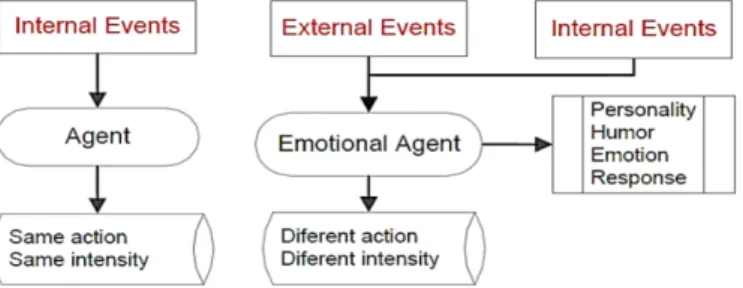
In this section we present the models of psychology that is adopted in our architecture. Figure 1 show, in a simplified manner, the operation desired in our affective agent, com- pared to a non-affective agent:
Figure 1 Comparison between Normal case and Affective
Agent
Games traditionally implements agent events as game tri- ggers that executes some kind of specific action. Our pro- posal pretends to capture (or produce) events or in-puts, in order to increase human aspects, such as person-ality, mood, emotion and response. Next, we describe each sta- ge and model used in our architecture.
Personality Model
The psychology model chosen for modeling the per-so- nality of the artificial agent in the proposed architecture is known as the Big Five model, taken from [18]. This is the model commonly used in recent research to describe per- sonality of individuals according to a number of de-fined features. The Big Five model began to take shape in the 1930s by British psychologist William McDougall, when he suggested analyzing the personality from five
major factors [18]. However, this model only gained signi- ficant attention from the 1980s, when research began to demonstrate the existence of five basic personalities that traits in individuals of different cultures and age groups. In this way, for the past 30 years, many psy-chologists agree with the five major factors defined in this model of perso- nality [19]. Through a lexical ap-proach in natural language model describes and classifies the human personality into five factors (Neuroticism, Extraversion, Openness to Ex- perience, Agreeableness and Conscientiousness), whe- re each factor brings togeth-er a variety of psychological traits. The approach used to discover these five factors came from the fact that all features which have some rele- vance, interest, utility or importance in human personality are recorded in natural language, justifying the relevance of the model to charac-terize the Big Five personality.
Emotion Model
Emotion is recognized as a central feature of human beha-vior. Because of that, it has been extensively stu- died in various areas of knowledge such as Psycholo- gy, Neu--roscience, Philosophy and Artificial Intelligence. Greek philosophers had already considered emotions as the most interesting facet of human existence, while they were also aware that they may confuse, disrupt and dis- -tract human reason. The separation of body and mind sug-gesting an interconnection (Theory of Dualism) was pro-posed by René Descartes, considered the foundation of the study of emotion as described [20], since Descartes defends the body functions as a unit of mechanical ac- tion deterministic and predictable, while the mind controls the action, memory and imagination being influenced by emotion. Studies of Descartes influence this research be- cause, since we insert emotions into mechanical bod-ies, simulating the theory of dualism. Currently, studies about
Revista de Informática Aplicada , Volume 9, Número 1, 2013
58
emotion are divided into three elements: (1) basic emo- tions, (2) primary, secondary and tertiary emotions and (3) emotions in the theory of evaluation. The model chosen was the emotions in the theory of evaluation, since it is easy to implement and of large utilization.
In [21] emotions in the theory of evaluation are de-fined as the evaluation process, where events are classi-fied and their emotional intensity is determined by the goals, belie- fs, attitudes and risk of the person or agent. In the search for a suitable model for this process, we have chosen for this research the model of Cognitive Ortony, Clore and Collins (OCC), due to its simplicity of imple-mentation in logic programming, in addition to being a model with good results and simple to use at emotion recognition computer systems, as described [22]. Ortony et al. proposed a the- ory based on a cognitive approach of the emotion, which describes the origin of emotions from cognitive processes that enable each of them. This theory results in a psycho- logical model that explains the origin of 22 different types of emotions. The OCC model as-sumes that emotions can arise from the evaluation of three different aspects of the world: events, agents and objects, and the activation of the emotion are still de-pendent on the individual’s per- ception and interpretation. Emotions reflect a short-term effect, which after being activated by an event, action or object returns to its initial state in a short time. In humans, emotions often influence cognitive and physiological ac- tivities. The 22 emotions of the OCC model in [23] are ranked between positive and negative, as well as the ac- tions necessary for its activa-tion.
Mood Model
Mood and emotion are distinguished in terms of in-tensity and in terms of duration [24]: mood differs from emotion in the sense that it is considered more durable and results from small events or stimuli generated from emotions. Because of that, besides mapping the basic personality and emotions of the artificial agent, it is also necessary to consider features based on its mood. Tradi-tionally, the mood is represented in a one-dimensional scale, where the extremes are “good” and “bad” [6]. In order to describe and assess mood states, we used the PAD model (Plea- sure, Arousal and Dominance) [25], which were initially developed to verify the level of satis-faction of consumers after purchasing a product. This model is simple and easy to deploy, consisting of three independent dimensions used to describe the mood states: (1) Pleasure/displea- sure measures the affective qualities of emotional states; (2) Arousal/tranquility describes a composition of physical activity and attention; (3) Domi-nance/submission is defi- ned in terms of control and no control of a situation. The derivative of this three-dimensional representation repre- sents the mood of an agent. As we have two different va- lues for each dimen-sion variation, we can represent ei- ght different mood states. The table defined by [26] maps
the PAD model to different moods states. The PAD model was chosen pri-marily for its easy logic implementation, and diversity of possible results.
Response Model
The response is basically the treatment response of the junction of the three models (personality, mood and emo- tion) with the behavior of the individual. However the re- sults of the models are not directly mapped to a binary pattern, i.e. the response is usually based on vague and ambiguous information, and may have different kind of in- terpretation. Because of that characteristic, the re-sponse model was implemented using fuzzy logic [27]. In our mo- del, the agent responds to some event that is linked to the three states of mood reactions described in
the PAD model [28] subdivided into 22 possible states of emotion. Such an answer defines the final behavior of the agent and is obtained directly from combinations of mood emotion and personality of the agent. We resort to logi- cal reasoning to conclude that the agent responds to an event in the game.
The Greek philosopher Aristotle (384-322 BC) estab- -li-shed a set of strict rules so that conclusions could be ac-cepted and logically valid. The Aristotle logic, also cal- led Western logic, defines a proposition as being strictly bina-ry, that is, it is true or false and it cannot be (even par- tially) true and false at the same time. This as-sumption is the logical law of no contradiction. However, when mo- deling human behavior to an artificial agent, personality/ emotio-nal/mood features are not usually only totally true or false. They rather admit intermediate val-ues between true and false. Thereby, according to [29], the fuzzy logic is more appropriate, if not inevitable, to gather conclusions regar-ding the agent responds to an event, rather the ina- de-quacy of assuming extreme re-sponses. Furthermore, the fuzzy logic enables the captur-ing of vague informa- tion, commonly present in the natu-ral language, in order to convert the results arising from the PAD and OCC model to a numeric value. The Nebula or fuzzy logic was deve- loped by Lotfi, Asker and Zadeh in 1965, using as a basis set theory. The objective was to understand and resolve the vagueness and aspects of the information, such as impression, ambiguity and uncer-tainty, typically present at the human thinking [29]. For this research we consider the Fuzzy Logic as a tool capa-ble of capturing vague in- formation, generally described in a natural language, as the results obtained in the model of mood PAD, mapping them to a numeric value, capable to be computationally manipulated.
We call the fuzzification as the step where we identify the values of variables, normalized to a world standard that will activate the rules which have been pre-defined in a knowledge base. This will be later used for triggering the inference process that determines how rules are called and combined. The defuzzification will be referred as the
59
Revista de Informática Aplicada , Volume 9, Número 1, 2013
step that converts the results obtained to information that will be presented back to the user.
4 Affective Agent Architecture
In this section we describe our proposed architecture for Affective agents applied to game oriented NPC, ac-cording to the events due personality, mood and emotion inputs. Figure 2 illustrates a simplified overview:
Figure 2 Architecture overview
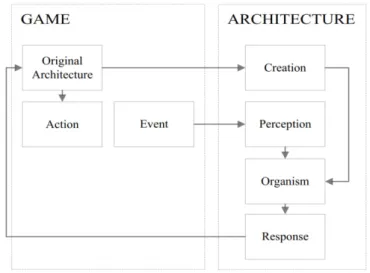
To allow the operation of architecture communicating with some game simulation of the real world, this is sub-divided into modules communicating with the game, as shown in Figure 3:
Figure 3 Architecture and game communication
Basically, in a game a NPC is encoded from the ac-tions it performs. These actions can be mapped as events be- tween agents or events not controlled by any NPC (envi- ronmental events). Thus, the architecture is com-posed of four modules (creation, perception, organism and respon- se.) hat are directly related to the events taking place in game. The original architecture of the NPC communica-
tes with the module creation. When an event happens in the game, either associated with the environ-ment or with the NPC, this is measured by the perception module. The architecture internally performs the compu-tations in the organism module and then responds in response module, which in turn performs an action of memory of NPC. The creation and perception module of events are re- -sponsible for initiating and generating all the necessary features for the architecture. The creation module initially defines the NPC personality in a vector P varying be-twe- en -1 and 1, which are mapped to the five strands of the Big Five model. With the personality defined, the
basis mood is generated, representing the mood of the agent without interference events. To compute the basis mood it is used the formula defined by [30], where the vec- tor character is transformed into a point in a three-dimen- sional state of humor. At this time as we don`t have events perceived, we have upgraded the current mood equals to base mood (same values), while there are no events ha- ppening the NPC has the performance calculat-ed from the values of the base mood. When an event occurs, it is accompanied by intensity. However, not all events are interpreted by the NPC, due to several factors such as attention, interest, time, etc. To address that, only events with an intensity value above of a minimum value are con- sidered and events with intensity below this are ignored. Before mapping the events, it is necessary to map the cur- rent emotion of the agent from the table of direct mapping of mood to emotion, defined by [25]. This is possible sin- ce the basis mood has already been computed, then, we can start inserting events. An event perceived by the agent may take various characteristics, a death, a victory, the conquest of something and many other ac-tions can ha- ppen in the real world and consequently in the game. As a number of possibilities can happen, each event is mapped to the main emotion associated to it, according to the OCC model of emotion. As the event and the emotion of the NPC use the same model, the association of the emotion to the agent is done by a sum of vectors.
The next step (response module) is where we get the real change in the agent, as an emotion is a temporary state, so we have the mapping from the direct conversion of [25] in the opposite direction. At this point the current and basis mood of the agent differs, due to the insertion of the events and its interpretation from the point of view of the NPC. In the final step we use fuzzy logic to map the 22 mood states to the three states of emotion, to rep-resent the change in the performance of the NPC. The mapping is fulfilled by considering the performance that the modification occurs in the components of the emotion of the NPC. In this case, the emotions components are linked to cognitive compo- nents defined in [29], which are memory, perception, deci- sion making, learning, motiva-tion, attention , prioritization, planning and creativity.
The final result indicates the value that changes the per- formance of the NPC, which is between 1 and -1. The architecture provides many possible ways to use these results. Here we have chosen two of these possibilities:
Revista de Informática Aplicada , Volume 9, Número 1, 2013
60
the rule of three direct and the rule of three spot. The rule of three direct, as the name suggests, is a rule of three considering the default value of the agent as the maxi- -mum value (100%), adjusting values between -1 and 1 for values between 0 and 1. In this way, the events interfere only negatively on the NPC, which in certain scenarios can be valid, such as the one presented in [5]. The local rule of three however, does not correct the values but instead maps them considering a range of interference. To make the rule of three, the values are regarded as intermediate, and consequently the events interfere either positively or negatively to the NPC. This heuristic is used in the model simulation of the game EA Sports FIFA 2013©, presented in section VI.
5 The Provenance Model for Affective Agents
Recording the source and history of information is es-sen- tial when dealing with data that needs to be evaluated and reproduced, which is substantially what happens in digital games. Thereby, we benefit from data provenance topic, first defined in [30], which encompass initial and final times of events and process, generated files, modi-fied parame- ters, errors occurring during the data pro-cessing, among others. The model adopted here is PROV [3], since it is domain-independent and represents prove-nance data through the well-known ER model.
The provenance model proposed in this paper extends the one defined in [13]. By using this model, we are able to re- present not only the game definitions but also the variation in emotional features of the NPC during a game session. To represent such information, we map the PROV ele- ments to the game elements, as follows. Enti-ties are any element with a proper meaning in the game. The Agent element is an entity that carries out activities inside the game, in our case they are going to be the NPC and the character that the player controls. Activities are a sequen- ce of actions that either the NPC or the player performs. In the affective agent games scenario, the activ-ities are either internal or external events that are able to trigger changes in mood and emotions of the NPC. Final-ly, Plans are events that can be broken up in small well-defined se- quences. The actions responding to an event are going to be mapped to plans. Figure 4 depicts the provenance data model adopts in this work. It is a UML class diagram, resulting from the gathering of information that should be represented in a game session. Since the proposed mo- del follows the PROV recommendation, each class inhe- rits a particular class of PROV model. Thus, the classes Object, Scene, World, EmotionComponent and GameDi- fficulty corre-spond to a PROV-Entity. Object, Scene and World repre-sent the structure of the game. i.e., the sce- nes, possible worlds and objects used during the game. The Emo-tionComponent represent a particular emotion associated to the affective agent and it is also connected to the diffi-culty of the game (GameDifficulty). In this way, this class is independent from the specific mood, emotion and per-sonality models. The Event class (and its spe- cializations, ExternalEvent and InternalEvent) is mapped to an Activi-ty-PROV, since an event may be generated
by an agent and it is going to have an action response. The Agent and NonPersonControlAgent classes repre- sent an Agent-PROV, since the agent is the element that catalyzes, ena-bles, controls or affects the execution of an activity. Fi-nally, the Action class is mapped to a Plan- -PROV, as a plan defines and correlates the agent function within an activity and is composed of a set of actions. By express-ing the elements mapped above, each informa- tion per-tained to the game can be kept in the provenance data-base.
61
Revista de Informática Aplicada , Volume 9, Número 1, 2013
6 Model Simulation
This section aims to present the architecture model propo- sed in this paper in the form of a simulator. We believe that the theory and practice presented here can add much in the way the players understand and play current games. The simulator is named PMESAA - Per-sonality, Mood and Emotion Simulator to Affective Agents, composed of the three main activities described next.
Agent definition: It is where we define the settings of the affective agent. Initially, it is necessary to introduce values in the five basic guidelines personality parameters. Then, from the defined personality, the simulator com-putes in real time what is the basis mood of the agent. With the ba- seline mood set, the simulator computes the current emo- tion of the agent. An emotion will be as-signed only when this is greater than the minimum inten-sity performance of the agent.
Processing of Events: Events are actions that have an emotional denotation. A particular action is relevant to the agent when it has an associated emotion. With the event described in terms of emotion, we must determine whether or not the event is an internal event or external. All inter- nal events are perceived by the agent. On the other hand, an external event is noticed only when the intensity of the emotion is greater than the value of the minimum intensity performance parameter. When an event is perceived by the agent, we have to change its current emotion parame- ters. In this way, the emotion value assigned to the agent is no longer derived from the personality and basis mood, but it also takes into account the external events.
Computation of the Final Result: A Result is estab-lished when there are either modifications in the agent or the in- clusion of events. The first output result that we have it is the current mood of the agent. Initially, this is equal to the mood base. When an event happens, the current mood is going to change, as we compute the new mood of the
agent based on the related emotions. When an event is inserted, the attribute performance intensity also changes, to ensure that the emotions are changing the performance of the agent.
This simulator, by using the proposed architecture, has the assurance that the personality, mood and emotion follow the reasoning models of psychology, however inputs cali- bration happens from the user, requiring as input values for personality of the agent and intensity of events emo- tions applied. Extending the focus of this article, we stron- gly suggest the use of the questionnaire NEO PI-R of Cos- ta and McCrae [31] for the input of values of personality, while for values of emotion events suggest a psychological evaluation of the impact of the event in the real world. Example of Application
There are several games that can make use of the ar- -chitecture proposed here, among these we can highli- ght PES 2013TM, NBA2K13TM, UFC UNDISPUTED 3TM, NHL 13TM, where the events represented internally to the game are the same happened in the real world. In order to show the applicability of the architecture presented in this paper, we introduce the PMESAA in a simulation of the game EA Sports FIFA 2013©, where we used the origi-nal data of the same. Other games not based on simula-tion of the real world can also make use of the architec-ture presented here. In such cases, the main differences are the origin and characteristics of events, since the events are fictitious, and entered into the system. In the database of FIFA 13 game each player has a specific configuration based on the performance of the real world, which is going to be the way in which the performance intensity alters the actions of the player.
Revista de Informática Aplicada , Volume 1, Número 1, 2014
The simulator proposes modifications contained in the at- tributes of the NPC during the game, now there is nothing similar in games, as in the current architecture NPCs per-
Revista de Informática Aplicada , Volume 9, Número 1, 2013
62
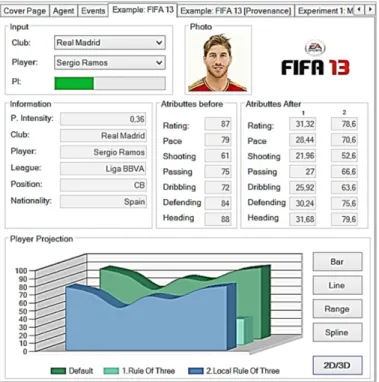
formance is fixed or varying exclusively tem-poral (physi- cal tiredness, fatigue etc.). These modifica-tions generate a graph modified constantly during the game. Figure 5 re- presents this graph in a specific instant:
Figure 5 Compared graphically change the attributes of
an NPC
As shown, the green graphic (Default) represents the ex- pected performance under normal conditions, or free from change events. The light green graphic (1. Rule of Three) represents the change in the percentage of isolated event that affects the performance. Finally, the light blue graphic (2. Local Rule of Three) shows the performance of the player in his attributes at the exact moment after noticing an event (in this case the emotion has “shame” with inten- sity of 0.9). Numerically speaking, all attributes obtained a decrease of approximately 10.34%, which directly influen- ce the player performance (in a free kick, a penalty or a simple goal kick.). It is not the focus of this article, but we believe that by introducing affective agents in games we create a new range of data and from the analysis of prove- nance data it is possible to produce interesting results for the developer to be able to analyze the game and better understand a victory and defeat. Such an analysis can be subject of future work.
By modifying the performance intensity of the agent from the entrance of an event, we are going to have a different value related to all attributes. Positive values of emotion have values tending to a maximum of default agent value, values for negative emotion values will tend to values dis-tance of default agent value. Using the varia-ble intensity performance, we chose to apply a simple logic of local rule of three.
Evaluating Results
To evaluate the generated results,, we use two differ-ent approaches. We first analyze the pattern of results from the logical point of view of the expected results. Then we evaluate the results on a case study of a real-world game replicated internally in the simulator and analyzed the ter- ms of provenance of the data generated. To evaluate the simulation and therefore the operation of the simulator, we determined behaviors commonly ac-ceptable based on human reaction to events:
“A Positive input event maximizes positive outputs respon- se”. In this case, a positive emotion maximizes the posi- tive results. We considered the average results for each attribute (rating in this case) in 100 tests for each of the 11 positive emotions, generating a total of 1.100 tests to prove this rule. As results presented, all positive events produced positive results, changing to greater than half of the original value. This indicates that the simulator obeys this criterion.
“A Negative input event maximizes negative outputs res- ponse”. In this case, a negative emotion maximizes the negative results, the average results for each attribute (pe- nalties in this case) in 100 tests for each of the 11 negative emotions, generating a total of 1.100 tests to prove this rule. As results presented, all negative results changed to less than half the original value, proving the rule addres- sed.
“Positive input events intensity generates different re-sults of different intensity”. To evaluate this we use of the attri- bute minimum intensity performance equal to 0.5. As the logic applied is the same in all emotions we chose
emotion Admiration for example. The results obtained from 100 tests were conducted for each of the three inten-sities using emotion generating a total of 300 tests. As the re- sults show, higher intensities tend to positive results and to the maximum value. For lower values of intensity, but abo- ve the minimum value, intensity measure will have more distant performance of the maximum value of the agent. “Entries intensity of negative events generates differ-ent results of different intensity”. To evaluate this we use of at- tribute minimum intensity performance equal to 0.5. As the logic applied is the same in all emotions we chose emotion Anger for example. The results were obtained from 100 tests, conducted for each of the three intensities adopted in the emotion, yielding a total of 300 tests. As the results show, higher intensities have larger negative results, ten- ding in the opposite direction. For lower val-ues of intensi--ty, but above the minimum value intensity, values indicate performance measures farther from the opposite value of the maximum value of the agent.
“Events of lower intensity than the minimum intensity of user perception are not perceived as the same”. To pro- ve this rule, we use the attribute minimum intensity per- formance equal to 0.5. As the logic applied is the same in all emotions we chose two emotions, Admiration and Anger. We generate 100 tests were performed on each of the emotions chosen, generating a total of 200 tests. As the results presented, where the intensities are lower than
63
Revista de Informática Aplicada , Volume 9, Número 1, 2013
the minimum intensity, the emotion of the event was not perceived by NPC.
With the analysis of the pattern generated and evalu-ated data on the direction and the expected direction of archi- tecture for psychological reasons, we deepen into a case study applied directly to the simulator conceptual archi- tecture, from the point of view of the provenance. In this section, we replicate the scenario of the final game of the 2013 FIFA Confederations Cup in a simulation of the game FIFA 2013© FIFA from EA Sports with NPC af-fective. With the use of provenance, we can realize a scout and see what the impact of emotions in the game session is. In cur- rent games, only the human player per-formance is varia- ble. In the case of NPC, the behavior does not change and is predefined. A player who plays a game today by Brazil versus Spain (in FIFA 2013©) and loses, technically can- not understand the opposing team’s performance based on the events that occurred before and during the game, since the performance of the opposing team is always constant and equal in all matches. In short, the change always happens exclusively by the player, and thus a vic- tory for player due to poor performance of the opponent is not possible.
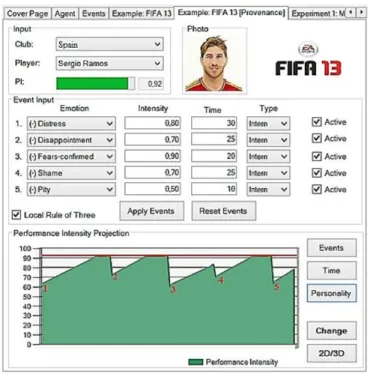
In order to introduce emotions in the context of the game, we developed an application that captures infor-mation from the original game, such as the characteristics of each team, the player’s performance, and the metadata asso- ciated with them. The application then allows that in addi- tion to the original features, we can define the events and emotional consequences of each event in each NPC. This result emotive alters the player’s performance in the match (PI). Analyzing the game that occurred in Mara-canã, we can configure multiple NPC and interpret your performan- ce throughout the game. However, due to lim-ited space in the paper we take as an example the Spanish player Sergio Ramos. Ramos attended all matches, influ-encing and being influenced throughout the game by the events. Many of these events have affected positively and nega- tively the NPC, so that we use only high-value events of influence, thus seeking to graphically predict their perfor- mance during the game using the provenance. The appli- cation of the events is presented in Figure 6.
Figure 6 Analysis of the performance of the player Ramos
during the game
From the graph generated, several conclusions can be made. For example, when the first goal for Brazil (event 1) occurs, the distress is the predominant emotion, due to the intensity and the scenario of the game. Consequently, the player’s performance drops during a long period, but as time passes becomes less present and this player’s per- formance is stabilized for a short time. When David Luiz saves what would be the first goal of Spain (event 2), the feeling present in greater intensity in the staff is disappoint- ment by the not confirmation of a desirable event, hence the emotion produces a second drop in per-formance, but with lower intensity and faster recovery. In the third event, with the completion of the second goal in Brazil, the se- cond half of play, the predominant emotion is fear confir- med, with strong intensity and slow
recov-ery. At this point, the player’s performance drops dramat- -ically, and even before full recovery, the player’s perfor- -mance is compounded by the loss of penalty (event 4), clearly influenced by the accumulation of unfavorable events that produced under-performance by the player, plus the shame by mistake. Before the end of the game, the event five occurs, where the athlete gets another loss of performance affected by the expulsion of teammate (Pity), and until the end of the game, the player perfor- -mance is consistently below its normal performance.
7 Conclusions
Currently, the globalized worlds has made infor-mation available quickly and in many cases free, such as the infor- mation of an agent as a real football player, bas-ketball or cricket are quickly available in different media, especially
Revista de Informática Aplicada , Volume 9, Número 1, 2013
64
the Internet. The approach of this article goes towards this attribute of the contemporary world, which is favorable to add veracity to the games. The approach adopted here goes further, attempting not only to insert changes of the external environment, but also to modify it internally as the consequences of external world events. Even in in games that do not simulate the real world, it is possible to take into account different external and inter-nal events and un- derstand how they modify a NPC de-fined according to an affective model.
We believe that the proposal presented here may make games funnier, from the point of view of the player, since the events will have a direct impact on the perfor-mance of NPC. However, in order to experimentally show that, it is necessary to experiment directly with people playing with and without the architecture present-ed here, which goes beyond the proposal presented here. On the other hand from the simulation presented here, it was possible to realize a new level of realism added to the game while increasing the degree of reality between the game and the world of the player.
From the scientific point of view, the models present-ed here are grounded in psychological theoretical models, so one of the contributions presented is the implementa-tion of them and test their real applicability. From the point of view of the architecture presented here, signifi-cant results are found that indicates a new path in the configuration of NPC, by including mechanisms of ma-nipulation of per- sonality mood and emotion. This tackles are of affective agents, a recent concept in digital games. The use of affective agents in games can open new doors for user interaction as playing a less predictable game and increa- sing the possibilities of man machine interaction used until then. This research contributes to a new scenar-io (but not only) in simulation games in the real world, allowing that the player can oppose a NPC quite predict-able until now. Because of that, the player must formulate new strategies if she still wants to beat the NPC. Using the architecture, we add major changes in the way the players play a game based in the real world, what once was a simple game where the possible answers would be the victory or defeat, the data based on the emotion of the NPC provide inte- resting information for user understand why the result of a game, not based on the player’s per-formance, but in the performance of the NPC. That’s the difference that makes a toy into a learning experience.
9 References
[1] Guojiang, W. and Xiaoxiao; F., Behavior decision model of intelligent agent based on artificial emotion, Advanced Computer Control (ICACC), 2nd International Conference on , vol.4, pp.185,189, 27-29 (2010).
[2] Freire, J., Koop, D., Santos, E., and Silva, C. T. “Pro- venance for computational tasks: A survey,” Compu-ting in Science & Engineering, vol. 10, no. 3, pp. 11–21, 2008. [3] Missier, P. Belhajjame, K. and Cheney, J. “The W3C PROV family of specifications for modelling prov-enance metadata,” in Proceedings of the 16th Internation-al Con- ference on Extending Database Technology, 2013, pp. 773–776.
[4] Sales, R., Clua, E., Oliveira, D., Paes, A. An Arti-ficial Emotional Agent-Based Architecture for Games Simula- tion. J.C. Anacleto et al. (Eds.): ICEC 2013, LNCS 8215, pp. 156–159, 2013.
[5] Sales, R., Clua, E., Oliveira, D., Paes, A. An Ex-pe- rimental Analysis of Non-player Character as Affective Agents. (Eds.): SBGAMES 2013 (in press).
[6] Picard, Rosalind, Affective Computing. MIT Press, Bos- ton. (1997).
[7] Laird, J. E. (2008). Extending the Soar cognitive archi- tecture. Proceedings of the Artificial General Intelli-gence Conference. Memphis, TN: IOS Press.
[8] Kshirsagar, S. and Thalmann, N. A Multilayer Perso- nality Model. 2nd international symposium on Smart gra- phics, pp 107-115 (2002).
[9] Gebhard, P.. Alma: a layered model of affect. Pro-ce- edings of the Fourth International Joint Conference On autonomous Agents and Multi- agent Systems, Utrecht. (2005).
[10] Kasap, Z., Ben Moussa, M., Chaudhuri, P. and Mag- nenat-Thalmann, N. Making Them Remember—
Emotional Virtual Characters with Memory. Computer Gra- phics and Applications, IEEE (Volume:29 , Issue: 2 ), pp 20-29 (2009).
[11] Djordjevich, D.D., Xavier, P.G., Bernard, M.L., Whet- zel, J.H., Glickman, M.R. and Verzi, S.J. Preparing for the aftermath: Using emotional agents in game-based training for disaster response. Computational Intelligence and Ga- mes. CIG ‘08. IEEE Symposium, pp 266-275 (2009). [12] Khaled, R., and Ingram, G. “Tales from the front lines of a large-scale serious game project,” in Proceed-ings o the SIGCHI Conference on Human Factors in Computing Systems, 2012, pp. 69–78.
[13] Kohwalter, T. C. Clua, E. W. and Murta, L. G. “Prove- nance in Games.” In: XI SBGames, p. 162–171, Brasília, DF, Brazil.
[14] White, W. Koch, C. Gehrke, J. and Demers, A. “Better scripts, better games,” Communications of the ACM, vol. 52, no. 3, pp. 42–47, 2009.
[15] Mateas, M. and Stern, A. “A behavior language for story-based believable agents,” Intelligent Systems, IEEE, vol. 17, no. 4, pp. 39–47, 2002.
[16] Adams, E., Dormans, J. Game Mechanics: Ad-vanced Game Design. Berkeley, Calif.: New Riders, 2012.
65
Revista de Informática Aplicada , Volume 9, Número 1, 2013
[17] Marsella, S., J. Gratch, and P. Petta. “A blueprint for an affectively competent agent: Cross-fertilization between Emotion Psychology, Affective Neuroscience, and Affecti- ve Computing.” (2010).
[18] Michael, S. and Todd F., Psychological Science: Mind, Brain and Behavior. Artmed, Porto Alegre. (2005).
[19] McCrae and Costa, Handbook of personality: Theory and research. A five-factor theory of personality. Guilford, New York. (1999).
[20] Damásio, A. R., Descartes’ Error. Companhia das Le- tras, São Paulo. (1996).
[21] Strongman, K. T., The Psychology of Emotion. John Wiley and Sons, Chichester. (2003).
[22] Kasap, Z. Thalmann, N. Intelligent virtual hu-mans with autonomy and personality: State-of-the-art. Journal Of Intelligent Decision Technologies, 3-15 (2007).
[23] Ortony et al., Andrew, Gerald L. Clore and Allan Collins. The Cognitive Structure of Emotion. Cambridge University Press, Cambridge. (1988).
[24] Vinayagamoorthy et al., Vinoba, Marco Gillies, A. Ste- ed, E. Tanguy, X. Pan, C. Loscos, e M. Slater. Building expressions into virtual characters. Eurographics Confe- rence State of the Art Reports, Vienna .(2006).
[25] Mehrabian, A., Pleasure-arousal-dominance: A gene- ral framework for describing and measuring individ-ual di- fferences in temperament. Current Psychology, New York. (1995).
[26] Mehrabian, A., A general powerful system for asses- sing temperament to personality. http://www.kaaj.com. [27] Sandri, S. and Correa, C. “Lógica nebulosa,” Escola de redes neurais: Conselho Nacional de Redes Neurais, vol. 5, pp. 73–90, 1999.
[28] Leite, F. N. H. F., Impact of emotional experi-ences in customer satisfaction: A study in medical offic-es. Universi- dade Federal de Fortaleza, Fortaleza - CE. (2006).
[29] Sandri, S. and Correa, C. , Claudio and Sandra, fuzzy logic. INPE, São Paulo. (1999).
[30] Buneman P., Khanna, S. and Wang-Chiew, T. “Why and where: A characterization of data provenance,” in Da- tabase Theory—ICDT 2001, Springer, 2001, pp. 316–330. [31] Costa, P., and R. McCrae. “NEO PI-R, Inventário de Personalidade NEO Revisto.” Florida: Psychological As- sessment Resources–Adaptação Portuguesa de Marga- -rida Pedroso de Lima e António Simões (2000). Lisboa: Cegoc.