Instituto Superior de Psicologia Aplicada
ASSESSING PERSONALITY WITH THE SHEDLER AND WESTEN ASSESSMENT PROCEDURE (SWAP-200): A NEW APPROACH USING THE
PSYCHOANALYSIS SESSION NOTES
Nome do Autor
David Jorge Pinto de Sousa Rodrigues
Nº de Aluno 11688
Tese submetida como requisito parcial para obtenção do grau de Mestre em Psicologia
Especialidade em Clínica
Instituto Superior de Psicologia Aplicada
ASSESSING PERSONALITY WITH THE SHEDLER AND WESTEN ASSESSMENT PROCEDURE (SWAP-200): A NEW APPROACH USING THE
PSYCHOANALYSIS SESSION NOTES
David Jorge Pinto de Sousa Rodrigues
Dissertação Orientada por António Pazo Pires Nº de Aluno
11688
Tese submetida como requisito parcial para obtenção do grau de Mestre em Psicologia
Especialidade em Clínica
Dissertação de Mestrado realizada sob a orientação de António Pazo Pires, apresentada no Instituto Superior de Psicologia Aplicada para obtenção de grau de Mestre na especialidade de Clínica conforme o conforme despacho da DGES nº 19673 / 2006 publicado em Diário da Republica 2ª série de 26 de Setembro, 2006.
Sobretudo, quero agradecer ao Instituto Superior de Psicologia Aplicada, pelo cuidado em ter cuidado em ensinar, e a todos os professores e funcionários, que directa ou indirectamente me transmitiram os seus conhecimentos, experiências e bons momentos.
Também quero agradecer ao Professor António Pires pela sua orientação neste trabalho, e pela disponibilidade, experiência e atenção.
Estes mais de 5 anos de formação no ISPA trouxeram-me boas experiências pessoais e profissionais, e vou recordar com saudade os dias de estudante universitário passados nos corredores, na biblioteca, no bar, nas salas, no dÍSPAR, na reprografia, na livraria, nas salas de professores e no telhado. Tantos espaços, tanta vida. E por tudo isto:
Família E Amigos,
Um muito obrigado pela força, companhia e partilha! ;)
Diagnosticar as perturbações de personalidade sempre foi um desafio. Existem, ainda antes do princípio do séc. 20, teorias que tentam explicar as perturbações de personalidade e a sua respectiva distinção. As contribuições mais valiosas da psicologia clínica para a personalidade e a sua patologia, têm sido a criação de instrumentos que avaliam as perturbações de personalidade no contexto clínico. No entanto, esses instrumentos não espelham os procedimentos de avaliação usados na prática clínica, onde os clínicos obtêm a informação para avaliar os processos da personalidade através das narrativas e dos aspectos mais relevante do paciente (tais como as formas de regular as emoções, a capacidade para ter relações íntimas e o comportamento face ao clínico) e tiram as suas próprias conclusões. (Westen, 1997). Neste estudo, apresentamos uma abordagem alternativa para fornecer descrições clinicamente ricas e detalhadas da personalidade de uma forma empírica e quantitativa, a Shedler and Westen Assessment Procedure (SWAP-200; Shedler & Westen, 2004b; Westen & Shedler, 1999a, 1999b), que é baseada na Metodologia Q.
Deste modo, é analisada a sua fiabilidade e viabilidade, os grupos diagnósticos emergentes e o uso clínico deste instrumento. A literatura revista para uma alternativa em avaliar os perturbações de personalidade através da SWAP-200 demonstrou que este instrumento de avaliação, administrada pelo próprio clínico é significativamente uma medida clínica para a avaliação da personalidade, e pode providenciar futuras investigações para um melhor diagnostico dos perturbações da personalidade.
Diagnosing personality disorders (PDs) is always been a challenge. Even before the begging of the 20th century, there are theories that try to explain the PDs and the distinction between them. The most valuable contributions from clinical psychology to personality and its pathology consisted in the creation of instruments for the assessment of personality disorders in clinical context. However, these instruments do not mirror the assessment procedures used in clinical practice, whereas clinicians elicit the information to assessing personality processes through the narrative and the most relevant aspects from a subject (such as ways of regulating emotions, capacity for intimate relationships and the behavior toward the interviewer in the consulting room) and draw independent conclusions (Westen, 1997). In this study, we present an alternative approach to provide detailed, clinically rich personality descriptions in a empirical and quantifiable form, the Shedler-Westen Assessment Procedure (SWAP-200; Shedler & Westen, 2004a, 2004b; Westen & Shedler, 1999a, 1999b), based on the Q-methodology.
This way, it’s analyzed the reliability and validity, the emerged diagnostic groupings and the clinical use of this instrument. The reviewed literature for an alternative in assessing personality disorders through the SWAP-200 demonstrated that this clinician administered instrument is a clinically significant diagnostic measure of personality, which can provide future investigations to personality disorders diagnosis.
LITERATURE REVIEW
INTRODUCTION 1
1.PERSONALITYDISORDERS(PD’S) 2
1.1BRIEF HISTORICAL REVIEW OF PDS 2
1.2.DSM–III AND THE BIRTH OF AXIS II 3
1.3.PROBLEMS ON CLASSIFYING PERSONALITY DISORDERS 5
2.THEQ-METHODOLOGY 6
2.1.Q-SORT AND FACTOR ANALYSYS 6
2.2.THE SWAP-II:AN INNOVATIVE Q-SORT. 8
3. THE SHEDLER AND WESTEN ASSESSMENT PROCEDURE - 200 10
3.1.DEVELOPING THE ITEM SET 10
3.2.RELIABILITY AND VALIDITY 11
3.3.DIAGNOSTIC GROUPS 13
3.3.1.CURRENT PD TAXONOMY 14
3.3.2.EMPIRICALLY IDENTIFIED DIAGNOSTIC GROUPINGS 15
3.3.3.TRAIT DIMENSIONS IDENTIFIED VIA FACTOR ANALYSIS 16
3.4.INSTRUCTIONS AND DATA RESULTS 17
4. CLINICAL INFERENCES: REFINING THE PDS DIAGNOSIS 20
CONCLUSION 22 REFERENCES 23 EMPIRICAL STUDY RESUMO 28 ABSTRACT 29 INTRODUCTION 30 1. METHOD 32 1.1 SUBJECT 32 1.2 TREATMENT 33 1.3.PROCEDURE 33
1.4. INSTRUMENT 34
2. RESULTS 35
2.1.PERSONALITY DISORDER (PD)T-SCORES 35
2.2.Q-FACTOR T-SCORES 36
2.3.FACTOR T-SCORES 37
2.4.IIDIOGRAPHIC CASE DESCRIPTION 38
DISCUSSION 41 REFERENCES 43 APPENDIXA 46 ITEMS CLASSIFICATION 47 FACTOR T-SCORES 55 Q-FACTOR T-SCORES 56 FACTOR SCORES 57 APPENDIXB 59 DYSPHORIC 60 ANTISOCIAL-PSYCHOPATHIC 61 SCHIZOID 62 PARANOID 63 OBSESSIONAL 64 HISTRIONIC 65 NARCISSISTIC 66 AVOIDANT-DYSPHORIC 67
HIGH FUNCTIONING DEPRESSIVE-DYSPHORIC 68
EMOTIONALLY DYSREGULATED-DYSPHORIC 69
DEPENDENT MASOCHISTIC-DYSPHORIC 70
HOSTILE EXTERNALIZING-DYSPHORIC 71
APPENDIX C
INTRODUCTION
A problem always present in the field of clinical psychology is that there are no “gold standards” for the diagnosis of personality disorders (Fridell & Hesse, 2006; Bradley, Hilsenroth & Westen, 2007, Livesley, 1995; Hunsley & Marsh, 2004). There are some dogmatic standards for comparing the absence/present of symptoms according to the latest edition of the Diagnostic and Statistical Manual of Mental Disorders (DSM-IV; American Psychiatric Association, 1996, 2002) or the International Classification of Diseases (ICD-10; World Health Organization, 1993), but the core consensual of the diagnosis of personality disorders (PDs) it’s not the same for every clinician. Even more, to diagnosis such PDs are necessary to use some standard clinical interviews, self-report measures or clinician-rated instruments. Hunsley and Mash (2008) in the book A Guide to Assessments That Work (p.416) rated the majority of the clinical instruments used for diagnosis. There are several arguments (reviewed further on this study) that the instruments for classifying PD remain clinically and empirically problematic. Also, it has not been proven satisfying to either researchers or clinicians, because clinicians relies on what they do best, i.e. making inferences and diagnosis based on the observation of a subject. In an attempt to clarify the problems in assessing personality, emerges the Shedler and Westen Assessment Procedure – 200 (SWAP-200; Shedler & Westen, 2004a, 2004b; Westen & Shedler, 1999a, 1999b), a clinician-rated instrument designed to bridge the gap between science and practice. In order to verify if the SWAP-200 is a reliable instrument, it was search the concerning literature available mainly on the EBSCO database (such as the PsycINFO; PEP Archive) with the keywords SWAP-200, diagnosis, assessment.
In this study, we present the feedback of that search, including the context in which emerges the SWAP-200, the method for creating the SWAP-200, the reliability and validity, the instructions to use it and the empirically derived taxonomy.
1. PERSONALITY DISORDERS (PD’s)
1.1 BRIEF HISTORICAL REVIEW OF PDS
The DSM-III (APA, 1996 and successive) definition of personality disorders, together with their distinction from other clinical syndromes (Axis I disorders), has provided a remarkable impulse to consider this psychopathological class has a research area.
It is possible to retrace the steps through where personality and pathology have been conceptualized and articulated in the history of psychiatry and clinical psychology. Traditionally, academic personality psychologists have been more interested in non-clinical populations and therefore, didn´t provided much attention, in their theories, to abnormal personalities or to the personality pathology. Retracing the history of clinical psychology, Vaillant and Perry (1985) regained already in publications of the nineteen century, the definition of personality disorder; in 1907, Kraeplin (1907, as cited in Belfiore, 2007) had already described four types of psychopathological personality, while in 1908, initiated the psychoanalytical study of character pathology. After this, follows the distinction made by Alexander Franz (1930, as cited in Belfiore, 2007) between the neurotic Character and the symptomatic Character, and the psychoanalytical treatment operated by Reich (1933, as cited in Belfiore, 2007) for the personality disorders.
The most valuable contributions from clinical psychology to personality and its pathology consisted in the creation of instruments for the assessment of personality disorders in clinical context. The birth of the classical approach to the assessment of personality in clinical setting, documented in the writtens of Rapaport, Gill & Shafer (1968, as cited in Belfiore, 2007), documented that the diagnostical assessment of personality had to do with different types of organization of spontaneous thought processes from the subject, and from attempts to interfere with the nature of his personality and his adaptative difficulties.
The focus of this method was mainly determined by the psychiatric diagnosis of that time and by the dominant approaches of the psychodynamical therapeutics.
Has an opposition to the traditional approach, based in a whole battery of tests, in 1943 is published for the first time, from Hathaway & McKinley, a self-report questionnaire, the Minnesota Multiphasic Personality Inventory (MMPI; Hathaway & McKinley, 1999), that contained scales for the revelation of important clinical syndromes, such depression, hypochondria, schizophrenia and others. The fact that MMPI has been defined has a
personality test is a demonstration of the overlap of the concepts that belonged to the clinical field and from others related with personality or with personality pathologies. Considering the relevance given to the clinical interview in psychiatry, and confirming the progresses gattered in the 70´s, in the construction of structured interviews for the main humour disorders and for psychosis (e.g. the PSE or Present State examination and SADS or Schedule for Affective Disorders and Schizophrenia), it´s not surprising that has been being developed several semistructured interviews such as the Structural Clinical Interview for DSM – III – R (SCID – II; Spitzer, Williams & Gibbon, 1997) and the Personality Disorder Examination (PDE; Loranger, 1988, as cited in Belfiore, 2007), that validate personality disorders like they are decribed in the DSM system. Nowadays, the standard approach more used for the diagnosis of personality disorders is the structured interview.
1.2. DSM–III AND THE BIRTH OF AXIS II
Traditionally, personality psychologists related with the academical environment, have been mostly more interested in normal personality, its structure and development, while other psychologists from the clinical area have turned their attention from the beginning, to the pathological variations of personality operation. DSM – I (APA, 1952, as cited in Belfiore, 2007) provided 4 categories of psychiatric disorders:
1 – Pattern disorder 2 – Treatment disorder
3 – Impulse. Control and relationship disorder 4 – Sociopathic disorder
In DSM- II (APA, 1968, as cited in Belfiore, 2007), these categories were only used in cases where the patient didn´t entered other categories. Personality disorders, defined in a specific and separated axis, did their first appearance in DSM – III (APA, 1993) that used a multiaxial diagnosis system that made the distinction between clinical syndromes (Axis I) and personality disorders (Axis II). DSM – III brings out the controversy related with the nature and role of personality and its pathology in the history of psychiatry and modern research on personality. The introduction of a distinction between clinical syndromes and personality disorders, such as the explicit description of personality pathologies inside DSM – III, didn´t brought approval to the intellectual community; some sustained, through a basis of a long
clinical, that the disorders defined in Axis II had nothing to do with the clinical reality. These questions put in evidence some of the difficulties related with the benefits of an atheoretical approach sustained by researchers of DSM – III and their successors. The development of DSM – III looked for a diagnosis system that could provide explicit criteria, mainly behavioral, and therefore that could have been validated with a certain security. As a consequence, lots of researchers of the psychiatrical and clinical psychology field accepted the review of the diagnosis system that brought, not only an increase of the amount of diagnosis in Axis II in the clinical settings (Loranger, 1990), but also a remarkable increase of the number of researches on the personality pathologies, made in journal of general psychiatry and psychology (Archive of General Psychiatry, American Journal of Psychiatry, Journal of Abnormal Psychology).
The amount of investigations about personality pathologies had a sensational increase in the 25 years elapsed since the duplication of DSM – III; the benefit of such evolution consists in the possibility that is acquired by making testable and falsifiable models that are not only descriptive, but on the contrary emphasize the etiology, the mechanism and the long term evaluative consequences of personality pathologies. With the advent of specific diagnostic criteria and a polithetic approach to classification, Axis II of DSM – III represented the opportunity for articulated discussions and for the empirical research on the relations between conceptualized personality disorders of psychopathology and normal personality studied by academical personality psychologists. The theoretical discussion focused mostly on 3 conceptual key-questions, more precisely:
1 – The dimensional or categorical nature of personality disorders (Costa & Widiger, 2002):
2 – The difference between normal and pathological personality characteristics (e.g. social isolation as a possible explanation for low socialization vs. suicide attempts as not being present in some normal dimensions of personality (Wiggins, 1982).
3 – The nature of processes and the basic structure, underlying both personality disorders and normal personality (Rutter, 1987; Cloninger, Svrakic, Przybeck, 1993; Livesley, Jang, Vernon, 1998; Depue, Lenzenweger, 2001).
Although there have been some efforts to clarify PDs, some problems still remain, as it going to be discussed further.
1.3. PROBLEMS ON CLASSIFYING PERSONALITY DISORDERS
The DSM-IV classification of personality disorders (PDs) has not proven satisfying to either researchers or clinicians. Since its inception, the instruments for classifying PD remain clinically and empirically problematic. For example, they have marginal validity and poor retest reliability at intervals greater than 6 weeks (First et. al, 1995, as cited in Shedler & Westen, 1999a) and the comorbidity of axis II disorders are too high; a patient often can receive one or more diagnostics of PD, whether obtained by self-reports measures or structured interview (Watson & Sinha, 1998). Also the categories and criteria are not empirically based and often disagree with empirical findings from cluster and factor analyses (Blais & Norman, 1997; Morey, 1988). It artificially dichotomizes continuous variables into present/absent, which is neither theoretically nor statistically sensible, since the problems are not viewed as a continuum (Shedler & Westen, 1999a) and lacks the capacity to weight criteria that differ in their diagnostic importance (Davis, Blashfield & McElroy, 1994).
It fails to considerer personality strengths and to address the range of personality pathology, found in patients who seek treatment but do not fall within the 10 personality disorder categories included in axis II (Westen, 1997; Westen & Arkowitz, 1998), this way resulting that many problems cannot be diagnosed. But even diagnosed, the categories and criteria are not as clinically useful as they might be (because it tells us little about which treatments to use, which personality processes to target for treatment, and so on).
An additional problem is that these instruments do not mirror the assessment procedures used in clinical practice, whereas clinicians elicit narrative information relevant to assessing personality processes (such as ways of regulating emotions, capacity for intimate relationships’, characteristic motives) and draw independent conclusions, based on inferences from patient’s narrative descriptions of their life, relationships and behavior toward the interviewer in the consulting room (Westen, 1997).
In contrast, current instruments rely on direct questions and expect patients to report on their own personalities, especially when lack of insight and self-understanding is characteristic of some personality disorders. Instead of identifying the best diagnostic criteria and then finding ways to operationalize them, Axis II committees have tended to exclude criteria that cannot be assessed by direct questions (e.g. Livesley, 1995). Further, many studies document the distorting effects of psychological defenses on self-report data, especially when people are asked questions that have implications for self-esteem. For example, the attachment style
predicts discrepancies between self-reported anxiety and objective physiological measures of anxiety (Dozier & Kobak, 1995)
Self-report data tend to be more predictive of internalizing pathology whereas observer reports tend to be more predictive of externalizing pathology (Fiedler, Oltmanns, & Turkheimer, 2004). For Westen and Shedler (2007) clinically trained observers have access to internal distress and to less socially desirable aspects of the patient’s personality, which are revealed through interpersonal interaction and descriptions of interactions. Neurophysiologic studies concluded that what clinicians can observe and infer about personality may be very different from what a patient can describe (Schacter, 1992; Westen, 1998).
Some of the issues reviewed above in this article show some problems in conceptualizing and measuring personality disorders. There as been some considerable strides in increasing the understanding of the course and etiology of some personality disorders, and current efforts largely assume the validity of the current nosology, rather than systematically testing alternatives. An alternative approach to provide detailed, clinically rich personality descriptions in a systematic and quantifiable form is the Shedler-Westen Assessment Procedure (SWAP-200; Shedler & Westen, 2004a, 2004b; Westen & Shedler, 1999a, 1999b) that is based on the Q-methodology.
2. THEQ-METHODOLOGY
2.1.Q-SORT AND FACTOR ANALYSYS
The Q methodology circumscribes both a data collection (Q-sorting) and a data analysis technique (Q-factor analysis), and it is qualitative through its assumptions and research logic and quantitative through the statistical apparatus sustaining data analysis (Brown, 1993). Further on, the core concepts of Q-methodology will be defined, and the steps of a Q-procedure sketched.
A Q-sort, in the context of personality disorders, is a set of statements that describe different aspects of personality and psychological functioning. A Q-card is the card a statement is written on, and each statement (printed on a separate index card) may describe a given patient well, somewhat, or not at all. A clinician or interviewer sorts the cards into categories, on the basis of the degree to which the statements describe the patient, from those
that are inapplicable or not descriptive to those that are highly descriptive (Westen & Shedler, 1999a).
The Q-sort method requires that clinicians assign a specified number of statements to each category. With standard rating scales, the clinician does not have discretion about how many items to put in each category. In psychometric terms, the clinician must arrange the items into a fixed distribution. The use of a fixed distribution has important psychometric advantages over standard rating procedures, because it minimizes error variance due to rater effects (Westen & Shedler, 2007). In another words, assessors assign scores with the same frequency.
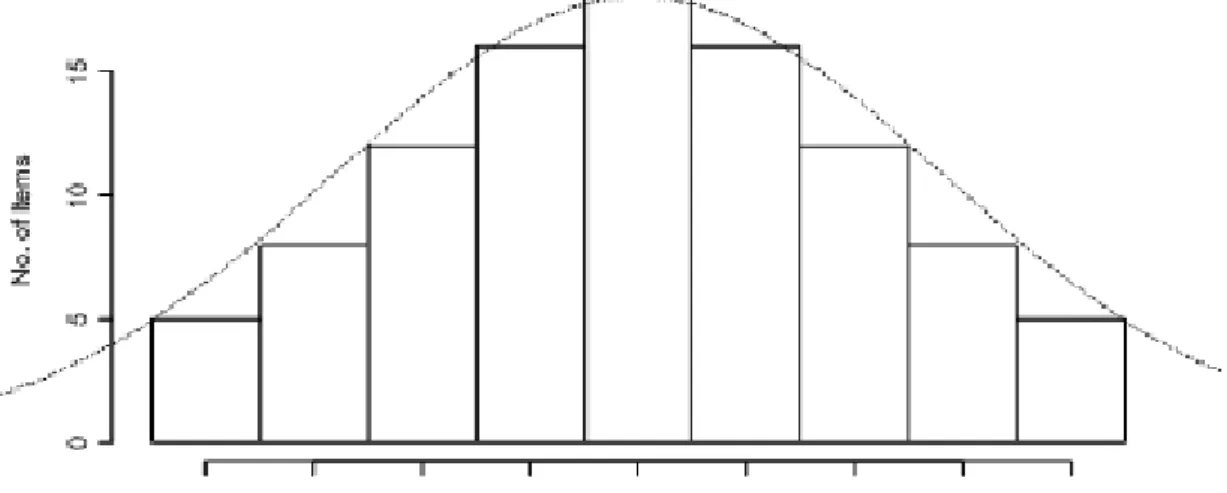
Due to its forced distribution, Q-sort is an ipsative technique, i.e. the sum of the raw scores is constant for each respondent (Baron, 1996), and can be more valid than normative scales, i.e. values that approach a normal curve (e.g. The California Q-sort, Figure 1). Due to their conception, the former eliminate a number of biases, such as avoiding the use of extreme response categories; the tendency to agree to statements as presented; and the portray that the respondents have of themselves in a more positive manner. Also this method can ensure that assessors attend systematically to all constructs subsumed by the item set.
After collecting the data, a factor analysis is performed. What the researcher actually looks for in giving meaning to the data is a common cause running through the scores of the whole array in some degree, from one end of the array to the other. The factors are operants: matrices are looked at for what the data tell, not what can be projected upon them as hypotheses or categorizations. Therefore, first it is looked the normalized factor scores for a
FIGURE 1 - Item distribution of the California Q sort (solid lines) compared with the normal curve (dotted line).
factor and its distinguished statements. Then, it is looked the differences between factor arrays and the consensus statements (Boros, Visu-Petra & Cheie, 2007).
The procedure identifies groups who are similar to one another and dissimilar to others in other groups. Q-analysis can be understood by comparison with conventional factor analysis, which is a common statistical technique in psychological research. Factor analysis is used when a data set contains many variables, and these variables appear to be redundant measures of a few underlying dimensions (factors). The difference is that factor analysis identifies grouping of similar variables (i.e., columns in a data matrix) that are assumed to be markers of a common underlying factor. In contrast, Q-analysis identifies grouping of similar people (i.e., cases or rows in a data matrix) who are assumed to represent a common diagnostic syndrome or type (McKeown & Thomas, 1988)
2.2.THE SWAP-II:AN INNOVATIVE Q-SORT.
The SWAP is a set of personality descriptive statements (items), each of which may describe a given patient well, somewhat, or not at all. A clinical assessor sorts the statements into eight categories based on the degree to which the statements describe the patient, from 7 (highly descriptive) to 0 (not descriptive).
Items are written in straightforward, experience-near language (e.g., “Tends to be passive and unassertive” or “Has an exaggerated sense of self-importance”), and items that require inferences about internal mental processes are written without recourse to jargon (e.g., “Tends to see own unacceptable feelings or impulses in other people instead of in him/herself”). The standard vocabulary of the SWAP allows clinicians to provide in-depth psychological descriptions of patients in a systematic and quantifiable form and ensures that all clinicians attend to the same spectrum of clinical phenomena. (Shedler & Westen, 2007).
The instrument is based on the Q-sort method which requires clinicians to arrange items into a fixed distribution (Block, 1978, as cited in Shedler & Westen, 1999a), and assign each score a specified number of times (Shedler & Westen, 2007), minimizing the sources of error variance by calibrating assessors and ensuring that different assessors assign scores with the same frequency (relative to the 200 items, when an assessor assigns a score, it means that is the most defining of the patient’s personality).
To ensure that the fixed score distribution would be appropriated for describing most patients and not an arbitrary imposition, the authors observed how clinicians rated SWAP items when they did not impose a fixed distribution, to determine the distribution of the clinicians used naturally. They also included a broad range of item content to ensure that there would always be enough items that belong in the highest or most descriptive score categories (Westen & Shedler, 2007), so that the fixed distribution permit a normatively accurate portrayal of the individual.
Prior Q-sort instruments have treated items as extremely characteristic to extremely uncharacteristic (bipolar dimensions), and have used quasi-normal score distributions in which middle scores indicated neutrality on the dimension (e.g. Figure 1).
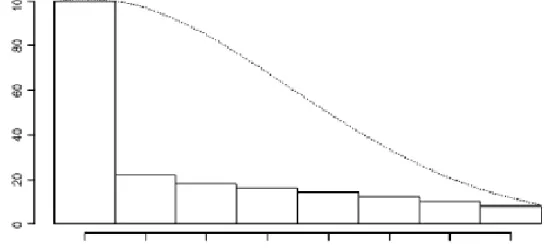
An innovation of the SWAP is that all items are written to assess unipolar constructs, and the fixed score distribution is therefore asymmetric, resembling half of a normal distribution (Figure 2). Half of the items receive scores of 0 (not applicable to the patient), and progressively fewer items receive higher values, in the same way people do not have a given form of pathology, and fewer have the pathology in more extreme form. Also, this distribution approximates the generated naturally by most clinicians that rated SWAP without a fixed distribution.
FIGURE 2 -Item distribution of the Shedler–Westen Assessment Procedure–200 (solid lines) compared with the normal curve (dotted line)
3. THE SHEDLER AND WESTEN ASSESSMENT PROCEDURE - 200
3.1.DEVELOPING THE ITEM SET
The SWAP-200 is an assessment instrument designed to bridge the gap between the clinical and empirical traditions in personality assessment and has been used to refine and dimensionalize existing Diagnostic and Statistical Manual of Mental Disorders (DSM-IV; APA, 1994), to diagnostic categories without presupposing the DSM-IV typology of personality disorders and to identify factors or trait dimensions relevant to describing personality pathology.
The item set was developed and revised over a 7-year period and incorporates constructs drawn from a wide range of sources including Axis II diagnostic criteria included in DSM–III through DSM–IV; selected Axis I criteria that could reflect personality traits (e.g., depression and anxiety); research in personality psychology; research on normal personality traits; research on coping and defensive processes; research of interpersonal pathology in PD patients; clinical literature on PDs written over the past 50 years (Westen & Shedler, 2007); and the feedback of hundreds of psychologists and psychiatrists who used earlier versions of the instrument to describe their patients (Shedler & Westen, 1998; Westen & Shedler, 1999a). Each time a clinician used the instrument, it was asked one critical question: “Were you able to describe the things you considerer most psychologically important about this patient?”, whereas 86% of clinicians, agreed or strongly agreed (less than 5% disagreed). The results did not differ by profession or clinician theoretical orientations.
Because the SWAP is jargon free and clinically comprehensive, is has the potential to serve as a language for describing personality pathology that can be used by any skilled clinical observer. Writing items in this jargon free manner minimizes unreliable interpretive leaps and makes the item set useful to all clinicians regardless of their theoretical orientation. The items are also written in the form of diagnostic criteria. Items that prove to be empirically diagnostic for a disorder,can therefore be used directly as candidate diagnostic criteria, without the need for translation from the language of self-report to the language of clinical description, allowing the instrument to provide a comprehensive assessment encompassing personality strengths as well as pathology (Westen & Shedler, 2007).
The SWAP is meanly based on information provided by clinicians, in what they do well, namely, making specific observations and inferences about individual patient they treat and know well or interview systematically. Clinicians generally have access to both internal distress and to less socially desirable aspects of the patient’s personality that are revealed through interpersonal interaction and descriptions of interactions. In this way, many personality processes may be inaccessible via self-report by virtue of cognitive architecture, whereas others may be inaccessible due to denial, self-deception, or self-presentation.
Shedler and colleagues (1993) demonstrated that widely used self-report measures could not distinguish between psychologically healthy individuals and psychologically troubled individuals who maintained a façade of mental health based on defensive denial. Although self-report instruments could not distinguish genuine from illusory mental health, clinical assessors could do so using written autobiographical narrative material and unstructured clinical interviews. This logic is analogous to the logic of intelligence testing. Instead of asking people their opinions about their vocabulary skills, psychologists present vocabulary word and draw independent conclusions regarding performances.
Westen and Shedler (2007) employed a method using the SWAP based on Meehl’s book, Clinical vs. Statistical Prediction. Meehl’s (1954, as cited in Westen & Shedler, 2007) demonstrated that statistical prediction is superior to prediction made without the benefit of quantified data and statistical methods (for a detailed discussion of this topic, see Westen & Weinberger, 2004, 2007). In this way, the specific observations and inferences of the clinicians relies on statistical algorithms, aggregating data to derive reliable, valid scales and indices and predict relevant criterion variables.
3.2.RELIABILITY AND VALIDITY
The Q-sort method allows researchers to combine descriptions of different patients, to obtain a composite personality description of a particular type of patient. This is accomplished by averaging the values assigned to each SWAP-200 item across a number of patients. A statistical consequence of averaging is that only items ranked highly by all clinicians will have high ranking in the composite description, and it is obtained a list of the psychological features that virtually all clinicians consider important to the diagnosis (Westen & Shedler, 2007).
Composite descriptions can be a diagnostic prototype (description of hypothetical, prototypical patients with a given personality disorder in its purest form), which is a richly detailed description of the personality disorder that reflects the clinical and theoretical understanding of many practicing clinicians, or actual patients in a given diagnostic category, described by the authors as the composite description. The composite description is a richly detailed description of actual patients with the personality disorder.
Shedler and Westen (1999a) made a validation of the SWAP-200 doing an enquiry, selecting a random sample of experienced psychologists (the divisions of clinical psychology, psychotherapy and psychoanalysis) and psychiatrists and focused a study on recent DSM axis II diagnoses to validity the SWAP-200 as a method for assessing personality disorders.
On the basis of their responses, it was asked for two-thirds of the clinicians to use the SWAP-200 to describe a current, actual patient from a specific diagnostic category and for the other one-third to describe a hypothetical, prototypical patient from a specific diagnostic category. It was also asked descriptions of healthy, high-functioning patients (both prototypical and actual).
In addiction, it was provided to clinicians a list of all personality disorders, in order to rate the extent which the patient met criteria for each disorder, on a 1-7 rating scale (1= not at all, 4=has some features, 7=fully meets criteria).
First, it was examined whether actual patients with a personality disorder diagnosis resembled the diagnostic prototype for that personality disorder. A validity analysis showed that SWAP-200 descriptions of actual patients who shared a diagnosis (composite descriptions of actual patients) matched the hypothesized portraits of prototypical patients with the same axis II diagnosis (diagnostic prototypes), which were provided by different clinicians, and did not match the diagnostic prototypes for unrelated diagnoses.
The second way of assessing validity looked at the relations between personality disorder scores and clinicians’ 7-point ratings. A personality disorder score is a correlation between a patient’s SWAP-200 description and a diagnostic prototype, indicating the degree of match. The analysis showed high convergent and discriminant validity with clinicians’ ratings of the degree to which patients met diagnostic criteria for each personality disorder.
A third way of examining validity, sets aside diagnosis and focuses instead on the ability of the SWAP-200 to predict patients’ general level of functioning, as measured by the Global Assessment of Functioning Scale (DMS-IV; APA, 1996), and it was found a strong relation between SWAP-200-based psychological health scores and the GAF scale.
The results of the sorts can also be scored for empirically derived personality groupings, called Q-factor scores, by correlating the data describing a real or prototypical patient with empirically derived categories derived from prototypical sorts. The Q-factors came from Q-analyses in which factor analysis was carried out on the basis of groups of people rather than variables (Westen & Shedler, 1999b). Personality Disorder and Q-factor scores are transformed into T scores (M = 50, SD = 10), based on empirically derived normative prototypes (Westen & Shedler, 1999a, 1999b).
The results of the sorts can be scored for 12 personality or trait factors, derived from factor analysis of SWAP data (Westen & Muderrisoglu, 2003). The r-factor scores are also transformed into T scores on the basis of normative prototype scores. The resulting T scores can be used categorically, with scores at 55 or above indicating traits and scores of 60 or above leading to a categorical diagnosis, or dimensionally, so that higher scores indicate more presence of the category.
Finally, the endorsement of individual items can be considered. For example, the items most characteristic of a group can be listed. The relative endorsement of items by various groups can also be compared.
The internal consistencies of the PD scores are in the .90s (Westen & Shedler, 1999a). The SWAP-200 descriptions of patients are highly correlated with clinician rating of personality disorders for the patients (e.g., Westen & Muderrisoglu, 2003; Westen & Shedler, 1999a).
The empirically derived Q-factor scores have also been evaluated, and both reliability and validity are good (e.g., Westen and Shedler, 1999b). The validity of the r-factor scores has been explored by correlating the r-factor scores of treating clinicians and scores of independent clinicians viewing videotaped interviews, providing cross-informant agreement (Westen & Muderrisoglu, 2003). The SWAP-200 scores also differ between clinical groups in expected ways (e.g., Cogan & Porcerelli, 2005; Porcerelli, Cogan, & Hibbard, 2004).
3.3.DIAGNOSTIC GROUPS
An important consideration for personality researchers is whether diagnostic assessment should focus on personality syndromes or personality traits. Syndromes are multifaceted constellations of personality processes (encompassing cognition, affectivity,
interpersonal functioning, impulse regulation, etc.; APA, 2002, p. 686) that are understood to be interdependent. All editions of the DSM to date have focused on syndromes. In contrast, trait approaches focus on discrete dispositions typically derived through factor analysis (e.g., extroversion, neuroticism). Some investigators mistakenly conflate trait approaches with dimensional diagnosis, and syndromal approaches with categorical diagnosis (e.g., the DSM– IV typology of PDs is syndromal and also categorical). However, these are independent considerations whose association is purely historical (Westen, Gabbard & Blagov, 2006). The dimensional/categorical distinction refers to whether people are assumed to fall into discrete categories or to vary along a continuum. The syndromal/trait distinction refers to whether the unit of diagnosis is a constellation of interrelated personality characteristics or separate characteristics.
In the following sections, it will be described two syndromal approaches and one trait approach, all based on SWAP–II data. All of the approaches are dimensional. In the case of the syndromal approaches, diagnostic groupings are defined by empirically derived prototypes - descriptions that represent each diagnostic syndrome in its ideal or pure form (based on all 200 SWAP items). Individual patients are diagnosed dimensionally (on a continuum) based on the degree of resemblance or match with the prototype. (Westen, Shedler & Bradley, 2006).
3.3.1.CURRENT PD TAXONOMY
The SWAP scoring algorithms generate a dimensional score for each PD included in the DSM-IV (Paranoid, Schizoid, Schizotypal, Antisocial, Borderline, Histrionic, Narcissistic, Avoidant, Dependent, Obsessive-Compulsive). However, there are some differences. The empirically derived portrait of narcissistic personality disorder is highly similar to its DSM-IV description, suggesting that the axis II work groups have, in fact, captured most of the important features of the disorder seen in clinical practice. The major difference is that narcissistic patients appear to be more controlling, more likely to get into power struggles, and more competitive than DSM-IV suggests. The narcissistic composite also includes a defense: externalization, which is missing from the DSM-IV description and includes the tendency to be articulate. In contrast, he empirically derived portrait of actual patients with borderline personality disorder is substantially different from its DSM-IV description. The data show that actual borderline patients are most distinguished by their intense, poorly modulated affect and, more generally, by their omnipresent dysphoria and desperate efforts to regulate it. This suggests that questions about the comorbidity of borderline personality disorder and
depression may be somewhat artifactual, since intense affect states, including depression (and related interpersonal concerns such as abandonment), are, in fact, defining features of borderline personality disorder (Shedler & Westen, 1999a, 2004a).
3.3.2.EMPIRICALLY IDENTIFIED DIAGNOSTIC GROUPINGS
According to Shedler and Westen (1999b) to identify the different diagnostic groupings, it was made a Q-analysis based on the SWAP-200 descriptions of actual patients, diagnosed by their clinicians as meeting axis II criteria for a personality disorder diagnosis, whereas hypothetical patients and healthy, high functioning patients were excluded from the group.
So, with the composite descriptions of the patients, which was retained Q-factors (principal components) with eigenvalues of 1 or higher (Kaiser’s criteria)1. From the procedure, after a varimax rotation (i.e., orthogonal rotation, designed to create independent or uncorrelated Q-factors), it was obtained seven principal Q-factors.
Tables 1 to 7 (Appendix B) lists the SWAP-200 items that best describe the patient in each of the seven Q-factors or diagnostic categories. The second column shows the factor score for each item, which indicates its centrality or importance in defining the Q-factor. The items are arranged in descending order of importance, from highest to lowest. Several aspects are worthy of note. Although many of the categories resemble current axis II diagnostic criteria, the Q-factors reflect the empirical solution that maximizes their distinctiveness and minimizes comorbidity.
Second, the largest number of patients was classified as belonging in the first Q-factor, which is not in the DSM-IV, labeled as dysphoric personality disorder (patients that experience feeling of inadequacy, shame, guilty, depression, anxiety, and fear of rejection or abandonment). The category included patients diagnosed by their treating clinicians as having depressive, dependent, avoidant, self-defeating, or borderline personality disorder.
Third, a single schizoid Q-factor emerged that included many patients currently diagnosed as schizoid and schizotypal, as well as a subset of patients diagnosed as avoidant. A second divergence from the Axis II was that patients diagnosed as borderline tended to fall into either the dysphoric or histrionic Q-factors. Other divergence is that a large percentage of patients currently diagnosed as having obsessive-compulsive personality disorder appear to be
1 For an understandment on this topic see: http://www.statsoft.com/textbook/stfacan.html (retrieved November
less disturbed than the current conceptualization. They are emotionally constricted, prone to intellectualization, and overly concerned with rules, but they are not particularly dysfunctional and they are conscientious and productive to a fault. Because the first Q-factor contained so many patients, it was conducted a second Q-analysis to identify subgroups of patients within the dysphoric Q-factor, whereas five Q-factors proved to be most clinically coherent (Appendix B; Tables 1.a to 1.e.). The first subgroup was labeled as dysphoric: avoidant, and were characterized by SWAP-200 statements indicating some characteristics in descending order of importance., such as being shy or reserve, avoid social situations because fear of embarrassment, lack social skills, among other factors. The second subfactor was labeled dysphoric: high-functioning neurotic and it was characterized by SWAP-200 statements indicating psychological strengths, mixed with items indicating chronic dysphoria. Being articulated, having moral and ethical standards, being empathic, mixed with a tendency to blame themselves or feel responsible for bad things that happen, are some of the characteristic of these patients.
A third subfactor, which included many patients diagnosed as borderline, was labeled dysphoric: emotionally dysregulated, and were characterized as having emotions that spiral out of control, struggles with genuine suicidal whishes, an inability to soothe or comfort themselves when distressed, among others characteristics. The fourth subfactor, labeled dysphoric: dependent-masochistic, includes patients who appear to be much more disturbed than those in the current axis II dependent category. These patients tend to get drawn into or remain in relationships in which they are emotionally or physically abused, are ingratiating or submissive, became attached quickly or intensely, as others factors described in the tables (Appendix B; Tables 1a. to 1.e). The final subfactor was labeled dysphoric: hostile-externalizing and contained patients who were hostile and prone to blame others for their difficulties, with passive-aggressive features.
3.3.3.TRAIT DIMENSIONS IDENTIFIED VIA FACTOR ANALYSIS
Finally, the SWAP-200 factor analysis identified 12 clinically relevant personality dimensions. 1) Psychological Health, that assesses the positive presence of psychological strengths and inner resources, including the capacity to love, finding meaning in life experiences, and gain insight into self and others. 2) Psychopathy, that includes features such as lack of remorse, a seeming imperviousness to consequences, impulsivity, and a tendency to abuse alcohol and drugs. 3) Hostility, is straightforward and requires no interpretation. 4)
Narcissism, and it reflects self-importance, grandiosity, entitlement, and the tendency to treat others as audiences to provide admiration. 5) Emotional Dysregulation, and refers to a deficiency in the capacity to modulate and regulate affect, so that affect tends to spiral out of control, change rapidly, get expressed in intense and unmodified form, and overwhelm reasoning. 6) Dysphoria, which captures depression, anhedonia, shame, humiliation and a number of cognitive and affective correlates. 7) Schizoid Orientation, it refers that patients high on this dimension do not just keep to themselves. They are also concrete in their thinking, barren in their representations of others (as reflected by an inability to describe others in meaningful ways), have constricted emotions, and have little capacity for empathy. 8) Obsessionality, that describes not only hyperconscientiousness but a cognitive and defensive style that includes absorption in details, intellectualization, preoccupation with dirt and contamination, intrusive and obsessional thoughts, stinginess, and difficulty discarding things. 9) Thought Disorder (or schizotypy), and distinguishes schizotypal personality disorder from all other personality disorders, even schizoid and borderline. 10) Oedipal Conflict, it includes a constellation of items reflecting triangulated romantic relationships that always involve a third-party competitor, choosing romantic partners who are unavailable or inappropriate, sexual jealousy, and excessive or inappropriate seductiveness. 11) Dissociation, that describes incongruity and disconnectedness between affect, cognition, and memory that is often associated with a developmental history of trauma or abuse. This construct is of crucial clinical import, especially for individuals who have been victims of complex trauma and for many patients diagnosed with borderline personality pathology. 12) Sexual conflict, as it describes a conflicted orientation toward sexuality, including the association of sexuality with danger (whether consciously or unconsciously), and guilt, shame, revulsion, or disgust in connection with sexuality (Shedler & Westen, 2004b; Mullins-Sweatt & Widiger, 2007).
3.4.INSTRUCTIONS AND DATA RESULTS
Researchers can use the instrument in one of two ways. Clinicians can use the Q-sort to describe patients based on what they have observed over the course of treatment, as long as they have had a minimum of 5 or 6 contact hours with the patient. Alternatively, clinically trained interviewers can describe a patient using the SWAP-200 after completing the Clinical Diagnostic Interview (CDI; Westen & Muderrisoglu, 2003, 2006). The structured PD
interviews does not primarily ask patients to describe themselves (although it does not avoid face-valid questions about behaviors, intentions, or phenomenology, e.g., whether the patient has self-mutilated or thought about suicide). Instead, it asks patients to provide detailed narratives about their symptoms, their education and work history, and their relationship history, focusing on specific examples of emotionally salient experiences. From these data (or from all available clinical data, if the clinician is describing a patient in ongoing treatment), the clinician informant makes judgments about the ways the patient characteristically thinks, feels, regulates impulses and emotions, views the self and others, and behaves in significant relationships, reflected in the placement (ranking) of the items (Bradley, Hilsenroth & Westen, 2007)
The SWAP-200 is a set of 200 statements that allows describing a patient’s psychological functioning. Each statement is printed on a separate card, approximately the size of a business card. Each statement will apply to a given patient more, less, or not at all.
The task is to arrange the statements into eight categories or piles, according to the degree to which the statements apply to the patient that is being described. The first pile (pile 0) will contain statements that are not true of the patient, are irrelevant, or concern matters about which has no information about him. This will be the largest pile by far. The next pile (pile 1) will contain statements that may apply to the patient just a little bit; the next (pile 2) will contain statements that apply a little bit more, and so on. The last pile (pile 7) will contain statements that describe the patient especially well and that seem to capture what is most central about his or her personality. It should be placed the statements higher (i.e., closer to pile 7) depending either on the pervasiveness or the extremeness of the characteristic in question (or both). For example, one might give high placement to the statement “Tends to be overly needy and dependent” (item 77) either because the patient often appears needy, or because, on occasions when the patient is needy, the level of neediness seems extreme.
Each of the eight piles must contain a specific number of cards. When one has finished arranging the cards, it should have the following number of cards in each pile:
Pile: 0 1 2 3 4 5 6 7
Number of Cards: 100 22 18 16 14 12 10 8
To get the right number in each pile, one will have to make choices that may sometimes seem arbitrary. For example, one may have to choose whether it is true that the
patient “Fantasizes about finding ideal, perfect love” (item 128) or more true that s/he “Tends to act impulsively, without regard for consequences” (item 134). Such choices are difficult, but are a necessary part of the procedure.
First, to begin it should be sorted the cards into four or five piles to read each card in turn. If a statement does not describe the patient at all, it should be putted it in the left-hand pile. If it describes the patient extremely well, it should be putted it in the right-hand pile. The middle piles are for statements that fall somewhere in between. It should be picked the eight statements that best describe the patient, from the cards in the right-most pile. These statements will become pile 7. Then, it should be picked the next 10 most descriptive statements, which will make up pile six (if a clinician do not have enough cards, it should choose the most applicable statements from the next lower pile and move them up). Then, it should be repeated the process for each pile, working from right to left, until the clinician have the correct number of cards in each pile.
The intent of many of the SWAP-200 statements is to describe subtle psychological processes. Evaluating these statements requires clinical inferences that go beyond the face value of the patient’s words and actions. People often have conflicting or contradictory attributes, and the SWAP-200 is designed to reflect this, so it can be given high placements to statements that seem mutually contradictory.
To objective is to obtain a description that reflects the patient’s stable or enduring qualities, not simply momentary states. If in doubt, it should be described the patient as s/he has been during the past two years. For example, if a clinician is describing a patient who is a recovered alcoholic, who has not had a drink in several years and does not continue to wrestle with strong impulses to drink, the statement “tends to abuse alcohol” (item 147) should receive very low placement in the sort (e.g., pile 0 or 1). The clinician should, however, give the item low to moderate placement (e.g., pile 2, 3, or 4) if the patient continues to struggle intensely with impulses to drink but has managed to refrain from doing so.
After the clinicians arrange the statements into eight categories, clinicians can obtain individualized personality portraits (narrative descriptions) by listing the statements that receive the highest rankings in a patient’s description (i.e., items with scores of 5, 6 and 7), and then use these statements to anchor their clinical inferences and formulations (for examples on this approach, see Lingiardi, Shedler & Gazzilo, 2006; Westen & Shedler, 1999b)
Clinicians also can derive dimensional PD scores that measure the similarity between a patient’s SWAP description and prototype descriptions, representing each DSM-IV PD
(Westen & Shelder, 1999a) resembling MMPI profiles (MMPI; Hathaway & McKinley, 1999), empirically derived categories and trait dimensions (Shedler & Westen, 2004a; Westen & Shelder, 1999b).
The SWAP statements can be combined in patterns to capture a wide range of clinical phenomena and convey meanings that transcend the content of the individual items. Also, it as the ability to describe and quantify psychological conflict and contradiction, and because the SWAP addresses underlying personality processes that give rise to these characteristics, it suggests some answers for treatment strategy’s (Shedler & Westen, 2007).
4. CLINICAL INFERENCES: REFINING THE PDS DIAGNOSIS
For Cogan and Porcerelli (2005) a reliable, valid and standardized clinician-report measure has several potential advantages. Clinicians are sophisticated observers of behavior who consider patient’s explicit reports, and also consider patters of relating that occur between therapist and patient within the consulting room. The production of clinical inferences, with their different levels of complexity and accuracy, is an important parameter of therapists’ activity. It guides and shapes therapists’ actions, such as the elaboration of clinical judgments, the formulation of a differential diagnosis, the establishment of long and short-term therapeutic goals, and the development of therapeutic strategies. (Roussos, Boffi-Lissin & Duarte, 2007). According to Wolizky (2007) clinical inference refers to the clinician’s cognitive-affective experience as he or she observes, scans, selects, organizes, and gives psychological meanings to the patient’s verbal and nonverbal behavior and affective tone in the context of stored memories of the patient as all of this material is filtered through the lenses of the clinician’s views of the dynamics of mental life in general and of the patient in particular. Many clinicians would say that the process ideally involves an empathic, transient identification with the patient and an alertness to possible countertransference reactions and theory-driven reactions. Whether inferences based more on theory than on empathy are less accurate or have less clinical utility, has not been established. In any case, the products of this complex process are inferences at varying degrees of remove from the observations that gave rise to them. Clinical interpretation involves communicating aspects of one’s clinical inferences to the patient to facilitate the patient’s self-understanding.
For a refined personality disorder diagnosis independent clinicians should be able to arrive at the same diagnosis, the diagnoses should be relatively distinct from one another, and each diagnosis should be associated with unique and theoretically meaningful correlates (Shedler & Westen, 2004a).
Efforts to define personality disorders more precisely have led to eroding the distinction between personality disorders such as multifaceted syndromes, and simple personality traits such as single dimensions, whereas some diagnostic criteria are essentially redundant indicators of one trait. According to Shedler and Westen (2004b), after using the SWAP for identifying core features of personality, the criterion sets from the DSM-IV are not clinically accurate and adequately distinct. Also, clinicians’ conceptions of the personality disorders differed systematically from the DSM-IV descriptions and included psychological features absent from the DSM criterion sets. In general, clinicians emphasized aspects of patients’ mental life or inner experience, as well as overt behaviors, whereas the axis II criterion sets place more emphasis on behaviors.
The DSM-IV criterion sets are too narrow. They do not capture the richness and complexity of personality syndromes and limits the number of diagnostic criteria to eight or nine items per disorder, and it’s impossible for such small item sets both to describe personality syndromes in their complexity, and to describe distinct syndromes. Certain traits play role in more than one personality disorder. Excluding such traits from personality disorder criterion sets leads to clinically inaccurate descriptions, but including the same item in multiple criterion sets leads to comorbidity. One way to make the diagnostic categories more distinct is to expand the size of criterion sets and to diagnosing personality traits disorders as configurations or gestalts rather than by tabulating individual symptoms (Shedler & Westen, 2004b). A depressive or dysphoric personality disorder category should be considered according to the overlap of features from avoidant and dependent personality. Also, patients diagnosed with borderline and histrionic share too many features to allow clear conceptual or empirical distinctions, and the DSM-IV fail to capture the intense emotional pain that appear central to borderline personality. There are two groups that these patients can fall into: emotional dysregulation – that is, intensely painful affect that spirals out of control and often elicits desperate attempts to regulate it; and the other group is defined by a dramatic style of affect expression, sexual seductiveness, an impulsive cognitive style, and somatization. It should also be considered the patients diagnosed with schizoid and schizotypal personality disorders, because they share so many overlapping features that they are empirically indistinguishable.
CONCLUSION
Current concepts of assessing personality disorders are problematic, as they mostly rely on self-report measures or structured interviews. The SWAP-200 is a valid alternative to the assessment of personality, based on the clinical experiences of the clinicians. It has proven to have good reliability and validity, interrater reliability, and results in assessing change in psychotherapy (Lingiardi, Shedler & Gazillo, 2006; Porcerelli, Dauphin, Ablon & Leitman, 2007; Josephs, Anderson, Bernard, Fatzer & Streich, 2004; Cogan, 2007; Cogan & Porcerelli, 2005). Even more, it as a reliable clinical utility, presenting three different taxonomies (current DSM taxonomy, empirically identified diagnostic groupings an trait dimensions identified via factor analysis) that captures a wider range of pathology. Also, it can provide a narrative description sorting the most descriptive items of the subject, which can be useful for case formulation and treatment planning (Shedler & Westen, 2007). Another contribution is that being a clinician-report measure does not raise the problems of obtaining confidential patient information, since clinicians can describe their patients anonymously.
Thus, the empirical taxonomy has a major contribution for reanalyzing the DSM diagnosis, because the SWAP-200 approach to personality disorder is different from that of DSM. First, the diagnostic categories and “criteria” are empirically derived and therefore faithful to the data. To the extent allowed by contemporary data analysis methods, they reflect the categories that exist in nature. By contrast, the DSM categories and criteria reflect the opinions of committees. Thus, the inclusion of a depressive personality category is based on evidence. The SWAP-200 therefore provides the technology to establish personality disorder taxonomy on a stronger empirical foundation than DSM. Second, the method allows conceptualizing personality disorders as continua, not categories. For example, clinicians can describe borderline pathology on a continuum ranging from mild through moderate to severe, rather than classifying borderline personality disorder as present/absent. Third, the SWAP-200 incorporates intra-psychic and dynamic factors such as motives, fantasies, object representations, conflict, and defense, whereas DSM emphasizes manifest symptoms (Shedler, 2002).
However, some authores argue the fundaments of the SWAP-200 (Wood, Garb, Nezworski & Koren, 2007), but although it can have some limitations, the reviewed literature for an alternative in assessing personality disorders through the SWAP-200 demonstrated that this clinician-rated instrument is a clinically significant diagnostic measure of personality, and deserves future investigations.
REFERENCES
American Psychiatric Association. (1993). DSM-III-R: Manual de Diagnóstico e Estatística das Perturbacões Mentais. (3ª ed.). Lisboa: Eficiente.
American Psychiatric Association. (1996). DSM-IV: Manual de Diagnóstico e Estatística das Perturbacões Mentais. (4ª ed.). Lisboa: Climepsi.
American Psychiatric Association. (2002). DSM-IV-R: Manual de Diagnóstico e Estatística das Perturbacões Mentais. (4ª ed.). Lisboa: Climepsi.
Baron, H. (1996). The relationship between ipsatized and normative measures of personality. Journal of Occupational Psychology, 69, 65-79.
Bartram, D. (1996). Strenghts and limitations of ipsative measurement. Journal of Occupational Psychology, 69, 49-56.
Belfiore, A. (2007). SWAP-200 e SCID-II: Due Test Psicodianostici a Confronto in un Campione di Soggetti com Doppia Diagnosi. (Doctoral dissertation, University of Bari, 2007). TesiOnline Dissertations.
Blais M, Norman D (1997). A psychometric evaluation of the DSM-IV personality disorder criteria. Journal of Personality Disorders, 1, 1168-176.
Boros, S., Visu-Petra, L., Cheie, L. (2007). A q-sort analysis investigating the social perception of a chronic disease: between sympathy and stigma. Cognition, Brain, Behavior, 11(2), 437-459.
Bradley, R.. Hilsenroth, M., Guarnaccia, C., Westen, D. (2007). Relationship between clinician assessment and self-assessment of personality disorders using the SWAP-200 and PAI. Psychological Assessment, 19(2), 225-229.
Brown, S. R. (1993). A primer on Q methodology. Operant Subjectivity, 16, 91-138.
Cloninger, C., Svrakic, D. & Przybeck, T. (1993). A psychobiological model of temperament and character. Archives of General Psychiatry, 50, 975-990.
Cogan, R. (2007). Therapeutic aims and outcomes of psychoanalysis. Psychoanalytic psychology, 24(2), 193-207.
Cogan, R., & Porcerelli, J. H. (2005). Clinician reports of personality pathology of patients beginning and patients ending psychoanalysis. Psychology and Psychotherapy: Theory, Research and Practice, 78, 235–248.
Costa, P.T. & Widiger, T.A. (2002). Personality Disorders and the Five-Factor Model of Personality (2th ed.). Washington, DC: APA. Retrieved from books.google.com.
Davis, R., Blashfield, R., McElroy, R. (1994). Weighting criteria in the diagnosis of a personality disorder: a demonstration. Journal of Abnormal Psychology, 102, 319-322.
Depue, R.A. & Lenzenweger, M.F. (2001). A neurobehavioral dimensional model of personality disorders. In Livesley, W.J. (Ed.), Handbook of Personality Disorders, (pp. 124-135). New York: Guilford Press.
Dozier, M., & Kobak, R. (1992). Psychophysiology in attachment interviews: converging evidence for deactivating strategies. Child Development, 63, 1473-1480.
Fiedler, E., Oltmanns, T., & Turkheimer, E. (2004). Traits associated with personality disorders and adjustment to military life: Predictive validity of self and peer reports. Military Medicine, 169, 32-40.
Fridell, M., & Hesse, M. (2006). Clinical Diagnosis and SCID-II Assessment of DSM-III-R Personality Disorders. European Journal of Psychological Assessment, 22(2), 104–108. Hathaway, S.R. & McKinley, J.R. (1999). MMPI-2: Inventário Multifásico de Personalidad
de Minnesota-2. Madrid: TEA.
Hunsley, J., J. Mash, J. E. (2008) A Guide to Assessments That Work. US: Oxford University Press. Retrieved from books.google.com
Lingiardi V., Shedler, J., & Gazillo, F. (2006). Assessing Personality Change in Psychotherapy with the SWAP-200: A Case Study. Journal of Personality Assessment, 86, 23-32.
Livesley, W. J. (1995). The DSM-IV Personality Disorders. London: Guilford Press. Retrieved from books.google.com
Livesley, W.J., Jang, K.L. & Vernon, P.A. (1998). Phenotypic and genetic structure of traits delineating personality disorder. Archives of General Psychiatry, 55, 941-948.
Loranger, A.W. (1990). The Impact of DSM-III on Diagnostic Practice in a University Hospital: A comparison of DSM-II and DSM-III in 10.914 patients. Archives of General Psychiatry, 47, 672-675.
Marin-Avellan, L., McGauley, G., Campbell, C., & Fonagy, P. (2005). Using the SWAP-200 in a personality-disordered forensic population: Is it valid, reliable and useful? Journal of Criminal Behaviour and Mental Health. 15, 28–45.
McKeown, B., Thomas, D. (1988). Q-Methodology. Quantative Applications in the Social Ciences (4th ed.). London: SAGE. Retrieved from books.google.com
Morey, L.C. (1988) Personality disorders in DSM-III and DSM-III-R: convergence, coverage, and internal consistency. American Journal of Psychiatry,145, 573-577.