EXPATRIATE VS LOCALS – CAREER MANAGEMENT
PROCESSES AND RELEVANT FACTORS IN
MULTINATIONALS
Tiago Manuel Gaspar Veríssimo
Dissertation submitted as partial requirement for the conferral of
Master in Business
Supervisor:
Ph. D. Henrique Duarte, Auxiliary Teacher ISCTE Business School, Business Department
EXPATRIATE VS LOCALS – CAREER MANAGEMENT
PROCESSES AND RELEVANT FACTORS IN
MULTINATIONALS
Tiago Manuel Gaspar Veríssimo
Dissertation submitted as partial requirement for the conferral of
Master in Business
Supervisor:
Ph. D. Henrique Duarte, Auxiliary Teacher ISCTE Business School, Business Department
EXPATRI ATE VS LOCAL S – C AREER M AN AG EMEN T PR O C E S S ES AND R ELEV AN T FAC TORS I N MULTI NA TI ON ALS
T iago Manu el G asp ar Ve ríss imo
I The aim of this investigation is to determine in what extent the individual and organizational factors are liable for the motivation intensity and for the expected success of an international assignment. Therefore, we also cleared the variables that can influence these behaviours and create a higher perception of success in which concerns employees on an international assignment.
Survey data were collected from 130 non-expatriates and from 32 expatriates (from which only 18 were still on an international assignment) through survey questionnaires. The results show that the individual and organizational factors influence the motivation intensity and the expected success of an international assignment. Additionally, both individual and organizational factors are influenced by individual and organizational characteristics (respectively). In the individual characteristics the factors with more relevance are the highest educational level, the marital status (married or living with someone) and the foreign language – English. All organizational characteristics showed a significant impact on organizational policies, being the latter presented as good predictors of motivation intensity and expected success.
The implications of our findings intend to enhance and alert multinationals of their practices regarding the expatriates, since the latter are an important part of the organization’s intellectual assets. Thus, it is important not only to support employees during an international assignment, but also to assure that all activities are well communicated inside the organization.
Finally, companies should also understand the assignee motivation, the motivation related to family support and international adjustment on international assignments, since as we shall see this can provide companies’ benefits.
Key-words: Career Support; International Assignment Success; International
Adjustment; Individual and Organizational Characteristics
JEL Classification System: J61 – Geographic Labour Mobility; Immigrant Workers;
II Esta investigação tem como objectivo determinar em que medida os factores individuais e organizacionais impactam na intensidade da motivação e no sucesso esperado de um destacamento internacional. Foram igualmente apuradas as variáveis que podem influenciar estes comportamentos e criar uma maior percepção de sucesso nos colaboradores no que toca ao destacamento internacional.
Foram criados questionários online onde foram operacionalizadas estas questões. O questionário foi aplicado a 130 não expatriados e a 32 expatriados (sendo que destes apenas 18 continuam em destacamento internacional).
Os resultados demonstram que os factores individuais e organizacionais influenciam a intensidade da motivação e a o sucesso expectável num destacamento. Adicionalmente, tanto os factores individuais como organizacionais são influenciados por características individuais ou organizacionais consoante o caso. Dentro das características individuais, os factores mais importantes são as habilitações literárias, o estado civil (casado ou em união de facto) e a língua inglesa. As características organizacionais mostraram um significativo impacto nas políticas organizacionais, sendo estas preditas da intensidade da motivação e do sucesso expectável.
Com estes resultados pretende-se melhorar e alertar para as práticas que são desenvolvidas nas multinacionais relativamente aos cuidados a ter com os colaboradores expatriados, uma vez que estes são parte importante do activo intelectual da organização, bem como perceber se as práticas implementadas pela empresa, para apoiar o colaborador durante um destacamento internacional, são bem comunicadas na organização.
Por último, as empresas devem ainda ter em conta a motivação do expatriado, a motivação relacionada com o apoio da família e o ajustamento em contexto de expatriação, uma vez que tais acções, como veremos adiante, poderão trazer benefícios à própria empresa.
Palavras-chave: Apoio na Carreira; Sucesso no Destacamento Internacional;
Ajustamento Internacional; Características Individuais e Organizacionais
JEL Classification System: J61 – Geographic Labour Mobility; Immigrant Workers;
III Acknowledgements
Writing a master thesis is always a challenge, being the first difficulty to find the right topic and the right supervisor. My thesis was not an exception! To write it would not have been possible without the gracious support, inspiration and guidance, during the whole research and writing period, of my supervisor Ph.D. Henrique Duarte.
I would also thank to Ph.D. Maria Kraimer, Ph.D. Jan Selmer, Dra. Barbara Anderson, Ph.D. Terence R Mitchell, Ph.D. Michael Harvey, Ph.D. Barry Hocking, Dr. Ariane Berthoin Antal, Ph.D. Sabine Brüggeman, Ph.D. Stahl Guenter and Ph.D. Hans van der Heijden, who kindly shared with me some surveys (used by them in their research work) and suggested me some articles related to my thesis topic.
Furthermore, I would like to express my gratitude to a number of people who provided comments, support and advice. My acknowledges go specially to Brígida Cação da Silva, Luís Flores, Miguel Sá, Ana Sofia Mendes, João Kol, Inês Alves and Tatiana Teófilo.
Particular thanks to my cousin Diogo Veríssimo, who has helped me in my research, namely finding some difficult articles, being always ready to lend a hand.
Finally, I cannot finish without saying how grateful I am to my parents for the support they provided me through my entire life and in particular during this period.
Tiago Veríssimo ISCTE-IUL May 2011
IV
1. Executive Summary ... 1
2. Introduction ………... 3
2.1. Reasons of the problem ...………... 3
3. Expatriates vs locals ……….. 6
3.1. Organizational Characteristics ……...……….. 6
3.1.1 Organizational Perceived Support ……….………. 6
3.1.2. Effect of Organizational Characteristics on Expected Career Success ... 12
3.2. Individual Characteristics ………..……… 16
3.2.1. Motivation ………..……….. 16
3.2.2. Adjustment to International Assignments ..……….. 20
3.2.3. Effects of Individual Characteristics on Expected Career Success ……. 25
3.3. Individual and Organizational Characteristics – Proposed Model ……… 30
4. Method ……….. 32
4.1. Organizational context and sample characteristics ……… 32
4.2. Instrument and measures ……… 33
4.2.1. Assignee motivation ……… 34 4.2.2. Motivation intensity ………. 34 4.2.3. Adjustment .…..……… 35 4.2.4. Organizational motivation ………... 36 4.2.5. Organizational support ………. 36 4.2.6. Perceived support/integration ……….. 37 4.2.7. Expatriation expectations ……… 38 4.3. Results ………….………... 39
5. Conclusions and discussion …….……… 52
5.1. General discussion ... 52
5.2. Contributions and implications of the research ... 60
5.3. Limitations ... 62
5.4. Directions for future research ... 63
References ……… 64
Appendix ……….. 69
Appendix A – Results of factor analysis ...……….. 70
V Figure I – Key Drivers of International Mobility – Portuguese Multinationals
Companies ...………. 11
Figure II – Key Drivers for International Mobility – Multinationals in Portugal ... 11
Figure III – Activities, roles and psychological issues in four career stages ... 18
Figure IV – Four Models of Career Development ... 18
Figure V – The Cross-cultural adjustment of expatriates: cultural shock and performance ... 23
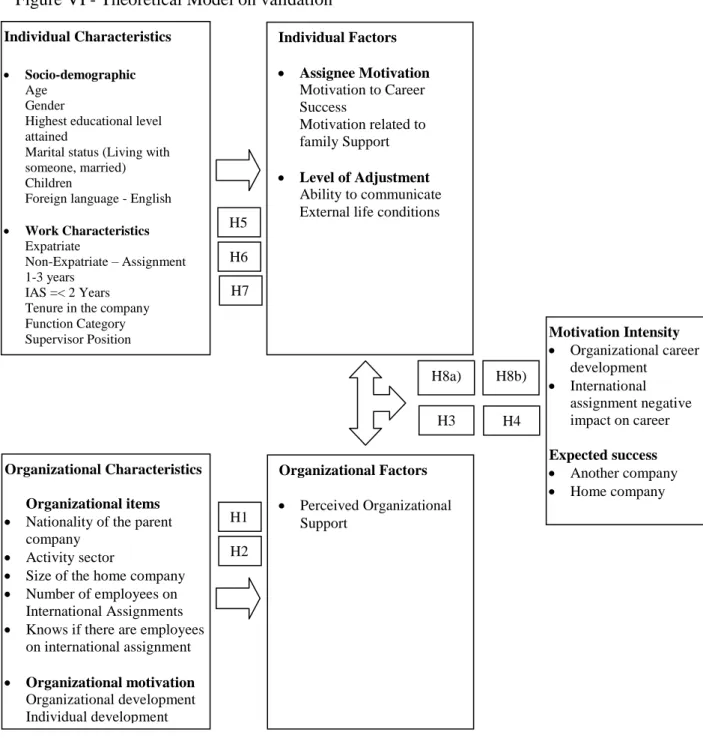
Figure VI – Theoretical Model on validation ... 30
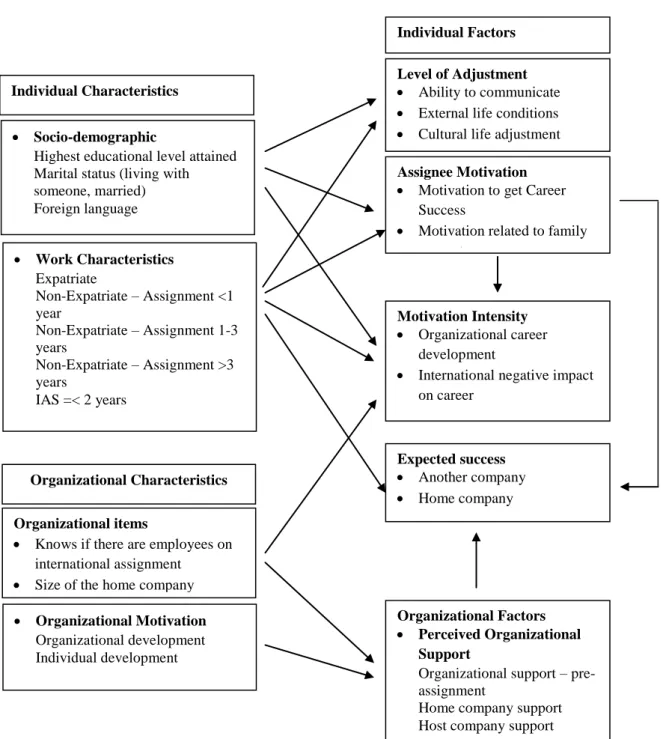
Figure VII – Theoretical Model validated ... 52
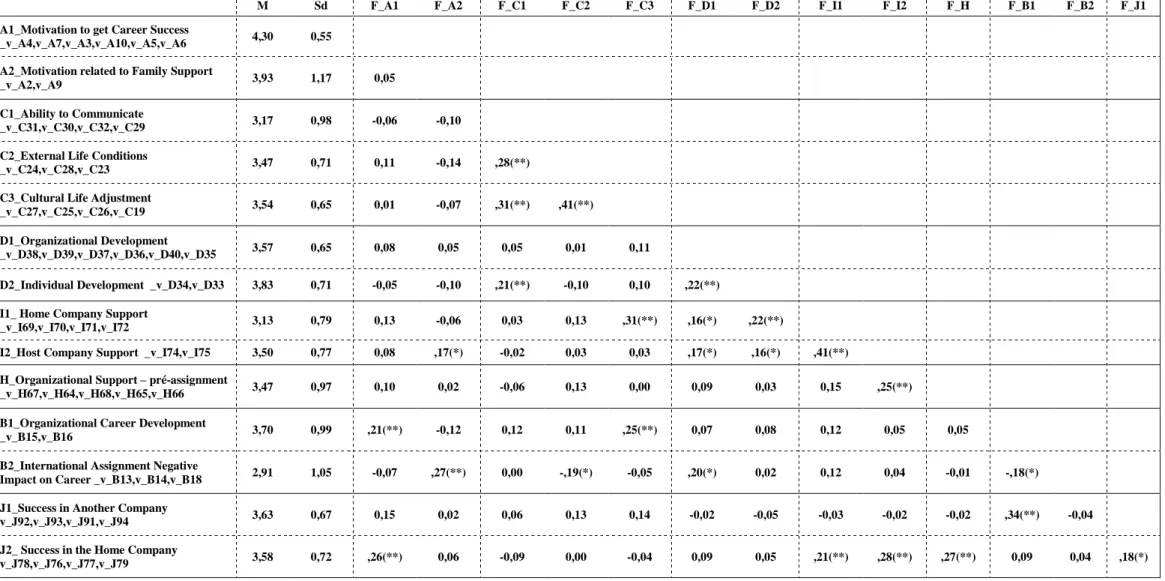
List of Tables Table I – Descriptive Statistics and Correlations ... 41
Table II – Regression results for organizational factors dimensions ... 42
Table III – Regression results for individual expected success dimensions ... 45
Table IV – One-Way Anova related to the earlier career stage ... 47
Table V – Regression results for motivations related to the family support ... 48
Table VI – Regression results for individual factors ... 49
1
1. Executive Summary
The current study fits on the scope of the Master thesis in Management. The investigation proposed has as theme “Expatriate vs locals” – career management process and relevant factor in multinationals.
This study focus on the perception of the expatriates towards multinationals and in what extent organizational characteristics (success and support) and individual characteristics (success, motivation and adjustment) can contribute to the success of international assignments. Starting from this idea, we will try to understand in what extent individual and organizational factors may influence motivation intensity and expected success of expatriates on an international assignment, and in what extent these factors are influenced by individual and organizational characteristics referred before.
The referred items have been studied in vast literature, namely the one related to perceived organizational support (Kraimer and Wayne, 2004 and van der Heijden, van Engen and Paauwe, 2009), expatriated success (Cerdin and Le Pargneux, 2009), international adjustment (Selmer, 2001; 2006) and motivation from organizations and individuals to go abroad (Antal, 2001; Bonache, Brewter and Suutari, 2001; Howe-Walsh and Schyns, 2010).
Thus, the main goal of this study is to understand the link of all these dimensions among them, but mainly to understand how these items are perceived by expatriates and non-expatriates and how they contribute to the motivation intensity and expected success on international assignments.
So, we propose a model which is based on the literature review that follows, and that states that individual and organizational characteristics shall influence the final result of an international assignment. The innovator character holds precisely with the attempt of linking all these items among them in order to achieve a final result that is the motivation intensity and expected success of an international assignment.
To background this model, it is presented a literature review that focuses all the items separately as well as tries to link them.
2 In order to validate the model we used an online survey, applied to 130 non-expatriates and 32 non-expatriates.
The results point that Socio-Demographic dimensions (individual characteristics) shall influence the level of adjustment, assignee motivation and motivation intensity. Still in the field of the individual characteristics we have work characteristics that shall influence beyond the dimensions referred before the expected success.
Regarding the organizational characteristics the latter influence the organizational factors (i.e. perceived organizational support) and motivation intensity.
We have also the assignee motivation that shall influence the motivation intensity and the expected success, whereas the organizational factors only influence the expected success.
In this context, we obtained an integrated model of motivation intensity and expected success, which brings us also a set of key information regarding perceived organizational support, assignee motivation, motivation related to family support and international adjustment.
3
2. Introduction
2.1. Reasons of the problem
According to the “2004 Global Relocation Trends Report”, 44% of the expatriates, at the time of the end of their international assignment and consequent repatriation to the home company, decide to abandon the same in the following two years, being the above mentioned rate superior when we only refer to companies, whose process of expatriation is a recent one (Baruch, Steele and Quantrill, 2002, quoted by Kraimer, Shaffer and Bolino, 2009). In addition, it is still shown that from the expatriates that are still busy in companies of their home country, about 30-50% are considered by the latter inefficient or only partially efficient (Black et al, 1991, quoted by Bolino and Feldman, 2000).
So, and in spite of the high turnover in multinationals, of the expatriates after their repatriation, as well as of the associated costs (in average, about 1 million dollars/a year, approximately Euro 748,390.96I, per expatriate) to their assignments, usually with the duration of 3/4 years (Bolino and Feldman, 2000 and Lazarova and Caligiuri, 2001, quoted by Kraimer, Schaffer and Bolino, 2009), a survey done in 2004 has revealed that in that year about 60,000 multinationals employed more than 45 million people all over the world, being more or less the double of 1990, being still foreseen that in the present year the number may rise to 75 millions.
So, this research has as its main issue to know what the perception of the expatriates towards multinationals is and in what extent organizational characteristics (success and support) and individual characteristics (success, motivation and adjustment) can contribute to the motivation intensity and expected success of international assignments.
In this context, according to Edström and Galbraith (1997, quoted by Harzing and Ruysseveldt, 1995 and by Stahl and Björkman, 2006) some of the main reasons that explain the fact of some multinationals risking on the sending of employees in international assignments, even knowing about all the trouble that may be provoked if the process isn’t well led, as well as the costs in which the company may incur are:
4 (i) the necessity of performing tasks implying high knowledge, when there is a deficit of internal offering or difficulty in giving training in the required area; (ii) the necessity of improving business capacities in employees with potential, added to the fact of the same acquiring an overview of the company in its totality, as well as international experience to improve their knowledge in a certain area and (iii) necessity of improving the company, sending to certain branch offices some of its best employees (of the parent company) as a way of these ones giving training to local employees and of keeping the high quality in the services that are provided by the company.
However, and in spite of the described before, there are many multinationals that don’t give enough support to the expatriates during their international assignment (Stroh et al., 2005; Stroh, Gregersen, & Black, 1998, quoted by Harris, 2008), being this one of the factors that leads to the situation of one fifth of the expatriates intending to leave the company when they go back (Hammer, Hart and Rogan, 1998, quoted by Harris, 2008). So the first goal is to analyse the perception of expatriates and non-expatriates regarding the type of support that is given by the home and host company and also if the perceived support may contribute to the success of organizational development. Furthermore, and in order to fight against the main issues related to the failure of an international assignment, namely: (i) matrimonial stress, (ii) employees and children, (iii) loss of privacy and identity, (iv) children’s bringing up, (v) new culture, (vi) local atmosphere, (vii) safety requirements and (viii) unknown structures (Anderson, 2005), it is necessary to give a permanent attendance to the expatriate and to his/her family during his/her international assignment, as well as in the process of repatriation (Black, Gregersen and Mendenhall, 1992). Thus, the second goal is to understand the factors that can contribute to the success of an international assignment from an organizational and individual point of view.
Additionally, and besides the motivations of the company when sending an employee to an international assignment, it is also necessary to understand the ones of the employee himself/herself, being these ones quite often connected to his/her career progression. So, the expectations of the expatriate after the end of the assignment will always be bigger in contraposition to his/her mobility, that’s to say, in the case of not having done the international assignment (Bolino and Feldman, 2000). However, a
5 study conducted by Black, Gregersen and Mendenhall (1992) shows that only 11% of the Americans, 10% of the Japanese and 25% of the Finnish got a promotion after the end of their international assignment. What is more surprising is that 77% of the Americans, 43% of the Japanese and 54% of the Finnish have performed inferior tasks and even with less authority (Harvey, 1989; Feldman and Thomas, 1992; Welch, 1994; Gregersen and Black, 1996; Kamoche, 1997; Selmer, 1999; quoted by Bonache, Brewster and Suutari, 2001) comparing with the ones they were entitled to during the international assignment. So, the third goal of this study is to understand the main motivations of the employee in terms of beginning an international.
Furthermore, and for Feldman and Tompson (1993, quoted by Cerdin and Le Pargneux, 2009: 7), “a positive general job satisfaction is an important indicator of
adjustment to new jobs.” In this context, individuals must adjust to new jobs during
expatriation as well as during repatriation. The success of the latter may be very important for the success of the international assignment. So, the fourth and final
goal is to understand if the expatriates and non expatriates are aware of their
6
3. Expatriates vs locals
3.1. Organizational characteristics
3.1.1. Organizational Perceived Support
“More and more companies look at globalization today as the answer to increase their value and become competitive on the global market.” This is even truer in the
countries where the international market is a small one as it is the Portuguese case (Hay Group, 2010: 2).
Furthermore, and as referred by Kraimer and Wayne (2004: 209) “organizational
scholars have addressed the challenges of expatriate assignments by theoretical and empirical examination of the predictors of various expatriate success measures” (e.g.,
Aycan, 1997, Black & Gregersen, 1991a; Black and Mendenhall & Oddou, 1991; Caligiuri, 1997; Caligiuri, Joshi & Lazarova, 1999; Kraimer, Wayne & Jaworski, 2001; Shaffer, Harrison & Gilley, 1999). From this stress perspective, expatriate research has examined various role stressors, situational and social support of expatriate success. A handful of studies have begun to examine the role of perceived organizational support, a particular source of social support, in prediction of expatriate success with promising results (Guzzo, Noonam & Elron, 1994, Kraimer et al., 2001; Shaffer, Harrison, Gilley & Luk, 2001, quoted by Kraimer and Wayne, 2004).
Much of this research has adopted the perceived organizational support, since the latter has been defined as the employee’s global beliefs that the organization values their contributions and cares about their well-being (Eisenberger, Huntington, Hutchinson and Sowa, 1986, quoted by Kraimer and Wayne, 2004).
Additionally, several studies point out that corporate support with the aim of the retention of expatriates has become a significant determinant of international business success (Selmer, Ebrahimi and Mingtao, 2000; Tung, 1998, quoted by van der Heijden, van Engen and Paauwe, 2009).
Thus, corporate support has earned great importance to the day-to-day of a multinational organization, since companies are having their branch companies more and more geographically spread being these, however, more integrated in a global strategy as the necessity of an international circulation is becoming greater and greater
7 (Stahl and Björkman, 2006), because “more than an individual evaluation of the
economic benefits of different geographical sites, it is an organizational logic that prevails” (Peixoto, 1999: 69). Therefore, “internationalization will only fulfil its promise of growth if it is sustainable in the long term” (Hay Group, 2010: 2).
Furthermore, and in line with the referred previously, many multinationals have been betting more and more on the expatriation of top managers, being the purpose of these ones the fulfilment of necessities of the branch company, as well as the management of key projects, the transference and the implementation of the corporate culture (Stahl and Björkman, 2006) through their acquired experience (Earley and Erez, 1997). In Portugal, for example, there are lots of companies that, in spite of the recent economic crisis, which has been affecting the world markets, have been following that way, namely, and just as an example:
Group EDPII
At present the Group EDP is represented in different countries, such as: Portugal, Brazil, Spain and USA, having in 2009 12,009 (in 2008 around 12,166) employees as a whole being these ones allocated, respectively, to each one of the countries that were referred before in the following proportion: 7,331, 2,339, 2,041 and 298 (in 2008 they were 7,652, 2,322, 1,922 and 270).
Group Portucel SoporcelIII
At the end of 2007 the Group Portucel Soporcel had an approximate number of 1,952 (in 2008 and 2009 were respectively 2,175 and 2,297) employees divided into four professional levels: Managers (3%), Top Staff (15%), Middle Office Force (16%) and Executors (66%) (this information was not updated for 2008/2009).
With international presence the staff of the Group is divided by the different countries where the Group is represented, namely, Portugal (96,6%), Germany (0,8%), Austria II http://www.edp.pt/pt/aedp/sobreaedp/recursoshumanos/Rel_social/EDPDocuments/RelatorioSocial2008 .pdf (2010-04-22); http://www.edp.pt/pt/investidores/publicacoes/relatorioecontas/2009/Relatrio%20e%20Contas%202009 /Inst_Sustentabilidade_PT.pdf (2011-04-18); III http://backoffice.portucelsoporcel.net/dynamic-media/files/rsustentabilidade_2006_2007__ versao_final_pt_-_net.pdf (18-04-2011).
8 (0,2%), Spain (0,5%), France (0,4%), Holland (0,3%),Italy (0,3%),United Kingdom (0,5% ) and USA (0,4%) (this information was not updated for 2008/2009).
Group CIMPORIV
At the end of 2008 the Group CIMPOR had 6,432 (in 2008 they were 5,997) employees under the cement activity and central services, being 60 in a transfer system or in a situation of expatriationV (in 2008 they were 35).
With presence in 13 countries it is in China, Portugal and Brazil that the number of employees is bigger (data referred to 2009), representing respectively 16,34%, 13,56% and 13,23% of the global totality of the Group. Spain with 10,65%, Turkey with 10,28% and India with 8,35% are equally three countries with high importance at this level. The other countries are: Egypt (7,23%), South Africa (6,78%), Mozambique (6,22%), Tunisia (3,25%), Morocco (2,71%), Cape Verde Islands (0,95%) and Peru (0,06%).VI
In this context, the organizational support can serve to alleviate the stress associated with working and living in a foreign country as well as to contribute to the success of the international assignment, since the organizational support is a predictor (as referred before) of the success of the expatriate on international assignments. Thus, larger companies that are investing on internationalization business and with vast presence in other countries should give more support to their expatriates, since the latter shall contribute to their international success and fulfil its promise of growth sustainable in the long term. It is in line with the referred before that we hypothesize the direct link between the company size and the respective perceived support degree.
Hypothesis 1: Companies with a vast presence in other countries and with more
employees are the ones that give more support to their expatriates.
http://www.portucelsoporcel.com/emag/relatorio-sustentabilidade-2008-2009/files/rel_
sustentabilidade08-09_net.pdf (18-04-2011);
IV http://www.cimpor.pt/cache/bin/XPQej8wXX2533ZAX6gkNRyMZKU.pdf (24-04-2010);
http://www.cimpor.pt/cache/bin/XPQej8wXX5977ZAX6gkNRyMZKU.pdf (18-04-2011);
V The employees granted between companies of the same country were considered as belonging to the
group of the permanent staff of the country;
9 As we can observe, international business plays an important role in the global economy as it dominates a major part of global commercial activities. This global economy provides multinational companies with an increasingly, dynamic and interdependent business environment (Cheng and Lin, 2009), being in this context, expatriate assignments an increasingly critical role in the execution of international business strategies and the development of global managers (Stahk et al., 2009). Thus, and as a way to optimize the investment done, companies must take into account the importance of the pre-departure, of the experience in the host country (while the assignment lasts) and on repatriation. So, and a little before the beginning of the assignment training should be given to the future expatriates and to their families a whole of clear expectations (both positive and negative) on what is waiting for them in the host country contributing in this way to a “pre-adaptation”, which may make the real adaptation easier when arriving at the new country (Vance and Paik, 2006), making the transition of the expatriate and his/her family to the host country much easier “lessening” this way the uncertainty and confusion associated to the change. Such measures will allow and help the expatriate in the process of concentrating himself/herself only on the work that he/she will develop making him/her productive in a shorter period of time (Wilsom and Dalton, 1998).
In line with the referred before, some companies have been launching programmes of mentoring through the person of the mentor. There are still other programmes that may support the expatriate and contribute to the success of the international assignment, namely: planning of the career with the individual before the beginning of the assignment, permanent counselling during the period of the assignment in order to help them keep in mind the career goals, planning of the career for the next international assignment (usually in a period between six and eight months before the end of the present assignment and the keeping of a constant contact between the home company and the expatriate in such a way that it makes the expatriate feel as if he/she hadn’t stopped belonging to the home company (Tung, 1988).
So, the existence of a “mentor” in the home company may be a benefit in terms of the expatriate feeling social support, as well as the fact of the mentor being able to protect the expatriate’s interests while he/she is away avoiding this way that the expatriate may have a strong desire of returning home due to reasons that are linked with the
10 home company, since the mentor will be able to inform the expatriate about all the developments that have happened with the company in its daily routine (Kram, 1985, quoted by Feldman and Thomas, 1992).
Besides the support that should be given by the home company, there should be a certain care on the part of the host company, so that the problems connected with cultural adaptation may be solved by the expatriate in a short time. This fact is important for the expatriate’s success because many top managers, when they start their international assignments in sites where the local employees belong to a different culture and don’t share the same experience and value system, can’t get the answer that these ones thought to obtain at a first time (quite often when comparing with the employees of their home country). Therefore, it has been observed by Earley and Erez, (1997: 19) that “a person’s expectations towards others will influence how she or he
acts towards them, and this behaviour in turn influences how they respond”.
Based on the referred, eventual expectations that the expatriate may have about the local employees will influence the way how this one will deal with these employees and so, sometimes he/she will try to rearrange the reality according to his/her previous expectations (this issue is presented by Dov Eden, through the Effect of Pygmalion)VII. In this context, and based on the referred before, it is necessary to give a permanent attendance (i.e., support) to the expatriate and to his/her family during his/her international assignment (Black, Gregersen and Mendenhall, 1992). Nevertheless, it is important not to forget that an employee is only sent to an international assignment in order to fulfil certain key purposes for the organization (and for the individual), which include control, socialization (Harris and Brewster, 1999), international growth, processes, mergers & acquisitions, among others (Hay Group, 2010). As example, please see the figure I and II that shows the key drivers for international mobility in Portuguese Multinationals and in Multinationals in Portugal.
VII This effect is well seen in the popular theatre play My Fair Lady based on Bernard Shaw’s play
11 Figure I - Key Drivers for International Mobility – Portuguese Multinationals Companies (Hay Group, 2010: 5)
Figure II - Key Drivers for International Mobility – Multinationals in Portugal (Hay Group, 2010: 5)
At this respect we can see that the international growth (i.e. development) is one of the most important factors when a company defines its international assignment policy. Additionally, the multinationals in Portugal also give great importance to career management (Hay Group, 2010).
In this context, and as referred before, expatriate assignments play an increasingly critical role in the execution of international business strategies and on the development of global managers. Thus, the development of companies on an international perspective is accompanied many times by the increase of the international assignments. Therefore, and as a way to optimize the investment done,
International Growth Control the Core Business across all geographies Processes, Mergers & Acquisitions Know how Development and Transfer Career Management Isolated Projects Innovation
1 – Not Important 2 – Important 3 – Very Important
1 – Not Important 2 – Important 3 – Very Important Career Management
International Growth Know how Development and Transfer Control the Core Business across all geographies Innovation Process, Mergers & Acquisitions Isolated Projects
12 companies must give a good support to their expatriates (before, during and after the assignment), as e.g., we have the pre-departure and mentoring programmes. Moreover, Fink, Meierewert and Rohr (2005, quoted by van der Heijde, van Engen and Paauwe, 2009) “found that the expatriated gain market-specific knowledge, personal skills,
job-related management skills, network skills, and general management skills that are vital for competitive advantage”. Thus, in the line with the referred before we
hypothesize the direct link between organizational development and the support degree, since the more a company bets on international business as a key player, the more investment on expatriates (i.e. support) shall be done by the organization, since the latter takes part in a critical role in which concerns the strategy of the company.
Hypothesis 2: Employees that perceive more organizational development
belong to companies that give more support.
3.1.2. Effects of Organizational Characteristics on Expected Career Success
In the expatriate literature, success has most commonly been examined using constructs such as expatriate adjustment (Black et al., 1991; Florkowski & Fogel, 1999; McEvoy & Parker, 1995; Shaffer et al., 1999, quoted by Kraimer and Wayne, 2003), withdrawal cognitions (Florkowski&Fogel, 1999; Guzzo et al., 1994; Shaffer & Harrison, 1998; Shaffer et al., 2001, quoted by Kraimer and Wayne, 2003), job performance (Caligiuri, 1997, 2000, quoted by Kraimer and Wayne, 2003), and organizational commitment (Florkowski & Fogel, 1999; Gregersen & Black, 1992, quoted by Kraimer and Wayne, 2003). While most of these success criteria are examined independent of each other, there seems to be general agreement on the fact that international assignment success is evident if expatriates “(i) remain in the
assignment until the end of the term, (ii) adjust to living conditions in the new culture, and (iii) perform well on the job” (Aycan & Kanungo, 1997, quoted by Kraimer and
Wayne, 2003: 211).
Also from a managerial perspective, it is important to understand that not all expatriates take assignments in difficult places. For example, “an Austrian may take
an assignment in Germany or Switzerland, or a Briton in the USA” (Avril and
13 Additionally, with the increasing concern over retaining expatriates upon their repatriation to the home-country, companies consider retention of these former expatriate employees as an important success criterion (Black & Gregersen, 1991b, quoted by Kraimer and Wayne, 2003), since and as referred in the last point, the international assignments are a tool of strategic importance aiming at the fomentation of the international net of the organization, being used quite a lot in the “embryonic phases” of the process of implementation of a new subsidiary or to control the operations abroad (Scullion, 1994, quoted by Morley and Heraty, 2004). “This
approach must take into consideration the employee’s internationality mobility, not only as an answer to the present business needs from local operations, such as cost effectiveness and know-how transfer, but also as an opportunity to manage people’s development, motivation and careers, to consolidate the corporate culture and to anticipate the future needs for leadership and talent” (Hay Group, 2010: 2).
In this context, expatriates act as “conducting wires” between the company’s headquarters and the subsidiaries placed in the assignment countries (Wilsom and Dalton, 1998).
So, and confronted with the fact of having to serve two “masters”, many expatriates come to the situation of obeying only in one direction, which may provoke costs and consequences for the expatriates and for the company as a whole. And, if an individual is highly compromised with a foreign policy, it will be difficult for the home company to get a co-ordination with the expatriated because of the fact of this one being highly focused on the local situation. On the other hand, expatriates that are quite compromised with the home company often try to implement its policies or inappropriate procedures in the host-country company.
In this context the multinationals need expatriates that are highly compromised with both companies (the one of the host-country and the one of the home) (Black, Gregersen and Mendenhall, 1992). Thus, one way of characterizing multinational companies is a network of capital, products, knowledge (Bonache, Brewster and Suutari, 2001) and relationship building among branches located in different countries (Cerdin and Le Pargneux, 2009). In line with the referred before, Fink, Meierewert and Rohr (2005, quoted by van der Heijden, van Engen and Paauwe, 2009) found that expatriates gain market-specific knowledge, personal skills, job-related management
14 skills and general management skills that are vital for competitive advantage. The loss of an expatriate knowledge and skills is thus critically detrimental for companies hoping to develop global competences (Cassiday, 2005, quoted by van der Heijden, van Engen and Paauwe, 2009).
Thus, career support can be essential for companies retaining their repatriates, but the success of expatriates on assignment is equally important (van der Heijden, van Engen and Paauwe, 2009).
Furthermore, a recent meta-analysis found that support is positively related to career satisfaction and salary (Ng et al., 2005, quoted by Kuijpers, Schyns and Scheerens, 2006). Additionally, Forster and Johnsen (1996) argue that it is partly a lack of career support by the parent company that leads expatriates to perceive unfavourable impacts on their career (van der Heijden, van Engen and Paauwe, 2009).
In this context, and as referred before, it seems that there is general agreement on the fact that international assignment success is evident if: (i) expatriates remain in the assignment until the end of the term, (ii) adjust to living conditions in the new culture, and (iii) perform well on the job. Additionally, the retention of expatriates by the organization is also an important success criterion, since the international assignments are strategic tools. Thus, the success of an international assignment is many times measured by the referred three goals. Thus, an in order to achieve the referred goals, the company support will be very important, since and as referred before support is positively related to career satisfaction (i.e., success).
So, it is in line with the referred before that we hypothesize the direct link between the perceived organizational support and the career success.
Hypothesis 3: Employees that perceive great organizational support are also the
ones that expect more career success.
The costs involved with underperformed are substantial. Moreover, the performance of expatriates is critical to the success of the international assignment. Therefore, Feldman and Thomas (1992), found that career support is a significant predictor of performance.
15 Furthermore, Lazanova and Caligiuri (2001, quoted by van der Heijden, van Engen and Paauwe, 2009) found that it is the expatriates’ perception of their organization’s support, rather than an objective assessment of whether such practices exist, that will have the greater influence on career support outcomes. Additionally, Kraimer and Wayne (2003) found that perceived career support has an indirect effect on task performance.
Therefore, “companies are interested in career development realizing that improved
efficiency, profitability, corporate growth and, maybe even the survival of the company, increasingly depend on better use and development of employee talent”
(Walker, 1973, quoted by Selmer and Leung, 2003: 126).
Furthermore, “the responsibility for the employee’s career consequently is more in the
hands of the company than the individual.” Hall and Moss (1998) “call for a relational approach that companies should take towards their employees’ careers where employers provide opportunities, rather than manage employees’ careers”
(Walsh and Schyns, 2010: 264).
In this context, and since the performance of expatriates is critical to the success of the international assignment and that the career support is a significant predictor of performance, multinational companies should bet on increasing the support that they give to their expatriates, since in the end of the day, the support that they give will be positively correlated to the performance achieved by the expatriate. Additionally, a good performance by the expatriate will also contribute for his/her career development.
Thus, it is in line with the referred before that we hypothesize the direct link between organizational support and career development.
Hypothesis 4: Employees that perceive great organizational support notice that
16
3.2. Individual characteristics
3.2.1. Motivations
“Zoha's rationale for moving evolved over time. The younger she was, the fewer environmental factors she considered. In her early twenties, she went on exchange to Lyon because it was the only school that still had space when she applied. She moved to Geneva because she had a job offer there. In essence, she would decide that she wanted to move then look everywhere and take the best opportunity. Now, when making such a decision, she factors in the type of destination she would like and how it fits with her personal objectives. In her latest relocation, she considered whether her destination could accommodate her partner's career as well as her own, whether it was safe and secure, and how it would accommodate her lifestyle preferences.
(Malawski, 2005: 10-11).
For many individuals work is a feature that defines their life. In fact, our happiness and self-fulfilment may depend on the way as we are able to control our evolution as professionals and the effect that this one has on our family and personal life (Greenhaus, Callanan and Godshalk, 2000). Furthermore, and in a recent past, only a few number of individuals had an exclusively international career. A more common situation was the one linked to employees that were expatriated for a period of 3 – 5 years and when this period came to an end, they would come back and wouldn’t be any more liable to another similar experience (Harris, 2008).
However, this pattern of experiences has been changing for years as a consequence of a fast globalization of business. And so, employees with international competence of business became a critical factor of success for the multinationals being able, as a consequence, to aspire to an international career as an integrating part of the strategy for the formation of talents on the part of the company itself (Kraimre, Shaffer and Bolino, 2009), which may open doors to the development of their careers in the future. In this context, it is important to understand the main motivations of employees to go abroad. One of the main arguments is that “the nature of an overseas assignment is
filled with challenge and discretion, and the main reason for expatriates to accept foreign assignment is their internal motivation” (Stahl, Miller, & Tung, 2002; Stahl &
17 Cerdin, 2004, quoted by Harris, 2008). Osland (1995, quoted by Harris, 2008) “found
that the most successful expatriates felt a sense of calling”. Inkson, Arthur, Pringle,
and Barry (1997, quoted by Harris, 2008: 214) “note that it is common for many New
Zealanders to pursue international experiences as part of their college or immediate post-collegiate lives”. Thus, the findings of Inkson et al (1997) raise the question of
whether some cultures may encourage international experiences, thereby fostering internal motivations for accepting international assignments among people reared in those cultures (Harris, 2008).
Furthermore, Stahl, Miller, and Tung, (2002: 216) have observed that “a survey of
U.S. expatriate managers in more than 50 countries, found that managers increasingly view international assignments as enhancing their internal, rather than external, careers. Most expatriates surveyed were seriously concerned about repatriation, yet the overwhelming majority of them perceived an international assignment as essential to their subsequent career advancement”. Additionally, most of the expatriate
surveyed viewed their international assignment as an opportunity to acquire skills and expertise usually not available at the home country. These findings suggest that expatriates value an international assignment primarily for the experience and the opportunities it brings for personal development and career enhancement, even though it may not be with their current company. The positive attitudes that many expatriates have towards their international assignment, support the emerging notion of boundaryless careers.
This paradigm “faces the career as a continuous process which may be developed between departments, hierarchical levels, companies and even in the development of new competences” (Rodrigues, 2010: 3).VIII
Douglas Hall (quoted by Greenhaus, Callanan and Godshalk, 2000: 12) has observed that “the new career contract is not a
pact with the organization; it is an agreement with one’s self and one’s work”.
Furthermore, Dalton, Thompson and Price (1977, quoted by Beaumont, 1994) concluded that high performers early in their career performed very different functions from high performers at both the mid and late career stages (please see figure III).
VIII For a better understanding of the topic here described please see: Rodrigues, A. F. (2010), Atitudes
Boundaryless Career nos profissionais de Consultoria em Tecnologia de Informação, Master thesis in Human Resource Management, ISCTE Business School, ISCTE – IUL.
18 Figure III – Activities, roles and psychological issues in four career stages (Dalton, Thompson and Price, quoted by Beaumont, 1994: 132).
I II III IV Central activity Helping learning, following directions Independent
contributor Training, interface
Shaping the direction of the organization Primary
relationship Apprenticeship Colleague Mentor Sponsor Major psychological issues Dependence Independence Assuming responsibility for others Exercising power
Based on the referred before, we defined career development as “an ongoing process
by which individuals progress through a series of stages, each of which characterized by a relatively unique set of issues, themes, or tasks” (Greenhaus, Callanan and
Godshalk, 2000: 117). Figure IV summarizes four of the more frequently cited approaches to career development.
Figure IV – Four Models of Career Development (Greenhaus, Callanan and Godshalk, 2000: 118)IX
Miller and Form Super
Age Stage Age Stage
0-15 Preparatory Work Period 0-14 Growth 15-18 Initial Work Period 15-24 Exploration
18-34 Trial 25-44 Establishment
35-65 Stable 45-64 Maintenance
65+ Retirement 65+ Decline
Hall and Nougaim Schein
Age Stage Age Stage
0-25 Pre-Work 0-21 Growth, Fantasy, Exploration 25-30 Establishment 16-25 Entry into World of work 30-45 Advancement 16-25 Basic Training
45-65 Maintenance 17-30 Full Membership in Early Career 65+ Decline 25+ Full Membership in Midcareer
35-45 Midcareer Crisis 40+ Late Career
40+ Decline and Disengagement ? Retirement
19 Moreover, it has been argued that early career challenge is related to later career success (Beaumont, 1994).
In this context, we can suppose that employees on earlier career’s stage will see an international assignment as a tool for their career development, which shall be liable, in future, to greater career success. Therefore, employees on earlier career’s stage (i.e., on establishment stage – Hall and Nougaim, quoted by Greenhaus, Callanan and Godshalk, 2000: 118) want to prove their added value to company.
So, it is in line with the referred before that we hypothesize the direct link between earlier career’s stage and career success.
Hypothesis 5: Employees that are on earlier career’s stage expect greater career
success by accepting an international assignment.
On the other hand, and despite the referred before, there are another factor (not related to career development) that sometimes can be crucial in the acceptance or not of the international assignment, which is the family support.
In this context, companies cannot only “look” at the employee that will assume an international assignment, since the expatriate’s family plays an important role in the success of the international assignment. A number of authors recognize the importance of the spouse throughout the whole expatriate assignment. Black and Stephens (quoted by Anderson, 2005: 571) “provide the results of research indicating that the more
spouses were in favour of the international assignment, the higher was their adjustment to their general environment and their interaction with host nationals. Indeed, HR professionals rated spouse resistance to expatriation as 4.4 (5 being very critical) as the most critical family challenge faced in respect to family-related expatriate issues” (Global Relocations Trends 2002 Survey Report, quoted by
Anderson, 2005). Mendenhall et all (quoted by Anderson, 2005: 571) “quoting a
number of researchers, observe that the morale of the expatriate can be affected by a spouse or family member who is not coping with the stresses and strains of relocation”.
20 In this context, a number of authors recognize the importance of the spouse throughout the whole assignment. Borstorff et al. (quoted by Anderson, 2005: 571) “indicated that
the cross-cultural adjustment and job relocation literature suggest that the motivation of spouses to go abroad impacts significantly on the effort (i.e., motivation) made by expatriates to adjust.”
Thus, it is expectable that employees have more motivation to go to an international assignment if they feel their family support.
Moreover, and as referred in hypothesis 5, employees on earlier career’s stage will see an international assignment as a tool for their career development. Thus, employees that are no further on earlier career’s stage will have to be a strong reason to accept an international assignment, since many times they are already in top positions.
Furthermore, and despite many times employees that are no further on earlier career’s stage may accept an international assignment because they want continuously improve their skills or only because they are very committed with the company, it is also true that if they are married, family support might be a key item in the acceptance or not of the international assignment.
So, it is in line with the referred before that we hypothesize the direct link between the employees that are no further on earlier career’s stage and the motivation to get career success if they feel their family support.
Hypothesis 6: Married employees that are no further on earlier career’s stage
will have more motivation to get career success if they feel their family support.
3.2.2. Adjustment to international assignments
Expatriation is characterized by high levels of stress either for the employer, or for his/her family as a result of the process of dislocation and of the cultural shock they will have to cope with (Furnham, 1990, quoted by Jordan and Cartwright, 1998).
“How long did it take you adjust to living in the Netherlands? About 37 seconds. Unlike other people who came on assignment – we knew where we
21
were, I already knew enough of the language to get by, we knew quite a bit about the culture, and we had good friends there, so it was a relative easy adjustment. (…)” – a well adjusted expatriate
“How long did it take you adjust to living in Italy? I never did. Living there, existing there, is not a problem. It is the level of frustration that you either sublimate or put up with or opt not to put up with. It is a frustrating existence because of the way the society works. (…)” – a poorly adjusted expatriate (Harrison, Shaffer and Bhaskar-Shrinivas (2004: 199-200).
Following the two short experiences related before, a good socio-cultural adaptation will have to take into account the capacity of the expatriated and of his/her family being able to adjust themselves or to interact in an efficient way with the members of the culture of the host country (Ward and Kennedy, 1996, quoted by Selmer, 2006).One of the main barriers to this adaptation is language. This one reflects and affects the perspective of each individual on the world, as language and culture are interconnected and inseparable dimensions. So and according to Hall (1973, quoted by Selmer, 2006: 352) “culture is communication”. A good capacity of communication will allow the cultural development through the interaction with other individuals because communication affects and reflects culture, as well as the last one affects and reflects what is codified in the message transmitted through language (Selmer, 2006). However, we must point out that the cultural factor isn’t easy to control. So and firstly we will have to realize what the meaning of culture really is. The concept in itself is “a woollen ball“. Kroeber and Kluckhohn (1952, quoted by Tayeb, 2005) quote 164 different definitions of culture having this one equally two big framings mainly depending on the context it is being discussed. So anthropologically and sociologically speaking culture refers to the values and attitudes visible in certain individuals that belong to a certain society (being this one the meaning in which this work is inserted). On the other hand, culture is usually identified as the art and the literature belonging to a certain society (Tayeb, 2005).
Hofstede (1997) refers to culture as a collective programming of the mind which distinguishes the members of a group or category from the other. Tayeb (1988, quoted by Tayeb, 2005) adds that culture is something changeable having historically
22 improved through values, attitudes and meanings that are learnt and shared among the members of a certain community.
It is in this context that some expatriates find the first barriers to success in their international assignments as many of them, when accepting positions of leadership in companies that receive them, use the same leadership strategy and the same ideologies as if they went on performing the activity in his/her home country, forgetting that success or failure in the implementation of a strategy depends on the way as the same is understood and adequate to the culture in question (Black,1992; Black and Porter, 1991; Lawson and Swain, 1995; Okechuku and Man,1992; Schermerhorn and Bond, 1992; Selmer, in press; Stening and Harmer, 1992: Zeira, Harari and Nundi, 1975; quoted by Selmer, 1996 ). So at the time of the sending of expatriates these ones should own cross-cultural competences as a way of being able to manage teams constituted by members that do not share their culture. The central pretext is that the manager cannot wait for the moment the members of his/her group may accept attitudes and measures that do not fit his/her way of thinking, being the expatriated manager the only strange element in all this relation of management and being taken for granted that this one is the only one that has to adapt himself/ herself to the new reality (Mead and Andrews 2009). So it is clear that the actions of an individual are only guided and not dictated by the cultural values so a top manager should have a mind opened to new cultural experiences when he/she starts his/her international assignment (Earley and Erez, 1997).
Being so and according to Hofstede (1997), the cross-cultural contacts are generally accompanied by a certain number of typical psychological and social processes. At the time of an international assignment the expatriate is usually prone to suffer an initial
cultural shock, which may be more or less overcome according to the expatriate’s
training and prep previous to the assignment (Black, Gregersen and Mendenhal, 1992). This way the expatriate tends at a first moment to experiment enthusiasm, which is provoked by the novelty of the assignment and of the contacts generated by his/her new reality being the new cultures responsible for a certain admiration and curiosity. After this moment the crisis provoked by the fact of having to cope with the reality, that’s to say, the cultural shock becomes quite clear. This shock may be provoked by different factors, such as being far from the family, friends, privation of certain habits,
23 difficulties of adaptation to the local culture, such as, language, food, among others. As time goes by the expatriate gets a better understanding of the local context starting establishing interpersonal relations. Finally, we are then before the real adjustment (Rego and Cunha, 2009; Hofstede, 1997). So the expatriated employees that are in temporary assignments in a foreign cultural atmosphere will undergo processes of cultural adaptation as the u-curve and w-curve (Black and Gregersen, 1991) of figure V may illustrate.
Figure V – The Cross-cultural adjustment of expatriates: cultural shock and performance (Rego and Cunha, 2009: 297; Hofstede, 1997: 242).
Expatriation Repatriation After Repatriation
Negative Positive
Cross-cultural Adjustment
The W of two cultural shocks and two adjustments + _ Cultural shock Crisis Feeling of discomfort, desire to return
The cultural shock cycle and the cross-cultural adjustment of the expatriate Positive Negative Cross-cultural Adjustment “Honeymoon” Stadium of “tourist” Enthusiastic, euphoria,
pleasure of novelty Acculturation
Stable situation
Course of expatriation +
24 Furthermore, we have to point out that sometimes when the international assignments last long periods at the time of the end of the process of cultural adaptation, when the expatriates come back to their home country, they may try an inverse cultural shock (Hofstede, 1991 and Black, 1992 and Forster, 1994 quoted by Bonache, Brewster and Suutari, 2001).
Due to the above mentioned and in order to smooth the initial cultural shock a recent survey has shown that about two thirds of the multinationals “offer” to their expatriates programmes of cultural development (Fitzgerald – Turner, 1997 quoted by Luthans and Farner, 2002).
Thus, and as the costs associated to the international assignments are considerable and a bad performance or cultural adaptation on the part of the expatriate during an international assignment may create in the future important problems in the company (Gates 1996, quoted by Bolino and Feldman, 2000), many companies award compensations and benefits as an incentive to expatriation (Harris, 2008), such as: allowances, fringe benefits and some tax compensation, which in practice makes the payment package be between 3 and 5 times superior to the base salary got by the expatriated in the home country (CFO magazine, June 1998, quoted by Wilson and Dalton, 1998).
In addition to the many incentives that firms offer their expats, companies also often provide a number of what is referred to as equalization adjustments. These are payments whose purpose is to adjust for differences (generally in a higher direction) in mandated payments that expats have no control over – some of which are paid by the expatriate and some of which are paid to the expatriate. The most common and probably significant of these adjustments is the cost-of-living adjustment (COLA).
“The purpose of the COLA is to enable expatriates to maintain as closely as possible the same standard of living in the foreign assignment that he or she would have had at home (or better, if coming from a low-cost-of-living city or country)” (Briscoe and
Schuler, 2004: 318).
In this context, “we can conclude that any change in a person’s life entails a
25 more experience on international assignments that shall have more facility to adjust or to understand their necessities of adjustment.
Additionally, “growing older may be associated with increasing maturity” (Hechausen and Krueger, 1993; van Lange et al., 1997, quoted by Selmer, 2001: 1222). Thus, it is likely that older expatriates will find it easier to live and work abroad since their suitability will be less in doubt by local people making it easier to adjust than younger expatriates.
Moreover, one of the most important advances in the understanding of cross-cultural adjustments is the realization that people make adjustments in advance of actually transferring abroad. The nature of these anticipatory adjustments is primarily psychological – that is, people being to adjust their mental maps and rules before
actually move abroad. They develop what researchers term anticipatory expectations. For example, if individuals know in advance that the Japanese drive on the left side of road, they can make mental adjustments before actually travelling to Japan, just us, if people know that the Swiss take gifts of flowers or chocolate when invited to dinner at someone’s house, they can mentally adjust to this in advance (Black, Gregersen and
Mendenhall 1992: 123).
In this context, we can conclude than older expatriates will have more adjustment facilities than younger expatriates. Also, it is expectable that expatriates are more aware of their adjustments necessities than non-expatriates, namely, and as referred before, because expatriates start to make adjustments in advance of go on international assignments. So, in line with the referred before we hypothesize the following:
Hypothesis 7: Expatriates are more aware of their adjustment necessities in the
places to which they are expatriated than the non-expatriates.
3.2.3. Effects of Individual Characteristics on expected Career Success
“How should we measure the success of an expatriation in career terms?” (Harris, 2008: 214). As a proof that there is a support for this worry, a study done to 500 companies of Fortune showed that only between 4 and 7% of the times the international experience is taken into account when the time comes for the executives
26 being promoted (Black, Gregersen and Mendenhall, 1992), not being still clear how important it may be the positive impact that the international assignment can have on an employee’s career progression (Mendenhall, Dunbar and Oddou, 1987, quoted by Shen and Hall, 2009), being necessary to refer that more than a half of the times after returning the assigned employees will perform tasks of minor responsibility when comparing to the ones they have performed during their international assignment being sometimes equally impossible to recover the position acquired before the expatriation, being such a situation seen as “a lowering in the career rank” by the expatriates (Black, Gregersen and Mendenhall, 1992).
This “lowering in the career rank” occurs due to the natural development of the career management cycle of the different employees of a certain company. Such a fact combined with the pattern of traditional linear career (a career that highlights the vertical mobility) leads to the situation that when a certain employee is expatriated someone in the home company will be promoted in order to occupy the open position. So, when the expatriate returns to the home company if no position in the company has been safeguarded for him, the employee won’t have any available function compatible with his/her qualifications, which will contribute to the fact of the individual having to perform functions with inferior importance (Greenhaus, Callanan and Godshalk, 2000).
This situation seems to oppose the referred before, where it is referred that it is necessary international experience when we are supposed to improve vertically in a multinational company (in top function), being such experience one of the main motivations for the assignment.
However, as a consequence of an incorrect planning or of a new leadership of the company some expatriated employees may occupy an inferior position compared with the one they had got either in the home company, or in the host company when they return from their international assignment because in spite of having one of the qualifications to get a vertical progression (that’s to say, international experience), there is no available task in the new frame of the company.
As a consequence there should be a connection between the international assignment and the employee’s career plan in the long term in such a way that his/her expectations wouldn’t be defrauded because if the international experience in a multinational may
27 be an important factor when we think of occupying a top position in a multinational we have, however, to be careful to avoid the situation of the search for this experience becoming a factor of abandonment of the company by the expatriate after his/her repatriation.
In this context, expatriates have always in mind two great issues related to the development of their career when they consider the challenge that is linked with an international assignment: (i) will this international assignment grant me a strategic role in the business?, (ii) will this international assignment allow me a career improvement? As the global managers have in average more than fourteen years of experience in the home company, these ones want to have as guarantee that an international assignment won’t let them out of sight and out of mind consequently losing their rank for future strategic actions in the home company.
Thus, a good connection between the international assignment and the employee’s career plan may contribute to the fact of this one being more prone to invest his/her time, energy and compromise in such a way that he/she may transform his/her international assignment into a success (Brett and Werbel, 1980, quoted by Feldman and Thomas, 1992). Recent studies have shown that in general the employees are satisfied with the expatriation process not being able, however, to say the same in which concerns his/her repatriation process. So these studies propose that the employees consider the expatriation as a great opportunity of development and career progression even if this may mean his/her organization leaving after repatriation (Stahl and Cerdin, 2004; Suutari and Brewster, 2003; Tung, 1998 quoted by Cerdin and Le Pargneux, 2009).
In addition to this and as a motivating factor for the acceptance of international assignments a study conducted by Suutari and Brewster (2003, quoted by Shen and Hall, 2009) has shown that the repatriated employees are an “appetizing” target for the headhunting enterprises that search employees with international experience, as according to the study 65% of the employees with international experience have the chance of receiving job proposals while they are still in international assignment, being that after ceasing the assignment the rate decreases only 60%.
In this context, and based on the referred before, researches indicate that parent companies are paying too little attention to the career development of their expatriates