International Conference on Modern Languages, Teaching and Education
Modern languages and Modern Learners: different scores among Asian immigrant minorities for academic and language skills development
Sandra Figueiredo
Post-doctoral researcher of Universidade Autónoma de Lisboa, Lisbon, Portugal, [email protected] Margarida Alves Martins
Full Professor of ISPA – Instituto Universitário, Lisbon, Portugal, [email protected] Carlos Fernandes da Silva
Full Professor of University of Aveiro, Aveiro, Portugal, [email protected]
Abstract
A total of 108 children belonging to six groups – Western Europe, Eastern Europe, Portuguese-speaking African countries, Latin America, Asia and China - were compared regarding tasks on verbal reasoning and vocabulary skill to examine nationality group effects on task performance and language proficiency. This study aims to verify whether students from different nationalities and learners of Portuguese as L2 evidence similar difficulty levels in tests on language skills. Results of MANOVA showed that nationality groups differed in a significant manner, in particular, two groups – from South Asia (Meridional) and from Latin America - whose performance was different for both tests. The Asian group evidenced more difficulty in vocabulary decoding and verbal reasoning when compared to other nationality groups. Higher scores were attained by the Latin American group whose language of testing had common features with the home language and therefore showed more overlapping. The influence of the co-variable "Languages spoken at home" on the results was also confirmed, which suggests that nationality is a less strong predictor compared to the number of languages spoken at home. Results will be discussed from the point of view of individualized assessment and intervention according to immigrant school groups in European contexts.
Keywords
Nationality; Academic Success; Mother Tongue; Second Language; Verbal Reasoning. 1. Research study
Considering the limitations of the literature regarding European contexts as far as profiles of competences and difficulties faced by school minorities, this study analyzes and compares the performance of different groups ans analyzes predictors to answer the following question: how do national school groups behave in a battery of tests on Portuguese as second language? We will focus on tasks on vocabulary and verbal reasoning (semantic relations and morphological extraction). The study hypothesis: national school groups perform differently on the same tasks on Portuguese as second language.
1.1. Participants: 108 immigrant students aged between 7 and 18 years old (M= 13; SD= 2,7). 46 (43%) male and 59 (55%) female, divided into six national groups: 25 (23%) from China, 6 (6%) from Latin American countries, 31 (29%) from Eastern Europe, 19 (18%) from PALOPs, 12 (11%) from Western Europe, 14 (13%) from other Asian countries (other than China). ANOVA tests were carried out to compare results according to the participants' nationalities and in relation to several variables: The results were: F(5,101) = 2.600, p = .30 for the school year; F(5,99) = 72.381, p = .000 for the type of mother tongue; F(5,84) = 5.015, p = .000 for the L2 learning/exposition onset (since arrival date in Portugal to the assessment date); F(5,50) = 1.503, p = .206 for socioeconomic status (parents' jobs); and F(4,18) = 3.130, p = .040 for proficiency level indicated by the school. No significant difference was found among the different socioeconomic groups.
Subjects were classified by schools according to proficiency levels defined by the Common European Framework of Reference for Languages (Council of Europe, 2001) and our sample includes only the first three groups: A1 (beginner level), A2 (elementary level) and B1 (threshold level).
1.2. Measures
Semantic Associations – task 1: The 6-item semantic association test was adapted from Woodcock-Munoz Language Survey-Revised (WMLS-R, 2005). The Portuguese adapted task evidenced high reliability with internal correlation consistency of .86. This test, within the area of vocabulary, aims to assess students ability to identify semantic relations among randomly placed words; students are asked to complete the six items by providing synonyms and antonyms of each word in Portuguese. The task was thus assessed: 2 points for each correct answer (Total score: 12 points). Example: Word: “rico (rich) _____(synonymous) ____(antonymous)”. (fill in the missing word by identifying the correct synonymous or antonymous of the presented word).
Morphological Extraction – task 2: The morphological extraction test includes four items and was adapted from the Morphological Extraction Test by August, Kenyon, Malabonga et al. (2001). This study presents a Cronbach alpha of .53. The objective of the test is to assess students' ability to make changes and extractions from a derived word in a specific sentence. In the case of L2 students, we aim to verify, in terms of vocabulary and verbal reasoning, interference from first language to host language in the process of morphological change. Change is analyzed regarding conversion of morphemes in new words in the main language. The task was thus assessed: 2 points for each correct extraction, 1 point for each partially correct answer (total score: 8 points). Example: Word: Friendship / Sentence: "My schoolmates are my __________."
In terms of psychometric properties of the above mentioned tests, only that on morphological extraction evidenced limited internal consistency (.53). The original test in English presents a high Cronbach coefficient (.93).
Procedure: data collection took place in 2013 and 2014 in primary and secondary state schools in the district of Lisbon. Communicating with the schools of district of Lisbon allowed us to identify 108 immigrant students, 23 of whom were informed of their proficiency by the school. Upon informed consent and authorization and selection of demographics of school population, the tasks were applied and assessed (scored) in accordance with the information of the original tasks. Participants were selected based on the following criteria: 7-18 years old, immigrants or children of immigrants both with or without school experience in Portugal before emigration, proficiency in Portuguese between A1 and B1 levels, public schools. Tests were applied both in paper and in computer formats. Students completed the battery of tests (15 tasks) in 60 minutes in a quiet classroom. Participants were divided into groups so that test application would be more effective and they were carried out under the supervision of the researcher. Data was treated using SPSS, version 21.
2. Results
2.1. Univariate analysis of variance: differences among national groups were expected, especially considering subjects from countries further away and with less developed educational systems and less similar to European systems (Abreu, Puglisi, Cruz-Santos et al., 2013). We expect those differences in language skills allow us to organize the groups in regards to difficulties experienced and that learners more at risk in terms of learning can be identified (Abreu, Puglisi, Cruz-Santos et al., 2013).
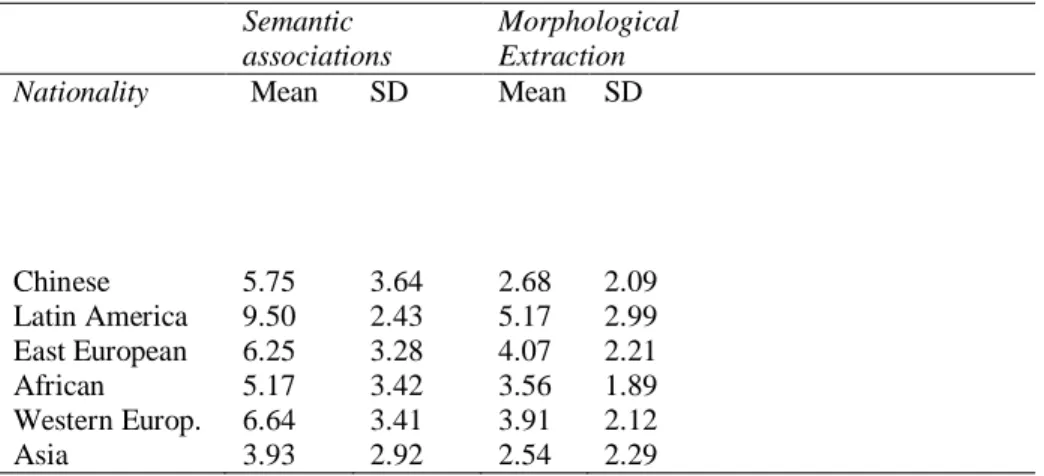
ANOVAs were used and the independent variable applied was nationality and the dependent variables were the performances in the two tasks. Table 1 evidences the averages and the standard deviations in the tasks by the students in the three groups. The six groups present different performance averages according to the tasks applied. Through the univariate ANOVAs we examined the effect size on the groups mean differences, using nationality, L1 type, and languages spoken at home as independent variables. For task 1 (semantic associations), the groups differed significantly (considering only the results for effect size, η2) in the results obtained only considering the nationality variable (η2= .130). For task 2 (extraction) there was no substantial effect size (η2= .121). The η2 value showed to be substantial only for the nationality variable (differences according to the type of home language), considering the benchmarks of Cohen for statistical value of η2 (Cohen, 1988). In the task on semantic associations (task 1), the Latin American group has the highest number of correct answers, followed by the (Western and Eastern) European groups. The group who performed the poorest was the Asian (from countries in the Indian subcontinent). Information on means and standard deviations are shown in Table 1.
ANOVA results evidenced significant differences among the groups: F(5.98)=2.757;p=.023. Post-hoc analysis showed statistically significant differences between the groups from Latin America and those from Asia (speakers of Indo-Aryan languages).
Table 1 Descriptive statistics for semantic associations and morphological extraction, in Portuguese as a L2, according to six groups of nationalities
Semantic associations
Morphological Extraction Nationality Mean SD Mean SD
Chinese 5.75 3.64 2.68 2.09 Latin America 9.50 2.43 5.17 2.99 East European 6.25 3.28 4.07 2.21 African Western Europ. Asia 5.17 6.64 3.93 3.42 3.41 2.92 3.56 3.91 2.54 1.89 2.12 2.29
2.2. Analysis of covariance: we used series of analyses of covariance to assess the impact of the subjects' mother tongues and of the language spoken at home (between the subjects and their families) in the performance by each group of subjects. These variables in the sample may influence the differences in the results. After having controlled the variable "Mother tongue", the national group obtained the same significant values (Pillai’s Trace: .020). On the other hand, by controlling the variable "Language spoken at home", the values for "nationality" were no longer significant, as it had occurred in previous tests. Only Roy's largest root kept significant p (.008) while all other tests are statistically irrelevant (p>.05). Based on these results, we conducted another ANOVA test, "Language spoken at home" being the independent variable. The results were very different.
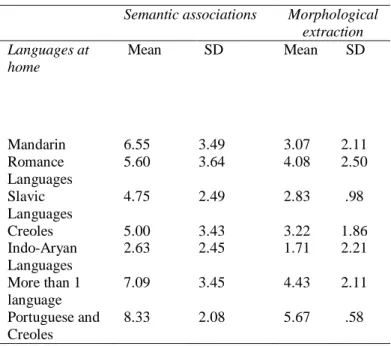
In the task on semantic associations (task 1), the group that speaks Mandarin at home, with the parents, performs better than the other monolingual speakers. However, speakers of Indo-Aryan languages (from Asian countries) perform the poorest in all tasks. Considering the subjects that speak more than one language at home (one of which Portuguese as L2), they have the highest number of correct answers. For this task: F(6.94)=2.442;p=.031. Information on means and standard deviations are shown in Table 2.
There were significant differences between the Indo-Aryan groups and the multilingual group (those who speak several languages at home). In the task on semantic associations, no statistically significant differences were found though there were differences among the groups (F(6.91)=2.569;p=.024), especially between speakers of more than one language at home and the remaining subjects (monolingual). ANOVA results evidenced significant differences among the groups: F(6.94)=3.263;p=.006. Information on means and standard deviations are shown in Table 2. Post-hoc Tukey analysis showed significant differences (p<.05) between the Indo-Aryan group and the speakers of Mandarin, Creole and 'multilingual' speakers.
Table 2 Descriptive statistics for semantic association and morphological extraction, in Portuguese as a L2, according to six groups of languages speakers (languages spoken at home)
3. Discussion: this study aimed at differentiating national school groups by applying a battery of tests on Portuguese as a second language (L2). The tasks selected were on vocabulary (1) and verbal reasoning (2). We concluded that there was, in fact, a difference in performance level among the national groups. Best results depended on the tasks but the poorest performances were, as expected, of subjects from less developed educational systems, less similar to the Western European systems. Based on this, we identified students from Asian countries (especially those from South and Southeast Asia) and from African countries (despite having Portuguese as the official language) as those most at-risk. Considering the results separating the different national groups and considering the covariance, which revealed the importance of another variable - that of "languages spoken at home" - in the performance of the tasks, we aimed to understand why there is more significant difference in some tests and which are the most at-risk groups in non-English speaking European countries. Moreover, based on the analysis of the full test, which includes the three selected tasks, we conclude that the components of an L2 assessment test suggest multidimensionality.
Firstly, in this study we focused on evidences that revealed differences (ANOVAs) among the national groups. Therefore, and in regards to all the evidences that showed differences among the groups, semantic associations and morphological extraction, our hypothesis is not fully confirmed because the subjects from Latin America were those that performed best, followed by the subjects from Eastern Europe. These were the expected results (Table 1). However, in the case of the subjects from Latin America (mostly from Colombia and Cuba), they came from distant countries with weak educational systems. On the other hand, and as expected, the Asian (non-Chinese) group performed the poorest. The significant differences were, in the semantic associations task, between
Semantic associations Morphological extraction Languages at home Mean SD Mean SD Mandarin 6.55 3.49 3.07 2.11 Romance Languages 5.60 3.64 4.08 2.50 Slavic Languages 4.75 2.49 2.83 .98 Creoles Indo-Aryan Languages More than 1 language Portuguese and Creoles 5.00 2.63 7.09 8.33 3.43 2.45 3.45 2.08 3.22 1.71 4.43 5.67 1.86 2.21 2.11 .58
the Asian groups and the ones from Latin America and from Eastern Europe. These results are consistent with those obtained in previous studies (Crowther, Trofimovich, Saito et al. 2014; McCarthy, Evans & Mahon, 2013) which analyzed the difficulties experienced in English as a second language by speakers of Indo-Aryan languages such as Urdu, Bengali and Punjabi (from Asian countries other than China).
On the other hand, our results clash with the usual profile of the Hispanic minority by several authors who claim that speakers of Spanish have a low learning success rate in the USA (Feyter & Winsler, 2010; Shifrer et al., 2011). In the Portuguese context, the Hispanic group perform the best, in particular in these tasks. The disadvantaged socioeconomic status that is usually associated to this minority is also true in Portugal but the closeness of the two languages, Portuguese and Spanish, may be the main predictor of advantage and minimize the variable of the low socioeconomic status (associated to low level o education) that is usually seen as the main predictor for the group's learning difficulties (Hoff, 2003). Specifically in regards to the task on semantic associations (verbal reasoning), the level of vocabulary acquired determines the ability to identify synonyms and antonyms of words in L2 (Schmitt, 2008). The closeness of the languages, Portuguese and Spanish, may allow the Hispanic group to more easily acquire and decode words when compared to the Asian group (Kieffer & Lesaux, 2012). L2 learners who do not learn multiple meanings (and a grade of synonymy and of antonymy) will not perform accurately and identify semantic relations (Fernandes, 2009).
Interestingly, Chinese students have a very poor performance, similar to that of the Asian group (speakers of Indo-Aryan languages) in the task on morphological extraction (Table 1), which is unexpected considering the skills Mandarin speakers evidence in manipulating minor segments (not minimum units such as phonemes) and in decomposition strategies (Zhang, 2015; Zhang & Koda, 2008; Zhang, Lin, Wei et al., 2013). On the other hand, our results are similar to those in the study by Zhang (2015), which outlines the difficulty of Mandarin and Urdu language speakers in derivation decoding/construction. Indo-Aryan language speakers showed lower achievement in general tasks and, when compared to the difficulty index calculated for all participants (Figueiredo, Alves Martins & Silva, 2015). Lexical schemata for these language groups are differently stored according to the specificities of the home language (Cyrino, 2010; Faruck & Vulchanova, 2014; Taboada, 2012).
The results of covariance (Table 2) show that "mother tongue" is not a predictor but that "languages spoken at home" is. Our results suggest that more than the type of languages it is the number of languages spoken at home that may significantly influence performance in the tasks we analyzed. Students attaining highest scores are those who state they speak more than one language at home, including Portuguese as L2 and their mother tongues, or, in the African group, the fact that Creole and Portuguese are spoken at home. This result replicates those of recent studies (Barac & Bialystok, 2012), even on the European context (Maluch, Kempert, Neumann et al., 2015), which show that speaking more than one language at home, as long as one of them is the language of instruction, has positive effects. This seems indisputable and explains how this variable (languages spoeken at home) emerges as more important than nationality in regressive analyses and as co-variable in the effects of the variable nationality in the covariance analyses in our study
In summary, Hispanic speakers usually have more correct answers when compared to the Asian group (speakers of Indo-Aryan languages), whose performance is the poorest in all tasks. As far as the other national groups are concerned, these have different levels of performance in the two tasks. Subjects from Eastern and Western Europe have very similar scores (Table 1), especially in verbal reasoning (semantic associations and morphological extraction); the results in the vocabulary test are not so similar, though. The gap between the educational system in developed countries, as in Europe, and underdeveloped ones, as those in Southern Asia and in Latin America, may be less of a predictor than the language factor. This provides an advantage to the Hispanic group, as they speak a Romance language, like Portuguese, and to those who speak more than a language at home. These results have important educational implications, especially from the point of view of minorities' diagnostic evaluation and the intervention according to nationality and type of speakers, focusing on tasks on verbal reasoning and vocabulary, considering that the results divided subjects in these tasks, and not others (such as picture naming, cognates or listening comprehension), within the same construct. These measures, such as picture naming and listening comprehension, may serve as means to differentiate issues and groups of immigrants at school in other contexts, such as the American (Gollan, Weissberger, Runnqvist et al., 2012); cognate identification tests (Brenders, Hell & Dijkstra, 2011) or the metaphorical language test (Littlemore, Chen, Koester et al., 2011) may reveal differences among school populations in European contexts other than Portugal or in Asian contexts in L2 contexts (Hashemian, Reza & Nezhad, 2007), and even within the same population, such as the Hispanic (Gollan et al.; Rosselli, Ardila, Jurado et al., 2012), but it cannot be applied to all European educational systems because of the different minorities and especially the different type of speakers involved and how they react to English or to a Romance language as L2.
REFERENCES
Abreu, P., Puglisi, M., Cruz-Santos, A., & Befi-Lopes, R. (2013). .Effects of impoverished environmental conditions on working memory performance. Memory, 22(4).Alba, R. & Foner, N. (2014), Comparing Immigrant Integration in North America and Western Europe: How Much Do the Grand Narratives Tell Us? International Migration Review, 48, 263–291. Doi: 10.1111/imre.12134
August, D., Kenyon, D., Malabonga, V., Louguit, M., Caglarcan, S., & Carlo, M. (2001). Extract the base test—English. Washington, DC: Center for Applied Linguistics.
Barac, R., & Bialystok, E. (2012). Bilingual Effects on Cognitive and Linguistic Development: Role of Language, Cultural Background, and Education. Child Development, 83(2), 413–422.
Brenders, P., Hell, J., & Dijkstra, T. (2011). Word recognition in child second language learners: Evidence from cognates and false Friends. Journal of Experimental Child Psychology, 109(4), 383–396.
Crowther, D., Trofimovich, P., Saito, K., & Isaacs, T. (2014). Second Language Comprehensibility Revisited: Investigating the Effects of Learner Background. TESOL Quarterly. doi: 10.1002/tesq.203
Cyrino, S. (2010). On romance syntactic complex predicates: Why Brazilian Portuguese is different (Sobre predicados complexos sintáticos nas línguas românicas. Estudos da Língua (gem), 8(1), 187–222.
Fernandes, N. (2009). Relações semânticas de sinonímia e antonímia: contributo para o desenvolvimento da competência lexical na aula de Português Língua estrangeira. Master Program Porto: Faculdade de Letras da Universidade do Porto.
Feyter, J. & Winsler, A. (2010). “The early developmental competencies and school readiness of low-income, immigrant children: Influences of generation, race/ethnicity, and national origins”. Early Childhood Research Quarterly, 24, 411–431.
Figueiredo, S., Martins, M., Silva, C., Simões, C. (2015). Second language education context and home language effect: language dissimilarities and variation differences in immigrant student’s outcomes. International Journal of Multilingualism.
Gollan, T., Weissberger, G., Runnqyist, E., Montoya, R., & Cera, C. (2012). Self-ratings of spoken language dominance: A Multilingual Naming Test (MINT) and preliminary norms for young and aging Spanish–English bilinguals. Bilingualism: Language and Cognition, 15,594-615. Doi:10.1017/S1366728911000332.
Hashemian, M., Reza, M., & Nezhad, M. (2007). The Development of Conceptual Fluency & Metaphorical Competence in L2 Learners. Startseite, 30(1).
Hoff, E. (2003). Causes and consequences of SES-related differences in parent-to-child speech. In Marc H. Bornstein and Robert H. Bradley (Eds.), Socioeconomic status, parenting, and child development (pp.147-160). NJ: Lawrence Erlbaum, 2003.
Kieffer, M. J. & Lesaux, N. K. (2012), Direct and Indirect Roles of Morphological Awareness in the English Reading Comprehension of Native English, Spanish, Filipino, and Vietnamese Speakers. Language Learning, 62, 1170–1204. Doi: 10.1111/j.1467-9922.2012.00722.
Littlemore, J., Chen, P., Koester, A., & Bardnen, J. (2011). Difficulties in Metaphor Comprehension Faced by International Students whose First Language is not English. Applied Linguistics. Doi: 10.1093/applin/amr009.
Maluch, J., Kempert, S., Neumann, M., & Stanat, P. (2015). The effect of speaking a minority language at home on foreign language learning. Learning and Instruction, 36, 76–85.
McCarthy, K., Evans, B., & Mahon, M. (2013). Acquiring a second language in an immigrant community: The production of Sylheti and English stops and vowels by London-Bengali speakers. Journal of Phonetics, 41(5), 344–358.
Shifrer, D., Muller, C., & Callahan, R. (2011). “Disproportionality and Learning Disabilities: Parsing Apart Race, Socioeconomic Status, and Language”. Journal of Learning Disabilities, 44, 246-257.
Taboada, A. (2012). Relationships of general vocabulary, science vocabulary, and student questioning with science comprehension in students with varying levels of English proficiency. Instructional Science, 40(6), 901–923.
Weir, c. (2005). Limitations of the Common European Framework for developing comparable examinations and tests. Language Testing, 22(3), 281-300.
Woodcock, R. W., Munoz-Sandoval, A. F., Ruef, M. L., & Alvarado, C. G. (2005). Woodcock-Munoz language survey – Revised, English. Itasca, IL: Riverside Publishing.
Zhang, H. (2015). Morphological Awareness in Vocabulary Acquisition Among Chinese-Speaking Children: Testing Partial Mediation via Lexical Inference Ability. Reading Research Quarterly, 50(1), 129–142. doi:10.1002/rrq.89.
Zhang, D., & Koda, K. (2008). Contributions of L1 reading subskills to L2 reading development in English as a foreign languages among school-aged learners. Indonesian Journal of English. Language Teaching, 4(1), 1–17.
Zhang, J., Lin, T., Wei, J., & Anderson, R. (2013). Morphological Awareness and Learning to Read Chinese and English. In X. Chen, Q. Wang, and Y. Luo (Eds.), Reading Development and Difficulties in Monolingual and Bilingual Chinese Children - Literacy Studies (pp. 3-22). Springer.