Efficient co-templating roles of amines and amides admixed with
alkylammonium salts for the stabilisation of new AlPO
4–n
topologies
C. Borgesa, M.F. Ribeiroa, C. Henriquesa, M.T. Duartea, J.P. Lourençob, Z. Gabelicaca
Instituto Superior Técnico, Departamento de Engenharia Química, Av. Rovisco Pais, P-1049-001 Lisboa, Portugal; Fax: 351-21 8417246; e-mail: filipa.ribeiro@ ist.utl.pt
b
Universidade do Algarve, Unidade de Ciências Exactas, P-8000 Faro, Portugal
c
Groupe Sécurité et Ecologie Chimiques, ENSCMu, Université de Haute Alsace, 3, rue A. Werner, F-68093 Mulhouse Cedex, France
Two different aluminophosphate structures were synthesised in aqueous media using as main template methylamine (MA), directly added, or generated in situ from methylformamide (MF). Both involve novel AlPO4-n topologies that undergo structural transformations upon
template removal, yielding above 350°C microporous thermostable materials with interesting properties. Tetraalkylammonium (TEA) cations were used optionally as co-templates along with MA. Only non protonated MA was found incorporated into the pore volume of both structures, in relatively strong interaction with the framework oxygens. TEA appeared to stabilise one of the phases at defined stages of nucleation and/or growth processes, without playing any specific structure-directing role.
1. INTRODUCTION
Since the early extended work of Flanigen et al. on the synthesis of the new wide family of microporous aluminophosphates [1], the extensive research activity results every day in the discovery of novel AlPO4-n topologies. The diversity of structures and compositions of such
materials is reflected in their Al/P molar ratio varying from 1 to 0.5 [2] and by the presence of four-, five- or even six-coordinated Al atoms sharing oxygens with extra framework OH or H2O species. They can be synthesised in both classical aqueous media [1], but also in
non-aqueous systems [2-4], typically in the presence of organic (poly)amines [5]. The various amines tested so far have been proven to act both as space fillers and true directing molecules [6], but can also behave as charge balancing agents for some anionic frameworks [7, 8].
Although the role of amines in directing AlPO4-n structures is still poorly understood [9],
their templating ability has been recently more in depth investigated in the case of dimethylamine in AlPO4-21 prepared in quasi non aqueous media [10]; a steric-electronic
model could be proposed to describe the crystallisation process by a true structure directing effect. The smallest member of the amine family, namely methylamine (MA) was, to our knowledge, never used as a template in the aluminosilicate synthesis [11], probably because of its small size. Gabelica et al. have, on the other hand, exploited the remarkable complexing abilities of methylamine towards a variety of metallic ions [12], with the aim to synthesise metallosilicate zeolites. By forming stable methylamino metallic complexes, MA essentially plays a mineralising role in the initial gel depolimerization stages, although it could be occasionally found incorporated in the zeolite framework (e.g. in the case of Ga-ZSM-5),
thereby playing a pore filling role next to TPA+ templates [13]. Some AlPO4-n materials
could be synthesised in solvothermal conditions in the presence of (poly)alkylamides as solvents. These latter were shown to undergo a hydrothermal degradation under defined temperature conditions and yield CO and the corresponding amines [2, 4, 8]. In particular MA, stemming from methylformamide (MF) degradation, was found occluded in its protonated form between the interlayer spacings of the structure that crystallised under such conditions (Mu-7) [8], neutralising the anionic (Al3P4O16)3- sheets. When MF was replaced by
an equivalent volume of aqueous MA, Mu-7 did not crystallise while a compact AlPO4 phase
of berlinite topology appeared [14]. The only example of an open structure obtained in the presence of MA as the sole template was a silicoaluminophosphate called CFSAPO-1 [15] but neither the role nor the charge of MA were defined. Here we report a preliminary study of the efficiency of methylamine to direct specific AlPO4-n structures by acting as true,
non-protonated template. In order to prevent the formation of AlPO4-n phases involving
negatively charged sheets that would require the amine protonation, we have avoided solvothermal syntheses. Tetraalkylammonium cations (e.g. TEA+), known to stabilise neutral precursors to AlPO4-n open structures in aqueous media [16] were used optionally as
co-templates along with MA that was expected to play the main pore filling or templating role. MF was also tested as precursor to MA under similar diluted conditions.
2. EXPERIMENTAL
Alumina (PURAL SB, Condea) was added to diluted ortho-phosphoric acid (Merck, 85% aq. soln.) and the resulting solution was stirred for 1h in order to obtain a homogeneous gel. MA (Fluka, 41% aq. soln.) or MF (Fluka 99%) was added to the gel followed by the desired amount of TEAOH (Alfa, 35% aq. soln.) or TEABr (Alfa 99%). The mixture was then stirred for 2 h. Prior to heating in a Teflon-lined autoclave at 170ºC under autogeneous pressure. The crystallization time was 24 h for the gels involving MA and 1 week for the gels involving MF. The resulting crystalline products were recovered by centrifugation, washed with distilled water and dried at 80ºC overnight.
The structure type and crystallinity of all samples were checked by X-ray powder diffraction on a powder diffractometer with quartz crystal curve monocromator and detector INEL CPS 120º and on a Rigaku diffractometer using CuKα radiation filtered by Ni. Some samples were heated in a high temperature chamber coupled to the diffractometer, and the XRD patterns were recorded in situ. For the as-synthesised samples the treatment consised in increasing the temperature at a rate of 5ºC/min. under nitrogen flow from room temperature to 550ºC with 35 min. steps at 100, 200, 300, 400 and 500 ºC. The heating was continued up to 800ºC under dry air flow with 35 min. steps at 600, 700 and 800º C. Diffractograms were recorded at every step using a conventional sample holder. The crystal morphology was determined by SEM on a Hitachi F-2400 microscope. The quantitative determination of Al and P was performed by ICP (inductively coupled plasma). TG/DSC (N2 flow, heating rate of
5°C/min.) and methanol adsorption experiments were carried out on a Setaram TGA 92 microbalance. Before adsorption, each as-synthesised sample was heated in situ, at a rate of 5ºC/min under nitrogen flow and kept at 550ºC for 2 h under air flow, then cooled under nitrogen to 65°C. Once the sample weight had stabilised, the N2 flow was switched to an N2 -methanol flow obtained by bubbling N2 into a methanol saturator at 25°C.
3. RESULTS AND DISCUSSION
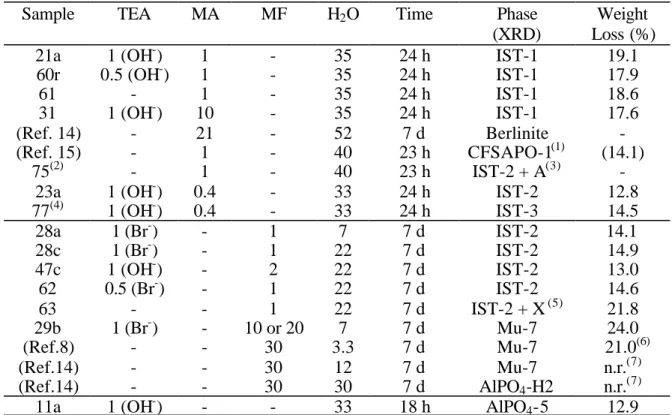
Table 1 gives the list of the different solid phases obtained under the specified experimental conditions.
Table 1
Synthesis conditions for various samples (gel molar composition for 1Al2O3;1P2O5, heating
time at 170ºC, final phase structure, total weight loss upon calcination at 550ºC under N2/air)
and comparison with appropriate literature data
Sample TEA MA MF H2O Time Phase
(XRD)
Weight Loss (%)
21a 1 (OH-) 1 - 35 24 h IST-1 19.1
60r 0.5 (OH-) 1 - 35 24 h IST-1 17.9 61 - 1 - 35 24 h IST-1 18.6 31 1 (OH-) 10 - 35 24 h IST-1 17.6 (Ref. 14) - 21 - 52 7 d Berlinite -(Ref. 15) - 1 - 40 23 h CFSAPO-1(1) (14.1) 75(2) - 1 - 40 23 h IST-2 + A(3)
-23a 1 (OH-) 0.4 - 33 24 h IST-2 12.8
77(4) 1 (OH-) 0.4 - 33 24 h IST-3 14.5 28a 1 (Br-) - 1 7 7 d IST-2 14.1 28c 1 (Br-) - 1 22 7 d IST-2 14.9 47c 1 (OH-) - 2 22 7 d IST-2 13.0 62 0.5 (Br-) - 1 22 7 d IST-2 14.6 63 - - 1 22 7 d IST-2 + X (5) 21.8 29b 1 (Br-) - 10 or 20 7 7 d Mu-7 24.0 (Ref.8) - - 30 3.3 7 d Mu-7 21.0(6) (Ref.14) - - 30 12 7 d Mu-7 n.r.(7) (Ref.14) - - 30 30 7 d AlPO4-H2 n.r.(7)
11a 1 (OH-) - - 33 18 h AlPO4-5 12.9
(1)
From ref. [15], gel heated at 150ºC with 0.4 mol SiO2 (silicasol);
(2)
Same synthesis as reported in
ref. [15], without SiO2, gel heated at 150ºC;
(3)
Major amorphous phase (noted A) present.
(4)
Same conditions as in ref. [15], but with 1mol. SiO2 (fumed silica);
(5)
Presence of minor amounts of
a crystalline, non identified phase, noted X; (6) Upon calcination at 700ºC; (7) Not reported.
3.1. Syntheses in the presence of methylamine
A first series of samples synthesised in the presence of MA as the main template yielded a solid that involves a so far unknown topology, here referred to as IST-1 (for Instituto Superior Técnico). This phase was obtained for gels having the initial composition: 1Al2O3; 1P2O5;
xTEAOH ; yMA ; 35H2O, for y≥1, both in the presence or absence of TEAOH (x being 0, 0.5
or 1). Under the same conditions but for 0≤y≤0.4, (e.g. sample 23a), another topology, called IST-2, was formed.
The only work describing synthesis conditions of AlPO-n compounds somewhat to our recipe used for IST-1, refers to a large initial amount of MA, more diluted conditions and a heating of the resultant gel for 7 days [14] (Table 1). AlPO4-berlinite (compact structure) was
the only crystalline product obtained under such conditions.
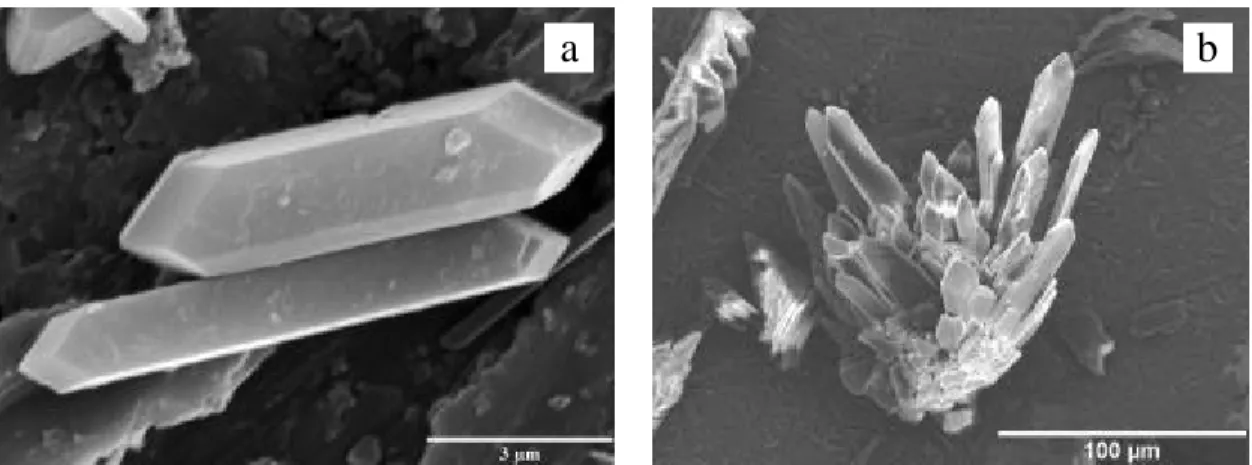
The morphology of IST-1 consists in elongated isolated prismatic crystals (Fig. 1a) and IST-2 forms fan-aggregated elongated crystals of a different outline (Fig. 1b).
Fig. 1. SEM micrographs of IST-1 (a) and IST-2 (b).
XRD patterns of both as-synthesised phases are also markedly different (Fig. 2a and 2b) and so is their chemical composition: the average formulas calculated from chemical analysis (P and Al) and from thermoanalytical data (total weight losses at 550°C) are 1Al2O3: 1P2O5: 2
MA for IST-1 and 1Al2O3: 1P2O5: 1.5 MA for IST-2.
5 10 15 20 25 30 35 40 2θ/ degrees (a) 5 10 15 20 25 30 35 40 2θ/degrees (b)
Fig. 2. XRD pattern of IST-1 (a) and IST-2 (b)
The composition of IST-1 is always the same, independently on the amount of TEAOH added in the initial gel, thus suggesting that TEAOH does not play any specific (e.g. templating) role. This is confirmed by the fact that no traces of TEA were found incorporated within the solid, along with MA (TG-DSC data (Fig. 3) and 13C NMR data [17]).
Fig. 3. TG and DSC profiles of IST-1 (a) and IST-2 (b) (1TEA ; 0 TEA
…
…
)a
b
0 5 10 15 20 25 50 150 250 350 450 550 Temperature (ºC) weight loss (%) -25 -20 -15 -10 -5 0 5 mV TG DSC (b) 0 5 10 15 20 25 50 150 250 350 450 550 Temperature (ºC) weight loss (%) -25 -20 -15 -10 -5 0 5 mV TG DSC (a)In addition 13C NMR showed that the included methylamine was not protonated [17], which is well in line with the formula of a pure neutral AlPO4-n framework with Al = P.
Quite surprisingly, next to the 13C NMR line at 28.06 ppm and corresponding to non protonated MA found in other such solids[18], another narrow and equally intense resonance was observed at 24.39 ppm (spectra not shown but discussed in detail in reference [17]). Since this line does not correspond to the protonated MA, that is currently characterised by a chemical shift around 26.3 ppm [8, 18] we have concluded that this second type of MA molecule should undergo a particularly strong interaction with the IST-1 framework [17].
At the present stage of our exploratory work, we can claim that IST-1 is an unusual novel stable AlPO4-n structure involving two very different types of MA templates that probably
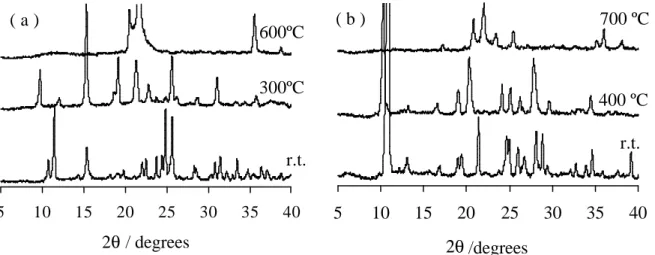
both contribute to the stabilisation of that open framework. It should also be noted that both types of MA undergo a quasi simultaneous thermal decomposition at about 300°C (Fig. 3a), suggesting that once the structure is destabilised by the release of one type of MA, it starts a progressive collapse leading to a steady destabilisation of the other type of MA, even if the first MA is initially more strongly attached to the framework. Supporting such a marked structure rearrangement are our XRD data that show a very different topology of the so obtained calcined phase, (Fig. 4a), but also the corresponding 27Al-NMR and 31P-NMR characteristics [17]. The new topology obtained upon calcining IST-1, here called IST-1(c), is stable from 300 to about 550°C, while it progressively starts collapsing around 600°C, leading to a tridymite type residue (Fig 4a).
5 10 15 20 25 30 35 40 2θ / degrees r.t. 300ºC ºC 600ºC ( a ) 5 10 15 20 25 30 35 40 2θ /degrees r.t. 400 ºC 700 ºC ( b )
Fig. 4. XRD patterns of IST-1 (a) and IST-2 (b): as-prepared and calcined at selected temperature.
IST-1(c) shows interesting sorption characteristics towards methanol (Fig. 5a). The amount adsorbed at 65°C for p/pº values of 0.07 namely 0.05 mg MeOH/mg solid accounts for the presence of a microporous structure.
IST-2 was obtained under the same experimental conditions, providing that the initial amount of MA is substantially lower than 1 mole (Sample 23a, Table 1). While the actual amount of amine in the IST-2 pore structure was lower than in IST-1 (1.5 mole par 1Al2O3;
1P2O5), 13C NMR revealed that only one type of weekly bound MA is present (δ = 27.56 ppm
[17]). A thorough search in the literature resulted in finding only one XRD pattern similar with the one characterising the as-synthesised IST-2 (Fig. 2b) called CFSAPO-1 [15], was
0 0.02 0.04 0.06 0.08 0.1 0.12 0.14 0 1000 2000 3000 4000 5000 time (sec.) mg MeOH /mg solid IST-3 IST-2 IST-1 (a) 0 0.02 0.04 0.06 0.08 0.1 0 1000 2000 3000 4000 5000 time (sec.) mg MeOH /mg solid IST-2, 1 TEA IST-2, 0.5 TEA IST-2, 0 TEA (b)
Fig.5. Methanol adsorption profiles for IST-1, IST-2 and IST-3 (a) and IST-2 synthesised in presence of different TEA contents (b)
synthesised under conditions relatively close to ours, with MA as the sole template, in the presence of silicasol, the heating being achieved at 150°C. Its final composition, namely: 1Al2O3; 0.99P2O5; 0.32SiO2; 1.1MA; 1.27H2O, also corresponds to a neutral framework,
suggesting that silica, if incorporated, induces the formation of SiO2 islands (2 Si replacing 1
Al and 1 P). However, the different morphology (spherical polycrystalline aggregates), and especially its thermal behaviour that does not yield a structure corresponding to IST-2(c) (Fig. 4b) but a different crystalline phase [15], strongly argue for CFSAPO-1 and IST-2 being different phases, although possibly structurally related in their as-synthesised forms.
Moreover, all our IST-2 phases prepared either by using MA or methylformamide (MF) (see below), always showed the very same characteristics (except the influence of TEA - see below), clearly indicating that we deal with a pure, well defined crystalline phase. It should be noted that XRD pattern recorded with the standard sample holder, used in thermal treatments, shows changes in the relative intensities of specific peaks (when compared with Fig. 2b) due to the strong preferred orientation of the crystals. Upon repeating the synthesis conditions described in [15] but without adding SiO2 to the gel, we actually obtained a poorly crystalline
IST-2 (sample 75, Table 1), the low crystallinity being probably due to the relatively low temperature used (150°C). However, when we used our optimised conditions yielding IST-2 but in the presence of 1 mole of fumed silica, a new phase, with a cubic morphology (not shown), here called IST-3, was obtained. Although its thorough characterisation is in progress [17], its X-ray diffractogram (not shown), sorption properties towards methanol (Fig. 5a) and composition (SAPO type phase) argue for another novel, quite open (sorption data) structure type, so far not reported elsewhere. This experiment at least shows that the presence of silica can substantially influence not only the composition but also the final topology.
3.2. Syntheses in the presence of methylformamide
As already demonstrated in several cases [2, 4, 8, 14], amides readily decompose in aqueous solutions at a relatively high temperature, in acidic or neutral pH conditions, to yield the corresponding amines and CO. Vidal et al [8,14] have obtained, under quasi non aqueous conditions with methylformamide (MF), as the sole solvent (along with traces of water stemming from the reactants), a novel lamellar phase called Mu-7. This solid containing protonated MA, generated through the hydrothermal decomposition of MF.
We were also able to reproduce this phase using slightly similar conditions and similar (large) MF amounts (sample 29b, Table 1). For more diluted conditions, Mu-7 was not obtained but the phase AlPO4-H2 starts to crystallise [14] (Table 1). This phase shows
definitely a different XRD pattern than IST-2 which was only obtained when small amounts of MF (1 to 2 mole) were used in the precursor gel under either concentrated (sample 28a) and diluted (samples 28c, 47c, or 62) conditions. The fact that IST-2 and not IST-1 crystallises in the presence of 1 MF, clearly indicates that the MF to MA transformation is far to be complete. Any excess of non transformed MF remains in solution and was never found to act as template for any AlPO4-n structure [14], oppositely to MA that was found in all the
IST-2 phases synthesised by this method.
3.3. Possible role of TEA as co-template for IST-1 and IST-2
So far, the presence of TEA does not seem to influence the formation of IST-1, that indeed seems very strongly stabilised by the particular structure of the two different MA molecules located in its porous network. This seems not be true for IST-2, that only involves one type of MA in its structure, far less strongly interacting with the lattice. Indeed, without TEA, a less crystalline IST-2 is formed and a side phase co-crystallise (sample 63). Moreover, such sample proved far less thermostable (tridymite already formed at 500°C in sample 63) than its analogues, samples 47c and 62, for which tridymite appears only at 700°C (Fig. 4b). In such a case, TEA might play some stabilising role at a defined stage of the nucleation or growth process leading to IST-2. The fact that TEA was never found incorporated in the final pore volume of the crystalline phase, pleads in favour of an early stabilisation of the very first primary or secondary building units precursors to IST-2, or possibly in favour of a stabilisation of the first nuclei that result from the assembling process of these units, at a further stage. In contrast to what was observed in the case of zeolites, where a quaternary cation can play a true structure-directing role leading to specific zeolite nuclei that can further be filled by the most abundant organic additives present in the reaction batch, such as amines [19], in our case it is most probably MA that plays such a directing role, because in the absence of MA and only in its absence, the sole TEA would yield AlPO4-5 (sample 11a,
Table 1). One role of TEA might also consist in stabilising the first side phases particles, by forming with them various complexes or associations, probably not bulky enough to precipitate along with the main phase IST-2. However, we can propose another possible role of TEA. Like most of the quaternary ammonium cations, TEA could favour a better condensation of the T-O-T bonds in the first nuclei, thereby minimising the amount of defects (non-completely condensed bonds) that would further destabilise the final structure. Such an assumption was not so clearly expressed in different early studies dealing with the competitive roles of quaternary ammonium cations and the corresponding amines. For example statements such as «protonated amines exert a more efficient templating influence on the crystallisation process (of ZSM-5) than the corresponding amines» [20], were proposed but neither explicited, nor proved. Other various experimental early [20, 21] or more recent [22] results obtained during the study of the early crystallisation stages of different aluminosilicates or aluminophosphates, plead in favour of such an stabilisation concept. This phenomenon is now being subject to a more in depth investigation [17]. Finally, this early influence of TEA could be evidenced in a more spectacular way by examining some properties of the three IST-2 phases crystallised in the presence of variable amounts of TEA. Figure 3b shows that while IST-2 (1 TEABr) (sample 28c) shows a TG-DTA pattern illustrating the release of 1.5 MA, sample 63 (IST-2 prepared in the absence of TEA) shows a far different behaviour: a first substantial release of water, followed by a further release of MA. Neglecting the presence of minor amounts of the X side phase, the weight loss recorded for that sample allowed us to recalculate its formula: 1Al2O3; 1P2O5; 0.75 MA: 1.3 H2O.
and its Al and P coordinations (NMR data [17]) are different. Moreover, samples 62 (0.5 TEA) and 63 (0 TEA) adsorb far less methanol (in that order) than their analogue 28a (1 TEA) (Fig. 5b), suggesting that, despite the fact that sample 63 is more porous in its as synthesised form (more important total weight loss - Table 1), it is less porous after calcination. Obviously a more pronounced collapse of the structure occurred, possibly due to the presence of defects not readily stabilised by TEA in the early stages of the crystallisation.
ACKNOWLEDGEMENTS
We gratefully acknowledge the contributions of Prof. J. Rocha from University of Aveiro and Dr. M. R. Silva from University of Coimbra. We thank FCT for financial support.
REFERENCES
1. S.T.Wilson, B.M. Lok, C.A. Messina, C.A. Cannan and E.M. Flanigen, J.Am.Chem.Soc., 104 (1982) 1146.
2. L. Vidal, V. Gramlich, J. Patarin and Z. Gabelica, Eur.J.Inorg.Solid State Chem., 35 (1998) 545.
3. S. Oliver, A. Kupermann, A. Lough and G.A. Ozin, Chem. Mater., 8 (1996) 2391.
4. L. Vidal, J. L. Paillaud and Z. Gabelica, Microporous Mesoporous Mater., 24 (1998) 189. 5. M.E. Davis and F.R. Lobo, Chem. Mater., 4 (1992) 756.
6. X. Wang, J. Yu, J. Zhu, Y. Zou and R. Xu, Microporous Mesoporous Mater., 39 (2000) 281.
7. B. Wei, J. Yu, Z. Shi, S. Qiu and J. Li, J. Chem. Soc. Dalton Trans., (2000) 1979.
8. L.Vidal, C. Marichal, V.Gramlich, J. Patarin , Z. Gabelica, Chem. Mater., 11(1999) 2728. 9. K. Maeda, A. Tuel and C. Baerlocher, J. Chem. Soc. Dalton Trans., (2000) 2457.
10. Z. Liu, W. Xu, J. Yang and R. Xu, Microporous Mesoporous Mater., 22 (1998) 33. 11. Z. Gabelica and S. Valange, Res . Chem. Intermediates, 24 (1998) 227.
12. Z. Gabelica and S. Valange, Microporous Mesoporous Mater., 30 (1999) 57.
13. Z. Gabelica, C. Mayenez, R. Monque, R. Galiasso and G. Giannetto, in: Molecular Sieves, Vol.1, M. L. Occelli and H. E. Robson (Eds.) Van Nostrand Reinhold, N.Y., 1992, p.190. 14. L. Vidal, phD Thesis, Université de Mulhouse, France, 1999.
15. H. He and Y. Long, J. Inclus. Phenom. 5 (1987) 591.
16. J.P. Lourenço, M.F. Ribeiro, F. R. Ribeiro, J. Rocha, B. Onida E. Garrone and Z. Gabelica, Zeolites, 18 (1997) 398.
17. C. Borges, M.F. Ribeiro, C. Henriques, M.T. Duarte, J. P. Lourenço, J. Rocha and Z. Gabelica, in preparation.
18. M. Hesse, H. Meir and B. Zeech, Spectroscopic Methods in Organic Chemistry, .T.Verlag (eds), Engl. Transl. New York, 1997, p 194.
19. Z. Gabelica, E.G. Derouane and N. Blom, Appl. Catal., 5 (1983) 109. 20. A. Araya and B.M. Lowe, Zeolites 6 (1986) 111.
21. E. W. Valyocsik and L.D. Rollmann, Zeolites 5 (1985) 123.
22. see e.g. Z. Gabelica, Zeolites 11 (1991), 598 ; S.L. Burkett and M. Davis, J. Phys. Chem., 98 (1994), 4647 ; M. Otake, Zeolites 14 (1994), 42.