Repositório ISCTE-IUL
Deposited in Repositório ISCTE-IUL:
2018-06-05Deposited version:
Pre-printPeer-review status of attached file:
UnreviewedCitation for published item:
Bianchi, I. S., Sousa, R. D. & Pereira, R. (2017). IT governance mechanisms at universities: an exploratory study. In Strategic and Competitive Use of Information Technology (SCUIT). Boston
Further information on publisher's website:
--Publisher's copyright statement:
This is the peer reviewed version of the following article: Bianchi, I. S., Sousa, R. D. & Pereira, R. (2017). IT governance mechanisms at universities: an exploratory study. In Strategic and
Competitive Use of Information Technology (SCUIT). Boston. This article may be used for non-commercial purposes in accordance with the Publisher's Terms and Conditions for self-archiving.
Use policy
Creative Commons CC BY 4.0
The full-text may be used and/or reproduced, and given to third parties in any format or medium, without prior permission or charge, for personal research or study, educational, or not-for-profit purposes provided that:
• a full bibliographic reference is made to the original source • a link is made to the metadata record in the Repository • the full-text is not changed in any way
The full-text must not be sold in any format or medium without the formal permission of the copyright holders. Serviços de Informação e Documentação, Instituto Universitário de Lisboa (ISCTE-IUL)
IT governance Mechanisms at Universities:
An Exploratory Study
Full Paper
Isaias Scalabrin Bianchi
University of Minho
[email protected]
Rui Dinis Sousa
University of Minho
[email protected]
Rúben Pereira
Instituto Universitário de Lisboa (ISCTE-IUL)
[email protected]
Abstract
The pervasive use of technology has created a critical dependency on IT that requires particular attention to IT Governance (ITG). A set of ITG mechanisms involving structures, processes and relational mechanisms can be considered to implement IT governance and enhance business/IT alignment. Universities are organizations with a specific context and depend on IT for the success in teaching and learning, research and service. However, ITG implementation in universities has not received much attention and research in this type of organization is scarce. Therefore, the purpose of this research is to identify the most appropriate set of ITG mechanisms for universities. Semi-structured interviews with CIOs in ten universities from five countries were carried out. This research proposes six new ITG mechanisms to be added to the current set of ITG mechanisms. This research concludes by presenting the limitations and future work
.
Keywords
IT Governance mechanisms, universities, exploratory study.
Introduction
Information technology (IT) is used to acquire, to process and disseminate information in support of human activities. As complex organizations of hardware, software, and data, IT systems are developed to support individual and group work within some organizational setting (March and Smith 1995). In doing so, organizations have been using IT to automatize and perform business processes integrating customers, distributors and suppliers to achieve competitive advantage. Therefore, IT is essential to support the growth and sustainability of all types of organizations (De Haes et al. 2013; Wu et al. 2015). Such pervasive use of technology has created a critical dependency on IT that calls for a particular attention to IT Governance (ITG) (De Haes and Van Grembergen 2015).
ITG mechanisms exist to help organizations in ITG implementation. There are three types of ITG mechanisms (processes, people, and structures) to guide decision-making regarding technology issues (Grama 2015) that, when implemented, can impact organizations positively and enhance business/IT alignment (Wu et al. 2015). In other words, such mechanisms are necessary to manage this variety of technologies as well as to support IT-related decisions, actions and assets (Pereira et al. 2014). Moreover, the adoption of formal practices at the highest level of the organization for governing IT, as claimed in (Weill and Ross 2004) and (Lunardi et al. 2014), brings benefits and improves organizational performance.
The process of identifying the right mechanisms to a specific organization context is a complex endeavor which may depend on several factors like size, region, industry, control (public or private), among others (Marrone et al. 2014; Pereira and Silva 2012; Sambamurthy and Zmud 1999).
Universities are complex organizations that require adequate IT and information systems (IS) to fulfil their mission. Their IT consists on a variety of applications, different platforms, academic systems, cloud applications, i.e., a heterogeneous set of technologies (Wilmore 2014). All these are required to offer the right conditions for teaching, learning and research activities while supporting the management processes (Coen and Kelly 2007; Wilmore 2014). Moreover, the effective and efficient use of IT at universities to support investigation, teaching and management duties requires appropriate ITG (Bianchi and Sousa 2016). There are also evidences that effective ITG in universities is strongly associated with the high level of maturity of ITG mechanisms (Yanosky and Caruso 2008).
Nowadays, consensus exists about the importance of IT governance for organization’s success. Universities are seen as complex organizations that require appropriate ITG. However, research regarding ITG mechanisms in universities is still scarce. Further research about ITG mechanisms in universities is well seen and even advisable to provide effective guidance. Thus, this research seeks to identify the most appropriate ITG mechanisms for universities.
Information Technology Governance (ITG)
The growing importance of corporate governance and IT governance has been recognized in several studies (Aasi et al. 2014; Nfuka and Rusu 2011; Qassimi and Rusu 2015). According to Wiedenhöft et al., (2016) ITG involves a set of high-level definitions, such as principles, values and goals, operationalized through mechanisms. ITG mechanisms are the practical manifestation of these high level definitions that are turned part of the day-by-day activities as a way to turn the ITG practicable. An ITG framework may be deployed using a set of mechanisms including structure, process, and relational mechanisms (De Haes and Van Grembergen 2004; De Haes and Van Grembergen 2005; De Haes and Van Grembergen 2009; Peterson 2004; Weill and Ross 2004).
ITG structures are responsible for defining roles and responsibilities. Steering committees are an example of a structure. A steering committee is composed of directors, managers and executives, in other words, people responsible for decision-making in the organization (De Haes and Van Grembergen 2008b; Webb et al. 2006; Weill and Ross 2004).
ITG processes refer to planning and strategic decision making of IT based on practices from ITIL, COBIT or Balanced Scorecard to name some examples, including techniques and appropriate tools to align business and IT (De Haes and Van Grembergen 2008a; De Haes and Van Grembergen 2008b; Webb et al. 2006; Weill and Ross 2004).
ITG relational mechanisms include the participation and interaction between IT and the business. An appropriate communication and knowledge sharing with learning and coaching is important (De Haes and Van Grembergen 2008b; Webb et al. 2006; Weill and Ross 2004).
ITG at Universities
As universities rely more and more on IT to improve educational performance, teaching and learning, research and service become more dependent on IT services. Essential for success, IT governance has been pointed out in the top ten IT issues at universities (Allison et al. 2008) calling the attention to the effective implementation of some ITG mechanisms as well as IT frameworks and applications.
Universities from several countries, have increasingly recognized the importance of ITG (Jairak et al. 2015). Complex organizations, such as universities, should frequently review their ITG mechanisms to better deal with innovation and changes in their environment as well as to adapt to new technologies (Hicks et al. 2012). It is not only necessary but also essential for universities in order to reduce risk and resolve vulnerabilities to provide an efficient and high quality service (Kam et al. 2016). As stated above, ITG is an emerging topic (Wu et al. 2015) and an instrument to control and manage the IT resources such as infrastructure technology and people in any kind of organizations, including universities (Bajgoric 2014; De Haes and Van Grembergen 2009; Hicks et al. 2012). Despite the growing attention (Wu et al. 2015) and relevance recognized among universities executives to ITG, the adoption level is low (Yanosky and Caruso
2008) and empirical studies are scarce (Jairak et al. 2015).
Research Methodology
Few studies attempted to identify suitable ITG mechanisms for universities. Our study intends to contribute to what is still an exploratory stage in achieving that research objective. It adopts an inductive strategy using qualitative data from semi-structured interviews to collect data from different points of view (Myers 2013) building upon the practical experiences from key actors in the university context (Benbasat et al. 1987).
Data Collection and Analysis
In order to identify implemented ITG mechanisms as well as new mechanisms at universities, we did semi-structured interviews in ten universities across five different countries: Brazil, Portugal, Netherlands, Spain and Israel. We adopted a convenience sampling to select a variety of universities from different contexts with a variation in institutional size, culture, strategy, structure and processes to reduce contextual bias (Dubé and Paré 2003).
Interviews were conducted with the universities’ IT decision-makers at the top and medium management levels (CIO, IT Coordinator and IT Director) usually responsible for all that concerns IT (ITGI 2003). The authors adopted the following contact strategy: access the IT web site at institution to get the CIO or some IT decision-maker information such as name and e-mail. Then, an e-mail was sent to the individual explaining the objective of the research and the purpose of the interviews, including an invitation to participate and the questionnaire to work as a guide for the interview. A document with the ITG mechanisms definition was also included to ensure that all the interviewees had the same interpretation for each ITG mechanism during the interview.
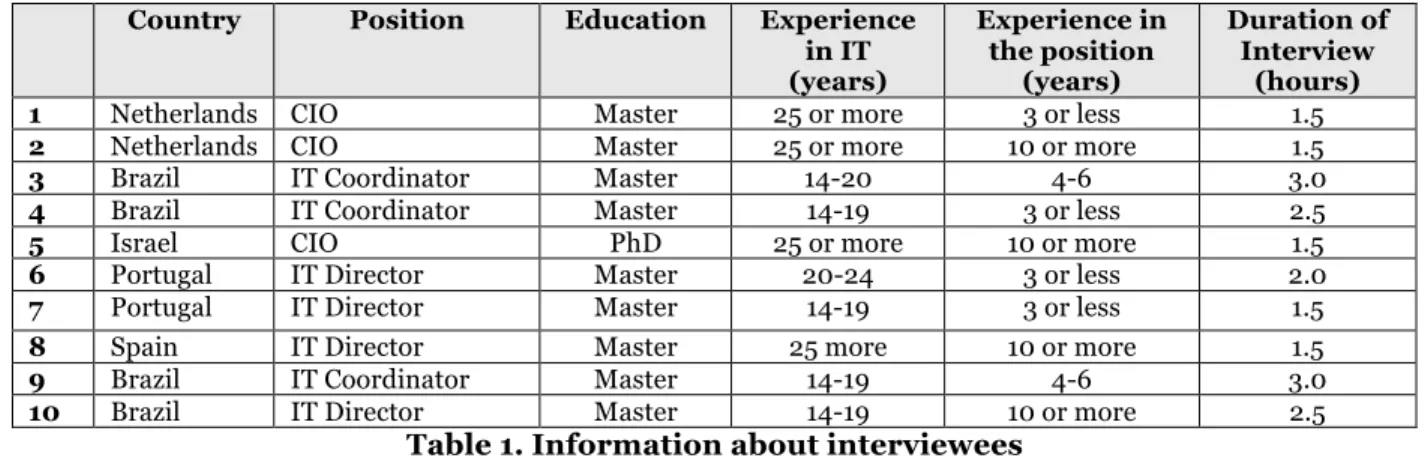
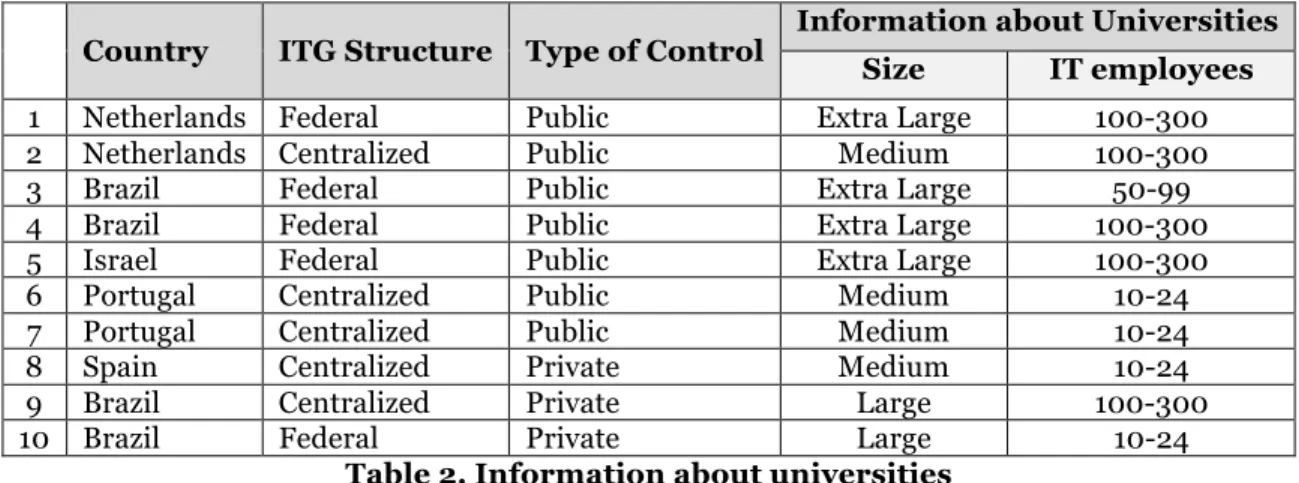
Finally, following a positive answer from the invited individuals, the interviews were scheduled. Over twenty universities from ten different countries were contacted and ten positive answers were received. Table 1 provides some information regarding the interviewees and Table 2 provides some information regarding their institutions.
Country Position Education Experience in IT (years) Experience in the position (years) Duration of Interview (hours)
1 Netherlands CIO Master 25 or more 3 or less 1.5
2 Netherlands CIO Master 25 or more 10 or more 1.5
3 Brazil IT Coordinator Master 14-20 4-6 3.0
4 Brazil IT Coordinator Master 14-19 3 or less 2.5
5 Israel CIO PhD 25 or more 10 or more 1.5
6 Portugal IT Director Master 20-24 3 or less 2.0
7 Portugal IT Director Master 14-19 3 or less 1.5
8 Spain IT Director Master 25 more 10 or more 1.5
9 Brazil IT Coordinator Master 14-19 4-6 3.0
10 Brazil IT Director Master 14-19 10 or more 2.5
Table 1. Information about interviewees
The questionnaire to frame the interview was developed in three parts: the first part, with general questions about the institution; the second part, with personal questions about the interviewee; the third part, with questions regarding the level of implementation.
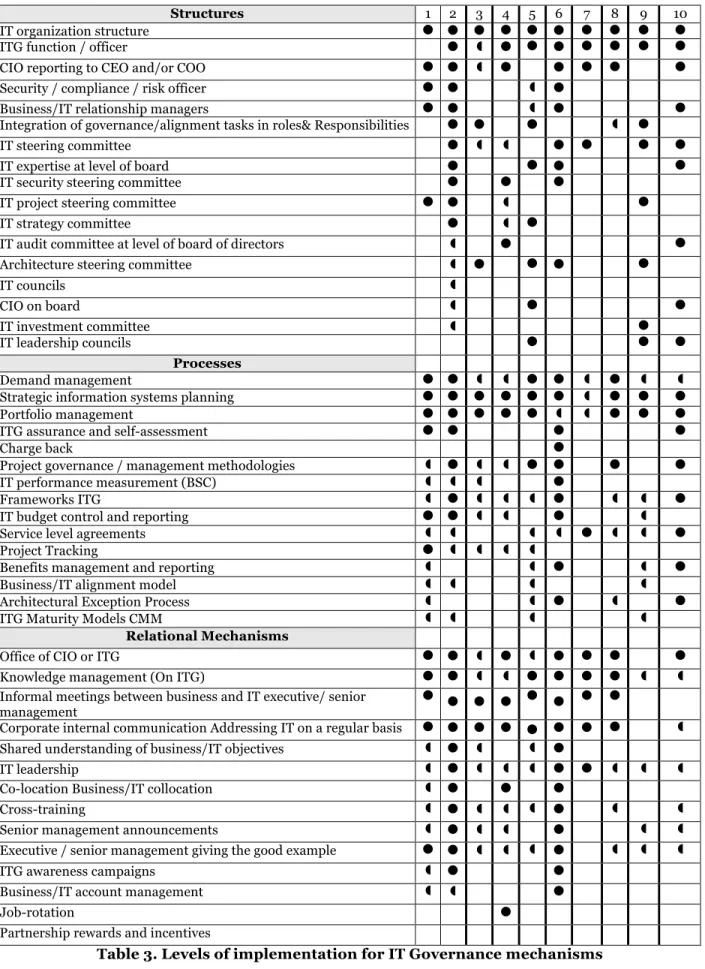
The following type of question was asked to each interviewee. “What is the level of implementation of the <IT Governance mechanism> in your institution?” on a scale of 0 to 5, where 0 means “not implemented” and 5 means “fully implemented”. The question was repeated for each one of the 46 mechanisms that are presented in Table 3. When there was some evidence that the mechanism was used (1 to 3 in the scale), the cell was filled with “º”. When the mechanism was almost or fully implemented (4 or 5 in the scale), we used “”. For each one of these mechanisms, a definition was previously provided and some practical examples were given. Anyway, to almost all the interviewees, many of the mechanisms were familiar which turned the interviews easier to perform.
We used the classification of QS World University Rankings (QS 2017) based on Carnegie Classification of Institutions of Higher Education to classify the universities’ size: extra-large for more than 30.000 students; large for more than 12.000 students; medium for more than 5.000 students; and small for less than 5.000 students.
Country ITG Structure Type of Control Information about Universities Size IT employees 1 Netherlands Federal Public Extra Large 100-300 2 Netherlands Centralized Public Medium 100-300 3 Brazil Federal Public Extra Large 50-99 4 Brazil Federal Public Extra Large 100-300 5 Israel Federal Public Extra Large 100-300 6 Portugal Centralized Public Medium 10-24 7 Portugal Centralized Public Medium 10-24 8 Spain Centralized Private Medium 10-24 9 Brazil Centralized Private Large 100-300 10 Brazil Federal Private Large 10-24
Table 2. Information about universities
The last question asked was: “Would you like to add other mechanism that is not at the list and you think that it is relevant to IT governance in universities?” In doing so, we intended to uncover other mechanisms from practitioner’s experience that have not been adequately covered in the literature, in particular, for universities. The list of ITG mechanisms used in the questionnaire was essentially based on De Haes and Van Grembergen (2008a), complemented with some other mechanisms from the literature review. Between August of 2016 and January of 2017, we conducted face-to-face interviews in Netherlands, Portugal, Spain and Israel and skype interviews in Brazil. Interviews in Brazil and Portugal were conducted in Portuguese, the native language of interviewer and interviewees, while interviews in Netherlands, Israel and Spain were conducted in English.
To record the interviews, “ECAM call recorder” was used for skype and “Quick Time player” for face-to-face interviews. We attempted to follow some recommendations to make the interview process more effective (Myers and Newman 2007). We did a verbatim transcription of all the interviews.
Using “NVIVO” (version 11.3.2 for mac) to analyze data, we performed open, axial, and selective coding for qualitative analysis following recommendations by Strauss and Corbin (1998). Such data enabled us to identify the ITG mechanisms implemented at universities as well as the effectiveness of these mechanisms in practice. We began with the initial list (Table 3) until no more mechanisms were proposed what happened after the fifth interview.
Table 4 provides the designation and the quote from the interviewee to support the proposal of a new mechanism.
Doing an interpretative analysis of interviewees’ suggestions for new mechanisms, we used Structures, Processes and Relational Mechanisms as the three main categories to code the data. For example, quote 1 was inserted in the processes category at the selective code created, “Methodology to manage disruptive innovation”.
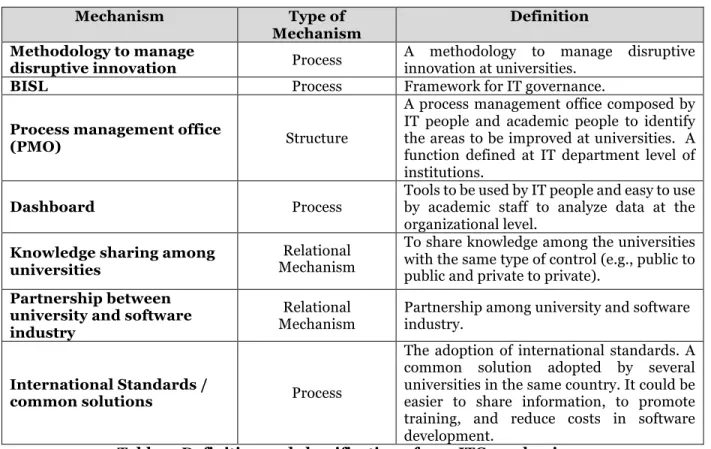
Table 5 provides a definition for each new mechanisms as well as its classification as structure, process or relational mechanism.
Structures 1 2 3 4 5 6 7 8 9 10
IT organization structure
ITG function / officer º
CIO reporting to CEO and/or COO º
Security / compliance / risk officer º
Business/IT relationship managers º
Integration of governance/alignment tasks in roles& Responsibilities º
IT steering committee º º
IT expertise at level of board
IT security steering committee
IT project steering committee º
IT strategy committee º
IT audit committee at level of board of directors º
Architecture steering committee º
IT councils º CIO on board º IT investment committee º IT leadership councils Processes Demand management º º º º º
Strategic information systems planning º
Portfolio management º º
ITG assurance and self-assessment
Charge back
Project governance / management methodologies º º º
IT performance measurement (BSC) º º º
Frameworks ITG º º º º º º
IT budget control and reporting º º º
Service level agreements º º º º º º
Project Tracking º º º º
Benefits management and reporting º º º
Business/IT alignment model º º º º
Architectural Exception Process º º º
ITG Maturity Models CMM º º º º
Relational Mechanisms
Office of CIO or ITG º º
Knowledge management (On ITG) º º º º
Informal meetings between business and IT executive/ senior management
Corporate internal communication Addressing IT on a regular basis º
Shared understanding of business/IT objectives º º º
IT leadership º º º º º º º
Co-location Business/IT collocation º
Cross-training º º º º º º
Senior management announcements º º º º º
Executive / senior management giving the good example º º º º º º
ITG awareness campaigns º
Business/IT account management º º
Job-rotation
Partnership rewards and incentives
Mechanism Suggested Quote
1 Methodology to manage disruptive innovation
“I am not sure how to pronounce …. Innovation Disruption. Only focus we could know. Not only we have. But focus in innovation. How do manage innovation in this institution? Not same in place for that. Discuss I have. We should do something. Because this institution is a class room teaching. What are the mechanisms could help management innovation” [1]
2 BISL
“The reference framework followed is the BISL. BISL is a framework developed to the Dutch reality. We follow all recommendation of this framework and methodology in the institution […] Therefore, could be include at list” [2]
3 Dashboard
[…] “Tools such as dashboard should be used by IT people and academic staff aiming to analyze organizational data. A tool easy to use […] I mean, easy to import data and create the panel with KPIs to analyze. Something intuitive that people without a high technical knowledge can use and understand.” [3]
4 Process management office
[...] “In my opinion a mechanism that could be included is a process management office (PMO). I think that a PMO is an important function at IT level that could help to improve the research and administrative area results… It should be composed by people with knowledge on IT and universities business so the process could be either better modeled and improved […] People with IT and business knowledge are ideal to transcribe the requirements.” [4]
5 Knowledge sharing among universities
“To share knowledge upon courses, training it’s important to IT governance to be strong at university. Moreover, it improves the level of IT as well as the IT quality at university. [5] Because the private sector is our competitor […] Not specifically, but. It’s not usual to share information about IT with them […] by sharing information with other institutions we would be promoting training, and reducing cost and in case of software developing” […] [5]
6
Partnership between university and software industry
[…] “A partnership and agreements among the university with the software industry to solution for education for software licensing (e.g. Microsoft program, IBM among others) could be applied with other industries to provide a range of technologies to students, academic and administrative staff to test and use. In an openness environment that is the universities it is important to provide a range of technologies” [5]
7 International Standards / common solutions
[…] “To adopt the international standards… solution adopted by universities in the same country for instance... only public. For instance, if all universities of the same sector adopted the same software it would be easier to exchange information and even promote a course of new software, technology, and management for all the IT employees.” [5]
Table 4. New IT Governance mechanisms proposed by interviewees The next section discusses the findings and presents the conclusions.
Discussion and Conclusions
This research aimed at identifying suitable ITG mechanisms for universities. Ten universities from five different countries participated in this research. Interesting insights were collected from the interviews. It became clear that universities have specificities and challenges that shape the way management needs to apply ITG to that context.
Some new mechanisms were suggested by the interviewees to be added to the general ITG mechanisms’ baseline (Table 4) proposed by De Haes and Grembergen (2008). In addition, a definition for each new mechanism was also developed (Table 5).
Mechanism Type of
Mechanism Definition
Methodology to manage
disruptive innovation Process A methodology to manage disruptive innovation at universities.
BISL Process Framework for IT governance.
Process management office
(PMO) Structure
A process management office composed by IT people and academic people to identify the areas to be improved at universities. A function defined at IT department level of institutions.
Dashboard Process Tools to be used by IT people and easy to use by academic staff to analyze data at the organizational level.
Knowledge sharing among universities
Relational Mechanism
To share knowledge among the universities with the same type of control (e.g., public to public and private to private).
Partnership between university and software industry
Relational
Mechanism Partnership among university and software industry.
International Standards /
common solutions Process
The adoption of international standards. A common solution adopted by several universities in the same country. It could be easier to share information, to promote training, and reduce costs in software development.
Table 5. Definition and classification of new ITG mechanisms
The first mechanism proposed by the first interviewee was named “methodology to manage disruptive innovation”. Universities provide a suitable environment to test different solutions to stimulate research, teaching, and innovation to be further applied to other industries. Moreover, it is necessary to identify opportunities on how to be innovative in a classroom environment and provide disruptive innovation in the teaching-learning process. Therefore, a methodology to assist in selecting and governing these technologies would be important.
The second mechanism, the framework Business Information Service Management Library (BISL), was suggested by two universities from the Netherlands. BISL was developed and customized in practice in the Dutch education system; in the literature, we did not find much documentation in English. It is a framework that is restricted to a country and, in fact, something already covered in the initial list as ITG frameworks. Thus, this specific mechanism shouldn’t be included as part of the proposed new set of mechanisms. The third mechanism, the Business Process Office (BPO), was classified as a structural mechanism. Business Process Management (BPM) is an emergent and recent approach discussed in organizations. Organizations are a collection of processes, even though for the most part, processes are not well defined and documented. A formal BPO brings IT and business closer together to work as partners. It is an interesting mechanism to identify bottlenecks and process improvements. The goal of this BPO is to discover, analyze and propose areas to be optimized. Those proposed areas can be discussed by an IT strategy committee.
The dashboard was also identified as another possible new mechanism. As a panel with key indicators to be used by IT and business to control the most relevant areas, it is essentially a tool that facilitates the access to and analysis of data from teaching, learning and research areas.
Another suggested mechanism was the knowledge sharing among universities. Given the space limitations, we can´t provide more quotes from the interviews. However, we concluded that this mechanism is essential to have good ITG at universities. This mechanism enables universities to share crucial information on several topics (i.e. management, courses, etc.). However, this mechanism has a limitation that was highlighted by the interviewees. Such mechanism can only be implemented among universities managed by a common entity like most public universities. The application of these mechanisms among public and private universities does not seem to be a future reality since they are competitors. The interviewees argued that the sharing of information between public and private universities in practice is not common due to the market competition to get students. Therefore, an association where the universities share knowledge and resources regarding ITG can bring many benefits for cost reduction, for example, in software acquisition, sharing courses and training. The universities share similar facilities and solutions such as infrastructure, systems, and laboratories. For instance, some scale economy could be applied in new software acquisition when purchased in quantity for all universities rather than individually. To summarize, we are convinced that the implementation of this mechanism would not be easy given the universities’ context (i.e. financial autonomy), but the centralization of some common aspects could be very effective and useful in practice.
The ‘Partnership’ mechanism between the software industry and universities is essential to a complex and open-minded environment to develop new ideas, create knowledge and propose solutions to complex problems. Students and teachers need to test and know a variety of IT solutions. At universities, the IT department is responsible for providing the infrastructure with laboratories and software to meet the teaching-learning requirements. However, many universities face severe financial restrictions in spending money with new software acquisitions. To promote new software alternatives and provide a larger range of technologies to students and professors, a partnership with the software industry may be essential. In fact, several organizations have educational programs specific to universities such as Microsoft, IBM and DELL aiming to delivery IT systems. Moreover, this partnership can bring many other advantages for universities such as cost reduction in software, material for training, support, and knowledge for students and professors.
The final mechanism proposed was international standards/ common solutions. Universities have characteristics which are different those of financial and health care industries. This mechanism requires making a benchmark with other universities to adopt the same international standards and solutions. Moreover, purchasing a new technology to interact with the CIOs from other universities to exchange ideas and discuss experiences can bring insights as well as benefits in terms of cost reduction before implementing new software, for example, in the process of implementing new IT service management software (ITSM). Several open source and commercial tools are available. Nevertheless, few of these tools are known in the context of universities and the process of implementing and training may be too expensive. Therefore, adopting tools common to other universities can be advantageous to foster partnership among universities to promote courses, exchange information and reduce costs.
To sum up, this research proposes six new ITG mechanisms specific for a university context grounded on a set of interviews performed in ten universities from five different countries. From the six mechanisms suggested to increase the general ITG mechanisms’ baseline proposed by De Haes and Van Grembergen (2008), three are classified as processes; Methodology to manage innovation, Dashboard and International standard. The PMO is classified as a structural mechanism. Finally, knowledge sharing and partnership among universities and the software industry are classified as relational mechanisms. In conclusion, the authors argue that the saturation point was located and the list of mechanisms presented in table 3 and table 4 together provides the suitable list of ITG mechanisms in universities. The aim is to have an ITG mechanisms list not only from a literature review perspective but from a practitioner’s.
Limitations and Future Research
This research has some limitations. First of all, the collected data was limited to ten universities from five different countries. Despite the invitation of other fifteen universities to participate in the research, we did
not get an answer so far. We are aware that CIOs agenda is always hectic, but we will keep pursuing to involve more universities in this research to strengthen the conclusions for IT Governance in universities. Since one of the researchers has been working for over seven years in IT, in large universities, in Brazil, it is understandable that Brazil may be somehow highly represented.
This research shows that is possible to extend the ITG mechanisms baseline proposed by De Haes and Grambergen (2008) when looking at specific contexts. This was an exploratory study. Thus, more empirical work will be required to assess and validate these mechanisms in a larger and different set of universities. Since we only focused and proposed new mechanisms for universities, future research should consider other industries to conduct similar research.
Acknowledgements
This work was supported by CAPES Foundation, Ministry of Education of Brazil Process n.º10415/13-0 and by COMPETE: POCI-01-0145-FEDER-007043 and FCT – Foundation for Science and Technology, project UID/CEC/00319/2013.
REFERENCES
Aasi, P., Rusu, L., and Shengnan, H. 2014. "The Influence of Culture on IT Governance: A Literature Review," In Proceedings of the Annual 47th Hawaii International Conference on System Sciences
(HICSS), Hawaii, USA, pp. 4436-4445.
Allison, D. H., DeBlois, P. B., and Educase, C. I. C. 2008. "Current Issues Survey Report," Educause
Quarterly (31:2), p. 14.
Bajgoric, N. 2014. "Business Continuity Management: A Systemic Framework for Implementation,"
Kybernetes (43:2), pp. 156-177.
Benbasat, I., Goldstein, D. K., and Mead, M. 1987. "The Case Research Strategy in Studies of Information Systems," MIS Quarterly (11:3), pp. 369-386.
Bianchi, I. S., and Sousa, R. D. 2016. "IT Governance Mechanisms in Higher Education," Procedia
Computer Science (100), pp. 941-946.
Coen, M., and Kelly, U. 2007. "Information Management and Governance in Uk Higher Education Institutions: Bringing IT in from the Cold," Perspectives: Policy and Practice in Higher Education (11:1), pp. 7-11.
De Haes, S., and Van Grembergen, W. 2004. "IT Governance and Its Mechanisms," Information Systems
Control Journal (1), pp. 27-33.
De Haes, S., and Van Grembergen, W. 2005. "IT Governance Structures, Processes and Relational Mechanisms: Achieving IT/Business Alignment in a Major Belgian Financial Group," IEEE, pp. 237b-237b.
De Haes, S., and Van Grembergen, W. 2008a. "An Exploratory Study into the Design of an IT Governance Minimum Baseline through Delphi Research," Communications of the Association for Information
Systems (22), pp. 443-458.
De Haes, S., and Van Grembergen, W. 2008b. "Analysing the Relationship between IT Governance and Business/IT Alignment Maturity," In Proceedings of the 41st Annual Hawaii International
Conference on System Sciences (HICSS), Hawaii, USA, pp. 428-428.
De Haes, S., and Van Grembergen, W. 2009. "An Exploratory Study into IT Governance Implementations and Its Impact on Business/IT Alignment," Information Systems Management (26:2), pp. 123-137. De Haes, S., and Van Grembergen, W. 2015. "Enterprise Governance of IT, Alignment and Value," in
Enterprise Governance of Information Technology. Springer, pp. 1-10.
De Haes, S., Van Grembergen, W., and Debreceny, R. S. 2013. "Cobit 5 and Enterprise Governance of Information Technology: Building Blocks and Research Opportunities," Journal of Information
Systems (27:1), pp. 307-324.
Dubé, L., and Paré, G. 2003. "Rigor in Information Systems Positivist Case Research: Current Practices, Trends, and Recommendations," MIS quarterly (27:4), pp. 597-636.
Grama, J. L. 2015. "Understanding IT Grc in Higher Education: IT Governance." (Available at:
Hicks, M., Pervan, G., and Perrin, B. 2012. "A Study of the Review and Improvement of IT Governance in Australian Universities," In Proceedings of the International Conference on Information
Resources Management (CONF-IRM), Vienna, Austria.
ITGI, I. G. I. 2003. Board Briefing on It Governance, (Second Edition ed.). United States of America. Jairak, K., Prasong, P., and Pilastpongs, S. 2015. "Information Technology Governance Practices Based on
Sufficiency Economy Philosophy in the Thai University Sector," Information Technology & People (28:1), pp. 195-223.
Kam, H. J., Katerattanakul, P., and Hong, S. 2016. "It Governance Framework: One Size Fits All?," In Proceeding of the 22nd Americas Conference on Information Systems, (AMCIS), San Diego, USA. Lunardi, G. L., Becker, J. L., Maçada, A. C. G., and Dolci, P. C. 2014. "The Impact of Adopting It Governance on Financial Performance: An Empirical Analysis among Brazilian Firms," International Journal
of Accounting Information Systems (15:1), pp. 66-81.
March, S. T., and Smith, G. F. 1995. "Design and Natural Science Research on Information Technology,"
Decision support systems (15:4), pp. 251-266.
Marrone, M., Gacenga, F., Cater-Steel, A., and Kolbe, L. 2014. "It Service Management: A Cross-National Study of Itil Adoption," Communications of the Association for Information Systems (34:1), pp. 865-892.
Myers, M. D. 2013. Qualitative Research in Business and Management, (2nd Edition ed.). Sage Publication.
Myers, M. D., and Newman, M. 2007. "The Qualitative Interview in Is Research: Examining the Craft,"
Information and Organization (17:1), pp. 2-26.
Nfuka, E. N., and Rusu, L. 2011. "The Effect of Critical Success Factors on IT Governance Performance,"
Industrial Management & Data Systems (111:9), pp. 1418-1448.
Pereira, R., and Silva, M. 2012. "IT Governance Implementation: The Determinant Factors,"
Communications of the IBIMA (2012).
Pereira, R., Silva, M., and Lapão, L. 2014. "Business/IT Alignment through IT Governance Patterns in Portuguese Healthcare," International Journal of IT/Business Alignment and Governance
(IJITBAG) (5:1), pp. 1-15.
Peterson, R. 2004. "Crafting Information Technology Governance," Information Systems Management (21:4), pp. 7-22.
Qassimi, N. A., and Rusu, L. 2015. "IT Governance in a Public Organization in a Developing Country: A Case Study of a Governmental Organization," Procedia Computer Science (64), pp. 450-456.
QS, Q. W. U. R. 2017. "How Do We Classify Institutions?" (Available at: http://www.iu.qs.com/university-rankings/qs-classifications/; retrieved April 18, 2017).
Sambamurthy, V., and Zmud, R. W. 1999. "Arrangements for Information Technology Governance: A Theory of Multiple Contingencies," MIS quarterly (23:2), pp. 261-290.
Strauss, A. L., and Corbin, J. M. 1998. Basics of Qualitative Research : Techniques and Procedures for
Developing Grounded Theory (2 ed.). Sage Publications.
Webb, P., Pollard, C., and Ridley, G. 2006. "Attempting to Define IT Governance: Wisdom or Folly?," In
Proceedings of the 39th Annual Hawaii International Conference on System Sciences, (HICSS),
Hawaii, USA, pp.194a-194a.
Weill, P., and Ross, J. W. 2004. It Governance: How Top Performers Manage IT Decision Rights for
Superior Results. Boston, Massachusetts: Harvard Business School Press.
Wiedenhöft, G., Luciano, E. M., and Macadar, M. A. 2016. "Information Technology Governance in Public Organisations: Understanding the Expectations of Its Adoption Though the Lens of Organisational Citizenship," In Proceeding of the Twenty-Fourth European Conference on Information Systems
(ECIS), İstanbul,Turkey.
Wilmore, A. 2014. "It Strategy and Decision-Making: A Comparison of Four Universities," Journal of
Higher Education Policy and Management (36:3), pp. 279-292.
Wu, S. P.-J., Straub, D. W., and Liang, T.-P. 2015. "How Information Technology Governance Mechanisms and Strategic Alignment Influence Organisational Performance: Insights from a Matched Survey of Business and It Managers," MIS Quarterly (39:2), pp. 497-518.
Yanosky, R., and Caruso, J. B. 2008. "Process and Politics: IT Governance in Higher Education," EDUCAUSE Center for Applied Research, Boulder: Colorado.