Social cues in the expression of sequential alternative reproductive tactics in young
males of the peacock blenny, Salaria pavo
Teresa Fagundes
a, Mariana G. Simões
a,b, David Gonçalves
a,c,d,⁎
, Rui F. Oliveira
a,eaUnidade de Investigação em Eco-Etologia, ISPA-IU, Rua do Jardim do Tabaco, 34, 1149‐041 Lisboa, Portugal
bInstituto de Medicina Molecular, Faculdade de Medicina da Universidade de Lisboa, Av. Professor Egas Moniz, 1649‐028 Lisboa, Portugal c
Centro de Ciências do Mar (CCMAR–CIMAR), Universidade do Algarve, Campus de Gambelas, 8005‐139 Faro, Portugal
d
University of Saint Joseph, Rua de Londres 16, Macau
eChampalimaud Neuroscience Programme, Instituto Gulbenkian de Ciência, Rua da Quinta Grande, 6, 2780‐156 Oeiras, Portugal
a b s t r a c t
a r t i c l e i n f o
Article history: Received 19 March 2012
Received in revised form 18 July 2012 Accepted 29 July 2012
Keywords:
Alternative reproductive tactics Social dominance
Androgens 11-Ketotestosterone Cortisol
Body condition
Phenotypic change in response to variation in environmental cues has been widely documented infish. Tran-sitions in social dominance, in particular, have been shown to induce a rapid switch in reproductive pheno-types in many species. However, this effect has been mainly studied in adults and focused on behavioural transitions. The way social cues constraint the phenotypic development of juveniles remains poorly studied infish. We tested the importance of social dominance and density in the phenotypic development of juve-niles of the peacock blenny Salaria pavo. This species shows sequential male alternative reproductive tactics. In thefirst breeding season males can reproduce as nest-holders or as parasitic males (female-mimicking), or postpone reproduction; from the following season afterwards all males reproduce as nest-holders. Parasitic males have relatively larger testes that lack a testicular gland, present in the testes of nest-holders. The tes-ticular gland is the main source of androgens in the testes and accordingly nest-holders have higher circulat-ing androgen levels. In addition, exogenous androgen administration to parasitic males promotes the development of secondary sexual characters (SSC) only present in nest-holders such as a head crest and an anal gland. We raised juveniles under a high or low-density treatment and monitored social interactions for 1 month. No significant effect of density on the development of juvenile males was detected. However, within each replicate, the relative body size of juvenile males at the beginning of the experiment determined their dominance status, with dominant males developing towards the nest-holder morphotype. Dominant males engaged in more nest defence behaviour, showed larger testicular glands, had higher levels of 11-ketotestosterone (11-KT) and testosterone (T) and developed more SSC, as compared to subordinate males. However, these effects of social dominance were moderated by body condition as only dominant males in good body condition developed SSC. The effect of social dominance and of the area of the testicular gland on the development of SSC was mediated by 11-KT and on the expression of nest defence behaviour by T. Interestingly, in spite of the higher androgen levels and more pronounced morphologic development of SSC in dominant individuals, gonadal development was independent of social dominance and mostfish still had underdeveloped testis at the end of the experiment. In conclusion, social dominance promoted the development of the testicular gland, an increase in circulating androgen levels and the development of SSC, but did not promote testicular development. This suggests a dissociation of mechanisms underlying sex-ual maturation and the expression of male reproductive traits. This dissociation seems to be the key for the occurrence of female-mimicking males in this species, which are sexually mature despite lacking the SSC typ-ical of nest-holders.
© 2012 Elsevier Inc. All rights reserved.
1. Introduction
Alternative reproductive tactics (ART) may be determined by envi-ronmental factors when these are good predictors of the reproductive
success of each of the tactics[1]. Some social cues have been demonstrat-ed to promote the expression of different ART. Social dominance, for instance, has recently been demonstrated to promote the rapid develop-ment of gonads and concomitant switch from helper to breeding tactic in the cooperatively breeding cichlid Neolamprologus pulcher[2]. Similarly, Astotilapia burtoni quickly changes its reproductive phenotype in re-sponse to social dominance through up regulation of production of GnRH and androgens which promote sexual maturation, courting behav-iour and sexual coloration[3]. However, the reproductive phenotypes of
⁎ Corresponding author at: Unidade de Investigação em Eco-Etologia, ISPA-IU, Rua do Jardim do Tabaco, 34, 1149‐041 Lisboa, Portugal. Tel.: +351 21 8811700; fax: +351 21 886 0954.
E-mail address:[email protected](D. Gonçalves).
0031-9384/$– see front matter © 2012 Elsevier Inc. All rights reserved. http://dx.doi.org/10.1016/j.physbeh.2012.07.011
Contents lists available atSciVerse ScienceDirect
Physiology & Behavior
these two species are reversible and do not involve morphological changes. Animals expressing ART very often differ morphologically. The typical pattern of ART consists of two types of males that are character-ized by different sets of traits: on the one hand bourgeois[4], type I[5] or dominant males[6]; and, on the other hand, parasitic, type II or subor-dinate males. The bourgeois males invest in obtaining and defending re-sources by being territorial and attracting females. They are typically larger and commonly exhibit morphological differences like secondary sexual characters (SSC). Parasitic males rely on behaviours like sneaking, darting or female-mimicking in order to fertilize eggs during spawning events between the females and the bourgeois males, thus exploiting the reproductive investment of bourgeois males. In general, parasitic males have relatively larger gonads than bourgeois males to overcome the disadvantage of a lower proximity to females when spawning[4]. Despite the typical sets of traits of ART, different combinations of those traits are found in different species and physiological mechanisms should vary accordingly to provide such variability. Therefore, we inves-tigated which cues may trigger the expression of one or another tactic in juveniles of the peacock blenny Salaria pavo and what physiological mechanisms modulate the corresponding reproductive phenotype.
Mechanisms underlying tactic expression should be able to convert environmental cues into appropriate reproductive behaviours and mor-phological traits such as SSC. In fish, androgens, and particularly 11-ketotestosterone (11-KT), are known to promote the development of SSC[7]and to influence the expression of male reproductive behav-iours[8]. Moreover, social environment modulates androgen levels in teleostfish[9,10]. Therefore, we expect that social dominance promotes the development of morphological and behavioural traits typical of the bourgeois tactic and that this effect on development is achieved via modulation of androgens (mediation effect, sensu Baron and Kenny [11]). More attention has been given recently to the possible mediation or moderation (sensu Baron and Kenny[11]) roles of corticosteroids on the effect of factors of the social environment on reproductive pheno-type expression (e.g.[12–14]). The response of corticosteroids to social dominance varies widely in different species, but in somefish species social dominance influences cortisol levels (e.g. subordinate males have higher cortisol levels in coho salmon, Oncorhynchus kisutch[15]; and in rainbow trout, Oncorhynchus mykiss[16]). Cortisol, in turn, can modulate androgen production[17]and therefore it should influence the expression of the reproductive phenotype. In this way, cortisol may mediate the effect of social dominance on the expression of repro-ductive tactics. But corticosteroids have also been proposed to interact with the reproductive endocrine axis by suppression of androgen re-ceptors or by competing with binding globulins or steroidogenic en-zymes[18]. Such an effect, in species where cortisol is not dependent on social dominance, may constitute a moderation effect, i.e., the ex-pression of the reproductive phenotype may depend on social domi-nance but levels of corticosteroids may alter this relationship.
Contrary to what has been the norm, in which species withfixed alternative tactics are usually tested in early stages of development (e.g.[19,20]) and species with sequential tactics have been tested only during the switch between tactics (e.g.[21]), here we explore the possible mechanisms of tactic determination at the onset of re-production thus, from the juvenile stage to the first reproductive morph. At this life stage, the endocrine mechanisms have been overlooked in species with sequential alternative tactics and very much so in vertebrates. Hence, we address the following questions: Can social dominance and male density influence tactic expression? And can social dominance also influence slower developing reproduc-tive morphotypes such as those that involve SSC? What are the phys-iological mechanisms underlying the expression of such conditional tactics? We explore the role of steroid hormones as possible media-tors or moderamedia-tors of the effects of social dominance on the expres-sion of tactic-specific traits. We expect that (1) social dominance may constitute a cue to tactic expression since higher social domi-nance facilitates resource acquisition and can therefore contribute
to the reproductive success of the resource defending tactic, the bour-geois tactic; (2) social dominance should promote the expression of the bourgeois tactic through higher levels of androgens and/or lower levels of cortisol; (3) male density, as a potential signal of the intensity of male–male competition, should raise the incidence of the parasitic tactic.
2. Materials and methods 2.1. Model species
Two male ART are present in S. pavo. Parasitic males are small males who reproduce by fertilizing eggs inside the nests defended by nest-holders[22,23]. Nest-holders are larger males that establish and defend nests (bourgeois tactic). They express SSC, namely a head crest and a pheromone producing anal gland[24–26]and they have higher levels of both testosterone (T) and 11-KT than parasitic males[27,28]. Parasitic males deceive nest-holders through female mimicry[23,29], displaying female-like courtship towards nest-holder males and not ex-pressing SSC. They have relatively larger testes than nest-holders and undeveloped testicular glands[23]. The testicular glands are accessory organs of the gonads and constitute the major source of androgens in this species[27,30]. In thefirst year males can either express 1) the par-asitic tactic; 2) the nest-holder tactic; or 3) postpone reproduction, and all males will reproduce as nest-holders from their second breeding sea-son onwards[31](T. Fagundes, M. G. Simões, J. L. Saraiva, A. F. H. Ros, D. Gonçalves and R. F. Oliveira, unpublished data).
2.2. General procedures and sampling
Juvenile males of S. pavo were captured during low tide in the in-tertidal area of Ilha da Culatra, a barrier island situated in Ria Formosa Nature Park (36°59′N, 7°51′W), in the South coast of Portugal. We sampled artificial hard substrates such as tiles and bricks, existent in the area to delimit the borders of clam culturefields, and captured ju-veniles with hand nets. Fish were collected prior to the beginning of the reproductive season and were identified as individuals without SSC, that exhibited a male genital papilla and that did not release milt when pressing the ventro-lateral surface of the abdomen. In pre-vious studies, wherefish were dissected for gonadal inspection, milt stripping has been verified to be an appropriate criterion to distin-guish parasitic males from non-reproductive males[32].
After capture,fish were transported to the aquarium facilities of the ISPA-IU in Lisbon and housed in a stock tank (length: 120 cm×width: 40 cm×height: 50 cm) with sand and shelters. The light:dark cycle and the temperature in the stock tank, as well as in the treatment aquaria, were 13L:11D and 24.5±1 °C, respectively. These conditions are similar to those experienced by this population in thefield during this time of the breeding season. In previous experiments it was shown that this species exhibits the full range of behaviours, including male and female courtship displays and egg laying, under similar conditions (e.g.[29,32–35]). Fish were fed ad libitum once a day with chopped mussel'sflesh. Fish remained in the stock tank from 1 to 2 weeks before being assigned to a treatment aquarium. Just before the start of the ex-perimentfish were anaesthetized with MS-222 (PHARMAQ Ltd, dilution 1:10,000) and measured with a 0.1 mm-precision calliper for total length (TL) and maximum head height. The length and width of the anal gland were measured with a 20× magnifier to the nearest 0.1 mm (SZ-PT Olympus stereoscope). The body weight was measured on a 0.001 g-precision scale. Fish recovered from the anaesthesia in a contain-er with abundant acontain-eration and wcontain-ere then introduced in the treatment aquaria. In the last day of the experiment,fish were euthanized with an overdose of MS-222 (dilution 3:10,000; American Veterinary Medical Association 2007). Immediately after the anaesthesia, blood samples were collected from the caudal vein with a 1 ml heparinised syringe and a 25 gauge needle. The blood sample was centrifuged at 3000 rpm
for 10 min and the plasma was stored at−20 °C until further processing. At the end of the experiment the measurements taken at the beginning of the experiment were repeated. Additionally, length and width of tes-tes and of tes-testicular glands, and wet weight of body after removal of in-ternal organs (eviscerated body weight) and of testes were measured. 2.3. Experimental treatment
The experiment was conducted between mid April and May of 2003 and 2004. The experimental period included 2 weeks of the preproductive season and extended another 2 weeks into the re-productive season. Young males from which sperm can be stripped are present in thefield at the start of the breeding season suggesting that the onset of the expression of the tactics occurs either during or before this early period. Thus, the period in which the experiment was carried out was selected in order to maximize the probability of including a potential sensitive period and a period during which the reproductive tactics can be expressed and identified. The one month duration of the experimental period allowed the subjects (juvenile males at the start of the experiment) to express their reproductive tactic in the current breeding season. Males could differentiate SSC and breed as a nest-holder, invest only in spermatogenesis and breed as a parasitic male, or postpone breeding and allocate resources into growing until the next breeding season.
Juvenilefish were introduced in their treatment aquaria simulta-neously after morphological measurements. The high density treat-ment consisted of 6 juvenile males per aquarium and the low density treatment of 3 juvenile males per aquarium (length: 50 cm × width: 24 cm × height: 30 cm). The aquaria had sand as sub-strate and one shelter perfish. These shelters were made of grey PVC tubes (length: 10 cm, opening diameter: 2 cm) with one end closed by an opaque dark plasticfilm. The PVC tubes were distributed per-pendicular to the main axis of the aquaria and parallel to each other, with a distance of 6.5 cm between them in the high density treatment, and of 13 cm in the low density treatment. Such densities and nest distances are within the range of those found in the natural population (personal observation). In each replicate, fish were matched for size resulting in a coefficient of variation of the individual's TL in each aquarium of less than 5%. Five replicates of the high density and 9 of the low density treatment were conducted. 2.4. Behavioural observations
Behavioural observations started the day after the individuals were introduced in the treatment aquaria. Each morning focal obser-vations[36]of 20 min were conducted in each aquarium. Observa-tions started 30 min after the lights went on, from 9:30 to 14:00 approximately. The time of the start of the observations of the differ-ent aquaria was randomized. A total of 28 observations per replicate were conducted during the 30 days of the experiment. During focal observations, the behaviours of all the individuals present in the aquarium were registered and subsequently analysed using The Ob-server software (Noldus Information Technology, Wageningen, The Netherlands). Within agonistic behaviours, charges, bites, chases andflights were treated as events and their frequency was registered; dorsalfin erection and ventral presentation were treated as states and both their frequency and duration were recorded. Ventral presenta-tion, a submissive behaviour, was defined as the individual laying on itsflanks immobile or swimming very slowly while presenting its abdomen to anotherfish. Dorsal presentation, a nearly identical behaviour, has been described for another blenny as inhibiting ag-gressive behaviour[37]. A social interaction was considered to occur when any behaviour was directed to an individual, irrespective of the reaction of the receiver of the behaviour. The end of the interac-tion was determined as the absence of behaviour from any of the par-ticipants for more than 3 s. Defeats were determined by fleeing
behaviour or ventral presentation and the outcome of the agonistic interactions was used to assess social dominance. Individuals were classified as dominant, intermediate or subordinate males according to a simulation statistic procedure that allows the identification of in-dividuals that won or lost more agonistic interactions within their so-cial groups than would have been predicted by chance[38]. If the number of victories was higher than expected by random distribution (one-tailed tests) individuals were considered dominant; individuals with a number of defeats higher than expected were considered sub-ordinate; and individuals whose defeats and victories were not differ-ent from random expectations were classified of intermediate status. Only 5 of the 57 individuals tested were classified as intermediate, 2 in the low density treatment and 3 in the high density treatment. The intermediate group was excluded from the statistical analyses where social dominance was used as a grouping factor because the use of such small groups would compromise the power of the analy-ses. Courtship behaviour was also registered as a state and two types were considered: male-like or female-like courtship displays. Male courtship display consists of jerking the body laterally while protrud-ing the head from the nest. Other courtship behaviours described for the species like zigzag swimming, in which the male leaves the shel-ter and circles the female, are rare in this population and were not quantified. The female courtship display is characterized by rapid movements of the opercula, fanning the pectoralfins and waving the dorsal and caudalfins while the body is usually vertical with the belly exposed to the male[39]. Courtship displays were only analysed as such if they occurred in a courtship context, namely if one of the participants was in the nest. The context is important because, in this species, female-like courtship behaviour may also be expressed in agonistic context as a submissive behaviour. The position of the in-dividuals in relation to the nest was also registered as a state. Detailed behavioural descriptions for this species can be found in Fishelson [24], Patzner et al.[39]and Uiblein[40].
2.5. Steroid extraction and quantification
Plasma samples were extracted for the free, sulphate and glucoronide steroid phases for the subsequent quantification by radio-immunoassay of 11-KT, T and cortisol using the methods de-scribed in Canário and Scott[41]and Scott and Canário[42]. Steroid res-idues were dissolved in 1 ml of 0.1 M phosphate buffer, pH 7.6, containing gelatine (1 g/L), and stored again at−20 °C until radioim-munoassay (RIA) was conducted. The three extracted steroid phases were mixed in equal parts and RIAs were carried out to quantify the hormonal concentration in the mix. The antibody for 11-KT was kindly donated by D.E. Kime and its cross-reactivities were described in Kime and Manning[43]. The antibody for T was purchased from Research Diagnostics (RDI-TRK2T2, Concord, USA), and the cross-reactivities provided by the supplier are 16% for 5α-dihydrotestosterone, 1% for androstenediol, 0.4% for androstenione,b0.1% for androsterone, b0.1% for dehydroepiandrosterone,b0.1% for progesterone, 0.001% for estra-diol and 0.001% for cortisol/pregnenolone. For the quantification of cor-tisol, the antibody supplied by Interchim (20-CR50, Montluçon, France) was used and its cross-reactivities are 5.7% for 11‐desoxycortisol, 3.3% for corticosterone and less than 0.7% for cortisone, according to the sup-plier. The analyses of each hormone were conducted in a single assay per hormone and the intra-assay coefficients of variation were 3.8% for 11-KT, 5.9% for T and 1.3% for cortisol.
Because of the small size of our study species, the plasma volume obtained was occasionally lower than optimal for the radioimmuno-assay. With lower plasma volumes, an increase in variation of the quantitated androgen levels is expected and a posteriori outlier tests detected, in fact, upper outlier values (exceeding 3rd quar-tile + 1.5 interquarquar-tile range) of androgen levels in plasma samples with volumes smaller than 10μl. Therefore, plasma volumes lower than 10μl were excluded from the analyses.
2.6. General statistical procedures
The goal of the experiment was to test the effects of social domi-nance, an individual level variable, and of density, a group (replicate) level variable. Because individuals are nested in replicates, social dominance values within each replicate are not independent of each other. General linear mixed models allow the analysis of these dif-ferent organizational levels and compose appropriate degrees of freedom, and consequently significance levels, under restricted max-imum likelihood estimation. Social dominance and density were in-troduced asfixed effects and replicates (experimental aquaria) as random effects in a hierarchical linear model of random intercepts. Univariate tests were conducted to test the effect on each dependent variable. For the analysis of SSC, a covariate, total length (TL), was in-troduced in the model as afixed effect in order to control the effect of density and dominance on SSC for TL. With the same purpose, evis-cerated body weight was introduced as a covariate in the analysis of the weight of gonads. Endocrinological and behavioural variables, the area of the testicular glands and TL were analysed without covar-iates. Initial TL was also analysed without the random effects of repli-cates to evaluate a possible association of absolute body size and dominance. The analyses were run on SPSS 17.0 (statistical package for the social sciences) for Windows (Chicago: SPSS Inc.). Significance levels were 0.05 and statistical tests were two-tailed. Both testes and testicular glands were considered to have an elliptical shape for the computation of their areas. The gonadossomatic index (GSI) was cal-culated as the weight of both testes / eviscerated body weight and the body condition factor (adjKTL) as body weight / (total length)b, where
b is the slope of the body length (TL)–body weight (W) relationship (logW = a + blogTL).
Variables that did not meet the assumptions of parametric statis-tics were either logarithm (log) or, in the case of count data, square root transformed, as it will be mentioned in theResultssection. Be-havioural variables that showed very low frequencies, like courtship displays, were analysed by simulation statistics using the software ACTUS (Analysis of Contingency Tables Using Simulation [44]). Goodness-of-fit simulation tests were conducted using ADERSSIM software[38].
2.7. Assessment of mediation and moderation effects
To assess possible mediation and moderation roles of hormones or body condition on the effect of social dominance on the expression of the reproductive tactics, multiple regression analysis was used[45,46]. Social dominance was operationalized as a continuous variable for in-troduction in the regression model, by using the dominance index pro-posed by Barlow and Ballin [47]: dominance index =[number of victories/ (number of victories + number of defeats)]. The use of this second method to assess social dominance (in addition to the simula-tion procedure described above) was necessary for using different sta-tistical procedures and is justified by the fact that the two methods are mutually consistent, that is, individuals classified as dominant or subordinate males by the simulation statistics procedure differed signif-icantly in their dominance indexes (average values of dominance index computed for dominant= 0.90, intermediate = 0.49 and subordinate= 0.17 individuals; F1,54= 172.08, pb0.001).
The mediation effect or indirect effect is the simplest model of path analysis. The mediation is the effect of an independent variable on an outcome variable that is accomplished by a third variable, the mediator. The independent variable (X) determines the mediator (Me) which in turn determines the value of the outcome variable (Y). Wefirst tested the significance of the regression of Me on X. Whenever this effect was not significant the mediation hypothesis was excluded; otherwise the mediation effect was tested by the col-lapsibility test[45]: (b−b′)/|ρXMe σb′|. In this test, b is the total effect, the unstandardized coefficient of regression of Y on X, b′ is the
direct effect of Y on X, the unstandardized coefficient of regression of Y on X when controlled for Me,ρXMe is the correlation coefficient be-tween X and Me andσb′ is the standard error of b′. This statistic follows a tn−3distribution.
The moderator effect is the effect of the interaction between an in-dependent (X) and a moderator (Mo) variable on an outcome vari-able (Y). The moderator does not cause Y but it changes the relation between X and Y, therefore the effect of X on Y may be seen as depen-dent on the value of Mo. The interaction term is usually the product X∗Mo. The effect is tested by a hierarchical multiple regression in which both X and Mo are introduced in the model in afirst step and the interaction term is added in the second step of the analysis. All variables except the outcome are standardized. The moderator effect is accepted if thefit of the data improves with the addition of the in-teraction term, i.e., if F-change≠0[46].
2.8. Ethical note
The number of individuals captured and sacrificed was kept to a minimum and biological material collection for complementary studies was maximized. Fish were always anaesthetized before manip-ulation and recovered from anaesthesia in a small isolation aquarium with abundant aeration. Fish were introduced in the experimental aquaria together with other individuals and were monitored for the first hours.
All animal protocols were performed under a“Group-1” licence from the“Direcção-Geral de Veterinária, Ministério da Agricultura, do Desenvolvimento Rural e das Pescas, Portugal”. The experimental procedure followed the ASAB/ABS Guidelines for the Use of Animals in Research and the American Veterinary Medical Association Guide-lines on Euthanasia (American Veterinary Medical Association, 2007). 3. Results
3.1. Behavior
Within the 5 high density replicates, 3 had 1 dominant male and 2 replicates showed 2 dominant males. Within the 9 low density repli-cates, 7 had 1 dominant individual and in 2 replicates there were 2 dominant individuals. The analysis of frequency of the different social dominance categories (dominant vs intermediate vs subordinate males) in the two density treatments, through simulated contingency tables, did not reveal any difference between treatments in terms of pro-portion of individuals with different dominance statuses (ACTUS simula-tion statistic, contingency table of density treatment×dominance status, chi-square test: χ2
2,57=1.995; p=0.39). Dominant males occupied
preferentially 1 (47% of the males), 2 (35% of the males) or 3 (17% of the males, all in the high density treatment) nests, as tested on the ADERSSIM software by chi-square goodness-of-fit tests in which the number of seconds spent inside the nests was compared to values expected from a uniform distribution of each dominant male by the dif-ferent nests.
The behaviour of dominant males was similar to the behaviour of nest-holder males in that they occupied nests for a longer period of time and participated in more agonistic interactions than subordinate males. Together these two variables were interpreted, and will be re-ferred to, as nest defence. Furthermore, density and dominance status interacted to influence both the participation in agonistic interactions and the time inside the nest, the latter presenting only a marginally non-significant interaction effect. The positive effect of social domi-nance on time spent inside the nest was stronger in the low density treatment (Table 1, estimated marginal means of time inside the nest at low density: dominant males =3 h 32 min ±24 min and subordi-nate males= 38 min ±23 min; at high density: dominant males= 2 h 23 min ±31 min and subordinate males = 36 min ± 26 min) but the effect on the number of agonistic interactions was stronger in the high
density treatment (Table 1, estimated marginal values of agonistic interactions, transformed data reconverted to original scale, at low density: dominant males X−SE/X/X+SE=303/358/417 and subor-dinate males 235 / 282 / 333; at high density: dominant males 364 / 443 / 530 and subordinate males 145 / 192/ 246). The frequency of female-like courtship, that parasitic males usually display when approaching the nests, was however very low and did not differ between dominant and subordinate males (ACTUS simulation statistic, chi-square test: χ2
21,52= 0.85;p = 0.38). The effect of density on the behaviour of the
immature males was not significant for any of the variables analysed (Table 1).
3.2. Morphology
Within each replicate, thefish that became dominant were signif-icantly larger (TL) at the beginning of the experiment than those that became subordinate. However, there was no overall difference be-tween the initial TL of dominant and subordinate males across repli-cates. There were no significant differences between individuals that would later become dominant or subordinate in the develop-ment of SSC (head crest or anal gland relative size) at the beginning of the experiment (Table 1). At the end of the experiment, and con-trolling for body size, dominant males showed larger head crest and anal glands than subordinate males, but the differences in anal gland size were only marginally non-significant (p=0.055). Howev-er, it should be mentioned that at the end of the experiment there were no individuals with SSC fully developed, as found in the repro-ducing nest-holders in nature. Dominant males had larger testicular glands than subordinate males but the weight of testes controlled for eviscerated body weight did not differ between dominant and subordinate males (Table 1). All but four individuals were still sexual-ly immature (with low GSI = 0.18 ± 0.042) at the end of the experi-ment. These fourfish had well-developed testes typical of parasitic males and were all subordinate males (two in the low density and two in the high density treatment). In summary, dominant and sub-ordinatefish differed in all the morphological traits that distinguish nest-holder from parasitic males but not in the relative size of testes. No effect of density was detected for any of the measured variables but a marginally non-significant (p=0.09) trend for males of the low density treatment to exhibit larger anal glands than those of the high density treatment was detected (Table 1).
3.3. Hormones
Dominant individuals exhibited higher circulating levels of 11-KT and T, but not of cortisol, than subordinates and there was no effect of density on circulating levels of steroids (Table 1). Cortisol was neg-atively correlated with GSI (r =−0.39, p=0.03, n=30, GSI was log transformed).
3.4. Mediator and mediation effects
Possible mediation by steroids or body condition of the effect of social dominance on the expression of the different traits that charac-terize each tactic was tested. The dominance index could predict an-drogen levels, the potential mediators (11-KT = 1.19 + 1.51Di, r2=
0.26, pb0.01, n=30; T=4.64+14.20Di, r2= 0.27, pb0.01, n=30).
The results of the collapsibility test (Table 2) support the hypothesis that the effect of social dominance on the development of SSC and on nest defence behaviour are mediated by the levels of circulating 11-KT and T, respectively. Where the results supported a mediation effect through androgen levels, the role of the testicular gland as de-terminant of these levels was estimated by a new mediation test. An effect of the area of the testicular gland on the development of the head crest, mediated by circulating levels of 11-KT, and on nest de-fence behaviour, mediated by circulating levels of T, was detected (Table 2). Neither levels of cortisol in plasma (cortisol = 9.22 + 10.52Di, r2= 0.09, p = 0.11, n = 30) nor body condition at the end of
the experiment (adjKTL= 0.01+ 0.00Di, r2= 0.04, p= 0.12, n = 57)
was associated with social dominance, therefore a possible mediation effect is excluded a priori.
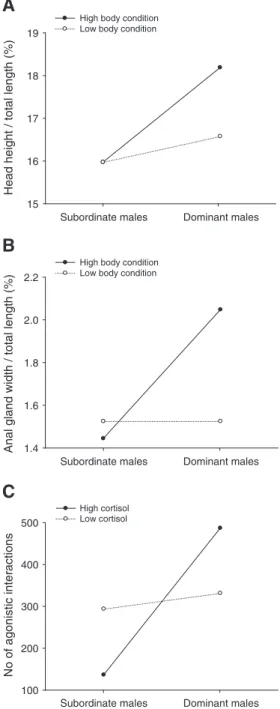
The data supported a moderation role of initial body condition, i.e., the effect of dominance on SSC was dependent on body condition at the start of the experiment (Table 3). For individuals with above aver-age initial body condition, social dominance predicted the expression of the head crest (maximum head height / TL = 0.17 + 0.02Di, r2= 0.48, pb0.01, n=21) and of the anal gland (anal gland width/TL= 0.015 + 0.08Di, r2= 0.31, pb0.01, n=21) but for males with initial
body condition below the average, social dominance was not associ-ated with head crest (maximum head height / TL = 0.16 + 0.01Di, r2= 0.05, p = 0.20, n = 35) or anal gland (anal gland width / TL =
0.015 + 0.02Di, r2= 0.04, p = 0.25, n = 36) development (Fig. 1A, B). Contrarily, initial body condition did not moderate the effect of dom-inance on GSI, development of the testicular glands, nest defence
Table 1
General linear mixed model analysis of the effects of density and social dominance on each of the morphological, gonadal, endocrinological and behavioural variables of juvenile males of the peacock blenny. For the morphological variables“maximum head crest” and “anal gland width”, TL was used as a covariate; for “testes weight” the covariate used was eviscerated body weight. Endocrinological and behavioural variables and testicular gland area were analysed without covariates. Estimated means of transformed variables are reconverted to the original scale. Marginally non-significant F-test values are represented by1
if p = 0.06 and2
if p = 0.09.
Density Dominance status Estimated marginal means X ± SE (transformed variables reconverted: X−SE/X/X+SE)
Density×dominance status Dominant males Subordinate males
Pre-experiment values
TL (across replicates) F1, 50= 1.189
TL (within replicates) F1, 11.932= 0.035 F1, 36.004= 21.160⁎⁎⁎ 6.61 ± 0.27 cm 6.33 ± 0.27 cm F1, 36.004= 0.658
Maximum head height F1, 11.152= 0.583 F1, 40.896= 2.990 1.06 ± 0.01 cm 1.04 ± 0.01 cm F1, 37.506= 0.283
Anal gland width F1, 5.407= 2.701 F1, 24.818= 0.579 1.23 ± 0.06 mm 1.18 ± 0.05 mm F1, 22.945= 2.849
Post-experiment values
Maximum head height F1, 10.863= 0.358 F1, 41.755= 13.559⁎⁎ 1.25 ± 0.02 cm 1.17 ± 0.02 cm F1, 35.677= 0.100
Anal gland width F1, 11.766= 3.3742 F1, 43.737= 3.8741 1.29 ± 0.08 mm 1.14 ± 0.07 mm F1, 37.689= 0.001
Testicular gland area F1, 11.229= 0.777 F1, 36.247= 6.167⁎ 1.93 ± 0.30 mm2 1.35 ± 0.27 mm2 F1, 36.247= 1.687
Testes weight F1, 11.543= 0.681 F1, 43.245= 0.024 0.005 ± 0.003 g 0.005 ± 0.003 g F1, 36.369= 1.548
11-KT (log) F1, 4.397= 0.114 F1, 18.052= 6.832⁎ 2.00/2.38/2.82 ng ml−1 1.17/1.37/1.61 ng ml−1 F1, 18.052= 1.381
T (log) F1, 5.516= 0.152 F1, 18.057= 7.938⁎ 11.25/14.06/17.58 ng ml−1 5.58/6.90/8.55 ng ml−1 F1, 18.057= 0.970
Cortisol F1, 8.651= 0.152 F1, 18.027= 3.166 8.45/12.05/17.18 ng ml−1 4.98/7.10/10.12 ng ml−1 F1, 18.057= 0.268
Experiment values No. of agonistic interactions (square root)
F1, 11.532= 0.030 F1, 36.125= 36.583⁎⁎⁎ 351/399/450 200/235/272 F1, 36.125= 10.709⁎⁎
Time in nest F1, 10.721= 1.174 F1, 36.048= 66.612⁎⁎⁎ 2 h5 7 min ± 20 min 37 min ± 17 min F1, 36.048= 3.7561 ⁎ Indicates significant F‐test values at the significance level of 0.05.
⁎⁎ Indicates significant F‐test values at the significance level of 0.01. ⁎⁎⁎ Indicates significant F‐test values at the significance level of 0.001.
behaviour or on levels of 11-KT (Table 3). Cortisol did not influence the effect of dominance on reproductive tactic expression but the data supported a moderation effect of cortisol on the expression of agonistic behaviour. Dominant males with higher levels of cortisol participated in more agonistic interactions than those with lower levels, conversely subordinate males with higher levels of cortisol showed less agonistic behaviours than those with lower levels (Table 3; Fig. 1C).
4. Discussion
Social dominance influenced the expression of the first reproduc-tive phenotype of the peacock blenny. A higher social status promot-ed not only nest defence behaviour but also the development of testicular glands, an increase in androgen levels and the growth of SSC, traits that characterize the nest-holder tactic (the bourgeois phe-notype). Therefore social dominance can influence the expression of ART, even when these involve slower developing traits like SSC.
The emerging social hierarchy established within replicates pre-dicted the development towards the different ART. The social status was not predicted by absolute body size but the small differences in the initial relative body size (within social groups) could predict the dominance status achieved by the end of the experiment. The expres-sion of reproductive tactics has been shown to depend on body size in different life stages of some invertebrate species (e.g.[19,48,49]) and on social dominance in the case of the cichlid N. pulcher. Body size dif-ference is an important determinant of social dominance in fish [50,51]and, as in S. pavo, in N. pulcher social dominance is dependent on relative body size[2]. Therefore, relative body size and associated
dominance status may constitute an important social cue for ART ex-pression infish in general but also in other taxa.
In the African tilapia, A. burtoni, social dominance stimulates growth of GnRH producing neurons in the POA and this promotes the production of gonadotropins, which in turn trigger sexual maturation, androgen production and consequently sexual coloration [52,53]. However, in the peacock blenny, as in most typical ART patterns, sexual maturation and sexual traits, like SSC, are dissociated. Parasitic males, which have no SSC, are not only sexually mature but are in fact those who exhibit larger gonads. This dissociation is visible in our data. By the end of this experiment most individuals had, surprisingly, only vestigial gonads, in spite of the fact that dominant males significantly increased the develop-ment of SSC in comparison with subordinates. Such dissociation between the growth of SSC and testes development can hypothetically be achieved by the testicular glands. These glands are, in this species, the major producers of androgens in the testes and androgen concentration measured in testicular glands closely correlates with circulating levels of androgens but not with the levels of androgens in the remaining testicu-lar tissue[27]. Therefore steroidogenic activity in these glands seems to be independent from steroidogenic activity in the testes. In accordance, in the end of the experiment dominant males had more developed tes-ticular glands than subordinate males and higher circulating levels of T and 11-KT. Furthermore, the data supported a mediation effect of 11-KT in the development of the head crest in response to both social dominance and testicular gland size. This in agreement with previous ex-periments showing that androgen administration, in particular of 11-KT, stimulates the development of male SSC in parasitic males of S. pavo [32,34]. Social dominance also promoted nest defence behaviour and again the data suggests a role for androgens, in this case T, in mediating this effect. This result should be interpreted with some caution as, de-spite theory predicting a bidirectional relationship between androgens and aggressive behaviour[9,55], previous studies conducted on this spe-cies show no effect of 11-KT, T or estradiol on territorial and/or nest de-fence behaviour in parasitic males[32,34]. Nevertheless, the results obtained in this study for androgens are in agreement with male mor-phological characters being mostly dependent on 11-KT, with this hor-mone having a minor effect in the modulation of sexual behaviour in fish[56]. In conclusion, the results suggest that a higher dominance sta-tus promoted the development of the testicular gland and higher plasma levels of androgens that, in turn, facilitated the development of bourgeois male traits.
One question that remains to be answered is the different mecha-nisms through which testes develop with or without a testicular gland. If a mechanism similar to that of A. burtoni is present in S. pavo, in which social dominance stimulates the release of gonado-tropins, the development of testes with testicular glands could be achieved in two ways: 1) by a change in the expression of gonadotro-pin receptors in the testes vs the testicular gland; 2) by a differential
Table 3
Moderation tests of circulating cortisol levels and body condition (adjKTL) on the effect
of social dominance (dominance index) on the outcome variables. Head crest relative size = maximum head height /total length, anal gland relative size = anal gland maxi-mum width/total length. r2adj=adjusted coefficient of determination of the regression
of each of the outcome variable on the dominance index and each of the moderators; r2adj
intincludes additionally the interaction term (dominance index×moderator) as an
independent variable. Significant Fchangeis represented by ⁎ at 0.05 and by ⁎⁎ at the 0.01
significance level.
Moderator (Mo) Cortisol Body condition (adjKTL)
Outcome variables (Y) r2
adj r2
adjint Fchange r2adj r2adjint Fchange
Head crest relative size 0.252 0.223 0.007 0.425 0.495 8.314⁎⁎ Anal gland relative size 0.226 0.198 0.072 0.163 0.267 8.639⁎⁎
GSI (log) 0.124 0.123 0.963 0.099 0.083 0.094
Testicular gland area 0.106 0.075 0.097 0.102 0.087 0.086 No. of agonistic interactions 0.286 0.388 5.471⁎ 0.164 0.164 0.984
Time in nest 0.595 0.580 0.004 0.484 0.478 0.423
11-KT 0.412 0.450 2.864
Table 2
Mediation by 11-KT or T of the effect of social dominance and testicular gland area on morphological and behavioural outcome variables. b: total effect of social dominance or tes-ticular gland area on the outcome variables; b′: direct effect of social dominance or testes-ticular gland area on the outcome variables controlling for the mediator; the mediated effect is tested by a collapsibility test. Head crest relative size = maximum head height / total length, anal gland relative size = anal gland maximum width /total length. N= 30.
Mediator (Me) 11-KT T Independent variables (X) Outcome variables (Y) Total effect (b) Direct effect (b′) Mediated effect (b−b′)/|ρXMe σb′|
Direct effect (b′) Mediated effect (b−b′)/|ρXMe σb′|
Social dominance Head crest relative size 0.020⁎⁎ 0.011 21.941⁎⁎⁎ 0.019 0.259
Anal gland relative size 0.059⁎⁎ 0.056 2.258⁎ 0.080 −1.625
No. of agonistic interactions 301.699⁎⁎ 229.052 1.364 198.816 1.966⁎
Time in nest 238.358⁎⁎ 246.628 −0.391 201.249 1.822⁎
Testicular gland Head crest relative size 0.007⁎⁎ 0.005 3.279⁎⁎⁎
Anal gland relative size 0.028⁎⁎ 0.026 1.093
Anal gland relative size 46.616 39.842 3.245⁎⁎⁎
Time in nest 28.032 24.088 3.754⁎⁎⁎
⁎ Indicates significant mediation effects, pb0.05. ⁎⁎ Indicates significant mediation effects, pb0.01. ⁎⁎⁎ Indicates significant mediation effects, pb0.001.
production and release of the two gonadotropins by the pituitary gland, as for example, a higher LH/FSH ratio, given the known ste-roidogenic effect of LH[54]. Both mechanisms could promote the de-velopment of testicular glands and their steroidogenic function, independent of gonadal development, not only in S. pavo but also in other species possessing similar structures.
However, social dominance was not a sufficient condition for the development of the bourgeois tactic at this life stage. A low body con-dition prevented the effects of social dominance on the development of SSC. Body condition did not moderate the effects of social domi-nance in the development of the testicular gland or on 11-KT. There-fore, low body condition seems to limit the growth of SSC and while dominant males in good condition were able to grow larger SSC,
those in low condition, even if dominant, were unable to develop their SSC.
Social dominance did not determine circulating levels of cortisol and accordingly a mediation role of this hormone on the effect of so-cial dominance on tactic expression was not supported by the data. Equally, no support was found for a moderation role of cortisol on the expression of the reproductive tactics but, interestingly, the data did agree with a moderation role of cortisol in the expression of agonistic behaviour. Although social dominance in this species does not determine cortisol levels both of these factors interact, so that dominant males with high cortisol levels participated in more agonis-tic interactions whereas subordinate males with high cortisol levels avoided such interactions. However, once again, due to the reciprocal nature of the relationship between hormones and behaviour, inter-pretation of causality should be cautious. Moreover, circulating levels of cortisol were inversely correlated with GSI. The negative associa-tion between cortisol and GSI agrees with previous studies in puber-tal male common carp, Cyprinus carpio, showing that cortisol retards gonadal development[57,58]. Therefore, cortisol may play an inhibi-tory role in testicular development also in this species, a hypothesis that deserves further attention.
Density is another characteristic of the social environment known to affect the expression of alternative tactics in other species, namely invertebrates[20,59]. Low density may signal weak male–male com-petition and thus constitute an optimal cue for the development of the bourgeois tactic, since the success of this tactic is dependent on resource defence. However, in our experiment density did not in flu-ence the development of juvenile males. The fact that relative body size influenced tactic expression shows that juvenile males were sen-sitive to cues of the social environment. Thus, the absence of an effect of density is better explained by a low importance of this variable in determining tactic choice. Within each social group, dominant juve-nile males defended 1 to 3 nests more intensively and chased other males away from those nests. In thefield, nest sites are aggregated having a short distance between them (similar to the distances used in the present experiment). It is likely that such nest-site proximity may render social dominance a cue for tactic choice that is stronger than density, because it allows dominant males to control much of the resources irrespectively of the local male-to-nest ratio, which is dependent on density.
The dissociation observed in this study between male morphology and GSI permits that males that do not exhibit SSC may still mature and reproduce. In other words, it allows for the existence of the fe-male mimicking tactic. Furthermore, it may on its own determine the different morphotypes and ontogenetic pathways followed by males of this population. The results suggest that young dominant males will express the nest-holder tactic directly in theirfirst breed-ing season. The development of the testicular gland and associated in-crease in androgen levels seem to be the key for translating social dominance cues into phenotypic changes towards the nest-holder phenotype. Contrarily, subordinate males will restrict the develop-ment of the testicular gland and of SSC and may either reproduce as parasitic males or postpone reproduction according to the onset of sexual maturation, which is independent of social dominance. Para-sitic and immature males will constitute distinct ontogenetic path-ways but both will express the bourgeois tactic in the next breeding season. This switch to a nest-holder phenotype deserves further at-tention. In the second breeding season, the same cues may determine the beginning of the development of the nest-holder phenotype in these two pathways: as these males grow, their relative body size in the population will increase and their social status will rise, therefore allowing the development of the nest-holder morphotype. However, all males express the bourgeois tactic in their second breeding season therefore alternative hypotheses, as the existence of a size or age limit from which males will obligatorily initiate the expression of SSC, should be considered.
Dominant males Subordinate males
Head height / total length (%)
15 16 17 18 19
B
Dominant males Subordinate malesAnal gland width / total length (%) 1.4 1.6 1.8 2.0 2.2
A
C
Dominant males Subordinate males No of agonistic interactions 100 200 300 400 500High body condition Low body condition
High body condition Low body condition
High cortisol Low cortisol
Fig. 1. Moderation by body condition on the effect of social dominance on the expression of secondary sexual characters, namely on: A) relative size of head crest and B) relative size of anal gland. C) Moderation by circulating levels of cortisol on the effect of social dominance on the number of agonistic interaction. Dominant and subordinate males are defined here as average dominance index+1SE and −1SE, respectively. The same is true for the categorization of body condition and cortisol values.
A translation of the results obtained tofield conditions suggests that smaller males in the presence of nest-holders, which are larger and therefore more dominant, will inhibit the development of the testicular gland and of SSC. In this way, subordinate males may main-tain their female-like morphology and reproduce as parasitic males. This might explain why the frequency of parasitic males is higher in populations with a shortage and aggregation of nest sites[60], as these conditions are likely to increase the frequency of subordinate juveniles. 11-KT, most likely secreted by the testicular glands, seems to be responsible for the conversion of the dominance status to the expression of SSC but exactly which neuroendocrine mechanisms promote the development of testicular glands remains a crucial ques-tion. Further research should investigate the effect of social domi-nance on possible differential production of gonadotropins and their steroidogenic effect on the testicular glands. Equally, the possible in-fluence of circulating cortisol levels on sexual maturation deserves further investigation.
In conclusion, our study suggests that social dominance, associat-ed with a good body condition, is a key factor promoting the develop-ment of the bourgeois tactic in juvenile males of this species and that this is mediated by androgens.
Acknowledgements
The authors would like to thank Tânia Oliveira for running the RIAS, Albert Ros for helping infield work during the project and the Ria For-mosa Nature Park for providing logistic support and allowing the study to be conducted in the nature reserve area. We would also like to thank the anonymous reviewers of the earlier versions of this work for important contributions to the improvement of the manuscript. This study was funded by the research grants POCTI/BSE/38395/2001 and PTDC/MAR/71351/2006 and the R&D Units Plurianual Program (R&D unit 331/2001) from the Portuguese Foundation for Science and Technology (FCT). During the course of this project T. Fagundes was being supported by an FCT fellowship (SFRH/BD/6502/2001).
References
[1] Shuster SM, Wade MJ. Mating systems and strategies. Princeton, NJ: Princeton University Press; 2003.
[2] Fitzpatrick JL, Desjardins JK, Milligan N, Stiver KA, Montgomerie R, Balshine S. Female-mediated causes and consequences of status change in a socialfish. Proc Biol Sci 2008;275:929-36.
[3] Fernald RD. Social regulation of reproduction: what changes and why? Horm Brain Behav 2009;1:683-91.
[4] Taborsky M. Bourgeois and parasitic tactics: do we need collective, functional terms for alternative reproductive behaviours? Behav Ecol Sociobiol 1997;41: 361-2.
[5] Bass AH. Sounds from the intertidal zone: vocalizingfish. Bioscience 1990;40: 249-58.
[6] Taborsky M. Sneakers, satellites and helpers: parasitic and cooperative behavior infish reproduction. In: Slater PJB, Rosenblatt JS, Snowdon CT, Milinski M, editors. Advances in the study of behavior. San Diego: Academic Press; 1994. p. 1–100. [7] Borg B. Androgens in teleostfishes. Comp Biochem Physiol 1994;109C:219-45. [8] Gonçalves D, Oliveira RF. Hormones and sexual behavior of teleostfishes. In:
Norris D, Lopez KH, editors. Hormones and reproduction of vertebrates. Academic Press; 2010. p. 119-47.
[9] Oliveira RF. Social modulation of androgens in vertebrates: mechanisms and func-tion. In: Slater PJB, Rosenblatt JS, Snowdon CT, Roper TJ, editors. Advances in the study of behavior. New York: Academic Press; 2004. p. 165-239.
[10] Hirschenhauser K, Oliveira RF. Social modulation of androgens in male verte-brates: meta-analyses of the challenge hypothesis. Anim Behav 2006;71:265-77. [11] Baron RM, Kenny DA. The moderator–mediator variable distinction in social psy-chological research: conceptual, strategic, and statistical considerations. J Pers Soc Psychol 1986;51:1173-82.
[12] Knapp R, Hews DK, Thompson CW, Ray LE, Moore MC. Environmental and endo-crine correlates of tactic switching by nonterritorial male tree lizards (Urosaurus ornatus). Horm Behav 2003;43:83-92.
[13] Leary CJ, Garcia AM, Knapp R. Elevated corticosterone levels elicit non-calling mating tactics in male toads independently of changes in circulating androgens. Horm Behav 2006;49:425-32.
[14] Rodgers EW, Earley RL, Grober M. Social status determines social phenotype in the bi-directional sex changing goby Lythrypnus dalli. J Fish Biol 2007;70:1660-8.
[15] Ejike C, Schreck CB. Stress and social hierarchy rank in coho salmon. Trans Am Fish Soc 1980;109:423-6.
[16] Winberg S, Lepage O. Elevation of brain 5-HT activity, POMC expression, and plasma cortisol in socially subordinate rainbow trout. Am J Physiol 1998;274:R645-54. [17] Consten LD, Keuning ED, Terlou M, Lambert JGD, Goos HJT. Cortisol effects on the
testicular androgen synthesizing capacity in common carp, Cyprinus carpio. Fish Physiol Biochem 2002;25:91-8.
[18] Knapp R. Endocrine mediation of vertebrate male alternative reproductive tactics: the next generation of studies. Integr Comp Biol 2004;43:658-68.
[19] Tomkins JL. Environmental and genetic determinants of the male forceps length dimorphism in the European earwig Forficula auricularia L. Behav Ecol Sociobiol 1999;47:1-8.
[20] Radwan J, Unrug J, Tomkins JL. Status-dependence and morphological trade-offs in the expression of a sexually selected character in the mite, Sancassania berlesei. J Environ Biol 2002;15:744-52.
[21] Immler S, Mazzoldi C, Rasotto MB. From sneaker to parental male: change of re-productive traits in the black goby, Gobius niger (Teleostei, Gobiidae). J Exp Zool A Comp Exp Biol 2004;301:177-85.
[22] Almada VC, Gonçalves EJ, Oliveira RF, Santos AJ. Courting females: ecological con-straints affect sex-roles in a natural population of the blenniidfish Salaria pavo. Anim Behav 1995;49:1125-7.
[23] Gonçalves EJ, Almada VC, Oliveira RF, Santos AJ. Female mimicry as a mating tactic in males of the blenniidfish Salaria pavo. J Mar Biol Assoc U K 1996;76:529-38. [24] Fishelson L. Observations on littoralfishes of Israel I. Behaviour of Blennius pavo
Risso (Teleostei, Blenniidae). Isr J Zool 1963;12:67-91.
[25] Papaconstantinou CA. Secondary sex characters of blennioidfishes (Pisces: Blenniidae). Thalassographica 1979;3:57-75.
[26] Patzner RA, Seiwald M. The reproduction of Blennius pavo Risso (Teleostei, Blenniidae). VII. Secondary sexual organs and accessory glands of the testis during the reproductive cycle. V Congr Europ Ichthyol Stockholm 1985:293-8. [27] Oliveira RF, Canário AV, Grober MS. Male sexual polymorphism, alternative
repro-ductive tactics, and androgens in combtooth blennies (Pisces: Blenniidae). Horm Behav 2001;40:266-75.
[28] Gonçalves D, Teles M, Alpedrinha J, Oliveira RF. Brain and gonadal aromatase ac-tivity and steroid hormone levels in female and polymorphic males of the peacock blenny Salaria pavo. Horm Behav 2008;54:717-25.
[29] Gonçalves D, Matos R, Fagundes T, Oliveira RF. Bourgeois males of the peacock blenny, Salaria pavo, discriminate female mimics from females? Ethology 2005;111:559-72. [30] Reinboth R, Becker B. In vitro‐metabolization of [14C]testosterone by
spermato-genic tissue and the accessory gland of Blennius pavo (Blenniiformes, Teleostei). Gen Comp Endocrinol 1986;5:11-6.
[31] Oliveira RF, Gonçalves EJ, Santos RS. Gonadal investment of young males in two blenniidfishes with alternative mating tactics. J Fish Biol 2001;59:459-62. [32] Oliveira RF, Carneiro LA, Gonçalves DM, Canário AV, Grober MS. 11-Ketotestosterone
inhibits the alternative mating tactic in sneaker males of the peacock blenny, Salaria pavo. Brain Behav Evol 2001;58:28-37.
[33] Carneiro L, Oliveira R, Canário AVM, Grober M. The effect of arginine vasotocin on courtship behaviour in a blenniidfish with alternative reproductive tactics. Fish Physiol Biochem 2003;28:241-3.
[34] Gonçalves D, Alpedrinha J, Teles M, Oliveira RF. Endocrine control of sexual be-havior in sneaker males of the peacock blenny Salaria pavo: effects of castration, aromatase inhibition, testosterone and estradiol. Horm Behav 2007;51:534-41. [35] Gonçalves D, Oliveira RF. Time spent close to a sexual partner as a measure of
fe-male mate preference in a sex-role-reversed population of the blenny Salaria pavo (Risso) (Pisces: Blenniidae). Acta Ethologica 2003;6:1-5.
[36] Martin P, Bateson P. Measuring behaviour: an introductory guide. Cambridge: Cambridge University Press; 1993.
[37] Santos RS, Barreiros JP. The ethogram of Parablennius sanguinolentus parvicornis (Valenciennes in Cuvier & Valenciennes, 1836) (Pisces: Blenniidae) from the Azores. Arquipélago - Sér Ciênc Nat 1993;11A:73-90.
[38] Almada VC, Oliveira RF. Sobre o uso de estatística de simulação em estudos de comportamento. Análise Psicológica 1997;15:97–109.
[39] Patzner RA, Seiwald M, Adlgasser M, Kaurin G. The reproduction of Blennius pavo (Teleostei, Blenniidae) V. Reproductive behavior in natural environment. Zool Anz 1986;216:338-50.
[40] Uiblein F. Zur ethologie des pfauenschleimfisches Blennius (=Salaria) pavo. Nova Thalassia 1989;10:5–88.
[41] Canário AVM, Scott AP. Synthesis of 20a-hydroxylated steroids by ovaries of the dab (Limanda limanda). Gen Comp Endocrinol 1989;76:147-58.
[42] Scott AP, Canário AVM. 17a,20β-Dihydroxy-4-pregnen-3-one 20-sulphate: a major new metabolite of the teleost oocyte maturation-inducing steroid. Gen Comp Endocrinol 1992;85:91–100.
[43] Kime DE, Manning NJ. Seasonal patterns of free and conjugated androgens in the brown trout Salmo trutta. Gen Comp Endocrinol 1982;48:222-31.
[44] Eastabrook CB, Eastabrook GF. ACTUS: a solution to the problem of analysing sparse contingency tables. Hist Methods 1989;22:5-8.
[45] MacKinnon DP, Lockwood CM, Hoffman JM, West SG, Sheets V. A comparison of methods to test mediation and other intervening variable effects. Psychol Methods 2002;7:83–104.
[46] Frazier PA, Tix AP, Barron KE. Testing moderator and mediator effects in counsel-ing psychology research. J Couns Psychol 2004;51:115-34.
[47] Barlow GW, Ballin PJ. Predicting and assessing dominance from size and colora-tion in the polychromatic Midas cichlid. Anim Behav 1976;24:793-813. [48] Emlen DJ. Alternative reproductive tactics and male-dimorphism in the horned
beetle Onthophagus acuminatus (Coleoptera: Scarabaeidae). Behav Ecol Sociobiol 1997;41:335-41.
[49] Emlen DJ, Nijhout HF. Hormonal control of male horn length dimorphism in Onthophagus taurus (Coleoptera: Scarabaeidae): a second critical period of sensi-tivity to juvenile hormone. J Insect Physiol 2001;47:1045-54.
[50] Whiteman EA, Cote IM. Dominance hierarchies in group-living cleaning gobies: causes and foraging consequences. Anim Behav 2004;67:239-47.
[51] Jacob A, Nussle S, Britschgi A, Evanno G, Muller R, Wedekind C. Male dominance linked to size and age, but not to‘good genes’ in brown trout (Salmo trutta). BMC Evol Biol 2007;7.
[52] Maruska KP, Fernald RD. Behavioral and physiological plasticity: rapid changes during social ascent in an African cichlidfish. Horm Behav 2010;58:230-40. [53] Maruska KP, Fernald RD. Plasticity of the reproductive axis caused by social status
change in an African cichlidfish: II. testicular gene expression and spermatogen-esis. Endocrinology 2011;152:291-302.
[54] Schulz RW, Vischer HF, Cavaco JEB, Santos EM, Tyler CR, Goos HJT, et al. Gonado-tropins, their receptors, and the regulation of testicular functions infish. Comp Biochem Physiol B Biochem Mol Biol 2001;129:407-17.
[55] Wingfield JC, Hegner RE, Dufty AM, Ball GF. The challenge hypothesis — theoretical implications for patterns of testosterone secretion, mating systems, and breeding strategies. Am Nat 1990;136:829-46.
[56] Oliveira RF, Ros AF, Goncalves DM. Intra-sexual variation in male reproduction in teleostfish: a comparative approach. Horm Behav 2005;48:430-9.
[57] Consten D, Keuning ED, Bogerd J, Zandbergen MA, Lambert JG, Komen J, et al. Sex steroids and their involvement in the cortisol-induced inhibition of pubertal de-velopment in male common carp, Cyprinus carpio. Biol Reprod 2002;67:465-72. [58] Goos HJ, Consten D. Stress adaptation, cortisol and pubertal development in the
male common carp, Cyprinus carpio. Mol Cell Endocrinol 2002;197:105-16. [59] Tomkins JL, Lebas NR, Unrug J, Radwan J. Testing the status-dependent ESS model:
population variation infighter expression in the mite Sancassania berlesei. J Evol Biol 2004;17:1377-88.
[60] Saraiva J, Pignolo G, Gonçalves D, Oliveira RF. Interpopulational variation of the mating system in the peacock blenny Salaria pavo. Acta Ethologica 2012;15: 25-31.