A Work Project, presented as part of the requirements for the Award of a Masters Degree in Management from the NOVA – School of Business and Economics.
REFLECTION OF CEMS BUSINESS PROJECT
Development of Technology Roadmap for Embraer Metálicas and Analyze How Disruptive Innovations Shift the View on Competitive Advantage in Today's Business Ecosystem.
MARKUS MOHR #1794
A Project carried out on the CEMS Master in International Management course, under the supervision of: Alper Nakkas
Abstract
Embraer Metálicas supplies the mother company, Embraer S.A. in Brazil, with ready to assemble large aluminum parts, such as wings and stabilizers. Due to the fact of competing against other players in the market, Embraer Metálicas needs to stay highly competitive by constantly improving efficiency of the factory. As part of the CEMS Business Project, this work provides the company with a technology roadmap and action plan, by having analyzed the value chain, sales forecast and new technologies in manufacturing and aeronautics. The paper concludes by pointing out that sustainable competitive advantage is outdated and the role disruptive technologies play.
Keywords
Table of Content
ABSTRACT & KEYWORDS I
TABLE OF CONTENT II
1. BRIEF CONTEXT 1
1.1.CLIENT 1
1.1.1.EMBRAER S.A. 1
1.1.2.EMBRAER METÁLICAS 1
1.2.MARKET OVERVIEW &CURRENT SITUATION 2
1.3.THE BUSINESS PROJECT CHALLENGE 3
2. REFLECTION ON THE WORK DONE 4
2.1.PROBLEM DEFINITION 4
2.2.METHODOLOGY 4
2.2.1.HYPOTHESIS 4
2.2.2.ANAYLSIS 5
2.2.2.1.THE ADJUSTED FUNNEL 5
2.2.2.2.CURRENT SUPPLY AND MANUFACTURING PROCESS CHAIN 5
2.2.2.3.GLOBAL DEMAND &SALES FORECAST 8
2.2.2.4.TECHNOLOGICAL TRENDS IN BOTH AERONAUTICS AND MANUFACTURING 11
2.3.RECOMMENDATIONS TO THE COMPANY 16
2.4.WORK PLAN 16
2.5.CONCERNS 17
2.6.PERSONAL EXPERIENCE 17
2.7.BENEFIT OF HINDSIGHT:WHAT ADDED MOST VALUE?WHAT WOULD HAVE BEEN DONE DIFFERENTLY? 18
3. REFLECTION ON LEARNING 19
3.1.SUSTAINABLE COMPETITIVE ADVANTAGE 19
3.2.TRANSIENT ADVANTAGE. 19
3.3.DISRUPTIVE TECHNOLOGIES CAN CHANGE THE BUSINESS ECOSYSTEM COMPLETELY 21
3.3.1.STEEL PRODUCTION AND MINIMILLS 21
3.3.2.DISRUPTIVE INNOVATION -THE ECONOMIC ENGINE 22
1. Brief Context
1.1. Client
The client to be covered in this paper is Embraer Metálicas, SA, which serves as a partly autonomous outpost for Embraer S.A. and competes against other external suppliers. First, the mother company is presented to have a context. Afterwards follows a in-depth analysis of Embraer Metálicas to get a clear picture of the facilities in Évora.
1.1.1. Embraer S.A.
The company evolved from a state-owned research project into one of the Brazil's most successful companies. Started in 1969, Empresa Brasilieira de Aeronáutica (Embraer) was created as a government-owned corporation. After privatization in 1994, Embraer positioned itself as one of the world's biggest aircraft producers for airplanes under 130 seats.1 Today, the headquarter is located in Sao Paulo, Brazil with a turnover of approximately US$ 6.2 billion and 19,000 employees worldwide. The core business consists of three main categories: 1) Commercial Aviation; 2) Defense and Security; 3) Executive Aviation.2 Having production facilities in Brazil, Portugal, China and U.S., Embraer delivers commercial aircraft to over 85 airlines in 50 countries. Direct competitors of Embraer are leading aircraft manufacturers Boeing and Airbus, but also Bombardier and Comac.
1.1.2. Embraer Metálicas
The facility in Évora, Portugal was opened in 2012 and serves as a center of excellence for ready-to-assemble metal products to be shipped to final assembly in Brazil. Using an expandable industrial area of 37,000m2, Embraer Metálicas employs a workforce of about 300 people under CEO Paulo Marchioto. The excellence lies not only in manufacturing large one-piece aluminum parts, assembly, maintenance and commercialization of metallic parts, but also in executing technological, industrial, commercial and service activities that relate to manufacturing processes of metallic products.3
1 See BP Presentation Slide 4 2 See BP Presentation Slide 5
Embraer Metálicas is producing aluminum parts for 3 different products of the Embraer portfolio:
Type Model Part
Executive Legacy 450/500 & 600/650 Painting, Spars, Spar Ribs, Wing Skins Commercial E175 E-Jet & E2-Jet Wing Covers, Vertical Stabilizer, Stringers
Defense KC-390 Vertical Stabilzer, Wing Covers
1.2. Market Overview & Current Situation
At the moment, Embraer Metálicas exclusively supplies Embraer S.A., but actively competes against other established players in the market for metallic aerostructures. Embraer Metálicas direct competitors supply to a bigger customer base with many key accounts, which is reflected in the bigger revenue and employee count.4 Aeronova from Spain hs 4,500 employees, a revenue of about 650 million € and 5 key accounts (Boeing, Bombardier, Beechcraft, Pilatus and Embraer). Therefore it is Embraer Metálicas strongest and most direct competitor. Following is Triumph Group, Inc. from the U.S., which employs 4,700 people to supply 5 key accounts (Airbus, Boeing, Bombardier, Cessna, Gulfstream) which represents a revenue of about 260 million €. The next respectable customer is Bombardier from the UK with about 600 employees and a revenue of about 75 million €, which is created by 3 key accounts (Airbus, Boeing, Bombardier). To compare these numbers, Embraer Metálicas serves only one key account (Embraer S.A.), creates work for 300 employees with a revenue of about 35 million €.
The market for metallic aerostructures consists of few, specialized and established players in which Embraer Metálicas is still a rather small player on the international competitive landscape. The research and development of aluminum was scaled down, because the material was said to be outdated and new material like composites will take over. Due to many problem in composites manufacturing and still having shortcomings in the application of the material, many manufactures went back to increase the proportion of aluminum in produced parts. In the light that the company was founded only in 2012, the company seems to be competing successfully. Strong bonds to Embraer S.A. and state-of-the-art production facilities could pose a competitive advantage and yield strong growth in the near future.
1.3. The Business Project Challenge
The first challenge in this business project was to set the correct scope and problem definition. Since there was no clear problem to be answered but rather a task to be tackled, the scope and direction of the work was defined by the group in discussion with the company advisor. Over the course of the discussion expectations from both sides could be clarified and the following Matrix has been identified and further developed to meet the demands of the company:
The first step was to identify where Embraer Metálicas is positioned at the moment and where they want to go strategically. As depicted above, Embraer Metálicas wants to move up along a diagonal line, which is according to Heyes and Wheelwright's model the optimal shift for a manufacturing company. The next step was then to identify how and over what timeframe Embraer Metálicas could achieve this goal. To give final recommendations, the company asked the business project team to develop a technology roadmap, which should include upcoming technological trends to be implemented in the facility.
83"
Applying new manufacturing trends will help Embraer Metálicas to move to a
more favorable position in the product-process matrix
E' Recommenda:on">"Shi\ing"Embraer"Metálicas"Produc:on"Strategy'
Source: 7th Framework Porgram, Aeronautics and Air Transport Research, Project Synopsis – Volume 3
Shifting Embraer Metálicas
> Applying the sales forecasts model will help to shift the position to the right > Applying state of the art and
disruptive manufacturing technologies will help to further automatize the processes and therefore go up in the matrix
> Shifting along the diagonal line
puts Embraer in a more favorable and efficient position to stay competitive in the market
Continous Flow Volume'and'Extent'of'CustomizaUon' Low volume Customized Assembly Line Batch Production Workshop Medium volume
Multiple products Few products High volume standard products High volume,
The'Product'–'Process'Matrix'
Pro
cess'Ty
pe'
2. Reflection on the Work Done
2.1. Problem Definition
As mentioned in 1.c. The Challenge of the Business Project, Embraer Metálicas wants to shift the strategic positioning along the diagonal line in the Heyes and Wheelwright Matrix. This means the company wants to become more efficient by increasing atomization across the whole plant, reduce idle times, drive down costs, stay a state-of-the-art production facility and identify upcoming technologies and be ready to implement them. This is highly relevant to stay competitive in the market, win projects from Embraer S.A. for the facility and prevent them from be given to the competitors. Furthermore, Embraer Metálicas was named "Centre of Excellence" and can only keep this position by constantly identifying trends and new technologies.
In order to give recommendations accordingly, a multitude of analyses needed to be done. First, the supply and production chain needed to be identified and analyzed to detect potential inefficiencies and bottlenecks, as well as the utilization rate and room for improvements. In the second step, drivers and factors that affect global sales and demand for aircraft needed to be identified to create a forecast model, which shows how the capacity of the plant could be utilized in the future. The last step was to identify new and state-of-the-art technologies, both in aeronautic trend and manufacturing to improve the efficiency and eliminate potential bottlenecks and cost drivers. In the end a final project and technology roadmap was to be created to give Embraer Metálicas recommendations and an action plan over the next two decades.
2.2. Methodology
2.2.1. Hypothesis
Given the problem statement, not only one, but a multitude of hypothesis can be derived. First of all, the demand for airplanes will rise over the next years, especially developing economies with rapidly growing GDPs will have an increased demand in aircraft and air travel. The next hypothesis to be tested is the fact that the facility of Embraer Metálicas is already highly automated, but is still facing some inefficiency, which can be improved or even eliminated by applying state of the art and new technologies in the manufacturing process. Besides the time and labor efficiency, another factor is the capacity development over time and it is to analyze whether
Embraer Metálicas can sell the spare capacity of the plant to third parties in order to achieve full utilization and drive down costs.
2.2.2. Anaylsis
2.2.2.1. The Adjusted Funnel
The analysis part was build around an adjusted funnel approach. This means, information was gathered on a broad basis first, for example, what is Embraer doing in general and where are they operating. From there, Embraer Metálicas was analyzed in more detail, which is in the first place how they fit in Embraer's global value chain and what role they play. Afterwards the in depth analysis was split into 3 parts:
1) Current supply and manufacturing process chain 2) Global demand and sales forecast
3) Technological trends in both aeronautics and manufacturing
By getting into detail and gather in depth information, precise recommendations and a 20-year roadmap and action plan could be delivered to Embraer Metálicas.
2.2.2.2. Current Supply and Manufacturing Process Chain
Embraer Metálicas provides ready-to-assemble wings and takes over big parts of pre-assembly before shipping parts to Brazil and since the products are of highest important for flight safety, a flawless supply chain and production process is crucial to guarantee accuracy and precision at the lowest error rate.
To understand Embraer Metálicas current situation, a first distinction between in-house production and outsourcing to partners had to be done. By attending a supplier workshop, many of those issues could be identified and clarified. Since Embraer in Évora is 'Centre of Excellence' for large aluminum parts, most of the parts, especially smaller components, are supplied by third parties (see BP presentation Slide 22). This raises the issue of supply, quality and storage risk. Supply risk implies that major production delays can be caused by low-value parts within the supply chain. Embraer Metálicas also needs to identify reliable suppliers in order to avoid flawed products and therefore have quality problems in final assembly. Furthermore, the extensive amount of supplied parts raises the problem of storage risk, which is that the storage of all parts must be managed in a way that the parts are not damaged.
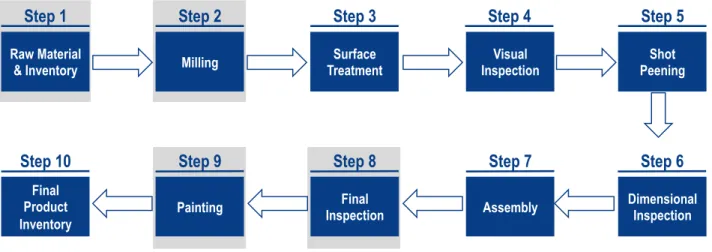
Embraer Metálicas manufactures highly customized products to meet customer's specific needs. Every part needs to be produced according to the client's security standards, as the parts are highly relevant for the flight safety. Due to this high customization, the plant is built around a Pull Manufacturing system, where the client's order triggers the 10-step manufacturing process for wing covers and stabilizers (depicted in figure 2 below).5
Step 1: Aluminum, the main raw material for production is sourced from ALCOA in Germany and is shipped weekly to the facility in Évora. The material is delivered in rectangle shaped blocks and some are already pre-cut in an approximated shape of the final product to avoid scrap.
Step 2: Milling precise and large blocks of metal is one of Embraer Metálicas core competencies, which is executed by one of seven fully automated milling machines delivered by the Japanese manufacturer Makino. The aluminum blocks are cut vertically in order to simplify the detachment of scrap, which comprises 95% of the initial aluminum block and is sold to third parties to reprocess it. Since so much of the aluminum block is turned into scrap from milling, only 5% of the initial aluminum is turned into the final product.
Step 3 & 4: In order to ensure the highest quality and to meet industry requirements, the milled aluminum block's surface is refined in a chemical bath supplied by Dürr and then afterwards visually inspected in a dark room. The surface treatment is accomplished via a highly automated and precise anodization process. Subsequently, the piece undergoes a semi-automated visual
24"
The manufacturing of wing covers and stabilizers involves a 10-step process
that is analyzed in the following
Final Inspection Final
Product Inventory
Painting Assembly Dimensional Inspection
Shot Peening Visual Inspection Surface Treatment Milling Raw Material & Inventory
Step 1 Step 2 Step 3 Step 4 Step 5
Step 9
Step 10 Step 8 Step 7 Step 6
Recommendations for Process Improvement follow
B Introduction – Production at Embraer Metálicas
Source: Company Visit to Évora manufacturing facility
inspection in a dark room, in order to identify potential defects, which are highlighted by phosphorescent chemical substances.
Step 5: The block's surface is strengthened through a Shot Peening and Peen Forming process, which is executed by MIC in a strategic collaboration within the plant in Évora. The parts undergo a bombardment of microspheres to improve the surface and the mechanical properties of the product. In the Shot Peening process, the jets are aligned from each side to achieve surface hardening, whereas in the Peen Forming the shape of the product is adjusted by using jets only from one side.
Step 6: The dimensional inspection ensures compliance with dimensional standards and requirements through optical metrology machinery. This process is low on automation and requires labor intense workforce intervention. After the inspection, the piece is stored on racks, waiting for the final assembly.
Step 7: The parts produced and supplied are put together in the respective semi-automated assembly line for each product line. By keeping the products in separate assembly lines, the productivity is increased and throughput time reduced. Each part is perforated and fixated to attach the smaller parts with the large aluminum parts produced in-house. To ensure high process effectiveness, the process supervised by an precision measurement system and the equipment is supplied by the company Electroimpact.
Step 8: After being completely assembled, the products undergo a final comprehensive quality and safety inspection, which is considered the most delicate and crucial part in the manufacturing process. The labor intensive inspection comprises visual and acoustic inspection and is carried out by up to 15 people per piece and ensures highest quality of the product to prevent any cracks or fuel leakages.
Step 9: The last step in the process chain is the electrostatic painting, which is a high standard painting process to ensure uniform and flawless white color layer. This is achieved by giving the paint and the piece to be painted opposite electric charges so that they stick together flawlessly.
With this analysis in hand, Embraer Metálicas could be identified in the Product-Process Matrix as operating workshop-type processes for low-medium volumes, since they produce in make-to order with low batch sizes (of about 30-40 per month). Despite many steps being highly automated, there is still room for improvement, which is going to be analyzed in the following.
From the prior findings, a SWOT-Analysis can be derived, which shows that Embraer benefits from expertise and know-how, but suffers from inefficiencies and reliance on suppliers. Furthermore, it shows that opportunities can only be seized if production processes are designed in a more efficient way.6
2.2.2.3. Global Demand & Sales Forecast
Having identified Embraer Metálicas` current position in the business ecosystem and their supply and manufacturing chain, the next logical step is to look into the market and how it will develop. To forecast global sales and demand, there are many factors to be taken into account. In this business project, there were 9 external factors identified that can influence aircraft demand, which are called 'growth drivers' in the following.7
The variables are partly obvious but others that affect the demand greatly are only visible on the second sight, which are: 1) GDP growth; 2) Middle Class Growth; 3) Number of Billionaires; 4) Propensity to Fly; 5) Oil Price; 6) Market Regulations; 7) Environmental Regulations; 8) Infrastructure; and 9) Competition.
6 See BP Presentation Slide 35-36
35"
The SWOT analysis shows that Embraer benefits from expertise and know-how, but suffers from inefficiencies and reliance on suppliers
B Introduction – Production at Embraer Metálicas
> Know-how
> Strict compliance with mother company’s requirements > High level of quality and
product safety > Center of excellence > IEFP (Embraer-sponsored
professional training)
> High costs (very recent learning curve)
> High inventory costs
> High reliance on suppliers (over 80% of parts are sourced from suppliers)
> E2 Jets in development phase > KC-390 in development phase > European funds for aircraft
production
> Stable future demand > Political Interest
> Absence of an industrial cluster in Portugal
> Established competitors in the market (Aernnova, Triumph)
Strengths Weaknesses
Opportunities Threats
36"
Opportunitites can only be seized if production processes are designed in a more efficient way
B Introduction – Production at Embraer Metálicas
O pp or tu ni tie s Bets
> Stable forecasts allow investments
in capacity increase
> Measures can be taken to
increase efficiency
> Expand product portfolio for
Embraer SA
> Expertise can lead to attracting
new (external) customers
Restrictions
> New contracts cannot be won if
prices are above industry standards ! need to increase efficiency
> Strong need to accelerate the
learning curve to increase competitiveness
Actions
> Lock-in of suppliers through
long-term contracts
> Use modern production facilities
and know-how to compete against established players
> Potential acceleration of the
learning curve with increased production volume
Risks
> Competitors can produce more
efficiently due to economies of scale and higher volumes
> Absence of an industrial cluster can
affect costs and innovation negatively reducing competitiveness Strengths Weaknesses Th re ats
Looking into the effects of GDP to the aircraft purchasing behavior of an economy, the main finding is that in mature economies demand is driven by fleet renewal, whereas in emerging economies sales is driven by fleet expansion. Airline passenger demand has been historically correlated with GDP growth, but the executive segment always lagged 2 years behind the growth. Even though emerging markets grow rapidly, the customer base of Embraer will still remain Central Europe and North America in short and middle term, since in these regions many executive Jets are sold. (See BP Presentation Slide 39)
In the long term (next 20 years), growing middle class and number of billionaires in emerging economies will boost demand for commercial and executive aviation. The relative amount of middle class compared to the total world population will rise from 33% (2013) to 63%(2033) and the number of billionaires will also drastically increase (see slide 40).
At the moment, the propensity to fly in China is as low as 0.25, which means only 1 out 4 persons will possibly commercially fly within our outside of China. Within the next 20 years, this number will rise to a European level of 1.0, which means the number of flights per person will quadruple in China and is only surpassed by the USA with a number of 1.6 at the moment. Some goes for other emerging economies, e.g. India has a propensity to fly of 0.06, but will rise to 0.26 over the next 20 years, which means even more than quadruple. Given the number of people in those countries, the total amount of flights will rise drastically and increase the demand for aircraft.
Oil prices on a sustainable low level can boost economic growth and thus fleet expansion in the long run. In the short run, however, it can postpone or hinder fleet renewal, since there is no need for more fuel-efficient aircraft. Growing economies will result in the demand for more business and executive air travel in the medium term and volatile oil prices will result in buying more fuel efficient and clean aircraft in terms of risk control. Nevertheless, oil and jet fuel exposure is normally hedged, which means less effect in the short term.
Environmental commitments like reducing carbon emission by 50% until 2050, increasing fuel efficiency by 1.5% per year until 2020 and carbon neutral growth from 2010-2020 will stimulate fleet renewal, since these numbers are not feasible with many old airplanes. In North America, state-owned airlines with a seat count of 76 are protected, but escape clauses to increase the size
of the fleet are negotiated. So some airlines might expand in the future to bigger aircraft, but Embraer cannot meet this requirements at the moment - only with the introduction of the new E2 Jets. Market liberalization can therefore be both, opportunity but also thread in the short term.
The demand for airplanes can only rise as long as the countries take care of the infrastructure and are prepared for the rising air travel. Economies like China and India are heavily investing into paved airports to link secondary and tertiary cities throughout the countries. India has plans to more than double the airports in order to meet the demand. Brazil is predicted to face a crisis by 2030, due to the lack of airport capacity to handle the increasing number of passengers.
Given the factors and drivers of global aircraft demand and combining it with historical and public order and backlog data, a model could be derived to forecast the future demand and plant capacity needed to meet this forecast. The first step is to apply the drivers to the respective product in Embraer's Portfolio and check if the tendency is rather rising and falling (See Slide 46-49) to estimate the orders in the long-term future (See Slide 57).
The facilities of Embraer Metálicas are today at a 80% utilization rate with the current portfolio. Taking into account the estimates and forecasts from the above developed model, the capacity would be at 106% by 2030, which in return means an expansion of the plant is needed to meet the future demand.
According to these results, the introduction of the E2 series and KC-390 will increase the batch sizes, which in return will shift Embraer Metálicas to the right in the Product-Process matrix. Adjustments in terms of increased automation are needed in order not to mismatch the processes with the demand.
58"
Embraer Metálicas needs an expansion to guarantee it meets medium term
demand for the new E-2 models. Opportunity to sublet facilities from 2020.
Current Capacity (2015): 80%
Current Pipeline: Legacy 450/500, Legacy 600/650, E-175, E-2 E-190, E-2 E-195 and KC390
Future Capacity (2030): 106%
Future Pipeline: Legacy (600/650), E-2 E-190 E-2 195, E-2 E-175, KC390, …
Opportunity to temporarily sub-let facilities and equipment from 2020, as E-175 production halts
0 5 10 15 20 25 30 35 40 45 N ew D eliv er ie s A irc ra ft Year
Plant Usage (excluding KC-390)
Plant Usage
Current Maximum Capacity C Sales and Demand Forecast > Capacity Forecast
2.2.2.4. Technological Trends in both Aeronautics and Manufacturing
In order to mediate or even eradicate the bottlenecks in Embraer Metálicas facilities, a vast analysis of state of the art technologies as well as future trends were studied. The analysis was carried out in 3 steps:
1. Screening ready-to-use and implement manufacturing technologies with technology readiness level of 9 (TRL - See Slide 86) in order to increase current productivity
2. Identify research and science projects to meet manufacturing trends in the future (at least TRL 5-6)
3. Analyze future trends in aeronautics and combine them with present research results to give an outlook and trigger own research on how to implement them.
1. State of the Art Manufacturing Technologies Fully Automated Storage System
At the moment, Embraer Metálicas operates a manual decentralized warehousing system, which means the raw material is manually stored on the ground in the goods entrance without a certain storage system. Throughout the manufacturing process, the pieces are stored in interims position along the assembly line, without a dedicated space and system. This raises inefficient processes in terms of labor-intensive storage and management of goods, longer handling times and risk of damaging inventory. With a higher demand, Embraer will also need to handle higher quantity of inventory, which can be tackled by a fully automated storage system. The potential benefits range from decreasing the number of employees and forklifts needed via automation, increased visibility and transparency of the flow of goods through direct connection to the ERP - to a significant decrease of time to find and receive items.8
Overhead Crane System
Currently, large pieces are put on transportation racks and then moved manually from production step to production step, which increases the time needed when extracting the piece from the rack to be fed into the manufacturing machine and then back on the rack and therefore a bottleneck occurs. Furthermore, these racks need to be moved manually, which makes the task time and labor intensive. The implementation of overhead crane systems can facilitate the material flow
and feeding process from rack to machine. More benefits result from increased flexibility to move the pieces, heavy loads can be carried with minimum effort, decreased feeding times and less employees needed to move inventory.
Painting Robots
Employees execute the current manual painting process, which increases inefficiencies due to its manual character. Not only the time is an issue, but also the health of the employees, because long painting sessions can cause problems in the respiration system. Fully automated electrostatic painting system, where the painting process is carried out by multi-axis robots, is commonly used in the automotive sector. This substitution can increase the painting quality, due to the fact that errors are minimized and throughput time can be optimized. Since robots work always with the same quality, the finishing quality is also very stable and paint consumption can be reduced, compared to a manual process.
2. Manufacturing Trends and Research
Trends and research projects identified, that could possibly shift the whole manufacturing process or mediate bottlenecks in the near and long term future.
Additive Manufacturing (AM)
It is a 'process of joining materials to make objects from 3D model data, usually layer upon layer, as opposed to subtractive manufacturing methodologies.' Additive Manufacturing is commonly referred to as '3D printing', 'Rapid Prototyping', 'Layer Manufacturing', 'Laser Manufacturing' and 'Freeform Fabrication'.9
This disruptive technology has many advantages: 1. High degree of automation
2. Virtually able to produce any geometrical structure
3. General-purpose: time and price depend on shape not on material 4. Able to fabricate parts with different characteristics
5. Material only placed where function is realized 6. No tooling freezes --> Freedom of design
7. More complexity with less cost 8. Highest strength with lowest weight
9. Fully automated production and quality control
10. Any material, also suitable for titanium and aluminum
Despite the many advantages, there are disadvantages to consider, which might make this technology unsuitable for mass-production at the moment:
1. No hollow structures, due to limited way to get rid of excess material
2. Penalized by high cost of material, due to poor supply chain (will change in the near future)
3. Parts must be procedural redesigned for new techniques
Depending on the geometrical shape, the field of application and characteristics the part must have, different types of additive manufacturing are available to produce the part in the most efficient way.
Powder Bed Fusion (PBF) is very suitable for round structures (not closed) like spheres and objects extended in every dimension. In this process, a point heat source selectively fuses or melts a region of a powder, which is loosely held in a bed above a build plate. This process is also known as direct metal laser sintering (DMLS) or selective laser melting (SLM)
The second process is called selective laser sintering (SLS) and in this process a laser is used as the power source to sinter powdered or thin layers (from a coil) of material. The laser aims automatically at points in space defined by a 3D model, binding the material together to create a solid structure (comparable to conventional 3D printing).10
Additive could solve two major problems and inefficiencies in the plant of Embraer Metálicas. 1) Shift external supply to internal production:
The problem Embraer Metálicas is facing is the fact that parts smaller than 1.5m are generally outsourced and supplied by a third party. Since wings are crucial parts of the aircraft, no risk should be taken. With additive manufacturing this process could be insourced and make processes more flexible.
2) Reducing raw material by up to 90% to reduces costs drastically:
During the milling process, 90% of the aluminum is turned to scrap, which is then sold, but only to a fraction of the purchasing price. Since 50% of the costs of the final wing are driven by raw material, this solution bears a high potential for improvement and cost saving for the company. Therefore it is recommended to start testing with additive manufacturing soon and implement the solutions in the process to gradually replace traditional milling. In this way costs can be driven down and the ecological footprint improved.
Nonlinear Elastic Wave Spectroscopy (NEWS)
This technique is a vibro-acoustic ultra sound non-destructive autonomous modular system for aircraft's material-state evaluation, which measures nonlinear anomalies in the frequency spectrum in kHz and MHz range. Due to its high sensitivity, the system can diagnose manufacturing defects and damage such as micro cracks and cavities.
This system tackles the bottleneck Step 8: Final inspection, because this system potentially can replace the task of 15 employees, since it is very reliable and less time consuming compared to the manual approach. Having the system connected to the IT, the whole process can be documented and can be fully automated. The system is in TRL 8 and in its final testing and can be therefore implemented rather soon and might result in immense time and cost savings.
3. Future Trends in Aeronautics
The EU invested 1 billion € into the 'Seventh Framework Program for Research'11 to fund promising research project or create own ones to tackle the upcoming problems. The research areas are clustered in 6 groups according the activity:
1. Greening of the Airport
Main objective is to reduce emissions of CO2 and NO2 and halving the perceived noise 2. Increasing Time Efficiency
Besides this being a permanent concern in design and manufacturing, research has concentrated now also on wake-vortex issues, cockpit technologies and turnaround processes in airpots
3. Ensuring Customer Satisfaction & Safety
This research area focuses on new on-board instrumentation for measurements, solutions for de-icing of wings and aircraft, as well as enhancing the customer comfort
4. Improving Cost Efficiency
Focusing on staying competitive by delivering cost efficient products, this group looks into modern design tools / systems and new measurement and testing techniques, which is especially interesting for Embraer Metálicas
5. Protection of Aircraft and Passenger
Detection and tracking of dangerous materials, behavioral modeling in airports and protection against explosive materials are the in the focus of this research group 6. Pioneering Air transport of the Future
This forward looking group examines and explores numerous breakthrough concepts and rethinks every part of airplanes in order to create aircraft of the future.
The research conducted in this program is mostly still in a low technology readiness level, but some are still worth looking into as this might be the future of air travel and Embraer Metálicas need to consider these in the future for their production process. One of the most costly ones is in the group of 'Greening the Airtransport' and focuses on bringing down fuel consumption up to 10%. The program is called 'Hybrid Laminar Flow Control' (See slide 64-66) and the idea behind is to apply grids to the manufactured wing and stabilizers to control the laminar flow and reduce the friction drag.
2.3. Recommendations to the company
Applying the adjusted funnel approach brings the findings from the analysis part together and enables to give Embraer Metálicas recommendations how to tackle the future capacity problems. The main purpose was to shift Embraer to a more favorable position on the product - process matrix, which is done in the first step by applying the findings from the global demand and sales forecast, to shift the facilities to the right on the matrix. By applying state of the art and disruptive manufacturing technologies, which help to further automate the processes, the position in the matrix will shift upwards, which then results in a diagonal shift in total. Shifting along the diagonal line puts Embraer Metálicas in a more favorable and efficient position to stay competitive in the market.
This GANTT-Chart shows how Embraer Metálicas is advised to implement the recommended technologies over time:
2.4. Work Plan
When being confronted with the problem, the team decided to divide the task into 3 work packages: 1) Technological Environment; 2) Trends in the Aviation Industry; and 3) Competitive
85"
Technological Roadmap
New Technologies Sales and Commercial
2015 Manufacturing
E' Recommendations > Technological Roadmap
Additive Manufacturing Vibro-Audio Inspection Overhead Cranes Automatized Robots Assembly Painting
Fully Automated Storage System Smaller Parts Replace Milling
AFLOXNEXT: Hybrid Laminar Flow Control BUTTERFLI
PELSKIN Coating
Technology Stream 1 Technology Stream 2 Renting Spare Capacity
Capacity 2015 2020 2025 2030 2015 2020 2025 2030 2015 2020 2025 2030
realized that information from Embraer was limited due to confidentiality issues. Therefore a more general approach with rather broad recommendations was taken, without exact numbers. To get a clearer picture, global demand and sales forecast was added as another work package during the course of the project. Having worked on these work packages, the business project team is able to analyze the problems as shown above and come up with a technology and action road map as shown below.
2.5. Concerns
The first challenge in this business project was to set the correct scope and problem definition. Since there was no clear problem to be answered but rather a task to be tackled, the group struggled in the beginning to set the correct framework. Furthermore, much information could not be shared with the project team, due to confidentiality reasons, which, in turn, made information gathering a tedious endeavor. The main challenge was therefore to find data autonomously from various but valid sources in order to deliver a useful technology roadmap and outlook over the next years. In terms of implementation, some problems can arise from the fact that technologies presented have still a low TRL. They might be not ready for industrial application, or the research can be discontinued entirely. Furthermore, implementing completely new technologies can result in having first extensive research and testing in order to ensure the validity of the innovation, which, in return, can use up too much time and budget.
2.6. Personal Experience
In my opinion, we had a well-balanced group, where each team member had certain skills and experiences from which the whole team could benefit. These skills ranged from prior educational background to work experience to be shared. In my case, the engineering background, especially the classes in material science and manufacturing technology helped a lot to quickly grasp the topic and the challenges. My work experience in Mercedes Benz AG in Hungary further facilitated the understanding, because I worked in the factory planning and saw many of the manufacturing processes already live in action. Therefore I could share my knowledge with the group and augment it with hands on experience. The intercultural training with enhanced communication skills I experienced in the undergrad program helped me to mediate problems and
Microsoft excel could be gladly compensated by other team members who then explained me how they reached the results and helped me learn more about it. Even though the whole project was executed in English, sometimes the language barrier slowed down the process, since much information about Embraer Metálicas was only available in Portuguese. The fact of having two Portuguese speakers in the group eased this obstacle drastically. I realized that my skills in Excel with the vast variety of options are still limited and I need to work on that by getting involved in more projects and training about excel.
2.7. Benefit of hindsight: what added most value? What would have been done differently?
The strong connection to the advisors helped to smoothen the process. The students could delve in the topic really quick, due to the fact that the company advisor was available for meetings; phone calls and replied to the emails comprehensively with valuable information. The invitation to visit the factory in Évora facilitated the understanding of the processes and gave students with only business background deep insights about how manufacturing companies work. The most added value for the students was to get another perspective on the industry and understand that there is more than the usually presented companies in the lectures. The majority of the group has never seen a manufacturing facility from the inside before and was able to get a guided tour through the single steps of the production process. For Embraer Metálicas, the project helped to create a broad outlook of what is coming up next in the business environment. The vast competitive and technology analysis by reading many scientific papers saved the research department intensive work and helped to guide them in a certain direction.
There are some issues that could have helped the speed up the process in the beginning: 1) the project outline was confusing to begin with and the goals were not totally clear. Only the could resolve the issues and open questions. Next time, the project outline should get more attention in the creation, because this is what the students rely on. 2) The company advisor of Embraer was really helpful and answered the problems as good as he could, but due to confidentiality restrictions many information and data could not be shared and had to be gathered tediously via internet and literature research. Since this project is very beneficial for Embraer, a non-disclosure agreement with consequent sharing of data would have helped the team a lot and might have resulted in even better conclusions.
3. Reflection on Learning
In this part of the work project, the gap between knowledge from the masters, which has been applied in the business project and new knowledge, which has been gathered during the research and application will be closed. Many concepts like SWOT-Analysis, GANTT-Chart and other Matrices have been used and have been mentioned and explained already in the analysis part. The focus of this part lies on questioning Michael Porter's classic view on 'competitive advantage', tackling it with the recent notion of 'transient advantage' and crosschecking the importance of 'disruptive technologies' in terms of economies and manufacturing.
3.1. Sustainable Competitive Advantage
The idea of creating a real 'sustainable competitive advantage' is now for decades in the heart of business textbooks and was preached by many experts and business gurus. It describes the fact that companies should compete in the market with an advantage, which others can't imitate and therefore puts the respective company in a unique position.12 Managers all over the world were urged to find or create something that others can't copy and build the whole corporate strategy around that said advantage. This business project was also built around that notion of having or finding a unique technology, capability or know-how to outrun competitors and win contracts for Embraer Metálicas. It is still a solid concept and works for big conglomerates such as General Electric, IKEA or Unilever, but it has become rare for a company to truly sustain lasting advantage. Nowadays, the market with its competitors and customers has become unpredictable and industries are amorphous. Factors like globalization or digital revolution have created a flat world and lowered the barriers of entry, which makes maintaining competitive advantage harder than ever.
3.2. Transient Advantage.
The idea behind 'transient advantage' is that planning strategically 10 years ahead to create and establish a unique competitive position, sustained for a long period of time, is nowadays not relevant anymore for most businesses. It is about creating and launching new strategic initiatives over and over again to create advantages that can be built rapidly but in the same time also abandoned quickly.13
12 Porter & Montgomery, 27-35
In many industries the competitive advantage simply evaporates in less than a year and imitators are already on the verge of releasing a resembling product or technology. Therefore, companies simply can't afford spending months on creating long-term strategies. To stay ahead, they need to constantly launch new initiatives and basically exploit many transient competitive advantages at once. Those advantages in sum can keep a company in the lead in the long run, but just as in another portfolio, they need to be changed and adjusted constantly. For example, Milikan & Company, a US based textile and chemicals company, has adopted this notion and abandoned the assumption of stability being the norm. Companies who failed to see this in advance realize it only when it's too late. Prominent examples are: Nokia, IBM or Kodak.
The life span of the advantages may differ from a year to a decade, but the cycle itself looks always the same. As soon as advantages start to be fleeting, firms must act and go through the
cycles quicker and more often. To achieve this, they need to have a deeper understanding of the early and late stages to react accordingly, compared to having just one advantage sustained over a long period. Each phase requires different skillsets and therefore different kind of people: In the launch phase, creative people who can fill in blank sheet with ideas are needed; in the ramp up phase, ideas are brought to scale, which calls for people who can assemble the right resources; the exploitation phase stands for capturing profits and the company needs consequently people who are good in analytical thinking and efficiency; reconfiguring is often skipped and went on to the next disengaging phase, where tough-minded people are needed who can take emotionally hard decisions.
Managers are often well aware of the need to change operations. Although, deeply embedded assumptions might lead them into false decisions and therefore the companies into traps:
1) First-mover trap: It is often falsely assumed that being first to the market creates sustainable advantage. In most industries this is wrong due to globalization.
2) Superiority trap: Any new product is often not as good as a honed and polished version, which has been iteratively improved. Many companies don't see the need to revamp their initial successful product and face suddenly competitors with much more mature products.
3) Hostage-resource trap: For executives who run big and profitable companies it makes no sense to shift resources to new ventures in order to stay profitable in the short run. As in the example of Nokia, already in 2004 they had a product that resembled the today's iPad, but the project was discontinued before launch, because Nokia's emphasis was on mass-market phones. 4) Organizational trap: When executives are asked why some ideas never went through the simple answer is: '... they simply fall between the cracks of our organizational structure'.
5) Sporadic innovation trap: In many firms there are no systems for creating a continuous pipeline of new advantages, because only individuals drive them. This on-and-off makes it highly vulnerable to swings in the business cycle.
3.3. Disruptive Technologies can change the Business Ecosystem completely
Innovations can disrupt customer tastes, buying behaviors and therefore the whole market - this fact widely accepted in the business environment. Even though incumbents usually try to keep the novelties out of the market, most of the time the entrance is unpreventable. The question to be answered is how and to what extend new technologies can disrupt the manufacturing process and what consequences does this have for the market.
3.3.1. Steel Production and Minimills
As explored by Clayton Christensen, traditionally, steel was produced in huge integrated steel mills with billions of capital invested. In those big facilities, all kinds of steel was produced, reaching from rudimental rebar steel (concrete reinforcement steel) up to high quality sheet steel for high-tech products. In the 1970s a new way of producing steel was introduced: the Minimills. Deploying the power of electricity, the furnaces could be shrunk down to a fraction of the size of traditional mills, and with the size
also the cost of production decreased. Nevertheless, the quality of the steel was rather poor and therefore could only be used for the production of standard concrete reinforcement steel. The profit margins in the rebar business was low, only 7%, but since the
1975 1980 1985 1990 1995 Rebar Angle iron Structural Steel Sheet Steel 7% 12% 18% 25-30%
minimills reduced the cost by 20%, the margins rose by exactly that amount and made it really profitable. The traditional mills did not see anymore the use of the production of rebar steel and from that point on, only the minimills supplied rebar steel to the market. After the last integrated steel mill quit producing rebar steel, the prices dropped all of the sudden by 20%, making the rebar steel business less profitable for the minimills and so they sought to tackle the next higher quality of steel: angle iron, bars and rods. By increasing the quality of the production process, minimills were finally able to provide sufficient quality and reducing the cost by 20% again. So they pushed the traditional mills out of that business as well. Again, as the last integrated mill quit the angle iron steel business, the prices plummeted by 20% and the minimills needed to find another way to stay profitable. They climbed up the quality ladder again and again until they reached the high quality sheet steel area. Over time the minimills pushed out most of the integrated steel mills from the market by gradually innovating their production process and strategy, whereas the integrated ones did not seem to change their strategy.14 The same happened to General Motors, when Toyota entered the US market in the 70s with their very cheap 'Corona'. Toyota gradually climbed the ladder and produced higher quality cars and took away market share from General Motors until they reached the premium class with their 'Lexus' brand. Then the Koreans came with their KIA and took away the lower market end from Toyota. These examples show, that companies constantly have to look for new advantages. Even if they have a monopoly, a new technology can disrupt the manufacturing processes and therefore the whole market.
3.3.2. Disruptive Innovation -‐ The Economic Engine
According to Christensen, there are 3 different types of innovations. The first one is obviously 'disruptive innovation', which offers new products or solutions and hence disrupts the market. Usually this type of innovation creates jobs and uses capital in the first place to create this novelty. The next type of innovation is 'sustaining innovation', which improves the existing product gradually to give better customer experiences. In general, sustaining innovation creates only few jobs and also uses only little money. The next type is 'efficiency innovation', which supplies the same products but cheaper. In its very nature of cutting costs, this type of innovation usually eliminates jobs, to make processes more efficient for example by automation. Due to efficiency increase, this type of innovation frees capital. In a regularly working economic engine,
this freed up capital will be reinvested to develop new inventions and disruptive technologies. These new technologies will then offset the eliminated jobs, due to the fact that disruptive innovations require workforce and labor. Christensen's model builds consequently a reinforcing circle, which acts as an economic motor that keeps companies and therefore whole economies running.
But ever since modern finance has occurred and grew rapidly in the last decades, things have been changing in this sensitive motor15. This new view on finance gave the business world sophisticated ratios to measure profitability of the company, e.g. IRR (internal rate of return) or RONA (Return on Net Assets) just to name a few. The problem is, that it gives options to executives to decide what to do with the capital freed in the efficiency innovation. Before the new finance, it was clear that the money had to be reinvested into disruptive innovations, which will pay off normally only after 5-10 years. Companies nowadays choose often a different approach. It is more profitable to reinvest this capital into innovations and technologies to make the existing process more efficient, because this normally pays off after one to two years. Companies started to seek short term return and drive the profitability up, despite the healthy way of reinvesting it in disruptive technologies. This process will then be repeated over and over again, which catapults the firms into a loop. Companies will get stuck in this loop until a new competitor comes with better technology and disrupts the market. Many companies realize this bad state of affairs too late and will ultimately pushed from the market.
According to McKinsey Global Institute, new technologies account for about $33 trillion economic impact until 2015.16 They show that leading executives are aware that their competitive advantage might erode over time and many start to understand that adopting disruptive technologies is not optional or convenient anymore. While many manufacturers understand the necessity of new technologies to stay competitive in the market, only one quarter of the CEOs are planning to use emerging technologies to create growth opportunities.17 Consequently, managers and executives need to rethink their approach towards strategy and embrace the new paradigm for creating unique positions in the market. Only by staying innovative, the companies and hence the whole economy will maintain healthy.
15 Greenwood & Scharfstein, 2012 16 Manyika, Chui, & et al, 2013
References
• Aeronova. (2015). on www.aernnova.com • Bajarin, T. (2015).
This Will Be the Most Disruptive Technology Over the Next 5 Years. on time.com: http://time.com/3663909/technology-disruptive-impact/ • Belligoni, C. (2015).
Company Visit to Évora manufacturing Facility. • Centro Historico Embraer. (2015).
on www.centrohistoricoembraer.com.br/en-us
• Christensen, C. (07/2014). Harvard Magazine. 15. 05 2015
on www.harvardmagazine.com: http://harvardmagazine.com/2014/07/disruptive-genius • Electroimpact. (2015). on www.electroimpact.com • Electro-Static. (2015). on www.electro-static.com • Embraer. (2015).
Embraer Portugal Suppliers Workshop . • Denning, S. (2013).
It's Official! The End Of Competitive Advantage.
on Forbes.com: http://www.forbes.com/sites/stevedenning/2013/06/02/its-official-the-end-of-competitive-advantage/
• Documento. (27. March 2015). Digabit.com. May 15 2015
HOW THE ADOPTION OF DISRUPTIVE TECHNOLOGIES ARE DRIVING GROWTH FOR MANUFACTURERS: on http://digabit.com/how-the-adoption-of-disruptive-technology-is-driving-growth-for-manufacturers/
• GLobal Market Forecast 2014-33. (2014).
on Airbus.com: http://www.airbus.com/company/market/forecast • Greenwood, R., & Scharfstein, D. (2012).
• Triumph Group Inc.,. (2015). Annual Report.
• Heyes, R., & Wheelwright, S. (1979). The Product - Process Matrix.
• Nunes, P., & Downes, L. (2015).
The Five Most Disruptive Innovations At CES 2015.
on Forbes.com: http://www.forbes.com/sites/bigbangdisruption/2015/01/09/the-five-most-disruptive-innovations-at-ces-2015/
• Manyika, J., Chui, M., & et al. (May 2013).
Disruptive technologies: Advances that will transform life, business, and the global economy . McKinsey Global Institute .
• Marketline Company Profile: Embraer SA . (2015). on www.embraer.com
• McGrath, R. G. (2013).
Transient Advantage. Harvard Business Review . • Olofson, C. (2013).
Making the Shift from Sustainable To Transient Advantage.
on Innosight.com: http://www.innosight.com/innovation-resources/strategy-innovation/making-the-shift-from-sustainable-to-transient-advantage.cfm • Porter, M. E., & Montgomery, C. A. (1991).
Seeking and Securing Competitive Advantage. Boston: Harvard Business Review. • Porter, M. (1985).
The Competitive Advantage: Creating and Sustaining Superior Performance. New York: Free Press.