UNIVERSIDADE DE LISBOA
FACULDADE DE CIÊNCIAS
DEPARTAMENTO DE QUÍMICA E BIOQUÍMICA
Exploring the interactions between neuron
degeneration and RNA homeostasis through biological
network analysis
Marina Luque García-Vaquero
Mestrado em Bioquímica
Especialização em Bioquímica
Dissertação orientada por:
Prof. Doutor Francisco Rodrigues Pinto e
Prof. Doutora Margarida Gama-Carvalho
Abstract
Amyotrophic lateral sclerosis (ALS) and spinal muscular atrophy (SMA) are characterized by motor neuron (MN) degeneration and commonly referred as motor neuron diseases (MND). MN degeneration leads to the loss of muscle innervation and subsequent muscular atrophy. In addition to phenotypic similarity, they also share molecular overlaps. Genes that codify FUS, TDP43, SETX and SOD1 proteins are the best-known causative genes of ALS and SMN dysfunction is the cause of SMA. FUS, TDP43, SMN and SETX (FTSS) proteins are known to physically interact and are involved in similar functions, many of which related to RNA metabolism processes.
This supports the hypothesis that ALS and SMA are different pathophenotypic results derived from related molecular origins, in particular from RNA homeostasis perturbation. However, it is very intriguing how such critical events could specifically induce motor neuron perturbation. Besides, RNA metabolism is not the only function described for MND associated genes, indeed FTSS proteins are highly multifunctional which hinders the identification of the most relevant functions in this context.
In order to solve these questions we followed a systems biology approach exploring the interactomic and functional framework of MN degeneration. Under the hypothesis that FTSS proteins are central elements in MN degeneration, we performed a local network analysis to unravel the most influential functions among FTSS proteins. We constructed a protein-protein interaction (PPI) network constituted by FTSS proteins' common interactors to identify the most over represented functions within this FTSS-focused network.
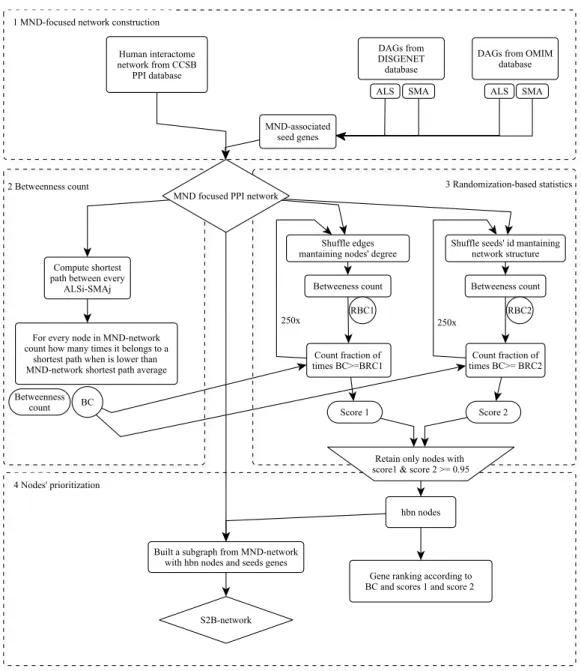
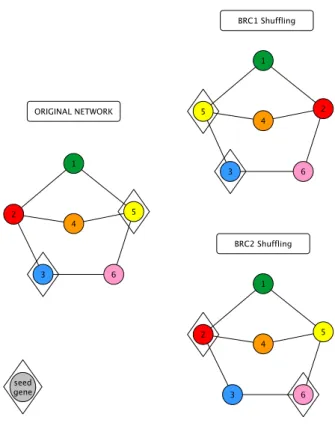
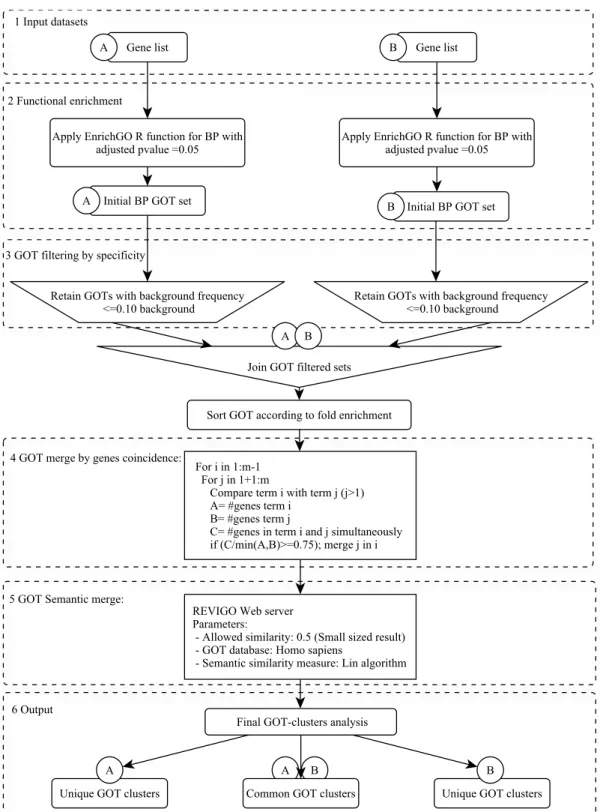
We also performed a PPI network analysis including all the known MND associated genes. For that purpose we developed a new method, S2B (double specific betweenness) to prioritize nodes specifically linking a pair of diseases. While standard betweenness is measured for all possible shortest paths between any nodes, S2B only considers those shortest paths involving Disease Associated Genes (DAGs) from one disease as initial nodes and DAGs from the other disease as final nodes. Therefore, S2B method only prioritizes proteins linking MND causative genes. Moreover, knowing that highly connected nodes (hubs) are more likely found by chance in a shortest paths involving DAGs, S2B method also performs two network randomization-based statistics to filter out proteins that link MND DAGs non specifically.
Finally we functionally enriched the prioritized candidates and compared against the functional set obtained with FTTS-focused network in other to explore the role of RNA metabolism and other putative molecular mechanisms on MN degeneration. The combined approaches used in this work provided novel biological processes simultaneously involved in ALS and SMA diseases and confirmed the relevance of known related processes.
Globally, our results suggest five pathways in common between ALS and SMA: 1) DNA damage and apoptosis induced by R-loop deregulation, 2) inflammation and neurodegeneration induced by immune hyper-sensitivity, 3) chromatin deregulation and genotoxicity produced by histone biogenesis perturbation, 4) splicing patterns alteration and genotoxicity produced by spliceosome assembly failure and 5) deregulation of microtubule related processes leading to morphological problems in axon and synapse formation. Besides the new hypothesis of common pathomechanisms in MNDs, our work also supplies a new network-based DAG prioritization method, S2B, to identify disease-disease linking candidates we expect to contribute to the study of various complex diseases.
Keywords:
Amyotrophic Lateral Sclerosis, Disease-Associated Gene prioritization, network biology, Spinal Muscular Atrophy, systems biologyResumo
A esclerose lateral amiotrófica (ALS) e a atrofia muscular espinal (SMA) são caracterizadas pela degeneração dos neurónios motores (MN) e são comummente conhecidas como doenças neuromusculares, ou mais especificamente doenças do neurónio motor (MND). A morte dos neurónios motores está diretamente envolvida na perda da inervação muscular e na consequente atrofia muscular. Para além da convergência fenotípica, estas doenças também partilham grandes semelhanças moleculares. A perda de função dos genes que codificam as proteínas FUS, TDP43, SETX e SOD1 são as causas mais conhecidas de ALS. No caso da SMA, a doença é provocada pela produção de formas não funcionais da proteína SMN. Sabe-se que as proteínas FUS, TDP43, SMN e SETX (FTSS) interagem fisicamente e, além disso, são conhecidas por estar envolvidas num conjunto de funções semelhantes, muitas das quais estão relacionados com os processos de metabolismo do RNA. Esta observação levou à hipótese de que a ALS e a SMA são fenótipos patológicos que, apesar de diferentes, derivam de mecanismos moleculares semelhantes, possivelmente associados à perturbação da hemóstase do RNA. No entanto , é muito intrigante como eventos transversais a todos os tipos celulares podem induzir a morte especifica dos neurónios motores. A fim de resolver estas questões nós propomos uma abordagem de biologia de sistemas para descrever a estrutura interactómica e funcional da degeneração dos neurónios motores.
A biologia de sistemas (systems biology) baseia-se no pressuposto de que "o todo é mais do que a soma das partes". Utiliza um abordagem holística para decifrar a complexidade dos sistemas biológicos e para isso integra muitas disciplinas científicas como a biologia, ciências computacionais, estatística e matemática. A biologia de sistemas concebe as entidades biológicas como sistemas complexos de elementos interrelacionados. Deste modo, uma boa maneira de entender as suas propriedades é representando-as como redes (networks). A biologia de redes (networks biology) é um subcampo da biologia de sistemas que explora os princípios da teoria de redes para inferir informação biológica. Da mesma forma, as doenças são o resultado fenotípico de perturbações interrelacionadas e assim também podem ser representadas como redes biológicas. A medicina de redes é, por sua vez, focalizada na obtenção de conhecimento biomédico a partir da biologia de redes.
O nosso principal objetivo é, em primeiro lugar, identificar os elementos mais centrais numa rede de interação proteína-proteína contendo os genes associados à ALS e à SMA. Estes elementos serão parte de mecanismos patológicos hipoteticamente envolvidos na degeneração dos neurónios motores. Considerando a hipótese de que as proteínas FTSS são elementos centrais nas MNDs, realizamos primeiramente uma análise exploratória para desvendar as funções mais influentes entre as proteínas FTSS. Para isso foi construída uma rede de interações proteína-proteína (PPI) constituída pelos interactores mais próximos às proteínas FTSS, o que nos permite identificar as funções mais sobre-representadas dentro da rede.
Embora, sabendo que as proteínas FTSS não são as únicas proteínas associadas às MNDs, também realizámos uma exploração mais integrativa incluindo todos os DAGs (genes associados à doença) conhecidos para a ALS e SMA e aplicando um método de priorização de DAGs para prever os elementos mais centrais a ligar as duas patologias. Contudo, depois de fazer extensa uma pesquisa bibliográfica, não encontramos nenhum método com um objectivo semelhante, pelo que construímos um método novo com base em teoria de redes para prever os nós que ligam especificamente os DAGs associados a um par de doenças. O método S2B foi concebido a partir do pressuposto de que as proteínas que interagem com um DAG são provavelmente relacionadas com a mesma doença (constituindo módulos de doenças na rede) e também que os DAGs são propensos a ser associados a mais do que uma doença (os módulos de doenças podem sobrepor-se). Assim, o método S2B está focado na medição dum tipo particular de medida de centralidade (S2B betweenness). O betweeness é uma medida de centralidade popular em biologia de redes que conta as vezes que um nó está envolvido num caminho mais curto (shortest path) numa rede. Geralmente o betweeneess standard é medido para todos os possíveis caminhos mais curtos entre quaisquer nós enquanto que o S2B
betweenness apenas considera os caminhos mais curtos entre pares de DAGs. Portanto, o
método S2B só prioriza a centralidade dos elementos ligando genes causativos de duas doenças. Além disso, sabendo que os nós altamente conectados (hubs) são mais propensos a aparecer por acaso num caminho mais curto entre DAGs, o algoritmo do S2B também utiliza dois algoritmos estatísticos baseados em aleatorizações da rede com os quais mede a especificidade dos hubs no contexto das doenças em estudo. As proteínas resultantes da priorização realizada pelo S2B foram enriquecidos funcionalmente. Os resultados da análise de enriquecimento foram comparados com os resultados obtidos no analise da rede particular para as proteínas FTSS para assim, explorar qual é o papel do metabolismo do RNA e outros mecanismos moleculares hipotéticos na degeneração dos neurónios motores.
No conjunto das várias abordagens seguidas, este trabalho levou à descoberta de novos processos biológicos candidatos a mecanismos moleculares comuns entre a ALS e a SMA, mas também confirmou alguns processos já conhecidos simultaneamente envolvidos na ALS e na SMA. Globalmente, os nossos resultados sugerem cinco vias moleculares principais em comum nas duas patologias: 1) danos no DNA e apoptose induzidos pela desregulação da formação de “R-loops”, 2) inflamação e neurodegeneração induzida por uma hipersensibilidade imunológica, 3) desregulação da cromatina e genotoxicidade produzida pela perturbação da biogénese de histonas, 4) alteração dos padrões de “splicing” e genotoxicidade criada pela falha da formação do spliceossoma e 5) desregulação de processos relacionados com microtúbulos que levam a problemas morfológicos na formação de axónios e sinapses.
As vias identificadas sugerem novas hipóteses que podem ser experimentalmente testadas. Assim, esta investigação pode ajudar a melhorar a compreensão dos mecanismos envolvidos na morte dos neurónios motores e também ajudar eventualmente ao desenho de alvos terapêuticos e biomarcadores para as MNDs. Além disso, também fornecemos um novo método para a priorização de DAGs candidatos a ligar os mecanismos moleculares de duas doenças relacionadas. Tal como no caso das MNDs, esperamos que este método ajude a comunidade a estudar outros tipos de doenças complexas.
Palavras-chave:
esclerose lateral amiotrófica, priorização de genes associados à doença, atrofia muscular espinal, biologia de sistemas
Table of contents
Abstract
III
Resumo
V
List of figures and tables
XI
Abbreviations
XII
Chapter 1: Background
1
Introduction 1Network theory 2
Network properties 2
Network biology 6
Network structure and robustness 7
Protein-protein interaction networks 8
Network medicine 9
Motor neuron degeneration-related diseases (MND) 12
Objectives 14
Chapter 2: FTSS-focused network
15
Introduction 15Methodology 16
PPI data retrieval 16
FTSS-focused network functional enrichment and functional clustering 17
FTSS-focused network construction 18
Results and Discussion 18
PPI data retrieval 18
FTSS-focused network 19
Conclusions 22
Chapter 3: S2B method
25
Introduction 25Methodology 27
S2B method 27
MND-focused network construction 27
Betweenness count (BC) 28
Randomization-based statistics (BRC) 29
Node prioritization 30
Functional enrichment comparisons 30
Functional enrichment 30
GOT filter by specificity 30
GOT fusion by gene co-occurrence 30
GOT fusion by semantic similarity 32
Functional clusters comparison 33
Comparison of S2B results with FTSS-focused network and MND-DAGs 32
S2B method results' topological analysis 34
S2B method functional analysis 36
Functional comparison between SEEDS and S2B results 37
Functional comparison between FTSS-network and S2B results 40
Conclusions 42
Chapter 4. General discussion and conclusions
45
Future remarks 48References
51
Supplementary data description
59
S-2.1 PPI data retrieval 59S-2.2 FTSS-network functional enrichment and functional clustering 59
S-3.1 MND-focused network construction 59
S-3.2 S2B method 59
S-3.3 Functional characterization raw results 59
List of figures and tables
Figure 1.1 Illustration of the differences of centrality measures Figure 1.2 Network models with direct impact on understanding biological networks Figure 2.1 Flowchart describing FTSS-focused network construction methodology Figure 2.2 Venn diagram describing retrieved FTSS-related PPIs Figure 2.3 FTTS-focused network Figure 3.1 Flowchart describing the workflow of S2B method Figure 3.2 Illustration of BRC1 and BRC2 shuffling procedure Figure 3.3 Flowchart describing the standard workflow of functional characterization on any pair of protein sets Figure 3.4 Comparison of S2B results with FTSS-focused network and MND-DAGs Figure 3.5 Subnetwork resulted from the S2B method prioritization Figure 3.6 Centrality analyses of proteins prioritized by S2B method Figure 3.7 Descriptive summary of functional enrichment comparison between S2B and SEEDS (A) and S2B and FTSS (B) results Figure 3.8 Overview unique functional clusters found in S2B comparing to SEED genes’ results Figure 3.9 Overview of common functional clusters between S2B and SEED genes Figure 3.10 Overview unique functional clusters found in S2B comparing to SEED genes’ results Figure 3.11 Overview unique functional clusters found in S2B comparing to FTSS-network genes’ results Figure 3.12 Overview of common functional clusters between S2B and FTSS -network genes. Figure 3.13 Overview unique functional clusters found in S2B comparing to FTSS-network genes’ results Figure 4.1 MNDs hypothetic mechanisms Figure 4.2 Illustration of the differing grades of relevance of functions according to particular diseasome contexts Table 3.1 Summary of MND DAGs retrieval
Abbreviations
ALS:
Amyotrophic Lateral Sclerosis
BP:
Biological process
CUI:
Concept Unique Identifier
DAG:
Disease Associated Gene
DNA:
Deoxyribonucleic Acid
FDR:
False Discovery Rate
FTSS:
FUS, TDP43, SMN, SETX proteins
GO:
Gene Ontology
GOT:
Gene Ontology Term
GTLinker: Gene Term Linker
hbn:
High Betweenness node
hnRNP:
Heterogeneous Nuclear Ribonucleoprotein
MN:
Motor Neuron
MND:
Motor Neuron Disease
mRNA:
Messenger RNA
pol II:
RNA Polymerase II
PPI:
Protein-Protein Interaction
pre-mRNA: Precursor Messenger RNA
RBP:
RNA Binding Protein
RNA:
Ribonucleic Acid
RNP:
Ribonucleoprotein
rRNA:
Ribosomal RNA
SMA:
Spinal Muscular Atrophy
snoRNA:
Small Nucleolar RNA
SNP:
Single Nuclear Polymorphism
snRNP:
Single Nuclear Ribonucleoprotein
UMLS:
Unified Medical Language System
Chapter 1: Background
Introduction
Systems biology aims to understand biological processes at the system level. It focuses on
understanding the roles of interactions between genes, proteins, biochemical reactions and other components in an organism (Kitano 2002). Biological entities and processes are complex systems and therefore too intricate to analyze in a non-systematic way. These can be easily represented as networks and studied applying varied network theory concepts and methods (Barabási & Oltvai 2004).
Additionally, thanks to the development of high-throughput techniques, such as Next Generation Sequencing, we currently have countless amounts of biological data. The availability of completely annotated genome sequences of several organisms and the accessibility to databases of genomic, interactomic or metabolic information has allowed researchers to explore biological questions from a global perspective.
This is why networks have become a central resource in Systems biology. Network biology enables researchers to model, store, report, transmit and interpret molecular interactions (Hiesinger & Hassan 2005). Moreover, network biology has enormous applications in biomedical research. Phenotypes are emergent properties of the interactions among all of the components of a system (Hiesinger & Hassan 2005). Likewise, a disease is a pathologic phenotype caused by complex interactions that cannot be understood in a reductionist way. This led to the emergence of a new biomedical field commonly termed network medicine (Barabasi 2007). Network theory techniques can be exploited to describe networks’ properties and structure that in turn, can help us understand the networks behavior and identify relevant elements within it. Particularly in biological systems, networks’ characteristics can help to identify key genes or functions that may have great impact on biomedical research.
An interesting object of research in which network medicine can be very useful is the
exploration of commonalities between Amyotrophic Lateral Sclerosis (ALS) and Spinal Muscular Atrophy (SMA) diseases.
Both are Motor Neuron degenerative Diseases (MND) and thus, share phenotypic characteristics. Knowing that both have numerous known Disease Associated Genes (DAG) and some of these are related to similar cellular functions, it has been hypothesized that ALS and SMA share molecular pathomechanisms. Nevertheless, it is not clear yet to affirm which are the most central genes and which are the most affected functions inducing this common phenotype.
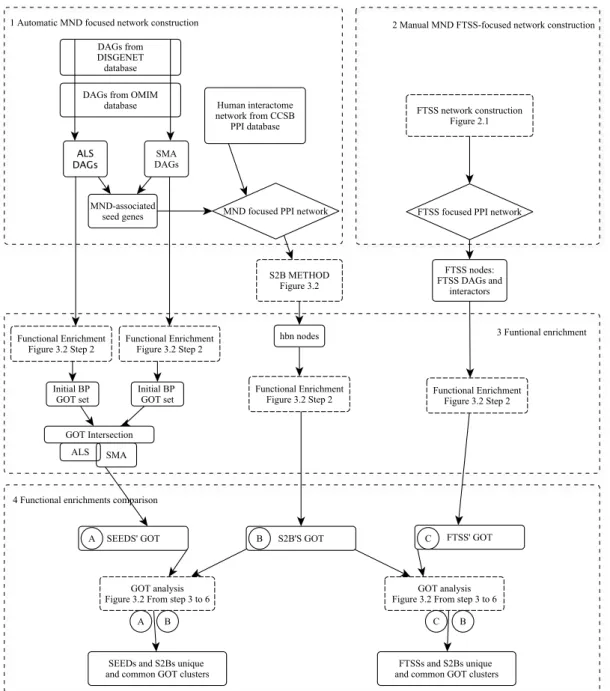
For further analysis of these putative common pathomechanisms, we have pursued two network-based approaches. First, we used four proteins (SMN, FUS, TDP43 and SETX) as seeds to search the human interactome for common interactors, producing a new disease related network (FTSS-focused network). These four proteins where chosen because they are involved with the two diseases, have common molecular functions related with mRNA processing and besides, physically interact with each other. Second, we have developed a method that prioritizes within a human interactome network the proteins that show higher specific betweenness linking ALS and SMA-related genes and thus possibly have key roles in the pathogenesis. In the remaining sections of this chapter, the main concepts behind the followed network-based approaches will be briefly presented.
Network theory
Networks are graphical representations of relations between discrete objects within complex
systems. A complex system is characterized by two main properties; i) they are composed by many components and ii) these components are highly interconnected. The behavior of complex systems is quite different from merely the sum of the properties of its individual parts. Therefore, it is not possible to reliably predict the conduct of a complex system only by the simple extrapolation of the properties of a few components (Anderson P.W. 1972).
Networks are not only a convenient way of representing complex data but also mathematical and computationally easier to handle. Thus, network theory provides a set of techniques to analyze complex systems’ structure and behavior. The nature of complex systems is highly diverse and therefore network theory methodologies have been exploited in variety of disciplines such as: communications, engineering, sociology, ecology and biology (Newman 2003).
The basic mathematical concept used to model networks is a graph. It can be defined as a diagram representing a system of connections or interrelations (edges or links) among several units (nodes or vertices). In this work, the terms graph and network will be used with the same meaning.
Network properties
This section will discuss some important network parameters and measures useful for the analysis and understanding of network characteristics' impact on biological function. A comprehensive description of these properties can be found in Diestel 2000; Mason and Verwoerd 2007; Pavlopoulos et al. 2011; Winterbach et al. 2013 among others.
Interactions are the basis for building meaningful network models. According to edges’ properties we can distinguish different type of networks. Depending on the existence of directionality in the interactions we can sort them in two broad classes: directed or undirected
networks. Depending on the type of interactions and the scientific question to address, edges
may have assigned scalar weights according to the relevance or reliability of the interaction. Thus unweighted networks model homogeneous relationships and weighted networks non-binary ones.
A connected network is a graph wherein any node has a path to reach any other node. When a network is unconnected, subsets of nodes and edges become isolated. These subsets or components can have very different sizes being the biggest one usually called main component. On the other hand, an induced subnetwork is a graph formed by a subset of nodes within a larger network and all the respective edges connecting that subset. Likewise, a clique is an induced subnetwork where every node directly interacts with every other node. The analysis of network structural parameters allows distinguishing amongst various network topologies that in turn involve interesting biological properties. The shortest path, as the name implies, is the minimum number of links one must traverse to move from node u to node v. The distance from a node u to a node v is the length of the shortest path from u to v in the network. The average (or characteristic) path length is the average distance over all pairs of vertices while network diameter is the greatest distance between any pair of connected nodes in a network. Conversely, degree is the number of edges incident on a certain node within the network whereas the degree distribution of a network is the fraction of nodes in the network with degree k. Thus the degree distribution P(k) gives the probability that a selected node has exactly k links. Clustering coefficient of a given node is a ratio between the actual number of edges connecting the node’s direct neighbors and the theoretically maximum number of edges that could connect them. Therefore, it measures the local density of links around a node. Modularity on the other hand quantifies the tendency of a graph to be divided into clusters. Knowing a partition of the network nodes into non-overlapping subsets it is possible to compute a modularity coefficient as the fraction of all network edges that connects nodes in the same subset. A cluster or module is a subset of nodes, which ideally has many more edges within the cluster than edges linking to external nodes. Networks’ modularity is not always evident and usually several clustering algorithms need to be applied in order to get an acceptable modularity coefficient.
The problem of identifying the most important nodes in large complex networks is of fundamental importance (will the discussed more extensively in following sections). The relevance of nodes is usually based on centrality measures because it is commonly assumed that the removal of nodes with central positions in the network can lead to the network connectivity failure. There are several centrality measures based on varied assumptions and metrics. We will only refer two classical centrality measures that have been widely used in networks biology.
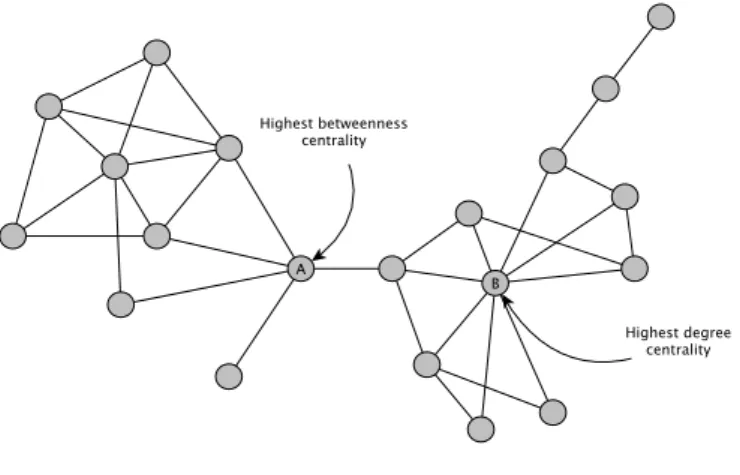
Degree centrality is based on the assumption that: an important node is involved in a large number of interactions. As we referred before, the degree of a node is the number of edges the
node has connecting it to other nodes (illustrated Figure 1.1). Thus, the degree centrality of a node is its normalized degree.
Betweenness centrality is based on the assumption that: an important node will lie on a high proportion of paths between other nodes in the network. Therefore, the betweenness centrality of
a node is the number of shortest paths of the network that include it. Nodes with low degree but high betweenness can be considered bottlenecks because their removal can be fatal to the network connectivity (Yu et al. 2007) (illustrated in Figure 1.1).
Figure 1.1 Illustration of the differences of centrality measures. There are pointed in the network the most central nodes according to degree (B) or betweenness measure (A) respectively. Node A is involved in the highest number or shortest paths and thus is a bottleneck for global connectivity whereas node B shows the highest number of edges (connections). Figure adapted from (Yu et al. 2007).
Besides the identification of central nodes, we can also be interested in finding the nodes that are more closely related with one or more nodes that are relevant under our subject study. The most direct approach is to consider the distance to the relevant node. Unfortunately, in most biological networks this approach is not sufficiently discriminatory as there will be numerous ties in the distance values. Therefore, other approaches have been used that take the information about the number of paths linking two nodes and the length of those paths. These approaches can be based in diffusion (Kondor & Lafferty 2002) or in related random-walk algorithms (Can et al. 2005). The former simulate a diffusion process along the network edges starting from a seed node. After some time, the amount of the diffusible substance in each node measures the relatedness with the seed node. Random walks simulate the iterative trajectory of walkers that decide randomly what is the next node to visit among the direct neighbors of the present node. Different measures based on the trajectories of random walkers (random walk with restarts (Tong et al. 2006) or commute time (Fouss et al. 2007)) can quantify the
The systematic analysis of network parameters, such as degree distribution, characteristic path length or clustering coefficient, allowed researchers distinguish different type of networks models and describe their inherent properties. In this section we will describe three models that had a direct impact on the study of biological networks. For more detailed discussion we suggest several reviews (Newman 2003; Przulj 2011; Raman 2010; Winterbach et al. 2013)
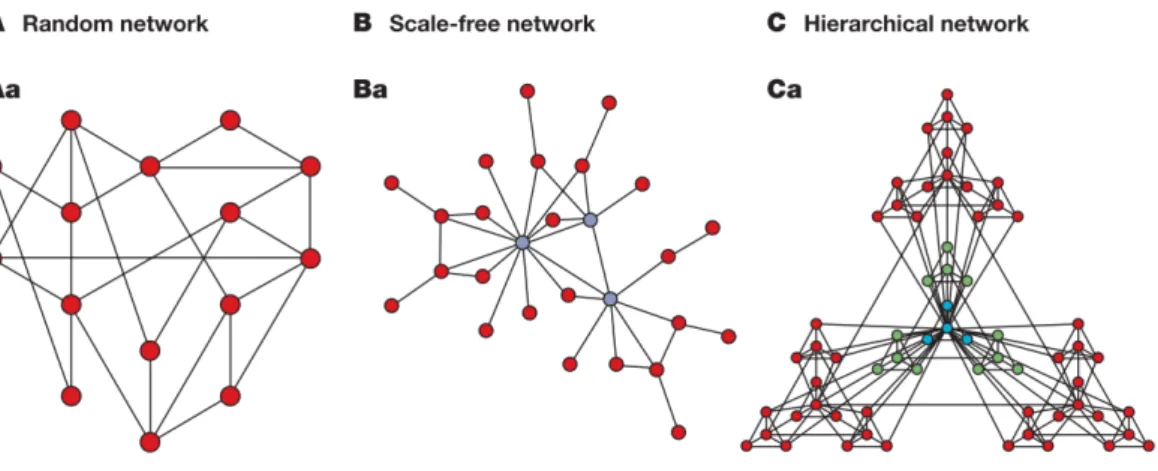
Erdös–Rényi’s random graph (Erdös & Rényi 1960) is the earliest random graph model in
which edges are drawn between pairs of nodes uniformly at random with the same probability (Figure 1.2A). Random molecular networks can serve as a null model against which to compare biological network data results. The assumption is that the likelihood of an observed feature is determined by considering its distribution in randomly generated networks. In order to be more realistic we can apply some constraints in the randomization process. The network feature most commonly maintained is the nodes' degree.
Scale-free networks (Barabasi & Albert 1999) are characterized by a power-law degree
distribution. This means that most of the nodes have relatively low degree while there are other nodes with an unusually high degree (Figure 1.2B). These highly connected nodes are usually called hubs and they may have key roles in the network functionality maintenance and hence have a high biological relevance.
Hierarchical networks (Ravasz & Barabasi 2003) have a scale-free topology with additional
local modular structure (Figure 1.2C). These features are common in biological networks (Barabási & Oltvai 2004), thus we can focus on the biological features that emerge from the hierarchical networks’ topology (Pavlopoulos et al. 2011).
Figure 1.2 Network models that have a direct impact on understanding biological networks. The
figure illustrates Erdös–Rényi (ER) model of a random network (part A) in which edges are drawn between pairs of nodes uniformly at random with the same probability. Then Scale-free networks (part B) are characterized by a power-law degree distribution. Finally hierarchical networks (part C) have a scale-free topology with additional local modular structure. Figure adapted from (Barabási & Oltvai 2004).
Network biology
As Emile Zuckerkandl and Linus Pauling stated in 1962, “life is a relationship between molecules,
not a property of any molecule” (Zuckerkandl & Pauling 1962). This means today that biological
characteristics only arise from intricate interactions between the cells’ constituents, such us DNA, RNA, proteins and small molecules.
Network biology is the combination of systems biology and network theory principles with
computational and statistical analyses in which the topology of the graphs representing molecular interaction networks themselves became the subjects of study (Barabási & Oltvai 2004). The main objective of network biology is the modeling of biological networks and identification of relevant structures (Mason & Verwoerd 2007). As potential applications we can refer drug target identification, protein’s or gene’s function prediction, or the identification of new biomarkers to provide early disease diagnosis (Pavlopoulos et al. 2011).
In biological networks, nodes can represent molecules like genes, proteins, drugs or conditions like phenotypes or diseases. Edges represent interactions or associations between two nodes. According to the type of biological data that we integrate, there are several kinds of biological networks (Laukens et al. 2015; Pavlopoulos et al. 2011; Winterbach et al. 2013) .
Metabolic networks are formed by macromolecules; enzymes, cofactors and other metabolites
needed for catalyzing biochemical reactions. These usually are weighted and directed graphs. Moreover, they are typically scale-free networks.
Signaling networks represent series of interactions between different bioentities such as
proteins, chemicals or macromolecules. They are also usually directed graphs and are characterized by the presence of many feedback loops.
Co-expression networks are constructed with genes as nodes that are linked by edges when a
similar co-expression pattern is found. They are directed networks and are not necessarily weighted.
Transcriptional regulatory networks contain information concerning the control of gene
expression in cells. These networks are imperatively directed graphs. Moreover, they are typically sparsely connected graphs because genes are usually regulated by few transcription factors (Leclerc 2008).
Protein interaction networks hold the information of how proteins operate in coordination
with others to enable the biological processes within the cell. These are typically unweighted and undirected graphs.
Network structure and robustness
Biological robustness is a property that allows a system to maintain its functions despite
external and internal perturbations. It is considered to be a fundamental feature of complex evolvable systems (Kitano 2004). In the context of network theory, robustness is the resilience against node removal. Thus intuitively, a network is robust if its basic functionality (connectivity) is maintained even after the lost of some of its components.
Many biological networks have been described as scale-free or hierarchical networks (Khanin & Wit 2006; Barabasi & Albert 1999; Ravasz & Barabasi 2003). This apparent universality of topological features in biological networks does not seem a merely matter of chance. It is more likely the result of a high degree of internal order governing the cells’ molecular organization in pursuit of a close balance between robustness and evolvability (Jeong et al. 2000; Barabási & Oltvai 2004; Kirschner & Gerhart 1998). Evolvability is the capacity of biological systems to generate a heritable phenotypic variation, that can potentially disrupt system’s robustness (Kirschner & Gerhart 1998).
Therefore, identification of the basic architecture of a robust system and its associated trade-offs is essential for understanding the strengths and weaknesses of a given network. In a biological system these weaknesses can be translated as nodes' essentiality. In random networks if a critical fraction of nodes is removed, the network disintegrates into multiple non-communicating islands of nodes. On the contrary, scale-free networks do not have this critical threshold for disintegration. Even if 80% of randomly selected nodes fail, networks’ integrity is maintained (Albert et al. 2000). This happens because the random failure, by chance, mainly affects low degree nodes. However this simultaneously means that the targeted removal of a few hubs could produce a catastrophic effect.
Robustness against perturbations not only depends on nodes’ degree but also in the modules architecture and components’ dispensability. Besides, modularity itself seems to be a mechanism for limiting the effects of local perturbations in cellular networks. The failure of a cluster blocks a particular function but avoids the general breakdown (Kitano 2004). Furthermore, it has been observed that protein complexes generally are composed of uniformly essential or non-essential molecules (Dezso et al. 2003). Therefore, the functions’ dispensability is usually determined by the whole cluster essentiality (Barabási & Oltvai 2004). It is also intuitive that those nodes with central localization in the network have a greater impact in the network connectivity and then, can be defined as essential nodes for networks robustness maintenance.
Node prioritization, that consists in identifying or ranking the most central nodes in the
network is one of the most challenging aims in network theory (Mason & Verwoerd 2007; Freeman 1978). The key difficulty is the identification of a representative measure of essentiality. Furthermore, some nodes may not be necessarily central but hold crucial roles for particular functions on the networks (Mason & Verwoerd 2007).
Some authors proposed that node degree and essentiality might be related (Jeong et al. 2001) however relationship between centrality and essentiality is still under discussion (Zotenko et al. 2008). Besides, node degree alone seems to be a poor measure of essentiality due to the fact that available data sets are biased toward essential proteins because they are more frequently studied (Przulj 2011).
Protein-protein interaction networks
Among the multiple types of biological networks, protein-protein interaction (PPI) networks combine the availability of abundant data and the potential to uncover novel molecular mechanisms. Proteins are the main catalysts, structural elements, signaling messengers and molecular machines of biological tissues. Thus, protein-protein interactions are extremely important in orchestrating the events in a cell. In other words, PPI networks provide a simplified overview of the web of interactions that take place inside the cell (Raman 2010).
A protein-protein interaction usually refers to a binary relationship between one protein and another. However, the term “protein interaction” can include a great range of events such as transient and stable complexes, as well as physical and functional interactions. And likewise, a wide variety of approaches have been developed to detect protein-protein interactions. These associations may be direct physical interactions identified by experimental methods or indirect functional linkages predicted on the basis of computational analyses. For detailed information about the PPI prediction techniques we suggest two reviews (Raman 2010; Xie & Nice 2014).
Eventually, all this information is stored in numerous publicly available databases. We can classify the PPI databases into three main categories based on the methods used to collect or generate the data:
i) Repositories of experimental data collected through manual curation, computational extraction or direct deposit by the authors [MINT (Licata et al. 2012), IntAct (Orchard et al. 2014)]
ii) Predicted PPI interactions [I2D (new version of OPHID) (Brown & Jurisica 2005)]
iii) Portals that provides unified access to a variety of PPI databases [STRING (Snel et al. 2000), GeneMANIA (Warde-Farley et al. 2010) or mentha (Calderone et al. 2013)]
Here we describe those that were used in this thesis work. For further information about available databases we suggest (Ooi et al. 2010; Raman 2010; Tranchevent et al. 2010).
IntAct (Orchard et al. 2014) is a molecular interaction database that contains manually curated
data from public literature or direct user submission. Most of the interaction data is PPI but also captures non-protein molecular interactions such as DNA and RNA. The detection methods and type of interactions are described together with all binary interaction and have assigned a weight to estimate its relevance. Moreover, IntAct is updated frequently and can also be downloaded (http://www.ebi.ac.uk/intact/).
mentha (Calderone et al. 2013) is a Search Tool that integrates high confidence interaction
information curated by IMEx (Orchard et al. 2012) databases. These primary databases are manually curated but its literature coverage is not complete. Besides, mentha is focused on experimentally determined direct protein interactions, avoiding information extracted from text mining. These facts limit the number of results obtained from mentha when comparing to other search tools such as STRING (Snel et al. 2000) that is more focused on retrieving information with predictive tools from heterogeneous databases. Results are also returned as weighted interactions, which provide a confidence measure (http://mentha.uniroma2.it/).
GeneMANIA (Warde-Farley et al. 2010) is a gene function prediction server that uses a gene
function prediction algorithm to reconstruct a composite network from several PPI databases. It also returns co-expression interactions and other interaction types that can be merged with PPI data in a unique network (http://genemania.org/).
CCSB Database (Rolland et al. 2014) is a compendium of high-throughput datasets that are
focused on the prediction of high-quality binary PPIs. Most interactions gathered on these datasets were mainly mapped in a systematic approach and thus unbiased by the preferential study of proteins with biomedical or technological interest (Rual et al. 2005; Yu et al. 2011; Venkatesan et al. 2009; Rolland et al. 2014). These datasets are complemented with high confidence binary associations from the literature (Rolland et al. 2014). Therefore, CCSB results in a non-biased high confidence database that homogeneously covers the human interactome.
In all the cases, it should be pointed that the already identified PPI collection forms a small portion of the assumed total interactome (Rolland et al. 2014). Besides, the relation of PPI data quality with biological significance is not direct. It should also be remembered that PPI databases contain lots of interactions of proteins with ubiquitins, chaperons, ribosomal proteins and other similarly sticky proteins that might not be biological meaningful for the specific problem under study (Ooi et al. 2010).
Network medicine
The subcellular intricate connectivity implies that the impact of a specific genetic perturbation is not restricted to the activity of its gene product but can spread along the links of the network. Thus, a disease phenotype is rarely a consequence of an abnormality of a single gene but reflects the perturbations of the complex intracellular network (Barabási et al. 2011).
Furthermore, this complexity causes a deviation of the correlation between genotype and phenotype. There exist pleiotropic genes that can produce multiple phenotypes and there are numerous environmental factors that can also influence the gene expression patterns in similar genetic backgrounds (Kann 2007). Therefore, integrative analysis of interactions such as network-based approaches can help us to understand the organizing principles that govern cellular networks and their role in disease.
Network medicine is then the application of networks-based approaches into biomedical
problems. Is the set of methodologies that aims to understand diseases through theirs underlying molecular interactions (Barabási et al. 2011).
Biological functions are accomplished by the coordinated participation of biological components (metabolites, proteins or genes) (Zuckerkandl & Pauling 1962), thus as “guilt by association” principle claims, those proteins that physically interact are strongly suspected to be involved in similar functions (Gillis & Pavlidis 2011; Oliver 2000). Likewise, proteins involved in the same disease-phenotype show a high propensity to interact with each other (Goh et al. 2007; Gandhi et al. 2006; Oti & Brunner 2007). According to this, we can distinguish three types of interrelated modules: i) topological modules that gather highly connected and close nodes,
ii) functional modules that are conformed by nodes with similar functions on the
neighborhood of the network (Spirin & Mirny 2003) and
iii) disease modules that represents groups of nodes that together contribute to a cellular function disruption that results in a particular phatophenotype (Barabási et al. 2011).
Thus, it is accepted that gene products related to a particular pathophenotype tends to be located in a close neighborhood within the protein-protein interaction network and these are usually related to similar functions (Gandhi et al. 2006; Oliver 2000) and vice-versa. Conversely, if a same gene is linked to two different disease phenotypes this linkage is often an indication that the two diseases have a common genetic origin (Barabási et al. 2011).
Furthermore, there is evidence from many sources that similar phenotypes are the result of functionally related clusters of genes and this is even more obvious in the case of genetically heterogeneous diseases (Oti & Brunner 2007). Moreover, genes associated with a disease preferentially interact with other disease-causing genes over those without any known disease association (Aravind 2000). Thus, different disease modules are more prone to overlap, so that perturbations caused by one Disease Associated Gene (DAG) can affect other disease modules (Goh et al. 2007).
The presence of hubs in biological networks suggests that these highly interconnected nodes may play essential roles in biological functions. However, hubs’ essentiality suggest that these nodes cannot be directly associated to disease causative genes. Hubs inactivation could cause the network systemic failure and possibly the early death of the individual. Thus, it is improbable that such genetic alterations can persist in the population (Barabási et al. 2011). Consequently, disease causative genes are expected to be found on the network periphery where they can be more easily tolerated and inherited by the progeny (Goh et al. 2007). Additionally, disease genes seem to be tissue-specific while essential genes are expressed in multiple tissues (Barabási et al. 2011) .
All these observations can be exploited to predict novel DAGs on the basis of the particular location of candidate genes within the studied networks. As such, DAGs prediction (or prioritization) has become one of the most popular applications of network medicine.
Computational methods for gene prioritization are necessary to effectively translate the high-throughput derived experimental data into legible disease-gene associations (Moreau & Tranchevent 2012).
DAGs prioritization methods typically use networks where the nodes are genes or proteins
and the aim is to prioritize the nodes that are more important for a given disease (Bromberg 2013). In these networks data is integrated by attributing weights to nodes and by defining the edges and associated weights. Edges can reflect PPI, co-expression patterns or other molecular interaction information. Centrality measures, distances between nodes or diffusion-based algorithms can then be used to rank all the nodes in the network, prioritizing the nodes most relevant for the disease that are not part of the initial set of DAGs (Tényi et al. 2016; Köhler et al. 2008; Simões et al. 2015; Wu et al. 2015; Calderone et al. 2016).
Others build phenotypic networks in which the nodes are diseases. In particular, Goh and colleagues constructed a highly detailed diseasome network (Goh et al. 2007). Disease networks can helps us comprehend why and how certain groups of diseases arise together, share molecular mechanisms or have common phenotypic properties (Piro 2012). In disease networks, edges can represent varied type of data such as comorbidities (disease co-occurrences), common phenotypic features or common DAGs.
Network based disease-gene prioritization methods require interactomic data and also a minimum set of known DAGs. There are numerous collections of human DAGs (Kann 2007) but we will only describe the two that were used in this work.
OMIM database (Hamosh et al. 2002) is knowledge based, manually curated and frequently
updated. Initially focused on monogenic disorders, nowadays includes information of complex and multifactorial diseases. As part of the NCBI Entrez database, OMIM is freely available and contains over 15 000 genes with known sequence and over 6000 phenotypes. As other comparable databases, it does not constitute a standard library for describing disease phenotypes. The lack of a controlled vocabulary and consistent annotations hampers the information retrieval. DisGeNET (Pinero et al. 2015) is one of the largest repositories currently available of its kind. It integrates expert-curated databases with text-mining data covering information of monogenetic and complex diseases. Besides, it has implemented a score based on evidence to prioritize gene-disease associations. It provides standardized annotations of entities (genes and diseases) and their relationships (ontologies), which helps in the retrieval and analysis of information.
Motor neuron degeneration-related diseases (MND)
Spinal Muscular Atrophy (SMA) and Amyotrophic Lateral Sclerosis (ALS) are both Motor
Neuron Diseases (MNDs), a group of progressive neurological disorders that destroy motor
neurons. These cells control essential voluntary muscle activity such as speaking, walking, breathing, and swallowing. Normally, messages from nerve cells in the brain (upper motor neurons) are transmitted to nerve cells in the brain stem and spinal cord (lower motor neurons) and from them to particular muscles. Upper motor neurons coordinate the lower motor neurons to produce movements such as walking or chewing whereas lower motor neurons control movement in the arms, legs, chest, face, throat, and tongue. In general, affected individuals lose strength and the ability to move their arms and legs, and to hold the body upright. When muscles of the diaphragm and chest wall fail to function properly, individuals lose the ability to breathe without mechanical support. In the most severe cases of SMA, children never sit or stand and the vast majority usually dies of respiratory failure before the age of 2. On the other hand, ALS patients usually die within 3 to 5 years from the onset of symptoms (typically on the third decade of life).
The molecular causes of motor neurons' degeneration are still unclear, limiting therapeutic options and consequently patients’ life expectancy.
Spinal Muscular Atrophy (SMA) is a childhood onset disease characterized by the
degeneration of lower motor neurons (localized in the spinal chord). It is an autosomic recessive disease caused by mutations in the Survival Motor Neuron (SMN1) gene (Lefebvre et al. 1995).
Besides SMN1, SMN2 gene also codifies SMN protein. SMN1 and SMN2 share more than 99% nucleotide identity, and both are capable of encoding a functional SMN protein. How ever, due to a silent substitution in exon 7, ~75-90% of SMN2 transcripts encode for a truncated and unstable splicing isoform of SMN, and thus a very small amount of full length-active protein is actually being produced from this gene (Lefebvre et al. 1995; Kashima et al. 2007; Wirth 2000). Henceforth we will only refer to SMN as a conjunction of both genes.
The SMN protein generates the core machinery for varied RNA-metabolism related functions pathways including pre-mRNA splicing, histone mRNA 3’-end processing and cytoplasmic mRNA decay (Li et al. 2014). The SMN1 gene product forms the SMN complex together with Gemin proteins. SMN complex in turn plays a critical role in the assembly of small nuclear ribonucleoproteins (snRNPs) that constitute the spliceosome machinery (Lefebvre et al. 1995). The spliceosome is a macromolecular ribonucleoprotein (RNP) complex responsible for intron removal from pre-mRNAs (a process commonly known as splicing). This process is critical for the production of correct mRNAs and also for generating transcripts’ diversity through alternative splicing events.
Among the snRNPs, SMN low levels also affects to U7snRNP biogenesis (Tisdale et al. 2013). This
snRNP is crucial for the histone mRNA 3’end processing. Most histone transcripts are not poly-Adenylated and their 3’ ends are produced by an endonucleolytic cleavage mediated by U7snRNP. Besides, SMN is also knwon to recognize methylation marks in histones (Sabra et al. 2013). On the other hand SMN also is involved in axonal mRNA transport. It regulates the mRNA vesicles assembly (Zhang et al. 2006) and interacts with axonal transport machinery by direct association with acting-binding proteins and neuronal RBPs (Fallini et al. 2012). Amyotrophic Lateral Sclerosis (ALS) in the other hand is an adult onset disease characterized by the degeneration of both lower and upper motor neurons (localized in the spinal chord and brain respectively). In 90% of the cases it is a sporadic disease but there are also familial subtypes caused by mutations in numerous genes related to diverse cell functions as oxidative stress (SOD1), RNA metabolism (TARDBP, FUS, Senataxin, Ataxin2, HNRNPA2/B1, ELP3, HNRNPA1), vesicle trafficking (Alsin, FIG4, OPTN, VABP, CHMP2B) and proteasomal function (UBQLN2, VCP) (Siddique & Siddique 2008; Carrì et al. 2015). SOD1 was the first and one of the best-known familial ALS-causative genes (Rosen et al. 1993). SOD1 gene encodes the superoxide dismutase 1 protein, which is responsible for destroying free superoxide radicals produced by the oxidative metabolism. Therefore when it is mutated, cells suffer oxidative stress that induce mitochondrial and endoplasmic reticulum stress that usually results in protein aggregation and apoptosis pathway activation (Carrì et al. 2015). However, should be listed that SOD1 mutation only causes the 1% of ALS cases (Marangi & Traynor 2015).
TDP43 (the TARDBP gene product) was firstly associated to ALS in 2008 (Sreedharan et al.
2008; Rutherford et al. 2008). It is a DNA and RNA biding multifunctional protein that can be localized in the nucleus or cytoplasm according to the function in which it is involved. It has been related to several steps of the gene expression pathway including transcription, splicing, RNA transport and localization, mRNA decay (stabilization) and translation (Lagier-Tourenne et al. 2010).
FUS also identified as ALS-causal gene (Kwiatkowski Jr et al. 2009) is as well a
nucleocytoplasmic-shuttling multifunctional protein that not only binds to RNA but also to DNA. Thus it is involved in DNA and RNA metabolism including DNA repair, regulation of transcription, RNA splicing and RNA export to cytoplasm(Lagier-Tourenne et al. 2010).
Senataxin (SETX) was firstly related to a juvenile form of Amyotrophic Lateral Sclerosis (ALS4)
(Chen et al. 2004). It belongs to the superfamily I of DNA-RNA helicases and it is involved in diverse aspects of RNA metabolism and genome integrity maintenance.
Senataxin coordinates the binding of RNA polymerase II (pol II) to chromatin and therefore, regulates the transcription in all steps. The nascent RNA is coated by RBPs that protect it from the template DNA-strand. This potential DNA/RNA hybrid structure is called R-loop and pauses pol II progression allowing the correct termination of transcription. In absence of R-loop structure, transcription continues leading to read-through intergenic products (Richard & Manley 2016). Additionally, for the proper ending of transcription it is also necessary the R-loop resolution conducted by Senataxin. Lack of SETX activity induces genome damage and instability (Skourti-Stathaki et al. 2011). To simplify we refer SETX both to gene and Senataxin protein.
RNA-metabolism events are ubiquitous and necessary for all cells’ survival thus, we are still missing the molecular link between RNA related functions and MNs specific degeneration. Within this set of functions associated to MND-DAGs, splicing seems to be the central piece. SMN is the main causal gene of SMA disease and is directly involved in splicing function maintenance (Lefebvre et al. 1995). On the other hand, ALS related gene products of FUS and TDP43 are also involved in splicing related functions. Furthermore, nervous tissue has an extremely high alternative splicing activity, which is believed to have a great relevance for neural development and differentiation (Madgwick et al. 2015). However, these DAG-products are multifunctional proteins, thus it is not clearly evident which is the key function that, when perturbed, leads to the MND phenotype.
Moreover, there are further non-RNA metabolism related functions directly associated to the MN death. Some authors believe that, due to the high sensitivity of the nervous tissue to reactive oxygen species (Friedman 2011), oxidative stress could be the main disturbing agent. The oxidative stress may be produced by SOD1 dysfunction that leads to protein aggregation, mitochondrial and endoplasmic reticulum stress and eventually induces apoptosis (Carrì et al. 2015).
Others claim that the main cause is the genotoxic stress induced by deregulation of histone expression as a consequence of SMN dysfunction (Tisdale et al. 2013)This hypothesis is also plausible due to the critical role of chromatin remodeling in nervous tissue development and differentiation (Pattaroni & Jacob 2013). Therefore, although several hypotheses about MN degeneration initiation causes have been proposed, the specific pathomechanisms are still unknown. Phenotypic and genetic similarity between ALS and SMA suggest the presence of closely related disease modules and opens the door to the study of their common molecular pathomechanisms using network-based approaches.
Objectives
ALS and SMA are diseases with different causes but common complex phenotypes. In both cases the molecular mechanisms that link the causes of disease with motor neuron degeneration are not completely known. This thesis work aims to apply network biology approaches to
characterize common molecular pathways involved in ALS and SMA. In particular this
thesis will:
1 – Analyze a protein interaction network around proteins known to be involved in both
diseases and in a common molecular pathway – RNA processing (Chapter 2)
2 – Develop a network-based prioritization method to identify relevant proteins
specifically connecting genes associated with both diseases (Chapter 3)
Chapter 2: FTSS-focused network
Introduction
ALS and SMA show great phenotypic and molecular similarities. FUS, TARDBP (TDP43) and SETX are ALS-associated genes (Rutherford et al. 2008; Sreedharan et al. 2008; Kwiatkowski Jr et al. 2009; Chen et al. 2004) while loss of SMN activity is the main cause of SMA (Lefebvre et al. 1995).
These four genes (FTSS) are known to physically interact (Sun et al. 2015; Tsuiji et al. 2013; Yamazaki et al. 2012; Skourti-Stathaki et al. 2011; Zhao et al. 2016; Suraweera et al. 2009; Bennett & La Spada 2015). Furthermore, all four proteins are involved in RNA processing, which may have direct implications on MND common phenotype (Cooper et al. 2009).
Gems are nuclear structures that contain SMN complex components but not snRNPs. Both TDP43 and FUS have been found to bind SMN and accumulate in Gems thus seem that they are required for the maintenance of these structures (Ishihara et al. 2013; Tsuiji et al. 2013; Yamazaki et al. 2012). Gems’ function is still unknown but probably they are directly related to snRNP maturation processes (Liu & Dreyfuss 1996; Cioce & Lamond 2005; Clelland et al. 2009). Additionally, it was found that Gems assembly is disrupted in ALS model SOD1 deficient mutant mice (Kariya et al. 2012). All these evidences place Gems structures at the core of ALS and SMA-related events, being the snRNP immaturity a potential key factor in MN degeneration.
Together with SMN, FUS has been found to interact with U7snRNP and therefore, it is suspected to be involved in histone mRNA biogenesis (Raczynska et al. 2015). This fact is relevant in MND context because it is known that transient histones modifications can produce lasting cellular changes that influence the synaptic plasticity (Levenson & Sweatt 2005). Moreover, histone biogenesis perturbation can also lead to global chromatin changes that eventually induce cellular genotoxicity (Tisdale et al. 2013).
Additionally, FUS is also involved in DNA damage response events (Rulten et al. 2014) together with SMN that at the same time acts as intermediary between SETX and RNA Pol II to coordinate R-loop formation in RNA elongating complexes (Zhao et al. 2016). In the same way, SETX has been directly related to the immune response depression and when mutated to a hyper-sensitivity to infections (Miller et al. 2015). This fact may be key in MND because SETX is already associated to ALS4 (ALS type 4) and ataxia with oculomotor apraxia (AOA2) (Chen et al. 2004). Besides it is known that the prolonged immune response and expression of inflammatory mediators leads to cell death and neurodegeneration (Amor et al. 2010; Friedman 2011).
On the other hand, it has been observed in mice that the increase of SMN levels improves the neuromuscular function altered by the oxidative stress produced by the lack of SOD1 activity,
typical in ALS (Turner et al. 2014). Likewise, SETX and FUS are involved in DNA damage response generated by oxidative stress (Suraweera et al. 2007; Rulten et al. 2014) and thus, their concurrent failure could lead to fatal perturbations.
These evidences strongly suggest that FTSS proteins are tightly interrelated and physically interact to perform functions mainly related to RNA metabolism. Though RNA metabolism seems to have a central role, it has not been explained yet how RNA-related ubiquitous functions may lead to the death of MN in particular. Furthermore, some authors suggest that the widespread changes in splicing are an indirect feature of the delayed neuronal development (Garcia et al. 2013) caused by the perturbation of synaptogenesis (Zhang et al. 2013). On the same theme, the evidences of perturbations in varied functions non-related to RNA-metabolism raises further doubts about the initial steps on MND.
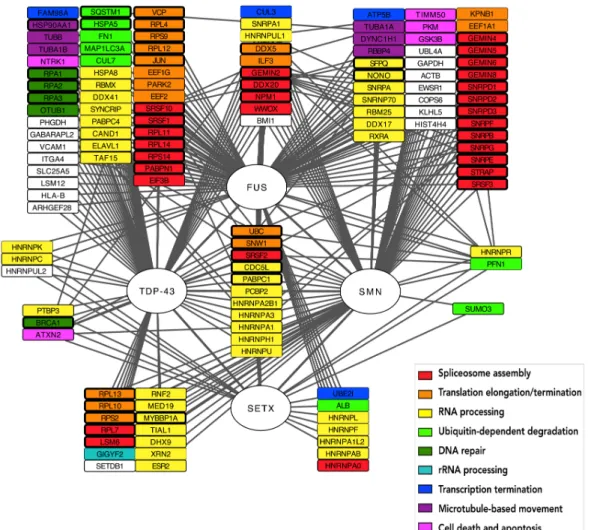
To answer these questions, we have constructed a PPI network focused only on FTSS genes and its common interactors (FTSS-focused network) and performed a functional enrichment analysis to characterize this protein set. We expect that, the overrepresented functions resulting from this analysis may bring clues about MND-related pathomechanisms.
Methodology
PPI data retrieval
FUS, TDP43, SMN and SETX (FTSS) protein physical interactors were retrieved from mentha (Calderone et al. 2013) (http://mentha.uniroma2.it/), IntAct (Orchard et al. 2014)
(http://www.ebi.ac.uk/intact/), GeneMANIA (Warde-Farley et al. 2010)
(http://genemania.org/) and literature references (Sun et al. 2015; Tsuiji et al. 2013; Yamazaki et al. 2012; Skourti-Stathaki et al. 2011; Zhao et al. 2016; Suraweera et al. 2009; Bennett & La Spada 2015). The referred databases where accessed during November 2015.
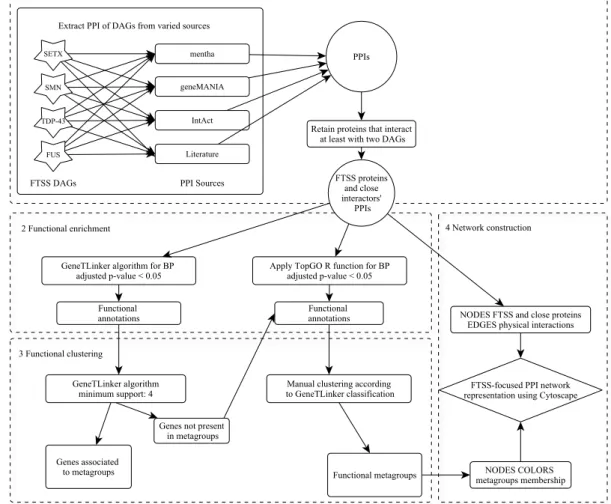
To facilitate the retrieval of SMN PPIs, the physical interactions found with both SMN1 and SMN2 genes were included. We only selected PPIs identified in Homo sapiens and described as physical interactions (Figure 2.1-1). From the initial set of interactor proteins, only the proteins that interacted with at least two of the FTSS proteins were retained (Figure 2.1 step 1). All raw and curated datasets are available in Supplementary data S-2.1.
FTSS-focused network functional enrichment and functional clustering
Functional enrichment analysis and functional clustering were performed simultaneously using Gene Term Linker (GTLinker) algorithm (Aibar et al. 2015) available within the FGNet R-package and through http://gtlinker.cnb.csic.es/.
The functional enrichment was constrained to Biological Processes (BP) Gene Ontology Terms (GOTs) annotated in Homo sapiens proteins. GOT enrichment was considered statistically significant with a False Discovery Rate (FDR) adjusted p-value less than 0.05 (Figure 2.1-2).
Figure 2.1 Flowchart describing FTSS-focused network construction methodology. FTTS-focused
network is constructed using PPI related to FTSS proteins. Proteins were maintained if interact with at least two of the FTSS proteins (step 1). Then, there was performed a functional enrichment analysis using GTLinker and TopGO algorithms (step 2). Metagroups created by GTLinker algorithm were manually edited (step 3) and finally FTSS-network with functional annotation was constructed (step 4).
The GTLinker clustering algorithm was applied to annotations with at least 4 associated proteins (minimum support) (Figure 2.1-3). Since GTLinker metagroups are formed by varied GOTs, we manually assigned general titles to each cluster. Besides, GTLinker does not return
functional information from proteins excluded by the clustering algorithm so, we also performed an additional functional enrichment analysis using topGO R function (Alexa & Rahnenfuhrer 2010) (Figure 2.1-2). We used this functional data to, when possible; manually include the remaining proteins into the metagroups suggested by GTLinker result (Figure 2.1-3). All data relative to functional enrichment and clustering analyses are available in Supplementary data S-2.2.
FTSS-focused network construction
The PPI data and functional information collected in previous steps was finally plotted as a network using Cytoscape software version 3.4.0 (Shannon et al. 2003) (Figure 2.1-4).
Results and Discussion
PPI data retrieval
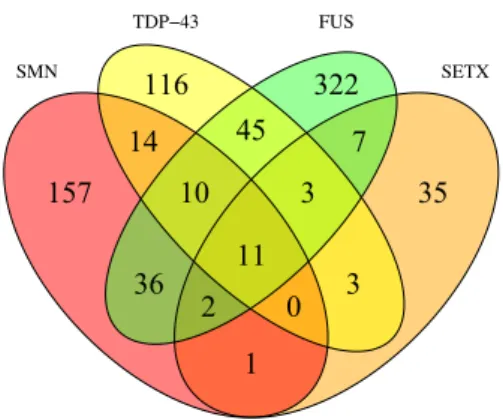
The initial sets of interactions originated a network with 636 proteins and 1007 interactions with the FTSS proteins. Only proteins that interact with at least two of the four studied proteins were retained, resulting in a final set of 136 proteins and 377 interactions
.
Figure 2.2 Venn diagram describing retrieved FTSS-related PPIs: Each
overlapping area describes the number of intermediary proteins interacting simultaneously with FUS, TDP43, SMN and/or SETX. Those non-overlapping areas describe the number proteins that interact only with a single FTSS protein and thus were removed from the FTSS-focused network.
According to Figure 2.2, FUS is the most promiscuous protein having described a total of 436 PPIs. Besides it is the protein that more PPI losses (322) when filtering which reflects FUS multifunctionality and plus demonstrates that it is also involved in many functions non-related 116 45 322 14 10 11 3 7 157 36 2 0 3 35 1 SMN SETX TDP−43 FUS