EVALUATING FOREST SPECIES RESPONSE TO
DIFFERENT CLIMATE CONDITIONS AS A BASE FOR
SUSTAINABLE FOREST MANAGEMENT UNDER CLIMATE
CHANGE
ANTÓNIO HENRIQUE COSTA GOMES SOARES CORREIA
SCIENTIFIC ADVISORS:
Ph.D Maria Helena dos Reis Noronha Ribeiro de Almeida Ph.D Margarida Tomé
Ph.D Ander Arias
THESIS PRESENTED TO OBTAIN THE DOCTOR DEGREE IN
FORESTRY ENGINEERING AND NATURAL RESOURCES
EVALUATING FOREST SPECIES RESPONSE TO
DIFFERENT CLIMATE CONDITIONS AS A BASE FOR
SUSTAINABLE FOREST MANAGEMENT UNDER CLIMATE
CHANGE
ANTÓNIO HENRIQUE COSTA GOMES SOARES CORREIA
SCIENTIFIC ADVISORS:
Ph.D Maria Helena dos Reis Noronha Ribeiro de Almeida; Ph.D Margarida Tomé; Ph.D Ander Arias (NEIKER Tecnália)
Jury:
President: Doutora Maria Teresa Marques Ferreira, Professora Catedrática, Instituto Superior de
Agronomia, Universidade de Lisboa.
Members: Doutora Maria da Conceição Lopes Vieira dos Santos, Professora Catedrática,
Faculdade de Ciências, Universidade do Porto; Doutor Filipe Duarte Santos, Professor Catedrático, Faculdade de Ciências, Universidade de Lisboa; Doutora Maria Helena Reis de Noronha Ribeiro de Almeida, Professora Associada, Instituto Superior de Agronomia, Universidade de Lisboa; Doutora
Maria João Magalhães Gaspar, Professora Auxiliar, Escola de Ciências da Vida e do Ambiente, Universidade de Trás-os-Montes e Alto Douro; Doutora Nahia Gartzia Bengoetxea, Investigadora,
Neiker-Tecnalia Basque Institute for Agricultural Research and Development, Espanha.
THESIS PRESENTED TO OBTAIN THE DOCTOR DEGREE IN
FORESTRY ENGINEERING AND NATURAL RESOURCES
Programa de doutoramento FCT (Sustainable Forests and Products, SUSFOR)
PD/BD/52405/2013
2019
i Abstract | António Correia
Abstract
To anticipate European climate scenarios for the end of the century, we explored the climate gradient within the REINFFORCE (RÉseau INFrastructure de recherche pour le suivi et l’adaptation des FORêts au Changement climatiquE) arboreta network, established in 38 sites between latitudes 37◦ and 57◦, where 35 tree species are represented. Understanding how climate affects tree phenology, biotic and abiotic vulnerability, is a most important research subject under Climate Change. We focused on determining which climatic variables best explain their survival and growth, and identify which species that are more tolerant to climate variation and those whose growth and survival future climate might constrain. We used empirical models to determine the best climatic predictor variables that explain tree survival and growth, to predict the impact on the specific response of tree species to changing climate scenarios, to evaluate the loss and assess the risk of maintaining or changing species, under each scenario. Considering the scenarios described on IPCC’s Fifth Assessment Report, predictions were run under two main Representative Concentration Pathways (RCP) 4.5 and 8.5. Precipitation-transfer distance was most important for the survival of broadleaved species, whereas growing-season-degree days best explained conifer-tree survival. Growth (annual height increment) was mainly explained by a derived annual dryness index (ADI) for both conifers and broadleaved trees. Species that showed the greatest variation in survival and growth in response to climatic variation included Betula pendula Roth, Pinus elliottii Engelm., and Thuja plicata Donn ex D.Don, and those that were least affected included Quercus shumardii Buckland and Pinus nigra J.F.Arnold. We also demonstrated that provenance differences were significant for Pinus pinea L., Quercus robur L., and Ceratonia siliqua L. A higher survival risk is expected for conifer species, especially for species like Calocedrus decurrens, Pseudotsuga menziesii, and Pinus nigra. For growth, high risk is indicated for Larix decidua, Pinus pinaster, and Betula pendula. Risk distribution points to higher risk at southern sites, and higher production potential for northern sites. Here, we demonstrate the usefulness of infrastructures along a climatic gradient like REINFFORCE to determine major tendencies of tree species responding to climate changes.
Keywords: climate response; climate adaptation; REINFFORCE; Pinus; Quercus; Cedrus; Eucalyptus; Betula; Pseudotsuga; Sequoia
ii Abstract | António Correia
iii Resumo | António Correia
Resumo
As alterações climáticas são reconhecidamente atualmente como um fato que ocorre com impacto nos sistemas naturais e humanos em todos os continentes. Ao longo da História, as populações humanas e os ecossistemas sofreram ajustes e adaptações ao clima, variabilidade climática e fenómenos extremos, com diferentes proporções de sucesso. No entanto, estima-se que as alterações climáticas estejam a ocorrer a um ritmo demasiado elevado para permitir uma adaptação natural dos sistemas. Compreender como o clima afeta a fenologia, a vulnerabilidade a danos bióticos e abióticos, revela-se de extrema importância para a antecipação dos efeitos das alterações climáticas sobre a floresta. O aumento esperado da temperatura potenciará um alongamento do período de crescimento, o qual poderá afetar a exposição a pragas e agentes patogénicos. Em conjunto com diminuição da quantidade de precipitação anual, ou o aumento da extensão da época sem chuva, proporcionará um aumento do stress hídrico, nas regiões mais a sul. Adicionalmente, os eventos climáticos extremos combinados com as alterações na fenologia potenciam consequências dramáticas, nomeadamente a antecipação do abrolhamento com exposição a geada. Não obstante, existe a previsão de um aumento de produtividade da floresta a norte, por conta do aumento de temperatura e concentração de CO2 atmosférico, permitindo acompanhar o acréscimo da procura de produtos florestais. Muitos trabalhos têm focado a modelação do comportamento futuro das espécies, procurando prever o efeito das condições futuras no material de regeneração florestal, através da sua distribuição atual. Outros, porém, utilizam modelos de base fisiológica com dados obtidos em ambiente controlado, para uma pequena amostra representativa da espécie. A informação gerada por estes meios é extremamente importante, embora recorram a necessárias simplificações de forma a permitir um melhor ajuste para os modelos. Uma dessas simplificações é a omissão da variabilidade genética intraespecífica, que afeta necessariamente de forma positiva ou negativa, a capacidade de uma espécie enfrentar as condições futuras, expressa na variação do comportamento ao longo dos gradientes climáticos. De forma a antecipar os efeitos das alterações climáticas na Europa que se esperam ocorrer até ao fim do século, neste trabalho propomos explorar o gradiente climático abrangido pela rede de arboreta REINFFORCE (RÉseau INFrastructure de recherche pour le suivi et l’adaptation des FORêts au Changement climatiquE),
iv Resumo | António Correia
estabelecida em 38 locais entre as latitudes 37◦ e 57◦, onde estão instaladas 35 espécies, cuja variabilidade genética de cada espécie é representada por pelo menos 3 proveniências.
Como objetivo geral para este trabalho, procurámos determinar quais as variáveis climáticas com maior poder explicativo para o crescimento e sobrevivência destas espécies, e perceber que espécies apresentam uma maior tolerância á variabilidade climática, assim como aquelas que poderão sofrer maiores constrangimentos sob os cenários climáticos previstos.
Na primeira fase do estudo (Artigo I), nos dois arboreta da rede REINFFORCE localizados mais a sul (Lisboa e Sintra), foram monitorizadas 3 espécies, uma nativa (Quercus robur L.) e 2 não nativas (Quercus rubra L. e Betula pendula Roth). Foram avaliados o crescimento, fenologia foliar e danos por insetos, de acordo com os protocolos definidos para a rede REINFFORCE. A interação Espécie x Site revelou-se significante para sobrevivência e crescimento. Na fenologia observaram-se diferenças entre e dentro das espécies. Não foram observadas diferenças significativas para tolerância ao frio. A Betula. pendula apresentou um abrolhamento mais precoce em ambos os locais, consequentemente beneficiou do período de crescimento mais alargado e maior crescimento em altura, sendo menos afetada por danos por insetos, embora a sobrevivência tenha revelado suscetibilidade a temperatura mais elevada, onde a espécie Quercus robur apresentou melhor desempenho.
Na segunda fase do estudo (Artigo II), que beneficiou de toda a informação disponível na rede de 38 arboreta Reinfforce, utilizámos modelos empíricos para determinar as melhores variáveis climáticas preditoras para o crescimento e sobrevivência das plantas. A variável com a qual se obteve melhor ajustamento dos modelos para o crescimento de ambos os grupos de espécies foi o índice anual de aridez (Annual Dryness Index – ADI) que é calculado como a raiz quadrada do valor anual em graus de dia acima dos 5ºC, dividido pelo valor anual de precipitação. Para a sobrevivência, a variável que se revelou mais expressiva para o grupo das coníferas foi o valor em graus de dia acima de 5ºC para a época de crescimento (março-setembro); para as folhosas, a distância climática para a precipitação anual entre arboterum e local de proveniência do material, proporcionou um melhor ajustamento para a sobrevivência. Identificaram-se as espécies que apresentam maior e menor amplitude na variabilidade para o crescimento e sobrevivência ao longo do
v Resumo | António Correia
gradiente climático da rede. Isto revelou que algumas espécies se apresentam maior resistência aos efeitos da variação do clima.
Utilizando os modelos ajustados e as variáveis preditoras resultantes da fase anterior do trabalho, na terceira fase (Artigo III) calculou-se o risco em crescimento e sobrevivência inerentes a cada uma das espécies, através de uma metodologia probabilística, sob o efeito de 2 cenários de alteração climática, RCP 4.5 W/m2 e RCP 8.5 W/m2 e dois horizontes temporais, 2050 e 2080. O risco avaliado revelou que espécies importantes para produção florestal na Europa, como Pinus pinaster, Betula pendula e Larix decidua, apresentam valores elevados de risco, ou seja, de potencial perda de crescimento e sobrevivência, para os cenários previstos. Sob este contexto, foi possível identificar quais as espécies que apresentam menor risco, ou mesmo negativo, podendo apresentar alternativa viável para uma manutenção da produtividade a médio e longo prazo. São as espécies Pinus ponderosa, Pinus brutia e Acer pseudoplatanus. O híbrido Eucalyptus x gundal, apesar de apresentar um valor não negligenciável de risco de sobrevivência, particularmente para 2080, possui um potencial de crescimento elevado, compensando a opção por este material de regeneração florestal. Deve referir-se que os maiores valores de risco são observados nos locais onde as espécies apresentam atualmente melhor desempenho, e que o potencial de crescimento será mais elevado no centro e norte da rede. Para as localizações a sul, a conjugação do aumento de temperatura com a redução de disponibilidade hídrica, potencia o aumento do risco para espécies identificadas como tolerantes à secura, como a Quercus suber.
É importante referir que o presente estudo assenta nos dados dos primeiros 4 anos após a instalação das referidas espécies, sendo esta fase de extrema relevância para o estabelecimento de um povoamento e de grande suscetibilidade para as plantas. Estes resultados contribuem para uma compreensão global do potencial das espécies face às alterações climáticas, servindo de suporte para uma a tomada de decisão ao nível da indústria e política florestal, para fomentar uma floresta adaptada, capaz de manter a produtividade mesmo sob condições futuras mais adversas. O estudo corrobora ainda a importância da rede de arboreta REINFFORCE como ferramenta para monitorizar de forma contínua o impacto das alterações climáticas nas espécies florestais e proporcionar bases para a migração assistida de espécies, considerando os cenários de alterações climáticas.
vi Resumo | António Correia
Keywords: resposta ao clima; adaptação ao clima; REINFFORCE; Pinus; Quercus; Cedrus; Eucalyptus; Betula; Pseudotsuga; Sequoia
vii Aknowledgments | António Correia
Acknowledgments
I would like to take this opportunity to acknowledge the support and friendliness that contributed to the execution and completion of the present work.
Firstly, to the REINFFORCE team – Francis, Rebeca, Christophe, Nahia, Maria José, Javier, Julio, Carmen, Richard and all the others who embraced the challenge to address the climate change adaptation by this means, and provided the data and knowledge that initiated the present work.
To Carla Faria, Ana Rodrigues, Rui, Maria, Lurdes, Madalena, Catarina Cruz and the other friends from ISA’s staff, for their friendship and help to face the hard fieldwork.
To the thesis supervisor team and Professors who helped in the beginning and the end of the process, Ander Arias, Margarida Tomé, Manuela Branco, Helena Pereira, Francisco Castro Rêgo
To the Professors and Friends who left an imprint on my learning and personality throughout my journey, António Fabião, João Santos Pereira, António St. Aubin, José Tomé, and Hachemi Merauani who also helped me in the field with the collection and conservation of Quercus ilex and Quercus suber seeds.
To the Institutions and their Representatives, who facilitated the fieldwork, and sometimes endured the hard fieldwork side-by-side with me, Maria João Gaspar and UTAD, and Nuno Oliveira and Parques de Sintra - Monte da Lua
To Fellow SUSFOR students, with whom I exchanged life experiences and help with the hard Mathematical courses– André, Juan, Ana, Carla, Sofia, Teresa, Júnia and Raquel.
A special word of thanks to Professor Maria Helena Almeida, who provided both scientific and emotional guidance, helping to withstand the long, hard path, with whom I learned so much, not only for improving the researcher but also the character.
To my parents, for their understanding and support all along this stormy path.
To my family, Henrique, Margarida, and Patrícia, for their love and unwavering support, with whom I’ve learned to fight for what is really important, and that “impossible” is just a minor word… when your mind is set for the right goal!
viii Aknowledgments | António Correia
ix Preamble | António Correia
Preamble
The REINFFORCE arboreta network
In order to implement a climate response study in the Atlantic Region, to assess field vegetable material performance, infrastructure was installed in 4 countries, uniting 18 partners around the problematic of Forest adaptation to Climate Change (EFI/IEFC, Neiker, HAZI, Xunta de Galicia, iuFOR, GAV, Azorina, DRRF, FPF, INRA, Forest Research and ISA). This infrastructure, named REINFFORCE Network, was installed in 2012 and aims to provide continuous information with less uncertainty. The network extends from Scotland (North) to Lisbon (South), and from Bordeaux (East) to the Azores (West), taking advantage of very different climatic conditions. This network is composed by 38 sites, called Arboreta, each one being a collection of exactly the same genetic material, composed by 35 species, represented by at least 3 provenances from its current distribution, in order to capture maximum species variability (Orazio et al, 2013). The North/South and East/West extension of this Network allows to explore a gradient of climate conditions specifically designed to mimic temporal expected changes and the range of predicted future climate scenarios.
The present work results from the first four years of data generated by this combined effort of measuring, monitoring and maintenance.
x | António Correia
xi Contents | António Correia
Contents
Abstract ... i Resumo ... iii Acknowledgments ... vii Preamble ... ix Chapter I – Introduction ... 1Problem / Knowledge gap ... 1
Research goal and objectives ... 3
Thesis structure ... 4
Material and methods ... 4
Chapter II – Original contributions ... 6
Description of the original contributions ... 6
I. Monitoring two REINFFORCE arboreta: first result on site, climate and genetic interaction showing the impact on phenology and biotic damages. ... 9
II. Early Survival and Growth Plasticity of 33 Species Planted in 38 Arboreta across the European Atlantic Area ... 40
III. Probabilistic risk analysis for 33 forest species survival and growth under RCP 4.5 and 8.5 scenarios in western Europe using REINFFORCE arboreta network results. ... 61
Chapter III – Conclusions ... 80
Conclusion ... 80
Originality and value of the research goals ... 81
Outcomes at a glance ... 82 Final remarks ... 83 References ... 85 Annex ... 87 Funding ... 87 Presentations ... 87 Posters ... 88
Supplementary material for Article I ... 90
Supplementary material for Article II ... 99
xii Contents | António Correia
1 Chapter I | António Correia
Chapter I – Introduction
Problem / Knowledge gap
For the past 25 years, Forest global area has decreased 1.29 billion hectares, mainly due to deforestation and climate-related constraints, albeit planted forest has shown an increase of 10.4 million hectares, also in areas considered highly susceptible to climate change effects (Payn et al. 2015). But can one say that the reforestation material being used is the most suited to cope with future climate conditions? When addressing the Climate Change impact on Forest Species, there is still an implicit uncertainty that constrains the application of acquired knowledge into new management options for Forest adaptation (Lindner et al. 2014). Yet, planning an adaptation towards an uncertain future has been recognized as a need to minimize the risks and maximize the opportunities that climate change presents to sustainable forest management (Edwards et al. 2012).
Prediction of future climate includes not only an increase in mean temperatures (IPCC 2014) in temperate latitudes but also greater variability in temperatures (Rigby and Porporato 2008). In addition to climate trends, extreme events had already been identified as a major cause of forest dieback (Bréda and Peiffer 2014). The future climatic scenarios for Portugal point to an increase in average summer temperatures from 0.3 to 0.7ºC in a short-term period (2016-2035), and up to 4.6ºC until 2100. As far as precipitation is concerned, the estimates suggest a reduction of annual rainfall from 20 to 40%, especially in Southern Portugal. Water stress will represent a leading constraint to primary production. The combined effects of drought and high temperatures will bring decreases in carbon assimilation in some areas. Changes in plant phenology, (i.e. increased growth period due to winter warming), together with elevated atmospheric carbon dioxide will not alter this trend. Another expression of the predicted climate change effect is the rising the risk of forest fires. Other extreme meteorological events will become more frequent, with non-periodic droughts (several years’ duration) causing mortality and irreversible changes in the plant community, heat waves causing forest fires, storms generating strong winds and the consequent overthrow of trees, flash floods and soil erosion (Santos, F.D. and Miranda, P. 2006).
2 Chapter I | António Correia
Climate change will require trees to cope with new biotic and abiotic environments and stresses, such as drought, temperature extremes, flooding, wildfire, and novel insect and disease pressures (Eriksson et al. 2013). Nevertheless, uncertainty constrains the application of acquired knowledge into new management options for Forest adaptation (Lindner et al. 2008, 2014). Current impact assessments with simulation models contain several simplifications, which explain the discrepancy between results of many simulation studies and the already observed changes in forest productivity and species distribution (Lindner et al. 2014). One of the simplifications is the failure to include species’ phenotypic plasticity when modeling, due to a shortage of information on plasticity in response to future climate conditions.
Patterns of genetic variation vary greatly among species: some species are climatic specialists that exhibit strong differentiation over small geographic and climate scales, while others are generalists that show less differentiation across a wide range of environmental gradients. Some species can also exhibit multiple adaptive strategies over different portions of their range. Based on the knowledge of silvics and population genetics, as well as on studies of forest responses to past climate conditions, it is possible to anticipate that plants that are genetic specialists will be most vulnerable to climate change. This would be especially apparent during the regeneration and juvenile phases of growth, and in moisture-limited areas (Eriksson et al. 2013). Every species and every life stage of each species respond differently to changing climate variability. While all will respond to some extent to a general increase in temperature and a regional increase or decrease in precipitation, the climate seasonality with its seasonal shifts in extremes will very differently affect the many species that combine to make forest ecosystems. Many responses are to extremes rather than to means, and therefore larger uncertainties in the projections of climate extremes cause considerable uncertainties when assessing the likely response of forest ecosystems towards the end of the current century (Lindner et al. 2014).
Sustainable Forest Management is based on the principle of maintaining and enhancing the long-term health of forest ecosystems while providing environmental, economic, social, and cultural opportunities for current and future generations (Edwards et al. 2012). Genetic diversity is, in this context, a tool that should be used and made available for forestry management, providing adequate Forest Regeneration Material to withstand the challenges that emerge with Climate Change, mainly drought condition. Forest stand regeneration is, therefore, an opportunity to increase stand resilience, which can be achieved using
best-3 Chapter I | António Correia
fitted Forest Regeneration Material, from the proper provenance region (ENAAC, 2013). Genetically diverse and adapted seed as well as planting stock will provide the foundation for healthy forests and ecosystems in the future. If climate change proceeds as predicted, a major concern is that planting stock originating from fixed contemporary seed zones will be growing in sub-optimal conditions by the end of the century or sooner (Eriksson et al. 2013).
Research goal and objectives
The proposed work aims to improve our understanding on 35 forest species field performance established in 38 arboreta, located along a range of climatic conditions, from latitude 37° to 57° N, in a range of climatic conditions enabling to assess adaptation measures for Atlantic forest resources. This will allow reducing the uncertainty of species’ behavior predictions in response to Climate Change, contributing to a successful Sustainable Forest Management.
To achieve the main goal, the work is divided into 2 chained objectives:
Objective 1- General climate response model
a) To identify the main climate variables explaining species’ response variation along the network’s range;
b) To determine which species present a significant different response within the network's climate range (phenotypic plasticity), using the full range of arboreta and all of the species represented;
c) To estimate how climate variation impacts each species' growth and survival, and determine the climate range that can be considered optimal
Objective 2-Using general response models as a basis to perform risk analysis
4 Chapter I | António Correia
Thesis structure
The present thesis is organized in 3 chapters. The first chapter introduces the climate change problematic in the Forest context, including the proposed route to deal with the uncertainty, and to promote a better adapted forest. The second chapter consists of three original contributions, published or submitted to peer-review scientific journals. The last chapter consists of conclusions, final remarks, and references for the overall thesis. The Annex section provides the reader with the funding information for the present work, as well as the additional outputs generated by the study, for the purpose of dissemination of the results among the community.
Material and methods
Material
In order to assess field impacts that future climate conditions may induce in 35 forest species, a “Space for Time” approach is achieved using the REINFFORCE arboreta network. This will allow to simulate several expected climate conditions, to test species’ plasticity and local adaptation capabilities, and to identify optimal and limiting climate conditions within the proposed range.
The arboreta network is composed of 38 arboreta that share the same plant material, and are ranged from Scotland to Portugal. Overall, there are 35 species in the network, 33 installed in all arboreta, plus Fagus sylvatica and Larix x eurolepis in part of the network. In each arboretum, the 33 species are represented by at least 3 provenances, selected from each species’ current distribution range. Each provenance is represented by 12 plants, with 3 repetitions for 4 species (Pinus pinaster, Betula pendula, Cedrus atlantica, and Quercus robur), selected for assessing site heterogeneity, totalizing 36 plants (3x12). The network experimental design is fully described in Orazio et al. (2013). The harmonized data collection was done under a strict unified protocol (IEFC 2011). The present work focus on the 33 species existing in the full range of the network.
5 Chapter I | António Correia
Methods
In order to fulfill the objectives, the following questions were addressed:
Question underlying Objective 1: Do some forest species present differential response to Climate conditions, in survival and growth, and can we identify the Climate variables that produce a significant impact in growth and survival on these species?
Question underlying Objective 2: Can we identify associated risk for selected species usage under the various climate change scenarios?
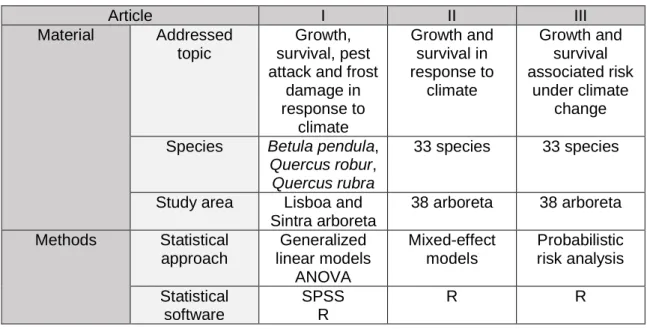
In table 1, a short description of material and methods is provided per article.
Table 1. Summary for data, statistical methodology, and software by article
Article I II III
Material Addressed topic
Growth, survival, pest attack and frost
damage in response to climate Growth and survival in response to climate Growth and survival associated risk under climate change
Species Betula pendula, Quercus robur, Quercus rubra
33 species 33 species
Study area Lisboa and Sintra arboreta 38 arboreta 38 arboreta Methods Statistical approach Generalized linear models ANOVA Mixed-effect models Probabilistic risk analysis Statistical software SPSS R R R
6 Chapter II | António Correia
Chapter II – Original contributions
Description of the original contributions
This doctoral thesis consists of 3 scientific articles (1 published papers and 2 submitted manuscript). The published article is presented in the original format, and the ones still under evaluation, although completed, are presented using the style of the chosen journal. Accordingly, the thesis includes the following contributions identified by Roman numerals (I-III):
Article I – Shahim, H., Correia, A.H., Branco, M., Almeida, M.H. (2018). Monitoring two REINFFORCE arboreta: first result on site, climate and genetic interaction showing the impact on phenology and biotic damages. Scientia Forestalis. DOI:
Article II – Correia, A.H.; Almeida, M.H.; Branco, M.; Tomé, M.; Cordero Montoya, R.; Di Lucchio, L.; Cantero, A.; Diez, J.J.; Prieto-Recio, C.; Bravo, F.; Gartzia, N.; Arias, A.; Jinks, R.; Paillassa, E.; PASTUSZKA, P.; Rozados Lorenzo, M.J.; Silva Pando, F.J.; Traver, M.C.; Zabalza, S.; Nóbrega, C.; Ferreira, M.; Orazio, C. Early Survival and Growth Plasticity of 33 Species Planted in 38 Arboreta across the European Atlantic Area. Forests 2018, 9, 630. DOI: https://doi.org/10.3390/f9100630
Article III – Correia, A.H.; Almeida, M.H.; Tomé, M.; Pereira, J.S.; Cantero, A.; Diez, J.J.; Prieto-Recio, C.; Gartzia, N.; Arias, A.; Jinks, R.; Paillassa, E.; Pastuszka, P.; Rozados Lorenzo, M.J.; Silva Pando, F.J.; Traver, M.C.; Zabalza, S.; Ferreira, M.; Cota, T.; Orazio, C. (2018) Probabilistic risk analysis for 33 forest species survival and growth under RCP 4.5 and 8.5 scenarios in western Europe using REINFFORCE arboreta network results. AFS. DOI:
The author of the present thesis shared the first authorship in article I and was the first author in article II and III.
For article I, the thesis author collaborated in data analysis, field data gathering and manuscript writing.
7 Chapter II | António Correia
For articles II and III, the thesis author was responsible the whole work, co-gathering the data, performing the data analysis, discussing results with co-authors and writing the manuscripts, under the guidance of the Ph.D. supervisor team. Thesis supervisor Dr. Maria Helena Almeida guided the author in his research training and participated as co-author in the articles. The supervisors and the author participated in formulating the scientific questions addressed in this thesis.
In Article I, a first exploration of the growth and survival data is performed at local level, using 2 arboreta from the REINFFORCE network, and 3 selected species from the established 35. Additional data for budburst time, pest damage and susceptibility to frost damage is collected in order to access the potential influence of these variables on growth and survival, in the studied locations, and eventually expanding the methodology to the entire arboreta network. In the 3 studied species (Betula pendula, Quercus robur, and Quercus rubra), no significant differences were found for frost damage, but the interaction between site and species showed to be relevant. The budburst time revealed significant differences between and within species, with Betula pendula presenting the earliest budburst date, which potentially originates a longer growing period. Nevertheless, under higher temperature survival it is negatively affected. This introductory study reveals the potential of the arboreta network to provide valid data on species response to climate conditions.
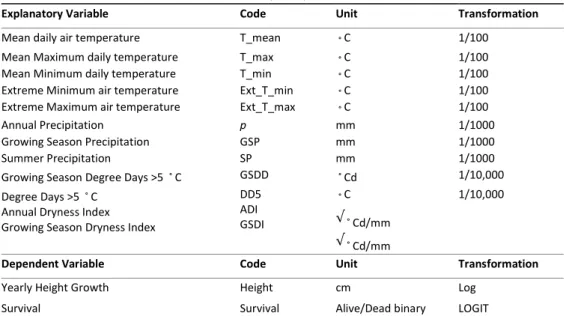
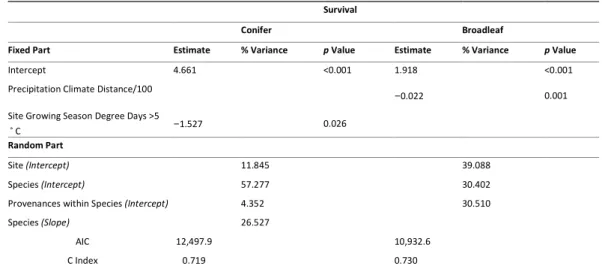
In Article II, a thorough analysis of the entire arboreta network data is performed, for the period between 2012-2016, corresponding to the establishment period. Several climate variables were tested in order to determine Climate influence on growth and survival, . Annual Dryness Index (ADI), growing degree days above 5º C and precipitation climate distance between the site and material origin contributed to the best explanation for growth and survival. The use of mixed-effect models allowed to build models for estimating the traits for all the range of the climate variables per species. For higher temperature and lower water availability, we observed that several species present a significant drop in performance, like Pinus pinaster and Betula pendula, and other present lower variation for the traits along the entire gradient.
In Article III, the risk analysis is performed by means of a probabilistic methodology (van Oijen et al. 2013), taking advantage of the estimated growth and survival for climate change scenarios RCP 4.5 and 8.5, calculated using the models fitted in article II. These estimates
8 Chapter II | António Correia
are calculated for the mid (2050) and long (2080) term, in order to provide a continuous range of possible situations, in order to better support decision-making with minor uncertainty. The results show a higher overall risk for conifer species’ survival, and broadleaf species only present positive risk under the RCP 8.5 2080 scenario. There are some identified important European species that will undergo high risk, like Betula pendula and Pinus pinaster, but there are some species that are estimated to improve performance under climate change, and which can represent valid replacements.
9 Chapter II | António Correia
I. Monitoring two REINFFORCE arboreta: first result on site, climate
and genetic interaction showing the impact on phenology and biotic
damages.
Shahim, H., Correia, A.H., Branco, M., Almeida, M.H. (2018). Monitoring two REINFFORCE arboreta: first result on site, climate and genetic interaction showing the impact on phenology and biotic damages. Submited to Scientia Forestalis.
10 Chapter II | António Correia
TÍTULO: Avaliando dois arboreta da rede REINFFORCE: primeiros resultados sobre interacção local, climática e genética, demonstrando o impacto sobre fenologia e danos bióticos
TITLE: Monitoring two REINFFORCE Network Arboreta: first result on site, climate and genetic interaction showing impact on phenology and biotic damages
Resumo: Compreender como o clima afeta a fenologia das plantas e a sua
vulnerabilidade biótica e abiótica é um assunto de extrema importância. Particularmente, quando o aumento da temperatura parece promover um alongamento do período de crescimento, o qual poderá afetar a exposição a pragas e agentes patogénicos. Adicionalmente, os eventos climáticos extremos combinados com as alterações na fenologia potenciam desfechos significantes, nomeadamente a antecipação da rebentação dos gomos com exposição a geada. Neste trabalho, foram monitorizadas 3 espécies, uma nativa (Quercus robur L.) e 2 não nativas (Quercus rubra L. and Betula pendula Roth), em 2 arboreta da rede REINFFORCE (Lisboa e Sintra). Foram avaliados o crescimento, fenologia foliar e danos por insetos, de acordo com os protocolos defenidos sob o projecto REINFFORCE. A interacção Espécie x Site revelou-se significante para sobrevivência e crescimento. Na fenologia observaram-se diferenças entre e dentro das espécies. Não foram observadas diferenças significativas para tolerância ao frio. A espécie B. pendula apresentou rebentação dos gomos mais precoce em ambos os locais, resultando num período de crescimento mais alargado e maior crescimento em altura, sendo menos afetada por danos por insetos, embora a sobrevivência tenha revelado suscetibilidade a temperatura mais elevada, onde a espécie Q. robur apresentou melhor performance. Este estudo corrobora a
11 Chapter II | António Correia
importância da rede de arboreta REINFFORCE como ferramenta para monitorizar o impacto das alterações climáticas nas espécies florestais e proporcionar bases para a migração assistida de espécies, considerando os cenários de alterações climáticas.
Abstract: Understanding how climate affects tree phenology, biotic and abiotic vulnerability, is a most important research subject. Particularly, climate warming appears to lengthen the
growing season, which may affect the exposition to insect pests and pathogens. Also,
extreme weather events combined with shifts in phenology may have dramatic
consequences, such as early leaf flushing exposure to freezing events. In this study 2
arboreta were followed in the south most distribution of the REINFFORCE Network (Lisbon and Sintra) for 3 species, one native (Quercus robur L.) and 2 non-native (Quercus rubra L.
and Betula pendula Roth). Plant growth, leaf phenology and insect damage were assessed
according to protocols defined under REINFFORCE project. Species x site interaction was
found significant for survival and growth. Phenology differed between and within all species.
No difference found for frost tolerance. B. pendula had earlier bud burst at both sites,
resulting in a longer growth period, and higher stem growth, being least affected by insect
damage, although survival was affected under higher temperature, where Q. robur
performed better. This study corroborates the importance of REINFORCE arboreta network
as a tool to assess climate change impact on forest species and support assisted migration
considering climate change scenarios.
Palavras-chave: Betula pendula, Quercus robur, Quercus rubra, fenologia, tolerância ao frio, danos por pragas
Keywords: Betula pendula, Quercus robur, Quercus rubra, phenology, frost tolerance, pest damage
12 Chapter II | António Correia
1. Introduction
Climate change is now accepted as one of the most important phenomenon affecting the
future of the world’s natural systems and, in turn, human society. Many published reports
have presented significant evidence that climate changes over the past fifty years have
affected several aspects of forest ecosystems. These include tree growth and dieback,
invasive species problems, species distributions and migrations, seasonal patterns in
ecosystem processes, demographics and even extinctions (IPCC, 2007a). Future climate
scenarios in the Mediterranean region indicates a systematic 3 to 4 °C increase in average temperature and reduction in annual rain fall by 20 to 40% (IPCC, 2013). Consequently, in
this region, species distribution may be mainly driven by the stress caused by the increase
of arid and semi-arid regions (SANTOS, 2002). The combined outcome of droughts and high
temperatures will cause further lower carbon sequestration in some areas.
Forests also influence local climate (ELLISON, 2017), and thus afforestation programs may
play a decisive role on climate regulation at both local and global levels. At the same time,
due to climate change, trees are facing physiological stress, variations in phenology, and
variations in the exposition to pests and diseases. Therefore, mutual interaction between
forests and climate change has become a most important research issue. REINFFORCE
project established a network of arboreta with the aim to improve our general understanding
of species capacity to cope with climate changes. The same genetic materials was planted
under 38 different climates, from the south of Portugal to the south of Scotland (along a
range of latitudes from 37° to 58°) covering the European Atlantic temperate forests
distribution. Programs like REINFFORCE create physical infrastructures to study adaptation
13 Chapter II | António Correia
Many forest ecosystems studies have correlated recent climate trends with changes in
phenology as well as with changes in forest productivity (ROSENZWEIG, 2007). Such
studies have indicated that climate warming appears to lengthen the growing season and
increase tree growth rates in many boreal and temperate forests. However, for
Mediterranean regions, studies suggested that the warming has contributed to measurable
reductions in forest productivity through interactions with drought, fire and biotic disturbance
(ROSENZWEIG, 2007). From our literature review there are few studies addressing the
effect of climate on the tree phenology in Mediterranean climates and its impact on biotic
and abiotic risks. For temperate regions, it was demonstrated that changes in phenology
can affect ecological relationships, for example, by creating a mismatch between plant
flowering time and the presence of insect pollinators (POST, 2007; ROSENZWEIG, 2007).
On the other hand, as many herbivorous insect species can only develop on young plant
material, there could be a mismatch between plant phenology and active larval stages. It
may also occur on some insect species, that changes in the phenology of leaves growth or
growing tips can cause shifts in the phenology of herbovirous insects larval development
(VISSER, 2001). Intra-specific variability in plant phenology may further affects the window
of exposition to herbivore insects (SAMPAIO, 2016).
In addition, changes in climate variables may have direct influence on insect pests and
pathogens affecting both their survival and development. There is further evidence that
warmer temperature is generally favorable for insects by shortening their life cycle
(CURRANO, 2008; FRAZIER, 2006), although extreme hot temperature may also cause
important insect mortality dependent on life stage and its phenology (e.g. SANTOS, 2011).
It also can have indirect influence brought by the interactions between host species and their
14 Chapter II | António Correia
Climate change indicators includes not only shifts in mean conditions but also changes in
the frequency and timing of extreme weather events such as severe cold, spring frost and
extended drought (SOLOMON, 2007; MARINO, 2011). Consequently, tree seedlings are
responding to pressures of both mean, and extreme conditions. For example, mean
temperature and the occurrence of late spring frost may strongly affect the emergence,
development, growth, and survival of plants (FISICHELLI, 2014; SANTOS, 2002).
Specifically, and as a by-product of warmer temperatures, the occurrence of frost after leaf
total flushing is projected to become more common phenomenon in some parts of the world
(MEEHL, 2000, GU, 2008). This scenario has a number of important ecological implications.
In particular, the newly developed leaves are sensitive to frost events as they lack the
structural rigor necessary to prevent damage. Depending on the timing of spring warmth,
early and accelerated leaf development has the potential to increase the frequency and
magnitude of leaf damage from freezing events (NORBY, 2003; INOUYE, 2008). Resultant
lasting effects include the loss of stored carbon and nutrients as well as reduced
photosynthetic carbon gain (GU, 2008; MARTIN, 2010), and utterly, increase mortality of
young trees. Additional studies show that plant grown under elevated CO2 present
decreased freeze tolerance, making even the most freeze-tolerant species more vulnerable
to potential frost damage at warmer freezing temperatures (WOLDENDORP, 2008). The
most responsive species to these are likely to occur in the cool to cold climates at high
latitudes and altitudes where seasonal temperatures and the length of frost-free period are
important determinants of the growing season (CHEN, 1995). A freezing event will thus
injure these freeze-tolerant plant species depending on the acclimation state of the plant
which is also affected by elevated CO2 levels (LOVEYS, 2006).
This study aimed to analyze budburst in one locally native (Quercus robur L.) and two
15 Chapter II | António Correia
and characterize they’re survival, growth, physiological, pest attack and leaf phenology, in
response to the climatic conditions on test sites. Each species is represented by contrasting
provenances (in order to sample species’ variability), since adaptive traits are related to
geographic origin. This knowledge contributes for the selection of forest reproductive
material to be used in afforestation programs, as well as support assisted migration to
mitigate climate change effects.
2. Materials and Methods
2.1. Field description
The study took place at two arboreta: Lisbon (Lat: 38° 42' 51.07" N; Long: 9° 11' 31.66" W;
altitude: 106 m) and Sintra (Lat: 38° 46’ 48.29’’ N; Long: -9° 24’ 48.92’’ W; altitude: 400 m).
Lisbon arboretum was installed in spring 2012, and Sintra arboretum in winter 2012.
For this study, three broad leaves species were chosen, Q. robur (QURO), Q. rubra (QURU),
B. pendula (BEPE). QURO is the only native to the studied area; QURU is native to North America. BEPE is mostly distributed in the Center and North of Europe, absent from the
Iberian Peninsula except for some restricted high mountain areas (VAKKARI, 2009). QURO
was represented by four provenances (FRAN from France; UNIT from UK; PAGO from
Spain; POSA from Italy), QURU by two (FEST from France; VANA from Spain), and BEPE
by three (NORD from France; KRAL from Krakova Slovakia; UNIT from UK). Provenances’
detailed information is provided in supplementary material (S2). At least twelve seedlings
were observed per provenance. For QURO and BEPE, 36 plants per provenance were
installed. For QURU, 12 plants per provenance were installed. All of these plants were
included in the study.
Sites differ on soil, climatic and meteorological characteristics observed during the period
16 Chapter II | António Correia
characterized by higher humidity and a fresher summer in comparison to Lisbon.
Considering the difference between climate conditions observed at each arboreta and at
provenance sites, observations revealed consistently higher temperature differential at
Lisbon for the summer period, and at Sintra all year round, with particular higher differential
for the winter period (Fig. 1). There was also higher precipitation deficit at Lisbon, and winter
excess at Sintra.
Figure 1 Meteorological variables difference between arboreta (2012 - 2014 data) and
provenance site (1961 - 1990 ): a) Mean maximum temperature; b) Mean minimum temperature; c) Precipitation. BEPE- Betula pendula; QURO- Quercus robur; QURU-
-10 0 10 20 B EP E-K R A L B EP E-K R A L B EP E-N O R D B EP E-N O R D B EP E-U N IT B EP E-U N IT Q U R O -F R A N Q U R O -F R A N Q U R O -P A G O Q U R O -P A G O Q U R O -P O SA Q U R O -P O SA Q U R O -U N IT Q U R O -U N IT Q U R U -F ES T Q U R U -F ES T Q U R U -V A N A Q U R U -V A N A SintraLisbonSintraLisbonSintraLisbonSintraLisbonSintraLisbonSintraLisbonSintraLisbonSintraLisbonSintraLisbon 0C
a)
-10 0 10 20 30 B EP E-K R A L B EP E-K R A L B EP E-N O R D B EP E-N O R D B EP E-U N IT B EP E-U N IT Q U R O -F R A N Q U R O -F R A N Q U R O -P A G O Q U R O -P A G O Q U R O -P O SA Q U R O -P O SA Q U R O -U N IT Q U R O -U N IT Q U R U -F ES T Q U R U -F ES T Q U R U -V A N A Q U R U -V A N A SintraLisbonSintraLisbonSintraLisbonSintraLisbonSintraLisbonSintraLisbonSintraLisbonSintraLisbonSintraLisbon 0Cb)
-200 0 200 400 B EP E-K R A L B EP E-K R A L B EP E-N O R D B EP E-N O R D B EP E-U N IT B EP E-U N IT Q U R O -F R A N Q U R O -F R A N Q U R O -P A G O Q U R O -P A G O Q U R O -P O SA Q U R O -P O SA Q U R O -U N IT Q U R O -U N IT Q U R U -F ES T Q U R U -F ES T Q U R U -V A N A Q U R U -V A N A SintraLisbonSintraLisbonSintraLisbonSintraLisbonSintraLisbonSintraLisbonSintraLisbonSintraLisbonSintraLisbon m m17 Chapter II | António Correia
Quercus rubra. Provenance designation and information are described on supplementary material S2 and ORAZIO (2013).
Note: provenance climate data (1961 – 1990) obtained from ClimateEU v4.63 software package, available at http://tinyurl.com/ClimateEU, based on methodology described by Hamann et al. (2013)
Figure 1 Diferença entre as variáveis climáticas dos arboreta (2012-2014) e locais de
proveniência (1961-1990): a) Média das temperaturas máximas; b) média das temperaturas mínimas; c) Precipitação. BEPE- Betula pendula; QURO- Quercus robur; QURU- Quercus rubra. As designações e informações sobre as proveniências de cada espécie estão descritas no material suplementar S2 e em ORAZIO (2013).
Nota: Dados climáticos para as proveniências (1961 – 1990) foram obtidos a partir do software ClimateEU v4.63, disponível em http://tinyurl.com/ClimateEU, baseado na metodologia descrita por Hamann et al. (2013)
2.2. Meteorology
Temperature and precipitation were monitored hourly by an automatic local weather station
placed at each arboreta.
Meteorological variables difference was calculated between arboreta observed data (2012
- 2014) and provenance site data (1961 – 1990) obtained from ClimateEU v4.63 software
package, available at http://tinyurl.com/ClimateEU, based on methodology described
by Hamann et al. (2013)
2.3. Plant survival
Survival was evaluated in May 2014. Survival is expressed as the percentage of the living
seedling recorded since plantation to 2014, for each provenance.
2.4. Growth measurement
Growth measurements were carried out in November 2013. Height (cm) was measured for
the tallest living plant branch/bud using extensive pole, with 1 mm precision. Diameter (mm)
18 Chapter II | António Correia
crossed measurements. Growth is determined as the difference between initial
measurement, at installation, and 2013 measurement.
2.5. Phenology
At Lisbon, phenological status was evaluated weekly, from the last week of February 2014,
until complete budburst. The best branch with highest numbers of buds in each direction
(west, east, north and south) was chosen and tagged for follow-up. The buds in the tagged
branches were closely observed every week to check the stage of development, following
the phenology protocol defined under REINFFORCE project (reinfforce.iefc.net).
On the 3rd and 4th of March, the phenology observation was carried out at both Lisbon and
Sintra, to compare phenology status at this specific time.
2.6. Insect damage
At the mid of April, when the leaves of all the seedlings have expanded, one field observation
was done to monitor insect damage on the three species and all the 10 provenances. For
that, the protocol of biotic damage defined under REINFFORCE project (reinfforce.iefc.net)
was applied. Damage and severity, as expressed by the proportion of attacked leaves per
branch, were registered.
2.7. Spring frost tolerance
Frost tolerance was evaluated for two species (QURO and BEPE) in the end of May, through
cell membrane injury in leaf discs measuring electrolyte leakage conductivity, after artificial
freezing. Each species was represented by three provenances. Seven seedlings from each
provenance were sampled. Five fully expanded leaves from each seedling were collected,
and a composite sample with one leaf disc per each seedling and per provenance was
prepared in a vial tube. Three tubes per provenance and per species were placed in each
freezing bath. Frost treatment was induced in a cryostat (Aralab, Lisbon, Portugal) with three
19 Chapter II | António Correia
followed a constant cooling and thawing rate of 4 °C/ h and 2 h exposure to five target freezing temperatures (–3, –5, –6.6, –9, –10.5 °C). When the temperature of the bath was at –2 °C, about 0.5 g of finely crushed ice (from deionized water) was added to each tube to make contact with the leaf discs avoiding super cooling. Bath temperature was monitored
via thermocouples sensors connected to a data logger (DL2, Delta-T). After the freezing
treatment, 15 ml of deionized water was added to each tube, the tubes were then kept for
24 hours at water bath at 25 °C. Electrolyte conductivity was then measured in each tube (T1) with a K220 conductivity meter (Consort, Turnhout, Belgium). The samples were boiled
in an autoclave at 120 °C for 10 min and held at 25 °C for 24 h before measurement of maximum electrolyte conductivity (T2). Relative injury (RI) was expressed as a ratio of
electrolyte conductivity measured after freezing treatment to maximum electrolyte
conductivity, RI = (T1/T2) *100 (ROCHA, 2013; COSTA E SILVA, 2008). RI was then used
to calculate TL50 for each provenance (which is an assessment of the temperature that
causes death to 50% of plants).
2.9. Statistical analysis
A generalized linear model was adjusted for survival, proportion of attacked leaves (insect
damage), bud burst percentage, frost damage percentage, using a logit link, and height and
diameter growth. ANOVA procedure was used to assess provenance (nested within
species), species and site effect significance for height growth, diameter growth, number of
days (since January 1st) until bud burst occurred (defined by reaching the stage number 10)
and frost damage variables, in order to assess the effect of species and provenances. Model
normality assumptions were verified through graphical analysis and Levene test. Wald
Chi-square test was used for model significance. Fisher's least significant difference (LSD) was
used for post-hoc multiple comparisons. Species effect on phenology was tested through
20 Chapter II | António Correia
The analysis of phenological stages, bud burst, insect damage, and frost damage was done using SPSS software (ver. 22.0). Analysis of survival and growth was performed with R (ver. 3.3.2) software.
Graphics were generated with visreg package for R.
3. Results 3.1. Survival
Survival was higher at Sintra (Fig 2). Interaction site x species was found to be significant (table 1 in supplementary material S3). For the two non-native species, survival was much higher at Sintra than Lisbon, whereas for QURO differences in survival between the two sites were not so high (Fig. 2). At Sintra, survival was highest for BEPE, whereas at Lisbon, survival was highest for QURO.
21 Chapter II | António Correia
c) d)
Figure 2 Probabilidade de sobrevivência estimada para as espécies/proveniências em
Sintra e Lisboa, para plantações com 2 anos. a) Quercus rubra, b) Quercus robur, c) Betula pendula, d) todas as espécies. BEPE- Betula pendula; QURO- Quercus robur; QURU- Quercus rubra. As designações e informações sobre as proveniências de cada espécie estão descritas no material suplementar S2 e em ORAZIO (2013).
Nota:As linhas horizontais representam a probabilidade estimada. As barras cinza representam os intervalos de confiança de 95%. Os valores de significância podem ser consultados na tabela S3 dos materiais suplementares.
Figure 2 Estimated provenance/species survival probability at Sintra and Lisbon for 2-year
plantation. a) Quercus rubra, b) Quercus robur, c) Betula pendula, d) All species. BEPE- Betula pendula; QURO- Quercus robur; QURU- Quercus rubra. Provenance designation and information are described on supplementary material S2 and ORAZIO (2013).
Note: Horizontal line represents estimated probability. Grey bars represent 95% confidence interval. Significance values can be consulted in the S3 table, on the supplementary material.
Table 1 Resultados da análise de “desvios” para os modelos lineares generalizados (teste
do tipo III) em relação à sobrevivência.
22 Chapter II | António Correia
Species Variance source Chisq Df Pval
BEPE provenance 0.599 2 Site 297.560 1 *** provenance: site 2.658 2 QURO provenance 5.5128 3 Site 24.3180 1 *** provenance: site 1.2115 3 QURU provenance 0.2022 1 Site 1.5272 1 provenance: site 6.6433 1 ** All species 48.66 2 *** Site 330.41 1 *** species: site 96.91 2 ***
Nota: Pval código de significância (“***” < 0.0001 < ”**” < 0.001 < “*” < 0.05 < “.” < 0.1 < “ “
< 1)
3.2. Growth
Tree growth was higher in Sintra, regarding both height (F = 29.465, P < 0.001) and diameter
(F= 97.318, P < 0.001). A significant species: site interaction was observed for height and
diameter (Figure 3 in supplementary material S4).
No significant difference was found between provenances for height growth within species–
either at Lisbon or Sintra (S4). For BEPE, provenance is almost significant (P = 0.08), with
evidence that KRAL and NORD provenances have higher height growth values for Sintra
(supplementary material S5).
As for diameter growth, provenance is significant for QURU (supplementary material S4),
and FEST has significantly higher growth than VANA at Sintra (supplementary material S5,
23 Chapter II | António Correia
a) b)
c) d)
Figure 3 Crescimento médio em altura em Sintra e Lisboa para uma plantação com 2 anos.
a) Quercus rubra, b) Quercus robur, c) Betula pendula, d) todas as espécies. BEPE- Betula pendula; QURO- Quercus robur; QURU- Quercus rubra. As designações e informações sobre as proveniências de cada espécie estão descritas no material suplementar S2 e em ORAZIO (2013).
Nota: As linhas horizontais representam o crescimento médio e as barras cinza representam o erro padrão. Os valores de significância podem ser consultados na tabela S4 dos materiais suplementares.
Figure 3 Provenance/species mean height growth at Sintra and Lisbon for 2-year plantation.
24 Chapter II | António Correia
pendula; QURO- Quercus robur; QURU- Quercus rubra. Provenance designation and information are described on supplementary material S2 and ORAZIO (2013).
Note: Horizontal line represents mean and grey bars represent standard error. Significance
values can be consulted in the S4 table, on the supplementary material.
a) b)
c) d)
Figure 4 Crescimento médio em diâmetro (colo) para as espécies/proveniências em Sintra
e Lisbon para uma plantação com 2 anos. a) Quercus rubra, b) Quercus robur, c) Betula pendula, d) todas as espécies. BEPE- Betula pendula; QURO- Quercus robur; QURU- Quercus rubra. As designações e informações sobre as proveniências de cada espécie estão descritas no material suplementar S2 e em ORAZIO (2013).
25 Chapter II | António Correia
Nota: As linhas horizontais representam o crescimento médio e as barras cinza representam o erro padrão. Os valores de significância podem ser consultados na tabela S4 dos materiais suplementares.
Figure 4 Provenance/Species mean diameter growth at Sintra and Lisbon for 2-year
plantation. a) Quercus rubra, b) Quercus robur, c) Betula pendula, d) All species. BEPE- Betula pendula; QURO- Quercus robur; QURU- Quercus rubra. Provenance designation and information are described on supplementary material S2 and ORAZIO (2013).
Note: Horizontal line represents mean and grey bars represent standard error. Significance
values can be consulted in the S4 table, on the supplementary material.
3.3. Phenology
The three studied species significantly differed on the budburst date (F2,81 = 18.22, P <
0.001). Kruskal-Wallis test also showed significant differences between species on the
phenology stage observed in Lisbon arboreta during the period of three months since the
first of March till the end of May (Z = 72.64, d.f. = 2, P < 0.001). All BEPE’s provenances
have an early bursting comparing with the other species, while the two provenances of
QURU showed the latest bursting (Fig 5). Further significant difference were found among the four provenances of QURO (F3,54 = 3.56, P= 0.024), while the provenances of the other
species showed no significant differences: QURU (F1,5 = 0.042, P = 0.839), BEPE (F2,26 =
1.81, P = 0.183).
Comparing bud bursting for each of the provenance between Lisbon and Sintra, six
provenances, BEPE Nord, BEPE Unit, QURO Pago, QURO Posa, QURO Unit and QURU
Vanna, were earlier to burst at Sintra. Two provenances QURO Fran and QURU Fest,
showed similar bud burst timing in both locations. Only BEPE Kral was earlier to sprout in
Lisbon than Sintra (Fig. 5). Nevertheless, when applying Mann-Whiteny test to compare the
phenology stage in both sites at (3 and 4 March, 2014) no significant difference was found
26 Chapter II | António Correia
Figure 5 Evolução da rebentação dos gomos (percentagem do total de plantas observadas)
por espécie e proveniência, durante o período de avaliação, no arboretum de Lisboa. BEPE- Betula pendula; QURO- Quercus robur; QURU- Quercus rubra. As designações e informações sobre as proveniências de cada espécie estão descritas no material suplementar S2 e em ORAZIO (2013).
Figure 5 Evolution of budburst (percentage of total observed plants) per species and
provenance along observation period, at Lisbon arboretum. BEPE- Betula pendula; QURO- Quercus robur; QURU- Quercus rubra. Provenance designation and information are described on supplementary material S2 and ORAZIO (2013).
3.4. Insect damage 0 50 100 2 8 F e v. 4 M ar . 1 1 M ar . 2 0 M ar . 2 7 M ar . 3 A p r. 1 0 A p r. 1 7 A p r. 2 4 A p r. 2 9 A p r. B u d b u rs t %
Betula pendula
Bepe Kral Bepe Nord Bepe Unit 0 50 100 2 8 F e v. 4 M ar . 1 1 M ar . 2 0 M ar . 2 7 M ar . 3 A p r. 1 0 A p r. 1 7 A p r. 2 4 A p r. 2 9 A p r. B u d b u rs t %Quercus robur
Quro Fran Quro Pago Quro Posa Quro Unit 0 50 100 2 8 F e v. 4 M ar . 1 1 M ar . 2 0 M ar . 2 7 M ar . 3 A p r. 1 0 A p r. 1 7 A p r. 2 4 A p r. 2 9 A p r. B u d b u rs t %Quercus rubra
Quru Fest Quru Vana27 Chapter II | António Correia
The main damage type observed consisted on chewed leaves (86 to 99% among all types
of damage). Leaf miners, sap feeders, galls and skeletizers showed very low level of
occurrence. The probability of suffering leaf damage was overall highest for QURO leaves
at Sintra (0.49) (Table 2). At Lisbon, QURU had similar values of leaf damage as QURO,
whereas in Sintra values were slightly but significantly lower in comparison with the
congeneric native tree species (Tables 4). BEPE on the other hand showed the lowest
probability of damage in both sites (0.09 and 0.18 at Lisbon and Sintra, respectively) (Table
2).
The comparison between the native species (QURO) with the average of the non-native
species also revealed a significant difference on insect damage for both Lisbon (F1,82 =
0.018, P < 0.001), and Sintra (F1,185 = 0.013, P < 0.001).
The provenances of BEPE in Lisbon did not differ on the insect damage (Z = 2.25 , d.f. = 1,
P= 0.13), nor did the provenances of QURO (Z = 3.61 , d.f. = 1, P = 0.057), or QURU (Z =
0 , d.f.= 1, P = 1.0). Yet, for Sintra, provenances of QURO differed significantly (Z = 4.32,
d.f. = 1, P = 0.037). Still, there were no significant differences observed among the
provenances of BEPE and QURU (Z = 2.58, d.f. = 1, P = 0.1) (Z = 3, d.f. = 1, P = 0.83).
Table 2 Percentagem de folhas apresentando danos (média ± erro padrão) para os arboreta
de Lisboa e Sintra, para cada espécie.
Table 2 Percentage of damaged leaves (average ± standard error) at Lisbon and Sintra for
each tree species.
Species Lisbon Sintra
Betula pendula 9 ± 1.2 a 18 ± 0.7 a
Quercus robur 40 ± 1.3b 49 ± 1.4c
Quercus rubra 40 ± 4.8b 31 ± 2.7 b
Nota: Os valores seguidos pela mesma letra não são significativamente diferentes dentro de cada arboreto. (α = 0.01)
28 Chapter II | António Correia
Note: Values followed by the same letter per site do not differ significantly (α = 0.01).
3.5. Spring frost tolerance
QURO and BEPE showed similar RI when subjected to negative temperatures ranging from -3 to -10.5 ºC (41.39 ± 1.73 vs. 39.05 ± 1.87, respectively). Calculated TL50 (supplementary
material S6) was also similar between QURO (-7,18 ± 0,025 ºC) and BEPE (-7,05 ± 0,067
ºC).
No statistical effect found for provenance on frost damage, both for QURO (F2,6 = 0.241, P=
0.787) and BEPE (F2,6 = 1.19, P = 0.317). Fitting a generalized linear model for frost damage
(with provenance nested in species effect), for TL50 -6.6 ºC temperature, no significant
effect was found between species (Z = 0.42, d.f. = 1, P = 0.51).
4. Discussion
Although the REINFFORCE network’s full range is composed by 38 sites, this preliminary
work aims to analyze a small window of locations. The two study sites are considered of
particular interest, as they are the most southern located within the REINFFORCE arboreta
range, characterized mainly by higher temperatures and dryer climate which may
dramatically affect tree survival, growth and risk to abiotic and biotic factors.
Meteorological conditions differed between sites, maximum summer temperatures were
lower and air humidity higher at Sintra in comparison with Lisbon. As soil type also differs,
soil water extraction by plants at Lisbon arboretum (Loam-Sandy clay) would be more
difficult, since soil matric potential is expected to be considerably lower. This could have had
a major impact on plant survival and growth.
29 Chapter II | António Correia
The site, provenance: site and species: site significant effect, show how some
species/provenance respond differently at each site, highlighting the relevance of the
edaphoclimatic conditions, especially for survival. Sintra arboretum seems to be more
favorable to the overall performance of all species. At Sintra, BEPE outperforms the other
species in every aspect, with NORD and UNIT provenances standing out at height growth.
Even at Lisbon, this species has a higher height increment than the others, although survival
is compromised. Interestingly, QURO presented the higher survival rate at Lisbon, without
having any superior effect on growth for that arboreta. QURU had the lowest survival at
Lisbon, but does not differ in growth from the previous. QURO is known to have higher
drought tolerance than BEPE (VAN HEES, 1997), sustaining it even under higher
temperature (KUSTER, 2012), which helps explain its advantage at the lowest survival site
(Lisbon) (Fig. 2, 3 and 4), as plants develop higher root growth under water stress, than
under water availability (OSONUBI, 1981). For BEPE, drought impact is amplified by an
increase in summer air temperature (KHARUK, 2013), so this corroborates for the higher
mortality and lower growth rate observed at Lisbon arboretum. BEPE’s earliness of budburst
contributes to its high annual growth rate (ZAPATER, 2012) as observed in our results,
typical for pioneer species like this one (HYNYNEN, 2008). Drought can trigger an early
investment in deep root growth resulting in slower above ground growth, so this explains the
reduced diameter growth observed at Lisbon arboretum, according to Kuster (2012). There
is also an observed difference for diameter growth in QURO between sites, although height
growth was similar. In Kuster (2012), species presented a lower diameter to height growth
ratio under high temperatures, varying greatly with provenance. So the assumption that the
significant lower diameter growth observed for FRAN and POSA (Table 6) can be a direct
influence of higher temperature and precipitation summer deficit from provenance conditions