SIZING PERSONNEL: EVALUATION OF NURSING IN OBSTETRIC AND MIXED PEDIATRIC INTENSIVE CARE UNITS
DIMENSIONAMENTO DE PESSOAL: AVALIAÇÃO DA ENFERMAGEM EM UNIDADES DE TERAPIA INTENSIVA OBSTÉTRICA E PEDIÁTRICA MISTA
CUANTITATIVO DE PERSONAL DE ENFERMERÍA EN UNIDADES DE CUIDADOS INTENSIVOS OBSTÉTRICA Y PEDIÁTRICA MIXTA
Rodrigo Nonato Coelho Mendes1 Amanda de Figueirôa Silva Carmo2, Rosana Dourado Loula Salum3,
Fernando Antônio Ribeiro de Gusmão-Filho4, Suely Arruda Vidal5, Viviane Euzébia Perreira Santos6
ABSTRACT
Objectives: To assess the adequacy of nursing staff and understand how these professionals perceive this issue. Methods: evaluative, exploratory, descriptive, quantitative and qualitative study, developed in Obstetric and Mixed Pediatric ICUs for the Hospital Don Malan / IMIP in Petrolina-PE. Was calculated the scaling nursing and 13 semi-structured interviews were conducted, analyzed according to Bardin. Results: Mixed Pediatric ICU has correct number of staff and Obstetric decreasing the frame. The units have shortage of nurses and an incorrect distribution by category/ bed. It was observed that the nursing staff of the Pediatric ICUs Mixed considers its high workload, while in the ICU Obstetric this was considered mild. Conclusion: The scaling of nursing without compliance with the current legislation may compromise the quality of care offered, especially in units of critical care. Descriptors: Nursing assessment: Personnel downsizing, Nursing, Workload, Intensive care units.
RESUMO
Objetivos: Avaliar a adequação do quadro de pessoal de enfermagem e compreender como esses profissionais percebem essa questão. Métodos: Estudo avaliativo, exploratório, descritivo com abordagens quantitativa e qualitativa, desenvolvido nas UTIs Pediátrica Mista e Obstétrica do Hospital Dom Malan/IMIPem Petrolina-PE. Calculou-se o dimensionamento de enfermagem e foram realizadas 13 entrevistas semiestruturadas, analisadas segundo Bardin. Resultados: A UTI Pediátrica Mista possui correto quantitativo de pessoal e na Obstétrica há redução do quadro. As unidades possuem déficit de enfermeiros e uma incorreta distribuição por categoria/leito. Observou-se que a equipe de enfermagem da UTI Pediátrica Mista considera sua carga de trabalho elevada, enquanto que na UTI Obstétrica esta foi considerada leve. Conclusão: O dimensionamento de enfermagem sem conformidade com a legislação vigente pode comprometer a qualidade dos cuidados oferecidos, sobretudo em unidades de cuidados críticos. Descritores: Avaliação em enfermagem, Dimensionamento de pessoal, Enfermagem, Carga de trabalho, Unidades de terapia intensiva.
RESUMEN
Objetivos: Evaluar el cuantitativo de personal de enfermería y comprender cómo estos perciben este problema. Métodos: Estudio
evaluativo, exploratorio, descriptivo con abordaje cuantitativo y cualitativo, desarrollado en las UCIs Pediátrica Mixta y Obstétrica del Hospital de Don Malan/IMIP en Petrolina-Pernambuco. Se calculó el dimensionamiento de enfermería y 13 entrevistas semi-estructuradas fueran realizadas, analizadas según Bardin. Resultados: UCI Pediátrica Mixta tiene el número adecuado de personal y en la Obstétrica una disminución del cuadro. Las unidades tienen escasez de enfermeras y una incorrecta distribución por categoría-cama. Se observó que el personal de enfermería de la UCI Pediátrica Mixta considera que su carga de trabajo elevada, mientras que en la Unidad de Cuidados Intensivos Obstétrica se consideró leve. Conclusión: La escala de enfermería, sin el cumplimiento de la legislación vigente, puede comprometer la calidad de la atención ofrecida, sobretodo en unidades de atención crítica. Descriptores: Evaluación en Enfermería, Dimensionamiento de Personal, Enfermería, Carga de Trabajo, Unidades de Cuidados Intensivos.
1Majoring in nursing from the Federal University of São Francisco Valley / UNIVASP. E-mail: rodrigo.coelho.mendes @ gmail.com.
Nurse. 2Master in Maternal and Child Health Institute of Integrative Medicine of Pernambuco / IMIP. E-mail:
[email protected]. 3Nurse graduated from UNIVASF. E-mail: [email protected] Doctor. Course Coordinator of
Medicine, University of Pernambuco - UPE. 4Teacher Course Graduate IMIP. Ph.D. in Public Health Research Center Aggeu by
Magellan. E-mail: [email protected]. 5Medical. Masters and Ph.D. IMIP. E-mail: [email protected]. 6Nurse. PhD in
Nursing. Associate Professor of Nursing course at the Federal University of Rio Grande do Norte. E-mail: [email protected]. Article prepared Dissertation: Assessing the quality of public units intensive care in maternal and child health in the city of Petrolina-PE. 2012. Instituto de Medicina Integral Professor Fernando Figueira / IMIP.
The need for concentration of resources and improvement to patient care critics gave rise to the Intensive Care Units (ICU) in hospitals with specialized infrastructure, medical and nursing uninterrupted, specific equipment, skilled human resources and access to other technologies sophisticated diagnostic and therapeutic.1
The ICU is a place of great expertise and technology, becoming a space for working health professionals, especially doctors and nurses, who have a high level of knowledge, skill and dexterity to perform different procedures that define the boundary between life and death of people. 2
It is considered the health care system in intensive care as the more complex, requiring a high nursing workload and promotion of complex care. Thus, there is need to ensure adequate number of workers to ensure proper nursing care during the 24 hours of the day. 4
It is understood as scaling nursing staff, a procedure for filling workers, which aims to predict the amount of these by category needed to meet directly and / or indirectly, the needs for nursing care of clients. 5
A quantitative estimate of the nursing staff should be performed by the nurse through the calculation of nursing staff, established by the Federal Nursing Council through Resolution COFEN No. 293/20046. Already regarding the distribution
of nursing staff in relation to the number of beds, the National Agency for Sanitary Vigilance published the Board Resolution - RDC n º 07 of February 24, 2010 and RDC No. 26, May 11, 2012, which provide for the minimum requirements for operation of Intensive Care Units. 7-8
Thus, it behooves the nursing responsibility to provide continuous care to patients, ensuring quality standards of care, it is
necessary, therefore, to have qualified human resources and quantity to meet that purpose. 9
Objective: Assess the adequacy of nursing staff in relation to the scale and distribution by category in Intensive Care Units in maternal and child health and understand how professionals perceive this issue.
This was an evaluative study, exploratory and descriptive quantitative and qualitative approaches, the sample consisted of 12 nurses and 46 nurses.10 Counting the total number
of nursing professionals of the two Intensive Care Units, Pediatric and Joint Obstetric Hospital Dom Malan (HDM) / IMIP - Institute of Integral Medicine Professor Fernando Figueira, in the city of Petrolina-PE, which is a referral service for maternal and child health in the region. Held from March to November 2011. The ICU has 10 beds and obstetric ICU Pediatric Mixed 10, 06 and 04 of neonatal pediatrics.
Quantitative data were obtained through documents containing the following information: the scales of the nursing staff of the months from March to May 2011; the weekly work of nursing professionals, the quantity of workers, the occupancy rate and the average stay of patients in the period March-May 2011 and the number of beds available. Obtaining qualitative data was through interviews guided by a semi-structured. The subjects who took part in the study were nursing professionals who work in these units. The sample size was determined by saturation criterion, the interviews were closed when the contents of the speeches expressed an exhaustion of ideas.
The interviews were recorded, transcribed and analyzed using the technique of analysis of Bardin. 11 Quantitative data were
INTRODUCTION
analyzed using the Resolution of the Federal Board of Nursing - COFEN n ° 293/2004 and the Board Resolution - RDC N º 07/2010 and 26/2012. 6-8
For the calculation of scaling, it was considered the largest occupancy rate achieved during the period for each ICU, representing 70% and 60% for the Obstetric and Pediatric Joint respectively. The evaluation also considered the distribution of professionals by category. Were used for classification of the trial design and distribution of tertiles: owning 100% of the quantity of nurses in all categories; possess between 100 to less than 70% of the quantity of nurses in all categories; owning less than 70 quantitative% of nursing professionals in all categories. To perform the sizing calculation of nursing staff was necessary to consider: the total picture and by the professionals of each ICU, the degree of dependency of patients, and the occupancy rate of beds.
The nursing staff of the Joint Pediatric ICU consists of 31 staff (06 nurses and 25 nursing technicians), and the staff of ICU nursing Obstetric consists of 17 professionals (05 nurses and 12 nursing technicians).
Since they are two units with exclusive intensive care beds, and who did not use classification scores of severity of disease, established the degree of dependence of the same as being in intensive care. To calculate the nursing hours, we considered the total number of beds and higher occupancy rate found in the period from March to May of 2011 which was 70%, i.e., 07 beds for ICU Pediatric Combination to 60%, or is, 6 ICU beds for Obstetric.
The Constant Marine (KM) considered the lowest empirical coefficient of 15% for Technical Safety Index (STI) as additional nursing staff to cover planned absences and unexpected. 6
The working week was 30, 36 and 40 hours for the Joint Pediatric ICU and 30 and 40 hours for Obstetric ICU, so we used to load an arithmetic average of the three and the two different workloads to ICU Obstetric and pediatric Joint respectively. Therefore, it was necessary to use the KM of 0.2683 to 30 hours, KM from 0.2236 to 36 hours and KM of 0.2012 to 40 hours. 6
We calculated the total nursing hours (THE) for 24 hours / day, from the following expression:
Where:
PCI (
Patients of Intensive Care
)HE (Nursing Hours for intensive care patients = 17.9 h)
We determined the nursing staff using the following expression:
Where:
QP (Staff)
KM (Marine constant) THE (time nursing hours)
Regarding the distribution of professionals by category and this proportion by number of beds, it was considered COFEN Resolution 293/2004 stipulates that minimally 52% of nurses for intensive care, as well as RDC 07/2010 and 26/2012, the which define a clinical nurse per shift for each 08 and most recently 10 beds, while defining a practical nurse for every two beds.
The study was approved by the Ethics Committee for Studies Animals and Humans under protocol # 0001/201 110 as a subproject of dissertation lecturer in maternal and child health IMIP and complied with Resolution 196/96 of the National Health Council that guides the research ethics involving humans. 12 The participants signed
the Informed Consent and clarified to ensure anonymity and were identified by names.
Sizing of the nursing staff of ICU pediatric mixed and obstetric
Calculating the THE of the Pediatric ICU was obtained:
Calculating the THE of the Obstetric ICU was obtained:
Staff of the Mixed Pediatric ICU:
Staff of Obstetric ICU:
Distribution of the number of staff by category
With regard to the distribution of nursing staff by category, was observed the Pediatric ICU Mixed owned 62.5% of nursing staff and 37.5% of
nurses, while 37.7% had Obstetric ICU nurses and 62.3% of nursing staff, as provided in Table 01
Table 01: Distribution of nursing staff in the ICU by category investigated period March-May 2011.
Source: Data from field survey, 2011.
Distribution of the number of staff compared to the number of beds
For nurses, the Pediatric ICU Mixed, there was a correct distribution of these professionals during the daytime, but the night shift, this ratio does not meet the RDC 7, leaving only one nurse for 10 beds. However, with the publication of RDC RDC No. 26, in force since May 2012, this ratio meets the recommendations of the resolution. Already 7-8 in respect of professional technical level, the proportion of these beds is respected and is in line with current regulations on all shifts. Obstetric ICU observed the ratio of one nurse for every 10 beds in each turn and about a nursing technician for every 03 beds in each shift. Thus, it is clear that even before the current RDC ANVISA the proportion of mid-level professionals that do not respect the rules.
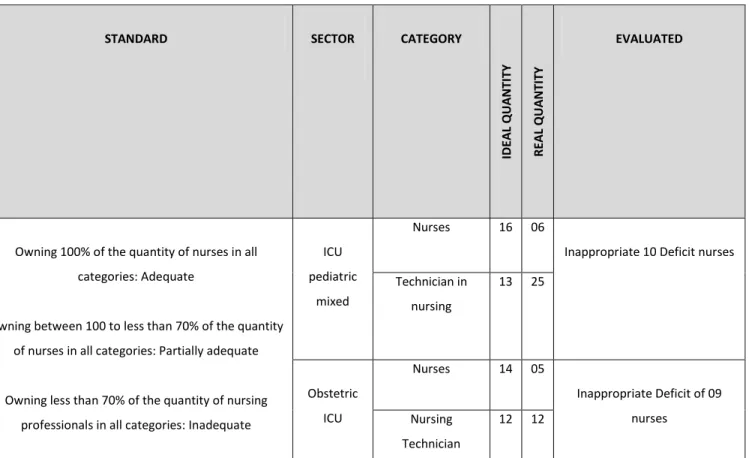
For the evaluation of intensive care units studied were considered sizing calculations of Pediatric ICU nursing and Joint Obstetric and distribution of professionals by category. Was used for the trial's outcome classification into tertiles (Table 02). SECTOR PERCENTAGE DISTRIBUTION BY CATEGORY AMOUNT NEEDED BY CATEGORY QUANTITATIVE EXISTING BY CATEGORY PEDIATRIC MIXED ICU Nurses (52%) 16 (52%) 06 (37,5%) Practical nurses (48%) 13 (48%) 25 (62,5%) ICU OBSTETRICAL Nurses (52%) 14 (52%) 05 (37,7%) Practical nurses (48%) 12 (48%) 12 (62, 3%)
Table 02: Evaluation of ICU investigated with regard to the design of nursing staff by category, from March to May 2011.
Source: Data from field survey, 2011.
Perception of the nursing staff about the workload and dimensioning of staff
Once preceded assessment of the adequacy of the design and distribution of nursing staff by category, we sought to understand the perceptions of professionals on this issue and direct relationship with the workload. From discourse analysis emerged two categories: 1 - perception of nurses about the workload; 02 - perception of the nursing staff about their sizing.
Considering the race / color, 03 considered themselves white, 08 brown, 01 yellow and 01 black. It was found that the 07 nursing technicians had no technical qualification course in ICU and 06 nurses, 04 were postgraduates, whereas, only 01 were specialized in Intensive Care. Of the 13 nurses, 06 were nurses and 07 practical nurses, aged 23 to 39 years, these only 01eram male, and 04 were married, 07 singles and 02 living in a consensual union.
Category 01 - Perception of nurses about the workload
Pediatric ICU mixed, 04 nurses mentioned the heavy workload, however, assured that the 01 professional saw his light workload related to distribution of staff and 01 said the workload depended on duty. However, although there were among nursing technicians, differing opinions regarding the workload, the nurses ensured that this was excessive, since accumulated care and management functions, as discourse:
I believe that any ICU [...] has a great level of work, then so be technical; managerial be either care, and then it is very, very large overhead pros professionals [...]. (Thais)
Some professionals associated workload to the amount of hours worked in the industry, the environment, degree of dependency and complexity / severity of care required by patients in accordance with the lines:
STANDARD SECTOR CATEGORY
ID EA L Q UA N TI TY R EA L Q UA N TIT Y EVALUATED
Owning 100% of the quantity of nurses in all categories: Adequate
Owning between 100 to less than 70% of the quantity of nurses in all categories: Partially adequate
Owning less than 70% of the quantity of nursing professionals in all categories: Inadequate
ICU pediatric
mixed
Nurses 16 06
Inappropriate 10 Deficit nurses Technician in nursing 13 25 Obstetric ICU Nurses 14 05 Inappropriate Deficit of 09 nurses Nursing Technician 12 12
The workload is very heavy it because we work 12 hours and off 24, as is a closed sector with great responsibility, so sometimes we feel pressured, sometimes there is no time nor right cheek, resting, unwind. (Leilane)
Look is ... hard! [...] Is an activity [...] stressful and tiring, because the responsibility is very great, with patients requiring care 100% absolute. (Arthur)
In most obstetric ICU nurses considered the workload lighter and only 01 professional and 01 considered high priced. In the obstetric ICU, the nurses are satisfied with the workload:
I do not think the heavy workload here is not [...] I do not feel overwhelmed. (Fernanda)
It is satisfactory (Laura)
In the opinion of respondents had not overwork Obstetric ICU, which could be related to the low occupancy rate of beds that were approximately 60% and short average length of stay of patients was approximately 2.5 days in period study.
Category 02 - perception of the nursing staff about the dimensioning
When analyzing the perception about the size of the team, it was found that most professionals PICU mixed considered it satisfactory and suitable for development work in the sector:
It is satisfactory; we have a full team (Leilane)
Having attended by all means a team with a proper scaling to the amount of bed that exists within the ICU (Marcia)
It was noted that although the number of professionals would be acceptable to the nursing staff, the distribution was observed dissatisfaction:
Look, there are 10 beds and are 05 technicians, 01 for medication, it is directed, and 04 on the tour [...] when the
10 beds are full [...] 01 will be left with 03 beds and the other with 02 each, ends up being that when you have complications, this is kind of pulled (Arthur)
Well, I have 10 ICU beds in total, and usually work with a team of 05 technical, then, one of which is in medication and 04 techniques to be distributed to the rest of the beds [...] what I find most fair, I think it would be more correct, a technique for 02 patients (Alda)
Regarding Obstetric ICU, which was noted with satisfaction the size of the nursing staff and dissatisfaction with nursing technicians:
Regarding the ICU're shorn in relation to nursing technicians ... The nurse're normal (Fernanda)
I think it's just, it should have more technical (Deborah)
Considering also the number of occupied beds in the ICU and severity of obstetric patients, there was a professional satisfaction as the design team:
Regarding the ICU're shorn in relation to nursing technicians, nurses're normal (Fernanda)
I think it's just, it should have more technical (Deborah)
ICU in question, there were scores used to measure patient severity index. Thus, all patients were considered high complexity and severity. It was found that there is no clarification as to this team classification.
The evaluation classify the ICU, as the design for the two categories of nursing as unsuitable, since it does not possess the minimum amount of resolution defined by nurses COFEN 293/04.
Before the sizing calculation established the framework for nursing of 29 professionals would be appropriate for the Joint Pediatric ICU
and 26 for Obstetric. Thus, in relation to quantitative general nurses, the Pediatric ICU Mixed presented in accordance with Resolution COFEN No. 293/2004 while in ICU Obstetric identified a deficit of 09 professionals.
The dimensions inappropriate human resources in nursing has implications on the outcome of quality of care, since the quantitative and qualitative aspects of personnel are directly linked to the final product of their work is that the quality of care provided. 13
Regarding practical nurses, the ICU had the recommended quantity, with the Pediatric ICU Mixed exceeding the number of technicians. However, as the number of nurses in ICU, this was not in accordance with the minimum percentage of 52%, the proportion was found to be only 37.5% for Mixed Pediatric ICU and 37.7% for Obstetric. Thus, there was a deficit of 10:09 in the Pediatric ICU nurses and Joint Obstetric respectively and an excess of 12 nursing technicians Mixed Pediatric ICU.
Considering the Regulatory Law of Professional Nursing, rests exclusively upon the nurses performing nursing care directly to the patient with severe life-threatening, and greater technical complexity of care, for which they require basic knowledge and scientific capacity make immediate decisions.14
Thus, the small percentage of nurses can generate workload to these professionals and reductions in quality of care for critical patients.15
From this fact comes a concern about the execution of techniques whose domain is the scientific and technical professional nurse and who probably are being carried out by professional technical level.
The design of personal subsidizes planning in order to provide professional nursing adequate in number and qualifications to provide care in accordance with the quality desired by the institution. 16
The quantity and distribution of personnel by category favor humanization and quality of care provided. 17 In this sense, the nursing care is
conceived as a qualified professional action, resulting from the application of scientific knowledge by the nurse and her team, which should bring positive results to the patient in terms of meeting their needs for health and safety. 18
Regarding the distribution of professionals according to the number of beds in the pediatric ICU nurses expressed dissatisfaction and reported work overload, which could involve the distribution identified at night and on weekends and holidays which is 10 beds / nurse during the day while this ratio would be 05 beds / nurse. However, it is pertinent to discuss the latter situation that really does not represent a ratio of one nurse for every 05 beds and adequately accurate, since one of the nurses was daytime diarist / care manager collaborating on tasks according to their availability. This fact was reflected not only in the professional relationship / number of beds, but also in the accumulation of functions and roles, as in periods where there was a nurse manager, nurse on duty took on a greater number of patients than recommended and is involved inevitably, with managerial responsibilities.
About this, it is stated that the work of nurses is often multifaceted and submitted to the diversity of positions, becoming generators of wear and predisposing to stress, especially when it is related to the ICU. 19 Moreover, compliance with the paperwork becomes a stressor to the nurses, since their academic faces assistance. 20
In the obstetric ICU professionals refused to overload what one might attribute the low occupancy rate and stay in the industry. In this context, when there is a high occupancy rate of beds, the employee suffers the most varied processes of wear and work overload. 21 Thus, the
high workload of nursing in an ICU is also closely related to the patients' length of stay and occupancy of beds in the industry. 22
This could be attributed also to the severity index of the users, as the report came one of the interviewees, however, this assumption cannot be confirmed since the unit did not use a rating system of the patients. Nursing work is developed in a scenario which comprises patients in critical health condition, heavily dependent on assistance, and, because it is a sector closed with high job demands and complexity of care, changes in that environment a place stressful, tiring and work overload. 23
The process of quantitative forecasting of nursing staff should take into consideration the existing workload in inpatient units which, in turn, relates to the care needs of patients and the standard of care required. Given the quantitative professionals in the ICU, which is observed in daily practice of nurses on duty each distribution is, empirically, the nursing staff according to the number of patients. 24
Whereas the basic objective indices of gravity is the quantitative description of the degree of dysfunction of seriously ill patients, and disease severity translated into a numerical value, it is necessary to classify the degree of dependence of patients because the from this, one can predict various aspects related to the care process and ensure the amount of nurses needed to provide nursing care to patients. 25-6
The classification of the two investigated ICU emerged as inadequate especially the shortage of nurses. Was found a deficit in the number of professional nurses where they accounted for 37.5% Mixed Pediatric ICU and 37.7% in Obstetrics.
It was possible to hypothesize that certain nursing actions that should be assessed and implemented by nurses could be being carried out by nursing staff, which in some cases may compromise the quality of care and patient safety, and generate workload. This situation demanded more time devoted to patients by nursing staff, promoting the discontinuity of care and / or compromising the comprehensiveness of care.
Moreover, the development of numerous bureaucratic characters of managerial activities by nurses reduces the time devoted to patient care. Furthermore, called attention to the importance of systematizing up assistance for the purpose of streamlining the time of the professionals in directing the actions of the entire nursing staff.
Demonstrated the relevance of the application of an instrument for measuring workload that is useful to assist in quantifying the number of nurses needed, as the demand of the unit. The number of employees affects the assistance thus improves the design of personal care provided and thus raises the standards of service quality.
1. Inoue, KC. Absenteísmo-doença da equipe de enfermagem em unidade de terapia intensiva. Revbrasenferm[online]. 2008 [Acesso em 13 Set 2012]; 61(2): 209-214. Disponível em:http://www.scielo.br/pdf/reben/v61n2/a 10v61n2.pdf.
2. Brasil MS. Política Nacional de Atenção ao Paciente Crítico. Brasília: Diário oficial da União, 2005 [Acesso em 13 Set 2012].
Disponível em:
<http://www2.ghc.com.br/gepnet/docsris/ris materialdidatico62.pdf>.
REFERENCES
3. Tranquitelli AM, Ciampone MHT. Número de horas de cuidados de enfermagem em Unidade de Terapia Intensiva de Adultos. RevEscEnferm USP [Internet]. 2007 [citado 2011 fev 17];
41(3): 371-7. Disponível em:
<http://www.scielo.br/pdf/reeusp/v41n3/05. pdf>.
4. Antunes AV, Costa MN. Dimensionamento de pessoal de enfermagem em um hospital universitário. Rev Latino-am Enfermagem [Internet]. 2003 [citado 2011 fev 15]; 11(6):
832-9. Disponível em:
<http://www.scielo.br/pdf/rlae/v11n6/v11n6 a19.pdf>.
5. Conselho Federal de Enfermagem. Resolução COFEN 293/2004. [citado 2011 mar 12].
Disponível em:
<http://site.portalcofen.gov.br/node/4329>; 6. Brasil MS. Agência Nacional de Vigilância
Sanitária. RDC nº 7, de 24 de fevereiro de 2010. Dispõe sobre os requisitos mínimos para funcionamento de Unidades de Terapia Intensiva e dá outras providências. 2010 [Acesso em 13 Set 2012]. Disponível em: http://bvsms.saude.gov.br/bvs/saudelegis/an visa/2010/res0007_24_02_2010.html.
7. Brasil MS. Agência Nacional de Vigilância Sanitária RDC nº 26, de 11 de maio de 2012. Dispõe sobre os requisitos mínimos para funcionamento de Unidades de Terapia Intensiva e dá outras providências. 2012 [Acesso em 13 Set 2012]. Disponível em: <http://bvsms.saude.gov.br/bvs/saudelegis/a nvisa/2012/rdc0026_11_05_2012.html>.
8. Campos LF, Melo MRAC. Dimensionamento de pessoal de enfermagem: parâmetros, facilidades e desafios. CogitareEnferm [Internet] 2009 [citado 2011 mar 23]; 14(2):
237-46. Disponível em:
http://ojs.c3sl.ufpr.br/ojs2/index.php/cogitar e/article/viewArticle/15609.
9. Brasil MS. Departamento de Informática do Sistema Único de Saúde.Disponível em: <http://portalsaude.saude.gov.br/portalsaude /arquivos/pdf/2012/Jun/04/centro_tec_infor matica_ms_2009.pdf>
10. Informações de Saúde:Cadastro Nacional dos Estabelecimentos de Saúde. 2001. Disponível em:http://cnes.datasus.gov.br/Exibe_Ficha_Es tabelecimento.asp?VCo_Unidade=26111024307 11.
11. Bardin L. Análise de conteúdo. Tradução Luís Antero Reto; Augusto Pinheiro. 2004. 70 ed. Lisboa.
12. Brasil MS. Conselho Nacional de saúde. Resolução nº 196 de 10 de outubro de 1996. Dispõe sobre pesquisas envolvendo seres humanos. 1996. [citado 12 Mar 2011].
Disponível em:
<http://dtr2004.saude.gov.br/susdeaz/legislac ao/arquivo/Resolucao_196_de_10_10_1996.pdf 13. Tanos MAA, Massarollo MCKB, Gaidzinski RR. Dimensionamento de pessoal de enfermagem em uma unidade especializada em transplante de fígado: comparação do real com o preconizado. RevEscEnferm USP [Internet] 2000 [citado 2011 out 20]; 34(4): 376-82.
Disponível em:
<http://www.scielo.br/pdf/reeusp/v34n4/v34 n4a09.pdf>.
14. Brasil. Presidência da República, Casa Civil, Subchefia para Assuntos Jurídicos. Lei nº 7.498, de 25 de junho de 1986. Dispõe sobre a regulamentação do exercício da enfermagem, e dá outras providências [Internet]. Brasília, DF; 1986. [citado 2011 out 13]. Disponível em: http://www.planalto.gov.br/ccivil_03/leis/L7 498.htm.
15. Inoue KC, Matsuda LM. Dimensionamento da equipe de enfermagem da UTI-adulto de um hospital ensino. Rev. Eletr. Enf. [Internet]. 2009 [citado 2011 fev 15]; 11(1): 55-63.
http://www.scielo.br/pdf/ape/v23n3/v23n3a1 1.pdf.
16. Mazur CS. Aspectos quali-quantitativos do dimensionamento de pessoal de enfermagem em uma unidade cirúrgica de um hospital de ensino [dissertação de enfermagem]. Curitiba, Universidade Federal do Paraná. 2007. Setor de Ciências da Saúde. Programa de Pós-Graduação
em Enfermagem. Disponível em:
<http://www.ppgenf.ufpr.br/Disserta%C3%A7%C3% A3oC%C3%ADntiaMazur.pdf>.
17. Perroca MG, Jericó MC, Calil ASG. Composição da equipe de enfermagem em Unidades de Terapia Intensiva. Acta Paul Enferm [Internet]2011 [citado 2011 out 20]; 24(2):
199-205. Disponível
em:<http://www.scielo.br/scielo.php?script=sci_a rttext&pid=S0103-21002011000200007>.
18. Venturi KK. Qualidade do cuidado em UTI: relação entre o dimensionamento de pessoal de enfermagem e eventos adversos [dissertação de enfermagem]. Curitiba, Programa de Pós-Graduação Mestrado em Enfermagem, Universidade Federal do Paraná, 2009. Disponível em:<http://www.ppgenf.ufpr.br/Disserta%C3%A7% C3%A3oKriscieVenturi.pdf>.
19. Santos FD, Cunha MHF, Robazzi MLCC, Pedrão LJ, Silva LA, Terra FS. O estresse do enfermeiro nas unidades de terapia intensiva adulto: uma revisão da literatura.Revista Electrónica Salud Mental, Alcohol y Drogas [Internet] 2010 [citado 2011 ago 1]; 6(1): 1-16. Disponível
em:<http://www.revistasusp.sibi.usp.br/scielo.ph p?pid=S180669762010000100014&script=sci_arttex t>
20. Guerrer FJL, Bianchi ERF. Estressores em UTI. In:. Padilha KG, Vattimo MFF, Silva SC, Kimura M Enfermagem em UTI: cuidando do paciente crítico. Barueri: Manole, 2010; 1367-1378.
21. Sancinetti TR, Gaidzinski RR, Felli VEA, Fugulin FMT, Baptista PCP, Ciampone MHT, Kurcgant P, Silva FJ. Absenteísmo - doença na equipe de enfermagem: relação com a taxa de ocupação. RevEscEnferm USP [Internet] 2009 [citado 2011 nov5]; 43(2): 1277-83. Disponível em:http://www.scielo.br/pdf/reeusp/v43nspe2/a 23v43s2.pdf.
22. Gonçalves LA, Padilha KG. Fatores associados à carga de trabalho de enfermagem em Unidade de Terapia Intensiva.RevEscEnferm USP [Internet] 2007 [citado 2011 fev 17]; 41(4):
645-52. Disponível em:
<http://www.scielo.br/scielo.php?script=sci_artte xt&pid=S0080-62342007000400015>.
23. Garanhani ML, Martins JT, Robazzi MLCC, Gotelipe IC. O trabalho de enfermagem em unidade de terapia intensiva: significados para técnicos de enfermagem. Revista Electrónica Salud Mental, Alcohol y Drogas [Internet] 2008 [citado 2011 nov5]; 4(2): 1-15. Disponível em: http://redalyc.uaemex.mx/redalyc/pdf/803/8031 3056006.pdf.
24. Ducci AJ, Zanei SSV, Whitaker IY. Carga de trabalho de enfermagem para quantificar proporção profissional de enfermagem/paciente em UTI cardiológica. RevEscEnferm USP [Internet] 2008 [citado 2011 ago 9]; 42(4): 673-80. Disponível em:
http://www.scielo.br/pdf/reeusp/v42n4/v42n4a0 8.pdf.
25. Tranquitelli AM, Padilha KG. Sistemas de classificação de pacientes como instrumentos de gestão em Unidades de terapia intensiva. RevEscEnferm USP [Internet] 2005 [citado 2011 set 27]; 41(1): p. 141-6. Disponível em: http://www.scielo.br/pdf/reeusp/v41n1/v41n1a1 8.pdf.
26. Fonseca JP, Echer IC. Grau de dependência de pacientes em relação à assistência de enfermagem em uma unidade de internação clínica. Rev Gaúcha de enferm[Internet] 2003
[citado 2011 ago 13]; 24(3): p. 346-54. Disponível em:http://www.lume.ufrgs.br/handle/10183/235 18.
Received on: 13/09/2012 Required for review: No Approved on: 27/02/2013 Published on: 01/04/2013