Universidade do Minho
Instituto de Educação
April 2018
The Potential of Music in Engaging Students
to Learn English
Fatima Pereira Dias
The P
o
tential of Music in Engaging Students to Learn Eng
lish
UMinho|2018
Fatima Pereira Dias
April 2018
The Potential of Music in Engaging Students
to Learn English
Universidade do Minho
Instituto de Educação
Supervised by
Doutora Flávia Vieira
Supervised Pedagogical Traineeship Report
Master in Teaching English in Primary Education
ii
DECLARAÇÃO
Nome: Fatima Pereira Dias
Endereço eletrónico: fatimadias6@gmail.com
Telefone: (+351) 963188928
Número do Cartão de Cidadão: 11839122
Título do Relatório: The Potential of Music in Engaging Students to Learn English Orientadora: Doutora Flávia Vieira
Ano de conclusão: 2018
Designação do Mestrado: Mestrado em Ensino do Inglês no 1.º Ciclo do Ensino Básico
É AUTORIZADA A REPRODUÇÃO INTEGRAL DESTE RELATÓRIO APENAS PARA EFEITOS DE INVESTIGAÇÃO, MEDIANTE DECLARAÇÃO ESCRITA DO
INTERESSADO, QUE A TAL SE COMPROMETE.
Universidade do Minho, ______/_______/_________
Assinatura: ________________________________________________ (Fatima Pereira Dias)
iii
Acknowledgments
Thank you, Susana, for your support and friendship. Thank you, husband and sons, for your patience.
Thank you, Professor Flávia and all the other Professors, for your mentoring. Thank you Sónia, for your companionship.
v
The Potential of Music in Engaging Students to Learn English
Fatima Pereira Dias
Master in Teaching English in Primary Education University of Minho
2018
Abstract
The aims of the present teaching report, integrated in the Master of Teaching English in Primary Education, are to describe, interpret and evaluate the Intervention Project “The potential of music in engaging students to Learn English”. This project was developed with fourth-graders in a primary school. Exploring and investigating the potential of music in the classroom as a way to engage and motivate students in learning English as a second language was the main intent of the project. Its objectives were: identifying students’ attitudes towards English language learning in general and specifically their sentiment towards music, promoting students’ engagement using activities related to music, helping students develop their "learning to learn" ability, and evaluating gains and limitations of using music in the classroom. In the first stage of the project there was a period of field observation, where I was able to collect data using direct classroom observation and guided observation with the help of an observation grid. I tried to make a profile of the class in order to perceive their engagement in the English class and their attitude towards English learning and music, which was essential to start incorporating music activities in class. I used music for various purposes: to initiate and end lessons, to learn vocabulary/new lexis, to compose a verse for a song and with TPR. These different music activities were part of three didactic sequences, and after each sequence students could evaluate not only what they felt towards the music activities but also what they had learnt in that sequence. This enabled students to develop self-evaluation abilities and provided information for analysing my action.
Based on the project results, I came to the conclusion that music is a very powerful tool, enabling students to learn English in a stress-free and playful way. So, music has the potential of engaging and motivating students.
Key words: music, engagement, English learning, young learners
vii
Table of Contents
Introduction………1
Chapter 1 - Theoretical framework
………51.1 The potential of music in teaching and learning in a playful way………...5
1.2 Engaging students with music in learning a foreign language ………...7
Chapter 2 – Intervention context
………...13Chapter 3 –Intervention stages
………...153.1 My teaching philosophy and the action research project………...15
3.2 Stage one – Observation………....18
3.3 Stage two – Action Phase………..19
3.3.1 Lesson sequence 1 – Christmas Time……….28
3.3.2 Lesson sequence 2 – I love fruit!...34
3.3.3 Lesson sequence 3 – Home Sweet Home………...37
3.4 Stage three – Overall evaluation of the project……….40
Final conclusion……….………...43
References……….45
Appendices………48
Appendix 1 – Self-evaluation Questionnaire - Sequence 1……….…47
Appendix 2 – Self-evaluation Questionnaire - Sequence 2……….48
Appendix 3 – Self-evaluation Questionnaire - Sequence 3……….49
Appendix 4 – Lesson plan - Sequence 1………..50
Appendix 5 – Lesson plan - Sequence 2………..53
Appendix 6 – Lesson plan - Sequence 3………..56
Figures Figure 1 – My representation of teaching………15
Figure 2 – Observation grid – Student Engagement………18
Figure 3 – Initial Questionnaire………...……20
Figure 4 – Picture card to introduce lesson activity………....25
viii
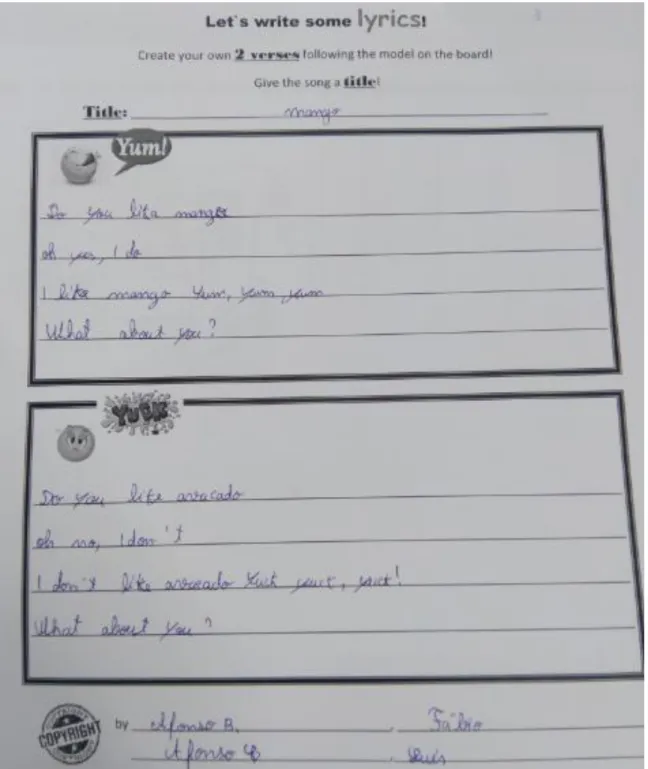
Figure 6 – Students’ example of the lyrics for a song………...….36
Figure 7 – Students’ example of the lyrics for a song………39
Tables Table 1 – Project objectives and strategies………..17
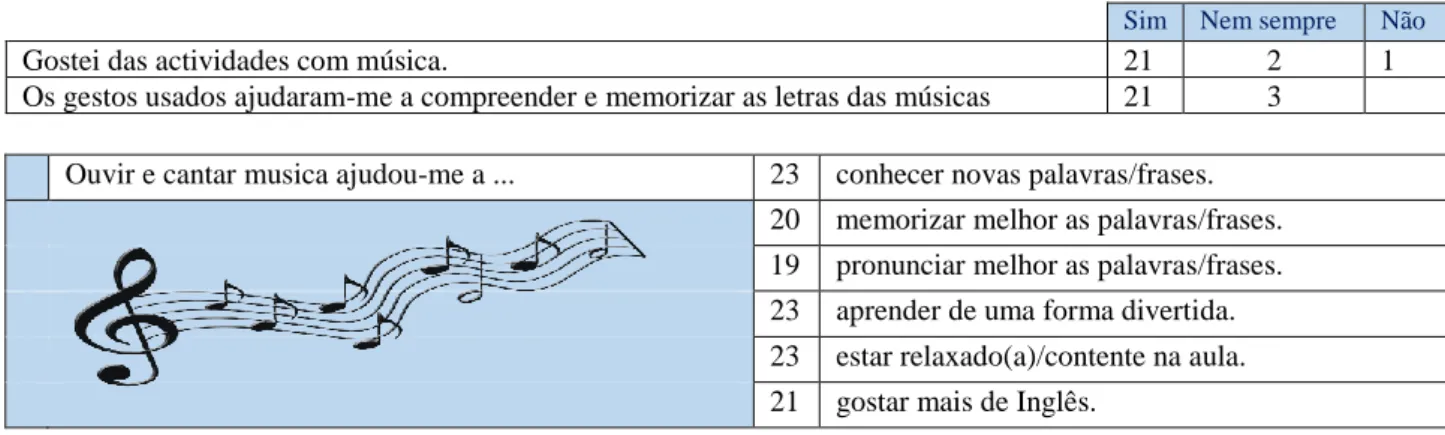
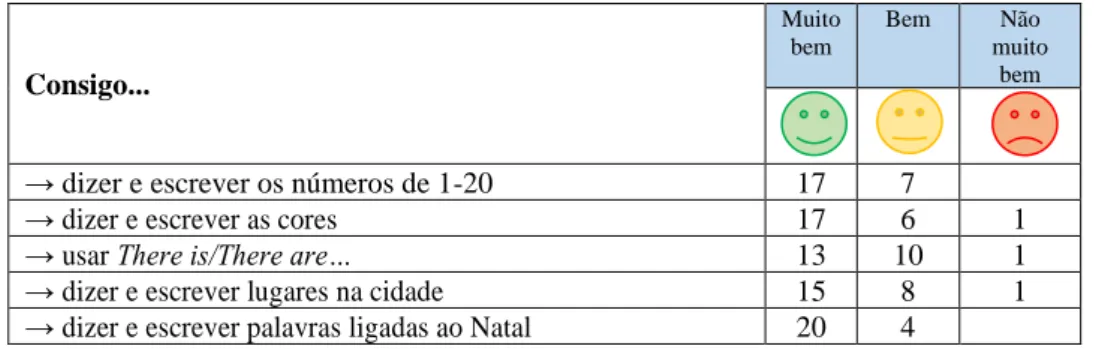
Table 2 – Students’ perceptions of the use of music: Sequence 1………..31
Table 3 – Students’ perceptions of language learning: Sequence 1………32
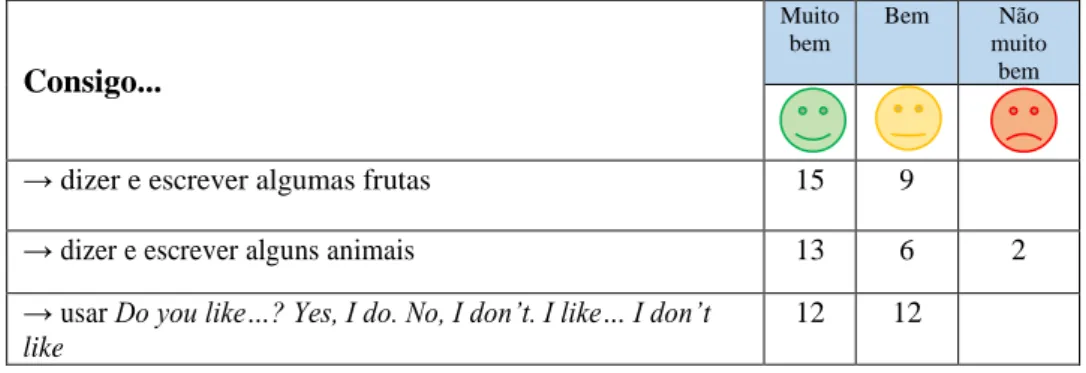
Table 4 – Students’ perceptions of the use of music: Sequence 2……….…..37
Table 5 – Students’ perceptions of language learning: Sequence 2………37
Table 6 – Students’ perceptions of the use of music: Sequence 3……….………..40
Table 7 – Students’ perceptions of language learning: Sequence 3………40
Table 8 – Students’ perceptions of their attitudes and behaviours in class: Sequences 1, 2 and 3……….41
Table 9. Students’ perceptions of the use of music: Sequences 1, 2 and 3……….42
Table 10 – Students’ perceptions of language learning: Sequences 1, 2 and 3……...…42
Charts Chart 1 - Learners’ preferences in language learning………..……22
ix
Development can only take place when children are actively involved, when they are actively involved with a high, non-stop degree of concentration, when they are interested, when they give themselves completely, when they use all their mental abilities to invent and make new things, and when this gives them a high degree of satisfaction and pleasure.
1
Introduction
Music gives a soul to the universe, wings to the mind,
flight to the imagination and life to everything.
(Plato)
In this teaching report, integrated in the Master Degree in Teaching English in Primary Education at the University of Minho, my Intervention Project, entitled The potential of music in engaging
students to learn English, was developed in a primary school in the district of Braga with a class of
fourth-graders. It enabled me to put into practice my hypothesis that music engages students in learning English and to reflect on being a teacher and my teaching methods. My ultimate goal was not only coming to certain conclusions, but to grow as a professional as well. I have been teaching English to youngsters and children for 10 years, therefore the practicum was not my first contact with teaching English to young learners. However, it was an opportunity to reflect further on and improve my action as a language teacher.
Reflecting on my teaching means I need to look deeper at what I do in my classroom as a teacher. I believe many of us do it in an informal way, while driving home, thinking back on what we felt, saw and accomplished. Or we talk to a friend reporting on what went well or not in our lesson that day. Isn’t it enough? Well, I came to one conclusion so far (hopefully there will be more): having to write my inner thoughts, seeing them on the screen, I have a greater understanding of what I really did. It seems that I look at it from an outside-in perspective.
When we are engaged in teaching a lesson, we have limited capacities in identifying or analysing what is really going on. As we are so focused on our task, following an order of steps, trying to breeze from one step to another, our observation ability is quite limited. We are not only focusing on our students’ performance and reactions, but we are embroiled in so many different feelings ourselves (satisfaction, delight, confusion, distress and even some frustration) all at the same time. These feelings are definitely valuable, but not enough to lead to conclusions on teaching performance and consequently students’ learning achievements.
For this reason, collecting classroom data and writing my thoughts and feelings after a lesson was essential, not only to have positive or negative feedback of what happened in the classroom, what activities captured their attention more, but most of all to help me improve my teaching, looking back and thinking about what I would have done differently.
2
Another important aspect developed in this study is the importance of giving students not only the possibility to learn in a calm, fun and friendly environment, using music as a tool, but also to try to capture the attention of as many students as possible with the chosen activities. Here, Gardner’s (2011) intelligences were one of the references I used. Different students, different personalities, different learning styles, therefore different activities that cater for all their needs. As a teacher I need to be aware of my students and then adapt my teaching to them. Students are the main characters and I only guide them to a happy ending.
How students learn is therefore very important for a teacher to plan the lessons according to students. But students need to reflect as well on how they learn better. The self-evaluation sheets used at the end of each lesson sequence and the informal conversations we had on how they learn better were ways to help them to develop more self-regulated learning.
The project highlights the importance of music in learning English. One of my primary objectives when choosing this topic for was to show that music can promote students’ engagement in learning English. One activity that caters for all my learners is using music in the classroom. It can be used in many different ways, we only need to know what we want the music for: to start and end the lesson, to relax, to learn grammar and vocabulary, to memorise better, just for fun, etc. Music enables us teachers to create a positive and creative atmosphere. Gestures and mimic are of great importance here. Children need to move, in an organized way, and singing a song using their bodies to interpret or give meaning to words or sentence structures is the best way to learn whatever language they want to learn. The rhythm of a song invites you right away to move your body, to clap your hands or stomp your feet. It is natural! With music, there is a varied possibility of activities that can integrate all four skills (listening, speaking, reading and writing) and cater for different types of learning styles (audio, kinaesthetic, musical intelligence, visual…) at some point of the lesson.
My main goal as a teacher is first of all creating a rapport with my students. Implementing music in my classes is a way to make sure my students learn in an enjoyable and natural way. Music is part of every children’s lives, and bringing it into the classroom will definetely engage them in learning more effectively. I have always used music in my classroom, and from my experience there is no better strategy to motivate and engage students in learning. It brings fun, excitement and creativity into the classroom and the possibilities of using music as a tool are infinite. According to the Common European Framework of Reference for Languages, “Imaginative and artistic uses of language are important both educationally and in their own right. Aesthetic activities may be productive, receptive, interactive or mediating and may be oral or written. They include such activities as: singing (nursery rhymes, folk songs, pop songs, etc.)” (Council of Europe, 2001, p. 56).
3
As for the structure of this teaching report, there are three chapters. In the first chapter, the Theoretical Framework, the potential of music in teaching and learning in a playful way and how to use music to engage students in learning a foreign language are explored. Chapter two focuses on the Intervention Context and gives some information on the students and the school where the action-research project was developed. The last chapter describes the Intervention Stage. It starts with my teaching philosophy and then presents the project phases, from the observation phase to the action phase, where three lesson sequences were developed, and finally the reflection phase, where an overall evaluation of the project is done. The report ends with a final conclusion, where gains and limitations of the project are presented.
5
Chapter 1
Theoretical framework
1.1 The potential of music in teaching and learning in a playful way
Music is the universal language of mankind.
(Henry Wadsworth Longfellow)
Everybody “speaks music”. Following the idea of music being the universal language present in all cultures around the world we can see what music does: it entertains, it communicates stories of the past, present and future, it inspires to be creative, it unites people and it educates. It is something rooted to society, showing their unique characteristics. So, music transmits cultural aspects when using songs from around the world. We can use songs, with different rhythms and sounds from completely different places. This will help our students to be aware of cultural differences and to be tolerant, as today they share their seats with many students from different countries. Why not play a
Samba, if you have students from Brazil, using some recycled cans and made up drums to accompany
the music? Or use African music with children from their native cultures, showing them what great musical heritage, they have at their homes?
We all know that music is an essential part of the human being, right from when they are babies (or even in their mother’s womb?). Music is a natural part of children’s lives, right from the beginning and it gives them all many possible positive feelings. You can talk to your baby to calm him/her down or to capture his/her attention. Investigation shows that when a mother sings to her baby, instead of talking to it, the baby is more focused on the mother, it calms down.
Music is like a language, sounds are used, there is a message. The difference is that “usually” the message in a conversation, when communicating, is more direct and concrete while music is mostly emotional (Mora, 1999, p.147). It makes us feel all kinds of feelings. We feel and then we express it. Of course, every human feels differently and therefore expresses himself in many ways. The importance here is that there is always an involvement when we are faced with music.
When we choose a song, a chant a rhyme for our students, we are promoting their happiness and well-being, and they automatically feel relaxed and motivated to learn, as they are learning without being aware they are learning. This idea is related to one of Stephen Krashen’s hypothesis (1982, p. 31)
For optimal learning to occur the affective filter must be weak. A weak filter means that a positive attitude toward learning is present. Because of the casual learning environment used when singing, songs are one method for achieving a weak affective filter and promoting language learning
6
Music is a very important tool in the classroom. In my project I have used it with young learners, but music is useful for every age and classroom. Using music in the classroom when teaching English can develop many different skills:
Cognitive skills: singing a song, recalling the lyrics of it or singing it over and over again makes
children memorise new lexis and language structures better. So, music reinforces memory.
Communicative skills: singing a song helps children first listen to the intonation patterns, speech
sounds of the language and then they imitate it in a natural way, without being aware of having mastered complex aspects of a language. Using these new acquisitions later in concrete dialogues or situations in the classroom helps them communicate in a relaxed way, without being afraid of making mistakes.
Motor skills: Children need to move, in an organized way, and singing a song using their bodies
to interpret or give meaning to words or sentence structures is the best way to learn whatever language they want to learn. The rhythm of a song invites you right away to move your body, to clap your hands or stomp your feet, therefore the coordination between singing and moving is highly developed.
Social skills: When we sing in a class, we automatically create social interactions. We clap
together, turn around, look at each other and laugh and smile at each other, we help each other Gfeller K. E. (1983) also agrees that music activities are flexible teaching tools that provide enjoyable opportunities for socialization.
So, with music children can learn to be focused, increase their span of attention, develop their motor skills when music is used with gestures and movement, develop verbal communication, learn new lexis and sentence structures that can later be used in creating other dialogues with same structure, and they develop a better social behaviour. They work as a group but sing as one. There must be respect and patience between them. Mutual help is necessary to achieve the final goal of singing together in harmony.
Therefore, music creates the perfect stress-free environment to learn in an enjoyable way, where learning comes naturally and not imposed, emotions are positive and everyone feels part of it, working together.
Music can also be seen as contagious mechanism. Have you ever been to a party where the music that was playing wasn’t really your style, but all of a sudden, your body started to move to the rhythm? Yes, we can´t forget the social aspect here. The importance of the crowd surrounding us has an
7
important role in our mood. But now imagine it with children. We have got the “crowd”, hopefully in a good and fun mood. Now you just need to add the right song and the party can get started!
Some of your students may be surprised, it may be the first time or they are not used to sing songs and dance in front of others. But we know the power of crowd persuasion. The more extroverted lead the shyer ones to get into the flow in a natural way. It’s like a game, where at first you don´t know the rules and you feel out of place, but then you want to play the game too, and you are carried away. This is how music works with children. Some jump right into it, others need more time. I could see this in students’ self-evaluation. Some students did not have very positive feelings towards music, but after experiencing it, their answers turned out to be more positive. So why don’t we use more music in our classroom when there are so many advantages and gains?
There are so many songs that can be found online, on YouTube for example, and almost every textbook has a CD with songs on it. I understand that some teachers may not feel very comfortable with singing, they think they don’t have a good voice or they feel they don’t have rhythm. But new technologies are a good support, and teachers may also ask students to choose a song and let them prepare their presentation in small groups. Here the teacher is only their guide and perhaps after seeing students dealing with music so naturally, s/he feels more confident to join in.
1.2 Engaging students with music in learning a foreign language
When I think of engagement I think of students being involved in my lessons, motivated and interested. But is there one definition of engagement, clarified for all teachers?
The concept of “student engagement” is presented in the Glossary of Education Reform (2018), an online resource:
In education, student engagement refers to the degree of attention, curiosity, interest, optimism, and passion that students show when they are learning or being taught, which extends to the level of motivation they have to learn and progress in their education. Generally speaking, the concept of “student engagement” is predicated on the belief that learning improves when students are inquisitive, interested, or inspired, and that learning tends to suffer when students are bored, dispassionate, disaffected, or otherwise “disengaged.” Stronger student engagement or improved student engagement are common instructional objectives expressed by educators.
Engagement can also be defined as students’ willingness to participate in learning activities with positive emotion (Chapman, 2003; Skinner & Belmont, 1993). According to Fredricks, Blumenfeld & Paris (2004, p. 59-109), there are three dimensions of engagement: behavioural, emotional and cognitive engagement:
8
Behavioural engagement draws on the idea of participation; it includes involvement in academic and social or extracurricular activities and is considered crucial for achieving positive academic outcomes and preventing dropping out. Emotional [or affective] engagement encompasses positive and negative reactions to teachers, classmates, academics, and school and is presumed to create ties to an institution and influence willingness to do the work. Finally, cognitive engagement draws on the idea of investment; it incorporates thoughtfulness and willingness to exert the effort necessary to comprehend complex ideas and master difficult skills.
In my opinion, emotional engagement is the most important one as students learn best when being in a friendly and positive environment. According to the Motivational Systems Theory by Ford (1992), caring behaviour, an important aspect of relational behaviour, provides a strong motivational foundation for cognitive and behavioural engagement in school contexts. This means that when students feel that they are in a caring and friendly environment, they are motivated to engage cognitively and behaviourally.
The first step to engage students is then to create a positive environment, a sense of belonging and a friendly relationship, and this means developing a rapport with students. Learning then comes more naturally, as when students are engaged they learn better and more. According to the English Language Program Guide in Primary Schools (Orientações Programáticas para o Ensino do Inglês
no 1º Ciclo do Ensino Básico), it is important to foster a positive relationship with learning English
(“fomentar uma relação positiva com a aprendizagem da língua”) (Bento et al., 2005, p. 11). There are of course many methods to help students be engaged in the classroom, and music is definitely a valuable resource as most children enjoy singing or listening to music it seems only natural that by using music their interest in learning a language in a fun way should be increased.
When selecting music activities to use with young learners in the classroom, it is important to be aware of the children’s developmental level and individual characteristics (Bredecamp & Copple, 1997). Songs need to have simple vocabulary/sentence structures and repetition is a must. Most textbooks offer a song, a chant or a rhyme in every unit. They are usually short and include vocabulary or structures to be learnt and practised. Some songs use familiar tunes to make it more appalling to students. They invite students to dance and move along besides singing along.
Music is a tool that can be used in many different ways, we only need to know what we want the music for: to start and end the lesson as a routine activity, to help students feel relaxed and calm, to help them pay attention, to teach grammar and vocabulary, to help them memorise better, to teach language rhythm, to help them pronounce correctly and simply just for fun. You can even use music just as background music, just to enhance the classroom atmosphere, or to make students just listen and draw what they feel. Brewer states that background music stimulates internal processing and creativity, and encourages personal reflection (Brewer, 1995) And all this is done in an authentic way.
9
Music enables us teachers to create a positive and creative atmosphere. Gestures and mimic are of great importance here.
All kind of activities can be used when exploring music as it can develop all four skills (listening, speaking, reading and writing). When I think of the “perfect” lesson, I think of all my students being motivated and involved. Could they all be involved and motivated, if I only did listening and speaking activities in my lessons or just reading and writing tasks? The answer is, no way. If I really do want to make my classes interesting and challenge all my learners, with all their different learning needs, I really must incorporate activities related to all four skills in my lessons. It doesn´t mean all four skills get the same attention every time. Sometimes the listening and speaking skills will be more developed in one lesson and the reading and writing skills will be more focused at another point. It means all skills will be present at some point of my lesson.
Learning and practicing a language should as natural and authentic as possible. A language has all the four skills incorporated in our daily lives, we receive information by listening or reading it and we respond to it by speaking and writing. So, it is only natural to develop the four skills together as a unit and not separate them, enabling my students to come closer to real life situations. Students will need to develop all these skills, in order to learn English in a meaningful, authentic, natural and communicative way. Of course, there are skills at primary level that need to be developed more than others, namely the listening and speaking skills. As we know, the main purpose of learning a language is to communicate. According to the English Language Program Guide in Primary Schools (Orientações Programáticas para o Ensino do Inglês no 1º Ciclo do Ensino Básico), we should use the language as a vehicle of understanding the world around us and as a vehicle of communication (“fazer apreciar a língua enquanto veículo de interpretação e comunicação do/com o mundo que nos
rodeia”) (Bento et al. 2005, p. 11).
The exposure to all four domains follow a certain natural sequence. First students listen to the language, they get familiar with the sounds and rhythm of it (sometimes combined with reading word/sentence cards). Listening is followed by speaking, where students have the chance to experiment with the language. At this point it is then natural to read and finally write what they have learnt. According to the Primary School Curriculum Goals, Metas Curriculares de Inglês. Ensino Básico: 1.º Ciclo (Cravo, Bravo & Duarte, 2014, p. 3): “É uma aprendizagem que se consolida de forma gradual, partindo da compreensão oral e da repetição, para as situações simples de interação e de expressão em articulação com a leitura e a escrita.”
So, for different kind of learners I need to offer them the opportunity to do activities as varied as possible and integrating the four skills enables me to do so. Some prefer and learn better by listening and speaking, others do better when having the chance to read it and write the information down.
10
Integrating all skills in one lesson motivates, interests and engages students. With music, this all is possible to achieve. Perhaps I will focus more on the listening and speaking skills when using music, but that doesn’t mean that the reading and writing activities are not present at all. According to the Primary School Curriculum Goals (Metas Curriculares), third and fourth grades should be able understand sounds, intonation and rhythms of the English language, identify rhymes, chants and songs, words and expressions and then they should be able to produce them by using repetition and pronunciation activities. Through music all this is possible.
An important contribution to understanding how learners learn and how teachers can vary approaches so as to respond to different learning styles is the theory of Multiple Intelligences by Howard Gardner, which emphasizes the importance of using various methods in order to teach children in an effective way.
According to Gardner, the different intelligences rarely act independently. Everyone has strengths and weaknesses when using these intelligences. We are all smart, just in different ways.
Musical intelligence is one of Gardner’s types of intelligences. Gardner explained that “music may
be a privileged organizer of cognitive processes, especially among young learners” (Gardner, 1997, p. 9). Children are particularly receptive to sound and rhythm, with musical intelligence appearing early on in their intellectual development (Davies, 2000). They learn best through songs, rhythms and other musical expressions.
But there are other intelligences catered for with music. When singing a song, students will develop their linguistic intelligence as they are developing always some parts of language skills. There is always the listening skill, when listening to a song, the speaking skill, when singing the song, sometimes the reading skill when confronted with the lyrics, and when creating verses or lyrics, the writing skill is developed. Using songs with visual aids like pictures, flashcards, posters, realia and videos helps our students that have their visual/spatial intelligence more developed, they learn more visually. They enjoy learning from visual aids. Movement is also very important for small children, therefore movements and miming when singing a song, giving extra meaning to lexis or sentence structures, or just dancing movements, will help our bodily-kinaesthetic intelligences. Children will develop their motor skills and coordination in association with learning the language, which is a basic element of the method of Total Physical Response. When singing as a group, we also cater for the
interpersonal intelligences. Gardner (2011, p. 253) claimed that the interpersonal intelligence consists
of “the ability to notice and make distinctions among other individuals and, in particular, among their moods, temperaments, motivations, and intentions”. Music joins people and helps make group dynamics easier. When we sing a song in our lessons, there is this group connection and interaction.
11
As for the intrapersonal intelligence, some music activities will definitely cater for children’s emotional development and creativity, and background music can help them reflect and relax. Music may even cater for mathematical/logical students, as there is always a certain logical sequence in music, repetitions and a certain rhythm, a number of beats and patterns. We can even satisfy our
naturalist students by singing our songs outside, joining nature to the pleasure of singing.
We know that our classes are always heterogeneous. We know that everyone is unique in its form of learning. Therefore, first we need to find out what our students’ needs are and use different approaches in our lessons to satisfy these needs. We need to find tasks, a wide repertoire of activities/resources that suit as many different learning types as possible to get all students fully involved. Our main goal is to adapt our classes to our students, aiming a satisfaction for everyone involved. Music is one of the tools that can engage many students with different learning styles. What is important is providing for every student in at some time of your lessons. Make them feel that they are all special in their ways and that there is no one better than the other. They just learn differently!
13
Chapter 2
Intervention context
The project took place in two different primary schools, due to a change of my cooperating teachers. The first cooperating teacher ceased her contract at the end of the school year, therefore I was relocated to complete the second semester of the practicum. In the first context, a primary school located in an urban area, I attended and observed classes in the school year 2016/2017 (second semester), and I designed the project to be implemented in the following year (first semester). The school has 8 classrooms, 6 classrooms for the primary school students and 2 for the kindergarten students, and an exterior playground. There were 164 students at this school. The School Cluster where this school belongs is marked as an Educational Territory of Priority Intervention (Território
Educativo de Intervenção Prioritária – TEIP) since 2009, due to existing social and economic
problems in the school community and therefore the need of strategies to solve these problems. It also holds an Autonomy Contract, giving schools some kind of decision power. The second primary school where I completed the practicum is also in an urban area, although it belongs to a different School Cluster. This school has 9 classrooms, a staffroom and a reception, a kitchen, a canteen, a multipurpose hall, and a library.
The project was initiated in the first school through observation, focused on a third-grade class. The children’s English Level was A1 according to the Common European Framework of Reference for Languages (CEFR) (Council of Europe, 2001). The class had 21 students, but only 20 attended the English class; one of the children had special educational needs and did not attend the English lessons. There were 13 boys and 7 girls attending the English lessons, between the age of 7 and 9, three students being of another nationality: two students were from the Ukraine and one is from Togo, and therefore their first language was not Portuguese, their level in Portuguese being B2 and B1 according the CEFR. There were also 2 students with a previous retention in primary school. One student had special and personalized assistance, such as personalized pedagogical approaches (Apoio
pedagógico personalizado), individual curriculum adjustments (Adequações Curriculares Individuais), and adjustments in evaluation (Adequações Processo de Avaliação).
According to conversations with the main teacher (professora titular) and the cooperating teacher, the class was heterogeneous. As for their educational achievements in English, there were 6 students with some difficulties in obtaining a positive evaluation, 4 students had a good evaluation and the other 10 students had a very good evaluation. There were no negative marks in English. This evaluation was similar for Maths and Portuguese Language. Regarding their behaviour in the English
14
class, the students were interested and they liked to participate. Some were more concentrated and engaged than others, some were more distracted and talkative than others as well.
In the second school, during the first semester of 2017/18, I had the chance to teach English to a class of fourth graders and implement the project. The children’s English Level was also A1 according to the CEFR (Council of Europe, 2001). The class had 26 students, 15 boys and 11 girls attending the English lessons, between the age of 9 and 10. It was heterogeneous and diversified. With regard to English, students’ evaluation was quite positive, with 12 students obtaining an excellent, 11 students a good evaluation and only two with a satisfactory one. One student coming from Brazil joined the class in that year. As for their behaviour in the English class, students were involved and they liked to take part in all classroom activities.
Although the project was designed for one class and implemented in another class, I believe that the project proposal was suitable for both classes, as it just outlined the global approach to be developed with a focus on the exploration of music. In the first stage of the project I collected information about the students through observation and an initial questionnaire. This information was crucial to get to know them better and will be presented in the following chapter.
15
Chapter 3
Intervention stages
3.1 My teaching philosophy and the action research project
“Teaching isn’t what I do, it’s who I am” (Anonymous)
In my portfolio I presented a personal collage (see Figure 1) where I describe teaching as going on
a journey with a suitcase full of joy, which somehow sums up the spirit of my project.
When we choose a job, it is important not only to choose that specific job just because you´re good at something, but we need to choose it with our heart as well. Teaching is my passion.
You must love it to enjoy it completely. Teaching is not only to enable students to learn what you think they need to learn, but furthermore, it is to create a personal connection with them.
For me, it is very important to bond with my students, especially with my little ones at the primary school. Building a caring relationship with students and the school community is the first step to success.
There is a lot of touching, kissing, joking around and laughing out loud. Being in a classroom should be fun at this age. They must have fun learning. They must feel completely loose, relaxed and motivated. It is my job to make them feel this way, by giving them opportunities to learn without being aware that they are learning. It should be natural. Students don´t come to class empty handed, they already bring skills and characteristics that we only need to identify and then nourish them. This means, that when children play and sing in a natural way, the best activities for them should be based on what they do unconsciously, like singing a song, playing games, role-playing, etc. Movement is very important as well for small children, so the lesson can´t be taught with them sitting at their table all the time. They need to stand up and do some movement activities, like miming games or dancing and singing. My lessons must be colourful, because that´s the way I feel about a good lesson in primary school.
The way I teach depends a lot on my personality, of course. I like to have fun, singing and dancing, joking and enjoying myself. Teaching in primary classes means being a bit of an entertainer. So, I
16
take my personality into the classroom. It´s Fatima. Before being a teacher, I am Fatima. I like quiet moments as well, Zen moments I call them, where students need to be calm and in silence. It doesn´t mean there is always Party! What I want to say, is that our personality influences a lot our behaviour as a teacher, our ideologies and beliefs influence the way we teach. We must therefore be passionate about working with children. It demands a lot of energy from us and we must be flexible and adaptable. Our students should come first, that means we want them to come and leave with a smile. Every student should feel special and with a feeling of accomplishment, because I know for sure that each one has a speciality, some are good singers, good dancers, good painters, good writers, good listeners, good speakers, funny, etc. This way the fun factor in learning English in primary school is the most important one from my point of view
When studying for my master, I realized not only how little I knew about how children develop their thinking at different rates, but I also realized I was teaching without reflecting. When planning my lessons, I didn´t think consciously about different learning styles, what activities/resources would help my students develop or expand their cognitive skills or if my activities/resources were developing children´s understanding of the concepts I wanted to introduce. I usually did different activities in every lesson, of course, I tried to make learners understand new concepts, I knew one student likes this activity and another student doesn´t, but I had never taken the time to ask myself important questions. Why this activity? What for? Will everyone understand/participate? So, during the practicum I planned my lessons more carefully, not only asking myself what I would do, but do justice to all the other pertinent questions I forgot to ask myself before.
Now I have some guidelines to help me being a better teacher and enable my students to be more successful in their learning. I know more about different learning styles and how to use a wider repertoire of activities/ resources in each lesson suited to as many different learning types as possible (VAT – visual, auditory and kinaesthetic learners) to get all learners fully involved in my classes. I know now that with the right training and the right practice their thinking and learning skills can be improved.
As teachers, we want all our students to learn effectively, and knowing how they learn best helps us to prepare our lessons better, incorporating a variety of activities and so satisfying all our students´ needs. So, at some point of the lesson, all my students will be catered for. The integrated skills lesson offers diversified activities for all types of learners. Having a variety of activities will not only give every student the opportunity to understand and learn better, but they all will be more motivated and enjoy the English classes.
17
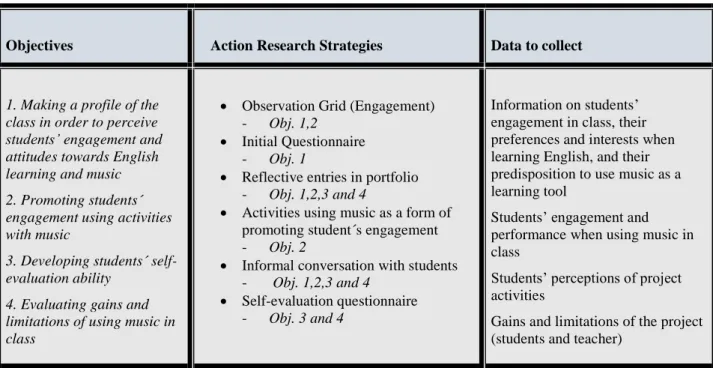
One strategy I have always found useful to engage students in learning is using music in the classroom. As I stated before, music can be used in many different ways and for different purposes, it caters for different learning styles, and it enables the creation of a positive and creative atmosphere. This is why I decided to explore music in my action research project, seeking to better understand its educational potential with young learners. Table 1 was developed to plan my action research project, presenting objectives, strategies and data collection instruments. The most important data collection instruments were an initial questionnaire (presented below in section 3.3) and 3 self-evaluation questionnaires (see Appendices 1, 2 and 3).
Table 1. Project objectives and strategies
During the project I conducted some form of inquiry before, while and after giving classes to specific students in a specific school. This aimed to increase the quality of learning and teaching practices. According to Burns (1999), the major focus of action research is on concrete and practical issues of immediate concern to particular social groups or communities. It is conducted in naturally occurring settings, primarily using methods common to qualitative research such as observing and recording events and behaviours. In the following sections I describe the stages of the project: the observation phase, the implementation phase/action phase and the final phase/reflection phase, which involved an overall analysis of practice and the writing of this
Objectives
Action Research Strategies
Data to collect
1. Making a profile of the class in order to perceive students’ engagement and attitudes towards English learning and music 2. Promoting students´ engagement using activities with music
3. Developing students´ self-evaluation ability
4. Evaluating gains and limitations of using music in class
• Observation Grid (Engagement) - Obj. 1,2
• Initial Questionnaire - Obj. 1
• Reflective entries in portfolio - Obj. 1,2,3 and 4
• Activities using music as a form of promoting student´s engagement - Obj. 2
• Informal conversation with students - Obj. 1,2,3 and 4
• Self-evaluation questionnaire - Obj. 3 and 4
Information on students’ engagement in class, their preferences and interests when learning English, and their predisposition to use music as a learning tool
Students’ engagement and performance when using music in class
Students’ perceptions of project activities
Gains and limitations of the project (students and teacher)
18
3.2 Stage one – Observation
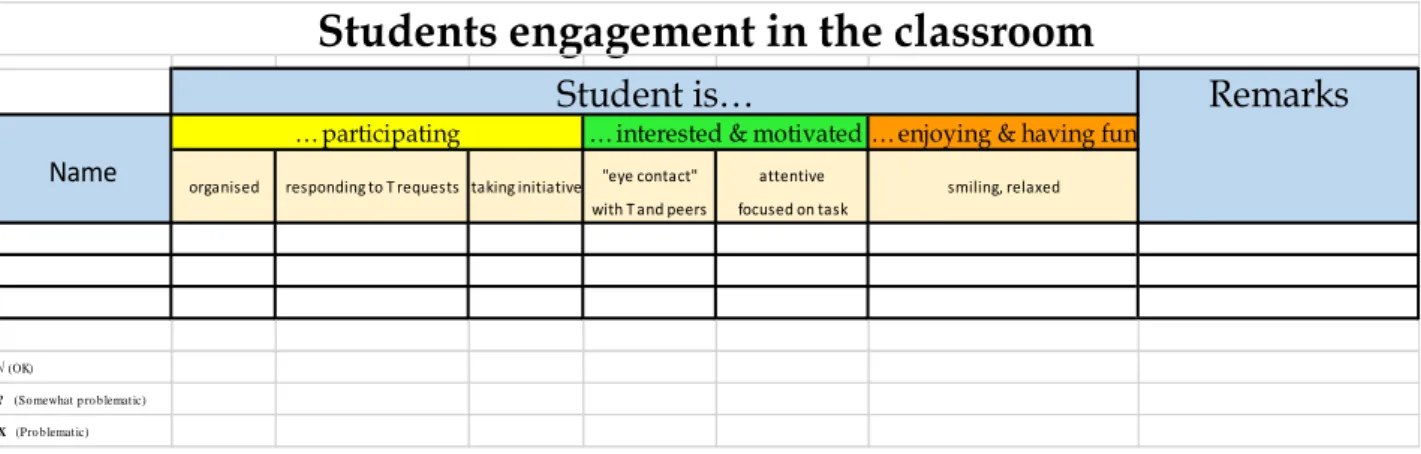
The first step of my action research project was to observe a class in order to collect some important information to later implement in my project. Observation is defined in the Oxford Dictionary as “the action or process of closely observing or monitoring something or someone, the ability of noticing things, especially significant details”. So, before getting into action and closely observe my students, I had to define first what things or significant details I was going to observe. For this I built an observing grid to help me focus on certain details related to student engagement (Figure 2).
Figure 2. Observation grid – Student Engagement
It is not easy to find a way to visualize engagement. How can you measure if students are engaged? How can you see a student is participating, interested and motivated and therefore enjoying and having fun? I tried to find some criteria that could help me observe the students. I came up with 3 that were integrated into the grid:
- Participation: is participation organised, e.g. does the student raise his/her hand in order to respond to teacher´s requests, does he/she take initiatives?
- Interest and Motivation: is there eye contact with teacher/peers while listening/interacting, is he/she attentive, on task?
- Enjoyment and Fun: is the student smiling and relaxed?
After having a data collection instrument that helped me with my observation, the next problem popped up. So many students in a classroom, how can I observe them correctly and make notes at the same time? I decided to divide students in groups, students that sat together and nearby, and observe them for some minutes. Then I would focus on another groups of students and so on. The major problem here was then that I didn’t knew their names at that time and I had prepared my grid for the lessons following their names in alphabetical order. That complicated things even more. It wasn´t as easy as I thought it would be.
Students engagement in the classroom
Student is… Remarks
…participating …interested & motivated …enjoying & having fun
Name "eye contact" attentive with T and peers focused on task
√ (OK)
? (So mewhat p ro b lematic) X (Pro b lematic)
19
So, I decided to be more flexible and took some general notes into my notebook, following the specific criteria on my grid. In general, I could see that students participated in an organized way, raising their hands when teacher asked a question or responding directly to a question, which happened mostly. Almost everyone was focused on the task at hand. Only some were having a little playtime or conversation with their peers for some seconds, which is completely natural at that age. The atmosphere was positive and relaxing, students being completely at ease. The grid was a great support to help me know what to focus on, but I would need more time to use it more effectively (knowing students’ names at least).
When we are teaching, we are so focused on what we are doing, following the steps of a lesson, that this kind of outside observation is impossible. It was really interesting to realise what you can see/observe when you are not the teacher. This observation experience was especially important to make me reflect on what student engagement means and become more prepared to implement my project with a focus on enhancing learner engagement through the use of music.
3.3. Stage two – Action Phase
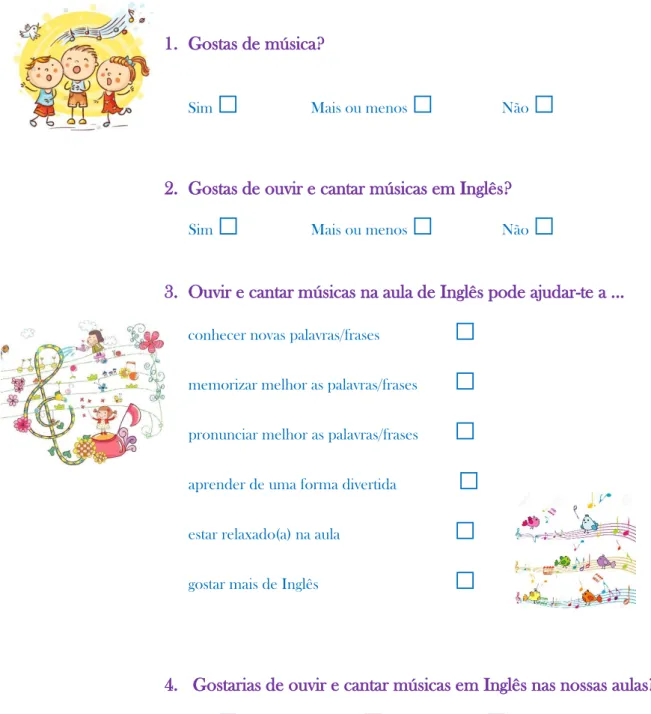
This stage is where the action begins. I wanted to use music for engaging students in learning English. Before I started with my lessons I needed to make a profile of the class in order to learn about their attitudes towards English learning in general and music in particular. This was my first step before implementing whatsoever. An initial questionnaire was handed out, divided in two parts. Part one is dedicated to what they think about English in general and the second part of the questionnaire focuses on music (Figure 3).
I tried to make the questions as simple as possible, as I have noticed through my teaching years, students sometimes have difficulties in answering questions not because they don’t know the answer, but because they don’t understand the question itself. With younger students we need even more to be careful with our words, simplify them as possible (this doesn’t mean they won’t learn more “sophisticated” vocabulary) when our main goal is communicating. Sometimes we think the words we use are clear in meaning and understanding, but young children have difficulties when these words are not part of their daily vocabulary. They may have heard it but that doesn’t mean they really know their meaning.
There is a very important aspect, from my point of view, that whatever is handed out to students, be it a worksheet, a questionnaire or something else, it has to be first explored with students before asking them to do what is need to be done. This doesn’t mean the information is only read aloud, no,
20
it can go a little further, asking students to think what is asked from them or what they should do. This not only helps them to be more autonomous but it also helps them to learn to analyse something on their own, coming to conclusions and sharing them out loud with others.
English and I
1. Gostas de aprender Inglês?
Sim
□
Mais ou menos□
Não□
2. Quando começaste a aprender Inglês?
no pré-escolar
□
no 1º ano□
no 2º ano
□
no 3º ano□
3. Aprender Inglês é ...
fácil Quase sempre
□
Às vezes□
Nunca□
divertido Quase sempre□
Às vezes□
Nunca□
4. Nas aulas de Inglês gostas de...
ouvir/ ler histórias
□
ouvir/cantar músicas□
jogar jogos□
fazer trabalhos manuais□
21
Figure 3. Initial Questionnaire
1. Gostas de música?
Sim
□
Mais ou menos□
Não□
2. Gostas de ouvir e cantar músicas em Inglês?
Sim
□
Mais ou menos□
Não□
3. Ouvir e cantar músicas na aula de Inglês pode ajudar-te a ...
conhecer novas palavras/frases
□
memorizar melhor as palavras/frases□
pronunciar melhor as palavras/frases□
aprender de uma forma divertida□
estar relaxado(a) na aula□
gostar mais de Inglês
□
4. Gostarias de ouvir e cantar músicas em Inglês nas nossas aulas?
22
As for the results I was a bit surprised. When creating this questionnaire, of course I had some expectations. Defending music as being one of the major tools to be used in the classroom, I was sure the results would show it without a doubt. There was no 100 percent, as I initially thought, but it came near to what I expected.
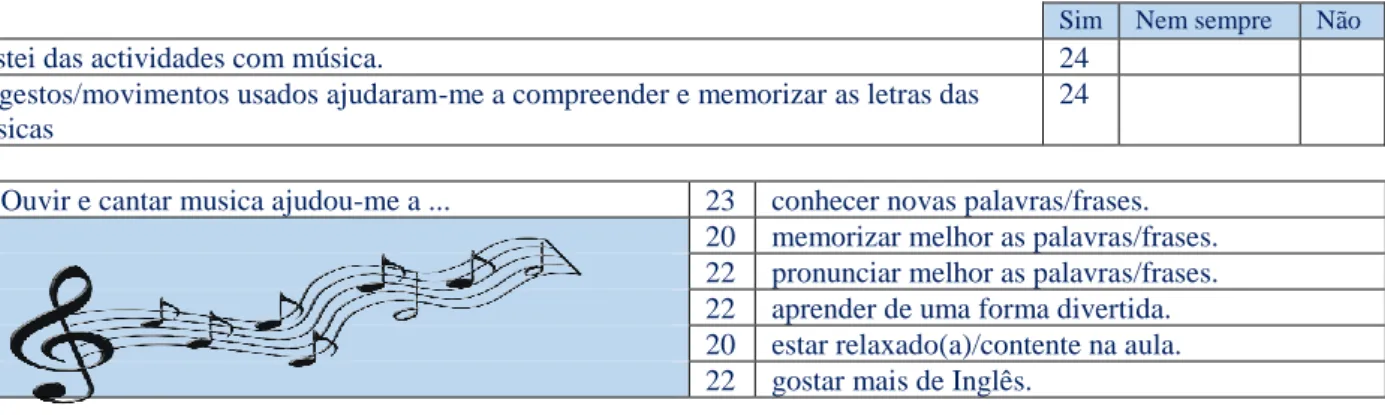
According to the results, every one of the 24 students enjoyed learning English, all of them having learnt English as a subject either from kindergarten (11 students) or as first and second graders (13 students). As for learning English being easy, 16 students agreed; 20 students thought it was fun learning English, so I can see that from the 8 students who thought English as not being easy all the time, 4 of them saw nonetheless English as being fun. This means that even when something is not perceived as easy by children, it still can give us some satisfaction.
The last question on part one of the questionnaire was about language learning activities they liked best. Here they could choose more than one answer. As can be seen in Chart 1, listening to music/singing, playing games and craft work was what they liked best in the English lessons. I was surprised that only 3 students chose reading and listening to stories as what they liked best in their English lessons.
Chart 1. Learners’ preferences in language learning
In order to better interpret students’ preference, I would have to investigate how and when these activities were used in the classroom. I can only say that from all four activities, the three could be considered being more “active, being students more involved “physically” in the activities.
As for the second part of my questionnaire, more related to music/music activities, the first question, whether they liked music or not: 19 students answered ‘yes’ and 5 ‘more or less’. As this questionnaire was anonymous I couldn’t ask why they didn’t really like music very much. The
23
question was closed, so maybe next time I need to reformulate my questionnaire, giving them the chance to explain their answers a bit more, so there is more inside information for me. With these results, I asked myself how is music used in the classroom: Are students on their seats when they sing, do they use gestures/miming, dancing movements? How often do they sing in English? The next question was really important for me to understand the potential value students saw in listening and singing in class. The results are shown in Chart 2.
Chart 2. Students’ perceptions of the learning value of music
Students could again choose several answers. I was happy to see that 17 students thought that learning with music was learning in a playful way, and 11 students thought that music could make them enjoy English more. Memorising lexis and sentence structures, pronunciation and feeling more relaxed were also chosen by at least 8 students. This only shows that students are aware that music is something enjoyable and fun and they also know how useful it can be to learn English as a subject. Regarding the last question, if they would like to listen to music and sing in the English lessons, only 4 students were not sure about it and one students answered ‘no’.
My goal with the project was to show them all that music could really be fun for everyone and could help them all learn in a playful way. To achieve my goal and try to engage my students through music activities, I needed to plan my didactic sequences with extra care. First, I needed to decide what topic to work on. Here it is important to say that the class had already started their lessons when I came to teach them. So, I had to follow the topics in their books, as there was already work in progress.
The three didactic sequences consisted of three lessons each, each one focusing on a specific topic and therefore with a suitable title: Christmas Time, I Love Fruit and Home Sweet Home.
0 5 10 15 20
Ouvir e cantar músicas na aula de Inglês
pode ajudar-te a...
24
In the first lesson of all sequences I introduced the topic in many different ways to help students guess the topic and activate a mental image of it based on their previous knowledge: using a puzzle (a reindeer), touching and smelling realia, in this case fruit, using a big cardboard with a door on it (a house).
The second lesson of each sequence was to practise and develop what they had learnt in the first lesson. Here the activities ranged from singing a song to practising new lexis/vocabulary, doing some exercises on a worksheet, creating a verse for a song, and singing a song using Total Physical Response.
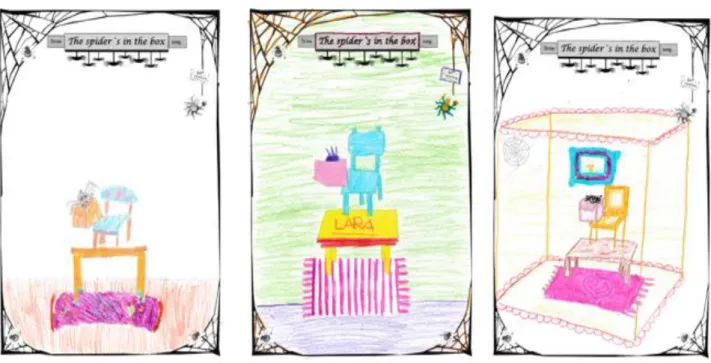
As for the last lesson, following a task-based approach, there was always a final task that summarized the topic of this unit: a final group game (Who wants to be a millionaire) using the real thing with a PowerPoint, building a fortune teller, and drawing the lyrics of a song (The spider’s in the box). The students were also asked to self-evaluate learning with a self-evaluation questionnaire (see Appendix 3).
Along with this sequence structure, every lesson started with the same “Hello” song and ended with the same “Goodbye” song, letting students know it was English time, creating a routine in our lesson. The Hello Chant was created by me:
Hello Song
Take one step forward (teacher and students sing it together and then they take a step forward) Poom, Poom (all imitating the sounds of the steps, while stepping forward)
Count: one, two, three (teacher and students sing it together)
One, Two Three (all showing one finger at a time when counting to three) Wave your hand, wave your hand (all waving hands)
Say hello to me (teacher and students sing it together) Hello!!! (loud shout)
The Goodbye song follows the same structure, but instead of taking one step forward, they take one step back, and at the end they say goodbye.
I also started to introduce picture/quote cards in every lesson to let students know what we were going to do that lesson. It is kind of a summary, but with picture cards. I had a picture card for different activities I could be doing that lesson:
• If there were games in that lesson – “Game Time” picture car • If there was a story: “Story Time” picture car
25
• If there was role-play/dramatization - “Show Time” picture card • If there was music – “Let’s sing” picture card
• If there was pair/groupwork – “Team work” picture card • If there was craft work – “Be creative” picture card.
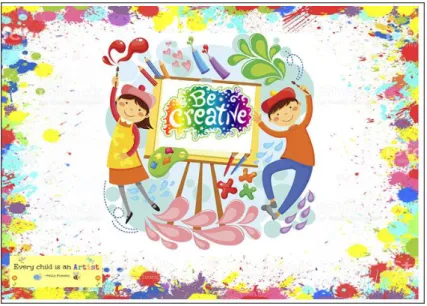
Each picture card had also a small quote related to the topic of the card. This is not only a way to let students look forward to what they are going to do, but it also gives the whole class time to reflect on important everyday subjects and themes. I was really impressed with some of their opinions and ideas when it came to the quotes. Figure 4 presents an example.
Figure 4. Picture card to introduce lesson activity
When teaching new vocabulary or language chunks, visual aids, such as flashcards/pictures are very important. I use them in almost every lesson. Student not only hear/read the new word, they visualise it at the same time. I usually create my own flashcards, using some ideas from the Internet or creating them by myself (see example in Figure 5). They must be appealing to students, sometimes even funny. It is a way to capture their attention to the pictures and they memorise the new lexis better as it is connected to something emotional.
26
And then we add gestures, a movement to it all and it is complete. Visual, auditory and kinaesthetic. There is no better way to memorise new lexis as students are offered different aids to their different needs.: “Acquisition of automatic language skills depends on rich, meaningful, repeated exposure to comprehensible input without awareness” (Bolitho et al., 2003, p. 253).
As for my lesson plan structures, used in all lesson sequences, I chose the following steps:
Greeting Stage – This is the stage where a routine activity was performed, where students started
speaking in English again (since last lesson, there was probably no other contact to the English language). So, singing the Hello chant helped students getting back to English, knowing now it´s time for English. It also helped them to settle down and start the lesson. It was also time for a little chat, maintaining therefore a rapport with my students. Here the speaking skill was developed informally. The time spent here was about 2-5 minutes.
Warm up stage – This stage was meant to introduce the topic of the lesson, set the context of the
lesson, activating in students’ minds a mental image of the topic itself with their already existing knowledge. This was done in many different ways as described before. At this stage I also started to do a small summary of the lesson through picture cards right after the greeting stage. Each picture card represents an activity. There is also a small quote on each picture card to reflect on. Here listening and speaking skills were developed. The time spent at this stage can vary, but I think as it is just a warm up, it should be not too long, going from 5-10 minutes.
Presentation – Introducing new target language and activating already known lexis were the main
objectives in this stage, sometimes using music. At this point, gestures were also introduced to give extra meaning. Listening skills were practised first as students listened to the presentation of new target language by the teacher, learning how the new lexis is correctly pronounced; then speaking skills were developed with students repeating model presentations and practising pronunciation. The reading skill was introduced when students were faced with word or sentence cards. The time spent at this stage can vary from 10-15 minutes. It shouldn’t be too long as it will diminish students’ retaining information.
Practice Stage – Students practised new target language, first with restricted activities and then
less restricted activities. By restricted activity I mean that students can practise the new target language with a whole class activity or in small groups. The less restricted activities are to be done by pairs or individually, so students can concentrate more on their own learning. Here several skills
27
were developed. The writing skill is also a possibility. Students will at this stage, still need some guidelines to produce something in writing.
Closure stage – At this stage students should be able to show what they have accomplished, giving
them a feeling of success. The previous activities could be presented to the class or a game is another good idea.
Reflection Stage – Here an informal chat with the students about what they have learnt, how they
have accomplished all the tasks and talking about their feelings towards the activities should be possible every lesson. I had sometimes the opportunity to do it during the lesson, when it came up on certain situations. I know, that due to lack of time, sometimes this isn’t possible, but starting next lesson with a flashback is also a possibility.
Goodbye Stage – Again, a routine activity was developed, where we sang all together a chant to
say goodbye. Students knew the lesson was over.
An important objective of the project was developing my students’ ability in “learning to learn”. Robert Fisher (2005), a leading expert in developing children’s thinking skills, says that thinking is not a natural function like sleeping, walking and talking. Thinking, he stresses, needs to be developed. Therefore, we must start early to teach our children/students to think, helping them apply their thinking skills in the classroom. This will lead to better self-awareness, self-confidence and consequently better learning. When our students are aware of what they can or can´t do, they can learn to overcome their personal problems. Teaching them to think enables them to learn better in their personal own way. They gain confidence and they learn that everybody learns differently and this doesn´t mean that the way they learn is better than others. Simply differently. So, noticing patterns and drawing conclusions gives students a better understanding not only of learning but of themselves as well. Knowing what we can do, what we can accomplish with certain strategies makes us more confident and independent. As a teacher, I need to develop activities that are not only meaningful and challenging but help learners develop strategies like information-processing thinking, problem-solving, decision making, critical and creative thinking and reflections. According to Chickering and. Ehrmann (1996, p. 3-6):
Learning is not a spectator sport. Students do not learn much just sitting in classes listening to teachers, memorizing pre-packaged assignments, and spitting out answers. They must talk about what they are learning, write reflectively about it, relate it to past experiences, and apply it to their daily lives. They must make what they learn part of themselves.
28
So, to enable my students to “learn to learn”, I used self-evaluation instruments and had informal chats to develop their thinking strategies by asking questions or making requests, like “How did you do it? What will you do next? How did you feel? Why was it easy/difficult?” etc. Therefore, after each didactic sequence they answered some questions on a questionnaire (see Appendices 1, 2 and 3), some related to their behaviour when on task, others related to music activities (these questions were always the same in every questionnaire), and the last part of the questionnaire (in line with learning contents in each sequence) was dedicated to showing what they had learnt, so real evidence was presented as they had to write down some examples.
At first, I wasn’t so sure to add the part of them writing language examples on the questionnaire, as I focused my lessons particularly on developing listening and speaking skills. Of course, there are always activities that are linked to reading and writing, but I have noticed that the writing part is the most difficult one to develop, if you don’t have enough time to deepen it. Even in their mother language, students have difficulties in writing and then they have to write in a different language, with different letters. It is kind of complicated. You need more than three lessons on a topic to develop their writing more, to make their writing more reliable.
In the following sections I present the three lesson sequences. The corresponding plans are in Appendices 4, 5 and 6.
3.3.1 Lesson sequence 1 - Christmas Time
In the first lesson sequence related to the Christmas Festivity, I wanted my students to learn new vocabulary and sentence structures related to that topic and then use that new lexis and practice it in a Christmas song.
In the first lesson, as for the communicative competences, I wanted them to learn and memorise vocabulary (Santa, Christmas tree, elves, presents, snowman, angel, sleigh, candle, stocking, star and
reindeer) and review/expand language chunks (There is/There are + number + noun). Regarding the
learning competences, students developed their memorising skill and used miming to give meaning to lexis and therefore understand/retain/memorise it better.
After the greeting stage, where we sang our Hello song, we solved a jigsaw puzzle on the board (a reindeer), introducing the topic of the lesson sequence 1- Christmas Time, activating in their minds a mental image of the topic with their already existing knowledge of topic, and arising expectations. Here the speaking skill was developed.