OWNERSHIP STRUCTURE AND FIRM PERFORMANCE:
EVIDENCE FROM GERMAN COMPANIES DURING AND
AFTER THE FINANCIAL CRISIS OF 2008-2011
Ana Rita da Silva Portugal dos Santos
Dissertation submitted as partial requirement for the conferral of
Master in International Management
Supervisor:
Professor Álvaro Augusto da Rosa, PhD, ISCTE Business School, Marketing, Operations and Management Department
ii
ACKNOWLEDGEMENTS
While one of the most challenging, but rewarding experiences of my life comes to an end, it is crucial to acknowledge those who have supported me in such endeavour.
First of all, I would like to dedicate this thesis to my grandmother Marieta. Unfortunately despite knowing I would be able to complete it, she passed away before I was able to submit my dissertation. I also want to thank to my parents, both my grandmothers and my aunt who have taught me that hard work and persistence always bring gratifying prizes. I thank them for providing me access to higher education, for reminding me that knowledge is the most powerful tool we can have to achieve success and for relentlessly encouraging me to complete this thesis.
Secondly, to my close friends Sara Sobral, Mónica Pereira and Pedro Sabido. I thank Sara for joining me on this journey and for bearing with me the challenges we faced while finishing our master’s degree. To Mónica and Pedro for, having finished their own thesis, keep on asking about my progress, giving me tips and words of encouragement, which certainly pushed me to finish this dissertation.
To my work colleagues for all the assistance they gave me in collecting the data for my study, in addition to incentivizing me to complete it.
Finally, but definitely not least, to my professor Álvaro Rosa, for accepting to enter on this project with me and for his deep interest on the topic, which kept reassuring me I was on the right path.
iii
RESUMO
Enquanto o mundo recupera dos efeitos da crise financeira mais recente, a ameaça eminente de uma nova crise paira sobre as economias. Muitos atribuiram a causa da crise financeira de 2008 a práticas erradas de governação corporativa, em particular a tomada de risco excessivo e má monitorização. Um dos mecanismos que deveria prevenir tais acontecimentos é a estrutura accionista, uma vez que é o dever dos accionistas proteger a empresa, por forma a que esta continue a existir para satisfazer os seus interesses. O modelo peculiar de governação corporativa alemão tem sido amplamente estudado para tentar entender se as suas caracteristicas melhoram o desempenho das empresas ou não. Através de uma amostra de 250 empresas para os anos de 2007 a 2016, o presente estudo procura o entender o impacto que diferentes tipos de accionistas (sejam membros internos, institucionais ou famílias) tiveram na empresa durante e depois da crise financeira.
Usando um modelo econométrico, concluiu-se que famílias como accionistas tiveram um impacto positivo na empresa durante os dois periodos, característico da sua visão orientada para o longo prazo. Por outro lado, accionistas institucionais tiveram um impacto negativo, uma vez que o seu objectivo é a maximização de lucros e não assistência durante períodos conturbados. Os membros internos impactaram o desempenho positivamente durante a crise, mas negativamente depois dela. Estes resultados confirmam o conceito de enraização pois, em tempo de crise, tentam melhorar o desempenho da empresa, mas depois procuram recompensas pelos seus esforços, dando origem a problemas de agência.
Palavras-chave: Governação Corporativa, Estrutura Accionista, Crise Financeira, Alemanha
iv
ABSTRACT
While the world is still recovering from the effects of the latest financial crisis, the threat of another one wanders again over economies. Many have attributed the causes of the financial crisis of 2008 to wrong corporate governance practices, especially excessive risk taking and bad monitoring. One of the corporate governance mechanisms which should prevent such events is ownership structure, as shareholders’ duty is to protect the company’s activity in order for it to prevail and satisfy their interests.
Germany’s peculiar corporate governance model has been long studied in an attempt to understand whether its characteristics ensure better corporate performance or not. Using a sample of 250 firms from 2007 to 2016, the present study aims to understand the impact that different shareholder types (i.e. insiders, institutional and family) had on firm performance during and after the financial crisis.
Through an econometric analysis, one can conclude that family shareholders present a positive impact on performance during both periods, aligned with their long-term view of the business. Institutional shareholders have a negative impact on performance during the periods in analysis, given their focus on return maximization and not in assisting the company on sustaining market downturns. Contrarily, insiders have impacted performance positively during the crisis, but negatively after it. These non-linear results confirm the inherent effect of entrenchment as, in times of crisis, insiders attempt to improve company’s performance, however afterwards they seek rewards for their efforts, leading to agency problems.
Key-words: Corporate Governance, Ownership, Financial Crisis, Germany JEL Classification System:
G01 – Financial Crisis
G30 – Corporate Finance and Governance: General Y4 – Dissertations
v
TABLE OF CONTENTS
1. Introduction ... 1
2. Literature Review ... 3
2.1 Definition of Corporate Governance ... 3
2.2 Shareholder and Stakeholder Perspectives ... 5
2.3 Corporate Governance in Germany ... 6
2.4 Previous Studies on Corporate Governance and Firm Performance ... 10
2.5 Previous Studies on Corporate Governance and the Financial Crisis ... 11
2.6 Previous Studies on Corporate Governance, Firm Performance and the Financial Crisis ... 14
2.7 Research Questions Definition ... 15
3. Context of the Study ... 17
3.1 Overview of the Financial Crisis ... 17
3.2 Financial Crisis in Germany ... 19
3.3 Current Relevance of the Study ... 22
4. Methodology ... 24
4.1 Hypothesis Definition ... 24
4.2 Sample and Sources ... 27
4.3 Variables Description ... 28 4.3.1 ROA ... 28 4.3.2 Ownership Variables ... 29 4.3.3 Firm size ... 31 4.3.4 Variables Correlation ... 31 5. Data Analysis ... 33 5.1 Descriptive Analysis ... 33 5.1.1 Dependent Variable ... 33
vi 5.1.2 Ownership Variables ... 34 5.1.3 Control Variable ... 35 5.2 Econometric Analysis ... 36 5.2.1 Hypothesis Testing ... 36 5.2.2 Endogeneity ... 40 5.3 Discussion of Results ... 41
6. Conclusions, Contributions, Limitations and Further Reseach ... 44
6.1 Conclusions ... 44
6.2 Contributions, Limitations and Future Research ... 46
vii
LIST OF TABLES
Table 1 – Summary of major studies on the relationship between company performance
and ownership structure ... 10
Table 2 – Summary of major studies on the relationship between company performance and corporate governance during the financial crisis ... 14
Table 3 – Correlation Matrix for the variables included on the hypothesis... 32
Table 4 – Summary statistics for the dependent variable ... 34
Table 5 – Summary statistics for the ownership variables ... 34
Table 6 – Summary statistics for the control variable ... 35
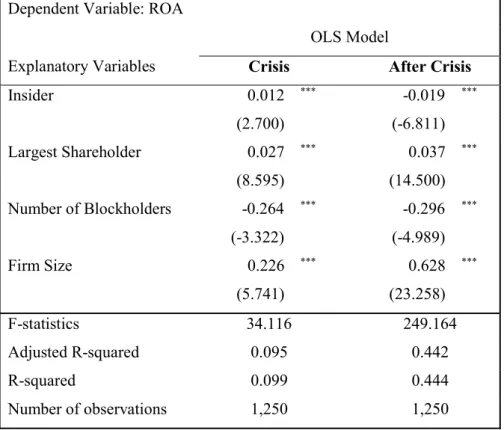
Table 7 – Regression results for testing the impact of insider shareholders on ROA during the crisis period (2007-2011) and after (2012-2016)... 37
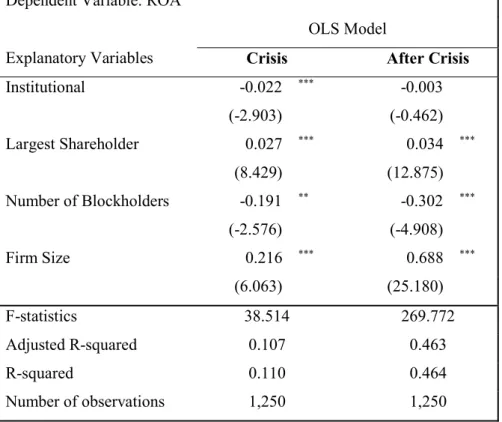
Table 8 – Regression results for testing the impact of institutional shareholders on ROA during the crisis period (2007-2011) and after (2012-2016) ... 38
Table 9 – Regression results for testing the impact of family shareholders on ROA during the crisis period (2007-2011) and after (2012-2016)... 39
1
1. Introduction
As a result of globalization, the world has undergone through profound changes along the 21st century, reaching extends far beyond the simple opening of physical, cultural and
capital boarders. Interconnectivity and interdependence between countries increased, allowing for a single event in one specific country to have a tremendous impact in all economies. This was the case of the financial crisis in 2008, which began in the United States, but soon became the largest world economic and financial crisis since the Great Depression in the 1930’s (Kirkpatrick, 2009).
Although the financial crisis had its greatest impact on the German economy in 2009 and being considered the biggest recession in post-war history (Stawicka, 2013), it began to show its effects on the country in September 2008 when US investment bank Lehman Brothers went bankrupt.
Scholars across the globe have long studied financial crises from a corporate governance perspective, including Grant Kirkpatrick who, in his study from 2009, attributed the blame for the downfall of financial institutions to various lapses in corporate governance procedures. A poor risk management system, supported by a weak corporate governance structure that did not safeguard stakeholders from taking excessive risk were to blame. Proper corporate governance entails good, efficient management and supervision of companies, based on internationally recognized standards, seeking to look after company owners’ interests, as well as taking its broader social environment into consideration (Cromme, 2005). However, by not following good corporate governance standards, companies became too exposed to risks they could not measure nor understand, leading to a crisis that affected almost every economy in the world.
Hence, it is of great importance to study all sides of corporate governance during crises as it shines light to its implications and work on future reforms (Tarraf, 2010). One of these sides worth scrutinizing is ownership structure and its effects on firm performance, as investors usually tend to ignore damaging corporate governance practices in times of economic upturn (Zingales & Rajan, 2003).
2 Distinct ownership structures can either contribute to creating firm value by mitigating agency problems or induce these problems and drag firm value down. Hence this study will focus on German companies and target ownership structure as a corporate governance mechanism. Its ultimate purpose is to analyze if the ownership structure of a firm positively affected firm performance or not during and after the financial crisis, in the particular timeframe between 2007 and 2016.
To do so, a unique sample of 250 listed and non-listed companies will be used to test the established hypothesis trough three sets of variables: performance - measured through the ROA; ownership – through the percentage of the largest shareholder, the number of blockholders, and three different shareholder types – insiders, institutional and family. Firm size will be used to control.
The main goal of the present study is to understand what kind of impact distinct sorts of shareholders can have on the performance of a company inputting the financial crisis of 2008 as an external factor, seeking to comprehend if it caused changes in such structure or not.
Although not aiming at constructing a new theory on company ownership and its effects on performance, this dissertation seeks to reinforce or deny the conclusions of previous studies.
As such, this thesis is divided in six chapters:
- The first one provides insight into the theme to be explored and the study’s established objectives;
- The second chapter addresses the theme’s theoretical literature and the research questions it seeks to answer;
- The third chapter focuses on exploring the relevance of the present study, along with an overview of the financial crisis and its impacts in Germany;
- The forth chapter explains the chosen methodology and establishes the study’s hypothesis;
- The fifth chapter includes the analysis and discussion of the results; and
-
Finally, the sixth chapter presents the summary of the most important conclusions, main limitations of this thesis and recommendations for future research.3
2. Literature Review
This chapter introduces the existing literature and studies related to corporate governance (most particularly, ownership structure as a corporate governance mechanism) and its impact on firm performance.
2.1 Definition of Corporate Governance
OECD has defined corporate governance as “a set of relationships between a company’s management, its board, its shareholders and other stakeholders. Corporate governance also provides the structure through which the objectives of the company are set, and the means of attaining those objectives and monitoring performance are determined”. It went even further and described that good corporate governance should assure the company’s shareholders and stakeholders of their protected rights, making possible for companies to decrease the cost of capital, along with an easier access to capital markets (OECD, 2015). Historically, corporate governance shows that corporations arose in medieval times as a way for private citizens to differentiate their interests from the governmental ones and combine them as a way to achieve a goal (Dragomir, 2008).
It is of common agreement amongst scholars that Berle and Means were the fathers of modern corporate governance theory when, in 1932, they discussed the separation of ownership and management powers in public stock corporations (Kraus & Britzelmaier, 2014). Moreover, they argued that the dispersed equity ownership of companies promoted many governance issues, such as: to efficiently operate a firm, managers must have the freedom to make decisions and take risks, but those decisions cannot be constantly submitted to shareholders vote; additionally shareholders with a great share of the company’s equity might be more effective in monitoring the company’s management, but however they also take advantage of that position to serve their own interests regardless of the other shareholders’ (Berle & Means, 1932).
Following Berle and Means’ findings, Jensen and Meckling presented the Agency Theory in 1976, which defines the relationship between the Principal (the company’s
4 shareholder) and the Agent (manager designated by the shareholders to run the company on behalf of the Principal). Given that agents are in charge of the daily business activities, they own additional information, and sometimes even advantageous, when compared to principals. This asymmetry can be used by agents to satisfy their self-interests and from this conflict arises the Agency Problem (Ulrich, 2009).
Later, the stakeholder’s theory was introduced in 1984 by Freeman and explained that a firm is characterized by a much larger network of relationships with other groups and individuals (such as suppliers, employees, etc.) which are affected by or can affect the achievement of a company’s goals (Freeman, 1984).
As different theories regarding a firm’s purpose have emerged along the years, so the definition of corporate governance has been revised:
- “Corporate governance aims to solve the core problem of compensation to investors” (Schleifer & Vishny, 1997)
- “[Corporate Governance] deals with management and the supervisory system of companies and represents in fact the legal and factual regulation framework for the interaction of management, board and stakeholders” (Bassen & Zöllner, 2007) - “Corporate governance addresses the issue of decision-making at the level of the board of directors and top management to ensure that all decisions taken are in line with the objectives of the company and its shareholders” (Muelbert, 2009) - “Corporate governance covers all the rules of and constraints on corporate
decision-making” (Tarraf, 2010)
The introduction of the stakeholder concept made room for the emergence of different models for corporate governance and what a firm’s purpose should be. The two main perspectives are the shareholder and the stakeholder based models, which will be further explained.
5
2.2 Shareholder and Stakeholder Perspectives
Corporate governance theories on what interests a company should serve have been long discussed, being divided in two main concepts: the shareholder- and stakeholder-based. The shareholder-based approach is focused on the conflicts between managers and shareholders, claiming that companies only exist to maximize profits and shareholder value, even if at expense of others (Bottenberg, Tuschke, & Flickinger, 2017). According to this view, a firm’s corporate governance should be designed to secure the interests of investors and to achieve the highest firm value possible (Kraus & Britzelmaier, 2014). This approach can be found prevailing in Anglo-Saxon countries where the legislation foresees strong shareholder rights protection, covering those who only hold minority interests; where markets play an active role on corporate control; firms are dependent on capital markets for financing; and there are explicit transparency regulations (Bottenberg et al., 2017).
The paradigm for shareholder value maximization also asserts to be the most efficient system for managers to create value as they are primarily focused on serving shareholders’ interests (Fama & Jensen, 1983).
On the other hand, the stakeholder-based approach includes the interests of stakeholders, emphasizing their relevance on the company’s performance and success. Freeman suggested that firms are able to create superior value when balancing shareholders and non-shareholders’ interests, being associated with reduced costs on the long-term and more efficient transactions (Freeman, 1984).
Instead of focusing purely in one objective, by acknowledging that the various stakeholders groups (which also include the shareholders) deserve to have their interests considered, firms are even able to secure access to valuable resources besides the ones initially offered on the contracts (Donaldson & Preston, 1995; Harrison, Bosse, & Phillips, 2010).
This model is characteristic, although in different strengths, in Continental Europe, such as Germany, and Japan. How the German corporate governance model is characterized according to the economic context of the country will be discussed hereafter.
6
2.3 Corporate Governance in Germany
When World War II came to an end, Western Germany implemented a social market economy in order to rebuild the country which entailed: highly regulated markets to maximize the consensus between institutions (the state, firms and unions); firms were directed under co-determination with labor force and unions; and a vertically and horizontally divided state, oriented to arrange negotiations to reach compromise. The goal was to combine some elements of the free market economies with robust social welfare systems to coordinate all the market actors (van Hook, 2004).
As opposed to what liberal regimes of Anglo-Saxon countries claim to be the purpose of economic transactions, Germany saw the economy as a well-oiled machine, whose gears work in perfect symphony to achieve common well-being and social cohesion (Yamamura & Streeck, 2003).
The constant search for consensus was also reflected on the German production model, which focused in high quality products and a continuous industrial upgrading, with gradual improvements on existing products rather than generating new ones. This slow and gradual innovation process reflects their own negotiation based institutions, often dull and with a slow decision making time (Nelson & Rosenberg, 1993).
Likewise, Germany sought an equal distribution of the economic outcomes, even when the reunification in 1990 brought additional challenges for the country as it was conducted in a way that literally meant the transplantation of all West Germany’s institutions to East Germany, but in practice it was not so simple. The reunification meant that unions and employer associations would raise East Germany’s wages to West Germany’s levels, within a few years. However, in East Germany labor was not as qualified nor productive as workers from the West and given the German society’s low tolerance for inequality, wages were raised far beyond productivity (Yamamura & Streeck, 2003).
The pressures created by the reunification and international markets led to the need to introduce more shareholder-oriented management styles in order to regain Germany’s competitiveness in global markets, even though they often violated the German logic. As implemented on the Anglo-Saxon model, these practices included executive stock-based
7 compensation, transparency of accounting standards and control systems more oriented towards the markets (Sanders & Tuschke, 2007).
Nevertheless, general society and legislative forces were reluctant on the adoption of a fully shareholder-based system and acted to preserve the egalitarian governance model, whose main characteristics have endured along the years (Tuschke & Luber, 2012). The German corporate governance model features that still prevail, and are profoundly entrenched in the German economy, are:
- Two-tier board structure consisting on: a management board – which defines and implements strategies, manages the firm’s operations – and the supervisory board which is responsible for monitoring the firm’s strategy on the long-run and, based on the feedback received from the management board, appoint and dismiss the CEO as well as setting the compensation for the top management members (Bottenberg et al., 2017). This clear distinction between decision making and decision control offers a stronger monitoring focus;
- Employee co-determination: listed firms are legally obliged to have up to half of the seats on the supervisory board reserved for employee and union representatives (and in almost all larger firms there are organized work councils). Ergo employees’ opinion is taken into consideration when making relevant strategic and governance decisions (Mueller, 2012). Co-determination is linked with reduced information asymmetries, closer relations and higher employee trust and engagement, ultimately making the company more attractive to retain skilled employees which are considered an important source of competitive advantage (Colbert, 2004; Fauver & Fuerst, 2006). Even in organizational crises, co-determination has had positive outcomes with intensive negotiations, such as the case of Opel and its imminent bankruptcy in 2008 and where employees accepted lower wages in order to keep their jobs and avoided the company’s insolvency; - Concentrated ownership structure: in many German firms it is frequent to have
groups of blockholders which are oriented for the long-term and show a greater degree of commitment towards the firm by enforcing strong influence on the company’s strategy (Tuschke & Luber, 2012);
- Common presence of family ownership: it is very common among the small- and middle-sized companies, also known as Mittelstand, but also within the largest German firms, e.g. Volkswagen and Deutsche Telekom (Andres, 2008). Family
8 firms are often managed by the founders or their relatives therefore management and ownership are often superimposed (Fama & Jensen, 1983; Hutchinson, 1995). Still, normally the interests of family owners go past the short-term view for higher profits and focus on a sustainable development of the firm (James, 1999); - Strong SME sector and industrial firms: as mentioned by the Financial Times, a
huge strength of the German market are the Mittelstand, frequently family-run companies which are flexible, specialized and innovative firms with strong balance sheets (Fratzscher, 2019). These firms are in their majority managed by family members or a group of families, hence they present the same characteristics of family firms. SMEs are the traditional representation of what the stakeholder model embodies and are strongly committed to other stakeholder groups (Berghoff, 2006).
The stakeholder-oriented model is considered deeply institutionalized in Germany, not only in its legislation and corporate governance framework, but also in the characteristics and structure of institutions, in addition to the traditions and common practices that influence the decision-making process in firms (Aguilera & Jackson, 2003).
It should be noted that there were other features regarded as typical of the German corporate governance model, which however are increasingly less common as a result of the natural evolution of the German stakeholder approach towards one that embraces the changes of the world. For instance, associated with the big proportion of blockholders within firms was a dense network of business relations between firms that entailed cross-ownership and even executives serving supervisory boards or holding seats on the boards of different firms. These practices could be used to mask the lack of control over a firm’s management as well as create opacity towards capital markets (Bottenberg et al., 2017). Consequently, the corporate governance legislation was adapted in order to limit the number of seats held in different companies and to enhance information transparency. Another element that used to be embedded on the German corporate governance model was the role banks played in companies by providing long-term financing (also designated by Hausbanken) and even holding seats in supervisory boards. Even though bank loans remain the most important source of financing for firms, equity has gained relevance when it comes to finance company’s activities. Banks have also shifted their strategic focus towards corporate investment banking activities and conduct retail
9 banking activities purely as a complement for synergy reasons (Hackethal, Schmidt, & Tyrell, 2005). In addition, the banking sector has become increasingly competitive and the rivalry has weakened the old and established cooperation between banks and firms in governance matters or when companies faced financial distress (Hackethal et al., 2005). Besides, German tax legislation suffered some changes in order to facilitate German banks and firms selling equity stakes in other companies, which enabled the reduction of cross-holdings and bank participation in firm’s management as well as exposing them more to the demands of capital markets (Weber, 2009).
But perhaps the most meaningful step in the upgrading the German corporate governance model was of the German Corporate Governance Code (hereafter, GCGC), created in 2002 by means of a government commission. The aim of the code was to make German corporate governance practices transparent and understandable for international investors (Cromme, 2005), to cover the legal regulation for monitoring and managing public stock corporations in Germany. It also introduces the standards for good corporate governance by integrating elements of a shareholder-value oriented approach and a stakeholder-value oriented approach.
The code follows a comply-or-explain principle, thus having no binding force. However companies have to disclose, on an annual basis, if it has not applied the recommendations of the GCGC (Kraus & Britzelmaier, 2014). The content of the code is reviewed annually and adapted if necessary. The current version is dated from February, 2017, however a new version has been adopted in May 2019 and will enter into full force after the implementation of the Act for Implementing the Second EU Shareholder Rights Directive ("ARUG II").
All in all, Germany has been open to improving its corporate governance model and incorporating elements which could be considered as typical of shareholder-value based models (Bottenberg et al., 2017), such as financial performance indicators and value-based measures that assist companies’ management. Nevertheless, complying with these measures is not seen as a strategic goal, but rather as tool for corporate planning and to meet global market requirements without disregarding the traditional stakeholder-value orientation which has proven to be a source of competitive advantage for German companies.
10
2.4 Previous Studies on Corporate Governance and Firm
Performance
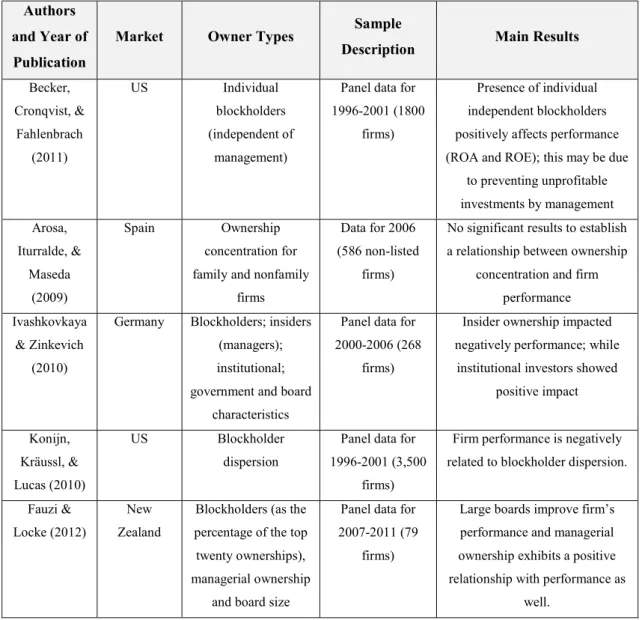
Berle and Means opened the theoretical discussion regarding the impact of the ownership structure on agency costs and corporate performance. Many empirical studies followed aiming to understand this impact and if it could be measured, both in developed and emerging markets. The table below presents a summary studies linking company performance and ownership structures, also containing an extract of the summary presented by Ivashkovskaya and Zinkevich (2010) their own study, in addition to others. Table 1 – Summary of major studies on the relationship between company performance and ownership structure
Authors and Year of Publication
Market Owner Types Sample
Description Main Results
Becker, Cronqvist, & Fahlenbrach (2011) US Individual blockholders (independent of management)
Panel data for 1996-2001 (1800
firms)
Presence of individual independent blockholders positively affects performance (ROA and ROE); this may be due
to preventing unprofitable investments by management Arosa, Iturralde, & Maseda (2009) Spain Ownership concentration for family and nonfamily
firms
Data for 2006 (586 non-listed
firms)
No significant results to establish a relationship between ownership
concentration and firm performance Ivashkovkaya
& Zinkevich (2010)
Germany Blockholders; insiders (managers); institutional; government and board
characteristics
Panel data for 2000-2006 (268
firms)
Insider ownership impacted negatively performance; while
institutional investors showed positive impact Konijn, Kräussl, & Lucas (2010) US Blockholder dispersion
Panel data for 1996-2001 (3,500
firms)
Firm performance is negatively related to blockholder dispersion. Fauzi &
Locke (2012)
New Zealand
Blockholders (as the percentage of the top twenty ownerships), managerial ownership
and board size
Panel data for 2007-2011 (79
firms)
Large boards improve firm’s performance and managerial ownership exhibits a positive relationship with performance as
11
Authors and Year of Publication
Market Owner Types Sample
Description Main Results
Wang & Shailer (2015) 18 emerging countries Ownership concentration Sample from 42 studies from 1989-2008 (419 firms)
Ownership concentration has a negative impact in performance.
Ducassy & Guyot (2017)
France Majority shareholder (> 50% threshold) and
second largest shareholder (>10%
threshold)
Panel data for 2000-2009 (212
firms)
A majority shareholder has positive influence on firm value as well as a second shareholder (if
there is the real possibility of exercising control over the firm). Paniagua,
Rivelles, & Sapena (2018)
59 countries Ownership dispersion, number of board
members
Panel data for 2013-2015 (1,207
firms)
Ownership dispersion is negatively related to firm performance as well as the number of board members.
It is worth mentioning that there are many relevant studies not listed and that over the years have inspired and served as a base of the described studies, as well as many others not listed. This is the case of the work published by Demsetz and other authors in 1895 and in 2001, the study by Morck, Schleifer, & Vishny (1988) and Himmelberg, Hubbarb, & Palia (1999). However, for the sake of contemporariness, only studies published in the last 10 years were considered.
2.5 Previous Studies on Corporate Governance and the Financial
Crisis
It is of common agreement that the bubble in housing prices in the U.S. was the trigger to the financial crisis of 2008. Nevertheless, the implications of corporate governance on the crisis have also been the target of many studies and while some argue that it was the root cause, others state there were deeper issues which enabled the global crisis.
Kirkpatrick (2009), in his report for OECD regarding corporate governance lessons from the financial crisis, was one of the first to attribute the crisis to failures in corporate governance control mechanisms, which did not prevent excess risk taking nor guaranteed
12 proper board oversight. These failures were mainly focused in three corporate governance areas: risk management, board practices and remuneration.
In regards to risk management, Poole (2010) and Fetisov (2009) explain that during a period of growing capital flows and market stability, investors sought higher yields and built portfolios containing risky long-term assets that were financed by low equity and short-term liabilities. The risks these kind of operations carried were overlooked and lacked proper due diligence. The absence of a chief risk officer in firms was also referred as a specific governance characteristic that, if existing, would have allowed for a better risk management. According to Bolton (2010), firms with a chief risk officer had higher profitability and sustained lower loan losses during the crisis than those without.
Moreover, studies focused on the Anglo-Saxon corporate governance model and its responsibility on bad board practices. For instance, the Sarbane-Oxely Act provided directors with greater independence and the power to appoint auditors, how much they would earn, in addition to select and compensate independent advisors. Even though the ultimate goal was for these entities to have an unbiased attitude when managing conflicts of interest between management and shareholders, they were entirely dependent on the directors who appointed them, thus carrying intrinsic conflict of interests (Pirson & Turnbull, 2010).
In addition, Yeoh (2010) studied corporate governance failures and included examples of failed organizations to show that bad corporate governance practices were evident. He argued that non-executive directors of financial institutions were also CEOs of equally big corporations with a global presence and simply did not have the time to be fully committed to their roles, nor did they possess the banking or financial expertise to be able to understand and challenge complex financial products that many of the failed institutions used. He concludes by asserting that the entities included on his study (e.g. Lehman Brothers, Bears Stearns and AIG) collapsed as a consequence of boards which did not fulfill their duty to protect the firm and shareholders’ welfare (Yeoh, 2010). Lastly, remuneration was appointed as a factor that lead to neglecting the consequences of excessive risk taking. Lewis (2010) condemned bankers and fund managers for accepting huge bonuses disregarding what their actions could generate and for believing that, in case of adversity, someone else would bear the costs, for example taxpayers and governments. The Financial Times had already brought to the public’s attention the
13 remuneration system in investment banking and its flaws by pointing out that the size of bonuses had no limit on its upper end, while being reduced to zero on the lower end. Thus, losses were born by the bank and its shareholders and not by the management, encouraging significant risk taking without penalties (Heller, 2008). Kirkpatrick (2009) goes even further and explained that in many cases the remuneration systems weren’t in any way connected with the firm’s strategy, risk appetite and long-term interests.
As in any other discussion, there is little agreement on who or what is to blame for the financial crisis. While some authors defend that bad corporate governance was in the core of the actions that conduced to the financial crisis, others ascertain that the entire financial system collapsed as a result of the lack of transparency and accountability. It is even possible to pin point examples of flawed corporate governance practices before and during the crisis, notwithstanding the idea that they were an important cause of the crisis (Muelbert, 2009). In sum, and as Bolton (2010) believed, there is no doubt that corporate governance contributed to the financial crisis, however there are no clear evidences if it was the ultimate cause.
14
2.6 Previous Studies on Corporate Governance, Firm Performance
and the Financial Crisis
The following table aims for summarizing some of the studies conducted with the same purpose as the present study, i.e. to understand the impact of different corporate governance mechanisms in firm performance during the financial crisis.
Table 2 – Summary of major studies on the relationship between company performance and corporate governance during the financial crisis
Authors and Year of Publication
Market Owner Types Sample
Description Main Results
Liu, Uchida, & Yang
(2010)
China CEO and executive directors ownership
Panel data for 2006-2008 (951 firms)
Managerial ownership positively affects firm value. Tryggvadóttir
(2011)
Iceland Three largest shareholders split by
type: institutional, industrial companies
and families
Panel data for 2007-2009 (116 firms)
Ownership concentration negatively impacts performance after 2008, but
positively before the crisis. Family ownership is positively related with firm performance, while industrial firm ownership is negatively. Francis,
Hasan, & Wu (2012)
S&P 1500 Board independence Panel data for 2007-2009 (876 firms)
Board independence does not affect performance
significantly. Erkens, Hung,
& Matos (2012)
30 countries Largest shareholder and institutional
shareholders
Panel data for 2007-2008 (296 firms)
Firms with higher institutional ownership had worse stock returns during the
crisis. Van Essen, Engelen, & Carney (2013) 26 European countries Ownership concentration; corporation, family, government and institutional owners; in addition to board structure measures
Panel data from 2004 to mid-2009 (1,197
firms)
Effects on corporate and family owners were insignificant, but institutional and government blockholders have a positive impact on
15
Authors and Year of Publication
Market Owner Types Sample
Description Main Results
Minichilli, Brogi, &
Calabrò (2016)
Italy Family ownership and nonfamily ownership
Panel data for 2002-2012 (219 firms)
Family ownership has a positive impact in performance before and
during the crisis Saleh, Halili, Zeitun, & Salim (2017) Australia Ownership concentration, family ownership and nonfamily ownership Two periods: 1998-2007 and 2008-2010 (677 firms)
Family firms with concentrated ownership perform better than nonfamily
firms with dispersed ownership. Also, ownership concentration has a positive impact on firm performance for both family and nonfamily
owned companies Beuselinck, Cao, Deloof, & Xia (2017) 28 European countries Government ownership
Panel data for 2005-2009 (4,737 firms)
Companies with government ownership had a smaller reduction in firm value than
firms without government ownership.
2.7 Research Questions Definition
It is undeniable that there is already a vast literature seeking to understand and measure the impact of corporate governance mechanisms in firm performance during the most recent financial crisis and that conclusions diverge. Nevertheless, it is to the author’s best knowledge that a study of this kind has not been conducted based on German firms. Ivashkovskaya and Zinkevich have conducted a study that is similar to a certain extent, however it did not contemplate the effects of the financial crisis. In addition, the existing literature appears to not have reached a consensus when it comes to the influence that ownership structure has over performance.
Hence, with the above mentioned literature as background, the present study aims to increase the empirical knowledge on the topic, focusing on whether the financial crisis has changed German companies’ performance based on a specific corporate governance
16 mechanism, ownership structure. As such, this search will materialize into the following research questions:
RQ 1: What is the impact of insider, institutional and family ownership on German firm’s performance during and after the financial crisis?
This research question was constructed to capture the main purpose of the study. Nevertheless, in order to go into more depth to answer to it, other research questions had to be designed so that it is possible to construct hypothesis that will shed light on the effects that different shareholder entities have in firm’s performance. Thus, from the main research question the following ones derive:
RQ 1a: Does the presence of insider ownership has a positive or negative effect on firm’s performance during and after the financial crisis?
RQ 1b: Does the presence of institutional owners has a positive or negative effect on firm’s performance during and after the financial crisis?
RQ 1c: Does the presence of family owners has a positive or negative effect on firm’s performance during and after the financial crisis?
The hypothesis built to answer to these questions also include the effects of the largest shareholder, as well as the number of blockholders (i.e. shareholder holding more than 5% of the firm’s capital). A well-known, and frequently used, measure of performance was chosen, the ROA (return on assets) and the sample contains small, medium and large sized German companies, listed and non-listed. How these hypothesis for these questions were set up will be further discussed in chapter 4.
17
3. Context of the Study
This chapter will introduce the background explanation of how the financial crisis emerged and spread across the globe, as well as the relevance of the selected time frame and country will be explored.
3.1 Overview of the Financial Crisis
The global financial crisis had its starting point in the US and the subprime crisis. Tracing back to an expansionary monetary policy, in 2000 the Federal Reserve began reducing the funds rate and the US Government encouraged the growth of the subprime mortgage market, in order to increase the percentage of families owning their homes. Consequently, lending activity quickly expanded with lower underwriting standards and higher risk. This allowed an increasing number of institutions to provide financial intermediation without proper regulatory oversight and by using short-term credit to invest in subprime MBSs (i.e. Mortgage Backed Securities). In an attempt to dilute the risk carried by these assets, banks bought loans from other financial institutions, split and restructured them into new instruments, such as Collateralised Debt Obligations (CDOs) and later sold them to investors with unclear information regarding risk. These CDOs backed by subprime mortgages were the ideal instrument for investors wanting higher yields, which was indeed possible as the rate of return for CDOs was higher than the market rate. (Poole, 2010).
Even though this measure seemed an appropriate engine to drive the American economy, according to Lang and Jagtiani (2010), 3 key factors prompt the financial crisis: the huge price increase in the housing market; the general decline in mortgage underwriting standards; and growth of residential MBSs. Because the performance of the mortgage market was closely related to the continuous appreciation in housing prices and based on the principle that individuals would always pay their mortgage, when housing prices started to slow down back in 2005, mortgages performance’s started to crumble (Lang & Jagtiani, 2010).
18 At this point, default rates began to rise as home owners realized that even trying to sell their houses wouldn’t be enough to pay them back, leaving financial institutions with concentrated exposure in mortgage-related products in very difficult situation.
In 2007, French bank BNP Paribas suspended three investment funds due to subprime mortgage problem in the US and financial markets started to collapse. Toxic assets such as CDOs were so largely dispersed through financial institutions (which by their turn were already highly leveraged) that confidence between financial institutions dropped, inducing a hike in interest rates for inter-bank lending and causing a global liquidity crisis. Chronologically, how the US subprime crisis spread and became a global crisis occurred throughout 2008 and can be summarized in three phases: first, in the beginning of 2008, Countrywide Financial (the mortgage unit of Bank of America) failure showed the first signs that something was not going well and in the meantime markets ceased to finance Bear Stearns prompting a bail out; secondly, although the economy was not slowing down at an alarming speed, the US government suspended Freddy Mac and Fanny Mae (i.e. the Federal Housing Finance Agency and the Federal National Mortgage Association), taking them into conservatorship and Lehman Brothers declared bankruptcy shortly after; finally, after Lehman collapsed, during phase three AIG (an insurance company) also had to be rescued by the US government. By the end of 2008, the Fed had cut its target funds’ rate to nearly zero and the financial crisis had escalated worldwide (Tarraf, 2010). Indeed, a study from the Macroeconomic Policy Institute (IMK) in Germany asserted that the subprime crisis in the USA became the Euro crisis thanks to German and French banks, which were the biggest creditors of Greece, Portugal, Ireland, Italy and Spain in addition to frequently buying securitized US mortgages through lightly regulated off-balance sheet special purpose investment vehicles. Between August 2007 and August 2008, German financial institutions accounted for 11% of worldwide bank write-downs deriving from the subprime crisis, which also represented German banks’ share on total US debt (Lindner, 2013). After the European Commission instructed every bank which had been rescued by national governments to reduce the credit granted, all banks suffered a crush in their liquidity as they relied greatly on inter-bank lending for attaining capital. Banks couldn’t satisfy their financing needs, thus triggering a chain reaction across the economy and ultimately governmental intervention was necessary.
19
3.2 Financial Crisis in Germany
In order to understand in more detail how the financial crisis reached Germany and how it was dealt with, it is important to clarify Germany’s financial system and its specific characteristics.
The German financial system is separated in three pillars: private, public and cooperative banks. Private banks are joint-stock corporations that, alike the Swiss sense, are privately held and managed by a few of its owners. Public banks entail banks are the most notable part of the German financial system. They consist on savings banks (Sparkassen) and the Landesbanken, which are owned by a municipal or regional government, respectively. Cooperative banks were created to provide access to credit for farmers and craftsmen and entail cooperative ventures between local retail institutions and regional institutions. From an external perspective, this three-pillar structure and the German financial system have always been seen as competitive, unprofitable and inefficient (Brunner, Decressin, Hardy, & Kudela, 2004). In the 19th century, private banks seemed to work as an elite,
being organized as it they were some kind of rich people’s clubs, thus they were not interested in lending money to small firms at retail level, while public and cooperative banks took that role in supporting the common people and benefiting from their deposits. This distinction gained force after the 1870 industrialization when large banks materialized the concept of main-bank relationship and supported economic growth. This division of activities and segments became blurred after the 1990’s due to a series of key, and apparently non-related, events that changed how financial institutions operated, setting them up for the disaster that would come with the burst of the subprime bubble and the financial crisis.
Initially, public banks benefited from public guarantees which enabled the Landesbanken to participate and borrow in international markets at interest rates that would reflect the creditworthiness of their owners (i.e. Germany’s regional states) instead of the banks themselves. However, in 2001 the European Comission ruled out that these guarantees had to cease to exist as they represented state aid of a kind that was not in accordance with the European Common Market’s competition rules, decision that would be effective as of 2005.
20 Knowing that the privileges would come to an end, during the transition period the Landesbanken began to issue new debt at benefitted rates backed by government guarantees and in a larger scale than before. From mid-2001 to mid-2005 they raised around € 250 billion. They also took on more risk by investing in MBSs in the US through structured investment vehicles (SIVs) created solely for this purpose. The German public banks had a great contribute to the increased demand of MBSs and CDOs and by the end of 2006, their exposure amounted to € 97 billion using off-balance sheet vehicles (Hellwig, 2018). Some authors even suggest that in addition to taking riskier loans as previously mentioned, supervisory boards in some institutions, such as WestLB and IKB, were filled with political personalities from public life that lacked financial competences to actually understand what a portfolio of asset-backed securities entailed (Dunbar, 2011; Lewis, 2010).
In addition to the increase in inter-bank lending activity, the internationalization of German institutions in the investment banking sector was also a move that later contributed to the spreading of the financial crisis into Germany. At the time, Germany’s biggest private banks were Commerzbank, Dresdner Bank and Deutsche Bank. The latter two, in an attempt to escape the restrictions presented by the German market, i.e. inefficiency, competitiveness and low profitability, established investment banking subsidiaries in London and the US by taking control of local investment banks and teams of bankers from other successful banks, such as Merrill Lynch. But by establishing these subsidiaries, a shift in power from Frankfurt to London and New York also occurred and the urge to have greater returns than in their home market, led to higher risk taking, which would later convert into expensive penalties from the US and EU authorities. In the particular case of Deutsche Bank, the bank was found to be involved in all varieties of wrong behaviors, e.g. miss-selling mortgage loans, miss-selling MBSs, manipulating the reporting of LIBOR and exchange rates to improve performance on interest rate and exchange rates (Hellwig, 2018).
So by the time MBSs write-downs began to occur and the crisis escalated, German banks were in too deep to not be affected by what was happening. Sachsen LB and Industriekreditbank (IKB) were the first mid-sized German banks to be impacted by the write-downs, as they had used short-term funding backed by liquidity guarantees to invest through their SIVs in what later became toxic assets.
21 Government support in Germany, unlike other countries, was not imposed to banks, rather than offered in the form of equity injections and guarantees. In his study, Hellwig (2018) summed the costs that German taxpayers sustained in order to save the financial institutions and it is estimated to exceed € 70 billion. The majority of these costs related to the Landesbanken: WestLB € 18 billion, HSH Nordbank € 16 billion, SachsenLB at least € 1.5 billion, Landesbank Baden-Württemberg (LBBW) € 5 billion, BayernLB € 10 billion. Expenses in the private sector amounted around € 14 billion for Hypo Real Estate (HRE) and between € 3 – 5 billion for Commzerbank (which had to absorb Dresdner Bank in order to avoid its collapse). Lastly, Industriekreditbank (IKB), which was a hybrid organized as a private-sector bank, costed taxpayers € 9.6 billion (Hellwig, 2018). On a social-economic perspective, Germany’s economy did not suffer as much as other European countries or even the US. In fact, it was able to decrease its unemployment rate from 7.8% to 5.5% between 2009 and 2012, while on the same year in the euro-area it was more than 11% (source: OECD). When the crisis was at its peak, in 2009, the government stepped in to assist companies on paying wages so that they would keep workers for when the economy recovered, saving more than 330,000 jobs. Another measure was targeted the heart of the German economy, the automotive sector, and entailed giving the German people a € 2,500 incentive to buy a new car and dispose the old one (Randow, 2019).
Despite the financial crisis’ timeline has been designated to have started in 2008 and ending in 2011, there have been subsequent crisis in many countries (e.g. Portugal, Spain or even Cyprus in 2013 and Italy in 2015 due to its non-performing loans) providing insight on the massive magnitude that damaging behaviors in the search for higher profits can have in all economies.
Once again considering the particular case of Germany, the Deutsche Bank’s scandals that have been emerging in the last few years show that the effects of the financial crisis are still echoing in German banks. Moreover, the problems of excessive capacity, low profitability and extreme competition still prevail on the German financial system, they have only been disguised by the existing monetary policy and very low interest rates (Hellwig, 2018).
22
3.3 Current Relevance of the Study
On a standalone basis, Germany can be defined as a country that is too big, but not big enough (Yamamura & Streeck, 2003). Germany is big enough to pose a threat to its neighbors, however not big enough to establish itself as an economic superpower without the support from other countries. The question of representing risk to the other European countries became more evident after the German reunification. As an outcome of WWII, dividing Germany made it safer, easier to reconstruct and control, but the unification made Germany the largest power in Western Europe. In order to keep the region at peace, Germany had to “prove” that it wasn’t a hazard to the rest of Europe and it found a way to do so by joining NATO in 1995, thus restricting its autonomy. A higher degree of restricted autonomy came as other countries pushed for the European Economic Community and so did Germany, making it from 1960 on the largest net contributor to the EU budget, which still occurs nowadays. In 2017, Germany paid an additional amount of € 13 billion to the EU than it received from it.
The creation of the European monetary system was another step that proved Germany’s commitment towards a unified Europe, since it involved policies that made any change of course highly costly (Yamamura & Streeck, 2003). The decision to join the European Community, and especially the single currency, was more politically motivated rather than economically. Still, the integration brought many advantages to Germany, including to the German trade (Germany exports a consistent large amount of its GDP to European countries, maintaining symmetrical trade relations) and decrease its own national leverage.
Since being part of the founding countries of the European Coal and Steel Community, Germany has played a paramount role in leading the unified countries to become the world’s biggest trading bloc. As argued by Paterson (2011), Germany’s leadership in the EU is described as a co-operative authority together with France. This became even more evident when the financial crisis hit Europe and the then German finance minister calmed the sovereign debt markets by assuring that state-members with stronger financial capacity would help the ones struggling. In addition, when the European Financial Stability Facility of € 750 billion was established to assist Greece, Germany guaranteed 27.13% of it, a stake significantly larger than the remaining members (Paterson, 2011).
23 Currently, Germany is a not only a member of NATO and the EU, but also of the United Nations, the G7, G20 and OECD. Its assertive position in these groups over the years has proven that Germany has the necessary decisiveness to lead on its own.
A study conducted by GIZ (Deutsche Gesellschaft für Internationale Zusammenarbeit), shows that people from all over the world are hoping and expecting that Germany takes a more pro-active and independent role in acting as a counterweight to the US, Russia and China. This view is also shared by The New York Times which foresees the EU as the next target for US President Trump’s trade wars. At the same time, the Bundesbank (Germany’s central bank) predicts the country will enter in recession by the end of 2019. To encourage domestic spending and prevent unemployment, the German government announced a € 50 billion injection. Hopefully these measures will allow for Germany to avoid another economic crisis and be able to deal with the problems of its financial system, as previously mentioned, as well as to take more responsibility in EU’s forefront. The importance of Germany in the EU and the world is undeniable. That is why the reported financial crisis that is threatening Germany once again enforces the timeliness of the present study and to the relevance of its conclusions to companies’ performance and to the German Corporate Governance model.
24
4. Methodology
This research was conducted under a deductive approach, hence in the first place the hypothesis were developed based on theories established in previous studies and then tested to understand their fit in reality.
From the literature review and the designated research questions, hypothesis have been established and will be presented. In addition, this chapter will also introduce the methodologies and the data used to achieve of this empirical study’s objectives, along with the data collection process and the variables selected to test each hypothesis.
4.1 Hypothesis Definition
This section aims to define the hypothesis which will be tested to answer to the research questions of the present study.
The first set of hypothesis is formulated in terms of ownership structure and different shareholder types. The reason behind the need to have more than one hypothesis to answer the first research question is because it would be necessary to have the three shareholder types present in every company to have enough observations to compute the regression model, which does not occur. As such, different research questions and hypothesis were formulated and each one of them contemplates one type of shareholders. Therefore, this study will entail the hypothesis defined as follows:
Hypothesis 1a: The presence of insider owners had a positive impact on companies’ performance during and after the financial crisis.
The relevance of this hypothesis is based on the agency theory developed by Jensen and Meckling (1976) where they claim that a company will always have underlying agency problems due to the fact that managers’ interests are in conflict with shareholder’s interests. Furthermore, as stated by Adam Smith in his renowned book The Wealth of the Nations (1776), managers are willing to neglect some management affairs because they
25 are simply taking care of other people’s money and when their own interests are threatened, they will seek to maximize theirs gains, even if at the expense of the ones who provided them with employment, the owners of the firm.
However, in the particular case where managers and even employees hold shares of the company (very common according to the German corporate governance model as previously depicted), the question of separation of ownership and control is eliminated prompting the reduction of agency costs. Whether or not this is true and whether holding shares of the firm encourages managers and employees to pursuit a positive and more sustainable performance, even during a crisis, is the aim of hypothesis 1a.
Other studies have sought to measure the influence that managerial ownership exerts over firm’s performance, such as Liu et al. (2010), Kapopoulos & Lazaretou (2007), and López-de-Foronga, López-Iturriaga, & Santamaría-Mariscal (2007).
Most importantly, Demsetz and Villalonga (2001) have combined the fraction owned by the five largest shareholders with the fraction of shares owned by management. They argued that a study using only one of these measures will either neglect the fact that investors are not protected from management abuse if managers holds enough shares to put them in the category of shareholder, or will assume that all shareholders classified as management have a common interest. This is very likely to not be true because, for instance, a board member might represent someone who has a large holding of the firm and will not have the same goals as the company’s CEO (Demsetz & Villalonga, 2001). The same idea applies for employees, as used on the present study, which are also accounted as insider owners. As such, Demsetz and Villalonga state that a study which combines both measures of ownership, the top five shareholders and management shares, will give a more accurate picture of the relationship between ownership and performance. This is exactly what this study aims to do by considering the fraction of the largest shareholder and the shares held by insiders.
Hypothesis 1b: The presence of institutional owners has a negative impact on companies’ performance on both periods in analysis.
The idea behind this hypothesis derives from the fact that the predictable behaviour of institutional shareholder is to pull out their stocks from firms which do not have an
26 amount of returns deemed as acceptable. On the study conducted by Van Essen et al. (2013) they posit that institutional ownership has a negative impact on performance during the financial crisis due to the lack of incentive or capability to aid underperforming companies (Van Essen et al., 2013). While in the context of a financial crisis, stable or decreasing returns are normal, afterwards rising returns are expected and if this is not the case, institutional shareholders will no longer desire to be involved on the company. That is why this hypothesis states that institutional owners will continue to have a negative impact after the crisis.
On an opposed view, the results attained by Ivashkovskaya and Zinkevich (2010) show a positive coefficient for institutional ownership. The rational argued by the authors consists on the fact that institutional shareholders are entitled to monitor the firm’s management, even if for their private interests. Therefore, they will have more control on management’s decisions, which will be beneficial, especially given the distressed period that was the financial crisis. Nevertheless, one should note that the study conducted by Ivashkovskaya and Zinkevich entailed data previous to the financial crisis of 2008.
Hypothesis 1c: The presence of family ownership has a positive impact on performance during and after the financial crisis.
Family ownership has for a long time been the object of numerous studies. More precisely, family firms have been described as being a very particular type of firms which form the base of the German business fabric. Still, the present study is not limited to analysing family firms, and considers all types of firms that have owners which form a family. For instance, Volkswagen is held in its majority by a family, however it is not considered as a family firm.
Studies particularly concerning family ownership include: Villalonga and Amit (2006) and later in 2010 as well), Minichilli et al. (2016), among many others. Other studies such as Van Essen et al. (2013) consider the effects of different types of shareholder besides family ownership, a line of thought also contemplated on the present study.
Family ownership has been observed to have a positive effect on performance due to the longer horizons of investment that owners usually have, as well as their resilience. The affective commitment and emotional attachment by the owners to the firm is also
27 highlighted (Minichilli et al., 2016) and even in a situation of difficult market perspectives, controlling families will attempt to rescue the company and its employees (Kets de Vries, 1993). Nevertheless, in the case of non-family firms, family ownership might not have such a great effect on firm performance as it has in family firms, because they might not be the only controlling shareholder type, which can prompt conflicts of interests or intentions. This can be the case when comparing the purpose of institutional shareholders and family shareholders whose time horizons are considered very conflicting (short-term vs. long-term).
4.2 Sample and Sources
The present study used a unique sample of 250 German companies, listed and non-listed, in the 10-year period from 2007 to 2016, totalling 2500 observations. Even though the financial crisis started showing its effects in Germany in 2008, the year of 2007 was included on the sample since it is the year generally considered as the market began realising the harshness of the subprime mortgages’ losses (Erkens et al., 2012).
On a first stage, a list of all the German companies with performance and control variables available for the 10-year timeline was retrieved from Bloomberg, totalling 330 companies. Afterwards, ownership data was hand-collected from two different databases: Thomson Reuters Eikon and Bureau Van Dijk’s Orbis (when no information was available on the first one). Eikon is a platform built through a network of more than 300,000 trusted contacts which provide comprehensive financial data, while Orbis contains financial and ownership information for over 310 million companies across the globe and is very useful when collecting information on smaller non-listed companies. Only companies which presented data for the full study period were kept, that is why the final sample is composed by 250 companies (76 per cent of the initial sample).
The sample has companies belonging to 29 different industries, with the prevailing ones being: automotive and machinery; chemical and medical; ICT (Information and Communications Technology); and consumer goods. Based on this, one can conclude that the sample represents the general structure of the German economy.
28
4.3 Variables Description
This study has been developed as a continuation to a certain extent of the research conducted by Ivashkovskaya and Zinkevich in 2010. On their study, these authors argued that one possible future research of their study was the impact of ownership structure in firm performance, but using the financial crisis as a kind of “natural experiment”. The rationale behind this concept is that the financial crisis was an event that triggered changes in companies, whether in the industry they operate or even at macroeconomic level, prompting time-variation changes in ownership that would otherwise not happen when using data from pre-crisis years and that usually is not present in other studies using ownership and performance data.
In this section, the selected variables to test the equations built to answer the research questions will be presented as well as reasoning behind them, besides being based on the above mentioned study.
4.3.1 ROA
The dependent variable will be ROA (Return on Assets), which has been used in many studies to assess the impact of corporate governance in firm performance (e.g Amore, Garofalo, & Minichilli, 2014; Minichilli, Brogi, & Calabrò, 2016; Saleh, Halili, Zeitun, & Salim, 2017; Tryggvadóttir, 2011). It is considered a measure for short-term accounting performance, being calculated as follows:
𝑅𝑂𝐴 = 𝑁𝑒𝑡 𝐼𝑛𝑐𝑜𝑚𝑒 𝑇𝑜𝑡𝑎𝑙 𝐴𝑠𝑠𝑒𝑡𝑠
As the ROA compares the company’s profits to the resources used to earn them, it illustrates on a very practical matter if a company’s performance is good or not. A higher ROA indicates more asset efficiency, showing if the company is able to earn more money based on less investment and giving investors an idea of how effective the company’s management is when converting the money invested into net income (Claessens & Tzioumis, 2006).