PORTUGUESE CULTURAL STANDARDS
FROM THE INDIAN PERSPECTIVE
Dissertation submitted as partial requirement for the conferral of Master in International Management
Student: Ricardo Sá
Supervisor:
Professor António da Silva Robalo
Director of the Master in International Management Program at ISCTE-IUL
i ABSTRACT
The present document has no other intention but to contribute for the studies relating the identification of Portuguese cultural standards, in this case, from the Indian perspective. The research method used in this document is the Cultural Standards Method, which bases its methodology in narrative, personally conducted interviews with members of one culture, capable of identifying differences between cultures, thus being able to create an opinion about certain cultural standards that, in their opinion, are most relevant for the main intent of studies like the present one.
As referred, the empirical data was gathered during personally conducted interviews with the 21 participants that accepted to be interviewed, all of them obeying the established criteria of having been raised within the Indian culture and been living in Portugal for at least 12 months – therefore, having been able to get themselves integrated in the society thus creating an opinion over their personal experiences.
The main text of the document is divided in five parts, contemplating the several backgrounds involved (historical - related to the countries, theoretical - related to the methods normally used for these studies and the Cultural Standard, the method used in this work), the empirical research done (the sample group, the interviews conducted and the cultural standards obtained from them) and a conclusion, in which the author summarises the results obtained and writes an epilogue to the document.
The habits, attitudes, daily life realities, misunderstandings and sometimes, even discomfort, informed during the interviews, allowed the author, after careful filtering, to conclude on the Portuguese Cultural Standards at the eyes of the Indians living in Portugal:
Importance of Social Relations
Time Perception
Relaxed Attitude
Inefficiency
Keywords:
National Culture; Cultural Standards; Portugal; India
JEL Classification System:
F23 – Multinational Firms; International Business M14 – Corporate Culture; Social Responsibility
ii SUMÁRIO
O presente documento não tem outra intenção que a de contribuir para os estudos associados à identificação das normas culturais Portuguesas, neste caso, da perspectiva indiana.
O método de pesquisa adoptado neste documento intitula-se “Cultural Standards Method”, o qual baseia a sua metodologia na narrativa através da condução de entrevistas pessoais com membros de uma determinada cultura, capazes de identificar diferenças entre as culturas, sendo assim capazes de criar uma opinião sobre as normas cultutrais que, na sua opinião, são mais relevantes para as intenções de estudos como o presente.
Como referido, os dados empiricos foram recolhidos durante entrevistas conduzidas pessoalmente com os 21 participantes que aceitaram ser entrevistados, todos eles obedecendo aos critérios previamente estabelecidos de, terem sido criados num ambiente cultural Indiano e estarem a viver em Portugal há pelo menos 12 meses – tendo sido assim possivel, a sua integração na sociedade, desta forma podendo opinar sobre as suas experiências pessoais. O texto principal do document está dividido em cinco partes, contemplando os diversos contextos envolvidos (histórico – relativo aos países; teórico – relativo aos métodos usualmente utilizados em estudos similares e; o “Cultural Standard Method”, o método utilizado neste estudo), a recolha de dados empirica efectuada (o grupo em causa, as entrevistas conduzidas e as normas culturais obtidas nas mesmas) e a conclusão, na qual o autor sumariza os resultados obtidos e escreve um epílogo ao documento.
Os hábitos, atitudes, quotidianos, desentendimentos e, por vezes, até desconforto, informados dureante as entrevistas, permitiram ao autor, após cudidadosa filtragem, concluir sobre as Normas Culturais Portuguesas aos olhos dos Indianos a viver em Portugal:
Importância das Relações Sociais
Percepção do Tempo
Atitude Descontraída
Ineficiência
Palavras-Chave:
Cultura Nacional; Normas Culturais; Portugal; India
Sistema de Classificação JEL:
F23 – Empresas Multinationais; Negócios Internacionais M14 – Cultura Corporativa; Responsibilidade Social
iii ACKNOWLEDGMENTS
First of all, I would like to thank all the participants that accepted to be interviewed regarding this subject and shared their personal experiences. Without their personal views and opinions, never could have this document been written.
I also would like to express the deepest appreciation to my supervisor, Professor António Robalo, responsible for introducing me to sociology themes related to business and management and to this one in particular. Without his teaching, guidance and supervision, never would this work have been completed.
In addition, I would like to extend my most sincere appreciation to all my colleagues and the Masters’ Professors, whose knowledge, enthusiasm and encouragement inspired me throughout the last two years.
Last but not least, I take this opportunity to express my gratitude to all members, present and past, of ISCTE’s “International Management Master Degree” Coordinating staff, for their commitment and enthusiasm to the course and to its students.
iv GENERAL INDEX 1. INTRODUCTION... 1 2. THEORETICAL BACKGROUND ... 3 2.1. Culture ... 3 2.2. Cultural Standards ... 8
2.3. Cross-Cultural Research in Management ... 11
2.3.1. Research about Cultural Dimensions ... 12
2.3.1.1. Geert Hofstede’s Cultural Dimensions ... 14
2.3.1.2. Shortcomings of Cultural Dimensions ... 16
3. CROSS-CULTURAL COMPARISON ... 17
3.1. Historical background ... 17
3.1.1. India ... 18
3.1.2. Portugal ... 20
3.2. Cross-Cultural comparison based on cultural dimensions ... 23
4. CULTURAL STANDARDS METHOD ... 28
5. RESULTS OBTAINED FROM THE EMPIRICAL RESEARCH ... 31
5.1. Applying the Cultural Standards Method ... 31
5.1.1. Sample Group ... 31
5.1.2. Interviews ... 33
5.2. Cultural Standards ... 33
5.2.1. Importance of Social Relations ... 35
5.2.2. Time Perception ... 39
5.2.3. Relaxed Attitude ... 40
5.2.4. Inefficiency ... 41
5.3. Feedback ... 44
5.4. Comparing Cultural Standards and Cultural Differences based on Cultural ... Dimensions ... 45
6. CONCLUSION ... 47
v INDEX OF FIGURES
Figure 1. 'The Onion Diagram: The depths of Culture ... 5
Figure 2. 'The Levels of Culture and their interaction ... 6
Figure 3. The levels of the human mental programming singularity ... 7
Figure 4. Hofstede's Cultural Dimensions scores for Portugal and India ... 24
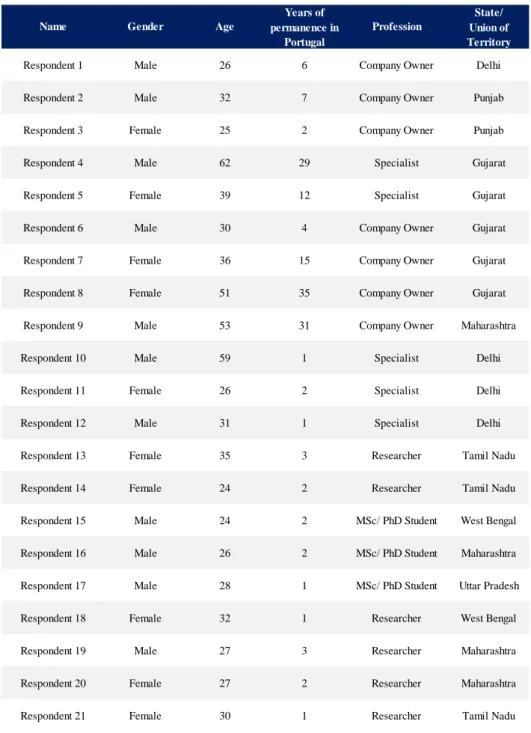
Figure 5. Profile of the sample group ... 32
Figure 6. Social Relations - Main References ... 36
1 1. INTRODUCTION
The XXI century begun with a very definite general understanding – it will be the century of globalisation and communication.
The idea of borders, which have been constantly changing since World War II (both geographical and political), has now reached a status on which political and economic diplomacy are a major influence. Economic and political agreements such as the European Union, Mercosur, NAFTA and others, changed the relations between entire blocks of countries and its politics and policies.
However, such has not been followed by the intrinsic cultures of these countries; if economics rules the world, local cultures continue to be of the outmost importance and there is no sign that such importance will diminish over time. Quite the contrary – there are many scholars that now believe globalization is not globalising everything, namely, local cultures. Social behaviours, languages, beliefs, life philosophies and obviously, religions, continue to be of a major importance in every country, no matter to which economic or political union it belongs to.
Nevertheless, the internationalisation of companies is a must if that company needs to expand either to gain market quota or to create synergies amidst its organisation. With this decision comes the necessity to export know-how, even if for just a finite period of time, as to implement the subsidiary company at the image of the mother-company regarding its internal policies, company culture, etc..
The implementation of a subsidiary company must follow not only the local rule of law but also the local culture as to not create an impression on the stake-holders and the local society in general that such company is ignoring local customs and behaviours. This perception would be disastrous for the relations between them and, for example, their workers as well as their local customers and suppliers.
To avoid any cultural misunderstandings and to maintain the due respect for local cultures, these companies make use special tools being one of those, academic papers on the perception of one certain culture regarding another certain culture.
The present document humbly contributes for these necessities by examining the Indian perspective and perception on Portuguese Cultural Standards. It is divided into five chapters, being the first one the present one – Introduction - which introduces the main objective and the context in which the document was written. The second one – Theoretical background –
2
introduces the theoretical background existing and the path the author could follow to create this document. The third chapter – Cross-Cultural Comparison – elaborates a comparison between the two countries and their cultures as to create on the reader a better understanding of the contexts on which the perceptions are based on. The fourth chapter – Cultural Standards Method – explains more extensively the method followed by the author to write this document and its conclusions being the fifth chapter – the one on which the author writes on the results obtained of the empirical research. The conclusion of this document is written on point #6.
3 2. THEORETICAL BACKGROUND
2.1. Culture
Is there a definition for ‘Culture’?
It is believed that it was Cicero, the Ancient Roman orator who for the first time used the word “culture” in one of his works of reference, “Tusculanae Disputationes”, by writing about the cultivation of the soul or “cultura animi” – an agricultural metaphor for the development of the philosophical soul, understood theologically as the highest possible ideal for human development.
Throughout the years, the concept has been broadened by being studied through many different approaches (psychology, anthropology, sociology, etc.) and engaged in several uses not only related to the original intention but also to define other groups of human characteristics. These days, one can dissertate, for example, about the nature of culture (civilization, community, ethnic group, social group, group lifestyle, etc.), about the elements of culture (arts, humanities, entertainment, etc.) and about the types of culture (organisational, etc.).
Therefore, no precise definition of culture was ever created hence the need to, in a certain way, to use a several at the same time as to create a thought. Below, we can find some of the most rational reflections ever made on the meaning of ‘Culture’:
‘Culture ... is that complex whole which includes knowledge, belief, art, morals, law, custom, and any other capabilities and habits acquired by man as a member of society.’ Tyler (British anthropologist) 1870: 1; cited by Avruch 1998: 6
‘Culture consists of patterns, explicit and implicit, of and for behaviour acquired and transmitted by symbols, constituting the distinctive achievements of human groups, including their embodiment in artefacts; the essential core of culture consists of traditional (i.e. historically derived and selected) ideas and especially their attached values; culture systems may, on the one hand, be considered as products of action, on the other, as conditional elements of future action.’ Kroeber & Kluckhohn 1952: 181; cited by Adler 1997: 14
4
‘Culture consists of the derivatives of experience, more or less organized, learned or created by the individuals of a population, including those images or encodements and their interpretations (meanings) transmitted from past generations, from contemporaries, or formed by individuals themselves.’ T.Schwartz 1992; cited by Avruch 1998: 17
‘[Culture] is the collective programming of the mind which distinguishes the members of one group or category of people from another.’ Hofstede 1994: 5
‘... the set of attitudes, values, beliefs, and behaviours shared by a group of people, but different for each individual, communicated from one generation to the next.’ Matsumoto 1996: 16
‘Culture is a fuzzy set of basic assumptions and values, orientations to life, beliefs, policies, procedures and behavioural conventions that are shared by a group of people, and that influence (but do not determine) each member’s behaviour and his/her interpretations of the ‘meaning’ of other people’s behaviour.’ Spencer-Oatey 2008: 3
Main characteristics of ‘Culture’
Even though no conclusion about its definition could ever been reached, scholars have been able to compile some of the main characteristics of Culture:
i. Culture is manifested at different levels of depth
Regarding this characteristic, two authors wrote seminal papers: Hofstede and Schein.
The vision of Hofstede is one of a multi-layered concept which core is formed by Values (definitions created around the concepts of moral and ethics related to a certain group which embodies a predetermined behaviour or principle on a precise issue), immediately followed by Rituals (collective activities towards a common end), Heroes (real or imaginary persons that embodies the correct behaviour) and Symbols (words, pictures or objects which embodies a particular thought, only recognised for those within the group). The following figure (Figure 1) represents such concept.
5 Figure 1. 'The Onion Diagram: The depths of Culture
(Source: Hofstede 2001:11)
Schein’s observations and studies led to similar conclusions. To the scholar, all is based on several underlying Assumptions, which are unconscious (pre-conscious) behaviours of a group over a certain issue. The power of these assumptions is enormous because the group will believe them as undebatable as if of a dogma we would be talking about. On the following step, we can find the ‘Espoused Values’, which are connected to a greater sense of awareness, immediately followed by the ‘Artefacts’, which can be simplistically defined as visible and audible behaviours (but often, hard to understand), patterns, art and other physical demonstrations of a group’s culture. The following figure (Figure 2) represents such concept.
6 Figure 2. 'The Levels of Culture and their interaction
(Source: Schein 1985)
ii. Culture affects behaviour and interpretations of behaviour
It is known that a certain gesture, expression or behaviour, within a culture can be interpreted with a totally different meaning to a member of a different culture. Hofstede (1991:8) claims that, even though certain aspects of a determined culture may be physically visible, such do not happen to their meaning. As an example one has hand gestures, clothes choices and even idiomatic expressions.
iii. Culture can be separated from our human nature and from our individual personality It is the social environment of a person that creates one’s cultural behaviours. Therefore culture is learned, not inherited, even though human nature can be considered as inherited, the layers above – Culture and Personality – are developed through time under the influence of the social environment. The following figure (Figure 3) represents such concept.
7 Figure 3. The levels of the human mental programming singularity
(Hofstede 1994:6)
iv. Culture influences biological processes
The most basic of our biological processes are influenced by the culture we have assimilated. Eating, being the most social of them all as we perform it in public often is one of these processes. For example, in many cultures the consumption of certain animals is considered normal, behaviour considered disgusting to other cultures.
v. Culture is associated with social groups
It is only considered cultural if a certain behaviour or physical entity is shared within a social group or society (Ferraro 1998: 16). Since all of us have different interactions within a society, it is considered normal for each one of us to be a member of different social groups simultaneously hence carrying several layers of mental programming within themselves, corresponding to different levels of culture, for example, nationality, ethnicity, gender, profession, generation, family role, etc.. (Hofstede 1991:10).
8
vi. Culture is subject to gradual change
It is known now that cultural behaviours are changeable. If one studies a certain culture in a certain moment and returns several years later, the findings will be certainly different for during that time, that culture will have allowed itself to be permeable to exogenous influences as well endogenous evolutions. For example, nowadays, the present society behaviour regarding sportive activities involving animals is certainly much different of that same society, some decades ago, within a different generation with different cultural baselines.
This document focuses on one culture’s perception of a second one having in mind its use by those who, for business management purposes, need such a document. Therefore, this document is based on the theoretical approach regarding Cross-Cultural Research in Management.
2.2. Cultural Standards
Origin and Definition
Having been established above that there is no exact and final definition for the word ‘Culture’, it is however advisable, for the purpose of this document, to establish a guideline definition.
As mentioned above, Culture is not only associated to social groups whose environment defines one’s social behaviour but also reveals changes throughout the times, as its society or group evolves accordingly to their needs. Therefore, we will use the definition above written and here repeated:
‘Culture consists of patterns, explicit and implicit, of and for behaviour acquired and transmitted by symbols, constituting the distinctive achievements of human groups, including their embodiment in artefacts; the essential core of culture consists of traditional (i.e. historically derived and selected) ideas and especially their attached values; culture systems may, on the one hand, be considered as products of action, on the other, as conditional elements of future action.’ Kroeber & Kluckhohn 1952: 181; cited by Adler 1997: 14
9
The mentioned acquiring of symbols which is based on the core values of the society underneath is transmitted by the act of socialization. This action, led by the members of a given society or group will emphasise on certain behaviours and beliefs, hence creating the legacy for the next generation who will change its baselines accordingly to their times which will lead to ad eternum repletion of the actions.
When two or more persons of different cultural groups meet, their respective cultures will guide the way they act at each moment therefore creating, as seen above, moments on which, the two cultures will clash over the same artefact or idea. Authors as Kluckhohn, Trompenaars, Hofstede and others have researched on Cultural Dimensions and, in some cases, even quantitatively measured. But these researches do not predict directly the way the persons involved in these encounters will behave when faced to a different behaviour on the same artefact or idea. Hence, the need to create a new path of research, one that would help to understand its dynamics and that would constitute as a shift from comparative researches of cultural differences: in 1991, Alexander Thomas presented his “Cultural Standards” approach in his book “Cultural Standards in International encounters” having presented us the following definitions:
“Culture Standards can be seen as the socially shared and accepted norms and values that bare used by individuals living within a particular culture, to evaluate the behaviour of each other” (Thomas, 1999)
“Cultural Standards are the types of perceptions, thoughts, values and behaviours which are treated as normal, typical and obligatory by the majority of the members of a certain culture.” (Thomas, 2005)
Culture Standards can therefore be seen as a guide to its user to establish a frame of reference against which to measure the counterpart behaviour and as an assessment tool for its perception, thought and behaviour on confronted to a certain fact. The knowledge within will allow its user to predict the counterpart behaviour at almost each moment.
10
Main characteristics of ‘Cultural Standards’
As seen, Cultural Standards are established under the core values and behaviours of a certain culture. Therefore, the main characteristics of Cultural Standards are directly correlated to the characteristics of ‘Culture’ as seen above and its inherent definitions.
If there are characteristics that cannot be directly related to the Cultural Standards – for example, the ones related to the biological process – others can. For example, its continuous evolution is directly correlated to this characteristic of Culture for, it all cultures evolve then its perception on others will too leading to a gradually and perhaps substitution of one cultural standards for another due to recent developments on its core. This only occurs when older elements are proven restrictive in the present context (Dinzelbacher, 1993).
However, “mentality is what changes the slowest (Le Goff, 1987)” and the rhythm of the rise and fall of cultural standards is therefore measured in generations and centuries. (Sylvia, 2005)
Shortcomings of ‘Cultural Standards’
Despite being a very useful tool for all the reasons above explained, Cultural Standards has nevertheless some limitations which are briefly explained below:
o It is considered to reduce the complexity of reality hence promoting stereotypical perceptions over facts for there isn’t one case where all individuals under the influence of a certain culture will behave equally when confronted to the same fact or behaviour. The clash of cultural identity and individual personality and beliefs will be the baseline for eventual changes within a culture;
o Cultural Standards also do not predict the moment of the personal contact and what exogenous factors are conditioning the behaviours of the individuals. It is known that, even on can have a belief which, by nature and in normal conditions, will determine a certain behaviour, if the factors of the environment of that fact changes dramatically, it will influence this presumably predictable behaviour and, often, change it.
All individuals involved as well as the respective situations, are also major contributing factors to the success (Sylvia, 2005);
11
The Cultural Standards Method
Because of all above, to establish Cultural Standards is a task that requires a very precise and determined procedure which is called the Cultural Standards Method.
The Cultural Standards Method deals with differences in the kinds of perceiving, norms of sensing, thinking, judging and acting, which can cause critical incidents in cross-cultural encounters (Thomas: 1996, Fink/Meierewert: 2001). Its steps will be further explained on Chapter 4 of this document.
2.3. Cross-Cultural Research in Management
Cross-Cultural Research in Management has been a field of study for many years now. Arguably the three main authors/ works that have established the seminal ideas for the new era studies are Adler’s International dimensions of organizational behaviour (1991), Hofstede’s Culture’s consequences (1980) and Trompenaars’ Riding the waves of culture (1993).
There is a urgent need for corporations to respond several questions to one of today’s biggest challenges for them: to establish themselves beyond their own borders so as to grow either by the establishment of subsidiaries in other countries or through the outsourcing of shared services or even the creation of call-centres to comprehensively support customers’ needs across several time zones.
Therefore, corporations need to develop ways to create a stimulant and productive workplace no matter the origin of the workforce. But that can be a challenge that, if taken through the wrong path can easily lead to failure. Hence the need to companies to base their recruitment and multicultural workforce decisions on cross-cultural research studies applied to management. But one asks: what is Cross-Cultural Management?
Nancy Adler (1983), gives a good definition of cross cultural management:
“Cross-cultural management is the study of the behaviour of people in organisations located
in cultures and nations around the world. It focuses on the description of organisational behaviour within countries and cultures, on the comparison of organisational behaviour across countries and cultures, and, perhaps most importantly, on the interaction of peoples from different countries working within the same organisation or within the same work environment.”
12
It is exactly on the last part of the sentence that this document is focused - on the interaction of peoples from different countries working within the same organisation or within the same work environment.
To deepen the research and create a better and more transparent understanding of the path leading to the conclusions, one must use a methodology tool specifically designed to cross-cultural research. In the following points of this chapter, two theoretical approaches for this study will be described - i) Cultural Dimensions (and within this field, the one author chosen to be the guideline on it) and ii) Cultural Standards - which will conclude on the decision of which methodology would be followed by the author on the course of this work.
2.3.1. Research about Cultural Dimensions
The Cultural Dimensions has been a field of research for more than half a century now and within this, three authors have stood apart of everybody else for the magnitude of the importance of their work: chronologically we have Geert Hofstede, Fons Trompenaars and Richard Gesteland.
The work conducted by Geert Hofstede for IBM between 1967 and 1973 is, perhaps, one of the most comprehensive studies on the impact of cultural values on the workplace and had as baseline the values and IBM workers in more than 50 countries. Such diversity allowed him to identify clusters (Cultural Dimensions), not only regarding countries behaviours regarding a certain issue but also within a country. As a result of such, the comparison between countries on the respective Cultural Dimensions could be possible hence creating a direct approach on its differences regarding these.
The Dimensions identified were:
Power Distance
Uncertainty Avoidance
Individualism
Masculinity
Later on, Hofstede, with the help of Michael Bond, added a fifth one – Long-term Orientation – after conducting an additional study using a survey instrument. However, this instrument,
13
developed by Chinese nationals, had results conditioned to the Asian reality hence valid only for this part of the world.
The work conducted by Fons Trompenaars, developed with Charles-Turner-Hampden, was initially based on Kluckhohn and Strobeck (1961) work, having its data collected through qualitative questionnaires made on several companies. Its results gave origin to a new set of Cultural Dimensions, in 1998, which are:
Universalism vs. Particularism
Individualism vs. Collectivism
Neutral vs. Affective Relationships
Specific vs. Diffuse Relationships
Achievement vs. Ascription
Attitudes to Time (Past, Present, Future)
Attitudes to the Environment
A brief analysis on these two sets of dimensions will conclude the following: Despite the differences on the sample (Hofstede made more than 100,000 questionnaires and Trompenaars around 50,000), there are conclusions made within the same cluster/ Dimension. For example, Individualism and Power Distance (partially correlated to Trompenaars Achievement vs. Ascription, having in mind that one status may origin in his social rank rather than in his personal merit).
The work conducted by Richard Gesteland, a management trainer with a long former experience on management due to his eight expatriate management assignments in six countries, was based on the analysis of his personal/ professional experience and on material he collected on the course of his 30 years of aforementioned experiences as well as a management trainer – his second professional life - rather than a specific research, as done by the above mentioned authors. Published in 1999, his work has no academic significance due to his methods; nevertheless, its conclusions led to a confirmation of the work done by Hofstede and Trompenaars as well to the identification of the following cultural variables that often causes problems for international negotiators and managers, to which he called
14
“Patterns of Cross-Cultural Business Behaviour” in his 2012 edition of “Cross-Cultural Business Behavior A Guide for Global Management”:
Deal-Focused vs Relationship-Focused Business Behaviour
Direct (low-context) vs Indirect (high-context) Communication
Informal (egalitarian) vs Formal (hierarchical) Business Behaviour
Rigid-Time (monochromic) vs Fluid-Time (polychromic) Cultures
Emotionally Expressive vs Emotionally Reserved Business Behaviour
The current work is based on an empirical research which results will be compared further on the document with Cultural Dimensions. Since Gesteland’s work cannot be used for lack of academic value and Trompenaars work has no results for Portugal in all dimensions needed, the work of Hofstede’s will be used for such goal.
2.3.1.1.Geert Hofstede’s Cultural Dimensions
The Cultural Dimensions as seen by Geert Hofstede are perfectly explained in his internet homepage (http://geert-hofstede.com/) being the following definitions an adaptation of these.
Power Distance (PDI)
This dimension expresses the degree to which the less powerful members of a society accept and expect that power is distributed unequally.
Individualism versus Collectivism (IDV)
Individualism can be defined as a preference for a distant social framework in which each one is expected to have only themselves in their mind along with their immediate family. Collectivism stands as a preference for a closer framework in society in which each one is expected to have their relatives or members, of a particular group or cluster, to look after them in exchange for unquestioning loyalty. The definition of a “I” or “we” behaviour is what sets apart a certain society's position on this dimension.
15 Masculinity versus Femininity (MAS)
Masculinity stands for a society’s preference for achievement, heroism, assertiveness and material rewards for success whereas Femininity stands for a preference for cooperation, modesty, caring for the weak and quality of life. In a Masculine society prevails the “I and in a Feminine society the “We” is the common belief and behaviour.
Uncertainty Avoidance Index (UAI)
The Uncertainty Avoidance dimension expresses to what extent, members of a certain society feel unease when facing uncertainty and ambiguity. When a Country exhibits a strong UAI, that means that it maintain rigid codes of belief and behaviour and exhibits intolerance when facing different behaviours and/ or ideas. When a society displays a weak UAI such means that it maintains a more relaxed attitude and practice counts more than principles.
Long Term Orientation versus Short Term Normative Orientation (LTO)
When a Society scores low on this dimension, this means that it prefers to maintain old traditions and norms, facing changes with suspicion. On the opposite side, a high score culture exhibits a more pragmatic and up-to-date approach, encouraging all efforts towards modern education as the path to the future.
This dimension helps define on how societies deal with their past, present and future.
Indulgence versus Restraint (IND)
Indulgence stands for a society that engage itself on the satisfaction of basic and natural human drives, enjoying life and having fun. Restraint stands for a society that avoids such behaviour by nature and regulating it by creating strict social norms.
16
2.3.1.2.Shortcomings of Cultural Dimensions
As seen above, Geert Hofstede’s Cultural Dimensions proved the existence of several Cultural Dimensions that, through an extend analysis via questionnaires, can explain a society’ culture and behaviours. Its importance and contribution for the sociological studies in unequivocal and as to this day, a fundamental tool for all researchers in the field.
Nevertheless, there are authors that have criticised the conclusions of Hofstede’s organisation. These contests are based in several arguments. For example, the result for an entire country may not be directly correlated to the individuals of the same country; even though the model’s output may correctly interpret when applied to a general population, such may not be true to all individuals especially when coexisting within regions or subcultures.
One other reason is the one related to the possibility of countries with similar scores in one certain Dimension to be in reality on opposite sides or at least to have differences of substance. This would be also an issue between these same countries: for example, being Sweden and Portugal both feminine countries the swedes may have Portugal as a masculine country. Therefore, a result for a certain country will not mean that the perception of that country over the other follows that same path.
In 2002, Brendan McSweeney published Hofstede’s ‘Model of National Cultural Differences and Consequences: A Triumph of Faith - A Failure of Analysis, Human Relations’ in which he suggests that Hofstede’s work is based on wrong assumptions, as follows:
Assumption 1 - Every micro-location is typical of the national
McSweeney states that the generalisation about concluding over an entire national population in each country solely on the basis of analysis of a questionnaire responses of employees in the subsidiaries of a single company: IBM, which immediately creates th doubt over its representativeness.
Assumption 2 - Respondents were already permanently ‘mentally programmed’ with three non-interacting cultures
Within this assumption, McSweeney questions how could have been possible to identify national cultures in IBM subsidiaries as well as supposing the existence of such cultures, and the typicality of what he could identify in that company. For that, it would have been
17
necessary to establish previously a number of other assumptions (eventually, also implausible) in order to measure these cultures.
Assumption 3 - The main dimensions of a national culture can be identified by questionnaire response difference analysis
In this point, McSweeney questions the following: even if he assumes that Hofstede managed to isolate unique aspects of national cultures, how can one conclude that he was able to construct adequate depictions of national cultures or national cultural differences?
Assumption 4 - That ‘identified’ in the workplace is unaffected by location
Hofstede assumes that what he identified within a workplace is situationally nonspecific, i.e., the location of the event does not affect one’s behaviour. However, to McSweeney, such is known, on daily life, to be untrue. One can behave in one way at the office and in a complete different way at home or during a social gathering moment.
3. CROSS-CULTURAL COMPARISON
3.1. Historical background
History shapes culture. When talking about India and Portugal, one is talking about two of the most ancient countries and cultures in their respective continents and area of geographical influence.
To comprehensively understand any of these cultures, their differences, similarities and perception on one another (in this case, India’s perception of the Portuguese cultural standards), one must understand the facts and events that contributed to the present moment of their cultures so as to understand the current status of the referred perceptions. However, due to the intricate and extent of both histories such would be impossible.
The following lines on India and Portugal do not intend to be a comprehensive explanation of the countries histories or their paths to the present status of their cultures; the intention is to be a humble contribution for the readers understanding of what may have influenced the present document conclusions.
Portugal and India have maintained cultural and economic relations for the last five centuries. The importance of this tie have been of major importance, not only for these two countries but
18
for all the Western and Eastern World with a special emphasis on the economic and cultural matters as one can confirm on point #3 of this document.
3.1.1. India
Although relatively young as a country1, India2 has been one of the most influent cultures on human civilisation with a history that goes back as far as 7000 BCE when it is believed the first known Neolithic settlements appeared in Hindustan3, which later gave origin to the Indus Valley Civilisation, the first urban culture in South Asia.
Throughout the years, its cultural diversity has been probably the most important aspect of the culture decisively contributing to one of the most advanced intellectual array of thoughts ever in mankind, in literature, mathematics and religious beliefs. Buddhism4 and three religions originated here – Hinduism, Jainism and Sikhism along with Zoroastrianism which arrived later, around the 1st millennium CE – which definitely influenced not only its inhabitant’s religious beliefs but also its social behaviour - for example, Yoga, a spiritual practice combined with physical and mental discipline, has its origin in India and is intimately connected to Buddhism, Hinduism and Jainism.
Hinduism definitely became the most important religious belief in the area and its main scriptures – The Vedas, a collection of hymns and other religious texts – are believed to have been written in India between 1500 and 1000 BCE.
By the 6th century BCE, the late Vedic period, the area had been consolidated into 16 Mahajanapadas – major oligarchies and monarchies – and had suffered a social development connected to the creation of the caste system and also to its religious beliefs giving birth to two separate movements – Buddhism, a philosophy based on Siddhartha Gautama’s teachings and Jainism – both based on the idea of renunciation during a period of increasing urban wealth development giving place to monastic traditions that still lasts nowadays. By the 3rd
1 The Republic of India was established on the 26th of January, 1950, after leaving the British dominion on the
15th of August, 1947.
2
The word “Hindus” (Old Persian) can be considered as the first origin of the word “India” alongside with the Sanskrit word “Sindhu” (although more recent) - both invoking the Indus River.
3
Hindustan – a Persian Word meaning “Land of the Hindus” refers geographically to basin of the five Punjabi rivers and the upper Indo-Gangetic Plain and is occasionally used to refer India as a whole. (Encyclopaedia Britannica).
4 For the purpose of this document, we will consider Buddhism neither a religion nor a philosophy. Using
Buddha’s own words, “… nobody should believe his teachings out of faith, but instead they should examine for themselves to see if they are true or not…”. And although having many philosophical teachings, since these are combined with daily meditations and habits that are in permanent change, the taught evolves accordingly.
19
century BCE, the Mauryan Empire had raised through other states annexations and its Kings built an empire that controlled most of the sub-continent. However, this empire is, accordingly to some, an overstatement as the several territories had a certain independence. By the 4th and 5th centuries CE, the Gupta Empire had completely redefined the administration system and under its ruling, Hinduism began to see itself more as a devotion belief rather than a ritual management. At the same time, sculpture and architecture found support on the rising urban society contributing to the enrichment of the Sanskrit literature as well of science, astronomy, medicine and mathematics.
The period leading to circa 1200 CE presents the creation of regional kingdoms with no ruler being able to achieve empire dominance. Due to the growth of the agricultural economy, pastoral peoples were included within caste society, as well non-traditional ruling classes; for the first time, this system show regional differences. At the same time, the first devotional hymns are written in the Tamil language and soon the society will evolve around the established beliefs and royalty will patron temples around the new urbanisations extending its influence to the southeast – from today’s Myanmar to Malaysia up to Java – initiating a process of translation of Buddhist and Hindu texts into their languages.
The establishment of the Islamic Delhi Sultanate in 1206 – due to successful raids of Muslim Central-Asia clans on the North of India, marks clearly a shift on the administration of the territory although not interfering too much on the local non-Muslim laws and customs. They saved India from the Mongol invasion plans of devastation and through its own plans of expansion on the south, managed to create the conditions to become an empire, controlling most of India and definitely influencing local society and its customs.
Early 16th century saw the fall of this empire which was substituted by another – the Mughal Empire – Central Asian warriors that managed to create a structured peaceful environment through administrative practices. New social groups appeared – the Marathas, the Rajputs, the Sikhs – and new elites became powerful along the country. It was the time where the great constructions appeared such as the Taj Mahal or the North India temples and palaces (now a touristic attraction around Agra, Jaipur, Jodhpur, etc.). Portugal, through Vasco da Gama, discovered the maritime route to India and soon the European countries such as Portugal and England would discover the importance of such route in their economies.
But as always, ambition and leadership crisis led to the fall of one more empire. By the early 18th century, Europe had established coastal trading companies such as the English East India Company – whose dominance would be established in a very bold fashion through its military
20
and maritime resources. By 1820, India was almost all subdue to the British Empire; this was the beginning of India’s colonial period.
The British policies on social reforms, taxes and the overall subjugation of Indian people led to the Indian Rebellion of 1857; although suppressed in 1858, led to the most important fact of the time – the dissolution of the East India Company and the beginning of the direct administration of the country by the British Government. The new government, understanding the origins of the 1857 rebellion, safeguarded the social organisation of the Indian society by protecting royalties and landed gentries. And in 1885, the Indian National Congress was founded.
After World War I, where 1 million Indians served, British reforms would take place alongside with repressive legislation. It is during this period that Indians begin to protest by cooperating in a non-violent movement and a new leader emerges: Mohandas K. Ghandi, later know as Mahatma Ghandi – the spiritual leader of the entire Indian people and the symbol of non-violent resistance against the British colonial presence. The end of World War II becomes the beginning of the end to the British presence in India. On August 16th, 1947, India becomes free of the colonial presence and presents one new country – Pakistan.
Although having ceased his place as Emperor of India in that date, George VI technically remained King of India until January 26th, 1950, date on which, the Republic of India was constituted.
Since then, India has transformed its way of life and the economic liberalisation of the last thirty years led to the creation of a different society. An emerging middle-class and a leading and undisputed intellectual capital, places the country in the list of the most relevant emerging countries of the world. With a population of about 1.2 billion people and growing, India has now a new role in global issues such as environment, geo-political clout and technologies, where it has been one of the most innovative.
3.1.2. Portugal
Portugal was established in 1143 as “Portucale”, when Dom Afonso Henriques became the first King of Portugal after taking possession of the land on the battles against the Kingdom of Castela.
The word “Portugal” has its origin on the Roman-Celtic “Portus Cale”, an ancient settlement along the Douro River, on the north of the territory. Although “Portus” can be interpreted as being “port” or “harbour”, “Cale” has no conclusive origin, having been referred as having its
21
origin on the Celtic word “Cale”, also meaning “port” or “harbour” or even that it derives from the Roman “Caladunum”.
By the 9th century, the denomination was already being used to refer to the territory on the north of the Douro River and at its end it had been reconquered from the Moors by Vimara Peres, under orders of the Asturian King, Alfonso III. The repopulation of the region took place and its reorganisation led the territory to the status of “County” – the “County of Portugal”. One of the cities that were founded by Vimara Peres was Vimaranes – today known as Guimarães (later considered as the birthplace of the country); this is the reason because today’s inhabitants of this town are known as Vimaranenses. His efforts on consolidating the territory were recognised by the King of Asturias by nominating him the first Count.
Later on, the Kingdom was divided with the northern part of Portugal becoming a part of the Kingdom of Galicia, later part of the Kingdom of León. By the end of the 11th century, Henry, a Burgundian Knight, was the Count of Portugal and managed to take advantage of the civil war going on between the Kingdoms of León and Castille to defend the territory independence through a merge with the County of Coimbra. Upon his death, his son, Dom Afonso Henriques took the responsibility of defending the County having to do it through several battles. After the Battle of São Mamede, on June 24th, 1128, he proclaims himself as the Prince of Portugal becoming the King in 1139. However, only in 1143 the Kingdom of Portugal is recognised and him as the King, through the signing of the Treaty of Zamora, having established Guimarães as the first capital of the Kingdom. Hence it is called the birthplace of Portugal.
By 1250, the Portuguese re-conquering had been concluded by D. Afonso II, by including the Moorish Al-Gharb in the Kingdom, entitling himself as “King of Portugal and the Algarves” and in 1290, the King D. Dinis rules the adoption of the “lingua vulgar” (Galego-Português) as the official language of the Kingdom to which he called the Portuguese language. In 1297, he signed the peace Treaty of Alcanizes with the Kingdoms of León and Castille therefore fixing the territorial limits of the Portuguese Kingdom.
In 1383, the King D. Fernando I die without a male heir and his widow, D. Leonor Teles, couldn´t maintain the peace with the Kingdom of Castile John I, for the latter, even though Portugal had chosen a new King – D. João I of Portugal – decided to entitle himself as King of Portugal and invaded Portugal. The next two years represents a period during which Portugal didn´t have a reigning King. But in 1385, after D. Nuno Álvares Pereira win over
22
Castille in the Battle of Aljubarrota, D. João I, illegitimate son of the former King D. Pedro I is acclaimed as King of Portugal, giving start to the Avis Dinasty.
In 1419, the Infante D. Henrique, son of King D. João I, is nominated to handle the Portuguese exploration along the African coast. This nomination gave birth to one of the most extraordinary periods of Portugal – The Discoveries – during which Portugal and Spain would dominate the seas and its economy which led to the Treaty of Tordesilhas, in 1494 (precipitated by Cristovão Colombo’s arrival in the Americas), where these countries divided the world in two. In 1498, Vasco da Gama discoveries the maritime way to India and in 1500, Pedro Álvares Cabral arrives in a land which is today known as Brazil.
In 1580, the Portuguese King D. Sebastião dies in the Battle of Alcácer-Quibir without descendants which led to another governance crisis in Portugal. But this time, the King Filipe II of Spain manages to gain control of the territory and becomes the King Filipe I of Portugal. This control lasted until 1640, when, on December 1st, a revolution headed by the nobility and the bourgeois wins and the independence of Portugal is restored.
The 18th century is marked by two separate periods – the first half, dominated by the flourishing of the mining in the Brazilian territory which led to the enrichment of the Kingdom and the second half, marked by the Lisbon earthquake in 1755 (November, 1st), during which Lisbon is almost totally destroyed. The Prime-Minister, Sebastião José de Carvalho e Melo, Marquis of Pombal, initiates a remarkable rebuild of the city, based on the urban concepts and aesthetics of the luminism and, to some, the free-masonry concepts too. He also starts profound reforms in the public administration, economy and education initiating a period called the Absolutism.
After the death of the King D. José I, the Marquis of Pombal is substituted and a period of declining of the Kingdom starts.
The first half of the 19th century is marked by the Napoleonic invasions and the civil war - 1828 and 1834 - between Absolutists and Constitutionalists. The monarchy crisis is not fully resolved until the beginning of the 20th century. In 1908 the King of Portugal and the Prince are assassinated and the last King of Portugal, D. Manuel II is exiled in Brazil. In the 5th of October, 1905, a revolution gets hold of power and the monarchy falls. Portugal becomes a Republic.
A military coup in 1926 leads to power Marechal Carmona who, in 1928, nominates António de Oliveira Salazar as Finance Minister. Having gained power in the next few years, Salazar is nominated Prime-Minister (Presidente do Conselho de Ministros) with dictatorial powers. His profoundly orthodox conservative ruling will mark the country’s 20th
23
rule until 1971. After the World War II and despite the United Nations advising about the issue, Portugal doesn’t make any effort to establish independence on its colonies and in 1961 a civil war – also called “Guerra do Ultramar” (Ultramarine War) - begins in several colonies (Mozambique, Guinea, Angola) which led to the ever growing discontentment of the people and also within the military.
In April 25th 1974, a successful coup d’état led by the military takes hold of power and establishes a non-dictatorial and a non-colonies policy system which led, not only to the independence of almost all Portuguese colonies by 1975 (with the exception of Macau – a Chinese concession - and Timor-Leste, the latter then occupied by Indonesia) as well as the 1976 Constitution and the election, in that same year, of Mário Soares (socialist party) as the first democratically elected Prime-Minister and António Ramalho Eanes as the first democratically elected President of the Republic.
In 1986, another historically event happens – Portugal joins the EEC – European Economic Community which started a new period of economic booming of the country. Since then, several important facts happened - in 1995, Portugal joins the Schengen Agreement, in 1998 organises the World Expo in Lisbon and in 2004 the European Football Cup.
Although having established an economic development in the EEC years through the influx of EEC capital and international and national investment, Portugal began to suffer with the international financial crisis in 2008 which led the country to be included in the PIIGS list (Portugal, Italy, Ireland, Greece and Spain), a pejorative acronym to identify the countries most affected by the crisis and the decrease of the respective ratings of the sovereign debt. This crisis escalated and in 2011, the Portuguese Government is obliged to ask international help, later denominated the Troika (International Monetary Fund, European Central Bank and the European Community).
3.2. Cross-Cultural comparison based on cultural dimensions
As seen previously in this document, the methodology that will support its conclusions is the one used in the Cultural Standards Method. Nonetheless, it is of great importance for this chapter to enter a field of vision related to the cultural dimensions perceived in the previous point. So as to apprehend these, a cross-cultural comparison has to be taken on the cultural dimensions of the countries involved. And for that the author chooses to use the above described Geert Hofstede’s cultural dimensions and its Portuguese and Indian scores as to
24
perceive and understand the dimensions involved: Power Distance, Individualism, Masculinity and Uncertainty Avoidance.
In 1991, a new dimension based on Confucian thinking and beliefs was added – Long-Term Orientation – and was applied to 23 countries. This new dimension, based on the research of Michael Harris Bond and supported by Hofstede, was conducted with the assistance of students and with a survey instrument developed with Chinese professors.
In 2010, Michael Minkov used recent World Values Survey data from representative samples of national populations to develop a new wave of thought and a new dimension – the sixth, called Indulgence versus Restraint, included in that same year’s edition of Culture and Organisations.
Therefore, the below Figure presents the results of these six dimensions for India and Portugal:
Figure 4. Hofstede's Cultural Dimensions scores for Portugal and India
(Source: http://www.geert-hofstede.com)
Power Distance
As stated before in this document, this dimension expresses the degree to which the less powerful members of a society accept and expect that power is distributed unequally.
Portugal and India scores on this dimension are relatively approximate (63 and 77 respectively). Such results reflect an appreciation on hierarchical distance and a top-down
25
structure in society and its organisations and individuals. Rules are mandatory and supposedly strictly followed as well as being accepted that those on the top of the pyramid are admitted to have privileges for their position and that these have subordinates that expect being controlled by them. Regarding India in particular such result is all the most important and understandable when one has in consideration the social structure of the country (an issue absent from this document for it was considered as irrelevant for its conclusions). Hence the existence of a centralised “real power” and the perception that obedience of the subordinates has to be complete and the top-down communication is formal despite possible familiar interaction or personal proximity.
Individualism vs. Collectivism
This dimension addresses the degree of interdependence a society maintains among its members and the way its self-image is defined in terms of “I” or “We”.
Portugal, with a score of 27 and in comparison with the rest of the European countries (except for Spain) is considered collectivist, stating a close long-term commitment to the member 'group', be that a family, extended family, or extended relationships. India, with a score of 48, can be considered as a society that has both collectivistic and individualistic traits. Its collectivist trait is shown by the need for the individual to feel himself a part of a larger social framework in which these are expected to contribute for the greater good. Its individualistic traits are seen as a consequence of its dominant religion/philosophy – Hinduism – which belief states the existence of a cycle of death and rebirth, being the latter dependent upon how the individual lived the preceding life.
Masculinity vs. Femininity
Masculinity stands for a society’s preference for achievement, heroism, assertiveness and material rewards for success whereas Femininity stands for a preference for cooperation, modesty, caring for the weak and quality of life. In a Masculine society prevails the “I and in a Feminine society the “We” is the common belief and behaviour.
A high score (Masculine) on this dimension indicates that the society, since its tender formative years, prefers behaviours that have achievement and success as its goal, being success defined by the winner / best in field – the “I” prevails. On the other hand, when a society scores low (Feminine) such indicates that the “We” is the collective tendency of
26
behaviour where the fundamental is to create the conditions for a better quality of life for all and success and standing out from the crowd is not as admired. The fundamental issue here is what motivates people, wanting to be the best (masculine) or liking what you do (feminine). Portugal, with a score of 31 is a country where the key word is consensus and polarization is not well considered or excessive competitiveness appreciated. In such matter that supposedly conflicts are resolved by compromise and negotiation and incentives such as free time and flexibility are favoured. The Society focus is on the well-being and social status is not shown. An effective manager is a supportive one, and decision making is achieved through involvement. But India, with a score of 56 is already considered a masculine society with its members having the need for visual display of success and power such as exterior signs of enrichment that comes with one’s success. In the case of India especially, this is thoroughly combined with of a millenary culture whose beliefs contains values such as humility and abstinence.
Uncertainty Avoidance
This dimension relates to how the society face the unknown future and how its members feel when facing ambiguous or unknown situations after having created beliefs and institutions that try to avoid these.
Regarding this Dimension, Portugal and India couldn’t be more far apart: Portugal, with a score of 99, is on the opposite side of India that scores 40. Such result identifies Indians as having a medium-low preference for avoiding uncertainty. In cultures such as the Portuguese there rules are understood as needed for its equilibrium (despite its effectiveness) and family security is an important element on each individual motivation. On the other hand, in cultures with scores such as the Indian one, imperfection is accepted. When talking about India in particular, and perhaps due to its immensity in all perspectives, it is considered as a having tolerance for the unexpected and established rolls and routines are followed and obeyed without questions however with exceptions (maybe even most of the times, being considered as an adjustment rather than an ignoring action).
Long Term Orientation
The challenges of the present and future and how the society faces its issues are studied in this dimension. Societies who score low on this dimension, are known to prefer to maintain
27
traditions and normative behaviours facing changes with suspicion. On the other hand, societies with high scores will have their members encouraged into new and more modern thinking, beliefs and behaviours firmly believing that this the path to the success in the future. Portugal scoring 28 in this dimension can be considered as normative. The respect for traditions and normative behaviour leads to a very constrict propensity to save for the future and a focus on quick results. However, India, with a score of 51, is seen as having a long-term view of its reality. It is here, as in so many moments, that Indian beliefs influence their behaviour and where the religious and philosophical thought and concept of “karma” dominates consequently their actions. Therefore, beliefs such as that time is a non-linear existence derives on such actions as the lack of punctuality, ever changing plans and an attitude on which existence is controlled by a superior entity often clashes with normative western countries that, by nature, score low on this dimension.
Indulgence vs. Restraint
In this dimension people’s control over desires and impulses are studied, based on their raising. Relatively weak control is called “indulgence” and relatively strong control is called “restraint”.
Portugal, with a low score of 33 and India with an even lower score of 26, can be considered as cultures of restraint. Such societies can have the tendency to cynicism and pessimism and also the perception that their actions are restrained by social norms creating a collective negative feeling on self-indulging.
28 4. CULTURAL STANDARDS METHOD
As stated above, the Cultural Standards Method deals with differences in the kinds of perceiving, norms of sensing, thinking, judging and acting, which can cause critical incidents in cross-cultural encounters (Thomas: 1996, Fink/Meierewert: 2001).
The implementation of this method obeys a pre-determined methodology whose steps - through sampling, interviewing and its interpretation – will enable the user to fully comprehend its environment and therefore, conclude about the cultural facts in question. The steps, initially presented by the founder of this method, Alexander Thomas, will be described within the variant presented by Fink, Kolling and Neyer, in their 2005 working paper “The Cultural Standards Method”. The steps are:
Step 1 – Narrative Interview
Step 2 – Transcription and Content analysis
Step 3 – Feedback with Culture Experts from Home and Counterpart Culture Step 4 – Mirror Studies and Triangulation Studies
o Step 1 – Narrative Interview
Narrative interviews are the raw material of this method. It’s from there that all conclusions will be taken. Created by Fritz Schutze, the persons are encouraged to lead the interview while considering the interviewer as a mere spectator to the narrative, hence contributing to the gather of information without restricting presumptions. (Brueck/ Kaizenbauer 2002:6). When applying a narrative interview, the interviewer should be almost absent of the action reducing its intervention to the creation of the stage where the interviewee will develop his rhetoric around his perceptions through short stories about his own real experiences within an intercultural interaction in management and business.
Nonetheless, the interviewer will have to establish the rhythm of the session by creating the environment on which the interviewer will develop. These interactions may contain bias which will constrain the findings. For this, it is advised that the interviews should be conducted by members of the same culture as the interviewee so as to not elevate the risk of misunderstanding the importance of a certain factor, because of their different cultural standards.
29
Other facts that can influence the success of an interview are the ones connected to age, gender and personality of the interviewers. For example, regarding some subjects, which potentially would have been considered worthy of being reported in the interview, some persons, having in mind their own culture customs, could become shy and avoid talking about it, if the interviewer is not from the same culture or gender, impoverishing the interview content.
o Step 2 – Transcription and Content Analysis
The interview analysis determines a qualitative analysis of its content; therefore, all interviews must be recorded for posterior analysis and a transcript should be produced.
The content of the critical incidents shared during the interviews must then be interpreted according to their significance to the interviewee understandings of his own culture.
Content analysis according to Mayring is based on three steps: i) summarising, ii) explication, iii) structuring (Lamnek 1995: 208). The selection and editing will create a more structured understandings of the content reducing it to relevant – the summarising.
The next moment of this step is related to the consistency of the findings in comparison to other interviews made, which interpretation will lead to the establishment of an order by categories.
As stated before, the danger of bias is always present and this step is not an exception. During this step a cultural interpretation bias may occur due to the researcher own experiences, prejudices and stereotypes; such reality has to be present at each moment of the conclusions as to reduce this danger to the minimum.
o Step 3 – Feedback with Culture Experts from Home and Counterpart Culture
Due to the danger stated above, the interpretation of the interview content as well as the content itself may be harmed of bias. This fact is fought by an external “audit”. An independent interpretation by cultural experts (home culture and counterpart culture) will prevent any bias to appear in the final document.
The methodology of this step involves the presentation to the experts of the critical incidents reported by the interviewees who will help to confirm or refute the findings or even, to identify new ones still unidentified so far.
30
o Step 4 – Mirror Studies and Triangulation Studies
Ideally, this step would be undertaken by the same panel of experts than the step before. During this step, if possible, comparative studies will be compared to the one in question reducing even more the possibility of misunderstandings due to cultural bias.
Mirror studies constitute our final step to eliminate the cultural bias with the help of “decentring, i.e., simultaneously developing the same instrument in several cultures”. (Van de Vijver/ Tanzer 1997:272).
After these four steps, the findings of the research should have been reduced to the essential, unbiased and critical conclusions. Nevertheless, new information through new studies, more recent and with more participants is appearing every day. As stated before, culture and cultural standards are not static and the speed of development of the present society and its intercultural contacts will certainly create the need for a more rapid development of these researches and its continuous repetition as to not to fall into obsolescence.