FGV IIU
International Intelligence Unit
FGV IIU Discussion Papers
Sustainability Challenges in the Power Sector: Brazil and the
Iberian Peninsula
Ruderico F. Pimentel
FGV IIU is a small think tank directly connected to the Presidency of Fundação Getulio Vargas. FGV IIU observes the international scene with the purpose of identifying issues, trends and partners relevant for Brazil, as well as contributes to explain Brazilian issues and characteristics to foreign audiences. The exchange of good practices, in both directions, is a subsidiary aim of the Unit.
FGV IIU Discussion Papers address new ideas or more technical issues deserving a broader discussion, that sometimes cannot wait for a more detailed, academic-like analysis. Their content can be varied and many of the ideas may later turn out into specific projects. They state viewpoints, analyses and syntheses considered relevant for the moment. The views in FGV IIU Discussion Papers do not engage in any way FGV or its executives and may only be attributed to the respective Authors.
FGV IIU Discussion Papers are identified sequentially, by year, at the left bottom of the front page.
FGV IIU
Director: Renato G. Flôres Jr.
Praia de Botafogo 210, 12th floor; Rio de Janeiro, Brazil. Voice: +55 21 3799 6220 (Licia)
1. Introduction.
Most of the world efforts in order to decarbonize the energy sector are centred in policies to change the electricity matrix, reducing radically the participation of fossil fuelled thermal generation - replacing coal and oil by other sources. Additionally, efforts are being made to increase the final use of electricity, including the promotion of new electric transportation modes.
Even if the proposed solution is not easily reachable, it has been lately made possible as electricity can be currently generated in a very competitive way from new renewable sources - wind and solar – without the direct emission of greenhouse gases. Nevertheless, as the sharp growth of wind and solar generation in the world is bringing far-reaching changes in the power sector, the intermittency of these new sources is still a problem waiting to be properly dealt with.
This context and perspectives for the power sector in the current century are not very different for both Iberian Peninsula and Latin America, connected more than separated by the Atlantic Ocean, where the penetration of the renewable forms is taking place, changing the traditional structures of the power sector. Given the cultural proximity of these regions, some common specificities may be found through a comparative view and explored in order to enlighten the complex issues involved in the transformation of their energy systems.
This transition to clean energy sources seems to have a broad support of the local public opinion in both regions, indicating that it will likely be continuously pursued, independent of eventual oppositions, as the climate warming is becoming a more serious problem and the need to reduce the emission of the greenhouse gases is asking for timely actions.
Although most of the initial steps have been supported by governmental incentives and regulation, the crucial players for the success of these new technologies are the companies that effectively implement the necessary investments, including among them, Spanish and Portuguese traditional power multinationals. Considering that they are present in both regions here examined, and, as such, take part in both
institutional fields influencing decisions, they reinforce, with its technical and political presence, the occurrence of common trends in all three countries here examined.
As the transition brings radical changes and new players and technological advances disrupt the older “business as usual” patterns, it is important to discuss and continuously develop new policies and regulations. The comparative analysis of national cases may help to promote adequate investments to reach the desired goals.
Spain and Portugal are leading transformation efforts, under a European Commission framework. These transitions, however, have to be cautiously considered as most European countries are currently replacing coal by natural gas, another fossil fuel. A further, more aggressive, expansion of renewables may be needed in the future, even if it will create new operational and commercial problems to be dealt with.
Latin America, in particular, a later mover, may learn from the experiences already in course in the Iberian Peninsula, facilitated by its cultural heritage. Here, for simplicity, the scope of the Latin America analysis is restricted to the Brazilian case, but its findings could probably be extended to other countries.
2. Electricity Generation Matrix in Spain, Portugal and Brazil.
The evolution of the electricity generation in these three selected countries draws attention to the fact that all three suffered very large structural changes in the last decades, with strong impacts on their sectorial businesses chain.
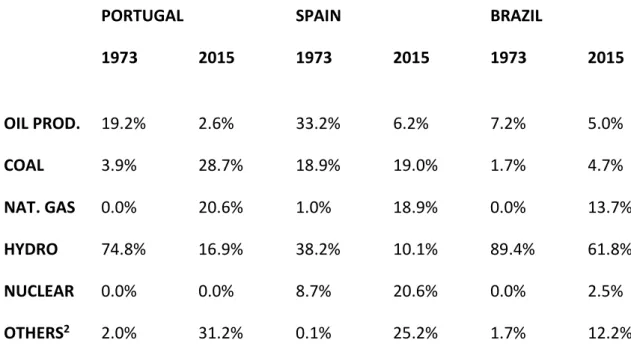
Having arrived at the current electricity structures through very different paths, Brazil, Spain and Portugal face nowadays similar challenges. Examining initially their evolution, from 1973 towards a more recent picture in 2015, many transformations can be observed, mainly related to the oil consumption, as shown in Table 1.
In this period, two important global phenomena have impacted their energy policies and have led to the reduction of the consumption of oil products in general.
First, the oil prices’ shocks of 1973 and 1978, forced these countries, as many others, to reduce their dependence on oil imports. As an answer, in the European
countries, oil have been replaced in the power sector by other fossil fuels, namely coal and natural gas.
Second, in the last decades, the climate warming, and the increase on the popular perception of its risks, put additional pressures, on the use of fossil fuels in general, especially on coal, in order to clean their energy matrixes.
After the oil prices shocks, imported coal had a strong growth in the Portuguese power sector, as the plants of Sines (1,180 MW) and Pego (576 MW), entered in operation, respectively, in 1985 and 1993, and imported coal (mainly from Colombia) became important component among the Portuguese primary energy supply sources. In Spain, were coal have been continuously kept in use, it has had a more or less stable participation during the whole 1973-2015 period, having currently more than 10,000 MW installed capacity in about 15 plants.
Now, however, both in Portugal and Spain, coal is one of the main concerns of their national and regional energy policies, as reduction of the CO2 emissions became
crucial. Under the present institutional constraints, both countries are expected to be free of coal generation by at most 2025 (Patuleia and Littlecott, 2019).
Among the primary answers to replace the oil products in the power sector, Spain, had also new nuclear and natural gas plants installed along the second half of the last century. Nuclear lost its momentum, but the use of natural gas kept growing. Currently, natural gas, on the contrary of coal, has been accepted in Spain and in Portugal as a transitional fuel, replacing other fossil fuels, since it reduces by half their emissions. Most of it is imported through gas pipelines from other countries or bought in its liquid form, LNG.
Nuclear, however, has faced strong opposition. In Spain, during the 70’s and 80’s there was strong growth of the nuclear industry as it was seen as the solution for the future energy needs, and nuclear generation became an important part of its electricity matrix. However, under the impact of the nuclear disasters of Three Mile Island in 1979 and of Chernobyl 1986, reinforced later by Fukushima, that policy changed, and anti-nuclear campaigns have successfully obstructed its posterior development. The
construction of new plants was blocked, and many existing nuclear plants are being progressively closed.
Table 1 – Electricity Generation by source (%) in Portugal, Spain and Brazil1
PORTUGAL SPAIN BRAZIL
1973 2015 1973 2015 1973 2015 OIL PROD. 19.2% 2.6% 33.2% 6.2% 7.2% 5.0% COAL 3.9% 28.7% 18.9% 19.0% 1.7% 4.7% NAT. GAS 0.0% 20.6% 1.0% 18.9% 0.0% 13.7% HYDRO 74.8% 16.9% 38.2% 10.1% 89.4% 61.8% NUCLEAR 0.0% 0.0% 8.7% 20.6% 0.0% 2.5% OTHERS2 2.0% 31.2% 0.1% 25.2% 1.7% 12.2%
(1) Data sources: Brazilian Ministry of Mines and Energy; Irena – International Renewable Energy Agency
(2) Including renewables – wind, biomass, solar
Hydroelectricity, another important source, has been used since early years by the Iberian Peninsula, and much more intensively in the Brazilian case (see for instance, Flores and Pimentel, 2017). In the last decades, both Portugal and Spain have shown a sharp decrease in the participation of hydro energy, following the progressive reduction on the availability of possible locations for new hydro projects, reinforced by a popular opposition to new dams.
Even so, a few projects have still been implemented, as the case of the hydro complex of Tamego of 1,158 MW in Portugal, currently being built by Iberdrola and that may help to reach the Portuguese goal of closing its coal plants. It was also the case of the pumped-storage and conventional hydro plant Cortes-La Muela complex with 1,780 MW capacity near the city of Valencia in Spain.
The intensive use of hydroelectricity makes Brazil a case apart. Without good quality coal reserves, and a very small domestic oil production during most of the past century, the country based its electricity expansion heavily on its large hydroelectric potential, using thermal power only in a very complementary way and to supply isolated locations. Building and equipment industrial sectors were fully developed, as new hydrothermal planning and operation expertise was devised, in a power sector dominated almost exclusively by state-owned companies.
As such, the oil price shocks of 1973 and 1978 did not substantially affected the Brazilian power generation, although it was strongly felt by the country’s economy, mostly by its road transportation sector with heavy impacts over the balance of payments. The Brazilian alternative answers to the oil shocks were mainly related to the successful sugar cane ethanol program, to replace part of the use of gasoline as a car fuel. In parallel, co-generation of heat and electricity with the bagasse have been successfully further developed helping the fossil fuel reduction in the power sector.
The main efforts in Brazil, however, were concentrated in the oil sector itself that, starting in the 70’s, led to important oil findings, off-shore, and progressively reverted the country’s position in the oil world ranks from heavy importer to marginal net exporter, bringing the oil production levels from less than 200 kBD up to around 2,800 kBD currently.
Even with the new discoveries, oil has maintained a small participation among the Brazilian electricity sources as cheaper resources are available. Most of the domestic findings of natural gas, associated and non-associated, had also a small impact in the power sector as it was absorbed by industrial uses, as the gas imports from Bolivia.
However, new recent large findings of off-shore pre-salt oil, mostly associated with natural gas, may change this picture. The possible need of burning this newly found gas, will eventually increase the country’s greenhouse emissions and it is posing difficult questions about its potential use by the power sector. In Brazil, differently of what happens in many countries, the use of new natural gas plants in the power sector instead of reducing current total emissions, will increase these emissions, as gas in Brazil is not meant to replace other fossil fuels and will probably take up part of the room created by the absence of new hydro projects.
Under the impact of the oil prices shocks, Brazil has also started a nuclear program and since 1985 two nuclear plants were built and a very costly third one is still being continuously and slowly developed. Although currently the program is the subject of discussion at the governmental level, in practice, considering its lack of economic competitiveness, it tends to be frozen by the time being.
The hydro plants, during many years represented the main generation source in Brazil, producing in the past more than 90% of the electricity supplied each year. They have been responsible for its very clean electricity sector, with nowadays more than 100,000 MW of installed capacity. But, as the new potential plant locations became more distant and its environmental impacts are reaching the Amazon region, new large projects have been blocked by strong popular and legal opposition, stopping most of the hydro development, now consisting only of very small units.
Many of the last large plants built were also of the run-of-the river type, with smaller reservoirs. The questioning about the reservoirs impacts over the environment, mainly the ones that could reach indigenous populations, have forced the reduction of new dams’ size. It was, for instance, the case of the UHE Belo Monte with 11,000 MW, in operation since 2016, with its last turbine installed in 2019, possibly the last large hydro plant built in Brazil. Consequently, the total capacity of storage of the hydro system in Brazil that in the past, when water-filled, could supply the demand for more than one year, now its estimated in at most five months.
In this context, the developing of new electricity non-greenhouse-gas-emitting sources became a central policy both in Brazil as it is in the Iberian Peninsula, and in both cases hydro plants are not anymore, the main solution. So, if nuclear plants, another non-emitting electricity sources, are discarded, a large expansion of other renewables is necessary. Geothermal, biomass, waste, agricultural and other residues can help, but in a limited way.
Since the turn of century, and more distinctly during the last decade, even coming from different structural perspectives, in Portugal and Spain the need to replace the existing coal plants, in Brazil to keep the expansion of the electricity matrix still clean without new hydro plants, both regions moved to the same kind of renewable solution: new wind and solar generation, whose significant price reductions in the world has
made possible its rapid growth in a very competitive way.
3. Advances of Renewables and new Challenges.
The later years are showing a sharp increase of wind generation, and more recently, a new wave of solar generation. After a significant growth in installation of wind turbines in Spain and in Portugal, Brazil is following along the same path.
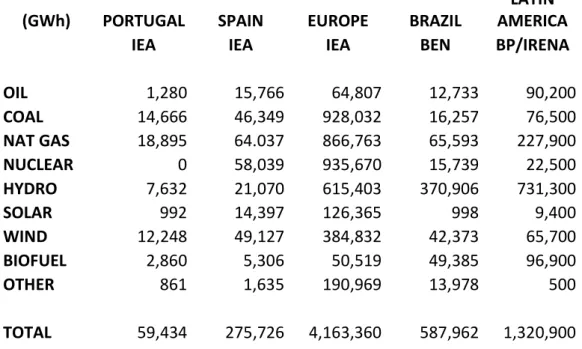
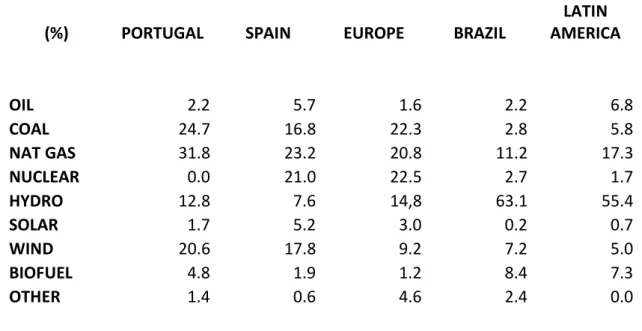
Table 2 shows that, already in 2017, the share of wind power as an electricity generation source in all these three countries was higher than in their respective regions. The participation of wind in Spain and in Portugal is much higher than the average role of wind generation in Europe.
Spain has been one of the leading European countries in this industry with a broad industrial base reaching all the stages of the production chain. Large world players have industrial plants installed in the country. Its net exports represented in 2018 almost US$ 3,000 million, being at that time the third biggest net exporter in the world. The Portuguese wind market also grew consistently with the Spanish transformations.
Table 2 – Electricity Generation by Source (2017)
(GWh) PORTUGAL SPAIN EUROPE BRAZIL AMERICA LATIN IEA IEA IEA BEN BP/IRENA OIL 1,280 15,766 64,807 12,733 90,200 COAL 14,666 46,349 928,032 16,257 76,500 NAT GAS 18,895 64.037 866,763 65,593 227,900 NUCLEAR 0 58,039 935,670 15,739 22,500 HYDRO 7,632 21,070 615,403 370,906 731,300 SOLAR 992 14,397 126,365 998 9,400 WIND 12,248 49,127 384,832 42,373 65,700 BIOFUEL 2,860 5,306 50,519 49,385 96,900 OTHER 861 1,635 190,969 13,978 500 TOTAL 59,434 275,726 4,163,360 587,962 1,320,900 Sources: IEA, BP, IRENA, Brazilian Energy Balances (MME)
(%) PORTUGAL SPAIN EUROPE BRAZIL AMERICA LATIN OIL 2.2 5.7 1.6 2.2 6.8 COAL 24.7 16.8 22.3 2.8 5.8 NAT GAS 31.8 23.2 20.8 11.2 17.3 NUCLEAR 0.0 21.0 22.5 2.7 1.7 HYDRO 12.8 7.6 14,8 63.1 55.4 SOLAR 1.7 5.2 3.0 0.2 0.7 WIND 20.6 17.8 9.2 7.2 5.0 BIOFUEL 4.8 1.9 1.2 8.4 7.3 OTHER 1.4 0.6 4.6 2.4 0.0
Brazil, a late arrival in the development of these new renewables, reached a higher wind participation than Latin America as a whole. In the Brazilian case, it should be noticed that it was the only country in its region that built an industrial park in order to supply gas turbines (see Flores and Pimentel, 2016) and additional equipment. Large market and governmental incentives were considered crucial to reach that industrial maturity.
Following wind, solar (mainly photovoltaic) is a more recent option that have also had its costs reduced and started to be widely used in all three countries, both through relatively larger plants (in the order of 50-100 MW each) as through smaller units distributed directly among the consumers. Solar may be possibly going to overcome the wind’s generation in a few years.
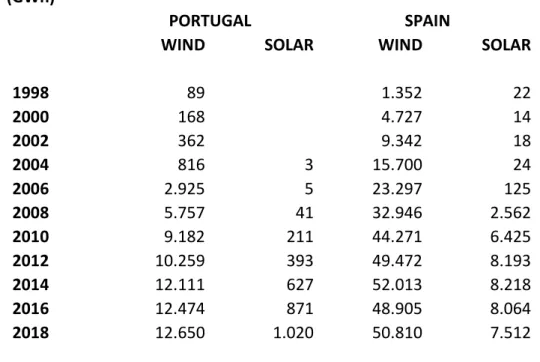
Table 3 shows the evolution of wind and solar in Portugal and Spain since the last years of the 90’s and along the current century. In 2018, considering both renewables, the Iberian Peninsula was responsible for 18% of the European installed capacity of these new sources, 7,236 MW in Portugal and 20,079 MW in Spain, while the European Union countries all together had installed 150,824 MW, according to the Eurostat data base (European Commission, 2019).
More recently, in Spain both wind and solar generation have remained at stable levels, as solar is still growing in Portugal.
Table 3 – Wind and Solar Electricity Generation Evolution in the Iberian Peninsula (GWh)
PORTUGAL SPAIN
WIND SOLAR WIND SOLAR
1998 89 1.352 22 2000 168 4.727 14 2002 362 9.342 18 2004 816 3 15.700 24 2006 2.925 5 23.297 125 2008 5.757 41 32.946 2.562 2010 9.182 211 44.271 6.425 2012 10.259 393 49.472 8.193 2014 12.111 627 52.013 8.218 2016 12.474 871 48.905 8.064 2018 12.650 1.020 50.810 7.512
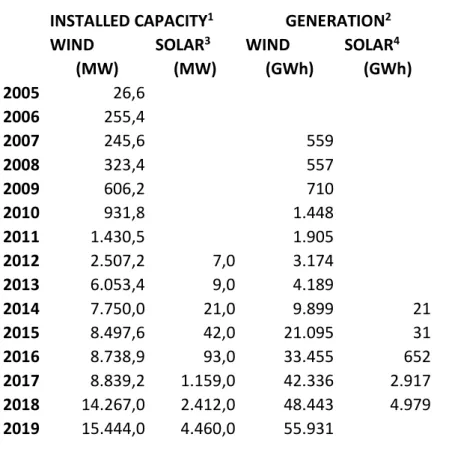
In Brazil, the growth of these new sources started few years later, but it has been very strong lately. Information provided by the Brazilian National Operator (ONS) about its recent evolution can be seen in the Table 4. Initially wind received incentives and the new plants were contracted through Feed-in-Tariffs mechanisms (1992-2004), but its more significant growth was made later, under a sequence of auctions promoted by the Brazilian government, associated to long term contracts by the distribution companies. These auctions started in 2005, and more than 15,000 MW of wind plant were contracted through them.
Solar generation followed, with more than 4,000 MW contracted through auctions since 2014. Its expansion in the integrated system has suffered with a recent contraction of the electricity demand growth in Brazil brought by a recessive period, but as soon the market starts its recovery, many new solar plants may be expected. In any case, its use as a distributed generation source kept growing, being estimated as responsible for around 45% of the total current solar capacity.
As wind and solar grew and took up more room among the generation sources in all these three countries, an increasingly serious problem stands out and need to be
dealt by its power sector operators: the intermittency.
While the seasonal variation of the hydro systems, well known since many decades, could be usually compensated by stocking water in the dams, and have had its intermittency handled with the support of a small thermal park, these new renewables pose more difficult problems as their daily and hourly frequent changes need to be timely administered.
Naturally, two main options can be considered: (1) to make use of other electricity generation sources when needed or (2) use a technology to stock the electricity generated in more abundant periods to be made it available at other moments, or even (3) a combination of these two solutions.
As renewable sources do not guarantee full time supply by themselves, they are usually integrated in larger power systems, with other plants that could replace them whenever needed; something frequently adopted. To compensate the intermittency, it is necessary to have available plants that can easily follow the load curve. Two types of such plants are basically used: hydro plants and gas turbines. The latter, typically open-cycle ones, is less efficient, though Iberdrola seems to be using in Spain a new kind of more expensive, closed-cycle gas turbines, able to rapidly follow the demand.
The large availability of hydro plants is especially helpful in Brazil, to manage the operation of its renewable parks. They could have been much more useful, if it wasn’t for the limitation imposed on the size of the more recently built Brazilian dams.
The system’s integration as a solution to the new renewables intermittency, apart from the need of special types of complementary turbines, has an implicit limitation when thermal units are used. As the wind and solar connections to the system grow, the need for additional sources also grows, limiting the maximum participation reachable by the new renewable.
Considering the second option, a few technologies have been tried around the world to efficiently stock electricity. Among them, batteries are the most usual ones. They are still quite expensive making its current use by the power sector relatively restrict, but future technological advances may improve this picture.
Table 4 – Evolution of the Brazilian Wind and Solar Installed Capacity and Generation INSTALLED CAPACITY1 GENERATION2
WIND SOLAR3 WIND SOLAR4
(MW) (MW) (GWh) (GWh) 2005 26,6 2006 255,4 2007 245,6 559 2008 323,4 557 2009 606,2 710 2010 931,8 1.448 2011 1.430,5 1.905 2012 2.507,2 7,0 3.174 2013 6.053,4 9,0 4.189 2014 7.750,0 21,0 9.899 21 2015 8.497,6 42,0 21.095 31 2016 8.738,9 93,0 33.455 652 2017 8.839,2 1.159,0 42.336 2.917 2018 14.267,0 2.412,0 48.443 4.979 2019 15.444,0 4.460,0 55.931
(1)Sources: ABEOLICA, ABSOLAR, ONS (2) Sources: ONS
(3) Includes solar units that are not integrated and distributes generation – approximately 45% of the total capacity
(4) Includes only plants connected to the integrated system
A more traditional solution for stocking electric energy, is the use of hydroelectricity. Considering all possible difficulties in developing new large dams in all the countries here discussed, and their crucial storage capacity, to help the absorption of new intermittent sources, this capacity may be increased by the development of pumping storage hydro plants. These plants operate in a closed cycle, moving water from a lower to an upper reservoir and generating electricity in the other periods when needed. Although this is an old method, Brazil has only two old and small of these plants, while Portugal and Spain are implementing new units with considerable success.
This comparative view reinforces the need for Brazilian authorities to examine in depth these possibilities, following the Iberian Peninsula example. Although many studies have been recently made in Brazil, no new projects have effectively been executed.
4. Energy Policy and Institutional Challenges in Brazil.
Brazil, Spain and Portugal have to deal with some difficult policy choices in order to advance the main sustainability goals. Besides the common advance in the wind and solar generation already well on its way, additional options should be developed in order to compensate for the intermittency, as new sources of electricity should be chosen to expand the systems, guaranteeing supply, and at the same time reducing the greenhouse gases emissions.
Using correctly the market, or even command and control institutional methods, to deal with these difficulties, requires clear rules based on the knowledge of effective hourly cost in each location, making it possible, in consequence, valuate correctly benefits and costs of stocking energy, promote the right incentives, and offer adequate remuneration to its investors.
In the Iberian Peninsula this type of information is necessarily made clear by the use of market rules managed by the Iberian wholesale market - MIBEL, as buyers and sellers have to present their day-ahead hourly price proposals. Possibly the use of hourly prices had motivated the implementation of new pumping-storage plants in these countries. Through a process started by the interconnection of the individual national systems operators, the MIBEL was one of the first coupled national markets in Europe integrating the Portuguese and Spanish markets since 2007, considering its transmission limitations. Currently, MIBEL is coupled also with other European markets, as the European power integration is slowly moving ahead.
In Brazil, co-ordination of the electricity integrated system is very different. For most of the regulated market, the operation and commercialization are independent and follow different rules. The individual plants, interconnected to the system, have their operation optimally determined by the National System Operator (ONS), using a mathematical algorithm based on total costs, independently of commercial considerations.
The main commercial regulated operations are managed by long range contracts negotiated through auctions. Hydro plants have a compensation system that determine their commercial rights independently of their actual operation. The regulated
distribution companies are obliged to present its demand’ forecasts and sign long range contracts in order to guarantee its future supply.
Only a smaller part of the electricity is sold to the regulated distribution companies through a short-range ‘market’, using weekly prices based on the marginal costs that are calculated by the ONS for three load levels, for each of the country’ main sub-systems, and adjusted by a set of regulatory rules.
Apart from the regulated market, the generators and larger buyers can buy and sell independently by negotiated prices, contracted among them in the so-called free market. Short-range operations, in any case, both in the regulated as in the free market, will use the centrally calculated prices. Under these conditions, as the prices are not individually hourly set, there is no proper incentives for an investor in developing energy stocking system.
This picture of the Brazilian regulatory system however has been contested and changes are slowly taking place, as new rules are allowing non-regulated markets to include smaller and smaller consumers. Even if a competitive hourly market is not being incorporated yet to define the short-term prices, the ONS is currently computing hourly generation costs for around 7,000 different locations1. Next year, these hourly and local
costs will be used to determine different marginal costs, that can be used to determine new types of prices for the short-term ‘market’, bringing possibly new incentives to the private players to stock electricity.
The substitution of the current system by a day ahead market and the use of prices instead of costs to govern its operations, has been proposed in Brazil but is still the object of many controversies. As a larger proportion of the current regulated market moves to the free market and the long-range contracts auctions loose force, it may become a possible step. Considering however, the high percentage of penetration of renewables in Brazil, the problem of the almost zero marginal cost of these sources will create serious difficulties to integrate them in a traditional marginal market. This problem is clearly discussed by Blazquez et al (2019) that shows that is highly unlikely to
1 The author is grateful to Dr. Sinval Gama, ONS chief operations officer, for his helpful
manage such a market with 100% renewables. The current discussions in Brazil seems to suggest that changes in the future institutional model may incorporate separate remunerations to demand supply capacity and to the energy generated.
The almost zero marginal cost is not the only problem in Brazil to replace the current model by a short-term market. Another serious problem of the abandonment of the long-range contracts system is the loss of its future supply guarantees. If the electricity demand returns to 3-5% yearly growth of the past, the heavy need of additional investments may be compromised, without full long-range contracts, usually required by investor to finance new large projects, usually built using a 30/70 relation between equity and (long-range) debt.
In any case, with the future hourly prices and new commercial rules, new pumping-storage hydro plants may be developed also in Brazil, helping to manage higher participation of wind and solar generation. Other solutions for the intermittency of wind and solar may also be incorporated but will depend on the technological and economical evolution of the batteries.
It is in this context that the decision about the new sources shall be made. The levelized costs of wind and solar are very low, but, considering only its economic viability. It is not clear how these sources will compete with, for instance, natural gas, as the full system costs to compensate the variabilities are considered. As the emissions of the natural gas should be also avoided, important non-market rules will have to be put in place to seek the full decarbonization of the power sector
Again, in Brazil, the new gas and off-shore oil discoveries are asking for difficult decisions as the country needs to make good economic use of these reserves. Other countries of Latin America are also facing similar dilemmas, as typically is the case of the very large ‘Vaca Muerta’ non-conventional oil and gas reserves in Argentine.
The institutional conditions and public opinion are crucial for the advance of these new forms, and they have been in general favourable, looking for a greener future. This seems to be a common cultural characteristic of Iberia and Latin America, confirmed by their advances in the use of these clean electricity sources
support for these industries in a very modified institutional field. In Brazil, a large number of smaller companies are replacing the traditional producers of electrical capital goods and dam building societies, and many new class associations have been created. It is difficult to anticipate how the balance between the need to develop new gas power plants to anchor the use of the new reserves of gas in Brazil and Argentina, and the efforts of this new players, with popular support, to have cleaner electricity matrices in order to fight against the global warming.
In Spain and Portugal, renewables seem to be winning, depending on the advances in batteries to keep moving forward but their increased dependence on natural gas has not been clearly stated as a problem to be faced. In the near future the Iberian Peninsula will have to find new solutions to effectively decarbonize its power sectors. Possibly, new solar, both centralized and distributed, and new off-shore more expensive wind plants will play a role, assuming that the intermittency problems will be solved by pumping-storage plants and cheaper batteries.
The complete decarbonization of the power sector, desired in these three countries, will have to deal with the presence of the natural gas, in order to reduce its participation in the electric matrices and shorten its time on the generation mix as a transitional fuel. The market may not automatically lead to this goal and, although the new renewables have had their costs sharply reduced in the last decade, institutional actions may be also necessary. But, even considering all present difficulties, the common roots, common cultural traits and common players, of Spain, Portugal and Brazil, and the observation of the recent past, indicates that both transitional processes will move forward and cleaner electricity matrices in both regions will be reached.
References
Associação Brasileira de Energia Eólica. 2019. Boletim Anual de Geração Eólica 2019. Associação Brasileira de Energia Solar Fotovoltaica ABsolar. 2019. Infográfico 2019.
Blazquez J., R. Fuentes-Bracamante and B. Manzano. 2019. A Road Map to Navigate the Energy Transition, Energy Insights 59, The Oxford Institute for Energy Studies.
BP. 2019. BP Statistical Review of World Energy Data 2018, 68th Edition
Direção-Geral de Energia e Geologia. 2019. Relatório de Monitorização da Segurança de Abastecimento do Sistema Elétrico Nacional 2019-2040 (RMSA-E 2018).
EIA – US Energy Information Administration. 2019. International Energy Outlook 2019,
EIA – US Energy Information Administration. 2017. Levelized Cost and Levelized Avoided Cost of New Generation Resources in the Annual Energy Outlook 2016.
Empresa de Pesquisa Energética - EPE/MME. 2019. Anuario Estatistico de Energia Elétrica 2019 Empresa de Pesquisa Energética - EPE/MME. 2018. Balanço Energético do Brasil BEN, 2018. European Commission. 2019. Statistical Report Eurostat
Flôres, R.G. Jr. and R.F. Pimentel. 2017. Hydroelectricity in Brazil and the Resource Curse?, Project Report FGV/NPII-GIZ
Flôres, R. G. Jr and R. F. Pimentel. 2016. Global Value Chains as Regional Integration Tool: The Case of the Renewables Industry in South America, Project Report GIZ/EPF & FGV/IIU. Hunt, J. D., A. A. V. Freitas and A. O. Pereira Jr. 2014. ‘Enhanced-Pumped-Storage: Combining
pumped-storage in a yearly storage cycle with dams in cascade in Brazil’, Energy, Vol. 78, p. 513-523.
International Renewable Energy Agency, IRENA. 2019. Renewable Energy Statistics 2019. KAS & FGV NPII. 2016. Analise da Matriz Energética e da Promoção da Energia Renovável no
Setor Elétrico Brasileiro.
Marin, E. C. 2004. La Electricidad en las Relaciones España-Portugal, Finisterra, XXXIX, 78; 63-73 MIBEL Regulatory Council. 2009. Description of the Operation of the MIBEL.
Ministerio de la Transición Ecologica. 2017. La Energia en España, Secretaria de Estado de Energia.
Operador Nacional do Sistema. 2019. Base de Dados Estatísticos.
Patuleia, A and C. Littlecott. 2019. Accelerating the Coal-to-Clean Transition in Portugal and Spain - Insights from the Decline of Coal Generation 2019, Analysis, E3G