Rev. IG, São Paulo, 13(2), 7-15, jul./dez.l1992
PALYNOLOGICAL
DATA ON A HOLOCENE
PEAT DEPOSIT IN TROPICAL
BRASIL: PRELIMINARY
PALEOCLIMATIC
AND PALEOECOLOGICAL
INTERPRETA TIONS
May Christine MODENESI Therezinha S. MELHEM RESUMO
A evolução das vertentes do planalto de Campos do Jordão durante o Pleistoceno é do-cumentada por três gerações de anfiteatros de erosão, que refletem uma seqüência de impor-tantes movimentos de massa relacionados a fases de incisão de caráter tectônico e a flutuações climáticas - provavelmente na transição para os climas mais secos contemporâneos das duas últimas glaciações do hemisfério norte. No Holoceno, processos com menor ação erosiva teriam depositado os colúvios das vertentes, evidenciando diminuição do ritmo de levanta-mento do planalto e da intensidade das flutuações do clima de montanha. O acentuado con-traste ambienta! criado pelo aparecimento dos anfiteatros teria condicionado a distribuição da vegetação e a organização do mosaico mata-campo.
O estudo palinológico de um depósito turfoso de base de anfiteatro permitiu detectar mudanças na cobertura vegetal do planalto durante o Holoceno Superior. Variações das asso-ciações vegetais das matas e dos campos seriam explicadas pelo ajustamento das formações vegetais a variações das condições de temperatura e umidade. Estas modificações refletiriam a transição dos climas mais quentes e provavelmente mais secos do Holoceno Médio para o clima atual do planalto, caracterizado por temperaturas mais baixas e por distribuição mais homogênea das chuvas.
ABSTRACT
In the Campos do Jordão Plateau, the slopes show at least three generations of erosion amphitheaters. Amphitheater genesis would reflect a succession of deep mass movements related to Pleistocene incision phases of tectonic character and to climatic fluctuations - probably durlng the transition to drier climates contemporaneous of the last two glaciations of the northem hemisphere. In the Holocene, climatic fluctuations and uplift rhythm lessened; colluvia on slopes point to less intense erosive phenomena. Pleistocene evolution of slopes, resulting in marked environrnental contrasts, determined the distribution of vegetation on slopes and the organization of the forest-grassland mosaico Palynology of a Holocene peat deposit snows changes in the plateau vegetation from 4,170 years BP, probably linked to climatic varia-tions. Adjustment of plant formations to variable temperature and moisture conditions would have modified the composition of forest and grassland communities. These modifications would reflect the transition from warmer and perhaps drier Middle Holocene climates to the present climate of the plateau, characterized by lower temperatures and more homogeneous rainfall distribution.
1 INTRODUCTION
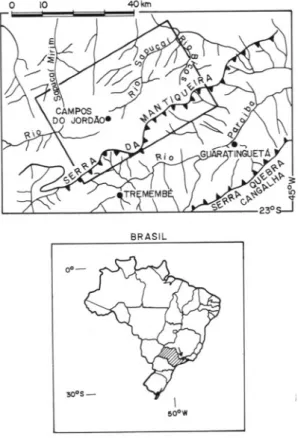
The Campos do Jordão Plateau (Figure 1), is the summit surface of Southeastern Brasil (AB' SABER & BERNARDES, 1958), a block moun-tain uplifted over 2,OOOmabove sea levei by an Oligocene deformation, further enhanced during the Pliocene (ALMEIDA, 1976). Lower Pro-terozoic gneisses and migmatites as well as Up-per Proterozoic granitoid rocks are the predominant lithologies. Schists, quartzites and metaconglomerates are minor occurrences (IPT,
1981). Quaternary evolution ofthe plateau under
montane climates produced a singular tropical landscape system, the altos campos (high grass-lands), contrasting with the surrounding 10wlands. At the Campos do Jordão Plateau mean an-nual temperatures are around 14°C and annual rainfall is rather variable - 800 to 2,8oomm. About 80% of the rain falls from October to March, thus defining a relatively dry period in autumn and winter. In the higher areas, next to the Mantiqueira escarpment, orographic in-fluences cause a 10wering of temperatures and an increase in rainfall; the dry season is not so well defined.
Rev. IG, São Paulo, 13(2),7-15, jul./dez.ll992
FIGURE 1 - Location of the Campos do Jor-dão Plateau.
The altos campos landform pattern is
characterized by a sharp contrast between the gently sloping convexities of hilltops and
lom-bas (grass-covered convex slopes) and the
dis-sected sectors of slopes and erosion amphitheaters. Vegetation forms a typical forest-grassland mosaic, strongly linked to landforms, drainage and surficial materiaIs. Grassland oc-cupies hilltops and convex slopes. Forest is con-fined to the dissected sectors of slopes, mainly to amphitheaters where deeper soils and espe-cially the incoherent regolith still have a supply of primary mineraIs (MODENESI, 1983). On the edges of the plateau and in deeply dissected areas, the altos campos mosaic is replaced by continuous forest cover.
Previous studies (MODENESI, 1984, 1988) showed that the Pleistocene evolution of altos
cam-pos slopes reflects a succession of deep mass
movements (slides and slump-slides) responsible for the formation of at least three generations of erosion amphitheaters. These events would
COf-respond to the mobilization of thick regoliths in the transition to drier climates during colder epochs of the Middle and Late Pleistocene, which were tentatively related (BIGARELLA & AB' SABER, 1964) to the last two glaciations ofthe northern hemisphere. Amphitheater genesis
would also reflect an increase of erosive activi-ties related to incision phases of tectomc character.
There is evidence that morphodynamic ac-tivity in the slopes decreased during the Holo-cene (MODENESI, 1984, 1988): on the lower part of the lombas three colluvial levels are in-tercalated with dark paleosols, indicating the al-ternance of slope denudation episodes with phases of relative stability and pedogenesis.
One of the highest points in southeastern Brasil, the Campos do Jordão Plateau would have been exposed, during the coldest phases of Quaternary glacial epochs, to temperatures much lower than the present ones. A cooling of approx-imately 4 to 6°C is estimated for this area of South America, during the coldest phase of the last ice age (18,000 years BP) (GATES, 1976). These considerations, plus the results of geomor-phological analysis (MODENESI, 1988), seem to indicate that Quaternary climatic fluctuations had a significant role in the development of the
altos campos landscape. Although climatic
fluc-tuations were probably lessened in the summit areas of Southeastem Brasil (AB' SABER, 1977, 1980), the plateau followed, at least to some ex-tent the rhythm of regional morphogenetic evo-lution. An altemation of morphoclimatic systems linked to montane subtropical environrnental conditions - either warm and wet or relatively dry and cold - would have been effective. The greater morphodynamic activity observed in the Pleistocene would reflect major climatic fluctu-ations associated to the uplift rhythm of the block (MODENESI, 1984, 1988). When altitudes were less, the morphogenetic action of Quaternary cli-mates would have been more effective opening larger spaces of resistasy (ERHART, 1955), along a trend not toa different from that of the neighbouring 10wlands. Later climatic changes resulting from upheaval and decrease in uplift rhythm probably lessened the intensity of ero-sive phenomena in the summit areas, allowing for longer biostasy phases (ERHART, 1955). Erosion amphitheaters would have provid-ed conditions suitable to the expansion of forests on the slopes (MODENESI, 1980, 1983). The marked environrnental contrast between am-phitheaters and lombas probably accounts for the mosaic pattem of vegetation. Conditioned by the evolution of slopes, this mosaic probably re-mained unchanged throughout the Late Pleisto-cene and the HoloPleisto-cene (MODENESI, 1988). The adjustment of the vegetation to changes in temperature and humidity would have been reflected by changes in the distribution and ex-tent of grassland and forest communities. In colder and drier episodes of the Late Pleistocene, when Araucaria presumably occurred in the
Rev. IG, São Paulo, 13(2), 7-15, jul./dez.11992
plateau (AB'SABER, 1977), subtropical mon-tane forests possibly occupied valleys and ero-sion amphitheaters, altemating spatially with the open vegetation probably of a steppe type -on the st-ony soils of hilltops and lombas.
Through geomorphic considerations and pollen analysis of peaty sediments found at the base of the more recent amphitheaters we attempt to detect changes in the Holocene vegetation and climatic conditions. The present results have led to a first set of paleoclimatic and paleoecologi-cal interpretations which are probably valid for other summit areas of southeastem Brasil.
2 PRESENT VEGETA TION
In the Campos do Jordão Plateau, the typical forest-grassland mosaic presents sharp bound-aries, with no transitional areas. Arauearia and
Podoearpus forests, thick and rich in epiphytes
and lianas, occupy valleys and amphitheaters.
Podoearpus is denser in the wet floodplain areas (várzea). Broad-leaved forests occur in
associa-tion with Arauearia, mainly in altitudes of 1,400-1 ,600m (SIEBERT
et ai.,
1975). In more humid slopes, approximately between 1,600 and 2,OOOm, a broad-leaved forestwithoutArauear-ia occurs. Denser and lower broad-leaved
com-munities occupy the top of the southeastem escarpment of the plateau; this vegetation
consti-tutes an unique íype offorest related to the ever-present rnist and to the relatively high humidity.
There are three types of grasslands in the plateau: campos limpos ("clean", open grass-lands) essentially covered by herbaceous vegeta-tion; campos sujos ("dirty", rnixed grasslands) with herbs, dwarf shrubs, shrubs, and isolated stunted trees, occupying larger areas, mainly on the drier slopes; campos de altitude (montane grasslands), above I ,800m, which are similar to the vegetation of other surnrnit areas of south-eastem Brasil and classified as related to the sub-paramos ofthe Andes (SIEBERT
et ai.,
1975).Homogeneous formations of Pteridophyta commonly appear in degraded grassland areas or on steep slopes. Extensive artificial conifer-ous forests (exotic species of Pinus) cover hilltops and lombas previously covered by grass. In the small peat basins at the bottom of erosion amphitheaters prevail Eriocaulaceae (Eriocaulum
cf kuntii and Paepalanthus planifolius),
Com-positae, Melastomataceae, Cyperaceae, Umbel-liferae, Pteridophyta (Blechnum) and Bryophyta (Sphagnum recurvum and S. nemoreum).
The fact that elements from the Andean flora and from the flora of southemmost South Arneri-ca were identified in the Mantiqueira (RAMBO, 1953 and BRADE, 1956), together with elements from the xerophilous flora and from Central
01 DEPTH -em Podoc(}rpus Aroucaria S~rj(}nio Drymi~ Abufi/on Crofon Ropon~a Cupanio Allophy/us Diodia
/lu
Labiala. Sopindoceoe Type A/chorn~a Compositoe Other triletes Pseudoschlzaea Spirogyra PalynomorphS Gromineoe Pfuis Lycopodium Gleich~nio Type Afhyrium Type Po/ypodium Type Lophosona Type Cyafh~o Sphognum Anfhoc~rus Eryngium Hydrocofy/~ Euphorbioceae Monosulcote Disulcote Curafella Ericoceoe Pinus I-Porote 3-Porote S-Poro!. 3-Colpote 3-Colporote ---Olher palens. .Blec"num Anemia Po/ypodium õ'e •. ;tI _ Type Penium Typ. Det>arya FungiII
I
I~II
e~
I.
~
•. .• •. ••-
•• ••• .. _.-.• õr
'" ji ••I
II
~
~
;;I~
I
I
~
3: z~
z (') to o~
z :i! m8
,..r
m z 8õ' ~ N -8 8 O ' L , " ! 1:D~l!lü:!:k<ccc~cacciM~:;::::t:i~#l!lmpj
'o.•:"" _-r't ~ N -. .O O tu » SAMPLES ..,0 ".•. c~D~~
:t
lTl
I~:::·;:::.t
:::
c
.1.':":'~::.:-,'.
c
1·1· lJl :!! (')"
... <> 1> CIl ,.. Z :D 1> O O -< C m l!l~ 11111'\.. 1 .MlT1 1111 11 f:'. õ '".-..l..-J -1 ~ lJl -< .., lJl 1> m Z i!l~ 1III1I1IIDIIIIIIIIIIIIIIIIIII:-::: :.11111111111111 -1i!l o ... 1>~G~
..,~
lJl O m 1> lJl 1>z
..,r
lJl ...o
o :I: -< ,.. :D m ,.. fi) '"r
:D o z~
o lJl ... c ... fi) :D~
()"
o~Di
Cl (')"
o o :D1> 3: ;o fi) .., m fi) o lJl r ..• 1>~
lJl Z ... O 1> VI mo
...., ....~
a-S'
~
S'
~
(D ...~
'T1 Õ c::: :::tI tI1 N Io
;'
OQ~
o
....,g.
(D'g
a
.g
o
~, ..• '" "' O '" lD '"-
SAMPLES 1> '"~~
+: ;t! 1+ : -< "'. N: o' '"~.
~.
li; .... o! .",~~
',0 I.." 1-<D VI "'.." "'''' ~o O CIl ~o elO o .., 'l661!,Z;JPl'lnf 'Çl-L '(Z)fl 'O(nUd0!1S '01 'A;J~Rev. IG, São Paulo, 13(2), 7-15, jul./dez.l1992
Brasil, stresses the importance ofthe region wi-thin the phytogeographic framework of southeastern Brasil (AZEVEDO, 1965). These elements probably entered the area during Quaternary c1imatie fluetuations. The sueeession of Quaternary c1imates might also be responsi-ble for the spatial distribution of different types of plateau vegetation and, according to PAUWELLS (1941), for the expansion of forest over grassland inherited from previous drier c1i-mates. MODENESI (1980), based on an analy-sis of the relationships between landforms, surficial materiaIs, degree of weathering and vegetation, carne to the same conc1usions.
3 STUDY SITE AND MATERIALS The study site is a tropical peat-bog (stratigraph-ic column in Figure 2) - acid peat with an impor-tant allochthonous mineral fraction - commonly found on tops of southeastern Brazilian block moun-tains. It fills one ofthe small hydromorphic depres-sions at the bottom of the more recent erosion amphitheaters (photo 1). 13to 14m above the present floodplain. Two units of acid peat (ph between 4 and 5), separated by a coarse sand lave r (e,
75/11Ocm), lie over silty materiais from bedrock weathering (f,280/33Ocm). The lowermost 130cm ofthe peat (e,150/280cm) are constituted ofsilty sands with 13% of organic matter, intercalated with coarser or finer materiais; this layer is here sub-divided according only to color. At the top ofthe lower unit(d,11O/15Ocm) occur blaek sandy silts with 55% of organie matter. The upper unit (b,
35-75cm) shows black silty c1ay with 14% of or-ganic matter. The whole sequence is covered by 35cm of yellowish-brown sai!(a)developed on rela-tively coarse material, in sharp contrast with the finer and darker material ofthe peat itself. Fossil roots ofEriocaulaeeae and partially decayed plant remains are present in the peat layers, especially in the darker and more humified ones (b, d,e2)
which shows a fibrous structure. 4 METHODS
Samples were taken from a 330cm pit wall, near the eenter of the peat deposit. Sample a
represents sediments eollected at a depth of 2Ocm. Processed samples initially weighted 50g. Coarse mineral partic1es were removed by repeated sieving and decanting. Unwanted organ-ic components were removed by potassium hydroxide treatment followed by oxidation with hydrogen peroxide and potassium chlorate. Due to the presence of an important mineral fraetion, gravity separation was made with zine chloride of specific gravity 2.0. After preparation, the residue was mounted in glycerin jelly; the slides were sealed with paraffin.
Four samples were collected for radiocar-bon age determinations. The samples were dat-ed at the Centre de Bondy-ORSTOM-France, through the Paleocli1'1UlSintertropieais agreement
between CNPq-Brasil and ORSTOM-France, under the supervision of Dr. Marc Fournier. Loss of some of the original samples made neces-sary renewed sampling for age determination, samples being colleeted at a point 20m from the previous site. The materiaIs dated at Bondy cor-respond to the middle of layers b (Bondy 491) and d (Bondy 484) and to the top (Bondy 483) and base (Bondy 492) of layer
e.
5 CONSTRUCTION OF DIAGRAMS Five hundred grains per sample were count-ed. In some cases, as the number of grains of the pollen sum was small (layers
d,
el' e3), ad-ditional counts were necessary, so as to reach a minimum of 150 grains ofthe pollen sumo Out ofthe 50 recognized pollen morphological types, it was possible to identify 7 at the species, 18 at the generic, and 7 at the family leveI. Results were expressed in percentages and, in order to show the main vegetational changes, presented in a classical diagram, aecording to FAEGRI&
IVERSEN (1975). The eomposite diagram (Figure 2) shows, from left to right, an outline of the analyzed section, the general cumulative diagram and a resolved diagram showing the fre-queneies of each palynomorph. For the interpre-tation of diagrams, surveys of the flora and ecologieal data on the regional vegetation (BRADE, 1942 and 1956; AZEVEDO, 1962; SIEBERTet al.,
1975; RIZZINI, 1979 and JOL Y, 1983) were taken into account, as well as direct field observations. Pollen analysis of surficial sediments (a)provided some data on re-cent deposition.The pollen sum (Figure 2) was based on the total of tree, shrub and herb pollen from the regional vegetation. It consists of three groups:
1. elements from the forest: Podoearpus,
Arauearia, Serjania, Drymis, Abutilon, Croton,
Rapanea, Cupania, Allophylus, Diodia, Ilex,
Labiatae, Sapindaeeae, Alehornea type.
2. elements from grasslands: Gramineae,
Curatella, Erieaceae (Gaultheria and
Leu-eothoe).
3. Compositae.
Pollen types presumed to be derived from the local vegetation are excluded from the pollen sumo This is the case of Hydroeotyle and
Eryn-gium, species from forests and grasslands which
also occur in the peat. Common in the pollen spectrum of sediments, some pteridophytes are typical of the wet subtropical forest, but may also
Rev. IG, São Paulo, 13(2), 7-15, jul./dez.l1992
occur in bogs (BRADE, 1942), on steep slopes, or in degraded grasslands (SIEBERT
et ai.,
1975). Two genera ofEricaceae (Gaultheria and Leueothoe) were included in the pollen sum, asthey are typical of the plateau grasslands and have not been listed in any of the floral surveys of the region.
The frequencies of elements not included in the pollen sum were caJculated as percentages of this sumo Elements which are commom in the present vegetation or preserved in the peat as macrofossils are not always represented in the pollen spectra of sediments. Sphagnum,
Arau-earia and Cyperaceae are underrepresented,
whilst some genera such as Pinus (a result of af-forestation practices) and Podoearpus are over-represented. Although absent from the pollen spectra, Eriocaulaceae are commom in the present vegetation (Erioeaulum and Paepalan-thus) and were identified in the sediments by their
fossi! roots.
6 INTERPRETATlON OF THE DlAGRAM The most frequent palynomorphs belong to plants of the peat bog community, whose com-position seems to change according to depth. In samples e_3 and e2 pollen grains from aquatic plants prevail. Pteridophyte spores, as well as cysts and spores from algae, are less frequento In layers e2, dand b, the total of Pteridophyta and Bryophyta spores is always higher than that of aquatic plant pollen plus cysts and algal spores. In the upper layer (a), algal reproduc-tive elements are the main palynomorphs close-ly followed by spores ofPteridophyta and Fungi. Sample
c
is barren and probably corresponds to a phase of more active slope erosion.As the general diagram shows (left-hand side of Figure 2), the sharp increase in forest pollen, observed between dand b, reflects a decrease in Compositae rather than a relative decrease of grassland pollen. From e2 to d the steady decrease of forest pollen is followed by an in-crease of grassland pollen percentages due to a significant decrease in Compositae. Between e3
and e2, the increase of forest pollen corresponds to a decrease of grassland pollen. The spectra of the topmost layer (b) of the deposit and that ofthe surface sample (a)are very similar. In both samples, percentages of forest pollen are higher than those of grass pollen, and Compositae values are the lowest of the profile.
Individual curves for each genus, family and morphological type, both included in and exclud-ed from the pollen sum, are representexclud-ed in the resolved diagram (right-hand side of Figure 2). They complement the general diagram.
A comparision between the floral invento-ry of Campos do Jordão and the pollen spectra of sediments shows that only a small number of elements from the regional flora - which is very diversified - occur in the sediments. On the other hand, all the taxa present in the sediments belong either to local or to regional vegetation, with the exception of Curatella, which is not in-cluded in any regional inventory. Curatella is a
very tolerant species, being one of the first
cer-rado species to appear and one of the last to
dis-appear. In the lower layers (samples e3, e2and
e/) of the peat deposit, pollen composition is
richer; 10 to 12 of the 18 morphological types included in the pollen sum are present. In con-trast, there are 9 types in sample d and only 8 in samples band
a.
The greater frequency vari-ations occur in forest elements. In the four low-er peat laylow-ers (e3through d), Abutilon, Croton,Cupania and Diodia are the rarest elements, and A llophylus , Serjania and Ilex the most frequent
ones; Serjania and Ilex occur in all samples. Ilex is the most abundant element of the broad-Ieaved forest. Arauearia pollen has similar frequencies, except ine2where it does not show. Of the ele-ments of the broad-Ieaved forest, Serjania,
Dry-mis, Cupania, Allophylus and Sapindaceae are
confined to samples b or a. Drymis and
Cupa-nia only occur in the surficiallayer (a), and AI-lophylus at the top ofthe peaty sequence (b). The
most significant change, reflected in the general diagram by a dislocation of the forest element curve, is the sudden increase of Podoearpus -absent in the lowermost layer - from layer d upward.
In the lower part of the diagram the increase in forest pollen corresponds to an increase in the number of pollen types and, ine2, to maximum values of Allophylus, Diodia, Ilex and Alehor-nea type. The frequency of grassland elements
varies between 38 and 60% of the pollen total. Percentages of grass pollen are generally high, except for e2• Low percentages of Curatella oc-cur only in the three lower layers. Small amounts of Ericaceae pollen grains are present through-out the profile, except for the bottom layer (e3).
The lower part of the general diagram (e3
through d) shows that the relationship between forest and Compositae frequencies is direct -an increase in forest pollen corresponds to -an in-crease in Compositae and vice versa. The rela-tionship between forest and grassland pollens is inverse. In the upper part (samples d through a)
the relationship between forest pollen and Com-positae pollen is inverse - an increase in forest pollen corresponds to a decrease in Compositae pollen. The frequency of Gramineae is practi-cally the same throughout.
Rev. IG, São Paulo, 13(2), 7-15, jul./dez./1992
The sudden decrease in Pinus percentages ob-served under the surface sediments may be explai-ned by its condition as anthropogenic vegeta-tion. On the other hand, the presence of Pinus pol-len at the top ofthe peat deposit (b) and again at the uppermost layer of the lower unit (d),would probably be explained (since special precautions were talcen against contamination, in the field or in the laboratory) by the vertical movement of
7 RADIOCARBON DA TING OF PEAT LAYERS
pollen grains within sediments, a possibility to be considered (MOORE
&
WEBB, 1978) in the first stages of peat formation. Friable and porous sur-face sediments would favour water percolation and the washing of pollen grains down from the sur-face to the peat upper layer(b). Some grains might go right through layerb - which is more recent and not well compacted - and the underlying coar-se sand lens (c), reaching the peaty layer (d).The results of radiocarbon age determinations are the following: Sample NumberLayer Age Depth
(cm) Yr BP C.J.1.2 - Bondy 491 78
b
290±
240 C.J.1.4 - Bondy 484 118 d 370+
270 - 260 C.J.1.5 - Bondy 483 140 e11.050+
600 - 570 C.J.2.2 - Bondy 492 265 e34.170+
380 - 360Samples for radiocarbon age determinations were talcen in a profile, 20m distand from the ori-ginal site, which showed differences in the thick-ness of the topmost layer a(30em thicker) and oflayers b,c andd(approximately lOem thinner).
8 PALEOCLIMATIC AND PALEOECOLOGICAL INTERPRETATION
It is known that in tropical areas, floristic diversity and lack of data on pollen raio and plant ecology represent limiting factors on the inter-pretation of pollen records. The presence of cer-tain elements from the local flora - which were not included in the pollen sum - provided some ecological information. Scarcity of Pteridophy-ta and BryophyPteridophy-ta spores and abundance of aqua-tic pollen grains would indicate the persistence of highly hydromorphic or even partially lacrus-tine conditions during the deposition of layers e3
and e
l'
On the other hand, dominance of Pteri-dophyta and Bryophita spores in e2, d and bwould define drier environments. These obser-vations seem to be confrnned by the higher de-gree of humification of samples e2, d and b,
since dark and highly humified peats would re-sult from drier slow growing communities
(FAE-GRI
&
NERSEN, 1975).Presence of spores of Zygnemataceae and
Spirogyra in the sediments is not a good
envi-ronmental indicator as they have a wide ecologi-cal tolerance.
The peat-deposit would have evolved from a partially lacustrine phase (e3, 4,170 BP) to drier environments. Succession of wet and drier environments was probably related to water-Ievel fluctuations due to aggradation of the hydromor· phic depression and/or climatic factors (MODE-NESI, 1988).
Podocarpus and Pinus are always well
repre-sented in the pollen spectra of sediments, due to their greater productivity and preservation, whe-reas Eriocaulaceae pollen --.: less resistant - is absent. Some under-represented elements come from entomophilous plants such as Croton,
Cu-pania and Serjania. The most common taxa in
the pollen sum are Gramineae, Compositae and
ltex in the lower part of the diagram, and Podo-carpus, Drymis, Compositae and Gramineae in
the upper one. Planted Pinus is a major element of the surficial layer. Changes in the forest--grassland relationship observed in the two up-per layers seem to result from the significant increase in Podocarpus and decrease in Compo-sitae. The occurrence of a greater number of pol-len types in deeper layers, mainly those of the broad-Ieaved forest, reflects a wider diversifica-tion of forest associadiversifica-tion and contrasts with the relative homogeneity observed in the upper la-yers (band a).The parallelism between the fre-quencies of forest and Compositae pollen grains, ao well as the inverse Compositae-Gramineae re-lationship, seems to indicate the dominance of forest Compositae, at least in the lower part of the peat deposito Should this be true, forest
vari-Rev. IG, São Paulo, 13(2), 7-15, jul./dez.l1992
ation should not have been as strongly marked as shown in the general diagram.
On the other hand, analysis of regional t10ra suggests that Compositae would be related more to the broad-leaved than to the Araucaria and
Podocarpus forest; SIEBERT et alo (1975) and
RIZZINI (1979) do not list Compositae in this as-sociation, and HUECK (1972) refers to them as secondary components of the herbaceous stra-tum. The probable link between Compositae and broad-leaved forest and the over-representation of Podocarpus in the upper layers would indicate a greater relative significance of forests in the lower part of the diagram and, consequently, a lesser t1uctuation in the pollen curve of this plant community. Thus the evidence suggests that, rather than a questionable increase in forest dominance, there was a change in composition. The only considerable drop in percentage of grassland community elements (23%) occurs in
ez. This would indicate the persistence of a
mixed grassland-forest vegetation with spatial relationship similar to the present ones during the last 4,170 years, in the whole period of peat for-mation. It may be concluded that in spite of the fact that the vegetation mosaic of the plateau did not undergo major changes during this period, the com'position of forest communities underwent changes. The previous broad-leaved forest, represented by a higher number of species, was probably replaced from 370 BP by a more homogeneous one, with Podocarpus. Such changes - contemporaneous with the deposition ofthe coarse sand layer (c)that separates the low-er peat unit from the upplow-er one - would ret1ect climatic t1uctuations: warmer conditions would have been followed by colder climates similar to the present one. The presence of Curatella in the lower part of a peat deposit seems to indicate that ~nthe Campos do Jordão Plateau increase in tem-perature was followed by rainfall decrease and increasing rainfall seasonality. A drier and
warm-er climate would have charactwarm-erized the summits of the plateau in Middle Holocene times. Tem-perature changes seem to follow the trend ob-served in the tropical Andes (VAN der HAMMEN, 1974, 1989) where Middle Holocene temperatures were 1 to e 2° higher than today's. Further associations with changes of rainfall af-fecting tropical South America are difficult. It should be remembered that the summit of the plateau, facing east humid winds, is wetter than the adjacent lowlands due to the prevalence of orographic rains.
The palynological analysis indicates that ad-justment of vegetation to variable temperature and humidity conditions seems to be ret1ected main-ly by changes in plant communities of forests and grasslands. Thus, from 4,170 BP to 1,050 BP het-erogeneous subtropical species-rich forests prob-ably coexisted with grassland vegetation including Curatella, a genus which is typical of the cerrados. Afiá 1,050 BP and especially 370 years BP a more homogeneous and
richer-in-Podocarpus forest probably replaced the
previ-ous community; Curatella seems to have vanished from the altos campos.
Variations in plant communities of the Cam-pos do Jordão Plateau would ret1ect the transi-tion to present climatic conditransi-tions, which are characterized by decrease in temperature and a more homogeneous rainfall distribution. This hypothesis agrees with the interpretation of geo-morphic data and suggests, as proposed by MODENESI (1988), that even at the summits of the Campos do Jordão Plateau, slight climatic t1uctuations were active during the Holocene.
9 ACKNOWLEDGEMENJ'S
This research was partially supported by the Fundação de Amparo à Pesquisa do Estado de São Paulo (FAPESP). We wish to thank Paulo Emílio Vanzolini for revision of the English text. 10 REFERENCES
AB'SABER. A.N. 1977 Espaços ocupados pela expansão dos climas secos na América do Sul por ocasião dos períodos glaciais qua-ternários. Paleoclimas, (3), 19p.
______ 1980 Razões da retomada parcial de semi-aridez holocênica, por ocasião do "otimum climalicum". Interfacies, (8), 6p. _____ & BERNARDES, N. 1958 Vale
do Paraíba, Serra da Mantiqueira e arredo-res de São Paulo. XVIII Congr. Intern. Geogr. Rio de Janeiro, Guia de Excursões (4), 303p. Rio de Janeiro.
ALMEIDA, EEM. 1976 The System of Conti-nental Rifis Bordering the Santos Basin. In: "Continental Margins of Atlantic Type". São Paulo, Oct. 1975. Anais Acad. Bras. Ci.,
(48):15-26.
AZEVEDO, L.G. 1962 Tipos de vegetação do sul de Minas e Campos da Mantiqueira. Anais Acad. Bras. Ci., 34(2) :225-234.
______ 1965 Contribuição à delimitação dos tipos de vegetação do Estado de São Pau-lo - Região de Campos do Jordão.
Arqui-vos de Botânica do Est. de São Pllulo, Nova
Rev. IG, São Paulo, 13(2), 7-15, jul./dez.ll992
BIGARELLA, J.J. & AB'SABER, A.N. 1964 Palãogeographische und Palãok1imatische Aspekte des Kãnozoikums in Sudbrasilien.
Zeitschr. Geomorph., 8(3):286-312.
BRADE. A.C. 1942 A composição da Flora Pte-ridófita do Itatiaia. Rodriguésia, 6(15).
BRADE. A.C. 1956 A Flora do Parque Nacio-nal do Itatiaia. Boi. Parq. Nac. Itatiaia,
(5):5-85.
ERHART, H. 1955 Biostasie et rhéxistasie: equi-se d'une théorie sur le rôle de Ia pedogéne-se en tant que phénomene géologique. Centre Recherches Scientifiques Académie des Sciences, 241: 1. 218-1. 220.
FAEGRI, K.
&
IVERSEN, J. 1975 Textbook of Pollen Analysis. Blackwell Scient. Pu-blic., 295p. Copenhagen.GATES, W.L. 1976 Modeling the ice-age cli-mate. Science, 191(4.232):1.138-1.143.
HUECK, K. 1972 Florestas da América do Sul. Edit. Univ. Brasília e Edit. Polígono S.A., 466p. São Paulo.
IPT - INSTITUTO DE PESQUISAS TECNO-LÓGICAS DO ESTADO DE SÃO PAULO 1981 Mapa geológico do Estado de São Pau-lo - Escala 1:500.000.
JOLY. A.B. 1983 Botânica - Introdução à Ta-xonomia Vegetal. Cia. Editora Nacional, 777p., 6~ edição. São Paulo.
MODENESI, M.C. 1980 Intemperismo e mor-fogênese no Planalto de Campos do Jordão, São Paulo. Rev. Bras. Geoc., 10(3):213-225.
_____ 1983 Weathering and Morpho-genesis in a Tropical Plateau. Catena.
10(3):237-251.
MODENESI, M.C. 1984 Evolução Quaternária de uma montanha tropical: o planalto de Campos do Jordão, SP. Revista do Instituto
Geológico, 5(112):7-13.
_____ 1988 Significado dos depósitos correlativos quaternários em Campos do Jordão - São Paulo: implicações paleocli-máticas e paleoecológicas. Boletim do Ins-tituto Geológico, (7), 155p.
MOORE, P.D.
&
WEBB, J.A. 1978 An illus-trated guide to pollen analysis. Hodder and Stroughton. "Biological Science Texts", 133p. London.PAUWELS, G. 1941 Algumas notas sobre a dis-tribuição do campo e da mata no sul do país e a fixidez do limite que os separa. Rev.
Bras. Geogr., 3(3):155-158.
RAMBO, B. 1953 História da flora do Planalto Riograndense. An. Bot. Herb. Barbosa
Ro-drigues (Itajaí), 5(5): 185-232.
RIZZINI, C. T. 1979 Tratado de Fitogeografia do Brasil. Aspectos sociológicos e florísticos vol. 2, Ed. HUCITEC e EDUSP, 374p. São Paulo.
SIEBERT, P. et aI. 1975 Plano de Manejo do Parque Estadual de Campos do Jordão. BoI.
Técn. do Instituto Florestal, (19), 148p. e Atlas.
VAN der HAMMEN, T. 1974 The Pleistocene changes of vegetation and climate in tropi-cal South America,
J
oum. Biogeogr. ,1:3-26.
_____ 1989 Paleoecology of the neotro-pics: an overview of the state of affairs. Boi.
Inst. Geoc. - USP. Publicação Especial,
v.8, p. 35-55.
Erulereço das autoras:
- May Christine Modenesi - Instituto Geológico - SMA - Caixa Postal 8772 - 04301-903 - São Paulo, SP - Brasil.