BULLYING AND VICTIMIZATION IN CHILDREN WITH SPECIAL
EDUCATIONAL NEEDS: IMPLICATIONS FOR INCLUSIVE
PRACTICES
Eleni Didaskalou
Department of Special Education, University of Thessaly, Greece Eleni Andreou
Department of Primary Education, University of Thessaly, Greece [email protected]
Anastasia Vlachou
Department of Special Education, University of Thessaly, Greece
Abstract
Bullying has been recognized as a widespread, persistent and serious problem occurring in schools across different national contexts. Despite the surge of interest in bullying in recent years, much of the research has focused on its multiple facets and characteristics among non-disabled students, while little is known about its incidence and dimensions in the population of students receiving special education support provision. It is well-known that schooling has generally been constructed and operates around the notions of normalization and homogeneity and children’s diversity often generates discriminating responses contributing to exclusionary educational experiences.
In the light of above, the present study aims at exploring the extent and different types of bullying and victimization among Greek students receiving special education support provision. The sample of the study consisted of 173 students attending 5th and 6th primary school grades and participating in pull-out special education delivery programs operating within mainstream schools.
According to the findings, participants were actively involved in both bullying and victimization with higher rates in victimization. Bullying was mainly related to physical aggressiveness, humiliating and racist behaviors towards others and social isolation from peers, while victimization included destruction of personal belongings and being
250 DIDASKALOU, ANDREOU & VLACHOU
attacked. Statistically significant differences were identified between girls and boys over the different types of bullying and victimization getting involved in, with girls experiencing mostly social isolation and manipulation from others and boys displaying aggressiveness towards others and attacking peers. Statistically significant differences were also found in physical bullying between children receiving more than 12 hours a week special education support and the rest. Children with developmental disabilities tended to use more indirect methods of bullying such as social exclusion more often than children with learning difficulties and children with learning difficulties combined with socio-emotional behavioral disorders. Overall bullying behavior was found to be predicted by presence of playmates during playtime and victimization by absence of playmates during break and limited number of friends in class.
The implications of the study for developing school-based inclusive responses to students with SENs, are also discussed.
Keywords: Bullying; Victimization; Special educational needs; Inclusion.
Resumo
O bullying tem sido reconhecido como um problema generalizado, persistente e grave que ocorre nas escolas em diferentes contextos nacionais. Apesar da onda de interesse nos comportamentos de bullying ao longo dos últimos anos, grande parte da pesquisa concentrou-se nas suas múltiplas facetas e características entre os estudantes sem deficiência, pouco se sabendo sobre a incidência e dimensões no seio da população estudantil com necessidades educativas especiais. É sabido que a escolaridade tem sido geralmente orientada e opera em função das noções de normalização e de homogeneidade, sendo que a diversidade das crianças gera, muitas vezes, atitudes discriminatórias que contribuem para experiências de exclusão educativa.
À luz do exposto, o presente estudo tem por objectivo explorar a extensão e diferentes tipos de bullying e vitimização entre estudantes gregos que recebem apoio ao nível da educação especial. A amostra do estudo foi constituída por 173 alunos do 5 º e 6 º anos do ensino básico que participam em programas de educação especial em funcionamento no seio de escolas regulares.
De acordo com os resultados obtidos, verificou-se que os alunos da amostra se encontravam activamente envolvidos em comportamentos de bullying e vitimização,
com índices de envolvimento mais elevados de vitimização. O bullying encontrou-se fundamentalmente relacionado aos comportamentos agressivos físicos, comportamentos racistas e de humilhação para com os outros e isolamento social dos seus pares, enquanto a vitimização incluiu a destruição de pertences pessoais e ser atacado. Diferenças estatisticamente significativas foram identificadas entre raparigas e rapazes relativamente aos diferentes tipos de comportamentos de bullying e vitimização em que se envolveram, sendo que as raparigas vivenciaram maioritariamente o isolamento social e a manipulação de outros, e os rapazes exibindo maioritariamente comportamentos de agressividade para com os outros e ataques aos colegas. Diferenças estatisticamente significativas foram também encontradas relativamente aos comportamentos de bullying entre crianças que recebem mais de 12 horas semanais de apoio no ensino especial. Crianças com deficiências de desenvolvimento tendem a usar métodos mais indirectos de bullying, como a exclusão social, mais frequentemente do que crianças com dificuldades de aprendizagem e do que as crianças com dificuldades de aprendizagem combinadas com distúrbios sócio-emocionais e comportamentais. No geral confirmou-se, como factor preditor da ocorrência de comportamentos de bullying, a presença dos colegas durante o recreio, e como factor preditor da vitimização a falta de companheiros durante o intervalo e o número limitado de amigos na sala de aula. As implicações do estudo para o desenvolvimento de respostas baseadas na escola inclusiva para alunos com necessidades educativas especiais, também são discutidas.
Palavras-chave: Bullying; Vitimização; Necessidades educativas especiais; Inclusão.
Introduction
During the last two decades an interest in question of rights, equity and inclusion has been established from different social groups and organizations, while in different countries there are a number of stated intentions and written policies moving towards the achievement of inclusive education (Booth & Ainscow, 1998; Vlachou, 2006). Although pupils’ with Special Educational Needs (SENs) social interactions constitute an important aspect of inclusive education, only limited literature exists on the social needs of children with disabilities while very little research has been undertaken to explore the relationships between special learning needs, friendship and bullying (Mishna, 2003; Savage, 2005). Research on the social competence of young children
252 DIDASKALOU, ANDREOU & VLACHOU
with disabilities has been influenced by the policies and practices associated with inclusion which has created a widely held expectation that children with and without disabilities will form meaningful social relationships with each other (Guralnick, 1999).
However, evaluations on the effects of inclusion on social contacts, relations and friendships are inconclusive. A number of studies assessing the effects of inclusion, generally support the conclusion that although young children with disabilities may benefit socially from inclusive placements through increased opportunities to interact and play with more competent social partners (Buysse & Bailey, 1993), they also are at relatively high risk for peer rejection and victimization (Guralnick, 1999; Guralnick, Gottman & Hammond, 1996; Odom & Diamond, 1998). It seems, therefore, that inclusion does not automatically leads to more social contacts and friendships with children without special needs, since these pupils prefer to associate with other pupils without disabilities (Guralnick & Groom, 1988) and the same applies to special needs pupils (Minnett, et al., 1995). Accordingly, Guralnick’s (1999) review of a series of studies focusing on young children with disabilities concluded that although inclusive settings may enhance social interactions between children with disabilities and their typically developing peers, social separation continues to exist in inclusive educational programs leading to an increased likelihood of bullying and victimization.
At the same time considerable variations exist in the educational provision for pupils with SENs at international, national and local levels that contribute further to the already inconclusive picture over the social outcomes of inclusive responses. In the early 1990s, the focus of special education reformer was “inclusion” which went beyond just admitting special needs pupils to the regular classroom and called for making these pupils truly a “part” of the regular classroom experience (Barton, 2001; Armstrong & Barton, 1999). However, vestiges of early restricted integrationist practices can still be found today across different educational systems operating pull-out services for pupils with SENs, while the resource room model of support provision continues to remain the most frequently utilized special education service delivery mode within regular schools (Vaughn & Bos, 1987; Klinger, Vaughn, Schumm, Cohen & Forgan, 1998). It is quite possible that separation from the mainstream class may itself provide additional risk for social isolation and thereby increases the possibility of bullying (Savage, 2005). In other words, the potential social consequences of partial segregation constitute a factor that might impact upon the likelihood of bullying. Some researchers, for example, who examined the negative effects of integration argue that integrated special needs pupils become socially isolated in the regular classroom and
this may harm their social-emotional development resulting in negative side-effects like becoming a victim of bullying (Guralnick, et al., 1995; Yude, et al., 1998; Bakker & Van der Griendt, 1999; Freeman & Alkin, 2000).
The link in this line of reasoning drawing inclusion and anti-bullying approaches together comes from a paper by Mishna (2003) reviewing the available evidence in bullying and dragging attention to the strong effects of social acceptance on the likelihood of bullying. Evidence from the USA indicates that children with a range of “learning disabilities” are often perceived by their peers to be lacking in communicative competence, are assumed to have reduced empathy and may thus be socially rejected and therefore become “at risk” of victimization (Greenham, 1999; Kuhne & Wiener, 2000; Wiener, 2002; Boivin, Hymel & Bukowski, 1995; Ziegler & Rosenstein-Manner, 1991). In the light of this proposed link the findings by Lindsay, Dockrell & Mackie (2008) from their survey in the UK on a sample of children with speech and language difficulties reveal that these pupils are frequently seen as having low self-esteem, and are generally rejected by peers, implying that they are also “at risk” of being bullied.
Other evidence indirectly suggests that aspects of segregated or party-segregated learning environments might raise the chances of a child experiencing bullying. As Ronald & Galloway (2002) report, one of the strongest factors that predicted bullying in Norwegian schools that participated in their study, was the social structure of classrooms. Classrooms with a strong social structured that emphasized class cohesion and peer friendship, were significantly less likely to experience bullying behaviour than classes not using these approaches. It is clear that if not attending (or only sometimes attending) these mainstream classes, then the opportunities for such preventive work are obviously more likely to be lost, placing the partly segregated child at risk of bullying. Finally, attendance at segregated settings is often associated with negative attitudes and stigma and might also be interpreted as an implicit signal from teachers of ‘weakness’ in a partly-segregated child on any potential bullies.
This seems to be especially evident in the case of Greece where discriminate attitudes against disability are still underpinning educational practices, while the strong influence of the defectology discourse on issues of “difference” among pupils has been until now one of the main resistances towards the development of more inclusive school communities. Currently, inclusive education in Greece is best understood as “integrationist” in the sense that it reflects thinking and practices reminiscent of approaches adopted in many countries in the 1970s (Vlachou, 2006). The integration
254 DIDASKALOU, ANDREOU & VLACHOU
discourse, however, instead of focusing on pedagogical practices including the political economy of schooling, organizational issues, staff development and the curriculum, focused on issue of disability. But the political and practical tactic of placing disability rather than the curriculum as the object of concern constitutes the basis of a divisive ideology that maintains exclusion. Thus, the prevailing approaches have failed to change the basic characteristics of the ordinary system that render it predominantly exclusive in structure and nature for both ordinary and the so called children with SENs. Within this context, current educational provision is taking one of three forms: placement in a special school; withdrawal from a mainstream classroom to a resource room or placement in a mainstream classroom without any form of additional support. This has led some commentators (Zoniou-Sideri, 2000; Vlachou-Balafouti, 2001) to describe the current situation as being “inclusionist” only in so far as it involves locational integration.
In light of the above, we were interested in examining the incidence and different types of bullying and victimization among mainstream students receiving special education support provision in resource rooms and identifying whether or not peer relations can serve as protective factors against bullying and victimization. Given that the present study constitutes the first systematic inquiry in victimization among Greek mainstream pupils with SENs, we consider that evidence on the extent of bullying might become one way of encouraging reflection on social and educational experiences of children participating in pull-out special education services and aid a more inclusive approach.
Within this context we set out to ascertain Greek primary school pupils’ receiving special education support provision views and experiences on bullying and victimization and explore some important dimensions of these problems. In particular, the aims of the study were to:
• establish the frequency of bulling and victimization among pupils who receive special education support provision and identify the specific forms of victimization that take place;
• identify the location of bullying and the extent to which the social environment (teachers, peers, parents) is informed about the bullying;
• examine whether bullying behavior and victimization are differentiated by gender and hours of attendance; and
• determine whether peer relations can serve as protective factors. Method
Sample
The sample consisted of 173 students attending 5th and 6th primary school grades and participating in pull-out special education delivery programs operating within mainstream schools (102 after official diagnosis and 72 without any diagnosis). It included 57 girls and 116 boys, ranging in age from 10 to 12 years (mean = 11.65, S.D. = 0.69).
Questionnaire
The shorten Greek version (Pateraki & Houndoumadi, 2001) of the revised Olweus questionnaire (Olweus, 1993) was employed. It consists of questions pertaining to frequency and types of bullying behaviour, where the bullying occurs, the extent to which the social environment (teachers, peers, parents) is informed about the bullying and questions about social relationships at school. The questionnaires were administered to students by two trained research assistants who read aloud the standardised instructions and the questions to them. Class teachers were not present during those 50-minute sessions but they gave us information concerning the reasons for students’ participating in pull-out special education delivery programs operating within mainstream schools as well as the amount of time they spend in resource room settings.
Identification Criteria
Those pupils who reported that they were the target of any form of bullying behaviour ‘once’ or ‘several times a week’ were considered victims. Bullies were those pupils who admitted to engaging in at least one form of bullying behaviour ‘once’ or ‘several times a week’.
Results
Bullying behaviour
256 DIDASKALOU, ANDREOU & VLACHOU
1.15 as bully/victims. The most frequent type of bullying behaviour reported by both bullies (30.9%) and victims (38.2%) was ‘hitting, kicking and pushing or threatened they ‘do it’ (direct physical). Victims reported that bullies ‘took money and things’ with a higher frequency (19.4%) than bullies were willing to admit (4.1% - the least reported type). The opposite pattern was observed with direct verbal bullying (‘calling names/making fun of about nationality/colour’ and ‘calling names/making fun of in other ways’), where victims were not willing to report these behaviours with the same frequency (11.3 % vs18.2% and 12.9% vs 18.4%, respectively). Indirect bullying in the forms of ‘isolation/ignorance’ and ‘spreading rumours’ were reported with about the same frequency by both bullies (22.3% and 14.2%, respectively) and victims (21.9% and 13.8%, respectively).
For students even minimally bullied, as well as for those considered victims, the playground was where most of the bullying took place (Table 1). The second and third most common venues were, for those students ever bullied the classroom and the corridors and, for victims the corridors and the road to and from school.
Table 1 – Location of bullying for students ever bullied and for those considered victims (numbers refer to percentages). Ever bullied Victims Playground 63.9 78.3 Corridors 36.4 49.2 Classroom 42.1 25.3 Toilets 32.9 41.7 Outside school 21.7 46.3 Other 7.2 8.9 Note: Students could check more than one response.
Many of self-identified victims (20.5%) did not tell anyone about their experience of victimization. This percentage is almost doubled for minimally victimized children (40.2%), who mostly prefer to share their experience with friends (62.3%). From those considered
as victims 33.1% tended to tell their parents, 19.7% their teachers, 18.5% the principal of the school 7.3% specialized stuff such as school psychologist, social worker, ergotherapist etc. and only.6% friends. Most children (69.5%) felt that telling somebody helped them and 30.5% that it’s no use telling anybody and the vast majority of all children participating in the study (82.3) believed that there should be and a whole school policy against bullying.
Group differences
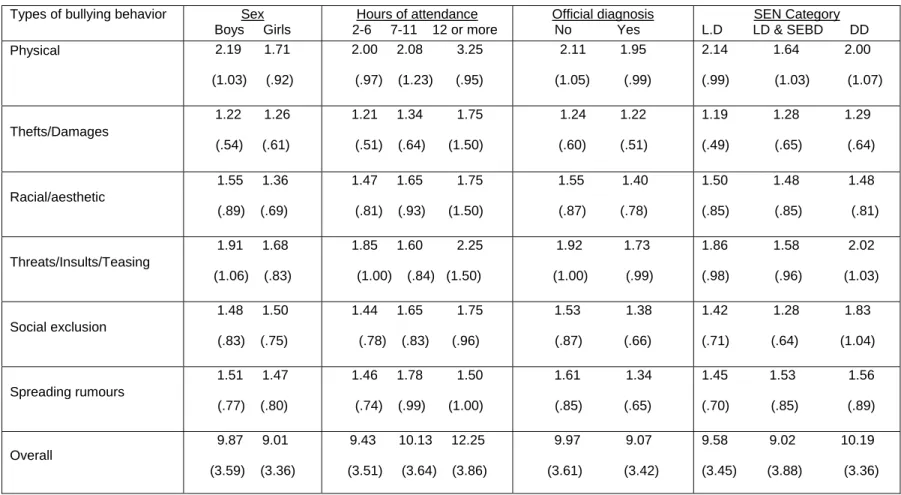
Analyses of variance were applied to investigate whether type of bullying behavior and victimization is differentiated by gender, hours of attendance pull-out special education program, official diagnosis and SEN category. The results of these analyses are presented in Tables 2 and 3.
Boys scored significantly higher than girls on physical [F(1,172)=8.854, p<.005] and overall bullying [F(1,172)=6.376, p<.005]. Children participating over 12 hours in the program scored significantly higher than the rest groups on ‘physical bullying’ [F(2,171=2.999, p<.05].
Regarding victimization, girls scored significantly higher than boys on ‘racial/aesthetic’ and ‘social exclusion’ victimization items [F(1,172)=8.791, p<.005 and[F(1,175)=4.829, p<.05, respectively]. Children attending 7-11 hours of pull-out special education program a week reported more physical victimization than children attending 2-6 hours a week, while children participating over 12 hours in those programs reported significantly more physical victimization and thefts/damages of personal belongings than the rest groups [F(2,171)=6.767, p<.001 and F(2,171)=5.959, p<.005 respectively].
Peer relations and bullying
The predictive value of children’s peer relations for both bullying and victimization was examined by means of children’s answers to three questions regarding presence of friends during playtime, number of friends in class and likeability by peers. In order to determine the relative contribution of each of these questions on both bulling and victimization two multiple regressions were performed.
INTERACÇÕES NO. 13, PP. 249-274 (2009)
Table 2 – Mean scores (SD) for sex, instruction in resource room (hours), official diagnosis and SEN Category in the Bullying behaviour scale
Types of bullying behavior Sex
Boys Girls Hours of attendance 2-6 7-11 12 or more Official diagnosis No Yes SEN Category L.D LD & SEBD DD Physical 2.19 1.71 (1.03) (.92) 2.00 2.08 3.25 (.97) (1.23) (.95) 2.11 1.95 (1.05) (.99) 2.14 1.64 2.00 (.99) (1.03) (1.07) Thefts/Damages 1.22 1.26 (.54) (.61) 1.21 1.34 1.75 (.51) (.64) (1.50) 1.24 1.22 (.60) (.51) 1.19 1.28 1.29 (.49) (.65) (.64) Racial/aesthetic 1.55 1.36 (.89) (.69) 1.47 1.65 1.75 (.81) (.93) (1.50) 1.55 1.40 (.87) (.78) 1.50 1.48 1.48 (.85) (.85) (.81) Threats/Insults/Teasing 1.91 1.68 (1.06) (.83) 1.85 1.60 2.25 (1.00) (.84) (1.50) 1.92 1.73 (1.00) (.99) 1.86 1.58 2.02 (.98) (.96) (1.03) Social exclusion 1.48 1.50 (.83) (.75) 1.44 1.65 1.75 (.78) (.83) (.96) 1.53 1.38 (.87) (.66) 1.42 1.28 1.83 (.71) (.64) (1.04) Spreading rumours 1.51 1.47 (.77) (.80) 1.46 1.78 1.50 (.74) (.99) (1.00) 1.61 1.34 (.85) (.65) 1.45 1.53 1.56 (.70) (.85) (.89) Overall 9.87 9.01 (3.59) (3.36) 9.43 10.13 12.25 (3.51) (3.64) (3.86) 9.97 9.07 (3.61) (3.42) 9.58 9.02 10.19 (3.45) (3.88) (3.36)
Note: LD: Learning Difficulties, LD & SEBD: Learning Difficulties & Social-emotional Behavioral Disorders, DD: Developmental Disabilities
Table 3 – Mean scores (SD) for sex, instruction in resource room (hours), official diagnosis and SEN Category in the Victimization scale.
Types of Victimization Sex Boys Girls Hours of attendance 2-6 7-11 12 or more Official diagnosis Yes No SEN Category L.D LD & SEBD DD Physical 2.44 2.24 (1.08) (1.02) 2.29 2.73 4.00 (1.03) (1.09) (.01) 2.45 2.25 (1.06) (1.07) 2.38 2.17 2.56 (.95) (1.21) (1.16) Thefts/Damages 1.66 1.82 (.99) (.98) 1.64 1.91 3.25 (.92) (1.12) (1.50) 1.74 1.64 (1.01) (.91) 1.70 1.53 1.92 (.96) (.94) (1.05) Racial/aesthetic 1.12 1.89 (.92) (1.09) 1.69 1.56 2.25 (.96) (.94) (1.50) 1.71 1.70 (.98) (1.01) 1.68 1.56 1.87 (.96) (.75) (1.18) Threats/Insults/Teasing 2.28 2.07 (1.08) (.96) 2.18 2.30 2.50 (1.02) (1.18) (1.00) 2.20 2.25 (1.00) (1.13) 2.26 2.02 2.26 (1.02) (1.11) (1.07) Social exclusion 1.23 1.98 (1.02) (1.12) 1.86 2.13 2.50 (1.01) (1.21) (1.73) 1.88 1.98 (1.07) (1.04) 1.93 1.82 1.92 (.98) (1.12) (1.19) Spreading rumours 1.95 1.96 (1.06) (1.03) 1.98 1.82 1.75 (1.05) (1.07) (1.50) 1.95 2.01 (1.06) (1.05) 1.96 1.94 1.95 (.98) (1.06) (1.22) Overall 11.85 11.86 (4.50) (4.52) 11.64 12.47 16.25 (4.45) (4.28) (5.79) 11.98 11.75 (4.33) (4.81) 11.90 11.02 12.51 (4.19) (4.99) (4.68)
260 DIDASKALOU, ANDREOU & VLACHOU
When bullying served as the dependent variable, R was significantly different from zero [R2 = .05, F(3, 168) = 2.89, p<.05]. Inspection of the predictor variables revealed that only playmates during break (beta = .58, t = .20, p<.005) significantly predicted scores on bullying behavior. Thus, bullying behavior was only predicted by presence of playmates during playtime.
For the regression on victimization R was also significantly different from zero [R2 = .21, F(3, 168) = 15.08, p<.001] . Scores on victimization were significantly predicted by both absence of playmates during break (beta = .33, t = 4 .37, p<.001) and number of friends the child has (beta = .51, t = 1.75, p<.005). Hence, victimization was predicted by absence of playmates during break and limited number of friends in class.
Discussion
Overall the results indicate that Greek pupils experiencing difficulties in the academic and psychosocial domains within mainstream educational settings are likely to be the perpetrators but also the targets of bullying, while in some cases they may perform both roles by displaying behavioural patterns of bully-victims. An intriguing finding of the present study generating considerable anxiety concerns the high levels of physical and verbal victimization pupils receiving special education support provision experience within mainstream schools. Over one third of the participants become regularly the targets of physical attacking, while one in five are being verbally abused and disrespected by peers. It could be therefore argued that the evidence endorses further the outcomes of those previous studies identifying children with SENs as a group particularly at risk of being victimized and also bullying others (Mishna, 2003; Lindsay, Dockrell & Mackie, 2008; Savage, 2005; Nabuzoka, 2003; Frederickson, Simmonds, Evans & Furnham, 2004). Sabornie (1994), for example, investigating various social and emotional characteristics of children with and without learning disabilities, including victimization in American middle schools found out that students facing learning problems reported significantly more victimization compared to their mainstream classmates. Accordingly, Morrison, et al., (1994) carried out a research on a sample of 485 students at a US high school concluded that pupils with learning disabilities were bullied more than the other pupils. In contrast with that evidence, the outcomes of the meta-analysis of 81 relevant studies carried out by Swanson & Malone (1992) revealed that pupils with learning difficulties are more likely to be rated as aggressive, immature, disruptive and bullies when compared with peers without
learning problems.
However, as it has already been pointed out, the knowledge base pertaining to the relationship between bullying and students with SENs is relatively new and somewhat sparse (Flynt & Morton, 2004). A key question that arises concerns the mediating mechanisms leading to increased rates of bullying and victimization among pupils facing learning problems within mainstream educational settings. Recent conceptualizations of bullying as a complex group phenomenon emphasize on the dynamic relationship between the child’s individual characteristics on the one hand, and the socio-environmental characteristics of the school on the other (Salmivalli, 2001; Andreou, Didaskalou & Vlachou, 2008). This relationship is the result of a dynamic interaction among variables at different levels of social interaction: individual, dyadic and group. When bullying occurs other children may reinforce the bullies’ aggression. Consequently, the school’s environmental characteristics and their impact on the social and psychosocial processes active within the peer group, constitute important dimensions of the problem under investigation. Any quest, therefore, for searching potential mediating factors contributing to an increasing vulnerability for pupils with SENs should be carried out at both: individual and contextual levels.
One important contextual dimension of the problem of bullying relates to the well-documented evidence that most episodes take place outside rather than within classrooms (Salmivalli, 2001; O’Connell, Pepler & Craig, 1999; Salmivalli, Lagerspetz, Osterman & Kaukiainen, 1996). The evidence from the present research is consistent with the findings of numerous previous studies which have consistently identified the open and closed common areas within institutions as places being particularly at risk for bully-victim problems to emerge. For example, the results of the research carried out by Norwich & Kelly (2004) on a sample of British pupils with moderate learning difficulties attending mainstream schools suggest that most bullying takes place in playgrounds during recess time and to a lesser extent in other school common areas, including corridors and bathrooms. Accordingly, Smith (2000) argues that bullies usually accost others in common areas such as playgrounds, hallways, or bathrooms where adult supervision may be lacking.
Returning to the case of Greece, the results of previous studies focusing on students’ behaviour within and outside classrooms illuminate significant aspects of teachers’ responses to pupils’ problems in the playground and address the difficulties they face in dealing effectively with such problems (Didaskalou & Millward, 2001;
262 DIDASKALOU, ANDREOU & VLACHOU
Didaskalou, 2000). Greek teachers’ responses in previous studies reveal a great discrepancy regarding the incidence of bullying problems taking place within and outside classrooms. In particular, they report a higher incidence of bullying occurring on the school premises compared to that they encounter within classrooms and they also face greater difficulties in managing such problems effectively in open school areas. Once transported from the classroom to the playground many Greek teachers appeared to “forget” many of the basic principles they are accustomed to applying so effectively in their classrooms. Rather than carrying forward the basic management principles making for effective classroom teaching, it appears that many teachers when taken away from the familiar territory of the classroom result to primitive and largely ineffective strategies. The absence of any organization of play-time activities in combination with the lack of a set of management strategies applied consistently by all teachers involved in supervising school common areas enhance further the limitations underpinning their responses.
As far as individual characteristics are concerned, children’s gender has been reported to constitute a significant variable in understanding the problem of bullying in schools. According to the findings significant differences were found in terms of gender in both bullying and victimization as a whole and its different forms. These discrepancies are likely to be related to the different types of victimization that boys and girls seem to experience. Whereas for boys victimization tends to be overt and physical and to communicate unambiguous defeat, for girls, victimization more often means being the targets of “relational aggression”. Girls’ victimization is less likely than boys’ to occur contingently on defensive or fighting responses and consequently may be less likely to function as punishment of aggressions. The gender differences revealed in the present study are therefore consonant with other findings which suggest that direct forms of victimization are more likely to be experienced by boys whereas indirect-covertly manipulative- forms more likely to be experienced by girls (e.g., Andreou & Metallidou, 2004; Crick & Grotpeter, 1995; Olweus, 1993).
An additional variable to that already mentioned above also associated with the problem of bullying in schools concerns the severity of students’ learning problems as these are implicitly depicted on the hours they spend in resource room settings. Assessing pupils’ needs and scheduling support room instructional provision are considered two important duties that comprise special teachers’ perceived work profile (Vlachou, 2006; Vlachou, Didaskalou & Argyrakouli, 2006). Since there is not any official statement procedure in Greek schools, the initial assessment for identifying the
particular needs of the referred pupils is mainly based on criterion-referenced measures such as basic skills checklists improvised by special teachers themselves or provided to special teachers in training seminars/courses and more simple evaluations such as verbal and ‘pen-and-paper’ testing of basic skills as well as a combination of checklists (Vlachou, 2006). It constitutes common practice for pupils with the most severe and profound difficulties receiving remedial instruction for a greater amount of time compared to their resource room classmates facing less serious learning and other problems. This may therefore account for the higher rate of victimization this particular group experience compared to the rest groups. Pupils attending the resource setting for a considerable part of their total instructional time may display severe and complex difficulties in the academic and psychosocial domains that render them being more often victimized than their rest mates. Because of their difficult and often non well-adapted behaviour, they seem to be one of the categories most at risk of being socially excluded and bullied. It is also possible that this high percentage of experienced victimization simply reflects that it may occasionally be difficult for the peer group to get on with pupils with serious problems (Flem & Keller, 2000).
Pupils’ with SENs social competence & bullying
Problems with bullying emerge through a complex process of interactions with significant others within which peers are of great importance, in developing, maintaining or altering the social environment in which bullying problems occur (Lagerspetz, et al., 1982; Salmivalli, et al., 1997; Stevens, et al., 2000). Research on the interaction between pupils with SENs and their peers indicate that they affect one another in different ways. For instance, numerous studies based on peer reports have identified high proportions of included children possessing low social status and being less accepted and more rejected than their mainstream counterparts (Nabuzoka & Smith, 1993; Martlew & Hodson, 1991; Sweeting & West, 2001; Norwich & Kelly, 2004; Lindsay, et al., 2008). This has been so across different national school systems, including the USA (Taylor, Asher & Williams, 1987) and the UK (Nabuzoka & Smith, 1993; Dyson, et al., 2004). Accordingly, the special education needs group participating in the study carried out by Frederickson & Furnham (2004) in UK, most closely resembled children rated by their classmates as disruptive, always seeking help, a bully and to a lesser extent a victim of bullying. Overall, Kavale & Forness (1996) on the basis of a meta-analysis of 152 studies concluded that about 75% of learning disabled children manifest social skills deficits that distinguish them from other children.
264 DIDASKALOU, ANDREOU & VLACHOU
More specifically, they encounter significant difficulties in forming social relationships with peers and score lower on prosocial behaviour descriptors than their mainstream school mates (Frederickson, Simmonds, Evans & Soulsby, 2007), which constitute factors that may lead to social rejection and victimization (Frederickson & Furnham, 2004).
Given the low position of pupils with SENs within the peer group, their involvement in bullying others may well-reflect a legitimized response and intention to gain social outcomes such as dominance or status among peers (Andreou & Metallidou, 2004; Andreou, Vlachou & Didaskalou, 2005). The presence of playmates during break time is therefore regarded as being a contextual prerequisite for bullies to gain position within the peer group and consequently being a predictor of bullying. Using bullying as a way to maintain high regard for themselves and ensuring their position in the group is especially so in the case of children facing learning problems who do not have experiences of success in an academic context. As Kaukiainen, et al., (2002, p. 276) argue, “bullying may represent their awkward and desperate attempt to “keep up appearances””.
Complementary evidence to that cited above also exists, emphasizing on those mediating factors placing particular children at risk for being victimized. In fact, the centrality of positive interactions for minimizing victimization has been illustrated through the effects that the lack of such interactions can have (Andreou, Vlachou & Didaskalou, 2005; Hodges, et al., 1997). As Egan & Perry (1998) maintain, children who feel that they are fairing poorly as a member of their peer group may be prone to becoming anxious, emotionally deregulated and perhaps even submissive during peer conflicts, thereby contributing to their victimization. Such children may lack the sense of confidence as well-being that derives from knowing that one is a well-integrated member of the peer group, e.g. that one has supportive friends and classmates who will be protective and who may join in sanctioning and aggressive peer.
Children with SENs have generally developed inadequate social competence that places them at continued risk which are themselves unable to resolve. Social competence has been found to be associated with positive behaviours and roles while inadequate social skills development has been related to victimization (Lindsay, et al., 2008). For instance, social competent children may deal with new challenges of victimization by drawing upon their social skills and forming new friendships groups, so enhancing protective factors (Smith, et al., 2004). Children with SENs, however, may
not be able to do this and may be more at risk of later adverse outcomes to similar levels of victimization (Lindsay, et al., 2008). As Thompson, Whitney & Smith (1994) argue, friends at school may serve as a protective net against victimization and pupils with SENs usually lack such a protection. In fact, the findings of the study carried out by Savage (2005) on a sample of mainstream pupils attending a language base part-time, reveal that those pupils reported being frequently targeted by bullies had fewer friends compared to the rest school mates suggesting that friendship serves as a potential protective factor against victimization. Accordingly, Martlew & Hodson (1991) compared the peer relationships and bullying of children with learning disabilities and matched children without learning problems. Their data reveal that children facing learning problems had fewer friends and were teased significantly more than the children without learning disabilities. The evidence emanating from the present study supports these views further by identifying the absence of playmates during break time and friends in class as potential risk factors for being victimized. In other words, having a number of peers willing to play with you in playground, despite attendance at resource room settings, may reduce the risk of being bullied even if attendance at resource room might minimize opportunities for developing those “protecting” factors.
As far as those children who are both bullies and victims are concerned, empirical evidence suggests that these are the most severely rejected by peers (Pellegrini, 1998; Perry, et al., 1988) and have especially serious adjustment problems (O’Moore & Kirkham, 2001; Perry, et al., 1988) in many areas (Schwartz, Proctor & Chien, 2001). For instance the findings resulting from the study carried out by Nabuzoka & Smith (1993) focusing on the relationships and status of children with learning disabilities by comparing them to children without learning problems reveal that four out of the total number of six children identified as bully/victims in that study had learning disabilities and were labeled by peers as shy, seeking help and disrupting others.
Another way that children’s social skills impact upon bullying is through the sorts of coping strategies they might use to deal with bullying. Naylor, Cowie & Del-Rey (2001) point out that by year 9, children are less likely to tell someone such as a teacher about bullying, but will do so more often in year 7. The alternative strategy used by children most frequently is to “bear it” or “ignore it”. Other evidence (Geisthardt & Munsch, 1996) suggests that children with learning-related difficulties are less likely to report bullying and ask for adult or peer help than their non-learning disabled peers (Wenz-Gross & Siperstein, 1997). This might be more evident for children with profound and severe difficulties where fear of stigma might perhaps be even more
266 DIDASKALOU, ANDREOU & VLACHOU
greatly developed and willingness to seek help less developed (Geisthardt & Munsch, 1996). These findings are consistent with the evidence from the present study indicating that the majority of victimized children did not tell anyone about their experience, while one third of them regarded doing so as pointless. Most of those pupils, however, who shared their personal adverse experience with others, felt that this helped them a lot, while the vast majority of participants made a strong appeal for getting effective support and protection from schools and teachers by suggesting that there should be a whole school policy against victimization. Participants’ low level of reporting should be considered in combination with the impact that prevalent cultural and school values and attitudes are likely to exercise on their responses and ways of behaving. For instance, aggression encouraging attitudes and behaviours may be maintained or even reinforced in cultural contexts within which the sensitivity and negative attitude to violence that victims tend to display are seen as negative attributes (O’Moore, 2000). Indeed, teachers and principals sometimes express intolerance at the victim’s inability to sort out their ‘own’ problems. So, rather than seeing sensitivity and the ability to restrain oneself from violent counterattack as a virtue, it is instead seen as a personal limitation. This perception among adults is often evident within traditional and male stereotype oriented educational contexts such as that in Greece.
Conclusions & Implications
A systemic-ecological framework is considered essential for understanding and addressing bulling in schools (Hanish & Guerra, 2000). This framework builds on the assumption that because people are embedded in social and environmental contexts, multiple factors invariably contribute to social behavioural patterns (Cairns & Cairns, 1991; Germain & Bloom, 1999). According to this framework, bullying problems do not reside solely within the child who bullies or who is victimized. Rather than individual characteristics, social interactions and ecological and cultural conditions are seen to contribute to social behavioural patterns (Cairns & Cairns, 1991; Germain & Bloom, 1999). Consequently, in promoting children’s with SENs well-being the emphasis should be on addressing those individual and environmental factors that affect them.
The present study has direct implications for considering how the ecology of mainstream schools operating pull-out services which represented the focus of this research, may influence the social outcomes of children with SENs. The wider question of course remains whether these children might benefit from more inclusive educational
interventions that placed them alongside their peers. The results once more stress that physical integration or “just being there”, is only a very basic condition and it takes much more time to become a member of the group. Special needs pupils need to participate in the regular curriculum, work and learn alongside other pupils and often need support in making contacts and establishing lasting relations (Keller & Sterling-Honig, 1993; Hunt, et al., 1996). In implementing inclusive education, the possible risk of social isolation and bullying of pupils with SENs deserves more attention and it seems a relevant issue for initial training, in-service and teachers support services (Moncy, Pijl & Zandberg, 2004).
Given the strong possibility that friendship and acceptance appear to provide protection against bullying, teachers and administrators should assess each component of the curriculum and learning environment to determine whether there is a “critical mass” of typically developing children available to assist young children with SENs in carrying out their interpersonal goals, interacting with classmates, participating in group-oriented activities and developing reciprocal relationships with peers (Buysse, Coldman & Skinner, 2001). In planning more directive interventions for children with SENs it is important to keep in mind that different types of classroom interventions may be useful for addressing different social goals (Odom, et al., 1999) and there is a specific need for more empirical data to guide teachers’ efforts to facilitate friendship formation between children with and without SENs.
Participants’ experiences reflect the absence of preventive policies against bullying and discrimination in Greek mainstream schools and their views have considerable implications towards the development of school-based anti-bullying inclusive practices. Many countries have implemented whole-school interventions to challenge how systems tolerate and foster children’s victimization and to alter staff and pupils’ responses (Garrity, Jens, Poster, Sager, & Short-Camilli, 1997; O’Connell et al., 1999). Generally, these programs increase awareness of bullying, involve parents in planning and intervening, use the student body to promote prosocial behaviour, and develop clear rules wherein bullying is not tolerated. Victims are provided protection along with support and help to enhance their social competence while bullies are assisted to redirect their need of power in accepted ways or to do something for compensating victims for their behaviour (Stevens, de Bourddeaudhuij & Van Oost, 2001). In light of the closeness of the relationship between friendship patterns and perceptions of bullying, one possibility that could be suggested is that the focus of anti-bullying interventions might be more successful if it went hand in hand with a more
268 DIDASKALOU, ANDREOU & VLACHOU
ecological focus of social acceptance and friendship skills (Savage, 2005). More ecological approaches to development of friendship and acceptance might well lead to substantial reductions in bullying and may be more effective than teaching children strategies once they have already been targeted by bullies. If substantiated by further research, this may mean that the potential risk for bullying that may result from partly-segregated educational provision will need to be taken into account in any decision about how provision for children with SENs is arranged (Savage, 2005).
In conclusion, this study generally supports the view that bullying is a prevalent problem among children with SENs in mainstream schools and that peer relationships at school may serve as a protective net against victimization. More research into bullying as a group process is needed, investigating in more detail, through a combination of self and peer reports as well as direct observations, the factors that influence bully/victim problems in these schools. Large-scale investigations should be conducted in this area to expand upon the findings of the present study and address topics such as changes in the social environment of schools that could reduce the number of children with SENs involved in bully/victim incidents and other possible intervention topics that are of special reference for inclusive education.
References
Andreou, E., & Metallidou, P. (2004). The relationship of academic and social cognition to behaviour in bullying situations among Greek primary school children. Educational Psychology, 24, 27-41.
Andreou, E., Didaskalou, E., & Vlachou, A. (2008). Outcomes of a curriculum-based anti-bullying intervention program on students; attitudes and behaviour. Emotional and Behavioural Difficulties, 13, 235-248.
Andreou, E., Vlachou, A., & Didaskalou, E. (2005). The roles of self-efficacy, peer interactions and attitudes in bully-victim incidents: Implications for intervention policy-practices. School Psychology International, 26, 545-563.
Armstrong, F. & Barton, L. (Eds) (1999). Disability, Human Rights and Education: Cross Cultural Perspectives. Buckingham: Open University Press.
Bakker, J. A., & Griendt, J. van de (1999). Zelfbeeld en sociale status van kinderen met leer-problemen in het regulier en special onderwijs [Self-image abd social position of pupils with learning problems in regular and special education], Tijdschrift voor Orthopedagogick, 38, 497-511.
Barton, L. (Ed) (2001). Disability, Politics and the Struggle for Change. London: David Fulton.
Boivin, M., Hymel, S., & Bukowski, W. M. (1995). The roles of social withdrawal, peer rejection, and victimization by peers in predicting loneliness and depressed mood in childhood. Development and Psychopathology, 7, 765-785.
Booth, T. & Anscow, M. (1998). From Them to Us: An International Study of Inclusion in Education. London: Routledge.
Buysse, V., Goldman, B., & Skinner, M. (2002). Settings effects of friendship formation among young children with and without disabilities. Exceptional Children, 68, 503- 517.
Cairns, R. B., & Cairns, B. D. (1991). Social cognition and social networks: a developmental perspective. In: D. Pepler & K. Rubin (Eds.), The Development and Treatment of Childhood Aggression (pp. 249-278). Hillsdale, NJ: Erlbaum. Crick, N., & Grotpeter, J. K. (1995). Relational aggression, gender &
social-psychological adjustment. Child Development, 66, 710-722.
Didaskalou, E. (2000). Emerging teacher perspectives in relation to emotional and behavioural problems in Greek primary schools. Unpublished Ph.D Thesis, Newcastle Upon Tyne: University of Newcastle Upon Tyne, Department of Education [s.499].
Didaskalou, E., & Millward, A. (2001). Greek teachers’ perspectives on behaviour problems: implications for policy makers and practitioners. European Journal of Special Needs Education, 16, 289-299.
Dyson, A., Farrell, P., Polat, F., Hutcheson, G. & Gallanaugh, F. (2004). Inclusion and Pupil Achievement. Research Report RR578. London: DfES.
Egan, S. K. & Perry, D. G. (1998). Does low self-regard invite victimization?, Developmental Psychology, 34, 299-309.
Flem, A., & Keller, C. (2000). Inclusion in Norway: a study of ideology in practice. European Journal of Special Needs Education, 15, 2, 188-205.
Flynd, S. W. & Morton, R. C. (2004). Bullying and children with disabilities. Journal of Instructional Psychology, 31, 43-51.
Frederickson, N. L., & Furnham, A. F. (2004). Peer-assessed behavioural characteristics and sociometric rejection: differences between pupils who have moderate learning difficulties and their mainstream peers. British Journal of Educational Psychology, 74, 391-410.
270 DIDASKALOU, ANDREOU & VLACHOU
and affective outcomes of inclusion. British Journal of Special Education, 34, 105-115.
Freeman, S. J., & Alkin, M. C. (2000). Academic and social attainments of children with mental retardation in general education and special education settings. Remedial and Special Education, 21, 3-18.
Garrity, C., Jens, K., Porter, W., Sager, N., & Short-Camilli, C. (1997). Bully proofing your school: Creating a positive climate. Intervention in School and Clinic, 32, 235-243.
Geisthardt, C., & Munsch, J. (1996). Coping with stress: A comparison of adolescents with and without learning disabilities. Journal of Learning Disabilities, 29, 287-296.
Germain, C. B., & Bloom, M. (1999). Human Behaviour in the Social Environment: An ecological View (2nd Ed.). New York: Columbia University Press.
Greenham, S. (1999). Learning disabilities and psychosocial adjustment: A critical review. Child Neuropsychology, 5, 171-196.
Guralnick, M. J. (1999). The nature and meaning of social integration for young children with mild developmental delays in inclusive settings. Journal of Early Intervention, 22, 70-86.
Guralnick, M. J., & Groom, J. M. (1988). Friendships of preschool children in mainstreamed playgrounds. Developmental Psychology, 24, 595-604.
Guralnick, M. J., Gottman, J. M., & Hammond, M. A. (1996). Effects of social setting on the friendship formation of young children differing in developmental status. Journal of Applied Developmental Psychology, 17, 625-651.
Hanish, L. D., & Guerra, N. G. (2000). Children who get victimized at school: what is known? What can be done? Professional School Counseling, 4, 113-119.
Hodges, E. E., Malone, M. J., & Perry, D. G. (1997). Individual risk and social risks as interacting determinants of victimization in the peer group. Developmental Psychology, 33, 1032-1039.
Hunt, P., Alwell, M., Farron-Davis, F. & Goetz, L. (1996). Creating socially supportive environments for fully included students who experience multiple disabilities. Journal of the Association for Persons with Severe Handicaps, 21, 53-71.
Kaukiainen, A., Salmivalli, C., Lagerspetz, K., Tamminen, M., Vauras, A., Maki, H., & Poskiparta, E. (2002). Learning difficulties, social intelligence, and self-concept: connections to bully-victim problems. Scandinavian Journal of Psychology, 43, 269-278.
Kavale, K. A. & Forness, S. R. (1996). Social skill deficits and learning disabilities: A meta-analysis. Journal of Learning Disabilities, 29, 226-238.
Keller, D. & Sterling-Honig, A. (1993). Curriculum to promote positive interactions of preschoolers with a disabled peer introduced into the classroom. Early Child Development and Care, 96, 1, 27-34.
Klinger, J. K., Vaughn, S., Schumm, J. S., Cohen P. & Forgan, J. W. (1998). Inclusion or pull-out-which do students prefer? Journal of Learning Disabilities, 31, 148-158.
Kuhne, M., & Wiener, J. (2000). Stability of social status of children with and without learning disabilities. Learning Disability Quarterly, 23, 64-75.
Lagerspetz, K. J., Bjorkqvist, K., Berts, M., & King, E. (1982). Group aggression among schoolchildren in three schools. Scandinavian Journal of Psychology, 23, 45-52. Lindsay, G., Dockrell, J. E., & Mackie, C. (2008). Vulnerability to bullying in children
with a history of specific speech and language difficulties. European Journal of Special Needs Education, 23, 1-16.
Martlew, M., & Hodson, J. (1991). Children with mild learning difficulties in an integrated and in special school: comparisons of behaviour, teasing, and teacher’s attitudes. British Journal of Educational Psychology, 61, 355-372.
Minnett, A., Clark, K. & Wilson, G. (1995). Play behaviour and communication between deaf and hard of hearing children and their hearing peers in an integrated preschool. Annals of the Deaf, 139, 420-429.
Mishna, F. (2003). Learning disabilities and bullying: double jeopardy. Journal of Learning Disabilities, 36, 336-347.
Monchy, M., Pijl, S. J., & Zandberg, T. (2004). Discrepancies in judging social inclusion and bullying of pupils with behaviour problems. European Journal of Special Needs Education, 19, 317-330.
Morrison, G. M., Furlong, M. J., & Smith, G. (1994). Factors associated with the experience of school violence among general education, leadership class, opportunity class, and special day class pupils. Education and Treatment of Children, 17, 356-369.
Nabuzoka, D. (2003). Teacher ratings and peer nominations of bullying and other behaviour of children with and without learning difficulties. Educational Psychology, 23, 307-322.
Nabuzoka, D., & Smith, P. K. (1993). Sociometric status and social behaviour of children with and without learning difficulties. Journal of Child Psychology and
272 DIDASKALOU, ANDREOU & VLACHOU
Psychiatry, 34, 1435-1448.
Naylor, P., Cowie, H., & Del Rey, R. (2001). Coping strategies of secondary school children in response to being bullied. Child Psychology and Psychiatry Review, 6, 114-120.
Norwich, B., & Kelly, N. (2004). Pupils’ views on inclusion: moderate learning difficulties and bullying in mainstream and special schools. British Educational Research Journal, 30, 43-65.
O’Connell, P., Pepler, D., & Craig, W. (1999). Peer involvement in bullying: Insights and challenges for intervention. Journal of Adolescence, 22, 437-452.
O’Moore, M. (2000). Critical issues for teacher training to counter bullying and victimization in Ireland. Aggressive Behaviour, 26, 99-111.
O’Moore, M., & Kirkham, C. (2001). Self-esteem and its relationship to bullying behaviour. Aggressive Behaviour, 27, 269-283.
Odom, S. L., & Diamond, K. E. (1998). Inclusion of young children with disabilities in early childhood education: a research base. Early childhood Research Quarterly, 13, 3-26.
Odom, S. L., McConnell, S. R., McEvoy, M. A., Peterson, C., Ostrosky, M., Chandler, L. K., Spicuzza, R. J., Skellenger, A., Creighton, M., & Favazza, P. (1999). Relative effects of interventions supporting the social competence of young children with disabilities. Topics in Early Childhood Special Education, 19, 75-91. Olweus, D. (1993) Bullying at school: what we know and what we can do. Oxford,
England: Blackwell.
Pateraki, L. & Houndoumadi, A. (2001). Bullying among primary school children in Athens, Greece. Educational Psychology, 21, 167-175.
Pelegrini, A. D. (1998). Bullies and victims in school: A review and call for research. Journal of Applied Developmental Psychology, 19, 165-176.
Perry, D. G., Kusel, S. J., & Perry, L. C. (1988). Victims of peer aggression. Developmental Psychology, 24, 807-814.
Piigl, J. S., Meijer, C. J. & Hegarty, S. (1997). Inclusive Education: A Global Agenda. London: Routledge.
Roland, E. & Galloway, D. (2002). Classroom influences on bullying. Educational Research, 44, 299-312.
Salmivalli, C. (2001). Peer-led intervention campaign against bullying: who considered it useful, who benefited? Educational Research, 43, 263-278.
schools. Scandinavian Journal of Psychology, 38, 305-312.
Salmivalli, C., Lagerspetz, K., Bjorkqvist, K., Osterman, K., & Kaukiainen, A. (1996). Bullying as a group process: Participant roles and their relations to social status within the group. Aggressive Behaviour, 22, 1-15.
Savage, R. (2005). Friendship and bullying patterns in children attending a language base in mainstream school. Educational Psychology in Practice, 21, 23-36. Schwartz, D., Proctor, L. J., & Chien, D. H. (2001). The aggressive victim of bullying:
emotional and behavioural dysregulation as a pathway to victimization by peers. In: J. Juvonen & S. Graham (Eds.), Peer Harassment in School: The Plight of the Vulnerable and Victimized (pp. 147-174). New York: Guilford Press.
Smith, P. K. (2000). Bullying and harassment in schools and the rights of children. Children & Society, 14, 294-303.
Stevens, V., De Bourdeaudhuij, I. & Van Oost, P. (2000). Bullying in Flemish schools: an evaluation of anti-bullying intervention in primary and secondary schools. British Journal of Educational Psychology, 70, 195-210.
Swanson, H.L. & Malone, S. (1992). Social skills and learning disabilities: A meta-analysis of the literature. School Psychology Review, 21, 427-442.
Sweeting, H., & West, P. (2001). Being different: correlates of the experience of teasing and bullying at age 11. Research Papers in Education, 16, 225-246.
Taylor, A. R., Asher, S. R., & Williams, G. A. (1987). The social adaptation of mainstreamed mildly retarded children. Child Development, 58, 321-334.
Thompson, D., Whitney, I., & Smith, P. K. (1994). Bullying of children with special needs in mainstream schools. Support for Learning, 9, 103-106.
Vaughn, S. & Bos, C. S. (1987). Knowledge and perception of the resource room: the students’ perspective. Journal of Learning Disabilities, 20, 218-223.
Vlachou, A. (2006). Role of special/support teachers in Greek primary schools: a counterproductive effect of ‘inclusion’ practices. International Journal of Inclusive Education, 10, 39-58.
Vlachou, A., Didaskalou, E., & Argyrakouli, E. (2006). Preferences of students with general learning difficulties for different service delivery modes. European Journal of Special Needs Education, 21, 201-216.
Vlachou-Balafouti, A. (2001). The Process of Change and the Politics of Resistance in Educational Contexts: The Case of Disability. In: L. Barton, (Ed.) Disability, Politics and the Struggle for Change (pp.110-125). London: David Fulton.
274 DIDASKALOU, ANDREOU & VLACHOU
of children with learning problems. Exceptional Children, 63, 183-193.
Wiener, J. (2002). Friendship and social adjustment of children with learning disabilities. In: B. Y. L. Wong & M. L. Donahue (Eds.), The social dimensions of learning disabilities: Essays in honor of Janis Bryan (pp. 93-114). Mahwah, NJ: Erlbaum.
Yude, C., Goodman, R. & McConachie, H. (1998). Peer problems of children with hemiplegia in mainstream primary schools. Journal of Child Psychology and Psychiatry, 39, 533-541.
Ziegler, S., & Rosenstein-Manner, M. (1991). Bullying at School: Toronto in an International Context. Toronto, Canada: Toronto Board of Education, Research Services.
Zoniou-Sideri, A. (Ed.) (2000). Integration: Utopia or Reality? The Educational and Political Dimension of Integrating Pupils with Special Needs. Athens: Ellinika Grammata.