FUNDAÇÃO GETULIO VARGAS
ESCOLA BRASILEIRA DE ADMINISTRAÇÃO PÚBLICA E DE EMPRESAS
ANDRÉ LUIZ MEDEIROS KLEVENHUSEN
IN THE JUSTICE WE TRUST: COURTS AS AN UNBIASED INSTITUTION TO RESOLVE GOVERNMENTAL CORRUPTION
RIO DE JANEIRO 2020
IN THE JUSTICE WE TRUST: COURTS AS AN UNBIASED INSTITUTION TO RESOLVE GOVERNMENTAL CORRUPTION
Dissertação apresentada à Escola Brasileira de Administração Pública e Empresas da Fundação Getúlio Vargas, como requisito para obtenção do título de Mestre em Administração Empresas.
Campo de Conhecimento: Instituições, Política e Governo Orientador: Prof. Carlos Pereira
Dados Internacionais de Catalogação na Publicação (CIP) Ficha catalográfica elaborada pelo Sistema de Bibliotecas/FGV
Klevenhusen, André Luiz Medeiros
In the justice we trust : courts as an unbiased institution to resolve governmental corruption / André Luiz Medeiros Klevenhusen. – 2020.
43 f.
Dissertação (mestrado) - Escola Brasileira de Administração Pública e de Empresas, Centro de Formação Acadêmica e Pesquisa.
Orientador: Carlos Pereira. Inclui bibliografia.
1. Ideologia – Aspectos políticos - Brasil. 2. Brasil – Política e governo. 3. Corrupção na política. 4. Confiança. 5. Poder judiciário – Brasil. I. Pereira, Carlos. II. Escola Brasileira de Administração Pública e de Empresas. Centro de Formação Acadêmica e Pesquisa. III. Título.
CDD – 320.981
ACKNOWLEDGMENTS
I want to express my gratitude to FGV for providing outstanding methodological and conceptual qualifications. The 12 courses I have attended during 2018/2019 shed light on the challenges, requirements, and high-quality research procedures. Beyond that, I get in touch with excellent professors and fascinating colleagues. Their knowledge and support through this journey were essential to conclude this dissertation. Particularly Carlos Pereira and Lúcia Barros had a significant contribution to this work. Much of this achievement’s quality relies on their expertise and accurate suggestions. I could not leave my family behind. Its boundless efforts to provide leading educational conditions is the ground of this accomplishment. I am also deeply thankful to my comprehensible girlfriend, Julia Ferraro. From patiently enduring my period as an M.A candidate.
ABSTRACT
There is very little information about the underlying reasons for an individual’s distrust of public leaders’ judgment. Although much is known about the reasons why citizens keep supporting corrupt politicians, most of the works do not consider the individuals’ ideological dimension. This study has important implications for the scholarship because it investigates the relationship between confidence in institutional decisions and identification with a candidate. Although Brazilian Supreme Court’s decisions are occasionally contradictory and controversial, we found that constituents consider courts an unbiased institution to resolve governmental corruption. Even when the convicted politician is the participant’s preferred candidate, there is no effect on court’s confidence levels. Beyond that, our results show that the more intense participants’ identification with his candidate, the higher the courts’ confidence. The study also identified that higher education, higher income, and males tend to present greater identification levels with their preferred candidates.
RESUMO
Há muito pouca informação sobre as razões que embasam a desconfiança de um indivíduo a respeito do julgamento de líderes políticos. Embora muito se saiba sobre as razões pelas quais os cidadãos continuam apoiando políticos corruptos, a maioria dos trabalhos não considera a dimensão o nível de identificação com um candidato. Este estudo tem implicações importantes para a academia, pois investiga a relação entre confiança nas decisões institucionais e a identificação com os candidatos. Embora as decisões da Suprema Corte brasileira sejam ocasionalmente contraditórias e controversas, descobrimos que os cidadãos consideram os tribunais uma instituição imparcial para julgar a corrupção de agentes políticos. Além disso, nossos resultados mostram que quanto maior a identificação dos respondentes com seu candidato preferido, maior a confiança nas decisões das cortes sobre desvio de dinheiro público. Mesmo quando o político condenado é o candidato preferido do participante, não há efeito nos níveis de confiança no Poder Judiciário. O estudo também identificou que ensino superior, maior renda e o sexo masculino estão correlacionados com maior identificação com o candidato.
Sumário
Relevance ... 1
How court decisions on political malfeasance became more controversial in Brazil? ... 3
Why do voters support corrupt politicians? ... 5
Hypothesis... 8 Research Design... 11 Data Collection ... 11 Dependent Variable ... 11 Respondents’ Ideology ... 12 Court Confidence ... 15 Independent Variables ... 16 Results ... 16 Data Analysis ... 16
Court Confidence Data ... 17
Preferred Candidate ... 18 Identification Levels ... 19 Model Analysis ... 20 Discussion ... 26 Limitations ... 29 References ... 30 Appendix ... 34
LIST OF FIGURES
Figure 1: Candidates Profiles ... 14
Figure 2: Histogram of Identification Levels... 20
Figure 3: Histograms of Diffuse Confidence ... 34
Figure 4: Histograms of Confidence in Politician's Trial ... 35
LIST OF TABLES Table 1: Mean and Median Values of Confidence in Judiciary Branch by Dimension ...18
Table 2: Voting by Candidate and Schooling ...19
Table 3: Estimates for the Impact of Variables on Individual's Confidence in Politician's Trial ...21
Table 4: Moderation Analysis of Candidate's Conviction on Individual's Confidence in Politician's Trial ...24
Table 5: Estimates for the impact of variables in individuals' identification with a candidate ...25
Relevance
Lately, in Brazil, courts’ decisions were controversial. There are several contentious verdicts like unconstitutionality of coercive conduct and validation by the Federal Police as an entity authorized to negotiate and conclude award-winning agreements, even without the Prosecution Office’s consent. Still, any other topic is so polemic as the arbitrament about the defendant’s arrest after losing the first appeal. Given that this matter directly affects former President Luis Inácio Lula da Silva’s imprisonment, it is difficult to disassociate some political influence from a fair-minded ruling. Beyond that, the Brazilian Supreme Court (SFT) has changed its understanding of this subject three times between 2009 e 2019.
In 2009, STF established that the convicted could remain free until all the remedies in the judiciary were exhausted. In 2016, another judgment changed this decision and resolved that the arrest could occur before an unappealable deliberation. Three years later, in 2019, the Supreme Court analyzed the same issue again. As has happened previously, the judges revised their prior conclusion and shifted their understanding. Thus, the current arrangement defined that the arrest is possible only after the so-called “res judicata” process (i.e., when the appeal possibilities are exhausted). The voting scores helps to explain why STF changed opinion so frequently. A tight majority has determined each of these resolutions: 2009 (7x4), 2016 (7x4), and 2019 (6x5).
In this context of controversial, tight, and conflicting decisions that can directly impact the presidential run, one expects that citizens predominantly distrust courts’ verdicts, especially those that have their political leaders convicted by the justice. After all, the circumstances provide pieces of evidence for those that support the political persecution argument. Consequently, common wisdom and the literature (Durr, 2000) assume that ideological incongruence between verdicts and respondents increases courts’ distrust.
In the opposite direction, however, our data show a different scenario. Voters would rather trust courts’ decisions than advocate for his/her favorite politician. We observed that courts bear enough institutional legitimacy, and they still have the capacity to decide about public leaders’ wrongdoings. Even when justice punishes one’s preferred candidate, it retains constituents’ confidence levels. This finding becomes even more unexpected if we consider what citizens forecasted for a political trial eight years ago. In 2012, while 73% of Brazilians thought the Mensalão’s (most massive corruption scheme up to Car-Wash Operation) defendants should go to prison, only 11% believed they would be punished
(Folha de São Paulo, 2016). This survey’s results ratified that Brazilians assumed their legal system as impotent to sanction political corruption.
Although research demonstrates that, in Brazil, public opinion considers the judiciary branch as slow, expensive, partial, complex, and corrupt (Falcão, 2012),our result contributes to the judiciary branch inquiry because it demonstrated that citizens might have changed their perspective on courts. Additionally, this study differs from traditional political science approaches since it correlates citizens’ identification with candidates and citizens’ confidence in institutional decisions. In this work, we defined identification with a candidate as the congruence between voters’ and candidates’ ideas. So far, the investigations have tended to focus more on partisanship and candidate preference (Anduiza, 2013; Bolsen, 2014; Boas, 2019). Instead of focusing on ideology type, we measured the extent to which identification with a candidate affects citizens’ confidence in the judiciary branch. With this approach, we aimed at expanding the current knowledge about institutional credibility.
According to Zaller (1992), people tend to see the political universe in a way that is consistent with their political predispositions. Ideology, which is part of a person’s identity (Huddy, 2001; Iborra, 2005; Teles, 2009), functions as a cognitive and protective shortcut so that those who share similar beliefs and values can make choices (Huckfeldt et al., 1999). Identity, according to Brewer (1991), fills two basic competing psychological and social needs—one of inclusion (being part of the group) and one of exclusion or differentiation (distinguishing oneself from others). According to Mason (2018), “identity-based elements of ideology are capable of driving heightened levels of affective polarization against outgroup ideologues, even at low levels of policy attitude extremity or constraint.” Based on this rationale, a judicial decision contrary to the group’s dominant identity-based ideology would be more likely to be considered baized by its members. Therefore, it is likely that people will reach conclusions that confirm their identity-based ideological bias.
In the contemporary world, this mechanism has deepened. Due to social network algorithms (Facebook and Twitter) or personal grouping choices (Whatsapp), people live in informational bubbles that match their political perspective and identity. Thereby an individual’s prior beliefs may influence the type of information he/she absorbs and reinforce her/his identity-based ideology. Doubtlessly, this pattern will produce narratives that do not correspond to facts, impacting how voters perceive politicians’ acts and institutional decisions. However, this pattern, in which that ideology performs an unprecedented role in shaping one’s distrust in institutional control does not seem to occur in Brazil.
Our investigation raised evidence that identification with a candidate, positively affects citizens’ confidence in the judiciary branch to resolve political wrongdoings. The higher respondents’ identification is, the higher their trust in courts.
We also examined which socio-demographic attributes related to a deeper identification with a candidate. The findings suggest that schooling, income, and gender (male) are variables that positively impact participants’ identification with a candidate. Our results also indicate that the less fortunate do not believe in courts’ decisions because they perceive the legal system as relentless with the poorer and compassionate with the richer.
How court decisions on political malfeasance became more controversial in
Brazil?
Since the 1988 Constitution, the judiciary branch has been occupying an increasing space in the Brazilian political life, defining and implementing the rules of politico-competitive electoral. For example, with the validity of the “Ficha-Limpa” law (convicted politicians, even if provisionally, could not run for election and assume elective positions) for the elections of 2010 confirmed, the Supreme Court profoundly changed the likely outcome of electoral competition if the law did not had been applied (Falcão, 2012). Beyond that, corruption struggle has been an ascending valiance issue. Most of the corruption scandals have not achieved beyond second-tier politicians and frequently ended up with the defendant’s’ absolution, although the pieces of evidence somehow suggested illegal activities. There was a predominant perception of impunity among public opinion. Nevertheless, the Lava-Jato (Car Wash Operation) introduced a relentless condemnatory pattern. What characterizes the last five years as a remarkable period in Brazil are three relevant aspects: the amount of money involved, the prominence of involved politicians, and a potential impact of court decisions in the electoral run.
No one could guess that illegal dollar traders arrest, in March 2014, would depart from Curitiba and arrive at the heart of Brazilian political power, Brasilia (MPF, 2020). Up to May 2019, Ministério Público Federal (Brazilian Public Prosecution Office - MPF) has requested 56 inquiries against deputies, senators, state ministers, and former presidents (Junqueira, 2016; Ministério Público Federal, http://www.mpf.mp.br/grandes-casos/lava-jato/linha-do-tempo). In May 2017, the total frozen proprieties summed R$ 3.2 billion, and one estimates that recoveries can reach R$ 38.1 billion (Odilla, 2018). One of the most symbolic outputs appeared during the Cui Bono Operation (Lava Jato’s branch). The police found a considerable amount of cash in an apartment attended by a former minister of
President Michel Temer, Gedel Vieira Lima. After 14 hours of working, seven machines counted R$ 51 million (“PF levou 14 horas”, 2017). These are impressive numbers, and they scale the magnitude of corruption in Brazil.
The corollary of Lava Jato was about to come with the former President’s, Luis Inácio Lula da Silva, conviction and arrest. While the majority of the public opinion stands for the struggle against corruption, a substantial fraction understood it as a move to set Lula aside from the presidential run. The Workers’ Party leader used to be one of the most beloved politicians in Brazil. Lula’s charisma mixes political skills, emotive discourses, and a poor background that accredit him as the lower strata representative. Beyond that, after 2002, the booming commodities prices also leveraged the country’s economic performance as a result of Brazil exports several products of this category. Consequently, the government had more money to spend, the unemployment and poverty rates stalled, and the President’s approval increased. By the end of his term in 2010, the former union leader achieved an astonishing 87% approval rate (Bonin, 2010).
Emotionally connected to the people, Lula represents the lower-income conflicts in the five last decades, not only to the most impoverished strata but also to many left-wing intellectuals. The underprivileged childhood, the active union leadership, the poverty reduction, and the economic achivements during his two terms in office are elements of his singular political trajectory in Brazil and around the world. Amid his reputation peak, Barack Obama stated that the Brazilian President at that time is the most popular politician on earth (Netto, A, 2009). That is why it is not surprising that he still enjoys political support even after being convicted for corruption twice in three levels of the judicial system. In order to make things worse, the recession period faced during Dilma’s second term and the corruption scams involving the Workers’ Party allowed the emergence of a firm opposition against Lula and his party.
Jair Bolsonaro has emerged as the most capable symbol to feed the anti-PT feeling prevalent in Brazilian society. From a military background his political career was notorious because of unbalanced statements like “(…) one can only make changes in Brazil by civil war, killing 30 thousand people.” and “Fernando Henrique (former Brazilian President) should be shoot” (Almeida, 2018). These fierce statements were not enough to ruin his reputation, and he preserved his popularity as the most forceful alternative against Lula. The former military wiser leap was to forecast the social networks as a suitable arena to disseminate his belligerent discourse. In this project, he was hugely successful. It has played
a fundamental role in building a robust and single-minded followers’ structure, popularly called “Bolsominions” (Minions are characters of the Despicable Me movie series, whose most evident temperament is impulsiveness and little self-control). In the 2018 elections, Bolsonaro defeated PT candidate, Fernando Haddad, in the second-round contest with the support of his online network.
In this contentious atmosphere, where many individuals unconditionally trust and follow public figures’ assumptions, we predicted that the confidence in institutional decisions would decrease. Specifically, when these decisions relate directly or indirectly to one of these groups of interests. In this sense, corruption convictions emerge as one of the most contested topics. Left-wing supporters claim that Lula has been convicted with dubious proves. While they say, there is much more concrete evidence against Aécio Neves, Dilma’s opponent in the 2014 elections, who still enjoys his freedom. Jair Bolsonaro uses the same strategy and defames the investigations against his son, Senator Flávio Bolsonaro. According to him, “it is all about political persecution” (Orte, 2019).
In this scenario, different political streams raise questions about malfeasance strive. Naturally, institutions are not immune to political interference, their decisions are not purely technical, and condemnatory processes can be biased. However, it is noticeable that the political persecution argument emerges mostly when the state coercive power hits individuals’ perspective about the political arena. These arguments echo well among politicians, but curiously, we raised evidence that they are not so compelling for voters.
Why do voters support corrupt politicians?
Scholars writing about the reasons that motivate voters to support corrupt politicians in the field of political science have observed that many voters support officeholders’ wrongdoings in exchange for material incentives he/she supplies. In this sense, citizens choose the politician whom they think can give them the most favor (Kurer, 2001). Others describe that the public dissemination of corruption in local governments has a significant effect on incumbents’ electoral performance (Ferraz and Finan, 2008; Pereira, 2015. A more recent perspective highlights the interaction between partisan bias and low political knowledge to tolerate corruption (Anduiza, 2013).
As we see, several mechanisms underlie corrupt politicians’ support. This topic has become a central issue in political science. The first attempts to explain the exchanges of material incentives for votes started with patronage and clientelism theories. These theories have successfully explained
political loyalty in settings in which exist an unambiguous hierarchical relation and reciprocity in the form of self-regulating and mutually beneficial swaps of favors. An individual of higher socioeconomic status (patron) using his influence and resources favors clients (jobs, contracts, permits, pensions, cash payments, and other, more basic goods in return for votes) (Hicken, 2011).
However, after the mid-twentieth century, economic development undermined one of the most critical pillars of clientelism. As living standards increase, the impact of government policies on citizens’ economic well-being becomes more notable (tax rates, exchange rates, the rate of growth, interest rates, wage rates). In this scenario, clientelist benefits are no longer attractive as they used to be. At the bottom line, candidates who promise to deliver broader, collective goods and policies turn into a more attractive option to voters. Those concepts are still appropriate to understand the dynamics between office seekers and voters. Modern types of clientelism tend to be more anonymous and dependent on party machines, dispensing patronage on behalf of the patron (Hicken, 2011) (Kitschelt, 2000). However, recent research has led to improved theories that enhanced the knowledge about what makes voters stand for corrupt politicians and rejects them.
For example, Ferraz and Finan (2008) demonstrated the impact of information disclosure on political accountability. He found that the disclosure of illegal activities in local governments had a significant effect on incumbents’ electoral performance. His research unveiled the role of media in influencing political outcomes. Voters punish politicians’ wrongdoings more intensively in places with local radio stations that broadcast the findings of the audit reports. This conclusion departs from Besley’s (2006) theory. According to him, when politics cannot capture local Media, citizens can monitor policymakers and hold politicians accountable, this control forces incumbent governments to act legally.
However, Pereira and Melo’s (2015) findings suggest that voters may assimilate misconduct information in diverse ways. The authors claim that corruption has indeed a negative effect on the ballot box’s results. Still, the negative effect of corruption diminishes as public expenditure rises. They explain that wrongdoing scandals are less credible in an environment of intensive public expenditure. Thus, at the subnational level, where voters’ preferences are targeted to the provision of public goods (health care, pavement, nursery, and security), voters exchange support for material benefits when they are not only private goods, as emphasized in the current literature. In this scenario, mayors’ party is not
that important as long as the city’s services are running well or corresponding to local dominant groups’ expectations.
At the national level, where the presidents’ decisions do not directly impact citizens’ life as much as the municipalities, the explanation for voters’ complacency with illegal behaviors may come from a distinct source. At the federal level, bonds to the politicians occur more frequently through partisanship. Thus, according to this stream, partisanship impacts the extent to which citizens will tolerate political corruption. In this fashion, citizens’ judgments about the same misconduct will be different if the responsible politician is a member of their party, of unknown partisan affiliation, or a political rival. Given this perceptual partisan bias, modifying party preferences can be more demanding than adjusting the degree of tolerance to corrupt misbehavior. Mainly in a country like Spain, where 60% of its citizens report being close to a political party (Anduiza, 2013; Bolsen, 2013). Nevertheless, in democracies with weak political parties, these dynamics may not arise. Voters traditionally adhere more intensively to a figure than to a party. For example, Brazilian President, Jair Bolsonaro, has quit his party but has not faced any kind of political loss. Although he did not join another party, he maintained his followers’ engagement.
If partisanship is not a robust explanation to understand voters’ support to corrupt politicians in weak parties’ democracies, how can we explain this phenomenon in these environments, considering that citizens prefer to vote for an honest candidate instead of a corrupt one? First, it must be clear that voters take several aspects of a candidate into account in their decision-making process. In this process, honesty is just one of them. Second, ideology acts critically in shaping voters’ world perception (Barros, 2018). Then another question emerges: what would happen when the ideologically preferred candidate is convicted? Will voters distrust judicial decisions? Or will they distrust the candidate?
Barros et al (2018) showed that when voters and corrupt candidates share the same ideology, they perceive him or her as less corrupt. These results suggest that there is no dilemma for citizens. If they choose between denying their political identity or a court decision, the resolution will be mostly not arduous. There is always room for people to distrust grounded court decisions. On the other hand, the identification rupture with a political party or public cause can be as costly as any other type of identity fracture related to “belonging,” such as the link with a town, ethnic or cultural group, profession, or religion (Benabou, 2016). Thus, in Barros et al (2018) words, it is not surprising “that even for voters who perceive the corruption of their ideologically preferred candidate, a cost-benefit evaluation makes
them believe that tolerating corruption is worthwhile.” In this sense, it is more convenient for citizens to reduce their confidence in the judiciary branch than in their ideologically preferred politician.
Hypothesis
This research aims to verify the extent to which individual identification with a candidate impacts citizen’s trust in the judiciary branch. To understand this mechanism, first, we have to be aware of the environment that makes voters lean toward the judiciary or away from it.
Brazil displays the most positive assessments of judicial institutions in Latin America (Pavão, 2019). Even compared with other regions, Brazil demonstrates a satisfactory performance, standing at 12th position in rank with 42 countries (Buhlmann, 2011). Nevertheless, throughout the world, legal institutions have become more influential in political disputes. As courts have been deciding about polemic political issues, these institutions have achieved a level of controversy never seen before. When the clash among different political forces moves from the political arena to the courts, - “judicialization of politics” or “politicization of judiciaries” - the soil to citizens’ distrust in institutions becomes fertile (Gibson, 2008). Then, currently, investigations must include this contemporary context, to understand voters’ confidence in the judiciary branch.
Many studies have focused on understanding what variables influence citizens’ trust in courts. There are several statistic significant variables that correlate with citizens’ attitudes toward their legal institutions: Ethnicity (Wenzel, 2003; Gibson, 2007); the level of education (Wenzel, 2003; Salzaman, 2013; Pavão, 2019); trust in societal institutions (Wenzel, 2003; Salzaman, 2013); self-reported knowledge (Wenzel, 2003; Salzaman, 2013); experiences people have with these courts (Wenzel, 2003); the methods by which local judges are selected (Wenzel, 2003); the role of the mass media (Wenzel, 2003) and support for the rule of law (Salzaman, 2013). However, most of these evaluations consider the confidence either in a general sense or specifically about American Supreme Court decisions. Few of them incorporate the peculiar circumstances that courts have experienced in recent years, in which polarization is a key concept.
Pavão (2019) analyzed citizens’ levels of efficacy against corruption during a polarized period. She investigates the extent to which this disposition is associated with political variables like disapproving of former Brazilian President Dilma Rousseff’s government. At the time of data collection, most of the corruption allegations in Brazil targeted Workers’ Party (PT) or coalition parties. Although corruption
is widespread in Brazilian political networks, in this period, there was the perception of PT leading wrongdoings in Brazil. So, it is not surprising that “individual efficacy against corruption is more prevalent among respondents who disapprove former President Dilma Rousseff’s government.”
Gibson (2007) reports ideology but does not include polarization in his analyzes about political institutions. According to him, profound partisan and ideological divisions have raised doubts about American political institutions’ legitimacy. He suggests that “attitudes toward the Supreme Court are not strongly influenced by the ideological predispositions of the respondents”. This conclusion does not take the most precise picture of the scene because it does not consider (i) the full range in the spectrum of the ideology (for further discussion about this topic, see the ideology section) and (ii) that the degree to which respondents’ identification with an ideology can differ. For voters with moderated levels of identification, the rupture with a political party or public cause is not as costly as it is for the most radical ones. In this scenario, we expect that a conviction has distinct effects. While voters less identificated with their candidate can quickly leave their favorite candidate behind, intensive identified voters cannot comfortably drop their political identity no matter how explicit the pieces of evidence are. To clarify this discussion we developed an experiment. In this experiment, we demanded to the participants to rank four candidates in their preferred order. We also asked to the participants to rate the extent to which he/she identified him/herself with the preferred candidate. Then, we showed a vignette about a politician trial. The convicted defendant was randomly defined and could be either the selected participant’s candidate or one of the other three contesters. By doing so we intended to proof the following hypothesis:
H1: Identification levels with the preferred candidate condition the confidence in the judiciary branch.
H2: When courts convict one’s preferred candidate, they diminish individual confidence in the judiciary branch
Although there are scarce investigations about the impact of identification with candidates on the confidence in legal institutions’ decisions, several studies relate either political knowledge or schooling to the extent to which citizens trust in court decisions. The results are controversial. Gibson (2007) and Buhlmann (2011) agree that well-educated individuals develop more trust in institutions. Gibson (2007) explains: “Citizens who are better educated learn more about the Supreme Court and the democratic theory in which the Court is embedded and sustained.”
In the Brazilian context, Pavão has encountered similar findings. According to her, higher levels of education and income promote a stronger sense of legal institutions’ efficacy against corruption. However, Salzman (2013) argues that higher levels of political knowledge in Latin America correlate with less confidence in the judicial system and the Supreme Court of the region. Individuals with a deeper understanding of institutions are more prone to recognize the inadequacies of their judiciaries. The effect of education is comparable to those for political knowledge. That is, both have statistically significant negative coefficients when correlated to judicial confidence measures.
Studies show that lower schooling decreases the support for convicted politicians in the field of voters’ behavior. Pereira and Melo (2015) claim that individuals with reduced levels of political instruction are more responsive to external information. Well-informed voters react rigidly to arguments that are inconsistent with their political predispositions, while poorly informed voters, usually the less literate ones, tend to uncritically accept whatever ideas and information they might encounter, facilitating the change to another candidate due to a court conviction. Figueiredo (2019) also analyzed the responsiveness of low-income voters to court rulings. His findings propose that they are more likely to be trustworthy of courts because poor voters punish convicted candidates for electoral corruption more frequently than the wealthier ones.
In other words, middle- and high-income voters just change their votes when they have a powerful signal of guilt against their preferred candidate. Pereira and Melo (2015) and Figueiredo’s (2019) findings corroborate the theory that less informed and underprivileged voters comply more frequently with court decisions about politicians’ malfeasance. Pavão (2019) claims that the most prosperous only trust the strong negative signals from courts because they are more distrusting of political parties and other institutions in dealing with corruption. Mainly when these signals diverge from their ideology. Departing from these shreds of evidence, we tested if schooling impacts voters’ identification levels with candidates. We compared how respondents rated their identification with candidates to the respondents’ educational achievements (completing high school, bachelor’s degree or graduate degree). Thus, we developed the following hypothesis:
H3: Schooling positively impacts voters’ identification with candidate
H4: Identification with candidate mediates the impact of schooling on citizens’ confidence on the judiciary branch
Research Design
Data CollectionThis research used a web-based survey to collect the data and to provide the necessary constructs’ measure for this work (ideology and judiciary branch confidence). We recruited participants by placing a paid advertisement on the Facebook platform. This is a widely used method because it yields a significant amount of answered questionnaires for low-priced investment. Beyond that, one can precisely aim at the target respondents regarding social-economic variables. To attract Facebook users to our survey, we have raffled off a coupon.
We adopted the following procedure: When people accept to take part in the survey, they answer (1) some socioeconomic questions; (2) the preferred candidate order on a first-round presidential election among four different competitors. Each of these contesters represents a specific political stream: liberal, libertarian, populist and conservative (Carmine et. D’Amico, 2015); (3) an attention check that allowed us to verify if participants have critically ordered the candidates in the previous question; (4) the extent the which the respondents identify themselves with the preferred candidate (0 to 10 scale); (5) a questionnaire measuring respondents’ diffuse confidence on the judiciary branch. The manipulation comes next. For each respondent, the questionnaire software has randomly assigned a vignette, in which one of four candidates has been convicted. The participants read the vignette showing that a randomly assigned candidate is leading the opinion polls and has been convicted on the court and on appeal by accepting illegal kickback for a government work contract. The vignette also showed the candidate’s arguments against the sentence. Then, the participants answer (6) a questionnaire measuring their confidence in these courts’ decisions.
Dependent Variable
We utilized two dependent variables in this model: respondent’s identification with the preferred candidate and confidence in the judiciary branch. The identification with the preferred candidate is a single-item response to a survey question (“In a 0 to 10 scale, to what extent do you identify yourself with your preferred candidate ideas? “ [0 no identification, 10 strong identification]). When the identification level is high, it means that this participant strongly supports his preferred candidate’s and they share very similar ideas. We divided confidence in the judiciary into two different types: diffuse confidence and confidence in courts’ decisions about a politician’s conviction (specific confidence). For each type, the respondents rated their degree of trust, through four questions. Each question aimed
to assess different dimensions of confidence: political motivation, fairness, reliability, defendants’ right protection.
We are aware that both the measures and the definition of these constructs are entirely controversial in the literature. So far, there are no gold standards that ensure scholars have a soft fly towards their goals when these constructs are passengers. Therefore, we developed the research design, aiming to reduce the most problematic issues.
Respondents’ Ideology
Like several other terms in the social sciences (‘society,’ ‘group,’ ‘action,’ ‘power’), ideology is one of these fuzzy catch-all terminologies that denote complex sets of phenomena. Two significant challenges emerge when one works with these expressions—first, the definition. Definitions generally do not adequately include all the complexities of such notions, and they will not precisely limit the boundaries in such bodies of knowledge — even if there are no controversies over the meaning of the central concepts. Second, ideology bears a negative meaning. Usually, people do not describe their belief systems or convictions as ‘ideologies.’ On the contrary, what ‘we’ support is the truth; what the others hold is the ideology. Hence, capitalism, the market, or Christianity, even when ‘we’ are not supporters of them, are ‘ours’ and are not usually considered ideologies in everyday discourse (Van Dijk, 1998).
This work does not rely on a definition to classify participants’ ideology. Instead, it looked for more spontaneous and realistic answers. One of the greatest challenges to assess one’s ideology is that there are unlimited choices. In the real world, the availability of candidates limits these. These candidates do not represent all the possible ideological spots along the spectrum, yet voters select the one that matches his/her aspirations the most. Thus, to obtain authentic and truthful results, we simulated a presidential electoral run. In this scenario, the respondents rank, in the questionnaire, the preferred candidate order on a first-round presidential election. This fictitious selection represents participants’ ideology in a multidimensional fashion.
We acknowledge that this procedure is not flawless because voters consider other elements beyond ideology. Still, in our questionnaire candidates’ descriptions were limited to the ideological one. Another concern was that, according to Feldman (2014) “the default left-right or conservative-liberal conceptualization may fail to capture significant aspects of ideology and ignores a great deal of heterogeneity in how citizens understand political conflict”. To avoid a unidimensional conception of
ideology, we followed Layman (2002) and adopted more than one aspect. The first relates to the preference for conformity against individual autonomy. That is, the role that moral and cultural values play in social life. This dimension focuses on issues like abortion, same-sex marriage, and drug legalization. The second dimension defines economic ideology. It refers to governmental intervention in the economy and includes issues such as taxation, government spending, and privatization of public companies (Feldman, 2014; Carmine 2015).
Thus, the candidates’ profiles have combined the economic and social dimensions in such a way that allowed us to identify individuals who are purely conservative or liberal and those who are conservative/liberal on one dimension with the opposite ideological position on the other. This framework provided four different ideological groupings (see Figure 1): liberals (support for governmental spending and opposition to traditional moralist behavior), conservatives (opposition to government spending and support to traditional moralist behavior), libertarians (opposition to government spending and traditional moralist behavior), and populists (support for governmental spending and traditional moralist behavior) (Carmine, 2015).
Although these candidates do not represent all the possible ideological combinations, we can assume some dimensions are frequently related to others. For example, those who strongly believe in personal freedoms also believe that same-sex marriage should be allowed (Carmine, 2015). However, what if that is not the case? If the respondent stands for same-sex marriage but opposes abortion? To overcome this matter, the item following candidates ranking is a question in which the respondent can rate to what extent he/she identifies him/herself with the chosen candidate ideas. When the identification level is high, it means that this participant strongly supports his preferred candidate’s . This methodology provides us two meaningful information: First, in which major ideological category participants find themself along the spectrum and, second, to what extent this category suits his/her perspective about the world.
Court Confidence
As ideology, confidence is a vague term used to specify complex sets of phenomena. In this paper, the concept of confidence reflects what extent participants perceive (i) the judiciary branch as a legitimate institution to resolve ordinary disputes and (ii) if it is an independent power to judge notorious public leaders.
Farejohn (2009) defines courts’ independence as the ability it bears to act sincerely according to its preferences and judgments. For example, if courts can convict politicians free of influence from other political or public opinion, we can consider they are independent. The higher the independence, the lesser the level of input these actors have on the court’s personnel, case selection, decision rules, jurisdiction, and enforcement of laws.
Beyond independence, legitimacy is the second pillar of citizens’ confidence in courts. Legitimacy becomes vital when courts appreciate controversial issues. When the justice, for in-stance, decide pleasing to all, discussions of legitimacy are barely heard. Although many contentious topics are waiting for judgment in Brazilian justice, the most questionable ones regard to public figures’ trials. When this type of defendant goes to trial, some may ask whether the institution has the authority, the “right,” to decide (Gibson, 2008). According to local legislation, this verdict may impact the electoral run because it removes a candidate from the dispute. As courts can directly interfere in the electoral run, legitimacy plays such an essential role. If legitimacy is scarce, citizens can easily assume some political inclination in these circumstances. Thus, paraphrasing Gibson (2008), “a crucial attribute of political institutions is the degree to which they enjoy the loyalty of their constituents; when courts enjoy legitimacy, they can count on compliance with (or at least acquiescence to) decisions running contrary to the preferences of their constituents.”
Citizens analyze courts’ legitimacy and independence through the verdicts in the short term regarding peculiar cases (specific support). Beyond this dimension, the satisfaction with courts’ procedures in general and judgments in the long term also affect citizens’ perception about this institution (diffuse support) (Buhlman, 2011). In order to measure specific/diffuse support for courts and its independency and legitimacy, we adopted Salzman (2013), and Pavão (2019) approaches. In his work, Salzman (2013) asked participants about the judicial system quality (“Is the judiciary in your country independent from political influence?”) and about the support for the rule of law (“In order to
capture delinquents, do you believe that authorities should always respect the law?”). Pavão (2019) used the 2016 Latinobarómetro survey data to compare how Latin American citizens assess if their judicial institutions are impartial and trustworthy. We rephrased some of these questions to fit them to our research goals.
Independent Variables
Our primary hypotheses aim to reflect if participants’ educational level may be related to the ideological intensity. We focused on the effect of the respondent had attended a certain academic level to explore this impact. Thus, our measure considered if respondents have completed or not elementary school, high school, university, or a graduate course. As our data collection method was unable to find enough people with an elementary degree, we decided to merge this category with those who attended high school. Although income was not in our model, we asked participants their earnings according to minimum wages in categories from less than one to more than five. One of our independent variables is the courts’ verdict about a corrupt candidate. We decided on illegal kickback as an infraction and for double-degree conviction because these attributes present a more substantial effect on voters’ decision-making processes (De Figueiredo, 2019).
Results
Data Analysis
Our web-based campaign recruited 835 respondents during the three last weeks of June. Out of these, 554 completed the questionnaire. We set aside 272 participants whose attention check did not match their preferred candidate opinions, which provided a sample of 282 participants. This sample was quite diverse in terms of its demography: Approximately 38% were male, 36% attended either elementary or high school, 30% attended university, and 34% attended a graduation course. 39% had a monthly income above 3 minimum salaries (around USD 600), and the average age was 39 years. Randomization checks indicate that demographic variables were balanced across the full-sample and the one that excluded the incorrect attention checks. There was no significant statistical difference between these databases. A confirmatory factor analysis model including the questions related to confidence in courts’ decisions about a politician’s conviction (alpha = 0.8) was estimated by maximum likelihood and presented adequate fit indexes (χ2 (6) = 2.6, RMSEA = 0.034, CFI=0.998).
Court Confidence Data
In the current political atmosphere, in which polarization predominates, individuals’ ideology defines not only his/her opinion about controversial topics, but also about issues that, so far, used to be unquestionable. Up to 2018, few dared to raise questions about democratic values’ relevance to the Brazilian civic environment. Nonetheless, several demonstrations started to arise since then. Some of these manifestations demanded an authoritarian regime based on the same framework of the Brazilian military dictatorship’s most violent period. While radical right-wings mistrust institutional mechanisms to solve problems, leftists did not recognize Congressmen’s decision to impeach Dilma Roussef and accused the legislative branch of a parliamentary coup. In this background, where heterogeneous ideological streams do not support the rule of law, one expects that the citizens will not trust institutions, namely when courts decide about a politician’s fate.
Beyond that, corruption affects the confidence an individual places in a institution in a negative manner. In Latin America, individuals that perceive corrupt practices taking place tend to have less confidence in the overall system of governance. Not only individual experience with corruption shapes citizens’ confidence in the judiciary. Those who view powerful presidents positively are more likely to have lower levels of confidence in the courts, while individuals who have higher levels of support for the law may have a greater level of confidence in the judiciary (Salzman, 2013).
Given that Car-Wash Operation unveiled the depth of public resources embezzlement, individuals in Brazil would probably assume that the judiciary institution is not different from other institutions. Furthermore, Brazilians lean toward presidentialism rather than parliamentarism, suggesting lower levels of confidence in the judiciary. Adding to this context the lack of support for the rule of law between distinct political viewpoints, one creates a perfect storm atmosphere. In this scenario, it is difficult to expect that courts would have a favorable evaluation, although Pavão (2019) and Buhlman (2011) showed positive justice performance among Brazilians.
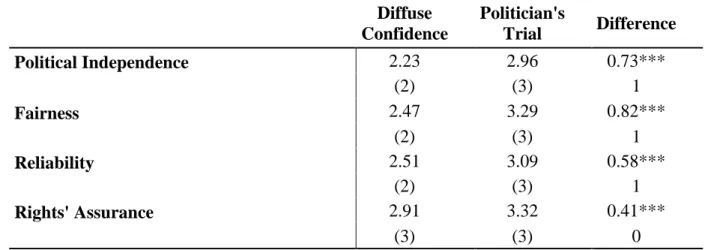
Unexpectedly, our data revealed that Brazilian justice assessment is not as negative as supposed, considering the adverse political context. Table 1 exhibit mean and median values of confidence by dimension (political independence, fairness, reliability, and rights assurance). Indeed, citizens display low levels of diffuse confidence in the judiciary branch. In three out of four attributes, the mode value is 2, i.e., most participants disagree that the judiciary branch is free of political influence, is fair, and is reliable. Surprisingly, the confidence increases when respondents evaluate courts’ decisions about a
politician’s conviction. Under the perspective of a political trial, courts turn into more trustworthy institutions. Not only the difference is statistically significant when compared to the diffuse confidence, but also the median and mode enlarge to 3 in the attributes in which they were 2.
Table 1: Mean and Median Values of Confidence in Judiciary Branch by Dimension
Diffuse Confidence Politician's Trial Difference Political Independence 2.23 2.96 0.73*** (2) (3) 1 Fairness 2.47 3.29 0.82*** (2) (3) 1 Reliability 2.51 3.09 0.58*** (2) (3) 1 Rights' Assurance 2.91 3.32 0.41*** (3) (3) 0
Notes: (i) Median values reported in parentheses. (ii) ***p < .001. (iii) Likert Scale 1 totally disagree, 5 totally agree.
These findings contrast with past works, which suggest that a controversial political background excessively decreases confidence in the judiciary (Durr, 2000; Salzman, 2013). Although the Brazilian justice assessment is far from good, we need to consider that courts do not try to be popular. Additionally, legal philosophy has some counterintuitive understandings about facts that might seem biased for those out of the juridical field. Thus, these results indicate that courts still enjoy a modest reservoir of goodwill among citizens, mainly to decide about politicians’ wrongdoings. In this sense, this work enlightens the discussion regarding the extent to which citizen divergence with courts’ decision changes their popular support. Durr (2000) shows that “divergence between the ideological preferences of the Supreme Court and the public drives down support for the Court”. However, we demonstrated that a highly ideological topic, as a politician’s trial, promotes people's confidence in the judiciary branch.
Preferred Candidate
During the survey, the respondents had to choose between four different candidates. Each candidate joined one opinion about moral standards and another about government spending: either conservative
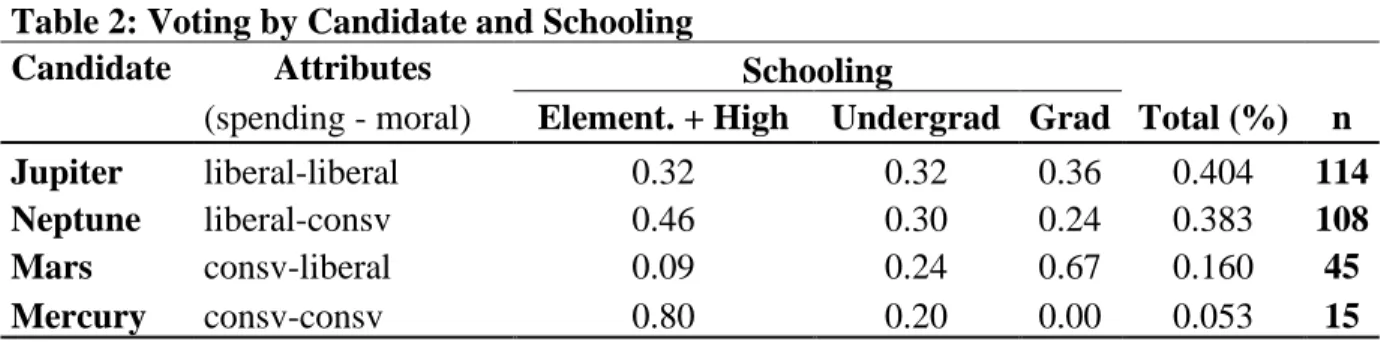
or liberal. Jupiter is the purely liberal candidate, Neptune is conservative on moral standards and liberal on government spending. Jupiter led the pool, and Neptune got the second place. Conservative candidates in the government spending dimension shared the worse performance, mainly Mercury, who had only 5%. Interestingly, liberal candidates on moral standards (Jupiter and Mars) find their highest shares amongst voters with a graduate degree. On the other hand, conservative candidates on moral standards perform better among those with an elementary or high school degree (Table 2).
Table 2: Voting by Candidate and Schooling
Candidate Attributes Schooling
(spending - moral) Element. + High Undergrad Grad Total (%) n
Jupiter liberal-liberal 0.32 0.32 0.36 0.404 114
Neptune liberal-consv 0.46 0.30 0.24 0.383 108
Mars consv-liberal 0.09 0.24 0.67 0.160 45
Mercury consv-consv 0.80 0.20 0.00 0.053 15
X-squared = 44.352, df = NA, p-value < 0.001 *simulated p-values
As we see, this behavioral dimension acts as an essential variable in influencing voters’ choice. Participants tend to over evaluate it in comparison to government spending to define the rejected candidate. When the survey software showed this attribute first and government spending secondly, there was a statistical difference between the sample in which the behavioral dimension was showed after the governmental spending dimension (χ2 = 9.5085, df = 3, p-value = 0.023). The order of these two dimensions presented no significant difference when voters selected the preferred candidate (χ2 = 4.0648, df = 3, p-value = 0.254).
Identification Levels
Respondents who incorrectly answered the attention check - i.e., those who were not able to determine the preferred candidate opinion about government spending and moral standards - were excluded from our sample. We calculated the identification levels for the remainders. Those answered the extent to which they identify themselves with the preferred candidate. Because candidates’ profile only displays a reduced piece of the elements that compose a political campaign, participants manifested high ideological intensity. The mode value was 8, the average 7.16, and the median 8. Beyond that, the highest identification category is the third most selected one, and it is considerably denser than the options among 0 and 4.
Figure 2: Histogram of Identification Levels
Model Analysis
Confidence in the judiciary branch is the sum of four dimensions (political independence, fairness, reliability, and rights assurance) analyzed by respondents through a 1 to 5 Likert scale. H1 assumed that identification levels with the preferred candidate condition citizens’ confidence in the judiciary branch. To test this hypothesis we developed a linear regression model. This model associates respondents’ identification with his preferred candidate (0 to 10 scale) with the sum of the four confidence in the judiciary branch dimensions. Model 1 (Table 3) confirms this premise. Unexpectedly, it shows that the stronger the identificaton with the candidate is, the higher is individuals’ trust in court decisions (ß1= .159, p <.05).
When we added control variables the effect of identification with a candidate is diluted. Model 2, 3, 4, and 5 incorporate the schooling and gender variables. The analysis of these four models suggests that schooling relates more intensively to the judiciary’s confidence levels than identification with a candidate. Model 5 shows that holding a bachelor degree positively and significantly influences individual confidence (ß1 = 1.091, p < .01) even when the model adopts gender (ß1 = .371, p = .326) and identification with a candidate (ß1 = .099 p = .233) as control variables. Although holding a
graduate degree also positively influences individual confidence (ß1 = .687, p <.1), this effect is inferior and less significant than the undergraduate effect.
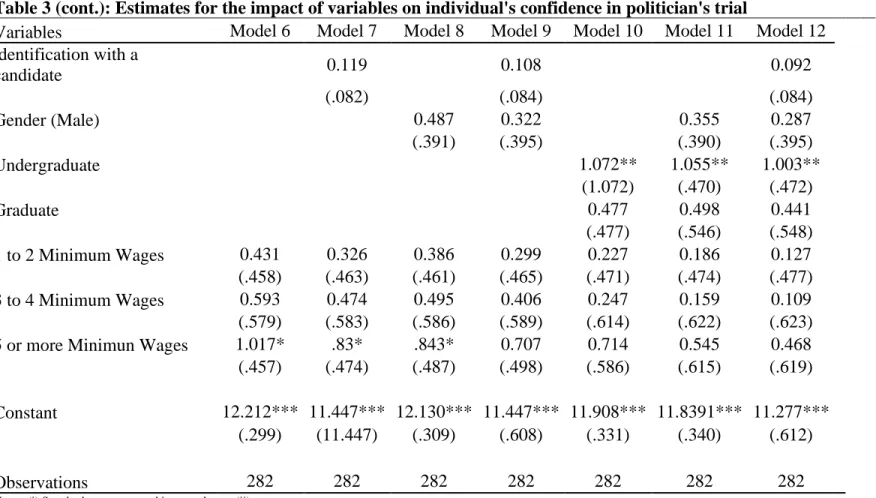
Model 6, 7, 8, and 9 adds income variables to to analyze citizens’ confidence in courts’ decisions about the politician trial. Those who earn more than 5 minimum wages presented the highest coefficients even when we added control variables (gender and identification with a candidate). However, this category is significant only in Models 6, 7, and 8. When we add schooling variables do the Model (Model 10, 11, and 12), income variables lose their significance. When all the variables take part in the estimation (Model 12), only undergraduate degree yields a significant effect (ß1 = 1.003, p < .05). We tested multicollinearity for this model, and the highest variation inflation factor presented suitable value (VIFgraduate < 2.16). Despite earnings and education are deeply correlated, our data suggest that schooling provides much more explanatory power than income. In this context, we reject H1 because, although identification with a candidateimpacts confidence in courts, the effect is positive instead of negative as predicted.
Table 3: Estimates for the Impact of Variables on Individual's Confidence in Politician's Trial
Variables Model 1 Model 2 Model 3 Model 4 Model 5
identification with a candidate .159** 0.115 0.099 (.079) (.0814) (.083) Gender (Male) 0.458 0.371 (.370) (.377) Undergraduate 1.25*** 1.141** 1.169** 1.091** (.435) (.441) (.440) (.444) Graduate .896** .752* .791* .687* (.418) (.429) (.426) (.434) Constant 11.523*** 11.990*** 11.247*** 11.877*** 11.258*** (.597) (.292) (.600) (.305) (.601) Observations 282 282 282 282 282
Notes: (i) Standard errors reported in parentheses. (ii) *p < .10; **p < .05; ***p < .01.
Table 3 (cont.): Estimates for the impact of variables on individual's confidence in politician's trial Variables Model 6 Model 7 Model 8 Model 9 Model 10 Model 11 Model 12
identification with a candidate 0.119 0.108 0.092 (.082) (.084) (.084) Gender (Male) 0.487 0.322 0.355 0.287 (.391) (.395) (.390) (.395) Undergraduate 1.072** 1.055** 1.003** (1.072) (.470) (.472) Graduate 0.477 0.498 0.441 (.477) (.546) (.548) 1 to 2 Minimum Wages 0.431 0.326 0.386 0.299 0.227 0.186 0.127 (.458) (.463) (.461) (.465) (.471) (.474) (.477) 3 to 4 Minimum Wages 0.593 0.474 0.495 0.406 0.247 0.159 0.109 (.579) (.583) (.586) (.589) (.614) (.622) (.623)
5 or more Minimun Wages 1.017* .83* .843* 0.707 0.714 0.545 0.468
(.457) (.474) (.487) (.498) (.586) (.615) (.619) Constant 12.212*** 11.447*** 12.130*** 11.447*** 11.908*** 11.8391*** 11.277*** (.299) (11.447) (.309) (.608) (.331) (.340) (.612) Observations 282 282 282 282 282 282 282
Notes: (i) Standard errors reported in parentheses. (ii)
H2 considered that the conviction of one’s preferred candidate diminishes individual confidence in the judiciary branch. To test this hypothesis, we elaborated an experiment. In this experiment, there are two treatment groups. One consists of the respondents whose vignette exhibited the conviction of their preferred candidate. The other control group read a vignette in which its rejected candidate was convicted. The control group read a vignette in which neither its preferred nor rejected candidate has been convicted. We also tested the extent to which identification with the preferred candidate moderates the impact of the conviction.
Model 1 (Table 4) indicates that identification with the preferred candidate has a significant and positive direct effect on the trust of the judiciary (ß1 = .154, p < 0.1). The preferred candidate’s conviction shows a negative impact, but this result is not statistically significant (ß1 = -.51, p = .224). Furthermore, the interaction term (preferred candidate convicted x identification with the preferred candidate) also presents a negative effect, still not significant (ß1 = -.055, p = .755).
In the survey, respondents had to rank the preferred candidate order. Thus, we also investigated if the lastly selected candidate conviction influences citizens’ confidence in courts (Model 2). As in Model 1, ideology intensity has a significant and positive direct effect on the trust of the judiciary (ß1 = .155, p < .1). This time, when courts find the rejected candidate guilty, confidence levels increases (ß1 = 0.17, p = .691) and the interaction term remains practically unchanged (ß1 = -.03, p = .880), however those result lack of statistical significance.
In Model 3, we analyzed the control group. It follows the same pattern of Model 2: ideology intensity has a significant and positive direct effect on the trust of the judiciary (ß1 = .163, p = .432). The conviction of a candidate that is not the preferred nor the rejected one does not seem to impact the confidence in courts (ß1 = .248, p = .485) because the result is not statistically significant. The interaction term is positive, but statistically insignificant (ß1 = -.042, p = .793)
This experiment raises evidence to refuse H2. Participants do not change their confidence levels on courts when these institutions punish a politician. Even if this politician is respondents’ preferred candidate and identification levels are high.
Table 4: Moderation Analysis of Candidate's Conviction on Individual's Confidence in Politician's Trial
Variables Model 1 Model 2 Model 3 Identification with Preferred Candidate (Direct
Effect) .154* .155* .163**
(.080) (.081) (0.08)
Preferred Candidate Convicted -.51
(.418)
Preferred Candidate Convicted x -.055 Identification with Prefered Candidate (.178)
Other Candidate Convicted 0.248
(0.335)
Other Candidate Convicted x 0.042 Identification with Prefered Candidate (0.16)
Rejected Candidate Convicted x .17
(.429)
Rejected Candidate Convicted x -.03 Identification with Prefered Candidate (.198)
Constant 12.662*** 12.669*** 12.668***
(.177) (.178) (.177)
Observations 282 282 282
(i) Standard errors reported in parentheses. (ii)*p < .10; **p < .05; ***p < .01. (iii) Quasi-Bayesian Confidence Intervals for mediation analysis
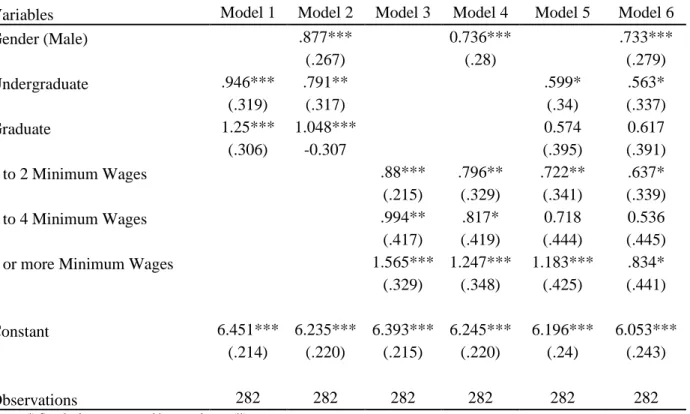
H3 investigated the extent to which schooling positively identification with a candidate. Model 1 (Table 5) demonstrates a positive and significant relation for those who hold either bachelor degree (ß1 = .946, p < .01) or a graduate degree (ß1 = 1.25, p < .01). Model 2 adds gender (male) as control and all the variables maintain a significant impact: gender (ß1 = 877, p < .01); bachelor degree (ß1 = .791, p < .01), and graduate degree (ß1 = 1.048, p < .01). Model 3 and 4 analyze the response of identification with a candidate to respondents’ income. In both models, all income strata present a positive and significant effect. Model 6 performs the analysis with all available variables. In this scenario, earning 5 or more minimum wages provides the most intensive effect (ß1 = .834, p < 0.1). Considering the great relationship between education and income, we performed a multicollinearity test for this model. The highest variation inflation factor presents a suitable value (VIFgraduate < 2.16).
Hence, we confirmed H3 and figured out that the income also plays a major role in influencing the identification with a candidatebeyond education.
Table 5: Estimates for the impact of variables in individuals' identification with
a candidate
Variables Model 1 Model 2 Model 3 Model 4 Model 5 Model 6 Gender (Male) .877*** 0.736*** .733*** (.267) (.28) (.279) Undergraduate .946*** .791** .599* .563* (.319) (.317) (.34) (.337) Graduate 1.25*** 1.048*** 0.574 0.617 (.306) -0.307 (.395) (.391) 1 to 2 Minimum Wages .88*** .796** .722** .637* (.215) (.329) (.341) (.339) 3 to 4 Minimum Wages .994** .817* 0.718 0.536 (.417) (.419) (.444) (.445)
5 or more Minimum Wages 1.565*** 1.247*** 1.183*** .834* (.329) (.348) (.425) (.441) Constant 6.451*** 6.235*** 6.393*** 6.245*** 6.196*** 6.053*** (.214) (.220) (.215) (.220) (.24) (.243) Observations 282 282 282 282 282 282
Notes: (i) Standard errors reported in parentheses. (ii)
*p < .10; **p < .05; ***p < .01.
H4 claimed that identification with a candidatemediates the impact of schooling on citizens’ confidence in the judiciary branch. We tested these hypotheses through the Models available in Table 6. Model 1 evaluates whether identification with a candidatemediates the effect of a bachelor's degree on citizens’ confidence, and Model 2 evaluates the effect of a graduate degree. Both models demonstrate a positive and significant direct effect of identification with a candidate: Model 1 (ß1 = 1.155, p < 0.05); Model 2 (ß1 = .742, p < .1). On the other hand, the average causal mediation effect provides no significant outputs: Undergraduate (ß1 = .102, p = .176); graduate (ß1 = .14, p = .174). These results suggest that identification with a candidatedoes not mediate the impact of schooling on an individual’s confidence in a politician’s trial, but it exerts a direct effect.
Table 6: Mediation Analysis of Schooling and Ideology Effect on Individual's Confidence on politician's Trial Variables
Model 1
Model 2 Ideological Intensity (Direct Effect) 1.155** .742*
Average Causal Mediation Effect .102
(Undergraduated)
Average Causal Mediation Effect .14
(Graduated)
Observations 282 282
(i) Standard errors reported in parentheses.
(ii)*p < .10; **p < .05; ***p < .01. (iii) Quasi-Bayesian Confidence Intervals for mediation analisys
Discussion
To explore the circumstances under which voters support courts’ decisions about a politician’s conviction, the explanation we develop in this dissertation highlights the role of respondents’ identification with the preferred candidate in influencing individual perception. Curiously, higher levels of identification increase the degree to which voters believe in convictions about political malfeasance. Interestingly, this relation does not appear when we ask participants about their diffuse confidence in the judiciary branch. Furthermore, voters rate the dimensions of diffuse confidence in the judiciary branch (political independence, fairness, reliability, and rights assurance) inferiorly when compared to the same dimensions in the specific scenario of a political figure trial.
Although not all results from our empirical analysis support the hypotheses we specified, the analysis shed light on the levels of respondents’ identification with the preferred candidate. First, we found that people with higher education, higher income, and males tend to present greater identification. Second, we found that higher identification leads to higher confidence in courts’ conviction of a politician. Third, schooling is an even more critical variable than the identification with
the preferred candidate to explain the increment in the confidence citizens have on courts’ in courts’ conviction of a politician. Fourth, our results suggest that citizens consider courts an unbiased institution to resolve governmental corruption despite the current polarized political environment. Fivth, and most importantly, regardless if courts punish the preferred or the rejected candidates of the participants, the confidence levels on these decisions remain constant.
Why do voters tend to hold constant their confidence levels in courts when these institutions punish their preferred candidate? One explanation is that identification with a candidate is not a variable that stick voters to politicians. Thus, voters might prefer to trust justice instead of his selected candidate. While public spending moderates the negative impact of corruption on the probability of reelection, we have no evidence to claim that identification with a candidate play the same role. In this sense, Our results endorse studies that present the exchange for material incentives as a crucial mechanism to induce political loyalty. Both the traditional patronage and clientelistic relationships or the more contemporary trade-offs that deliver broader, collective goods and policies can be a more attractive option to motivate voters (Hicken, 2011; Kitschelt, 2000; Kurer, 2001; and Pereira et Melo, 2015).
The second explanation considers that citizens can hold constant confidence in courts, but it does not necessarily mean that they will abandon their preferred candidate. According to Barros (2018), even if voters perceive the corruption of their ideologically preferred candidate, they consider if a candidate shift is worthwhile. In this scenario, it can be costly in terms of ideological identification and material benefits to change the ballot box’s decision. Thus, although voters trust courts and are aware of their candidate’s corruption issues, they maintain their initial choice because it may be more beneficial to handle corruption than picking an ideologically opposed candidate or someone who cannot provide the same welfare.
These explanations help us to understand why voters hold constant their confidence levels in courts when these institutions punish their preferred candidate. However, they do no clarify why court support is higher among voters more intensively identified with a candidate. To understand this mechanism, we need to specify how income and education can impact identification levels with candidates and trust in institutions.
We expected that the well-educated voters would be more skeptical of courts’ decisions. As Zaller’s (1992) reception axiom stated, “the greater a person’s level of cognitive engagement with an issue, the more likely he or she is to be exposed to and comprehend (…) political messages concerning that