FREE THEMES
1 Programa de Pós-Graduação, Instituto de Medicina Social, Universidade do Estado do Rio de Janeiro. R. São Francisco Xavier 524/ Pavilhão João Lyra Filho/7º, Maracanã. 20550-013 Rio de Janeiro RJ Brasil. mariaeneidaalmeida@ gmail.com
The permanent relation between biology, power and war:
the dual use of the biotechnological development
Abstract Throughout the twentieth century, the biological advance had a closer and closer relation with the strategies of power in search of high technology. From 1970, the manipulation of genetically recombined pathogenic agents was a high technological breakthrough that radical-ly over passed traditional biology and reinforced the war relations of science. The biotechnological revolution started along with new perspectives for the political and military field of science. From this point of the biotechnological development a new paradigm for war, as well as for the sciences of life, was then created and new challenges for International Health in the twenty first century came into scene. Through a historical account related to power, this paper is meant to present the mechanism of articulation existent between science and power and to contribute for under-standing how the military field is naturally insert-ed in the biotechnological development which, in its essence, produces biotechnologies for civil and military uses.
A
This excess of bio power takes place when the possibility is technical and politically given to man, not only to organize life but also to make life proliferate, to fabricate something live, to
fab-ricate something monstrous, to fabfab-ricate – to the limit – uncontrollable viruses that are universally destructive. This is a formidable extension of bio power that shall overcome human sovereignty.
Michel Foucault, lecture given on 17 March
1976, in Paris1.
Introduction
One of the branches of International Health in the World Health Organization (WHO) cerns the issue of war and its threats and, in con-temporary times, encompasses the issue of
bio-terrorism2. Guidelines at the world level for the
identification and reaction to bioterrorist threats also concern the protection of the sciences of life and the preparation of nations in the field of biodefense. It was with this approach and care
toward our time that a research3 in the field of
Health was carried out and involved the study of the history of biology in terms of influences of
power in the context of the modern world system4.
This study acknowledges a political-operational matrix of science whose structure and dynamics aim at serving, essentially, military demands.
Throughout the twentieth century and, up to today, a vast field of research and technological development of biology has taken place, the biol-ogy of war or the military biolbiol-ogy that deals with the invention and improvement of biological weapons. Within the paradigm of humankind, this means the back side, the reverse and the in-verse of the whole fundament of the sciences of life. This is one of the hidden or less studied as-pects in the area of health because, generally, the researchers are not willing to analyze the “ugly” side of biology and its natural articulation with power. In the paradigm of war, biology is a stra-tegic field and hits science at its core.
During the second half of the twentieth cen-tury, the biotechnological advance evidenced a closer relation with strategies of power in search of most modern science by means of a bipolar race of biology. The biotechnological revolution came into scene from 1970 and the perspectives for the political-military field moved forward and advanced with the empowerment of a new generation of biological weapons through the invention of a biotechnique named
recombi-nant DNA5. The first DNA recombinant was
constructed in 1970-71 by Paul Berg, from the University of Stanford, California, together with David Jackson e Robert Symons. Using enzymes of restriction in order to cut DNA and using
bacterial ligasesto join the cut extremities, they
mended a piece of the bacterial DNA to the DNA of a small animal virus, thus producing a chime-rical and entirely new DNA – a DNA ring formed
of genetic material of two different origins5
.
This technique is the genetic manipulation between different species and the result is named chimera. The chimeras started to be constructed in great diversity, speed and in large number of successful experiments. Some original examples are: a carrot that shines in the dark as the result of a combination of genes of a firefly and of a carrot; synthetic insulin results from binding the human gene to that of a bacteria; a combination of genes of tomatoes in a certain species of fish produces tomatoes resistant to frost; chicken genes in potatoes increase the animal resistance to plagues; genes of Chinese hamsters in tobac-co plants improve sterol protection. Many rural products began to be found in genetically modi-fied crops. The market has accepted transgenic or chimerical products in a fast and easy way. The chimera has dual use and serves both civil and military purposes. This invention gave room to a radical possibility for the construction of biolog-ical weapons with genetic modification of patho-genic agents for war purposes. Thus, biology has gained more and more importance for biode-fense. This scientific evolution improved the con-nection between biotechnological vanguard and the political-military interest in science.
This paper approached the development of its theme and its historical background with the intention to contribute for the understanding of the mechanism existent between science and power and how the military field has a role in the biotechnological advances whose products are meant for civil and military uses. Thus, this is the focus of the debate herein proposed.
The article is divided in three parts that
ac-count for the synthesis of a doctorate thesis3: the
aúd
e C
ole
tiv
a,
20(7):2255-2266,
2015
times, the development of biotechnology in ar-ticulation with military power is an attempt to follow the guidelines of biodefense and terror-ism. At the onset of the biological development for military use in the twentieth century, the threats in the field of military biology moved into a new field of action and provoked new strategic priorities worldwide. This was due mainly after the invention of the DNA recombinant, in a time when sciences of life were structurally changed, transcending nature itself, creating a new para-digm for life and war and, thus generating new challenges for the International Health in the twenty-first century.
1. Biotechnology of Dual Use or Sensitive Assets
For a better understanding of the meaning of biotechnologies of dual use or sensitive assets it is necessary, beforehand, to have the reader familiar with the structure and dynamics of the modern world system where the fight for scientific and technological power is inserted.
According to Diamond6, in the paths taken
by civilizations and societies from the five large continents, the technology developed in different times and in irregular rhythms formed a world of diversities where wars and their threats played a fundamental role for merging societies and causing their consequent technological develop-ments. It was in this way that technological in-novation and diffusion, along with a centralized political organization, were fundamental for the
issue of conquest. The studies by McNeill7 show
us that deep transformations took place as a re-sult of a search for power, starting with the dis-covery of the gunpowder in China in the tenth century until the arrival of fire guns in the West-ern world in the fifteenth century and the start of an occidental fabrication and improvement of
warfare. Parker8 explains that these
transforma-tions underwent a significant advance after the 1500’s with the overseas conquests and meant a break of the western war-military paradigm that was in effect at that time. A new way to make war was then implemented, with a more specialized military organization, with more powerful weap-ons and more sophisticated warfare.
The analyses made by Kennedy9 evidence that
the essence of the modern world system is the in-tertwining of the financial and military powers of the State. This system is composed of States with more power and States with less power. Some of
the more powerful State are also called, in the field of political economy and international re-lations, the “Great Powers”. These are States that hold the financial and military as well as the tech-nological powers. The author claims that there is a natural dynamics triggered by economic and technological aspects that affect the social struc-tures, the political system, the military power and the status of the states and empires in the world system. The military strategy of the Great Pow-ers, those who hold high technology, is evidenced by their effort to increase their military strength. The purpose is to become, or to continue being, rich and at the same time strong within this sys-tem, with the conditions to threaten and start a war, to be victorious, to proclaim peace and, meanwhile, to get ready for another war that may follow. According to other studies by this same author, throughout the history of civilizations, technological innovation has always had a pow-er of decision in the rise and fall of empires and those who could not follow high scientific devel-opment lost their power as they fell in the rank of world power; and those who advanced in high technology kept their condition as empires once they went up the world ranking system.
Fiori says that since the emergence of the modern world system, there has been a nev-er-ending warfare race whose empowerment never ceases. The reason for such a race is that there is a ruthless logic in the competition be-tween the Great Powers that forces the Nations to take part of it and to be permanently prepared with high technology, expanding their potencies for the safety, peace and tranquility of their na-tional peoples. War is a constant possibility in the interstate game, a virtual movement, the origin of the threat, and an essential component of the strategic calculation of power. And, depending on the desire of power of the State, it goes beyond
the one that is ahead of it. In this sense, it is
fun-damental for the State to be in the technological vanguard so as to have in hand the power and to safeguard its place in the world system, because the continuous presence of this “virtual war” is a stimulus for permanent and internal mobilization
of war resources10. This is the way we should
un-derstand the strategic field for the military use of biological development (Figure 1).
A
war or military purposes even though they may serve a civil purpose. This means that the use of the products under this category depends on its purpose, that is, biotechnologies for civil use can be used either for the wellbeing of people and populations, as in the case of fabrication of medications, the perspective for new treatments and the discovery of the cure for diseases or the reduction of injuries; or biotechnologies for mil-itary use that can empower biological weaponry and increase risks and threats for humankind.
In Brazil, the sensitive assets are classified by Law 9.112, dated 10 October 2005, as being those products for use in the nuclear, chemical, biological and missile area, and include goods for dual use as considered in respective conventions, regimens and international treties. PRONABENS –the National Program of Sensitive Assets, a sec-tor for articulation between MCT – the Brazilian Ministry of Science and Technology and ABIN – the Brazilian Agency of Intelligence, is meant to contribute for the realization of international commitments taken by Brazil. Among the com-mitments are those that aim at the non prolifer-ation of Weapons of Mass Destruction (WMD) and their vectors, including transfers of sensitive technologies and assets of dual use, whose ma-terials could be used in the production of weap-ons, and in this case, more specifically biological weapons.
In this field, there is a difference between “risk” and “threat” that must be clarified in face of their constant articulation. Threat is a presage, a daresay, a monition that something dangerous is about to occur. Risk is the possibility of a dan-ger, uncertain but predicable, an inconvenience. These two words are close in the field of power and remain together as we can see next. Threat is perceived by a great potency state as the risk of not having “exclusive” appropriation of a top
secret, which in turn means not having in hand most modern science and, consequently, not be-ing able to construct radical military products or
weapons that are also called “higher weaponry”11.
Last but not least, for a state, losing a position in the modern world system of power is the greatest threat it may have. High technology, with perma-nent development of radical or higher weaponry such as those universally known as biological, chemical and atomic WMD is one of the essen-tial supplies in the fight for power. And, no signs that this threat shall come to an end can be seen in this twenty-first century.
It is this military use of biotechnology that has been seen as a risk and as a threat simultane-ously. Biotechnologies for dual use are the ones that hold the strategic secret, belong in most modern science and provide for the construc-tion of radical warfare which in turn will ensure power to the States. Thus, the fight for power is a virtual war. And, if the strongest drive for virtu-al war is that aimed at the mobilization for war, then, the greater the threat, the more decisive is the action and the more powerful becomes the State. As we now understand the importance of holding exclusive possession of strategic secret in the fight for world power, it is time to analyze the Big Science of Biology.
2. Biology as the core science of strategies of power
The great novelty of current days is that of biology as the core science for strategies of power. How did this come into being? How did science become the core of the system? To answer these questions, we shall consider three topics: i) Big Science; ii) biology race; iii) onset of the Biotech-nological Era.
Figure 1. Biotechnologies of Dual Use.
Source: Almeida ME. Science High Technology
Biology
High technology
products
Strategic secret
Biotechnologies
of Dual Use
Civil Use Military Use
aúd
e C
ole
tiv
a,
20(7):2255-2266,
2015
i. The Big Science
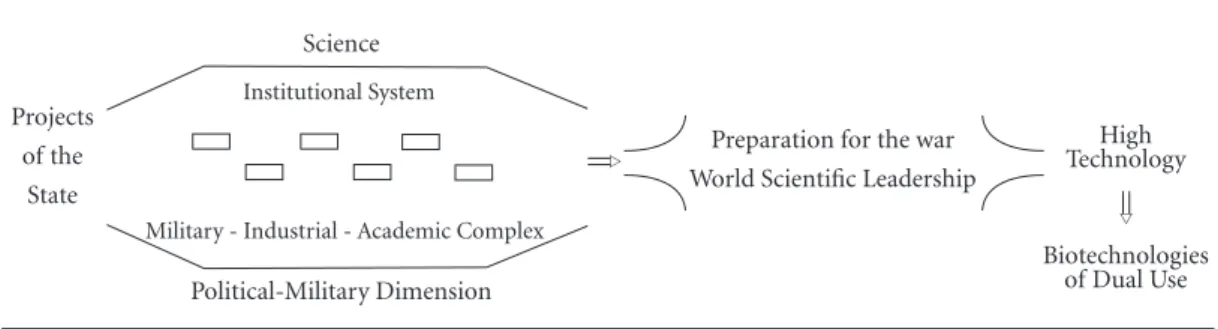
Big Science is a term used in the political-mil-itary dimension of science, developed by the Great Powers whose purpose is to prepare and execute projects of research devoted to war and world scientific leadership. Its structure is the “military-industrial-academic complex”, also understood as an integrated political-operation-al institutionpolitical-operation-al system that can respond to the projects of a State. The mission of such a com-plex is to develop science for the construction of high technology weaponry. Its dynamics is sup-ported by the State and takes place through an articulated system of strategic research for new weapons, the so-called “higher arms” – a concept that accounts for the construction of highly so-phisticated instruments and radical weaponry in connection with political-military strategies. The higher arms are the ones with most modern knowledge and strategic secret. This secret is the
end-product of the Big Science12; a first-degree
sensitive product for dual us (civil and military). For the field of biotechnology, this end-product represents biotechnologies of finest generation (Figure 2).
Here we highlight two original projects of the Big Science: in the field of physics, the Manhattan Project for the construction of the atomic bomb (1941); and in the field of biology, the Human Genome Project that disclosed the genetic code of living beings (1985). The Manhattan Project gave birth to the Atomic Age and triggered new warfare inventions and innovations in the nu-clear area during the decades that followed and have lasted up to today with the promotion of the atomic armament race. The Human Genome Project, from the perspective of our research, gave way to the Biotechnological Era through a great scientific development in times of exacerbation
of the Cold War, with the intention to protect the armed forces and the national populations, in opposition to the threat of WMD posed by the two poles of the world (the American and the Soviet) and for the prevention against bioterror-ism. Bioterrorism is an old threat that has been consolidated in the second half of the twentieth century in an increased movement of structur-ing the Great Power States and under a strategic planning more and more devoted to responding to the WMD threat. Besides the struggle for pow-er engaged in by the Great Powpow-er States, biotpow-er- bioter-rorism is also a motivation for the Big Science.
Some facts, given in details in the original version of my Doctorate thesis, had a major driv-ing effect in the past decades and are worth be-ing mentioned here so that we can perceive the rhythm taken by the Big Science: the end of the Cold War in late 1980’s and the on-going Rus-sian and American biological and hostile pro-grams; the intensive American preparation for a biological offense in the battlefield of the Gulf War (1990); the fragmentation of the Russian science due to the de-construction of the Soviet State; the supply of Russian biological knowledge to other States that struggle for a position in the world system; and the attacks of anthrax after the terrorist actions of September 11, 2011 in the United States of America, not clearly explained up to today.
ii. The Biology race
It is a fact that the biological war has endured over thousands of years, and some studies traces
it back to the Fifteenth Century B.C.13, as diseases
were treated as a strategy in the fight for power of colonists and imperialists who used them to decimate peoples and conquer territories. The science of microbiology, in the mid-nineteenth
Figure 2. Structure and Dynamics of the Big Science.
Source: Almeida ME. Projects
of the State
Institutional System
Preparation for the war World Scientific Leadership
High Technology
Biotechnologies of Dual Use
w
Military - Industrial - Academic Complex Science
Political-Military Dimension
A
century, along with the perspectives to cure dis-eases and epidemics of that time, provided for the discovery and manipulation of pathogenic microorganisms and, eventually, the issue of the dual use of the science. The civil aspect concerns the clinic issue and the new way to look at the diseases and the perspectives for new treatments, new medications and new techniques for clinical purposes.
For contemporary times and since the end of the Second World War, the atomic bomb, fol-lowed by the chemical weaponry, has been the most powerful political WMD. However, biolog-ical armament is the one with most potential for destruction due to its complex characteristic and erratic dissemination in the air. The rudimen-tary and limited-range weapons were gradually improved at the pace of technological
innova-tions. At the Imperialism time14, all the States,
that fought for world power and that eventually engaged in the First World War, developed offen-sive biological programs with an institutional-ized and articulated mechanism that involved the
academia, the industries and the armed forces15.
Those biological programs were peculiar to each empire.
Four generations of biological weaponry
took place16. For purposes of the First World
War, the first generation of biological weapons was created through the rudimentary manipu-lation of pathogenic microorganisms meanwhile the technical and scientific fields were at the ex-perimental level. During the Second World War, the second generation of biological weapons occurred by means of higher technical sophis-tication and more elaborate armament despite the First Convention of Geneva (1925) that was meant to rule over the prohibited use of biology
in wars17 in face of the intensified threats set by
biological advances. As the empires posed their own threats in search for world power, materi-als and techniques were being improved for the production, storage, dissemination, protection and construction of biological arsenals. And, the international legislation was undermined by the
context of that moment in time18.
From the end of the Second World War (1945), both the new weapons and the war be-came the differential for democracy, ideas, prac-tice and performance of political actors within the world political system. That was a landmark that not only encompassed the interstate system but above all, affected the humankind with its permanent threat of WMD. The hypothesis of a global war became permanent. In the analyses of
Aron19, the world became bipolar and, under the
threat posed by the Cold War, the humankind ex-perienced a permanent hypothetical war. With-in the perspective of this new way to face world conflicts and the likely decimation of the whole population by detonating the atomic bomb, the development of the military biology remained under the hypothesis of a war.
After the biotechnological revolution in the 1970’s, to be further explained, the third genera-tion of biological weapons took place as ammu-nition was in form of genetically modified patho-genic microorganisms In the twenty first centu-ry , the fourth generation came into scene as a consequence of a new fusion of two sciences, that is, the quantum physics and the molecular biol-ogy. This fusion accounted for the advent of the nanobiotechnology, a science whose amalgam is
at the nanology level20. The potential of this
sci-ence unifies amino acids and proteins, creating new cell processes, new viruses and new bacte-ria. The possibility of the nanologic amalgam for military use is unthinkable. According to
Var-da Burstyn21, the great potential of this science,
which is a frenetic race for fabricating unbeatable warriors and indestructible armaments, is found at the American Institute for Soldier Nanotech-nologies. A report published in the magazine Le
Monde22 addresses some radical military projects
that are creating robot soldiers with no human control and that are intelligent, restless and dead-ly machines. This new reality will be the fruit of biotechnology in the twenty first century.
iii. Starting the Biotechnology Era
In the beginning of the twentieth century, science advanced exponentially with the extraor-dinary discoveries in the field of the Einsteinium physics, with a scientific revolution that changed the rooted Newtonian paradigms of the time. In the 1930’s, physics triggered a revolution in biology and gave way to other sciences such as the microbiology, the pharmacology, the immu-nology as well as the genetics. It is a well known fact that wars stimulate science and that the Sec-ond World War was the fundamental stimulus
for technological breakthroughs22. In the field
aúd
e C
ole
tiv
a,
20(7):2255-2266,
2015
Powers toward the second half of the twentieth century. And, the State with the atomic bomb in its hands was the one with the credential for voice and veto powers in the modern world.
At the same time, biotechnology advanced with the unfolding of sciences related to physics and biology. As biology is the study of life and biotechnology is the study of the technique about life, the core of biotechnology is the manipula-tion of live cells by technical and technological advances. In this sense, the fusion of these two sciences, physics and biology, allowed for a par-ticular area called molecular biology that in turn allowed for the discovery of the deoxyribonucleic
acid (DNA)in 1944 and the structure of the
dou-ble helix of the DNA in 1953. The DNA is an or-ganic composite whose molecules contain genetic instruction that coordinate the development and operation of all living beings and of some viruses and transmit hereditary features of each being. Its main role is to store information required for the construction of proteins. The DNA segments with genetic information are called genes. The remaining sequence of DNA has either a struc-tural relevance or is involved with the regulation of genetic information use. From these funda-mental discoveries, it was possible to have the DNA recombinant technique (1970), considered
by Rifkin23 as the most powerful tool for the
de-velopment of biotechnology and the radical ex-pansion of the scientists’ imagination. Thus, the genetic manipulation was the one responsible for
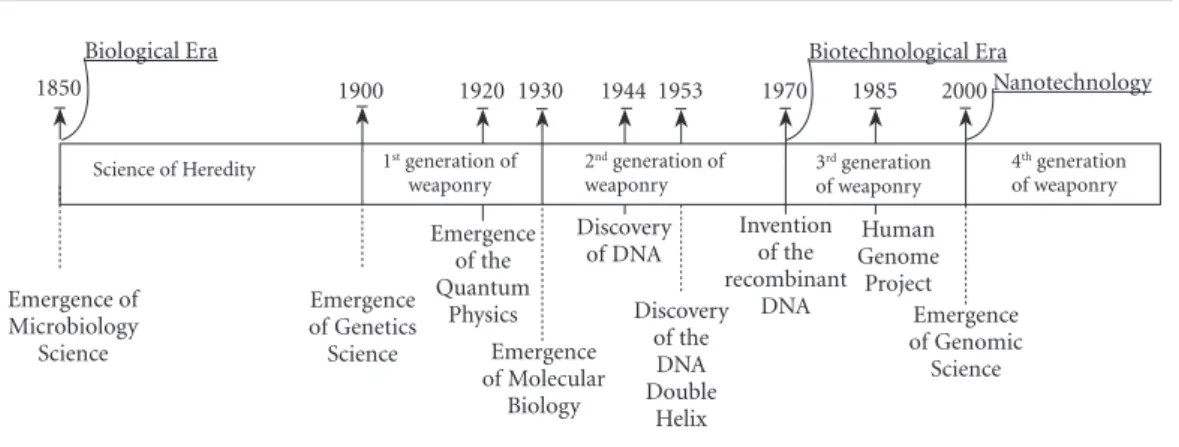
the great revolution from 197024 (Figure 3).
In the 1980’s, with the Human Genome Proj-ect, the first project of the Big Science in the field
of biology5, this science started to play a central
role in the political and military sectors. In 2000, with the presentation of the human genome draft, the discovery of the DNA chemical com-position or the decoding of the genetic code of live beings, the genomic science was born. This was the major science for the beginning of the twenty-first century. The political and military sectors were already in process of conceiving new weapons and at the same time, this science was seen as a threat to the extent that the manipu-lation of the genetic code of pathogenic agents meant a fragile biodefense for the States. In sum, as the biotechnological advances posed promis-ing and even unthinkable perspectives for civil use in the form of new treatments, new medica-tion and new healing techniques and benefits for the wellbeing of peoples, new and also unthink-able perspectives were posed for military use in
the form of new weapons and war materials25.
The event of September 11, 2001 promoted the establishment of a new world order of ex-treme attack to terrorism by the United States of America. This led to a new structure of biode-fense in the war against world terrorism. At this moment of political restructuring of the Ameri-can State, the biotechnological development had a unique role as the foreign and domestic policies concerned the use of sensitive biotechnologies and products for dual purposes by other States. Thus, the strategic movement of power stimu-lates and strengthens the Big Science which in turn affects intrinsically the field of International Health.
Figure 3. The biotechnological evolution.
Source: Almeida ME. Emergence of Microbiology
Science
Emergence of Genetics Science
Emergence of the Quantum
Physics Emergence of Molecular
Biology Discovery
of DNA Discovery
of the DNA Double
Helix
Invention of the recombinant
DNA
Human Genome Project
Emergence of Genomic Science
Science of Heredity 4th generation
of weaponry
1900 1920 1930 1944 1953 1970 1985 2000
1850
Biological Era Biotechnological Era
Nanotechnology
3rd generation
of weaponry 2nd generation of
weaponry 1st generation of
A
3. Impacts on International Health
Originally the field of International Health comprehends a set of sanitary relations in a global scale and refers to the inter-related char-acter of health worldwide along with the efforts to improve it in every country. It is a part of the international relations sector and involves the exchange of knowledge, information, funds, in-vestments, technology and political influence. It favors the improvement of health and life con-ditions of populations within the limits set by the nations involved. Traditionally, health as an international issue has been the focus of global commitment in surveillance and control of dis-eases that may lead to epidemics and in actions for regulations, norms, standards and policies encompassing the health and disease process at the global level. One of the approaches is based on power relations held by the States with health policies devoted to supersede the asymmetries of
the world system26, as well as to meet the
chal-lenges, to face the threats and to solve conflicts between nations.
In this sense, International Health is an im-portant field of articulation for times of peace and for times of contention and war. The Great Powers of today are connected to strategies of biodefense for fighting against international ter-rorism. With the American incident of delivery of letters containing anthrax in 2001, a new insti-tutional structure was triggered and developed to be protected from biological armament attacks.
Public health started to be a focus of concern as the American State became vulnerable to all sorts of biological attacks. The American army was short of uniforms, masks, helmets and de-tectors; there was also a shortage of vaccines and specific medical care for this type of attack. The Armed Forces also lacked experience in tactic and strategic sectors for fighting in a biological environment. The design of a public health plan that could deal with genetically recombined in-fectious agents was a hard challenge to face as there was no perspective of what kind of biologi-cal ammunition would be used and what immu-nization would be required. The biological threat may come from independent terrorists or from the States. The urgency relies on identifying as fast as possible the infectious agents and on pre-paring vaccines and antibiotics for the popula-tion, the Armed Forces and the allies. However, this means a whole new structuring of the State.
It is worth mentioning that the concern re-lated to this type of threat was not considered
at this point in history. For the United States of America, it became relevant in the 1990’s as a re-sult of the Gulf War and the deconstruction of the Soviet-Russian science. According to Miller
et al27, President Bill Clinton was certain of the
biological threat and saw it as a major challenge to be conquered by the American science. The main perspective was that the biotechnological development would be the solution for all the bi-ological threats once there was a potential for the production of efficient vaccines and new instru-ments for the detection of genetically modified pathogenic agents with the use of ultrasensitive sensors. The fabrication of genetically modified vaccines had always been seen as a technical, bureaucratic and military risk as they relate to a biotechnology that is sensitive and for dual use.
As the Americans felt the need to be protected against biological threats, the structure of public health is now being restructured and mechanisms of institutional reactions are being constructed. The Center for Disease Control (CDC) is an in-stitutional mechanism specialized in infectious diseases and military biological preparation and is part of the domestic safety policy. One of its missions is to detect biological attacks; neverthe-less, its operation was, up to the end of the de-cade of 1990, minimal due to the fact that bio-defense was funded by the American Department of Defense and not by a public health system. As a vast federal institutional network of the public
health system in the United States of America28 ,
it monitors public and private databanks in signs of biological, nuclear and chemical attacks, and is a source of reaction and preparation toward as-sisting afflicted populations. Its priority lies in the field of detection, diagnosis and the dealing with terrorist threats, and, of no lesser relevance, in the paramilitary training of paramedics and medical agents to meet the American demand of strategy.
Within this perspective, the idea was to have an institutional mechanism for prompt action in the American health system. In 1988, a cohesive group of military scientists was formed to work as a consulting committee, the so-called Think Tank, for setting priorities and promoting cooper-ation amongst several governmental sectors with influence on biodefense and converging to public health,. In 1999, the National Safety Institute was created and, in 2002, it was turned into the De-partment of National Security (DHS). And so was structured the American State for biodefense.
aúd
e C
ole
tiv
a,
20(7):2255-2266,
2015
is to identify patterns of occurrences of diseas-es and likely national or regional outbreaks, ac-cording to guidance for prevention, readiness and reaction in connection with to the area of trans-frontier epidemics and pandemics, includ-ing those originated from biological threat. Thus, several American public institutions of health started to plan training and qualification of
hu-man resources to face biological threats29.
One of the effects of the foreign policy held by the United States of American, and with in-ternational outreach, was a partnership with na-tions to develop scientific initiatives in Science and Technology (S&T), in Research and Devel-opment (R&D), and the formulation of policies associated to public health to combat bioter-rorism. The institute, the organizations and the agencies that carry out researches in infectious diseases followed those policies and were fund-ed for the creation of new departments and the development of major researches in connection with national and global war issues.
The fundamental strategy for public health was the promotion of improved skills for the prevention, preparation and reaction to bioter-rorism and other likely and related emergencies. Government departments such as the CDC and the National Institute of Health (NIH) prepare and administer resources for the Congress and the Department of Human Health Service (HHS/ CDC) promote communication and information of American and global activities concerning health in bilateral and multilateral partnerships
of American interest30.
Power relations have always existed in inter-national health policies. The most recent novelty worth mentioning here is the biological threat that permeates the field of International Health as it aims at readiness and reaction to biological attacks all over the world. This condition moti-vates the Big Science, as the American National Academy of Sciences claims while it states that ‘defense”, in the case of biological safety, means, above all, improvements in national and inter-national surveillance of diseases and reaction and
strengthening of public health systems31. In this
sense, it is important to acknowledge the issue of biological threat that also alters the dimension of the field of public health at the international level due to the American reorientation. Therefore, we can perceive a current trend of the health field of being urged to live under the threat of a war.
Before the terrorist attack to the United States in September 2001, in the month of May of the same year, the World Health Organization
(WHO) had adopted resolution WHA 54.14: “Global Health Security: alert and epidemic re-action”, a regulation to provide support for the WHO State members to identify, verify and react to emergencies at the International Public Health level. From this resolution and up to May 2005, an International Committee for the revision of this regulation addressed further into this theme and established and passed the Regulation for
International Health (WHA 58.3). This is an
In-ternational Law with the intent to have efficient and effective control over epidemic outbreaks in order to achieve maximum protection of the national states. For this purpose, new roles and new duties were set for the WHO State-members. This revision is a detection matrix for a world that is undergoing a technological revolution, with a communication network that covers the whole world instantly. It counts with an increas-ing flow of information obtained through the internet, with safety and efficacy and specific op-portunities and reliability.
Therefore, this regulation is a code of conduct for the notification of events related to Public Health at international risks and also, a form de-voted to coordinated reaction. Every action shall be strengthened by and engaged in this move-ment, and WHO anticipates aid for the national systems of health in face of the vast amount of required technical and scientific resource as well as of administration and/or management of in-formation in moments of emergencies.
The fundamental idea is to achieve global ef-ficacy of coordinated reactions in real time. This new regulation not only encompasses diseases that require notification but also considers in-ternational assistance to new infectious diseases, re-emergency of the traditional ones, emergen-cies caused by non-transmissible diseases, threats of biological war and bioterrorism. The essential is to identify the origin of the outbreaks of infec-tious diseases as well as that of biological attacks for immediate reaction.
A
Final Comments
And now comes the converging point of this arti-cle. The mechanism of the Big Science generated political and military effects of reaction to bio-logical threat in the field of International Health as American re-orientations took place. And,
despite the fact that the issue of bioterrorismis
not under the spotlight nowadays, the biotech-nological and military potential is structured and institutionalized with permanent production of biotechnologies for dual use. The New regulation for International Health (RIH) is a juridical code that the World Health Organization approved in May 2005 and has been in effect since June 2007. This regulation urged nations around the world to reorganize their systems of public health in order to meet the emergencies of trans-frontier risks that affect the globe in the twenty-first cen-tury.
In the same way, the Convention for Pro-hibiting Toxic and Biological Weapons, in effect since 1975, held at a world level in the United Nations, having Brazil as one of its signatories, has straight connection with the New Regula-tion for InternaRegula-tional Health as evidenced in the Final Document of the Seventh International Conference of CPAB/ONU, in December 2013, in the sense of reinforcing methods and capacities for surveillance and detection of diseases outbreaks at the national, regional and international levels, complying with the regulation for International Health (2005) is important for the construction of the capacity to prevent, protect, control and
re-spond to international propagation of diseases32. In
this same sense, in a meeting held in the second half of 2014, it was noted an increased concern with the scientific and technological develop-ment o biology, with the potential use contrary to CPAB and RIH as resulting from the dual use of biotechnology. Thus, it can be noticed that the International Health is more and more imbued of a bio-political-military tonic.
As the Big Science is found in the polit-ical-military dimension of science, whose end-product are radical armaments, and in the field of biology today, these are nanobiotech-nology armaments, it is essential understanding that the political-military stimulus of reaction to threat triggers this gigantic mechanisms of war strategy planning. Being the biology race guided by the drive of taking hold of strategic secrets and stimulated by the haunting threat, it becomes particularly clear that the use of biological agents
in future wars and in terrorist attacks is a real threat in this century.
The American government once declared that the nature of war has changed. This dates back to 1990, when the United States faced the biological threat in the Gulf war of 1991. Within this perspective, the General of the Armed Forc-es, Ronald R. Blanck, in the preface of the book of Military Medicine claims that, since the Gulf War (1991), the war weapons have changed and this fact deserves relevant attention from the Ameri-can nation because several nations are now devel-oping this type of biological armament. And, he strongly points out: The nature of war is changing. The nation expects us to be prepared for this type of attack and any incapacity of ours shall be
irrec-oncilable33.
Certainly no forecast can be made in re-gard to the future for, as a weapon of power, the atomic race has not ceased being a threat. What one can affirm, according to the aspects herein addressed, is that the biotechnological develop-ment is a great opportunity and a threat for the twenty-first century, both in terms of terrorism as well as in the fight for world power.
Paraphras-ing Moniz Bandeira34, a Portuguese-Brazilian
historian and political scientist, who invented the biological weapons, with their potential for action, were not the bioterrorists, but the scientists from the Great Powers.
As claimed by Kottow35, the resources
allocat-ed in public health are undergoing a biomilitary version in which a portion of the researches for health and qualification of professionals in the biomedical field are toward the threat of biolog-ical agents. The war strategy does not make any distinction between chemical, biological or nuclear arsenals as far as they become efficient biological weapons to meet military purposes. There is a dis-proportion between the magnitude or risk prob-ability of a biological weapon and the fears that such potential event causes. And, it is this dispro-portion that permeates the field of International Health.
There may be reason for that. Hans Morgen-thau, a German political scientist and a pioneer in the theory of International Relations, wrote at the end of the Second World War that ... for pol-itics, what matters is the nation, not the
human-kind36. This seems to be true. Maybe, one may
aúd
e C
ole
tiv
a,
20(7):2255-2266,
2015
References
Foucault M. Em Defesa da Sociedade. São Paulo: Ed. Martins Fontes; 1999.
Organização Mundial da Saúde (OMS). Nuevas
Ame-nazas para la Salud en el Siglo XXI. [acessado 2014
jul 1]. Disponível em: http://www.who.int/whr/2007/ overview/es/index5.html
Almeida ME. Guerra e Desenvolvimento Biológico: o caso da biotecnologia e da genômica na segunda metade
do século XX [tese]. Rio de Janeiro: UERJ; 2006.
Wallerstein I. The Modern World System. New York: Academic Press; 1974.
Wilkie T. Projeto Genoma Humano: um conhecimento
perigoso. Rio de Janeiro: Jorge Zahar; 1994.
Diamond J. Armas, Germes e Aço: os destinos das
socie-dades humanas. Rio de Janeiro: Record; 2003.
McNeill WH. The Pursuit of Power. Chicago: The Uni-versity of Chicago Press; 1982.
Parker G. The Military Revolution: military innovation
and the rise of the West (1500-1800). Cambridge: Press
of University of Cambridge; 1996
Kennedy P. Ascensão e Queda das Grandes Potências: transformação econômica e conflito militar de 1500 a
2000. Rio de Janeiro: Campus; 1989.
Fiori JL. Formação, Expansão e Limites do Poder Glo-bal. In: Fiori JL, organizador. O Poder Americano. Pe-trópolis: Ed. Vozes; 2004. p. 27.
Medeiros CA. O Desenvolvimento Tecnológico Ame-ricano no Pós-Guerra como um Empreendimento Militar. In: Fiori JL, organizador. O Poder Americano.
Petrópolis: Ed. Vozes; 2004. p. 225-252.
Almeida ME. Guerra e Desenvolvimento Biológico: o caso da biotecnologia e da genômica na segunda me-tade do século XX. Rev Brasileira de Epidemilogia 2006; 9(3):264-282.
Fernandes PMB. A Guerra Biológica através dos Sécu-los. Ciência Hoje 2002; 31(186):21-27.
Hobsbauwm EJ. A Era dos Impérios (1875-1914). Rio de Janeiro: Editora Paz e Terra S/A; 1988.
Davidson N. The Role of Scientific Discovery in the Es-tablishment of the First Biological Weapons Program-mes. In: Bradford Science and Technology Report Nº 5. October, 2005. [acessado 2014 jul 1]. Disponível em: http://bradscholars.brad.ac.uk:8080/handle/10454/711 Almeida ME. O Desenvolvimento Biológico em cone-xão com a Guerra. Physis 2007; 17(3):545-564. Organização das Nações Unidas (ONU). Protocol for the Prohibition of the Use in War of Asphyxiating Poi-sonous or other Gases, and of Bacteriological Methods of
Warfare. Geneva: ONU; 1925.
1. 2.
3.
4. 5. 6. 7. 8.
9.
10.
11.
12.
13. 14. 15.
16. 17.
Brasil. Decreto nº 2.977, de 1 de março de 1999. Pro-mulga a Convenção Internacional sobre a Proibição do Desenvolvimento, Produção, Estocagem e Uso de Armas Químicas e sobre a Destruição das Armas Quí-micas Existentes no Mundo, assinada em Paris, em 13 de janeiro de 1993. Diário Oficial da União 1999; 2 mar. Aron R. Paz e Guerra entre as Nações. Brasília: Editora UnB; 2002.
Burstyn V. The New Imperial Order Foretold. In: Panit-ch L, Leys C. The Empire Reloaded. London: The Merlin Press; 2004. p. 1-22.
Estados Unidos criam soldados robôs sem controle hu-mano. Le Monde 2005; 25 out.
Cornwell J. Os Cientistas de Hitler: ciência, guerra e o
pacto com o demônio. Rio de Janeiro: Imago; 2003.
Rifkin J. O Século da Biotecnologia: a valorização dos
genes e a reconstrução do mundo. São Paulo: Makron
Books; 1999.
Sfez L. A Saúde Perfeita: crítica de uma nova utopia. São Paulo: Loyola, 1996.
Franz DR, Parrot CD, Takafuji ET. The U.S. Biological Warfare and Biological Defense Programs. In: Sidell FR, Takafuji ET, Franz DR, editors. Medical Aspects of
Chemical and Biological Warfare. Washington: Office
of The Surgeon General at TMM Publications; 1997. p. 603-620.
Ferreira JR, Godue C, Nervi L, Rodríguez MI. Recapi-tulación y Análisis de la Reunión de Québec. In: Or-ganización Panamericana de Salud (OPS). Salud
Inter-nacional: un debate norte-sur. Washington: OPS; 1992.
p. 169-196.
Miller J, Engelberg S, Broad W. Germes: as armas
bio-lógicas e a guerra secreta da América. Rio de Janeiro:
Ediouro; 2002.
Centers for Disease Control and Prevention.
Emergen-cy, Preparedness and Response. [acessado 2014 jul 1].
Disponível em: http://www.bt.cdc.gov/index.asp Centers for Disease Control and Prevention. Bioterro-rism. [acessado 2014 jul 1]. Disponível em: http://www. bt.cdc.gov/bioterrorism/index.asp
Kickbusch I. Influence and Opportunity: reflections of the U.S. Role in Global Public Health. Health Affairs
2002; 21(6):131-141. 18.
19. 20.
21. 22. 23.
24. 25.
26.
27.
28.
29.
A
United States of America. National Academies [Insti-tute of Medicine & National Research Council]. Com-mittee on Advances in Technology and the Prevention of Their Application to Next Generation Biowarfare Threats. Development, Security and Cooperation Poli-cy and Global Affairs Division. Board on Global Heal-th/Institute of Medicine. Globalization, Biosecurity and
The Future of The Life Sciences. Washington: National
Academy of Sciences; 2006.
Organização das Nações Unidas (ONU). BWC 7RC. [acessado 2014 nov 8]. Disponível em: http://www. unog.ch
Blanck RR. Medical Aspects of Chemical and Biological
Warfare. Washington: Office of The Surgeon General at
TMM Publications; 1997.
Moniz Bandeira LA. Formação do Império Americano:
da guerra contra a Espanha à guerra no Iraque. Rio de
Janeiro: Civilização Brasileira; 2005.
Kottow M. Bioterrorismo, biodefesa, bioética. Cad
Sau-de Publica 2003; 19(1):299.
Morgenthau HJ. A Política entre as Nações: a luta pelo
poder e pela paz. Brasília: UnB; 2003.
Article submitted 04/09/2014 Approved 13/11/2014
Final version submitted 15/11/2014 31.
32.
33.
34.