Original Article
Artigo Original
A study on the semantic association of
Brazilian Portuguese words
Um estudo sobre associação semântica de
palavras do português brasileiro
Lucila Leal Calais
1Aveliny Mantovan Lima-Gregio
2Pablo Arantes
3Daniela Gil
4Alda Christina Lopes de Carvalho
Borges
4Keywords
Linguistics Language Cognition Speech Recognition Tests
Descritores
Linguística Linguagem Cognição Testes de Discriminação de Fala
Correspondence address:
Lucila Leal Calais
Universidade Federal de São Paulo – UNIFESP
Rua Botucatu, 802, Vila Clementina, São Paulo (SP), Brazil,
CEP: 04023-062. E-mail: [email protected]
Received: April 01, 2015
Study carried out at Programa de Pós-graduação em Distúrbios da Comunicação Humana – PPGDCH, Departamento de Fonoaudiologia, Universidade Federal de São Paulo – UNIFESP - São Paulo (SP), Brazil.
1Prefeitura do Município de Piracicaba - Piracicaba (SP), Brazil. 2Universidade de Brasília – UnB - Brasília (DF), Brazil.
3Universidade Federal de São Carlos – UFSCar - São Carlos (SP), Brazil. 4Universidade Federal de São Paulo – UNIFESP - São Paulo (SP), Brazil. Financial support: nothing to declare.
Conlict of interests: nothing to declare.
ABSTRACT
Purpose: To collect the semantic association norms of 96 Brazilian Portuguese words for further application in the formulation of a speech recognition test using sentences with controlled word predictability. Methods: Study participants were 67 volunteers aged 18 to 27 years. A semantic association task with word class delimitation was used. Results: The mean sizes of the total and meaning sets were larger in the second recall to both verb
and noun classes. The prevalent semantic association strength in the irst recall was strong to the irst word and
moderate to the second word. In the second recall, the prevalent semantic association strength was moderate
to both the irst and second words. Signiicant negative correlation was observed between association strength
and total and meaning set sizes. Conclusion: The semantic association norms of 96 Brazilian Portuguese words were collected as proposed and resulted in semantic associates for each target word in the verb and noun classes that were used in a speech recognition assessment considering sentences with controlled word predictability.
RESUMO
Objetivo: coletar normas de associação semântica de 96 palavras do português brasileiro e aplicá-las, posteriormente, na elaboração de um teste de reconhecimento de fala com frases com controle da previsibilidade da palavra. Método: participaram 67 voluntários com idades entre 18 e 27 anos. Foi aplicada uma tarefa de associação semântica com delimitação de classe de palavras. Resultados: o tamanho médio do conjunto total
e do signiicativo foi maior para a segunda evocação para as classes de verbos e substantivos. A força de
associação semântica que prevaleceu na primeira recordação foi forte para a primeira e média para a segunda palavra. Na segunda recordação, a força de associação com maior prevalência foi média para a primeira e para
a segunda palavra. Foi observada correlação negativa signiicativa entre a força de associação e os tamanhos
total e signiicativo do conjunto. Conclusão: Normas de associação semântica de 96 palavras do português
INTRODUCTION
The use of words in studies shows the need for a careful
selection of these stimuli because their characteristics can
generate undesirable effects of confusion. The necessity to
avoid possible secondary inluences demands knowledge on the
properties of words, with collection of norms being frequently
used to identify such attributes
(1).
Semantics is among the main characteristics of words.
Studies on semantic association norms involving research on
language, learning, and memory have been conducted in other
countries for over a century
(1,2). In Brazil, these studies are more
recent, since the 1990s, and they are important to the extent
that importing results from studies in other languages is not
advisable due to lack of reliability
(3).
The search for semantically associated words allows
estimation of the set of semantic associates owing to some
property or linguistic relationship, providing a way to assess the
knowledge on words that individuals have acquired throughout
their learning history
(1).
Studies have focused on the semantic association of words
and have correlated it with various aspects, such as semantic
categories
(3,4), syntagmatic and paradigmatic properties
(5),
development and/or aging processes
(6-9), semantic context
(1),
semantic dementia
(10), linguistic aspects as concreteness and
frequency of words
(2,11,12), memory
(11,13), etc.
Free word association tasks have been widely used in the
development of semantic association norms. They consist in
presenting a target word to participants and asking them to
produce a related word that comes to mind
(2). Two different
tasks can be used: single response, in which individuals are
required to produce only one response for each target word
(1-3,6-9)and multiple response, in which individuals produce two
or more responses in the sequence they come to mind
(10,12,13).
Continuous association, or multiple response, has been
criticized because it is subject to both response chaining, when
the second word is generated as a function of the irst word, not
the target word, and retrieval inhibition, when the irst word
inhibits the production of other words
(3,11). The effect of retrieval
inhibition can be mitigated when a limited number of responses
are required. Another reduction of this effect can be obtained
by increasing the variation of stimuli
(5).
Although there are good reasons to restrict the collection
of associates to one response per target word, there are cases
in which a strong association may occur irst, e.g.,
sangue
and
vermelho
(blood and red), reducing the number of different
associates and preventing sentences with more than one different
semantic associate related to the same word from being produced.
In this context, continuous responses enable greater variability
of associations, in addition to better estimate the probability of
weak associations
(5).
Strength of association between pairs of associates is
based on the number of concordant responses produced for the
same target word. This strength is classiied as weak (<10%),
moderate (from 10 to 24%), or strong (>25%)
(2,7,11). It is directly
related to set size, which can be total (all different responses
are considered) or meaning (only responses generated by two
or more participants are considered)
(11,12).
Special care should be taken during the search for semantic
associates regarding the acceptance of words derived from the
target word, as in “
trabalho
” - “
trabalhador
” (work - worker),
as well as with proper nouns, because of set size implications
and structural similarity between the target word and other
semantically associated words
(2,7). Considering the number of
associates in the preparation of sentences to be recognized,
the structural similarity between words could inappropriately
advantage recognition. For instance, in the sentence “
O sorveteiro
vendeu um sorvete
” (The ice cream man sold some ice cream/an
ice cream stick), recognition of the word “
sorvete
” (ice cream)
is favored by the word “
sorveteiro
” (ice cream man”).
Caution should also be taken in the search for semantic
associates with respect to counting. Generated words which vary
in gender, e.g., “
avô
” and “
avó
” (grandfather and grandmother)
or number, e.g., “
casa
” and “
casas
” (house and houses) and do
not present clear semantic difference between items are grouped
under the category of high frequency words
(1-3,6,8,9).
The search for word association norms is an indispensable
tool in the research on memory, representation and learning of
concepts, inluence of aging on learning and cognition, etc
(1).
In this context, studies involving speech recognition tests
using context sentences should consider the semantic association
of words in the preparation of the material. Increased control
over a particular property allows the researcher a more careful
selection of the stimulus
(1)and a less biased collection of the
information desired.
In the national literature, there are several studies on the
preparation of speech recognition tests using sentences, but
only one survey addressing the property of word semantic
association in the formulation of sentences was found
(14). In the
present study
(14), a speech recognition assessment considering
sentences with controlled word predictability was prepared. Study
participants were required to repeat only the last word of the
sentence. The inluence of type of sentence on this recognition
was analyzed and high and low predictabilities were found.
Therefore, the objective of this study was to collect the
semantic association norms of 96 Brazilian Portuguese words
for further application in a speech recognition assessment using
sentences with controlled word predictability
(14).
METHODS
This study was conducted in the graduate study program of the
discipline of Hearing Disorders, Department of Speech-language
Pathology, Federal University of Sao Paulo - UNIFESP. The study
project was approved by the Research Ethics Committee of the
aforementioned institution under no. 0948/09. All participants
signed an Informed Consent Form.
A list of 96 Brazilian Portuguese words belonging to the
concrete category was used for the application of the semantic
association task. The choice of words for the preparation of this
list was based on two studies addressing word concreteness
(14,15).
(more than 50 occurrences per million; a threshold established
according to values commonly used in the literature
(16)).
Study participants were 67 volunteers: 66 females (98.5%)
and one male (1.5%) aged between 18 and 27 years (mean age of
20.56 years). All volunteers were enrolled at the Speech-language
Pathology undergraduate course of a public university in 2009,
distributed as follows: 28 freshmen (41.8%), 22 sophomores
(32.8%), 6 juniors (8.9%), and 11 seniors (16.4%).
The words were arranged in a single version of the instrument
which comprised 16 pages. On the irst page, there was a header
to be illed with the participant’s identiication data (age, gender,
and course year), followed by the list of words. Each page was
divided into six parts and each part contained a word in a caption.
Under each caption, there were two numbered lines (1 and 2).
Participants were instructed to take the activity individually
and in silence, with no time limit. A semantic association task
with word class delimitation was used. Nouns were used with
approximately half of the participants (33), whereas verbs
associated with each of the words of the instrument were used
with 34 participants. This option was adopted in order to collect
words from these two classes for further use in the formulation
of sentences for a speech recognition assessment. This way, the
risk of generating words from only one grammatical class was
avoided, which would hinder the development of sentences
including the essential terms (subject, verb, and predicate).
Two responses were requested for each target word.
The task was collectively applied in a single session for a total
of four groups, depending on the availability of the participants.
The following instruction was provided: “You have received
paper sheets divided into six parts. Each of these parts contains
a written word. You are requested to write the irst two words
with relational meaning that come to mind in the corresponding
lines for each word.” After that, an example for the noun class
and one for the verb class were provided, e.g., the word “
praia
”
(beach) associated with the noun “
mar
” (sea) and the verb
“
nadar
” (swim). It was underscored that words derived from
the target word, such as “
trabalho
” (work) and “
trabalhador
”
(worker), as well as proper nouns would not be accepted.
The two words most frequently used for each target word
were computed for both the irst and second written words.
The generated words that varied in gender, e.g., “
menino
”
(boy) and “
menina
” (girl) or in number, e.g., “
asa
” (wing)
and “
asas
” (wings), and that did not present clear semantic
difference between the items were grouped under the category
of high frequency words.
Set size was analyzed in two ways: irst, the total set size
(TSS) was calculated following a criterion similar to those
proposed in other studies
(11-13). All different responses (words
and abbreviations) were considered in the TSS, including
idiosyncratic words and incorrect words (words of a class different
from that requested, words derived from the target word, and
nonexistent words). Regarding the idiosyncratic words, part
of the studies
(2,11)considered these words in the counting, but
part of them
(1,13)did not. Subsequently, the meaning set size
(MSS) was calculated, in which only responses generated by
two or more participants were considered. In the analysis of the
meaning set size, the semantic associates were classiied as small
(1 to 8 associations), medium (9 to 16 associations), and large
(17 to 34 associations). Meaning set analyses were performed
similarly to the classiication adopted in previous studies
(2,11).
Semantic association strength between pairs was calculated
by the percentage of occurrence of the semantic associate of
highest frequency for each target word
(2,7). Words generated
with agreement among the participants <10% were considered
weak, from 10 to 24% were regarded as moderate, and ≥25%
were considered strong.
Two other analyses were also conducted: correlation between
semantic association strength and sizes of total and meaning
sets and comparison between strength levels.
RESULTS
Participants completed the task in 28.5 minutes on average,
with a range of 19 minutes between the shortest and longest times.
To calculate the total set size, the Student’s t-test for paired
samples was used to compare mean values between the irst and
second recall of words from the verb and noun classes. In the
verb class, mean values of 13.2 (SD=5.5) and 20.7 (SD=4.5)
were obtained for the irst and second words, respectively,
with signiicant difference between the values (
p
<0.001). In
the noun class, mean values for the irst and second words
were 14.9 (SD=4.6) and 20.2 (SD=3.2), respectively, also with
signiicant difference between the values (
p
<0.001).
The meaning set size was calculated likewise, by comparing
the mean values obtained for the irst and second recall of word
classes. In the verb class, mean values of 4.5 (SD=1.6) and
5.9 (SD=1.8) were obtained for the irst and second words,
respectively, with signiicant difference between the values
(
p
<0.001). In the noun class, mean values for the irst and second
words were 4.8 (SD=1.8) and 6.0 (SD=1.4), respectively, also
with signiicant difference between the values (
p
<0.001).
Regarding the analysis of the meaning set of the 96 target
words in the verb class, 100% of the sets of semantic associates
were classiied as small for the irst recall – Verb 1 (V1), whereas
94.8% of the sets were classiied as small and 5.2% as medium
for the second recall – Verb 2 (V2). As for analysis of the
meaning sets in the noun class, 97.9% of the sets of associates
were classiied as small and 2.1% as medium for the irst recall
– Noun 1 (N1), whereas 94.8% of the sets were classiied as
small and 5.2% as medium for the second recall – Noun 2 (N2).
Table 1 shows the quantitative analysis of semantic association
strength between the target word and the two most frequently
associated words for the irst and second recalls, considering
all target words for the verb and noun classes.
It is possible to observe that, for the irst recall (V1 and
N1), the prevalent semantic association strength was strong,
followed by moderate and weak to the irst word, whereas
it was mainly moderate, followed by weak and strong to the
second word. For the second recall (V2 and N2), the prevalent
semantic association strength was moderate, followed by strong
and weak to the irst word, whereas it was seldom strong to the
second word.
set sizes for the verb and noun classes. Signiicant negative
correlations (
p
<0.05) can be observed for both classes. For verbs,
there was strong (
r
>0.5) correlation
(17)with the irst word of V1
and with both words of V2 in the total set size and only with the
irst word of V1 in the meaning set size. Correlation with the
second word of V1 in the total set size was considered moderate
(0.3>
r
<0.49) and there was weak (0.10>
r
<0.29) correlation
with the other words of the meaning set size. For nouns, there
was strong correlation with the irst word of N1 and with both
words of N2 in the total set size and only with the irst word
of S1 in the meaning set size. Correlation with the second
word of N1 in the total set size was considered weak, as well
as with the second word of N1 and N2 in the meaning set size.
Correlation with the irst word of N2 in the meaning set size
was considered moderate.
The following results were obtained for the verb class in the
comparison (ANOVA) between semantic association strength
and set sizes: signiicant difference (
p
<0.05) was observed for
the sizes of the total and meaning sets for the two words in
the irst and second recalls, except for the second recall to the
second word in the meaning set. The set sizes decreased as the
association strength increased, but this pattern was constant only
for the total set size. The following results were obtained for
the noun class in the comparison (ANOVA) between semantic
association strength and set sizes: signiicant difference (
p
<0.005)
was observed for the sizes of the total and meaning sets for the
two words in the irst and second recalls, except for the irst and
second recalls to the second word in the meaning set. Similarly
to what occurred in the verb class, the set sizes decreased as
the association strength increased, and this pattern was constant
for the total set size.
All of the words in this assessment generated at least two
associates for the verb and noun groups. It is worth noting that, in
several cases, more than two associates were generated because
they presented similar values at the highest level of association
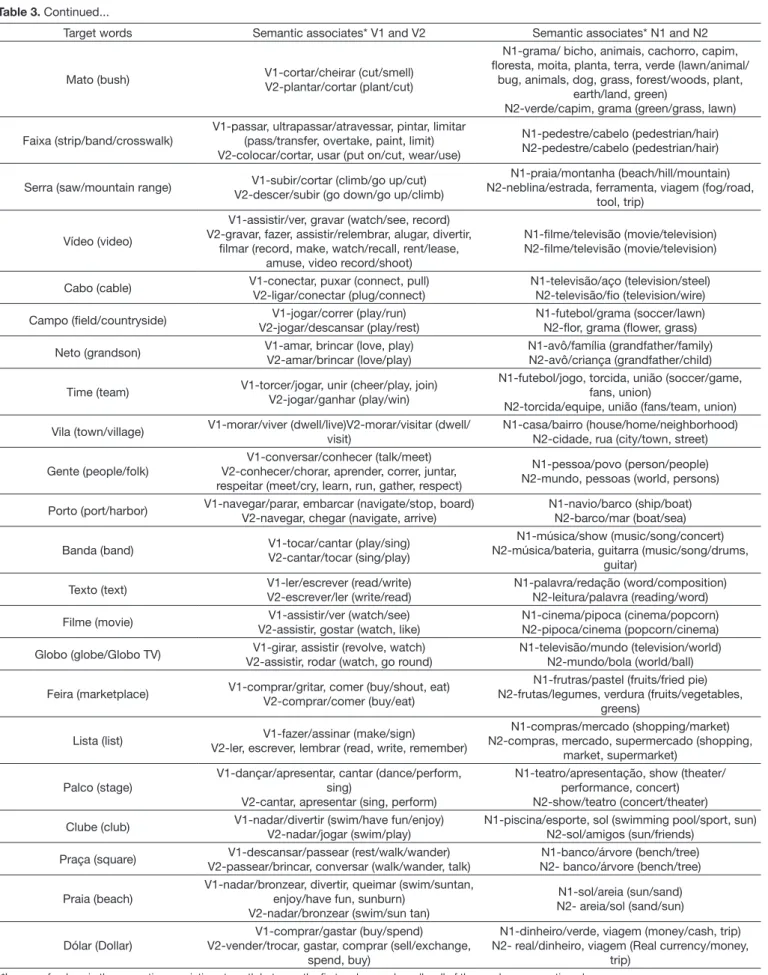
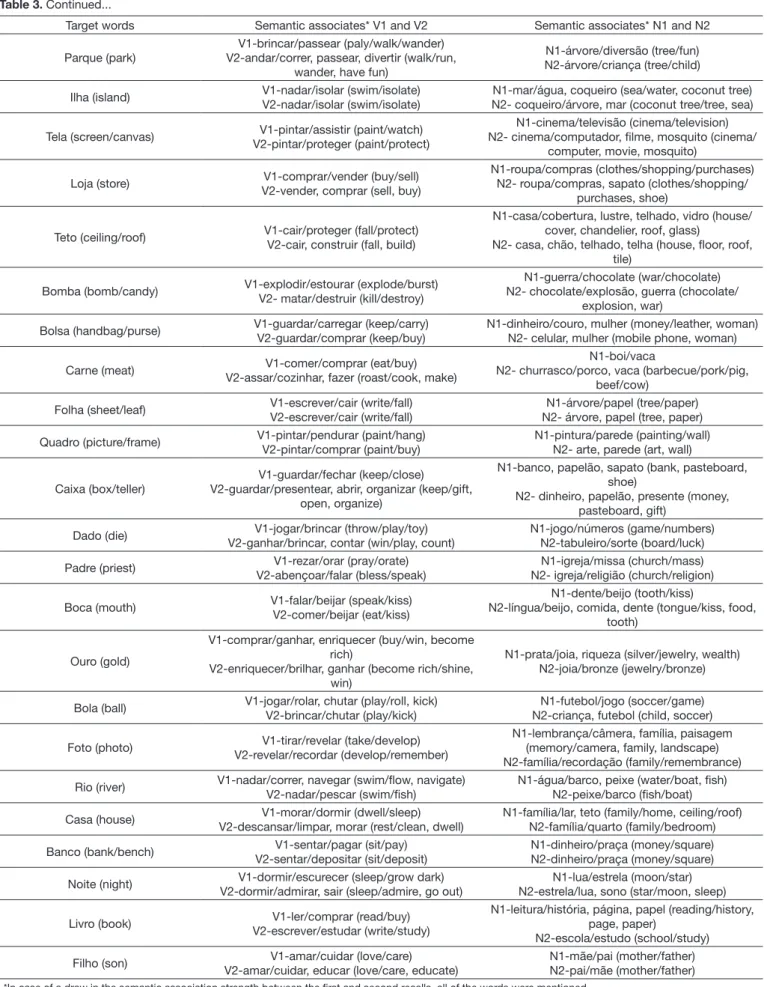
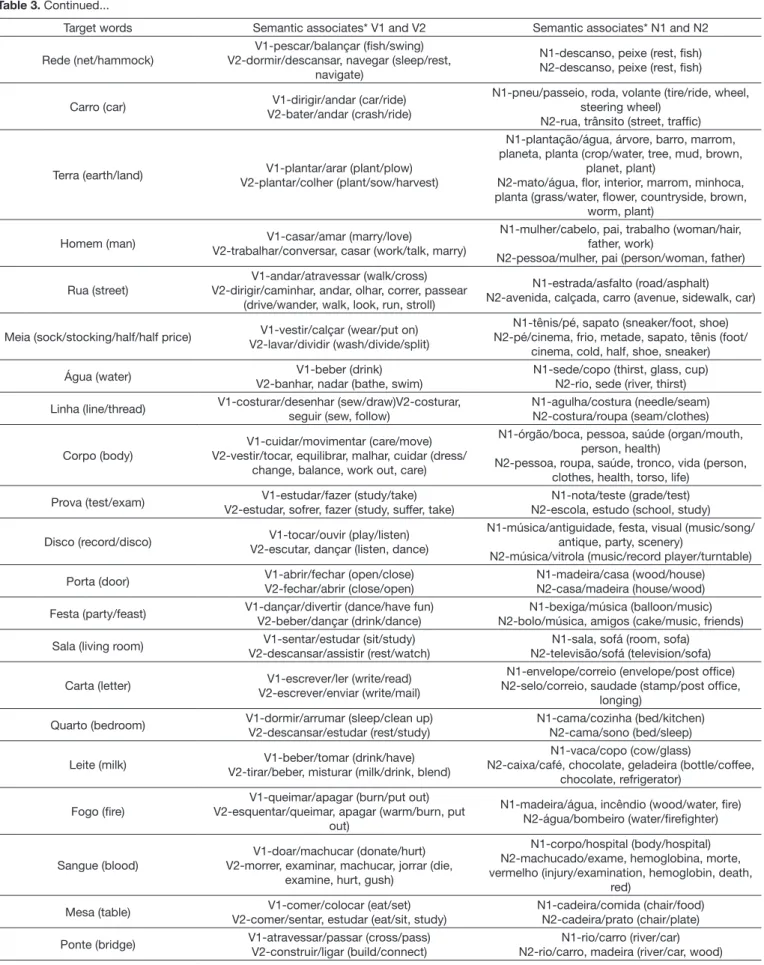
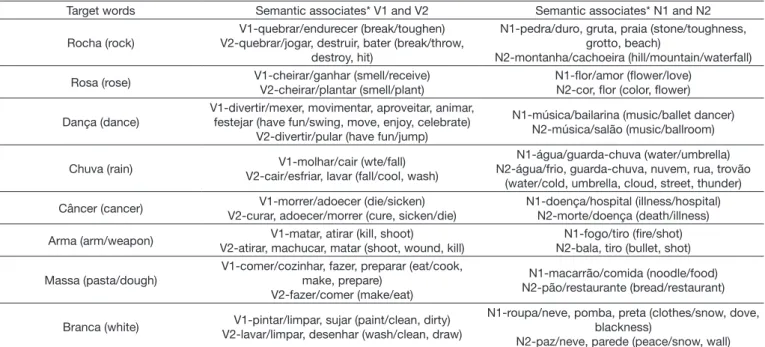
strength. Table 3 shows the high-frequency semantic associates
of the 96 target words for verbs and nouns.
DISCUSSION
Semantic association norms of 96 Brazilian Portuguese words
were collected in the present study. Word class delimitation
for the semantic associate and the writing of two semantically
associated words for each target word were the procedures
employed. The study aim was to generate a varied number of
associates that would enable the formulation of distinct sentences
from the same target word.
Among the results obtained with the semantic associates, it
was possible to observe that the total set size presented larger
mean values for the second recall compared with the irst recall.
The greater variation between the responses presented by
participants to the second word was equally observed in both
classes (verbs and nouns). Regarding the meaning set size, a
behavior similar to that previously described was observed,
with increased number of associates to the second evoked word,
but with smaller mean values. A possible explanation for this
increase in the sets in the second recall would be the effect of
the creation of a semantic chain, or response chaining
(3,11,18).
According to this hypothesis, it is possible that the second word
be a semantic associate of the irst recalled word, not of the target
word. Thus the set of associates tends to increase considering
that all individuals recall the same word in the irst recall.
The size of the total and/or meaning sets has been presented in
previous studies
(2,3,5,7,9,12); however, the means of evoked words for
both the total set
(2,7,9)and the mean set
(2,5,7,9,12)were considerably
larger. Only one study
(3)reported a mean value for the total set
Table 2. Correlation between semantic association strength and set sizes for verbs and nouns
Semantic association strength
Verb
TSS MSS
r p r p
Verb 1 - 1st word –0.61 <0.001* –0.53 <0.001*
Verb 1 - 2nd word –0.31 0.002* –0.15 0.152
Verb 2 - 1st word –0.61 <0.001* –0.22 0.032*
Verb 2 - 2nd word –0.57 <0.001* –0.12 0.227
Noun 1 - 1st word –0.71 <0.001* –0.60 <0.001*
Noun 1 - 2nd word –0.29 0.004* –0.05 0.610
Noun 2 - 1st word –0.60 <0.001* –0.33 0.001*
Noun 2 - 2nd word –0.58 <0.001* –0.15 0.135
*Statistically significant result (p<0.05); r = Pearson’s correlation coefficient
Caption: TSS = Total set size; MSS = Meaning set size
Table 1. Percentage of semantic association strength levels for the first and second recalls to verbs and nouns
Semantic association strength
V 1 V 2 N 1 N 2
1st word 2nd word 1st word 2nd word 1st word 2nd word 1st word 2nd word
Weak 1.0 28.1 10.4 45.8 3.1 26.0 9.4 47.9
Moderate 19.8 62.5 75 54.2 39.6 69.8 78.1 51.0
Strong 79.2 9.4 14.6 0.0 57.3 4.2 12.5 1.0
Table 3. Target words with high-frequency semantic associates and set sizes for verbs and nouns
Target words Semantic associates* V1 and V2 Semantic associates* N1 and N2
Costa (shore/back)
V1-nadar/andar, viajar, navegar (swim/walk, travel, navigate)
V2-coçar/nadar, admirar, mergulhar (scratch/swim, admire, dive)
N1-praia/corpo (beach/body) N2-mar/massagem (sea/massage)
Alvo (target) V1-atirar/acertar (shoot/hit)
V2-acertar/mirar (hit/aim)
N1-tiro, flecha (shot, arrow) N2-dardo/tiro (dart/shot)
Grupo (group) V1-conversar/juntar (talk/gather)
V2-trabalhar/estudar (work/study)
N1-pessoa/amigos (person/friend) N2-trabalho/amigo, família, pessoas, união (work/
friend, family, people, union)
Ponto (dot/stop)
V1-marcar/finalizar (mark/score/end) V2-terminar/escrever, desenhar, parar, acabar,
chegar (finish/write, draw, end, arrive)
N1-final/vírgula (period/comma) N2-ônibus/final (bus/end)
Peça (piece/play)
V1-montar/quebrar, assistir (assemble/break, watch)
V2-assistir/montar (watch/assemble)
N1-teatro/quebra-cabeça (theater/break, puzzle) N2-carro, quebra-cabeça, teatro (car, puzzle,
theater)
Luta (fight) V1-brigar/bater (fight/beat)
V2-ganhar, machucar/bater (win, hurt/beat)
N1-briga/luva (fight/glove) N2-briga/machucado (fight/injured)
Mata (woods)
V1-correr/plantar, acampar, caminhar (run/plant, camp, walk)
V2-cortar/plantar (cut/plant)
N1-árvore, floresta (tree, forest) N2-árvore/animais (tree/animals)
Pena (feather/fountain pen/pity) V1-voar/sentir (fly/feel) V2-cair/escrever (fall/write)
N1-galinha/pássaro (chicken/bird) N2-dó/ave (pity/bird)
Reino (kingdom) V1-governar/morar, mandar (rule/live, order) V2-mandar/morar, batalhar (order/live, battle)
N1-animal, rei (animal, king) N2-rei/castelo, rainha (king/castle, queen)
Obra (construction) V1-construir/trabalhar (build/work) V2-construir/criar (build/create)
N1-pedreiro/arte (mason/art)
N2-quadro/construção, tijolo (picture/construction, brick)
Cerca (fence)
V1-pular/fazer (jump/make)
V2-separar/proteger, construir (divide/protect, build)
N1-madeira/arame, fazenda (wood/barbwire, farm) N2-fazenda/arame, madeira (farm/barbwire, wood)
Posto (gas station/clinic/position)
V1-abastecer/parar (fuel/stop) V2-parar/cuidar, abastecer, pagar, vacinar (stop/
care, fuel, pay, vaccinate)
N1-gasolina (gasoline) N2-carro/álcool (car/ethanol)
Jogo (game)
V1-brincar/ganhar (play/win)
V2-ganhar/divertir, torcer, participar, competir (win/ amuse, cheer for, play, compete)
N1-futebol/bola (soccer/ball) N2-bola, tabuleiro (ball, board)
Pista (track/floor) V1-correr/dançar, andar (race/dance, walk) V2-andar/dirigir (walk/drive)
N1-carro/corrida (car/race) N2-carro/corrida (car/race)
Povo (people)
V1-juntar, unir, falar (gather, join, talk) V2-unir, lutar, trabalhar, criticar (gather, argue,
work, criticize)
N1-pessoas/gente (persons/people) N2-multidão/pessoas (crowd/people)
Vôlei (volleyball) V1-jogar/sacar (play/serve)
V2-sacar/ganhar (serve/win)
N1-bola/esporte (ball/sport) N2-bola, rede (ball, net)
Língua (tongue/language) V1-falar/beijar (speak/kiss) V2-comer/falar (eat/speak)
N1-boca/português (mouth/Portuguese) N2-dente/boca, fala (tooth/mouth, speech)
Mundo (world) V1-girar/viajar, viver (revolve/travel, live) V2-conhecer/girar (know/revolve)
N1-água, globo, terra (water, globe, Earth) N2-pessoas, terra (people, Earth)
Chefe (boss)
V1-mandar/comandar (demand/command) V2-trabalhar/obedecer, mandar (work/obey,
demand/order)
N1-trabalho/emprego (work/job)
N2-trabalho/cargo, cozinha, dinheiro, empregado, escritório, salário (work/position/function, kitchen,
money, employee, office, salary/wages)
Cara (face/head/person)
V1-bater, pintar/limpar, olhar, lavar, maquiar (hit/ slap, paint/clean, look, wash, make up) V2-olhar, pintar, expressar, cuidar, lavar (look,
paint, express, care, wash)
N1-rosto/coroa (face/head)
N2-face/homem, moeda, rosto (face/man, coin, face)
Órgão (organ) V1-doar/funcionar (donate/function) V2-tocar/doar (touch/donate)
N1-corpo/coração (body/hear) N2-pulmão/vida (ling/life)
Papa (Pope/pap) V1-rezar/comer (pray/eat)
V2-rezar/falar, comer (pray/talk, eat)
N1-igreja/comida (church/food) N2-religião/igreja, comida (religion/church, food)
*In case of a draw in the semantic association strength between the first and second recalls, all of the words were mentioned
Target words Semantic associates* V1 and V2 Semantic associates* N1 and N2
Mato (bush) V1-cortar/cheirar (cut/smell)
V2-plantar/cortar (plant/cut)
N1-grama/ bicho, animais, cachorro, capim, floresta, moita, planta, terra, verde (lawn/animal/
bug, animals, dog, grass, forest/woods, plant, earth/land, green)
N2-verde/capim, grama (green/grass, lawn)
Faixa (strip/band/crosswalk)
V1-passar, ultrapassar/atravessar, pintar, limitar (pass/transfer, overtake, paint, limit) V2-colocar/cortar, usar (put on/cut, wear/use)
N1-pedestre/cabelo (pedestrian/hair) N2-pedestre/cabelo (pedestrian/hair)
Serra (saw/mountain range) V1-subir/cortar (climb/go up/cut) V2-descer/subir (go down/go up/climb)
N1-praia/montanha (beach/hill/mountain) N2-neblina/estrada, ferramenta, viagem (fog/road,
tool, trip)
Vídeo (video)
V1-assistir/ver, gravar (watch/see, record) V2-gravar, fazer, assistir/relembrar, alugar, divertir,
filmar (record, make, watch/recall, rent/lease, amuse, video record/shoot)
N1-filme/televisão (movie/television) N2-filme/televisão (movie/television)
Cabo (cable) V1-conectar, puxar (connect, pull)
V2-ligar/conectar (plug/connect)
N1-televisão/aço (television/steel) N2-televisão/fio (television/wire)
Campo (field/countryside) V1-jogar/correr (play/run) V2-jogar/descansar (play/rest)
N1-futebol/grama (soccer/lawn) N2-flor, grama (flower, grass)
Neto (grandson) V1-amar, brincar (love, play)
V2-amar/brincar (love/play)
N1-avô/família (grandfather/family) N2-avô/criança (grandfather/child)
Time (team) V1-torcer/jogar, unir (cheer/play, join) V2-jogar/ganhar (play/win)
N1-futebol/jogo, torcida, união (soccer/game, fans, union)
N2-torcida/equipe, união (fans/team, union)
Vila (town/village) V1-morar/viver (dwell/live)V2-morar/visitar (dwell/ visit)
N1-casa/bairro (house/home/neighborhood) N2-cidade, rua (city/town, street)
Gente (people/folk)
V1-conversar/conhecer (talk/meet) V2-conhecer/chorar, aprender, correr, juntar, respeitar (meet/cry, learn, run, gather, respect)
N1-pessoa/povo (person/people) N2-mundo, pessoas (world, persons)
Porto (port/harbor) V1-navegar/parar, embarcar (navigate/stop, board) V2-navegar, chegar (navigate, arrive)
N1-navio/barco (ship/boat) N2-barco/mar (boat/sea)
Banda (band) V1-tocar/cantar (play/sing)
V2-cantar/tocar (sing/play)
N1-música/show (music/song/concert) N2-música/bateria, guitarra (music/song/drums,
guitar)
Texto (text) V1-ler/escrever (read/write)
V2-escrever/ler (write/read)
N1-palavra/redação (word/composition) N2-leitura/palavra (reading/word)
Filme (movie) V1-assistir/ver (watch/see)
V2-assistir, gostar (watch, like)
N1-cinema/pipoca (cinema/popcorn) N2-pipoca/cinema (popcorn/cinema)
Globo (globe/Globo TV) V1-girar, assistir (revolve, watch) V2-assistir, rodar (watch, go round)
N1-televisão/mundo (television/world) N2-mundo/bola (world/ball)
Feira (marketplace) V1-comprar/gritar, comer (buy/shout, eat) V2-comprar/comer (buy/eat)
N1-frutras/pastel (fruits/fried pie) N2-frutas/legumes, verdura (fruits/vegetables,
greens)
Lista (list) V1-fazer/assinar (make/sign)
V2-ler, escrever, lembrar (read, write, remember)
N1-compras/mercado (shopping/market) N2-compras, mercado, supermercado (shopping,
market, supermarket)
Palco (stage)
V1-dançar/apresentar, cantar (dance/perform, sing)
V2-cantar, apresentar (sing, perform)
N1-teatro/apresentação, show (theater/ performance, concert) N2-show/teatro (concert/theater)
Clube (club) V1-nadar/divertir (swim/have fun/enjoy) V2-nadar/jogar (swim/play)
N1-piscina/esporte, sol (swimming pool/sport, sun) N2-sol/amigos (sun/friends)
Praça (square) V1-descansar/passear (rest/walk/wander) V2-passear/brincar, conversar (walk/wander, talk)
N1-banco/árvore (bench/tree) N2- banco/árvore (bench/tree)
Praia (beach)
V1-nadar/bronzear, divertir, queimar (swim/suntan, enjoy/have fun, sunburn)
V2-nadar/bronzear (swim/sun tan)
N1-sol/areia (sun/sand) N2- areia/sol (sand/sun)
Dólar (Dollar)
V1-comprar/gastar (buy/spend)
V2-vender/trocar, gastar, comprar (sell/exchange, spend, buy)
N1-dinheiro/verde, viagem (money/cash, trip) N2- real/dinheiro, viagem (Real currency/money,
trip)
*In case of a draw in the semantic association strength between the first and second recalls, all of the words were mentioned
Caption: V1 = 1st verb recall; V2 = 2nd verb recall; N1 = 1st noun recall; N2 = 2nd noun recall
Target words Semantic associates* V1 and V2 Semantic associates* N1 and N2
Parque (park)
V1-brincar/passear (paly/walk/wander) V2-andar/correr, passear, divertir (walk/run,
wander, have fun)
N1-árvore/diversão (tree/fun) N2-árvore/criança (tree/child)
Ilha (island) V1-nadar/isolar (swim/isolate)
V2-nadar/isolar (swim/isolate)
N1-mar/água, coqueiro (sea/water, coconut tree) N2- coqueiro/árvore, mar (coconut tree/tree, sea)
Tela (screen/canvas) V1-pintar/assistir (paint/watch) V2-pintar/proteger (paint/protect)
N1-cinema/televisão (cinema/television) N2- cinema/computador, filme, mosquito (cinema/
computer, movie, mosquito)
Loja (store) V1-comprar/vender (buy/sell)
V2-vender, comprar (sell, buy)
N1-roupa/compras (clothes/shopping/purchases) N2- roupa/compras, sapato (clothes/shopping/
purchases, shoe)
Teto (ceiling/roof) V1-cair/proteger (fall/protect) V2-cair, construir (fall, build)
N1-casa/cobertura, lustre, telhado, vidro (house/ cover, chandelier, roof, glass)
N2- casa, chão, telhado, telha (house, floor, roof, tile)
Bomba (bomb/candy) V1-explodir/estourar (explode/burst) V2- matar/destruir (kill/destroy)
N1-guerra/chocolate (war/chocolate) N2- chocolate/explosão, guerra (chocolate/
explosion, war)
Bolsa (handbag/purse) V1-guardar/carregar (keep/carry) V2-guardar/comprar (keep/buy)
N1-dinheiro/couro, mulher (money/leather, woman) N2- celular, mulher (mobile phone, woman)
Carne (meat) V1-comer/comprar (eat/buy)
V2-assar/cozinhar, fazer (roast/cook, make)
N1-boi/vaca
N2- churrasco/porco, vaca (barbecue/pork/pig, beef/cow)
Folha (sheet/leaf) V1-escrever/cair (write/fall) V2-escrever/cair (write/fall)
N1-árvore/papel (tree/paper) N2- árvore, papel (tree, paper)
Quadro (picture/frame) V1-pintar/pendurar (paint/hang) V2-pintar/comprar (paint/buy)
N1-pintura/parede (painting/wall) N2- arte, parede (art, wall)
Caixa (box/teller)
V1-guardar/fechar (keep/close)
V2-guardar/presentear, abrir, organizar (keep/gift, open, organize)
N1-banco, papelão, sapato (bank, pasteboard, shoe)
N2- dinheiro, papelão, presente (money, pasteboard, gift)
Dado (die) V1-jogar/brincar (throw/play/toy)
V2-ganhar/brincar, contar (win/play, count)
N1-jogo/números (game/numbers) N2-tabuleiro/sorte (board/luck)
Padre (priest) V1-rezar/orar (pray/orate)
V2-abençoar/falar (bless/speak)
N1-igreja/missa (church/mass) N2- igreja/religião (church/religion)
Boca (mouth) V1-falar/beijar (speak/kiss)
V2-comer/beijar (eat/kiss)
N1-dente/beijo (tooth/kiss)
N2-língua/beijo, comida, dente (tongue/kiss, food, tooth)
Ouro (gold)
V1-comprar/ganhar, enriquecer (buy/win, become rich)
V2-enriquecer/brilhar, ganhar (become rich/shine, win)
N1-prata/joia, riqueza (silver/jewelry, wealth) N2-joia/bronze (jewelry/bronze)
Bola (ball) V1-jogar/rolar, chutar (play/roll, kick) V2-brincar/chutar (play/kick)
N1-futebol/jogo (soccer/game) N2-criança, futebol (child, soccer)
Foto (photo) V1-tirar/revelar (take/develop)
V2-revelar/recordar (develop/remember)
N1-lembrança/câmera, família, paisagem (memory/camera, family, landscape) N2-família/recordação (family/remembrance)
Rio (river) V1-nadar/correr, navegar (swim/flow, navigate) V2-nadar/pescar (swim/fish)
N1-água/barco, peixe (water/boat, fish) N2-peixe/barco (fish/boat)
Casa (house) V1-morar/dormir (dwell/sleep)
V2-descansar/limpar, morar (rest/clean, dwell)
N1-família/lar, teto (family/home, ceiling/roof) N2-família/quarto (family/bedroom)
Banco (bank/bench) V1-sentar/pagar (sit/pay)
V2-sentar/depositar (sit/deposit)
N1-dinheiro/praça (money/square) N2-dinheiro/praça (money/square)
Noite (night) V1-dormir/escurecer (sleep/grow dark) V2-dormir/admirar, sair (sleep/admire, go out)
N1-lua/estrela (moon/star) N2-estrela/lua, sono (star/moon, sleep)
Livro (book) V1-ler/comprar (read/buy)
V2-escrever/estudar (write/study)
N1-leitura/história, página, papel (reading/history, page, paper)
N2-escola/estudo (school/study)
Filho (son) V1-amar/cuidar (love/care)
V2-amar/cuidar, educar (love/care, educate)
N1-mãe/pai (mother/father) N2-pai/mãe (mother/father)
*In case of a draw in the semantic association strength between the first and second recalls, all of the words were mentioned
Caption: V1 = 1st verb recall; V2 = 2nd verb recall; N1 = 1st noun recall; N2 = 2nd noun recall
Target words Semantic associates* V1 and V2 Semantic associates* N1 and N2
Rede (net/hammock)
V1-pescar/balançar (fish/swing) V2-dormir/descansar, navegar (sleep/rest,
navigate)
N1-descanso, peixe (rest, fish) N2-descanso, peixe (rest, fish)
Carro (car) V1-dirigir/andar (car/ride)
V2-bater/andar (crash/ride)
N1-pneu/passeio, roda, volante (tire/ride, wheel, steering wheel)
N2-rua, trânsito (street, traffic)
Terra (earth/land) V1-plantar/arar (plant/plow) V2-plantar/colher (plant/sow/harvest)
N1-plantação/água, árvore, barro, marrom, planeta, planta (crop/water, tree, mud, brown,
planet, plant)
N2-mato/água, flor, interior, marrom, minhoca, planta (grass/water, flower, countryside, brown,
worm, plant)
Homem (man) V1-casar/amar (marry/love)
V2-trabalhar/conversar, casar (work/talk, marry)
N1-mulher/cabelo, pai, trabalho (woman/hair, father, work)
N2-pessoa/mulher, pai (person/woman, father)
Rua (street)
V1-andar/atravessar (walk/cross) V2-dirigir/caminhar, andar, olhar, correr, passear
(drive/wander, walk, look, run, stroll)
N1-estrada/asfalto (road/asphalt) N2-avenida, calçada, carro (avenue, sidewalk, car)
Meia (sock/stocking/half/half price) V1-vestir/calçar (wear/put on) V2-lavar/dividir (wash/divide/split)
N1-tênis/pé, sapato (sneaker/foot, shoe) N2-pé/cinema, frio, metade, sapato, tênis (foot/
cinema, cold, half, shoe, sneaker)
Água (water) V1-beber (drink)
V2-banhar, nadar (bathe, swim)
N1-sede/copo (thirst, glass, cup) N2-rio, sede (river, thirst)
Linha (line/thread) V1-costurar/desenhar (sew/draw)V2-costurar, seguir (sew, follow)
N1-agulha/costura (needle/seam) N2-costura/roupa (seam/clothes)
Corpo (body)
V1-cuidar/movimentar (care/move) V2-vestir/tocar, equilibrar, malhar, cuidar (dress/
change, balance, work out, care)
N1-órgão/boca, pessoa, saúde (organ/mouth, person, health)
N2-pessoa, roupa, saúde, tronco, vida (person, clothes, health, torso, life)
Prova (test/exam) V1-estudar/fazer (study/take)
V2-estudar, sofrer, fazer (study, suffer, take)
N1-nota/teste (grade/test) N2-escola, estudo (school, study)
Disco (record/disco) V1-tocar/ouvir (play/listen) V2-escutar, dançar (listen, dance)
N1-música/antiguidade, festa, visual (music/song/ antique, party, scenery)
N2-música/vitrola (music/record player/turntable)
Porta (door) V1-abrir/fechar (open/close)
V2-fechar/abrir (close/open)
N1-madeira/casa (wood/house) N2-casa/madeira (house/wood)
Festa (party/feast) V1-dançar/divertir (dance/have fun) V2-beber/dançar (drink/dance)
N1-bexiga/música (balloon/music) N2-bolo/música, amigos (cake/music, friends)
Sala (living room) V1-sentar/estudar (sit/study) V2-descansar/assistir (rest/watch)
N1-sala, sofá (room, sofa) N2-televisão/sofá (television/sofa)
Carta (letter) V1-escrever/ler (write/read)
V2-escrever/enviar (write/mail)
N1-envelope/correio (envelope/post office) N2-selo/correio, saudade (stamp/post office,
longing)
Quarto (bedroom) V1-dormir/arrumar (sleep/clean up) V2-descansar/estudar (rest/study)
N1-cama/cozinha (bed/kitchen) N2-cama/sono (bed/sleep)
Leite (milk) V1-beber/tomar (drink/have)
V2-tirar/beber, misturar (milk/drink, blend)
N1-vaca/copo (cow/glass)
N2-caixa/café, chocolate, geladeira (bottle/coffee, chocolate, refrigerator)
Fogo (fire)
V1-queimar/apagar (burn/put out) V2-esquentar/queimar, apagar (warm/burn, put
out)
N1-madeira/água, incêndio (wood/water, fire) N2-água/bombeiro (water/firefighter)
Sangue (blood)
V1-doar/machucar (donate/hurt) V2-morrer, examinar, machucar, jorrar (die,
examine, hurt, gush)
N1-corpo/hospital (body/hospital) N2-machucado/exame, hemoglobina, morte, vermelho (injury/examination, hemoglobin, death,
red)
Mesa (table) V1-comer/colocar (eat/set)
V2-comer/sentar, estudar (eat/sit, study)
N1-cadeira/comida (chair/food) N2-cadeira/prato (chair/plate)
Ponte (bridge) V1-atravessar/passar (cross/pass)
V2-construir/ligar (build/connect)
N1-rio/carro (river/car) N2-rio/carro, madeira (river/car, wood)
*In case of a draw in the semantic association strength between the first and second recalls, all of the words were mentioned
Caption: V1 = 1st verb recall; V2 = 2nd verb recall; N1 = 1st noun recall; N2 = 2nd noun recall
Target words Semantic associates* V1 and V2 Semantic associates* N1 and N2
Rocha (rock)
V1-quebrar/endurecer (break/toughen) V2-quebrar/jogar, destruir, bater (break/throw,
destroy, hit)
N1-pedra/duro, gruta, praia (stone/toughness, grotto, beach)
N2-montanha/cachoeira (hill/mountain/waterfall)
Rosa (rose) V1-cheirar/ganhar (smell/receive)
V2-cheirar/plantar (smell/plant)
N1-flor/amor (flower/love) N2-cor, flor (color, flower)
Dança (dance)
V1-divertir/mexer, movimentar, aproveitar, animar, festejar (have fun/swing, move, enjoy, celebrate)
V2-divertir/pular (have fun/jump)
N1-música/bailarina (music/ballet dancer) N2-música/salão (music/ballroom)
Chuva (rain) V1-molhar/cair (wte/fall)
V2-cair/esfriar, lavar (fall/cool, wash)
N1-água/guarda-chuva (water/umbrella) N2-água/frio, guarda-chuva, nuvem, rua, trovão
(water/cold, umbrella, cloud, street, thunder)
Câncer (cancer) V1-morrer/adoecer (die/sicken)
V2-curar, adoecer/morrer (cure, sicken/die)
N1-doença/hospital (illness/hospital) N2-morte/doença (death/illness)
Arma (arm/weapon) V1-matar, atirar (kill, shoot)
V2-atirar, machucar, matar (shoot, wound, kill)
N1-fogo/tiro (fire/shot) N2-bala, tiro (bullet, shot)
Massa (pasta/dough)
V1-comer/cozinhar, fazer, preparar (eat/cook, make, prepare)
V2-fazer/comer (make/eat)
N1-macarrão/comida (noodle/food) N2-pão/restaurante (bread/restaurant)
Branca (white) V1-pintar/limpar, sujar (paint/clean, dirty) V2-lavar/limpar, desenhar (wash/clean, draw)
N1-roupa/neve, pomba, preta (clothes/snow, dove, blackness)
N2-paz/neve, parede (peace/snow, wall)
*In case of a draw in the semantic association strength between the first and second recalls, all of the words were mentioned
Caption: V1 = 1st verb recall; V2 = 2nd verb recall; N1 = 1st noun recall; N2 = 2nd noun recall
Table 3. Continued...
closer to that (mean=19.06) found in this survey. With respect
to the increased number of associates for the second recall, only
one research
(5)conducted a similar procedure (requested three
recalls to each target word) and observed an increase in the
meaning set size for the second and third recalls. The differences
between the results obtained can be explained by the different
procedures used, the reduced number of words in common
(between two and eight), and the differences in the aspects of
concreteness, extension, and grammar class. Interestingly, the
study that presented similar data
(3)requested only one response
to participants and used categories (e.g., farm animals) as targets,
not single words. Another study
(1)described the category size
considering the different responses and the words were presented
in sentences of different linguistic contexts, which invalidated
the comparison of results.
Regarding the meaning set sizes, most of them were classiied
as small, without occurrence of large sets in any of the categories
considered, for both the irst and second written words. Previous
studies showed that most sets were either large
(3)or medium
(2,7).
A national study
(8)comparing different age groups reported a
majority of large sets for the group of children, medium sets
for adults, and small sets for the elderly, without occurrence of
any large set only in the group of elderlies. It is worth noting
that, in the mentioned studies, only one word was requested
and there was no restriction of category.
Association strength between the pair of semantic associates
was another aspect analyzed in this research. The semantic
association strength tended to decrease from the irst (mostly strong)
to the second (mostly moderate) word in the irst recall. As for
the second recall, most of the associations presented moderate
strength for both considered words (Table 1). The hypothesis of
response chaining
(3,11)could explain this decrease in association
strength, that is, a certain response is more likely to occur in
the irst words, whereas one of these responses is less likely to
occur, due to greater variability, at a second moment.
Some studies
(2,7)have also reported increased values (between
44% and 50%) for pairs with strong and moderate association
strength and decreased values (1.1% and 6%) for pairs with
weak strength. One study
(9), which considered different groups
of participants (young adults and elderly), described few pairs
of associates with weak association strength (between 3.4%
and 5.7%) and a higher percentage (between 46% and 50%) for
pairs with moderate and strong strength. Only one response was
requested in these studies, thus it was not possible to analyze
the reduction of association strength.
With respect to the correlation between semantic association
strength and sizes of the total and meaning sets (Table 2), the
results showed that the variables are inversely proportional.
The stronger the association strength, the smaller the set size,
that is, the smaller the number of associates generated per
target word, the stronger the association between the most
frequent associate and the target word. It is worth emphasizing
that signiicant correlations occurred in all associations in the
total set and in half of the associations in the meaning set.
Most correlations were considered strong for the total set and
moderate for the meaning set.
Similar analyses were conducted in other studies
(2,7,11,12), in
which signiicant negative correlation was observed between
the variables association strength and total and meaning set
size. Considering the correlation strength and the set sizes,
some studies found strong correlation for the total size
(2,7),
whereas others reported moderate correlation
(11,12). Regarding
the meaning size, all studies described strong correlations
(2,7,11).
shows a consistent pattern of decreased strength as the total set
size increases. Similar analysis has not been mentioned in the
studies consulted for comparison of results.
Regarding the semantic associates, the two words generated
with greater association strength for both the irst and second
recalls were considered equally for each group (verbs and
nouns). In many cases, there was a tie in the values of words,
so that they were all classiied to be possibly considered in the
formulation of sentences.
Finally, the lists of associates generated allowed control of
the semantic association aspect in the formulation of a speech
recognition assessment with predictability control of the inal
word.
CONCLUSIONS
The semantic association norms of 96 Brazilian Portuguese
words were collected as proposed and resulted in semantic
associates for each target word in the verb and noun classes
that were used in a speech recognition assessment considering
sentences with controlled word predictability.
REFERENCES
1. Janczura GA. Contexto e normas de associação para palavras: a redução do campo semântico. Paidéia (Ribeirão Preto). 2005;15(32):417-25. http:// dx.doi.org/10.1590/S0103-863X2005000300011.
2. Salles JF, Holderbaum CS, Becker N, Rodrigues JC, Liedtke FV, Zibetti MR, et al. Normas de Associação semântica para 88 palavras do português brasileiro. Psico (Porto Alegre). 2008;39(3):260-8.
3. Janczura GA. Normas associativas para 69 categorias semânticas. Psicol, Teor Pesqui. 1996;12(3):237-44.
4. De Deyne S, Storms G. Word associations: network and semantic properties. Behav Res Methods. 2008a;40(1):213-31. PMid:18411545. http://dx.doi. org/10.3758/BRM.40.1.213.
5. De Deyne S, Storms G. Word associations: norms for 1424 Dutch words in a continuous task. Behav Res Methods. 2008b;40(1):198-205. PMid:18411543. http://dx.doi.org/10.3758/BRM.40.1.198.
6. Macizo P, Gómez-Ariza CJ, Bajo MT. Associative norms of 58 Spanish words for children from 8 to 13 years old. Psicologica (Valencia). 2000;21(3):287-300.
7. Salles JF, Holderbaum CS, Machado CS. Normas de associação semântica de 50 palavras do português brasileiro para crianças: tipo, força de associação e set size. Interam J Psychol. 2009;43(1):57-67.
8. Zortea M. Estudo sobre associação semântica de palavras em crianças, adultos jovens e idosos [dissertação]. Porto Alegre: Universidade Federal do Rio Grande do Sul; 2010.
9. Zortea M, Salles JF. Estudo comparativo das associações semânticas de palavras entre adultos jovens e idosos. Psicol, Teor Pesqui. 2012;28(3):259-66. http://dx.doi.org/10.1590/S0102-37722012000300001.
10. Vesely L, Bonner MF, Reilly J, Grossman M. Free association in semantic dementia: the importance of being abstract. [abstract]. Brain Lang. 2007;103(1-2):154-5. http://dx.doi.org/10.1016/j.bandl.2007.07.092. 11. Nelson DL, Schreiber TM. Word concreteness and word structure as
independent determinants of recall. J Mem Lang. 1992;31(2):237-60. http://dx.doi.org/10.1016/0749-596X(92)90013-N.
12. Stein LM, Gomes CFA. Normas brasileiras para listas de palavras associadas: associação semântica, concretude, frequência e emocionalidade. Psicol, Teor Pesqui. 2009;25(4):537-46. http://dx.doi.org/10.1590/S0102-37722009000400009.
13. Stein LM, Feix LF, Rohenkohl G. Avanços metodológicos no estudo das falsas memórias: construção e normatização do procedimento de palavras associadas. Psicol Reflex Crit. 2006;19(2):166-76. http://dx.doi.org/10.1590/ S0102-79722006000200002.
14. Calais LL. Reconhecimento de fala em idosos: elaboração e aplicação de um teste considerando a previsibilidade da palavra [tese]. São Paulo: Universidade Federal de São Paulo; 2011.
15. Janczura GA, Castilho GM, Rocha NO, Van Erven TJC, Huang TP. Normas de concretude para 909 palavras da língua portuguesa. Psicol, Teor Pesqui. 2007;23(2):195-204.
16. Bybee JL. Phonology and language use. Cambridge: Cambridge University; 2001.
17. Cohen J. Statistical power analysis for the behavioral sciences. Hillsdale: Erlbaum; 1988.
18. Nelson DL, McEvoy CL, Bajo MT. Lexical and semantic search in cued recall, fragment completion, perceptual identification, and recognition. Am J Psychol. 1988;101(4):465-80. PMid:3232723. http://dx.doi. org/10.2307/1423225.
Author contributions
LLC is the main author of the article, DG is the study co-advisor, and ACLCB is the study advisor; LLC, AMLG, PA, DG and ACLCB contributed to the
study from its design to the inal writing of the manuscript. This study is part
of a doctoral dissertation; PA and DG also contributed to the considerations and decisions involving the methodology of the study, analysis of results, and