FREE THEMES
1 Escola Nacional de Saúde Pública, Fiocruz. R. Leopoldo Bulhões 1480, Manguinhos. 21041-210 Rio de Janeiro RJ Brasil. [email protected]
Mobile prehospital emergency care: an analysis
of implementation in the State of Rio de Janeiro, Brazil
Abstract Mobile prehospital care is a key com-ponent of emergency care. The aim of this study was to analyze the implementation of the State of Rio de Janeiro’s Mobile Emergency Medical Service (SAMU, acronym in Portuguese). The methodology employed included document anal-ysis, visits to six SAMU emergency call centers, and semistructured interviews conducted with 12 local and state emergency care coordinators. The study’s conceptual framework was based on Giddens’ theory of structuration. Intergovern-mental conflicts were observed between the state and municipal governments, and between munic-ipal governments. Despite the shortage of hospital beds, the SAMUs in periphery regions were better integrated with the emergency care network than the metropolitan SAMUs. The steering commit-tees were not very active and weaknesses were ob-served relating to the limited role played by the state government in funding, management, and monitoring. It was concluded that the SAMU im-plementation process in the state was marked by political tensions and management and coordi-nation weaknesses. As a result, serious drawbacks remain in the coordination of the SAMU with the other health services and the regionalization of emergency care in the state.
Key words Emergencies, Mobile emergency units,
Public health policy Gisele O’Dwyer 1
Cristiani Vieira Machado 1 Renan Paes Alves 1
O
’Dwy
Introduction
Emergency care, a fundamental part of health systems, has been a priority in Brazil since 20031,
as provided in the National Emergency Care Pol-icy (Política Nacional de Atenção às Urgências – PNAU)2.
The implementation of Brazil’s National Emergency Care Policy can be divided into three main stages: 2000 to 2003 – initial regulation; 2004 to 2008 – expansion of the Mobile Emer-gency Medical Service (Serviço de Atendimento Móvel de Urgência -SAMU), the mobile compo-nent of prehospital emergency care; and 2009 – implementation of the fixed component of prehospital care, 24-hour Emergency Care Units (Unidades de Pronto Atendimento – UPA)3.
International literature shows that prehospi-tal care4,5, that became a policy priority in
Bra-zil in 2004 through the expansion of the SAMU, yields important results. The decision to begin the implementation of the National Emergen-cy Care PoliEmergen-cy through this service was justified based on its importance for assuring reduced response time and regular delivery of emergen-cy care. The SAMU is a nationally-standardized care model, geared towards delivering 24-hour emergency care to homes, the workplace, and thoroughfares. It is aimed at guaranteeing care delivery, appropriate transport, and patient re-ferral to the Unified Health System (Sistema Úni-co de Saúde - SUS). Aid can be free requested by telephone from any location in the country by dialing the number 192. The call is answered by an emergency call center (Central de Regulação Médica) that determines the most adequate re-sponse, be it specific orientations or sending a basic life support or advanced life support am-bulance, the latter of which includes a doctor in the medical team. Official documents highlight the potential of the SAMU for organizing the care network6,7.
In 2011, the Health Ministry reformulated its emergency care policy8. The new guidelines
pro-pose the formation of an Urgent and Emergency Care Network (Rede de Urgência e Emergência) comprising of prehospital care (primary care, the SAMU and UPAs), hospital care, and home care.
In 2013, the SAMU 192 was present in all Brazilian states, with 175 emergency call centers covering 1,955 municipalities, which are home to 65% of the Brazilian population9. The Health
Ministry expected that the SAMU would reach 100% coverage of the Brazilian population by 2018.
The national literature regarding SAMU highlights the following: lack of professional training, the weak structure of care system, lack of coordination between the care units involved in providing emergency care, and the impact of external causes on care delivery3,10-17.
One of the main challenges facing prehospi-tal emergency care is its integration with primary care, the regulatory ‘gateway’ of the system, and hospitals, the system’s ‘exit door’14.
It is also important to highlight the impor-tance of intergovernmental negotiation, given that national regulations provide that the SAMU funding shall be divided between federal (50%), state (25%), and municipal (25%) governments. Coordination between different levels of gov-ernment is even more important in the case of regional SAMUs. The few studies regarding re-gional SAMUs reveal the importance of steering committees in relation to the establishment of federative agreements between municipalities12,15.
Since 1986, Rio de Janeiro, the country’s sec-ond most populous state, which has a high de-gree of urbanization, has been a pioneer in mo-bile prehospital emergency care in thoroughfares through the Emergency Aid Group (Grupamento de Socorro de Emergência - GSE) of the Military Firefighters Corps (Corpo de Bombeiros Mili-tar do State of Rio de Janeiro - CBMERJ). The GSE was responsible for responding to medical or traumatic emergencies in thoroughfares and other public places up to 2004. However, a more wide-ranging emergency service that encom-passed emergencies at household level was only implemented after the state government’s adher-ence to the national SAMU strategy.
This study is guided by the following ques-tions: what were the main characteristics of and conditioning factors in the implementation the SAMU in the State of Rio de Janeiro? What is its place within the emergency care policy and net-work?
This article aims to analyze the implementa-tion of the SAMU in the State of Rio de Janeiro considering the political and institutional con-text, coordination between health services, and emergency care network management.
Methodology
vis-aúd
e C
ole
tiv
a,
21(7):2189-2200,
2016
its to emergency call centers in the State of Rio de Janeiro, and 12 semistructured interviews with all acting state and regional coordinators during the period: three state emergency care coordi-nators, and nine coordinators of the six SAMUs that were in operation during the study period. None of the coordinators refused to participate.
The interviews with the state emergency care coordinators lasted between 60 and 100 minutes and were conducted using an guide containing questions addressing the historical background of the policy, the actors involved in the imple-mentation process, current operating status, coordination between the SAMU and the care network, prospects for expansion, state man-agement capacity, the creation of indicators, the performance of steering committees, and advances, limitations and challenges. Visits last-ing approximately six hours were made to each of the six SAMU centers: Rio de Janeiro (in the capital); Metropolitano I (in Nova Iguaçu); Met-ropolitano II (in Niterói); Baia de Ilha Grande (in Angra dos Reis); Médio Paraíba (in Volta Redon-da); and Centro-Sul (in Três Rios). During the visits, the SAMU coordinators were interviewed once using a similar guide with additional ques-tions regarding the operating dynamics of each center. Field notes were taken to complement the audio recordings.
The study’s conceptual framework was based on Giddens’ theory of structuration18, which uses
strategic conduct analysis to explore the relation-ship between cognitive skills and action strate-gies displayed by human agents and structural dimensions. For Giddens18, social practices can
be understood as procedures, methods or tech-niques skillfully performed by social agents using rules and resources. Therefore, agents have broad freedom of action, yet are always conditioned by the structural resources at their disposal.
Here rules are viewed as structural resources, whose normative aspect corresponds to practices from a rights-based perspective, duties and the ways in which these practices can be executed. These resources constitute the facilities or power base that agents can call upon and manipulate to influence their interaction with the other. “Cir-cumstances of the action” are the ways in which social and material phenomena facilitate or re-strict human action and are both the means and result of the action.
Access to the agent may come about through discursive consciousness – an actor’s ability to verbally express the conditions of his/her own ac-tions – and practical consciousness, or that which
can be understood through observation.
In this case study, the circumstances of the action concern the implementation of the Na-tional Emergency Care Policy in the context of the State of Rio de Janeiro. The documents were considered structural resources and the agents were accessed by way of discursive and practical consciousness during the field study. The results of the interviews were analyzed in the follow-ing stages: transcription, analysis of recurrfollow-ing themes, revision and refinement of initial catego-ries, and organization and interpretation of the narratives into categories.
The results are presented in the following categories: the SAMU implementation process and its political and institutional context; coor-dination of SAMU activities with other services; management of the SAMUs.
This study was authorized by the Research Ethics Committee.
Results and discussion
The SAMU implementation process and its political and institutional context
The National Emergency Care Policy was in-tended to be implemented as a comprehensive and articulated network19. However, it has been
fragmented into components, beginning with the SAMU.
The State of Rio de Janeiro’s SAMU was im-plemented in two stages: the first between 2004 and 2010, which comprised of the implementa-tion of the metropolitan SAMUs SAMU Metro-politano I, SAMU Metropolitano II, and SAMU Rio; and the second that began in 2011 with the implementation of SAMUs in three periphery re-gions - SAMU Baía de Ilha Grande, SAMU Cen-tro-Sul, and SAMU Médio Paraíba. Figure 1 shows the development of the SAMU in terms of num-ber of municipalities and population covered.
O
’Dwy
The regional SAMUs in Rio de Janeiro initial-ly differed from the SAMUs in other states, which were generally implemented in the most popu-lous municipalities that benefitted from greater financial resources and enjoyed better health care services. In 2005, only 35.7% of the country’s SAMUs were regional, i.e., encompassed more than one municipality. Only in 2008 did the na-tionwide implementation of regional SAMUs overtake that of municipal sevices3.
Given the regional nature of the SAMU, in-tergovernmental coordination is fundamental. The analysis of the implementation process re-veals political problems related to lack of agree-ment between local governagree-ments and divergences among municipal and state governments. These issues was raised principally by the coordinators of the Metropolitan SAMUs.
The implementation of the SAMU Metro-politano II in 2004 was the initiative of the local government of Niterói, with strong support from the municipality of São Gonçalo and through agreements with the remaining municipalities. According to the state emergency care
coordina-tor, the implementation of the SAMU in Niteró benefitted from a favorable political climate and technical conditions and the local government committed itself to administering the emergency call center.
Soon after, in 2005, the SAMU Metropolitano I was implemented by the Consortium da Baixa-da Fluminense, which took on the management of the service. The center is located in the mu-nicipality of Nova Iguaçu. According to inter-viewees, the SAMUs Metropolitano I and II only received state support in 2011 after an initiative to reshape the Emergency Care Network (Rede de Atendimento às Urgências - RAU).
The SAMU Rio was inaugurated by the state government in 2006. According to interviewees, the reason for the relatively late implementation of the SAMU in the capital was due to the fact that mobile prehospital care was previously pro-vided by the Firefighter Corps – thus requiring a specific coordination strategy – and difficulties in establishing intergovernmental partnerships up to that point. The creation of the State De-partment of Health and Civil Defense (Secretaria
Figure 1. Development of the SAMU in the state of Rio de Janeiro in terms of number of municipalities and
population covered between 2004 and 2012.
Source: data regarding the inauguration of the SAMU was obtained during the field research. Population data is from the Brazilian Institute of Geography and Statistics (IBGE, acronym in Portuguese). NB: the year in which the SAMU was inaugurated was considered rather than the date published in the Official Gazette.
0 5 10 15 20 25 30 35 40 45 50
2004 2005 2006 2007 2008 2009 2010 2011 2012
0,0 10,0 20,0 30,0 40,0 50,0 60,0 70,0 80,0 90,0
n
umb
er o
f m
unicipalit
ies
p
o
pulat
io
n c
o
ve
re
d (%)
aúd
e C
ole
tiv
a,
21(7):2189-2200,
2016
Estadual de Saúde e Civil Defense - SESDEC) in 2007 had a major impact on the capital’s SAMU. Between 2007 and 2011, when the Firefighter Corps were involved in state health management, the state played a management role only with re-spect to the SAMU Rio, which included the par-ticipation of the Firefighter Corps, while the two metropolitan SAMUs continued under the man-agement of local government.
The Firefighter Corps played such an im-portant role in the SAMU Rio that the SAMU remained part of the organizational structure of Office of Civil Defense even after the latter was separated from the Health Department in 2011. According to the coordinators there was a ‘bombeirização’of the SAMU, from the word bombeiro (firefighter), meaning that the service was totally assimilated by the Firefighter Corps.
Everyone in the ambulances are firefighters. The driver, technician, nurse and doctor, regardless of whether it’s a SAMU vehicle or red firefighters’ vehicle. And no distinction is made between care – the SAMU goes to the streets and goes to homes, and the red vehicle too – the closest available am-bulancegoes (E 4).
The assimilation of the SAMU Rio by the Fire-fighter Corps involved certain conflicts, including issues relating to compliance with federal norms such as the competent regulatory authority:
The emergency call center has a doctor who is a “regulation doctor”, who is the authority in medical matters. [...] Do you think the firefighters see it like that? No. For the firefighters, they are the ones in charge (E 1).
Conflicts are not limited to the authority of the regulation doctor. Conflicts were also men-tioned with respect to noncompliance with dress code and standard of appearance in the SAMU Rio.
‘Firefighter’ is written on all the ambulances of the SAMU-Rio. And nobody uses overalls. How am I going to make a military put overalls on? (E 1).
Another difference of the SAMU Rio is the fact that there are two types of regulations: pri-mary, applied by a civil doctor, whose role is to determine whether it is necessary to send an ambulance; and secondary, which are applied by a military doctor, who decides what kind of am-bulance to send and accompanies the amam-bulance. Another difference that was found was that the majority of calls are responded by intermediate ambulances with nurses rather than nurse tech-nicians.
The other SAMUs in the state work in part-nership with the Firefighters Corps. The latter
responds calls in thoroughfares, while the SAMU prioritizes households. However the calls to the numbers 193 (firefighters) and 192 (SAMU) are not integrated as in the SAMU Rio.
A number of initiatives geared towards inte-grating the actions of the Firefighters Corps with those of the SAMU were observed. However, in the capital, where this type of integration was in-stitutionalized through the ‘bombeirização’ of the SAMU, the SAMU was devolved from municipal and state health departments to the Office of Civ-il Defense.
The SAMUs in the periphery regions were implemented in the following stages: SAMU Baía de Ilha Grande (2010), followed by SAMU Cen-tro-Sul (2012), and finally SAMU Médio Paraíba (2012). Discussions concerning the implementa-tion of the SAMU Médio Paraíba through a joint funding scheme between the state and Health Ministry began in 2008. However, the implemen-tation of the service was postponed due to lack of definition regarding funding:
Unfortunately, at the time, the state did not of-fer itself as a co-funder; it didn’t even want to fund 25%. 50% would have been a burden for the mu-nicipalities. It would have been very complicated, so the municipalities had no alternative but to pull out (E 9).
The three SAMUs implemented in periph-ery regions are operated by intermunicipal con-sortiums, with a significant amount of funding coming from municipal and federal sources. On the whole, the state government is not recognized as a collaborator. One interviewee had a positive perception of intergovernmental relations and mentioned that the state government contrib-uted with only one SAMU in periphery regions, providing 25% of funding.
The political climate here is favorable. Com-pared to other regions, we observe that politics of-ten hamper any kind of regional coordination, but today the political climate is apt... Obviously there are disputes, but, on the whole, the climate is “very positive”. This is conducive to a good relationship between the state and federal government and ac-cessing new funds (E 9).
With respect to the SAMUs Médio Paraíba and Centro-Sul, it was observed that the stability of the local government conveyed confidence.
O
’Dwy
but the center has yet to be transferred. Disconti-nuity in the management of the municipal health system in Niterói has occurred due to political changes after the elections, hindering investment in infrastructure and affecting the service’s ability to respond to growing demand.
We are aware of the access difficulties resulting from poorly-maintained equipment, lack of staff, lack of space in the emergency call center, and pop-ulation overload that increases demand – the more people there are the more demand – and resulting from the public not knowing how to use the SAMU – the number of prank calls that we receive... that congests the lines, which delays response time. These things end up overburdening the system and staff, and hinder access to 192 (E 6).
The emergency call centers of the SAMU Rio and Metropolitano I have been expanded and re-located.
Given that they are relatively new, the SAMUs in periphery regions are well located and have a compatible fleet of ambulance vehicles.
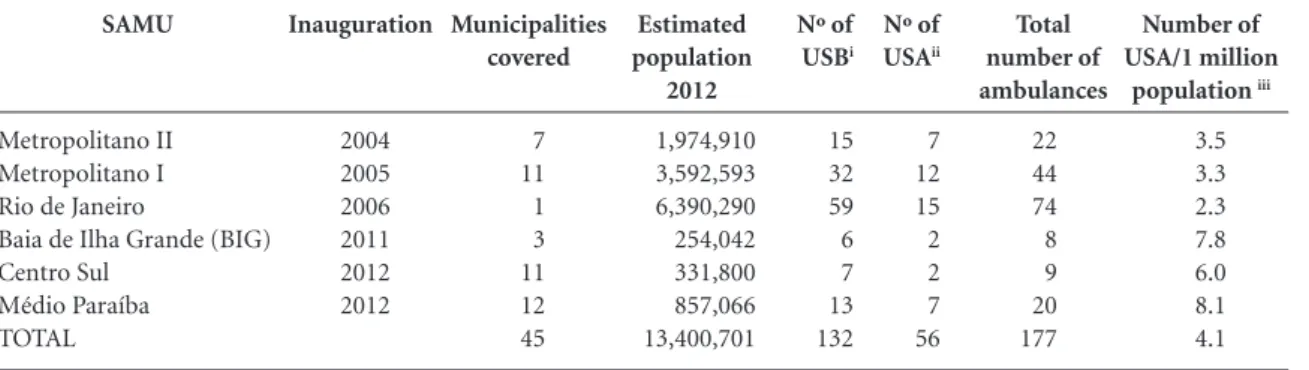
Table 1 summarizes the main characteristics of the six SAMUs present in the state in 2012, showing that the service achieved 82% popula-tion coverage.
In 2012, the number of Advanced Life Sup-port units (Unidades de Suporte Avançado - USA) per 1 million population was in accordance with national standards in all regions of the state with SAMU. The number was greater than the recom-mended average in periphery regions, which may be explained by the fact that the criteria used to define the number of units include both popu-lation and distance, while in the municipality of
Rio de Janeiro, the lower rate of USA per 1 mil-lion population may be explained by the higher population density and the fact that the teams of the intermediate ambulances include nurses.
The employment status of the staff at the SAMU Rio is different to that of the other ser-vices. All staff are members of the military, ex-cept for the primary civil regulators, who are em-ployed by a social organization.
With respect to the SAMU Metropolitano I and SAMU Metropolitano II, doctors are em-ployed in a number of different ways, with per-manent civil service employees working together with professionals employed on a contract basis with often precarious employment conditions and varying salaries. Each municipality is re-sponsible for employing their own staff.
According to certain interviewees, the em-ployment conditions in consortiums, such as those of the Centro-Sul and Três Rios regions, are better and these organizations can open public recruitment processes. In one of the SAMUs run by a consortium there was a low level of doctor and nurse turnover.
The interviewees suggested consortium man-agement as a way of meeting the expectations of municipalities in relation to each SAMU. One of the advantages of this form of management for the SAMUs in periphery regions was that it en-sured uniformity in the salaries of health profes-sionals.
Another critical structural issue related to the implementation of the SAMUs is capacity build-ing, given that urgent care is not recognized as a specialty for doctors and nurses in Brazil. The
Total number of ambulances
22 44 74 8 9 20 177
SAMU
Metropolitano II Metropolitano I Rio de Janeiro
Baia de Ilha Grande (BIG) Centro Sul
Médio Paraíba TOTAL
Inauguration
2004 2005 2006 2011 2012 2012
Municipalities covered
7 11 1 3 11 12 45
Table 1. Summary of the main characteristics of the Mobile Emergency Medical Service (SAMU) in the state of Rio de
Janeiro in 2012.
Estimated population
2012
1,974,910 3,592,593 6,390,290 254,042 331,800 857,066 13,400,701
Number of USA/1 million
population iii
3.5
3.3 2.3 7.8 6.0 8.1 4.1
Nº of
USBi
15 32 59 6 7 13 132
Nº of
USAii
7 12 15 2 2 7 56
Source: Health Ministry (www.saude.gov.br) and IBGE (population data). Elaborated by the authors.
i- USB = Basic Life Support Unit (Unidades de Suporte Básico). Ambulances used to transport patients classified as not needing a doctor; ii- USA = Advanced Life Support Unit (Unidades de Suporte Avançado). Ambulances used to provide care and transport high-risk patients who need intensive medical care. These ambulances should have a medical professional and the equipment necessary for this type of care;
aúd
e C
ole
tiv
a,
21(7):2189-2200,
2016
state emergencies coordinating office and Min-istry of Health seek to establish partnerships geared towards providing capacity building in Advanced Trauma Life Support (ATLS) and Ba-sic Life Support (BLS). However, despite the ef-forts made by the state and federal governments, in practice, the SAMUs have ended up adopting their own ways of providing capacity building for health professionals.
On its own, the municipality was not able by to provide training, so we sought out partnerships. One of the partnerships was with the Firefighters Corps, and the other was with professionals from the network. [...] we went over all the topics ad-dressed by the 2048 (ministerial order) and we invited the people from the network to give the courses (E 7).
Despite the capacity building efforts, local managers revealed that they were apprehensive with respect to the difficulties involved in keep-ing professionals, especially doctors.
In the SAMU Rio capacity building is the responsibility of the Firefighters Corps, who traditionally trained the military members who worked in the GSE.
Interviewees unanimously stated that the SAMU comprised an advance in emergency care and that there were prospects of expansion:
If the project was bad, the president and min-ister wouldn’t want to cover 100% of the country... Invest in something that doesn’t work... The project is good, it has grown, and the municipalities and regions have bought the idea and implemented [the service] (E 9)
... We are implementing because there is no way we can’t implement it... All the policies today ... Rede Cegonha (the Stork network), all the various kinds of policies are there “implementing SAMU”... Fund-ing is usually provided as part of “implemented SAMU”. We’ve passed the point of no return (E 7).
However, for the coordinators, the public negatively evaluate SAMU due to access difficul-ties and lack of understanding regarding what comprises an emergency demand.
But if you ask citizens they say that they can’t get through to 192. Or that their call wasn’t an-swered, or there wasn’t an ambulance available. (E 4). The public still doesn’t know how to use the SAMU. They think that it should solve every-thing... (E 5).
There are plans to expand the SAMU through-out the State of Rio de Janeiro. The next SAMU is planned for the Serrana region, covering 16 municipalities. However, the service had still not been implemented by the end of 2013. According
to the state coordinator of emergencies, the fact that 15 municipal secretaries were replaced after the 2012 elections delayed the agreements.
With respect to other regions that are void of coverage, a proposal to implement SAMUs in the North, Northeast, and Baixada Litorânea regions is currently being discussed.
A relatively high rate of turnover of SAMU coordinators was observed. In the metropolitan SAMUs, all the coordinators we replaced at least once during the study period. Seven out of the nine SAMU coordinators and all three state co-ordinators of emergency services interviewed during the study possessed the relevant qualifica-tions required for the function.
Coordination of SAMU activities with other services
The effective coordination of emergency care depends greatly on the availability of various types of healthcare network services. In this re-spect, the extent of primary healthcare coverage, availability of inpatient beds, and other types of emergency care services such UPAs, are particu-larly important. Table 2 shows the estimated cov-erage of the Family Health Strategy (Estratégia Saúde da Família - ESF), number of hospital beds per 1,000 population in the SUS, and number of UPAs in the regions covered by the SAMU in the State of Rio de Janeiro.
The SAMU is also intended to act as an ob-servatory of the healthcare network, where it is expected that primary healthcare coverage influ-ences emergency care. Primary healthcare cov-erage was greater in periphery regions, followed by metropolitan areas, while the municipality of Rio de Janeiro, where coverage has always been historically low, experienced rapid expansion as from 2010. However, the presence of ESF was not highlighted by local SAMU managers. In this re-spect, there was only one mention regarding the establishment of a collaborative relationship with primary care services, while for one of the state coordinators the role of primary care in the emer-gency care network needs to be problematized.
One of the difficulties we have with primary care is communication. Managers are unable to incorporate it [primary care] into the emergency network. Exactly because they are aware of the dif-ficulties involved in incorporating it (E 2).
O
’Dwy
We arrive and they always say that there are no beds, that it’s full, or they will detain my stretcher... So the “delta t” (time between responses) ends up being very long and hinders the liberation of the vehicle to respond to a new call (E 4).
If we take into consideration the parameters established by the national regulations (2.5 to 3 beds/1,000 population)20, it is possible to observe
that, with respect to the supply of beds in the re-gions covered by SAMU, only the region covered by the SAMU Central-Sul is above the recom-mended rate. However, there has been an increase in the number of beds throughout practically the whole state, except for three municipalities.
One problem that transcends the structural lack of beds is lack of integration between the services that make up the emergency care net-work.
We continue working in little boxes. A hospital is a hospital, a UPA is a UPA, the SAMU is the SAMU. None of these elements are incorporated into a network (E 2).
According to federal norms, this network should be formed and made available for the regulation of the SAMU. For the interviewees, agreements regarding standards between man-agers are not institutionalized, since emergency service doctors do not feel obligated to comply with them. Access to beds often depends on the personal relationship between doctors.
There are shift doctors who understand ze-ro-beds, and shift doctors who say there is no way that they can get in (E 5).
The relationship between the SAMU [teams] and hospitals ends up being a personal one. So the regulating doctor that is on shift says ‘ah so-and-so of emergency department so-and-so is my friend, I can put the patients there’. I think that the
relation-ship should be institutional, because that is what guarantees the patient a gateway [into the health system] (E 6).
In periphery regions, despite the relative lack of beds, the relationships are more collaborative. I know a chief doctor in the emergency care de-partment, I know the chief nurse in the emergency care department; when they have a problem with the SAMU they call me (E 8).
However, there is a problem regarding the place of origin of the patient when the referral is from another municipality that makes up the region.
The role of the state [government] has to be to intermediate these intermunicipal regulations: otherwise... the municipal manager chooses the beds (E 7).
The municipality of Rio de Janeiro’s hospital network is the largest in the country. However, it suffers from a low level of governability in re-lation to beds because the system is made up of municipal, state, federal, private and university hospitals. As a result, the interviewees mentioned that there is a shortage of beds in the capital.
The metropolitan regions lack services and face difficulties when it comes to using health equipment that belongs to the Municipality of Rio de Janeiro, which has been a frequent prac-tice until recently.
People must understand that an ambulance from a Baixada can no longer take a patient to Rio (E 5).
Another important component of emergency care networks that should be part of the SAMU is UPAs. The State of Rio de Janeiro is a pioneer in the implementation of UPAs, which it began in 2007 even before the creation of specific regula-tions by the federal government. The State of Rio Region
Baía de Ilha Grande Centro-Sul Médio Paraíba Metropolitana I Metropolitana II Rio de Janeiro
ESF coverage
76.30% 93.53% 76.99% 46.11% 76.63% 40.07%
Table 2. Estimated coverage of the Family Health Strategy, number of hospital beds per 1,000 population, and
number of UPAs in the regions covered by the SAMU in the State of Rio de Janeiro in 2012.
Nº of beds in the SUS/1,000 pop
1.07 5.18 1.88 1.65 2.21 1.97
Year UPA was inaugurated
2010 2009 1st UPA in 2008 1st UPA in 2008 1st UPA in 2010 1st UPA in 2007
Nº of UPAs
1 1 3 8 6 31
aúd
e C
ole
tiv
a,
21(7):2189-2200,
2016
de Janeiro had 61 UPAs in 2013, which is more than any other state in the country.
One of the requirements for implementing a UPA is that it must be linked to the SAMU. How-ever, it was observed that the UPAs in the three periphery regions were implemented before the SAMUs, contrary to the provisions of the federal regulations21. The three state emergency care
co-ordinators were favorable towards the UPAs and considered that they are part of the emergency care network, while some of the interviewees from the metropolitan regions were critical towards the UPAs. Some of the coordinators from the periph-ery regions considered that the UPAs are part of the regional emergency care system. Other coor-dinators criticized using UPAs as a strategy to re-duce hospital overcrowding and the provide cover for the closure of hospital emergency departments and emergency rooms in small towns.
So a UPA opens – that doesn’t solve the SAMU problem, it doesn’t solve the emergency problem. Why? Because a UPA is opened while a hospital emergency department is closed. Despite having a primary network that works, the region doesn’t have an “exit door” for the chronically ill... the emergency departments are full of elderly, diabetes, orthopedic, and cancer patients... (E – 6).
The state [government] should also be invest-ing in hospitals. Because UPAs are not like primary care, they don’t prevent patients from getting sick. They are the “exit door” of primary care. I mean that UPAs should be close to the PSF (Family Health Program). But they locate UPAs close to hospitals. So, instead of filling up just the hospitals, both fill up (E 5).
There is a shortage of beds in the emergency care network across the state. Personal relation-ships facilitate access to resources, particularly in the periphery regions. Despite studies carried out in the state having shown its importance, primary healthcare coverage was not mentioned by local managers as having an impact on the SAMU 15,16.
UPAs tend to act as a rearguard for the hospital system and are thus weakly integrated into SAMU.
Management of the SAMUs
Federal regulations have created specific mechanisms for managing and monitoring the SAMU. The National Emergency Care Steering Committee (Comitê Gestor Nacional de Atenção às Urgências) was created 22 as a formal space to
discuss and implement necessary modifications to the comprehensive emergency care system. In addition to the national committee, state,
region-al and municipregion-al steering committees should be established.
The national steering committee has been deactivated. The state steering committee, whose implementation was delayed, was also considered inactive by the three state emergency care coordi-nators, while Rio de Janeiro’s municipal steering committee has never been created. The steering committee of the SAMU Metropolitana II demon-strated consistent performance up to 2008, which facilitated the regionalization of emergency care in the region12, but has not met since then. The
re-gionalization of emergency care depends partially on the performance of these steering committees. The regionalization of the SAMUs is considered weak, is dependent on the municipalities, and re-ceives little support at state level.
Because you have a general coordinator who is placed to manage a region – but in fact he/she doesn’t manage anything, because each municipal-ity has a local manager – who has the power base. I, as general coordinator, end up being only a formal figure head (E 6).
There were municipalities that would refuse to pass the border – ‘I provide care up to the river here; after the river that’s it’. Then things began to change and we managed to change a lot of things. Each change of mayor leads to enormous opera-tional costs; you have to negotiate all over again, explain how it works, why he/she can’t think that the ambulances are his/hers (E 5).
The steering committee of the SAMU Met-ropolitana I, the least active, was influenced by the Regional Management Body (Colegiado de Gestão Regional - CGR).
The CGR is not going to be a partner of the con-sortium, unfortunately. It competes technically, in terms of implementing health policies; competing politically, with respect to power. (E 5).
The committees are more active in the pe-riphery regions. The three local coordinators confirmed that the regional steering committees held monthly meetings.
In 2011, the Health Ministry proposed the creation of State and Municipal Steering Groups (Grupo Condutor Estadual e Municipal) in each state, while maintaining the existing steering committees. The interviewees viewed this dupli-cation of regulating bodies as a problem.
What’s happening is that the emergency steer-ing group is not replacsteer-ing the emergency steersteer-ing committee (E 3).
O
’Dwy
times, care profile, and mortality rates, on a quar-terly basis.
The SAMUs studied here produce quarterly indicators that are sent to the Health Ministry. However, these indicators are neither used for local planning nor sent to the state government.
Few SAMUs currently use the software pro-vided by the Health Ministry. The federal govern-ment has indicated that it will be implegovern-menting a new SAMU information system. However, the solution found by the various centers is to im-plement their own system. The SAMU coordina-tors recognize that individualized systems do not help the SAMU fulfill its role as health observa-tory, since there is no communication between the systems, thus hindering the development of a national data base to provide input for integrated planning.
Despite advances in the implementation of regional SAMUs, the state government plays little part in planning and monitoring of the SAMU’s activities in Rio de Janeiro. Weaknesses were iden-tified in relation to the state government’s involve-ment in manageinvolve-ment and funding, and it was ob-served that the steering committees are generally ineffective. The state steering group recently ana-lyzed the regional emergency care plans.
Conclusion
Despite being a relatively new service, it could be said that the SAMU has played a key role in shap-ing emergency care in Brazil.
The findings of this study reveal a number of advances, limitations, and organizational chal-lenges facing mobile prehospital emergency care related to the political and institutional context, coordination with other services, and emergency care network management.
It also shows that the SAMU implementation process is conditioned by the trajectory of pre-hospital emergency care, the government drive to develop and promote the service, intergov-ernmental relations, and leadership of the local managers.
The State of Rio de Janeiro, with its extensive hospital network and prior experience in mobile prehospital care, got ahead of itself with the im-plementation of the regional SAMUs, leading to the need for improved intergovernmental coor-dination.
Brazilian federalism is one of the challeng-es facing the regional organization of the health
system, given that health regions must be built, governed, and funded through intergovernmental agreements and negotiations. Regionalization is a political process that requires certain entities to make concessions and affects power relations. It is therefore necessary to transcend the political and administrative boundaries of federative entities in order to promote the integration of the healthcare network, without however disregarding them23.
The results of this study are consistent with the findings of a recent study that demonstrat-ed that, despite the continuing challenges relatdemonstrat-ed to federal coordination, political coalitions be-tween federal, state and municipal governments contributed towards shaping the emergency care network in the State of Rio de Janeiro24.
Based on Giddens’ theory of structuration18,
the SAMU in the State of Rio de Janeiro gained substantial recognition and meaning as a tool for enhancing prehospital care. The consistency of the PNAU may be considered a structural feature in the form of “facility”. The “circumstances of action” were positively influenced by the govern-ment drive to develop and promote the service and the efforts made by the municipal secretaries.
However, although the ‘circumstances of the action’ for the implementation of the SAMU in the state have been relatively favorable, not all regions are covered by the service. Furthermore, although in general the SAMUs were initially im-plemented with sufficient structural resources, the replacement of these resources has differed by region, particularly in the metropolitan gions. One of the weaknesses highlighted in re-lation to authoritative resources was the weak governability of the steering committees, which has serious consequences for the legitimization of regulatory activities. The main restriction ob-served by the study was the limited role played by the state government. Addressing the constraints highlighted by this study is essential to ensuring the expansion and effective operation of mobile prehospital care in the state.
One of the limitations of the study was the lack of access to SAMU production indicators, which were not made available by the managers despite requests.
aúd
e C
ole
tiv
a,
21(7):2189-2200,
2016
References
Machado CV, Baptista TWF, Nogueira CO. Política de saúde no Brasil nos anos 2000: a agenda federal de prioridades. Cad Saude Publica 2011; 27(3):521-532. Brasil. Ministério da Saúde (MS). Portaria MS/GM nº 1863, de 29 de setembro de 2003. Diário Oficial da Na-ção 2003; 6 out.
Machado CV, Salvador FGF, O´Dwyer G. O Serviço de Atendimento Móvel de Urgência no Brasil: uma análise da política nacional. Rev Saude Publica 2011; 45(3):519-528.
Wang HE, Mann NC, Jacobson KE, Mears G, Smyrski K, Yealy DM. National characteristics of emergency medical services responses in the United States. Prehosp
Emerg Care 2013; 17(1):8-14.
Cone DC, Irvine KA, Middleton PM. The methodology of the Australian Prehospital Outcomes Study of Lon-gitudinal Epidemiology Project. Prehosp Emerg Care
2012; 16(4):505-512.
Brasil. Ministério da Saúde (MS). Portaria MS/GM nº 2048, de 5 de novembro de 2002. Diário Oficial da Na-ção 2002; 12 nov.
Brasil. Ministério da Saúde (MS). Portaria MS/GM nº 1864, de 29 de setembro de 2003. Diário Oficial da Na-ção 2003; 6 out.
Brasil. Ministério da Saúde (MS). Portaria MS/GM nº 1600, de 7 de julho de 2011. Diário Oficial da Nação
2011; 8 jul.
Brasil. Ministério da Saúde (MS). Sala de Apoio à Ges-tão Estratégica (SAGE). Brasília: MS; 2013.
Ciconet RM, Marques GQ, Lima MADS. Educação em serviço para profissionais do Serviço de Atendi-mento Móvel de Urgência (SAMU):relato da experi-ência de Porto Alegre – RS. Interface (Botucatu) 2008; 12(26):659-666.
Evangelista PA, Barreto SM, Guerra HL. Central de re-gulação de leitos do SUS em Belo Horizonte, Minas Ge-rais: avaliação de seu papel pelo estudo das internações por doenças isquêmicas do coração. Cad Saude Publica
2008; 24(4):767-776.
Lima JC, Rivera FJU. Redes de conversação e coorde-nação de ações de saúde: estudo em um serviço móvel regional de atenção às urgências. Cad Saude Publica
2010; 26(2):323-336.
Minayo MCS, Deslandes SF. Análise da implantação do sistema de atendimento pré-hospitalar móvel em cinco capitais brasileiras. Cad Saude Publica 2008; 24(8):1877-1886.
O’Dwyer G, Konder MT, Machado CV, Alves CP, Alves RP. The current scenario of emergency care policies in Brazil. BMC Health Services Research 2013; 13:70. O’Dwyer, G, Mattos, RA. O SAMU, a regulação no esta-do esta-do Rio de Janeiro e a integralidade segunesta-do gestores dos três níveis de governo. Physis 2012; 22(1):141-160. O’Dwyer G, Mattos, RA. O cuidado integral e a aten-ção às urgências: o Serviço de Atendimento Móvel de Urgências no Estado do Rio de Janeiro. Saúde Soc 2013; 22(1):199-210.
Belon AP, Yanagizawa N, Silveira MJ, Barros MBA, Bal-do C, Silva MMA. Atendimentos de emergência a víti-mas de violências e acidentes: diferenças no perfil epi-demiológico entre o setor público e o privado. VIVA – Campinas/SP. Cien Saude Colet 2012; 17(9):2279-2290. Giddens A. A constituição da Sociedade. São Paulo: Martins Fontes; 1984.
1.
2.
3.
4.
5.
6.
7.
8.
9.
10.
11.
12.
13.
14.
15.
16.
17.
18. Collaborators
G O’Dwyer was responsible for study conception and design, data analysis and interpretation, car-rying out field research, drafting this article and its critical review and approval of the version to be published. CV Machado was responsible for study conception and design, data analysis and interpretation, drafting this article and its crit-ical review and approval of the version to be published. RP Alves was responsible for carrying out field research and drafting this article and its critical review and approval of the version to be published. FG Salvador was responsible for car-rying out field research and drafting this article and its critical review and approval of the version to be published.
Acknowledgements
O
’Dwy O’Dwyer G. A gestão da atenção às urgências e o
pro-tagonismo federal. Cien Saude Colet 2010; 15(5):2395-2404.
Brasil. Ministério da Saúde (MS). Portaria MS/GM nº 1101, de 12 de junho de 2002. Diário Oficial da União
2002; 14 jun.
Brasil. Ministério da Saúde (MS). Portaria MS/GM nº 2648, de 7 de novembro de 2011. Diário Oficial da União 2011; 8 nov.
Brasil. Ministério da Saúde (MS). Portaria MS/GM nº 2072, de 30 de outubro de 2003. Diário Oficial da União
2003; 31 out.
Viana ALA, Lima LD, organizadores. Regionalização e relações federativas na política de saúde do Brasil. Rio de Janeiro: Ed. Contra Capa; 2011.
Lima LD, Machado CV, O’Dwyer G, Baptista TWF, An-drade CLT, Konder MT. Interdependência federativa na produção de políticas de saúde: a experiência das Unidades de Pronto Atendimento no estado do Rio de Janeiro. Cien Saude Colet 2015; 20(2):595-606.
Article submitted 10/10/2014 Approved 11/08/2015
Final version submitted 13/08/2015 19.
20.
21.
22.
23.