© 2015 Dental Press Journal of Orthodontics 13 Dental Press J Orthod. 2015 May-June;20(3):13-5
Evidence-based
Orthodontics
Reconciling scientiic research results with clini-cal practice represents a major challenge to healthcare professionals, including orthodontists.1-4 Current cal decision-making should be mainly based on clini-cal trials comparing two or more treatment or diag-nosis methods. These trials are known as randomized controlled trials (RCTs) and are considered the gold standard in scientiic evidence. The quality of RCTs can be assessed based on criteria pre-established by CONSORT (Consolidated Standards of Reporting Trials).5
CONSORT is a protocol developed by a group of researchers not only to identify problems arising from conducting RCTs, but also to report, in a full and clear manner, the results yielded by research, thereby facili-tating RCTs reading and quality assessment.5,6,7 It com-prises a 25-item checklist focused on scientiic article writing (available at www.consort-statement.org). This checklist provides us with standards of how the tri-al was designed, antri-alyzed and interpreted. Thus, it con-sists in a useful tool that allows the researcher to conduct a RCT and the clinical orthodontist to critically assess the quality of evidence provided.
As a result, the orthodontist is able to employ treat-ment or diagnosis methods in his clinical practice in a
safer and more reliable manner. In addition, he will be able to assess the quality of RCTs throughout its entire structure. In order to render analysis comprehension easier, the CONSORT checklist was divided into six categories, according to the parts of an article:
1 - Title and abstract: the title should be concise and the word “randomized” should be used. The abstract should be structured and include: trial design, methods, main results and conclusions.
2 - Introduction: it should include a brief literature re-view, the rationale for the trial and the objective or hypoth-esis, all of which reported in a clear and objective manner. 3 – Method: it should be carefully reported as follows: trial design; eligibility criteria for partici-pants, with explanation of rationale for such criteria; how and where data were collected; thorough de-scription of intervention, which allows results to be reproduced; description of sample size calculation; changes during the course of trial, with clear reasons; thorough description of methods used for alloca-tion into the trial groups, participants and evaluators blinding; and proper statistical analysis.
4 - Results: primary intervention results should be assessed for each group; the number of
partici-Contact address: Leandro Silva Marques E-mail: [email protected]
How to cite this article: Falci SGM, Marques LS. Consort: when and how to use it. Dental Press J Orthod. 2015 May-June;20(3):13-5.
DOI: http://dx.doi.org/10.1590/2176-9451.20.3.013-015.ebo
1 Post-doctorate student (Dental Clinic), Universidade Federal dos Vales do
Jequitinhonha e Mucuri (UFVJM), Diamantina, Minas Gerais, Brazil.
2 Adjunct professor of Orthodontics, Universidade Federal dos Vales do
Jequitinhonha e Mucuri (UFVJM), Diamantina, Minas Gerais, Brazil.
Submitted: March 09, 2015 - Revised and accepted: March 26, 2015
CONSORT: when and how to use it
© 2015 Dental Press Journal of Orthodontics 14
CONSORT: when and how to use it
Dental Press J Orthod. 2015 May-June;20(3):13-5
Evidence-based Orthodontics
pants, assessment losses and exclusions should also be reported for each group, reasons should be clearly stated; post intervention assessment and follow-up periods should be reported; statistical methods used to obtain values of primary and secondary outcomes for each group (e.g. 95% confidence interval) should be reported.
5 – Discussion: it should present: trial limitations addressing sources of potential bias, imprecision and methodological weaknesses; external validity; ap-plicability and interpretation consistent with results, balancing benefits and harms, considering other published evidence.
6 – Other information: the RCT should be
registered and the registry number presented; full trial protocol should be available; sources of fund-ing and other support, as well as the role of funders should be highlighted.
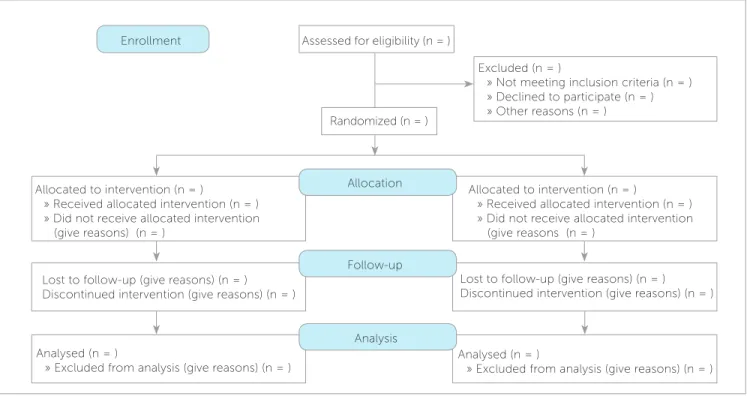
In addition to the checklist, CONSORT also en-compasses a flow diagram which provides the reader with information about how the trial was conducted, reporting enrolment, allocation, follow-up and
analysis of patients involved in the RCT (Fig 1).5
Importantly, the clinical orthodontist should analyze the presence and quality of this flow diagram in the
trial being assessed, since it provides a broad view of how the trial was conducted, in addition to concisely reporting the employed method.
The aforementioned CONSORT criteria have been used for RCTs analysis by more than 600
in-ternational periodicals.8 In Orthodontics, some
prominent journals such as the European Journal of Orthodontics and the American Journal of Or-thodontics and Dentofacial Orthopedics began to be based on these criteria in order to accept RCTs for publication. A study reports significant improve-ments in the quality of RCTs after these journals be-gan to adopt CONSORT criteria. Such progress was particularly noticed in articles published from 2010 on, when CONSORT was revised. Special attention should be given to articles published by the Journal of Orthodontics. Nevertheless, results varied
consid-erably.9 On the other hand, another study recently
published on the Journal of Evidence-Based Dental Practice concluded that the methodological quality of RCTs in prominent orthodontic journals was be-low expectations. This study highlighted that its re-sults could be compared to other dental and medical periodicals,10 which certainly does not justify low-quality RCTs in Orthodontics.
Enrollment
Excluded (n = )
» Not meeting inclusion criteria (n = ) » Declined to participate (n = ) » Other reasons (n = )
Allocated to intervention (n = )
» Received allocated intervention (n = ) » Did not receive allocated intervention (give reasons (n = )
Allocated to intervention (n = )
» Received allocated intervention (n = ) » Did not receive allocated intervention (give reasons) (n = )
Lost to follow-up (give reasons) (n = ) Discontinued intervention (give reasons) (n = ) Lost to follow-up (give reasons) (n = )
Discontinued intervention (give reasons) (n = )
Analysed (n = )
» Excluded from analysis (give reasons) (n = ) Analysed (n = )
» Excluded from analysis (give reasons) (n = )
Assessed for eligibility (n = )
Randomized (n = )
Figure 1 - CONSORT flow diagram of the progress through the phases of a parallel randomised trial of two groups (that is, enrolment, intervention allocation, follow-up, and data analysis). Available at: http://www.consort-statement.org/consort-statement/flow-diagram
Allocation
Follow-up
© 2015 Dental Press Journal of Orthodontics 15 Falci SGM, Marques LS
Dental Press J Orthod. 2015 May-June;20(3):13-5
Evidence-basedOrthodontics
1. Normando D. The clinician and the scientiic evidence. Dental Press J
Orthod. 2013;18(2):1.
2. Mariano MT, Januzzi E, Grossmann E. Scientiic evidence-based
orthodontics: incorporating science within clinic practice. Dental Press J Orthod. 2009;14(3):107-13.
3. Normando D. When the mean is an empty plate for clinicians and
scientists, and a full plate for politicians and writers. Dental Press J Orthod. 2014;19(5):14-5.
4. Angelieri F. Evidence-based orthodontics: has it something to do with your patient? Dental Press J Orthod. 2013;18(5):11-3.
5. Schulz KF, Altman DG, Moher D. CONSORT Group. CONSORT 2010
Statement: updated guidelines for reporting parallel group randomised trials. BMJ. 2010;340:c332.
6. Begg C, Cho M, Eastwood S, et al. Improving the quality of reporting of randomized controlled trials. The CONSORT statement. JAMA. 1996;276(8):637-9.
7. Moher D, Schulz KF, Altman DG. The CONSORT statement: revised
recommendations for improving the quality of reports of parallel-group randomized trials. Ann Intern Med. 2001;134:657-62.
8. Pandis N, Shamseer L, Kokich VG, Fleming OS, Moher D. Active
implementation strategy of CONSORT adherence by dental specialty journal improved randomized clinical trial reporting. J Clin Epidemiol. 2014;67(9):1044-8.
9. Sandhu SS, Sandhu J, Kaur H. Reporting quality of randomized controlled
trials in orthodontics-what afects it and did it improve over the last 10 years? Eur J Orthod. 2014 Sep 6. pii: cju050. [Epub ahead of print]. 10. Lempesi E, Koletsi D, Fleming PS, Pandis N. The reporting quality of
randomized controlled trials in orthodontics. J Evid Based Dent Pract. 2014;14(2):46-52.
11. Mattos CT, Ruellas ACO. Systematic review and meta-analysis: What are the implications in the clinical practice? Dental Press J Orthod. 2015;20(1):17-9.
12. Moher D, Liberati A, Tetzlaf J, Altman DG, PRISMA Group. Reprint: preferred reporting items form systematic reviews and meta-analyses: the PRISMA statement. Phys Ther. 2009;89(9):873-80.
REFERENCES While critically assessing an RCT, the clinical
orthodontist should pay close attention to how co-herent CONSORT checklist items and the charac-teristics of the assessed trial are. Clinicians should understand that, in some studies, there is no need for complete adhesion to all CONSORT items. One example is a study that assessed the level of adhesion to the CONSORT checklist by the American Jour-nal of Orthodontics and Dentofacial Orthopedics. Results revealed that articles conformed with 33 of 37 items from the checklist. According to the author, the following four items were not contemplated: changes to methods (3b), changes to outcomes (6b) after the trial commenced, interim analysis (7b), and trial stopping (14b), which were not rendered neces-sary for the assessed variables.8
Another valuable tool used to guide the clinical orthodontist towards an evidence-based practice is the search for systematic literature reviews and
meta-analysis of RCTs.11 These have currently been the
types of study that provide the best scientific evi-dence for clinical decision-making. They assess the methodological quality, conduct and writing of vari-ous RCTs on the same theme by means of scores, and are assessed in accordance with PRISMA
check-list (2009)12 which includes the CONSORT
check-list items. Thus, RCTs are classified as having low, medium and high risk of bias. However, it is com-mon to find systematic reviews yielding inconclusive results due to low methodological quality of RCTs, which, most of times, results from lack of proper de-scription of what is contemplated by the guidelines. In these cases, the orthodontist should focus on criti-cally assessing RCTs available in the literature, and use the results of trials considered of good method-ological quality, so as to guide their practice.