RESUmo
Este estudo teve como objeivo avaliar a validade de conteúdo do diagnósico de
enfermagem Náusea no período
pós-ope-ratório imediato, considerando-se o mode-lo de Fehring. Estudo descriivo com 52 ex-pertos que responderam um instrumento que coninha dados de ideniicação e de
validação do diagnósico Náusea. A
maio-ria dos expertos considerou o domínio 12 (Conforto), a classe 1 (Conforto ísico) e o enunciado (Náusea) adequados ao diag-nósico. Foram sugeridas modiicações na deinição atual do diagnósico de enfer-magem em estudo. Quatro caracterísicas deinidoras foram consideradas principais (relato de náusea, salivação aumentada, aversão à comida e sensação de vômito) e oito secundárias (degluição aumentada, gosto amargo na boca, palidez, taquicardia, diaforese, sensação de calor e frio, altera-ções da pressão arterial e dilatação pupi-lar). O escore total do diagnósico Náusea foi de 0,79. O relato de náusea, sensação de vômito, salivação aumentada e aversão à comida são fortes indicaivos do diagnós-ico de enfermagem Náusea.
dESCRitoRES
Diagnósico de enfermagem Náusea
Cuidados pós-operatórios Estudos de validação
Content validation of the nursing
diagnosis
Nausea
*O
riginal
a
rticle
AbStRACt
This study aimed to evaluate the con-tent validity of the nursing diagnosis of nausea in the immediate post-operaive period, considering Fehring’s model. De-scripive study with 52 nurses experts who responded an instrument contain-ing ideniicaion and validaion of nausea diagnosis data. Most experts considered the domain 12 (Comfort), Class 1 (Physi-cal Comfort) and the statement (Nausea) adequate to the diagnosis. Modiicaions were suggested in the current deiniion of this nursing diagnosis. Four deining characterisics were considered primary (reported nausea, increased salivaion, aversion to food and vomiing sensaion) and eight secondary (increased swallow-ing, sour taste in the mouth, pallor, tachy-cardia, diaphoresis, sensaion of hot and cold, changes in blood pressure and pupil dilaion). The total score for the diagnosis of nausea was 0.79. Reports of nausea, vomiing sensaion, increased salivaion and aversion to food are strong predictors of nursing diagnosis of nausea.
dESCRiPtoRS
Nursing diagnosis Nausea
Postoperaive care Validaion studies
RESUmEn
Este estudio tuvo como objeivo evaluar la validez de contenido del diagnósico de enfermería de las náuseas en el postope-ratorio inmediato, teniendo en cuenta el modelo de Fehring. Se trata de un estudio descripivo con 52 expertos que respondie-ron un instrumento que contenía los datos de ideniicación y validación del diagnósi-co de náuseas. La mayoría de los expertos consideran el dominio 12 (Confort), Clase 1 (Confort ísico) y el estado (Náusea) ade-cuados para el diagnósico. Fueron sugeri-das modiicaciones en la deinición actual del diagnósico de enfermería en estudio. Se consideraron cuatro caracterísicas dei-nitorias como principales (verbalización de náuseas, aumento de la salivación, aver-sión a la comida y sensación de vómito) y ocho secundarias (aumento de la deglu-ción, sabor amargo en la boca, palidez, taquicardia, sudoración, sensación de calor y frío, cambios en la presión arterial y di-latación de la pupila). La puntuación total del diagnósico de náusea fue de 0,79. El reporte de náuseas, sensación de vómito, aumento de la salivación y la aversión a los alimentos sólidos son fuertes indicadores del diagnósico de enfermería de náusea.
dESCRiPtoRES
Diagnósico de enfermería Náusea
Cuidados postoperatorios Estudios de validación
daniele Alcalá Pompeo1, Lídia Aparecida Rossi2, Luciana Paiva3
ValIdação de coNTeúdo do dIaGNósTIco de eNfermaGem náusea
ValIdacIóN de coNTeNIdo del dIaGNósTIco de eNfermerÍa náusea
*extracted from thesis “Validação do diagnóstico de enfermagem náusea no período pós-operatório imediato”, Inter-Unit doctoral Program in Nursing of ribeirao Preto school of Nursing, University of sao Paulo, 2012. 1 Professor, Phd, specialized Nursing departament, sao Jose do rio Preto faculty of
medicine, sao Jose do rio Preto, sP, Brazil. [email protected] 2 full Professor, ribeirao Preto school of Nursing, University of sao Paulo, ribeirao
Preto, sP, Brazil. 3 Phd student, ribeirao Preto school of Nursing, University of sao Paulo, ribeirao Preto, sP, Brazil.
intRodUCtion
For a nursing diagnosis to be included in the NAN-DA-I taxonomy or to go through the review process, it needs to be based on research, such as concept analy-sis, content validity, and construct validity and related criteria, validation by consensus and studies about di-agnostic accuracy(1).
The validaion of nursing diagnoses is recommended for all their components, i.e. itle, deiniion, deining characterisics, related factors, and even for the taxonom-ic structure itself, as it has been done in other classitaxonom-ica- classiica-ions(2). Most researches currently have focused only on
validaion of deining characterisics contained in a diag-nosis of NANDA-I taxonomy(3-4). The analysis of all
compo-nents provides subsidies for understanding not only nurs-ing diagnoses studied, but also the sphere of acivity in which it is inserted.
Depending on the objecives of the researcher, one can validate nursing diagnoses considering three models of validaion: Diagnosic Content Validaion - DCV; Clini-cal Diagnosic Validaion - CDV and Diferenial Diagnos-ic Validaion - DDV(5).
The Diagnosic Content Validaion, object of this study, is based on opinions of nurses experts or judges about the degree to which each deining characterisic is indicaive of a paricular nursing diagnosis. The author recommends conducing a literature review prior to use of the method, in order to provide theoreical support for the under-standing of the studied diagnosis and its components(5).
Before the Nursing Diagnosis Content Validaion, oth-er researchoth-ers have emphasized the need to conduct an integraive review of the literature, aiming to summarize the research on a paricular subject in a systemaic man-ner, and follow standards of methodological rigor, which enable the reader to idenify the characterisics of the an-alyzed studies and provide subsidies to the advancement of nursing(6).
The nursing diagnosis of nausea, present in the NANDA-I taxonomy II(1) is focused in the context of
can-cer patients, it does not express comprehensively the real needs of patients in the post-operative period. Moreover, in the specific literature of the post-opera-tive period, we find numerous studies addressing fac-tors related to nausea, which are not described in NAN-DA-I and are identified frequently in clinical practice. Therefore, it is recommended to conduct validation studies, aimed at reviewing the elements that consti-tute the diagnosis of Nausea, making it more accurate to guide, effectively, the establishment of outcomes and nursing interventions.
The aim of this study was to assess the content valid-ity of nursing diagnosis of Nausea in the immediate post-operaive period, considering Fehring’s model(5).
mEtHod
Non-experimental, descripive study whose popula-ion was composed of experts on the studied nursing di-agnosis. The content validaion does not require sample size calculaion, however, the model used in this study recommends the need for 50-100 nurses(5).
Some criteria have been described so that a nurse may be considered an expert on nursing diagnosis. Each criteri-on described presents a score, and to be ccriteri-onsidered an ex-pert, the person needs to obtain a minimum of ive points (criteria/points: Master Degree in Nursing: 4; Master De-gree in nursing with dissertaion content directed to nurs-ing diagnosis study: 1; publicaion of aricle in nursnurs-ing diag-nosis in reference journals: 2; Aricle published on nursing diagnoses with relevant content to the area: 2; PhD in the ield of nursing diagnosis: 2; Clinical experience, at least one year in the study area of diagnosis: 1 and Ceriicate (specializaion) of relevant clinical pracice in the ield of the diagnosics studies: 2. The higher the score, the greater the strength of the assessment evidence(7).
The sample consisted of 52 Brazilian nurses who had, at least, a master degree, who worked with nursing di-agnoses and paient care in the post-operaive period, teaching or researching. Paricipants with scores lower than ive were excluded according to Fehring’s(5) criteria,
regarding the selecion of experts. The selecion of parici-pants was done through acive search for expert profes-sionals of the above areas, in the Lates Plaform of the Naional Council for Scieniic and Technological Develop-ment - CNPq (Lates and Research Groups Directory) and by snow ball sampling type, which consists in selecion of paricipants, by appointment or recommendaion of pre-vious paricipants(8).
An instrument of data collecion, consising of two parts, was prepared: the irst containing ideniicaion and professional experience (expert) data, and the second re-lated to the nursing diagnosis validaion of nausea (state-ment, deiniion, posiion it occupies in the data structure and deining characterisics with their operaional deini-ions, described on a Likert scale). The expert was asked to assign a value to each deining characterisic of nausea diagnosis on a scale of 1 to 5, wherein the number 1 rep-resented the category of not relevant and the number 5
highly relevant. A review of the statement, the deiniion and taxonomic structure was based on three judgments: I agree, I parially agree and I disagree.
Ater developing the quesionnaire, we conducted an appearance and content validaion by ive PhDs nurses and experts in the themaic nursing diagnosis and peri-operaive nursing through an adapted instrument(4). High
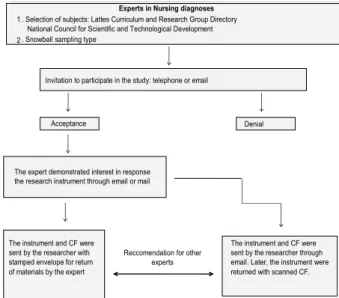
Data collecion began with a telephone call or a mes-sage sent by email to the expert nurse. At that moment, experts were informed about the study and were invited to paricipate. Upon posiive response, the paricipant ex-pressed interest in responding to the research in a printed or digital form. In the irst contact, we asked the nurse’s address for posing the Consent Form (CF), quesionnaire and stamped envelope for later reply. If the opion was digital form, the CF and the quesionnaire, previously cre-ated in Microsot Word sotware, were sent by email. The quesionnaire was returned with the answers illed in, and the Consent Form was scanned by the expert and sent to the researcher by email. During this irst contact, we asked them for informaion about other nurses with ex-pert proiles (Figure 1). Data collecion period lasted for four months (March-June 2011) and it was performed by the researcher.
The returned quesionnaires by the experts were ana-lyzed and each deining characterisic received a score (1 - highly relevant; 0.75 - very perinent, 0.50 - some relevance; 0.25 - somehow relevant; 0 - not relevant)(5).
Then, we calculated the weighted averages and subse-quent classiicaion of elements - higher weighted aver-age or equal to 0.80: Primary; averaver-ages between 0.50 and 0.79: Secondary and average lower than 0.50: irrelevant. Finally, the total DCV was calculated from the sum of the weighted averages divided by the total number of dein-ing characterisics.
The analysis of the responses of the experts as to the statement, deiniion and posiion in the taxonomic struc-ture (I agree, I parially agree and I disagree) was per-formed using simple frequency.
The research project was approved by the Ethics Com-mitee (EC) of the Faculty of Medicine of Sao Jose do Rio Preto - FAMERP as determined by Resoluion 196/96 of
the Naional Board of Health for research involving human subjects (Protocol No. 0456/2011).
RESULtS
We sent 80 invitaions to qualiied nurses so that they could paricipate as experts. From the total invited, 21 did not respond to the invitaion, four declined be-cause they did not consider themselves experts on the subject of the research, two were excluded because they did not reach the minimum score to be considered an expert and one did not accept due to lack of ime. Thus, the sample consisted of 52 expert nurses, most were fe-male (96.15%) (Table 1).
Most paricipants had a PhD (75 %), followed by 17.31% who were PhD candidates during the research and 7,69% had a master’s degree. Regarding professional oc-cupaion, 42.31% were professors, researches and provid-ed care service, 42.31% were professors and researches, 3.85% were researches and provided care services, 5.77% were professors and provided care services, 3.85% were only professors and 1.92% were only researches. The ar-eas of experise of the professional paricipants were: nursing diagnosis (40.38%), peri-operaive nursing and nursing diagnosis (30.77%), peri-operaive nursing (25%) and others (3.84%).
From the 52 experts who paricipated in the study, 45 (86.54%) claimed to idenify nursing diagnoses in their prac-ice always (19.23%), oten (48.07%), rarely (28.85%) and never (3.85%). The experts who answered never are those who do not use nursing diagnosis in their current pracice.
Most paricipants (75%) achieved a score equal to or greater than 11 in the selecion criteria of the experts. The mean score was 11.63 points, the median was 12 points, the standard deviaion was 2.24 and the range was 7-14 points.
Most nurses (82.69%) agreed with the locaion of di-agnosis of nausea in the domain 12, Comfort. Six nurses (11.54%) parially agreed, and three (5.77%) disagreed. Comments made by nurses who parially agreed or dis-agreed were: nausea could be allocated for domain 3 – Eliminaion/exchange or for the domain 11 – Safety/Pro-tecion; there is no other domain where the diagnosis its; the deiniion of the domain must be improved to be ap-propriate to the diagnosis.
Table 1 - Characterization of expert participants from the content validation step of the nursing diagnosis of nausea - Sao Jose do Rio Preto, SP 2011
Data on experts Mean Median SD Max. value Min. value
Age 44.02 45.00 10.49 68.00 26.00 Time they have
worked as a
nurse 20.92 21.00 10.50 45.00 3.00
Figure 1 - Flowchart of data collection step of content valida-tion of nursing diagnosis of nausea
Experts in nursing diagnoses
1. selection of subjects: lattes curriculum and research Group directory National council for scientific and Technological development 2. snowball sampling type
Invitation to participate in the study: telephone or email
acceptance denial
The expert demonstrated interest in response the research instrument through email or mail
The instrument and cf were sent by the researcher with stamped envelope for return of materials by the expert
reccomendation for other experts
Forty-one nurses (78.85%) agreed with the fact that the nursing diagnosis of nausea should remain in Class 1 - Physical Comfort; 15.35% and 5.77% parially agreed and disagreed, respecively. The reasons given by nurses who disagreed or parially agreed were: deiniion of the class physical comfort needs to be reviewed; nausea diagno-sis should also be contained in Classes 2 (Environmental Comfort) and Class 3 (Social Comfort).
Most experts agreed that the nausea statement is ap-propriate to the diagnosis (98.08%). Only one expert par-ially agreed considering that nausea could be a deining characterisic and not a nursing diagnosis.
Most experts agreed that the deiniion of nausea is adequate (82.70%). Eight (15.38%) parially agreed, and one (1.92%) disagreed. The statements of the experts who parially agreed and disagreed were: a) exclude the subjecive deiniion of the word; nausea is a subjecive sensaion, but also an objecive symptom for the possi-bility of objecive veriicaion of suggesive signs of nau-sea; b) insert in the deiniion aspects related to the in-tensity of nausea; c) insert the background to the concept
of nausea; d) replace the terms throat, epigastrium and abdomen by a single term - abdominal region; e) further specify the statement a wave at the back of the throat; f) present a new deiniion (subjecive sensaion of disgust to food, including its odor. Rising sensaion of vomiing, and accompanied by signs such as: hypersalivaion, dia-phoresis, tachycardia, pallor and tachypnea).
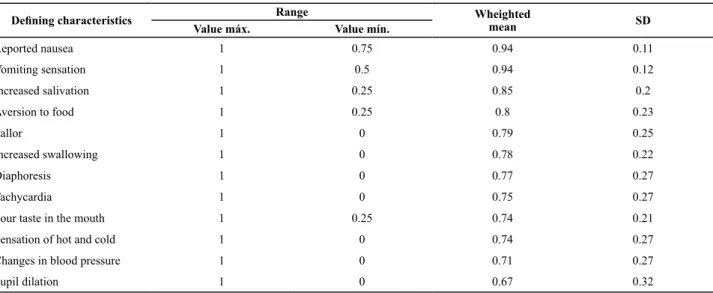
The experts judged the relevance of the deining characterisics of the nursing diagnosis of nausea. Table 2 shows the maximum, minimum, weighted mean and standard deviaion values of each deining characterisic evaluated. The deining characterisics may be considered primary, secondary and irrelevant.
Four deining characterisics were considered primary (reported nausea, increased salivaion, aversion to food and vomiing sensaion), and eight were called second-ary (increased swallowing, sour taste in the mouth, pal-lor, tachycardia, diaphoresis, sensaion of hot and cold, changes in blood pressure and pupil dilaion).
The total score of the nursing diagnosis was 0.79.
Table 2 - Deining characteristics of the nursing diagnosis of nausea, according to the score obtained in the content validation - Sao Jose do Rio Preto, SP 2011
Deining characteristics Range Wheighted mean SD
Value máx. Value mín.
Reported nausea 1 0.75 0.94 0.11 Vomiting sensation 1 0.5 0.94 0.12 Increased salivation 1 0.25 0.85 0.2 Aversion to food 1 0.25 0.8 0.23
Pallor 1 0 0.79 0.25
Increased swallowing 1 0 0.78 0.22
Diaphoresis 1 0 0.77 0.27
Tachycardia 1 0 0.75 0.27
Sour taste in the mouth 1 0.25 0.74 0.21 Sensation of hot and cold 1 0 0.74 0.27 Changes in blood pressure 1 0 0.71 0.27 Pupil dilation 1 0 0.67 0.32
diSCUSSion
The content validaion is based on the opinion of ex-perts on the topic under study, therefore, the ideniica-ion and selecideniica-ion of these professideniica-ionals become the focus in studies using this methodological approach. Inad-equate choice of experts selecion criteria may interfere with the reliability of the results, since these experts will be responsible for the task of judging how each compo-nent studied will represent the diagnosic class, and hence this should be invesigated in clinical validaion(9).
Obtaining experts have been a diiculty in the vali-daion studies of nursing diagnoses(9-10), since there is
disagreement in the literature regarding the necessary
requirements for deining an Expert. Addiionally to the small number of experts in the themaic of nursing diag-noses and oten lack of ime of these professionals to re-spond the research quesions with themaic oriented to validaion. Authors add that, in order to invite nurses ex-perts from other countries, linguisic and cultural aspects must taken into account(9).
Other studies of content validaion showed higher, similar or lower number of experts when compared to the number of experts in this search: 120 nurses (nurs-ing diagnosis of anxiety)(11), 72 experts (nursing diagnosis
vascular trauma)(13), 58 experts (nursing diagnosis of
nau-sea)(14), 50 experts (diagnosis of deicient knowledge)(4), 32
experts (diagnosic of sexual dysfuncion and inefecive sexuality patern)(15), 16 experts (diagnosic of fear and
anxiety)(16), 21 experts (nursing intervenions for paients
with diabetes mellitus)(17).
Most experts were females, a fact associated with the historical context of the profession, in which men are dis-couraged to follow nursing due to a stereotypical view of homosexuality, low salaries and less respect of the com-munity in comparison to other Professional classes(18).
The average age of the experts who paricipated in the study was 44.02 years; and the average ime they have worked as a nurse was 20.92 years. Other authors of similar studies reported these variables as important posiive points for idenifying an Expert(12,16). The work
ex-perience of nurses is essenial because it can help in the early ideniicaion of real or potenial health problems presented by the paients, and as professional pracice coninues, it was observed that the clinical experience increases proporionally with the ime of pracical expe-rience. Pracical experience, skills and values are consi-tuted in diferent type of knowledge, which has a strong inluence on decision making. While the explicit elements are taught formally, tacit elements are acquired during observaion and pracice(19).
Regarding ceriicaion, 75% of the paricipants had PhDs, 17.31% were PhD candidates and 7.69% had a mas-ter’s degree. The more ceriicates, the more researches were conducted and/or the greater the clinical experience of the nurse, the more expert they will be(9).
In this study, experts were professors, researchers and provided care services (42.31%) or they were profes-sors and researches (42.31%). The experience in diferent ields of work is an important characterisic of the expert to the reliability of the results, in a content validaion(4).
The ideniicaion and use of nursing diagnoses in clinical pracice, despite being part of the process of nursing work and being regulated by the Federal Nursing Council Reso-luions 272/2002 and 358/2009, although not imposed in many health insituions, as a consolidated acivity by pro-fessional nurses.
It is assumed that the professionals who work in the three levels of aciviies (educaion, research and care ser-vices) has the most frequent habit of performing clinical invesigaions and quesioning pracice, seeking reasons to support their care and educaion in scieniic knowl-edge. In addiion, nurses who work only in care services, oten have diiculies for periodic professional develop-ment such as: lack of ime, excessive working hours, dif-icult to use databases, lack of knowledge about research methods and not valuing the professional who do research or consume it in insituions. Therefore, working in educa-ion, research and care services is an important factor to be considered when choosing the expert, even though the
model used in this study considers that the expert should have only the clinical experience of at least one year in the ield of the studied diagnosics.
The working area of most nurses was the nursing agnosis (40.38%), peri-operaive nursing and nursing di-agnosis (30.77%) and peri-operaive nursing (25%). The symptom of nausea is present not only in the context of the surgical paient, but also in many and varied clinical situaions. Moreover, it is a lived experience, oten by all people throughout life.
Although the nursing diagnosis of nausea is common in the nursing pracice, for a nurse to be considered an expert in a paricular area, other aspects besides clinical pracice should be considered, such as: ceriicaion, per-formance of researches and knowledge on nursing diag-nosis, oten, he/she will have to give an opinion regarding not only the presence of deining characterisics, but also on the posiion of nursing diagnosis taxonomy, concepts and deiniions surrounding the phenomenon studied.
There are diferences between nurse specialists and expert. The irst term refers to the professional who has special skills or knowledge in a paricular pracice or aciv-ity, and the second relates to the nurse who has special-ized body of knowledge or skills, extensive experience in the speciic ield of pracice, high level of development for patern recogniion and quality of expert recognized by others(9). A specialist nurse can be considered an expert
in a paricular subject and therefore paricipate in valida-ion studies as a judge, as long as he/she is an expert in the ield in which the researcher proposes to invesigate(9).
Most professionals obtained a score equal to or great-er than 11 (75%). The highgreat-er the score, the highgreat-er the de-gree as well as pracical and research experience of nurs-es. All nurses had clinical experience of at least one year in the nursing diagnosis or peri-operaive nursing area, and most published aricles related to the topic of nursing di-agnosis.
Based on experience of clinical experience, it is ob-served that many nurses may be using nursing diagnoses in order to comply with a requirement and not focusing on this acivity as a tool to assist in idenifying and solving paients’ problems. In a study with the objecive to verify why the nursing process is not conigured as the nurse main acivity in everyday pracice, the authors ideniied problems in the operaionalizaion of the steps of the nursing process: data collecion (28.7%), nursing diagnosis (58.5%), planning (32%) and evoluion (34.2%)(20).
Nursing diagnosis is the step in which nurses have more diiculty and oten the diagnosic category of nausea is ignored when symptoms are not followed by vomiing.
experts opined about the ideal locaion of the diagnosic taxonomy in study. Most agreed that nausea should be-long to the domain 12- Comfort. The domain 3 (Elimina-ion/exchange) and domain 11 (Safety/protecion) were cited as possible domains. Other experts also suggested modifying the deiniion of the domain Comfort.
The domain 3, Eliminaion/exchange, is deined as: se-creion and exse-creion of waste products from the body(21).
The word excreion is deined as the disposal of waste by the body and excrete means expelling the body by natu-ral means. Secreion is the producion and release of sub-stances from glands(22). This domain has been discarded
because nausea may or may not be followed by vomiing. When not followed by vomiing, it generates no elimina-ion of gastric contents into the external environment.
The domain 11, Safety/protecion, is deined as: being free from danger, injury, or damage to the immune sys-tem; conservaion against loss and protecion of safety and absence of risks(1). The expert who opined on this
domain has not jusiied his/her response. Maybe his/her choice has been directed to avoid the risk of aspiraion during the expulsion of gastric contents or to excessive loss of luids and electrolytes that occurs due to repeiive episodes of vomiing. In both situaions, vomiing, neces-sarily, should be present, therefore, not being character-ized as a suitable domain to the diagnosis of nausea.
These two terms (nausea and vomiing) generate quite confusion, since they are two highly related complicaions that oten occur together; however, both should be evalu-ated independently(23). Vomiing occasionally occur without
the sensaion of nausea, staing that only certain parts of the vomiing center are associated with sensaion of nausea(24).
There is no possibility of inclusion of the nursing di-agnosis of nausea in the domains cited by experts in the ields (Domains 3 and 11) and their corresponding classes, since class is the subdivision of the domain. Most experts (78.85%) agreed that nausea should remain allocated to Class 1 - Physical Comfort.
Comfort or discomfort may occur in four contexts of human experience: physical, psycho-spiritual, sociocultur-al and environmentsociocultur-al contexts(25).
Physical comfort includes all bodily sensaions and homeostaic mechanisms of the individual. The psycho-spiritual comfort refers to the internal awareness of the individual, including self-esteem, self-concept, sexuality and meaning of life. The sociocultural comfort is deined by interpersonal, family and social relaionships (inance, family tradiions, rituals and religious pracices). Environ-mental comfort is deined as external human experiences, such as temperature, sound, odor, color, among others(25).
Nausea and pain may have physiological, psychological, sociocultural and environmental components, however, nausea is evidenced mostly in the physical context(25),
cor-roboraing NANDA-I taxonomy and the results of this study.
In a study about the domain 12 - Comfort, from NAN-DA-I taxonomy, the authors concluded that for this com-ponent, it is consistent with the Comfort Theory and with their classes, some modiicaions would be needed, such as: the development of a fourth class, called psycho-spir-itual comfort, and the name of the third class changed from social comfort to sociocultural comfort(25). The
nurs-ing diagnosis of Impaired Comfort was inserted into the taxonomy in 2008 and, by its deiniion, it is observed by encompasses the phenomena described in the theory of comfort (perceived lack of sense of comfort, relief, and transcendence in the physical, psycho-spiritual, environ-mental and social dimensions)(1).
It is common to observe in the evoluion of nurses, on-ly the label of the documented nursing diagnosis, such as: nausea, acute pain, inefecive breathing patern, hypo-thermia, among others. Other imes, it appears that the ideniicaion of a nursing diagnosis was made without prior consultaion with the deiniion of the diagnosis in quesion. Therefore, the statement should be thought of as an important element of a diagnosis. We should relect upon the condiion in which the individual is. Almost all nurses considered that the term nausea is suitable for this nursing diagnosis.
One expert considered that nausea would be a dein-ing characterisic and not a diagnosis. As hyperthermia and pain, nausea corresponds to an individual’s response to real or potenial health problems. Nurses can perform various nursing aciviies in a dependent or independent way in relaion to the prevenion, relief and control of nausea.
In validaion of the nursing diagnosis of nausea in can-cer paients, we ideniied that the itle Nausea is an ade-quate and clear descripion of the phenomenon(14). As
im-portant as the label of a nursing diagnosis is its deiniion, because it is through the deiniion that the nurse makes the decision about a nursing diagnosis. In this study, most experts agreed that the deiniion is adequate (82.70%).
An expert suggested the inserion of the deiniion that nausea is also an objecive symptom, as it can be veriied by means of suggesive signs such as pallor, body posiion and diaphoresis. Others have suggested replac-ing the words throat, epigastrium and abdomen by a sin-gle term; specify beter about a wave at the back of the throat and inserted data related to the intensity of nausea and its antecedents.
Although there is possibility of veriicaion of nausea through objecive signs, this can only be validated ater conirmaion of the paient. The general appearance of the paient, such as faces, body posture, color and ap-pearance of the skin should be valued. When the nurse inds a curved paient with the hand on abdomen and faces of pain, nurses should then ask if there is presence of pain, since the objecive signs ofered clues about the pain. In the episode of nausea, the same thing happens. The signs of pallor, sweaing, unwell faces and head for-ward posiion are clues that lead nurses to quesion the paient about the presence of nausea. In both situaions, the response of the paient is essenial.
We inserted the words discomfort and sickness for a beter adaptaion to the class (physical comfort) and for improved speciicaion of subjecive sensaion. Unpleas-ant subjecive sensaion of what? The expression wave-like sensaion in the back of the throat, epigastrium, or ab-domen refers to urge to vomit, symptom characterized by muscle events of vomiing but without expulsion of vomit. These muscle events, called aniperistalsis characterize the wave. The aniperistalic wave, which usually starts in the ileum, travels toward the mouth at a rate of two to three inches per second, pushing a large part of the con-tents of the lower small intesine back into the duodenum and stomach. The distenion of the gastrointesinal tract structures, especially the duodenum, is the excitatory fac-tor for the onset of the act of vomiing(24). However, the
paient with nausea does not necessarily have urge to vomit or vomit. Thus, a paient with only symptom of nau-sea may feel discomfort and sickness, without the sensa-ion of wave.
The words epigastrium and abdomen were removed and replaced with stomach and added the intensity lev-els of nausea. The abdomen is divided into nine regions: right upper quadrant, let upper quadrant, epigastrium, right lank, let lank, mesogastrium, right iliac fossa, let iliac fossa and suprapubic or hypogastric region(26). It is
observed that the term throat is an organ, epigastrium is a region of the abdomen and abdomen consists of nine regions. From this analysis, it was considered important to deine exactly where the individual shall present this discomfort (throat and stomach).
The NANDA-I taxonomy(1) showed a change in the
dei-niion of nursing diagnosis of nausea: a subjecive phe-nomenon of an unpleasant sensaion in the back of the throat and stomach that may or may not result in vom-iing. We corroborate to the current version presented by NANDA-I in relaion to the locaion of the symptom (throat and stomach), but there is also a suggesion for the inserion of the nausea intensity. A phenomenon means any amendment brought in bodies by the acion of physical or chemical agents; and all that is perceived by the senses or by conscience; wonder; rarity; person disinguished by some extraordinary talent(22). Sensaion
is deined as a body impression produced in an organ by
external objects in the senses, transmited to the brain by nerves, and determining a judgment or concept(22).
Thus, it is believed that the term subjecive and unpleas-ant sense of discomfort and unwell is more relevant than
a subjecive phenomenon from an unpleasant sensaion. The experts highlighted that the deiniion needs ad-justments. The greater clarity in the deiniion of a nursing diagnosis, the greater the likelihood that nurses will make accurate diagnoses and succeed in nursing intervenions.
The deining characterisics of the nursing diagnosis of nausea were assessed by experts regarding how acterisics were compared to nausea. From the 12 char-acterisics analyzed, four showed an average equal to or greater than 0.80 and eight have presented average of 0.50 to 0.79. Reported nausea and vomiing sensaion were the deining characterisics with the highest average (0.94), followed by increased salivaion (0.85) and aver-sion to food (0.80).
Nausea is a subjecive sensaion and the paient’s report is the best tool for its conirmaion. The vomiing sensaion, secreion of small amounts of saliva, pallor, dia-phoresis, and sensaion of hot and cold occur by simula-ion of autonomic signals, mediated by the sympatheic nervous system except the excessive salivaion, which is regulated by the parasympatheic nervous system. The impulses are transmited by vagal and sympatheic afer-ent ibers to the vomiing cafer-enter(27). Excessive swallowing
is a consequence of excessive saliva.
The aversion to food can occur when the paient is simulated with food in the irst hours ater surgery. The smell of food simulates the cerebral cortex and the vom-iing center, causing the paient to verbalize repulsion for food or he/she will assume behaviors as turning his/ her face to the other side of food, shaking his/her head in negaive sign and making facial expressions of disgust for food.
Tachycardia is a manifestaion presented only in the ejecion phase of vomiing(27). Thus, it is assumed that
nurses sill have diiculty disinguishing the manifesta-ions present in nausea and vomiing.
The instability of the cardiovascular system is common ater surgery. The hypotension in the immediate post-op-eraive period is caused by condiions ranging from shock to the vasodilataion induced by blocking sympatheic nerves that control vasomotor tone ater spinal anesthe-sia. Hypertension can be caused by anxiety, pain, hypo-thermia and hypovenilaion(28); consequently, changes in
blood pressure appear to be unrelated to the presence of nausea.
salivaion (secondary or greater than 0.50 and less than 0.75 weighted average)(14). No other studies on the
nurs-ing diagnosis of nausea were ideniied.
Finally, the total score of the nursing diagnosis was cal-culated, which was 0.79, considered adequate(5).
This study has limitaions related to the set of skills presented by the experts paricipants in this research. It is possible that a group of experts composed of anesthe-ists’ nurses, specializaion which does not exist in Brazil, may have other contribuions to this diagnosis in peri-op-eraive nursing.
ConCLUSion
Nursing diagnosis of nausea, according to experts, should belong to the domain 12- Comfort and to Class 1- Physical Comfort . The statement nausea is clear and appropriate. The deiniion of nausea, although adequate
for most paricipants, needed reformulaions for 17.30% of the experts. The proposed deiniion for nursing diag-nosis of nausea, based on the opinion of experts was: sub-jecive and unpleasant sensaion of discomfort in the back of the throat and/or stomach, mild to intense, which can result in vomiing.
The deining characterisics considered primary in-dicators for nursing diagnosis of nausea were: reports of nausea (0.94), sensaion of vomiing (0.94), increased salivaion (0.85) and aversion to food (0.80). The dein-ing characterisics classiied as secondary to the nursdein-ing diagnosis of nausea were: pallor (0.79), increased swal-lowing (0.78), diaphoresis (0.77), tachycardia (0.75), sour taste in the mouth (0,74), sensaion of hot and cold (0.74), changes in systemic blood pressure (0.71) and pupil dila-ion (0.67). There were no characterisics which were con-sidered irrelevant.
The total score of the nursing diagnosis of Nausea was 0.79, considered valid for the NANDA-I taxonomy.
REFEREnCES
1. NANDA Internaional. Diagnósicos de enfermagem: deinições e classiicação. Porto Alegre: Artes Médicas; 2012.
2. Carvalho EC, Rossi LA. A validaion of INCP: Alpha Version in Brazil. In: Rantz MJ, LeMone P, editores. Classiicaion of nursing diagnoses: proceedings of the fourteenth Confer-ence of the North American Nursing Diagnosis Associaion; 2002. Glendale: Cinahl Informaion Systems; 2002. p. 60-66.
3. Marins QCS, Alii G, Rabelo ER. Decreased cardiac output: clinical validaion in paients with descompensated heart failure. Int J Nurs Terminol Classif. 2010;21(4):156-65.
4. Galdeano LE, Rossi LA, Pelegrino FM. Validação de conteúdo do diagnósico de Enfermagem Conhecimento deiciente. Acta Paul. Enferm. 2008;21(4):549-55.
5. Fehring RJ. Methods to validate nursing diagnoses. Heart Lung. 1987;16(6):625-9.
6. Pompeo DA, Rossi LA, Galvão CM. Integraive literature re-view: the iniial step in the validaion process of nursing di-agnoses. Acta Paul Enferm. 2009;22(4):434-8.
7. Fehring RJ. The Fehring model. In: Carrol-Jonhnson RM, Pa-quete M, editores. Classiicaion of nursing diagnoses: pro-ceedings of the Tenth Conference; 1994. Philadelphia: J.B. Limppincot; 1994. p. 55-62.
8. Polit DF, Beck CT, Hungler BP. Fundamentos de pesquisa em enfermagem: métodos, avaliação e uilização. Porto Alegre: Artmed; 2004.
9. Galdeano LE, Rossi LA. Validação de conteúdo diagnósi-co: critérios para seleção de expertos. Ciênc Cuid Saúde. 2006;5(1):60-6.
10. Carvalho EC, Mello AS, Napoleão AA, Bachion MM, Dalri MCB, Canini SRMS. Validação de diagnósico de enferma-gem: relexão sobre diiculdades enfrentadas por pesqui-sadores. Rev Eletr Enferm [Internet]. 2008 [citado 2013 jul. 23];10(1):235-40. Disponível em: htp://www.fen.ufg.br/ revista/v10/n1/pdf/v10n1a22.pdf
11. Oliveira NMS, Chianca T, Rassool GH. A validaion study of the nursing diagnosis anxiety in Brazil. Int J Nurs Terminol Classif. 2008;19(3):102-10.
12. Chaves ECL, Carvalho ECC, Haas VJ. Validaion of the nursing diagnosis Spiritual Anguish: analysis by experts. Acta Paul Enferm. 2010;23(2):264-70.
13. Arreguy-Sena C, Carvalho EC. Risco para trauma vascular: proposta do diagnósico e validação por peritos. Rev Bras Enferm. 2009;62(1):71-8.
14. Tang JHC. Nausea: a nursing diagnosis validaion study. Int J Nurs Terminol Classif. 2006;17(1):57.
15. Melo AS, Carvalho EC, Haas VJ. Caracterísicas deinidoras validadas por especialistas e as manifestadas por pacientes: estudo dos diagnósicos disfunção sexual e padrões de sexu-alidade ineicazes. Rev Laino Am Enferm. 2008;16(6):951-8.
17. Teixeira CRS, Becker TAC, Citro R, Zanei ML, Landim CA. Validaion of nursing intervenions in people with diabetes mellitus. Rev Esc Enferm USP [Internet]. 2011 [cited 2011 Aug 15];45(1):173-9. Available from: htp://www.scielo.br/ pdf/reeusp/v45n1/en_24.pdf
18. Varaei S, Vaismoradi M, Jasper M, Faghihzadeh S. Iranian nurses self-percepion-factors inluencing nursing image. J Nurs Manag. 2012;20(4):551-60.
19. Nobre MRC, Bernardo WM, Jatene FB. A práica clínica base-ada em evidências. Parte I – Questões clínicas bem construí-das. Rev Assoc Med Bras. 2003;49(4):445-9.
20. Takahashi AA, Barros ALBL, Michel JLM, et al. Diiculies and faciliies pointed out by nurses of a university hospi-tal when applying the nursing process. Acta Paul Enferm. 2008;21(1):32-8.
21. NANDA Internaional. Diagnósicos de enfermagem: deinições e classiicação. Porto Alegre: Artes Médicas; 2010.
22. Houaiss A. Mini dicionário Houaiss da língua portuguesa. Rio de Janeiro: Objeiva; 2010.
23. Stadler M, Bardiau F, Seidel L, Albert A, Boogaerts JG. Difer-ence in risk factors for postoperaive nausea and vomiing. Anesthesiology.2003;98(1):46-52.
24. Guyton AC, Hall JE. Tratado de isiologia médica. Rio de Ja-neiro: Elsevier; 2011.
25. Kolkaba K. Comfort Theory and pracice: a vision for holisic health care. New York: Springer; 2003.
26. Bickley LS. Bates: propedêuica médica. Rio de Janeiro: Gua-nabara Koogan; 2010.
27. Cangiani LM, Slullitel A, Potério GMB, organizadores. Trata-do de anestesiologia SAESP. São Paulo: Atheneu; 2012.