Using selected scenes from Brazilian ilms to teach about
substance use disorders, within medical education
Usando cenas selecionadas de ilmes brasileiros para ensino a respeito dos
transtornos relacionados ao uso de substâncias, na educação médica
João Mauricio Castaldelli-Maia
I, Hercílio Pereira Oliveira
II, Arthur Guerra Andrade
III, Francisco Lotufo-Neto
IV, Dinesh Bhugra
VFaculdade de Medicina do ABC (FMABC), Santo André, São Paulo, and Faculdade de Medicina de São Paulo (FMUSP), São Paulo, Brazil
ABSTRACT
CONTEXT AND OBJECTIVES: Themes like alcohol and drug abuse, relationship diiculties, psychoses, autism and personality dissociation disorders have been widely used in ilms. Psychiatry and psychiatric conditions in various cultural settings are increasingly taught using ilms. Many articles on cinema and psychiatry have been published but none have presented any methodology on how to select material. Here, the authors look at the portrayal of abusive use of alcohol and drugs during the Brazilian cinema revival period (1994 to 2008).
DESIGN AND SETTING: Qualitative study at two universities in the state of São Paulo.
METHODS: Scenes were selected from ilms available at rental stores and were analyzed using a specii-cally designed protocol. We assessed how realistic these scenes were and their applicability for teaching. One author selected 70 scenes from 50 ilms (graded for realism and teaching applicability ≥ 8). These were then rated by another two judges. Rating diferences among the three judges were assessed using nonparametric tests (P < 0.001). Scenes with high scores (≥ 8) were deined as “quality scenes”.
RESULTS: Thirty-nine scenes from 27 ilms were identiied as “quality scenes”. Alcohol, cannabis, cocaine, hallucinogens and inhalants were included in these. Signs and symptoms of intoxication, abusive/harmful use and dependence were shown.
CONCLUSIONS: We have produced rich teaching material for discussing psychopathology relating to al-cohol and drug use that can be used both at undergraduate and at postgraduate level. Moreover, it could be seen that certain drug use behavioral patterns are deeply rooted in some Brazilian ilms and groups.
RESUMO
CONTEXTO E OBJETIVOS: Temas como o abuso de álcool e drogas, diiculdades nos relacionamentos, psicoses, autismo e transtornos de personalidade são largamente usados em ilmes. Os ilmes têm sido cada vez mais utilizados para ensinar psiquiatria e condições psiquiátricas em diferentes ambientes cultu-rais. Existem muitos artigos sobre cinema e psiquiatria. Mas nenhum desses apresenta metodologia sobre como selecionar o material. Os autores se propuseram a buscar representação do uso problemático de álcool e drogas no período de retomada do cinema brasileiro (1994-2008).
TIPO DE ESTUDO E LOCAL: Estudo qualitativo em duas universidades do estado de São Paulo.
MÉTODOS: As cenas foram retiradas de ilmes disponíveis em locadoras, e foram avaliados utilizando um protocolo desenvolvido especiicamente. Foi avaliado o realismo e a aplicabilidade didática de cada cena. Um autor selecionou 70 cenas a partir de 50 ilmes (notas de realismo e aplicabilidade didática ≥ 8) para posterior avaliação de outros dois autores. Diferenças nas notas dos três juízes foram avaliadas usando testes não-paramétricos (P < 0,001). Cenas com uma nota alta (≥ 8) foram deinidas como “cenas de qualidade”.
RESULTADOS: Trinta e nove cenas de 27 ilmes foram identiicadas como “cenas de qualidade”. Álcool, maconha, cocaína, alucinógenos e inalantes são mostrados nessas cenas. Sinais e sintomas de intoxicação, uso abusivo/nocivo e dependência foram encontrados.
CONCLUSÕES: Foi produzido rico material para ensino, tanto na graduação quanto na pós-graduação, da psicopatologia relacionada ao uso de álcool e drogas. Além disso, foi possível demonstrar como alguns comportamentos relacionados ao uso de drogas estão arraigados em certos ilmes e grupos brasileiros.
IMD. Preceptor, Discipline of Psychiatry,
Faculdade de Medicina do ABC (FMABC), Santo André, São Paulo. Researcher in the Grupo Interdisciplinar de Estudos em Álcool e Drogas (GREA), Instituto de Psiquiatria, Faculdade de Medicina da Universidade de São Paulo (FMUSP), São Paulo, Brazil.
IIMD, MSc. Psychiatrist, Department of Psychiatry,
Faculdade de Medicina da Universidade de São Paulo (FMUSP), São Paulo, Brazil.
IIIMD, PhD. Full Professor, Department of
Psychiatry, Faculdade de Medicina do ABC (FMABC), Santo André, São Paulo, and Associate Professor, Department of Psychiatry, Faculdade de Medicina da Universidade de São Paulo (FMUSP), São Paulo, Brazil.
IVMD, PhD. Associate Professor, Department
of Psychiatry, Faculdade de Medicina da Universidade de São Paulo (FMUSP), São Paulo, Brazil.
VMA, MSc, MBBS, FRCP, FRCPsych, MPhil, PhD.
Professor of Mental Health and Cultural Diversity, Institute of Psychiatry, King’s College, London, United Kingdom.
KEY WORDS:
Motion pictures as topic. Alcoholic intoxication. Substance-related disorders. Behavior, addictive. Education, medical.
PALAVRAS-CHAVE:
Cinema como assunto. Intoxicação alcoólica.
Transtornos relacionados ao uso de substâncias. Comportamento aditivo.
Using selected scenes from Brazilian ilms to teach about substance use disorders, within medical education | ORIGINAL ARTICLE
INTRODUCTION
Films are a powerful medium and not only are inluenced by the society and culture in which they are made but also inlu-ence society and culture in return. Use and abuse of psychoactive substances are a matter of concern not only in Brazilian society but also elsewhere. For any society, it is worthwhile investigating how substance abuse, dependence and addiction are portrayed in ilms and then, how this inluences vulnerable members of the audience. It is also useful to explore how accurate the portrayal is and whether this is a true relection of what is going on in society. his raises interesting questions for mental health professionals and trainers alike. Films are made for entertainment, but oten there is a kernel of truth in what they portray and, therefore, it should be possible to use them for teaching medical students and psychiatric trainees.
Substance abuse is a result of several factors including genetic susceptibility and social factors such as peer pressure, wanting to belong to a subculture, excitement about the illegality of the act, expression of hostility, independence from parents and teachers, and reduction of unpleasant sensations.1
Widespread use of illicit drugs contributes to a range of social problems such as the possibility of increased crime and community violence; corruption of public servants; disintegra-tion of social fabric of the society; emergence of new or com-plex health problems; lowering of productivity; ensnarement of youth in drug distribution and away from productive education or employment; and skewing of economies towards drug produc-tion and money laundering.2 Inevitably, substance misuse can
exacerbate costs relating to medical care and within the family and personal spheres.3
Films have a potentially inluential role, which already appears in other types of media.4 Films wrap the real world in a
reel and then unroll it into a life of dreams and fantasy for their audiences. Films represent the author’s view but the interpreta-tion is oten that of the individual members of the audience, who see and interpret ilms in diferent ways. It is a type of art that pro-vides an efective and powerful connection with the onlooker.5
In ilms, the themes of alcohol and drug abuse, diiculties in relationships, psychoses, autism and personality dissociation dis-orders are widely portrayed.6 his interaction is of major
inter-est to mental health professionals because audiences get infor-mation from ilms. Psychoanalysts and psychotherapists not only appear more frequently in ilms than do psychiatrists, but also remain heavily engaged in analyzing cinema.7 Films about drugs
are as old as cinema itself,8 starting in 1897 with Chinese Opium
Den, by William Kennedy Dickson. Films have already portrayed the hedonism of substance users, with their social and medical impairments and the potential consequences, in quite a realistic fashion, such as in Trainspotting (1996), Drugstore cowboy (1989),
Rush (1991), Performance (1970) and London kills me (1991).
Several medical schools around the world have integrated studies on the humanities into their undergraduate curricula, using philosophy, ethics, literature, theater and the arts.9 here
is a strong trend in medical education towards insisting that any learning activity should contribute to the students’ devel-opment of concrete and measurable competencies, whether skills, knowledge or attitudes.9 Using ilms as a teaching tool
can be a powerful means for engaging students, thereby clari-fying their misconceptions and educating them about addic-tion medicine.10 Cultural and social factors play a key role in
the way alcohol is used11 but oten in relation to other substance
use too. his can lead to use of appropriate and culturally sen-sitive methods for education and diagnosis. In Mediterranean countries, alcohol is introduced to young adults through wine, whereas in countries like the UK, binge drinking is common. hus dealing with binge drinking will require diferent strat-egies. Earlier studies focused on American cinema,12-14 but
such portrayals cannot be applied blindly to other cultures, although their impact can be studied within the cultural con-text. herefore, speciic issues relating to Brazil need to be explored separately.
Although Bhagar15 cautioned that there are no control studies
relating to teaching and understanding mental illnesses through cinema, teaching of psychiatry using ilms has been shown to be a rewarding way of learning.12,16 Medical consultants are oten used
by ilm-makers to provide advice,17 thus making such ilms
suit-able for teaching.
It has been suggested that the younger generation learns in diferent ways and that new technologies should be used in med-ical education.18 he need for more research in this area has also
been highlighted,18 given that use of ilms as teaching tools for
psychiatry has not been thoroughly studied, especially in difer-ent cultures. Hyler et al.19 recommended using Hollywood
por-trayals of psychopathology, considering that there are no issues of patient conidentiality and that these ilms are made with high quality and entertainment values. Films have been successfully used for teaching pharmacology,20 medical professionalism21 and
elements of the doctor-patient relationship.22
Perceptions of psychiatrists23 and electroconvulsive
ther-apy (ECT)24 in ilms have changed over time. Akram et al.23
noted that the stigma relating to the psychiatry profession has decreased. However, there has been an increase in the case of ECT.24 Because individuals who use alcohol25,26 and drugs26 are
potential victims of stigma applied by other people, and even from healthcare professionals in Brazil, selected scenes could be used to counteract stigma.
society in a more realistic fashion. his vocation arose in the Cinema Novo, Marginal or “de boca” tradition and has remained alive in the new generation of the so-called Revival of National Cinema. hese new Brazilian directors acknowledge their admi-ration for their predecessors, from the Glauber Rocha gener-ation, or from the popular ilms known as “chanchadas” and “pornochanchadas”.27
OBJECTIVE
We decided to identify scenes with teaching potential in a sys-tematic way, in order to use these to teach medical students the main concepts relating to alcohol and drug abuse and depen-dence, their diagnosis and their impact on others and on society.
METHOD
Design
We used a qualitative method to identify crucial scenes. It was decided to use a two-step approach: irstly to identify key scenes and then to obtain inter-rater agreement to check whether these scenes were suitable or not.
Sample
We chose to focus on Brazilian ilms made during the Revival of National Cinema from 1994 to 2008, as these relect not only a better picture of addictions but are also more recent and thus trainees are more likely to be aware of them. We decided to search among ilms that were available in DVD format and easily avail-able for rental in stores.
We screened the labels to identify the subjects and the censor board classiication of the ilms according to the themes. In addi-tion, we also selected random ilms to ensure that these major themes had not being missed. Ease of availability was one of the key factors for the choice. Ten diferent rental companies in the cities of São Paulo and Campinas were used. Smoking was not included in this study due to the large number of scenes in which smoking is featured. Disorders relating to use of stimulants and tranquilizers were also not included.
Inclusion criteria
i) Brazilian (production or coproduction) ilm scenes; ii) Portuguese-language ilm scenes (originally); iii) Films made from 1994 onwards;
iv) Scenes that present any signs or symptoms of disorders relat-ing to alcohol or drugs abuse classiied in the International Classiication of Diseases-10 (ICD-10) or the Diagnostic and Statistical Manual of Mental Disorders-IV (DSM-IV), translated;
v) Scenes that present some behavior relating to use of alcohol or other drugs.
Exclusion criteria
i) Films from other countries and in other languages; ii) Scenes produced up to 1993;
iii) Scenes in which signs, symptoms or behavior could not be clearly identiied in relation to substance use (alcohol or other drugs).
Assessment tools
A. Datasheet for evaluating the scenes
A datasheet was developed by three of the authors (JCM, AA and FLN) in order to evaluate and record scenes with alco-hol and drug-related content. The key information recorded included the name of the film, synopsis, director, actors in the scene, the start and end times of the relevant scenes, signs and symptoms displayed, fulfillment of the ICD-10 or DSM-IV-TR criteria, type of disorders or symptoms (intoxication, abuse/harmful use, dependence, withdrawal etc.), type of sub-stance shown (alcohol, cannabis, hypnotics, cocaine or hal-lucinogens; but not including tobacco), police involvement, psychodynamic factors involved, degree of realism (0-10), degree of teaching applicability (0-10), researcher and com-ments. Details and copies of the assessment datasheet can be obtained from the first author.
B. Rating scale for teaching applicability
A separate rating scale was developed to establish the best ilms for teaching the subject. On this scale, each relevant scene gained one point, each substance displayed gained one point, each related disorder found in ICD-10 gained one point, police involvement gained one point; and each scene that had a grade > 7.99 in relation to teaching applicability at the end of phase 2 gained two points. his scale was applied only to the ilms from which scenes were selected for phase 2 of the study (thus, the ilms selected were evaluated by the three judges).
Procedure
Using selected scenes from Brazilian ilms to teach about substance use disorders, within medical education | ORIGINAL ARTICLE
Statistical analysis
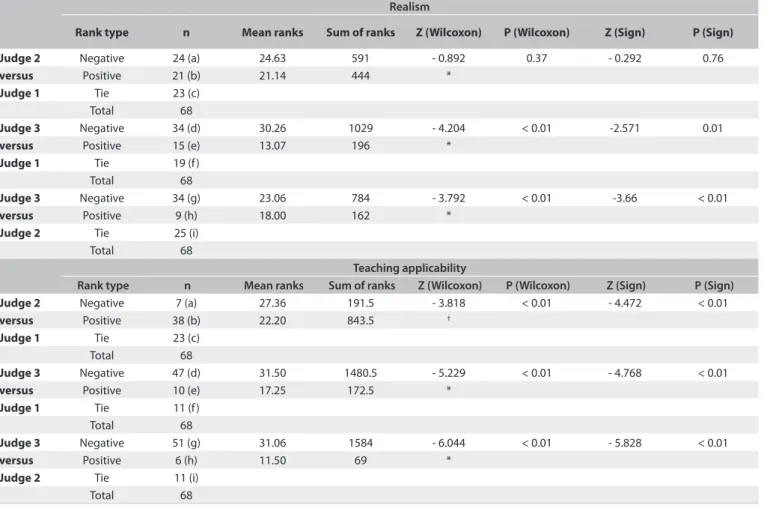
We used SPSS (Statistical Package for the Social Sciences) 18.0 for the analysis. Taking the grades to be discrete variables, we applied nonparametric tests (Friedman and Kendall W) for three dependent samples, in order to compare the three judges in rela-tion to the ratings for realism and teaching applicability. For both realism (P = 0.001 in the two tests) and teaching applicability (P < 0.001 in the two tests), there were statistical diferences among the three judges. A two-by-two nonparametric test (Wilcoxon and Sign) was applied to investigate these diferences. In award-ing grades, one evaluator was found to be diferent from the other two (P ≤ 0.01 in the two tests), but two evaluators did not difer (P = 0.37 in Wilcoxon and P = 0.76 in Sign). All three judges pre-sented assessment diferences regarding the teaching potential of the scenes (P < 0.001 in the two tests). herefore, the scenes that had good averages (37 scenes) for the teaching potential grades (average > 7.99) were characterized as “quality scenes” for teach-ing. hus, it was decided that “quality scenes” corresponded to a good average grade following evaluation by the three judges.
RESULTS
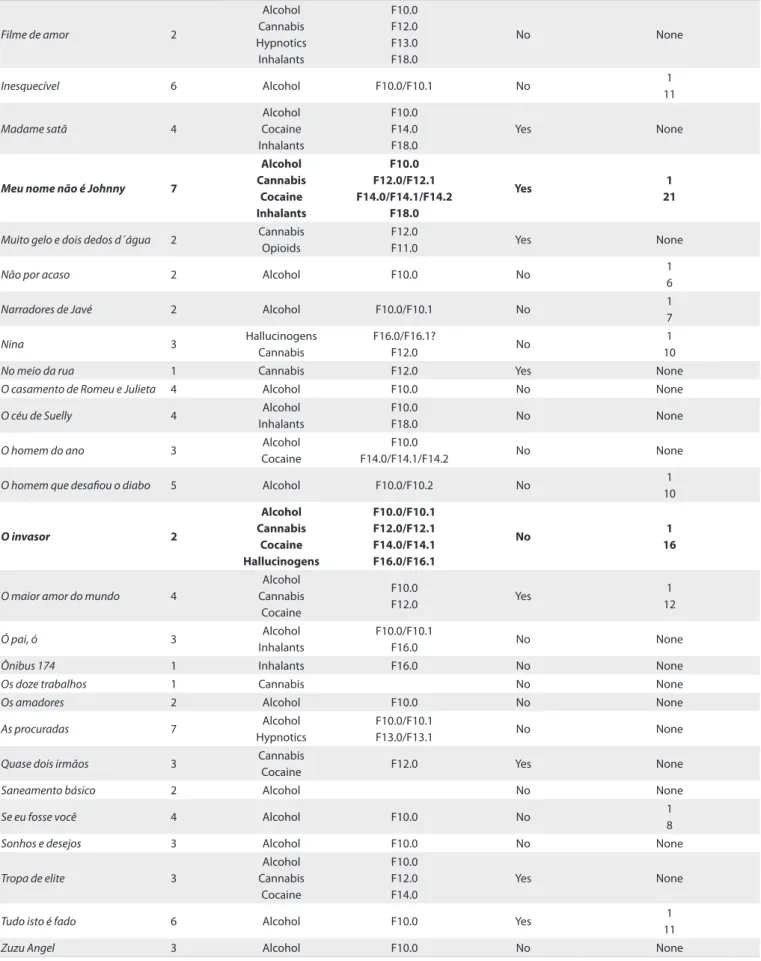
In the irst instance, a total of 192 scenes were identiied from 50 ilms that were viewed (Figure 1). he average number of scenes selected per ilm was 3.86. he ilms are listed alphabet-ically in Table 1. Over half (54%) of the ilms had a high-qual-ity scene in terms of teaching applicabilhigh-qual-ity. Moreover, it is worth noting that 80% included one or more scenes relating to alcohol. Cocaine was shown in 38% of the ilms, followed by cannabis (36%). Table 1 also illustrates the scores on the rating scale for teaching applicability.
he ICD-10 and/or DSM-IV-TR criteria were met in at least one selected scene in 96% of the ilms. Among the scenes, 78% met some of the diagnostic criteria for the disorders listed in the manuals. Not surprisingly, the criteria for intoxication were the ones most commonly met (74% of scenes), followed by criteria for abuse/harmful use (11%) and dependence (10%). Other disorders relating to use of alcohol and psychoactive sub-stances (abstinence, withdrawal with delirium, psychotic disor-der, amnesic syndrome, residual psychotic disordisor-der, late-onset psychotic disorder, other mental and behavioral disorders and unspeciied mental and behavioral disorders) were not shown in these ilms. Table 1 illustrates that the only relevant chapter of the ICD (among Chapters F10-19) that was not present in the study indings was the one relating to stimulants (F15).
he only diagnostic classiication that generated a conlict between the two manuals (ICD 10 and DSM-IV-TR) was the harmful use and the abuse of psychoactive substances, respec-tively. Police involvement was a target for evaluation, but it was only found in 28% of the ilms selected and in 10% of the scenes. Physical violence was present in 17% of the scenes. Not
surprisingly, these Brazilian ilms portray aspects of Brazilian cul-ture such as the habit of drinking before meals, which is a very common occurrence. hus, these ilms relect the true position and reality.
Various psychodynamic factors relating to use of alcohol and other substances appeared in 59% of the scenes. he most com-mon ones were: (1) coping with anxiety and stress; (2) coping with traumatic events; (3) celebration of important dates and personal victories; (4) building up courage to act; (5) dating; (6) coping with tedious daily life; (7) helping to express emotions and secrets; and (8) desire or pressure to feel new sensations.
he results from statistical analysis on the grades given by the three judges are presented in Tables 2 and 3.
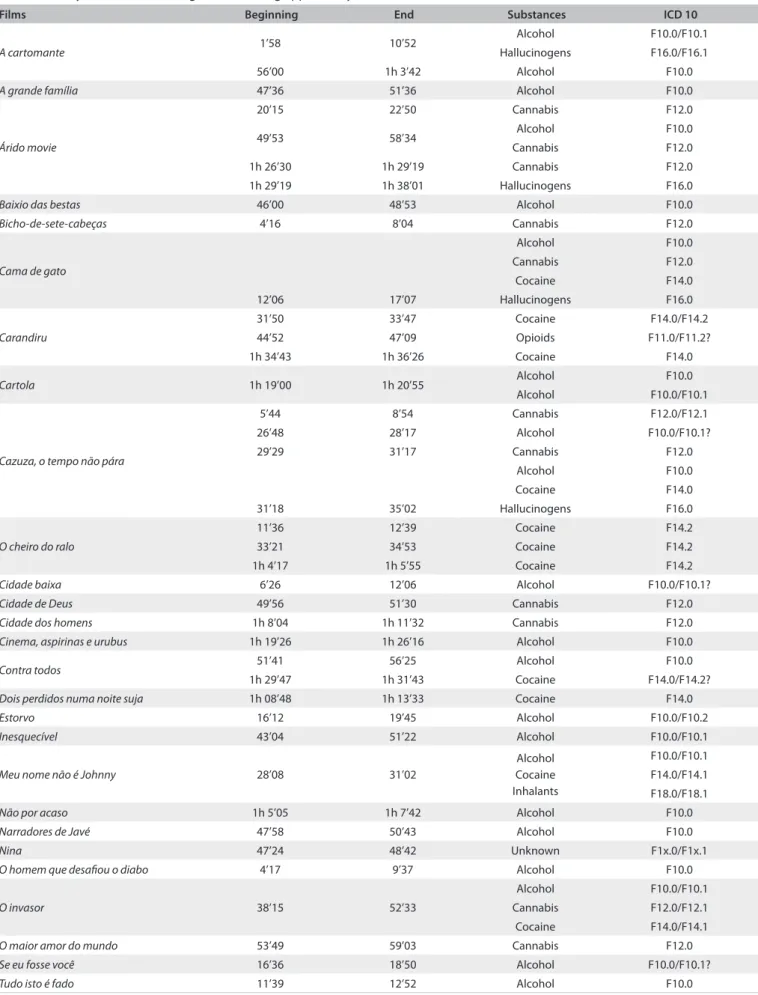
he ilms containing scenes that were classiied as qual-ity scenes with regard to their degree of realism and/or extent of teaching applicability are described in Table 4. his table also shows the start and end time of each scene, as well as the sub-stance depicted and the ICD-10 diagnosis that is suggested by the performance.
Alcohol
Many films present interesting material for observation of people making use of alcohol. Baixio das bestas (Bog of beasts),
Figure 1. Algorithm illustrating the process of selecting the quality scenes.
50 movies
1 judge evaluation
192 scenes
Two grades ≥ 8
70 scenes (37 movies)
3 judges evaluation
Teaching applicability
average ≥ 8
Films Scenes Substances ICD 10 Police involvement
Teaching applicability Number of scenes/score
A cartomante 5
Alcohol Hallucinogens Hypnotics F10.0/ F10.1/F10.2 F16.0/ F16.1 F13.1/F13.2 No 2 19
A grande família 4 Alcohol
Hypnotics
F10.0/F10.1
F13.1 No
1 11
Amarelo manga 2 Alcohol F10.0/F10.1 No None
Árido movie 15
Alcohol Cannabis Hallucinogens Cocaine F10.0/F10.1 F12.0/F12.2 F16.0 Yes 4 33
Baixio das bestas 5 Alcohol
Cannabis
F10.0/F10.1
F12.0/F12.1 No
1 13
Bellini e a esinge 2 Alcohol
Cocaine
F10.0
F14.0/F14.2 No None
Bicho de sete cabeças 5
Alcohol Cannabis Cocaine Hypnotics F10.0/F10.1 F12.0 F14.0 F13.0/F13.1 Yes 1 18
Bodas de papel 6 Alcohol F10.0 No None
Cafundó 4 Alcohol
Inhalants F10.0 No None
Caixa dois 2 Alcohol F10.0 No None
Cama de gato 3
Alcohol Hallucinogens Cocaine Cannabis F10.0 F16.0 F14.0 F12.0 No 1 13
Carandiru 3 Cocaine
Opioids
F14.0/F14.2
F11.0/F11.2? Yes
3 16
Cartola 6 Alcohol F10.0/F10.2 No 1
11
Cazuza - o tempo não para 5
Alcohol Cannabis Cocaine Hallucinogens F10.0 F12.0 F14.0 F16.0 Yes 4 22
O Cheiro do ralo 5 Alcohol
Cocaine
F10.0
F14.2 Yes
3 16
Cidade baixa 4
Alcohol Cannabis Cocaine F10.0 F12.0 F14.0 No 1 12
Cidade de deus 6 Cannabis
Cocaine
F12.0/F12.2
F14.0/F14.2 Yes
1 15
Cidade dos homens 3 Cannabis F12.0 Yes 1
8
Cinema, aspirinas e urubus 4 Alcohol F10.0/F10.2 No 1
9
Contra todos 7 Alcohol
Cocaine
F10.0
F14.0 No
2 15
Crime delicado 2 Alcohol
Hypnotics
F10.0
F13.0 No None
Dois perdidos numa noite suja 2 Cocaine F14.0/F14.2 No 1
7
Estorvo 5 Alcohol
Cocaine
F10.0
F14.0 No
1 11
Using selected scenes from Brazilian ilms to teach about substance use disorders, within medical education | ORIGINAL ARTICLE
Filme de amor 2
Alcohol Cannabis Hypnotics
Inhalants
F10.0 F12.0 F13.0 F18.0
No None
Inesquecível 6 Alcohol F10.0/F10.1 No 1
11
Madame satã 4
Alcohol Cocaine Inhalants
F10.0 F14.0 F18.0
Yes None
Meu nome não é Johnny 7
Alcohol Cannabis
Cocaine Inhalants
F10.0 F12.0/F12.1 F14.0/F14.1/F14.2
F18.0
Yes 1
21
Muito gelo e dois dedos d´água 2 Cannabis Opioids
F12.0
F11.0 Yes None
Não por acaso 2 Alcohol F10.0 No 1
6
Narradores de Javé 2 Alcohol F10.0/F10.1 No 1
7
Nina 3 Hallucinogens
Cannabis
F16.0/F16.1?
F12.0 No
1 10
No meio da rua 1 Cannabis F12.0 Yes None
O casamento de Romeu e Julieta 4 Alcohol F10.0 No None
O céu de Suelly 4 Alcohol
Inhalants
F10.0
F18.0 No None
O homem do ano 3 Alcohol
Cocaine
F10.0
F14.0/F14.1/F14.2 No None
O homem que desaiou o diabo 5 Alcohol F10.0/F10.2 No 1
10
O invasor 2
Alcohol Cannabis
Cocaine Hallucinogens
F10.0/F10.1 F12.0/F12.1 F14.0/F14.1 F16.0/F16.1
No 1
16
O maior amor do mundo 4
Alcohol Cannabis
Cocaine
F10.0
F12.0 Yes
1 12
Ó pai, ó 3 Alcohol
Inhalants
F10.0/F10.1
F16.0 No None
Ônibus 174 1 Inhalants F16.0 No None
Os doze trabalhos 1 Cannabis No None
Os amadores 2 Alcohol F10.0 No None
As procuradas 7 Alcohol
Hypnotics
F10.0/F10.1
F13.0/F13.1 No None
Quase dois irmãos 3 Cannabis
Cocaine F12.0 Yes None
Saneamento básico 2 Alcohol No None
Se eu fosse você 4 Alcohol F10.0 No 1
8
Sonhos e desejos 3 Alcohol F10.0 No None
Tropa de elite 3
Alcohol Cannabis
Cocaine
F10.0 F12.0 F14.0
Yes None
Tudo isto é fado 6 Alcohol F10.0 Yes 1
11
Zuzu Angel 3 Alcohol F10.0 No None
by Claudio Assis, has two major scenes. In the first scene, the role of alcohol in mood swings, increased aggression and eroticism is seen in several characters. They engage in an orgy in a brothel, with elements of physical sexual aggres-sion. In the second scene, almost all the symptoms relating to alcohol intoxication are seen in a character who gathers the courage to declare his love to his beloved’s grandfather. It is interesting to note the fleeting nature of that courage, because the man soon gives in to the first “dressing down” by the girl’s grandfather.
Other ilms of interest in discussing alcohol use are: Cartola;
Madame satã; O homem que desaiou o diabo; and Cafundó (Cartola, Madame satan, he man who deied the devil and
Cafundó). It is worth noting that alcohol use oten appears together with scenes showing use of other substances as well.
Opioids
We could only ind two scenes of opioid use among the 192 scenes that we catalogued. In the ilm Carandiru, the actor Lázaro Ramos plays a character who, in order to get an injection drug
Realism Teaching applicability
Mean SD P (Friedman) P (Kendall) Mean SD P (Friedman) P (Kendall)
Judge 1 9.24 0.69 < 0.01 < 0.01 8.54 0.76 < 0.01 < 0.01
Judge 2 9.13 0.92 9.13 0.87
Judge 3 9.21 1.77 6.62 2.47
Table 2. Results from nonparametric tests (Friedman and Kendall) applied to three dependent samples, in order to compare the three judges in relation to the ratings for realism and teaching applicability
Realism
Rank type n Mean ranks Sum of ranks Z (Wilcoxon) P (Wilcoxon) Z (Sign) P (Sign)
Judge 2 Negative 24 (a) 24.63 591 - 0.892 0.37 - 0.292 0.76
versus Positive 21 (b) 21.14 444 *
Judge 1 Tie 23 (c)
Total 68
Judge 3 Negative 34 (d) 30.26 1029 - 4.204 < 0.01 -2.571 0.01
versus Positive 15 (e) 13.07 196 *
Judge 1 Tie 19 (f )
Total 68
Judge 3 Negative 34 (g) 23.06 784 - 3.792 < 0.01 -3.66 < 0.01
versus Positive 9 (h) 18.00 162 *
Judge 2 Tie 25 (i)
Total 68
Teaching applicability
Rank type n Mean ranks Sum of ranks Z (Wilcoxon) P (Wilcoxon) Z (Sign) P (Sign)
Judge 2 Negative 7 (a) 27.36 191.5 - 3.818 < 0.01 - 4.472 < 0.01
versus Positive 38 (b) 22.20 843.5 †
Judge 1 Tie 23 (c)
Total 68
Judge 3 Negative 47 (d) 31.50 1480.5 - 5.229 < 0.01 - 4.768 < 0.01
versus Positive 10 (e) 17.25 172.5 *
Judge 1 Tie 11 (f )
Total 68
Judge 3 Negative 51 (g) 31.06 1584 - 6.044 < 0.01 - 5.828 < 0.01
versus Positive 6 (h) 11.50 69 *
Judge 2 Tie 11 (i)
Total 68
Table 3. Results from two-by-two nonparametric test (Wilcoxon and Sign) applied to investigate diferences between judges
(a) Judge 2 < Judge 1; (b) Judge 2 > Judge 1; (c) Judge 2 = Judge 1; (d) Judge 3 < Judge 1; (e) Judge 3 > Judge 1; (f) Judge 3 = Judge 1; (g) Judge 3 < Judge 2; (h) Judge 3 > Judge 2; (i) Judge 3 = Judge 2.
Using selected scenes from Brazilian ilms to teach about substance use disorders, within medical education | ORIGINAL ARTICLE
Films Beginning End Substances ICD 10
A cartomante 1’58 10’52
Alcohol F10.0/F10.1
Hallucinogens F16.0/F16.1
56’00 1h 3’42 Alcohol F10.0
A grande família 47’36 51’36 Alcohol F10.0
Árido movie
20’15 22’50 Cannabis F12.0
49’53 58’34 Alcohol F10.0
Cannabis F12.0
1h 26’30 1h 29’19 Cannabis F12.0
1h 29’19 1h 38’01 Hallucinogens F16.0
Baixio das bestas 46’00 48’53 Alcohol F10.0
Bicho-de-sete-cabeças 4’16 8’04 Cannabis F12.0
Cama de gato
Alcohol F10.0
Cannabis F12.0
Cocaine F14.0
12’06 17’07 Hallucinogens F16.0
Carandiru
31’50 33’47 Cocaine F14.0/F14.2
44’52 47’09 Opioids F11.0/F11.2?
1h 34’43 1h 36’26 Cocaine F14.0
Cartola 1h 19’00 1h 20’55 Alcohol F10.0
Alcohol F10.0/F10.1
Cazuza, o tempo não pára
5’44 8’54 Cannabis F12.0/F12.1
26’48 28’17 Alcohol F10.0/F10.1?
29’29 31’17 Cannabis F12.0
Alcohol F10.0
Cocaine F14.0
31’18 35’02 Hallucinogens F16.0
O cheiro do ralo
11’36 12’39 Cocaine F14.2
33’21 34’53 Cocaine F14.2
1h 4’17 1h 5’55 Cocaine F14.2
Cidade baixa 6’26 12’06 Alcohol F10.0/F10.1?
Cidade de Deus 49’56 51’30 Cannabis F12.0
Cidade dos homens 1h 8’04 1h 11’32 Cannabis F12.0
Cinema, aspirinas e urubus 1h 19’26 1h 26’16 Alcohol F10.0
Contra todos 51’41 56’25 Alcohol F10.0
1h 29’47 1h 31’43 Cocaine F14.0/F14.2?
Dois perdidos numa noite suja 1h 08’48 1h 13’33 Cocaine F14.0
Estorvo 16’12 19’45 Alcohol F10.0/F10.2
Inesquecível 43’04 51’22 Alcohol F10.0/F10.1
Meu nome não é Johnny 28’08 31’02
Alcohol Cocaine Inhalants
F10.0/F10.1
F14.0/F14.1
F18.0/F18.1
Não por acaso 1h 5’05 1h 7’42 Alcohol F10.0
Narradores de Javé 47’58 50’43 Alcohol F10.0
Nina 47’24 48’42 Unknown F1x.0/F1x.1
O homem que desaiou o diabo 4’17 9’37 Alcohol F10.0
O invasor 38’15 52’33
Alcohol F10.0/F10.1
Cannabis F12.0/F12.1
Cocaine F14.0/F14.1
O maior amor do mundo 53’49 59’03 Cannabis F12.0
Se eu fosse você 16’36 18’50 Alcohol F10.0/F10.1?
Tudo isto é fado 11’39 12’52 Alcohol F10.0
(heroin) while in jail, commits several dangerous acts thus sug-gesting a dependency pattern.
Cannabis
Watching the ilm Árido movie (Arid movie) in its entirety is per-haps the best way to discuss the psychopathology and develop-ments relating to cannabis use. his ilm allows discussion of some of the positive and negative aspects of cannabis use, given that the efects experienced by the characters vary greatly during the scenes. here is violence and police involvement, but there are also scenes of heightened sense of pleasure and relaxation, sometimes with concomitant use of alcohol.
In O maior amor do mundo (he greatest love of all) both neg-ative and positive aspects of cannabis use can also be identiied. he young boy uses the substance and is involved with drug traf-icking in the shantytown in the role of “airplane” (messenger). he actor José Wilker stars in a beautiful scene of intoxication accompanied by the boy. He experiences a feeling of great plea-sure at being intoxicated at an extremely diicult time in his life.
Sedatives and hypnotics
here were many scenes that showed sedative use. In most cases, the scenes included concomitant use of other substances (mainly alcohol), which would classify them as instances of abuse in the DSM-IV-TR. Only a few scenes showed symptoms of intoxica-tion, even if to a mild degree. Most showed consumption only in situations of psychological stress, as in the scene in A cartomante (he fortune teller), starring the actor Ilya São Paulo, when he dis-covers that he is being betrayed by his best friend. Another inter-esting scene occurs in Bicho de sete-cabeças (Brainstorm), where the chief doctor of the asylum uses a sedative pill for himself, along with whisky. In this, the cumulative efects (symptoms) of intoxication due to these two substances can be seen. he psy-chodynamic aspect of this consumption consisted of relief or afective anesthesia in the situation. he character seeks relief because he witnesses horrifying events within day-to-day life in the asylum system.
Cocaine
A greater variety of disorders was depicted in relation to cocaine, perhaps because this substance has the most negative scenes with its usage. In O cheiro do ralo (Drained), there are three scenes that scored high in realism in showing the likely path of a crack/cocaine dependent (the scenes do not show explicit consumption but it is implied through behavior), who begins to sell items from his family home in order to aford cocaine con-sumption, and who eventually sells his own nakedness to make more money. In the ilm O homem do ano (he man of the year), Murilo Benício plays a man with strong antisocial traits, which are enhanced during his irst use of cocaine, which he takes in
binges. Ater using cocaine, the character gains the courage to carry out revenge against an enemy who killed a friend and his pet. In Dois perdidos numa noite suja (Two lost people in a dirty night),Débora Falabella plays the role of a crack dependent who lives in the United States. She sustains her addiction by selling oral sex while disguised as a boy. In this ilm, a very well-pro-duced scene of intoxication that includes development of all the symptoms is seen. Such a scene allows discussion about depend-ence and use of prostitution to obtain cocaine.
Hallucinogens
In Árido movie (Arid movie), there is a vivid scene starring Guilherme Weber and José Dumont, in which the latter invites the former to try some tea made of unidentiied roots, at a time of great stress for the character. he changes in sensory perception caused by the tea are depicted in a very realistic fashion.
Volatile solvents
here are a few scenes involving use of these substances by chil-dren who are outside of the school environment. One scene that was selected takes place in Ônibus 174 (Bus 174), in which two pre-teenage children snif shoemaker’s glue and experience symptoms of intoxication. Another type of common use can be seen in Ó pai ó (Look at that) by Monica Gardenberg, in which adults use inhalants during the irst day of carnival in Salvador.
Multiple drugs
Several scenes depicted intoxication by two or more substances, but two scenes are extraordinary in their depiction, especially regarding psychopathology In Meu nome não é Johnny (My name is not Johnny), the leading actor Selton Mello is at a party that he hosts, and he uses three types of substances: alcohol, cocaine and inhalants. Consequently, he experiences symptoms of empow-erment, elated mood, relaxation, loss of balance and changes in sensory perception. his scene received the highest grade. In
Cazuza, o tempo não pára (Cazuza), the symptoms are not cen-tered on one character alone, but on a group, following use of alcohol, cocaine and hallucinogens (many concurrently), within the context of a concert by the rock band Barão Vermelho.
Treatment
Using selected scenes from Brazilian ilms to teach about substance use disorders, within medical education | ORIGINAL ARTICLE
In another ilm, Meu nome não é Johnny (My name is not Johnny), the character Johnny is arrested for drug traicking and is referred for treatment in the House of Detention and Psychiatric Treatment. Although once again portraying a model of treatment in the asylum style, where the character goes through many hard-ships, an improvement in his condition can be seen, in that he manages to stay abstinent ater treatment.
DISCUSSION
he main purpose of this study was to show how material suitable for teaching important aspects of psychiatry could be selected for use, especially in relation to alcohol and drugs in Brazil. his material can thus be used to teach not only psychiatric trainees but also medical students and other professionals such as nurses, social workers, psychologists and general practitioners.
We were able to cover seven of the nine chapters in the ICD-10. Among the scenes that were classiied as quality scenes regarding their teaching applicability, we found scenes showing disorders relating to use of alcohol, opiates, cannabis, cocaine/crack, hal-lucinogens, inhalants and many other drugs. Regarding types of disorder, more than one quality scene was found for each of the top three (intoxication, abuse/harmful use and dependence).
Recent studies have reported on the applicability of ilms for teaching medical students about psychiatry.12,23 However, the few
previous studies that have evaluated ilms as a teaching tool were small and non-systematic,12,15,28 thus difering from ours. Here,
we tried to select ilm scenes from a large sample (n = 50) in a systematic way, which produced a sample of 37 quality scenes for teaching. Most of the previous studies only described poten-tial areas of interest, without using any statistical analysis23,29 to
account for diferent populations (undergraduate students or res-idents) with diferent goals.29,30 Considering this, we looked at one
important area of medicine (addictions) and attempted to select material to be used speciically in medical education in this area.
It was also diicult to compare results across diferent geo-graphical regions. Hence, few deinite conclusions can be drawn. Moreover, few studies relating to use of ilms for teaching about addiction medicine have been conducted. Welsh31 used a
video-tape that was made by combining clips from various commer-cially available ilms, along with clips from several television news shows as well as a training ilm displaying intoxication and withdrawal syndromes. Among second-year medical students, more than 90% of the 89 respondents found the clips helpful in recognizing these syndromes and for appreciating the potential severity of these disorders. Unfortunately, we did not ind any ilm scenes relating to withdrawal. On the other hand, our study provides the opportunity of using many ilm scenes that pres-ent intoxication caused by many drugs, in medical education. Further evaluations on whether the target audiences found the material helpful can be undertaken. In addition, teachers would
be able to ascertain whether their students learned more with this technique. However, a note of caution is necessary, in that these ilms may perpetuate myths about addiction.10
Many studies have focused on American cinema,12,15,28 and
they may not be entirely suitable for use within other cultures, since the appropriate cultural context may be missing. he pres-ent study has attempted to expand the scipres-entiic literature on this ield beyond Hollywood. As could be expected, we found that certain Brazilian cultural values were relected in ilms, such as Rio de Janeiro’s hillside shantytowns in Tropa de elite, Cartola, O maior amor do mundo and Quase irmãos (he elite squad, Top hat, he greatest love of all and Almost brothers); young, wealthy hedonists in O invasor, Cama de gato and Meu nome não é Johnny
(he invader, Cat’s cradle and My name is not Johnny); and a man who would not say no to liquor in O homem que desaiou o diabo
(he man who deied the devil). Hence, these ilms can be used appropriately in teaching Brazilian students. Studies on other nationalities’ ilms could be carried out to look at the country in question or at regional cultural values.
Courses using ilms in relation to mental illness, within Psychiatry, have been shown elsewhere to be efective and enjoy-able for both the students and teachers involved.30 Selected scenes
can also be used to discuss new substances and new concepts of substance use with students of all professions, especially medi-cine and psychiatry. One example is the currently increasing use of club drugs, which still have low prevalence of use and depend-ence.32 hese substances could be discussed ater viewing ilms
such as Cama de gato (Cat’s cradle) and O invasor (he invader). For crack, a substance that has increasingly interested Brazilian researchers,33,34 ilms could be used to discuss some current
issues, which include using prostitution as a source of money to purchase crack34 and sexually risky behavior among crack users.33
Both issues were depicted in Dois perdidos numa noite suja (Two lost in a dirty night).
Garrison reported19 using certain ilms to portray increased
family engagement during psychiatric hospitalizations. Unfortunately, our sample showed hospitalization for patients only in negative terms, such as in scenes from Bicho de sete cabeças (Brainstorm) and Meu nome não é Johnny (My name is not Johnny). In Meu nome não é Johnny, the ilm shows the recov-ery of the main character (Johnny) ater treatment.
LIMITATIONS
nationalities’ ilms can ill this gap. It would be worth comparing Brazilian ilms with an American sample in the future, in order to evaluate whether the use of substances is shown in the same way, in terms of quantity, quality and context, even though cul-tural values will difer.
CONCLUSION
Having appropriately and cautiously selected ilms at hand can provide additional and interesting as well as stimulating start-ers for discussion of psychopathology and treatment. Numerous psychoactive substances appeared in the ilms that were evalu-ated in this study. Because drug use is closely linked to the culture in which an individual is living, only Brazilian cinema can accu-rately portray the behavior of Brazilians, which is what students must take into account during their training and clinical practice. Moreover, it is possible to relect on how some of these drug use habits are deeply rooted in some Brazilian groups.
REFERENCES
1. Dalgalarrondo P. Psicopatologia e semiologia dos transtornos mentais. 2a ed. Porto Alegre: Artmed; 2008.
2. Singer M. Drugs and development: the global impact of drug use and traicking on social and economic development. Int J Drug Policy. 2008;19(6):467-78.
3. Meloni JN, Laranjeira R. Custo social e de saúde do consumo do álcool [The social and health burden of alcohol abuse]. Rev Bras Psiquiatr. 2004;26(Suppl 1):SI7-SI10.
4. Pinsky I, Jundi SARJ. O impacto da publicidade de bebidas alcoólicas sobre o consumo entre jovens: revisão da literatura internacional: [revisão] [Alcohol advertising and alcohol consumption among youngsters: review of the international literature: [review]]. Rev Bras Psiquiatr. 2008;30(4):362-74.
5. Maia JMC, Castilho SM, Maia MC, Neto FL. Psicopatologia no cinema brasileiro: um estudo introdutório [Brazilian movies and psychopathology]. Rev Psiquiatr Clin (São Paulo). 2005;32(6):319-23. 6. Byrne P. Psychiatry and the media. Advances in Psychiatric
Treatment. 2003;9:135-43. Available from: http://apt.rcpsych.org/ content/9/2/135.full. Accessed in 2012 (Apr 19).
7. Greenberg HR. La-la land meets DSM-IV: the pleasures and pitfalls of celluloid diagnostics. Psychiatr Serv.2003;54(6):807-8.
8. Byrne P. Trainspotting and the depiction of addiction. Psychiatric Bulletin. 1997;21:173-5. Available from: http://pb.rcpsych.org/ content/21/3/173.full.pdf. Accessed in 2012 (Apr 19).
9. Ousager J, Johannessen H. Humanities in undergraduate medical education: a literature review. Acad Med. 2010;85(6):988-98. 10. Cape G. Movies as a vehicle to teach addiction medicine.Int Rev
Psychiatry. 2009;21(3):213-7.
11. Kerr-Corrêa F, Igami TZ, Hiroce V, Tucci AM. Patterns of alcohol use between genders: a cross-cultural evaluation. J Afect Disord. 2007;102(1-3):265-75.
12. Tarsitani L, Brugnoli R, Pancheri P. Cinematic clinical psychiatry cases in graduate medical education. Med Educ. 2004;38(11):1187. 13. Garrison D. The use of movies to facilitate family engagement in
psychiatry hospitalization. J Am Acad Child Adolesc Psychiatry. 2007;46(9):1218-21.
14. Gharaibeh NM. The psychiatrist’s image in commercially available American movies. Acta Psychiatr Scand. 2005;111(4):316-9.
15. Bhagar HA. Should cinema be used for medical student education in psychiatry? Med Educ. 2005;39(9):972-3.
16. Fritz GK, Poe RO. The role of a cinema seminar in psychiatric education. Am J Psychiatry. 1979;136(2):207-10.
17. Ramsay R. Psychiatry and the public. Psychiatric Bulletin. 1991;15:795. Available from: http://pb.rcpsych.org/content/15/12/795.full. pdf+html. Accessed in 2012 (Apr 19).
18. Skochelak SE. A decade of reports calling for change in medical education: what do they say? Acad Med. 2010;85(9 Suppl):S26-33. 19. Hyler SE, Moore J. Teaching psychiatry? Let Hollywood help! Suicide
in the cinema. Academic Psychiatry. 1996;20(4):212-9. Available from: http://ap.psychiatryonline.org/article.aspx?Volume=20&page=212&j ournalID=17. Accessed in 2012 (Apr 19).
20. Ventura S, Onsman A. The use of popular movies during lectures to aid teaching and learning of undergraduate pharmacology. Med Teach. 2009;31(7):662-4.
21. Lumlertgul N, Kijpaisalratana N, Pityaratstian N, Wangsaturaka D. Cinemeducation: a pilot student project using movies to help students learn medical professionalism. Med Teach. 2009;31(7):e327-32. 22. Baños JE. How literature and popular movies can help in medical
education: applications for teaching the doctor-patient relationship. Med Educ. 2007;41(9):918.
23. Akram A, O’Brien A, O’Neill A, Latham R. Crossing the line--learning psychiatry at the movies. Int Rev Psychiatry. 2009;21(3):267-8. 24. Walter G, McDonald A, Rey JM, Rosen A. Medical student knowledge
and attitudes regarding ECT prior to and after viewing ECT scenes from movies. J ECT. 2002;18(1):43-6.
25. Peluso ETP, Blay SL. Public perception of alcohol dependence. Rev Bras Psiquiatr. 2008;30(1):19-24.
26. Ronzani TM, Higgins-Biddle J, Furtado EF. Stigmatization of alcohol and other drug users by primary care providers in Southeast Brazil. Soc Sci Med. 2009;69(7):1080-4.
27. Nagib L. O cinema da retomada: depoimentos de 90 cineastas dos anos 90. São Paulo: Editora 34; 2002.
28. Datta V. Madness and the movies: an undergraduate module for medical students. Int Rev Psychiatry. 2009;21(3):261-6.
29. Jukić V, Brecić P, Savić A. Movies in education of psychiatry residents. Psychiatr Danub. 2010;22(2):304-7.
30. Sierles FS. Using ilm as the basis of an American culture course for irst-year psychiatry residents. Acad Psychiatry. 2005;29(1):100-4. 31. Welsh CJ. OD’s and DT’s: using movies to teach intoxication and
Using selected scenes from Brazilian ilms to teach about substance use disorders, within medical education | ORIGINAL ARTICLE
32. Leung KS, Cottler LB. Ecstasy and other club drugs: a review of recent epidemiologic studies. Curr Opin Psychiatry. 2008;21(3):234-41. 33. Carvalho HB, Seibel SD. Crack cocaine use and its relationship with
violence and HIV. Clinics (Sao Paulo). 2009;64(9):857-66.
34. Nappo SA, Sanchez Z, De Oliveira LG. Crack, AIDS, and women in São Paulo, Brazil. Subst Use Misuse. 2011;46(4):476-85.
Sources of funding: None
Conlict of interest: None
Date of irst submission: August 19, 2011
Lastreceived: May 8, 2011
Accepted: June 12, 2012
Address for correspondence:
João Maurício Castaldelli-Maia
Disciplinas de Psiquiatria e Psicologia Médica da Faculdade de Medicina do ABC (FMABC) Av. Lauro Gomes, 2.000
Vila Sacadura Cabral — Santo André (SP) — Brasil CEP 09060-870