Occupational conditions
and the risk of the use of
amphetamines by truck drivers
I Departamento de Medicina Legal, Ética
Médica, Medicina Social e do Trabalho. Faculdade de Medicina. Universidade de São Paulo. São Paulo, SP, Brasil
II Departamento de Estatística. Instituto de
Matemática e Estatística. Universidade de São Paulo. São Paulo, SP, Brasil Correspondence:
Lucio Garcia de Oliveira
Departamento de Medicina Legal, Ética Médica, Medicina Social e do Trabalho – FMUSP Instituto Oscar Freire
Av. Dr. Arnaldo, 455
01246-903 São Paulo, SP, Brasil E-mail: [email protected] Received: 10/22/2014 Approved: 3/3/2015
ABSTRACT
OBJECTIVE: To test whether the occupational conditions of professional truck drivers are associated with amphetamine use after demographic characteristics and ones regarding mental health and drug use are controlled for.
METHODS: Cross-sectional study, with a non-probabilistic sample of 684 male truck drivers, which was collected in three highways in Sao Paulo between years 2012 and 2013. Demographic and occupational information was collected, as well as data on drug use and mental health (sleep quality, emotional stress, and psychiatric disorders). A logistic regression model was developed to identify factors associated with amphetamine use. Odds ratio
(OR; 95%CI) was deined as the measure for association. The signiicance
level was established as p < 0.05.
RESULTS: The studied sample was found to have an average age of 36.7 (SD = 7.8) years, as well as low education (8.6 [SD = 2.3] years); 29.0% of drivers reported having used amphetamines within the twelve months prior to their interviews. After demographic and occupational variables had been controlled for, the factors which indicated amphetamine use among truck drivers were the following: being younger than 38 years (OR = 3.69), having spent less than nine years at school (OR = 1.76), being autonomous (OR = 1.65), working night shifts or irregular schedules (OR = 2.05), working over 12 hours daily (OR = 2.14), and drinking alcohol (OR = 1.74).
CONCLUSIONS: Occupational aspects are closely related to amphetamine use among truck drivers, which reinforces the importance of closely following the application of law (Resting Act (“Lei do Descanso”); Law 12,619/2012) which regulates the workload and hours of those professionals. Our results show the need for increased strictness on the trade and prescription of amphetamines in Brazil.
DESCRIPTORS: Transportation, manpower. Amphetamines. Working Conditions. Risk Factors. Occupational Risks. Occupational Health. Cross-Sectional Studies.
Lúcio Garcia de OliveiraI
Letícia Maria de Araújo de SouzaI
Lúcia Pereira BarrosoII
Marcela Júlio César GouvêaI
Carlos Vinícius Dias de AlmeidaI
Daniel Romero MuñozI
On October 6, 2011, Brazilian Health Surveillance Agency (ANVISA), by means of Resolution 52 (RDC 52/2011) from its Collegiate Board of Directors, has prohibited the production, trade, prescription, and consequently, amfepramone, fenproporex, and mazindol consumption.a Those substances are known as amphetamine derivatives, amphetamines, stimulants, and anorectics – the last two having those names due to their effects in the central nervous system. Despite that, such substances are still being consumed by truck drivers, possibly to the same extent as they were being consumed before the aforesaid regulation.14
In this context, poor working conditions have been encouraging truck drivers to use amphetamines;4-6 espe-cially nowadays, when the road transportation industry has become increasingly competitive.2,22 Thus, amphet-amines have been used to reduce fatigue and to preserve focus and attention while at work.6,9,15
A systematic literature review6 showed that amphetamines rank second on the list of the most used drugs among truck drivers (being only second to alcoholic beverages). This study showed that 29.5% of drivers reported having used amphetamines, whereas 8.5% were found to have traces of those substances when biological samples from them were submitted to toxicology screens.6
Conirming the reasons which had already been mentioned
by truck drivers, amphetamines can improve atten-tion.15 However, increased blood plasma concentrations of those substances impairs driving performance,13 due
to euphoria, quick low of ideas, increased mental skill
sensation, and even paranoid though, hallucinations, and mental confusion experienced by users.23 Collectively, those effects hinder motor coordination, concentration, and judgment – which are required whilst driving any vehicles.23 Thus, use of amphetamines or other
psycho-tropic substances does not beit safe driving.17,23
In this scenario, amphetamines are still the most frequently found substances in biological samples from drivers who are pulled over due to bad driving perfor-mance.8 They can also be found in biological samples from fatally-wounded drivers,3,5,10 and its use is
asso-ciated with trafic accidents,4 thus jeopardizing the safety and health of those drivers and the wellness of the population in general.19
INTRODUCTION
As a response to the amphetamine use problem, the United Nations (UN) suggest the most opportune and accurate control strategy be investing in research seeking to better understand the use, production, and
trafic of those drugs.19 However, studies on the prev-alence of drug use among truck drivers, in Brazil, are not yet very numerous, only few of them analyze the factors related to drug use by those professionals,6 espe-cially regarding amphetamine use.
Besides that, no Brazilian studies evaluated the inter-ference of occupational factors (as provided by Law 12,619/2012, which is most commonly known as Resting Act, or “Lei do Descanso”, in Portuguese,b which regu-lates the working hours and driving periods for profes-sional drivers) on amphetamine use from truck drivers. No studies considered mental health factors to as
vari-ables which could inluence amphetamine use either.9,18
Thus, this study aimed at testing whether occupational conditions from professional truck drivers are associ-ated with amphetamine use, after demographic, mental health, and drug use characteristics are controlled for.
METHODS
It is a cross-sectional study with a non-probabilistic sample with 684 truck drivers who were driving on three highways in Sao Paulo state (Presidente Dutra, Fernao Dias, and Cônego Domênico Rangoni), who had been recruited at Serviço Social do Transporte (SEST – Social Transportation Service) and Serviço Nacional de Aprendizagem do Transporte (SENAT – National Transportation Learning Service) stations, from June 2012 to September 2013. As the research which originated this study aimed to eval-uate the effects from use of psychotropic substances on the level of attention of truck drivers, subjects who were found have at least one of the following health conditions – which could interfere in their evalua-tion – were excluded from the sample: subjects who had trouble seeing colors; subjects who were taking psychotropic medications; subjects who reported having brain trauma (SF) during in their lifetime; subjects who lost consciousness at least once in their lifetime; the ones with neurological disease histories; or drivers who were HIV-positive.
a Ministério da Saúde. Agência Nacional de Vigilância Sanitária. Resolução - RDC nº 52, de 6 de outubro de 2011. Dispõe sobre a proibição
do uso das substâncias anfepramona, femproporex e mazindol, seus sais e isômeros, bem como intermediários e medidas de controle da prescrição e dispensação de medicamentos que contenham a substância sibutramina, seus sais e isômeros, bem como intermediários e dá outras providências. Diário Oficial União. 10 out 2011;seção 1:55 [cited 2014 Oct 15]. Available from: http://bvsms.saude.gov.br/bvs/ saudelegis/anvisa/2011/res0052_06_10_2011.html
b Brasil. Lei nº 12.619, de 30 de abril de 2012. Dispõe sobre o exercício da profissão de motorista; altera a Consolidação das Leis do Trabalho - CLT,
Truck drivers talked to a recruiter from the team in the related SEST-SENAT stations, and were informed the study would be conducted on that day and time. The study subjects were asked to answer a structured ques-tionnaire, which had already been used by Leyton et al11 with Brazilian truck drivers, so demographic and occu-pational data could be collected.
Subjects were asked about their personal experiences with use of amphetamines and other drugs in their
lifetime (deined as experimental use; that is, at least
once in their lifetimes), in the twelve months prior (in that year; that is, at least once in the twelve months prior to the interview), and within the previous thirty days,20 regardless of the reasons why they used it. The criteria in the alcohol, smoking, and substance involvement screening test (ASSIST-WHO, 3.1 version)7 were also included in that questionnaire, to evaluate the risk for addiction to amphetamines and other drugs. The thirty points which were possible in
the scale were classiied as low risk (occasional use;
up to three points), moderate risk (regular use, from three to 26 points), and high risk (problematic use, above 27 points).
Subjects also answered questionnaires about their mental health conditions, as those could be related to amphet-amine use – they included the following: emotional stress (Lipp Stress Symptoms Inventory for Adults – LSSI), psychiatric disorders (Mini International Neuropsychiatric Interview Plus – MINI Plus), and sleep quality (Pittsburgh Sleep Quality Index – PSQI and Epworth Sleepiness Scale – ESE). Regarding their sleep quality, scores above
ive in the PSQI scale indicate bad sleep quality. In the
ESE scale, scores above 10 indicate excessive sleepiness, and, above 16, high-level sleepiness.
All questionnaires and scales were double typed on Epi Info v.6.0 software. Consistency information checks and related corrections were performed. The data were transferred to and analyzed by R software, version
2.15.1. The classiication variables were expressed as
percentages and numerical ones (initially expressed as averages and standard deviations) were later
clas-siied according to their median values. Amphetamine
use in the previous twelve months was the dependent variable, which allowed classifying subjects in users and non-users. The univariate analyses (two-tailed distribution) were conducted through chi-squared and Fisher’s tests. Independent variables “daily work-load (hours)” and “restless driving (hours)” were classified according to the requirements from the Resting Act (Law 12,619/2012).b Also, as high risk for amphetamine addiction was not very prevalent, that category was grouped with moderate risk as per ASSIST-WHO. Variables which reached p < 0.25 were included in a logistic regression model and selected through backward elimination. The odds ratio (OR
and 95%CI) was calculated as a measure for associa-tion. The null hypothesis was rejected when p < 0.05. The model adjustment was evaluated by means of the analysis of standard deviation and Cook’s distance outliers. Multicollinearity was diagnosed by its impact
on parameter estimates and by the Variance Inlation
Factor (VIF).
This research was approved by the Research Ethics Committee from the Faculdade de Medicina of Universidade de São Paulo (Protocol 377/11, on 10/19/2011). All subjects signed consent forms (termo de consentimento livre e esclarecido) and were evalu-ated individually in close, safe, and silent rooms which
had been speciically set aside for the research.
RESULTS
Out of the 684 truck drivers who took part in the study, 149 (22.0%) were excluded for meeting at least one of the exclusion criteria of the original research. Also, twenty-one drivers were excluded as they reported having used illegal drugs other than amphetamines in
that year. Thus, 514 drivers took part in the inal analysis.
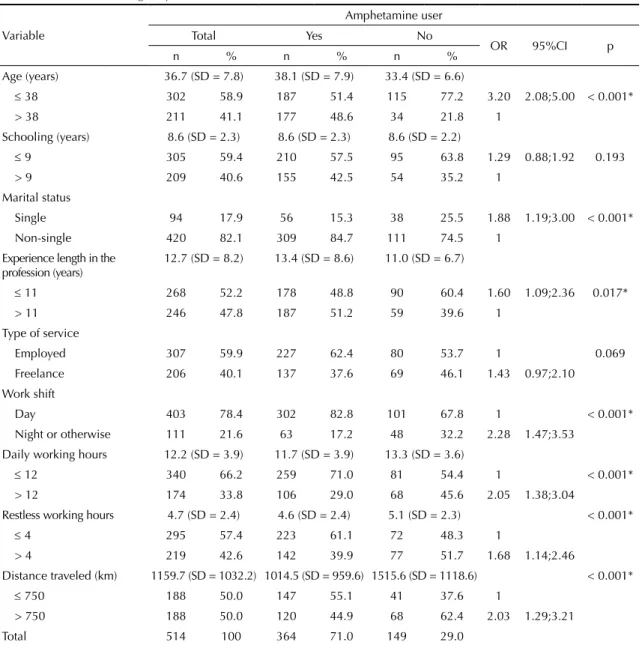
Subjects were also found to have an average age of 36.7 (SD = 7.8) years, average education level of 8.6 (SD = 2.3) years. Most of them (82.1%) were married or separated at the time of the interview. Subjects had an average of 12.7 (SD = 8.2) years of experience as professional drivers, driving an average 12.2 (SD = 3.9) hours daily, of which 4.7 (SD = 2.4) hours without resting, covering an average 1,159.7 (SD = 1,032.2) km on their last reported trip. More than half (59.9%) of subjects worked for companies, and 21.6% worked night or irregular shifts (Table 1).
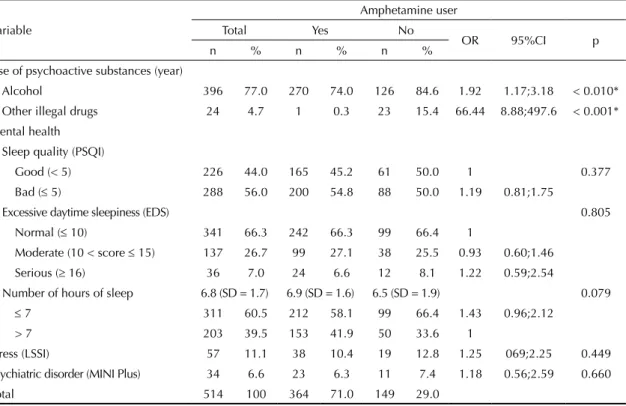
Regarding their mental health, 77.0% of subjects reported having used alcohol within the year prior to the interview, and 4.7%, at least one illegal drug (other than amphetamines) within the same period. Moreover, 56.0% of subjects scored for bad sleep quality, 33.7% of them experienced moderate to serious daytime sleepiness, 11.1% suffered from emotional stress, and 6.6% of drivers suffered from psychiatric disorders (Table 2).
Most of them (58.0%; n = 298) (95%CI 53.6;62.3) reported having used amphetamines in lifetime; 29.0% of them (n = 149) (95%CI 25.1;33.1) within a year; and 14.4% (n = 74) (95%CI 11.5;17.7), within a month. Among subjects who reported having used amphetamines within a year, 38.9% of them (n = 58) scored for problems related to such use as per the criteria from ASSIST-WHO.
besides working more hours a day, driving more hours without resting – and for longer distances. They work night or irregular shifts more often as compared to non-users (Table 1). In regards to their mental health, use of alcohol was more frequent among amphet-amine users. Amphetamphet-amine use was not associated with sleep conditions, emotional stress, or psychiatric disorders (Table 2).
After demographic and occupational variables were controlled for, the following from Table 3 were found: a) subjects who were younger than 38 years had higher chances of using amphetamines than their older peers; b) subjects with education levels below nine years had higher chances of using amphet-amines than subjects with higher education levels; c)
subjects who performed freelance work had higher chances of using amphetamines than employed peers; d) subjects who worked night or irregular shifts had higher chances for using amphetamines than their peers who only worked day shift; e) subjects who worked over 12 hours daily had increased chances for using amphetamines than their peers who worked up to 12 hours daily; e) drivers who stated having drunk alcohol at least once that year had increased chances for using amphetamines than their peers who reported not being users. Even though at a difference which is
marginally signiicant, subjects who drove over four
non-stop, no-resting hours had increased chances of using amphetamines than their peers who worked up to four hours.
Table 1. Demographic and occupational characteristics of truck drivers, according to their use of amphetamines in the 12 months prior to their interviews. Highways in Sao Paulo state, Southeastern Brazil, 2012-2013. (N = 514)
Variable
Amphetamine user
Total Yes No
OR 95%CI p
n % n % n %
Age (years) 36.7 (SD = 7.8) 38.1 (SD = 7.9) 33.4 (SD = 6.6)
≤ 38 302 58.9 187 51.4 115 77.2 3.20 2.08;5.00 < 0.001*
> 38 211 41.1 177 48.6 34 21.8 1
Schooling (years) 8.6 (SD = 2.3) 8.6 (SD = 2.3) 8.6 (SD = 2.2)
≤ 9 305 59.4 210 57.5 95 63.8 1.29 0.88;1.92 0.193
> 9 209 40.6 155 42.5 54 35.2 1
Marital status
Single 94 17.9 56 15.3 38 25.5 1.88 1.19;3.00 < 0.001*
Non-single 420 82.1 309 84.7 111 74.5 1
Experience length in the profession (years)
12.7 (SD = 8.2) 13.4 (SD = 8.6) 11.0 (SD = 6.7)
≤ 11 268 52.2 178 48.8 90 60.4 1.60 1.09;2.36 0.017*
> 11 246 47.8 187 51.2 59 39.6 1
Type of service
Employed 307 59.9 227 62.4 80 53.7 1 0.069
Freelance 206 40.1 137 37.6 69 46.1 1.43 0.97;2.10
Work shift
Day 403 78.4 302 82.8 101 67.8 1 < 0.001*
Night or otherwise 111 21.6 63 17.2 48 32.2 2.28 1.47;3.53
Daily working hours 12.2 (SD = 3.9) 11.7 (SD = 3.9) 13.3 (SD = 3.6)
≤ 12 340 66.2 259 71.0 81 54.4 1 < 0.001*
> 12 174 33.8 106 29.0 68 45.6 2.05 1.38;3.04
Restless working hours 4.7 (SD = 2.4) 4.6 (SD = 2.4) 5.1 (SD = 2.3) < 0.001*
≤ 4 295 57.4 223 61.1 72 48.3 1
> 4 219 42.6 142 39.9 77 51.7 1.68 1.14;2.46
Distance traveled (km) 1159.7 (SD = 1032.2) 1014.5 (SD = 959.6) 1515.6 (SD = 1118.6) < 0.001*
≤ 750 188 50.0 147 55.1 41 37.6 1
> 750 188 50.0 120 44.9 68 62.4 2.03 1.29;3.21
Total 514 100 364 71.0 149 29.0
DISCUSSION
The results showed that bad occupational conditions for professional truck drivers interfere on amphetamine use, after the effect from demographic, mental health, and use of other drugs are controlled for. Although it is not possible to conjecture what the cause-effect rela-tionship is in the association herein found, the study points towards the importance for responsible author-ities to be alert to the organization of those profes-sionals’ occupational activity, to prevent amphetamine use, its effects on driving, and other possible negative
outcomes in trafic.
The subjects in this study were young, low schooled adults who worked long hours daily, corroborating previous studies.9,18
Almost one third of subjects (29.0%) reported having used amphetamines in that year, which is similar to the 29.5% found by Girotto et al.6
Thus, no person can deny truck drivers keep using amphetamines even after the introduction of RDC (Resolution from the Collegiate Board of Directors) 52/2011 by ANVISA. The similar results from this
study and the one by Girotto et al6 may suggest that prevalences for amphetamine use have not changed after RDC 52/2011 was implemented. However, one cannot dismiss the highly variable rates for amphet-amine use in Brazil,4,9,18 which may both justify a certain regionalization in its use and its being an arti-fact of methodological differences between surveyed studies, such as the employment of different evaluation measurements (use in lifetime, in a year, in a month).
On the other hand, prevalence of amphetamine use among the subjects in this study was much higher than
1.1% – which is the index that was identiied for the
Brazilian population at large –,c which suggests its use keeps being part of culture among truck drivers.
In turn, the results from the logistic regression model pointed the following variables as predictors for amphetamine use: being younger than 38 years, having attended school for nine years or less, being freelancers, working night or irregular shifts, working over 12 hours daily, and drinking alcohol.
In fact, the association between amphetamine use and young
truck drivers corroborates the indings from Knauth et al.9
c Universidade Federal de São Paulo, Instituto Nacional de Ciência e Tecnologia para Políticas Públicas de Álcool e Outras Drogas (INPAD).
Segundo levantamento nacional de álcool e drogas: relatório 2012. São Paulo (SP): Universidade Federal de São Paulo; 2014.
Table 2. Use of alcohol, other drugs, and other mental health aspects from truck drivers, according to their use of amphetamines in the 12 months prior to their interviews. Highways in Sao Paulo state, Southeastern Brazil, 2012-2013. (N = 514)
Variable
Amphetamine user
Total Yes No
OR 95%CI p
n % n % n %
Use of psychoactive substances (year)
Alcohol 396 77.0 270 74.0 126 84.6 1.92 1.17;3.18 < 0.010*
Other illegal drugs 24 4.7 1 0.3 23 15.4 66.44 8.88;497.6 < 0.001*
Mental health Sleep quality (PSQI)
Good (< 5) 226 44.0 165 45.2 61 50.0 1 0.377
Bad (≤ 5) 288 56.0 200 54.8 88 50.0 1.19 0.81;1.75
Excessive daytime sleepiness (EDS) 0.805
Normal (≤ 10) 341 66.3 242 66.3 99 66.4 1
Moderate (10 < score ≤ 15) 137 26.7 99 27.1 38 25.5 0.93 0.60;1.46
Serious (≥ 16) 36 7.0 24 6.6 12 8.1 1.22 0.59;2.54
Number of hours of sleep 6.8 (SD = 1.7) 6.9 (SD = 1.6) 6.5 (SD = 1.9) 0.079
≤ 7 311 60.5 212 58.1 99 66.4 1.43 0.96;2.12
> 7 203 39.5 153 41.9 50 33.6 1
Stress (LSSI) 57 11.1 38 10.4 19 12.8 1.25 069;2.25 0.449
Psychiatric disorder (MINI Plus) 34 6.6 23 6.3 11 7.4 1.18 0.56;2.59 0.660
Total 514 100 364 71.0 149 29.0
LSSI: Lipp Stress Symptoms Inventory for Adults; MINI Plus: Mini International Neuropsychiatric Interview Plus; PSQI: Pittsburgh Sleep Quality Index; ESS: Epworth Sleepiness Scale
Thus, the relationship between amphetamine use and age may be possibly mediated by these young adults’ low expe-rience as professional drivers. In this sense, Williamson22 suggested that less experienced professional drivers are more prone to using stimulants, possibly because they do
not know how to deal with the dificulties in their profes -sion, thus resorting to drugs as a possible solution.
In turn, the association between amphetamine use and drivers’ low education may suggest that those profes-sionals are not aware of the future outcomes of such use, especially regarding their possibity to develop amphetamine-related disorders such as abuse or
depen-dence. Thus, the inding that 38.9% of subjects stated
they took amphetamines and suffered from the possible Table 3. Adjusted and unadjusted models on factor related to amphetamine use among truck drivers as self-reported regarding the twelve months prior to their interviews. Highways in Sao Paulo state, Southeastern Brazil, 2012-2013. (N = 514)
Variable No adjustment p After the adjustment* p
OR 95%CI OR 95%CI
Age (years) < 0.001* < 0.001*
≤ 38 3.20 2.08;5.00 3.69 2.32;6.01
> 38 1 1
Schooling (years) 0.193 0.011*
≤ 9 1.29 0.88;1.92 1.76 1.14;2.74
> 9 1 1
Marital status < 0.001*
Single 1.88 1.19;3.00* – – –
Non-single 1 – – –
Years in the profession < 0.05*
≤ 11 1.60 1.09;2.36* – – –
> 11 1 – – –
Type of service 0.069 0.020*
Employed 1 1
Freelance 1.43 0.97;2.10 1.65 1.08;2.53
Work shift < 0.001* 0.003*
Daytime 1 1
Night or otherwise 2.28 1.47;3.53* 2.05 1.27;3.29
Daily working hours < 0.001* < 0.001*
≤ 12 1 1
> 12 2.05 1.38;3.04 2.14 1.40;3.28
Restless working hours < 0.001*
≤ 4 1 1 0.073
> 4 1.68 1.14;2.46 1.46 0.96;2.22
Distance traveled (km) < 0.001*
≤ 750 1 – – –
> 750 2.03 1.29;3.21* – – –
Alcohol use (12-month) < 0.05*
No 1 1 0.043*
Yes 1.92 1.17;3.18 1.74 1.03;3.03
Other illegal drugs use (12-month) < 0.001*
No 1 – – –
Yes 66.44 8.88;497.6 – – –
Number of hours of sleep 0.079
≤ 7 1.28 0.96;1.72 – – –
> 7 1 – – –
problems related to such use indicates that they could actually already be the target for specialized intervention strategies. Because the undesired effects from amphet-amine use are commonly unknown to truck drivers,12
this inding reinforces the need for investments in public
policies intending on educating that social segment.
Drinking alcohol was also highlighted among
amphet-amine use predictors, which then again conirms the previous results by Knauth et al.9 In this sense, drinking alcohol was more prevalent among truck drivers (77.0%) than among men in the general Brazilian popu-lation (use in that year: 62.0%).c Also, use of alcohol among truck drivers exceeded the estimated levels for the general Brazilian population.21,c Those results suggest that those professionals may engage in polydrug use, a problematic use pattern, which leads to serious consequences to users and to public health and safety.20
In regards to the occupational variables, working over 12 hours daily kept being a predictor for amphetamine use. Corroborating that result, the association between excess workloads and amphetamine use had been previ-ously pointed out.9,18 Knauth et al9 found that trips lasting over three days increased the risk of amphetamine use among truck drivers, whereas Sinagawa et al18 found truck drivers who covered over 270 km to have more chances of using amphetamines than their peers who traveled smaller distances. However, those authors have not controlled for mental health effects on amphetamine
use, nor have they contextualized their indings with
the presidential decree which regulates amphetamine production, or even with the legislation governing the activities from professional long-haul drivers. However, in conclusion, all those data corroborate the use of amphetamines by truck drivers intending on increasing awareness, due to the need of traveling longer distances, as previously described.9,11
Also, driving for over four hours non-stop also kept being a predictor for amphetamine use, with a
margin-ally signiicant difference, however (p = 0.073). In addi
-tion to the aforemen-tioned inding, those informa-tion
point towards the need for complying with the provisions of Law 12,619/2012, the so-called Resting Act (Lei do Descanso).b That law ensures drivers a minimum one-hour meal break, as well as a daily 11-hour resting period, which suggests a working routine of up to 12 hours. Hence, professionals who drive for over 12 hours daily, besides failing to comply with the law, are more prone to using
amphetamines. That information corroborates the indings
from Williamson,22 who showed that truck drivers who
make use of stimulants violate trafic laws, especially those
related to working hours. The danger in that violation is
observed through the fact that drivers who work over 12 hours a day are more prone to fatigue and its outcomes.2 Thus, van der Beek2 proposed that reducing the number of working hours be one of the strategies for protecting the health and safety of truck drivers, which increases their chances of properly recovering after a typical day of work, and additionally reducing their chances of getting
involved in trafic accidents.
Being a freelance or working night or irregular shifts increased the risk of amphetamine use. In fact, as stated by Moreno et al,12 freelance drivers are more depen-dent on work demands, thus commonly engaging in long-haul trips – which involve irregular work shifts. And drivers who work irregular shifts are the ones who most frequently take stimulants.16 Thus, this is evidence in favor of inspecting daily work schedules of truck drivers in Brazil. Law 12,619/2012b presently only regulates the activity of professional drivers who are employed – those who are freelance are not inspected.
Use of amphetamines among truck drivers increases the
chance of risky behaviors in trafic by 78.0%, which
can be fatal.5 Brodie et al3 found that one in every six
truck drivers who died in trafic accidents had traces
of amphetamines in their blood samples. That way, amphetamine use among professional drivers is a very important risk factor which can be associated with serious accidents that sometimes lead to their deaths, as well as irreversible outcomes to third parties, which negatively impact society and public budgets.
In that scenario, the approval of Legislative Decree 273/2014 is concerning,d as it canceled Resolution 52/2011 from ANVISA,a which prohibited amphetamine produc-tion and use. Although there is still a long way until those substances are effectively released in the market, that will make it easier for truck drivers to purchase them, conse-quently assuming all associated risks. Between 2011 and 2014, informal reports already indicated those profes-sionals had already been adopting other stimulates (such as cocaine) as amphetamine replacements, in a way that resorting to them again could add comorbidities to the
psychiatric proiles of those professionals.
Besides focusing on controlling the sale of amphet-amines, public authorities must enforce the law which regulates the organization of truck drivers’ profes-sional activities and create proper conditions for Law 12,619/2012 to be complied with.b In this sense, a higher number of safe places may be established, to provide truck drivers with spaces in which they can pull over and rest, so they have conditions to perform
digniied work, as recommended by the International
d Brasil. Decreto Legislativo nº 273, de 2014. Susta a Resolução - RDC nº 52, de 6 de outubro de 2011, da Agência Nacional de Vigilância
Labor Organization.e Also, due to their polydrug use,
policies to ight alcohol use may have effects on use of
amphetamines and vice-versa.
In conclusion, the early recognition of drivers who make use of amphetamines and other drugs must be fostered. Educational campaigns are also required to be developed,
to promote knowledge that is speciic to that population.
Drivers who are already experiencing problems due to
amphetamine use should be sent to specialized programs, to get medicated, be provided psychological counseling, and rehabilitation, aiming to have decreased chances of
relapsing and improved safety in trafic.1
This study only relects a speciic aspect of the situa -tion. The use of a non-probabilistic sample is another
limiting factor, as the data cannot be assumed to relect
the whole population of truck drivers in Brazil.
1. Ahlner J, Holmgren A, Jones AW. Prevalence of alcohol and other drugs and the concentrations in blood of drivers killed in road traffic crashes in
Sweden. Scand J Public Health. 2014;42(2):177-83.
DOI:10.1177/1403494813510792 2. Beek AJ. World at work: truck drivers.
Occup Environ Med. 2012;69(4):291-5.
DOI:10.1136/oemed-2011-100342
3. Brodie L, Lyndal B, Elias IJ. Heavy vehicle driver fatalities: learning’s from fatal road crash investigations
in Victoria. Accid Anal Prev. 2009;41(3):557-64.
DOI:10.1016/j.aap.2009.02.005
4. Nascimento EC, Nascimento E, Silva JP. Uso do álcool e anfetaminas entre caminhoneiros de
estrada. Rev Saude Publica. 2007;41(2):290-3.
DOI:10.1590/S0034-89102007000200017 5. Gates J, Dubois S, Mullen N, Weaver B,
Bedard M. The influence of stimulants on truck driver crash responsibility in fatal
crashes. Forensic Sci Int. 2013;228(1-3):15-20.
DOI:10.1016/j.forsciint.2013.02.001
6. Girotto E, Mesas AE, Andrade SM, Birolim MM. Psychoactive substance use by truck drivers:
a systematic review. Occup Environ Med.
2014;71(1):71-6. DOI:10.1136/oemed-2013-101452 7. Henrique IFS, De Micheli D, Lacerda RB, Lacerda
LA, Formigoni MLOS. Validação da versão brasileira do teste de triagem do envolvimento com álcool, cigarro e outras substâncias (ASSIST).
Rev Assoc Med Bras. 2004;50(2):199-206.
DOI:10.1590/S0104-42302004000200039 8. Karjalainen KK, Lintonen TP, Impinen
AO, Lillsunde PM, Ostamo AI. Poly-drug findings in drugged driving cases during
1977-2007. J Subst Use. 2010;15(2):143-56.
DOI:10.3109/14659890903271608
9. Knauth DR, Pilecco FB, Leal AF, Seffner F, Teixeira AMFB. Manter-se acordado: a vulnerabilidade dos caminhoneiros no Rio Grande do Sul.
Rev Saude Publica. 2012;46(5):886-93.
DOI:10.1590/S0034-89102012000500016 10. Legrand SA, Gjerde H, Isalberti C, Van der Linden
T, Lillsunde P, Dias MJ, et al. Prevalence of alcohol, illicit drugs and psychoactive medicines
in killed drivers in four European countries.
Int J Inj Contr Saf Promot. 2014;21(1):17-28.
DOI:10.1080/17457300.2012.748809
11. Leyton V, Sinagawa DM, Oliveira K, Schmitz W, Andreuccetti G, De Martinis BS, et al. Amphetamine, cocaine and cannabinoids use among truck drivers on the roads in the State of Sao Paulo,
Brazil. Forensic Sci Int. 2012;215(1-3):25-7.
DOI:10.1016/j.forsciint.2011.03.032 12. Moreno CRC, Rotenberg L. Fatores
determinantes da atividade dos motoristas de caminhão e repercussões à saúde: um olhar
a partir da análise coletiva do trabalho. Rev
Bras Saude Ocup. 2009;34(120):128-38.
DOI:10.1590/S0303-76572009000200004 13. Musshoff F, Madea B. Driving under
the influence of amphetamine-like
drugs. J Forensic Sci. 2012;57(2):413-9.
DOI:10.1111/j.1556-4029.2012.02055.x 14. Oliveira LG, Endo LG, Sinagawa DM, Yonamine
M, Munoz DR, Leyton V. A continuidade do uso de anfetaminas por motoristas de caminhão no Estado de São Paulo, Brasil, a despeito da proibição de sua produção, prescrição e
uso. Cad Saude Publica. 2013;29(9):1903-9.
DOI:10.1590/0102-311X00029213 15. Oliveira LG, Santos B, Goncalves PD,
Carvalho HB, Massad E, Leyton V. Attention performance among Brazilian truck drivers and its association with amphetamine use: pilot
study. Rev Saude Publica. 2013;47(5):1001-5.
DOI:10.1590/S0034-8910.2013047004702 16. Pasqua IC, Moreno CRC. Consumo de substâncias
estimulantes e depressoras do sistema nervoso
por motoristas de caminhão. Nutrição Brasil.
2003;2(1):4-11.
17. Ponce JC, Leyton V. Drogas ilícitas e trânsito:
problema pouco discutido no Brasil. Rev
Psiquiatr Clin. 2008;35(Suppl 1):65-9.
DOI:10.1590/S0101-60832008000700014 18. Sinagawa DM, Carvalho HB, Andreuccetti G, Prado
NV, Oliveira KC, Yonamine M, et al. Association between travel length and drug use among Brazilian truck drivers. Traffic Inj Prev. 2015;16(1):5-9. DOI:10.1080/15389588.2014.906589
REFERENCES
e International Labor Organization (ILO). Decent worg agenda. Geneve: International Labor Organization; 2013 [cited 2014 Oct 15].
Research supported by the Fundação de Amparo à Pesquisa do Estado de São Paulo (FAPESP – Process 2011/11682-0 – Young Researcher Program Aid).
The authors declare no conflict of interest.
19. United Nations Office on Drugs and Crime (UNODC). Amphetamines and ecstasy: 2011 Global ATS Assessment. Vienna: United Nations Office on Drugs and Crime; 2011.
20. United Nations Office on Drugs and Crime (UNODC). World drug report 2014. New York: United Nations; 2014. 21. Universidade Federal de São Paulo, Centro Brasileiro
de Informações sobre Drogas Psicotrópicas (CEBRID). II Levantamento domiciliar sobre o uso de drogas
psicotrópicas no Brasil: estudo envolvendo as 108 maiores cidades do país. São Paulo (SP): Universidade Federal de São Paulo; 2005.
22. Williamson A. Predictors of psychostimulant use
by long-distance truck drivers. Am J Epidemiol.
2007;166(11):1320-6. DOI:10.1093/aje/kwm205 23. World Health Organization (WHO). Neuroscience of