ISSN online: 1807-1775
DOI: 10.4301/S1807-17752015000300008
___________________________________________________________________________________________
Manuscript first received/Recebido em: 26/08/2013 Manuscript accepted/Aprovado em: 10/06/2015 Address for correspondence / Endereço para correspondência
Tania Pereira Christopoulos, PhD Doutora em Administração de Empresas pela Fundação Getulio Vargas - SP (2008). Professora da Universidade de São Paulo - EACH Address Av. Arlindo Bétio. 1000 03828-000 - Sao Paulo, SP - Brasil E-mail: [email protected]
Rogério Rodrigues da Rocha, PhD Universidade de São Paulo – EACH E-mail: [email protected]
Published by/ Publicado por: TECSI FEA USP – 2015 All rights reserved.
SOCIAL CAPITAL ON TWITTER: THE CASE OF CANDIDATES
FOR SÃO PAULO MAYORAL ELECTION
CAPITAL SOCIAL NO TWITTER: O CASO DOS CANDIDATOS À PREFEITURA DE SÃO PAULO
Tania Pereira Christopoulos Rogério Rodrigues da Rocha
Universidade de São Paulo, São Paulo, SP, Brasil
______________________________________________________________________
ABSTRACT
The objective of this study is to analyze how relationships between individuals are structured in a virtual network, Twitter. The analysis is supported by theories of social capital. Twitter accounts of the candidates for São Paulo mayoral election, in the year 2012, were analyzed by using the NodeXL program. Quantitative validation by means of the clustering coefficient Clauset, Newman & Moore (2004) was applied. As a result, there were identified - through the topological/quantitative method - intersection points between the social capital and the relationships between individuals in virtual groups on Twitter, explained by reciprocal relations in each network.
Keyword:social capital; twitter; social networks; virtual networks.
1. INTRODUCTION
Over the last decade, there has been growing interest in properties of interaction systems, especially with regard to social networks. More specifically, researchers have focused on the study of a property that seems to be a common point to many different types of networks (Watts & Strogatz, 1998; Barabási & Albert, 1999; Amaral, Barthélémy, & Stanley, 2000), which is the division of networks into groups or communities (Park & Newman, 2003). However, recent studies show that addressing these aspects is not always sufficient (Kwak, Lee, Park & Moon, 2010) to understand interaction.
JISTEM, Brazil Vol. 12, No. 3, Sept/Dec., 2015 pp.647-662 www.jistem.fea.usp.br
non-trivial topological properties, such as correlations between the degree and duration of vertices, redundancy of connections, and clustering. (Jin, Girvan & Newman, 2001). These studies have been developed from the perspective of physics, with few overlaps with theories of human sciences. Under this perspective, this paper seeks to describe how the links between individuals in a virtual network (Twitter) are structured and developed (topological structure), vis-à-vis the analysis and structuring models of connections in the non-virtual field (real), explored by authors such as Becker (1993) Bourdieu (2003), Burt (1992), Flap (2002), Granovetter (1973) and Lin (2002), among others.
Therefore, we developed an analysis, by applying concepts of social capital studied by Lin (2002) - which encompasses several elements quoted by the authors above mentioned - and the clustering coefficient of Clauset et al. (2004). The methodological approach is based on the multiple case studies (Yin, 2005), since it is an appropriate method when studying contemporary phenomena.
This article is structured as follows: this section presents the introduction, the second section presents the concepts of social capital and a brief overview of Twitter as a tool for social capital building, the third section presents the methodology, the fourth section brings the achieved results, and finally, the last section presents the conclusions.
2. SOCIAL CAPITAL
The definition of social capital has been presented by several authors in order to highlight aspects such as network size, position of individuals in the structure and embedded resources (Lin, 2002; Lin, 1982; Bourdieu, 2003; Flap, 1994; Portes, 1998).
Lin (2002) defines social capital as embedded resources in a social structure; accessibility to such resources by individuals; and use or mobilization of these resources by individuals in intended actions (Table 1). According to Lin, the access and use of social resources are determined in part by positions in the hierarchical structure (assumption of position strength) and by the use of the weak ties (assumption of tie strength). It is noteworthy to highlight that the approach of social capital, with the emphasis on valued resources - such as wealth, power and status - had already been the subject of analysis by Lin (1982). Accordingly, social capital is analyzed in relation to the amount or variety of such resources, possessed by individuals who have direct or indirect ties or links.
Social resources can be specified as network resources and contact resources. Network resources refer to resources embedded in one´s ego network. In this network, contact resources are valued resources used to improve instrumental actions, such as job searchers (Lin, 2002)
Prior to the definition presented by Lin (2002), other classical definitions had been presented, also referring to the valuation of resources as a way of increasing social capital. Among those, we should mention Bourdieu (2003), who defines the volume of social capital as a function of network size and volume of capital (economic, cultural and symbolic) possessed by individuals in the network. Other authors such as Flap (1994) and Portes (1998) highlighted the power of social relations and the network size as relevant elements for the composition of social capital.
JISTEM, Brazil Vol. 12, No. 3, Sept/Dec., 2015 pp.647-662 www.jistem.fea.usp.br
resources, positions in the network (structural holes and structural constraints) exert influence over whether or not individuals achieve better positions or rewards within organizations. By locating individual nodes, one may verify the distance of a strategic position, evaluating the possibility to access it, such as a bridge, where the passerby has a competitive advantage, considering the possibility of accessing valuable information, more diversified and in greater quantity (Burt, 1992). Granovetter (1973) had already pointed out the strength of ties as a form of network measurement through the use of a bridge.
Lin (2002) also approaches the positions of individuals in the network, highlighting some position measures such as density, size, proximity, degree of distance and eigenvector, for example. Lin´s model (2002) offers two main approaches for measuring social capital as assets captured by individuals on social networks (Table 1), which will be detailed in the following paragraphs.
The first approach is to measure the available resources. Here, available resources in social networks are seen as the main element of social capital. The focus is to measure resources considered valuable - wealth, power, and status - among those accessed by individuals on their networks and links. Such measurement can be performed by two structures: (1) network resources and (2) contact person´s status. These measurements are usually operationalized through indicators described in column 3 of Table 1.
The second approach regards network positions (Lin, 2002). Depending on an individual´s position, bridges or access to bridges facilitate returns in actions. At this point, Lin (2002) refers to Burt´s concept of structural holes (1992). A structural hole is a gap that is created between two actors, located in distinct social groups or networks (groups), with no connections between them, which have complementary resources (Burt, 1992). The concept of structural holes comes from the lack of access between clusters, while the concept of bridges focuses on the access between clusters in the (almost empty) holes.
JISTEM, Brazil Vol. 12, No. 3, Sept/Dec., 2015 pp.647-662 www.jistem.fea.usp.br Table 1 – Social capitals a network asset (Lin, 2002)
Focus Evaluated aspects Indicators
Embedded resources
Network resources Resource range between bonds (distance between the most and least valuable asset), best chance to access resources in the network or between the links (access to the highest part of the resource hierarchy), variety or heterogeneity of resources, resources composition (average of resources); contact person with resources.
Status of contact persons
Contact´s occupation, authority or industry.
Network position
Bridge or access to a bridge.
Structural holes, structural constrains
Strenght of a tie. Number of network bridges, intimacy, intensity, interaction and reciprocity.
The operationalization of the elements of social capital is another important point in the literature. Lin, Dean &Ensel (1986) and Lin (1990, 1992) argue that in order to operationalize the critical points of social capital, one can define social capital as investment in social relations through which individuals gain access to embedded resources to improve expected returns of instrumental or expressive actions. Three processes can be identified as necessary to social capital structuring: (1) investment in social capital, (2) access and mobilization of social capital, and (3) return of social capital. These three elements allow assessing the return generating clearer results: (1) return of instrumental action, and (2) return to expressive action.
For instrumental action, one can identify three possibilities of return: economic, political and social, which are translated into wealth, power and reputation, respectively. For expressive action, social capital becomes a means to consolidate resources and to individual defense against a possible loss of resources (Lin, 1986, 1990). The principle is based on the possibility of accessing and mobilizing others who share similar interests and control of resources, so that these resources can be combined and shared in order to preserve and protect other existing resources. Three types of return can be expected: maintenance of physical health, mental health, and life satisfaction (family, marriage, work, community and neighborhood). In many cases, returns to instrumental and expressive actions reinforce each other.
JISTEM, Brazil Vol. 12, No. 3, Sept/Dec., 2015 pp.647-662 www.jistem.fea.usp.br
incompatibility between the extraordinary and the "abnormative" effort and expected returns of intentional actions - instrumental (LIN 2006).
After exposing all elements regarding location, access, operation and return of social capital, it is important to finalize the theoretical approach with the synthesis of
Lin’s model (2002), shown in Figure 1. In it, a block represents the preconditions and the precursors of social capital. Another block represents the elements of social capital, and a third block represents the possible returns of social capital.
Figure1.Social capital flow (Lin, 2002)
It is worth mentioning that there are other ways of measuring and analyzing social capital operationalization such as by size, density, cohesion, and proximity to a social network (Burt & Minor, 1982; Burt, 1984; Borgatti et al, 1998). However, in this article we selected Lin (2002) as a reference for analysis of access and implementation of social capital. This analysis is also supported by the coefficient of Clauset et al (2004).
3. TWITTER AS A TOOL FOR SOCIAL CAPITAL BUILDING
Micro-blogging is an emerging form of communication. It allows users to publish short messages, which can be presented in various channels, including the Internet and messaging services (Milstein, Chowdhury, Hochmuth, Lorica&Magoulas, 2008). One of the most remarkable micro-blogging services is Twitter, which allows "twitterers" posts "tweets" (with a limit of 140 characters) (Weng, Lim, & Jiang He, 2010). According to these authors, Twitter also provides the "social interaction" functionality, which allows outlining groups, measuring degrees of influence, and evaluating reciprocity, the latter being the point which serves as a reference for analysis of the existence of social capital.
JISTEM, Brazil Vol. 12, No. 3, Sept/Dec., 2015 pp.647-662 www.jistem.fea.usp.br
Twitter has gained great popularity since the first day it was released (Milstein et al., 2008). Therefore, it became the target of an increasing interest of the researchers´ community. The Twitter ecosystem is well suited to the study of ordinary individuals communicating with their friends and to analyze their roles, such as the role of influencers. Twitter also allows analyzing the work of experts, journalists, and other semi-public actors, as well as more visible public actors such as media representatives, celebrities, and government actors. Clearly, these individuals are able to influence different types of people, and to convey influence on different types of media (Bakshy, Hofman, Mason & Watts, 2011).
Twitter not only encompasses various types of identities, but also leads individuals to communicate in the same way: through tweets to their followers. Although, users with the same number of followers do not necessarily have the same kind of influence, it is possible to at least measure and compare the influence of individuals in a standardized way, through the activity on Twitter that is subject to observation (Bakshy et al., 2011) and the subsequent identification of individuals’ behavior.
Thus, through Twitter, it is possible to observe the activation chain of social capital as a whole, starting from its assets (a politician, in the case of this study, for example), its mobilization / capitalization (how many people have consolidated ties with an individual, serving as bridges to other groups, for example) and effects (how many people are loyal to the individual who they follow and reciprocate by retweets, for example.
4. METHODOLOGICAL APPROACH
In order to achieve the proposed objectives, we applied the Multiple Case Study method, comparing Twitter networks of various political candidates (Yin, 2005). Each political candidate network is considered a separate case, since they are systems with limited boundaries in terms of time (elections 2012), events (pre-election) and processes (the reciprocal or non-reciprocal communication flows on Twitter) (Creswell, 2003).
The case studies are quantitative, whose results are analyzed based on the coefficient of Clauset et al. (2004). This type of case study is not stressed by the literature, since the method is commonly related to qualitative approaches (Coutinho & Chaves, 2002; Ponte, 1994).
There were selected the Twitter networks of candidates for mayor of São Paulo, which summed 99.5% of the total votes in the first round of the elections held in 2012, with the following candidates: José Serra, Soninha Francine, Celso Russomanno, Levi Fidelix, Fernando Haddad, Paulinho Force, Celso Gianazzi and Gabriel Chalita. The results were analyzed and compared, by the application of the same methodology in order to verify if there were contrasting results as recommended by Yin (2005).
Data from Twitter networks of all the candidates were imported by NodeXL program on 23rd September, 2012 (ten days before the first round of the election, which took place on 3rd October, 2012). The Node XL program allowed us to analyze the links between the vertices or nodes of networks and their relationships, represented by sides
JISTEM, Brazil Vol. 12, No. 3, Sept/Dec., 2015 pp.647-662 www.jistem.fea.usp.br
the development of strong and weak ties, information fluidity, ownership and access to resources in the networks.
Through NodeXL, Twitter accounts of the candidates for mayor of São Paulo were scanned, by applying a radius of 100 people in the network of each election candidate. It was adopted, as a relationship degree – exponentiation of 1.5. This means that each group was an equation, and each person a variable. This equation was raised to the power of 1.5, which allowed finding the number of relationships of each person, considering the distance of 1.5.
After this procedure, we obtained a projection of relationship grades between people and the consequent parameter for the modularization / clustering of individuals who had greater similarity within the predetermined radius of 100 people.
The clustering method was supported by the Clauset et al algorithm. (2004). This algorithm assumes that, in all equations, each group has only one peak along the algorithm because when the largest group becomes negative, that is, from the moment it reaches its highest peak of relationships, all modules can only decrease (Clauset et al., 2004). The graphs were made along the lines of Fruchterman&Reingold (1991).
In order to validate the selected clustering hubs (vertices with large numbers of contact points), we used the clustering coefficient with a value above 0.500 which is characterized as the existence of a "good friend".
5. RESULTS
Candidate 1: Celso Russomanno
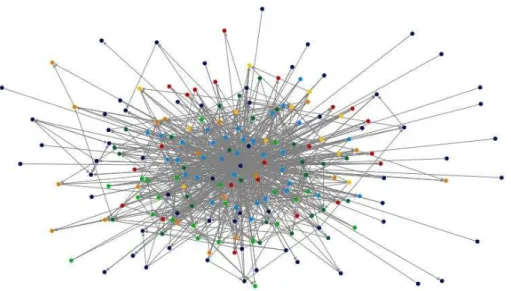
There is a limited number of people from Russomano’s network that are prepared or required to help him when triggered (mobilization). This is evident due to a low rate of strong relationships with groups of friends, which does not indicate readiness to help him and mobilize their resources, reducing the candidate´s social capital. Even with a clustering coefficient interval ranging from 1.000 to 0.667, which sets up a network of good friends, the candidate´s network seems limited on its topological map (Figure 2) making the candidate to get low instrumental return. The candidate had four groups within a preset radius of 100 individuals in his network, with a clustering coefficient in the range of 1.000-0.500. Each group is represented by a different color in Figure 2.
JISTEM, Brazil Vol. 12, No. 3, Sept/Dec., 2015 pp.647-662 www.jistem.fea.usp.br Figure 2.Celso Russomanno topological map
Source: Author
Candidate 2: José Serra
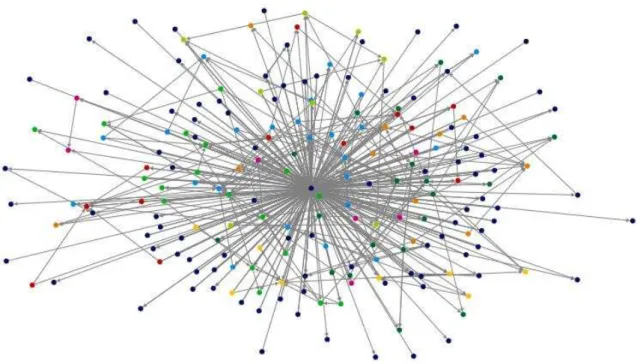
In José Serra´s network, we found an intersection between structure (availability), opportunity (accessibility) and an oriented action (use) of network elements, enabling elements of social capital, according to Lin´s assumptions (2002). Here, the instrumented action (political power) mobilized an entire network on behalf of the original action sender, as shown on his topological map.
JISTEM, Brazil Vol. 12, No. 3, Sept/Dec., 2015 pp.647-662 www.jistem.fea.usp.br Figure 3 - José Serra´s topological map
Source: Author
Candidate 3: Fernando Haddad
We identified the presence of "good friends" in few groups (three), and most of them in a single group, showing a tendency to homophilic interactions (search for relationships with individuals with similar characteristics and enough cohesion in the network).
JISTEM, Brazil Vol. 12, No. 3, Sept/Dec., 2015 pp.647-662 www.jistem.fea.usp.br Figure 4 - Fernando Haddad topological map
Source: Author
Candidate 4: Gabriel Chalita
We identified the presence of some "good friends" in various groups (seven), most of which found in a single group. The candidate had eight groups of friends, each represented by a different color in Figure 5.
JISTEM, Brazil Vol. 12, No. 3, Sept/Dec., 2015 pp.647-662 www.jistem.fea.usp.br Figure5 - Gabriel Chalita topological map
Source: Author
Candidate 5: Soninha Francine
We verified the presence of two "good friends" in two groups. The candidate had nine groups, represented by a different color in Figure 6.
JISTEM, Brazil Vol. 12, No. 3, Sept/Dec., 2015 pp.647-662 www.jistem.fea.usp.br Figure 6 - Soninha Francine´s topological map
Source: Author
Candidate 6: Carlos Gianazzi
In this case, it was obtained a diversity of groups, which converges to heterophilia perception. On the other hand, we cannot verify any good friend that would exercise the role of structural hole or that could contribute to strengthen the flow of resources between weak links. The main actors here, as in the previous example, are not engaged enough to disseminate information transmitted by the original message sender. In this case, the clustering coefficient was in the range of 0.667-0.583, in which one can observe few good friends within a limited circle of relationship, obtaining thus a low level of interaction / influence intra and extra-groups.
JISTEM, Brazil Vol. 12, No. 3, Sept/Dec., 2015 pp.647-662 www.jistem.fea.usp.br Figure 7 - Carlos Gianazzi´s topological map
Source: Author
Candidate 7: Levi Fidelix
We verified the presence of five good friends in two groups. The candidate had thirteen groups, each represented by a different color in Figure 8.
From a theoretical perspective, one can infer that despite the likely existence of high heterophilic relations, indicated by the presence of thirteen groups in his network, no good friends are in the group with the highest density of relations, which reduces the increase of the existing social capital. It is possible that there were people prepared or ready to help each other, but the absence of good friends in the largest group seems to have led the followers to act in a normative way, through inertia and not necessarily through an engaged way. Even though there were friends with a clustering coefficient in the range of 1.000-0.550, one may observe the limited presence of good friends in larger groups, which limited the network information flow as well as the existence of intra-group tie.
Figure 8 - Levi Fidelix´s topological map
JISTEM, Brazil Vol. 12, No. 3, Sept/Dec., 2015 pp.647-662 www.jistem.fea.usp.br Candidate 8: Paulinho da Força
Making a candidate network analysis, one can note the presence of two good friends in two groups. The candidate had twelve groups, each represented by a different color in Figure 9.
Here, it was not identified the role of a good and strong friend. Although we verified the presence of more engaged individuals, they were in groups of incipient relations, which led to a flaw effect of an executed instrumental action. In this case, we obtained a clustering coefficient in the range of 1.000-0.583 - limited presence of good friends in his network, in scattered clusters resulting in a low number of links between them.
Figure 9 - Paulinho da Força´s topologicalmap
Source: Author
6. CONCLUSION
This article aims to analyze how the relations between individuals are structured in a virtual network, Twitter, vis-à-vis the theories of social capital. We conducted a study on networks of candidates for mayor of São Paulo in 2012. The research was supported by theories of social capital and networks, validated by quantitative analysis based on the clustering coefficient of Clauset et al. (2004).
The practical contribution of this study is provided by the possibility of new studies inferring, through a network analysis tool, whether virtual interactions follow the same patterns of relations of structuring models verified in the field of non-virtual connections, explored by authors such as Lin (2002); Flap (1994); Ports (1998); Burt (1992); Granovetter (1973); Lin, Dean & Ensel (1986) and Lin (1990, 1992). Among these patterns, we can mention: strength of links, position in the structure, ownership and access to network and contact resources, operationalization and return of capital.
JISTEM, Brazil Vol. 12, No. 3, Sept/Dec., 2015 pp.647-662 www.jistem.fea.usp.br
the candidates in the non-virtual reality are similar to those seen in the virtual one, since candidates who obtained the most votes during the first round of municipal elections in 2012 (Fernando Hadad and José Serra) had a fair amount of good friends with cohesion on their networks, various possibilities of interaction, increasing the flow of information, access to resources, and possibility of return. The other candidates analyzed did not obtain enough votes to take them to the second round and presented a common point in the analysis: the absence of links that contribute to strengthening the flow of resources in the network.
The results are coherent with the initial objectives. By exploiting the theoretical assumptions about the Social Capital (reciprocal relations, development of subgroups, size of subgroups, loyalty to these groups and dissemination of views through tweets) and by applying the coefficient of Clauset et al through the NodeXL program we prove that there is overlap between the theory and the object of the study.
In addition, the study also provided theoretical contribution to the extent that it will enable new studies and inferences concerning the structure of relationships between individuals in a virtual network - these points being facilitated by topological maps - and their respective clusters / groups, clustering coefficients and analyses.
Another relevant point is the conclusion concerning the use of Twitter and social capital. In this social networking – Twitter - people have autonomy to build ties, through reciprocity, which ensures a more credible analysis of the influence of the power o f“the ego” over those people who surround it, which is a conclusion similar to others, already found in empirical studies of social capital.
Given these considerations, the overlap between the theory of social capital with empirical studies in the virtual world is presented as relevant to future studies, either in social capital or in group and individual behavior in social networks. There is thus the possibility of inferring what people can get in terms of individual gains when they are interacting in a virtual network that is not necessarily guided by mandatory reciprocity.
References
Amaral, L. A. N., Scala, A., Barthélémy, M,& Stanley, H. E..(2000). Classes of small-world networks.Proc. Natl. Acad. Sci. USA. 97(21), 11149-11152.
Bakshy, E.; Hofman, J. M.; Mason, W. A., & Watts, D.J..(2011).Everyone’s Influencer:
quantifying influence on Twitter.In Proceedings of the fourth ACM international
conference on Web search and data mining.65-74, Hong Kong, China.
Barabási, A. L., & Albert, R. A. (1999).Emergency of Scaling in Random Networks.Science 286, 509-512. doi:10.1126/science.286.5439.509.
Becker, G.S. (1993). Human Capital: A theoretical and empirical analysis, with special
reference to education. Chicago: University of Chicago Press.
Borgatti, S.P., Jones, C.,&Everett, M.G. (1998). Network measures of social capital.
Connections 21(2), 27-36.
Bourdieu, P. (2003).A dominação masculina. Rio de Janeiro: Bertrand Brasil.
Burt, R. S. (1992). Structural holes: The social structure of competition. Cambridge, MA: Harvard University Press.
Burt, R. S., & Minor, M.J. (1983).Applied network analysis: A methodological
JISTEM, Brazil Vol. 12, No. 3, Sept/Dec., 2015 pp.647-662 www.jistem.fea.usp.br
Clauset, A., Newman, M., &Moore, C. (2004).Finding community structure in very large networks. Physical Review E, 70 (6), 1-6.doi: 10.1103/PhysRevE.70.066111.
Coutinho, C, & Chaves, J. (2002). O estudo de caso na investigação em Tecnologia Educativa em Portugal. Revista Portuguesa de Educação, 15(1), pp. 221-244.
Creswell, J. W. (2003). Research Design: Qualitative, quantitative, and mixed method approaches. Thousand Oaks, Sage Publications, 2 ed.
Flap, H.D. (2002).No man is an island: the research program of a social capital theory. In O. Favereau and E. Lazega (Eds.), Conventions and structures.Markets, networks
and hierarchies (pp. 29-59). Cheltenham: Edward Elgar.
Fruchterman, T.M.J., &Reingold, E.M., (1991). Graph Drawing by Force-directed Placement. Software-practice and experience. 21 (11): 1129-1164.
Granovetter, M.S. (1973).The strength of weaker ties.The American Journal of
Sociology, 78 (6), 1360-1380.
Jin, E. M., Girvan, M., &Newman, M. E. J.(2001). The structure of growing social networks.Phys. Rev. E, 64 (04) (046132), 1-8.doi:10.1103/PhysRevE.64.046132
Kwak, H., Lee, C, Park, H., &Moon, S. (2010). What is Twitter, a social network or a news media?.In Proceedings of the 19th international conference on World wide web. 591-600. Raleigh, NC.
Lin, N. (1990).Social resources and social mobility: A structural theory of status attainment. In R. Breiger (ed.), Social Mobility and Social Structure, (pp. 247-271).Cambridge: Cambridge University Press.
Lin, N. (1992), Social resources: theory and research, In E. F. Borgatta (ed.), The
Encyclopedia of Sociology. (pp. 1936-1942). New York: Macmillan.
Lin, N.(2002). Social Capital: A theory of social structure and action. Cambridge: Cambridge University Press.
Lin, Nan. (1982). Social Resources and Instrumental Action..In P. Marsden & N. Lin.Social Structure and Network Analysis, pp. 131-145, Beverly Hills, CA: Sage Milstein, S., Chowdhury, A.,Hochmuth, G., Lorica, B.,&Magoulas, R.. (2008).Twitter
and the micro-messaging revolution: Communication, connections, and immediacy--140 characters at a time.Sebastopol, CA: O'Reilly Media / Radar
Park, J.,&Newman, M. E. J. (2003).The origin of degree correlations in the Internet and other networks.Phys. Rev. E, 68(2) (026112),1-7.doi: 10.1103/PhysRevE.68.026112.
Ponte, J. P. (1994). O estudo de caso na investigação em educação matemática.
Quadrante, 3(1), 3-18.
Portes, A. (1998). Social Capital: Its origins and applications in modern sociology.
Annual Review of Sociology,24, 1-24.doi: 10.1146/annurev.soc.24.1.1.
Watts, D. J.; &Strogatz, S. H. (1998, June 4).Collective dynamics of “small-world” networks.Nature 393, 440 – 442.doi:10.1038/30918
Weng, J., Lim, E.,& Jiang, J. He, Q. (2010).TwitterRank: Finding topic-sensitive influential twitterers.Davison, B.D., &Suel T. (Eds) Proceedings from the third ACM international conference on Web search and data mining.(pp. 261-270), New York.