DOI: http://dx.doi.org/10.7784/rbtur.v10i3.1186
Classic service styles in commercial catering: proposal
for standardiza-tion and clarifications for future research
Serviços clássicos na restauração comercial: proposta de
padroniza-ção e esclarecimentos para futuras pesquisas
Servicios clásicos de restaurantes comercial: propuesta de
normaliza-ción y direcciones para la investiganormaliza-ción futura
Rodolfo Wendhausen Krause1
Álvaro Augusto Dealcides Silveira Moutinho Bahls2
Abstract: This study aims to summarize the scientific knowledge and the empirical knowledge of the authors of this article about the four main types/styles of individual service in full-service food establishments. In addition, as secondary objectives, it seeks to simplify and standardize the types of classic services in restaurants. These objectives were met through a positivist methodological approach. The research techniques used were the com-parative analysis and a summary of the state of the art on the typology of classical services combine to the empirical knowledge of the authors. Subsequently, the validation of the proposal for standardization was made by a panel of evaluators. We came to simplify the services into three basic categories: French Service; Direct English Service and Plate Service. The study herein presented is of an exploratory nature and, thus further sci-entific studies should be conducted in order to deepen the knowledge on the topic. Particularly, there is lack of research on the mise en place.
Keywords: Restaurants. Types of service. Culinary Arts.
Resumo: Esse estudo tem como objetivo principal sintetizar os conhecimentos científicos do referencial teórico com os conhecimentos empíricos dos autores desse presente artigo sobre os quatro principais tipos/estilos de serviços individuais em estabelecimentos gastronômicos de serviço completo. Além disso busca-se, como obje-tivos secundários, simplificar e padronizar os tipos de serviços clássicos em restauração. Esses objeobje-tivos foram cumpridos através de uma abordagem metodológica positivista. Teve como técnicas de pesquisa uma análise comparativa e síntese do estado da arte sobre a tipologia de serviços clássica com os conhecimentos empíricos dos autores. Posteriormente, foi feita a validação da proposta de padronização por parte de um painel de avali-adores. Chegou-se a simplificação dos serviços em três categorias básicas: o serviço à francesa, à inglesa direto e serviço empratado. Entende-se que, por tratar-se de um estudo exploratório, a referida proposta é o inicia da pesquisa cientifica sobre o tema, tendo de ser averiguada com maior profundidade em estudos posteriores. O campo de pesquisa referente ao mise en place mostra-se, consequentemente, o que mais carece de pesquisas dessa natureza.
1 University of Vale do Itajaí (UNIVALI). Balneário Camboriú,SC, Brazil 2 University of Vale do Itajaí (UNIVALI). Balneário Camboriú,SC, Brazil
Krause, R.W.; Bahls, A.A.D.S.M. Classic service styles in commercial catering: proposal for standardiza-tion and clarifications for future
research
Palavras-chave: Restauração. Tipos de serviços. Gastronomia.
Resumen: Este estudio pretende resumir el conocimiento científico de lo teórico con el conocimiento empírico de los autores de este artículo sobre los cuatro principales tipos/estilos de los distintos servicios en los estable-cimientos gastronómicos de servicio completo. Además, se busca, como objetivos secundarios, simplificar y es-tandarizar los tipos de servicios clásicos de la restauración. Estos objetivos se cumplen a través de un enfoque metodológico positivista. Tenían como técnicas de investigación un análisis comparativo y la síntesis del estado del arte sobre la tipología de los servicios clásicos con el conocimiento empírico de los autores. Posteriormente, la validación de la propuesta de normalización fue realizada por un panel de evaluadores. Llegamos a simplificar los servicios en tres categorías básicas: el servicio a la francesa, el inglés directo y el servicio plateado. Se en-tiende que, debido a que es un estudio exploratorio, la propuesta es el comienzo de la investigación científica sobre el tema tuvo que ser investigado con mayor profundidad en futuros estudios. Se muestra el campo de la investigación para la puesta en su lugar, por lo tanto, lo que la investigación más necesidades de esta naturaleza.
Palabras clave: Restaurante. Tipos de servicios. Gastronomía.
INTRODUCTION
It cannot be emphasized enough the importance that food has to human beings at so many different levels, from the satisfaction of physiological needs to the most hedonistic and artistic wishes. The act of feeding and the permanent changes of this process go hand in hand with the human evolutionary leaps. The evolution of our eating habits "led to the improve-ment of social and economic relations, [one of the bases] for the displaceimprove-ment of various groups and their regions of settlement", (Krause & Bahls, p. 434, 2016). Food as a tourist at-traction is a recent field of study within the applied social sciences, and it emerges as an a -swer to the urgent need for research to assess performances, identify the shortcomings, effi-ciency, and potential improvements “ a pato, p. , . Currently, food goes beyond the simple tourist attraction, and becomes a key element of tourism, forming together with ac-commodation and transportation, an inseparable triad (Krause & Bahls, 2016). Therefore, the approach to the concept of quality is inherent to this new field of research. Previously, the quality was considered a distinctive feature, nowadays it is critical to the survival of a tourism food service establishment.
TheExpectancy-Disconfirmation Paradigm(EDP) was the inspiration for the topic cho-sen for this study. Regardless of its limitations, intrinsic to any scientific model, the EDP has
Krause, R.W.; Bahls, A.A.D.S.M. Classic service styles in commercial catering: proposal for standardiza-tion and clarifications for future
research
perceived as negative, where needs, wants, wishes, and ambitions were not met, the experi-ence will be of a low quality or unsatisfactory. Fundamentally, in the catering world it is of great importance the understanding between the parts involved in the process and the bal-ance between the quality in the preparation of food and beverages with the service per-formed subsequently. It must be clear what is being served and how it is served. It is of no use a high production, with the correct use of culinary techniques and first-class ingredients if, subsequently, the service to customer is carried out in an unthoughtful or inadequate man-ner or if it does ot eet usto e s e pe tatio s.
The quality of service in catering, despite the strong, and maybe preponderant, sub-jective nature (Krause, 2014), is not circumscribed to the result of the interpersonal relation-ship, welcoming and cordial, between the customer and the restaurateur, or to the prepara-tion of food. There is, also, an essential component to the food service provision: the tech-niques and the classic methods of presenting and delivering the food to the customers, called here types or styles of service. Despite being a topic briefly addressed in the most various domains, some topics considered fundamental to catering remain without further detailed studies. Therefore resulting in lack of cohesion between some terms, concepts, and proce-dures used, inherent to an immature field of knowledge.
Some concepts and classic techniques in the provision of food service, such as mise en place (types and setting of tableware), the typology and the performance of service, have always been the reference to assess the quality of the service of a restaurant. In this sense, the classic typology of service is considered here as the presentation, arrangement, and de-livery to the customer of a dish, or a set of dishes which compose a meal or part of it (Lang, 1995). Among them there is the French service (à la française), which has been used for centuries, although it remains a vague nomenclature and procedure, requiring further studies and whose variations cause incoherence in the service provision. What we see often is the provision of something different from the service expected, i.e. the communication between customer and restaurateur is full of misunderstandings, thus, causing discomfort to the par-ties, and impacting negatively the perceived quality of service. Fo e a ple, ost A e i a s consider the French service as a highly sophisticated service entailing tableside preparations as well as a variety of cutlery, a service that is, in fact, a combination of French, English, and Russian styles Ma ti age & Ma ti age, p. , . Besides the discrepancy between es-sential aspects of each service, such as the correct way of serving a dish, for example, there are different nomenclatures for the same type of service. Cândido (2010) names the Russian style as indirect English service, which makes the understanding even more difficult, causing dissatisfaction to the customer, who does not know what to expect from each service.
Krause, R.W.; Bahls, A.A.D.S.M. Classic service styles in commercial catering: proposal for standardiza-tion and clarifications for future
research
framework of the typology of service comes exclusively from a few books, which shows the lack of scientific research on this topic, essential to the quality of food service provision in tourism. Therefore, to achieve high standards of quality and satisfaction it is necessary to clarify and inform the core concepts through a literature review aiming to understand the essence of the topic (Bressan, 2008; Marconi & Lakatos, 2011; Martins, 2009).
This research applied the so- alled state-of-the-a t te h i ue to survey the studies, identify the discrepancies, and gaps in research studies on the topic under analysis. This is not a pape i the state-of-the-a t fo at, ho e e that app oa h as used to deli it the the-oretical framework. The review studies are essential to the development of applied social sciences, as is the case of Food Tourism, and extremely important for studies of an exploratory nature, as is the case of the present study. This approach allo s aps, critical analysis, which seek to highlight the issues and focused topics, methodological approaches, procedures and analysis, [...] as well as the gaps that can stimulate the production of new research Vosge au & Romanowski, 2014, p. 167). Furthermore, these studies favor the definitions of certain fields of research, assisting the understanding of subjects not well-established scientifically, poi ti g out the eed to i p o e the methodological and theoretical status, and event the research trends. [These studies can point to] methodological theoretical contributions and their understanding in different contexts; indicate methodological procedures used in the area, and pointing out trends in the approaches of edu atio al p a ti es (Vosgerau & Ro-manowski, 2014, p. 168).
Therefore, the main objective is to summarize the scientific knowledge of the theoret-ical framework and the empirtheoret-ical knowledge of the authors of this paper about the four main types/ styles of individual services in full-service restaurants. These are the French, Russian, English, and American Services (Payne-Palacio & Theis, 2012; Kotschevar & Luciani, 2007; Dahmer & Kahl, 2009; Martinage & Martinage, 2013; Lang, 1995; CIA, 2013). The secondary objectives are to simplify and put forward the standards of classic services in restaurants. The study is concluded with the proposal of simplification and standardization of the types of clas-sic services in restaurants, aiming to fill the gap in communication between the customer and the food entrepreneur, caused by the discrepancy between the concepts under study. The standardization give rise to three basic types of full services: French Service, Direct English Service, and Plate Service (the others are variations of these, e.g. the Russian Service), which are presented in a summary table in the final results section. As a result of this study it is expected that it fosters food service research, aiming to improve its quality as an integral part of tourism.
Krause, R.W.; Bahls, A.A.D.S.M. Classic service styles in commercial catering: proposal for standardiza-tion and clarifications for future
research
This study adopts a positivist perspective, among other aspects, it is considered that the verified data, perceived by the senses, is empirical evidence; thus, the positivism is based on empiricism, aiming the production of practical results (Macionis & Gerber, 2011). The topic of this study is critical to the quality of food service provision, however it remains unexplored from a scientific perspective. Hence, it is proposed the integration of science (drawing on the theo eti al f a e o k a d e pi i is d a i g o the autho s a ade i a d p ofessio al experience). Aiming to shed light on some aspects overlooked by the literature.
The methodological approach chosen for the research was a comparative study, which examines the similarities and differences between groups, peoples, countries, and/or events, to better understand a given phenomenon and/or widen the knowledge about a specific event (Marconi & Lakatos, 2003; Martins, 2009), i sofa as by using a type comparative study it is possible to discover regularities, and to notice displacements and transformations, build models and typologies, identifying continuities and discontinuities, similarities and differ-ences, as well explaining the widespread determinations that govern the social phenomena (Schneider & Schmitt, 1998, p. 01).
Literature review was adopted to compose the theoretical framework. The survey was carried out between August 2015 and May 2016. Scientific papers were retrieved from data-bases, such as EBSCOhost, ScienceDirect, SciELO, CAPES/MEC Portal of Journals, and Google Scholar. The survey of thesis and dissertations was done through the Brazilian Digital Library of Theses and Dissertations (BDTD).
The study was carried out from 1938 to 2016 (78 years). The starting point was the year of the first edition of the LarousseGastronomique, 1938, considered a benchmark of the scientific literature on gastronomy (Booklist Online, 2010). Usually, a time frame of 15 years is considered current (Gonçalves, 2008). However, that interval was enlarged because the initial results within a time frame of five years were insignificant. The keywords used (in Por-tuguese and in English) were: tipos OR estilosde serviços AND gastronomia AND restaurantes
types OR styles of service AND gastronomy AND restaurants.
Krause, R.W.; Bahls, A.A.D.S.M. Classic service styles in commercial catering: proposal for standardiza-tion and clarifications for future
research
The works included in the contemporary list are mostly scientific papers which discuss customer satisfaction and service quality from various perspectives. The results show that there are several models which seek to measure the level of customer satisfaction and the ways service quality can be assessed. However, there is no result among those papers regard-ing the topic proposed by this study. Other works are books, online documents, academic slide presentations, corporate information, among others. The main are, in order of publica-tion: the manual THE WAITER & WAITRESS AND WAIT STAFF TRAINING HANDBOOK (Arduser & Brown, 1ª ed. 2005); the website HOSPITALITY-SCHOOL.COM (2014); the guide SERVIÇOS DE ALIMENTAÇÃO E BEBIDAS (Eleutério, 1ª ed. 2014); and the book RESTAURANTE – ADMIN-ISTRAÇÃO E OPERACIONALIZAÇÃO (Cândido, 1ª ed. 2010).
The theoretical framework encompasses the scientific knowledge. The empirical knowledge comes from academic and professional works compiled over 22 years by the au-thors. The synthesis of that knowledge was presented to a validation panel composed of six professionals from the food sector. The number of reviewers was considered acceptable due to the exploratory and qualitative nature of this study. The specialized literature on the sub-ject (Bressan, 2008; Marconi & Lakatos, 2011; Martins, 2009) does not indicate an ideal num-ber of participants in the panel. Such authors posit that, in certain cases only one reviewer is valid, dependending on their representativeness of the community. Despite the relatively small number of reviewers, the panel is considered representative because it includes profes-sionals with vast experience on the topic under study, in national and international restau-rants, some of them with Michelin stars.
At the end of the results section we present a summary table with the various types of food se i es, o tai ed th ough spe ialized lite atu e, o ple e ted ith the autho s personal and professional considerations and empirical aspects. This methodology is bold in-sofar as it proposes the integration of empiricism and science aiming the broadening of knowledge. A second study, a field research, will be carried out to examine how theoretical concepts are approached by the Brazilian food service market.
THEORETICAL FRAMEWORK
The meal service should prioritize the usto e s o fort and convenience, be
effi-cient and meet the expectations of the final consumer. Historically the services called French,
E glish, a d ‘ussia “t les o espo ded to o plete a d i di idual t pes of eal se i es (Martinage & Martinage, p. 120, 2013). As time went by, and with the stabilization and
unifi-cation of Europe those styles ended up combined. When they migrate to the American
Krause, R.W.; Bahls, A.A.D.S.M. Classic service styles in commercial catering: proposal for standardiza-tion and clarifications for future
research
(Martinage & Martinage, 2013). At this point it is important to clarify the chief aspects related
to those four main individual full services and their variations, as well as the discrepancies
between the different theories and, therefore, where the theoretical framework falls short of
services standardization.
3.1 French service or Diplomat service
The initial observation point of this study is the reign of Louis XIV, wherein the service
à la Française reached its peak. The French service is the continuation of a ceremony carried
out by the French royal family in the seventeenth century, called the grand couvert, given its
high cost, initially, it was used by the royalty in special occasions and for dining in public, (Lang,
1995). Subsequently, Louis XVI started having a grandcouvert daily for dinner, at 10 pm
(Cha-teau de Versailles, 2016), and fixing some aspects of the service, today known French style.
This type of service within the standards established historically is not the most used.
It had its peak and refinement around 1690 and its last years were around 1830, when it was
substituted by the Russian service (Lang, 1995). Traditionally, a meal served à la Française was
divided into three separate courses: the fi st course included from soups to roasts, including ho s d ou e a d sta te s; the se o d, f o oasts […] a d egeta les, u til the s eet dishes; and the third consisted of pastry, petit four, desserts, ice-creams, and fruit. The order of the
menu depended on the number of starters; the number of items served on the first course
must be equal to those of the second. The first course was already set up on the table (in hot
dishes or covered warm, if necessary) before the guests arrive , hile the othe plates e e
placed in the place of the previous ones, and each guest served themselves as they pleased
from the moment the items were set on the table; every 15 minutes the dishes were swiftly
replaced (Lang, p. 967, 1995). After the guests finished a service the got up a d left the
ta le, hile it as lea ed a d eset fo the e t se i e (CIA, p. 39, 2013).
Besides the high cost of a service like this, it fell into disuse because of the ostentation
and extravagance to the detriment of comfort and satisfaction of guests (Payne-Palacio &
Theis, 2009). Diners could not satisfy their appetites and enjoy the main dishes still warm,
Krause, R.W.; Bahls, A.A.D.S.M. Classic service styles in commercial catering: proposal for standardiza-tion and clarifications for future
research
that the highest number of items could be served in one meal (LANG, 1995). This service
ex-panded, modified, and adapted over time in various locations, acquiring some recognizable
contemporary features, particularly, the preparation or completion of some dishes tableside
in the guéridon or "flambé trolley". However it is worth mention that the traditional French
service is still used, in few occasions, in French Embassies all over the world and in the
presi-dential palace of France (Martinage & Martinage, 2013).
The main features of this type of service are: the use of the guéridon and, conse-ue tl , the o pletio o full p epa atio of so e ite s at the usto e s ta leside the
chefderang (chief or experienced waiter), assisted by a commis or maybe a commis or
com-misdebarasseur (debarass means clean or remove); and, in a second moment, the
presenta-tion of the platters, from which the customer help themselves, from the left side (Cândido,
2010; Eleutério, 2014; Dahmer & Kahl, 2001; Martinage & Martinage, 2013). However some
authors (Payne-Palacio & Theis, 2009; CIA, 2013; Arduser & Brown; 2005) do not mention the
side for serving.
Besides preparing the food, the chef de rang dishes up and places the garnish. Heated
plates are used for hot food. The plate is prepared and, next, handed to the commis who
presents it to the guest Kots he a & Lu ia i, p. , . Common sense dictates which
courses are prepared beforehand, e ause o l the food hich can be cooked, assembled,
or finished in a relatively short time are prepared in front of the guests. Typical specialties
which can be served in French style are La Salade César (Caesar Salad), Le Tournedos au Poivre
(fillet of beef with pepper sauce), and Les Crepes Suzette (crêpes with orange sauce) Dah e
& Kahl, p. 19, 2001).
The guéridon is an auxiliary component, a small round table, and adapted to the table
service. It is ofte , e uipped ith réchaud (a heating element) and a large silver dome or
lo he fo o e i g food (CIA, p. 40, 2013). The guéridon should contain all of the tools needed for the preparation, conclusion, and service of food to the customer, it can be used
for mixing and serve salads, deboning fish, or carving meat. The most common variation of
this type of service is the use of platters instead of the guéridon. I this ase, the food is full
Krause, R.W.; Bahls, A.A.D.S.M. Classic service styles in commercial catering: proposal for standardiza-tion and clarifications for future
research
waiter. The platter is then placed on a guéridono heati g ta le a d plated the aite p
e-sent the platter to the customers who serve themselves (CIA, p. 40, 2013).
The tasks and techniques more commonly performed by the chief waiter are: Toss and
Mixing; Plate Presentation and Sauces; Deboning and Carving; and Flambéing (Kotschevar &
Luciani, p. 113, 2007). Contemporarily, the use of guéridon is almost exclusively reserved to
formal and traditional French service (CIA, 2013), since it takes more time and requires skilled
personnel. Therefore is more cost-effective to bring the food cooked from the kitchen to the
table (Cândido, 2010).
3.2 Russian service or Indirect English Service
The prince Alexander Borisovich Kurakin, the Russian ambassador to France (between
1810 and 1812) during the second Russian Empire, is known to have introduced the first
mod-ifications to the French Service to the point that this became a new style of service called à la
Russe, by the French high society (Lang, 1995). Since then, it became widespread, popularized
byUrbain Dubois, the creator of some of the French classic dishes. The French chef introduced
the Russian style to middle-class households in France (Lang, 1995). He defined the new
ser-vice style as less formal and ostentatious. The objective was to allow the guests, contrary to
the French service, to ha e the hot food as hotter as possible; instead of letting the guest
choose from a vast array of dishes, the order was previously established and the dishes were
served one at a time (Lang, p. 968, 1995). Luxury and extravagance were replaced by
conviv-iality and practicality. However, the presentation and looks of food were still of importance.
The service à la Russe is similar to the French service in many aspects, and was
modi-fied over the years until it became an entirely different style. It is a very formal and elegant
service, in which guests get personal attention. It is considered the most popular and it is used
in the most exclusive restaurants and hotels around the world. The simplicity, compared to
French service, made the Russian style a popular substitute for the latter. Still, it uses a table
setting similar to the service à la française (Lang, 1995; CIA, 2013; Payne-Palacio & Theis,
Krause, R.W.; Bahls, A.A.D.S.M. Classic service styles in commercial catering: proposal for standardiza-tion and clarifications for future
research
The two major differences are that only one server is needed and that food is fully
prepared in the kitchen. The food is arranged in silver platters, and the server (host, maître,
waiter, etc.) brings them to the dining room and presents them to the guests. The dishes are
prepared in the kitchen, and the use of guéridon is optional and only for heating and
finaliza-tions (Martinage & Martinage, 2013). Compared to the French service, it is less labor
inten-sive, and requires less skilled and experienced servers, thus it is less time-consuming and less
expensive. It requires less space, is adequate for large groups eating the same meal, and it
still is grand style. Like in the French service, the diner is given a considerable personal
atten-tion (Lang, 1995; CIA, 2013; Payne-Palacio & Theis, 2009; Martinage & Martinage, 2013;
Dah-mer & Kahl, 2001; Kotschevar & Luciani, 2007).
This service is based in one principle: everything should be carried out in the minimum
possible time, so that the dish is presented promptly without modification of flavors. The
guests are divided into groups of eight, ten, or twelve people, and each group is served by a aît e d hôtel (F e h o d fo aste ). The first guest to be served is defined before the beginning of the service, and the others are served clockwise (Lang, 1995).
To serve, the maîtrecarries the platters of food to the dining room and presents them
to the guests at the ta le, e t standing to the left of the each guest and holding the platter
in the left hand, the server shows each guest the food and then, using a large spoon and fork
with the ight ha d, dishes up the desi ed po tio o the guest s plate Dah e & Kahl, p.
21, 2001). Some authors (CIA, 2013; Arduser & Brown, 2005), confuse and/or do not mention
which should be the side to serve, causing confusion between the types of service.
Follo i g the o eptio ega ded as o e t, the po tio s of food a e lifted f o the service dish by the right hand by placing a large spoon with the bowl facing up under a portion,
and a fork is placed on top of it to hold it in place. A spoon is used to serve vegetables and
a othe ite s (Kotschevar & Luciani, p. 116, 2007). The service continues clockwise around the table and the remaining food returns to the kitchen. The wine follows the same
sequence of service, however it is first served to the host (Lang, 1995). The guéridon may be
used in the service à la Russe provided the food is prepared in the kitchen, and not finished
Krause, R.W.; Bahls, A.A.D.S.M. Classic service styles in commercial catering: proposal for standardiza-tion and clarifications for future
research
3.3 English Service (traditional)
E glish se i e, also k o as host se i e A duse & B o , , o igi ated i the traditional homes of the B itish a isto a , he e the host a es a d se es the po
-tions to the family and guests assisted by the domestic staff Ma ti age & Martinage, p. 123,
2013). Subsequently, this type of service spread to the country clubs in the United Kingdom
(CIA, 2013). The English service is less formal, less labor intensive and, thus, less expensive
and considerably faster. It is a style of service more intimate and personal, creates a more
communal atmosphere close to genuine hospitality, referring to family and to British
house-holds. For this reason it is graceful and adequate for intimate groups, and can be used
occa-sionally for a special dinner served in a private dining room of a restaurant (CIA, 2013;
Mar-tinage & MarMar-tinage, 2013). Like in the Russian service, all the food is prepared in the kitchen
and brought to the dining room to be placed and served to the guests/customers (CIA, 2013;
Martinage & Martinage, 2013; Dahmer & Kahl, 2001; Kotschevar & Luciani, 2007).
The host or hostess, in particular occasions represented by the head of the house,
serves the food from the platters, bowls and/or vessels which are brought from the kitchen
and placed before him or her at the head of the table (CIA, 2013; Martinage & Martinage,
2013; Dahmer & Kahl, 2001; Kotschevar & Luciani, 2007). Traditionally he or she carves,
debones, fillets or portions the main course, dishes it up with the garnish on individual plates
and serves it to each guest. Alternatively, the host only carves and put the portions on the
plates, handing over the plate to the person sat to his or her left (generally the second person
in the house hierarchy) who serves the garnish and passes the dish to the guest of honor and
to the other guests. The host determines the order of precedence of the guests (Martinage &
Martinage, 2013; Dahmer & Kahl, 2001; Kotschevar & Luciani, 2007). Another option of
ser-vice, less formal and more contemporary, the host or hostess, hands over the dish to the
closest person who passes it to the guest sat next to him or her, and so forth until all the
guests are served (CIA, 2013).
Krause, R.W.; Bahls, A.A.D.S.M. Classic service styles in commercial catering: proposal for standardiza-tion and clarifications for future
research
The English service (traditional) is not commercially viable. However, with adaptions
and modifications it can be commercially useful for events or in restaurants reserved to
pri-vate groups. After the food is brought from the kitchen, part of the dining room brigade dishes
up food and the others carry, present, and deliver each plate to the diners. In restaurants, the
English service techniques are adapted in a more formal way (Martinage & Martinage, 2013)
inasmuch as to have this service adapted to a normal operation and not only in events or for
private dinners. In this case, that variation is called Direct English Service and it is
character-ized by two aspects. First, the food comes fully prepared and assembled from the kitchen in
suitable containers, and there is no tableside food preparation, in front of customers. Second,
the server presents the serving dishes from the left side of the customer, and using the serving
cutlery (spoon under the fork, both facing upwards, as tongs) serves a portion of food directly o the usto e s plate (Martinage & Martinage, 2013). However some authors posit that the food should e se ed f o the ight A duse & B o , , gi e ise to dis epa ies of concepts and between the customer and server.
3.5 American Service or Plate Service
The American service (considered as a mix of the three above-mentioned styles) is less
formal, less expensive, and more efficient than French, Russian, or English styles and, it still
has a certain level of elegance (CIA, 2013). Maybe it is, currently, the most widespread in the
commercial catering world and, thus, is has various names and variations, called the simple
service, plated or plate service, executive and, also, A l’assiete (Cândido, 2010; Lang, 1995;
Dahmer & Kahl, 2001; Martinage & Martinage, 2013; CIA, 2013; Kotschevar & Luciani, 2007).
Despite the names they share a common feature. Essentially, all cooking and plating is done
in the kitchen and then the individual plates are set before the diners (CIA, 2013; Dahmer &
Kahl, 2001; Kotschevar & Luciani, 2007; Lang, 1995; Martinage & Martinage, 2013). Given the
fa t that the food is p epa ed, asse led a d plated up i the kit he the hef o u de the supervision of professional chefs, the food may be presented in a very attractive way [...]
Krause, R.W.; Bahls, A.A.D.S.M. Classic service styles in commercial catering: proposal for standardiza-tion and clarifications for future
research
their creativity, plating the food individually in a visually attractive manner Kots he a &
Luciani, p. 116, 2007).
This kind of service suited U ited “tates need for cost optimization, efficiency,
allow-ing for a fast turnover and high-volume operations (CIA, 2013). Other advantage of the
Amer-ican service is the possibility to adapt it to various situations and needs, from breakfast, to
lunch, or dinner services (Kotschevar & Luciani, 2007).
Some authors (Payne-Palacio & Theis, 2009) do not determine the order of service,
although the general rule is that the server approaches the guest from the right side, with the
prepared dish brought from the kitchen on the left arm, and sets it in front of guests with the
right hand (CIA, 2013; Dahmer & Kahl, 2001). Furthermore, adding to the controversy Ko-ts he a & Lu ia i p ese t the se i e f o the guests left, ithout justif i g it. Ma -tinage & Mar-tinage (2013) posit that this style of service should prioritize, contrary to the
other types of service, the predominant hand of the server, in order to expedite service. The sa e autho s lai that the iolatio of that ule is acceptable, and even welcomed, in case of a left-handed server, allowing them to carry up to three plates with the less used arm and
serve them with the predominant hand, ensuring that the plate is set before the diners more
swiftly, safety, and precisely (Martinage & Martinage, 2013).
4 RESULTS
Given that the traditional English service is not commercially viable and the present
study focus on commercial catering, that service is reserved to private or family occasions
and, thus, it is not considered in the final results, the same with the Russian service. Therefore,
the four classic services turn into: French service, direct English service (being the indirect
style a variation of this with the use of guéridon,) and plate service. This research proposes a
dialogue between two distinct subjects: one, from the theoretical framework perspective,
and the other, from the empirical perspective (professional and academic) of the authors of
this study, trying to summarize, simplify, and standardize the definitions about types of
Krause, R.W.; Bahls, A.A.D.S.M. Classic service styles in commercial catering: proposal for standardiza-tion and clarifications for future
research
aiming to validate, partially validate, or disprove the results put forward. The panel is
com-posed of six evaluators, three chefs and three hostesses (the person receiving the customer
and helping the service), all of them have national and international professional experience
in full service restaurants, some of them with Michelin stars.
This proposal is built upon the premise that the service procedures prioritize
right-handed people and aim to facilitate the use of the service tools and operation. The service
should not cross in front of the customer, so it must be determined from which side should
the plates and drinks be served, as well as the removal of dishware. The results of the
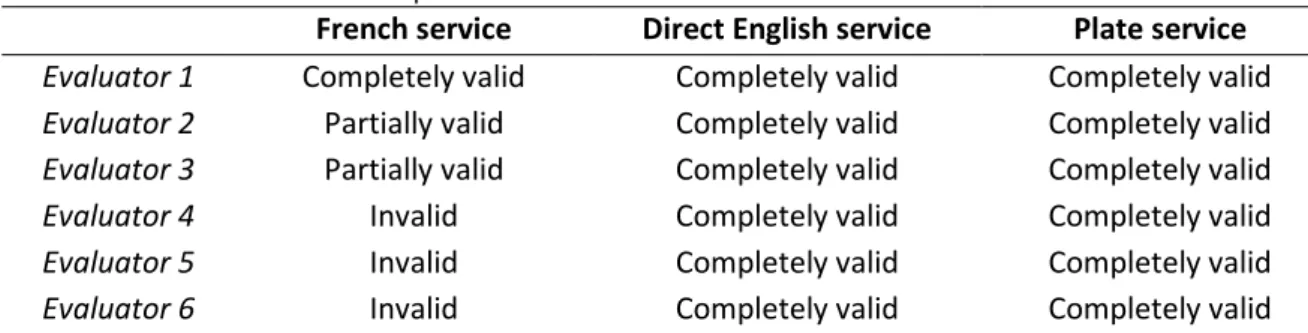
valida-tion panel are presented in Table 1.
Table 1 – Results of the validation panel
French service Direct English service Plate service Evaluator 1 Completely valid Completely valid Completely valid Evaluator 2 Partially valid Completely valid Completely valid Evaluator 3 Partially valid Completely valid Completely valid Evaluator 4 Invalid Completely valid Completely valid Evaluator 5 Invalid Completely valid Completely valid Evaluator 6 Invalid Completely valid Completely valid
Source: The authors (2016)
The only disagreement between the proposal put forward in this study and the
evalu-ation of the panel relates to the French service. However, the panel does not disprove of the
methodology to standardize and simplify the service, it only points out that this kind of service
with the guéridon is i disuse toda , […] is u o fo ta le fo the usto e s [a d] it is diffi-ult to e e ute, oth to the di e a d to the se e (Autores, 2016). The study sought also to simplify and standardized the names of the services, opting for the French service instead of
Diplomat service, because the latter requires a hierarchy and formality that are not used
com-mercially. The designation indirect English service was also preferred over Russian service,
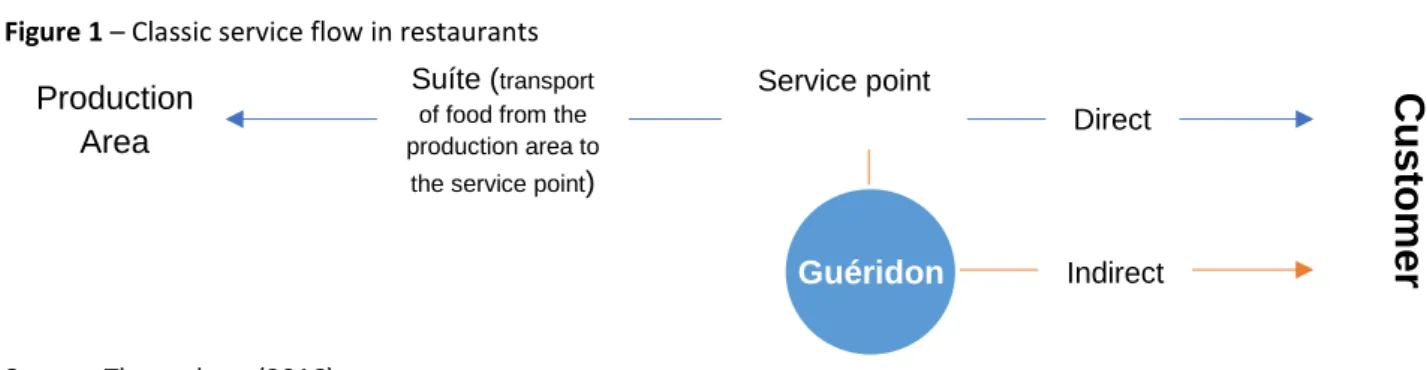
because the terms direct and indirect facilitate the understanding and the standardization of
the terms. The only difference lies in the fact that in the direct English service (also called suite
service) the food comes already prepared from the kitchen and goes directly to the
Krause, R.W.; Bahls, A.A.D.S.M. Classic service styles in commercial catering: proposal for standardiza-tion and clarifications for future
research
Figure 1– Classic service flow in restaurants
Source: The authors (2016)
Instead of American we opted for the designation plate service, contributing to the standardization of terms, relating it to its essential feature (the food comes already plated from the kitchen). We also propose that the name of the service is not attached to the country (contrary to the French and English services) was not invented in the United States of America. Furthermore, this type of service is commonly used in Italy and France, in various kinds of food establishments, from standard restaurants to high-end restaurants such as the D.O.M of Chef Alex Atala, in São Paulo. Inclusive in certain circles in the U.S.A. that kind of service is known as plate service.
French service– nowadays, the traditional French service (with the use of guéridon to prepare and finish food) is reserved to formal dinner parties and to a few exclusive high-end restau-rants (Arduser & Brown, 2005), it requires a high level of sophistication and skills from the se i g igade. Fu the o e, it ge e all e ui es a aptai to seat the guests a d take o -ders, a sommelier to recommend wines and to serve them, two servers (front and back wait-ers) to deliver and prepare the food, and a commis to bring water and bread CIA, p. 9, 2013), as well as to clear and set the tables. The traditional French service, because of its formality, requires a service brigade highly experienced and trained; in the industry is little used because it is time consuming and sometimes it makes customers uncomfortable. It is a service which prioritize hierarchy thus it is more used in diplomatic or state banquets, hence the designation Diplomat service.
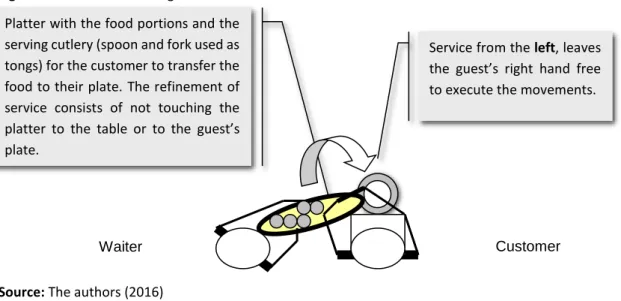
Base for execution: in Brazil the French service is done with the food being prepared in the kitchen, portioned and put on a guéridon (just to keep the food warm) or in a platter. The fork a d the spoo a e used to t a sfe the food to the guest s plate. The se i g utle is pla ed at the end of the platter with the handles out. The waiter holds the platter over a napkin with the left hand, and brings it to the guest s ta le. He approaches the guest from the left side holding the platter near the plate without touching the table or the plate. In that position the serving cutlery resting on the platter must be arranged so that the handles are turned to the guest who will transfer the food to their plate (Figure 2). Additional characteristics: the French
Production Area
Suíte (transport of food from the production area to
the service point)
Direct
Indirect Guéridon
C
u
sto
mer
Krause, R.W.; Bahls, A.A.D.S.M. Classic service styles in commercial catering: proposal for standardiza-tion and clarifications for future
research
service is carried out with a waiter to six, maximum eight, guests, and service follows the order of precedence and the host or hostess is served last. In case there is not a protocol list, the guest or older women are served first and then the men are served following the same rule. The rationale of the operation: This service is oriented for right-handed people, so it prioritizes the majority of the population. Thus, the service is from the left side of the cus-tomer because in this way the right hand is furthest from the platter and, thus more able to perform the movements necessary to transfer the food. The left hand becomes compromised and with limited movements due to the proximity of the serving dish, it functions just as a support to the right hand. In case this was performed from the right side, the majority of guests would have many troubles to execute properly the operation.
Figure 2– Schematic viewing of French service
Source: The authors (2016)
Direct English service – it is a variation of the French service, but in this case the transfer of
food from platters to the usto e s plate is do e the aite . The indirect service is
char-acterizes, simply, by the use of the guéridon to finish some dishes and it does not entail
cook-ing. Base for execution: the food is placed in the platter in portions, in the kitchen, or
por-tioned by the waiter before service. Sometimes the portioning is done only after presenting
the course to the customer as a way to respect the plating up done in the kitchen. From the
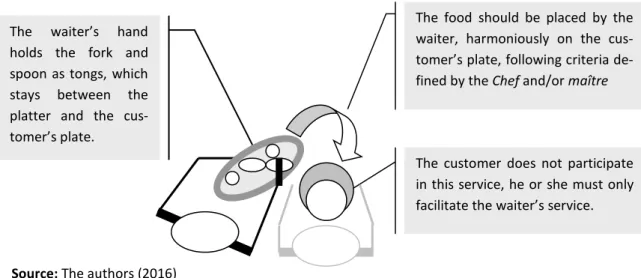
usto e s left side the server brings the platter closer to the plate. Using the serving cutlery in the right hand, as to gs, the se e t a sfe the food to the usto e s plate (Figure 3).
Service from the left, leaves
the guests right hand free to execute the movements. Platter with the food portions and the
serving cutlery (spoon and fork used as tongs) for the customer to transfer the food to their plate. The refinement of service consists of not touching the platter to the table or to the guest s plate.
Krause, R.W.; Bahls, A.A.D.S.M. Classic service styles in commercial catering: proposal for standardiza-tion and clarifications for future
research
Additional characteristics: the standard of this service is a maître/ waiter for six to eight
cus-tomers, and one or two commis to help. The platter may, initially be presented, from the right
side, so that the customer may verify if everything is in accordance with the order. It is also
the moment to showcase the plating up. After the approval the server initiates the service
from the left side. When transferring the food from the platter to the guest s plate the aite
must create a balanced and attractive plating. Normally, the plating up is decided with the
maître and the chef, taken into account the best possible way of showcasing the food and its
preparation. The skills in handling the serving cutlery as tongs is key to the quality of this
service. The rationale of the operation: in the case of the direct English service, it is up to the
waiter to choose the side for service (because they are the ones serving the food). I.e., if the
waiter is right-handed they will use the serving cutlery as tongs in the right hand, and this
should be between the platter and the plate. This is the more comfortable way to perform
the movement. If it was done from the right side, a right-handed waiter would have the
plat-ter between the right hand ith the spoo a d fo k as to gs a d the usto e s plate, hi h
would hinder the execution of the movement. The use of the cutlery as tongs, due to the
variations in holding it, allows for the transfer of portion items, garnish (inclusive pasta), sauce
and others such as a napkin.
Figure 3 - Schematic viewing of direct English service
Source: The authors (2016)
The aite s ha d
holds the fork and spoon as tongs, which stays between the platter and the
cus-to e s plate.
The food should be placed by the waiter, harmoniously on the
cus-to e s plate, follo i g ite ia
de-fined by the Chef and/or maître
Krause, R.W.; Bahls, A.A.D.S.M. Classic service styles in commercial catering: proposal for standardiza-tion and clarifications for future
research
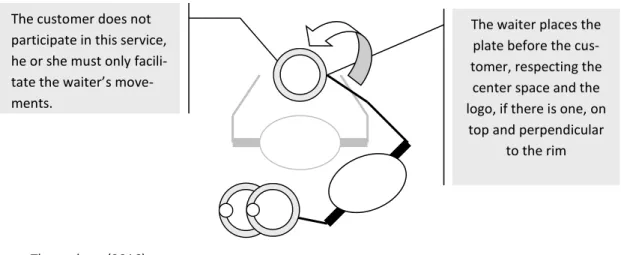
Plate Service – the name is simplified considering that the main feature of this service is that
the food is dished-up in the kitchen and the plate is simply placed before the customer. In this
way, the following designations can be included in this type of service: A l’assiette– (meaning to plate hi h is plated service in the kitchen, paying great attention to presentation; Ital-ian style – equivalent to l´assiette, however is simpler, but still refined in the presentation,
used especially with pasta a d isottos; E e uti e o P ato Feito plated up – Brazilian
des-ignation for l´assiette, but in a simpler way, consisting of plating up in the kitchen a large
amount of food, without much attention to presentation. Base for execution: there are
sev-eral possibilities, as seen before, however the reference is that the food is set before the
customer already plated up; a waiter picks up the plated food and with the right hand and,
from the usto e s right side of, sets the plate before the client (Figure 4). All these services
have a common feature, the plates are served already prepared, the differences are the
plat-ing up, more or less sophisticated, and the place where the preparation takes place. These
locations, based on what was seen, may be the kitchen, the guéridon or a side table.
Figure 4 - Schematic viewing of plate service
Source: The authors (2016)
Additional characteristics: In the plate service, in case there is a table plate in basic
mise-en-place, this will be lifted simultaneously from the left side while from the right side the plated
food is served (this is known as the pendulous). It is an exception given that the plates are
always lifted from the right side. The rationale of the operation: for the right-handed server
the only way of, naturally, set-in the plate before the customer is from their right side. In the The customer does not
participate in this service, he or she must only
facili-tate the aite s move-ments.
The waiter places the plate before the cus-tomer, respecting the
center space and the logo, if there is one, on
Krause, R.W.; Bahls, A.A.D.S.M. Classic service styles in commercial catering: proposal for standardiza-tion and clarifications for future
research
case of carrying three plates, he or she serves first the one in the right hand, and in the
se-quence gets the one on the left hand and repeats the operation.
Variation: the sophistication of this type of service may be called a la cloche. If the plate is
covered by a cloche (a tableware to cover a plate), after it is placed before the customer, the
server lifts a little of it and then turns it (still over the plate), and removes it from the table
turned upward. This operation is done to avoid drops of water from condensed steam on the
tablecloth or on the diner. Also, in the case of using the cloche, it is preferable that the server
brings one at a time, exceptionally, to meet the volume of orders, may bring two, one on each
hand. This service using cloche may be done simultaneously for all diners on a table. In this
case the plates are brought to a table side and with as many servers as guests (in this case
commis and, if necessary, servers from other stations are required). Each will pick a plate with
a cloche and from the custo e s ight side, a d at a sig al of the maître, they will all
simul-taneously put the plate before the customer. At another signal from the maître they will all,
Krause, R.W.; Bahls, A.A.D.S.M. Classic service styles in commercial catering: proposal for standardiza-tion and clarifications for future
research
Table 2 –Overview of the classic typologies of catering services
Main features Left or Right Rationale Variations
French Ser-vice
1. The food is prepared in the kitchen, portioned and placed in the appropri-ate crockery
2. The transfer of food to the plate is done by the customer
The serving dish with the food is presented from
the usto e s left side.
From the left. I this a the usto e s left ha d movements are limited, serving only as support. The
right hand is free for acting as the dominant hand for transferring the food to the plate
The guéridon can be used to prepare or finalization of some
dishes (called traditional à la française)
Direct English Service
1. The food is prepared in the kitchen, portioned and placed in the appropri-ate crockery
2. The transfer of food to the plate is done by the maître/server
The serving dish with the food is presented from
the usto e s left side.
From the left I this a the se e s left ha d movements are limited, serving only as support for
the platter. The right hand is free for acting as the dominant hand for transferring the food to the
plate
The guéridon can be used for fi-nalization or heating some dishes (called indirect English
service)
Plate Service
1. The food is plated up o the usto e s plate in the kitchen and brought by the server
2. The server places the plate before the customer
The plated food is set-in before the customers from their right side. The
servers use their right hands
From the right, standing form behind the customers without crossing in front of them. In this way the server uses the predominant hand (right) and diners
receive the plate also from their predominant side
Can use the cloche to cover the dish and refine the service, causing surprise and expecta-tion (called service à la cloche)
Krause, R.W.; Bahls, A.A.D.S.M. Classic service styles in commercial catering: proposal for standardiza-tion and clarifications for future
research
5 FINAL CONSIDERATIONS
This study is of an exploratory and theoretical nature about the classic typology of meal service and needs further research. The present proposal is the beginning of the scien-tific discussion on the topic. The first step to deepen the knowledge is to include in the vali-dation panel more professionals and academics from the field of culinary arts, in order to validate or refute the proposals put forward or/and modify them according to empirical data from future research. Also, the execution of the full services should be examined in terms of the market. Future field research carried in the major food establishments could reveal how these services are being done currently, looking for the validation of this proposal by the var-ious entrepreneurs.
Adopting the meaning of the consumption of service from the nature (ordinary/ ex-traordinary) of the o su e s experience the results obtained aim the extraordinary experi-e experi-e of food. This experi-ea i g experi-e phasizexperi-es thexperi-e pa ti ipatio of thexperi-e o su experi-e i thexperi-e p odu tio of experiences in restaurants, because they are the interpreters of the services offered by the market, although the system of offer put forward by the companies influences their interpre-tatio of the o su ed p odu ts a d se i es (Barbosa, p. 84, 2006). In this sense, this study aims to contribute to the mutual understanding between customer and entrepreneur.
The standardization process aiming to improve quality is slow and gradual. To achieve it organizations have to implement service recovery which consists of the attitudes take a o pa he failu es o u i the se i e p o isio […] s ste atizi g e o e a tio s is the process adopted by organizations that know their processes and realize that, due to the characteristics of service provision, failures occur and it is necessary to stay ahead of these events in order to keep the usto e s o fide e “la k et al., 1996 apud Oliveira, p. 26, 2002). That aims, in principle, the adequacy of the dining room brigade to the standardization suggestions exposed here and in future studies. The commercial catering lacks standardiza-tion which originates a gap between the server and the served. The authors of this study rec-ommend that the focus of the service should always be the customer. Therefore, in order to standardize the service, it should e al a s e e uted f o the usto e s ight and the server must be positioned behind them and place the plate with the right hand. The left-handed server must conform to this rule, it is the entrepreneurs dut to t ai and adapt the restau-rant brigade to standardization.
Krause, R.W.; Bahls, A.A.D.S.M. Classic service styles in commercial catering: proposal for standardiza-tion and clarifications for future research
by stages which show the steps to be adopted i ase of failu e (Oliveira, p. 28, 2002). How-e How-e , thHow-e o pa iso ith thHow-e odHow-els p How-esHow-e tHow-ed i thHow-e litHow-e atu How-e How-e How-ealHow-ed that thHow-e How-e is ot a odel fitti g the odels o tai ed fo […] a estau a t à la a te Ti o o, . He e, it is necessary the creation or adaption of a specific model to assess the quality of service of food establishments using the classic typology of client service.
It is expected that the current study will provide some clarification regarding issues arising from full service restaurants, bringing together scientific and empirical knowledge and validating the latter through a validation panel, aiming the improvement of the quality of the food experience. The proposals put forward herein aim to contribute to the discussion and research on the topic and offer directions for future research.
REFERENCES
Ameer, I. (2014). Satisfaction- A behavioral perspective on consumer: Review, criticism and contribu-tion. International Journal of Research Studies in Management, 3(1), 75-82.
Arduser, L. & Brown, D. (2005). The Waiter & Waitress and Wait Staff Training Handbook: A Com-plete Guide to the Proper Steps in Service for Food & Beverage Employees. Ocala: Atlantic Publishing Group Inc.
Booklist Online. (2010). Booklist Review. Larousse Gast o o i ue: The Wo ld s G eatest Culi a E -cyclopedia. American Library Association. Available: http://www.booklistonline.com/Larousse-Gas-tronomique-The-World-s-Greatest-Culinary-Encyclopedia-/pid=3785505. Accessed April 10, 2016.
Bressan, S. J. (2008). Fundamentos das Ciências Sociais. Ijuí: UNIJUÍ.
Cândido, I. (2010). Restaurante - administração e operacionalização. Caxias do Sul: EDUCS.
Chateau de Versailles. (2016). Restoration of the Queen’s Salon du Grand Couvert. Available: http://en.chateauversailles.fr/news-/events/life-of-the-estate/restoration-of-the-queens-salon-du-grand-couvert. Accessed June 28, 2016.
Dahmer, S. J., & Kahl, K. W. (2009). Restaurant service basics. Hoboken: John Wiley & Sons, Inc. Eleutério, H. (2014). Serviço de alimentação e bebidas. São Paulo: Érica.
Gonçalves, J. A. T. (2008). Metodologia de pesquisa. Critérios para delimitação do tema. Available: http://metodologiadapesquisa.blogspot.com.br/2008/10/delimitao-do-tema.html. Accessed March 5, 2016.
Johns, N. & Pine, R. (2002). Consumer Behaviour in the Food Service Industry: A Review. Hospitality Management, 21, 119-134.
Kotschevar, L. H., & Luciani, V. (2007). Presenting service: the ultimate guide for the foodservice pro-fessional. Hoboken: John Wiley & Sons, Inc.
experiên-Krause, R.W.; Bahls, A.A.D.S.M. Classic service styles in commercial catering: proposal for standardiza-tion and clarifications for future research
Krause, R. W. & Bahls, A. A. D. S. M. (2016). A gastronomia como fator de influência na escolha de destinações turísticas – base de estudo balneário Camboriú (SC-Brasil). PASOS. Revista de Turismo y Patrimonio Cultural, 14(2), 433-446.
Lang, J. H. (Ed.). The Larousse Gastronomique: The New American Edition os the World's Greatest Culinary Encyclopedia. New York: Librarie Larousse, 1995.
Macionis, J. J., & Gerber, L. M. (2011). Sociology. Pearson Prentice Hall.
Marconi, M. D. A. & Lakatos, E. M. (2011). Metodologia Científica. 6. ed. São Paulo: Atlas.
Martinage, B. M. & Martinage, C. (2013). Associate Handbook: Fine Dining Standards (Certification Codes Sold Separately edition). CreateSpace Independent Publishing Platform.
Martins, G. D. A. (2009). Metodologia da investigação científica para ciências sociais aplicadas. São Paulo: Editora Atlas.
Oliveira, K. (2002). Recuperação de serviços no processo de atendimento em restaurante: estudo de caso em Porto Alegre. 91 f. Dissertação (Mestrado) - Curso de Mestrado em Engenharia, Universi-dade Federal do Rio Grande do Sul, Porto Alegre.
Payne-Palacia, J. & Theis, M. (2012). Foodservice Management: Principles and Practices. Pearson Ed-ucation, Inc.
Scarpato, R. (2004). Gastronomy as a Tourist Product: the Perspective of Gastronomy Studies. Tour-ism and Gastronomy, p. 51-69. U.K.: Routledge.
Schneider, S. & Schmitt, C. J. (1998). O uso do método comparativo nas ciências sociais. Cadernos de Sociologia, p. 49-87.
The Culinary Institute of America - CIA. (2009). Remarkable Service: A Guide to Winning and Keeping Customers for Servers, Managers, and Restaurant Owners. John Wiley & Sons.
Tinoco, M. A. C. (2006). Proposta de modelos de satisfação dos consumidores de serviços. 119 f. Dis-sertação (Mestrado) - Curso de Mestrado em Engenharia, Universidade Federal do Rio Grande do Sul, Porto Alegre.
Vosgerau, D. S. R. & Romanowski, J. P. (2014). Estudos de revisão: implicações conceituais e metodo-lógicas. Revista Diálogo Educacional, Curitiba, 14(41), p. 165-189.
Paper submitted in: 10/07/2016. Paper accepted in: 11/08/2016. ____________
Rodolfo Wendhausen Krause
University of Vale do Itajaí (Univali) – Graduated in Mechanical Engineering from the Federal University of Santa Catarina (1982), graduation in Business Administration from the State University of Santa Catarina (1981),
Krause, R.W.; Bahls, A.A.D.S.M. Classic service styles in commercial catering: proposal for standardiza-tion and clarifications for future research
Cu e tl , he is a te u ed p ofesso i the Maste s P og a i Tou is a d Hospitalit f o the U i e sit of
Vale do Itajaí. He has experience in Management, Tourism and Food and Beverage industry (Restaurants, Bars and Other establishments), focused on Planning, Management, Restaurant Marketing, acting particularly on the following topics: quality, restructuring, food and beverages, training and implementation. Ad hoc reviewer for the Ministry of Education. Email: [email protected]
Álvaro Augusto Dealcides Silveira Moutinho Bahls
University of Vale do Itajaí (Univali) - Graduated in Tourism and Hospitality from the University of Vale do Itajaí (2003), completion of the training internship in Snowshoe Mountain Resort USA. International professional ex-perience, including four winter seasons in U.S.A. resorts. Focused on culinary arts and leisure and recreation, ski teacher - his first contact with pedagogy. Acted in the area of university exchanges in the exterior, through the Intercultural (based in Florianópolis), one of the most traditional agencies of exchange of the State of Santa Catarina. Representing this agency in UNIVALI, through the Agência Acadêmica de Turismo ACATUR (Academic Tourism Agency). In his last winter season in the U.S.A. he had the opportunity of working in Vail CO, one of the