HOW DO COUNTRY RISK AND NATIONAL CULTURAL DIFFERENCES
BETWEEN PARTNERS AFFECT THE SURVIVAL OF INTERNATIONAL
ALLIANCES IN EMERGING COUNTRIES?
LONGITUDINAL ANALYSIS OF 165 INTERNATIONAL JOINT VENTURES IN
BRAZIL FROM 1974 TO 2005
1PIERRE-XAVIER MESCHI Professeur des Universités Euromed Marseille - Ecole de Management & Université de la Méditerranée (Aix-Marseille II) - France
Courriel: [email protected]
Received 17 May 2007
1 This paper was fi rst published in French language in Revue Finance Contrôle Stratégie, vol. 9, n.4, décembre 2006, ISSN 1287-1141, Paris – France.
ABSTRACT
This article aims at identifying the individual and joint impact of two « country-level variables », namely national distance and country risk, on the survival of international joint ventures in emerging countries. Research hypotheses predicting the negative impact of national distance and country risk on survival are formulated in this article. These research hypotheses are tested in a sample of 165 international joint ventures that were formed in Brazil between 1974 and 2003. These joint ventures were subjected to an event history analysis over a period of time ranging from 1974 to 2005. The empirical results show that the intercultural dynamics increases the instability of international joint ventures whereas the survival of these alliances does not seem to be affected by the economic and political uncertainty of Brazil. Furthermore, the national distance between local and foreign partners has effects on survival that are variable according to the life cycle of international joint ventures.
Keywords:Joint Venture; Emerging Country and Brazil; Event History Analysis; Survival; Country Risk and Cultural Distance.
EDSON LUIZ RICCIO Professor School of Economics, Business Administration and Accountancy
University of São Paulo - Brazil E-mail: [email protected]
1 INTRODUCTION
During the early years of the Soviet Union, in Novem-ber 1922, at the end of the civil war and in a context of ma-jor economic crisis, Lenin approved the formation of mixed capital fi rms (combining State/private and foreign/Soviet capital). They were the fi rst ever international joint ven-tures (IJVs), which are organizational entities created and managed jointly by foreign and local fi rms. Thanks to this new form of collaborative organization, some US oil fi rms – namely, Chevron Oil, Socony and Standard Oil of New Jersey, which resulted from the dismantling of the Standard Oil Trust – were able to exploit oilfi elds in the region of Baku and the Caspian Sea in association with Soviet State companies.
Later, in other parts of the world, IJVs were to prove their usefulness as a mode of entry for foreign fi rms. IJVs multiplied and contributed to the internationalization of many US, European and Japanese fi rms. This central role
of the IJV in the internationalization strategy of fi rms, particularly multinationals, was identifi ed and stressed by Franko (1971) in his book, Joint Venture Survival in Mul-tinational Corporations. However, since 1971, the purpo-ses of IJVs have widened considerably, to the point where their initial main objective has become secondary in rela-tion to objective such as economies of scale and size effect (HENNART, 1988, KOGUT, 1988, GARRETTE; DUSSAUGE,
1995), competence learning and transfer (HAMEL et al.,
total, not shared, control of international operations and resources. These two combined movements led to a slow but inevitable decline of IJV as a mode of entry.
In the late 1990s, however, IJVs developed on a large scale again. The spectacular growth of the BRIC countries (Brazil, Russia, India and China) and emerging countries in general gave new momentum to IJVs. It is the political and economic uncertainty and the cultural specifi city of these countries that made IJVs so popular among foreign fi rms. US, European and Japanese fi rms tend to privilege IJV as a mode of entry whenever the country risk and the national cultural distance – known as “country-level variables” (KO-GUT; SINGH, 1988) – are high and diffi cult to manage.
By collaborating through an IJV with a local partner in the emerging country, the foreign fi rm protects itself against the negative impact of these variables. It is the IJJV’s very structure, and more particularly the natu-re and complementarity of each partner’s contributions, that make it so attractive. The foreign partner provides the IJV with upstream resources such as brands, fi nance and production technology (CONNOLLY, 1984, PAN, 1996). The local partner provides downstream resources such as awareness of local markets, access to distribution chan-nels, personnel (INKPEN; BEAMISH, 1997, KALE; ANAND, 2001), knowledge of local regulations and preferential access to the State authorities (KALE; ANAND, 2001). Thanks to its IJV with a local fi rm, the foreign fi rm does not deal directly with the emerging country’s market, dis-tribution networks, regulations and political stakeholders. It is the local partner who deals with them. Thus, the IJV allows the foreign partner to reduce its “liability of
foreign-ness” (HYMER, 1976, ZAHEER; MOSAKOWSKI, 1997,
RO-DRIGUEZ et al., 2005). The IJV is also a source of learning for the foreign partner, who takes advantage of the period of collaboration to observe the local partner’s modus ope-randi and to transfer its downstream resources and market knowledge. Apart from the learning outcomes, a foreign fi rm involved in an IJV benefi ts from a legitimation process on the part of the local consumers and political stakehol-ders (SCOTT, 1995, ZAHEER; MOSAKOWSKI, 1997) and gradually acquires the status of a “quasi-local player.”
While the IJV is a favorite mode of entry into emerging countries, its concrete outcomes do not live up to its pro-mise and its potential advantages. Empirical studies of IJV survival in emerging countries show that between 30 and
50% are sold off, bought out or dissolved by the partners in the fi rst fi ve years (LEE; BEAMISH, 1995, PAN, 1996, LEUNG, 1997, YAN, 1998; KALE; ANAND, 2001, MESCHI, 2005). Some studies have linked this high instability to the specifi c nature of country-level variables of emerging coun-tries, namely, high country risk and strong national cultural differences: “for IJVs formed in developing or transforming economies, the turbulent political and economic environ-ments together with the intercultural and interorganizational dynamics have made managing international joint ventures particularly challenging” (YAN, 1998:773). Therefore there is a paradox inherent to IJVs formed in emerging countries: the two country-level variables – country risk and national distance – which lead to the formation of IJVs in emerging countries are also those that cause their dissolution.
However, empirical studies of the impact of country risk and national cultural differences on IJV survival have produ-ced inconclusive results. Furthermore, the impact of these va-riables on survival has been only examined individually, and not jointly. The aim of this article is to perform an in-depth study of the relationship between these country-level varia-bles, taken individually and in interaction, and the survival of IJVs. More precisely, this article aims to answer the following questions: what is the impact of country risk and national cultural differences between local and foreign partners on the survival of IJVs? Is country risk a moderating variable, or does it amplify the impact of national cultural differences on the survival of IJVs? Does the longevity of IJVs affect the impact of national cultural differences on survival?
This article is organized in four parts as follows: in the fi rst part, we will defi ne and combine the concepts of cul-tural distance, country risk and IJV survival. Building on the theoretical frameworks of the culturalist approach (for analyzing the impact of national cultural differences) and environmental selection (for analyzing the impact of coun-try risk) we will formulate research hypotheses. In the se-cond part, we will detail the data collection, the variables, and the sample of 165 IJVs formed in Brazil between 1974 and 2003. These IJVs were subjected to an event history analysis over a period of time ranging from 1974 to 2005. In the third part, we will test the research hypotheses and discuss the results. In the conclusion, we will sum up the main fi ndings and present the limitations and the future directions of this research.
2 CULTURAL DIFFERENCES BETWEEN PARTNERS, COUNTRY RISK AND SURVIVAL
OF INTERNATIONAL JOINT VENTURES IN EMERGING COUNTRIES: THEORETICAL
APPROACHES AND RESEARCH HYPOTHESES
Conceived as a distinct organization in it own right, but managed jointly by the local and foreign partners, the IJV is by its very nature full of tensions. These tensions are omnipresent in the IJV. They are caused by the partners’ behavior and its changes over time. There are tensions because the partners wave between convergence and
by Schaan (1988), management of an IJV is a “subtle balan-ce.” It incurs high governance and transaction costs that can become unbearable for the partners if these tensions exacerbate.
Research literature on IJVs highlighted different varia-bles that may increase or moderate these tensions. Among these variables, there are three main groups: specifi c va-riables to the industry (growth rate of demand, degree of concentration, intensity of competition, entry barriers etc.), specifi c variables to the partners’ assets and resour-ces (experience, size, degree of internationalization, repu-tation etc.), and country-level variables (national distan-ce, country risk, corruption etc.). In the particular case of country-level variables, empirical studies that examined the relationship between these variables and IJV survival obtained inconclusive results. As regards national cultu-ral differences between partners, some empirical studies observed a negative impact on survival (LI; GUISINGER,
1991, BARKEMA; VERMEULEN, 1997, HENNART; ZENG,
2002), others a positive impact (PARK; UNGSON, 1997, POTHUKUCHI et al., 2002), and others found no signi-fi cant impact (FEY; BEAMISH, 2001). As regards country risk, empirical studies are more scarce, but the conclusions are still mixed: Barkema and Vermeulen (1997) observed no signifi cant relation between country risk and IJV survival, whereas Meschi (2005) showed that, in emerging coun-tries with high economic and political uncertainty, there was a signifi cant increase in the probability of termination of IJVs over time.
What of the tensions inherent to the IJV when it ope-rates in a country with high economic and political un-certainty and where there are marked cultural specifi cities? This link must be re-examined in the setting of emerging countries where country-level variables have very special importance. It must be studied in greater depth by exa-mining not only the individual impact of national distance and country risk, but also the joint impact of these varia-bles on IJV survival.
In forming an IJV, the partners will transfer to it the fi nancial, technological and commercial resources and as-sets that are required for its operation. Apart from these tangible contributions, the partners bring to the IJV the national habits, beliefs and values that characterize their respective home countries. These national habits, beliefs and values correspond to a national culture that constitu-tes a “software of the mind” (HOFSTEDE, 1980 and 1997) and “the invisible force behind the tangibles and observable in any organization” (KILMANN et al., 1985:2). The IJV’s employees, whether they are expatriates or locals, bring with them this national culture that shapes their behavior at work. Thus, any IJV is characterized by national cultu-ral differences whose intensity depends on the degree of congruence or divergence between the partners’ national cultures. If the national cultures involved are distinct and do not fi t well, then the national cultural differences will be strong and may create a cultural collision that is detri-mental to the IJV. In other words, the performance and,
more generally, the survival of IJVs are determined by the intensity of national cultural differences between the local and foreign partners. This reasoning is consistent with the culturalist approach that relates the (good or bad) func-tioning of organizations to cultural and cross-cultural fac-tors (HOFSTEDE, 1980 and 1997, CAMERON; FREEMAN,
1988, SCHNEIDER, 1989). This theoretical approach has been greatly developed in the setting of international
ac-quisitions (NAHAVANDI; MALEKZADEH, 1988, BUONO;
BOWDITCH, 1989) and IJVs (LI; GUISINGER, 1991, PARK;
UNGSON, 1997, BARKEMA; VERMEULEN, 1997, MESCHI,
1997, FEY; BEAMISH, 2001, HENNART; ZENG, 2002, PO-THUKUCHI et al., 2002). Building on this theoretical ap-proach, we can formulate a fi rst research hypothesis:
Hypothesis 1: The greater the national cultural di-fferences between local and foreign partners, the lower the probability of survival of IJVs in emerging coun-tries, and conversely.
Like any organization, an IJV is faced with the “liabili-ty of newness” during its fi rst few years of existence. This concept is derived from the theory of population ecology of
organizations (HANNAN; FREEMAN, 1977, CAROLL;
DE-LACROIX, 1982, FREEMAN et al., 1983). It translates into a mortality rate of organizations that is high immediately after their creation and then decreases gradually over time. Many reasons are put forward to explain this phenomenon, most notably the young organization’s low degree of ins-titutionalization (both internal and external). When they are fi rst created, and during their early years, young organi-zations lack internal institutionalization, namely, standar-dized managerial procedures and routines that are shared and well accepted by all the personnel. And they also lack external institutionalization, namely, external recognition and ties with the environment’s key stakeholders.
Liability of newness combined with strong national cultural differences between partners makes young IJVs particularly unstable. The initial lack of managerial proce-dures and routines is critical for an IJV that faces cultural tensions. During its early years, the IJV does not have any ready-made procedures and routines for resolving confl icts and it does not have enough experience of cross-cultural management. When the IJV gets older, it develops speci-fi c procedures and routines for cross-cultural management and it is suffi ciently experienced to handle and absorb cul-tural confl icts. As shown by some empirical studies (BEA-MISH, 1988, MESCHI, 1997, HENNART; ZENG, 2002), the IJV stability depends on its age or longevity. This leads us to propose a second research hypothesis:
Hypothesis 2: In emerging countries, the longevity of IJVs moderates the negative impact of national cul-tural differences on the probability of survival of these organizational entities.
alter the subtle, often precarious balance of the relations and tensions between partners. In the end, it is the IJV’s very survival that may be affected. The notion that environ-mental uncertainty is a critical factor to organization sur-vival has been put forward by the theoretical approach of environmental selection. Initially developed from theories of population ecology of organizations (HANNAN; FREEMAN,
1977, CAROLL; DELACROIX, 1982) and industrial organi-zation (BAIN, 1956, SCHERER, 1980, PORTER, 1980), this approach considers the environment as a “force” that do-minates the fi rm and determines its performance or even its survival.
From an economic point of view, an increase in envi-ronmental uncertainty is caused by government default on payments, a devaluation of the local currency and/or an increase in interest rates. These are macroeconomic factors that have a negative impact on demand and consumption in the emerging country. Therefore economic uncertainty is detrimental to the sales and fi nancial results of local fi r-ms and IJVs that operate in the emerging country. From a political point of view, an increase in environmental un-certainty can be related to the enforcement of restrictive regulations to hinder foreign direct investment (expropria-tion, nationaliza(expropria-tion, restrictions on repatriation of profi ts, discriminatory taxes etc.) and/or government instability
(weakening of the State, instability of political institutions, State corruption, coup d’état, unrest, riots, strikes etc.). In all cases, an increase in economic and political uncertainty leads to a change in fi nancial results, objectives and bar-gaining power of local and foreign partners.
The deterioration of country risk nullifi es the initial agreement between the partners (on their contributions and profi t sharing), which has to be completely renegotia-ted. However, it is often diffi cult to renegotiate the agre-ement because the partners do not agree to modify their position and role within the IJV. Renegotiation is all the more diffi cult if there are strong national cultural differen-ces between partners who do not manage to understand each other and communicate effectively. As a consequence the IJV cannot adjust to the new environmental conditions, and its survival is at stake. The following hypotheses may be formulated on the basis of the previous developments and the theoretical approach of environmental selection:
Hypothesis 3: The higher the country risk, the lower the probability of survival of IJVs in emerging countries, and conversely.
Hypothesis 4: Country risk amplifi es the negative impact of national cultural differences on the probabili-ty of survival of IJVs in emerging countries.
3 RESEARCH METHODOLOGY: SAMPLE, EVENT HISTORY ANALYSIS AND VARIABLES
This article is based on a sample of 165 international joint ventures that were formed in Brazil between 1974 and 2003. This sample was collected from LexisNexis and Factiva databases and data provided by the Brazilian Mi-nistry of Development, Industry and Commerce (Ministério do Desenvolvimento, Indústria e Comércio). It only includes large IJVs (namely, those for which the contract amount exceeded $US50 million) that involved at least two part-ners, a Brazilian one and foreign one. The IJVs of the sam-ple only include foreign partners from developed countries (see Table 1 ).
In this article, the unit of analysis is the IJV. Every IJV in the sample was examined through a longitudinal analysis between 1974 and 2005. Thus the status – ter-mination or survival – of the 165 IJVs was followed-up from their date of creation to the end of the period at risk in 2005. Drawing on the event history analysis, we iden-tifi ed the joint ventures that were still active at the end of the period at risk – namely, the censored IJVs – and those that were dissolved, sold off or bought out before the end of the period at risk – namely, the non-censored IJVs –. This longitudinal analysis was performed by a re-search team at the Faculdade de Economia, Administração e Contabilidade (FEA) of the Universidade de São Paulo (USP), which contacted each IJV by telephone. If the IJV had been terminated or could not be contacted, then the team contacted some representatives of the IJV’s Brazi-lian partner.
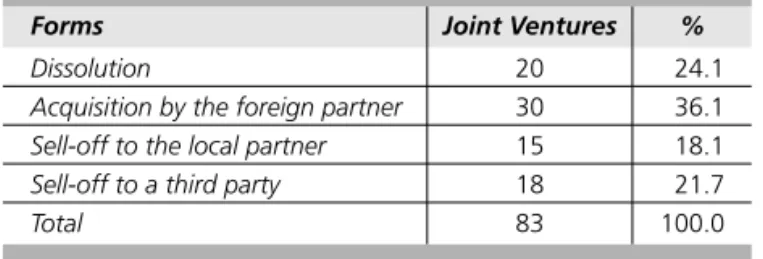
A total of 83 IJVs were dissolved, sold off or bought out before the end of the period at risk (50.3% of the sam-ple). Tables 2 and 3 respectively present the forms and the reasons for termination of these 83 IJVs.
Figure 1 presents the survival curve of IJVs formed in Brazil between 1974 and 2003. More precisely, Figure 1
details, year by year for the entire period at risk, the rate of survival of the IJVs in the sample.
A measurement of IJV survival was used as a depen-dent variable. This survival variable was measured by bi-nary coding (0, 1): the value 0 was given to IJVs that were still active at the end of the period at risk (in 2005), and the value 1 was given to IJVs that were terminated befo-re 2005. A simple survival model (without specifying its parametric form) was used to successively estimate a ha-zard rate of the different IJVs in the sample (KALBFLEISCH; PRENTICE, 1980, ALLISON, 1984).
h(t) or hazard function = λt
where t = 1, 2, , …, T and 0 < λt < 1
λt is the hazard rate corresponding to the time interval t
Table 1 Breakdown of joint ventures by country of origin of foreign partners
Country of origin a Joint Ventures %
USA 75 45.5
Japan 13 7.9
Italy 12 7.3
Germany 12 7.3
Great-Britain 11 6.7
France 9 5.5
The Netherlands 7 4.2
Spain 5 3.0
Norway 5 3.0
Canada 5 3.0
Belgium 3 1.8
Switzerland 3 1.8
Sweden 2 1.2
Finland 2 1.2
Austria 1 0.6
Total 165 100.0
a When more than one foreign partner is present in the joint venture, we only reported in
this table the country of origin of the foreign partner with the largest equity stake.
Table 2 Descriptive statistics of the forms of joint venture termination
Forms Joint Ventures %
Dissolution 20 24.1
Acquisition by the foreign partner 30 36.1
Sell-off to the local partner 15 18.1
Sell-off to a third party 18 21.7
Total 83 100.0
Table 3 Descriptive statistics of the reasons for joint venture termination
Reasons Joint Ventures %
Failure a 25 30.1
Expansion of one of the partner 23 27.7
Refocusing of one of the partner 19 22.9
Debt reduction of one of the partner 6 7.2
Miscelleanous 10 12.1
Total 83 100.0
a Joint ventures are classifi ed as failure when they are terminated following confl icts
between partners, fi nancial losses and/or low operating and fi nancial performance.
from λ1 to λt corresponds to the annual variation in the
probability of termination for a given IJV.
The impact of the independent variables and control variables on hazard rate was tested with a Cox proportio-nal hazards model (1972).
h(t) or hazard function = exp(βXt)λt
Xt is the vector of the independent variables and control variables at the time interval t within the period at risk and â is the vector of the regression coeffi cients.
Figure 1 Survival curve of international joint ventures in Brazil
0.1
0.2 0.3 0.4 0.5 0.6 0.7 0.8 0.9
1
Survival Rate
Longevity (Year)
0 1 2 3 4 5 6 7 8 9 10 11 12 13 14 15 16 17 18 19 20 21 22
CD
j =Σ{(Iij – Iib) 2/ V
i }/4 i =1
4
Iij is the distance index for the ith cultural dimension and
jth country, V
i is the variance of the index of i
th cultural
dimension, b stands for Brazil, and CDj corresponds to the cultural distance between the jth country and Brazil. Table
4 presents the descriptive statistics of the index of cul-tural distance within the sample.
As regards country risk, two scores were calculated: one for economic risk and one for political risk. Each score is positioned on a scale ranging from 0 (no risk) to 1 (ma-ximum risk). The scores for economic risk and political risk are taken from the IRIS database. Each of these scores cor-responds to a weighted average of several indicators. In the case of economic risk, the main indicators are the risk of government default on payments, the level of debt, infl a-tion and the GNP fi gures per capita. In the case of political risk, the main indicators are government and institutional
Table 4 Descriptive statistics of the cultural distance between Brazilian and foreign partners
Index of cultural distance
Mean = 1.74
Std dev. = 0.62
Min. = 0.22
Max. = 3.56
stability, the socio-economic situation, the level of corrup-tion and the government’s attitude towards foreign direct investment. In order to accurately determine time-related variations of country risk and the impact of these varia-tions on IJV survival, each score was introduced into the regression model in the form of a time-varying construct. The regression model used is known as Cox model with time-varying constructs. Thus the scores for economic risk and political risk were estimated for every year of the pe-riod at risk (from 1974 to 2005).
-Table 5 Descriptive statistics of control variables
Number of partners Mean = 2.1
Std dev. = 0.3
Min. = 2
Max. = 4
Contract amount ($US million)
Mean = 165.5
Std dev. = 227.5
Min. = 50
Max. = 1,200
Business activity Joint Ventures %
Automotive
Yes No
28 157
17.0 83.0
Chemicals
Yes No
22 143
13.3 86.7
Total 165 100.0
Equity distribution Joint Ventures % Unequal distribution
50/50
90 75
54.5 45.5
Total 165 100.0
no) observed in the sample, and the “equity distribution” between local and foreign partners (measured by a binary variable, 0-unequal ownership, 1-50/50 ownership).
Ta-ble 5 presents the descriptive statistics of the control variables.
4 TEST OF HYPOTHESES: HOW DO COUNTRY RISK AND NATIONAL CULTURAL
DIFFERENCES BETWEEN PARTNERS AFFECT THE SURVIVAL OF INTERNATIONAL
JOINT VENTURES IN BRAZIL?
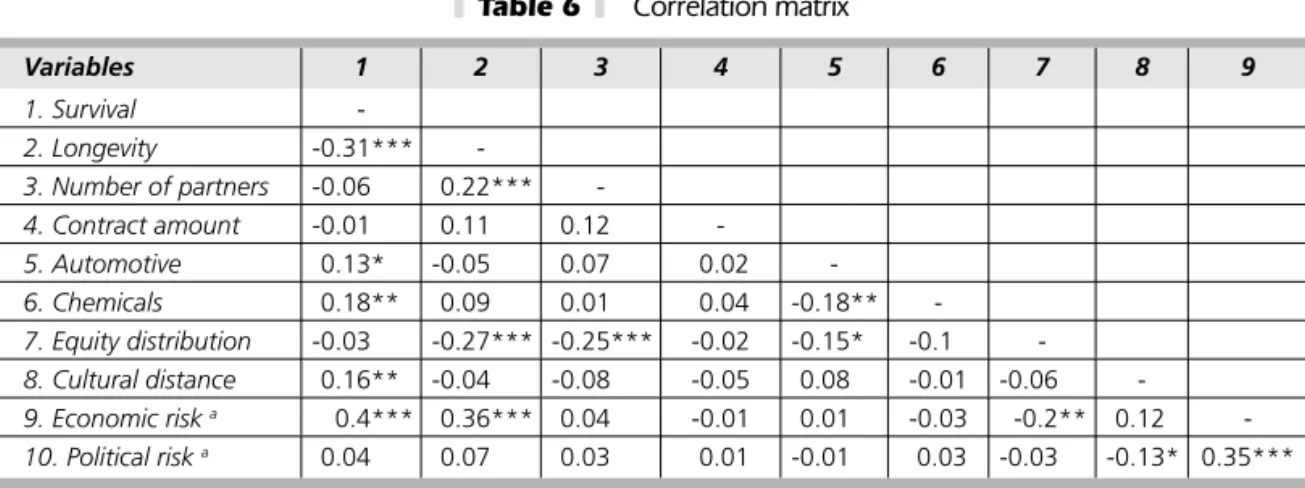
Table 6 presents a correlation matrix. Excluding the strong correlations involving some independent variables (namely, “longevity”, “chemicals”, “cultural distance” and “economic risk”) and the survival variable, Table 5 shows that the highest correlation is between the IJV’s longevi-ty and economic risk (r = 0.36 at p < 0.01). Apart from this observation, the correlation matrix does not raise any particular problems of colinearity between independent variables and control variables. The VIF (Variance Infl ation Factor) tests performed for each independent variable and
control variable do not exceed 2, and they confi rm this absence of colinearity.
Table 7a presents three Cox proportional hazards models associating a series of independent variables and control variables with the hazard rate of IJVs. The fi rst mo-del (momo-del 1) is reduced to only control variables. The se-cond model (model 2) tests the impact of control variables and cultural distance on hazard rate. The third model (mo-del 3) tests the impact of control variables and the effect of cultural distance and longevity interaction on hazard rate.
Table 6 Correlation matrix
Variables 1 2 3 4 5 6 7 8 9
1. Survival
-2. Longevity -0.31***
-3. Number of partners -0.06 0.22***
-4. Contract amount -0.01 0.11 0.12
-5. Automotive 0.13* -0.05 0.07 0.02
-6. Chemicals 0.18** 0.09 0.01 0.04 -0.18**
-7. Equity distribution -0.03 -0.27*** -0.25*** -0.02 -0.15* -0.1
-8. Cultural distance 0.16** -0.04 -0.08 -0.05 0.08 -0.01 -0.06
-9. Economic risk a 0.4*** 0.36*** 0.04 -0.01 0.01 -0.03 -0.2** 0.12
-10. Political risk a 0.04 0.07 0.03 0.01 -0.01 0.03 -0.03 -0.13* 0.35***
a This variable corresponds to an average score of country risk over the entire period at risk.
The three models in Table 7a show a good fi t (at p < 0.01). The analysis of coeffi cients of model 1 highlights three control variables that have a statistically signifi cant effect: the “automotive” and “chemicals” business activi-ties and “equity distribution.” More precisely, it is found that the probability of survival of IJVs increases signifi -cantly if they are in the automotive or chemicals business activities in Brazil. The signifi cant positive effect of equity distribution on hazard rate provides additional empirical validation to numerous studies, which showed that 50/50 equity ownership is a destabilizing factor for joint ventu-res (KILLING, 1983, GOMES-CASSERES, 1987, GERINGER; HEBERT, 1989, ZEIRA; SHENKAR, 1990). These studies associate 50/50 equity ownership with high joint venture instability: 50/50 equity ownership leads to confl icts and risks of paralysis in decision-making that are related to continuous negotiation between partners.
Model 2 identifi es a signifi cant positive impact of cul-tural distance on hazard rate (at p < 0.1). In other words, the probability of survival of IJVs that have strong cultu-ral distance between partners is lower than for those that have little or no national cultural differences. Therefore Hy-pothesis 1 is validated.
In model 3, the cultural distance and longevity interac-tion is signifi cant (at p < 0.01) and negative. This highli-ghts the moderating role of the age of IJVs and supports Hypothesis 2: the more IJVs grow older and increase in maturity, the less they are likely to be affected and desta-bilized by national cultural differences. Conversely, young IJVs, which are already subject to the liability of newness, are made particularly unstable by strong cultural distan-ce. Nevertheless, this last fi nding must be qualifi ed in the light of Figure 2 , which shows a difference in the survival curves according to the level of cultural distance.
According to Figure 2, it seems that the negative effect of cultural distance on young IJVs is not immediate. On the contrary, it is found that this effect is delayed and only arises from the fourth year. Table 7b confi rms this in analyzing the impact of cultural distance on the probabili-ty of IJV survival during a period at risk limited to the fi rst three years of existence: within this reduced period at risk, cultural distance has no signifi cant effect on hazard rate. Taken together, results in Tables 7a and 7b show that, whi-le there is indeed an interaction effect of cultural distance and longevity of IJVs on hazard rate, this effect only starts during the fourth year and affect “young” joint ventures that have already some maturity.
Table 8 presents four Cox proportional hazards mo-dels associating country risk variables and control varia-bles with the hazard rate of IJVs. Country risk variavaria-bles are analyzed in the four models as time-varying constructs. Models 1 and 3 test respectively the impact of economic risk and political risk on IJV survival. Models 2 and 4 test the interaction effect of the two country risk variables with cultural distance.
The four models in Table 8 show a good fi t (at p < 0.01). Nevertheless, coeffi cients of economic risk and po-litical risk (in models 1 and 3) are non-signifi cant. In other words, positive or negative variations of country risk do not affect the probability of survival of IJVs in Brazil. Therefore Hypothesis 3 is not validated. Models 2 and 4 highlight the existence of a single signifi cant interaction effect (at p < 0.1), which is that associating political risk and cultural distance: deterioration in political risk increases the insta-bility of IJVs that are already subject to national cultural differences. Conversely, improvement of political risk mo-derates the destabilizing effect of the cultural distance on IJV survival. These results partially support Hypothesis 4.
Table 7a Cox proportional hazards model, cultural distance and survival of joint ventures a, b
Variables Model 1 Model 2 Model 3
Cultural distance 0.28 (0.19)*
Cultural distance x longevity -0.13 (0.02)***
Number of partners -0.43 (0.39) -0.4 (0.4) -0.36 (0.37)
Contract amount -0.34 (0.31) -0.34 (0.31) -0.26 (0.34)
Automotive 0.81 (0.35)** 0.72 (0.35)** 0.95 (0.35)***
Chemicals 0.99 (0.43)** 0.99 (0.43)** 0.89 (0.43)**
Equity distribution 0.44 (0.23)* 0.44 (0.23)* 0.25 (0.24)
2xLog-likelihood -716.03 -713.69 -653.29
Model chi-square 16.7*** 19.28*** 57.24***
N (terminated joint ventures) 165 (83) 165 (83) 165 (83)
a Positive coeffi cients indicate that increase in independent variable and control variable values increase the hazard rate of joint ventures, and conversely.
b Cell entries are coeffi cient estimates. Numbers in parentheses are standard errors.
Figure 2 Survival curves of international joint ventures in Brazil according to the level of cultural distance a
a The mean index of cultural distance (mean
CD = 1.74) has been used to identify two levels of cultural distance in
the sample of international joint ventures: “low cultural distance” and “high cultural distance.” 0.1
0.2 0.3 0.4 0.5 0.6 0.7 0.8 0.9
1 Survival
Rate
Low cultural distance
High cultural distance
Longevity (Year)
0 1 2 3 4 5 6 7 8 9 10 11 12 13 14 15 16 17 18 19 20 21
Table 7b Cox proportional hazards model, cultural distance and survival of joint ventures during the fi rst three years of the period at risk a, b
Variables Model 1 Model 2
Cultural distance 0.27 (0.25)
Number of partners -1.06 (0.96) -1.01 (0.96)
Contract amount -0.49 (0.47) -0.47 (0.47)
Automotive 0.66 (0.49) 0.61 (0.49)
Chemicals 0.81 (0.6) 0.79 (0.6)
Equity distribution 0.37 (0.32) 0.38 (0.32)
2xLog-likelihood -387.64 -386.44
Model chi-square 7.71 8.98
N (terminated joint ventures) 165 (40) 165 (40)
a Positive coeffi cients indicate that increase in independent variable and control variable values increase the hazard rate of joint ventures, and conversely.
b Cell entries are coeffi cient estimates. Numbers in parentheses are standard errors.
Table 8 Cox proportional hazards model with time-varying constructs, cultural distance, country risk and survival of joint ventures a, b
Variables Model 1 Model 2 Model 3 Model 4
Economic risk -0.99 (1.1)
Political risk 2.48 (3.71)
Economic risk x cultural distance 0.32 (0.35)
Political risk x cultural distance 0.82 (0.52)*
Number of partners -0.43 (0.39) -0.43 (0.39) -0.44 (0.39) -0.41 (0.4)
Contract amount -0.35 (0.31) -0.33 (0.3) -0.34 (0.31) -0.34 (0.31)
Automotive 0.79 (0.34)** 0.77 (0.35)** 0.8 (0.34)** 0.72 (0.35)**
Chemicals 1.01 (0.43)** 0.99 (0.43)** 0.98 (0.43)** 0.99 (0.43)**
Equity distribution 0.41 (0.24)* 0.45 (0.23)* 0.44 (0.23)* 0.43 (0.23)*
2xLog-likelihood -715.2 -715.2 -715.59 -713.47
Model chi-square 17.3*** 17.84*** 17.18*** 19.55***
N (terminated joint ventures) 165 (83) 165 (83) 165 (83) 165 (83)
a Positive coeffi cients indicate that increase in independent variable and control variable values increase the hazard rate of joint ventures, and conversely.
b Cell entries are coeffi cient estimates. Numbers in parentheses are standard errors.
* p < 0.1 ** p < 0.05 *** p < 0.01 (two-tailed tests)
5 DISCUSSION AND CONCLUSION
The aim of this article was to identify the individual and joint impact of two “country-level variables” (KOGUT; SINGH, 1988) – national cultural differences and country risk – on the survival of IJVs formed in an emerging coun-try, Brazil. Some important fi ndings can be drawn from the different Cox proportional hazards models that have been performed in this article.
Firstly, taken individually, country-level variables in an emerging economy do not have a similar impact on IJVs survival: the “intercultural dynamics” makes it unstable, although its survival does not seem to be related to the emerging country’s “economic and political uncertainty” (YAN, 1998). Therefore national cultural differences and country risk are critical variables for IJVs, but they do not act in the same way or at the same time. Economic and po-litical uncertainty is critical only at the time when the IJV is formed, because it is one of the main factors that infl uence the strategic choice of whether to enter an emerging coun-try through acquisition, wholly-owned subsidiary or IJV. On the contrary to country risk variables, national cultural differences are found to be a determinant of IJV termina-tion. These different results provide additional empirical validation of the culturalist approach and are consistent with prior studies that have reported a negative impact of cultural distance on IJV survival (LI; GUISINGER, 1991,
BARKEMA; VERMEULEN, 1997, HENNART; ZENG, 2002).
Then, although it is supported by our empirical results, the culturalist approach to IJV survival must be qualifi ed because the intercultural dynamics has variable effects ac-cording to the life cycle of IJVs, and it varies over time. Thus, during the very fi rst years, an IJV formed in an emer-ging country does not seem to be affected by the degree of cultural distance that may exist between the local and
foreign partners. During this fi rst stage in the life cycle of IJVs, the intercultural dynamics created by two distinct national cultures is real and observable, but it does not appear to produce cultural tensions or major confl icts. IJVs are subject to what Park and Russo (1996) and Hennart et al. (1998) called the “honeymoon effect”, which opposes and counters the negative effect of national cultural diffe-rences and of liability of newness. However, this honeymo-on effect is temporary, and it honeymo-only delays the destabilizing effect of the cultural distance between partners. During a second stage in the life cycle, cultural distance produces its negative effect by causing cultural confl icts and ineffective communication between partners that often result in the dissolution of IJVs. During a third stage in the life cycle, “mature” IJVs with strong internal and external institu-tionalization have become capable of absorbing cultural confl icts and, more generally, managing the intercultural dynamics. At this stage, the age of IJVs has its full effect, and it smoothes out national cultural differences.
References
Allison P.D. (1984), Event history analysis. Sage University Paper.
Bain J.S. (1956), Barriers to new competition. Harvard University Press.
Barkema H.G. & Vermeulen F. (1997), « What Differences in the Cultural Backgrounds of Partners are Detrimental for International Joint Ventures », Journal of International Business, Vol. 28, n°4, pp. 845-864.
Beamish P. (1988), Multinational joint ventures in developing countries. Routledge.
Buono A. & Bowditch J. (1989), The human side of mergers and acquisitions. Jossey-Bass Publishers.
Cameron K. et Freeman S. (1988), « Cultural Congruence, Strength and Type: Relationship to Effectiveness », Working Paper of the University of Michigan.
Carroll G.R. & Delacroix J. (1982), « Organizational Mortality in the Newspaper Industries of Argentina and Ireland: An Ecological Approach »,
Administrative Science Quarterly, Vol. 27, pp. 169-198.
Connolly S.G. (1984), « Joint Ventures with Third World Multinationals: A New Form of Entry to International Markets », Columbia Journal of World Business, Summer, pp. 18-22.
Fey C. & Beamish P. (2001), « Organizational Climate Similarity and Performance: International Joint Ventures in Russia », Organization Studies, Vol. 22, pp. 853-882.
Franko L.G. (1971), Joint venture survival in multinational corporations. Praeger Publishers.
Freeman J., Carroll G.L. & Hannan M.T. (1983), « The Liability of Newness: Age Dependence in Organizational Death Rates », American Sociological Review, Vol. 48, pp. 692-710.
Garrette B. & Dussauge P. (1995), Les stratégies d’alliance. Les Editions d’Organisation.
Hamel G., Doz Y.L. & Prahalad C.K. (1989), « Collaborate with your Competitors and Win », Harvard Business Review, Vol. 67, n°1, pp. 133-139.
Hamel G. (1991), « Competition for Competence and Inter-Partner Learning within International Strategic Alliances », Strategic Management Journal, Vol. 12, Special Issue, pp. 83-103.
Hannan M.T. & Freeman J. (1977), « The Population Ecology of Organizations ». American Journal of Sociology, Vol. 82, pp. 929-964.
Hennart J.-F. (1988), « A Transaction Costs Theory of Equity Joint Ventures », Strategic Management Journal, Vol. 9, n°4, pp. 361-374.
Hennart J.-F., Kim D.-J. & Zeng M. (1998), « The Impact of Joint Venture Status on the Longevity of Japanese Stakes in U.S. Manufacturing Affi liates », Organization Science, Vol. 9, n°3, pp. 382-395.
Hennart J.-F. & Zeng M. (2002), « Cross-Cultural Differences and Joint Venture Longevity », Journal of International Business Studies, Vol. 33, n°4, pp. 699-716.
Hofstede G. (1980), Culture’s consequences. Sage Publications.
Hofstede G. (1997), Cultures and organizations: Software of the mind. McGraw-Hill.
Geringer J.M. & Hebert L. (1991), « Measuring Performance of International Joint Ventures », Journal of International Business Studies, Vol. 22, n°2, pp. 249-265.
Gomes-Casseres B. (1987), « Joint Venture Instability: Is it a Problem? », Columbia Journal of World Business, Vol. 22, n°2, pp. 97-102. Inkpen A.C. & Beamish P.W. (1997), « Knowledge Bargaining Power and the Instability of International Joint Ventures », Academy of Management Review, Vol. 22, n°1, pp. 177-203.
Kale P. & Anand J. (2001), « Effects of Market Liberalization on Joint Venture Contributions, Control, Stability and Performance: An Empirical Study of International Joint Ventures in India », Academy of Management Proceedings, Academy of Management Conference, Washington. this often causes stalemate in negotiations and
termina-tion of the alliance.
This article has some limitations. A fi rst limitation is in the choice of Brazil as the context for analyzing IJVs for-med in emerging countries. Every emerging country is spe-cifi c and, even within a set of countries such as the BRIC countries (Brazil, Russia, India and China), it is diffi cult to consider the economic, political and cultural situations in these countries as equivalent. The degree of “emergence” or transition varies greatly from one country to another. This must be borne in mind if one aims to generalize the above results and fi ndings to international joint ventures operating in emerging countries other than Brazil. In or-der to overcome this limitation, it would be necessary to
extend this research to other emerging countries in Latin America, and also in Asia and Eastern Europe. A second limitation is linked to the use of measurements of cultural distance and country risk that may fail to capture all the dimensions of these two multi-facetted concepts. Particu-larly regarding country risk, more signifi cant results might be obtained by using fi ner measurements. Thus, empiri-cal studies focusing on a precise facet of politiempiri-cal risk – in this case, the changes in local regulations towards IJVs formed with foreign fi rms – have stressed the importance of this variable in analyzing the determinants of the survi-val of international alliances in emerging countries (KALE;
NOTE - Address of the authors
Université de la Méditerranée 58, Bd Charles Livon – 13284 Marseille Cedex 07 – France
University of São Paulo School of Economics,
Business Administration and Accountancy Av. Prof. Luciano Gualberto, 908 São Paulo – SP
05508-900
Kilmann R., Saxton M.J. & Serpa R. (1985), Gaining control of the corporate culture. Jossey-Bass Publishers.
Kalbfl eisch J.D. & Prentice R.L. (1980), The statistical analysis of failure time data. John Wiley.
Killing P. (1983), Strategies for joint venture success. Praeger Publishers.
Kogut B. (1988), « A Study of the Life Cycle of Joint Ventures », Management International Review, Vol. 28, n°4, pp. 39-52.
Kogut B. & Singh H. (1988), « The Effect of National Culture on the Choice of Entry Mode », Journal of International Business Studies, Vol. 19, n°3, pp. 411-432.
Lee C. & Beamish, P.W. (1995), « The Characteristics and Performance of Korean Joint Ventures in LDCs », Journal of International Business Studies, Vol. 26, n°3, pp. 637-654.
Leung W.-F. (1997), « The Duration of International Joint Ventures and Foreign Wholly-Owned Subsidiaries », Applied Economics, Vol. 29, pp. 1255-1269.
Li J. & Guisinger S.E. (1991), « Comparative Business Failure of Foreign-Controlled Firms in the United States », Journal of International Business Studies, Vol. 22, n°2, pp. 209-224.
Meschi P.-X. (1997), « Longevity and Cultural Differences of International Joint Ventures: Toward a Time-based Cultural Management »,
Human Relations, Vol. 50, n°2, pp. 211-228.
Meschi P.-X. (2005), « Environmental Uncertainty and Survival of International Joint Ventures: The Case of Political and Economic Risk in Emerging Countries », European Management Review, Vol. 2, n°2, pp. 143-152.
Nahavandi A. & Malekzadeh A. (1988), « Acculturation in Mergers and Acquisitions », Academy of Management Review, Vol. 13, n°1, pp. 79-90.
Nanda A. & Williamson P.J. (1995), « Use the Joint Ventures to Ease the Pain of Restructuring », Harvard Business Review, Vol. 73, n°6, pp. 119-129.
Pan, Y. (1996). « Infl uences on foreign equity ownership level in joint ventures in China », Journal of International Business Studies, Vol. 27, n°5, pp. 1-26.
Park S.H. & Russo M.V. (1996), « When Competition Eclipses Cooperation: An Event History Analysis of Joint Venture Failure », Management Science, Vol. 42, n°6, pp. 875-890.
Park S.H. & Ungson G. (1997), « The Effect of National Culture, Organizational Complementarity and Economic Motivation on Joint Venture Dissolution », Academy ofManagement Journal, Vol. 40, n°2, pp. 279-307.
Porter M.E. (1980), Competitive strategy. The Free Press.
Pothukuchi V., Damanpour F., Choi J., Chen C.C. & Park S.H. (2002), « National and Organizational Culture Differences and International Joint Venture Performance », Journal of International Business Studies, Vol. 33, n°2, pp. 243-265.
Prevot F. & Meschi P.-X. (2006 forthcoming), « External Evolution Processes Affecting Joint Venture: The Case Study of a French-Brazilian Joint Venture in the Information Technology Sector », Thunderbird International Business Review, Vol. 44, n°2.
Rodriguez P., Uhlenbruck K. & Eden L. (2005), « Government Corruption and the Entry Strategies of Multinational », Academy ofManagement Review, Vol. 30, n°2, pp. 383-396.
Schaan J.-L. (1988), « How to Control a Joint Venture even as a Minority Partner », Journal of General Management, Vol. 14, n°1, pp. 4-18.
Scherer F.M. (1980), Industrial market structure and economic performance. Rand MacNally. Scott R. (1995), Institutions and organizations. Sage.
Yan A. (1998) « Structural Stability and Reconfi guration of International Joint Ventures », Journal of International Business Studies, Vol. 29, n°4, pp. 773-796.
Zaheer S. & Mosakowski E. (1997), « The Dynamics of the Liability of Foreignness: A Global Study of Survival in Financial Services », Strategic Management Journal, Vol. 18, n°6, pp. 439-464.