Offi cial Publication of the Brazilian Society of Anesthesiology www.sba.com.br
REVISTA
BRASILEIRA DE
ANESTESIOLOGIA
Abstract
Background and objectives: The aim of this randomized, double-blinded, prospective study was to determine the effectiveness and side effects of intravenous or epidural use of morphine, bupivacaine or ropivacaine on post-thoracotomy pain management.
Methods: Sixty patients undergoing elective thoracotomy procedure were randomly allocated into 4 groups by the sealed envelope technique. Group IVM, EM, EMB and EMR received patient controlled intravenous morphine, and epidural morphine, bupivacaine and morphine-ropivacaine, respectively. Perioperative heart rate, blood pressure and oxygen saturation and postoperative pain at rest and during cough, side effects and rescue analgesic requirements were recorded at the 30th and 60th minutes and the 2nd, 4th, 6th, 12th, 24th, 36th, 48th, and 72nd hour. Results: Diclofenac sodium requirement during the study was lower in Group EM. Area under VAS-time curve was lower in Group EM compared to Group IVM, but similar to Group EMB and EMR. Pain scores at rest were higher at the 12, 24, 36, and 48th hour in Group IVM compared to Group EM. Pain scores at rest were higher at the 30th and 60th minutes in Group EM and Group IVM compared to Group EMB. Pain scores during cough at the 30th minute were higher in Group EM compared to Group EMB. There was no difference between Group IVM and Group EMR. Conclusions: Morphine used at the epidural route was found more effective than the intravenous route. While Group EM was more effective in the late period of postoperative, Group EMB was more effective in the early period. We concluded that epidural morphine was the most effective and preferred one.
© 2013 Sociedade Brasileira de Anestesiologia. Published by Elsevier Editora Ltda. All rights reserved.
Comparison of Intravenous Morphine, Epidural Morphine With/
Without Bupivacaine or Ropivacaine in Postthoracotomy Pain
Management With Patient Controlled Analgesia Technique
Esra Mercanoğlu*
1, Zekeriyya Alanoğlu
1, Perihan Ekmekçi
2, Sacide Demiralp
2,
Neslihan Alkış
21. MD, Diplomate of European Society of Anaesthesiology (DESA), Ankara University Medical Faculty Anesthesiology and ICU Department, Turkey
2. MD, Ankara University Medical Faculty Anesthesiology and ICU Department, Turkey Received from Ankara University Medical Faculty Anesthesiology and ICU Department, Turkey.
Submitted on January 30, 2012. Approved on May 22, 2012.
Keywords: Analgesia, Patient Controlled; Morphine;
Amides/ropivacaine; Bupivacaine; Pain Management; Thoracotomy; Infusions, Intravenous; Analgesia, Epidural.
SCIENTIFIC ARTICLE
*Corresponding author:
E-mail address: [email protected].
Introduction
Pain is considered a major independent factor responsible for postoperative morbidity and mortality after thoracic opera-tions 1. Open thoracotomy is one of the most painful surgical
procedures and thoracotomy pain markedly affects post-operative respiratory function and patient recovery 2.
Post-thoracotomy pain belongs to incision, damage of ribs and intercostal nerves, chest wall infl ammation, cut of pleura and pulmonary parenchyma and placement of thoracotomy drainage tube 3. Acute post-thoracotomy pain functionally
results in lung restriction; adequate ventilation and coughing are compromised and a variety of analgesic techniques like systemic opioid, intercostal nerve blockade, intrapleural anal-gesia, epidural opioid with or without local analgesic, cryoanal-gesia, paravertebral nerve blockage, Transcutaneous electrical nerve stimulation (TENS) are used for post-thoracotomy pain management 3. Besides these techniques, patient controlled
analgesia (PCA) via systemic or epidural route has been used very commonly.
Continuous infusion with local anesthetic or opioid alone or in combination provides effective postoperative pain relief but the most effective ones alone or in combination remain controversial. Although epidural analgesia technique is the gold standard, it is not suitable for all patients and carries potential risks and limitations such as dural perforation, epidural hematoma, infection, hypotension, bradycardia and urinary retention 1.
Serious adverse effects like respiratory depression, urinary retention, hypotension, pruritus etc. may occur with the high doses of opioids and local anesthetics. Epidural or systemic an-algesia is safer and can be controlled by patients with PCA 4.
The most commonly used opioid is morphine (systemic or epidural) and the most commonly used local anesthetic is bupivacaine (epidural). In an attempt to reduce bupivacaine-induced side effects and toxicity, ropivacaine was developed and has been used for the last few years 5. Ropivacaine is a
long-acting amide local anesthetic and has reportedly lower central nervous system and cardiovascular toxicity and less motor block than equivalent doses of bupivacaine 5,6. Bupivacaine has the
longest duration of all local anesthetics. It is the preferred local anesthetic in this group because it provides excellent sensorial anesthesia 7. In epidural analgesia the combination of opioid
and local anesthetics may provide synergic effects and lower side effects with lower doses and concentrations.
The aim of this randomized, double-blinded, prospective study was to determine the effectiveness and side effects of in-travenous morphine or epidural use of morphine with or without bupivacaine or ropivacaine on post-thoracotomy pain manage-ment with the patient controlled analgesia technique.
Methods
After obtaining the local Ethics Committee’s approval and pa-tients’ written informed consent, we randomly allocated into four equal groups by sealed envelop technique 60 patients with ASA I-II physical status and ages between 18-80, undergoing elective thoracotomy procedure for lobectomy, bilobectomy, pneumonectomy or wedge resection without pleural resec-tion. The groups were intravenous morphine, thoracic epidural morphine, thoracic epidural morphine+bupivacaine, thoracic epidural morphine +ropivacaine and named as Group IVM,
Group EM, Group EMB and Group EMR respectively. We excluded from the study the patients who were allergic to the study drugs, had renal failure, were morbidly obese, pregnant, had chronic pain, were under pain control for the last 24 hours, had any contraindication to the placement of an epidural catheter, were not able to use PCA (Patient Controlled Analgesia), refused including to partake into the study, whose ASA physical status were more than two, had neuropathies.
Before the operation was started, we had recorded pa-tients’ demographic data, medical history, ASA physical status, allergies, smoking and alcohol history, the type of the proce-dure (pneumonectomy/lobectomy) and the side of thoracotomy and also in epidural groups the level of the catheter (T4-7 ).
Prior to taking the patients to the operating rooms, we premedicated them with 25 mg meperidine and 0.5 mg of atropine via intramuscular route. The forearm opposite to the surgical side was used for intravenous line and 0.9% NaCl infusion was given during the perioperative period. A double lumen endobronchial tube was placed after the patient was induced with 3-6 mg.kg-1 of thyopenthal and 0.6-1.1 mg.kg-1
rocuronium for general anesthesia. The patient’s lungs were ventilated using 50% oxygen mixed with air. We administered remifentanil as an opioid whenever needed. We maintained general anesthesia with sevofl urane. After the induction of anesthesia we monitored by means of an arterial line ia blood pressure and supplied arterial blood gases. After giving a lateral decubitus position, the operation began.
The patients’ systolic-diastolic-mean arterial pressures were recorded before, during and after the induction at the 5th minute, from the 10th to the 180th minute once every 10
minutes and on the 210th, 240th, 270th and 300th minute.
After the operation fi nished, we extubated patients in Group IVM but patients in epidural groups were extubated after an epidural catheter had been placed at the level of T4-7 under general anesthesia.
PCA doses were prepared as shown below:
GROUP IVM: IV morphine group
Concentration: 1-2 mg.mL-1
Total Dose: 100-200 mg.100 mL-1
Loading dose: 2 mg Bolus: 1 mg Infusion: 1 mg.h-1
Locking time: 15 min 4 hours limit: 18 mg
GROUP EM: Epidural morphine group
Concentration: 0.2-0.4 mg.mL-1
Total Dose: 20-40 mg.100 mL-1
Loading dose: 2 mg Bolus Dose: 1 mg Infusion: 1 mg.h-1
Locking time: 15 min 4 hours limit: 18 mg
GROUP EMB: Epidural morphine+bupivacaine group
Concentration: 0.1 % bupivacaine + 0.05 mg.mL-1 morphine
Total dose: (100 mg bupivacaine + 5 mg morphine).100 mL-1
215 Postthoracotomy Pain Management With Patient Controlled Analgesia Technique
Bolus Dose: 3 mL (3 mg bupivacaine + 0.15 mg morphine) Infusion: 5 mL.h-1 (5 mg bupivacaine + 0.25 mg morphine)
Locking time: 30 min 4 hours limit: 74 mL
GROUP EMR: Epidural morphine+ropivacaine group
Concentration: 0.1 % ropivacaine + 0.05 mg.mL-1 morphine
Total dose: (100 mg ropivacaine + 5 mg morphine).100 mL-1
Loading dose: 10 mL (10 mg ropivacaine + 0.5 mg) Bolus Dose: 3 mL (3 mg ropivacaine + 0.15 mg morphine) Infusion: 5 mL.h-1 (5 mg ropivacaine + 0.25 mg morphine)
Locking time: 30 min 4 hours limit: 74 mL
Postoperative period
Postoperatively, at the 30th minute, the patients whose
modifi ed Aldrete-Kroulik recovery score was more than 10 were included into the study. During 72 hours at postopera-tive period, we used the Wilson sedation scale for assessing patient sedation.
We started PCA in Group IVM.
In epidural groups, 5 minutes after operation, we admin-istered the test dose (3 mL 2% lidocaine) via the epidural catheter; the patients who did not have any motor blockade according to the Modifi ed Bromage Scale 1 were included into
the study. During 72 hours of the postoperative period the same scale was used to assess motor block.
During infusion, if hypotension was observed we interrupt-ed infusion and administerinterrupt-ed ephinterrupt-edrine 5 mg intravenously. After blood pressure normalized, the infusion continued.
We administered antihistamines as soon as we observed any allergic signs.
We assessed the degree of pain by using a 10 cm visual analogue scale (VAS), where zero represented no pain and 10 the worst imaginable pain and verbal rating scale (VRS), where: 0: no pain 1: little pain 2: moderate pain 3: severe pain 4: intolerable pain.
We administered a rescue analgesic (diclofenac sodium 75 mg IM) when VAS scores were more than 50%.
Verifying data
Postoperatively at the 30th min, 1st, 2nd, 4th, 6th, 12th, 24th,
36th, 48th and 72nd hours we recorded blood pressure, hearth
rate, respiratory rate, peripheral oxygen saturation, VAS and VRS at rest and during cough, rescue analgesic dose, sedation score (Ramsay), motor block and side effects (nausea, vomit, pruritus, urinary retention, respiratory failure, dizziness, headache, backache). At the end of 72 hours we removed the epidural catheter. At the end of the total rescue analgesic dose, we also recorded demand (dem) and delivery (del) of drugs on PCA.
Statistics
Analysis of data
For the aim of analyzing data, we used an IBM computer and Windows SPSS 13.0 (Statistical Program for Social Sciences, Chicago, IL, ABD); we used ANOVA, Kruskall Wallis One-Way
ANOVA and Chi-Square tests and p < 0.05 was considered signifi cant. Values are expressed as median and interquartile range.
Continuous variables were given by median [Inter quar-tile range] or mean ± standard deviation as appropriate. Categorical variables were presented by frequencies and percentages. Differences between the groups according to the demographic data were evaluated by one-way ANOVA and chi square test. Hemodynamic parameters were compared by repeated measures ANOVA. Kruskal-Wallis test was used for the distributed variables on ranks. Pairwise comparisons were determined by Mann Whitney U test. Categorical vari-ables were compared by Chi-square test. Comparisons within groups were done by Wilcoxon test. Area under curves (AUC) was calculated for postoperative pain scores. Difference between the AUC of groups were verifi ed by Kruskal-Wallis test. Signifi cance value was set as p < 0.05.
Results
With the purpose of comparing post-thoracotomy pain management, we included 60 patients that had undergone elective thoracotomy procedures into the study in Ankara University Medical Faculty Hospital. All patients completed the follow-up.
We administered IV morphine in the 1st group, epidural
morphine in the 2nd group, epidural morphine + bupivacaine
in the 3rd group and epidural morphine + ropivacaine in the
4th group.
Patients’ characteristics and demographic data were similar among groups (Table 1).
In all groups, patients’ procedure types, intraoperative and postoperative heart rate, blood pressure, oxygen satura-tionwere similar.
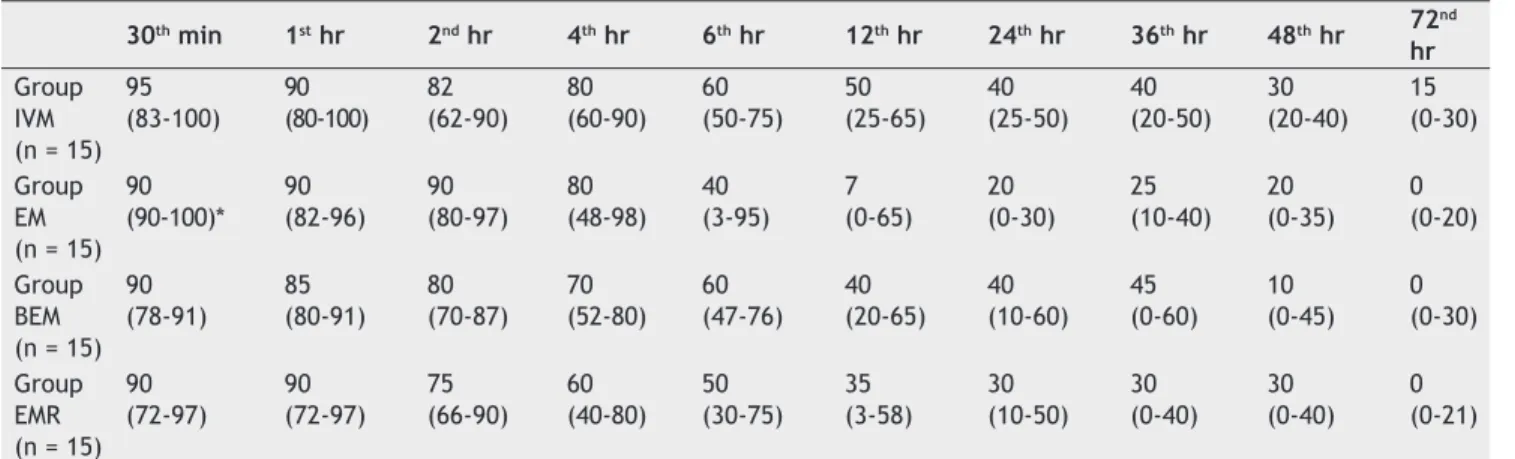
In Group IVM at 30th min and 1st hour, VAS scores during
cough were signifi cantly higher than in Group EMB (p < 0.05) (Table 2). Also in Group IVM at 12th, 24th, 36th, 48th and 72nd
hours VAS scores at rest were signifi cantly higher than in Group EM (p < 0.05) (Table 3). In Group EM at 30th min and
1st hour VAS scores at rest were signifi cantly higher than in
Group EMB (p < 0.05). VRS scores at rest and during cough were all similar between all groups. In Group EM at 30th
min VAS score during cough was signifi cantly higher than in Group EMB (p < 0.05). According to the pain scores there was no signifi cant difference between Group IVM and group EMR. Area under VAS-time curve was lower in Group EM 335 cm2 (305-375) compared to Group IVM 445 cm2 (355-462)
(p = 0.028) but similar with Group EMB 447 cm2 (290-520)
and Group EMR 395 cm2 (270-512) (Table 4).
After 72 hours, total PCA, DEM and DEL were similar among groups.
During postoperative 72 hours, total rescue analgesic requirement doses were lower in Group EM 75 mg (0-150) compared with Group IVM 225 mg (75-225) (p = 0.039), Group EMB 225 mg (75-300) (p = 0.006) and Group EMR 225 mg (150-375) (p = 0.02).
Table 1 Demographic data. Age (year) Height (cm) Weight (kg) Duration of Operation (min) ASA GENDER
ASA I(%) ASA II(%) Male(%) Female(%)
Group IVM
(n = 15) 52 (35-63) 170 (170-180) 72 (60-80) 215 (180-300) 15 (100%) 0 (0%) 11 (73%) 4 (26%)
Group EM
(n = 15) 51 (35-58) 168 (163-170) 75 (70-78) 200 (160-240) 15 (100%) 0 (0%) 9 (60%) 6 (40%)
Group EMB
(n = 15) 50 (40-62) 170 (160-175) 63 (60-75) 200 (160-260) 15 (100%) 0 (0%) 10 (66%) 5 (33%)
Group EMR
(n = 15) 38 (27-50) 175 (165-178) 72 (65-80) 210 (160-255) 15 (100%) 0 (0%) 9 (60%) 6 (40%)
Data are given as median and IQR (%25-75) and patients’ numbers and percentages.
GROUP IVM: IV morphine; GROUP EM: Epidural morphine; GROUP EMB: Epidural morphine + bupivacaine; GROUP EMR: Epidural morphine + ropivacaine.
Table 2 Comparing between groups’ postoperative VAS during cough.
30th min 1st hr 2nd hr 4th hr 6th hr 12th hr 24th hr 36th hr 48th hr 72 nd
hr Group
IVM (n = 15)
95 (83-100) 90 (80-100) 82 (62-90) 80 (60-90) 60 (50-75) 50 (25-65) 40 (25-50) 40 (20-50) 30 (20-40) 15 (0-30) Group EM (n = 15)
90 (90-100)* 90 (82-96) 90 (80-97) 80 (48-98) 40 (3-95) 7 (0-65) 20 (0-30) 25 (10-40) 20 (0-35) 0 (0-20) Group BEM (n = 15)
90 (78-91) 85 (80-91) 80 (70-87) 70 (52-80) 60 (47-76) 40 (20-65) 40 (10-60) 45 (0-60) 10 (0-45) 0 (0-30) Group EMR (n = 15)
90 (72-97) 90 (72-97) 75 (66-90) 60 (40-80) 50 (30-75) 35 (3-58) 30 (10-50) 30 (0-40) 30 (0-40) 0 (0-21)
Data are given as median and IQR (%25-75). GROUP IVM: IV morphine; GROUP EM: Epidural morphine; GROUP EMB: Epidural morphine + bupivacaine; GROUP EMR: Epidural morphine + ropivacaine. *(found to be signifi cantly higher than group EMB p < 0.05).
Table 3 Comparing between groups’ postoperative VAS at rest.
30th min 1st hr 2nd hr 4th hr 6th hr 12th hr 24th hr 36th hr 48th hr 72nd hr Group IVM
(n = 15) 90 (80-90)** 90 (80-90)** 80 (70-90) 70 (50-80) 60 (40-70) 40 (20-60)* 25 (20-40)* 25 (10-40)* 20 (0-30)* 0 (0-20) Group EM
(n = 15)
90 (90-100)+ 90 (80-90)+ 80 (60-85) 60 (50-85) 40 (10-60) 0 (0-20) 0 (0-20) 0 (0-20) 0 (0-15) 0 (0-10) GroupEMB
(n = 15) 80 (70-90) 75 (70-80) 70 (65-80) 65 (50-70) 50 (30-70) 40 (0-60) 30 (0-50) 30 (0-40) 0 (0-30) 0 (0-22) GroupEMR
(n = 15)
217 Postthoracotomy Pain Management With Patient Controlled Analgesia Technique
Discussion
Seventy percent of post-thoracotomy patients have too much pain in the early postoperative period. The pain that is caused by stretching costovertebral, costotransverse ligaments and posterior spinal muscles, causes many complications such as weak coughing, decrease in tidal volume and atelectasia, hypoxemia, postoperative pulmonary infection and dyspnea. These complications increase according to age, smoking, obesity and other illnesses 8,9.
Post-thoracotomy pain is one of the most painful pro-cedures and various methods have been used and new studies are being done for better methods. The effective methods for post-thoracotomy pain management and lower-ing systemic opioid dose are continuous intercostal block, paravertebral block, epidural opioid and/or local anesthetic techniques 3,10.
Epidural analgesia technique is actually considered the gold standard in this patient population 2.
In acute post-thoracotomy pain management, the tho-racic epidural analgesia technique is currently the most widely preferred one. With this technique, local anesthetics and opioids are used alone or in combination 11.
Although the thoracic epidural catheter is commonly inserted at T5-6 level, T10 level it may be a good method with a high dose of bupivacaine. In our study, we usually inserted the catheters at T4-5 level.
Patients can control their analgesic doses by the PCA technique 12. In our study we also used PCA technique and
found that all patients were satisfi ed.
There is always a higher risk of oversedation and res-piratory depression with the infusion technique than PCA technique 12,13. In our study, we administered a low dose
basal infusion with PCA and saw no complication that caused interruption of infusion.
A previous study reported an incidence of nausea and vomitingafter
epidural
opioids of approximately 30%, com-pared with 87%duringPCA
14.
In our study, PCA was usedin every group so it couldn’t be compared with the other one.
PCA technique can be used via routes like IV, IM, epidural and subcutaneous 12. In our study, IV and epidural routes
and basal infusion + bolus doses were used. Although there are different techniques, there are still attempts to fi nd an optimal drug or drug combinations, dose and route for
effective pain management 12. Furthermore, the IV route is
the most commonly used because it is the cheapest, easiest and most comfortable one for the patients 12.
It is suggested to give the loading dose with PCA to reach optimal plasma concentration and to give infusion to avoid further subanalgesic concentration period 15. As suggested,
we started infusion after the loading dose in all our study groups.
In postoperative pain studies, the thoracic epidural cathe-ter route has been found effective with local anesthetics 3.
Since the local anesthetics technique causes urinary retention, hypotension, weakness and parestesia of upper limbs, opioids are starting to be used via the thoracic epidural catheter route. Opioid via epidural route was found more ef-fective with lower dose than systemic opioid 15. In our study,
although systemic and epidural opioid doses were equal, side effects did not increase in the epidural technique.
For reducing epidural opioids’ side effects and increas-ing analgesic effects, local anesthetics have been added to opioids. For this purpose, we had our 3rd and 4th groups, but
we found that our 2nd group was the most effective one,
probably because of their relatively high dose. After adding bupivacaine to morphine (3rd group) the effect of analgesia
became higher at the 30th min and 1st hour. Rescue analgesic
was also the lowest in the epidural morphine group. Ready et al. 16 found out similar respiratory depression
in both parenteral and epidural route. Our results were not different from Ready’s.
There are some reports showing that the reason behind bradypnea is to provide good analgesia, and not because of respiratory depression of opioids 17. Contrary to those reports,
we saw no respiratory depression in our study, despite good analgesia being performed. Rawal 18 reported that the risk
of life-threatening respiratorydepression in patients with IV
PCA
is approximately 0.9%. Any life threatening respiratory depression was not observed in our study because of very low incidence.Veering and Cousins 19 did not observe any cardiovascular
depression and hypotension due to local anesthetic-induced negative inotropic effects in the thoracic
epidural
analgesia
technique in their study and the two groups did not differin terms of systolic and diastolic blood pressure, or heart rate.
Wu et al. 20 compared effectiveness of systemic opioid,
epidural opioid and epidural opioid+local anesthetic in a meta-analysis of postoperative pain. For all pain types they
Table 4 Area under curve (pain parameters x time) of groups.
AUC VAS AUC VRS AUC VAS Cough AUC VRS Cough
Group IVM
(n = 15) *445 (355-462) 31 (27-36) 525 (437-586) 36 (31-42)
Group EM
(n = 15) 335 (305-315) 31 (24-36) 625 (255-780) 43 (27-53)
Group EMB
(n = 15) 447 (290-520) 30 (20-37) 562 (441-615) 40 (34-45)
Group EMR
(n = 15) 395 (270-512) 31 (28-38) 460 (248-571) 36 (26-41)
found the effectiveness of epidural opioid superior to sys-temic opioid. But this was not valid for hydrophilic opioids. In their studies, continuous epidural infusion was found to be more effective in pain at rest and movement than PCA. However, nausea, vomit and motor block were observed more often. They showed that the epidural analgesia technique decreased perioperative morbidity and mortality. They also mentioned that epidural opioid administration with local anesthetic was the best in pain relief.
Continuous epidural analgesia and PCA via intravenous route techniques are being used very commonly and studies show that both techniques are good options for postopera-tive pain management in major operations. There are some reasons for the ideal one to remain unknown. The fi rst is lack of a standard method for epidural and systemic opioid, the second is the combination of epidural opioid and local anesthetic and the third reason is the reports from some studies that morbidity is decreased by epidural analgesia technique. Nonetheless, Azad et al. 21 studied 50 patients
that had undergone elective thoracotomy procedures to compare epidural and systemic analgesia effects, pulmonary functions, side effects and complications and they concluded that the epidural group presented better analgesia and lower sedation and nauseabut pulmonary complications and hospital stay were similar among groups. In our study, side effects were similar among four groups and analgesia was more effective in epidural groups.
When local anesthetics are administered due to continu-ous epidural infusion, agents like fentanyl should be added for providing better postoperative analgesia 22.
Macias et al. 23 performed a double-blinded randomized
study with 80 patients under elective thoracotomy proce-dure and, as a result, found epidural ropivacaine-fentanyl and epidural bupivacaine-fentanyl groups to be similar. We added morphine to bupivacaine and ropivacaine in our study as well and observed no signifi cant difference.
Kavanagh et al.3 have made a meta-analysis of current tech-niques for post-thoracotomy pain management. They compared
the use of opioids, NSAIDs, ketamine and regional
analgesia
. They concluded that the combination of thoracicepidural
local anesthetics and opioids could essentially abolish post-thoracotomypain but possible complications and cost-benefi t issuesshould be considered.
Cassady et al. 24 compared continuous thoracic
epidural
analgesia
with bupivacaine-fentanyl combination andPCA
with morphinein adolescents undergoing posterior spinal fusion and found the two groups comparable in terms of effectiveness and safety.
Bloch et al. 10 compared anIV infusion of tramadol with
epidural
morphine in post-thoracotomy pain management inadults and concluded that thoracic
epidural
analgesia
may lead to faster recovery of the respiratory function, but the procedure was not free of risk. Their study suggests that postoperative infusion of tramadol is at least as effective as thoracic epidural morphine.As mentioned above, there are several techniques for postoperative pain management and the choice depends on several factors such as anesthetist’s experience, preference, duration of local and systemic pain management, contraindi-cations of some analgesic drugs and techniques and patient’s
preference 25. For this reason, many studies are under way
to fi nd the ideal postoperative pain management technique. This present study is one of them.
In our study, we compared the effectiveness and side ef-fects of intravenous morphine, epidural morphine, epidural morphine + bupivacaine and epidural morphine + ropivacaine in post-thoracotomy pain management. We found VAS scores at rest in the postoperative 12th, 24th, 36th and 48th hours
to be higher in Group IVM than in Group EM (p < 0.05). VAS scores at rest during the postoperative 30th min and 1st hour
in Group IVM was higher than in Group EMB (p < 0.05). VAS scores at rest in the postoperative 30th min and 1st hour and
during cough in the postoperative 30th min were higher in
Group EM than group EMB (p < 0.05). Postoperative analge-sia effects of group IVM and Group EMR were similar. There was no difference according to side effects. Epidural groups were found to provide more effective analgesia and rescue analgesic was the lowest in Group EM. While Group EM was more effective at the late postoperative period, Group EMB was more effective in the earlier postoperative period.
As a summary, epidural morphine was found to be more effective than systemic morphine. While Group EM was signifi cantly more effective than Group IVM at late postop-erative period, Group EMB was more effective than Groups IVM and EM at early postoperative period. Group EMR was not more effective than the other groups. Rescue analgesic demand was the least in Group EM.
As a conclusion, this study found that epidural morphine 2 mg loading and 1 mg.hr-1 infusion doses with PCEA technique
is the most effective and all techniques in this study can be used safely because of similar side effects.
References
1. Andreas M, Zollinger A, De Lorenzi D et al. - Prospective, randomized comparison of extrapleural versus epidural analgesia for postthoracotomy pain. Ann Thorac Surg, 1998;66:367-372. 2. Casati A, Alessandrini P, Nuzzi M et al. - A prospective randomized
blinded comparison between continuous thoracic paravertebral and epidural infusion of 0.2% ropivacaine after lung resection surgery. Eur J Anaesthesiol, 2006;23(12):999-1004.
3. Kavanagh BP, Katz J, Sandler AN - Pain control after thoracic surgery. Anesthesiology, 1994;81:737-759.
4. Smith AJ, Haynes TK, Roberts DE, Harmer M - A comparison of opioid solutions for patient-controlled epidural analgesia. Anesthesia, 2008;51(11):1013-1017.
5. Macias A - A randomized double-blinded comparison of thoracic epidural ropivacaine, ropivacaine/fentanyl, or bupivacaine/ fentanyl for postthoracotomy analgesia. Anesth Analg, 2002;95:1344-1350.
6. Owen MD, D’Angelo R, Gerancher JC et al - 0.125 % ropivacaine is similar to 0.125 % bupivacaine for labor analgesia using patient-controlled epidural infusion. Anesth Analg, 1998;86:527-531. 7. Cousini MJ, Bernadette TV - Epidural blockade, In: Cousini MJ,
Bridenbaugh PO. Neural blockade. Lippincott: Raven. 1998;243-322.
8. Soto RG, Fu ES - Acute pain management for patients undergoing thoracotomy. Ann Thorac Surg, 2003;75(4):1349-1357. 9. Takamori S, Yoshida S, Hayashi A, Matsuo T, Mitsuoka M,
219 Postthoracotomy Pain Management With Patient Controlled Analgesia Technique
10. Bloch MB, Dyer RA, Heijke SA, James MF - Tramadol infusion for
posƩ horacotomy pain relief: a placebo-controlled comparison with epidural morphine. Anesth Analg, 2002;94:523-528. 11. Sentürk M - Acute and chronic pain after thoracotomies. Curr
Opin Anaesthesiol, 2005;18:1-4.
12. Glass PSA, Estok P, Ginsberg B, Goldberg JS, Sladen RN - Use of patient – controlled analgesia to compare the effi cacy of epidural to intravenous fentanil administration. Anesth Analg, 1992;74:345-351.
13. Ferrante FM, Timothy RV - Opioids and PCA, In ‘‘Postoperative Pain Management’’. Churchill Livingstone inc, 1993;107-277. 14. Bozkurt P - The analgesic effi cacy and neuroendocrine response
in pediatric patients treated with two analgesic techniques: using morphine-epidural and patient-controlled analgesia. Paediatr Anaesth, 2002;12:248-254.
15. White PF - Use of patient-controlled analgesia: an update on its use in the treatment in the treatment of postoperative pain. Anesth Clin N Am, 1989;7:63-78.
16. Chaney MA - Side effects of intratechal and epidural opioids. Can J Anaesth, 1995;42(10): 891-904.
17. Lee CR, McTavish D, Sorkin EM - Tramadol a preliminary review of its pharmacodynamic and pharmacokinetic properties and therapeutic potential in acute and chronic pain states. Drugs, 1993;46(2):313-340.
18. Rawal N - Epidural and spinal agents for postoperative analgesia. Surg Clin North Am, 1999;79:313-344.
19. Veering BT, Cousins MJ - Cardiovascular and pulmonary effects of
epidural anaesthesia. Anaesth Intens Care, 2000;28:620-635. 20. Wu CL, Cohen SR, Richman JM et al. - Effi cacy of postoperative
patient-controlled and continuous infusion epidural analgesia versus intravenous patient-controlled analgesia with opioids: a meta-analysis. Anesth, 2005;103(5):1079-1088.
21. Azad SC, Groh J, Beyer A et al. - Continuous peridural analgesia vs. patient-controlled intravenous analgesia for pain therapy after thoracotomy. Anaesthesist, 2000;49(1):9-17.
22. Scott DA - Ropivacaine for postoperative epidural analgesia. Techniques in Regional Anesthesia Pain Management, 2001; 5(2):64-69.
23. Macias A, Monedero P, Adame P - A randomized, double-blinded comparison of thoracic epidural ropivacaine, ropivacain-fentanyl or bupivacaine-fentanyl for post-thoracotomy analgesia. Anesth Analg, 2002;95:1344-1350.
24. Cassady JF, Lederhaas G, Cancel DD, Cummings RJ, Loveless EA - A randomized comparison of the effects of continuous thoracic epidural analgesia and intravenous patient-controlled analgesia after posterior spinal fusion in adolescents. Reg Anesth Pain Med, 2000;25:3246-3253.