Ethnomodeling: A Pedagogical Action for Uncovering Ethnomathematical
Practices
Daniel Clark Orey, Ph.D. California State University, Sacramento
Milton Rosa, Ed. D.
Encina Preparatory High School, San Juan Unified School District [email protected]
Abstract
The application of ethnomathematical techniques and tools of modeling allow us to examine systems taken from reality and give us insight into forms of mathematics done in a holistic way. The pedagogical approach that connects a diversity of cultural forms of mathematics is best represented through ethnomodeling, which is a process of translation and elaboration of problems and the questions taken from academic systems. Seen in this context, we would like to broaden the discussion ofpossibilities for the inclusion of ethnomathematics andassociatedethnomodeling perspectives that respect the social diversity of distinct cultural groups with guarantees for the development of understanding different ways of doing mathematics through dialogue and respect.
Keywords: ethnomathematics, ethnomodeling, mathematical modeling
1. Introduction
There are hundreds of reasons for the teaching and learning of mathematics. In our work, one of the most relevant reasons involves the consideration of mathematics as an overall expression of human development, culture, and thought. In this regard, mathematics may be considered as an integral part of the greater cultural heritage of humankind. What this heritage consists of is equally dependent upon time, context, and place.
Ethnomathematics has demostrated that mathematics is composed of many diverse and distinct cultural traditions, not just those emerging from the Mediterranian basin. It includes and places equal importance upon those matematical ideas, procedures, and practices found in indigeonous and non-Western contexts. Mathematical thinking has been influenced by the vast diversity of human characterisitcs that include languages, religions, morals, environmental, economical, social, and political activities.
In concert with these characteristics, human beings have developed logical processes related to the universal need to quantify, classify, measure, explain, comprehend, and model distincts aspects of our reality. All these characteristics have come to shape and operate within different social, cultural, and historical contexts. In so doing, each cultural group has its own way of doing mathematics whose connections represent given cultural value systems, especially in the ways in which they quantify and use numbers, geometric forms and relationships, measure or classify objects in their own environment.
For all these reasons, Bassanezi (2002) stated that distinct cultural groups have developed their own way to mathematize[1] their realities. Western scientific arrogance, that is an overt
disrespect of and outright refusal to acknowledge a cultural identity by some researchers, scientists, and mathematicians puts all processes of understanding and comprehension of many non-Western cultural systems at risk (D’Ambrosio, 1985; Zaslavsky, 1996).
This means that it is important to acknowledge and respect these cultural particularities
when stduents are enrolled and attend schools (Rosa, 2010). The cultural background of students must be respected by giving them confidence in using their own knowledge as well as by given them cultural dignity when their roots are accepted by teachers and school community (Bassanezi, 2002).
2. Ethnomathematics and Mathematics Education
Ethnomathematics as a research paradigm is much wider than traditional concepts of mathematics and ethnicity or any current sense of multiculturalism. D’Ambrosio (1990) referred to
ethno as that related to distinct cultural groups identified by cultural traditions, codes, symbols, myths,
and specific ways of reasoning and inferring. In so doing, ethnomathematics is considered as the way that various cultural groups mathematize because it examines how mathematical ideas, procedures, and practices are processed and used in their daily activities. It can be also described as the arts or techniques developed by diverse people to explain, to understand, and to cope with their own environments (D'Ambrosio, 1992).
According to Barton (1996), ethnomathematics embraces the mathematical ideas, thoughts, concepts, procedures, and practices as developed by all cultures. From this perspective, a body of anthropological research has come to focus on both the intuitive mathematical thinking and the cognitive process that are largely developed in minority cultural groups. Ethnomathematics may also be considered as a program that seeks to study how students have come to understand, comprehend, articulate, process, and ultimately use mathematical ideas, concepts, procedures, and practices that may solve problems related to their daily activities.
Barton (1996) stated that ethnomathematics is the study of mathematical ideas, anthropology, and history. In his opinion, the study of the history of mathematics assists in identifying the cultural and mathematical contributions of different cultures across the world. Seen in this context, the focus of ethnomathematics consists essentially of a serious and critical analysis of the generation and production of the mathematical knowledge and intellectual processes, the social mechanisms in the institutionalization of knowledge; and the diffusion of this knowledge (Rosa & Orey, 2006). In this much more holistic[2] context, mathematics uses an anthropological perspective to include diverse perspectives, patterns of thought, and histories, the study of the systems[3] taken from reality in order to help students to come to reflect, understand, and comprehend extant relations among all of the components of the system.
All individuals and students as well possess and develop both anthropological and mathematical concepts. These concepts are rooted in the universal human endowments of curiosity, ability, transcendence, life, and death. These endowments characterize our very humanness. Awareness and appreciation of cultural diversity that can be seen in our clothing, methods of discourse, our religious views, our morals, and our own unique worldview allow us to understand each aspect of the daily life of the humankind (Rosa & Orey, 2006).
The unique cultural background of each student represents a set of values and a unique way of seeing the world as it is transmitted from one generation to another. Rosa (2010) affirmed that principles of anthropology that are relevant to the work of ethnomathematics include the essential elements of culture such as language, economy, politics, religion, art, and the daily mathematical practices of diverse groups of students. Since cultural anthropology gives us tools that increase our understanding of the internal logic of a given cultural group; detailed anthropological studies of the mathematics of distinct cultures most certainly allows us to further our understanding of the internal logical system and beliefs of diverse group of students.
3. Ethnomathematics and Mathematical Modeling
practices as cultural conduits of the mathematical practices found in the students’ communities (Bassanezi, 2002; Rosa & Orey, 2008).
Investigations in modeling have been found to be useful in the translation of ethnomathematical contexts by numerous scholars (Bassanezi, 2002; Biembengut, 2000; Ferreira, 2004; Monteiro, 2004; Rosa & Orey, 2007a; Rios, 2000) in order to document and study the mathematical practices and ideas found in diverse cultural traditions. It has also become an important tool used to describe and solve problems arising from specific systems such as cultural, economical, political, social, environmental, which brings with it numerous advantages to mathematics learning (Barbosa, 1997; Bassanezi, 2002; Biembengut, 1999; Cross & Moscardini, 1985; Hodgson & Harpster, 1997; Orey, 2000; Orey & Rosa, 2007b).
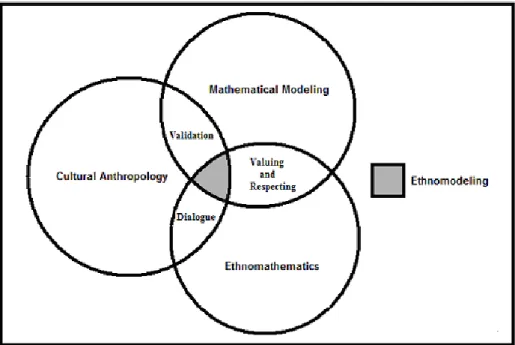
Outside of the ethnomathematics related research paradigm, it is known that many researchers, scientists, and educators search for mathematical models that can translate their deepening understanding of both real world situations and diverse cultural contexts. This enables them to seek and take possible political positions in relationship to the objects under study (Bassanezi, 2002; D’Ambrosio, 1993; Rosa & Orey, 2006). Using ethnomodeling as a tool towards pedagogical action of the ethnomathematics program, students have been shown to learn how to find and work with authentic situations and real-life problems (Rosa & Orey, 2003).
Figure 1: Ethnomodeling as an Intersection of Three Research Fields
It is also important to highlight that not all mathematical models developed by a specific cultural group can be considered as an ethnomathematical practice. In so doing, mathematical modeling is a concern that needs to be taken up thoughtfully in addition to the critique that ethnomathematics is useless. There is also the critique that ethnomathematics is a fraud because it is possible to model a given situation, while at the same time members of the specific cultural group under study may not know that kind of mathematics. This issue bears discussion because educators and researchers need to be extremely careful about avoiding both misleading claims as well as falling for misleading skepticism.
According to Eglash, Bennett, O’Donnell, Jennings, and Cintorino (2006), it is crucial to discuss “the difference between an ethnomathematical practice and the general practice of elaborating a mathematical model of a cultural phenomenon” (p.348). In this perspective, “the essential issue is the relation between intentionality and epistemological status” (p. 348). For example, Eglash et al (2006) stated that “a single drop of water issuing from a watering can, for example, can be modeled mathematically, but we would not attribute knowledge of that mathematics to the average gardener” (p. 348). On the other hand, they believe that estimating the increase in seeds required for an increased garden according to the mathematical practices transmitted through generations to the members of this specific cultural group would qualify this situation as an ethnomathematical practice.
4. Ethnomathematics and Ethnomodeling
In our opinion, ethnomodeling is a process of elaboration of problems and questions growing from real situations or systems taken from reality that forms an image or sense of an idealized version of the mathema [4]. The focus of this perspective essentially forms a critical analysis of the
generation and production of knowledge (creativity), and forms an intellectual process for its production, the social mechanisms of institutionalization of knowledge (academics), and its transmission (education). D’Ambrosio (2000) stated that “this process is modeling” (p. 142). In this regard, by analyzing their role in reality as a whole, this holistic context allows those engaged in the modeling process to study systems of reality in which there is an equal effort made by them to create an understanding of all components of the system as well as the interrelationships among them (D’Ambrosio, 1993; Bassanezi, 2002, Rosa, 2000).
The use of modeling as pedagogical action for an etnomathematics program values previous knowledge and tradtions by developing students’ capacity to assess and translate mathematical processes by elaborating models in diverse applications and contexts. In so doing, it is necessary to start with the social context, reality and interest of students and not by inforcing a set of external curricular values without context or meaning for the learner.
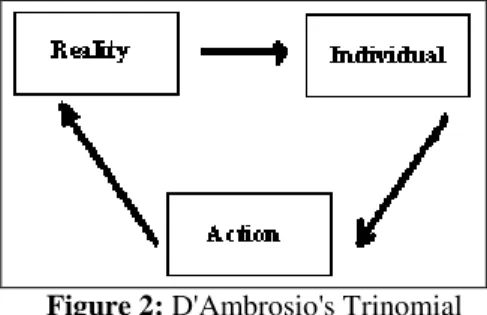
Bassanezi (2002) characterizes this process as “ethnomodeling” (p. 208), and defined ethnomathematics as “the mathematics practiced and elaborated by different cultural groups, and involves the mathematical practices that are present in diverse situations in the daily lives of members of these diverse groups” (p. 208). This interpretation is based on D’Ambrosio’s (1990) trinomial: Reality –> Individual –> Action.
Figure 2: D'Ambrosio's Trinomial
In considering ethnmodeling as a tool to uncover and study ethnomathemtics, teaching is much more than the transferance of knowledge because it becomes an activity that introduces the creation of knowledge (Freire, 1998). This approach in mathematics education is the antithesis of turning students into containers to be filled with information (Freire, 1970). In a Dambrosian Theory, it is necessary for school curriculum, to translate through ethnomodeling the interpretations and contributions of ethnomathematical knowledge into systemized mathematics because students are able to analyze the connection between both traditional and non-traditional learning settings. For example, to find the volume of the trunk of a cone can be motivated by the application of techniques learned by the ancestors of Joaquim, a wine producer in Ijuí, in the state of Rio Grande do Sul in Brazil. According to D’Ambrosio (2002), this is a beautiful example of an ethnomathematical practice and its natural encounter with mathematical modeling.
proposes an alternative epistemological approach asociated with a broad historiography. because it departs from standard practice and arrives in a far more natural way towards a pedagogical action with a cognitive focus that has strong cultural foundations. In this regard, we understand that ethnomodeling acts as an alternative methodology, which is more aligned to diverse sociocultural realities.
5. Ethnomodeling as Pedagogical Action
In the context of teaching mathematics, Orey and Rosa (2003) believed that through relevant mathematical activities, ethnomodeling, ethnomathematics, and school mathematics are mixed during this pedagogical process. However, in these activities, the emphasis in ethnomathematics is conceptual while the emphasis in modeling is performance and, they are both affected by technology (Orey & Rosa, 2003). In this context, ethnomathematics turns perceived conceptual mathematical poverty into conceptual mathematical richness. However, we believe that this process may go wrong when knowledge systems of the cultural groups under study are idealized through the lenses of academic mathematics or when the educational processes trap students in old ways of thinking. On the other hand, this process is likely to be positive provided that:
• Ethnomathematics looks forward, not backwards, that is, it is an expression of contemporary thought, not just a recording of historical, ingenuous, or exotic mathematical practices.
• Ethnomathematics assumes a sophisticated system of different mathematical ways of thinking, ideas, concepts, procedures, and practices, and not just mathematical drills and skills.
• Ethnomathematics is primarily about theory and its connection to practice.
In our point of view, if a mathematical system is actively used in the present as a system based on theories that are specific to a given cultural group and are used to solve real problems, then this process can be truly described as modeling. In such modeling, both conventional mathematics and the mathematical system of the cultural group are used. The most important aspect of this approach as ethnomathematics is not just to be able to solve problems, nor just so that people understand alternative mathematical systems, but also it is that students understand more about the role of the nature mathematics in a local cultural group as well as in a globalized society. People come to a better understanding of what they are doing when they are modeling the use of a mathematical system. In this regard, it makes more sense to ask about the relations between the mathematical system and societal context it is immersed in, and then compare them in order to look for similarities and differences between the two systems. For instance, for each mathematical world or paradigm, it is necessary to identify who possesses or controls the knowledge, to verify if the knowledge or information is valued, to understand how it is passed from generation to generation, to comprehend the functions of the knowledge system, and to identify the knowledge values in a specific cultural group.
In this context, many discussions have been raised by some researchers about the epistemology of an ethnomathematics program. Ferreira (1997) defined ethnomathematics as a methodological proposal with its own pedagogical action, which is stimulated by ethnographical studies and uses mathematical modeling as a tool to reach the educational goals of the investigated cultural group. In this regard, an ethnomodeling perspective allows educators to rethink how and what is taught, in that this perspective encourages students to recognize that there is mathematics in their daily lives, not just the mathematical concepts required by a formal and academic school curriculum (Rosa, 2010). How diverse people, despite of their formal schooling experiences, actually come to learn, measure, classify, order, organize, infer, and model important aspects of diverse modes of teaching and learning of mathematics.
students may not be able to identify their reality as contextualized mathematics. On the other hand, they have a grounded mathematical knowledge based in their previous experiences. In this educational process, perhaps teachers should not start with the students’ own realities, but start with students’ own conceptions of mathematics, even though if they are traditional. Further, teachers may be able to explore the ethnomathematical knowledge students may possess by applying contextualized mathematics activities to uncover important mathematical ideas and concepts.
We believe that it is beneficial to apply an ethnomathematical ethnographic study in order to come to a good understanding of the mathematical aspects of a giving cultural group, and having a clear purpose of this educational activity. In this perspective, the research on implementing an ethnomodeling perspective must be preceded by a full investigation on the ethnomathematics of the students because it is paramount to understand what mathematical ideas, concepts, procedures, and practices are important to their particular cultural environment. The ethnomathematical perspective must be situated clearly within the existing school curriculum and is intended to enhance the learning of mathematics (Rosa, 2000). The consequence of these ideas is that ethnomathematical work in the schools is not a simplistic presentation of cultural examples or situating mathematics in cultural contexts. Rather it requires considerable background work, complete understanding, and pedagogical sophistication. This is a complex task, takes time, and is difficult to develop an adequate pedagogical work for this kind of educational process.
6. Ethnomathematics and Curiculum
Some educators have difficulty in understanding the application of an ethnomodeling perspective in the classroom because they may not have considered that ethnomathematics is a teaching-research approach. Classroom research about ethnomathematics and its role in mathematics education is important because it is where D’Ambrosio’s (1990) vision must be implemented. In this regard, it is necessary to focus on the reasons for the application of an ethnomathematical perspective in the classroom.
In our opinion, there are three reasons for the application of ethnomodeling as a pedagogical action for the ethnomathematics program. They are:
• Ethnomodeling is an effective path to reach traditional mathematical concepts.
• Ethnomodeling is an effective way to develop intercultural classroom activities.
• Ethnomodeling is a pedagogical way to transform the relationship between mathematics and society.
Whatever the reason is, it is important to communicate its purpose and to obtain buy-in from
teachers, students, and the school community. The use of the critical education ideas of Freire (1970) is one way to achieve this approach. What follows in this pedagogical process is a critical examination of mathematical conceptions. In this regard, the aspect of teachers’ education is significant because the goal is that teachers know more about the nature of mathematics and additional pedagogical skills in order to help students undertake this critical examination. We believe that it is possible to reach this goal through ethnomodeling. However, since ethnomodeling as a pedagogical tool for teaching mathematics is a higher order task, teaching using this perspective may require professional development in the area of culture and mathematics (Rosa, 2010). In this approach it is also crucial to examine the previous knowledge of the students. This may include school knowledge as well as
curriculum took some aspects of the students’ culture and used it explicitly to integrate outside experiences into the conventional mathematics curriculum. According to Orey and Rosa (2003), students understand the nature of mathematics as they become aware of the mathematics in their own culture. In becoming aware of the mathematical ideas developed in their own cultures, students learn how to see mathematics as a human activity rather than just a set of symbols, numbers, and figures that are presented in this way only at the school environment.
Cultural mathematical practices may be related to conventional mathematical systems, and vice versa, through mathematical thinking. In this regard, Monteiro, Orey, and Domite (2004) argued that mathematical thinking involves symbolizing, generalizing, abstracting, and making logical connections, which can be facilitated by perceiving mathematics in various cultural contexts, which allows for the learning of mathematics through practical examples and investigations. According to Rosa & Orey (2006), one possible bridge could be how the connections between mathematics and the real world are realized by both the teachers and students through the mathematical examples and aspects of these approaches they choose for the pedagogical action of the process of teaching and learning of mathematics.
In this context, some ethnomathematicians often uses the term translation to describe the
process of modeling mathematical ideas, concepts, procedures, and practices of distinct cultural groups with a Western academic mathematical representation (Eglash at al, 2006; Rosa & Orey, 2007a). In some cases the translation to Western mathematics is direct and simple such as counting
systems and calendars. In other cases the mathematics may be embedded in a process such as the
iteration in bead work and the Eulerian paths in sand drawings. In this regard, “the act of translation is more like mathematical modeling” (Eglash at al, 2006, p. 348). On the other hand, Eglash at al (2006) stated that like all translation approaches, “the success is always partial, and intentionality is one of the areas in which the process is particularly tricky” (p. 348). In this respect, it is necessary to be careful when translating mathematical practices because often these practices are merely analyzed from a Western point of view. For example, some researchers apply the “symmetry classifications from crystallography to indigenous textile patterns” (Eglash et al, 2006, p. 349). In this context, we believe that ethnomathematics also makes use of modeling, yet, it attempts to use modeling to establish relations between the cultural groups’ conceptual framework and the mathematics embedded in their daily activities.
7. Final Considerations
Any study of ethnomathematics and mathematical modeling represents a powerful means for validating a student’s real life experience and gives them the necessary tools to experience at a more understandable or intuitive level and become critical participants in society. In so doing, educators should be empowered to analyze the role of what Borba (1990) refers to as a student’s ethnoknowledge
[5] in the mathematics classroom. There exists a need to create a new role to mathematics instruction that empowers students to understand power and oppression more critically by considering the effect of culture on mathematical knowledge by working with ethnomodeling to uncover the distorted and hidden history of mathematical knowledge. In our opinion, one of the most important characteristics of ethnomathematics research is to stretch the limits of what it is perceived as mathematics and its related thinking and link this aspect to what is known as academic mathematics. Thus, it is paramount that teachers use pedagogical tools such as ethnomodeling to in order to make the practical aspects of ethnomathematics from its theoretical foundations happen in the mathematics classrooms. This perspective forms the basis for the significant contributions of a Freirean-based ethnomathematical perspective in re-conceiving the discipline of mathematics and in a pedagogical practice. The use of Freire’s (1970) dialogical methodology is seen as essential in developing the curricular praxis of ethnomodeling by investigating the ethnomathematics of a culture in constructing a curriculum that enables the enrichment for all people’s knowledge of mathematics.
on this challenge and questioned whether it is possible to infer the causes for the difficult of the implementation of an ethnomodeling perspective in classrooms, it is necessary to identify if teachers are locating the problem outside the classroom. The answers may be responded to in a variety of ways, one of which may come from the teacher’s point of view of trying to observe and understand student’s own reality.
Seen in this context, we would like to broaden the discussion ofpossibilities for the inclusion of ethnomathematics and associated ethnomodeling perspectives that respect the social diversity of distinct cultural groups with guarantees for the development of understanding our differences through dialogue and respect. In our opinion, this is how ethnomathematics and ethnomodeling may empower students in this century against all kinds of domination and oppression.
Endnotes
[1] Mathematization is a process in which individuals from different cultural groups come up with different mathematical tools that can help them to organize, analyze, comprehend, understand, and solve specific problems located in the context of their real-life situation. These tools allow them to identify and describe a specific mathematical idea or practice in a general context by schematizing, formulating, and visualizing a problem in different ways, discovering relations and regularities, and transferring a real world problem to a mathematical idea through mathematization.
[2] A holistic context consists essentially of a critical analysis of the generation (creativity) of knowledge, and the intellectual process of its production. The focus on history analyzes the social mechanism and institutionalization of knowledge (academics), and its transmission through the educational process (D’Ambrosio, 1990).
[3] A system is a part of reality considered integrally. It is a set of components taken from the reality, which analyses components interrelationships between these components (D’Ambrosio, 1990).
[4] Mathema means to explain and understand the world in order to transcend, manage and cope with reality so that the members of cultural groups can survive and thrive.
[5] Ethnoknowledge is acquired by students in the pedagogical action process of learning mathematics in a culturally relevant educational system. In this process, the discussion between teachers and students about the efficiency and relevance of mathematics in different contexts should permeate instructional activities. The ethnoknowledge that students develop must be compared to their academic mathematical knowledge. In this process, the role of teachers is to help students to develop a critical view of the world by using mathematics.
References
Bandeira, F. A., & Lucena, I. C. R. (2004). Etnomatemática e práticas sociais [Ethnomathematics and social practices]. Coleção Introdução à Etnomatemática [Introduction to Ethnomathematics Collection]. Natal, RN, Brazil: UFRN.
Barbosa, J. C. (1997). O que pensam os professores sobre a modelagem matemática? [What do teachers think on mathematical modeling?]. Zetetiké, 7(11), 67-85.
Barton, B. (1996). Making sense of ethnomathematics: Ethnomathematics is making sense.
Educational Studies in Mathematics 31(1-2), 201-33.
Bassanezi, R. C. (2002). Ensino-aprendizagem com modelagem matemática [Teaching and learning
with mathematical modeling]. São Paulo, SP, Brazil: Editora Contexto.
Biembengut, M. S. (1999). Modelagem matemática e implicações no Ensino-aprendizagem de matemática [Mathematical modeling and its implications in teaching and learning mathematics].
Biembengut, M. S. (2000). Modelagem & etnomatemática: Pontos (in)comuns [Modeling &
ethnomathematics: (Un)common points]. In. Domite, M. C. (Ed.). Anais do Primeiro Congresso Brasileiro de Etnomatemática – CBEm-1. São Paulo, SP, Brazil: FE-USP, 132 -141.
Borba, M. C. (1990). Ethnomathematics and education. For the Learning of Mathematics, 10(1),
39-43.
Cross, M., & Moscardini, A. O. (1985). Learning the art of mathematical modeling. West Sussex,
England: Ellis Horwood Limited.
Crowe, D. W. (1987). Ethnomathematics Reviews. Mathematical Intelligencer, 9(2), 68-70.
D’Ambrosio, U. (1985). Ethnomathematics and its place in the history and pedagogy of mathematics.
For theLearning of Mathematics, 5(1), 44-48.
D’Ambrosio, U. (1990). Etnomatemática [Ethnomathematics]. São Paulo, SP, Brazil: Editora Ática.
D’Ambrosio, U. (1992). Ethnomathematics: A research Programme on the History and Philosophy of Mathematics with Pedagogical implications. Notices of the American Mathematics Society, 39.
1183-1185.
D’Ambrosio, U (1993). Etnomatemática: Um Programa [Ethomathematics: A program]. A Educação Matemática em Revista, 1(1), 5-11.
D’Ambrosio, U. (2000). Etnomatemática e modelagem [Ethnomathematics and modeling]. In. Domite, M. C. (Ed.). Anais do Primeiro Congresso Brasileiro de Etnomatemática – CBEm-1. São Paulo,
Brazil: FE-USP, 142.
D’Ambrosio, U. (2002). Ethnomathematics: An overview. In M. C. Domite (Ed.), Proceedings of
the Second International Congress on Ethnomathematics (ICEM2), CD Rom, Ouro Preto, MG,
Brazil: Lyrium Comunicação Ltda.
Eglash, R.; Bennett, A.; O'Donnell, C.; Jennings, S.; & Cintorino, M. (2006). Culturally situated design tools: Ethnocomputing from field site to classroom. American Anthropologist, 108(22),
347-362.
Ferreira, E. S. (1997). Etnomatemática: Uma proposta metodológica [Ethnomathematics: A
methodological proposal]. Rio de Janeiro, RJ, Brazil: MEM/USU.
Ferreira, E. S. (2004). Os índios Atroari e a etnomatemática [The indigenous people Waimiri-Atroari and ethnomathematics]. In Knijnik, G.; Wanderer, F., Oliveira. C. J. (Eds.). Etnomatemática: Currículo e Formação de Professores [Ethnomathematics: Curriculum and Teacher’s Education].
Santa Cruz do Sul, RS, Brazil: EDUNISC.
Freire, P. (1970). Pedagogia do Oprimido [Pedagogy of the Oppressed]. Rio de Janeiro, RJ, Brazil:
Paz e Terra.
Freire, P. (1998). Pedagogy of freedom: Ethics, democracy, and civic courage. New York. NY:
Rowman and Litttlefield.
Hodgson, T., & Harpster, D. (1997). Looking back in mathematical modeling: Classroom observations and instructional strategies. School Science & Mathematics, 97(5), 260-267.
Katz, V. J., Ethnomathematics in the classroom. (1994). For the Learning of Mathematics, 14(2),
Lipka, J. (2002). Schooling for self-determination: Research on the effects of including native language and culture in the schools. Charleston, WV: Clearinghouse on Rural Education and Small Schools.
Monteiro, A. (2004). Etnomatemática: papel, valor e significado [Ethnomathematics: role, value, and meaning]. In Ribeiro, J. P., Domite, M. C. S., & Ferreira, R. (Eds.). Etnomatemática: papel, valor e significado. São Paulo, SP, Brazil: Zouk.
Monteiro, A.; Orey, D. C.; & Domite, M. C. Etnomatemática: Papel, valor e significado [Ethnomathematics: Role, value, and meaning]. In J. P. M. Ribeiro, M. C. S. Domite, R. Ferreira (Eds.), Etnomatemática: Papel, valor e significado [Ethnomathematics: Role, value, and meaning] (pp. 13-37). São Paulo, SP, Brazil: ZOUK.
Orey, D. C. (2000). The ethnomathematics of the Sioux tipi and cone. In Selin, H. (Ed.). Mathematics Across Culture: the History of Non-Western Mathematics. Dordrecht, Netherlands: Kulwer Academic
Publishers, 239–252.
Orey, D. C. & Rosa, M. (2003). Vinho e queijo: Etnomatemática e modelagem! [Wine and cheese: Ethnomathematics and modeling!] BOLEMA, 16(20), 1-16.
Rios, D. P. (2000). Primero etnogeometría para seguir con etnomatemática [First ethnogeometry to follow with ethnomathematics]. In. Domite, M. C. (Ed.). Anais do Primeiro Congresso Brasileiro de Etnomatemática – CBEm-1. São Paulo, SP, Brazil: FE-USP, 367-375.
Rosa, M. (2000). From reality to mathematical modeling: A Proposal for using ethnomathematical knowledge. Unpublished master thesis. College of Education. Department of Teacher Education.
California State University, Sacramento.
Rosa, M. (2010). A mixed-methods study to understand the perceptions of high school leaders about English Language Learners (ELL) students: The case of mathematics. Unpublished doctorate
dissertation. College of Education. Doctorate in Educational Leadership Program. California State University, Sacramento.
Rosa, M., & Orey, D. C. (2006). Abordagens atuais do programa etnomatemática: delinenando-se um caminho para a ação pedagógica [Current approaches in ethnomathematics as a program: Delineating a path towards pedagogical action]. Bolema, 19(26), 19-48.
Rosa, M., & Orey, D. C. (2007a). Cultural assertions and challenges towards pedagogical action of an ethnomathematics program. For the Learning of Mathematics, 27(1), 10-16.
Rosa, M., & Orey D. C. (2007b). Etnomatemática: um enfoque histórico-antropológico
[Ethnomathematics: A historical-anthropological approach].
Revista de Educação
Matemática
,
10
(11, 12), 29-34.
Rosa, M., & Orey, D. C. (2008). Ethnomathematics and cultural representations: Teaching in highly diverse contexts. Acta Scientiae - ULBRA, 10, 27-46.
Zaslavsky, C. (1996). The multicultural math classroom: Bringing in the world. Portsmouth, ME: