Phylogenetic analysis of the order Pleuronectiformes (Teleostei)
based on sequences of 12S and 16S mitochondrial genes
Marisa F.C. Azevedo
1*, Claudio Oliveira
1, Belén G. Pardo
2, Paulino Martínez
2and Fausto Foresti
11
Laboratório de Biologia e Genética de Peixes, Instituto de Biociências,
Universidade Estadual Paulista, Botucatu, SP, Brazil.
2
Laboratorio de Genética, Faculdade de Veterinaria, Universidad de Santiago de Compostela, Lugo, Spain.
Abstract
The fish order Pleuronectiformes, composed of 14 families, has two suborders: Psettodoidei (with one family) and Pleuronectoidei (with thirteen families). The relationships among families of Pleuronectoidei and among the genera of their families have extensively been debated and a consensus has not yet been reached. In the present study, par-tial sequences of the 12S and 16S mitochondrial rRNA genes were obtained from 19 species belonging to the fami-lies Achiridae, Bothidae, Cynoglossidae, Paralichthyidae, Pleuronectidae, Scophthalmidae, and Soleidae. Additional sequences of 42 pleuronectiform species were obtained from GenBank. Phylogenetic analyses were con-ducted by the methods of maximum-parsimony, maximum-likelihood and Bayesian inference. Our results corrobo-rate the monophyletic status of all families, excluding Paralichthyidae. In the family Achiridae, the genus Catathyridium (freshwater) was the sister group of Trinectes (saltwater), and Hypoclinemus (freshwater) was the sis-ter group ofAchirus (saltwater). Assuming that the putative ancestor of achirids lived in saltwater, it is suggested that the freshwater habitats in South America were colonized independently by different achirid lineages.
Key words:phylogeny, molecular systematics, mitochondrial DNA, fish evolution, flatfishes.
Received: September 11, 2006; Accepted: May 14, 2007.
Introduction
Flatfishes of the Pleuronectiformes order are easily recognized because the adults are not bilaterally symmetri-cal (Nelson, 2006). Young flatfishes are bilaterally sym-metrical and swim upright, but early in their development one eye migrates across the top of the skull to lie adjacent to the eye on the other side (Ahlstromet al., 1984). Most spe-cies have both eyes on the right side and lie on the left side (dextral) but some suffer an opposite development (si-nistral) (Nelson, 2006). In some species, such as
Platichthys stellatus, both dextral and sinistral individuals may occur and this difference appears to be largely under genetic control (Policansky, 1982). However, there appears to be no convincing arguments for a direct adaptive advan-tage for being sinistral or dextral (Nelson, 2006). Many flatfish species have great economical importance, mainly due to the quality of their meat, and have been extensively exploited (Cerqueiraet al., 1997).
Regan (1910, cited by Ramos, 1998) proposed the first morphological classification for the order then named Heterostomata. The author considered the group as mono-phyletic and divided it in two putative monomono-phyletic subor-ders, Psettodoidei and Pleuronectoidei. Currently, the main classification of the order is still based on morphological characters. However, the monophyletic nature of several families has been extensively debated (Chapleau, 1993; Chapleau and Keast, 1988; Chanet, 1997; Fukui, 1997; Hensley, 1997; Cooper and Chapleau, 1998; Berendzen and Dimmick, 2002; Pardoet al., 2005).
The most recent and extensive phylogenetic study of Pleuronectiformes using morphological data was done by Chapleau (1993). According to this author, Psettodidae is the most primitive family, while Cynoglossidae and Soleidae are the most derived. Citharidae, Scophthalmidae, Paralichthyidae, Bothidae, Pleuronectidae, and Achiridae are considered intermediary families. According to the classification proposed by Nelson (2006), mainly based on the studies of Chapleau (1993), Cooper and Chapleau (1998) and Hoshino (2001), the order has 14 families. Psettodidae is the only family of the suborder Psettodoidei and the remaining families belong to the suborder Pleuronectoidei.
Send correspondence to Marisa Fagundes Carvalho de Azevedo. Nú-cleo em Ecologia e Desenvolvimento Sócio-Ambiental de Macaé, Universidade Federal do Rio de Janeiro, NUPEM/UFRJ, Caixa Postal 119331, 27910-970 Macaé, RJ, Brazil. E-mail: [email protected]. *Present address: Núcleo em Ecologia e Desenvolvimento Sócio-Ambiental de Macaé, Universidade Federal do Rio de Janeiro, Ma-caé, RJ, Brazil.
The first molecular study conducted on Pleuronec-tiformes by Tintiet al. (1999) reinforced the previously proposed relationships based on morphological characters, but only nine species were investigated. Pardoet al.(2005), analyzed fragments of about 650 base pairs (bp) of the 16S mtDNA gene of 30 species, and Berendzen and Dimmick (2002) analyzed DNA sequences of about 1200 bp of the 12S and 16S mtDNA genes of 44 species. These analyses resulted in well-resolved phylogenies at species and genus levels. However, the relationship among families remained unresolved.
Most species of flatfishes live in saltwater or brackish water, but some are also found in freshwater (Nelson, 2006). Among the few freshwater species those of the fam-ily Achiridae are encountered in Brazil. Achirids are mainly shore fishes restricted to both sides of Americas (Ramos, 2003a). According to Ramos (1998), the most primitive achirid species are freshwater species of the gen-eraHypoclinemusandCatathyridium. In the present study,
partial sequences of the mitochondrial genes 12S and 16S of mtDNA of 19 species belonging to seven families of Pleuronectiformes were determined with the aim of investi-gating the monophyletic nature of the recognized families, mainly that of the South America achirids.
Materials and Methods
Tissue samples
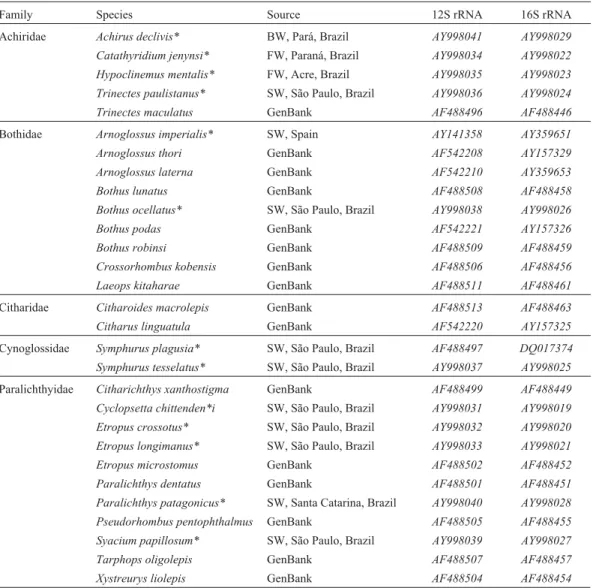
Tissue samples were obtained from specimens of 19 species of Pleuronectiformes belonging to the families Achiridae, Bothidae, Cynoglossidae, Paralichthyidae, Pleuronectidae, Scophthalmidae, and Soleidae. Species names and sampling sites are shown in Table 1. Additional sequences of 42 pleuronectiform species were retrieved from GenBank (Table 1). The single species of Psettodidae (Psettodes erumei) was used as outgroup, following the re-sults by Chapleau (1993) who demonstrated that this is the most primitive family among Pleuronectiformes.
Table 1- Specimens analyzed in the present study and respective GenBank access numbers. FW = freshwater; BW = brackish water; SW = salt water. As-terisks show the species sequenced in the present study.
Family Species Source 12S rRNA 16S rRNA
Achiridae Achirus declivis* BW, Pará, Brazil AY998041 AY998029 Catathyridium jenynsi* FW, Paraná, Brazil AY998034 AY998022
Hypoclinemus mentalis* FW, Acre, Brazil AY998035 AY998023
Trinectes paulistanus* SW, São Paulo, Brazil AY998036 AY998024
Trinectes maculatus GenBank AF488496 AF488446
Bothidae Arnoglossus imperialis* SW, Spain AY141358 AY359651
Arnoglossus thori GenBank AF542208 AY157329
Arnoglossus laterna GenBank AF542210 AY359653
Bothus lunatus GenBank AF488508 AF488458
Bothus ocellatus* SW, São Paulo, Brazil AY998038 AY998026
Bothus podas GenBank AF542221 AY157326
Bothus robinsi GenBank AF488509 AF488459
Crossorhombus kobensis GenBank AF488506 AF488456
Laeops kitaharae GenBank AF488511 AF488461
Citharidae Citharoides macrolepis GenBank AF488513 AF488463
Citharus linguatula GenBank AF542220 AY157325
Cynoglossidae Symphurus plagusia* SW, São Paulo, Brazil AF488497 DQ017374 Symphurus tesselatus* SW, São Paulo, Brazil AY998037 AY998025
Paralichthyidae Citharichthys xanthostigma GenBank AF488499 AF488449 Cyclopsetta chittenden*i SW, São Paulo, Brazil AY998031 AY998019 Etropus crossotus* SW, São Paulo, Brazil AY998032 AY998020 Etropus longimanus* SW, São Paulo, Brazil AY998033 AY998021
Etropus microstomus GenBank AF488502 AF488452
Paralichthys dentatus GenBank AF488501 AF488451
Paralichthys patagonicus* SW, Santa Catarina, Brazil AY998040 AY998028
Pseudorhombus pentophthalmus GenBank AF488505 AF488455
Syacium papillosum* SW, São Paulo, Brazil AY998039 AY998027
Tarphops oligolepis GenBank AF488507 AF488457
DNA extraction and sequencing
Total DNA was extracted from ethanol-preserved liver or muscle tissue with the Wizard Genomic DNA Puri-fication Kit (Promega). Partial sequences of the mitochon-drial genes 12S and 16S rRNA were amplified by the polymerase chain reaction (PCR) with the following prim-ers: L1091 and H1478 (Kocheret al., 1989) for the gene 12S rRNA, and 16Sa-L and 16Sb-H (Palumbiet al., 1991) for the gene 16S rRNA. Primer concentrations were 5µM.
Amplifications were performed in a total volume of 25µL
for 35 cycles (30 s at 95 °C, 60 s at 50-60 °C, and 120 s at 72 °C). The PCR products were visualized on a 1% agarose gel. The amplified segments were extracted from the gel with the kit GFX PCR DNA and Gel Purification (GE Healthcare). Sequencing reactions were performed with the
kit Big Dye Terminator v3.1 Cycle Sequencing Ready Re-action (Applied Biosystems) and analyzed in an automated sequencer ABI Prism 377 DNA Sequencer (Applied Bio-systems). Some sequencing reactions were done with the kit Thermo Sequenase fluorescent labeled primer cycle se-quencing kit with 7-deaza-dGTP (Amersham Biosciences) and analyzed in an automated sequencer model ALF Ex-press II (Amersham Biosciences). All sequences were read at least two times (forward and reverse).
Sequence analyses and phylogenetic approaches
Individual sequences of each species were initially analyzed with the software DAMBE (Xia and Xie, 2001) and a consensus sequence was obtained for each DNA seg-ment of each species. After that, all sequences were aligned
Table 1 (cont.)
Family Species Source 12S rRNA 16S rRNA
Pleuronectidae Eopsetta jordani GenBank AF488476 AF488426
Glyptocephalus zachirus GenBank AF488486 AF488436
Hippoglossus stenolepis GenBank AF488483 AF488433
Isopsetta isolepis GenBank AF488481 AF488431
Lepidopsetta bilineata GenBank AF488479 AF488429
Limanda aspera GenBank AF488491 AF488441
Lyopsetta exilis GenBank AF488484 AF488434
Microstomus bathybius GenBank AF488490 AF488440
Microstomus pacificus GenBank AF488480 AF488430
Parophrys vetula GenBank AF488488 AF488438
Platichthys flesus* SW, Spain AF542206 AY359670
Platichthys stellatus GenBank AF488482 AF488432
Pleuronectes platessa GenBank AF542207 AY157328
Pleuronichthys guttulatus GenBank AF488487 AF488437
Pleuronichthys verticalis GenBank AF488489 AF488439
Psettichthys melanostictus GenBank AF488485 AF488435
Pseudopleuronectes americanus GenBank AF488478 AF488428
Psettodidae Psettodes erumei GenBank AF488518 AF488468
Samaridae Samariscus xenicus GenBank AF488517 AF488467
Plagiopsetta glossa GenBank AF488516 AF488466
Scophthalmidae Lepidorhombus wiffiagonis* SW, Spain AY998042 AY998030
Scophthalmus aquosus GenBank AF488512 AF420449
Scophthalmus maximus* SW, Spain AY998043 AY998019
Scophthalmus rhombus* SW, Spain AY998044 AY998020
Soleidae Aseraggodes kobensis GenBank AF488493 AF488443
Dicologlossa cuneata* SW, Spain AF542211 AY359660
Heteromycteris japonicus GenBank AF488494 AF488444
Microchirus azevia GenBank AF542216 AY157318
Microchirus ocellatus GenBank AF542218 AF112850
Microchirus variegatus GenBank AY141359 AF112851
Monochirus hispidus GenBank AF542219 AF112852
Solea solea GenBank AF488492 AF112845
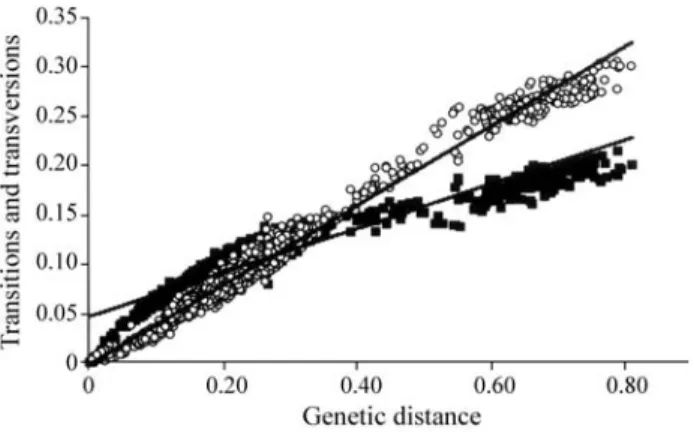
with the software Clustal W, implemented in DAMBE (Xia and Xie, 2001). Nucleotide variation, substitution patterns and genetic distances were examined using MEGA 2.1 (Kumaret al., 2001). Nucleotide saturation was analyzed by plotting the absolute number of transitions (Ti) and transversions (Tv) against genetic distance values in the software DAMBE (Xia and Xie, 2001).
Maximum-parsimony (MP) based phylogenetic anal-yses were performed using the software PAUP* beta ver-sion 4.0b10 (Swofford, 2002) with heuristic searches using random addition of sequences and the tree bisection and reconnection (TBR) algorithm. In all analyses, the charac-ter-state optimization method employed was the acceler-ated transformation (ACCTRAN). Parsimony trees were generated using Ti/Tv ratios of 1:1 and 1:2, considering gaps as missing data or as a fifth base. Bootstrap resampling (Felsenstein, 1985) was applied to assess support for indi-vidual nodes using 1000 replicates with random additions and TBR branch swapping.
Genetic distances among sequences were estimated by the Hasegawa-Kishino-Yano (HKY85) nucleotide substitu-tion model (Hasegawaet al., 1985), incorporating the pro-portion of invariant sites and among-site rate heterogeneity based on a hierarchical hypothesis test of alternative models implemented in the program Modeltest 3.7 (Posada and Crandall, 1998). The Bayesian-inference method of phylo-genetic analysis (Huelsenbecket al., 2001) was used to eval-uate alternative tree topologies through the estimation of posterior probabilities using MrBayes v. 3.0 (Ronquist and Huelsenbeck, 2003). The MrBayes analysis ran four chains simultaneously, each for 1 million generations. Every 100th generation was sampled and the asymptote of the likelihood score was detected with the SUMP command. All sampled topologies beneath the asymptote were discarded from the population of trees considered in the subsequent major-ity-rule consensus. The frequency with which a particular clade appeared in the population of retained topologies was interpreted as its posterior probability. Posterior probabilities were interpreted as a measure of how likely the clade appears in the optimal topology, rather than accuracy of the node with respect to species relationships or clade stability. Con-sensus trees were produced with the software TreeExplorer implemented in MEGA 2.1 (Kumaret al., 2001).
Maximum likelihood (ML) phylogenetic analyses were performed using the software PHYML (Guindon and Gascuel, 2003) in its website version (Guindonet al., 2005) using the Hasegawa-Kishino-Yano (HKY85) nucleotide substitution model (Hasegawaet al., 1985). Clade stability was estimated by non-parametric bootstrapping in 500 rep-licates with PHYML.
Results
Sequences obtained for this study have been deposited in GenBank (accession numbers AY998019 -AY998044) (Table 1).
The combined sequence data of the 61 flatfish taxa re-sulted in 1428 bp, of which 314 were conserved sites and 981 were parsimony informative. The transition/transver-sion (Ti/Tv) ratio observed was 0.9. Percent base composi-tion for sequenced regions of the L-strand was determined as follows: adenine (A) 29.4; cytosine (C) 26.1; guanine (G) 22.3; and thymine (T) 22.2. The analysis of these data clearly shows that the base composition of the L-strand is somewhat A-rich, similar to that described for several mito-chondrial genes of fishes (Alves-Gomeset al., 1995; Shi-mabukuro-Diaset al., 2004), lizards (Reeder, 1995), and snakes (Parkinson, 1999). The results from the analysis of plotting transitions and transversions against genetic dis-tance suggest the occurrence of low nucleotide saturation (Figure 1).
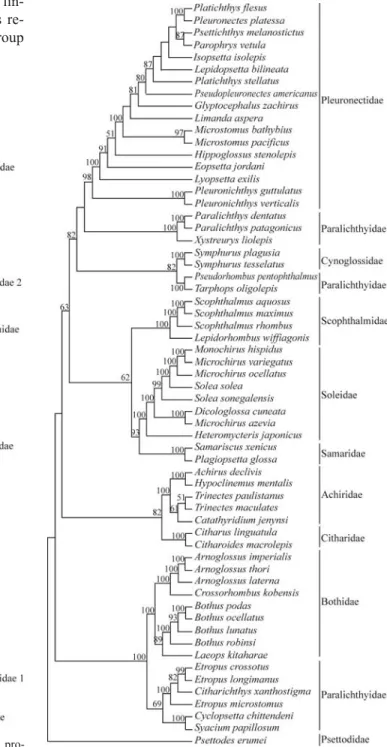
Initially, a total of eight MP heuristic searches were conducted employing all data or excluding 179 characters belonging to six segments with alignment problems, in-cluding or exin-cluding gaps, and considering the Ti/Tv ratios of 1:1 or 1:2. The resultant phylogenies were largely con-gruent. The best resolved MP consensus tree obtained from the analysis of 1000 bootstrap replicates including all posi-tions, treating gaps as missing data, and the Ti/Tv ratio of 1:1 is presented in Figure 2. For this tree, the results ob-tained were: tree length = 4332, consistency index (CI) = 0.4084, homoplasy index (HI) = 0.5916 and reten-tion index (RI) = 0.6259.
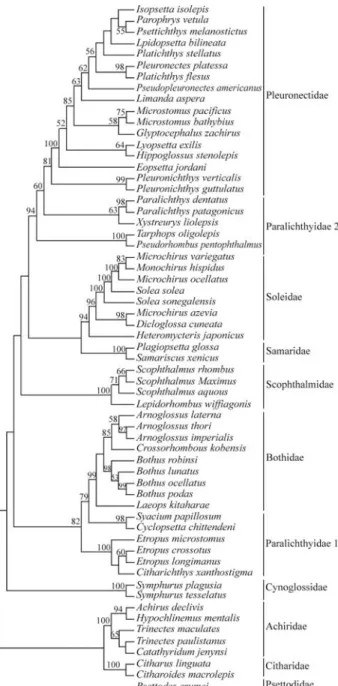
Phylogenetic analyses with the Bayesian method re-sulted in a similar tree with the nodes supported by values usually higher than those found in MP analysis (Figure 3). The phylogeny obtained with the ML method was similar to that obtained with the MP method (Figure 4) but some families were differently positioned.
Discussion
Considering Psettodidae as sister group of all other pleuronectiforms (Chapleau, 1993), all remaining families investigated in our study appeared as monophyletic (with the exception of Paralichthyidae) and were supported by
high bootstrap and posterior probability values. However, the data obtained did not resolve the relationship among several families, as already observed in previous studies employing 12S and 16S rRNA sequences (Berendzen and Dimmick, 2002; Pardoet al., 2005).
Paralichthyidae with about 16 genera and 105 species (Nelson, 2006), has been recognized as a paraphyletic group (Hensley and Ahlstrom, 1984; Chapleau, 1993; Par-do et al., 2005; Berendzen and Dimmick, 2002). In the present study, the analysis of specimens from eight genera showed that they belong to two or three independent lin-eages. The group identified as Paralichthyidae 1 was re-lated to Bothidae in all analyses (Figures 2 to 4). The group
identified as Paralichthyidae 2 in the MP and ML analyses appeared as polyphyletic (Figures 2 and 4), as also ob-served in the Bayesian analysis (Figure 3). The first group (Paralichthyidae 1), composed by the generaCyclopsetta,
Syacium,Citharichthys, andEtropuswas previously recog-nized by Chapleau (1993) as a natural group (named
Cyclopsettagroup) sharing a urinary papilla oriented to-wards the blind size, an ocular pelvic fin based on the mid-ventral line of the body, a blind size pelvic-fin base
an-Figure 2- Pleuronectiforms consensus maximum-parsimony tree pro-duced when gaps were treated as missing data and the Ti/Tv ratio of 1:1 (TL = 4332, CI = 0.4084, HI = 0.5916, RI = 0.6259). Numbers above branches are bootstrap values based on 1000 replicates. Values below 50% are not shown.
terior to that of the ocular side, a caudal fin with 17 rays, none of which are supported by preural, neural or hemal spines, and hypural 5 fused with the epural. A molecular re-lationship amongSyacium,Citharichthys, andEtropuswas also established by Berendzen and Dimmick (2002).
Hensley and Ahlstrom (1984) indicated a possible close relationship for the Cyclopsetta group with the bothids on the basis of the absence of a first neural spine and the presence of vertebral apophyses. A possible rela-tionship between the bothids and the Cyclopsetta group was also pointed out in the present study and in other mo-lecular studies (Berendzen and Dimmick, 2002; Pardoet al., 2005). The genusEtropuswas found to be paraphyletic,
with the species E. microstomusrelated to Citharichthys xanthostigma. Interestingly, the speciesE. microstomusis distributed from New Jersey to North Carolina and C. xanthostigmais found in Magdalena Bay, Baja California, Mexico, while the speciesE. crossotusandE. longimanus
are found across the Atlantic Ocean coasts of South Amer-ica (Eschmeyer, 1998).
The Paralichthyidae 2 group appeared here as a para-phyletic group composed of two units (independently iden-tified in the Bayesian analysis). One of these lineages with a 100% support included the genera Pseudorhombus and
Tarphops as observed also by Berendzen and Dimmick (2002). These two genera plus the genus Cephalopsetta
were recognized by Chapleau (1993) as the
Pseudorhombus group, a possible monophyletic lineage among paralichthyids. The third monophyletic lineage found in the Paralichthyidae was composed of the genera
Paralichthys and Xystreurys. Some morphological evi-dence of monophyly had been observed for these genera and the remained paralichthyids (Chapleau, 1993), but pre-vious molecular studies (Berendzen and Dimmick, 2002) also corroborated the hypothesis that these groups belong to a monophyletic clade.
The families Citharidae, Cynoglossidae, Samaridae, and Scophthalmidae were represented by a reduced number of species in the present study, in spite of this, they were found to be monophyletic in all analyses. The family Citharidae with five genera and six species (Nelson, 2006) was represented in this study by two genera,Citharusand
Citharoides.These two genera comprise sinistral species and appeared as monophyletic in all analyses realized. However, this family was described previously as a polyphyletic group (Hensley and Ahlstrom, 1984; Chapleau, 1993; Hoshino and Amaoka, 1998; Berendzen and Dimmick, 2002).
The family Cynoglossidae comprises three genera and 127 species (Nelson, 2006). In the present study, the two species of the genusSymphurusappeared as a mono-phyletic group. The monophyly of Cynoglossidae had al-ready been proposed by several authors (Hensley and Ahlstrom, 1984; Chapleau, 1993; Hoshino and Amaoka, 1998; Berendzen and Dimmick, 2002; Pardoet al., 2005).
The family Samaridae comprises three genera and about 20 species (Nelson, 2006). The monophyly of Sama-rinae was proposed by Sakamoto (1984) and confirmed by Chapleau (1993). These results permitted to raise the sub-family Samarinae to the sub-family level by Nelson (2006). In the present study, the two genera analyzed, Plagiopsetta
andSamariscus, appeared as belonging to a monophyletic group. Previous molecular studies also corroborated the monophyly of this family (Berendzen and Dimmick, 2002; Pardoet al., 2005).
The family Scophthalmidae comprises four genera and about eight species (Nelson, 2006). In the present study, four species belonging to two genera were analyzed.
The monophyly of Scophthalmidae as well as of the genus
Scophthalmuswas observed in all conducted analyses. This family has been recognized as monophyletic by several au-thors (Hensley and Ahlstrom, 1984; Chapleau, 1993; Ho-shino and Amaoka, 1998; Berendzen and Dimmick, 2002; Pardoet al., 2005).
The family Soleidae is represented here by six of its 35 genera (Nelson, 2006). This family was found to be monophyletic with a high posterior probability in the Baye-sian analysis. The monophyly of Soleidae previously pro-posed by Desoutter and Chapleau (1997) was corroborated by Pardoet al.(2005), although controversial data was re-ported by Berendzen and Dimmick (2002). Although the relationships among the genera were well supported, the species phylogeny suggested that the genera Solea and
Microchirusare not monophyletic.
The family Bothidae has 20 genera and about 140 species (Nelson, 2006). The four genera analyzed in the present study appeared as a monophyletic group. The monophyletic nature of Bothidae was proposed by Hensley and Ahlstrom (1984) and Chapleau (1993) and corrobo-rated in an extensive study conduced by Fukui (1997), where the author listed five synapormophies for the family.
The family Pleuronectidae is one of the largest families of flatfishes. This family was formerly split into the subfamilies Pleuronectinae, Poecilopsettinae, Rhombosolei-nae and SamariRhombosolei-nae but phylogenetic studies reviewed by Chapleau (1993) showed that these groups did not formed a monophyletic assemblage and should be ranked at family level. Thus, in a more recent phylogenetic study Cooper and Chapleau (1998) recognized that the name Pleuronectidae should only be employed for the species of the old subfamily Pleuronectinae, as followed here. Based on their revision, Cooper and Chapleau (1998) showed that the family Pleuronectidae is a monophyletic group defined by ten synapomorphies. The present results, based on 14 out of the 23 currently recognized genera of Pleuronectidae, confirm the monophyly of the group as suggested in previous molec-ular studies (Berendzen and Dimmick, 2002; Pardoet al., 2005). However, the division of this family into subgroups should be reevaluated. The first division proposed by Li (1981) was completely refuted since members of its tribes Hippoglossini and Pleuronectini did not form monophyletic groups. The Cooper and Chapleau (1998) proposal was par-tially corroborated. Thus, the monophyly of the subfamily Eopsettinae, as well as of the tribe Isopsettini were corrobo-rated, but the remaining divisions were not. Additional mo-lecular data are necessary for a better understanding of the relationships among pleuronectids.
The family Achiridae has seven genera and about 33 species (Ramos, 2003b, Nelson, 2006). The monophyly of the family was proposed by Chapleau and Keast (1988), and Chapleau (1993), and corroborated in an extensive re-vision conducted by Ramos (1998). In the present study, the analysis of four genera showed that they belong to a
monophyletic group. The genusCatathyridium(freshwater species) appeared as the sister group ofTrinectes(marine species) and the genusHypoclinemus(freshwater species) as the sister group ofAchirus(marine species). This hy-pothesis is different from that presented by Ramos (1998). This author found thatHypoclinemus andCatathyridium
were primitive sister groups to all other achirids and pro-posed that this family could have originated in freshwater. Based only on our data for the family Achiridae it is not possible to decide whether this family originated in marine or freshwater environments. However, considering that the sister groups of Achiridae are families found exclusively in saltwater, the most parsimonious hypothesis is that the achirid freshwater species of the generaHypoclinemusand
Catathyridium derived directly and independently from saltwater ancestors. The genetic divergence, estimated by the HKY85 model (Hasegawaet al., 1985) between the generaCatathyridiumandTrinecteswas only 7.45% and between the generaHypoclinemusandAchirusit was only 5.4%, supporting a recent origin of these genera. The achirid consensus MP tree (Figure 2) and the tree satisfying the alternative hypotheses that freshwater species were sis-ter-groups were tested using the Wilcoxon signed-rank test (Templeton, 1983) and the maximum-likelihood ratio test (Kishino and Hasegawa, 1989) implemented in PAUP*. Both tests rejected the null hypothesis that the alternative phylogenies were not statistically different (Templeton test z = -3.6556, p = 0.0003; Kishino - Hasegawa test t = 3.6826, p = 0.0002) reinforcing the hypothesis that freshwater spe-cies originated from different marine ancestors.
The present analyses corroborated the monophyletic status of most families of flatfish: Scophthalmidae, Pleuro-nectidae, Samaridae, Cynoglossidae, Achiridae, Cithari-dae, and BothiCithari-dae, but excluding the family Paralichthyi-dae which was shown to be polyphyletic. The polyphyletic origin of freshwater species suggests independent coloniza-tion events of continental waters by members of the family Achiridae. Future analyses of additional species and mainly on larger genomic regions will be necessary for a better un-derstanding of the relationships among flatfish groups, es-pecially with respect to interfamilial relationships.
Acknowledgments
The authors are grateful to Renato Devidé for his technical assistance, to Robson T. C. Ramos and Guaracy Tadeu Rocha for a critical reading of the manuscript and to Naércio A. Menezes, José Lima Figueiredo and Robson T. C. Ramos for identifying specimens. Funds supporting this study were provided by CNPq, CAUNESP and FAPESP, and Universidad de Santiago de Compostela.
References
Richards WJ, Cohen DM, Fahay MP, Kendall AW and Richardson SL (eds) Ontogeny and Systematic of Fishes. Special Publication n. 1. American Society of Ichthyology and Herpertology, Lawrence, pp 640-670.
Alves-Gomes J, Ortí G, Haygood M, Heiligenberg W and Meyer A (1995) Phylogenetic analysis of the South American elec-tric fishes (Order Gymnotiformes) and the evolution of their electrogenic system: A synthesis based on morphology, electrophysiology, and mitochondrial sequence data. Mol Biol Evol 12:298-318.
Berendzen PB and Dimmick WW (2002) Phylogenetic relation-ships of Pleuronectiformes based on molecular evidence. Copeia 2002:642-652.
Cerqueira VR, Mioso R, Macchiavello JAG and Berger AM (1997) Ensaios de indução de desova do linguado (Paralichthys orbignyanus Valenciennes, 1839). Bol Inst Pesca 24:247-254.
Chanet B (1997) A cladistic reappraisal of the fossil flatfish’s re-cord consequences on the phylogeny of the Pleuronecti-formes (Osteichthyes, Teleostei). Ann Sci Nat 18:105-117. Chapleau F (1993) Pleuronectiform relationships: A cladistic
re-assessment. Bull Mar Sci 52:516-540.
Chapleau F and Keast A (1988) A phylogenetic reassessment of the monophyletic status of the family Soleidae, with notes on the suborder Soleoidei. Can J Zool 66:2797-2810. Cooper JA and Chapleau F (1998) Phylogenetic status of
Paralichthodes algoensis(Pleuronectiformes, Paralichthyi-dae). Copeia 1998:477-481.
Desoutter M and Chapleau F (1997) Taxonomic status of
Bathysolea profundicolaandB. polli(Soleidae, Pleuronec-tiformes) with notes on the genus. Ichthyol Res 44:399-412. Eschmeyer WN (1998) Catalog of Fishes. California Academy of
Sciences, San Francisco, 2905 pp.
Felsenstein J (1985) Confidence limits on phylogenies: An ap-proach using the bootstrap. Evolution 39:783-791. Fukui A (1997) Early ontogeny and systematics of Bothidae,
Pleuronectoidei. Bull Mar Sci 60:192-212.
Guindon S and Gascuel O (2003) A simple, fast, and accurate al-gorithm to estimate large phylogenies by maximum likeli-hood. Sys Biol 52:696-704.
Guindon S, Lethiec F, Duroux P and Gascuel O (2005) PHYML Online - A web server for fast maximum likelihood-based phylogenetic inference. Nucleic Acids Res 33:557-559. Hasegawa M, Kishino H and Yano T (1985) Dating of the
hu-man-ape splitting by a molecular clock of mitochondrial DNA. J Mol Evol 22:160-174.
Hensley DA (1997) An overview of the systematics and biogeo-graphy of the flatfishes. J Sea Res 37:187-194.
Hensley DA and Ahlstrom EH (1984) Pleuronectiformes: Rela-tionships. Pleuronectiformes: Development. In: Moser HG, Richards WJ, Cohen DM, Fahay MP, Kendall AW and Richardson SL (eds) Ontogeny and Systematic of Fishes. Special Publication n. 1. American Society of Ichthyology and Herpertology, Lawrence, pp 670-687.
Hoshino K and Amaoka K (1998) Osteology of the flounder,
Tephrinectes sinensis (Lacepède) (Teleostei, Pleuronecti-formes), with comments on its relationships. Ichthyol Res 45:69-77.
Huelsenbeck JP, Ronquist F, Nielsen R and Bollback JP (2001) Bayesian inference of phylogeny and its impact of evolu-tionary biology. Science 294:2310-2314.
Kishino H and Hasegawa M (1989) Evaluation of the maximum likelihood estimate of the evolutionary tree topologies from DNA sequence data, and the branching order in Homi-noidea. J Mol Evol 29:170-179.
Kocher TD, Thomas WK, Meyer A, Edwards SV, Pääbo S, Villablanca FX and Wilson AC (1989) Dynamics of mito-chondrial DNA evolution in animals: Amplification and se-quencing with conserved primers. Proc Natl Acad Sci USA 86:6196-6200.
Kumar S, Tamura K, Jakobsen I and Nei M (2001) MEGA: Mo-lecular evolutionary genetic analysis, v. 2.1. Pennsylvania State University, University Park, and Arizona State Univer-sity, Tempe.
Li SZ (1981) On the origin, phylogeny and geographical distribu-tion of the flatfishes (Pleuronectiformes). Trans Chin Ich-thyol Soc 1981:11-20.
Nelson JS (2006) Fishes of the World. 4thed. Wiley, New York, 601 pp.
Palumbi S, Martin A, Romano S, McMillan WO, Stice L and Grabowski G (1991) The Simple Fool’s Guide do PCR, v. 2.0. University of Hawaii, Honolulu, 43 pp.
Pardo BG, Machordom A, Foresti F, Porto-Foresti F, Azevedo MFC, Bañon R, Sánchez L and Martinez P (2005) Phylo-genetic analysis of flatfishes (order Pleuronectiformes) based on mitochondrial 16S rDNA sequences. Sci Mar 69:531-543.
Parkinson CL (1999) Molecular systematics and biogeographical history of Pitvipers as determined by mitochondrial ribo-somal DNA sequences. Copeia 1999:576-586.
Policansky D (1982) The asymmetry of flounders. Sci Am 246:116-122.
Posada D and Crandall KA (1998) Modeltest: Testing the model of DNA substitution. Bioinformatics 14:817-818.
Ramos RTC (1998) Estudo filogenético da família Achiridae (Teleostei, Pleuronectiformes, Pleuronectoidei), com a revi-são das formas de água doce da América do Sul Cis-Andina e a reavaliação do monofiletismo de Soleomorpha (“So-leidae”). PhD. Thesis, Museu de Zoologia da Universidade de São Paulo, São Paulo.
Ramos RTC (2003a) Family Achiridae. In: Reis RE, Kullander SO and Ferraris Jr CJ (eds) Checklist of the freshwater fishes of South and Central America. Edipucrs, Porto Alegre, pp 606-669.
Ramos RTC (2003b) Systematic review of Apionichthys
(Pleuronectiformes, Achiridae), winth description of four new species. Ichthyol Explor Freshwaters 14:97-126. Reeder TW (1995) Phylogenetic relationships among
phryno-somatid lizards as inferred from mitochondrial ribosomal DNA sequences: Substitutional bias and information con-tent of transitions relative to transversions. Mol Phylogenet Evol 4:203-222.
Ronquist F and Huelsenbeck JP (2003) MrBayes 3: Bayesian phylogenetic inference under mixed models. Bioinformatics 19:1572-1574.
Sakamoto K (1984) Interrelationships of the family Pleuronec-tidae (Pisces, Pleuronectiformes). Mem Fac Fish Hokkaido Univ 31:95-215.
Swofford DL (2002) PAUP* - Phylogenetic analysis using parsi-mony (*and other methods), v. 4b10. Sinauer, Sunderland. Templeton AR (1983) Phylogenetic inference from restriction
endonuclease cleavage site maps with particular reference to the humans and apes. Evolution 37:221-244.
Tinti F, Colombari A, Vallisneri M, Piccinetti C and Stagni AM (1999) Comparative analysis of a mitochondrial DNA
con-trol region fragment amplified from three Adriatic flatfish species and molecular phylogenesis of Pleuronectiformes. Mar Biotech 1:20-24.
Xia X and Xie Z (2001) DAMBE: Data analysis in molecular biol-ogy and evolution. J Heredity 92:371-373.
Associate Editor: Maria Iracilda Sampaio